11-53
11-42 (30 min.) Dropping a product line, selling more tours
Mechum River Anglers, a division of Old Dominion Travel, offers two types of guided fly
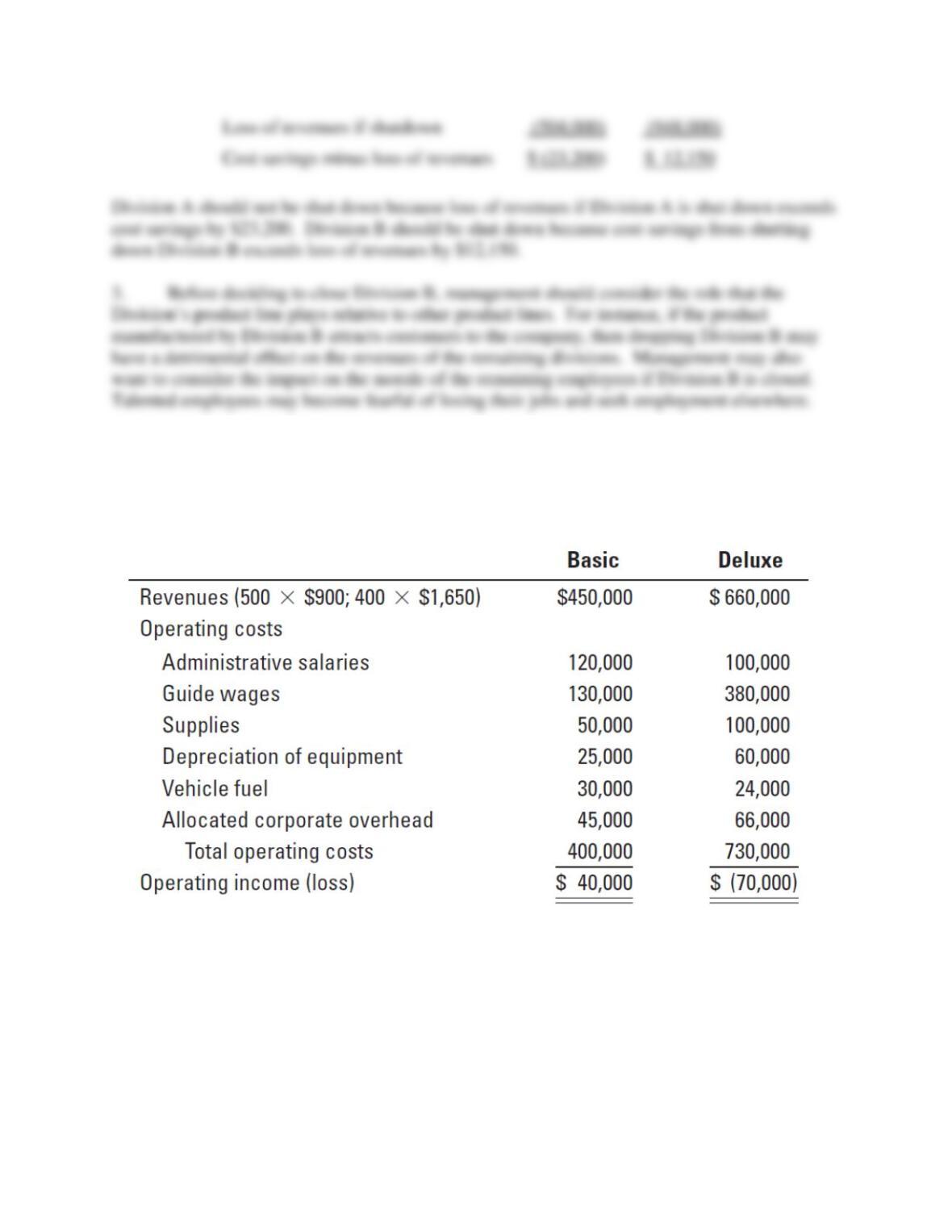
fishing tours, Basic and Deluxe. Operating income for each tour type in 2014 is as follows:
The equipment has a zero disposal value. Guide wages, supplies, and vehicle fuel are variable
costs with respect to the number of tours. Administrative salaries are fixed costs with respect to
the number of tours. Brad Barrett, Mechum River Anglers’ president, is concerned about the
losses incurred on the deluxe tours. He is considering dropping the deluxe tour and offering only
the basic tour.
Required:
11-54
1. If the deluxe tours are discontinued, one administrative position could be eliminated, saving
the company $50,000. Assuming no change in the sales of basic tours, what effect would
dropping the deluxe tour have on the company’s operating income?
2. Refer back to the original data. If Mechum River Anglers drops the deluxe tours, Barrett
estimates that sales of basic tours would increase by 50%. He believes that he could still
eliminate the $50,000 administrative position. Equipment currently used for the deluxe tours
would be used by the additional basic tours. Should Barrett drop the deluxe tour? Explain.
3. What additional factors should Barrett consider before dropping the deluxe tours?
11-55
SOLUTION
11-56
11-43 (30–40 min.) Optimal product mix.
(CMA adapted) Della Simpson, Inc., sells two popular brands of cookies: Della’s Delight and
Bonny’s Bourbon. Della’s Delight goes through the Mixing and Baking departments, and
Bonny’s Bourbon, a filled cookie, goes through the Mixing, Filling, and Baking departments.
Michael Shirra, vice president for sales, believes that at the current price, Della Simpson can
sell all of its daily production of Della’s Delight and Bonny’s Bourbon. Both cookies are made in
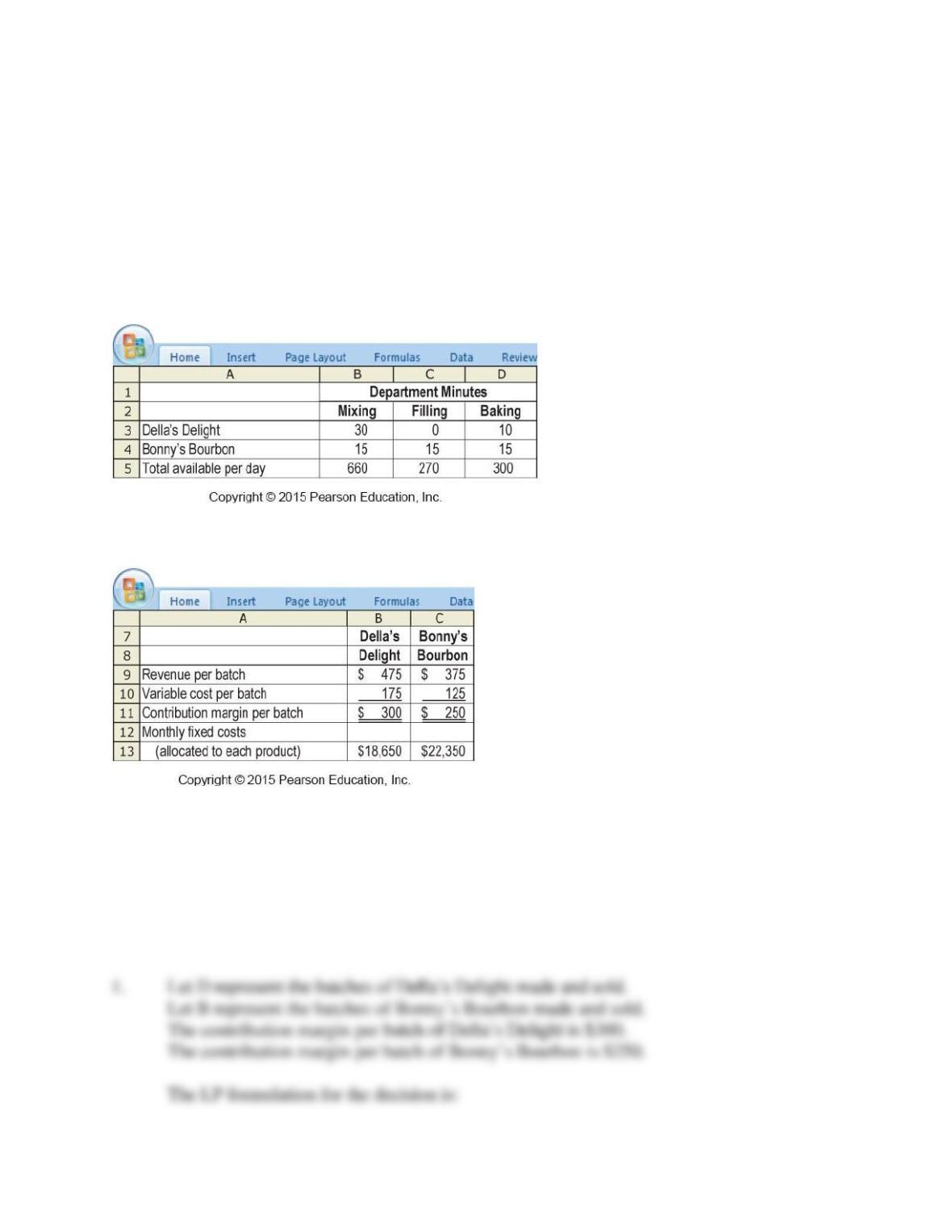
batches of 3,000. In each department, the time required per batch and the total time available
each day are as follows:
Revenue and cost data for each type of cookie are as follows:
Required:
1. Using D to represent the batches of Della’s Delight and B to represent the batches of Bonny’s
Bourbon made and sold each day, formulate Shirra’s decision as an LP model.
2. Compute the optimal number of batches of each type of cookie that Della Simpson, Inc.,
should make and sell each day to maximize operating income.
SOLUTION
11-57
Maximize $300D + $250 B
Subject to 30D + 15B 660 (Mixing Department constraint)
15B 270 (Filling Department constraint)
10D + 15B 300 (Baking Department constraint)
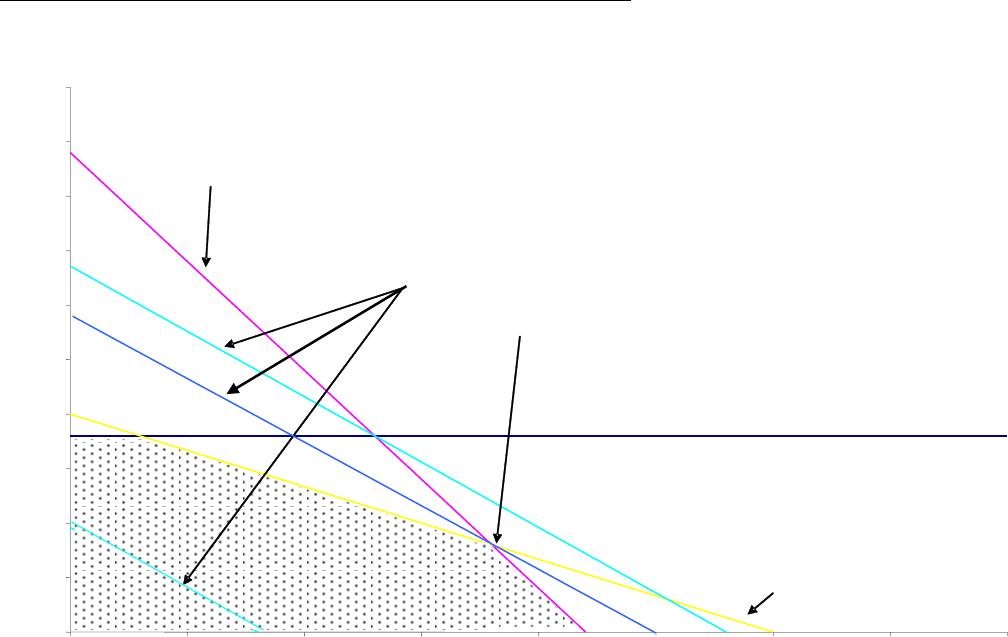
2. Solution Exhibit 11-43 presents a graphical summary of the relationships. The optimal
corner is the point (18, 8) i.e., 18 batches of Della’s Delights and 8 batches of Bonny’s Bourbons.
SOLUTION EXHIBIT 11-43
Graphic Solution to Find Optimal Mix, Della Simpson, Inc.
3, 18
0, 18
0, 44
22, 0
Della Simpson Production Model
0
5
10
15
20
25
30
35
40
45
50
0
5
10
15
20
25
30
35
40
D (batches of Della’s Delight)
B (batches of Bonny’s Bourbons)
Filling Dept. Constraint
Mixing Dept. Constraint
Baking Dept. Constraint
Equal Contribution
Margin Lines
Optimal Corner (18,8)
Feasible Region

11-58
We next calculate the optimal production mix using the trial-and-error method.
The corner point where the Mixing Dept. and Baking Dept. constraints intersect can be
calculated as (18, 8) by solving:
30D + 15B = 660 (1) Mixing Dept. constraint
10D + 15B = 300 (2) Baking Dept. constraint
Subtracting (2) from (1), we have
20D = 360
or D = 18
Substituting in (2)
(10 18) + 15B = 300
that is, 15B = 300 − 180 = 120
or B = 8
The corner point where the Filling and Baking Department constraints intersect can be calculated
as (3,18) by substituting B = 18 (Filling Department constraint) into the Baking Department
constraint:
10 D + (15
18) = 300
10 D = 300 − 270 = 30
D = 3
The feasible region, defined by five corner points, is shaded in Solution Exhibit 11-43. We next
use the trial-and-error method to check the contribution margins at each of the five corner points
of the area of feasible solutions.
Trial
Corner (D,B)
Total Contribution Margin
1
(0,0)
($300 0) + ($250 0) = $0
2
(22,0)
($300 22) + ($250 0) = $6,600
3
(18,8)
($300 18) + ($250 8) = $7,400
4
(3,18)
($300 3) + ($250 18) = $5,400
5
(0,18)
($300 0) + ($250 18) = $4,500
The optimal solution that maximizes contribution margin and operating income is 18 batches of
Della’s Delights and 8 batches of Bonny’s Bourbons.
11-59
11-44 (25 min.) Dropping a customer, activity-based costing, ethics.
Jason Ackerman is the management accountant for Carey Restaurant Supply (CRS). Beth
Donaldson, the CRS sales manager, and Jason are meeting to discuss the profitability of one of
the customers, Martha Leone’s Pizza. Jason hands Beth the following analysis of Martha
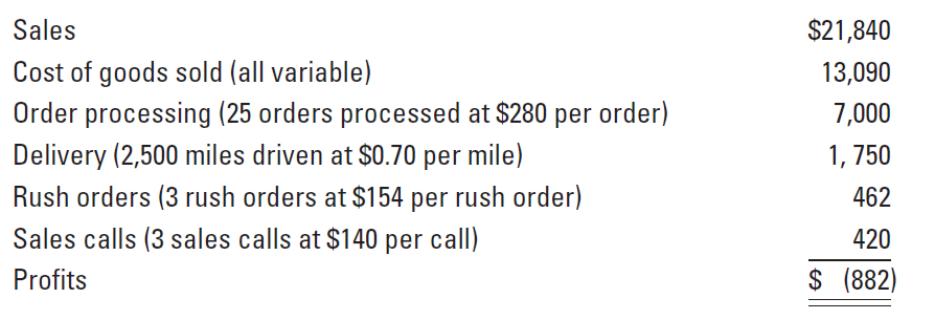
Leone’s activity during the last quarter, taken from Central’s activity-based costing system:
Beth looks at the report and remarks, “I’m glad to see all my hard work is paying off with
Martha Leone’s. Sales have gone up 10% over the previous quarter!”
Jason replies, “Increased sales are great, but I’m worried about Martha Leone’s margin, Beth.
We were showing a profit with Martha Leone’s at the lower sales level, but now we’re showing a
loss. Gross margin percentage this quarter was 40%, down five percentage points from the prior
quarter. I’m afraid that corporate will push hard to drop them as a customer if things don’t turn
around.”
“That’s crazy,” Beth responds. “A lot of that overhead for things like order processing,
deliveries, and sales calls would just be allocated to other customers if we dropped Martha
Leone’s. This report makes it look like we’re losing money on Martha Leone’s when we’re not.
In any case, I am sure you can do something to make its profitability look closer to what we
think it is. No one doubts that Martha Leone’s is a very good customer.”
Required:
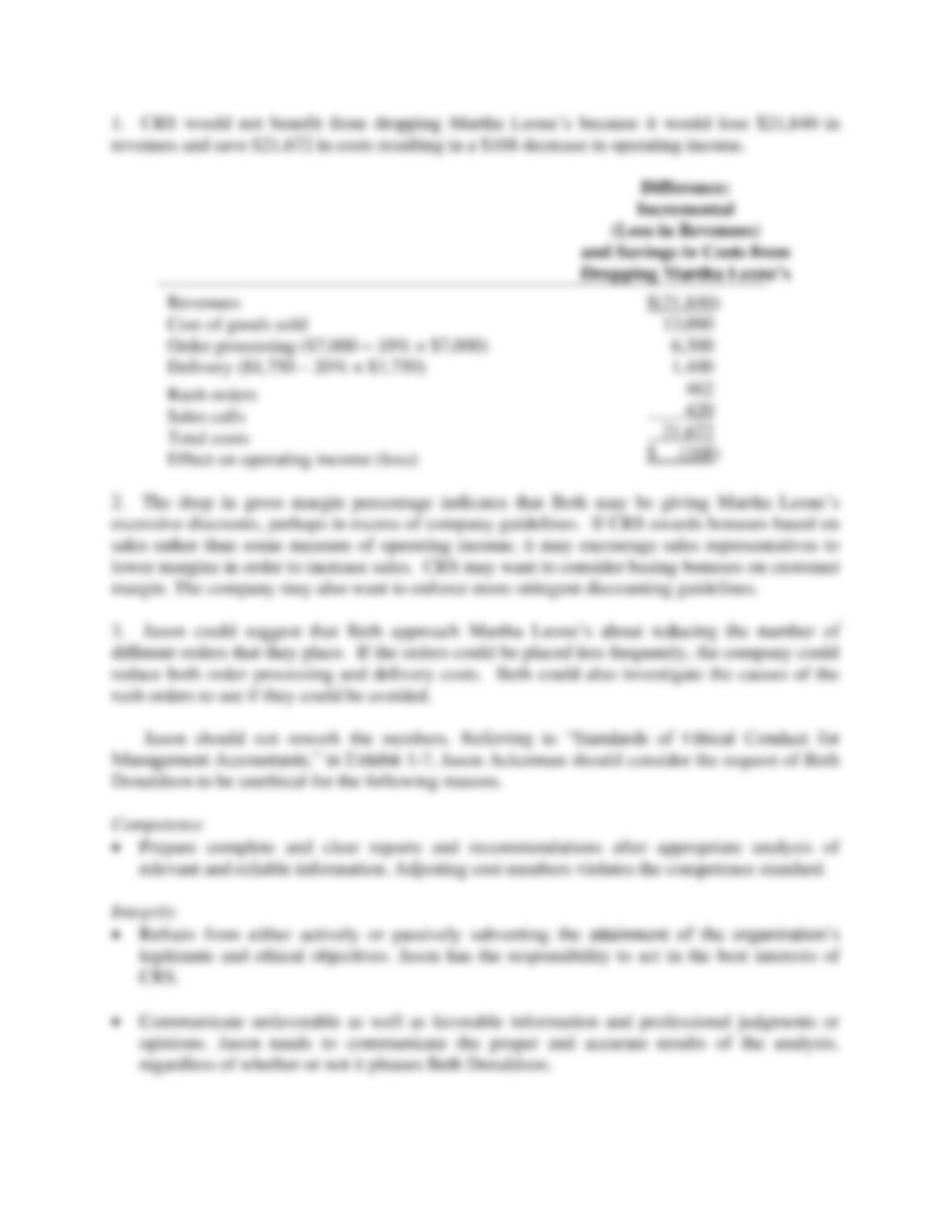
1. Assume that Beth is partly correct in her assessment of the report. Upon further investigation,
it is determined that 10% of the order processing costs and 20% of the delivery costs would
not be avoidable if CRS were to drop Martha Leone’s. Would CRS benefit from dropping
Martha Leone’s? Show your calculations.
2. Beth’s bonus is based on meeting sales targets. Based on the preceding information regarding
gross margin percentage, what might Beth have done last quarter to meet her target and
receive her bonus? How might CRS revise its bonus system to address this?
3. Should Jason rework the numbers? How should he respond to Beth’s comments about
making Martha Leone’s look more profitable?
SOLUTION
11-60
11-61
11-45 (30 min.) Equipment replacement decisions and performance evaluation.
Sean Fitzpatrick manages the Peoria plant of Garcia Manufacturing. A representative of Darien
Engineering approaches Fitzpatrick about replacing a large piece of manufacturing equipment
that Garcia uses in its process with a more efficient model. While the representative made some
compelling arguments in favor of replacing the 3-year-old equipment, Fitzpatrick is hesitant.
Fitzpatrick is hoping to be promoted next year to manager of the larger Detroit plant, and he
knows that the accrual-basis net operating income of the Peoria plant will be evaluated closely as
part of the promotion decision. The following information is available concerning the equipment
replacement decision:
▪ The historic cost of the old machine is $600,000. It has a current book value of $240,000,
two remaining years of useful life, and a market value of $144,000. Annual depreciation
expense is $120,000. It is expected to have a salvage value of $0 at the end of its useful life.
▪ The new equipment will cost $360,000. It will have a 2-year useful life and a $0 salvage
value. Garcia uses straight-line depreciation on all equipment.
▪ The new equipment will reduce electricity costs by $70,000 per year and will reduce direct
manufacturing labor costs by $60,000 per year.
For simplicity, ignore income taxes and the time value of money.
Required:
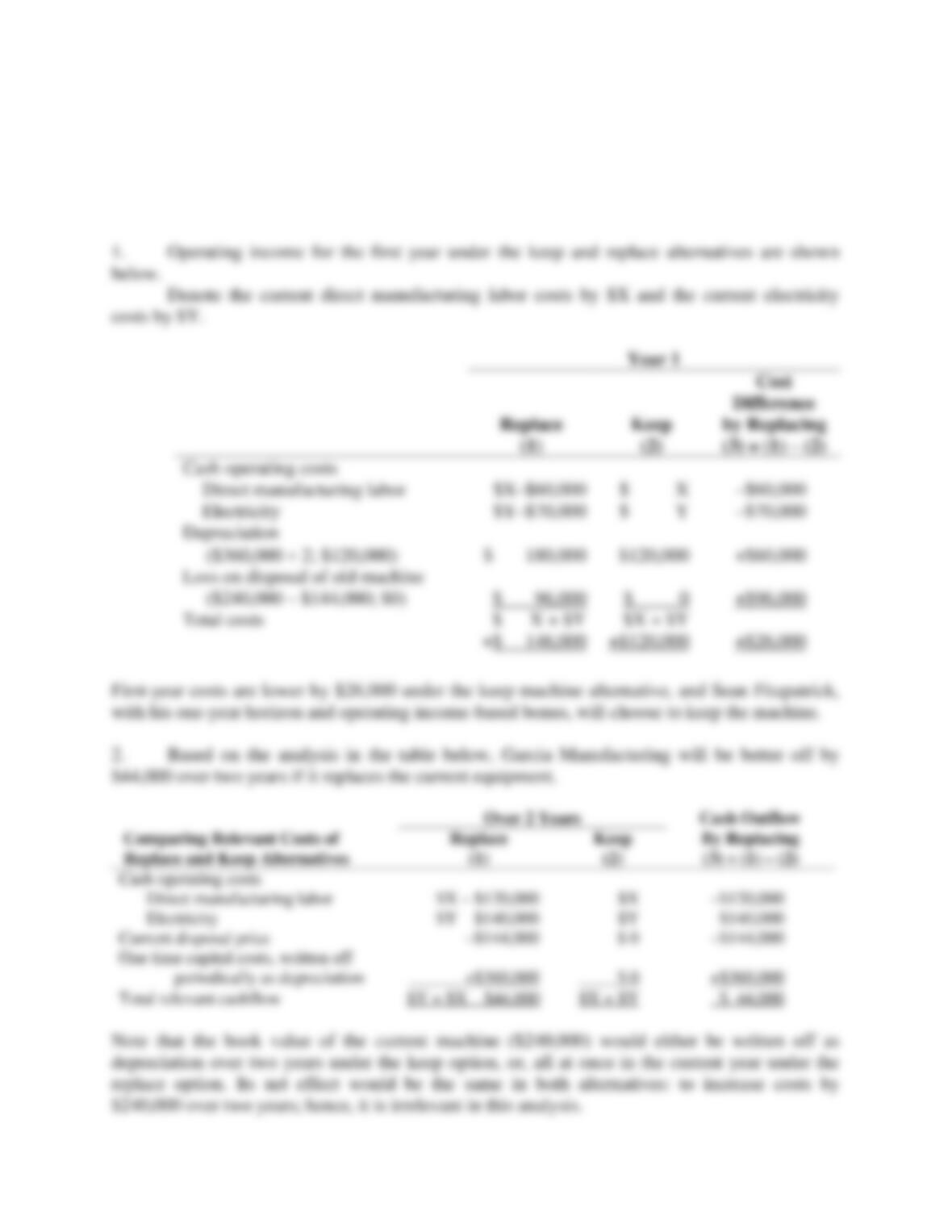
1. Assume that Fitzpatrick’s priority is to receive the promotion and he makes the equipment
replacement decision based on next year’s accrual-based net operating income. Which
alternative would he choose? Show your calculations.
11-62
2. What are the relevant factors in the decision? Which alternative is in the best interest of the
company over the next 2 years? Show your calculations.
3. At what cost would Fitzpatrick be willing to purchase the new equipment? Explain.
SOLUTION
11-63