Chapter 11: Balance Sheet Instructor Manual
Accounting Theory (9
th
edition) Page 1 of 16
CHAPTER HIGHLIGHTS
This chapter starts by examining the philosophical relationship between the balance sheet and
income statement. Two separate issues emerge: articulation between the two and which one is
to dominate, assuming articulation (asset-liability or revenue-expense approach). These choices
are pure cases but they do illustrate the broad theoretical choices that exist. The changes in
element definitions (assets, liabilities, and owners’ equity) are detailed from the Accounting
Terminology Bulletins, to APB Statement No. 4, to SFAC Nos. 3 and 6. The important point is
that there is a marked reorientation to the asset-liability perspective in APB Statement No. 4 and
the conceptual framework project, away from the revenue-expense perspective of the Accounting
Terminology Bulletins.
The chapter contains extensive discussions on investments in marketable securities (SFAS No.
115), impaired assets (SFAS No. 121), and financial instruments with emphasis on derivatives.
QUESTIONS
Q-1 What are the characteristics of assets, liabilities, and owners’ equity, and how have they
evolved over time?
Chapter 11: Balance Sheet Instructor Manual
Accounting Theory (9
th
edition) Page 2 of 16
Q-2 Why is it difficult to define the basic accounting elements?
In order to unambiguously define elements, the definitions would need to be very narrow,
probably based on legal concepts. This produces a very narrow balance sheet. Broader
Q-3
Why are asset and liability definitions important to the theoretical structure of accounting? Why
are definitions important to policy setting bodies?
At the most basic level, element definitions represent the accounting classification system. They
determine (partially at least) what is to be recognized and how it is to be classified. Given the
Q-4 Numerous attributes are measured in the balance sheet. Wh
at are the different attributes? Why is
this practice criticized?
Some attributes would be replacement cost provided it is lower than historical cost (inventories)
replacement cost (fair value) for trading and available-for-sale securities; net realizable value in
the case of accounts and notes receivable, though this is undoubtedly above the amount at which
Q-5 What do aggregated bala
nce sheet totals represent? These balance sheet data are used for ratio
analysis. How useful do you think ratio analysis is?
The answer to this question is really an extension of question four above. The question of the
lack of additivity and relevance is obviously at issue here which can severely impact ratio
Chapter 11: Balance Sheet Instructor Manual
Accounting Theory (9
th
edition) Page 3 of 16
Q-6 Multiple approaches have been advocated concerning the defi
nition of accounting elements and
the relationship between the balance sheet and income statement. What are these approaches and
how do they differ?
The basic distinction is between two approaches: articulated and not articulated. Within the
Q-7
What is the meaning of “owners’ equity” in the balance sheet? Why are certain unrealized gai
or losses included in owners’ equity?
Traditionally, owners’ equity is seen as the residual of net assets after fulfilling obligations to
creditors. A proprietary approach has been taken in its presentation. Inclusion of unrealized
gains/losses relates directly to articulation between the balance sheet and income statement.
Q-8
What are deferred charges and deferred credits, how do they come about, and do they conform to
asset and liability definitions?
Deferred charges/credits are debits/credits that are postponed in the income statement through
Q-9
Why have mutually unperformed executory contracts traditionally been excluded from financial
statements? Can this practice be justified in terms of ass
et and liability definitions? How relevant
is this approach for professional sports franchises?
Mutually unperformed executor contracts traditionally been excluded from financial statements
since there is an implied offset of the unrecorded asset and liability. Another way to explain it is
Chapter 11: Balance Sheet Instructor Manual
Accounting Theory (9
th
edition) Page 4 of 16
Q-10 What is the purpose of balance sheet classification? How useful is the inform
ation produced
from a classified balance sheet? What are some alternative classification systems that could be
used?
Classification could proceed along several lines: by attribute being measured, by liquidity, by
way in which realization will occur. In effect, all of these represent partial disaggregation of
Q-11
As a potential investor, what do you feel would be the most useful attribute of measurement for
each of the following: inventories held for sale, inventories held for production, and long term
debt? Would your answer differ if you were a poten
tial lender? What if you were a manager of a
company? What measurement problems are illustrated by this question?
At issue here is the possibility that alternative measurements are useful to different types of
users. This ties in to the user heterogeneity problem. Inventories held for sale might be most
Q-12
Why is it difficult to determine the historical acquisition cost of self constructed assets? Do
definitions of accounting elements and general principles of recognition and measurement
resolve the controversy over full absorption costing and variable costing of manufactured
inventory?
The issue is what is appropriately charged to asset cost, particularly in the absence of an arm’s
Q-13 The limitation of the accounting classification system depicted in Exhibit 11-
1 was referred to
throughout the chapter. What i
s meant by this? Give some examples. Why is the accounting
classification system the foundation of the accounting discipline?
With broad, ambiguous element definitions, there is the potential for dissimilarity among the
Chapter 11: Balance Sheet Instructor Manual
Accounting Theory (9
th
edition) Page 5 of 16
Q-14 Is the “available for sale” category for debt and equity securities used in SFAS No. 115 a
homogeneous category?
Distinctions between available-for-sale securities and the other two categories are fairly loose.
As noted in the text, transfers between available-for-sale and trading securities should be
Q-15
Based on your reading of this chapter, plus your general knowledge of accounting standards,
identify five examples of measurement flexibility in the statement of financial position.
Some examples are depreciation, inventory, treasury stock, conversion of convertible debt, full
cost/successful efforts for oil and gas companies, and stock dividends between 20 and 25
Q-16 SFAS No. 133
(213 pages), 149 (78 pages), and 155 (27 pages) define standards for derivatives
in 318 pages. How would a principles-based approach to setting standards affect their
length…or would it have any effect?
Rules-based standards are necessarily lengthy. Introduction of a rule makes implementation of
Q-17 Discuss the bright line that does or does not distinguish debt and equity classifications.
Q-18 Why is there an implicit recognition of fair value in the 1984 Revised Model Business
Corporation Act?
The 1984 Revised Model Business Corporation Act allows dividends to be paid as long as
Chapter 11: Balance Sheet Instructor Manual
Accounting Theory (9
th
edition) Page 6 of 16
Q-19 How does the asset impairment measurement approach of SFAS No. 121,
Accounting for the
Impairment of Long-Lived Assets and for Long-Lived Assets to Be Disposed Of,
compare to
deprival value?
Deprival value is a more broad-gauged measure because it aims to determine value in use. By
taking the higher of present value of future cash flows and net realizable value and comparing
Q-20 Why are interest rate swaps a zero sum game?
What one party gains, the other party loses netting out to a zero effect; this is referred to as a zero
Q-21 What is a securitization and why do firm’s use this technique?
Assets such as mortgages receivable are “packaged” and sold to a transferee. The transferee
finances the sale by issuing securities to another party. Assuming the transferor has relinquished
Q-22 Of the var
ious reasons that a firm might deal in its treasury stock, are there any that you might
think are questionable? Discuss.
Of the various reasons for dealing in treasury stock, supporting the market price of the firm’s
Q-23 Are disclosures of hedging effectiveness effective?
Q-24 Why are convertible bonds and convertible preferred stock not examples of embedded
derivatives?
Convertible bonds and convertible preferred stock are not embedded derivatives because their
Chapter 11: Balance Sheet Instructor Manual
Accounting Theory (9
th
edition) Page 7 of 16
Q-25 How does the term “embedded derivatives” compa
re with the term “embedded journalists” (from
the Iraqi War)?
Embedded derivatives are “embedded” in a “host” contract in a roughly similar way that
journalists were “embedded” with military units. However, the secondary contract applying to
the embedded derivative has no analogue relative to embedded journalists.
Q-26
Traditional measures of net assets do not capture the value of human capital in an organization.
Which trends, if an
y, suggest that intellectual capital may eventually be a candidate for inclusion
as an intangible on the balance sheet?
This is a thought question, one with no clear correct response. However, the trend towards
CASES, PROBLEMS, and WRITING ASSIGNMENTS
1.
Review a recent annual report and consider the following: Identify all attributes of measurement
explicitly identified in the balance sheet
and accompanying notes. Notice which items are not
specified. Group the accounting elements by attribute. How thorough is the explanation of
measurement in the balance sheet? Identify any unusual assets or liabilities. How useful is the
current noncurrent
distinction for assessing liquidity? Based on your review, what level of user
sophistication do you think is necessary to understand how the balance sheet numbers have been
derived? How useful do you think the balance sheet is? What are its limitations and
how might it
be improved, especially from a communication viewpoint?
This is an open-ended case designed to make students think about conceptual foundations of
accounting measurement, as embodied in the output (balance sheet). Among the things to
highlight are (1) the lack of detail concerning measurement and (2) the high level of aggregation.
Chapter 11: Balance Sheet Instructor Manual
Accounting Theory (9
th
edition) Page 8 of 16
2. Assume that an asset is being examined and it is determined tha
t its cash flows would be $10,000
per year for four years (assume that all cash flows are received at the end of the year). The
carrying value of the asset is $35,000 and its replacement cost is $30,000. The firm’s cost of
capital is 10 percent.
Required:
(a)What would be the amount, if any, that should be written off because the asset is impaired
under SFAS No. 121?
(b)Why is your answer in part (a) anomalous and how does SFAS No. 121 justify it?
(c)Would your answer to part (a) be different if the cash fl
ows were $8,000 rather than $10,000?
Explain.
(d)Is there anything unusual about your answer to part (c) since accounting rules are frequently
concerned with conservatism?
(a) None, because the undiscounted cash flows exceed the carrying value of the asset.
(b) The cash flows are undiscounted (reminiscent of troubled debt restructuring in SFAS No.
12) as well as carrying value also exceeding replacement cost (fair value). The standard
takes the view that “cost recoverability” is the issue of real concern to management. This
still flies in the face of the pervasiveness of present valuation.
3.
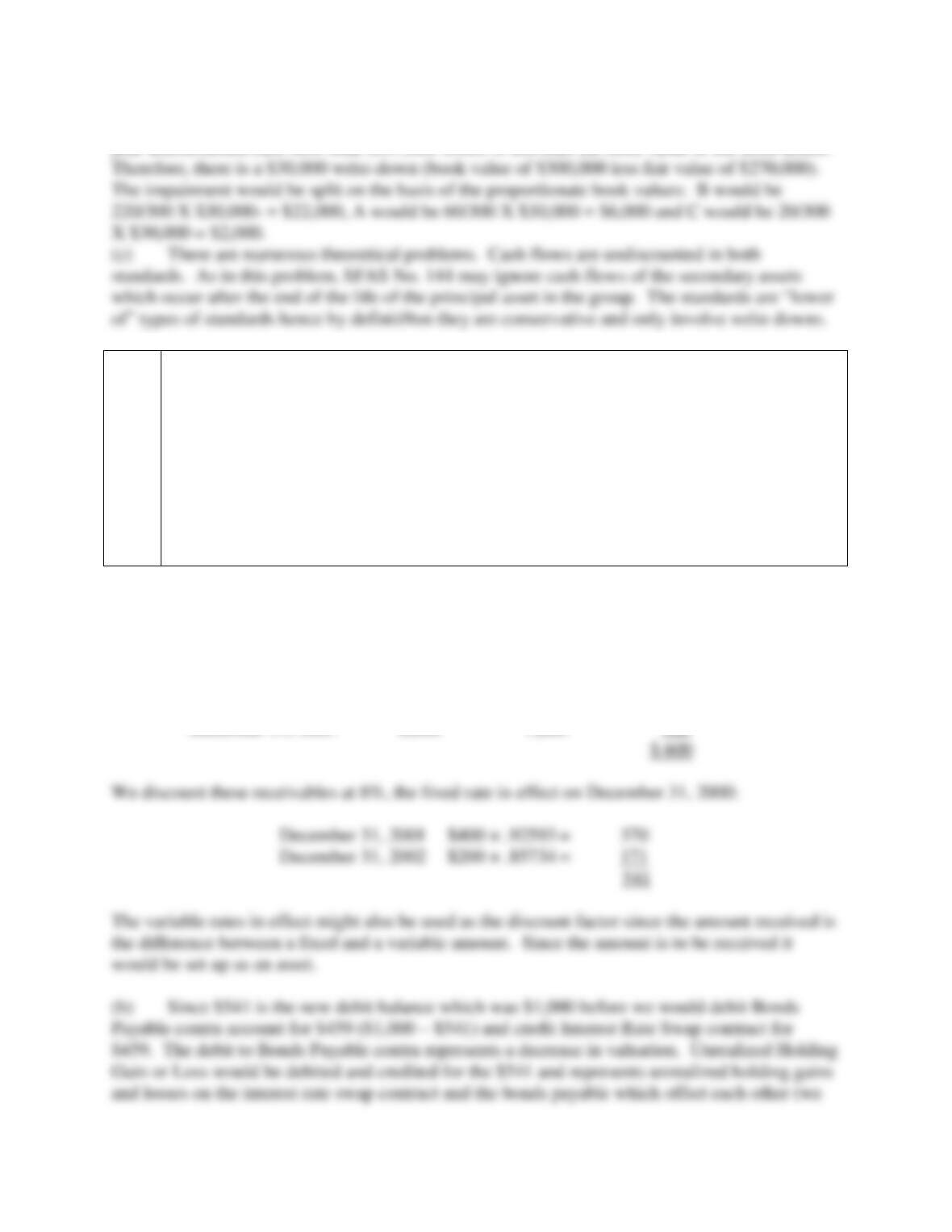
Assets A, B, and C comprise an asset group. Asset B is considered to be the principal asset in this
group. Asset B has a three-
year estimated life and A and C have remaining lives of four years.
Data on the ex
pected undiscounted cash flows of the three assets, their book values (carrying
values), and their fair values less costs to dispose are shown below:
1 $18,000 $80,000 $12,000
2 15,000 70,000 10,000
3 12,000 65,000 9,000
Undiscounted cash
flows by year A B C
Required:
(a)Determine the amount of impairment according to SFAS Nos. 121 and 144.
(b)By how much should each of the assets be written down?
(c)What theoretical problems do you see with the application of SFAS Nos. 121 and 144 to asset
impairments?
Chapter 11: Balance Sheet Instructor Manual
Accounting Theory (9
th
edition) Page 9 of 16
(a) and (b) Since Asset B is the principal asset in this group, it’s 3 year life governs. The 3
4. Assume an
interest rate swap with a notional value of $1,000,000. Firm A receives fixed and
pays variable. The fixed rate on December 31, 2000, is eight percent. The swap has two years to
run with variable interest rates of 7.8 percent and 7.6 percent expected on De
cember 31, 2001,
and 2002, respectively (annual settlements are assumed for simplicity). Firm A’s discount rate is
eight percent.
Required:
(a)Determine the fair value of the derivative and state whether it would be an asset or a liability.
(b)Assume that the swap occurred prior to December 31, 2000, and the interest rate swap
contract had a debit balance of $1,000. Under this circumstance make the entry for the fair value
as of December 31, 2000.
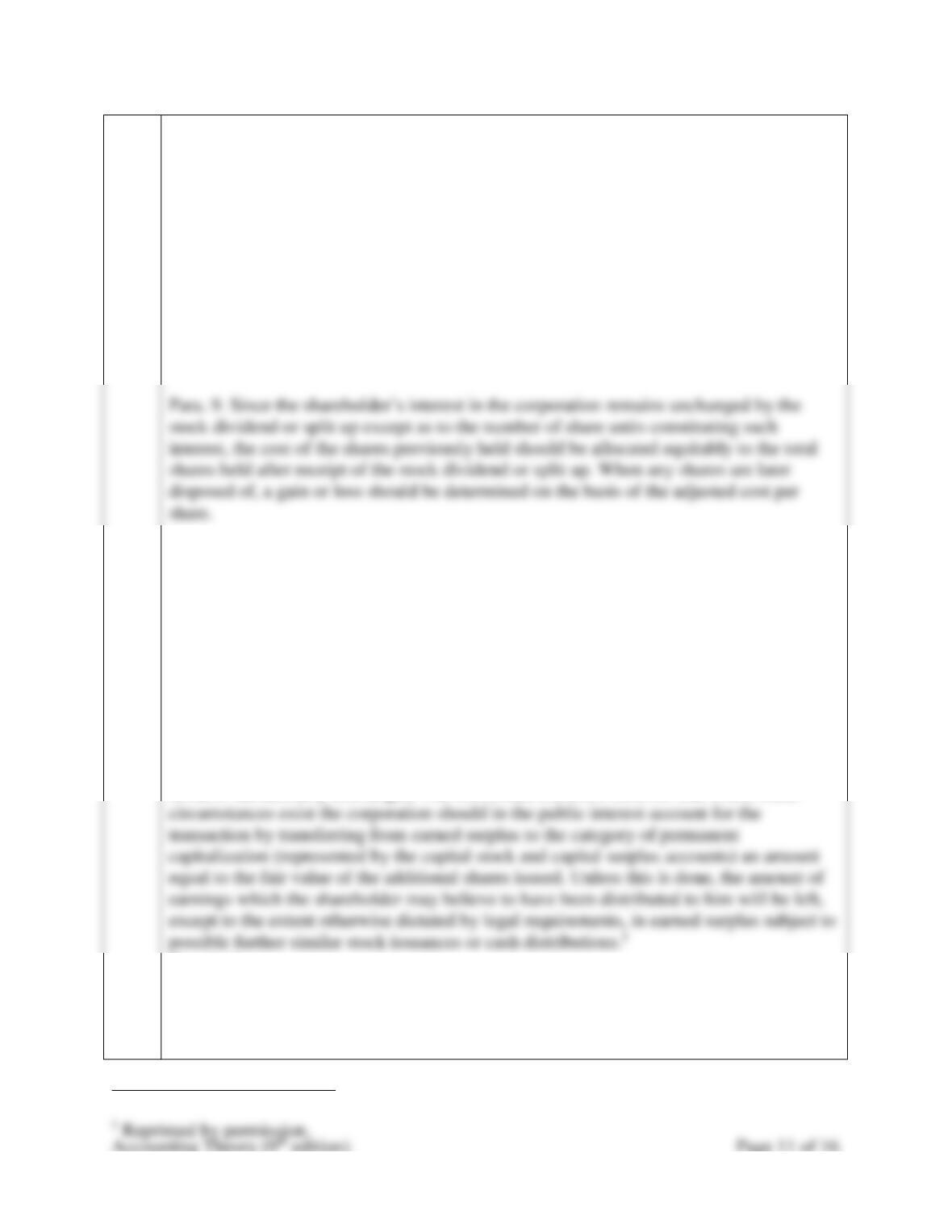
(a) At this point in time (Dec. 31, 2000), we would set up the following simplified table
where the holder is receiving fixed and paying variable.
“Received” by “Paid” by Net
Firm A Firm A Received
December 31, 2001 $8,000 $7,800 $ 400

Chapter 11: Balance Sheet Instructor Manual
Accounting Theory (9
th
edition) Page 10 of 16
Chapter 11: Balance Sheet Instructor Manual
5. Shown below are paragraphs 8–10 of ARB 43, Chapter 7 on stock dividends.
Para. 8. The question as to whether or not stock dividends are income has been
extensively debated; the arguments pro and con are well known. The situation cannot be
better summarized, however, than in the words approved by Mr. Justice Pitney in Eisner
v. Macomber, 252 U.S. 189, wherein it was held that stock dividends are not income
under the Sixteenth Amendment, as follows:
“A stock dividend really takes nothing from the property of the corporation and adds
nothing to the interests of the stockholders. Its property is not diminished and their
interests are not increased . . . the proportional interest of each shareholder remains the
same. The only change is in the evidence which represents that interest, the new shares
and the original shares together representing the same proportional interests that the
original shares represented before the issue of the new ones.”
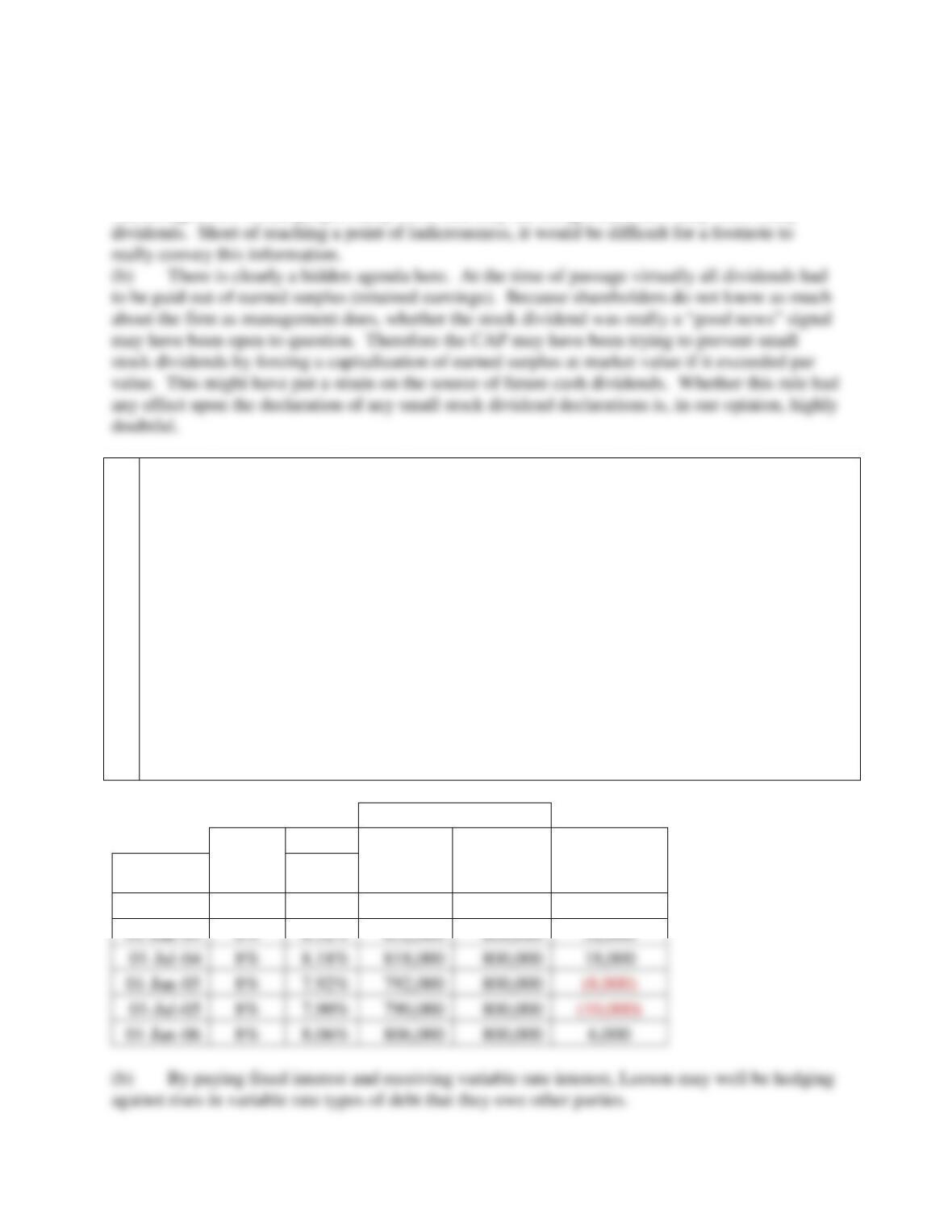
Para. 10. As has been previously stated, a stock dividend does not, in fact, give rise to
any change whatsoever in either the corporation’s assets or its respective shareholders’
proportionate interests therein. However, it cannot fail to be recognized that, merely as a
consequence of the expressed purpose of the transaction and its characterization as a
dividend in related notices to shareholders and the public at large, many recipients of
stock dividends look upon them as distributions of corporate earnings and usually in an
amount equivalent to the fair value of the additional shares received. Furthermore, it is to
be presumed that such views of recipients are materially strengthened in those instances,
which are by far the most numerous, where the issuances are so small in comparison with
the shares previously outstanding that they do not have any apparent effect upon the
share market price and, consequently, the market value of the shares previously held
Required:
(a)From a logical standpoint, evaluate the CAP’s argument involving situations where
market value of common stock should be capitalized in certain stock dividend situations.
(b)Do you see a possible “hidden agenda” here involving certain economic consequences
that the CAP was trying to bring about relative to stock dividends?
Chapter 11: Balance Sheet Instructor Manual
Accounting Theory (9
th
edition) Page 12 of 16
(a) The CAP’s argument is quite convoluted. They appear to be saying that they (the CAP)
understand that stock dividends are really not dividends but since recipients think that they are
dividends, small stock dividends should be treated as if they really are dividends. If this isn’t
bad enough, how would people really know that they are being treated as if they were really
6.
Leeson Company entered into an interest rate swap with Morley Corporation on January 1, 2003. The
notional a
mount of the swap is $20,000,000. Leeson will pay Morley a fixed annual rate of 8 percent.
Morley will pay Leeson LIBOR plus 1 percent. Settlement is to be made every six months and the
contract lasts for three years. The annual variable rates based on LIBOR plus 1 percent are:
July 1, 2003 8.26%
January 1, 2004 8.32%
July 1, 2004 8.18%
January 1, 2005 7.92%
July 1, 2005 7.90%
January 1, 2006 8.06%
Required:
(a)Set up a schedule showing the net receipts or payments for Leeson.
(b)Why would Leeson enter into a strategy of this type?
(c)Has Leeson benefited from this transaction?
(d)What dangers are present?
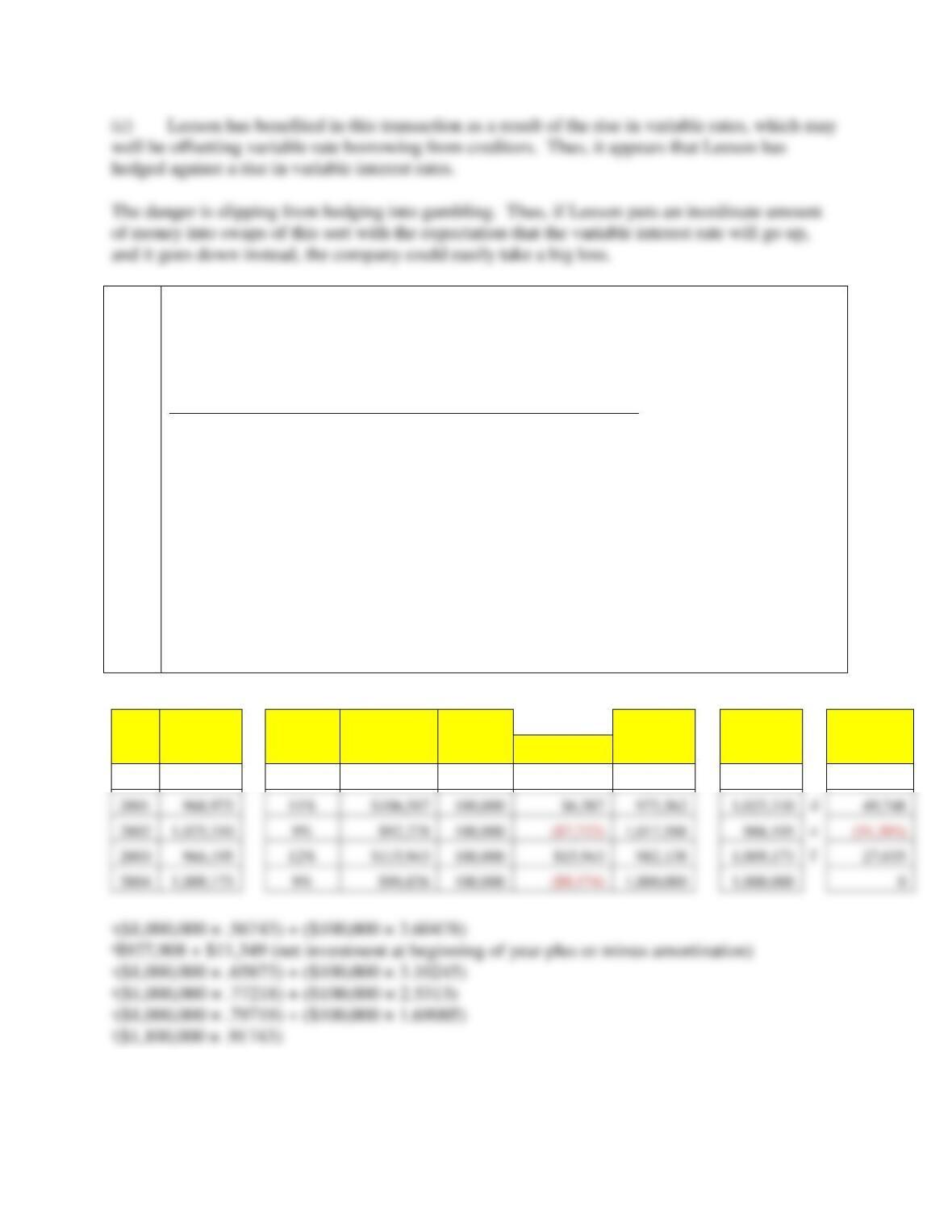
(a)
Leeson’s
Fixed
Rate
LIBOR
“Receipt”
from
Morley
“Payment”
to Morley
Net Receipt
or (Payment)
Date Percent
01-Jul-03
8% 8.26%
$826,000
$800,000
26,000
Chapter 11: Balance Sheet Instructor Manual
Accounting Theory (9
th
edition) Page 13 of 16
7. On January 1, 2000, $1,000,000 of 10 percent debenture bonds were acquired by Means
Corporation at $927,908,
which would yield a 12 percent rate of return. The bonds mature on
December 31, 2004. Interest is paid annually on December 31. Means Corporation classifies
these securities as available for sale securities. Shown below are the effective interest rate and
market value of the securities at various dates.
Date Effective Interest Market Value
December 31, 2000 11% $968,975
December 31, 2001 9% $1,025,310
December 31, 2002 12% $966,195
December 31, 2003 9% $1,009,173
Required:
(a)Using the method suggested by Kathryn Means (i.e., use the current interest rate for
the recognition of income and determination of fair value with the holding gain
component going to owners’ equity), determine the income and unrealized holding gain
components for the years 2000 through 2004 (assume that the interest rate change occurs
on each December 31).
(b)Make the entries that result from assuming that these debenture bonds were Means
Corporation’s only available for sale securities.
(a)
Year Beginning
of Year Yield Effective
Interest
Stated
Interest
Carrying
Value
Market
Value
Unrealized
Gain
(Loss) Amortization
2000 927,908 a
12% $111,349
$100,000
$11,349
939,257 b
968,975 c
29,718
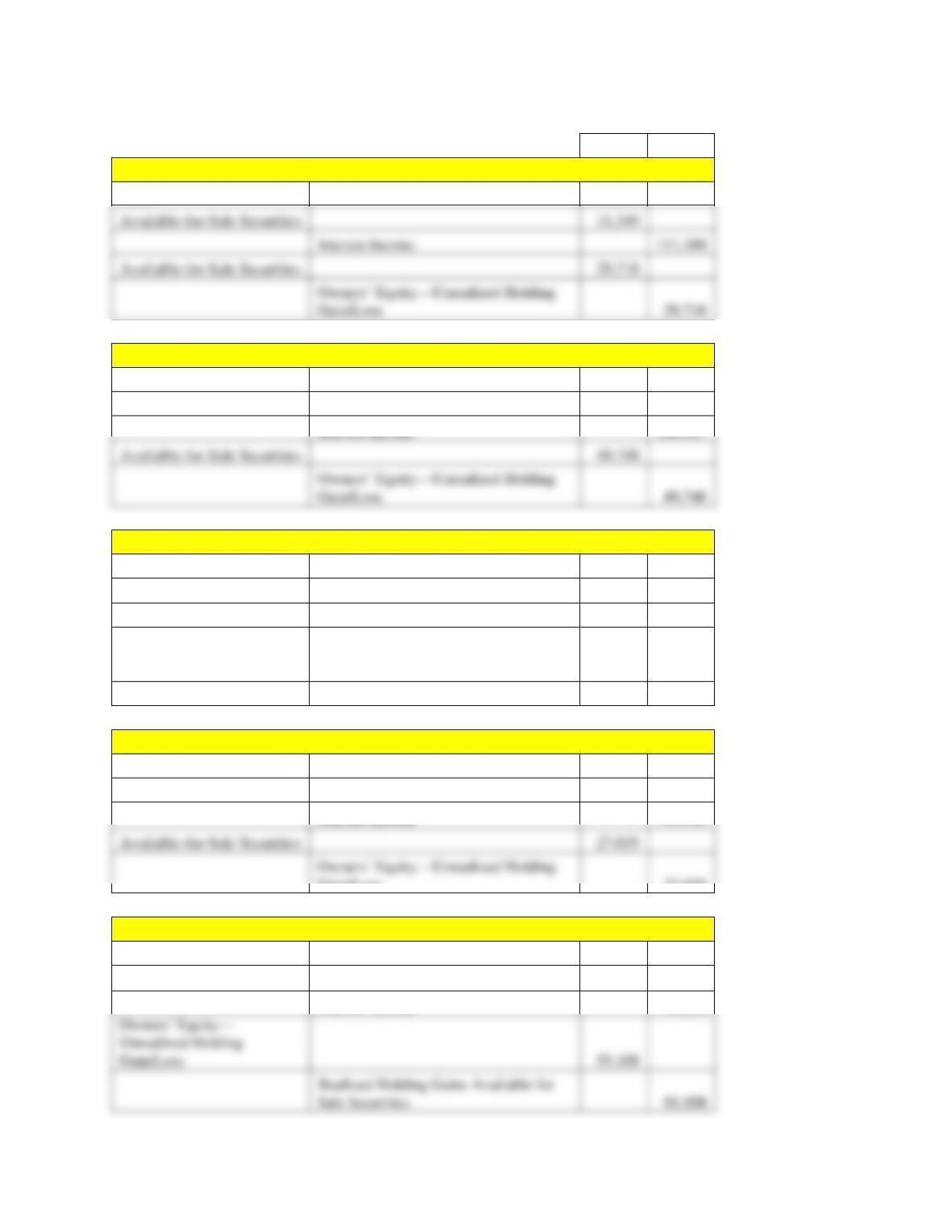
(b) see solution on next page
Chapter 11: Balance Sheet Instructor Manual
Accounting Theory (9
th
edition) Page 2 of 16
DEBIT CREDIT
2000
Cash 100,000
2001
Cash 100,000
Available-for-Sale Securities 6,587
2002
Cash 100,000
Available-for-Sale Securities 7,722
Interest Income 92,278
Owners’ Equity—
Unrealized Holding
Gain/Loss 51,393
Available-for-Sale Securities 51,393
2003
Cash 100,000
Available-for-Sale Securities 15,943
Gain/Loss 27,035
2004
Cash 100,000
Available-for-Sale Securities 9,174
Chapter 11: Balance Sheet Instructor Manual
Accounting Theory (9
th
edition) Page 3 of 16
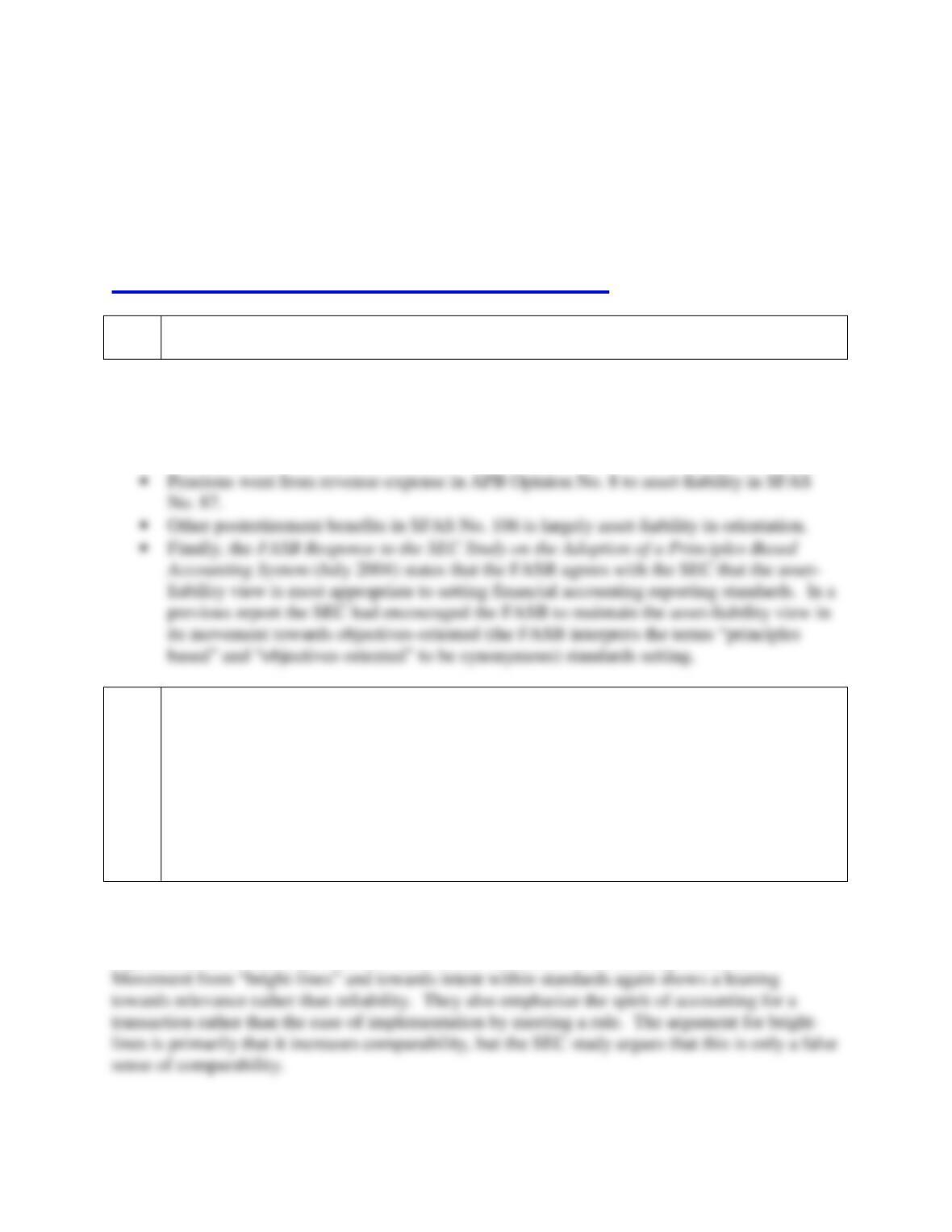
The last entry in 2004 takes the sum of the unrealized holding gains/losses on available-for-sale
securities and runs it through income. Holding these available-for-sale bonds to maturity would
probably not occur frequently, but it illustrates Means’ approach adequately. Notice that the sum
of the interest income and the holding gains equals $572,091, which is also equal to the cash
dividends of $500,000 and the discount of $72,092 ($1,000,000 – $927,098). Available-for-sale
securities are, of course, an example of non-articulation.
CRITICAL THINKING AND ANALYSIS
1. It might be said that we are slowly moving toward an asset-
liability approach in the balance
sheet. Which event situations support this statement?
Several indicators suggest a movement towards the asset-liability approach in U.S. standards
including:
• Income tax allocation has moved from revenue-expense in APB Opinion No. 11 to asset-
liability in SFAS No. 109.
2. In July 2003, the SEC submitted to Congress its Study Pursuant to Section 108(d) of the
Sarbanes-Oxley
Act of 2002 on the Adoption by the United States Financial Reporting System of
a Principles-
Based Accounting System. A year later, FASB issued its reply, FASB Response to
the SEC Study on the Adoption of a Principles-Based Accounting System (July 2004). Th
e SEC
recommended that FASB when setting standards “avoid the use of percentage tests (‘bright
lines’) that allow financial engineers to achieve technical compliance with the standard while
evading the intent of the standard.” Identify where bright lines c
urrently exist in the statement of
financial position, areas in which we might expect revisions in the future. What is the argument
for use of bright-line tests?
These two reports from the SEC and FASB are very interesting. You may want to have your
students read both (the FASB one at a minimum) as part of this assignment. They clearly show
expectations of institutional roles and show future directions for accounting standards.
Chapter 11: Balance Sheet Instructor Manual
Accounting Theory (9
th
edition) Page 4 of 16
3. The comingling of legal and contingent liabilities exists under current GAAP accounting.
Discuss potential problems this creates and propose alternatives to address them.
Legal liabilities are “certain” claims on the assets of the firm. Contingent liabilities may or may