Problem 11-25A (continued)
2. Considering all three investments together, Linda did not earn a 16%
rate of return. The computation is:
Net
Present
Value
Common stock …………………….
$ 7,560
Preferred stock …………………….
Bonds ………………………………..
Overall net present value ……….
3.
Investment required
Factor of the internal =
rate of return Annual net cash inflow
Ethics Challenge (45 minutes)
1. Rachel Arnett’s revision of her first proposal can be considered a
violation of the IMA’s Statement of Ethical Professional Practice. She
discarded her reasonable projections and estimates after she was
questioned by William Earle. She used figures that had a remote chance
2. Earle was clearly in violation of the Standards of Ethical Conduct for
Management Accountants because he tried to persuade a subordinate to
prepare a proposal with data that was false and misleading. Earle has
Ethics Challenge (continued)
3. The internal controls Fore Corporation could implement to prevent
unethical behavior include:
approval of all formal capital expenditure proposals by the Controller
and/or the Board of Directors.
Case (45 minutes)
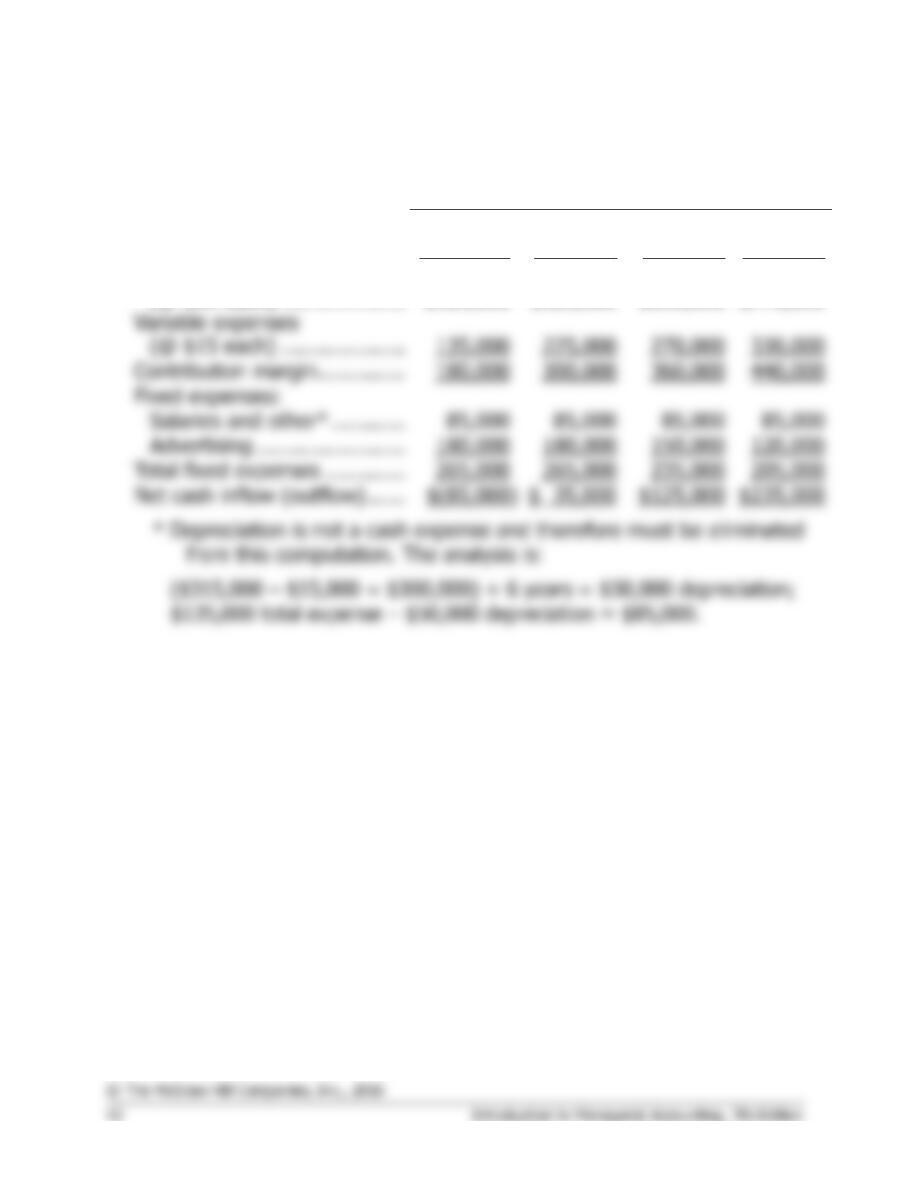
1. The net cash inflow from sales of the device for each year would be:
Year
1
2
3
4-6
Sales in units ……………………
9,000
15,000
18,000
22,000
Sales in dollars
(@ $35 each) ………………..
$315,000
$525,000
$630,000
$770,000
Total fixed expenses ………….
Net cash inflow (outflow) ……
Case (continued)
2. The net present value of the proposed investment would be:
Now
1
2
3
4
5
6
Cost of equipment …
$(315,000)
Working capital ……..
(60,000)
Salvage value of
Total cash flows (a) .
$(375,000)
Present value
Net present value ….
Yearly net cash
Chapter 11
Take Two Solutions
Exercise 11-1 (10 minutes)
1. The payback period is determined as follows:
Year
Investment
Cash Inflow
Unrecovered
Investment
1
$17,500
$1,000
$16,500
2
$2,000
$22,500
3
$2,500
6
$6,000
7
$5,000
9
$3,000
Exercise 11-2 (10 minutes)
1.
Now
1
2
3
4
5
Purchase of machine ………………….
$(27,000)
Reduced operating costs …………….
$7,000
$7,000
$7,000
Total cash flows (a) …………………..
$(27,000)
$7,000
$7,000
$7,000
Discount factor (10%) (b) …………..
Present value (a)×(b) ………………..
$(27,000)
Net present value ……………………..
2.
Item
Cash
Flow
Years
Total
Cash
Flows
Annual cost savings ..
$7,000
5
$ 35,000
Initial investment …..
1
Net cash flow ………..
Exercise 11-4 (10 minutes)
This is a cost reduction project, so the simple rate of return would be
computed as follows:
Operating cost of old machine ………………..
$ 30,000
Annual incremental net operating income …
Cost of the new machine ………………………
Scrap value of old machine ……………………
Exercise 11-6 (15 minutes)
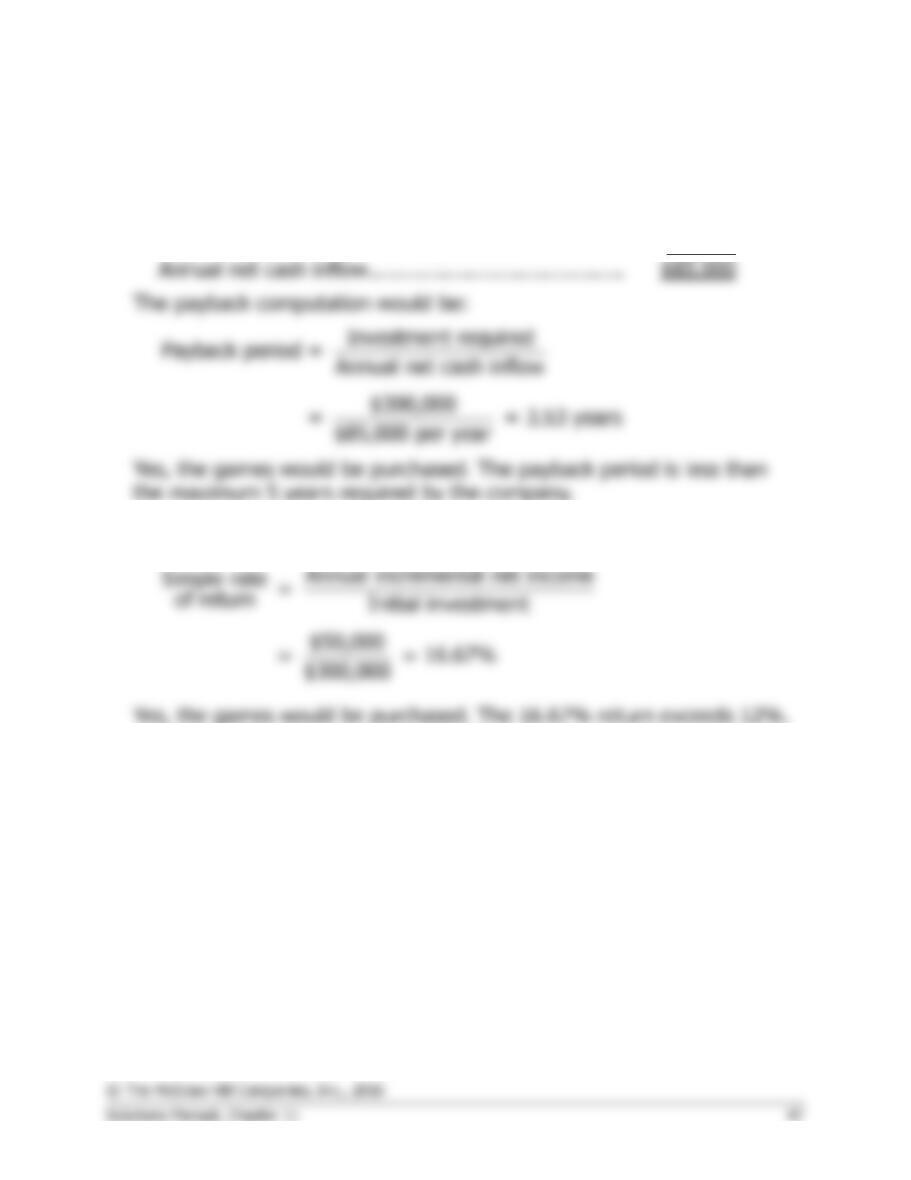
1. Computation of the annual cash inflow associated with the new
electronic games:
Net operating income ……………………………………
$50,000
Add noncash deduction for depreciation …………….
35,000
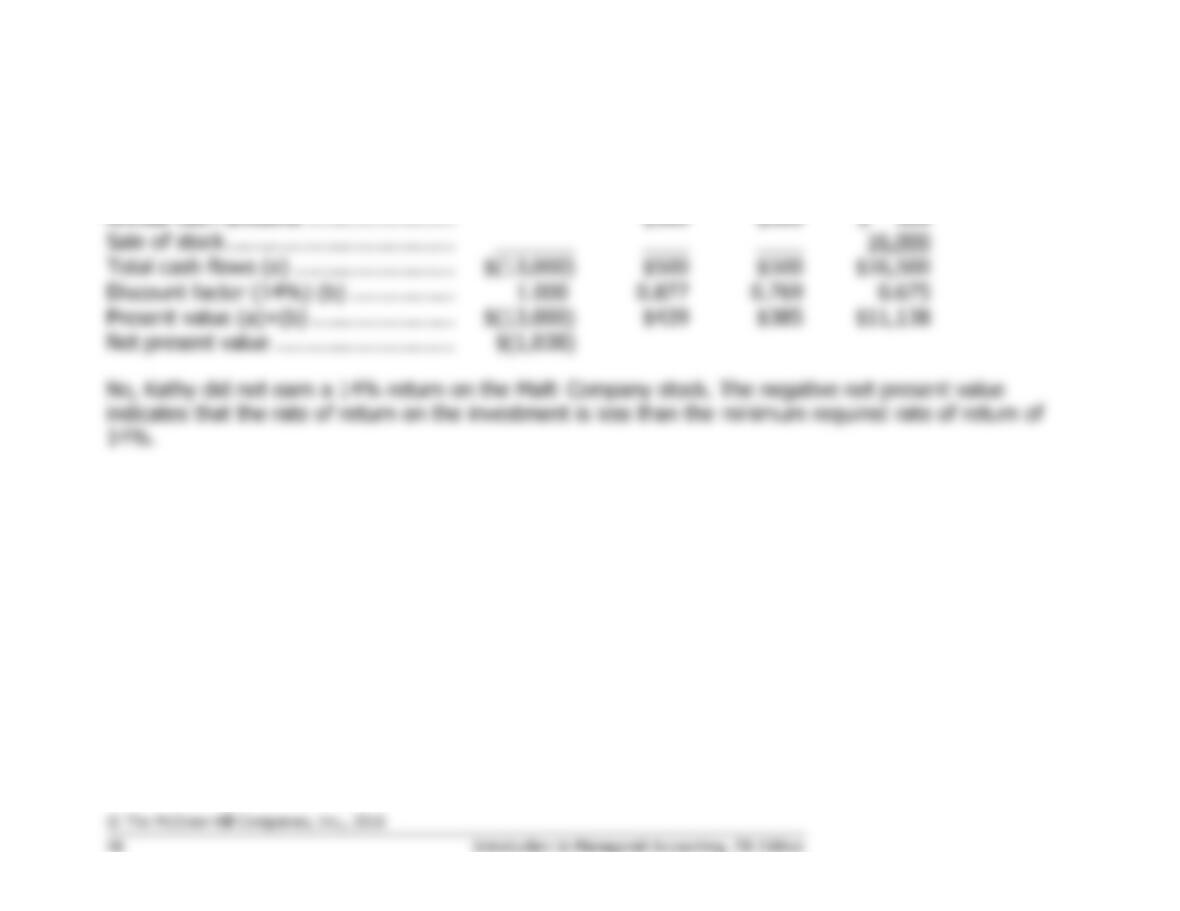
2. The simple rate of return would be:
Exercise 11-8 (10 minutes)
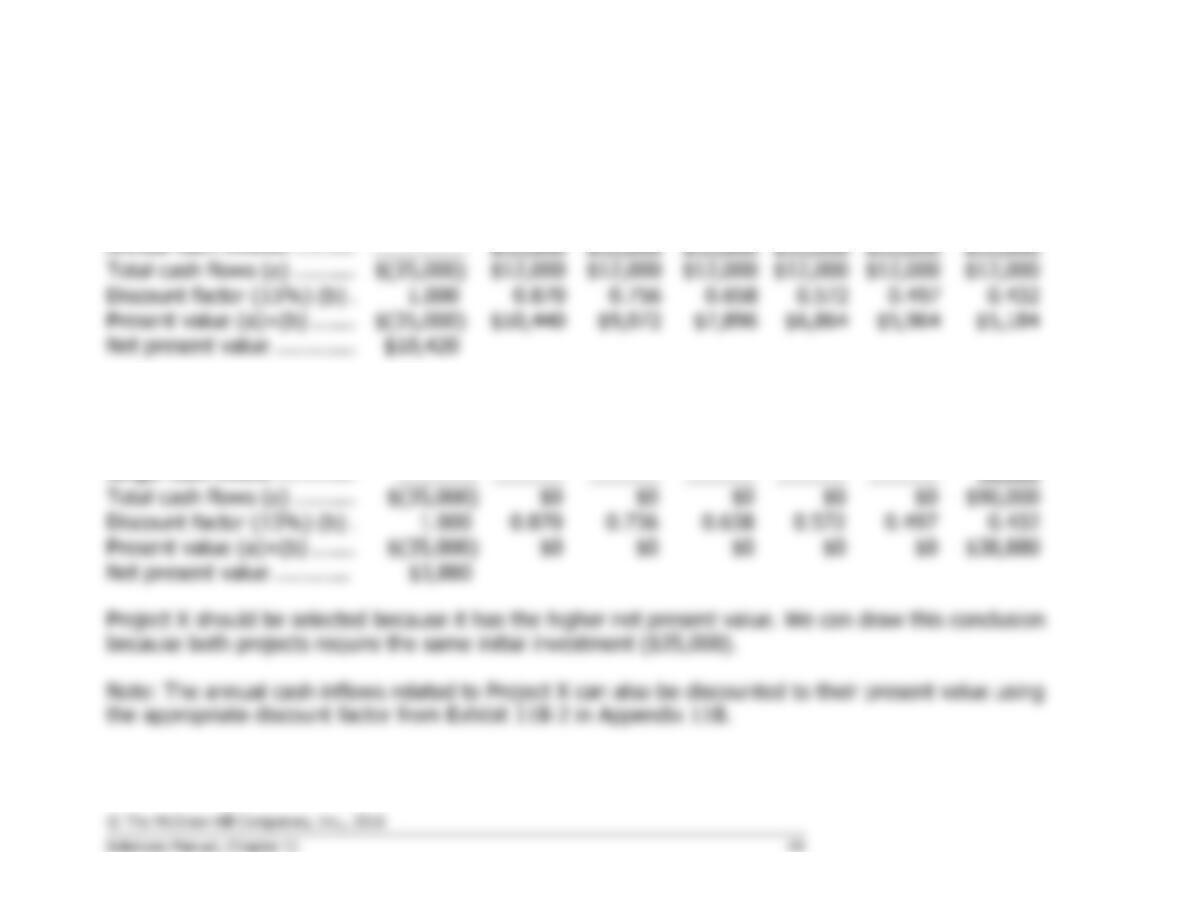
Now
1
2
3
Purchase of stock…………………………
$(13,000)
Annual cash dividend ……………………
Sale of stock ……………………………….
Total cash flows (a) ……………………..
$(13,000)
Discount factor (14%) (b) ……………..
Present value (a)×(b) …………………..
$(13,000)
Net present value ………………………..
Exercise 11-11 (10 minutes)
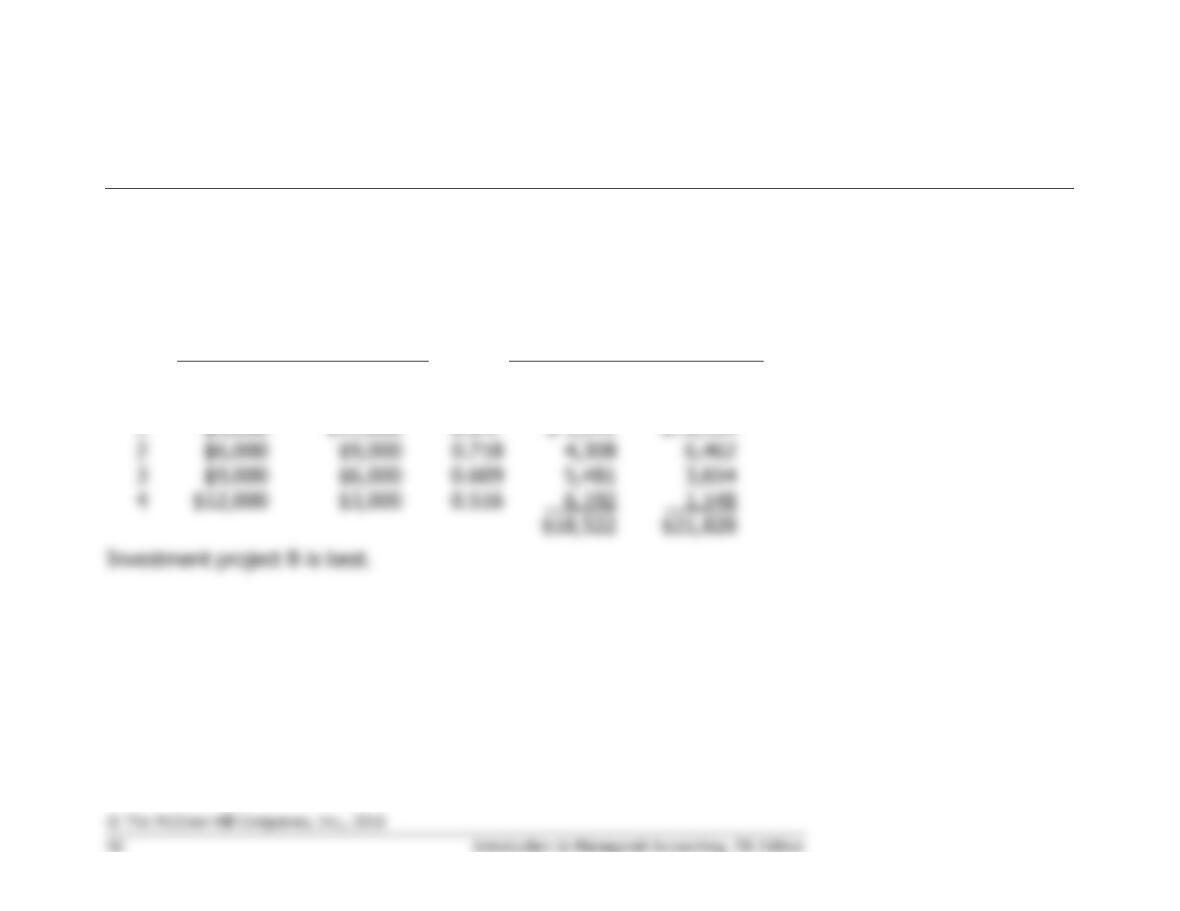
Project X:
Now
1
2
3
4
5
6
Initial investment …………..
$(35,000)
Annual cash inflows ……….
________
$12,000
Total cash flows (a) ……….
$(35,000)
$12,000
Discount factor (15%) (b) .
0.497
Present value (a)×(b) …….
$(35,000)
Net present value ………….
Project Y:
Now
1
2
3
4
5
6
Initial investment …………..
$(35,000)
Single cash inflow ………….
_______
______
______
______
______
______
90,000
Total cash flows (a) ……….
$(35,000)
$90,000
Discount factor (15%) (b) .
Present value (a)×(b) …….
$(35,000)
Net present value ………….
Appendix 11A
The Concept of Present Value
Exercise 11A-1 (10 minutes)
Amount of Cash Flows
18%
Present Value of Cash
Flows
Year
Investment
A
Investment
B
Factor
Investment
A
Investment
B
1
$3,000
$12,000
0.847
$ 2,541
$10,164
2
$6,000
3
$9,000
0.609
Exercise 11A-2 (10 minutes)
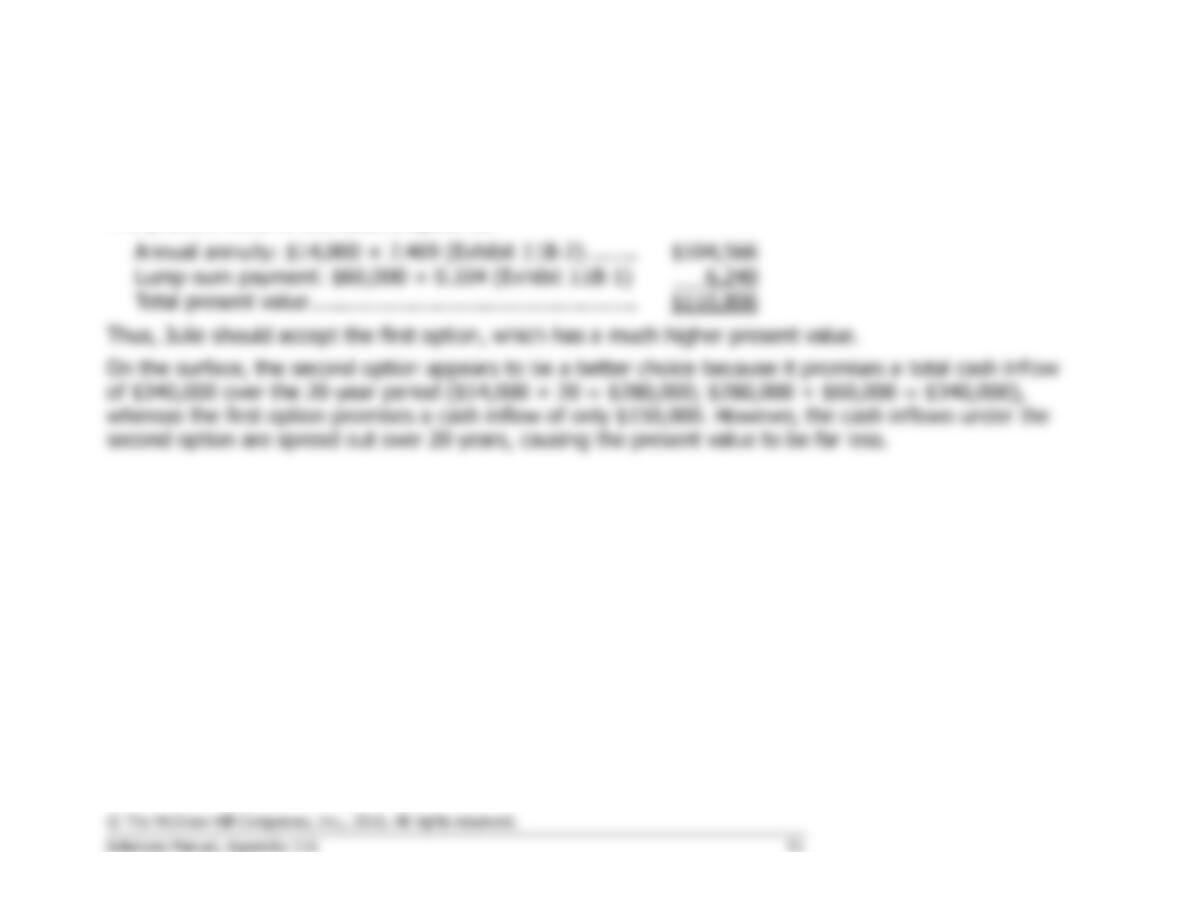
The present value of the first option is $150,000, since the entire amount would be received
immediately.
The present value of the second option is:
Exercise 11A-3 (10 minutes)
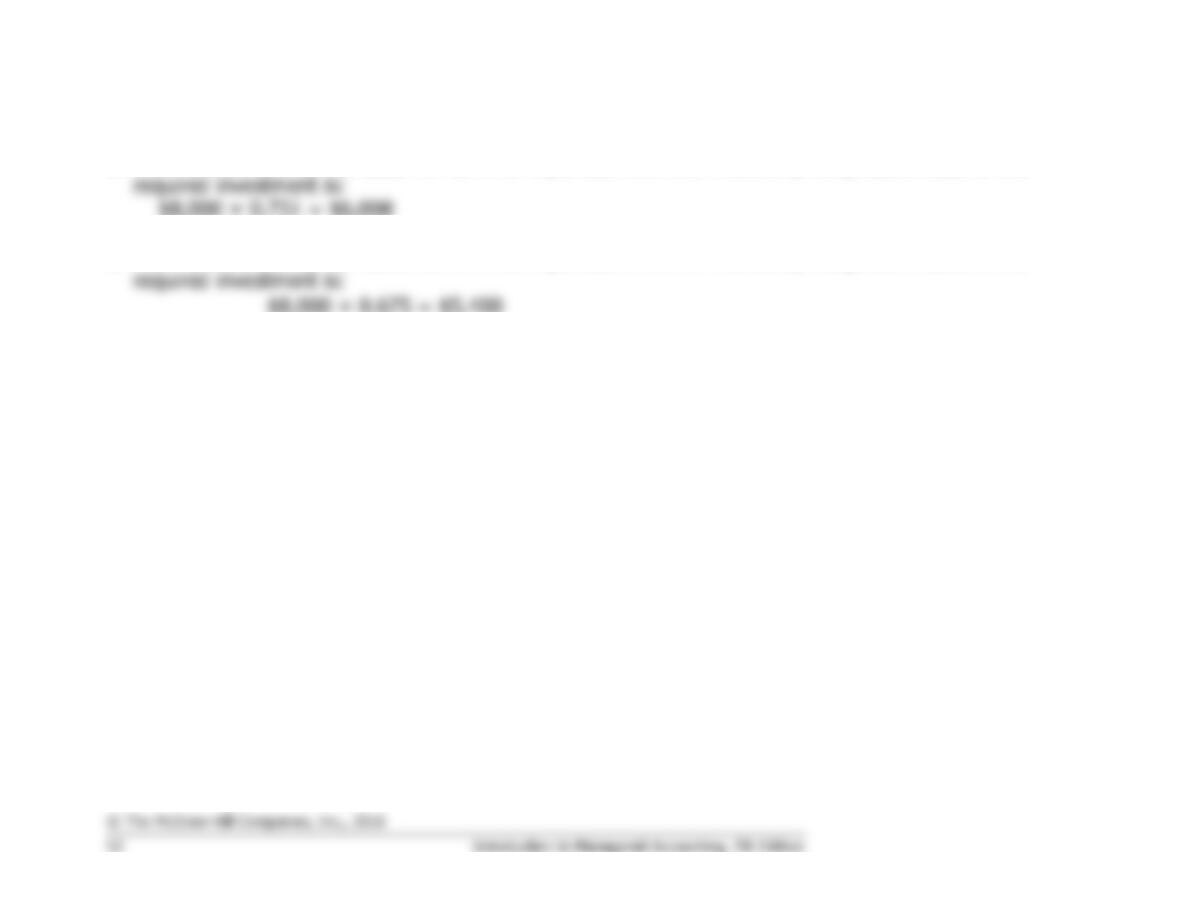
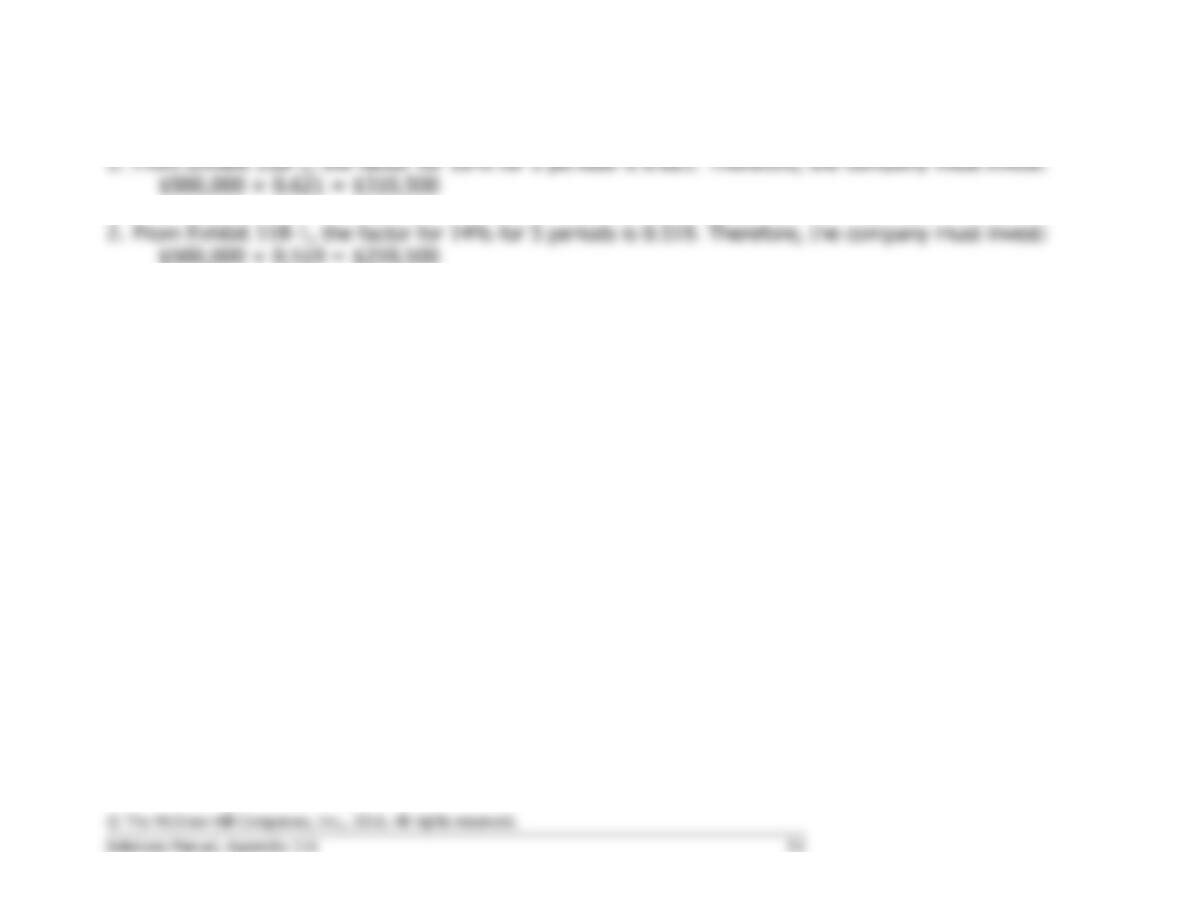
1. From Exhibit 11B-1, the factor for 10% for 3 periods is 0.751. Therefore, the present value of the
2. From Exhibit 11B-1, the factor for 14% for 3 periods is 0.675. Therefore, the present value of the
Exercise 11A-4 (10 minutes)
Exercise 11A-5 (10 minutes)
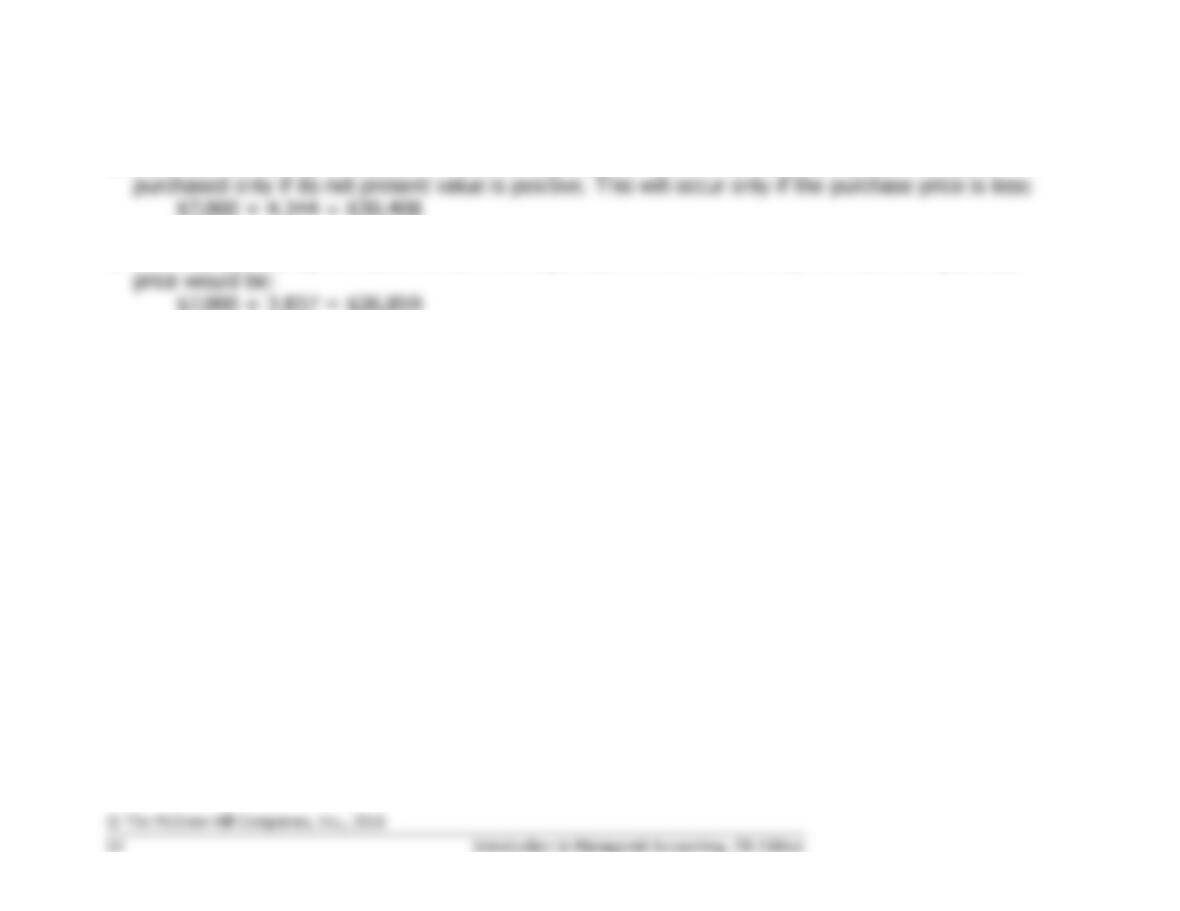
1. From Exhibit 11B-2, the factor for 16% for 8 periods is 4.344. The computer system should be
2. From Exhibit 11B-2, the factor for 20% for 8 periods is 3.837. Therefore, the maximum purchase
Exercise 11A-6 (10 minutes)
1. From Exhibit 11B-2, the factor for 12% for 20 periods is 7.469. Thus, the present value of Mr.
2. Whether or not it is correct to say that Mr. Ormsby is the state’s newest millionaire depends on your