Chapter 11 – Reporting and Interpreting Stockholders’ Equity
11-1
CHAPTER 11
REPORTING AND INTERPRETING STOCKHOLDERS’ EQUITY
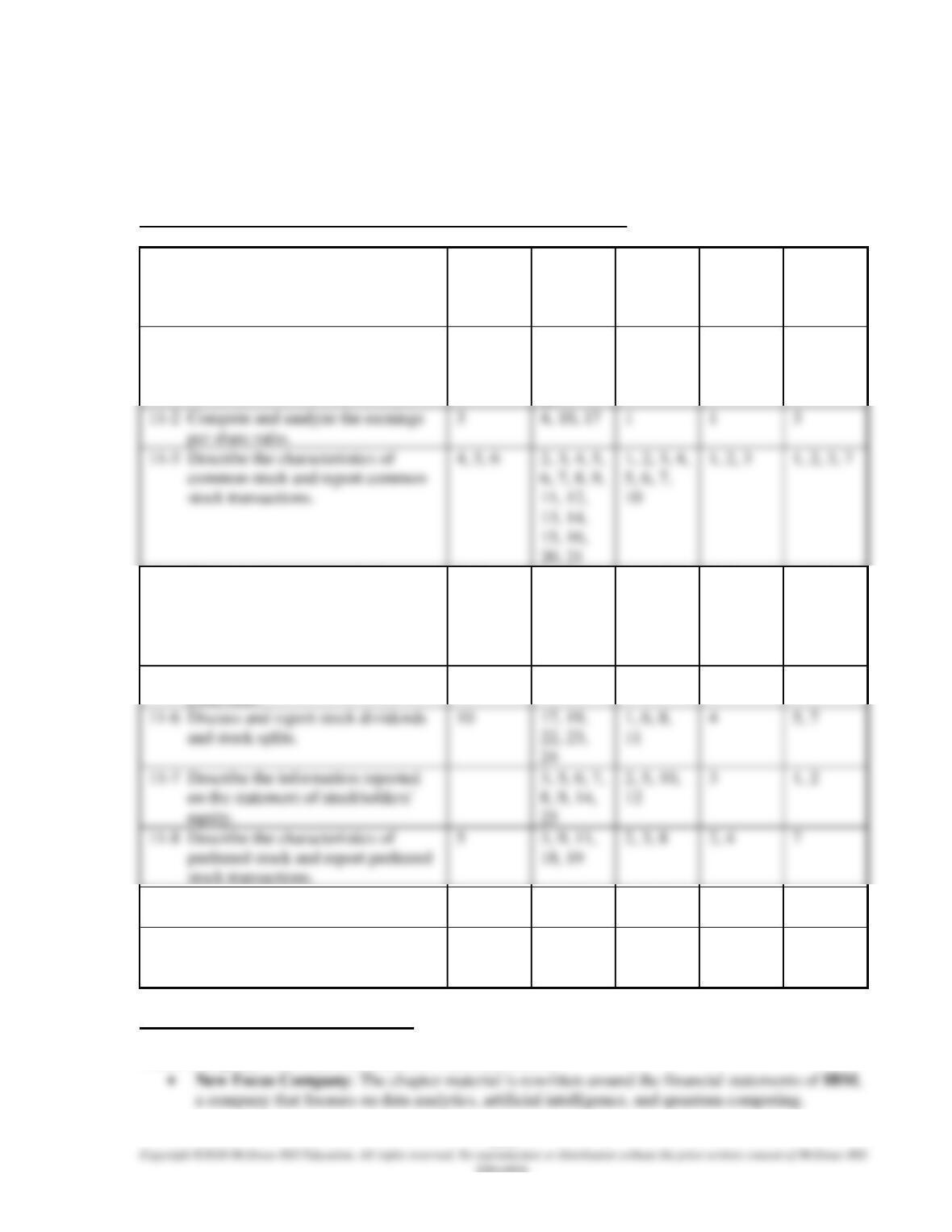
Learning Objectives and Related Assignment Materials
Learning Objectives
Mini-
Exercises
Exercises
Problems
Alternate
Problems
Cases and
Projects
11-1 Explain the role of stock in the
capital structure of a corporation.
1, 2
1, 2, 3, 4,
5, 6, 7, 8,
9, 12, 14,
25
1, 2, 3, 4,
5, 10, 12
1, 2, 3
1, 2, 7
11-2 Compute and analyze the earnings
per share ratio.
3
4, 10, 17
1
1
3
11-4 Discuss and report dividends.
7, 8
5, 12, 14,
16, 17,
18, 19,
20, 21,
24
1, 6, 8, 9,
10, 11
1, 4
1, 2, 3, 4,
5, 6, 7
11-5 Compute and analyze the dividend
yield ratio.
9
14
10
11-6 Discuss and report stock dividends
10
17, 19,
22, 23,
24
1, 6, 8,
11
4
5, 7
11-7 Describe the information reported
equity.
3, 5, 6, 7,
8, 9, 14,
2, 5, 10,
12
3
1, 2
11-8 Describe the characteristics of
stock transactions.
5
3, 9, 11,
18, 19
2, 3, 8
2, 4
7
11-9 Discuss the impact of stock
transactions on cash flows.
11
16, 17,
18, 24
6, 7, 9,
11
Chapter Supplement: Accounting for
Owners’ Equity for Sole
Proprietorships and Partnerships
25
12
Synopsis of Chapter Revisions
Focus Company: International Business Machines (IBM)
Chapter 11 – Reporting and Interpreting Stockholders’ Equity
11-2
• New contrast companies: Microsoft Corporation and Intel Corporation.
• New learning objective focused on the Statement of Stockholders’ Equity.
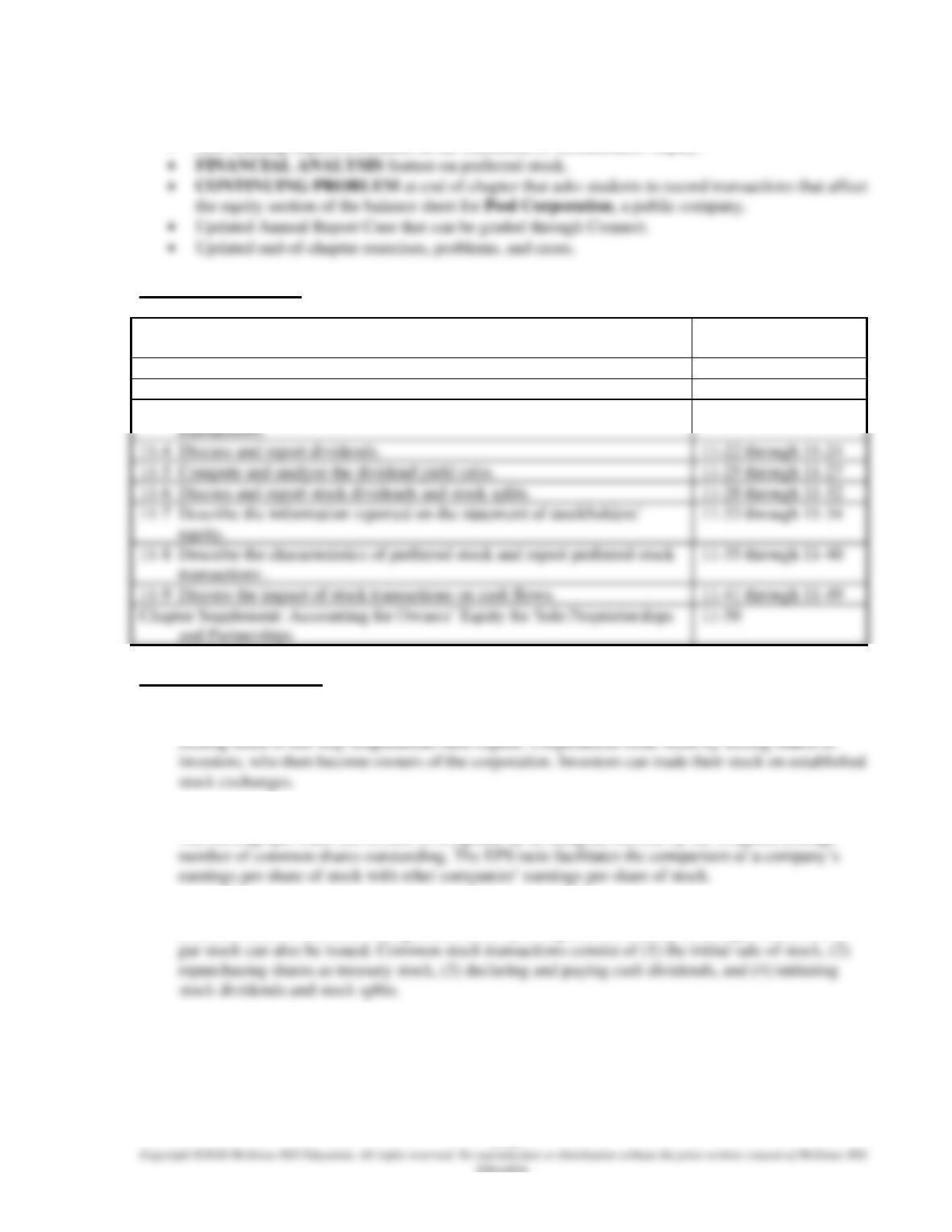
PowerPoint Slides
Learning Objectives
PowerPoint® Slides
11-1 Explain the role of stock in the capital structure of a corporation.
11-5 through 11-9
11-2 Compute and analyze the earnings per share ratio.
11-10 through 11-12
11-5 Compute and analyze the dividend yield ratio.
11-25 through 11-27
11-6 Discuss and report stock dividends and stock splits.
11-28 through 11-32
11-7 Describe the information reported on the statement of stockholders’
11-33 through 11-34
11-8 Describe the characteristics of preferred stock and report preferred stock
11-35 through 11-40
11-3 Describe the characteristics of common stock and report common stock
11-13 through 11-21
Chapter Take-Aways
11-1 Explain the role of stock in the capital structure of a corporation.
11-2 Compute and analyze the earnings per share ratio.
The earnings per share (EPS) ratio is computed by dividing net income by the weighted average
11-3 Describe the characteristics of common stock and report common stock transactions.
Common stock is the basic voting stock issued by a corporation. Usually it has a par value, but no-
Chapter 11 – Reporting and Interpreting Stockholders’ Equity
11-3
Chapter Take-Aways
11-4 Discuss and report dividends.
Investors earn a return on their stock investment through stock price appreciation, the receipt of
11-5 Compute and analyze the dividend yield ratio.
The dividend yield ratio is computed by dividing dividends per share by a stock’s market price per
11-6 Discuss and report stock dividends and stock splits.
Stock dividends and stock splits are both ways for companies to distribute additional shares of stock
11-7 Describe the information reported on the statement of stockholders’ equity.
The statement of stockholders’ equity is one of the four financial statements required by GAAP. It
11-8 Describe the characteristics of preferred stock and report preferred stock transactions.
The purpose of preferred stock is the same as that of common stock: to raise capital. Preferred stock
11-9 Discuss the impact of stock transactions on cash flows.
Any cash inflows or outflows associated with a company’s stock are reported in the Financing
Chapter 11 – Reporting and Interpreting Stockholders’ Equity
11-4
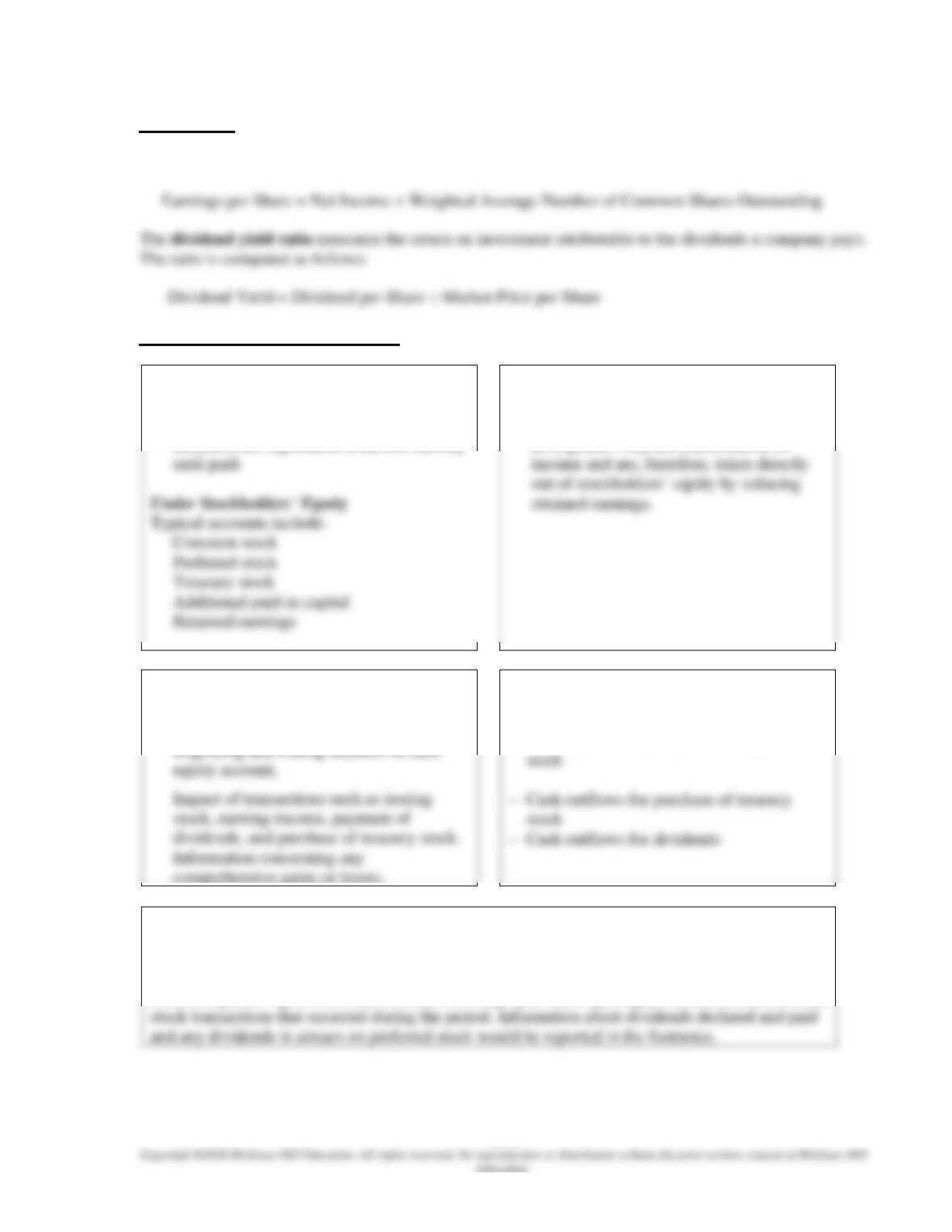
Key Ratios
The earnings per share ratio reflects net income on a per share basis. The ratio is computed as:
Finding Financial Information
Balance Sheet
Under Current Liabilities
Dividends, once declared by the board of
directors, are reported as a current liability
Income Statement
Capital stock transactions do not affect the
income statement. Dividends paid are not
an expense. They are a distribution of
Statement of Stockholders’ Equity
This statement reports detailed information
concerning stockholders’ equity, including
Statement of Cash Flows
Under Financing Activities
+ Cash inflows from initial sale of stock
+ Cash inflows from sale of treasury
Notes
Under Summary of Significant Accounting Policies
Capital stock is typically not discussed in detail in the summary footnote.
Under a Separate Note
Most companies report information about their employee stock option plans and information about
Chapter 11 – Reporting and Interpreting Stockholders’ Equity
11-5
Chapter Outline
Teaching Notes
1. Explain the role of stock in the capital structure of a corporation.
I. Ownership of a Corporation
A. Benefits of Stock Ownership
1. Owners of common stock receive a number of benefits:
number of shares owned
b. Dividends—A proportional share of the distribution of
a. A voice in management—Vote at the annual
B. Authorized, Issued, and Outstanding Shares
Illustrated in Exhibit 11.1
1. Authorized number of shares––the maximum number of
shares a corporation can issue as specified in its charter
3. Outstanding shares––the total number of shares of stock
2. Issued shares––the total number of shares of stock that
2. Compute and analyze the earnings per share ratio.
C. Key Ratio Analysis: Earnings per Share (EPS)
Common Shares Outstanding
3. EPS emphasizes the amount of earnings attributable to a
4. EPS is a measure of performance over a prior period,
future periods
1. Earnings per Share (EPS) = Net Income (as reported on
the income statement) ÷ Weighted Average Number of
3. Describe the characteristics of common stock and report common stock transactions.
II. Common Stock Transactions
A. Terminology
1. All corporations issue common stock and some elect to
issue a second type of stock called preferred stock
2. Common stock––the basic voting stock issued by a
corporation
Chapter 11 – Reporting and Interpreting Stockholders’ Equity
11-6
b. Instead, they elect a board of directors; the board’s
role is to hire and monitor executives who manage a
company’s activities on a day–to-day basis
3. Depending on state law, a company’s common stock may
be required to have a par value; most states require
b. Par value has no relationship to the market value of a
4. Legal capital––the permanent amount of capital defined
by state law that must remain invested in the business;
serves as a cushion for creditors
a. Par value––the nominal value per share of stock as
B. Initial Sale of Stock
2. Once a company’s stock has been traded on established
3. IBM sold 100,000 shares of its $0.20 par value stock for
$150 per share
1. Initial public offering (IPO) involves the very first sale of
a company’s stock to the public (i.e., when the company
dr Cash (+A) (100,000 × $150)
15,000,000
cr Common Stock (+SE)
(100,000 × $0.20)
20,000
cr Additional Paid-in Capital
(+SE)
14,980,000
Cash (A) +15,000,000 = Common Stock (SE) +20,000 +
Additional Paid-in Capital (SE) +14,980,000
b. If no par or stated value, entire proceeds from the sale
Assets = Liabilities + Stockholders’ Equity
C. Sale of Stock in Secondary Markets
1. When a company sells stock to the public, the transaction
is between the issuing corporation and the investor
3. If an investor sold 1,000 shares of IBM stock to another
investor, IBM would not record a journal entry
Chapter 11 – Reporting and Interpreting Stockholders’ Equity
D. Stock Issued for Employee Compensation
1. Advantage of the corporate form is the ability to separate
the management of a business from its ownership
2. Separation can be a disadvantage because some managers
may not act in the owners’ best interests; potential
problem can be addressed in a number of ways:
b. Another strategy is to offer managers stock options,
a. Compensation packages can be developed to reward
E. Repurchase of Stock
1. A corporation may want to repurchase its stock from
existing stockholders for a number of reasons
a. One common reason is the existence of an employee
bonus plan that provides workers with shares of the
company’s stock as part of their compensation
i. Because of SEC regulations concerning newly
2. Treasury stock––a corporation’s own stock that has been
issued but subsequently reacquired and is still being held
by that corporation
Chapter 11 – Reporting and Interpreting Stockholders’ Equity
11-8
3. IBM repurchased 100,000 shares of its stock in the open
market when it was selling for $140 per share
dr Treasury Stock (+XSE, –
cr Cash (–A)
Cash (A) –14,000,000 = Treasury Stock (SE) –
14,000,000
4. Treasury Stock account is a contra-equity account; it is
subtracted from total stockholders’ equity
5. When a company sells its treasury stock:
a. GAAP does not permit a corporation to report income
or losses from investments in its own stock
b. Transactions with the owners are not normal profit-
making activities
6. IBM resells 10,000 shares of treasury stock for $150 per
share; the company had repurchased the stock for $140
per share
dr Cash (+A) (10,000 × $150)
cr Treasury Stock (–XSE, +SE)
(+SE)
7. Assume instead that the treasury stock had been resold at
$130 per share rather than $150 per share
dr Cash (+A) (10,000 × $130)
dr Additional Paid-in Capital
cr Treasury Stock (-XSE, +SE)
(10,000 × $140)
1,400,00
Cash (A) +1,300,000 = Additional Paid-in Capital (SE)–
100,000 + Treasury Stock (SE) +1,400,000
1,300,00
4. Discuss and report dividends.
III. Dividends on Common Stock
A. Return on Investment
on their investment
2. Return on investment can come in two forms:
b. Dividends
1. Investors buy common stock because they expect a return
5. Compute and analyze the dividend yield ratio.
B. Key Ratio Analysis: Dividend Yield Ratio
1. Dividend Yield = Dividends per Share ÷ Market Price per
Share
Chapter 11 – Reporting and Interpreting Stockholders’ Equity
2. Measures how much a company pays out in dividends
each year relative to its share price
3. The dividend yield ratio reflects the return on investment
C. Declaration and Payment of Dividends
1. Three key dates:
a. Declaration date––the date on which the board of
directors officially approves a dividend; once the
2. On October 31, the board of IBM declares a $1,387
million dividend
Earnings (–SE)
dr Retained
1,387,000,000
3. On December 9, IBM pays the dividend
Refer students to Pause for
Feedback – Self-Study Quiz
dr Dividends
Payable (–L)
1,387,000,000
cr Cash (–A)
1,387,000,000
4. Two fundamental requirements for payment of a cash
6. Discuss and report stock dividends and stock splits.
IV. Stock Dividends and Stock Splits
A. Stock Dividends
1. Stock dividend––a distribution of additional shares of a
basis at no cost to existing stockholders
Chapter 11 – Reporting and Interpreting Stockholders’ Equity
11–10
a. A stock dividend by itself has no economic value
ii. The stock market reacts immediately when a stock
dividend is issued; stock price falls
b. In some cases, the stock dividend makes the stock
more attractive to new investors; in such cases, the
stock price decrease at the time of a stock dividend
will likely not be exactly proportional to the number
of new shares issued
3. When a company’s board of directors declares a stock
dividend, the company must transfer an amount out of the
Retained Earnings account (or the Additional Paid-in
b. Small stock dividend
i. Distribution of additional shares that amount to less
than 20–25 percent of currently outstanding shares
Additional Paid-in Capital account
ii. GAAP requires the amount transferred to be based
on the market price of the stock, with the par value
($0.20 par ×
50,000,000)
10,000,000
cr Common Stock
(+SE)
($0.20 par ×
10,000,000
Chapter 11 – Reporting and Interpreting Stockholders’ Equity
11–11
50,000,000)
5. IBM declared a small stock dividend that resulted in an
additional 5,000,000 shares being distributed to
stockholders; IBM stock was trading at $150 per share
5,000,000)
cr Additional Paid-in
Capital (+SE)
dr Retained Earnings (–SE)
($150 market price ×
6. Regardless of whether a stock dividend is classified as
large or small, there is no change in the total amount of
stockholders’ equity
B. Stock Splits
1. Stock split––gives stockholders a specified number of
additional shares for each share they current hold
2. Stock splits are not dividends
a. In a stock split, the total number of authorized shares
is increased by a specified amount
ii. A company’s footnotes will state whether the stock
i. For example, when a company declares a two-for-
b. When a company initiates a stock split, it also reduces
the par value of its stock so that the total dollar
amount in the Common Stock account remains
unchanged
i. If IBM executes a 2-for-1 stock split, it reduces the
Chapter 11 – Reporting and Interpreting Stockholders’ Equity
does not but is disclosed in the notes to the financial
statements
Use Supplemental
Enrichment Activity #4
Use Supplemental
V. Statement of Stockholders’ Equity
Illustrated in Exhibit 11.2
A. In addition to an income statement, balance sheet, and
statement of cash flows, GAAP requires a statement of
stockholders’ equity
C. Statement of stockholders’ equity also reports accumulated
other comprehensive gain (loss), which captures certain
items that are reported as a part of comprehensive income,
but not net income
These topics are covered in
intermediate accounting
courses
1. Unrealized hold gains or losses from available-for-sale
securities
a. Under GAAP, gains and losses are reported on the
income statement only when the stock is sold
is sold are included in comprehensive income
a. Many U.S. companies have foreign subsidiaries that
conduct business using foreign currencies
b. Unrealized gains and losses that occur before the stock
7. Describe the information reported on the statement of stockholders’ equity.
VI. Preferred Stock
A. Issuance of Preferred Stock
common stock
1. In addition to common stock, some corporations issue
preferred stock–– stock that has specified rights over
common stock.
Chapter 11 – Reporting and Interpreting Stockholders’ Equity
3. Preferred stock differs from common stock in a number
of ways:
preferred stock to raise capital
b. Preferred stock is less risky because holders receive
assets if the corporation goes out of business
a. Preferred stock typically does not have voting rights;
B. Dividends on Preferred Stock
preference
1. Because investors who purchase preferred stock give up
2. The two common dividend preferences include:
a. Current dividend preference––requires that dividends
be paid to preferred stockholders before any dividends
are paid to common stockholders
8. Describe the characteristics of preferred stock and report preferred stock transactions.
C. Focus on Cash Flows – Financing Activities
Illustrated in Exhibit 11.3
1. The cash inflows and outflows associated with these
transactions are reported in the Financing Activities
section of the statement of cash flows
c. The cash received from the sale of treasury stock is
reported as cash inflow
d. The cash used to pay cash dividends is reported as a
cash outflow
Chapter 11 – Reporting and Interpreting Stockholders’ Equity
11–14
9. Discuss the impact of stock transactions on cash flows.
VI. Chapter Supplement: Accounting for Owners’ Equity for Sole Proprietorships and Partnerships
A. Owner’s Equity for a Sole Proprietorship
1. Sole proprietorship—Unincorporated business owned by
one person
a. Only two owners’ equity accounts are needed:
i. A capital account for the proprietor
for a sole proprietorship
2. In most respects, the accounting for a sole proprietorship
is the same as for a corporation.
a. Because a sole proprietorship does not pay income
B. Owners’ Equity for a Partnership
1. Partnership (per Uniform Partnership Act)—An
association of two or more persons to carry on as co-
owners of a business for profit
a. Agreement between the partners constitutes a
partnership contract
i. Agreement should specify matters such as division
of periodic income, management responsibilities,
Chapter 11 – Reporting and Interpreting Stockholders’ Equity
11–15
2. Accounting for a partnership follows the same underlying
principles as any other form of business organization,
except for those entries affecting equity
Recording of owner’s equity
for a partnership illustrated
in Exhibit 11.5
a. Separate capital and drawing accounts must be
3. The financial statements of a partnership follow the same
format as those for a corporation except that:
a. The partners’ equity section of the balance sheet is
detailed for each partner
Chapter 11 – Reporting and Interpreting Stockholders’ Equity
11–16
Supplemental Enrichment Activities
Note: These activities would be suitable for individual or group activities.
1. Handout 11-1
Use handout 1-1 for an in-class discussion of the meaning of the terms: (1) authorized, (2) issued, and
2. Handout 11-2
3. Handout 11-3
4. Handout 11-4
Use Handout 11-4 for an in-class activity designed to review the recording of stock dividends. The
solution follows the handout master.
5. Handout 11-5
6. Handout 11-6