Chapter 11
Capital Budgeting Decisions
Solutions to Questions
11-1 A capital budgeting screening decision is
concerned with whether a proposed investment
11-2 The “time value of money” refers to the
fact that a dollar received today is more valuable
than a dollar received in the future simply
because a dollar received today can be invested
to yield more than a dollar in the future.
11-3 Discounting is the process of computing
the present value of a future cash flow.
11-4 Accounting net income is based on
accruals rather than on cash flows. Both the net
present value and internal rate of return
methods focus on cash flows.
11-5 Unlike other common capital budgeting
methods, discounted cash flow methods
11-6 Net present value is the present value of
11-7 One assumption is that all cash flows
11-8 No. The cost of capital is not simply the
interest paid on long-term debt. The cost of
value method, the cost of capital is used as the
discount rate. If the net present value of the
project is positive, then the project is acceptable
because its rate of return is greater than the
cost of capital. (b) In the case of the internal
rate of return method, the cost of capital is
compared to a project’s internal rate of return. If
the project’s internal rate of return is greater
present value of a given future cash flow
decreases. For example, the present value factor
for a discount rate of 12% for cash to be
received ten years from now is 0.322, whereas
the present value factor for a discount rate of
14% over the same period is 0.270. If the cash
to be received in ten years is $10,000, the
present value in the first case is $3,220, but only
discount rate) is zero. The internal rate of return
would be less than 14% if the net present value
11-12 The project profitability index is
computed by dividing the net present value of
11-13 The payback period is the length of time
for an investment to fully recover its initial cost
investment proposals. The payback method is
useful when a company has cash flow problems.
dollar received today. Furthermore, the payback
method ignores all cash flows that occur after
the initial investment has been recovered.
The Foundational 15
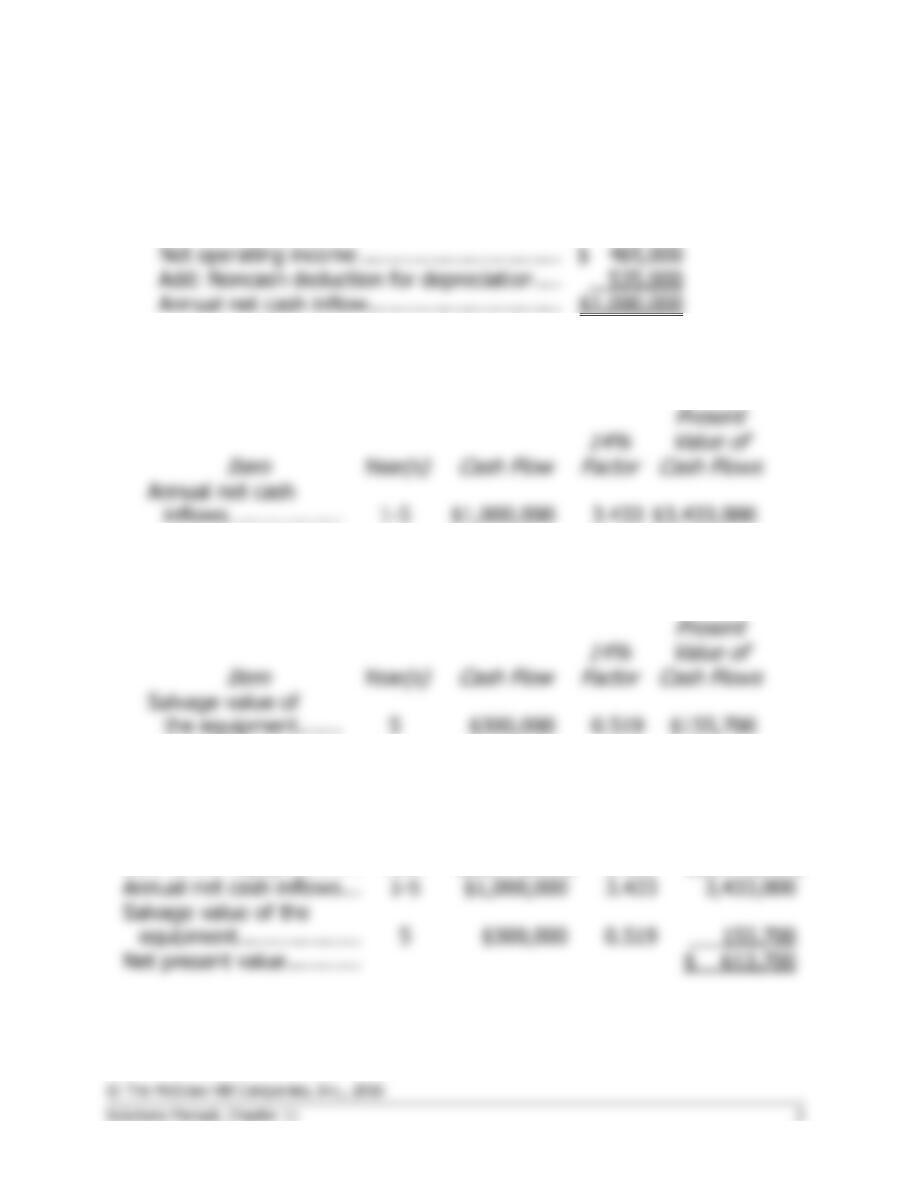
1. The depreciation expense of $535,000 is the only non-cash expense.
2. The annual net cash inflows are computed as follows:
3. The present value of the annual net cash inflows is computed as
follows:
4. The present value of the equipment’s salvage value is computed as
follows:
Factor
5. The project’s net present value is computed as follows:
Item
Year(s)
Amount of
Cash Flows
14%
Factor
Present Value
of Cash Flows
Cost of the equipment ……………
Now
$(2,975,000)
1.000
$(2,975,000)
Annual net cash inflows ………….
3.433
The Foundational 15 (continued)
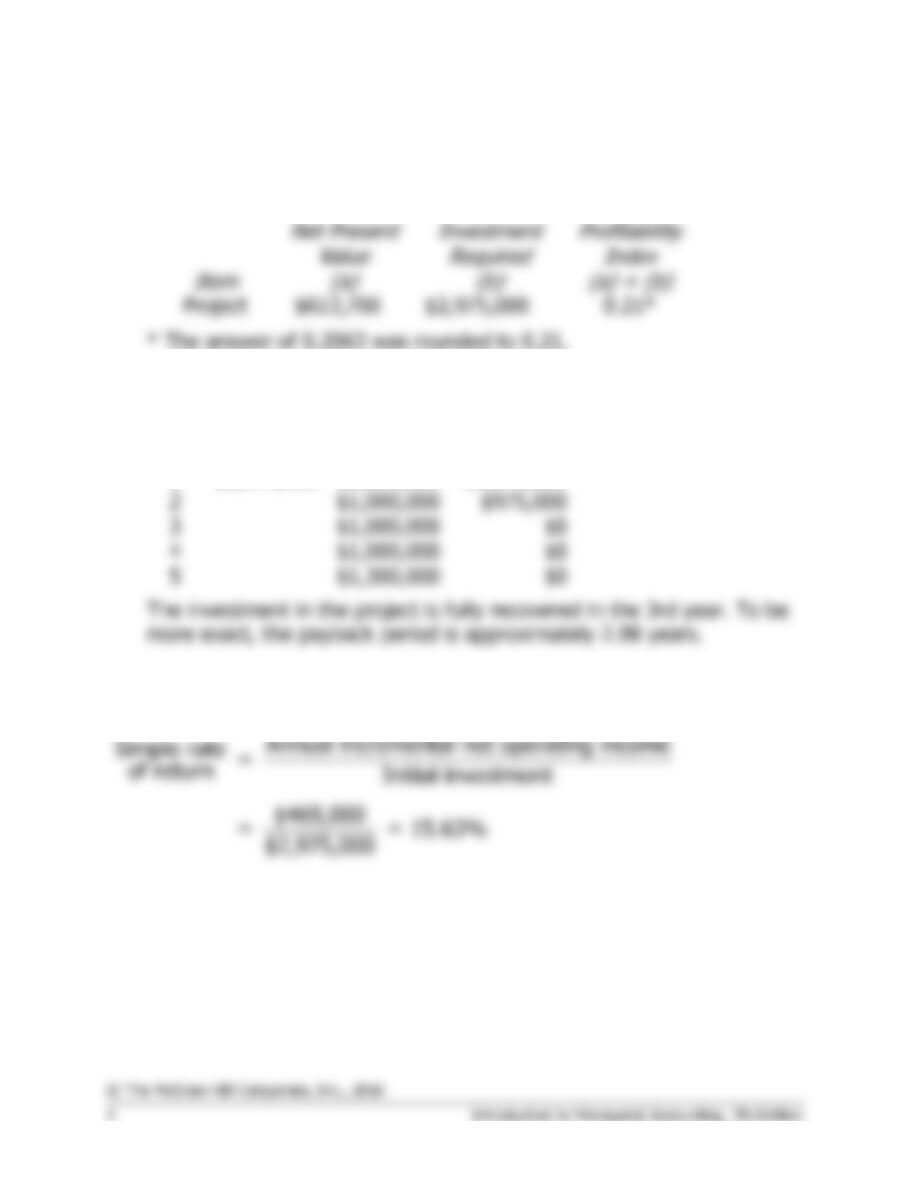
6. The project profitability index for the project is:
Project
7. The payback period is determined as follows:
Year
Investment
Cash
Inflow
Unrecovered
Investment
1
$2,975,000
$1,000,000
$1,975,000
8. The simple rate of return is computed as follows:
The Foundational 15 (continued)
9. If the discount rate was 16% instead of 14% the project’s net present
value would be lower because the discount factors would be smaller.
10. The payback period would be the same because the initial investment
11. The net present value would be higher because a higher salvage value
translates into a larger cash inflow at the end of five years. If we hold
12. The first step in computing the simple rate of return is to realize that if
the salvage value increases by $200,000, then the annual depreciation
expense will decrease by $40,000 ($200,000 ÷ 5 year useful life). The
The Foundational 15 (continued)
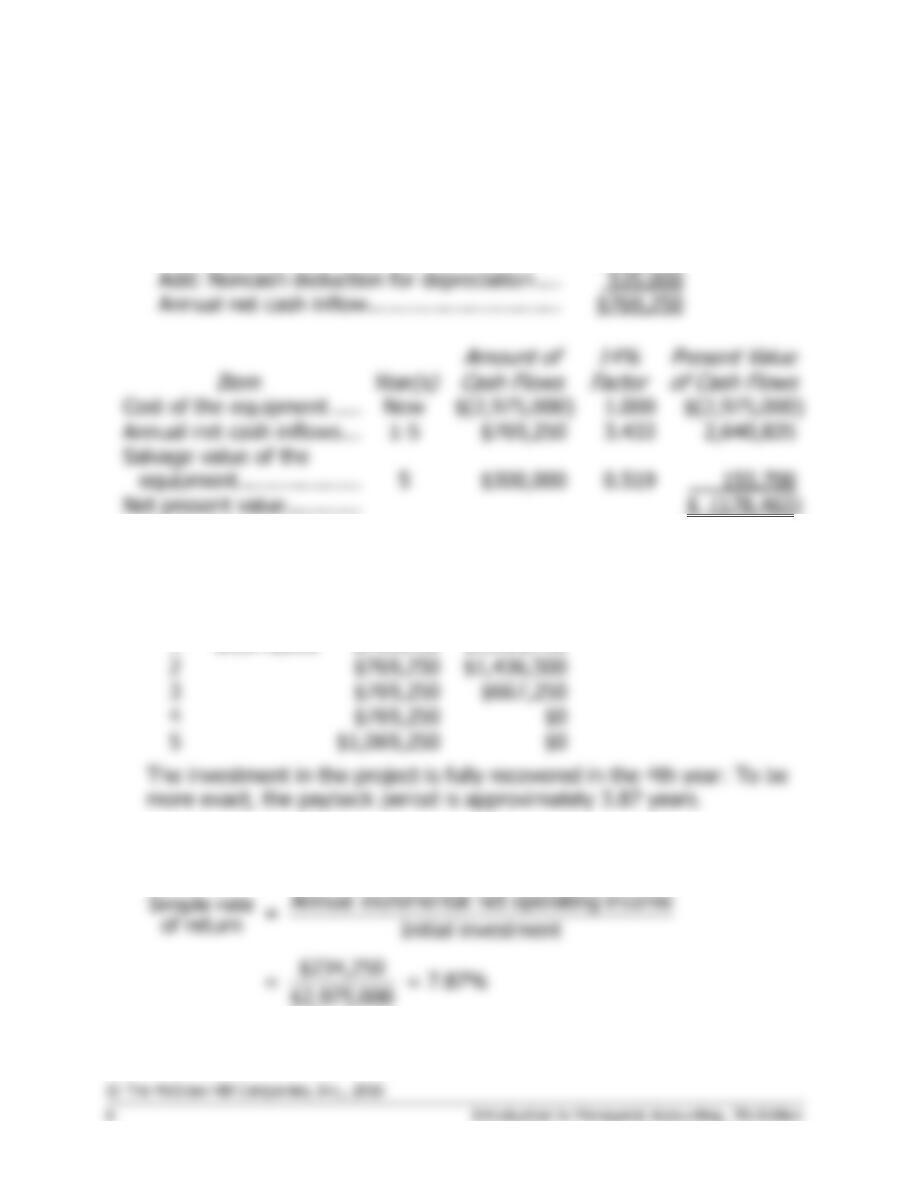
13. The new contribution margin would be $2,735,000 × 55% =
$1,504,250. The new net operating income would be $1,504,250 –
$1,270,000 = $234,250. The remaining calculations are as follows:
Net operating income …………………………..
$234,250
Add: Noncash deduction for depreciation ….
Year(s)
Cost of the equipment ……………
1.000
Annual net cash inflows ………….
1-5
3.433
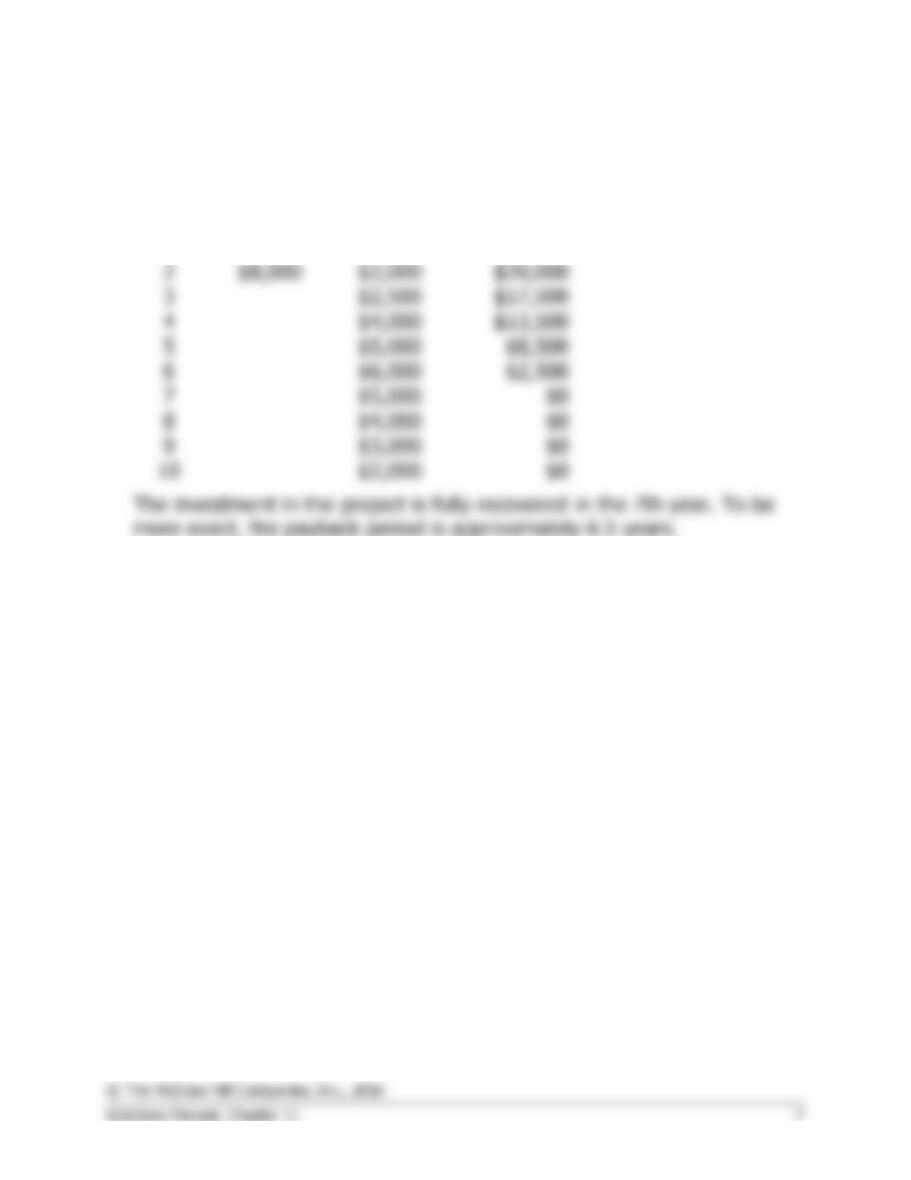
14. The payback period is computed as follows:
Year
Investment
Cash
Inflow
Unrecovered
Investment
1
$2,975,000
$769,250
$2,205,750
2
$769,250
$1,436,500
3
$769,250
4
$769,250
15. The simple rate of return is computed as follows:
Exercise 11-1 (10 minutes)
1. The payback period is determined as follows:
Year
Investment
Cash Inflow
Unrecovered
Investment
1
$15,000
$1,000
$14,000
6
$6,000
7
$5,000
2. Because the investment is recovered prior to the last year, the amount
of the cash inflow in the last year has no effect on the payback period.
Exercise 11-2 (10 minutes)
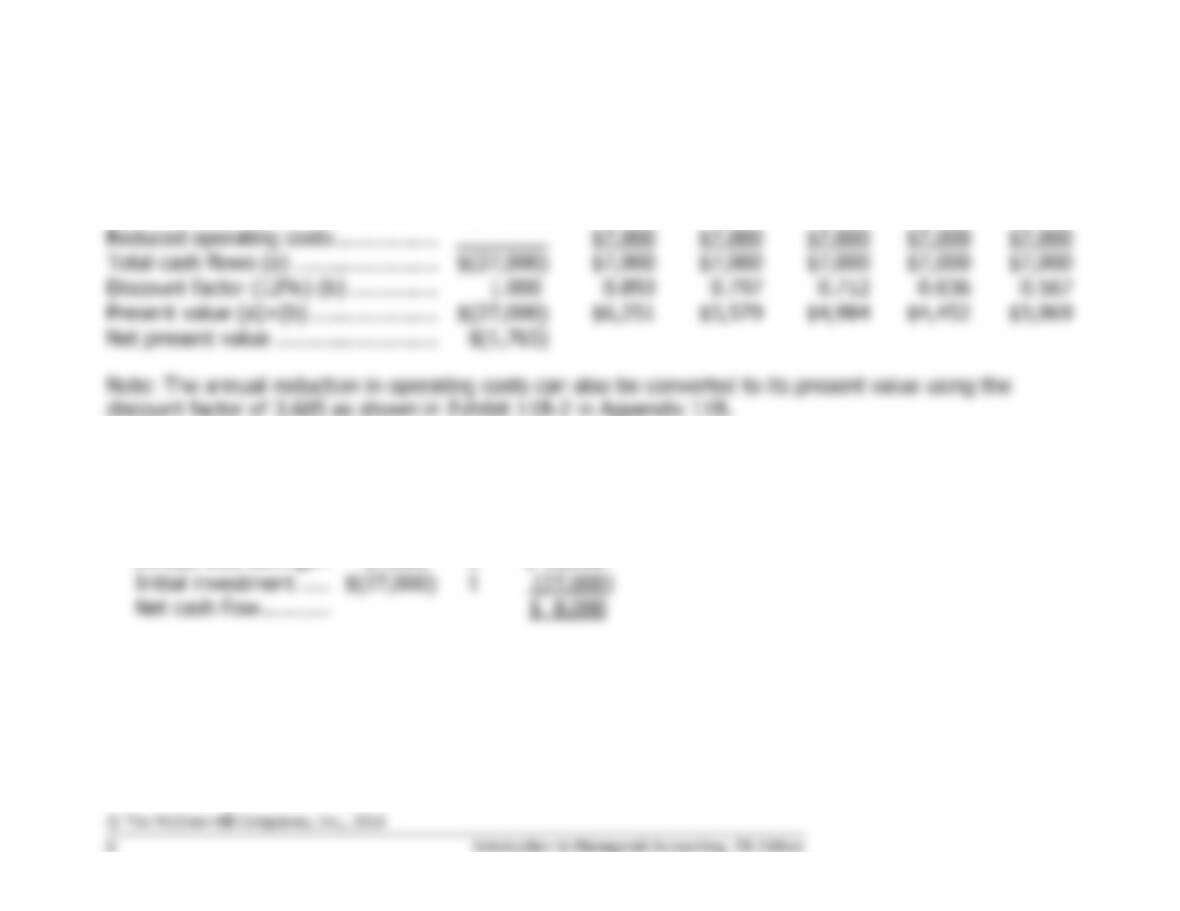
1.
Now
1
2
3
4
5
Purchase of machine ………………….
$(27,000)
Reduced operating costs …………….
________
$7,000
$7,000
$7,000
Total cash flows (a) …………………..
$(27,000)
$7,000
$7,000
$7,000
Discount factor (12%) (b) …………..
Present value (a)×(b) ………………..
$(27,000)
$6,251
$5,579
$4,984
Net present value ……………………..
$(1,765)
2.
Item
Cash
Flow
Years
Total
Cash
Flows
Annual cost savings ..
$7,000
5
$ 35,000
Initial investment …..
1
Net cash flow ………..
Exercise 11-3 (10 minutes)
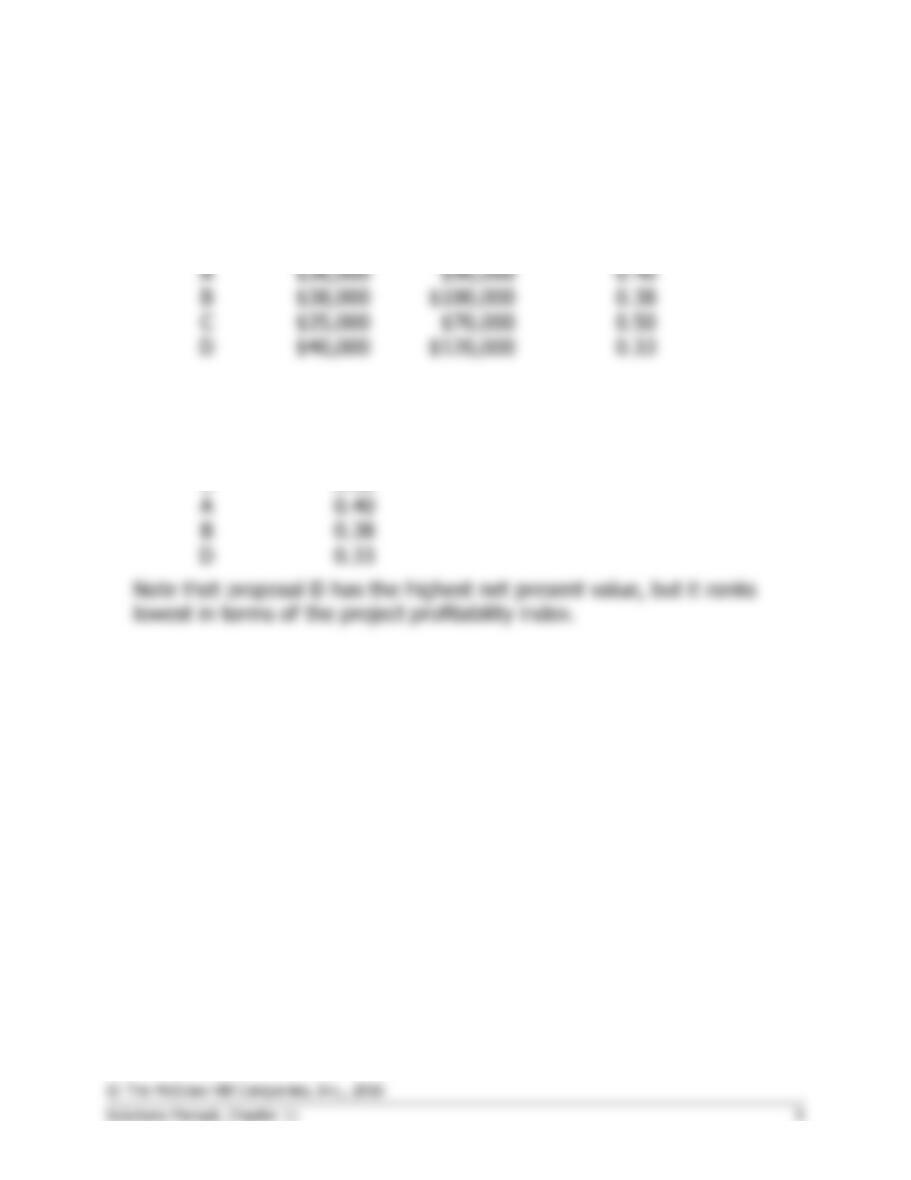
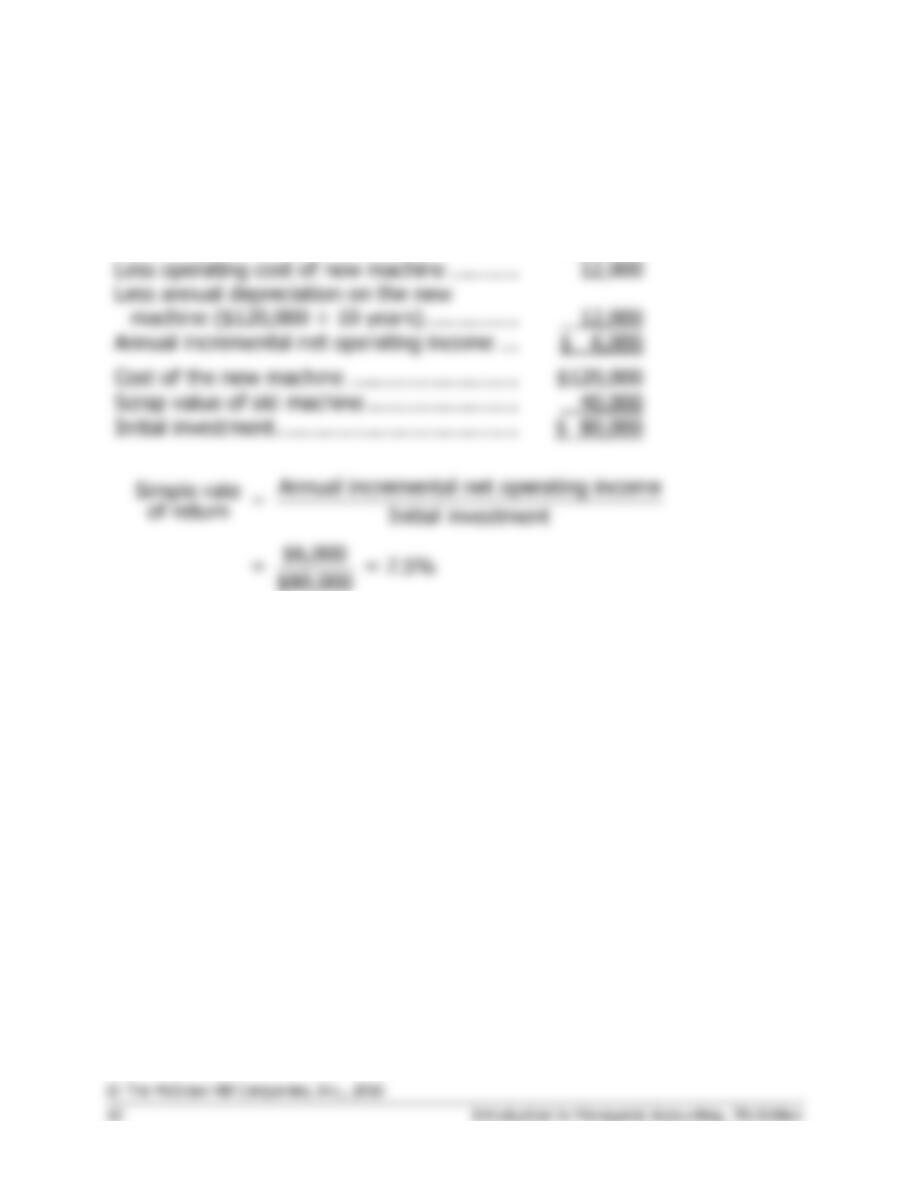
1. The project profitability index for each proposal is:
Proposal
Number
Net Present
Value
(a)
Investment
Required
(b)
Project Profitability
Index
(a) (b)
0.38
C
0.50
D
0.33
2. The ranking is:
Proposal
Number
Project Profitability
Index
C
0.50
D
0.33
Exercise 11-4 (10 minutes)
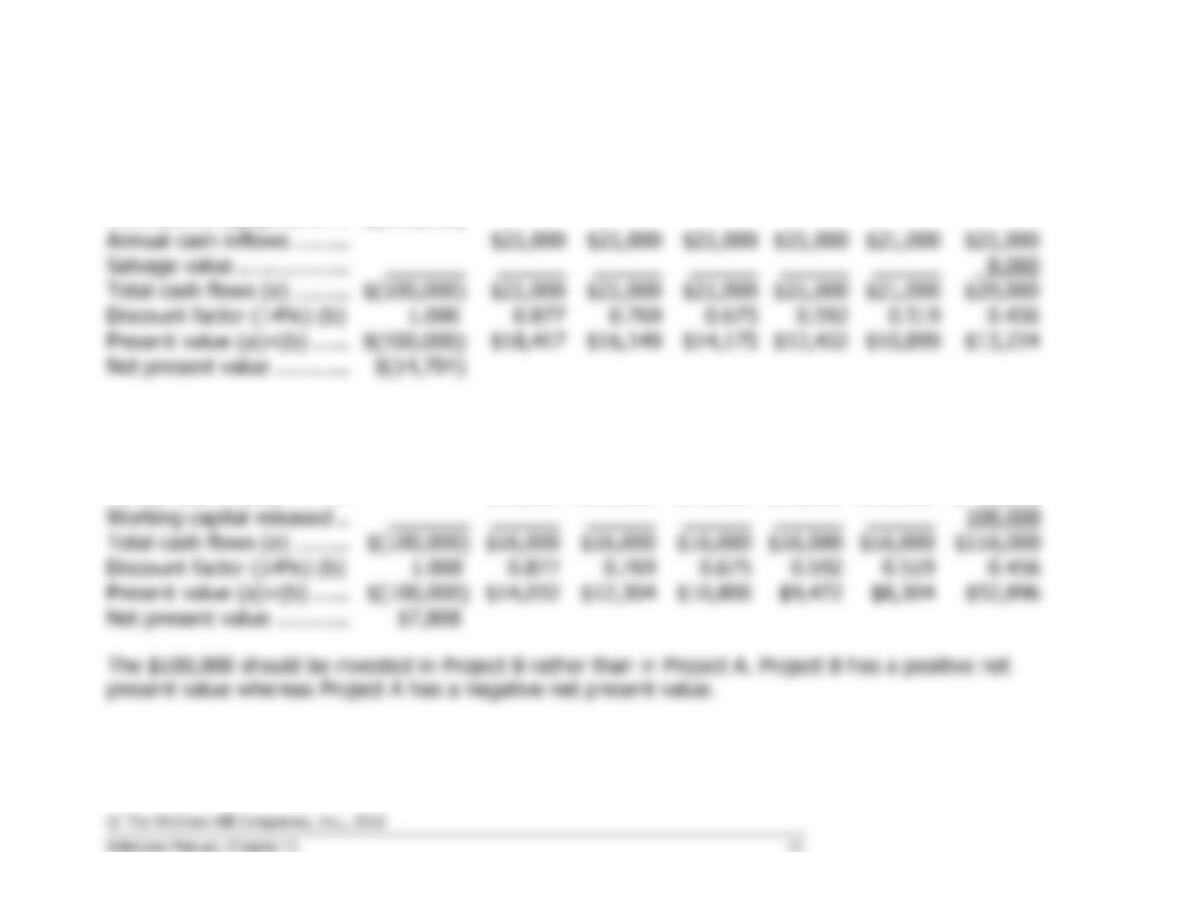
This is a cost reduction project, so the simple rate of return would be
computed as follows:
Operating cost of old machine ………………..
$ 30,000
Annual incremental net operating income …
$ 6,000
Cost of the new machine ………………………
Scrap value of old machine ……………………
40,000
Exercise 11–5 (15 minutes)
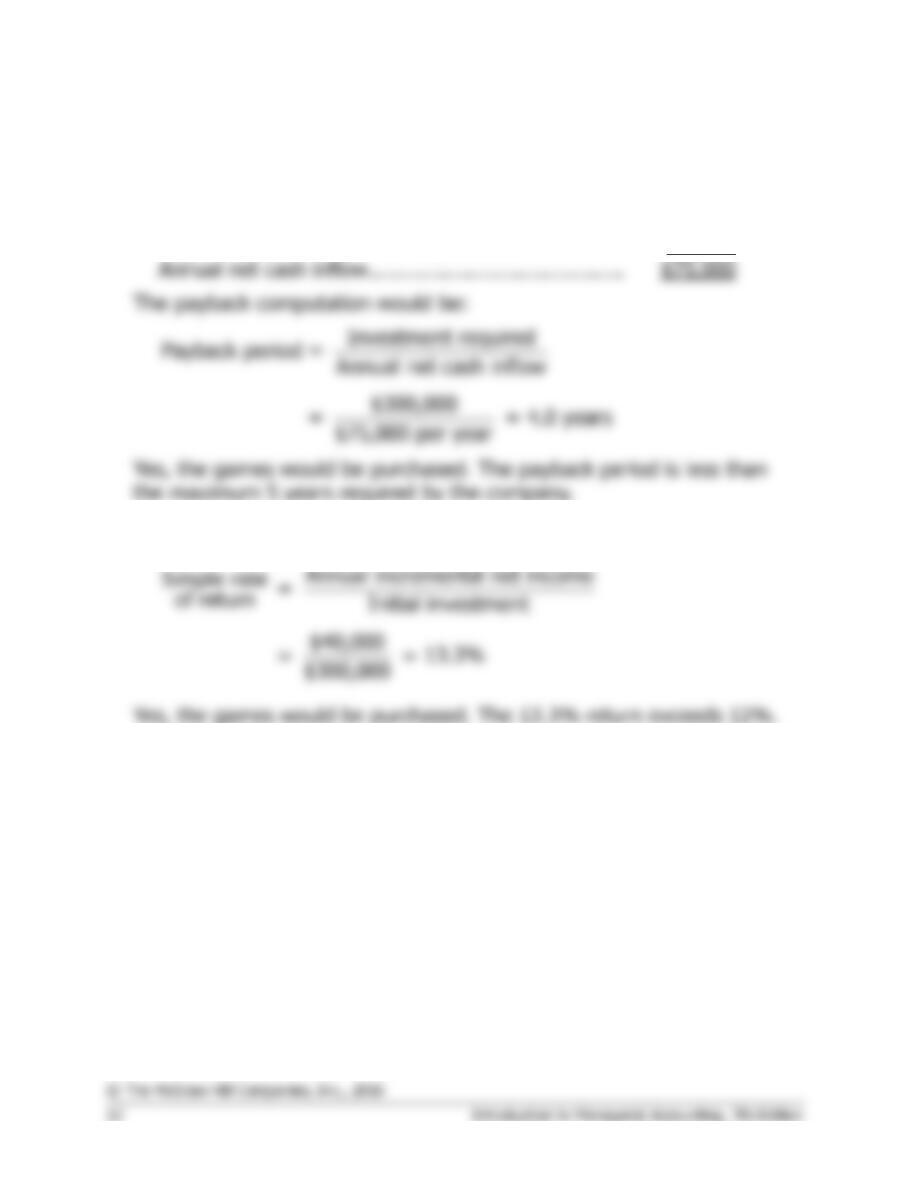
Project A:
Now
1
2
3
4
5
6
Purchase of equipment …..
$(100,000)
Annual cash inflows ………
$21,000
$21,000
$21,000
$21,000
Salvage value ………………
Total cash flows (a) ………
$(100,000)
$21,000
$21,000
Discount factor (14%) (b)
Present value (a)×(b) ……
$12,432
$10,899
Net present value …………
Project B:
Now
1
2
3
4
5
6
Working capital invested ..
$(100,000)
Annual cash inflows ………
$16,000
$16,000
$16,000
$16,000
$16,000
$ 16,000
Working capital released ..
Total cash flows (a) ………
$16,000
$16,000
$16,000
$16,000
$16,000
Discount factor (14%) (b)
Present value (a)×(b) ……
$12,304
Net present value …………
Exercise 11-6 (15 minutes)
1. Computation of the annual cash inflow associated with the new
electronic games:
Net operating income ……………………………………
$40,000
Add noncash deduction for depreciation …………….
35,000
2. The simple rate of return would be:
Exercise 11-7 (20 minutes)
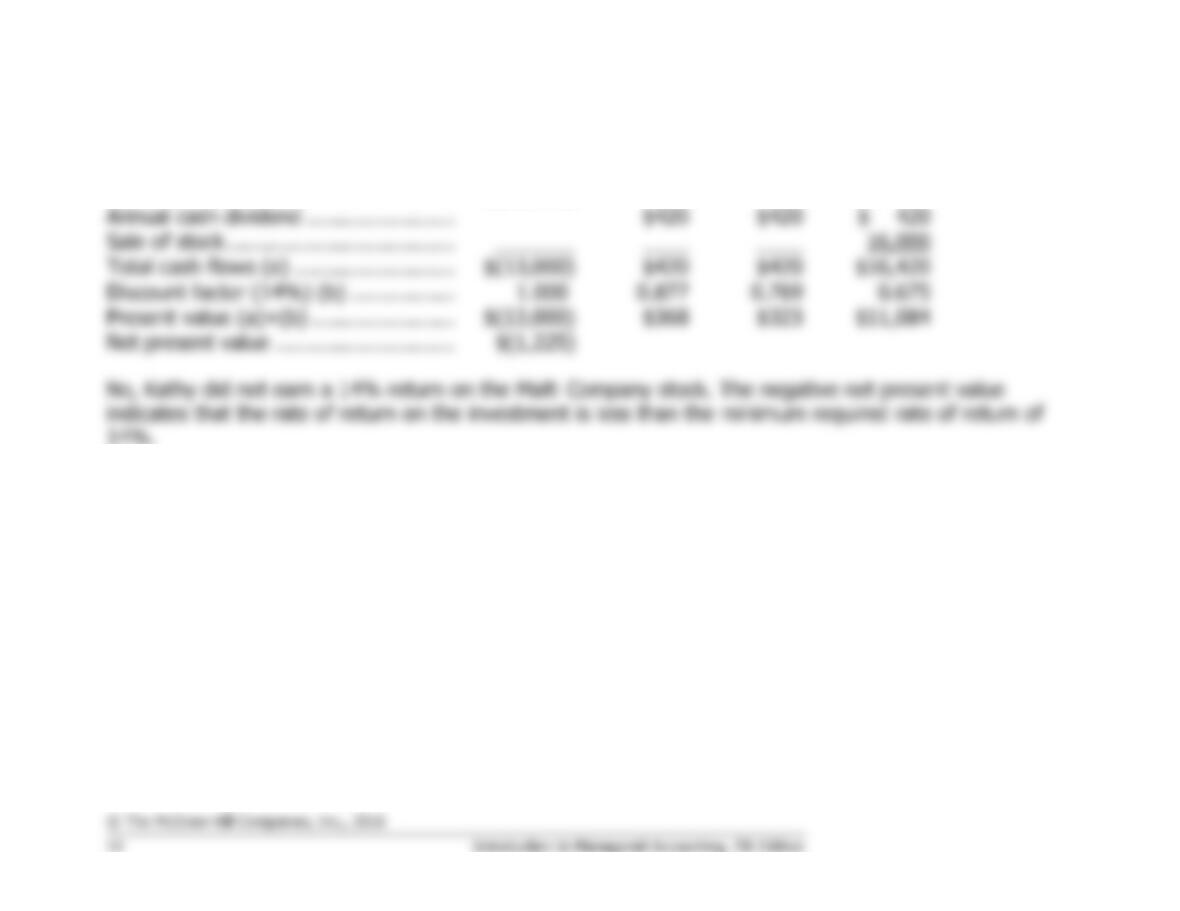
1. The net present value is computed as follows:
Now
1
2
3
4
5
Purchase of
equipment …………….
$(3,000,000)
Sales ……………………
$2,500,000
Variable expenses …..
Total cash flows (a) ..
$(3,000,000)
Discount factor (b) ….
Present value
2. The simple rate of return would be:
3. The company would want Derrick to pursue the investment opportunity because it has a positive net
present value of $17,700. However, Derrick might be inclined to reject the opportunity because its
Exercise 11–8 (10 minutes)
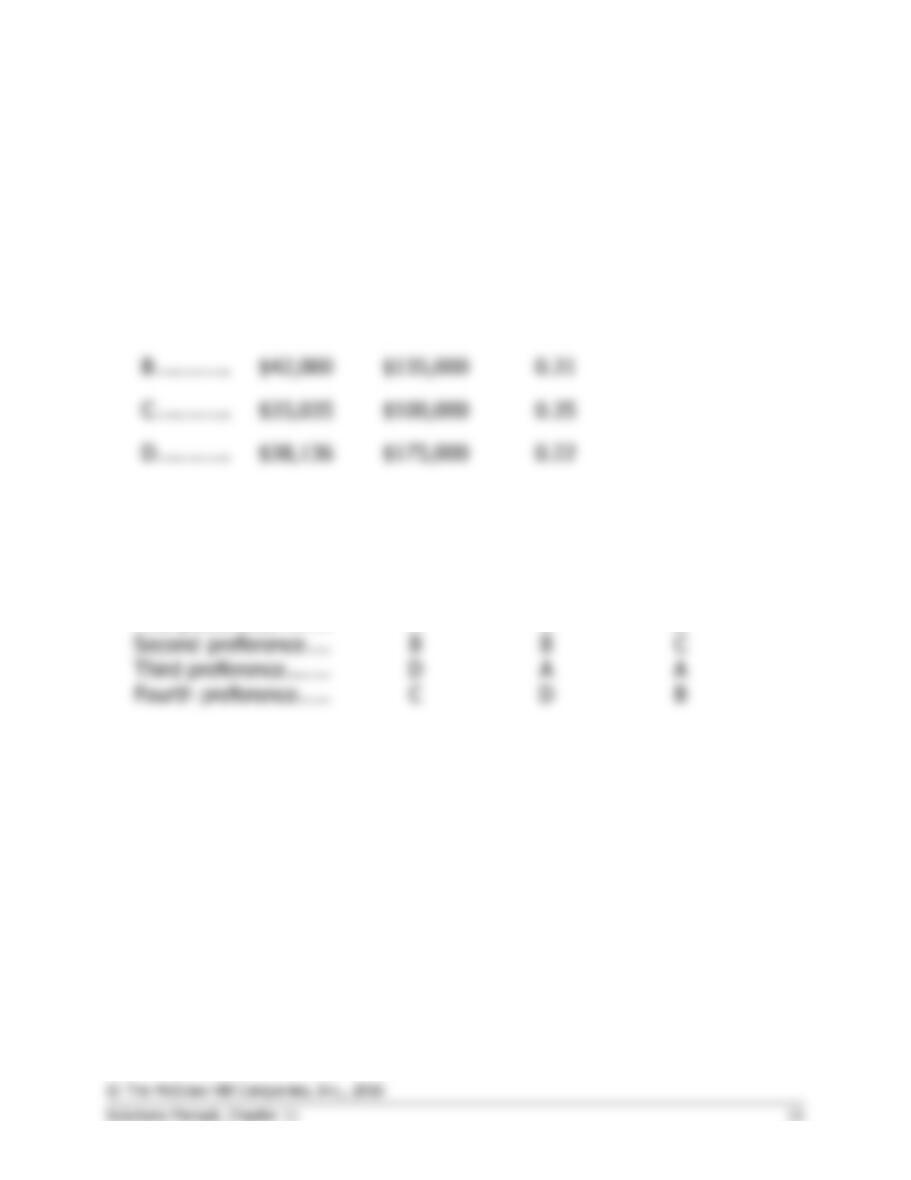
Now
1
2
3
Purchase of stock…………………………
$(13,000)
Annual cash dividend ……………………
Sale of stock …………………………..…..
Total cash flows (a) ……………………..
$(13,000)
Discount factor (14%) (b) ……………..
Present value (a)×(b) …………………..
$(13,000)
Net present value ………………………..
Problem 11-9 (30 minutes)
1. The project profitability index is computed as follows:
Project
Net Present
Value
(a)
Investment
Required
(b)
Project
Profitability
Index
(a) ÷ (b)
A …………
$44,323
$160,000
0.28
B …………
$42,000
$135,000
0.31
C …………
$35,035
$100,000
0.35
D …………
$38,136
$175,000
0.22
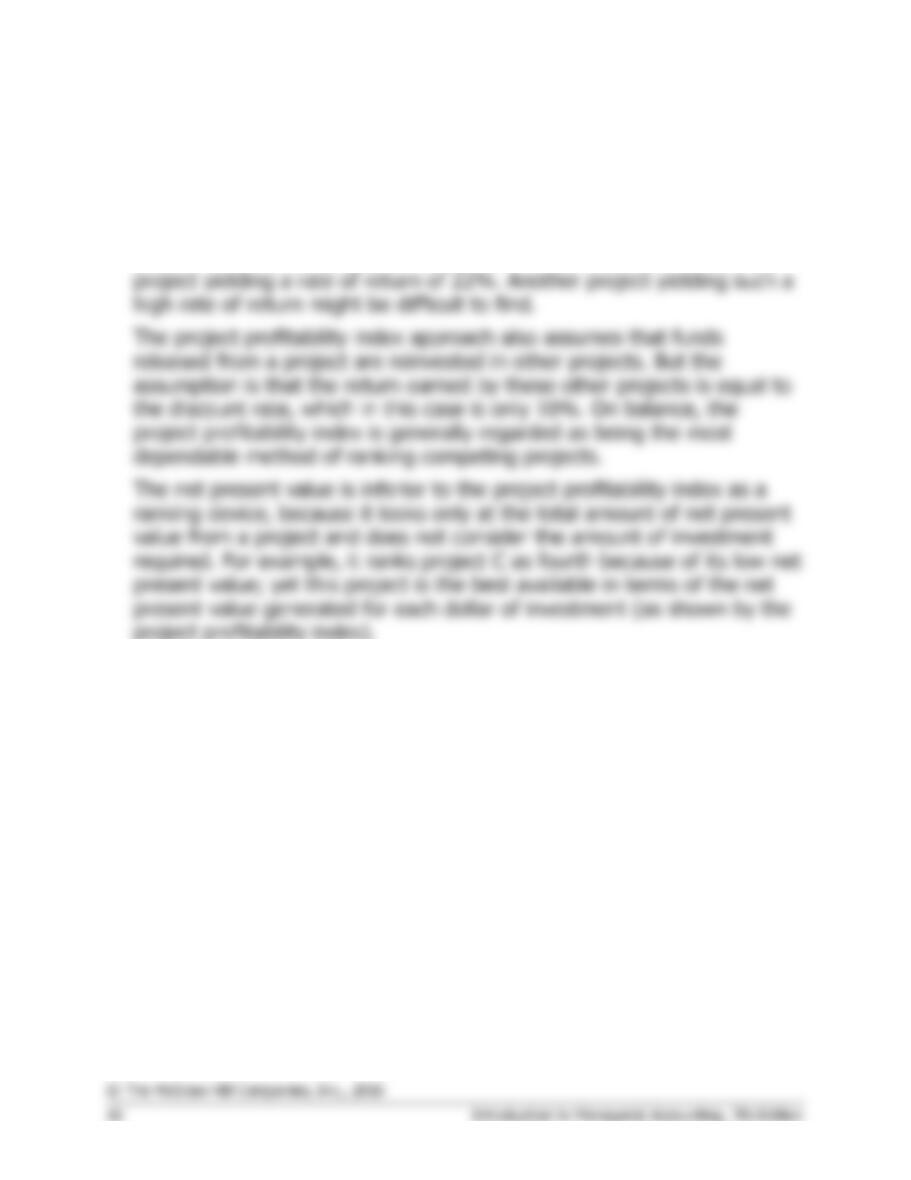
2. a., b., and c.
Net Present
Value
Project
Profitability
Index
Internal Rate
of Return
First preference ……..
A
C
D
Second preference ….
B
B
C
Third preference …….
A
A
Fourth preference …..
C
B
Problem 11-9 (continued)
3. Oxford Company’s opportunities for reinvesting funds as they are
released from a project will determine which ranking is best. The
internal rate of return method assumes that any released funds are
reinvested at the rate of return shown for a project. This means that
funds released from project D would have to be reinvested in another
Exercise 11-10 (15 minutes)
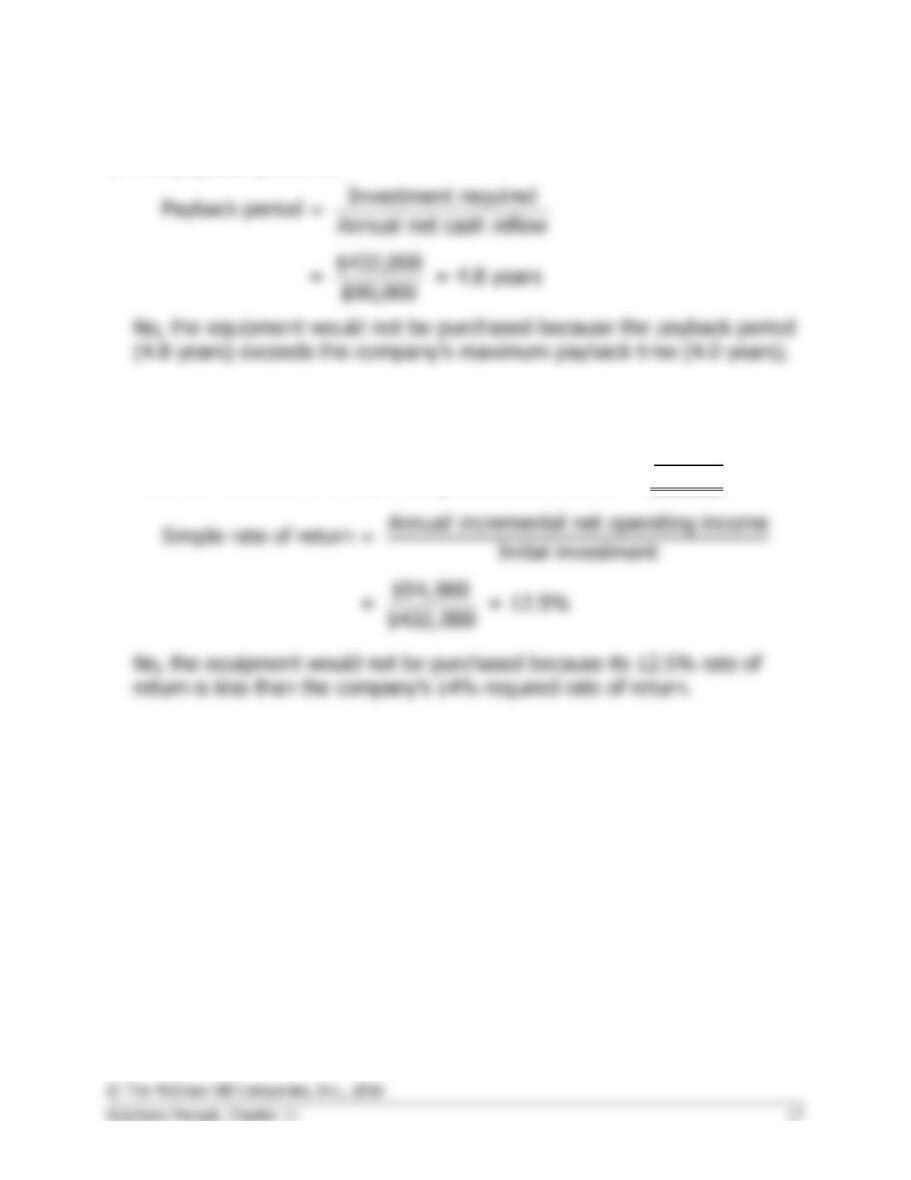
1. The payback period is:
2. The simple rate of return would be computed as follows:
Annual cost savings ………………………………………..
$90,000
Less annual depreciation ($432,000 ÷ 12 years) ……
36,000
Annual incremental net operating income ……………
$54,000
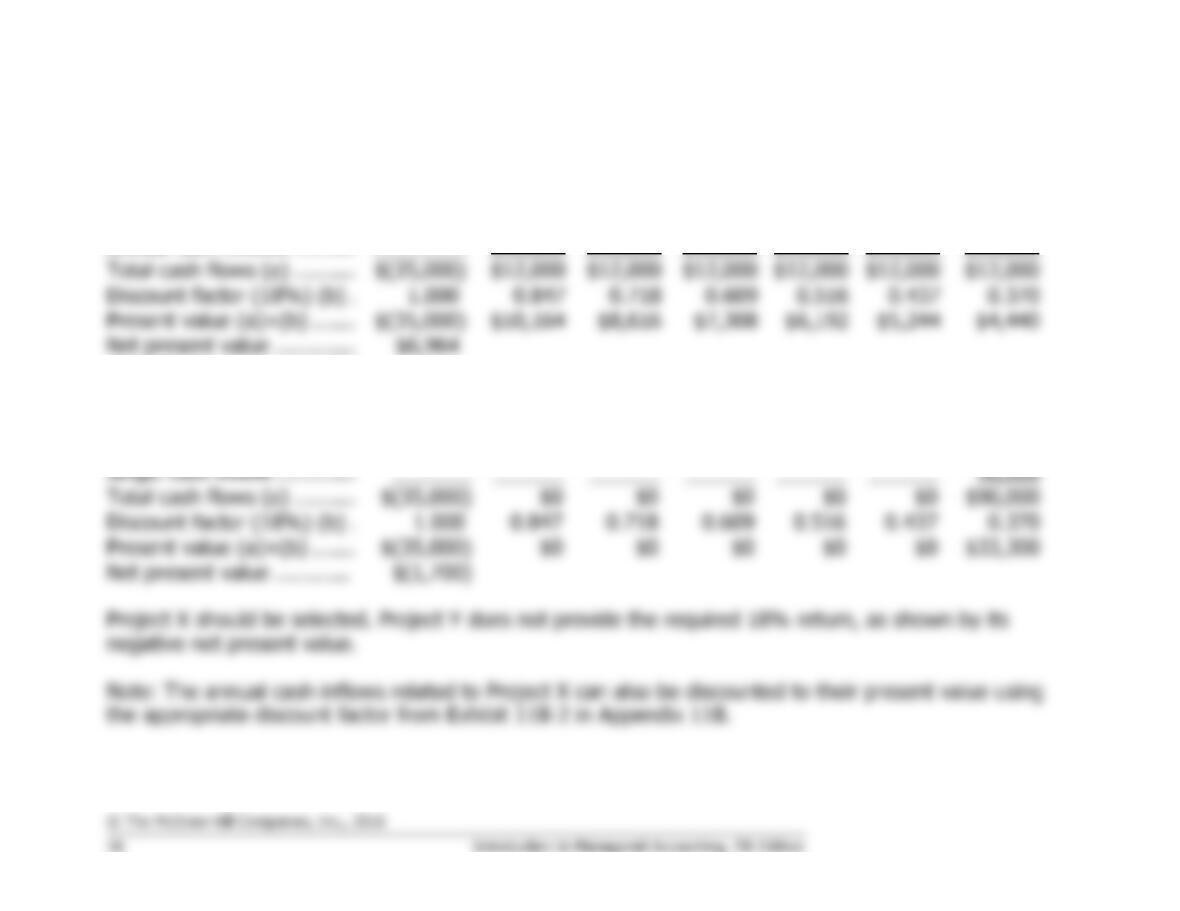
Exercise 11–11 (10 minutes)
Project X:
Now
1
2
3
4
5
6
Initial investment …………..
$(35,000)
Annual cash inflows ……….
________
$12,000
$12,000
$12,000
$12,000
$12,000
$12,000
Total cash flows (a) ……….
$(35,000)
$12,000
$12,000
$12,000
$12,000
$12,000
$12,000
Discount factor (18%) (b) .
Present value (a)×(b) …….
$(35,000)
$10,164
$6,192
$5,244
Net present value ………….
Project Y:
Now
1
2
3
4
5
6
Initial investment …………..
$(35,000)
Single cash inflow ………….
______
______
Total cash flows (a) ……….
$(35,000)
Discount factor (18%) (b) .
Present value (a)×(b) …….
$(35,000)
Net present value ………….
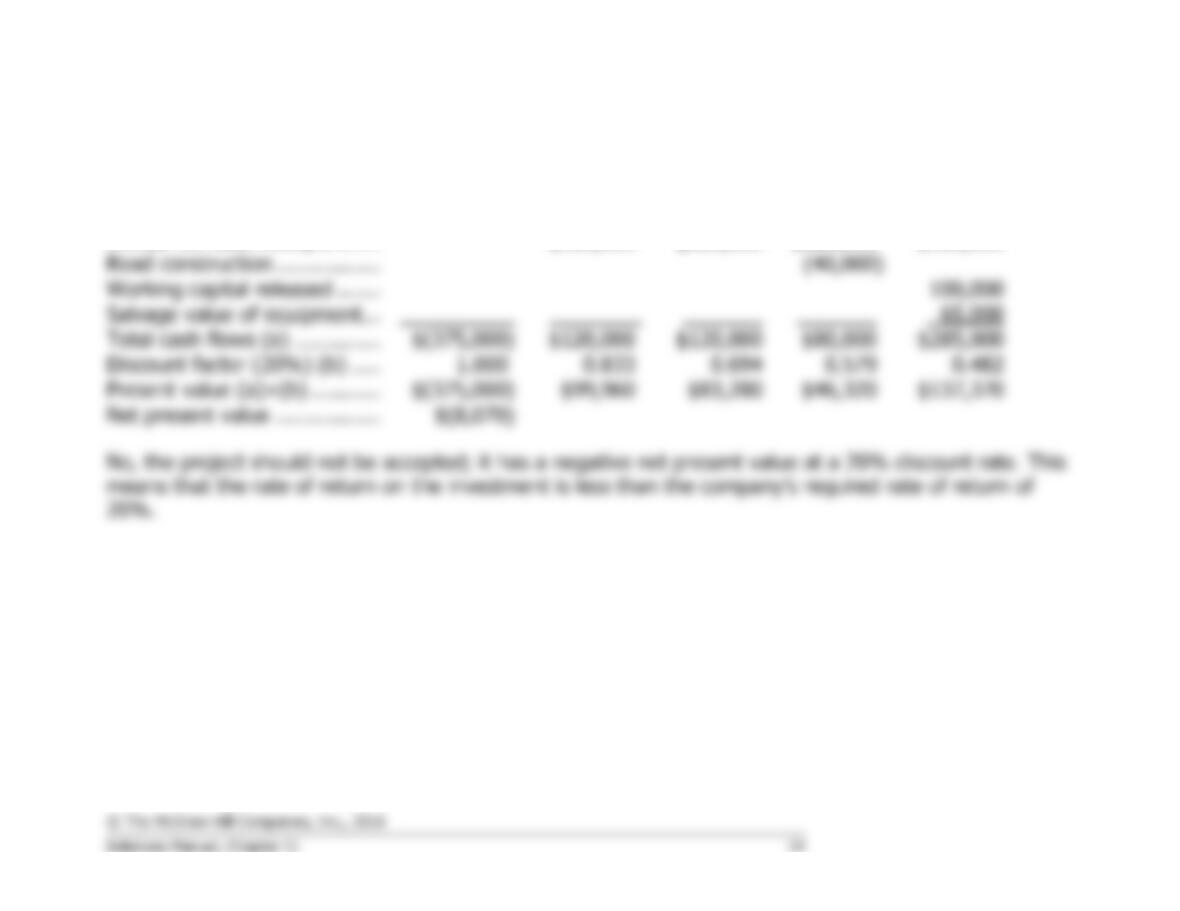
Problem 11-12A (20 minutes)
Now
1
2
3
4
Purchase of equipment ……….
$(275,000)
Working capital investment …
(100,000)
Annual net cash receipts …….
$120,000
$120,000
$120,000
$120,000
Road construction ……………..
Working capital released …….
Salvage value of equipment …
_______
Total cash flows (a) …………..
$(375,000)
$120,000
$120,000
$80,000
$285,000
Discount factor (20%) (b) …..
Present value (a)×(b) ………..
$46,320
$137,370
Net present value ……………..
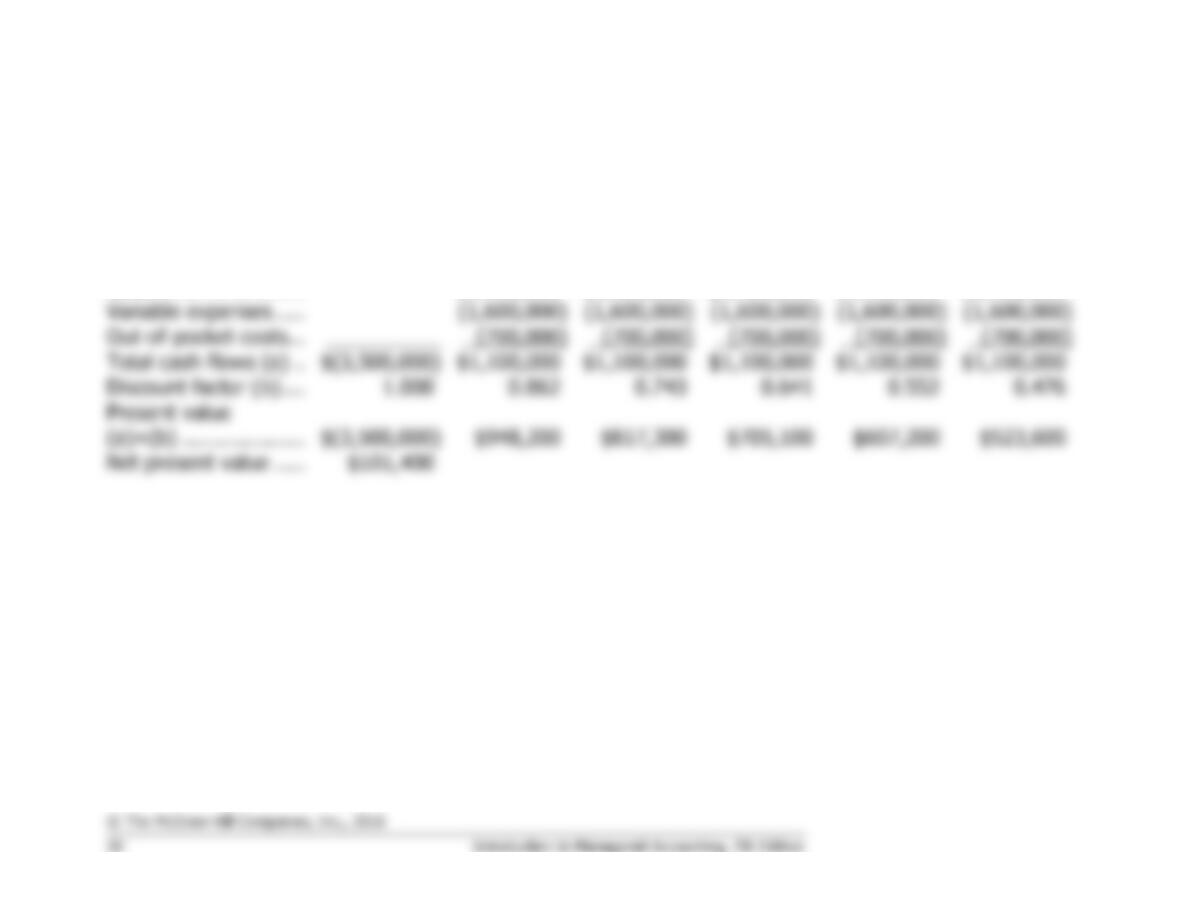
Problem 11-13A (20 minutes)
1. The net present value is computed as follows:
Now
1
2
3
4
5
Purchase of
equipment …………….
$(3,500,000)
Sales ……………………
$3,400,000
$3,400,000
$3,400,000
$3,400,000
$3,400,000
Variable expenses …..
Out-of-pocket costs …
Total cash flows (a) ..
Discount factor (b) ….
Present value
(a)×(b) ………………..
$(3,500,000)
Net present value …..