5. User Insight: Strategy of calling bonds when stock price has risen
Chapter 10, P 7. (Continued)
rather than accepting the call price. Since the price of the company’s stock has
The company can improve its debt to equity ratio without using cash by calling the
bonds, thereby inducing the bondholders to convert their bonds in common stock
30 517,500
7,500
525,000
Chapter 10, P 8.
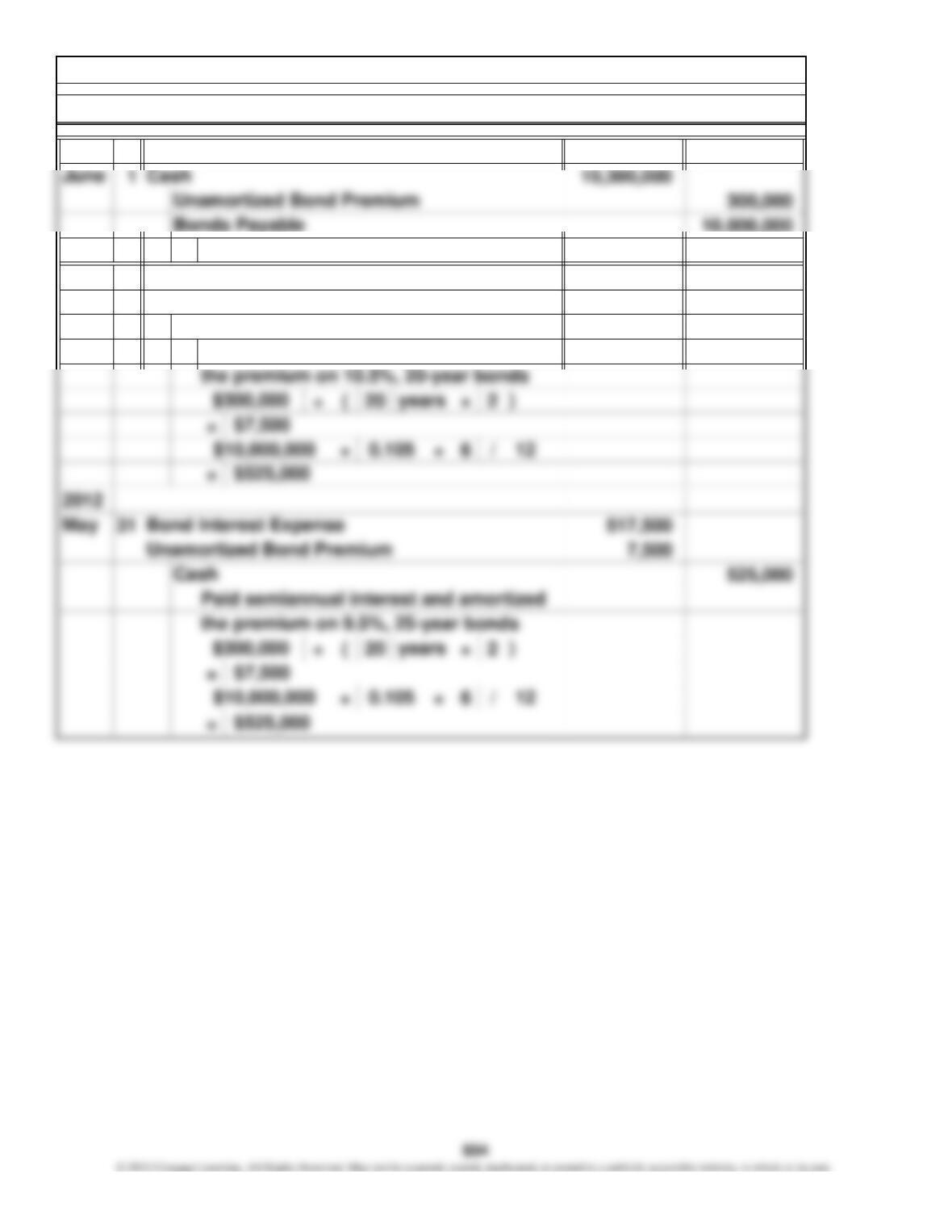
2011
Sold 10.5%, 20-year bonds at 103
Unamortized Bond Premium
Cash
Nov. Bond Interest Expense
1. Journal entries prepared for bonds issued at more than face value
Paid semiannual interest and amortized
30 532,500
7,500
525,000
=
Chapter 10, P 8. (Continued)
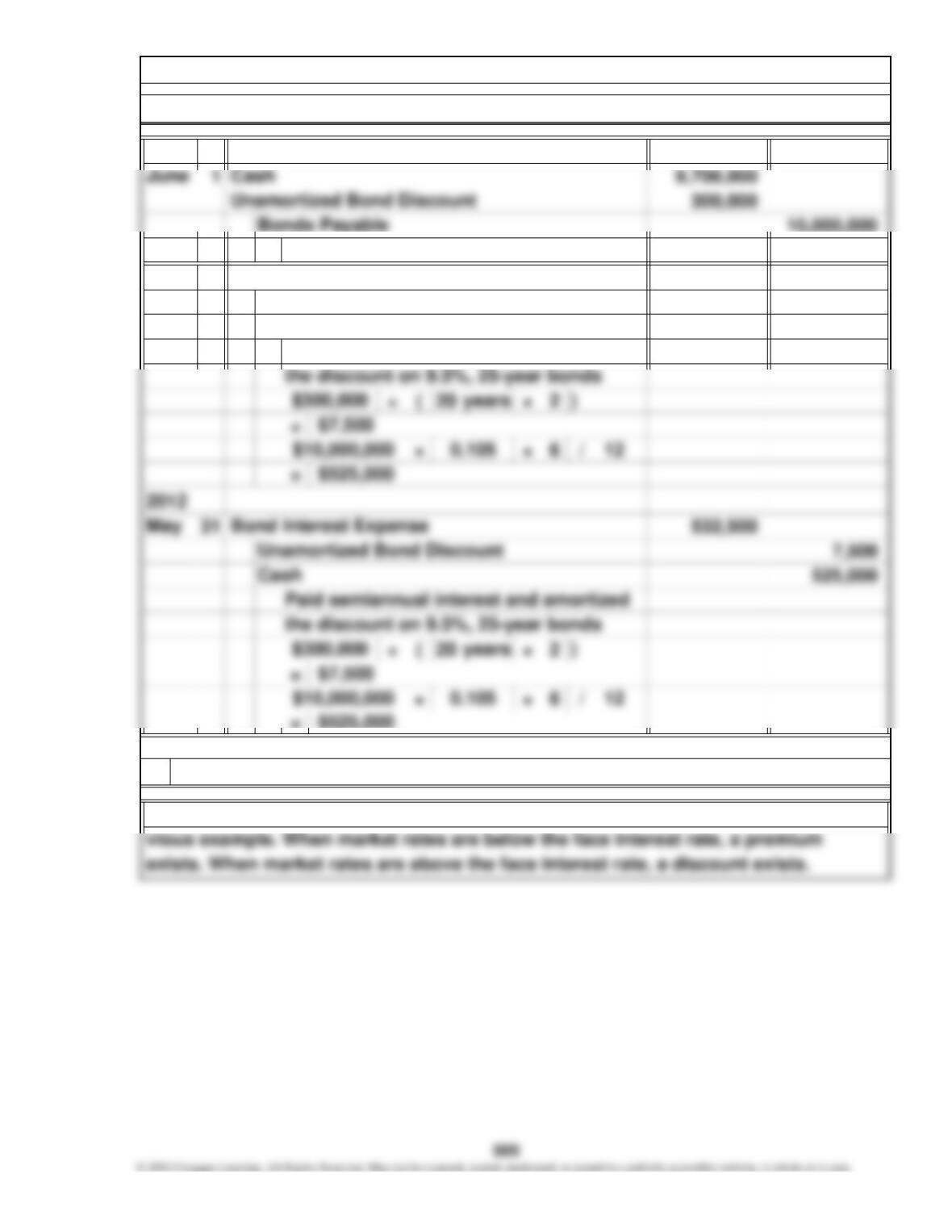
2011
Sold 10.5%, 20-year bonds at 97
Unamortized Bond Discount
Cash
Nov. Bond Interest Expense
Paid semiannual interest and amortized
User Insight: Role of market interest rates
Market interest rates play a role in creating the premium and discount in the pre-
3.
2. Journal entries prepared for bonds issued at less than face value
1 10,300,000
300,000
10,000,000
30 394,000
6,000
400,000
31 394,000
6,000
400,000
Chapter 10, P 9.
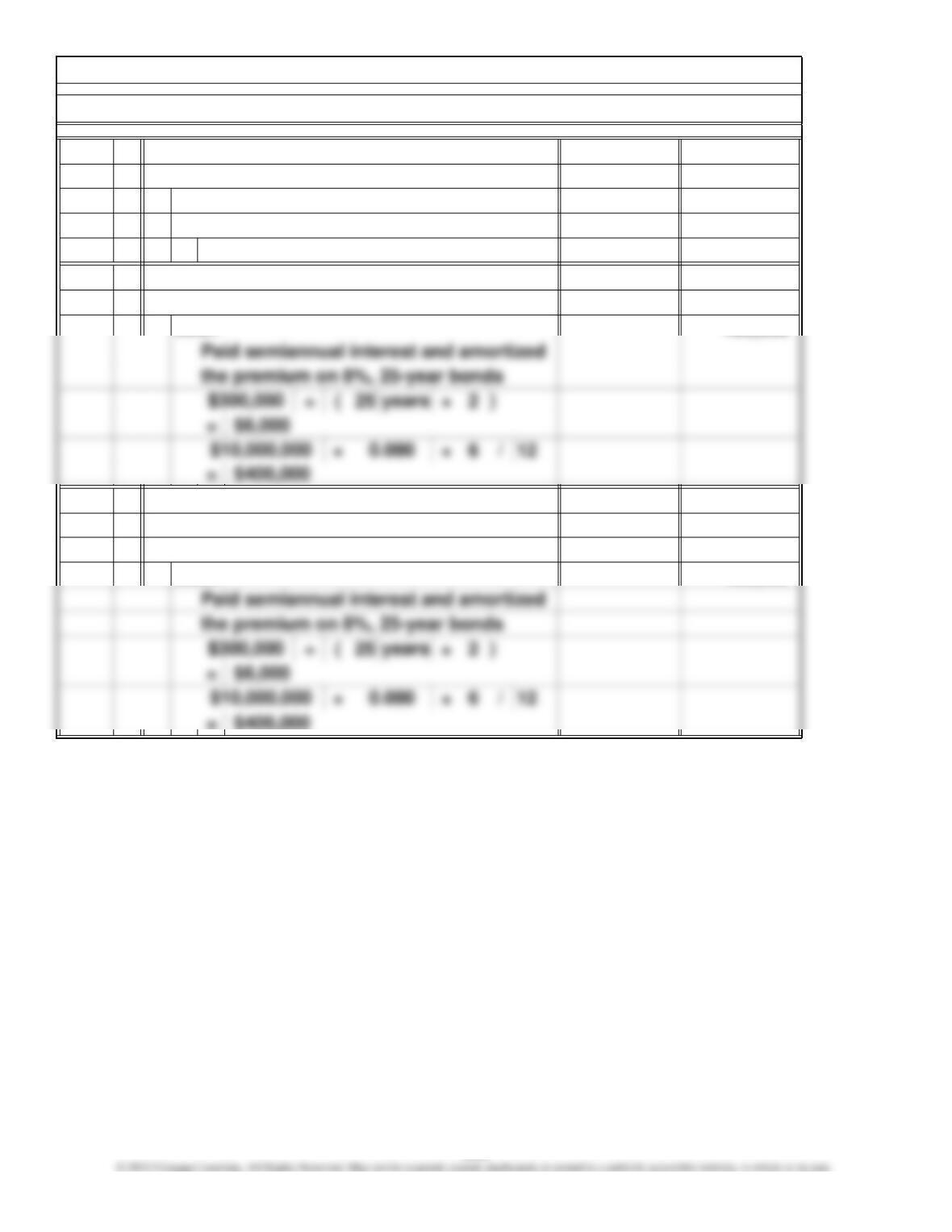
2011
June Cash
Unamortized Bond Premium
Bonds Payable
Sold 8%, 25-year bonds at 103
Unamortized Bond Premium
Cash
Nov. Bond Interest Expense
Unamortized Bond Premium
Cash
1. Journal entries prepared for bonds issued at more than face value
2012
May Bond Interest Expense
506
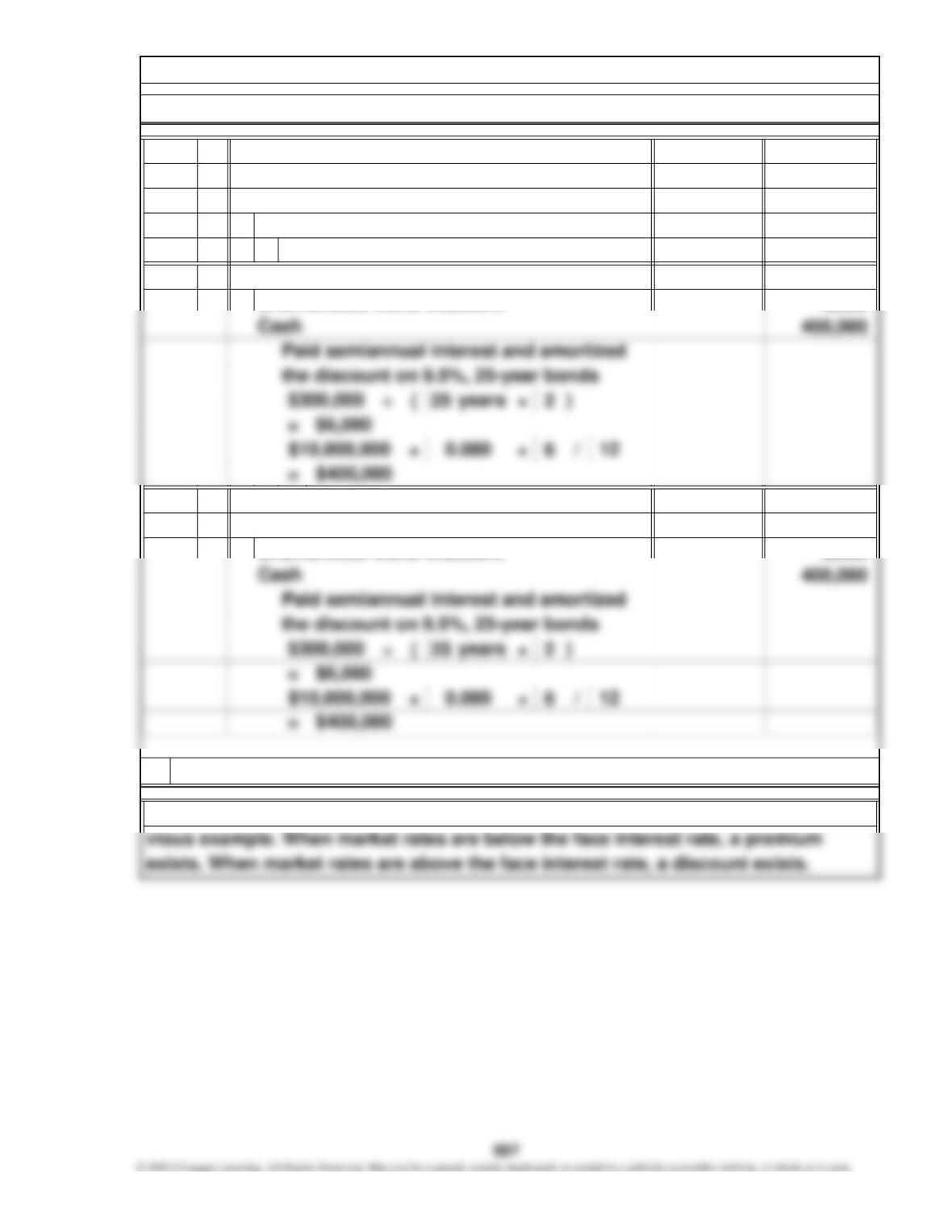
1 9,700,000
300,000
10,000,000
30 406,000
6,000
31 406,000
6,000
Chapter 10, P 9. (Continued)
2011
June Cash
Unamortized Bond Discount
Bonds Payable
Sold 8%, 25-year bonds at 97
Unamortized Bond Discount
Nov. Bond Interest Expense
May Bond Interest Expense
Unamortized Bond Discount
3. User Insight: Role of market interest rates
Market interest rates play a role in creating the premium and discount in the pre-
2. Journal entries prepared for bonds issued at less than face value
2012
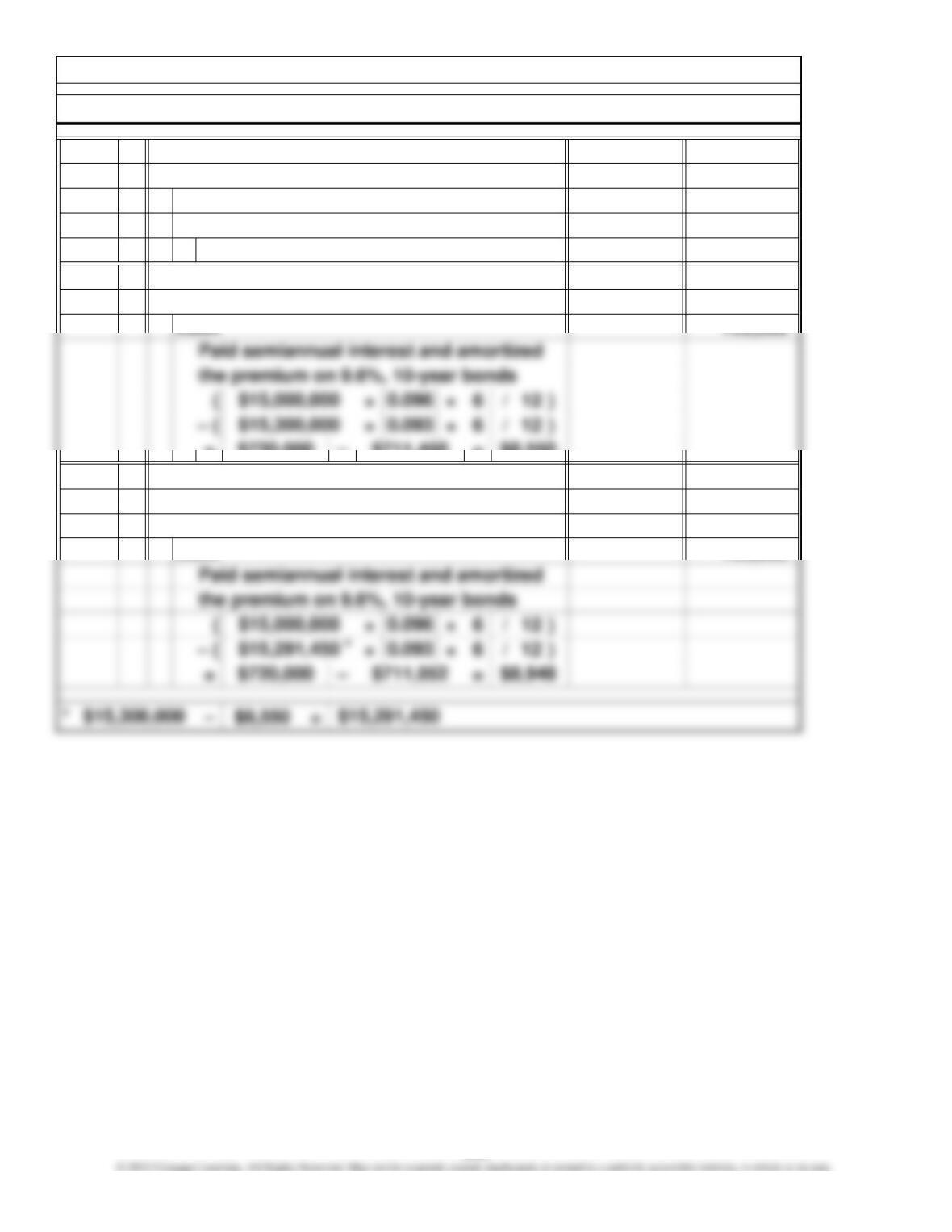
1 15,300,000
300,000
15,000,000
30 711,450
8,550
=–=
31 711,052
8,948
720,000
Apr.
Chapter 10, P 10.
Bond Interest Expense
Bond Interest Expense
$8,550
$711,450$720,000
2012
Mar.
Cash
2011
Sold 9.6%, 10-year bonds at 102
1. Journal entries prepared for bonds issued at more than face value
Cash
Sept.
Unamortized Bond Premium
Unamortized Bond Premium
Bonds Payable
Unamortized Bond Premium
Cash
508
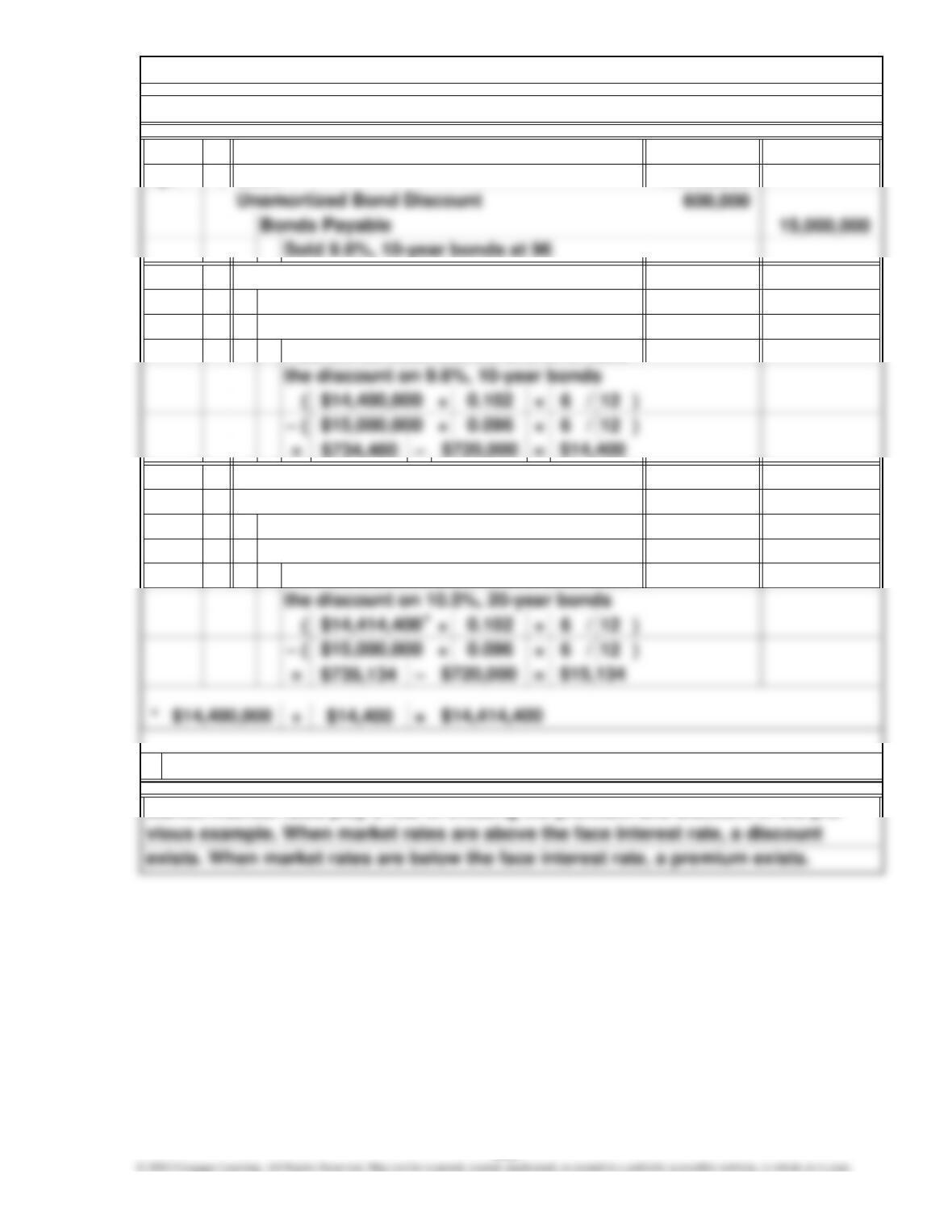
1 14,400,000
30 734,400
14,400
720,000
31 735,134
15,134
720,000
Mar.
2012
Paid semiannual interest and amortized
Cash
Chapter 10, P 10. (Continued)
2011
Apr. Cash
Unamortized Bond Discount
Sept.
Bond Interest Expense
Bond Interest Expense
Market interest rates play a role in creating the premium and discount in the pre-
Paid semiannual interest and amortized
Unamortized Bond Discount
Cash
2. Journal entries prepared for bonds issued at less than face value
3. User Insight: Role of market interest rates
*
509
Chapter 10, C 1.
Future commitments for operating leases, such as those described for Walgreens,
asset is leased, under a capital lease, it must be recorded as a long-term asset with
as an operating expense on the income statement.
option to buy the asset at a nominal price at the end of the lease. Even though the
about the same as the useful life of the asset, and stipulates that the lessee has the
do not appear on the balance sheet. The $2.0 billion for the current year will appear
A capital lease is a long-term lease that cannot be canceled, has a duration that is
510
Convertible securities are bonds that may be converted into shares of common
stock at the option of the bondholder. These bonds are favorable to the bondholder
because they pay interest and are scheduled to be paid at a specified time. At the
Chapter 10, C 2.
same time, if the company is successful and the price of its stock goes up, the bond-
Unsecured notes (also called debenture bonds ) are bonds issued on the general
credit of the organization. Because there are no specific assets as security in case
the company does not pay, unsecured bonds involve more risk to the creditor. Notes
with higher risks usually carry higher interest rates to entice the creditor to loan the
money.
511
Leverage is a corporation’s ability to increase earnings by earning more on its as-
Chapter 10, C 3.
The Wal-Mart bond sold for a premium because the market price of 108 was greater
than the face value of 100. Interest rates have declined since the date of issue be-
cause the bond is selling at a premium. As a result, the market rate of interest will
Chapter 10, C 4.
sets than it is paying in interest on its debt. This plan results in higher leverage
because it involves issuing debt and reducing the amount of stock outstanding by
512
Chapter 10, C 5.
that earns 10 percent, the return is greater than the interest cost of 6.875 percent.
Fifth, the convertible feature offers financial flexibility. If the price of the stock
There are several good reasons for issuing convertible notes instead of noncon-
terest cost of the notes. For example, if the company uses the funds for a purpose
rises, the noteholders may convert their notes into common stock, thereby reliev-
ing the company of the need to repay the debt. Finally, it may be the only way the
market value would be $651,785,756. The holders would have a theoretical gain of
$151,785,756. Since the price of the stock is above $112 per share and the holders
other stockholders would decrease.
elect to convert the notes into common stock, which is a likely scenario, the debt to
equity ratio would improve because the debt would decrease and the stockholders’
equity would increase. However, the percentage ownership of the company by the
513
1.
2.
3.
fund employees’ future pension benefits. CVS’ plan is underfunded by $240 mil-
Under a defined benefit plan the employer pays an amount in the current year to
Under an operating lease the risks of ownership lie with the lessor and typically
the life of the lease is shorter than the life of the asset being leased. In contrast,
a capital lease is more like an installment purchase where the life of the lease is
Chapter 10, C 6.
From the note on property and equipment, it may be seen that CVS has a small
514
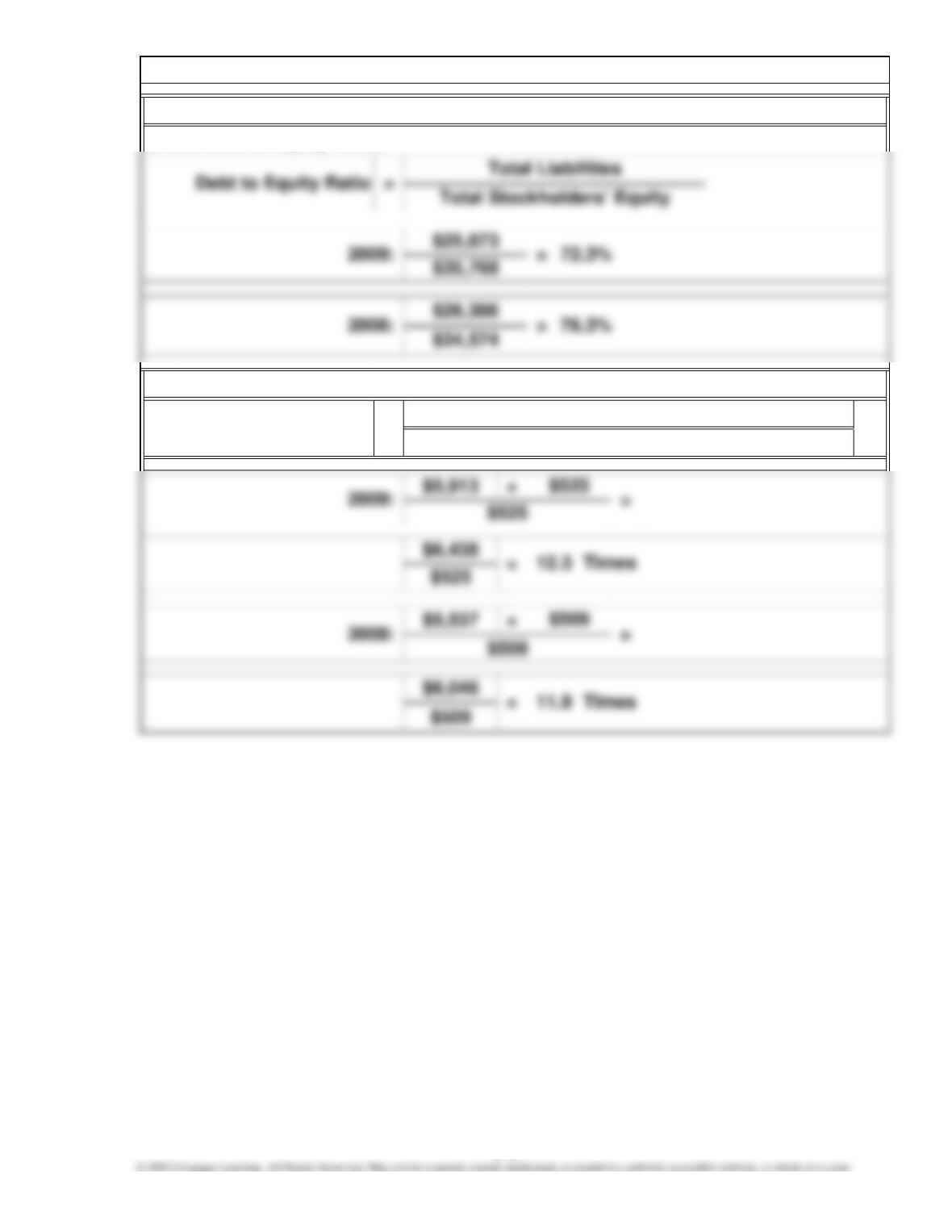
Interest Coverage Ratio = Interest Expense
Income Before Income Taxes + Interest Expense
Chapter 10, C 7.
(dollars in millions)
CVS’s Debt to Equity Ratio:
CVS’s Interest Coverage Ratio:
515
Chapter 10, C 7. (Continued)
(dollars in millions)
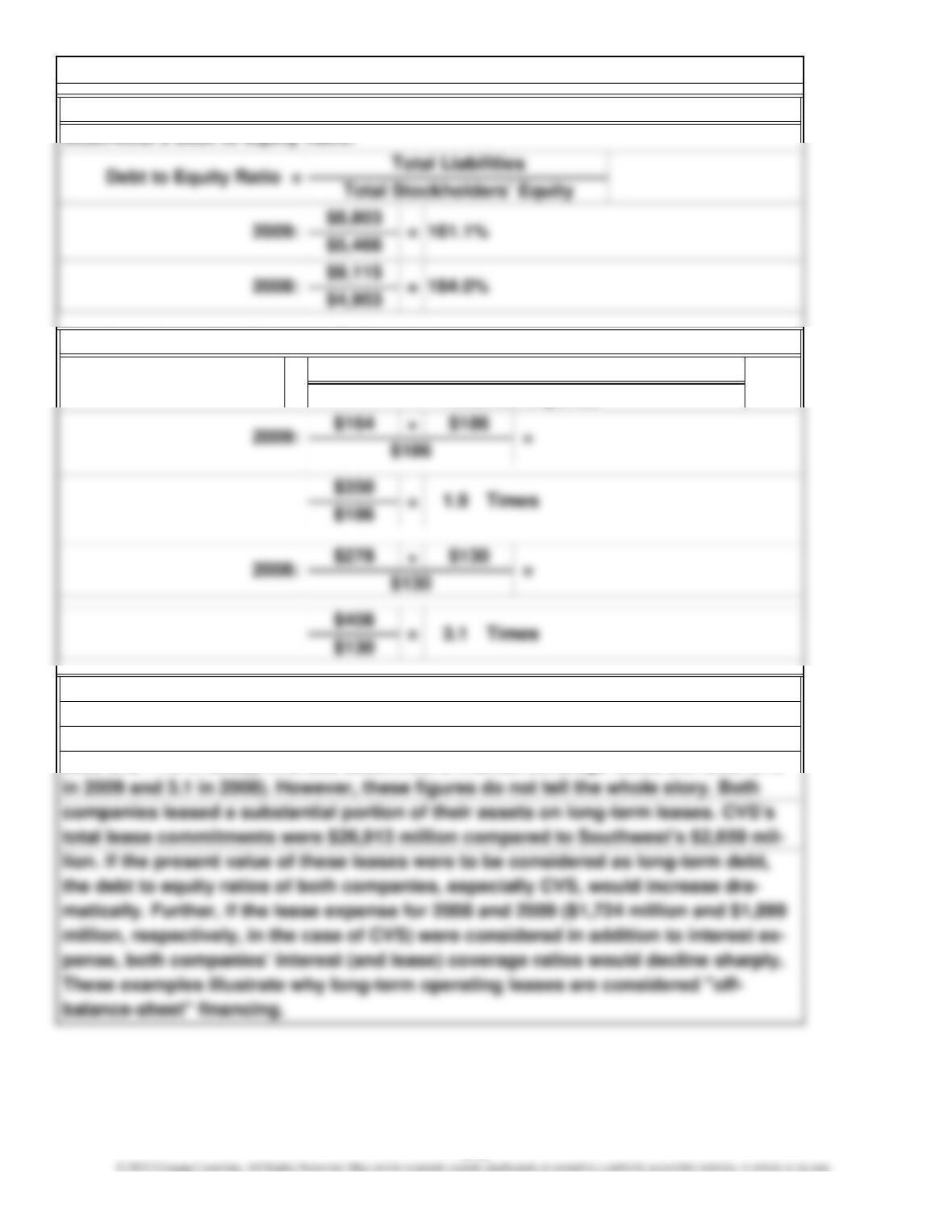
Southwest’s Interest Coverage Ratio:
Income Before Income Taxes + Interest Expense
Interest Expense
Interest Coverage Ratio =
2009 and 11.9 in 2008), whereas Southwest’s interest coverage ratios are lower (1.9
in 2008 to 161.1 percent in 2009. CVS has higher interest coverage ratios (12.3 in
CVS’s debt to equity ratio decreased from 76.3 percent in 2008 to 72.3 percent in
2009. Southwest’s debt to equity was higher. Its ratio decreased from 184.0 percent
516
1.
From:
Date:
Re:
fertilizer plant or to use a capital lease, the following issues should be considered:
Cash flow requirements
Chapter 10, C 8.
Kwak’s proposal is not considered acceptable accounting practice because no
sale has taken place. Following through with this proposal would be a violation of
the revenue recognition principle. In addition, the proposal would not be ethical
because it would result in fraudulent financial reporting. Although the company
To:
Memorandum
Chapter 10, C 9.
Megan Russ
Student’s Name
Today’s Date
Issuance of long-term bonds versus leasing to finance the new plant
At our meeting to discuss whether to issue long-term bonds and purchase the new
517