CHAPTER 10
Acquisition and Disposition
of Property, Plant, and Equipment
ASSIGNMENT CLASSIFICATION TABLE (BY TOPIC)
Topics
Questions
Brief
Exercises
Exercises
Problems
Concepts
for Analysis
1.
Valuation and classification
of land, buildings, and
equipment.
1, 2, 3, 4,
6, 7, 13, 21
1
1, 2, 3, 4,
5, 13
1, 2, 3, 5
1, 5, 6
Self-constructed assets,
capitalization of overhead.
5, 8, 20, 21
4, 6, 12, 16
2
Capitalization of interest.
6, 8, 9, 10,
11, 13, 21
2, 3, 4
5, 7, 8, 9,
10, 16
5, 6, 7
3
Exchanges of assets.
12, 16, 17
8, 9, 10,
11, 12
11, 16, 17,
18, 19, 20
4, 8, 9,
10, 11
4
5.
Lump-sum purchases,
issuance of stock, deferred-
payment contracts.
12, 13, 14,
15
5, 6, 7
3, 6, 11, 12,
13, 14,
15, 16
2, 11
Costs subsequent to
acquisition.
18, 19
13
21, 22, 23
Alternative valuations.
3
Disposition of assets.
14, 15
24, 25
4
1
ASSIGNMENT CLASSIFICATION TABLE (BY LEARNING OBJECTIVE)
Learning Objectives
Questions
Brief
Exercises
Exercises
Problems
Concepts
for
Analysis
1. Identify property, plant, and
equipment and its related costs.
1, 2, 3, 4, 5, 6, 7, 8,
20, 21
1
1, 2, 3, 4,
5, 6, 11,
12, 13
1, 2, 3, 4,
5, 6, 11
1, 5, 6
2. Describe the accounting problems
associated with interest
capitalization.
8, 9, 10, 11, 13, 21
2, 3, 4
5, 6, 7, 8,
9, 10
5, 6, 7
20
4. Describe the accounting treatment
for costs subsequent to
acquisition.
18, 19
13
21, 22, 23
5. Describe the accounting treatment
for the disposal of property, plant,
and equipment.
23
14, 15
24, 25
2, 4
24, 25
16, 17, 18
ASSIGNMENT CHARACTERISTICS TABLE
Item
Description
Level of
Difficulty
Time
(minutes)
E10.1
Acquisition costs of realty.
Moderate
15–20
E10.2
Acquisition costs of realty.
Moderate
10–15
E10.3
Acquisition costs of trucks.
Moderate
10–15
E10.4
Purchase and self-constructed cost of assets.
Moderate
20–25
E10.5
Treatment of various costs.
Moderate
30–40
E10.6
Correction of improper cost entries.
Moderate
15–20
E10.7
Capitalization of interest.
Difficult
20–25
E10.8
Capitalization of interest.
Moderate
20–25
E10.9
Capitalization of interest.
Moderate
20–25
E10.10
Capitalization of interest.
Moderate
20–25
E10.11
Entries for equipment acquisitions.
Moderate
10–15
E10.12
Entries for asset acquisition, including self-construction.
Difficult
15–20
E10.13
Entries for acquisition of assets.
Moderate
20–25
E10.14
Purchase of equipment with zero-interest-bearing debt.
Difficult
15–20
E10.15
Purchase of computer with zero-interest-bearing debt.
Moderate
15–20
E10.16
Asset acquisition.
Difficult
25–35
E10.17
Nonmonetary exchange.
Difficult
10–15
E10.18
Nonmonetary exchange.
Difficult
20–25
E10.19
Nonmonetary exchange.
Difficult
15–20
E10.20
Nonmonetary exchange.
Difficult
15–20
E10.22
Analysis of subsequent expenditures.
Difficult
15–20
E10.23
Analysis of subsequent expenditures.
Moderate
10–15
E10.24
Entries for disposition of assets.
Moderate
20–25
E10.25
Disposition of assets.
Moderate
15–20
P10.1
Classification of acquisition and other asset costs.
Moderate
35–40
P10.2
Classification of acquisition costs.
Difficult
40–55
P10.3
Classification of land and building costs.
Difficult
35–45
P10.4
Dispositions, including condemnation, demolition, and
trade-in.
Moderate
35–40
P10.5
Classification of costs and interest capitalization.
Moderate
20–30
P10.6
Interest during construction.
Difficult
25–35
P10.7
Capitalization of interest.
Moderate
20–30
P10.8
Nonmonetary exchanges.
Difficult
35–45
P10.9
Nonmonetary exchanges.
Difficult
30–40
P10.10
Nonmonetary exchanges.
Difficult
30–40
P10.11
Purchases by deferred payment, lump-sum, and
nonmonetary exchanges.
Moderate
35–45
ASSIGNMENT CHARACTERISTICS TABLE (Continued)
Item
Description
Level of
Difficulty
Time
(minutes)
CA10.1
Acquisition, improvements, and sale of realty.
Moderate
20–25
CA10.2
Accounting for self-constructed assets.
Moderate
20–25
CA10.3
Capitalization of interest.
Moderate
30–40
CA10.4
Nonmonetary exchanges.
30–40
CA10.5
Costs of acquisition.
Moderate
20–25
CA10.6
Cost of land vs. building—ethics.
Moderate
20–25
ANSWERS TO QUESTIONS
1. The major characteristics of plant assets are (1) that they are acquired for use in operations and
2. The company should report the asset at its historical cost of $450,000, not its current value. The
3. (a) The acquisition costs of land may include the purchase or contract price, the broker’s commis–
sion, title search and recording fees, assumed taxes or other liabilities, surveying, demolition
(less salvage), and landscaping costs.
(b) Machinery and equipment costs may properly include freight and handling, taxes on the
4. (a) Land.
(b) Land.
(c) Land.
5. (a) The position that no fixed overhead should be capitalized assumes that the construction of
plant (fixed) assets will be timed so as not to interfere with normal operations. If this were not
the case, the savings anticipated by constructing instead of purchasing plant assets would be
nullified by reduced profits on the product that could have been manufactured and sold. Thus,
Questions Chapter 10 (Continued)
(b) Capitalizing overhead at the same rate as is charged to normal operations is defended by
6. (a) Disagree. Organization and promotion expenses should be expensed.
(b) Agree. Architect’s fees for plans actually used in the construction of the building should be
charged to the building account as part of the cost.
7. Since the land for the plant site will be used in the operations of the firm, it is classified as property,
plant, and equipment. The other tract is being held for speculation. It is classified as an investment.
LO: 1, Bloom: C, Difficulty: Simple, Time: 3-5, AACSB: Communication, AICPA BB: None, AICPA FC: Reporting, AICPA PC: Communication
8. A common accounting justification is that all costs associated with the construction of an asset,
10. The avoidable interest is determined by multiplying (an) interest rate(s) by the weighted-average
amount of accumulated expenditures on qualifying assets. For the portion of weighted-average
accumulated expenditures which is less than or equal to any amounts borrowed specifically to
Questions Chapter 10 (Continued)
11. The total interest cost incurred during the period should be disclosed, indicating the portion
capitalized and the portion charged to expense.
12. (a) Assets acquired by issuance of capital stock—when property is acquired by issuance of
common stock, the cost of the property is not measured by par or stated value of such stock. If
(b) Assets acquired by gift or donation—when assets are acquired in this manner a strict cost
(c) Cash discount—when assets are purchased subject to a cash discount, the question of how
the discount should be handled occurs. If the discount is taken, it should be considered a
(d) Deferred payments—assets should be recorded at the present value of the consideration
exchanged between contracting parties at the date of the transaction. In a deferred payment
situation, there is an implicit (or explicit) interest cost involved, and the accountant should be
careful not to include this amount in the cost of the asset.
(e) Lump sum or basket purchase—sometimes a group of assets is acquired for a single lump
Questions Chapter 10 (Continued)
13. The cost of such assets includes the purchase price, freight and handling charges incurred,
insurance on the equipment while in transit, cost of special foundations if required, assembly and
installation costs, and costs of conducting trial runs. Costs thus include all expenditures incurred in
14.
Fair value of land
X Cost = Cost allocated to land
Fair value of building and land
$500,000
X $2,200,000 = $440,000 (Cost allocated to land)
$2,500,000
Fair value of building and land
16. Ordinarily accounting for the exchange of nonmonetary assets should be based on the fair value of
the asset given up or the fair value of the asset received, whichever is more clearly evident. Thus
any gains and losses on the exchange should be recognized immediately. If the fair value of either
asset is not reasonably determinable, the book value of the asset given up is usually used as the
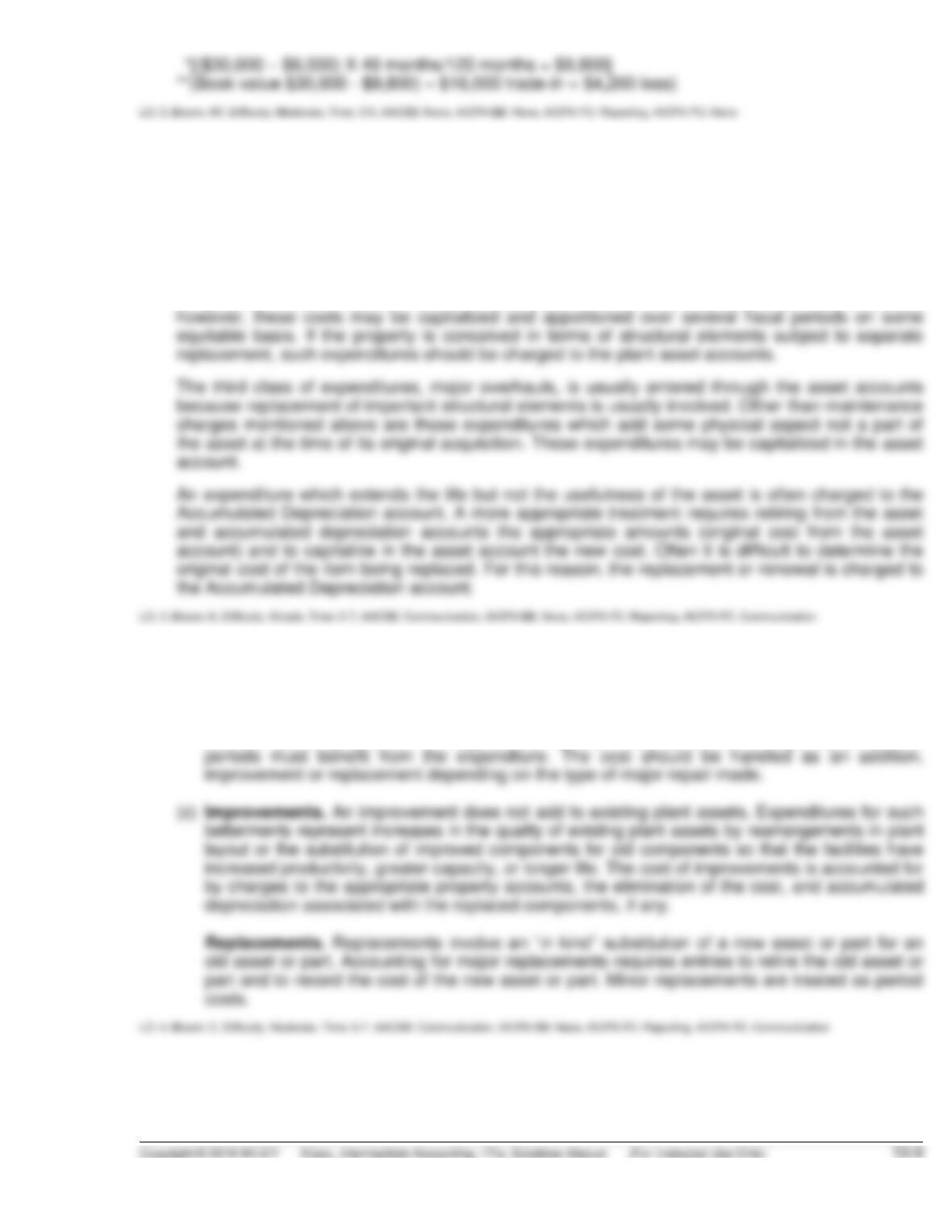
17. In accordance with GAAP which requires losses to be recognized immediately, the entry should be:
Trucks (new) …………………………………………………………………………… 42,000
18. Ordinarily such expenditures include (1) the recurring costs of servicing necessary to keep property
in good operating condition, (2) cost of renewing structural parts of major plant units, and (3)
costs of major overhauling operations which may or may not extend the life beyond original
expectation.
The first class of expenditures represents the day-to-day service and in general is chargeable to
operations as incurred. These expenditures should not be charged to the asset accounts.
The second class of expenditures may or may not affect the recorded cost of property. If the asset
is rigidly defined as a distinct unit, the renewal of parts does not usually disturb the asset accounts;
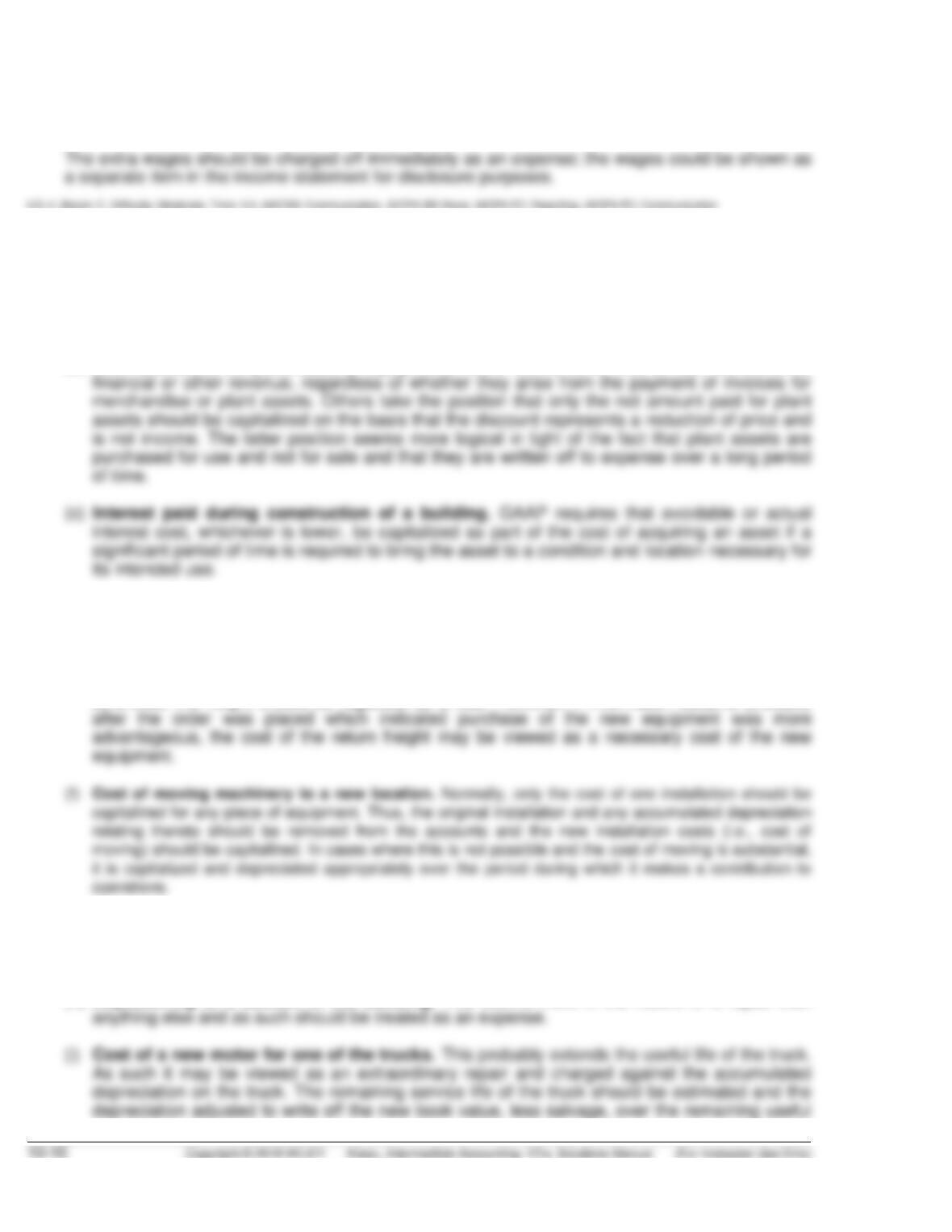
19. (a) Additions. Additions represent entirely new units or extensions and enlargements of old units.
Expenditures for additions are capitalized by charging either old or new asset accounts
depending on the nature of the addition.
(b) Major Repairs. Expenditures to replace parts or otherwise to restore assets to their previously
efficient operating condition are regarded as repairs. To be considered a major repair, several
Questions Chapter 10 (Continued)
20. The cost of installing the machinery should be capitalized, but the extra month’s wages paid to the
dismissed employees should not, as this payment did not add any value to the machinery.
21. (a) Overhead of a business that builds its own equipment. Some accountants have
maintained that the equipment account should be charged only with the additional overhead
caused by such construction. However, a more realistic figure for the cost of equipment results
if the plant asset account is charged for overhead applied on the same basis and at the same
rate as used for production.
(b) Cash discounts on purchases of equipment. Some accountants treat all cash discounts as
(d) Cost of a safety device installed on a machine. This is an addition to the machine and
should be capitalized in the machinery account if material.
(e) Freight on equipment returned before installation, for replacement by other equipment of
greater capacity. If ordering the first equipment was an error, whether due to judgment or
otherwise, the freight should be regarded as a loss. However, if information became available
(g) Cost of plywood partitions erected in the remodeling of the office. This is a part of the
remodeling cost and may be capitalized as part of the remodeling itself is of such a nature that
it is an addition to the building and not merely a replacement or repair.
(h) Replastering of a section of the building. This seems more in the nature of a repair than
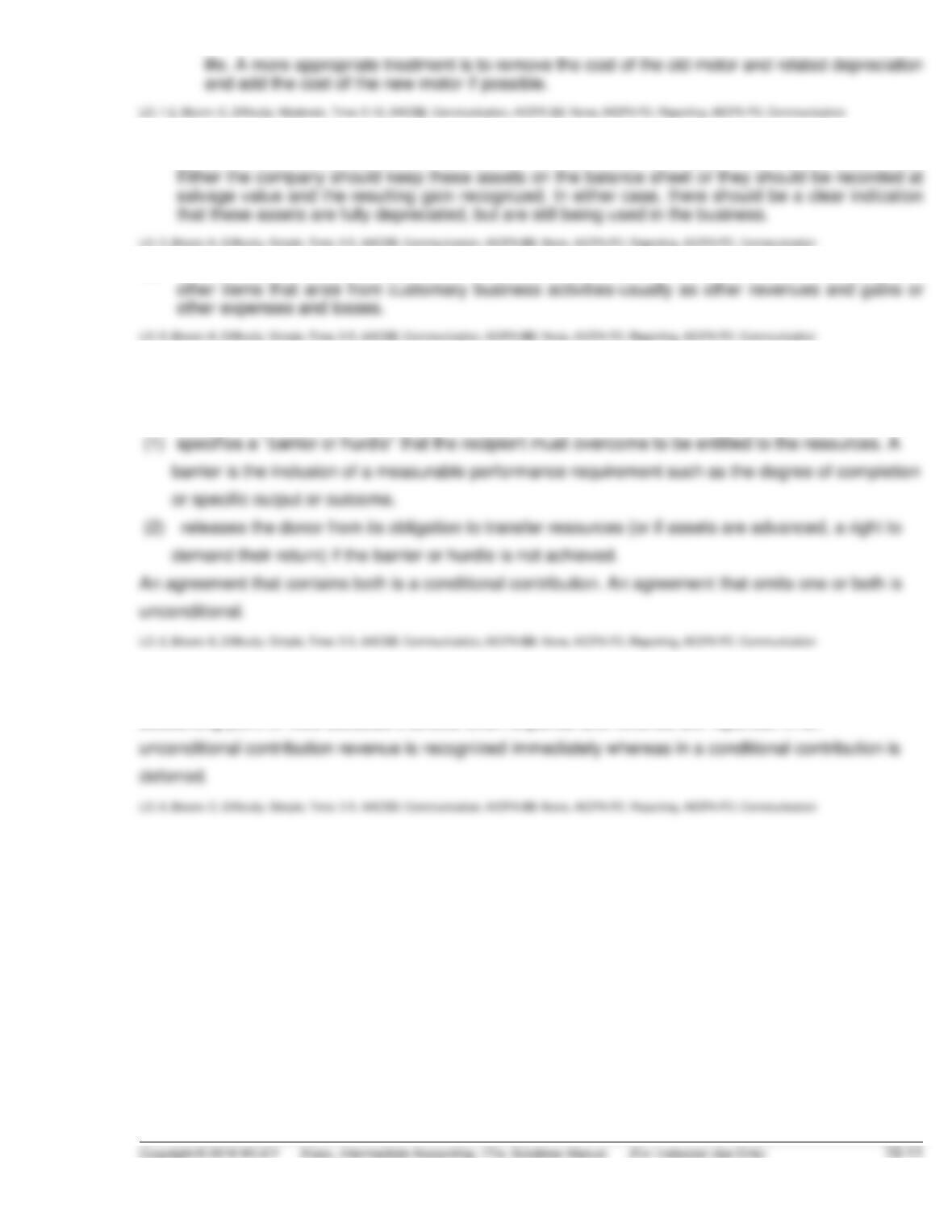
22. This approach is not correct since at the very minimum the investor should be aware that certain
assets are used in the business, which are not reflected in the main body of the financial statements.
23. Gains or losses on plant asset retirements should be shown in the income statement along with
*24. The criteria for evaluating whether contributions are unconditional (and thus recognized
immediately in income) or conditional (for which income recognition is deferred) depend on the terms of
the gift or grant agreement. The focus is on whether a gift or grant agreement has the following terms.
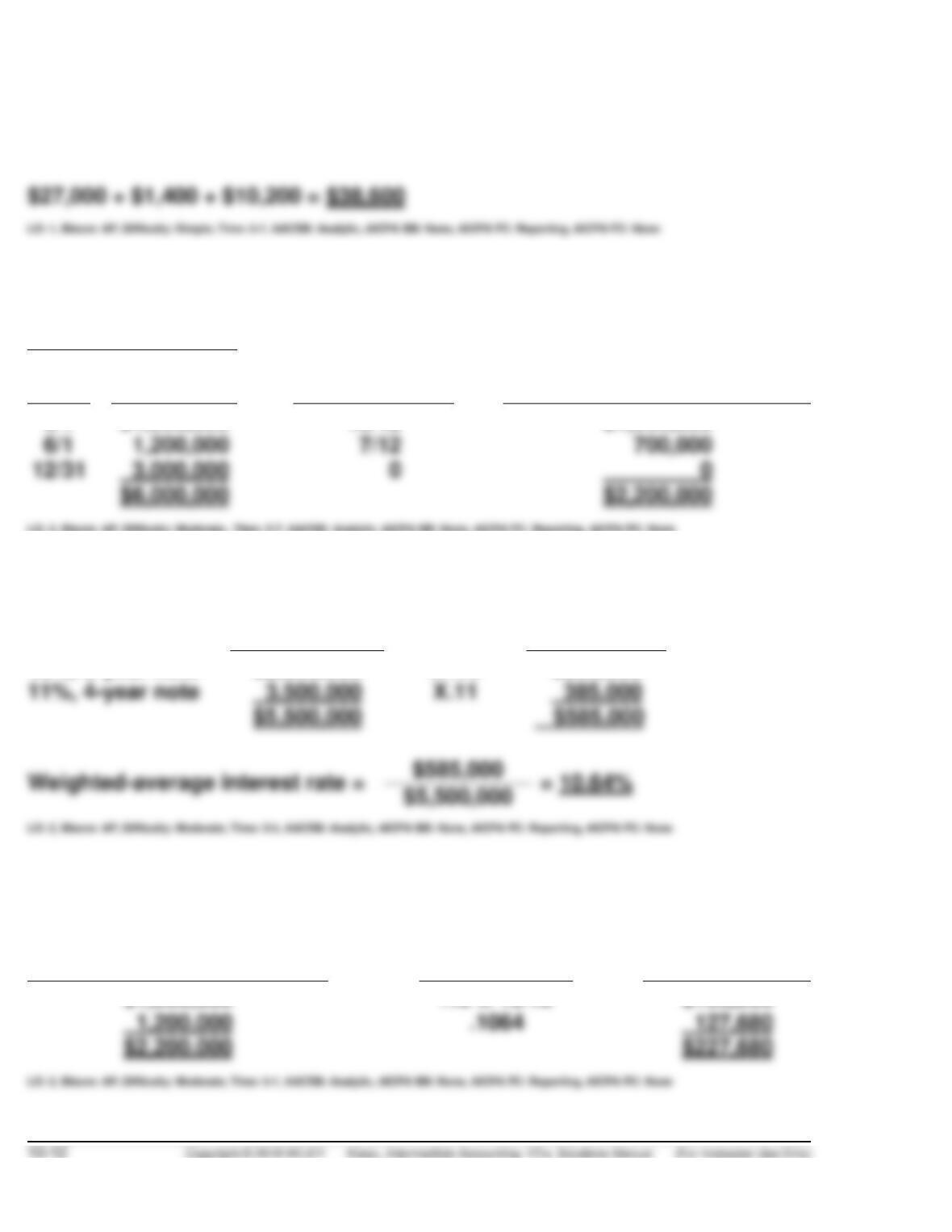
*25. The distinction between a conditional and unconditional contribution is important from an
accounting point of view because it affects when expense and revenue are reported. In an
SOLUTIONS TO BRIEF EXERCISES
BRIEF EXERCISE 10.1
BRIEF EXERCISE 10.2
Expenditures
Date
Amount
Capitalization
Period
Weighted-Average
Accumulated Expenditures
3/1
$1,800,000
10/12
$1,500,000
0
0
LO: 2, Bloom: AP, Difficulty: Moderate,, Time: 5-7, AACSB: Analytic, AICPA BB: None, AICPA FC: Reporting, AICPA PC: None
BRIEF EXERCISE 10.3
Principal
Interest
10%, 5-year note
$2,000,000
X .10
$200,000
BRIEF EXERCISE 10.4
Weighted-Average
X
Interest
=
Avoidable
Accumulated Expenditures
Rate
Interest
$1,000,000
.12 X 10/12
$100,000
BRIEF EXERCISE 10.5
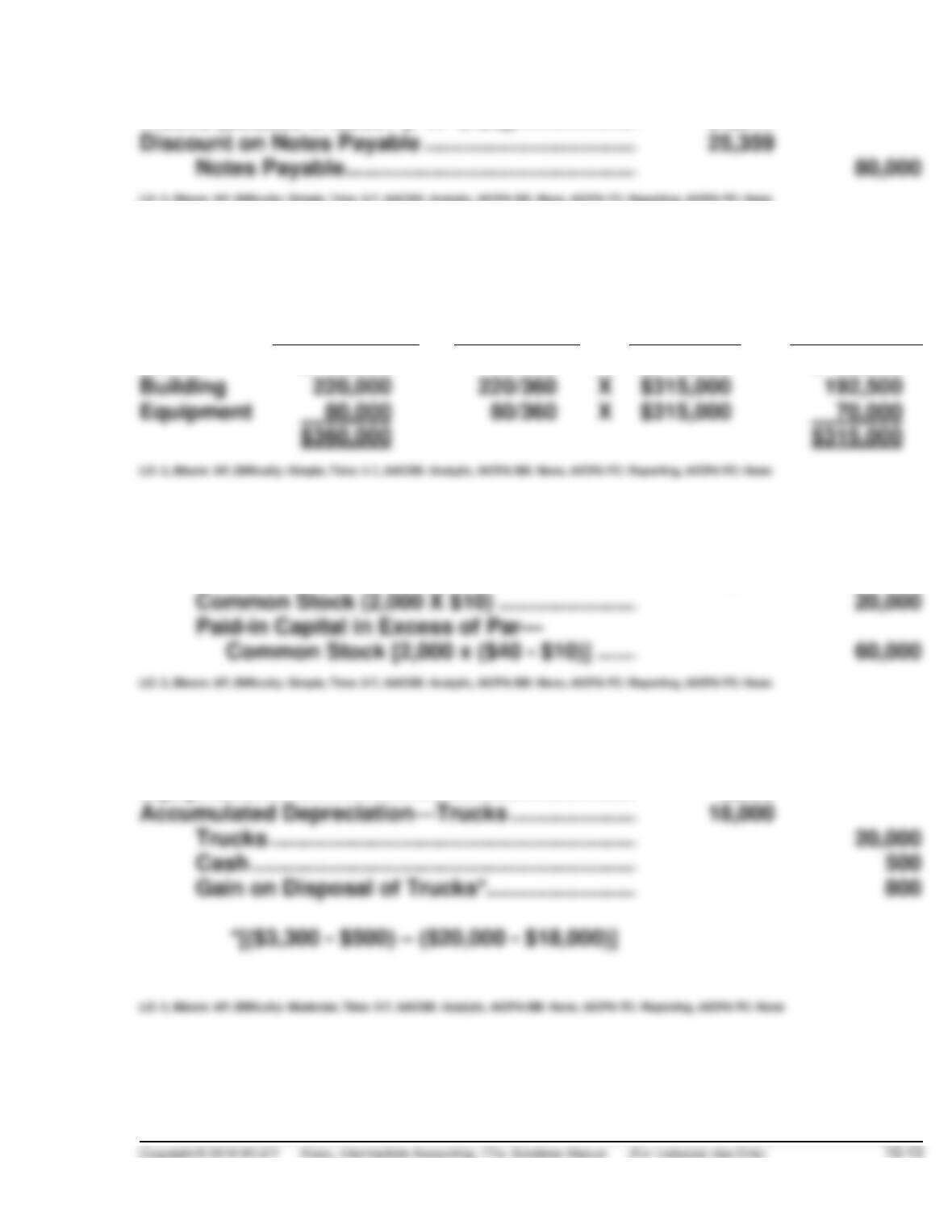
Trucks ($80,000 X .68301 (PVF 4, 10%)) ………………………..
54,641
Discount on Notes Payable ……………………………………..
25,359
Notes Payable…………………………………………………
LO: 3, Bloom: AP, Difficulty: Simple, Time: 5-7, AACSB: Analytic, AICPA BB: None, AICPA FC: Reporting, AICPA PC: None
BRIEF EXERCISE 10.6
Fair Value
% of Total
Cost
Recorded
Amount
Land
$ 60,000
60/360
X
$315,000
$ 52,500
Building
X
$315,000
Equipment
BRIEF EXERCISE 10.7
Land (2,000 X $40) …………………………………………………..
80,000
Common Stock (2,000 X $10) …………………………..
BRIEF EXERCISE 10.8
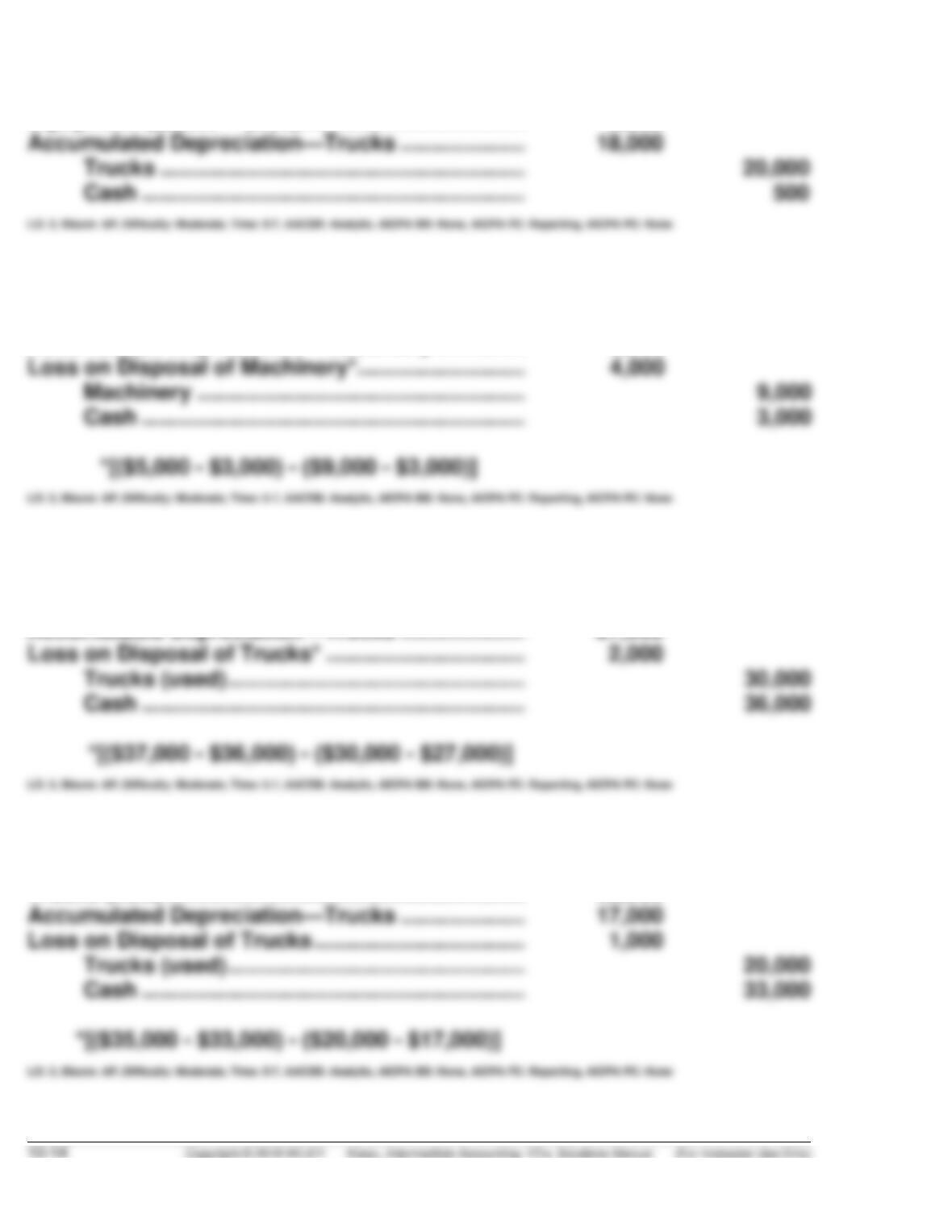
Equipment……………………………………………………….
3,300
Accumulated Depreciation—Trucks …………………………
Trucks ……………………………………………………….
Cash ……………………………………………………….
Gain on Disposal of Trucks* …………………………..
BRIEF EXERCISE 10.9
Equipment ($3,300 – $800) ……………………………………….
2,500
Accumulated Depreciation—Trucks …………………………
18,000
Trucks ……………………………………………………….
Cash ……………………………………………………….
BRIEF EXERCISE 10.10
Equipment ……………………………………………………….
5,000
Accumulated Depreciation—Machinery ……………………
3,000
Loss on Disposal of Machinery* …………………………..
4,000
Machinery ………………………………………………………
Cash ……………………………………………………….
BRIEF EXERCISE 10.11
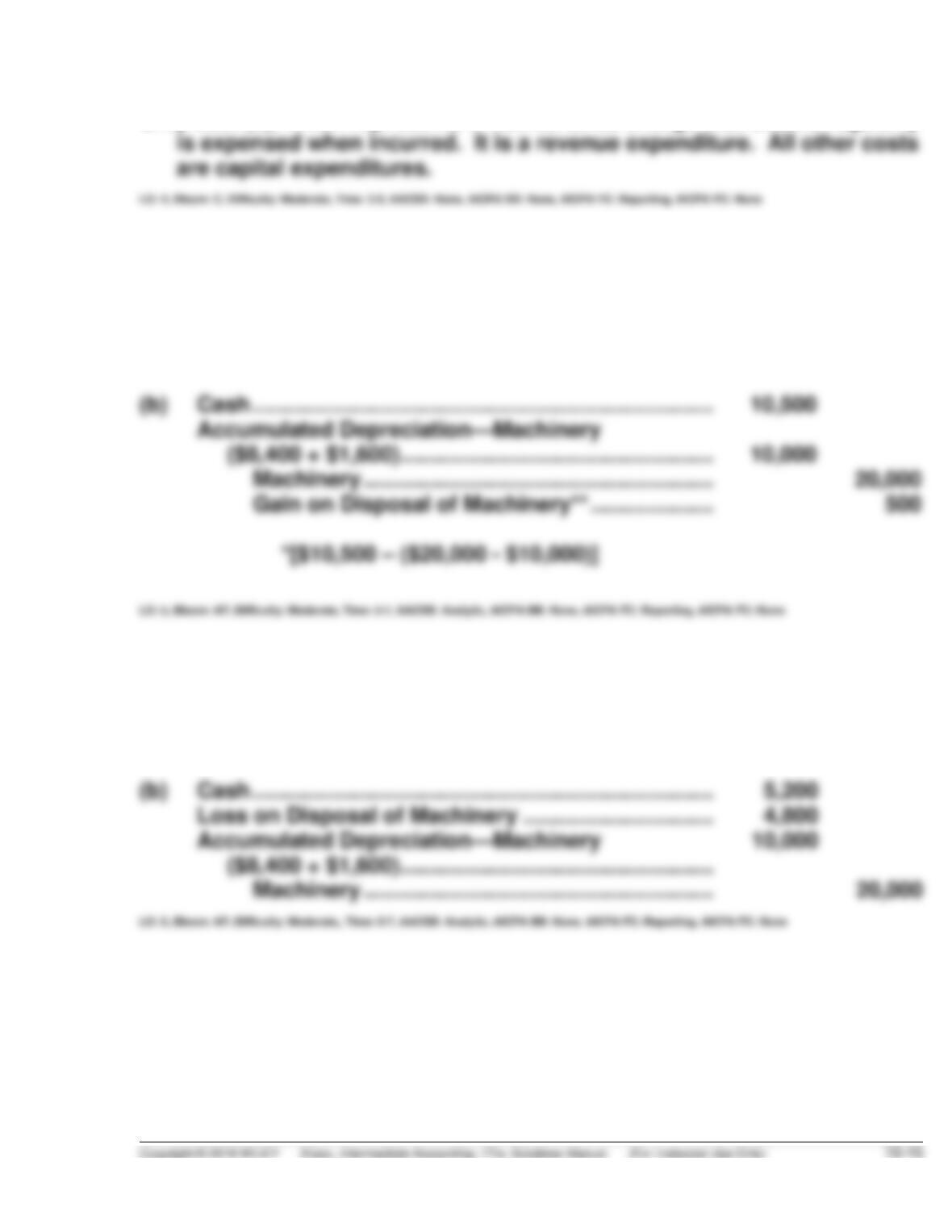
Trucks (new) ……………………………………………………….
37,000
Accumulated Depreciation—Trucks …………………………
27,000
Loss on Disposal of Trucks* ……………………………………
Trucks (used) ………………………………………………….
Cash ……………………………………………………….
BRIEF EXERCISE 10.12
Trucks (new) ……………………………………………………….
35,000
Accumulated Depreciation—Trucks …………………………
Loss on Disposal of Trucks ……………………………………..
1,000
Trucks (used) ………………………………………………….
Cash ……………………………………………………….
BRIEF EXERCISE 10.13
Only cost (c), which represents a maintenance charge that occurs regularly
BRIEF EXERCISE 10.14
(a)
Depreciation Expense ($2,400 X 8/12) ………………………
1,600
Accumulated Depreciation—Machinery ……………
1,600
(b)
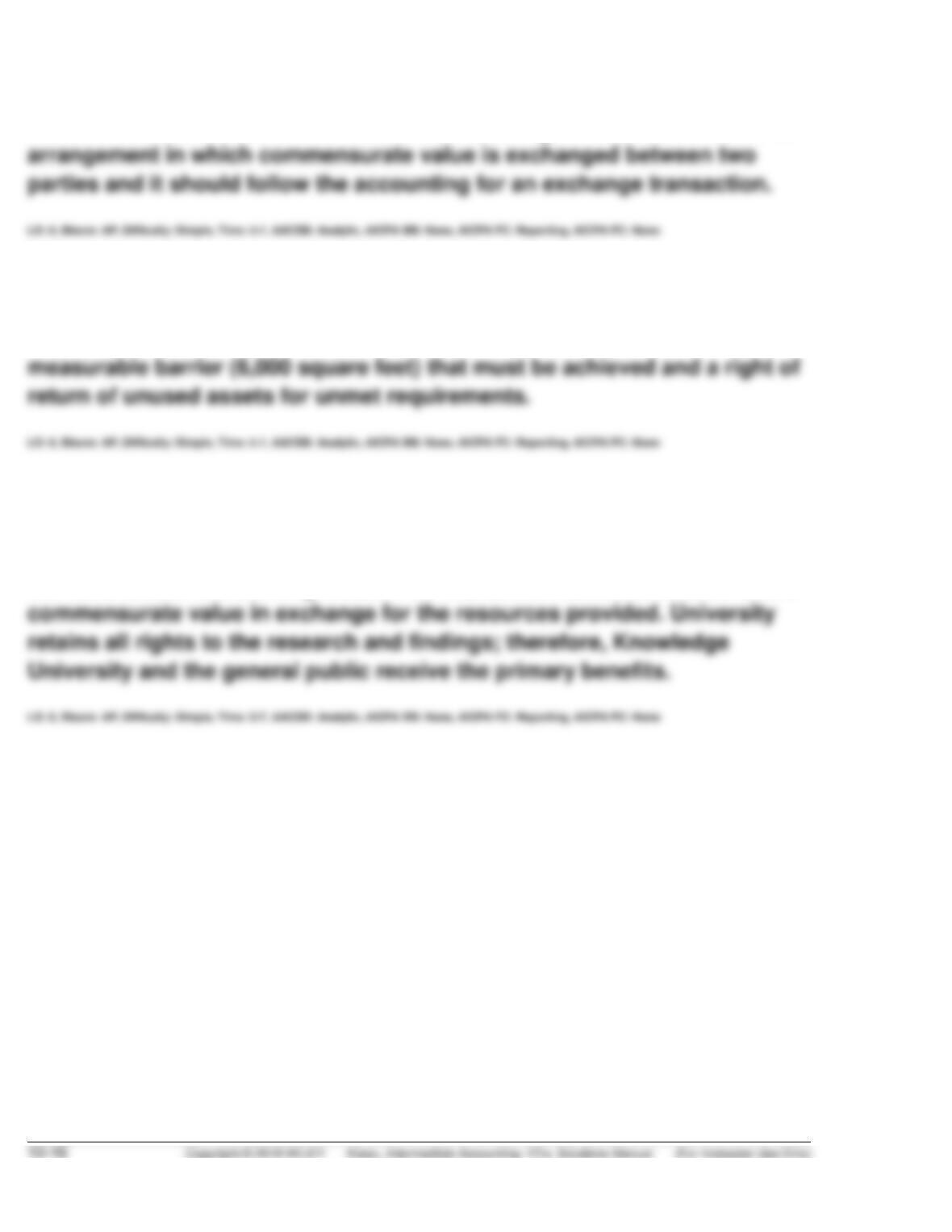
Cash ………………………………………………………………………
Machinery ………………………………………………………
Gain on Disposal of Machinery** ……………………..
BRIEF EXERCISE 10.15
(a)
Depreciation Expense ($2,400 X 8/12) ………………………
1,600
Accumulated Depreciation—Machinery ……………
1,600
(b)
Cash ………………………………………………………………………
5,200
Loss on Disposal of Machinery …………………………..
4,800
Machinery ………………………………………………………
*BE10.16
This transaction should be considered an exchange transaction. This is an
*BE10.17
This transaction is a conditional contribution. The grant is includes a
*BE10.18
This grant is considered a nonexchange transaction accounted for under
the contribution accounting model. The foundation does not receive direct
SOLUTIONS TO EXERCISES
EXERCISE 10.1 (15–20 minutes)
Item
Land
Land
Improvements
Building
Other Accounts
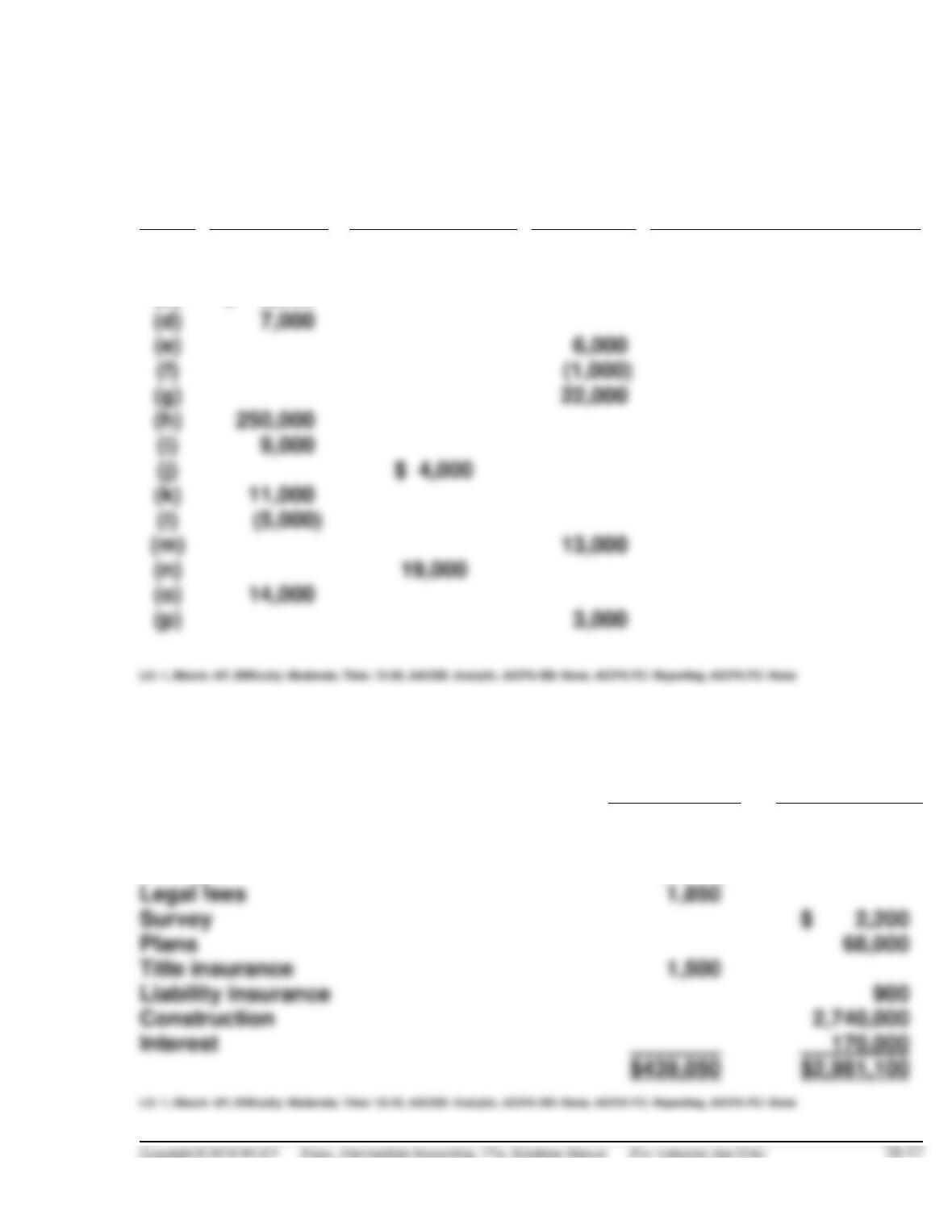
(a)
($275,000) Notes Payable
(b)
$275,000
(c)
$ 8,000
(d)
7,000
6,000
(g)
22,000
(h)
9,000
$ 4,000
11,000
(5,000)
13,000
(n)
(o)
14,000
(p)
3,000
EXERCISE 10.2 (10–15 minutes)
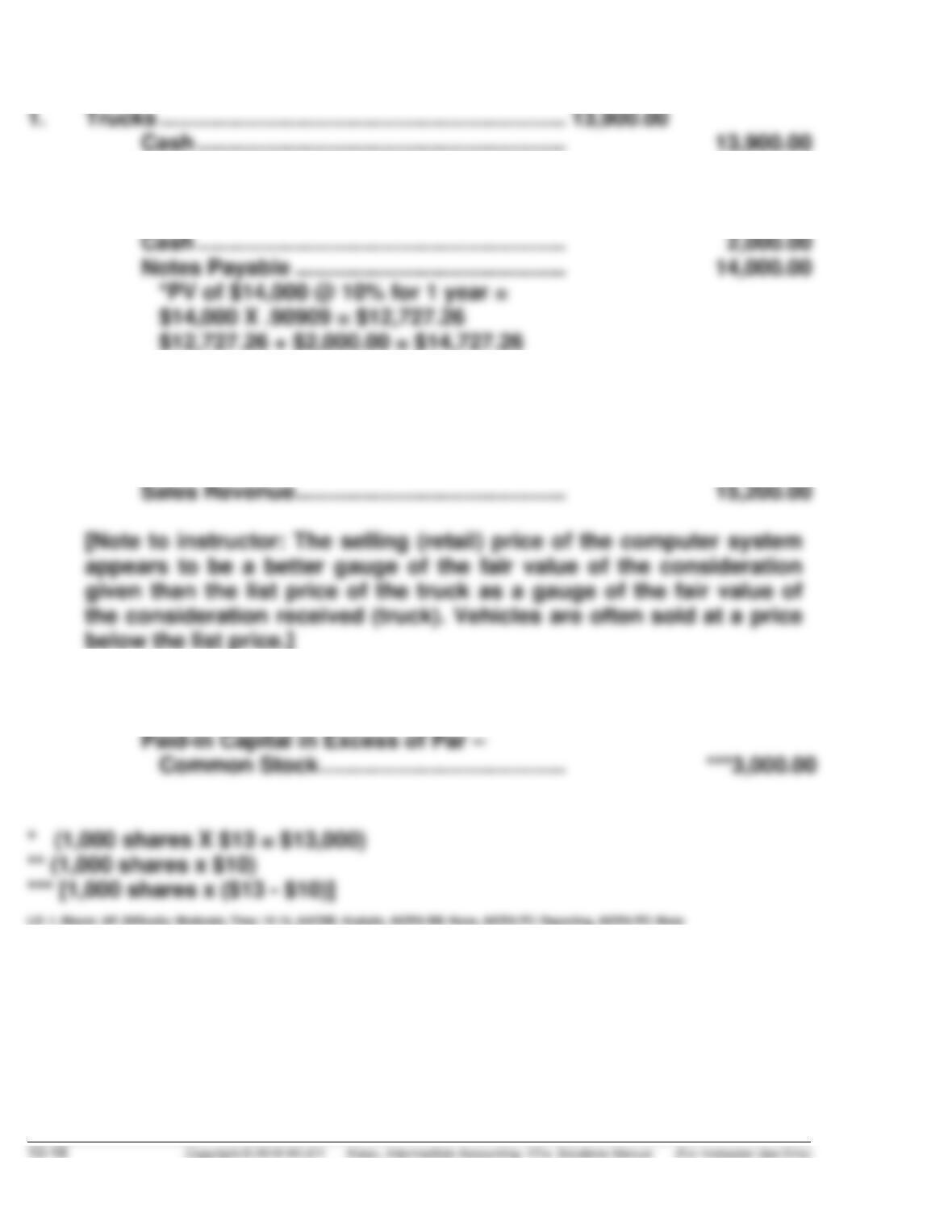
The allocation of costs would be as follows:
Land
Building
Land
$400,000
Razing costs
42,000
Salvage
(6,300)
Survey
Plans
Title insurance
Liability insurance
Construction
Interest
EXERCISE 10.3 (10–15 minutes)
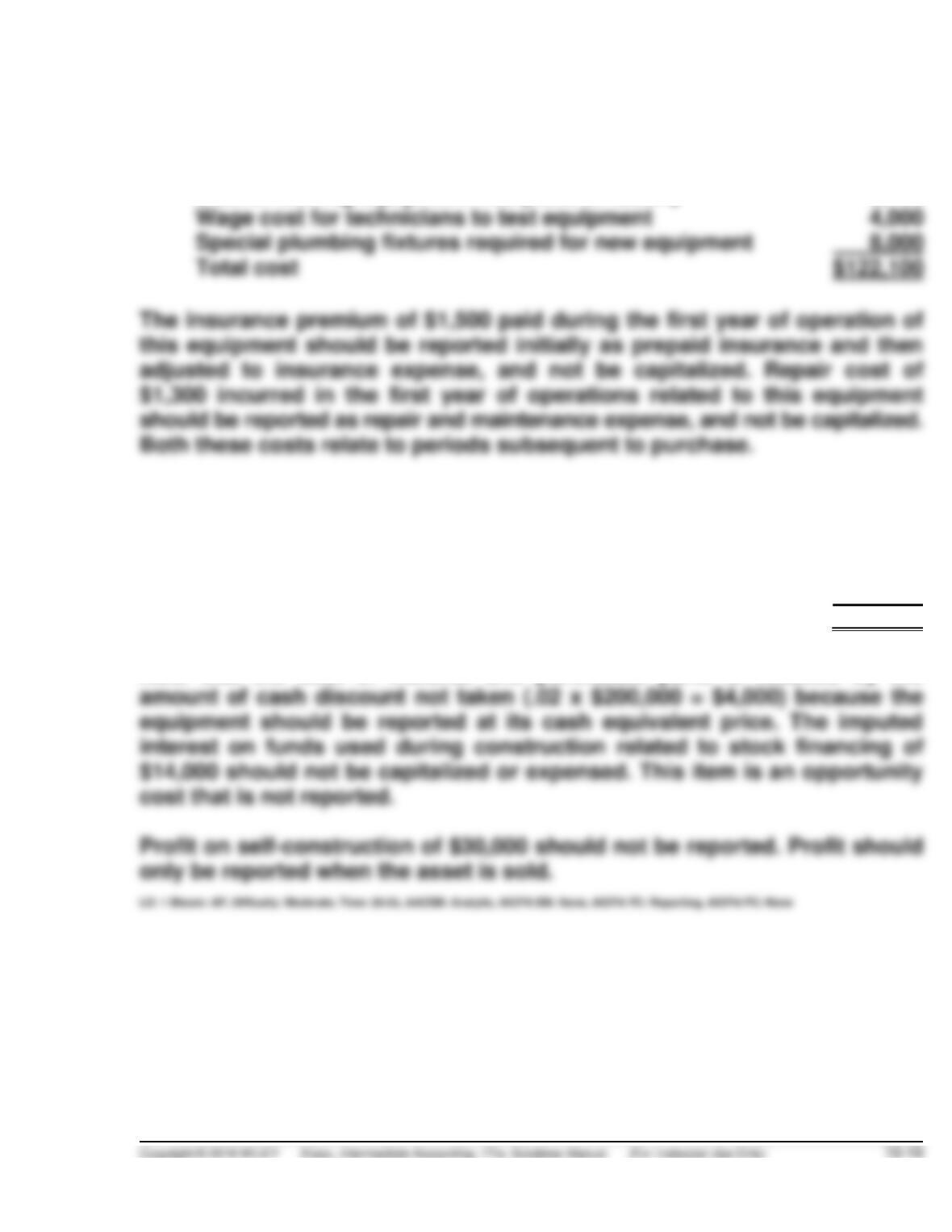
1.
Trucks ……………………………………………………………………
13,900.00
Cash ……………………………………………………….
2.
Trucks ……………………………………………………………………
14,727.26*
Discount on Notes Payable …………………………..
1,272.74
Cash ……………………………………………………….
Notes Payable ………………………………………………..
*PV of $14,000 @ 10% for 1 year =
$14,000 X .90909 = $12,727.26
3.
Trucks ……………………………………………………………………
15,200.00
Cost of Goods Sold …………………………………………………
12,000.00
Inventory ……………………………………………………….
12,000.00
Sales Revenue ………………………………………………..
4.
Trucks ……………………………………………………………………
13,000.00*
Common Stock ……………………………………………….
**10,000.00
EXERCISE 10.4 (20–25 minutes)
Purchase
Cash paid for equipment, including sales tax of $5,000
$105,000
Freight and insurance while in transit
2,000
Cost of moving equipment into place at factory
3,100
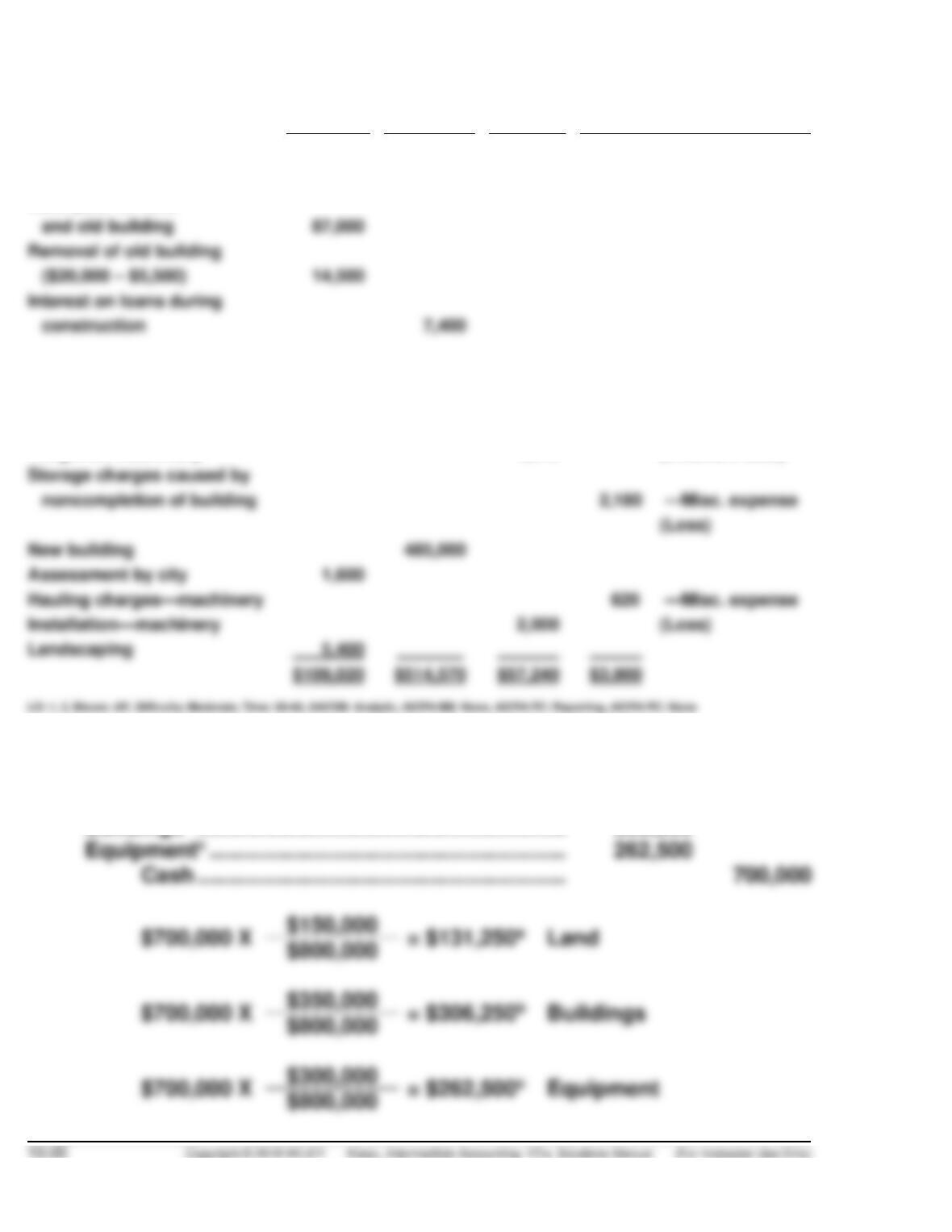
Wage cost for technicians to test equipment
4,000
Special plumbing fixtures required for new equipment
Total cost
$122,100
Construction
Material and purchased parts ($200,000 X .98)
$196,000
Labor costs
190,000
Overhead costs
50,000
Cost of installing equipment
4,400
Total cost
$440,400
Note that the cost of material and purchased parts is reduced by the
EXERCISE 10.5 (30–40 minutes)
Land
Buildings
M & E
Other
Abstract fees
$ 520
Architect’s fees
$ 3,170
Cash paid for land
and old building
Removal of old building
($20,000 – $5,500)
14,500
Interest on loans during
construction
7,400
Excavation before
construction
19,000
Machinery purchased
$53,900
$1,100
—Misc. expense
Freight on machinery
1,340
(Discount Lost)
Storage charges caused by
noncompletion of building
—Misc. expense
(Loss)
New building
Assessment by city
1,600
Hauling charges—machinery
2,000
(Loss)
5,400
$109,020
$57,240
EXERCISE 10.6 (15–25 minutes)
1.
Land a ……………………………………………………….……………
131,250
Buildingsb ……………………………………………………….
306,250
Cash ……………………………………………………….