Wild and Shaw Financial and Managerial Accounting 9e Solutions Manual: Chapter 10
708
Problem 10-9BB (60 minutes)
Part 1
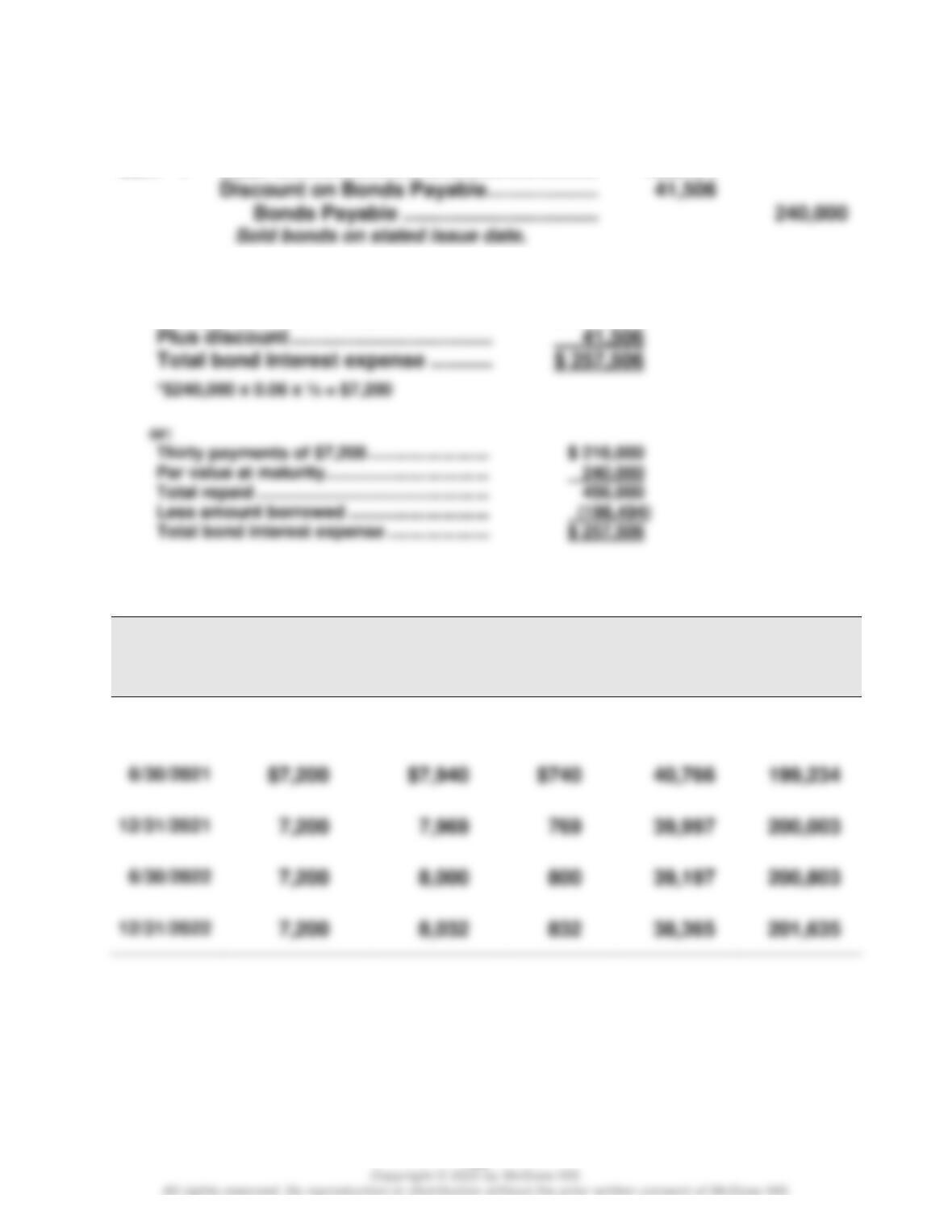
Jan. 1
Cash ………………………………………………….
198,494
Part 2
Thirty payments of $7,200* …………..
$ 216,000
Part 3
Semiannual
Interest
Period-End
(A)
Cash Interest
Paid
[3% x $240,000]
(B)
Bond Interest
Expense
[4% x Prior (E)]
(C)
Discount
Amortization
[(B) – (A)]
(D)
Unamortized
Discount
[Prior (D) – (C)]
(E)
Carrying
Value
[$240,000 – (D)]
1/01/2021
$41,506
$198,494
6/30/2021
6/30/2022
Wild and Shaw Financial and Managerial Accounting 9e Solutions Manual: Chapter 10
709
Problem 10-9BB (Concluded)
Part 4
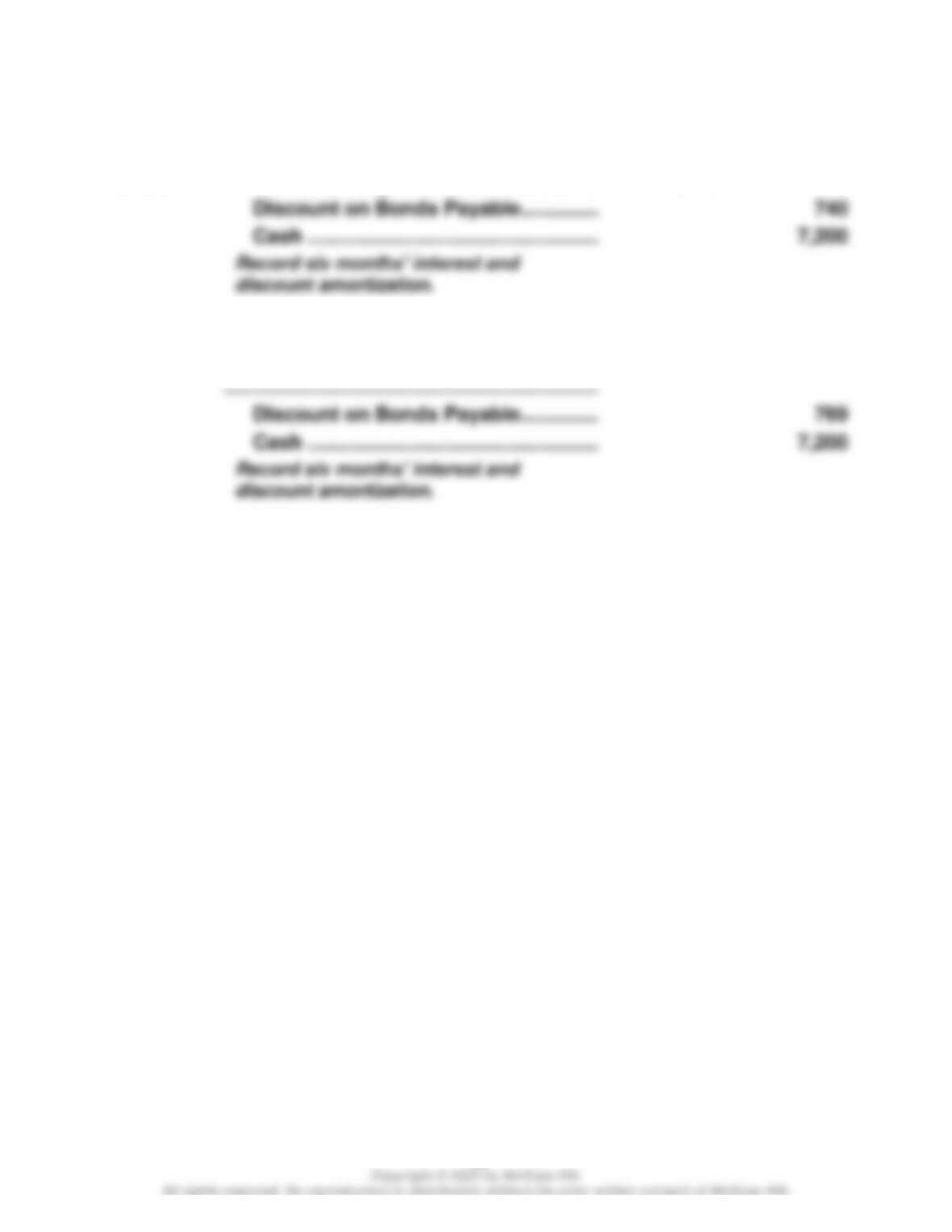
June 30
Bond Interest Expense ……………………….
7,940
Dec. 31
Bond Interest Expense
…………………………..……………………………..
7,969
Wild and Shaw Financial and Managerial Accounting 9e Solutions Manual: Chapter 10
710
Problem 10–10BB (45 minutes)
Part 1
Ten payments of $14,400 ……………..
$144,000
Less premium ……………………………..
(12,988)
Total bond interest expense ………..
$131,012
or:
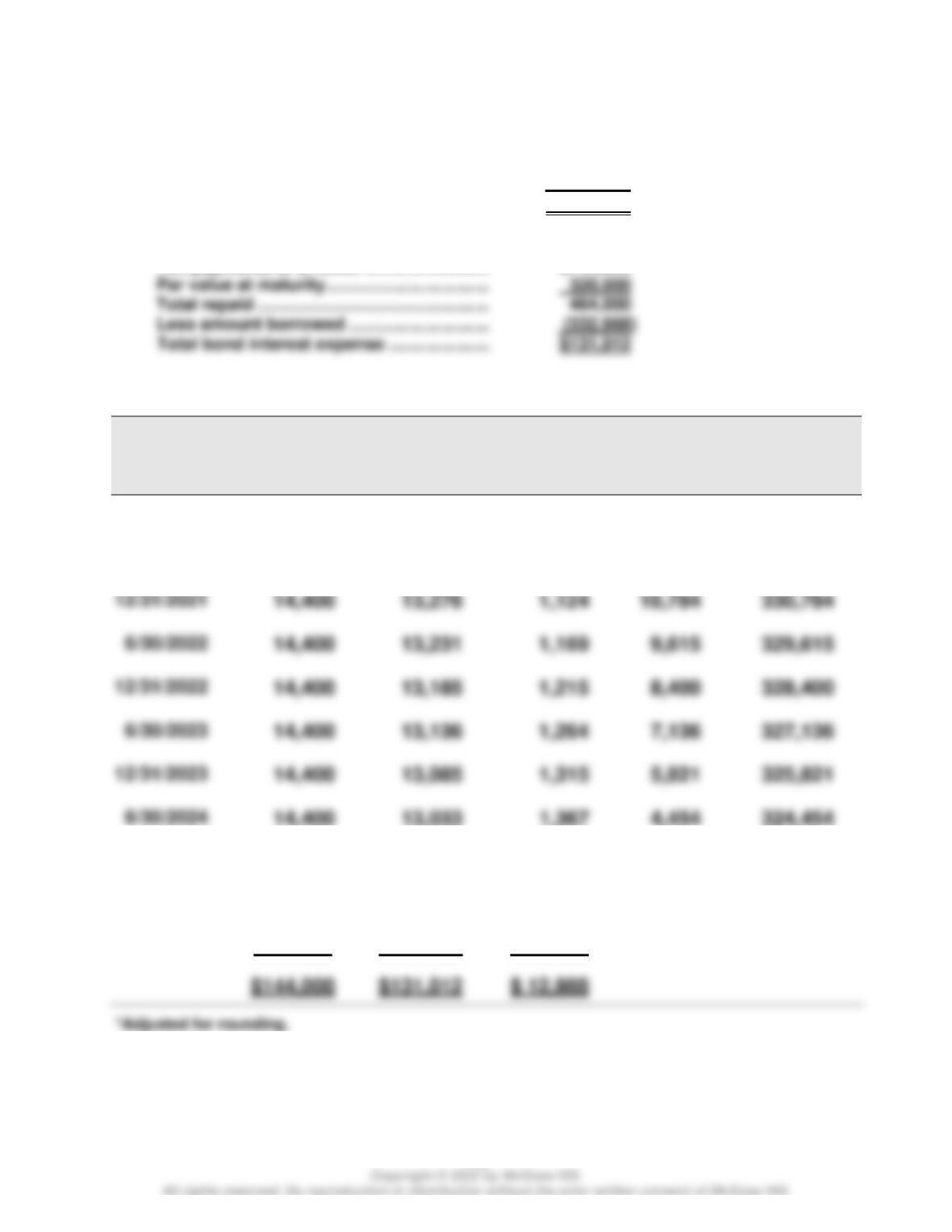
Ten payments of $14,400 ……………………..
$144,000
Total repaid …………………………………………
Part 2
Semiannual
Interest
Period-End
(A)
Cash Interest
Paid
[4.5% x $320,000]
(B)
Bond Interest
Expense
[4% x Prior (E)]
(C)
Premium
Amortization
[(A) – (B)]
(D)
Unamortized
Premium
[Prior (D) – (C)]
(E)
Carrying
Value
[$320,000 + (D)]
1/01/2021
$12,988
$332,988
6/30/2021
$ 14,400
$ 13,320
$ 1,080
11,908
331,908
13,276
1,124
10,784
330,784
6/30/2022
13,231
1,169
329,615
13,185
1,215
328,400
6/30/2023
13,136
1,264
327,136
13,085
1,315
325,821
6/30/2024
13,033
324,454
12/31/2024
14,400
12,978
1,422
3,032
323,032
6/30/2025
14,400
12,921
1,479
1,553
321,553
12/31/2025
14,400
12,847*
1,553
0
320,000
$144,000
$131,012
Wild and Shaw Financial and Managerial Accounting 9e Solutions Manual: Chapter 10
711
Problem 10-10BB (Concluded)
Part 3
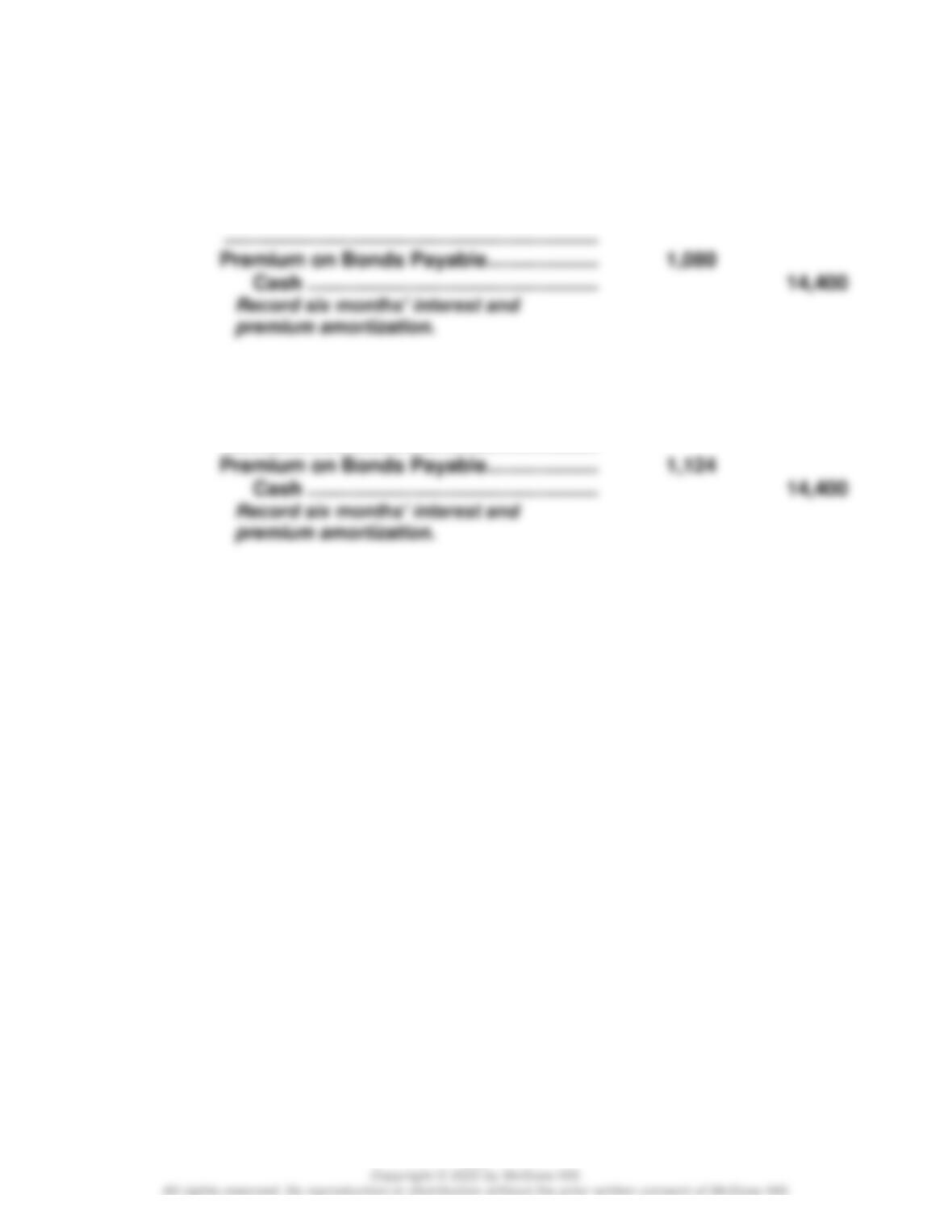
2021
June 30
…………………………..……………………………..
Bond Interest Expense
…………………………..……………………………..
13,320
2021
Dec. 31
Bond Interest Expense
…………………………..……………………………..
…………………………..……………………………..
13,276
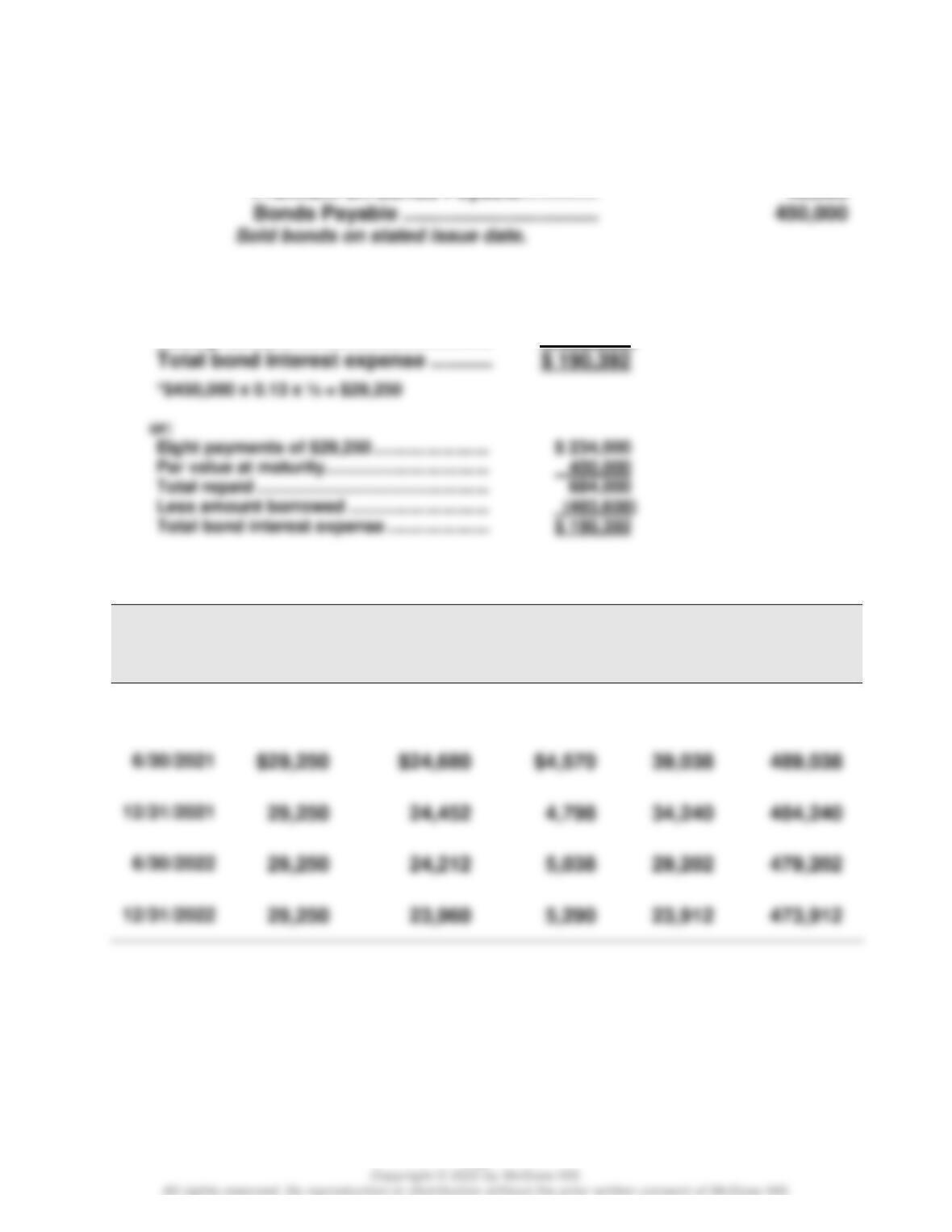
Wild and Shaw Financial and Managerial Accounting 9e Solutions Manual: Chapter 10
712
Problem 10-11BB (70 minutes)
Part 1
Jan. 1
Cash ………………………………………………….
493,608
Premium on Bonds Payable…………..
43,608
Bonds Payable ……………………………..
Part 2
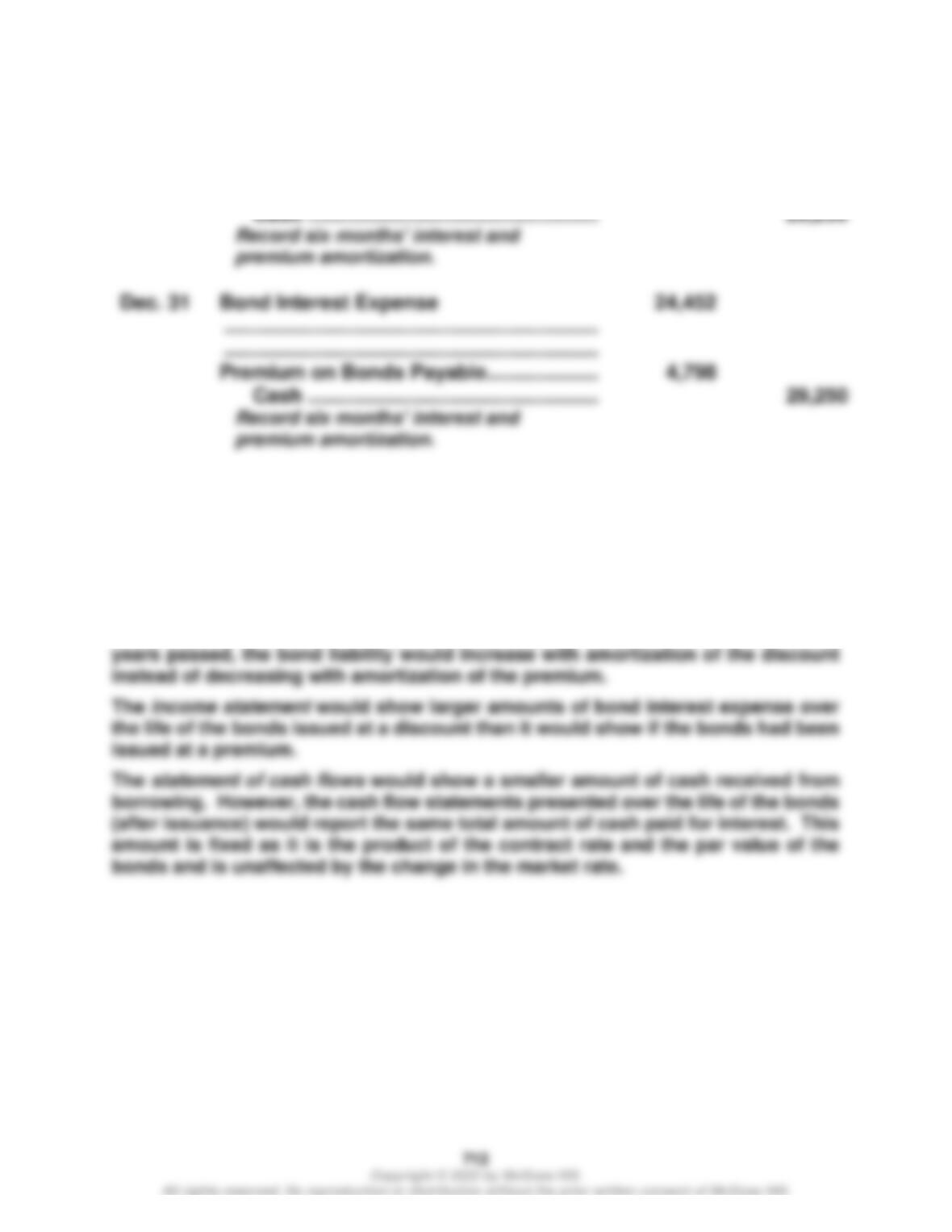
Eight payments of $29,250* ………….
$ 234,000
Less premium ……………………………..
(43,608)
Part 3
Semiannual
Interest
Period-End
(A)
Cash Interest
Paid
[6.5% x $450,000]
(B)
Bond Interest
Expense
[5% x Prior (E)]
(C)
Premium
Amortization
[(A) – (B)]
(D)
Unamortized
Premium
[Prior (D) – (C)]
(E)
Carrying
Value
[$450,000 + (D)]
1/01/2021
$43,608
$493,608
6/30/2021
6/30/2022
Wild and Shaw Financial and Managerial Accounting 9e Solutions Manual: Chapter 10
Problem 10-11BB (Concluded)
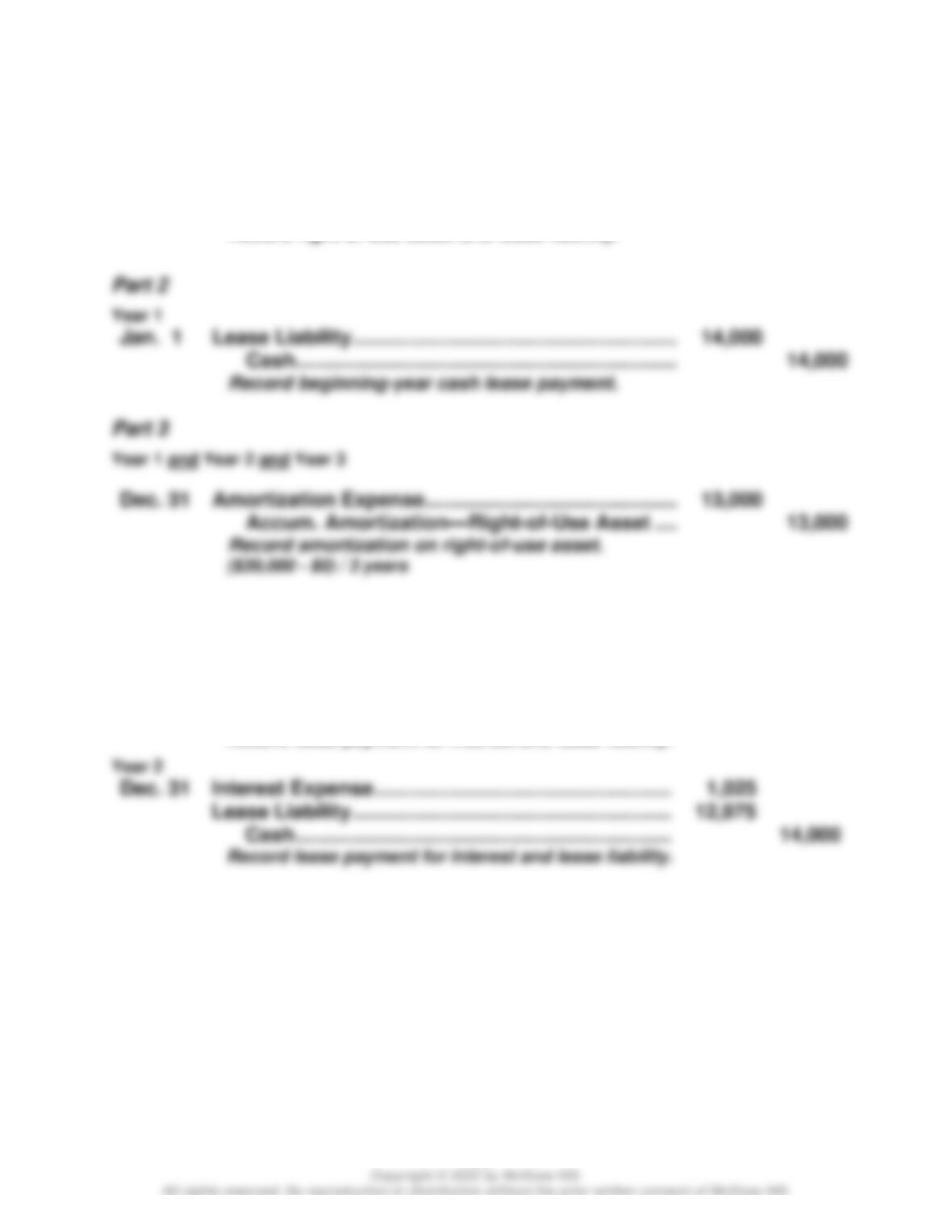
Part 4
June 30
Bond Interest Expense ……………………….
24,680
Premium on Bonds Payable………………..
4,570
Part 5
If the market rate on the issue date had been 14% instead of 10%, the bonds would
have sold at a discount because the contract rate of 13% would have been lower
than the market rate.
This change would affect the balance sheet because the bond liability would be
smaller (par value minus a discount instead of par value plus a premium). As the
Wild and Shaw Financial and Managerial Accounting 9e Solutions Manual: Chapter 10
714
Problem 10-12BC (35 minutes)
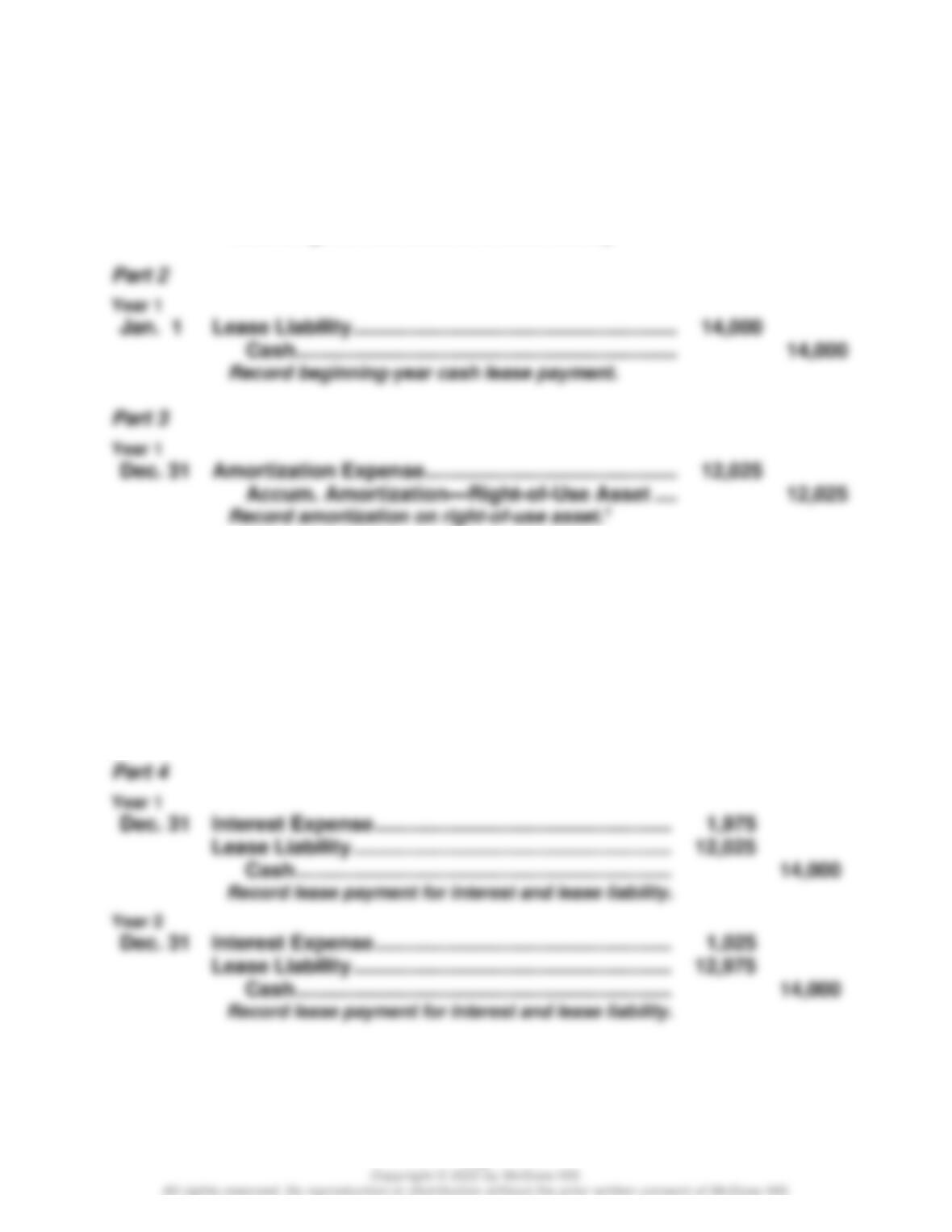
Part 1
Year 1
Jan. 1
Right–of-Use Asset …………………………………………..
39,000
Lease Liability …………………………………………….
39,000
Record right-of-use asset and lease liability.
Jan. 1
Lease Liability ………………………………………………….
14,000
Cash …………………………………………………………..
14,000
Record beginning-year cash lease payment.
Dec. 31
Amortization Expense ………………………………………
13,000
Accum. Amortization—Right-of-Use Asset ….
13,000
Part 4
Year 1
Dec. 31
Interest Expense ……………………………………………..
1,975
Lease Liability …………………………………………………
12,025
Cash ………………………………………………………….
14,000
Record lease payment for interest and lease liability.
Dec. 31
Interest Expense ……………………………………………..
1,025
Lease Liability …………………………………………………
12,975
Cash ………………………………………………………….
14,000
Wild and Shaw Financial and Managerial Accounting 9e Solutions Manual: Chapter 10
715
Problem 10-13BC (35 minutes)
Part 1
Year 1
Jan. 1
Right–of-Use Asset …………………………………………..
39,000
Lease Liability …………………………………………….
39,000
Record right-of-use asset and lease liability.
Jan. 1
14,000
Cash …………………………………………………………..
14,000
Dec. 31
Amortization Expense ………………………………………
12,025
Accum. Amortization—Right-of-Use Asset ….
12,025
Record amortization on right-of-use asset.1
Year 2
Dec. 31
Amortization Expense ………………………………………
12,975
Accum. Amortization—Right-of-Use Asset ….
12,975
Record amortization on right-of-use asset.2
Year 3
Dec. 31
Amortization Expense ………………………………………
14,000
Accum. Amortization—Right-of-Use Asset ….
14,000
Record amortization on right-of-use asset.3
1 $14,000-$1,975 2 $14,000-$1,025 3 $14,000-$0
Dec. 31
Interest Expense ……………………………………………..
Cash ………………………………………………………….
14,000
Dec. 31
Interest Expense ……………………………………………..
Cash ………………………………………………………….
14,000
Wild and Shaw Financial and Managerial Accounting 9e Solutions Manual: Chapter 10
716
SERIAL PROBLEM — SP 10
Serial Problem — Business Solutions (75 minutes)
Part 1
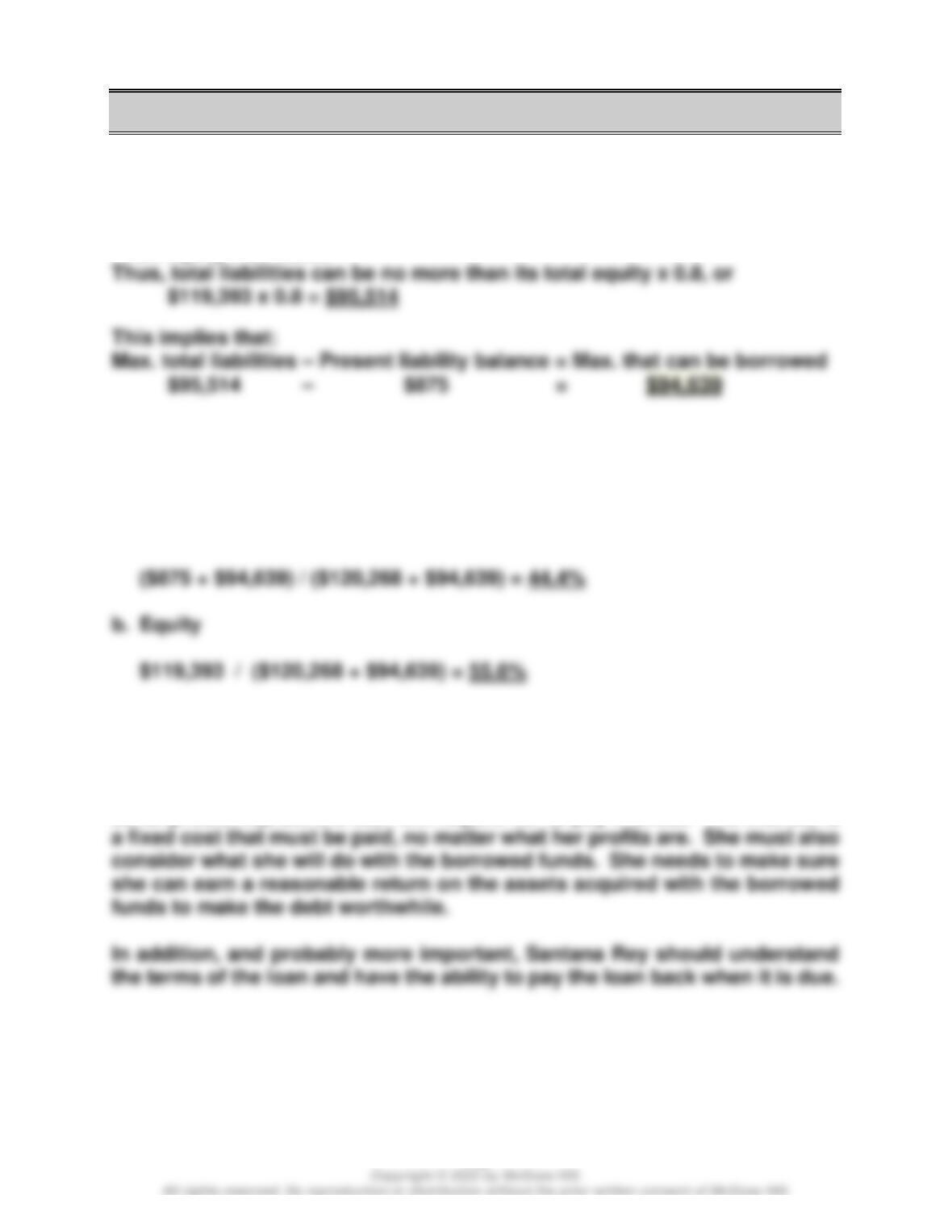
Total equity = $119,393
Part 2
Assume the secured loan is taken, then the percent of assets financed by:
a. Debt
Part 3
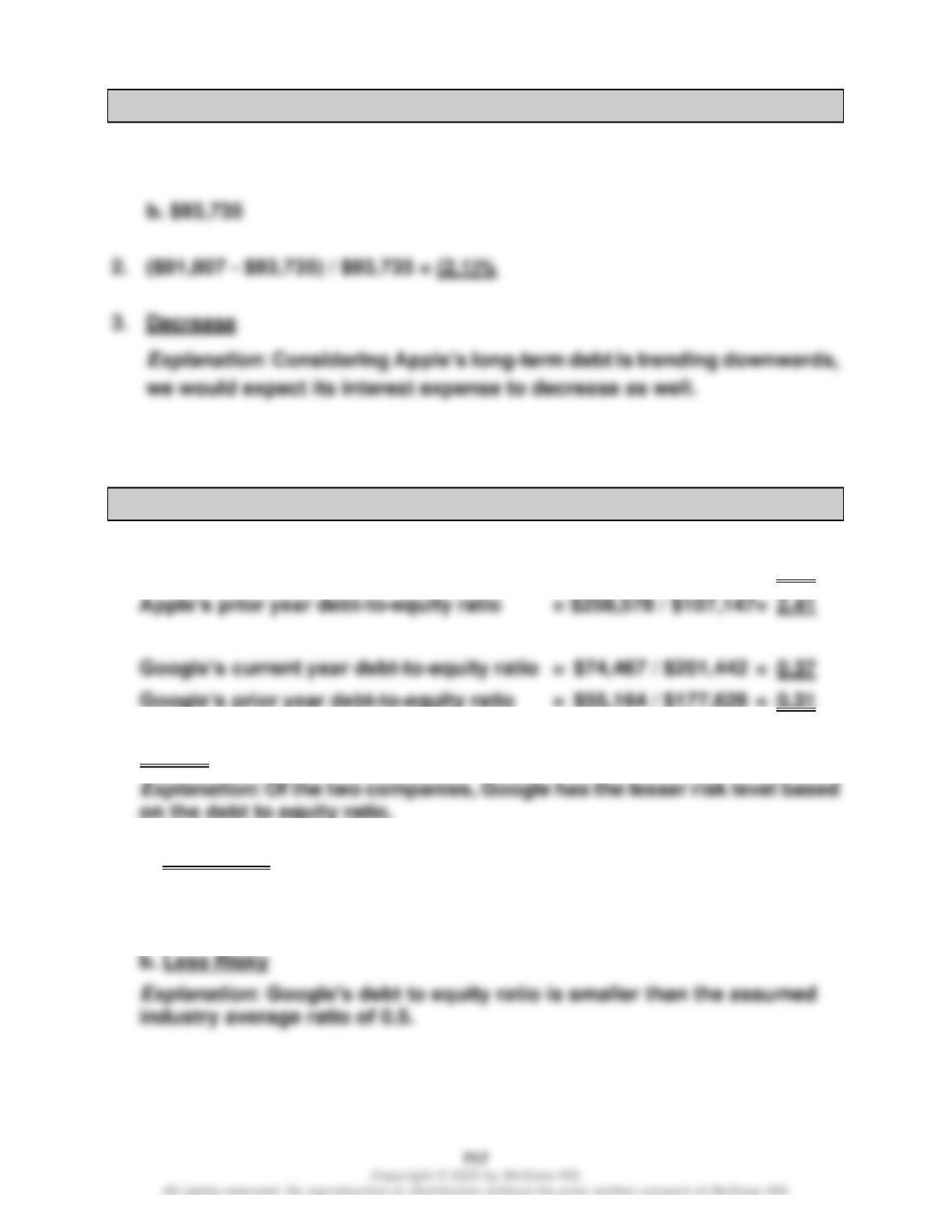
Santana Rey should understand the risks she is taking by borrowing funds
from the bank. She currently has no interest-bearing debt (per prior chapter
serial problems), but the loan will require her to pay interest. The interest is
Wild and Shaw Financial and Managerial Accounting 9e Solutions Manual: Chapter 10
Company Analysis — AA 10-1 (15 minutes)
$ millions
1. a. $91,807
Comparative Analysis — AA 10-2 (25 minutes)
$ millions
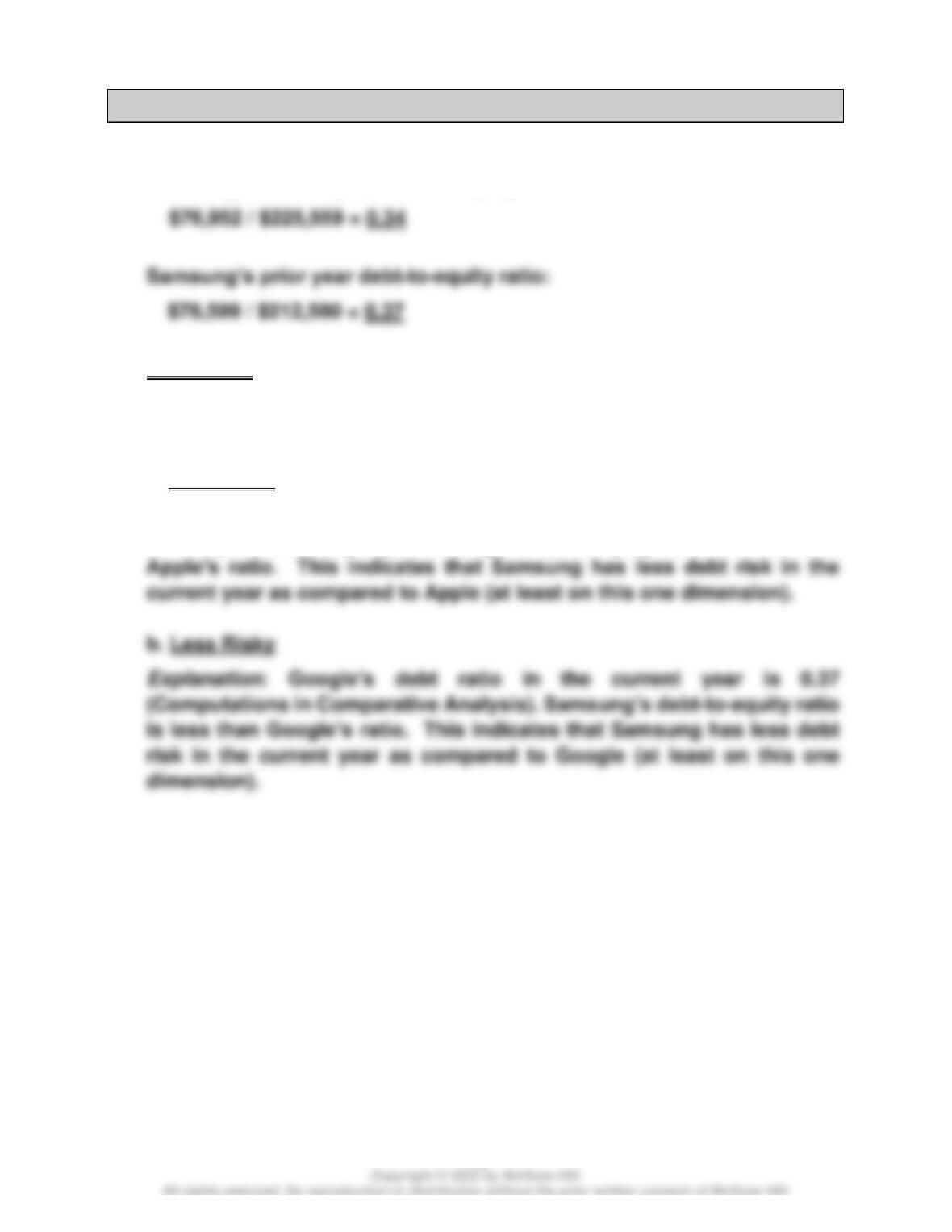
1. Apple’s current year debt–to-equity ratio = $248,028 / $90,488 = 2.74
2. Google
3. a. More Risky
Explanation: Apple’s debt to equity ratio is larger than the assumed
industry average ratio of 0.5.
Wild and Shaw Financial and Managerial Accounting 9e Solutions Manual: Chapter 10
718
Extended Analysis — AA 10-3 (20 minutes)
$ millions
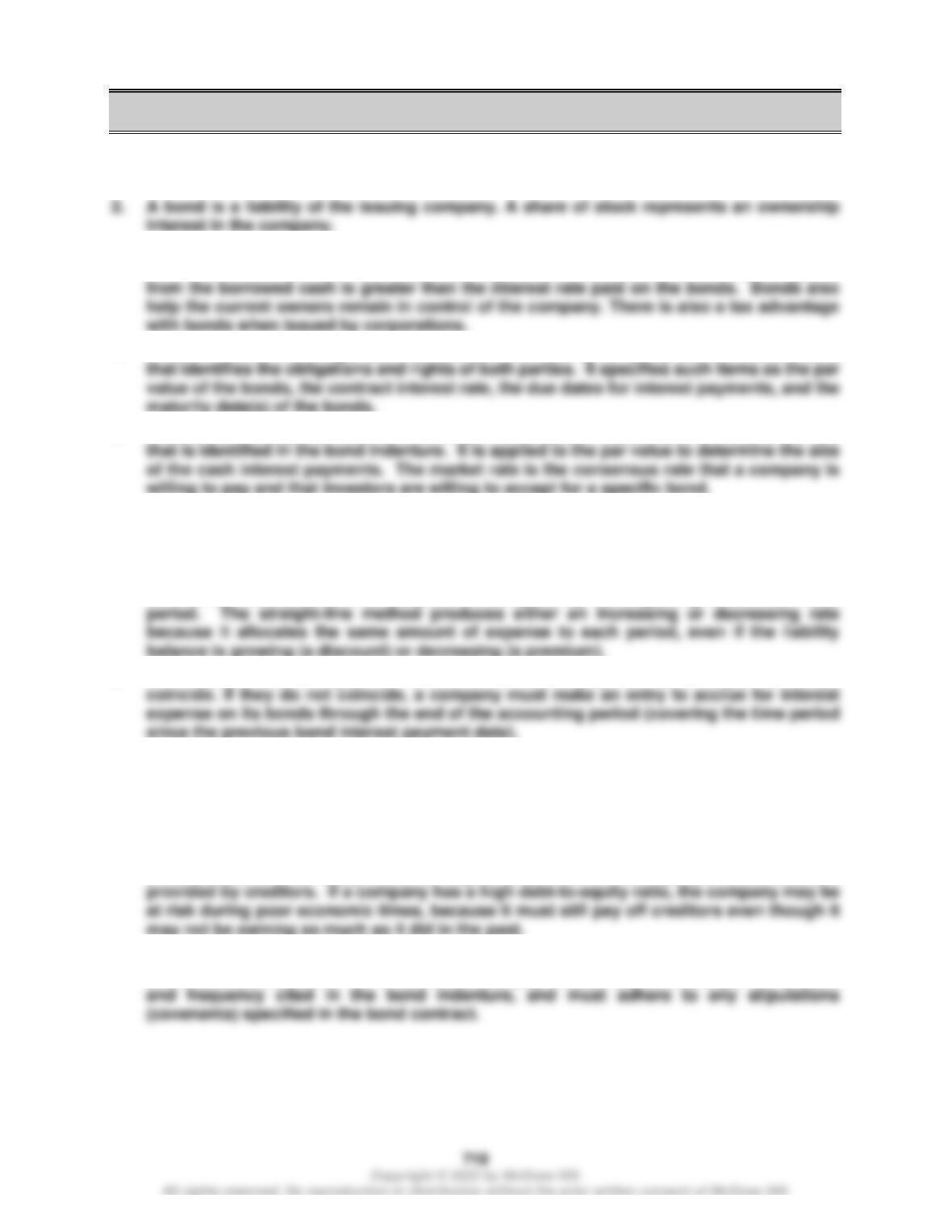
1. Samsung’s current year debt–to-equity ratio:
2. Less Risky
Explanation: Samsung’s debt–to-equity ratio decreased slightly from the
prior year to the current year.
3. a. Less Risky
Explanation: Apple’s debt ratio in the current year is 2.74 (Computations
in Comparative Analysis). Samsung’s debt–to-equity ratio is lower than
Wild and Shaw Financial and Managerial Accounting 9e Solutions Manual: Chapter 10
DISCUSSION QUESTIONS
1. Notes payable generally involve borrowing from a single creditor, whereas bonds payable
are usually sold to many different lenders (bondholders).
3. Bonds can allow a company’s owners to increase their return on equity without investing
additional amounts. This result occurs as long as the rate of return on the assets acquired
4. A bond indenture is a legal contract between the issuing company and the bondholders
5. The contract rate (also known as the coupon rate, stated rate, or nominal rate) is the rate
6. In general, the supply of and demand for bonds affect market rates. The market rate for a
particular bond issue is also affected by risks unique to the issuer (e.g., financial
performance and condition) and the length of time until the bonds mature.
7.B The effective interest method creates a constant rate of interest over a bond’s life because
the market rate at the time of issuance is multiplied by the beginning balance for each
8. A company’s accounting period and its bond interest payment dates might not always
9. The price of bonds can be computed by finding the present value of both the par value at
maturity and the periodic cash interest payments discounted at the market rate of interest.
10. The issue price of a $2,000 bond sold at 98 ¼ is 98.25% of $2,000, or $1,965. The issue
price of a $6,000 bond priced at 101 ½ is 101.5% of $6,000, or $6,090.
11. The debt-to-equity ratio is calculated by dividing total liabilities by total equity. The higher
a company’s debt–to–equity ratio, the higher proportion of a company’s assets that are
12. An entrepreneur (owner) must repay the bondholders the principal (par value) according
to the term of the bonds. He or she must also pay interest on the bonds per the amount
Wild and Shaw Financial and Managerial Accounting 9e Solutions Manual: Chapter 10
13.C If a lease is a long-term lease, then a right-of-use asset account for the lease asset is
14.C A finance lease is a long-term lease in which the lessor transfers substantially all the risks
and rewards of ownership to the lessee—see one or more of five criteria that must be met.
15.C Pension plans can be designed as defined benefit plans or defined contribution plans. In
a defined benefit plan the employer estimates the contribution necessary to pay a pre-
defined benefit amount to its retirees. For example, an employee’s monthly pension
Wild and Shaw Financial and Managerial Accounting 9e Solutions Manual: Chapter 10
721
Ethics Challenge — BTN 10-1
1. The ethics of the Traverse County officials are questionable. The financial
impact of the leasing arrangement is the same as bond financing in that
the county has a debt obligation requiring the repayment of principal and
interest over time. Taxes may need to be raised to repay the lease just as
2. Because the lease requires payments of a non-binding nature, investors
who purchased the tax-exempt securities from the bank are holding an
investment that is more risky than the conventional municipal bonds of
Traverse County.
Wild and Shaw Financial and Managerial Accounting 9e Solutions Manual: Chapter 10
722
Communicating in Practice — BTN 10-2
MEMORANDUM
TO:
FROM:
SUBJECT:
The body of the memorandum should make the following points:
The associate is confused about the concept of a bond premium. Bonds that
sell at a premium provide the issuing company more cash than they are
required to pay the bondholders at their maturity date. When a bond is issued
The bottom line is that the market prices the bonds according to their
perceived risks and returns. What your associate needs to focus on is the
level of risk she is willing to accept and then invest accordingly.
Wild and Shaw Financial and Managerial Accounting 9e Solutions Manual: Chapter 10
Teamwork in Action — BTN 10-3
Parts 1 and 2
Effective Interest Amortization of Bond Premium
Semi-
annual
Period-end
(A)
Cash
Interest
Paid
(B)
Bond
Interest
Expense
(C)
Premium
Amortization
(D)
Unamortized
Premium
(E)
Carrying
Value
1/01/2021
$ 4,100
$ 104,100
6/30/2021
6/30/2023
12/31/2023
4,500
4,091
409
1,872
101,872
6/30/2024
4,500
4,075
425
1,447
101,447
12/31/2024
4,500
4,058
442
1,005
101,005
6/30/2025
4,500
4,040
460
100,545
12/31/2025
100,000
The following computations should be articulated by team members as
each line is explained and prepared:
Column (A) Cash Interest Paid = Bonds’ par value ($100,000) x Semiannual
contract rate (4.5%).
Column (B) Bond interest expense = Bonds’ prior period carrying value x
Semiannual market rate (4%).
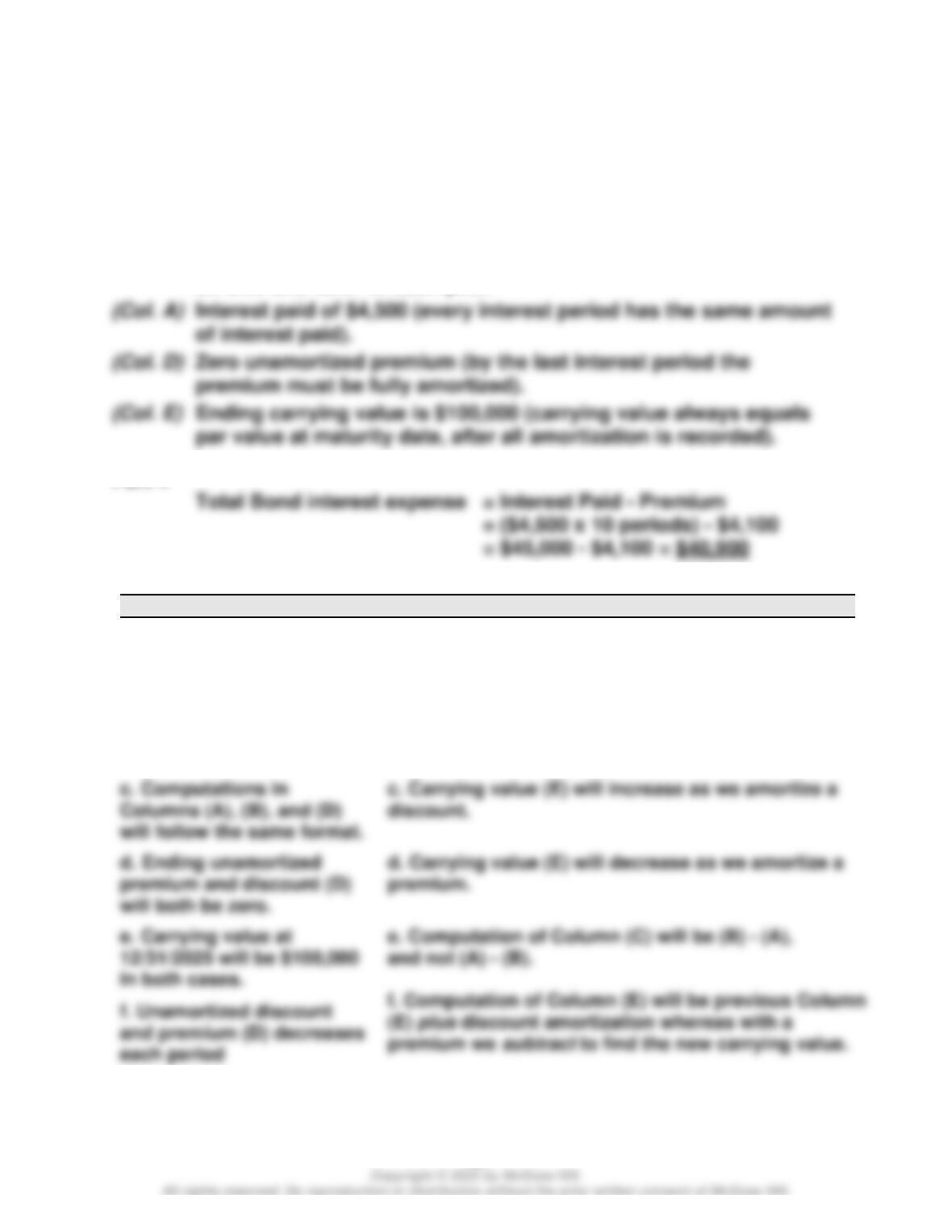
Wild and Shaw Financial and Managerial Accounting 9e Solutions Manual: Chapter 10
724
Teamwork in Action (Concluded)
Part 3
Without completing the table, team members should be able to project the
final number in the first column and for each of the columns (A), (D), and
(E). Specifically:
(Col. 1) Last interest period date is 12/31/2025 because this is a five-year
bond, issued 1/1/2021, with semiannual interest payments made
on 6/30 and 12/31 of each year.
Part 4
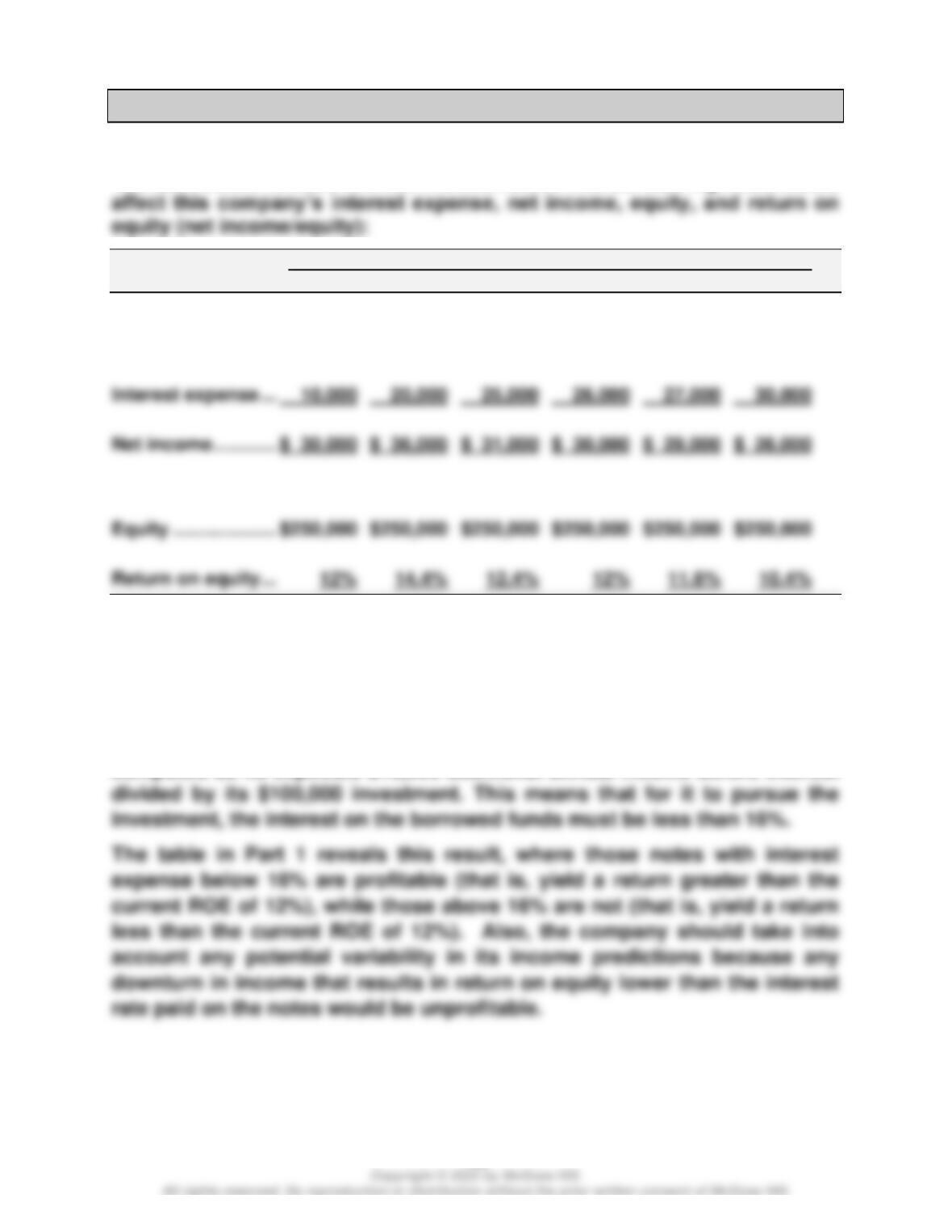
Part 5 List likely includes:
Similarities
Differences
a. Table column headings
for the period and for
columns (A), (B), and (E).
a. Column (C) will be Discount Amortization and
Column (D) will be Unamortized Discount.
b. Dates in the period
column and interest paid in
column (A).
b. Bond interest expense is higher (lower) than the
interest paid and will increase (decrease) as we
amortize a discount (premium).
Wild and Shaw Financial and Managerial Accounting 9e Solutions Manual: Chapter 10
725
Entrepreneurial Decision — BTN 10-4
Part 1
The table below reveals how the five alternative interest-bearing notes would
Alternative Notes for Expansion
Current 10% Note 15% Note 16% Note 17% Note 20% Note
Income before
interest …………. $ 40,000 $ 56,000 $ 56,000 $ 56,000 $ 56,000 $ 56,000
Part 2
The analysis in Part 1 illustrates the general rule (called “financial leverage”
or “trading on the equity”): When a company earns a higher return with
borrowed funds than it is paying in interest, it increases its return on equity.
In the case of this company, it is predicting a return of 16% on its investment,
computed as its expected $16,000 additional annual income before interest

Wild and Shaw Financial and Managerial Accounting 9e Solutions Manual: Chapter 10
726