Chapter 10
Reporting and Interpreting Bonds
ANSWERS TO QUESTIONS
1. A company might choose to issue bonds instead of stock to avoid diluting
2. A bond is a liability issued to the investing public so that a corporate or government
entity can raise capital to finance operations or expansion. Bonds are traded on
3. Unsecured bonds are not backed by any type of asset as a guarantee of repayment
4. A bond indenture is a legal document that specifies all the details of a bond offering.
5. Bond covenants are designed to protect bond investors by limiting what a company
can do while the bond is still outstanding.
6. A bond’s coupon rate (also called the stated rate, contract rate, or nominal rate) is
the interest rate specified on a bond and is the rate used to compute the bond’s
periodic cash interest payment. The market rate of interest (also known as the yield
7. The difference between a bond’s coupon rate and the market rate of interest
determines whether a bond is issued at a discount or a premium. When the coupon
8. The market interest rate reflects the return investors demand to invest in a security
9. The book value of a bond is the bond’s principal amount plus any premium or minus
any discount. A bond’s book value is what a company reports on its balance sheet.
10. The formula used to calculate the cash payment bond investors receive for interest
11. The debt-to-equity ratio is calculated by dividing total liabilities by total stockholders’
12. When market interest rates increase, bond prices decrease. This concept is easily
ANSWERS TO MULTIPLE CHOICE
Financial Accounting, 10/e 10-3
Authors’ Recommended Solution Time
(Time in minutes)
Mini-exercises
Exercises
Problems
Alternate
Problems
Cases and
Projects
No.
Time
No.
Time
No.
Time
No.
Time
No.
Time
1
5
1
5
1
15
1
30
1
25
2
10
2
10
2
30
2
30
2
20
3
5
3
20
3
30
3
30
3
20
4
5
4
20
4
20
4
35
4
30
5
10
5
15
5
25
5
35
5
30
6
15
6
10
6
30
6
30
6
25
7
15
7
15
7
45
7
35
7
8
10
8
20
8
45
8
35
12
13
14
15
5
5
17
15
12
13
14
15
10
20
20
20
12
13
14
15
45
15
15
45
* Due to the nature of this project, it is very difficult to estimate the amount of time students
will need to complete the assignment. As with any open-ended project, it is possible for
students to devote a large amount of time to these assignments. While students often
MINI-EXERCISES
M10–1. 1. Balance sheet
2. Footnotes
M10–2.
Principal
$600,000 0.45639
=
$273,834
M10–3.
The times interest earned ratio is a better indicator. The debt-to-equity ratio assesses
M10–4.
The formula for the times interest earned ratio is:
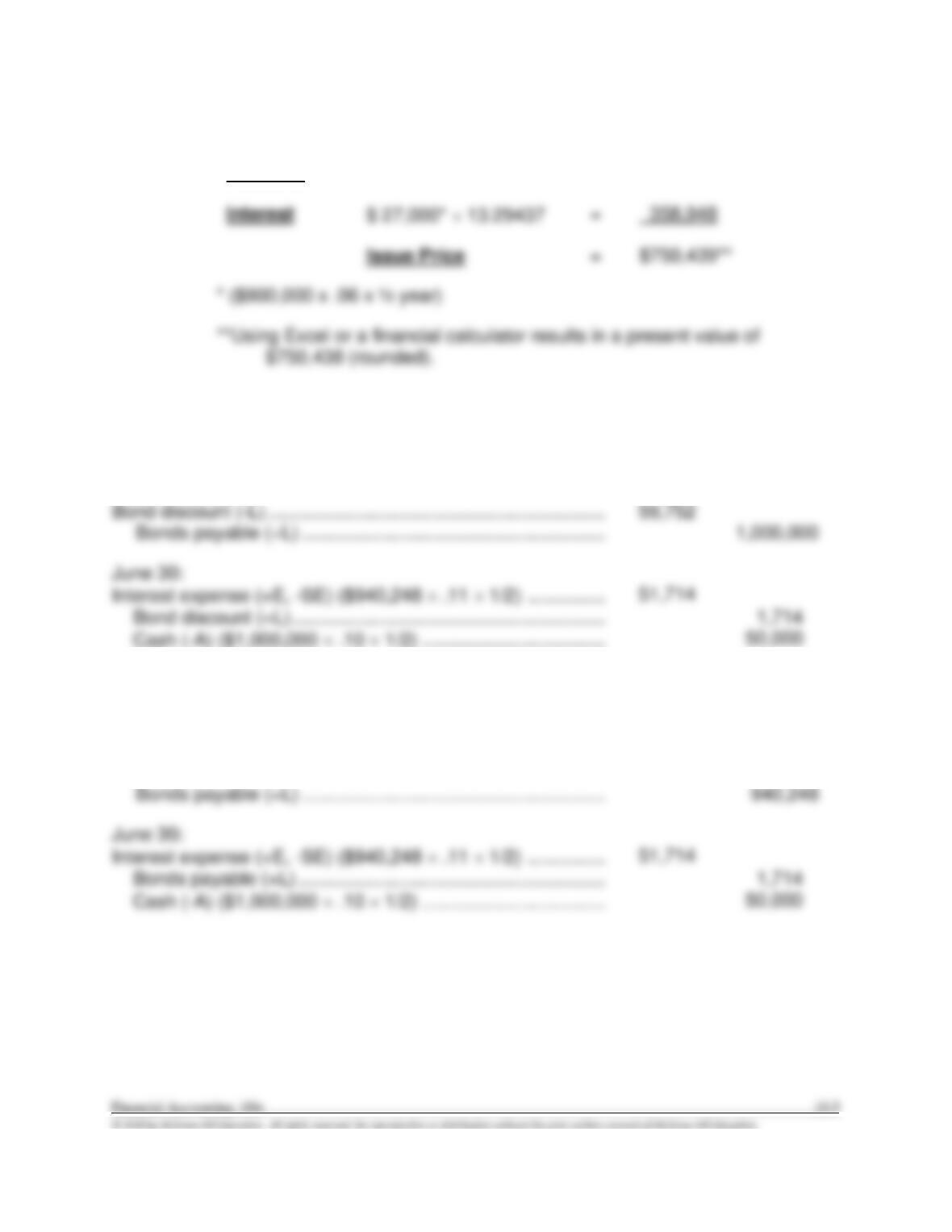
M10–5.
Principal
$900,000 0.43499
=
$391,491
Interest
=
M10–6.
January 1:
Cash (+A) ……………………………………………………………………
940,248
Bond discount (-L) ………………………………………………………..
Bonds payable (+L) ………………………………………………….
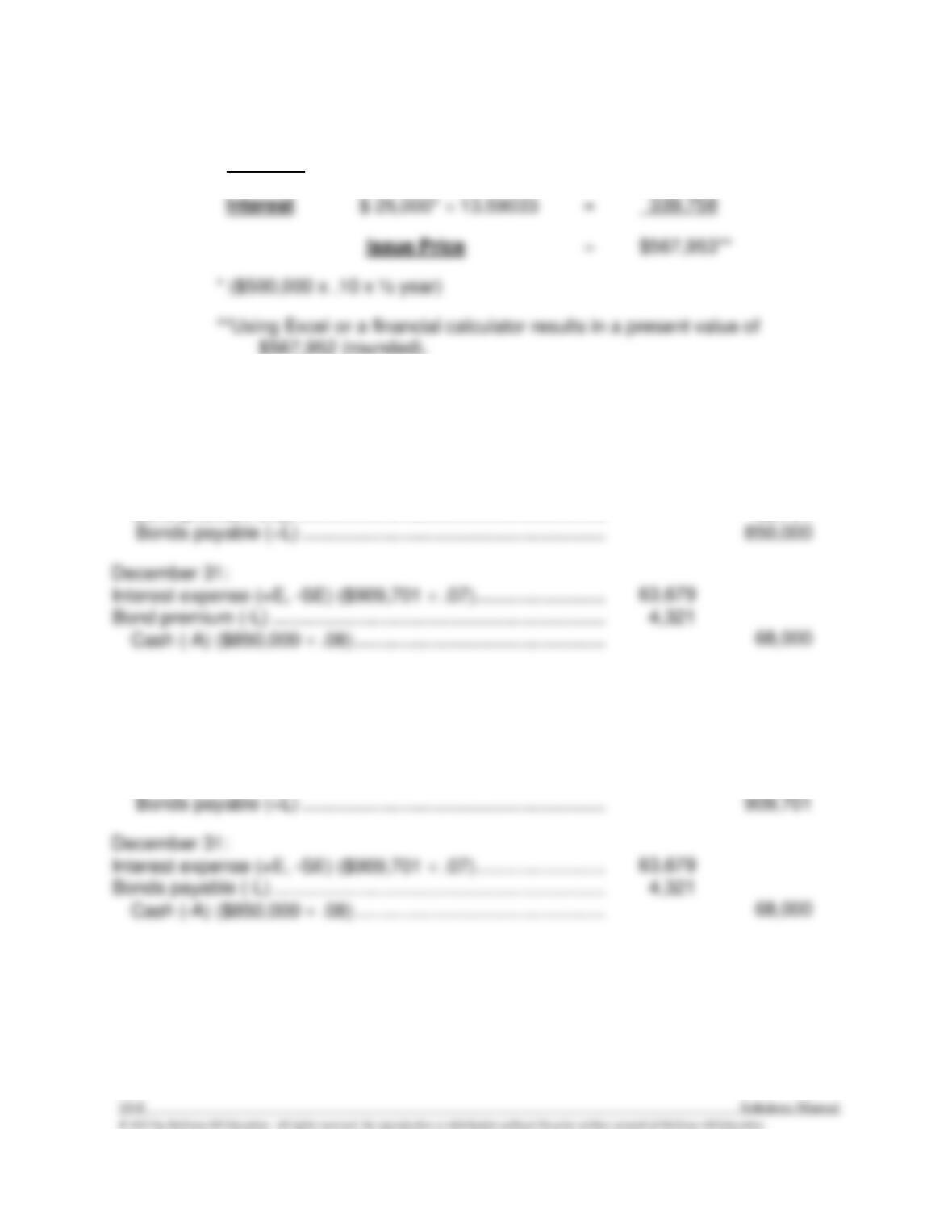
M10–7.
January 1:
Cash (+A) ……………………………………………………………………
940,248
Bonds payable (+L) ………………………………………………….
M10–8.
Principal
$500,000 0.45639
=
$228,195
Interest
=
M10–9.
January 1:
Cash (+A) ……………………………………………………………………
909,701
Bond premium (+L) …………………………………………………..
59,701
Bonds payable (+L) ………………………………………………….
Bond premium (-L) ……………………………………………………….
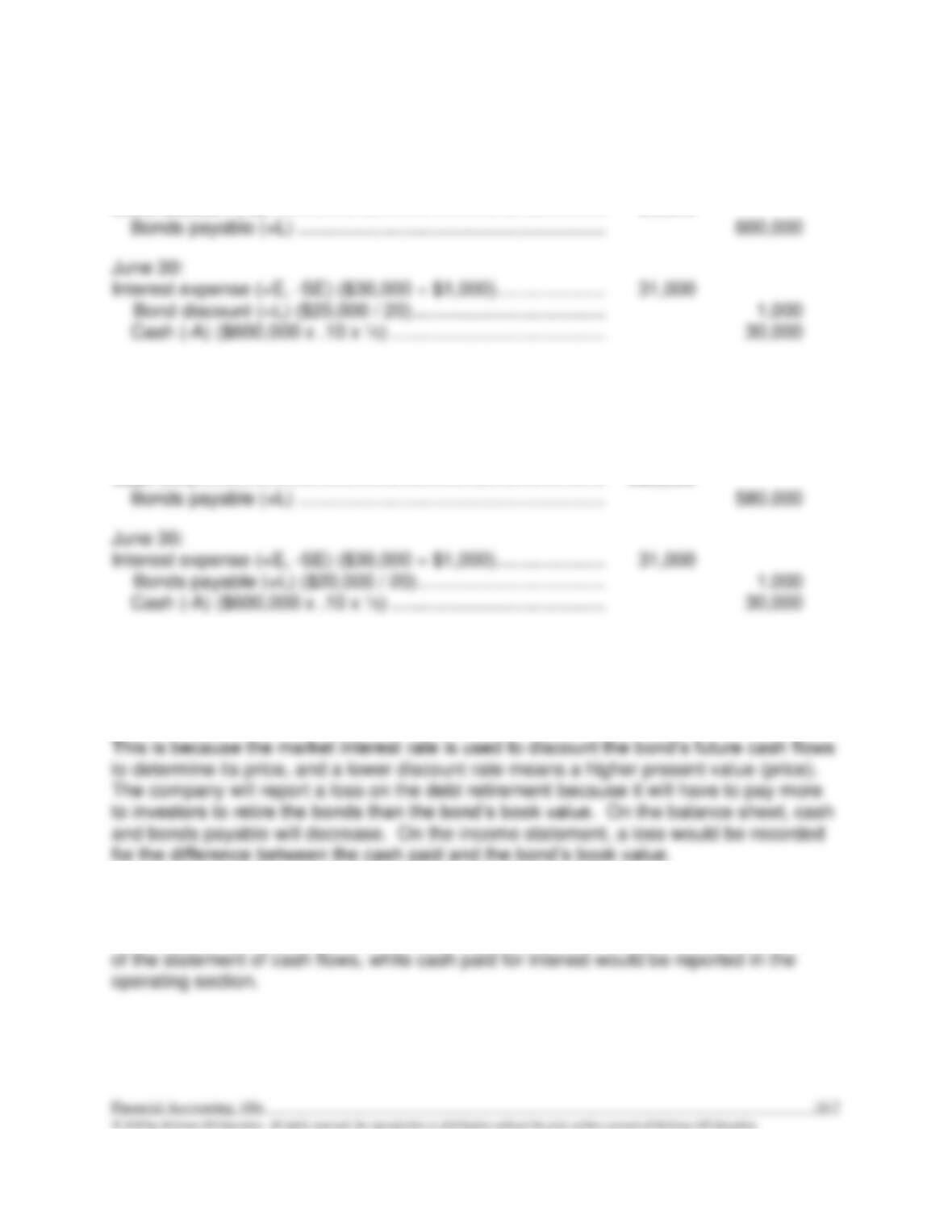
M10–10.
January 1:
Cash (+A) ……………………………………………………………………
909,701
Bonds payable (+L) ………………………………………………….
Bonds payable (-L) ……………………………………………………….
M10–11.
January 1:
Cash (+A) ……………………………………………………………………
580,000
Bond discount (-L) ………………………………………………………..
20,000
Bonds payable (+L) …………………………………………………..
600,000
Interest expense (+E, –SE) ($30,000 + $1,000) …………………
31,000
Cash (-A) ($600,000 x .10 x ½) …………………………………..
30,000
M10–12.
January 1:
Cash (+A) ……………………………………………………………………
580,000
Bonds payable (+L) …………………………………………………..
580,000
Interest expense (+E, -SE) ($30,000 + $1,000) …………………
31,000
Cash (-A) ($600,000 x .10 x ½) …………………………………..
30,000
M10–13.
If market interest rates fall after the issuance of a bond, the bond’s price will increase.
M10–14.
Cash paid for principal when a bond matures would be reported in the financing section
EXERCISES
E10–1.
Investors care about knowing the coupon rate because it determines the cash interest
E10–2.
If interest rates were to fall, companies might decide to call their bonds and issue new
E10–3.
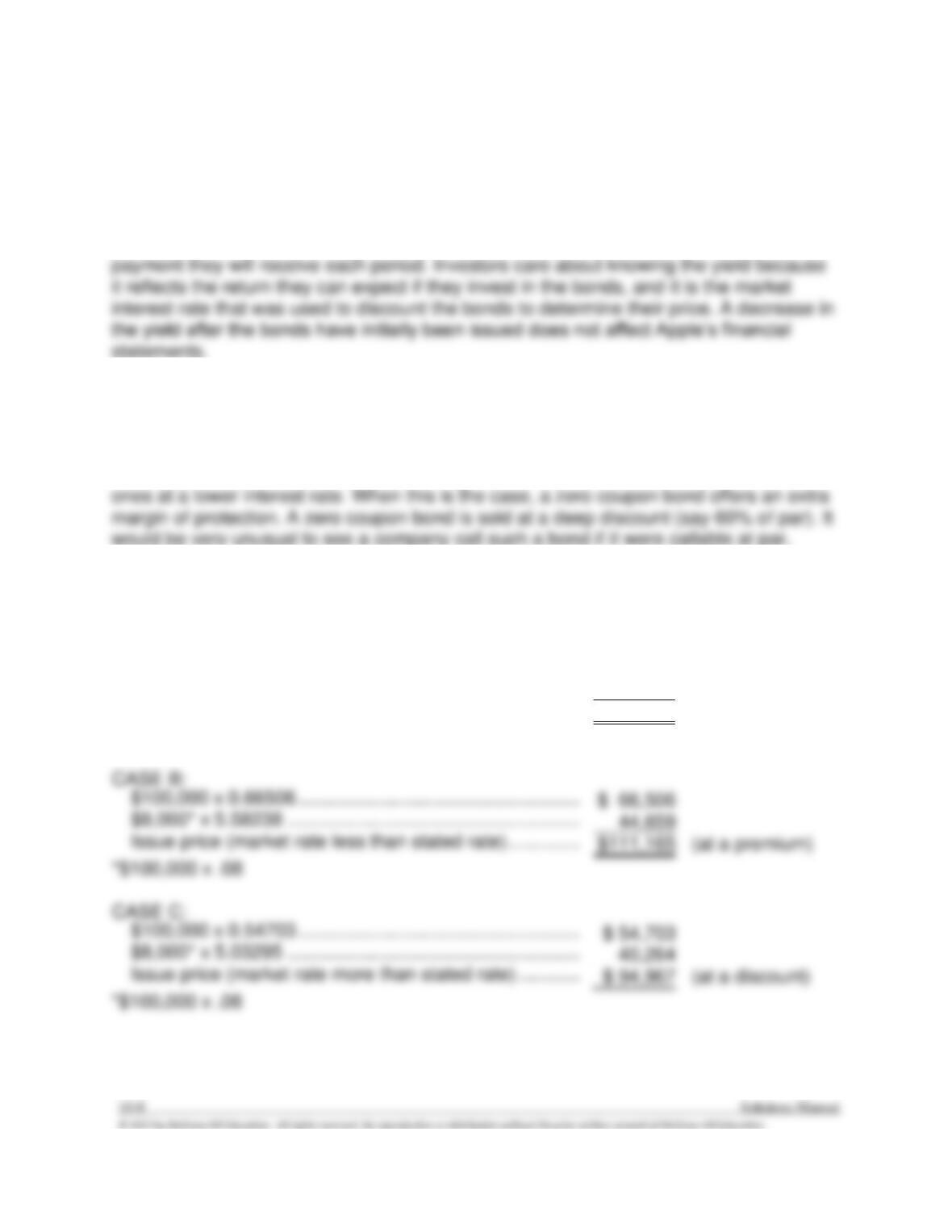
CASE A:
$100,000 x 0.58349 ………………………………………………
$ 58,349
$8,000* x 5.20637 ………………………………………………..
41,651
Issue price (market and stated rate same) ……………….
$100,000
*$100,000 x .08
CASE B:
$100,000 x 0.66506 ………………………………………………
$ 66,506
$8,000* x 5.58238 ………………………………………………..
Issue price (market rate less than stated rate) …………..
$111,165
(at a premium)
$100,000 x 0.54703 ………………………………………………
$8,000* x 5.03295 ………………………………………………..
40,264
Issue price (market rate more than stated rate) …………
(at a discount)
Financial Accounting, 10/e 10-9
E10–4.
CASE A:
$500,000 x 0.67297 ………………………………………………
$336,485
$15,000* x 16.35143 …………………………………………….
245,271
Issue price (market rate less than coupon rate) …………
$581,756
(at a premium)
CASE B:
$500,000 x 0.55368 ………………………………………………
$276,840
$15,000* x 14.87747 …………………………………………….
223,162
Issue price (market rate same as coupon rate) …………
(at par)
CASE C:
$500,000 x 0.43499 ………………………………………………
$ 217,495
$15,000* x 13.29437 …………………………………………….
Issue price (market rate greater than coupon rate) …….
$ 416,911
(at a discount)
E10–5.
Req. 1
At issuance, liabilities would increase and equity is not affected so the debt–to–
equity ratio increased.
Req. 2
When Denver recognized interest expense, it decreased net income and
E10–6.
Applied Engineering’s ratios look better than Innovative Engineering’s ratios. Applied
Engineering has a lower debt-to-equity ratio than Innovative Engineering. This means
E10–7.
Present value:
Financial Accounting, 10/e 10–11
E10–8.
Present value:
$600,000 x 0.71679
=
$430,074
$22,500* x 6.66378
=
=
$580,009
Req. 1
January 1:
Cash (+A) ……………………………………………………………………
Bond discount (-L) ………………………………………………………..
Bonds payable (+L) …………………………………………………..
Req. 2
June 30:
Interest expense* (+E, -SE) ………………………………………….
24,650
Cash (-A) …………………………………………………………………
22,500
*($580,009 x .085 x ½)
Req. 3
June 30:
Balance sheet:
Long-term Liabilities
Bonds payable
$582,159*
E10–9.
Present value:
$600,000 x 0.71679
=
$430,074
$22,500* x 6.66378
=
=
$580,009
Req. 1
January 1:
Cash (+A) ……………………………………………………………………
580,009
Bonds payable (+L) …………………………………………………..
580,009
Req. 2
June 30:
Interest expense* (+E, -SE) ………………………………………….
Req. 3
June 30:
Balance sheet:
Long-term Liabilities
Bonds payable
Financial Accounting, 10/e 10–13
E10–10.
Req. 1
Date
Cash
Interest
Interest Expense
Discount
Amortization
Book Value
of Bond
Jan. 1, Yr 1
$97,327
*
$97,327 x .06 = $5,840
100,000
Present value computation:
Principal:
$100,000 x .83962
Interest:
$5,000 x 2.67301
Req. 2
Year 1
Year 2
December 31:
Income statement
Balance sheet
E10–11.
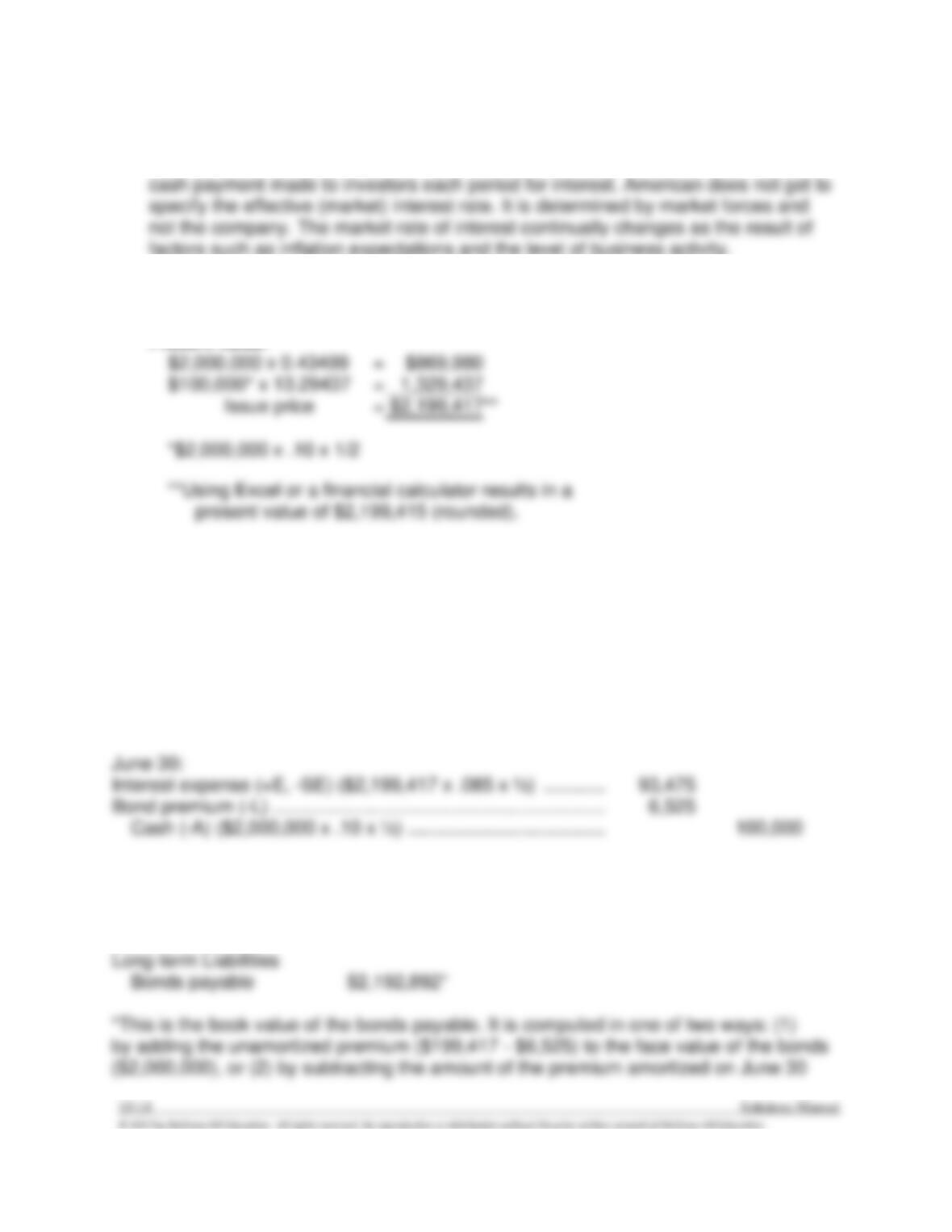
Req. 1 The bond’s issue price was $948. This is given in the amortization table. It can
also be computed by taking the present value of the future cash flows and
discounting them by the market interest rate of 8 percent.
Year 1:
($948 + $16)
Year 2:
($964 + $17)
E10–12.
American Airlines specifies the coupon rate for the bonds, which determines the
E10–13.
Present value:
$100,000* x 13.29437
Req. 1
January 1:
Cash (+A) ……………………………………………………………………
2,199,417
Bond premium (+L) ………………………………………………….
199,417
Bonds payable (+L) ………………………………………………….
2,000,000
Req. 2
Interest expense (+E, –SE) ($2,199,417 x .085 x ½) …………
Bond premium (-L) ……………………………………………………….
Cash (-A) ($2,000,000 x .10 x ½) ………………………………..
Req. 3
Balance sheet:
Long-term Liabilities
Bonds payable
Financial Accounting, 10/e 10–15
($6,525) from the book value of the bonds at the beginning of the period ($2,199,417).
E10–14.
Present value:
$100,000* x 13.29437
Req. 1
January 1:
Cash (+A) ……………………………………………………………………
2,199,417
Bonds payable (+L) ………………………………………………….
2,199,417
Req. 2
June 30:
Interest expense (+E, -SE) ($2,199,417 x .085 x ½) …………
93,475
Bonds payable (-L) ……………………………………………………….
Cash (-A) ($2,000,000 x .10 x ½) ………………………………..
Req. 3
Balance sheet:
Long-term Liabilities
Bonds payable
E10–15.
Req. 1
Date
Cash
Interest
Interest Expense
Premium
Amortization
Book Value
of Bond
Jan. 1, Yr 1
$10,278
Dec. 31, Yr 1
$500
*
$10,278 x .04 = $411
$89
10,189
Dec. 31, Yr 2
10,097
Dec. 31, Yr 3
Principal:
$10,000 x .88900
Interest:
$500 x 2.77509
Req. 2
Year 1
Year 2
December 31:
Income statement
Interest expense …………..
Balance sheet
E10–16.
Present value
$1,000,000 x .45639
=
$456,390
=
Cash (+A) ……………………………………………………………………
Bonds payable (+L) …………………………………………………..
Bond premium (+L) ……………………………………………………
E10–16. (continued)
Effect on statement of cash flows:
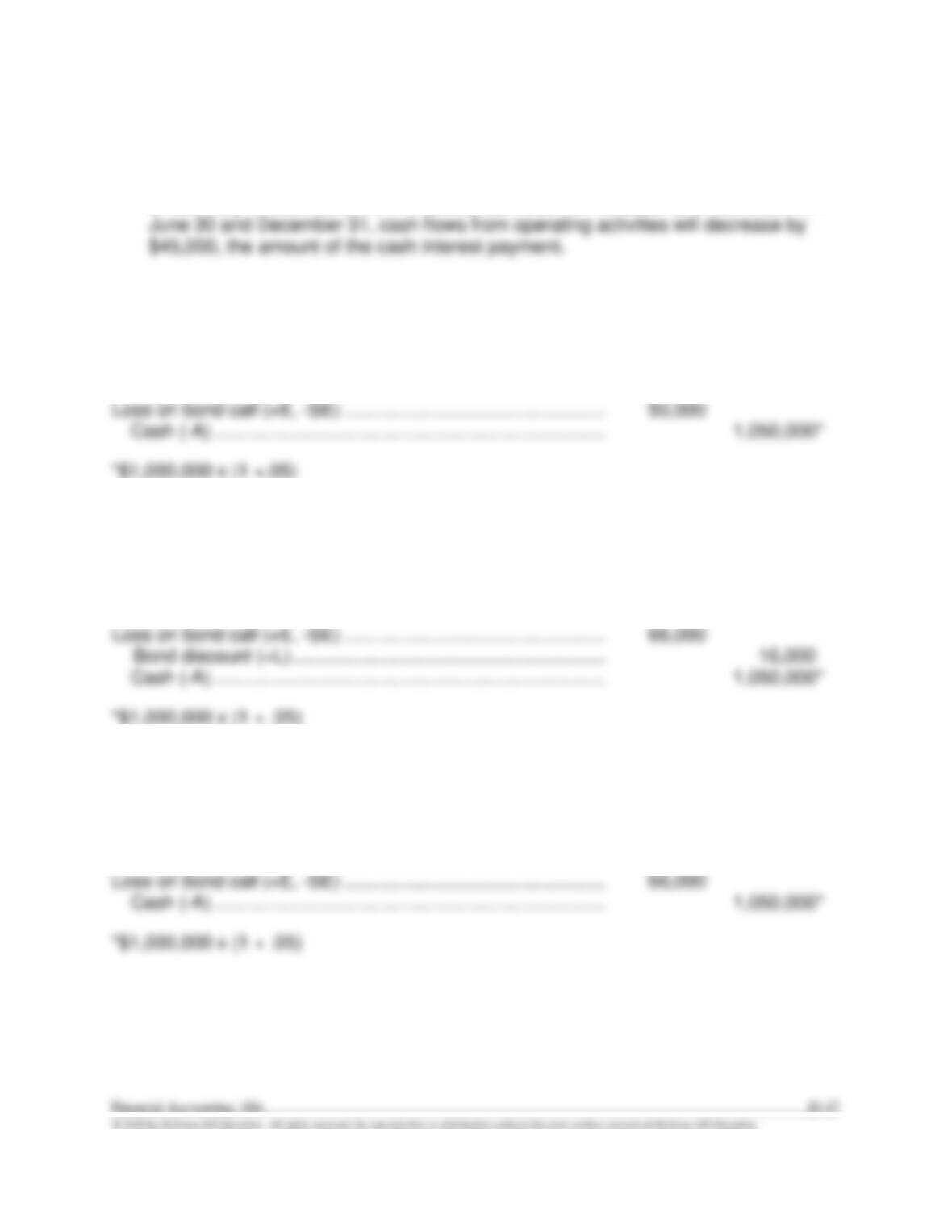
On January 1, cash flows from financing activities will increase by $1,067,955. On
E10–17.
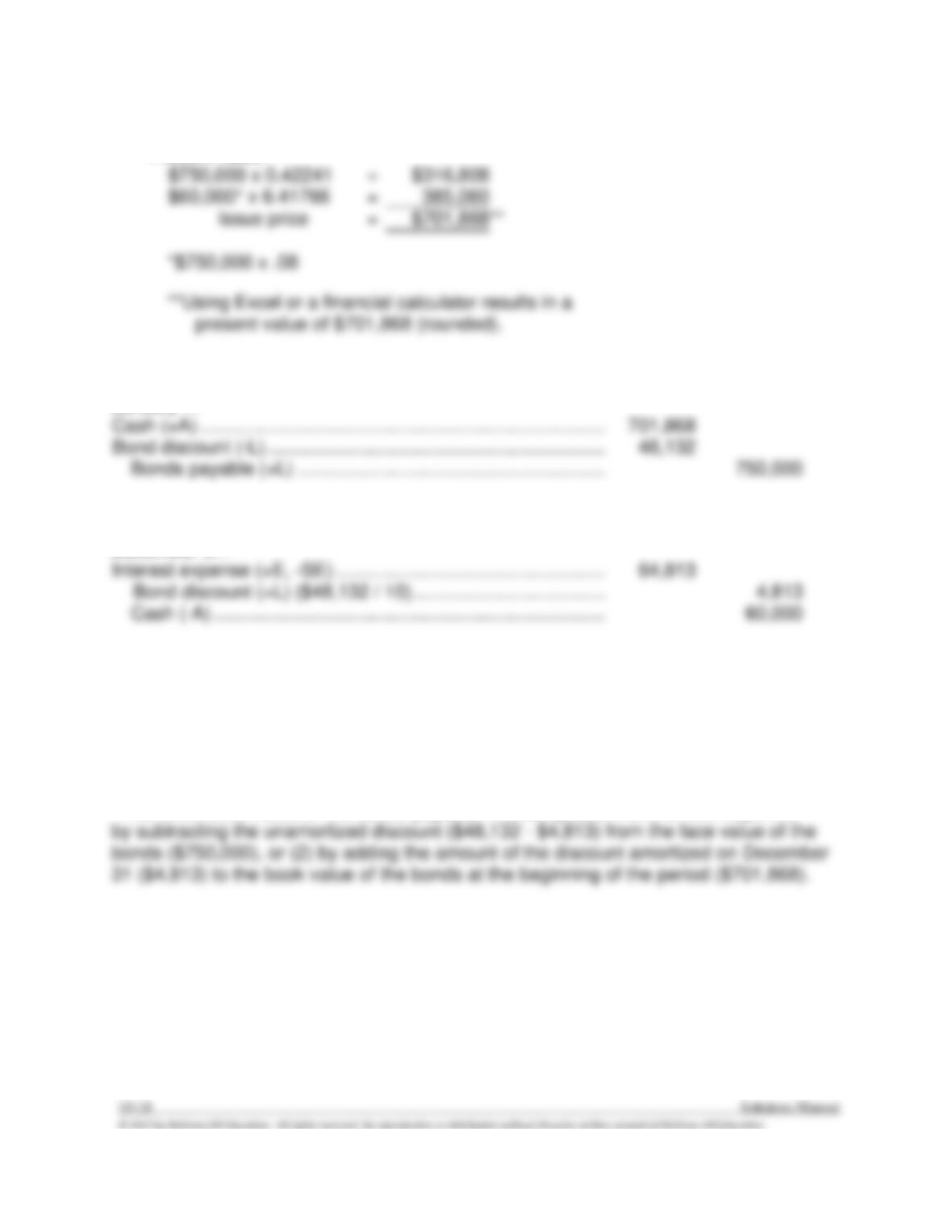
Bonds payable (-L) ……………………………………………………….
1,000,000
Loss on bond call (+E, –SE) …………………………………………..
Cash (-A) …………………………………………………………………
E10–18.
Bonds payable (-L) ……………………………………………………….
1,000,000
Cash (-A) …………………………………………………………………
E10–19.
Bonds payable (-L) ……………………………………………………….
984,000
Loss on bond call (+E, –SE) …………………………………………..
Cash (-A) …………………………………………………………………
E10–20.
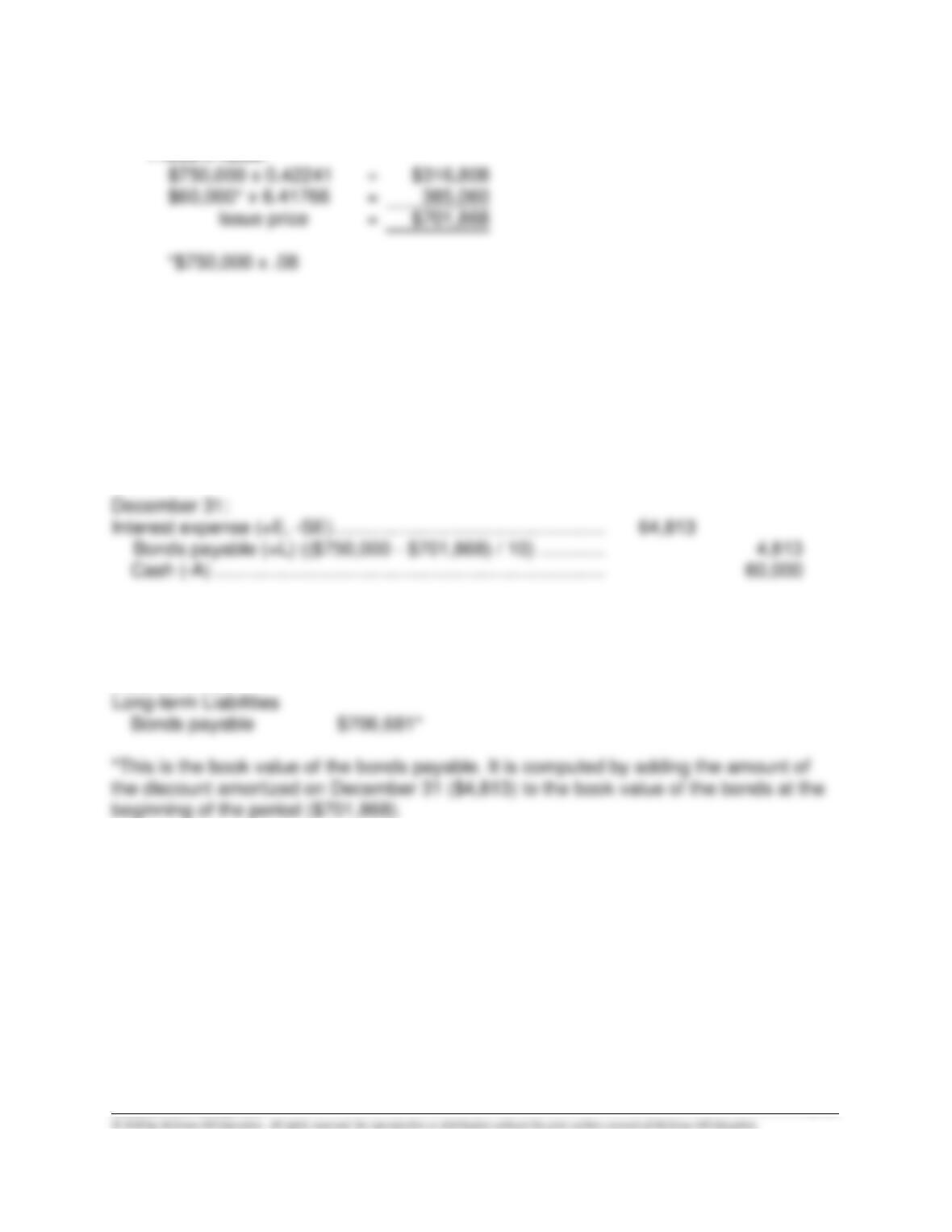
Present value:
$750,000 x 0.42241
$60,000* x 6.41766
Req. 1
January 1:
Cash (+A) ……………………………………………………………………
701,868
Bond discount (-L) ………………………………………………………..
Bonds payable (+L) …………………………………………………..
Req. 2
December 31:
Interest expense (+E, –SE) …………………………………………….
Req. 3
December 31:
Balance sheet:
Long-term Liabilities
Bonds payable
$706,681*
*This is the book value of the bonds payable. It is computed in one of two ways: (1)
Financial Accounting, 10/e 10–19
E10–21.
$750,000 x 0.42241
$60,000* x 6.41766
Req. 1
January 1:
Cash (+A) ……………………………………………………………………
701,868
Bonds payable (+L) …………………………………………………..
701,868
Req. 2
Interest expense (+E, –SE) …………………………………………….
Req. 3
December 31:
Balance sheet:
Long-term Liabilities
Bonds payable
E10–22.
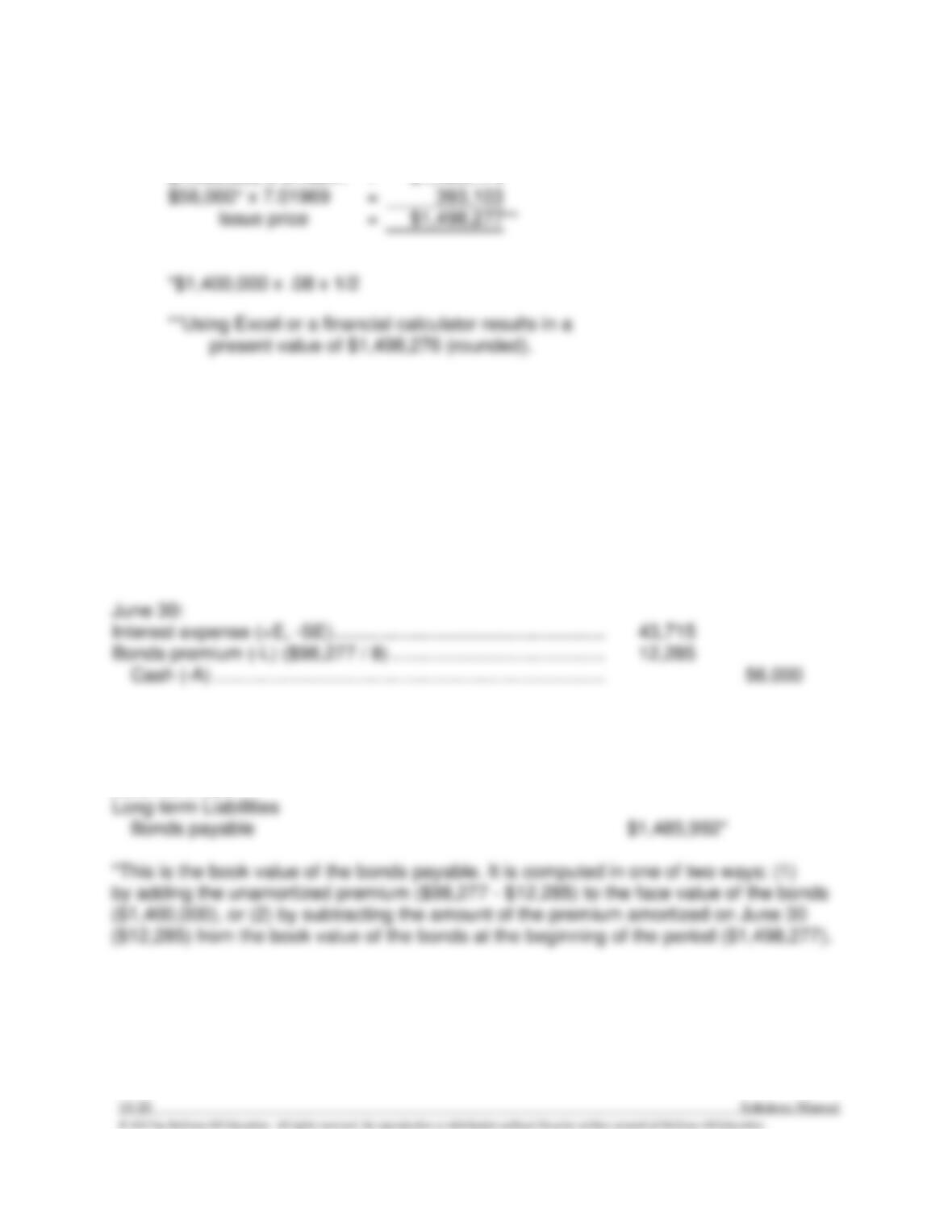
Present value:
$1,400,000 x 0.78941
=
$1,105,174
$56,000* x 7.01969
=
=
Req. 1
January 1:
Cash (+A) ……………………………………………………………………
1,498,277
Bond premium (+L) ………………………………………………….
98,277
Bonds payable (+L) ………………………………………………….
1,400,000
Req. 2
Interest expense (+E, –SE) …………………………………………….
Bonds premium (-L) ($98,277 / 8) …………………………..………
Cash (-A) …………………………………………………………………
Req. 3
June 30:
Balance sheet:
Long-term Liabilities
Bonds payable