Chapter 10 – Reporting and Interpreting Bond Securities
10-1
CHAPTER 10
REPORTING AND INTERPRETING BOND SECURITIES
Learning Objectives and Related Assignment Materials
Learning Objectives
Mini-
Exercises
Exercises
Problems
Alternate
Problems
Cases and
Projects
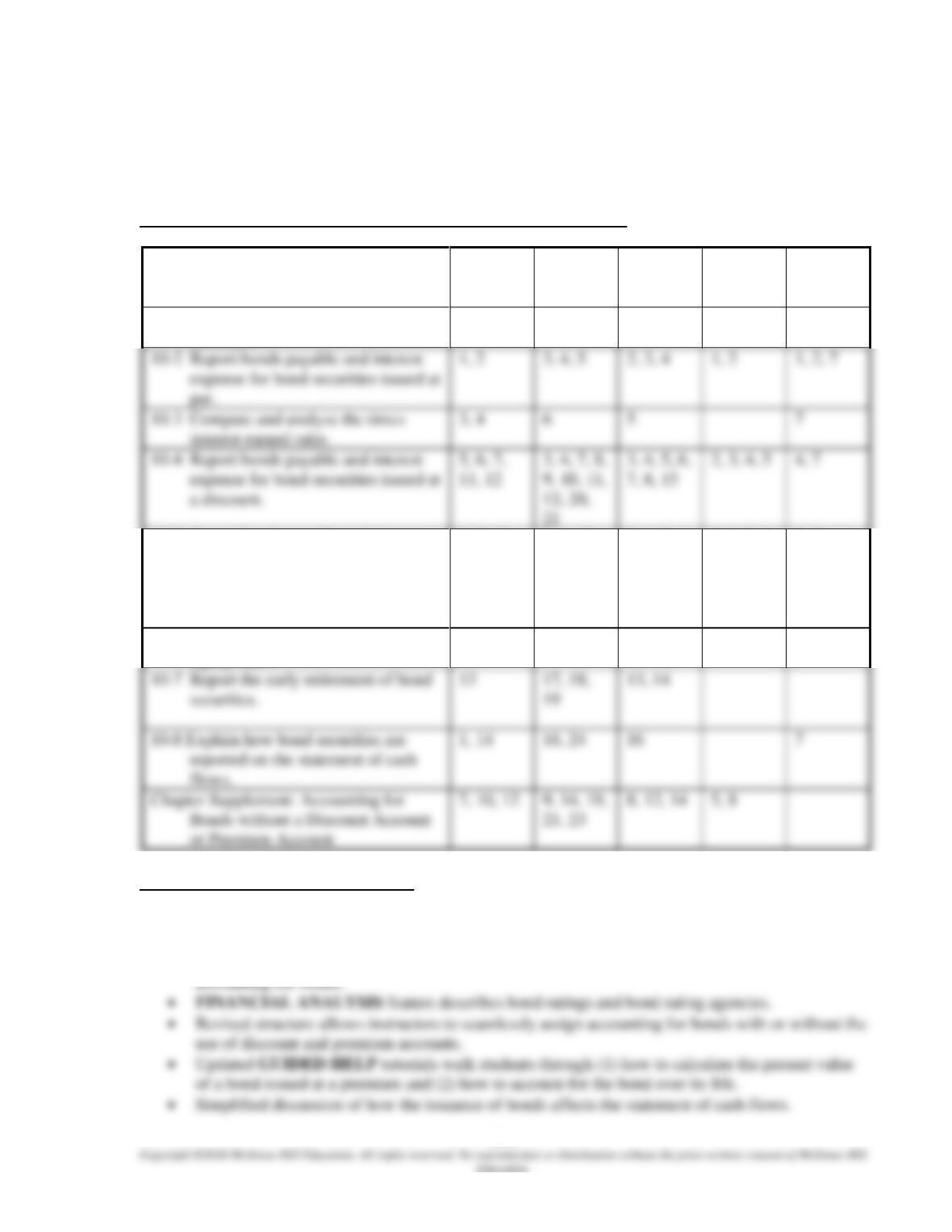
10-1 Describe the characteristics of bond
securities.
1
1, 2, 13
1
1, 2, 5, 6,
7
10-3 Compute and analyze the times
interest earned ratio.
3, 4
6
5
7
10-5 Report bonds payable and interest
expense for bond securities issued at
a premium.
8, 9, 10
3, 4, 12,
13, 14,
15, 16,
18, 22,
23
3, 4, 9,
10, 11,
12
2, 6, 7, 8
3, 7
10-6 Compute and analyze the debt-to–
equity ratio.
3
5, 6
1, 5
1, 2, 3, 7
19
flows.
or Premium Account
21, 23
Synopsis of Chapter Revisions
Focus Company: Amazon
• Focus company data updated.
• Updated graphics that visually help students understand the timing of bond payments and the
Chapter 10 – Reporting and Interpreting Bond Securities
10-2
• CONTINUING PROBLEM at the end of chapter asks students to record bond transactions for
PowerPoint Slides
Learning Objectives
PowerPoint® Slides
10-1 Describe the characteristics of bond securities.
10-5 through 10-13
10-2 Report bonds payable and interest expense for bond securities
issued at par.
10-14 through 10-20
10-3 Compute and analyze the times interest earned ratio.
10-21 through 10-22
10-4 Report bonds payable and interest expense for bond securities
issued at a discount.
10-23 through 10-30
10-5 Report bonds payable and interest expense for bond securities
10-31 through 10-41
10-6 Compute and analyze the debt-to-equity ratio.
10-42 through 10-43
10-47 through 10-48
Account or Premium Account
10-49
Chapter Take-Aways
10-1 Describe the characteristics of bond securities.
Bond securities are commonly referred to as just “bonds.” Companies issue bonds to raise long-term
capital. Bonds offer a number of advantages compared to stock, including the tax deductibility of
Chapter 10 – Reporting and Interpreting Bond Securities
10-3
Chapter Take-Aways, continued
10-2 Report bonds payable and interest expense for bond securities issued at par.
Three types of events must be recorded over the life of a typical bond: (1) the receipt of cash when
10-3 Compute and analyze the times interest earned ratio.
The times interest earned ratio reflects the amount of income earned for each dollar of interest
10-4. Report bonds payable and interest expense for bond securities issued at a discount.
Bonds are sold at a discount whenever the coupon rate is less than the market interest rate. A
10-5 Report bonds payable and interest expense for bond securities issued at a premium.
Bonds are sold at a premium whenever the coupon rate is greater than the market interest rate. A
10-6. Compute and analyze the debt-to–equity ratio.
10-7. Report the early retirement of bond securities.
A company may retire a bond before its maturity date, either by purchasing the bond in the open
10-8. Explain how bond securities are reported on the statement of cash flows.
Cash received from issuing a bond and cash paid to retire a bond at maturity are financing cash
Chapter 10 – Reporting and Interpreting Bond Securities
10-4
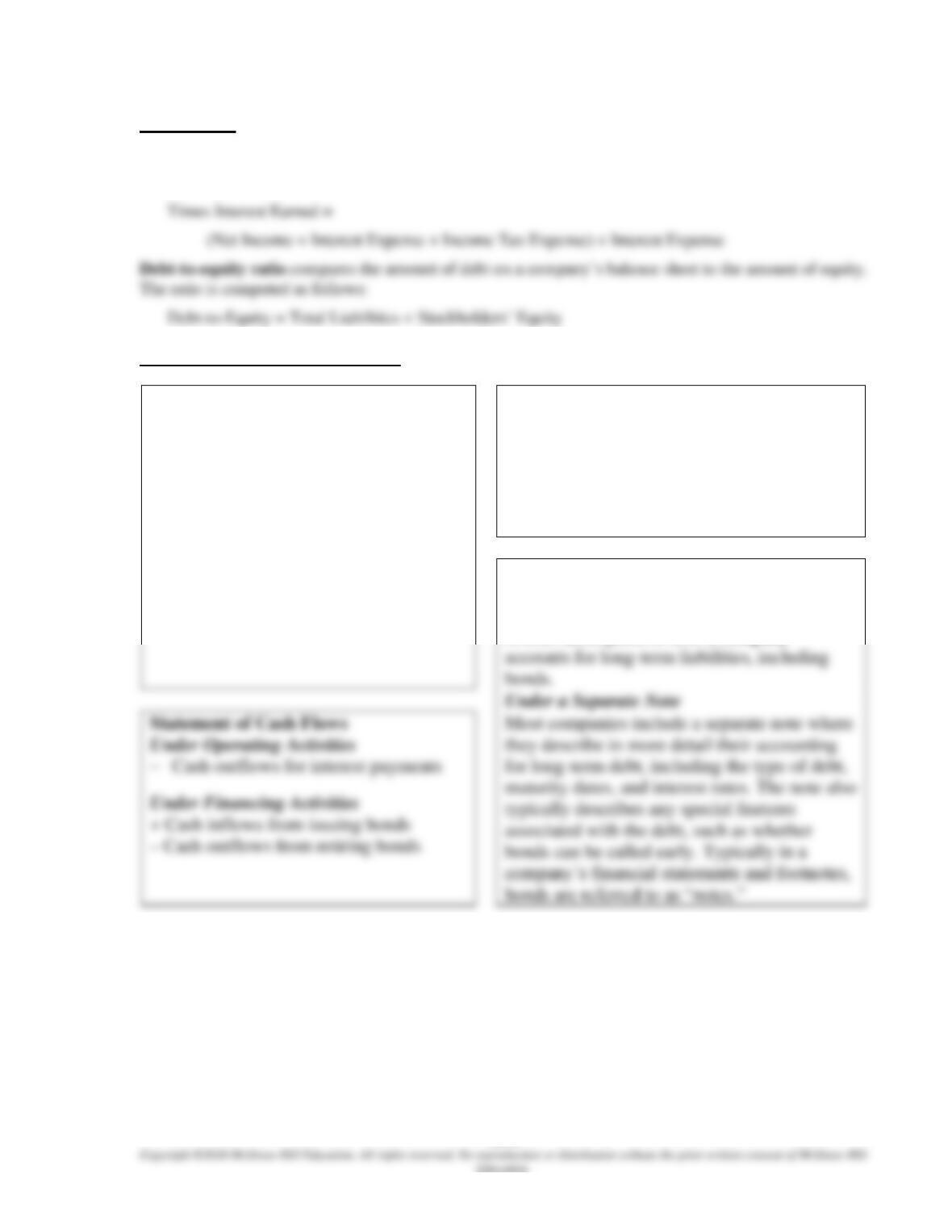
Key Ratios
Times interest earned ratio reflects the amount of income earned for each dollar of interest expense. It is
a measure of a company’s ability to meet its interest obligations. The ratio is computed as:
Finding Financial Information
Balance Sheet
Bonds are normally listed as long-term
liabilities. An exception occurs when the
bonds are within one year of maturity, in
which case they are reported as current
liabilities with the title “Current Portion
of Long-Term Debt.”
Income Statement
Issuing bonds and retiring bonds do not affect
the income statement. Recognizing interest
expense and any gain or loss from early
retirement does affect the income statement.
Most companies report interest expense in a
separate category on the income statement.
Notes
Under Summary of Significant Accounting
Policies
A brief description of how a company
Chapter 10 – Reporting and Interpreting Bond Securities
10-5
Chapter Outline
Teaching Notes
LO 1 – Describe the characteristics of bond securities.
I. Characteristics of Bonds Securities
Illustrated in Exhibit 10.1
A. Why Issue Bonds?
1. Advantages:
a. Stockholders maintain control; bondholders do not
vote or share in the company’s earnings
b. A portion of interest expense is tax-deductible (the
2. Disadvantages:
b Negative impact on cash flows; debt must be repaid at
a specified time in the future
a. Risk of bankruptcy; interest payments to bondholders
B. Bond Terminology
1. Bond principal (par value, face value, maturity value)––
the amount a company pays bondholders on the maturity
2. Coupon rate (stated rate, contract rate, nominal rate)––the
interest rate specified on a bond, and the rate used to
3. Types of bonds:
a. Convertible bonds––bonds that may be converted to
other securities of the issuer (usually common stock)
c. A secured bond has specific assets pledged as a
Chapter 10 – Reporting and Interpreting Bond Securities
10-6
4. Bond Issuance Process
a. Indenture––a legal document that describes all the
details of a debt security to potential buyers
b. Prospectus––a regulatory filing that describes all the
details of a debt or equity security to potential buyers;
it also specifies all the details of the bond offering:
when they purchase bond securities
C. Risk
1. Default risk – the probability that a bond issuer will not
be able to meet the requirements specified in the
indenture
See Financial Analysis
feature “Bond Rating
2. Agencies that evaluate default risk use letter ratings to
specify the quality of a bond
Agencies and Their
Assessments of Default Risk”
II. Reporting Bond Transactions
A. Two types of cash payments in bond contract:
2. Cash interest payments (sometimes referred to as coupon
a. Computed by multiplying the principal amount times
the interest rate stated in the bond contract
1. Principal is usually single payment at the end of the
B. Issue price
1. The market determines the issue price using present value
concepts; computed as follows:
a. Compute the present value of the principal (a single
Chapter 10 – Reporting and Interpreting Bond Securities
10-7
C. Investors demand a certain rate of return to compensate them
for the risks related to a particular company’s bond offering
period
a bond
1. Market interest rate (yield, effective-interest rate)––the
rate of return investors demand for a company’s bonds on
2. Impact of interest rates on issuance price:
a. If the stated and the market interest rates are the same:
i. A bond sells at par
ii. Issuer receives cash equal to its par value
b. If the market rate is higher than the stated rate:
c. If the market rate is lower than the stated rate:
See Financial Analysis
i. A bond sells at a discount – issuer receives less
3. During the life of the bond, its market price will change
as market interest rates change; it does not affect the
company’s financial statements and the way its interest
payments are accounted for from one period to the next
Refer students to Pause for
Feedback – Self-Study Quiz
LO 2 – Report bonds payable and interest expense for bond securities issued at par.
D. Bonds Issued at Par
a. Present value:
Single payment: $100,000 × 0.82270
Annuity: $5,000 × 3.54595
Issue (sale) price of bonds
1. Bonds sell at their face (par) value when the market
interest rate that investors demand is equal to the interest
Chapter 10 – Reporting and Interpreting Bond Securities
dr Cash (+A)
cr Bonds Payable (+L)
Cash (A) + 100,000 = Bonds Payable (L) + 100,000
3. Reporting Interest Expense on Bonds Issued at Par
a. The amount of interest each period will be $5,000
(10% × $100,000 × 1/2)
b. Journal entry:
dr Interest Expense (+E, –SE)
cr Cash (–A)
Cash (A) –5,000 = Interest Expense (E, SE) –5,000
LO 3 – Compute and analyze the times interest earned ratio.
E. Key Ratio Analysis: Times Interest Earned
1. Times Interest Earned = (Net Income + Interest Expense
+ Income Tax Expense) ÷ Interest Expense
meet its current interest obligations
3. A high ratio is viewed more favorably; indicates an extra
margin of protection in case profitability deteriorates
build their capacity for future operations
LO 4 – Report bonds payable and interest expense for bond securities issued at a discount.
F. Bonds Issued at a Discount
1. Bonds sell at a discount when the market rate of interest
is higher than the stated interest rate
Annuity: $5,000 × 3.46511
2. On 1/1/19, the market rate is 12% when Amazon sells its
bonds (which have a face value of $100,000); the bonds
mature in two years and have a coupon rate of 10%;
Chapter 10 – Reporting and Interpreting Bond Securities
10-9
c. Journal entry with Discount account:
Throughout the remainder of
dr Cash (+A)
96,535
dr Bond Discount (+XL, –L)
3,465
cr Bonds Payable (+L)
100,000
the chapter, the bond
discount account is used in
all journal entries.
d. Journal entry without Discount account:
See the Chapter Supplement
dr Cash (+A)
96,535
cr Bonds Payable (+L)
96,535
For journal entries without
the bond discount account
Assets = Liabilities + Stockholders’ Equity
Cash (A) +96,536 = Bond Payable (L) +96,535
e. Reporting bonds payable at their book value results in
the same amount being reported on the balance sheet,
regardless of whether a bond discount is explicitly
recorded in the journal entry
3. Amazon received only $96,535 when it sold the bonds,
but must repay $100,000 at maturity; the $3,465 of
additional cash that must be paid is an adjustment of
interest expense
a. To adjust interest expense, the borrower amortizes the
interest expense and added to the book value of the
liability each period over the life of the bond
Chapter 10 – Reporting and Interpreting Bond Securities
10–10
4. Reporting Interest Expense on Bonds Issued at a Discount
Using Effective-Interest Amortization (with Discount
Account)
a. Three steps:
ii. Compute cash owed for interest:
iii. Compute amortization amount:
i. Compute interest expense:
Interest Expense – Cash Interest
cr Bond Discount (–XL, +L)
b. First interest payment on Amazon bonds is on 6/30/19:
Interest expense = $96,535 × (0.12 × ½ year) = $5,792
Cash owed for interest = $100,000 × (0.10 × ½ year) =
$5,000
c. Each period, the amortization of the bond discount
increases the bond’s book value, bringing it closer to
the $100,000 that is due at maturity
dr Interest Expense (+E, –SE)
cr Cash (–A)
Cash (A) –5,000 = Bond Discount (XL) +840 +
d. Second interest payment on Amazon bonds is on
12/31/19:
Beginning book value = $96,535 + $792= $97,327
Interest expense = $97,327 × (0.12 × ½ year) = $5,840
Cash owed for interest = $100,000 × (0.10 × ½ year) =
Chapter 10 – Reporting and Interpreting Bond Securities
10–11
LO 5 – Report bonds payable and interest expense for bond securities issued at a premium.
G. Bonds Issued at a Premium
2. On 1/1/19, the market rate is 8% when Amazon sells its
bonds (which have a face value of $100,000); the bonds
mature in two years and have a coupon rate of 10%;
interest is payable twice a year on 6/30 and 12/31
a. Present value:
Annuity: $5,000 × 3.62990
bond that is sold at a premium; both result in the same
Present value factor based on
1. The first method explicitly keeps track of the bond
premium by incorporating it into the journal entries
2. The second method implicitly keeps track of the
bond premium but does not incorporate it into the
journal entries.
c. Journal entry with Premium account:
See the Chapter Supplement
dr Cash (+A)
103,630
dr Bond Premium (+L)
cr Bonds Payable (+L)
100,000
1. Bond Premium is a liability account
2. Balance sheet reports the bonds payable at their
for journal entries without
d. Journal entry without Premium account:
dr Cash (+A)
103,630
cr Bonds Payable (+L)
103,630
Assets = Liabilities + Stockholders’ Equity
Cash (A) +103,630 = Bond Payable (L) + 103,630
regardless of whether a bond premium is explicitly
e. Reporting bonds payable at their book value results in
Chapter 10 – Reporting and Interpreting Bond Securities
10–12
4. Reporting Interest Expense on Bonds Issued at a
Premium Using Effective-Interest Amortization (with
Premium Account)
a. Three steps:
i. Compute interest expense:
Beginning Book Value × Market Interest Rate ×
n/12; n = # of months in each interest period
dr Interest Expense (+E, –SE)
dr Bond Premium (–L)
cr Cash (–A)
ii. Compute cash owed for interest:
5. The difference between effective-interest amortization of
a bond discount and a bond premium is that the
amortization of a discount increases the book value of the
liability and the amortization of a premium decreases it
Illustrated in Bond Premium
Amortization Schedule
H. Regardless of whether a company issues bonds at par, at a
discount, or at a premium, the company will enter the same
journal entry when the bonds mature
dr Bond Payable (–L)
100,000
cr Cash (–A)
100,000
Help 10-1
Refer students to Guided
I. The Book Value of a Bond over Time
Illustrated in Exhibit 10.2
3. The book value of a bond issued at a discount increases
over time; at maturity, the book value equals the face
1. The book value of a bond issued at a premium decreases
over time; at maturity, the book value equals the face
J. Zero Coupon Bonds
See Financial Analysis
1. Bonds that do not pay periodic cash interest are typically
called zero coupon bonds
feature “Zero Coupon
Bonds”
its maturity value
2. A bond with a zero coupon interest rate is simply a deeply
Chapter 10 – Reporting and Interpreting Bond Securities
K. Accounting for Issuance Costs
1. When companies issue bonds, they almost always use an
underwriter to help them with the offering; they charge a
fee
a. The fee increases the bond discount if the bonds were
L. Reporting Interest Expense Using Straight-Line
Amortization
a. GAAP requires that companies use the effective-
interest method to amortize bond discounts and bond
premiums; however, GAAP permits companies to use
We focus on the effective-
interest method in this
chapter
LO 6 – Compute and analyze the debt-to-equity ratio.
M. Key Ratio Analysis: Debt-to-Equity Ratio
1. Debt-to-Equity Ratio = Total Liabilities ÷ Stockholders’
Equity
creditors
2. Ratio measures the relationship between the amount of
LO 7 – Report the early retirement of bond securities.
III. Early Retirement of Bonds
A. Bondholders can sell the bonds to investors; transaction does
not affect the books of the issuer of the bonds
1. A corporation may retire bonds before maturity
a. Bond with a call feature may be called in for early