Problem 10A–12 (45 minutes)
1.
and 2.
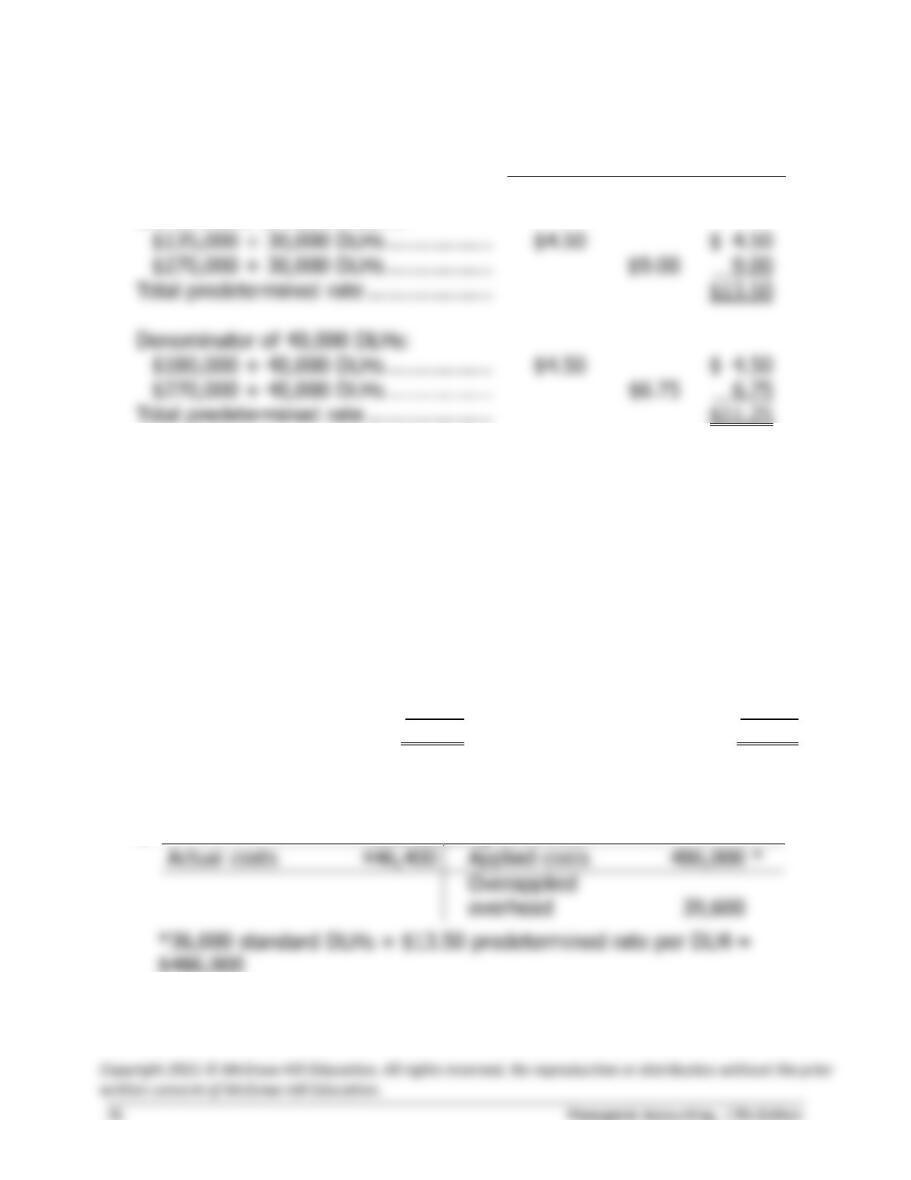
Per Direct Labor-Hour
Variable
Fixed
Total
Denominator of 30,000 DLHs:
$135,000 ÷ 30,000 DLHs ……………..
$ 4.50
$270,000 ÷ 30,000 DLHs ……………..
9.00
Total predetermined rate ………………..
Denominator of 40,000 DLHs:
$270,000 ÷ 40,000 DLHs ……………..
6.75
$11.25
3.
Denominator Activity:
30,000 DLHs
Denominator Activity:
40,000 DLHs
Direct materials, 4 feet ×
$8.75 per foot …………..
$35.00
Same ………………………
$35.00
Direct labor, 2 DLHs ×
$15 per DLH ……………..
30.00
Same ………………………
30.00
Variable overhead, 2
DLHs × $4.50 per DLH ..
9.00
Same ………………………
9.00
Fixed overhead, 2 DLHs ×
$9.00 per DLH …………..
18.00
Fixed overhead, 2 DLHs
× $6.75 per DLH ……..
13.50
Standard cost per unit …..
$92.00
Standard cost per unit ..
$87.50
4. a. 18,000 units × 2 DLHs per unit = 36,000 standard DLHs
b.
Manufacturing Overhead
*
Problem 10A-12 (continued)
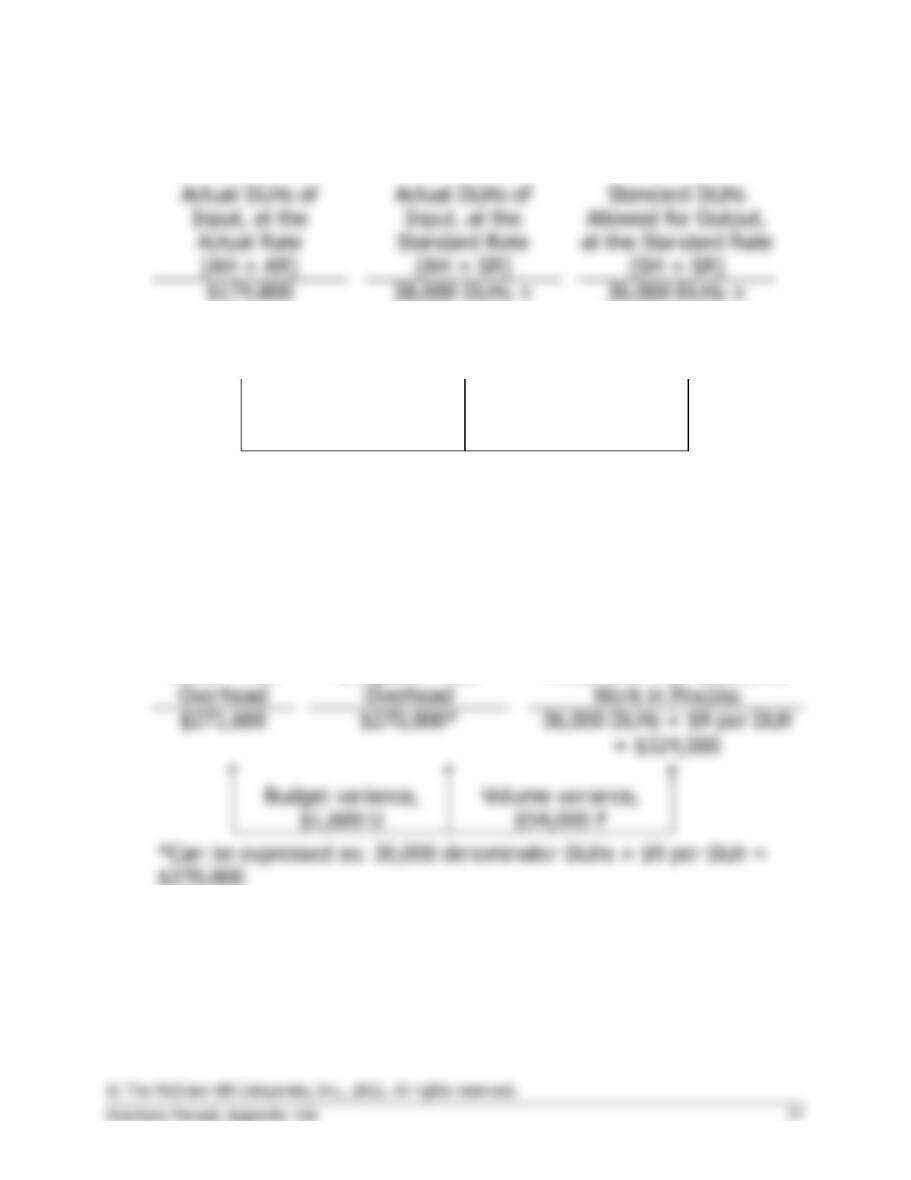
c. Variable overhead variances:
$4.50 per DLH
$4.50 per DLH
= $171,000
= $162,000
Variable overhead rate
variance,
$3,800 U
Variable overhead
efficiency variance,
$9,000 U
Alternative solution:
Variable overhead rate variance = (AH × AR) – (AH × SR)
($174,800) – (38,000 DLHs × $4.50 per DLH) = $3,800 U
Variable overhead efficiency variance = SR (AH – SH)
$4.50 per DLH (38,000 DLHs – 36,000 DLHs) = $9,000 U
Fixed overhead variances:
Problem 10A-12 (continued)
Alternative solution:
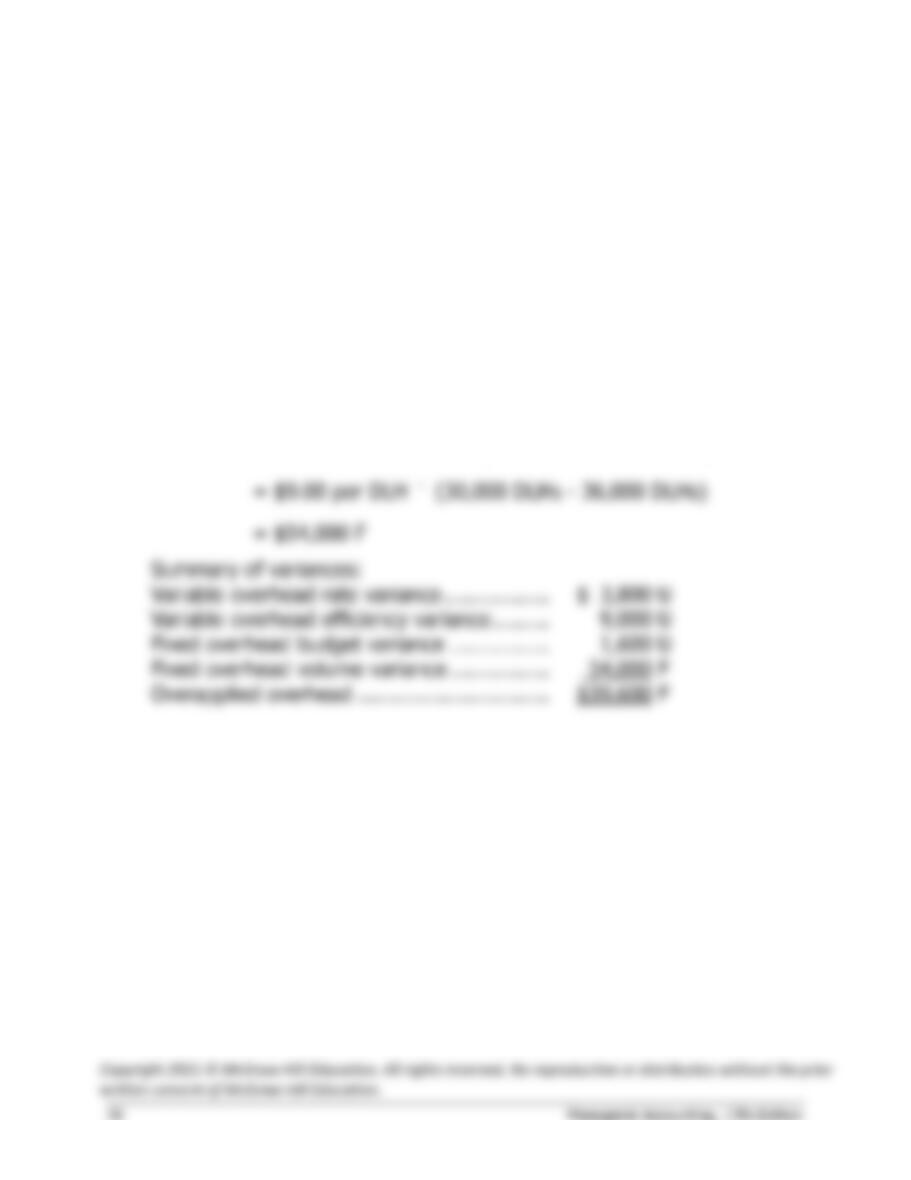
Budget variance:
Budget Actual fixed Budgeted fixed
= –
variance overhead overhead
= $271,600 – $270,000
= $1,600 U
Volume variance:
Fixed portion of Standard
Volume Denominator
= the predetermined × – hours
Variance hours
overhead rate allowed
æö
÷
ç÷
ç÷
ç÷
ç÷
÷
ç
èø
Problem 10A–12 (continued)
5. The major disadvantage of using normal activity is the large volume
variance that ordinarily results. This occurs because the denominator
activity used to compute the predetermined overhead rate is different
from the activity level that is anticipated for the period. In the case at
hand, the company has used a long-run normal activity figure of 30,000
DLHs to compute the predetermined overhead rate, whereas activity for
Appendix 10B
Standard Cost Systems: A Financial Reporting
Perspective Using Microsoft Excel
Exercise 10B-1 (10 minutes)
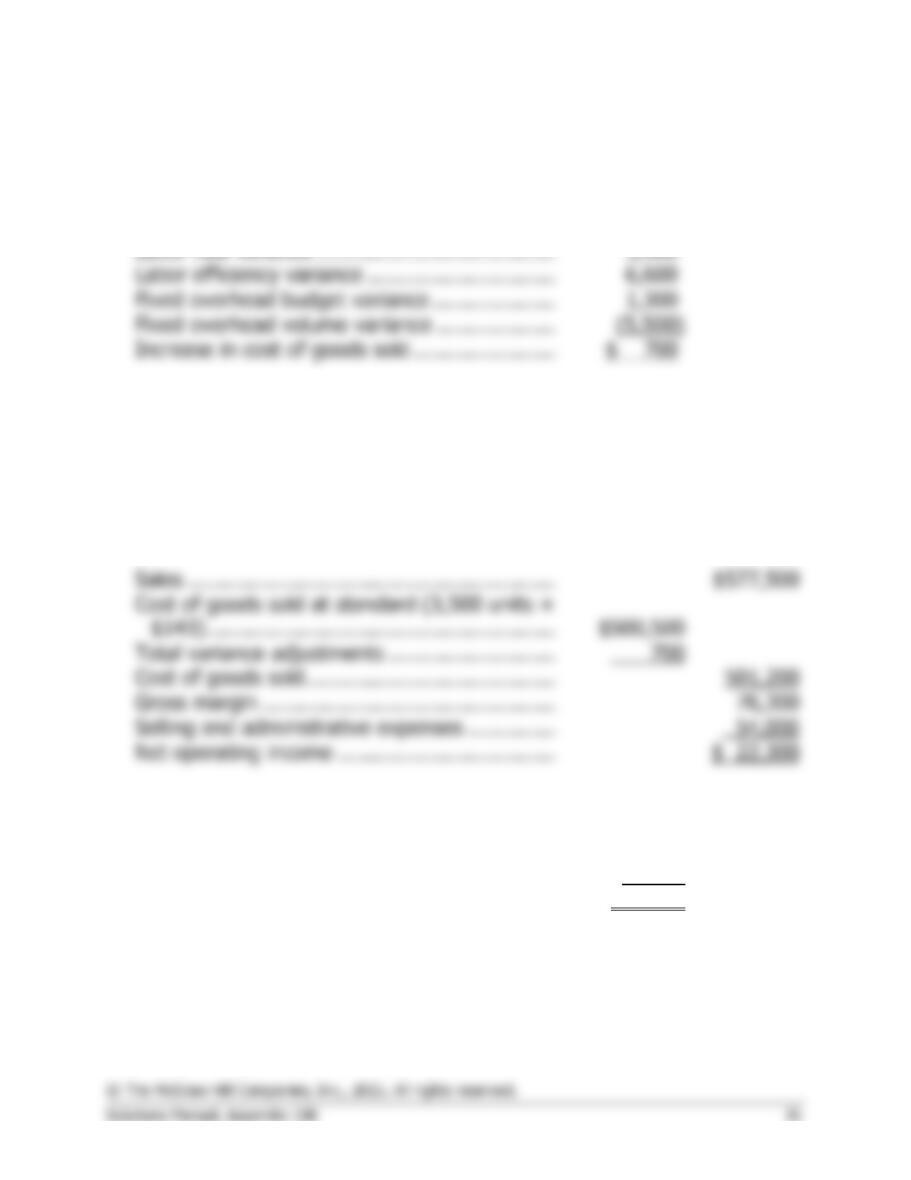
1. The cost of goods sold will decrease by:
Materials price variance …………………………..
$ (6,500)
Materials quantity variance ………………………
10,200
Labor rate variance ………………………………..
Labor efficiency variance …………………………
Fixed overhead budget variance ………………..
Fixed overhead volume variance ……………….
Decrease in cost of goods sold ………………….
2. The income statement is as follows:
Sales (10,000 units × $135) ……………………..
$1,350,000
Cost of goods sold at standard (10,000 units
× $105) …………………………………………….
$1,050,000
Total variance adjustments ………………………
(11,700)
Cost of goods sold ………………………………….
Gross margin ………………………………………..
Selling and administrative expenses …………..
Net operating income ……………………………..
Exercise 10B-2 (15 minutes)
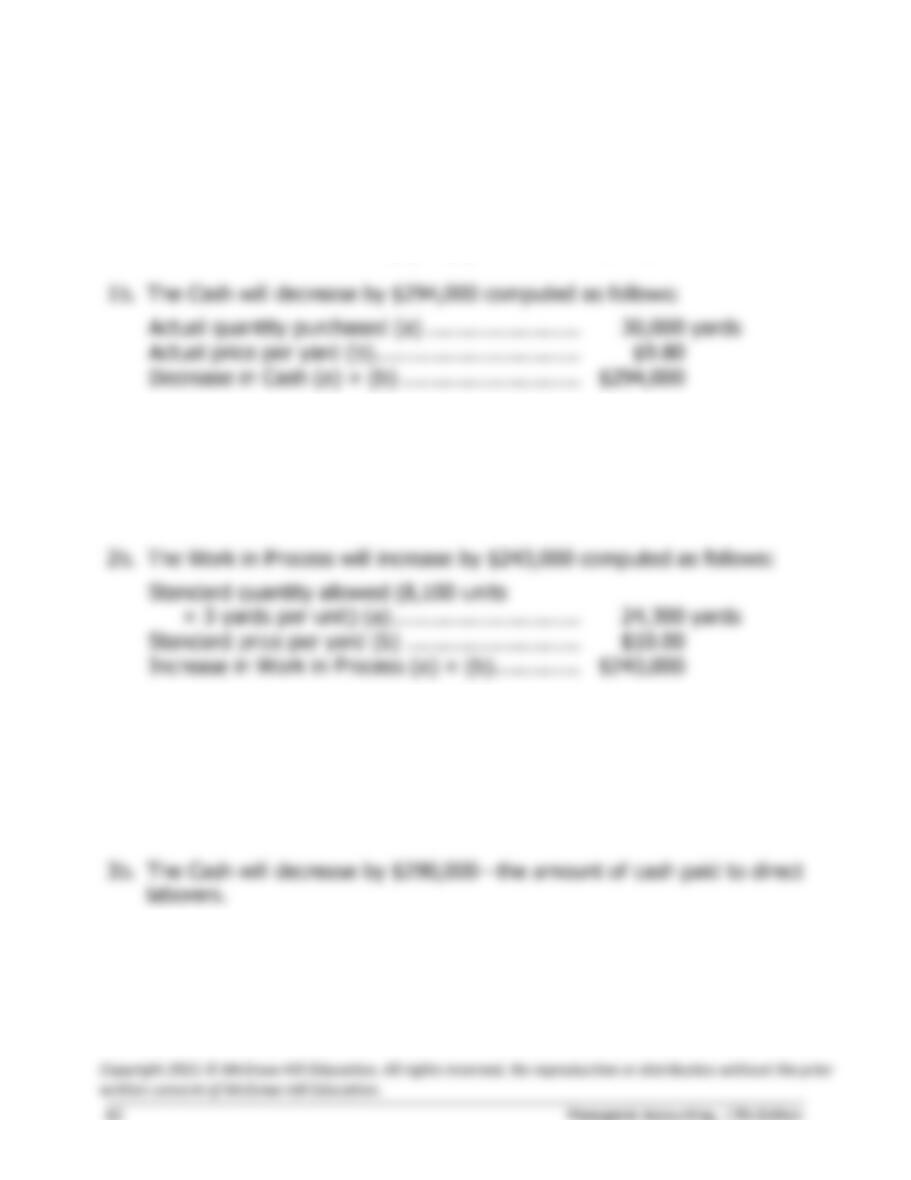
1. The cost of goods sold will increase by:
Materials price variance …………………………..
$ 3,400
Materials quantity variance ………………………
(9,000)
3,900
6,600
Fixed overhead budget variance ………………..
Fixed overhead volume variance ……………….
(5,500)
2. The first step is to compute the number of units sold as follows:
Total sales (a) ………………………………………
$577,500
Selling price per unit (b) …………………………
$165
Number of units sold (a) ÷ (b) …………………
3,500
The income statement is as follows:
Sales …………………………………………………..
Total variance adjustments ………………………
Cost of goods sold ………………………………….
Gross margin ………………………………………..
Selling and administrative expenses …………..
3. The ending balance in Retained Earnings is computed as follows:
Beginning balance in retained earnings ………
$70,000
Net operating income …………………………….
22,300
Ending balance in retained earnings ………….
$92,300
Exercise 10B-3 (20 minutes)
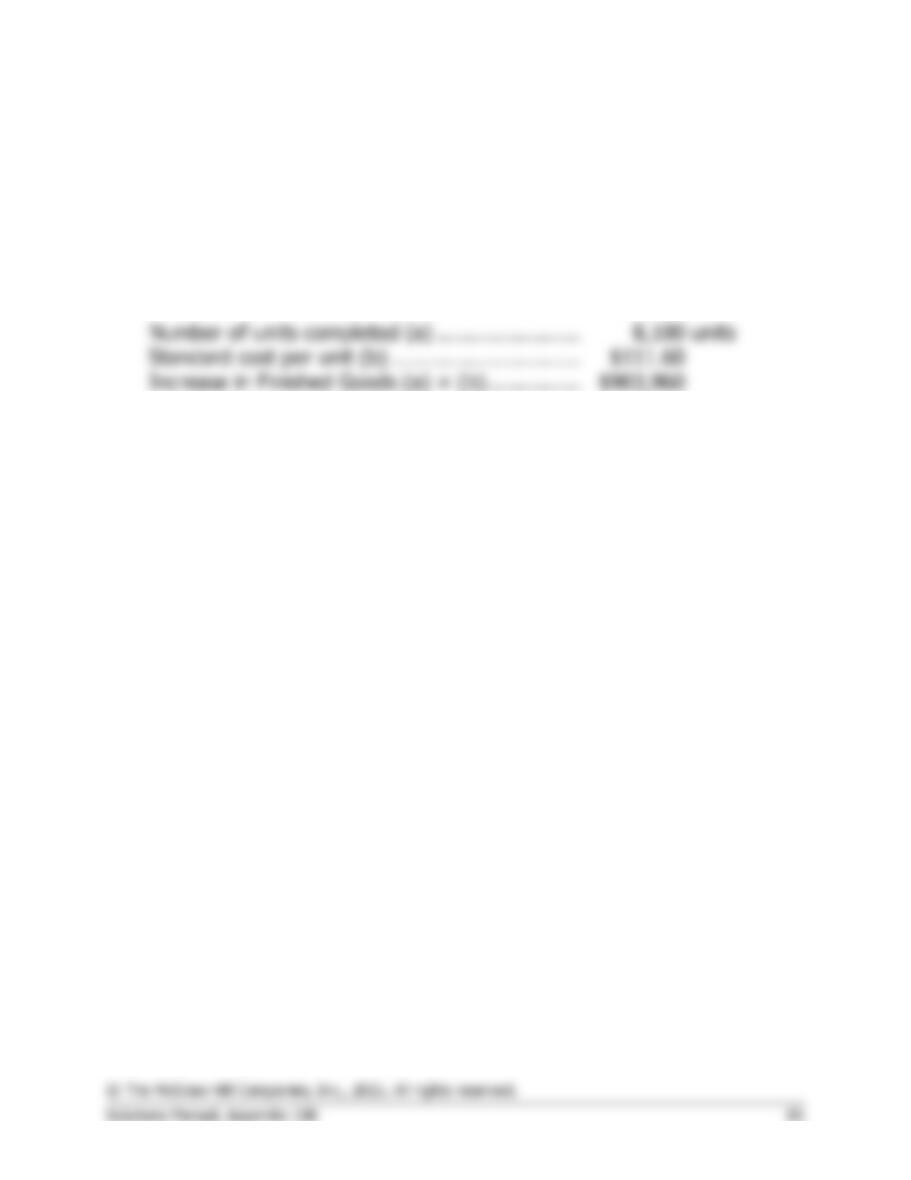
1a. The Raw Materials will increase by $300,000 computed as follows:
Actual quantity purchased (a) …………………….
30,000
yards
Standard price per yard (b) ……………………….
$10.00
Increase in Raw Materials (a) × (b) ……………..
$300,000
Actual quantity purchased (a) …………………….
30,000
yards
Actual price per yard (b) …………………………...
Decrease in Cash (a) × (b) ………………………..
$294,000
2a. The Raw Materials will decrease by $300,000 computed as follows:
Actual quantity used (a) …………………………...
30,000
yards
Standard price per yard (b) ……………………….
$10.00
Decrease in Raw Materials (a) × (b) …………….
$300,000
Standard price per yard (b) ……………………….
Increase in Work in Process (a) × (b) …………..
$243,000
3a. The Work in Process will increase by $272,160 computed as follows:
Standard hours allowed (8,100 units
× 2.4 hours per unit) (a) ………………………
19,440
hours
Standard rate per hour (b) ………………………..
$14.00
Increase in Work in Process (a) × (b) …………..
$272,160
Exercise 10B-3 (continued)
4. The Work in Process will increase by $388,800 computed as follows:
Standard hours allowed (a) ………………………..
19,440
hours
Predetermined overhead rate per hour (b) …….
$20.00
Increase in Work in Process (a) × (b) …………..
$388,800
5. The Finished Goods will increase by $903,960 computed as follows:
Number of units completed (a) …………………..
units
Standard cost per unit (b) …………………………
Increase in Finished Goods (a) × (b) ……………
$903,960
Exercise 10B-4 (30 minutes)
1a. The Raw Materials will increase by $720,000 computed as follows:
Actual quantity purchased (a) …………………….
60,000
yards
Standard price per yard (b) ……………………….
$12.00
Increase in Raw Materials (a) × (b) ……………..
$720,000
Actual quantity purchased (a) …………………….
60,000
yards
Actual price per yard (b) …………………………...
$11.00
$660,000
1c. The materials price variance is computed as follows:
Materials price variance = AQ(AP – SP)
60,000 yards ($11.00 per yard – $12.00 per yard) = $60,000 F
Actual quantity used (a) …………………………...
yards
Standard price per yard (b) ……………………….
2b. The Work in Process will increase by $672,000 computed as follows:
Standard quantity allowed (28,000 units
× 2 yards per unit) (a) …………………………
56,000
yards
Standard price per yard (b) ……………………….
$12.00
Increase in Work in Process (a) × (b) …………..
$672,000
3a. The Work in Process will increase by $630,000 computed as follows:
Standard hours allowed (28,000 units
× 1.5 hours per unit) (a) ………………………
42,000
hours
Standard rate per hour (b) ………………………..
$15.00
Increase in Work in Process (a) × (b) …………..
$630,000
Exercise 10B-4 (continued)
3b. The Cash decrease by $600,000 computed as follows:
Actual hours (a) …………………………..………….
40,000
hours
Actual rate per hour (b) …………………………....
$15.00
Decrease in Cash (a) × (b) ………………………..
$600,000
4a. The Work in Process will increase by $1,680,000 computed as follows:
Standard hours allowed (28,000 units
× 1.5 hours) (a) …………………………………
42,000
hours
Predetermined overhead rate per hour (b) …….
$40.00
Increase in Work in Process (a) × (b) …………..
$1,680,000
5. The Finished Goods will increase by $2,982,000 computed as follows:
Number of units completed (a) ………………..
28,000
units
Standard cost per unit (b) ………………………
$106.50
Increase in Finished Goods (a) × (b) …………
$2,982,000
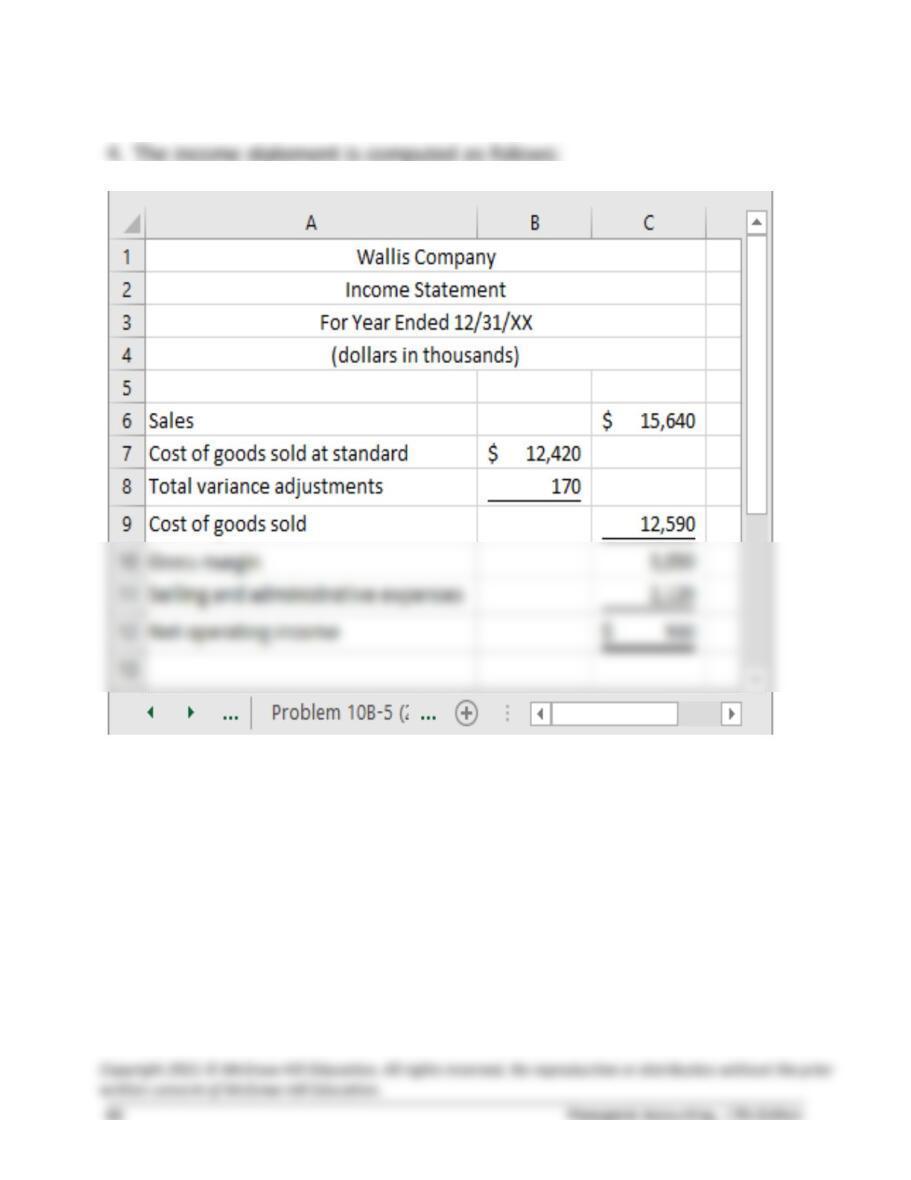
Problem 10B–5 (60 minutes)
1. The manufacturing cost variances are computed as follows:
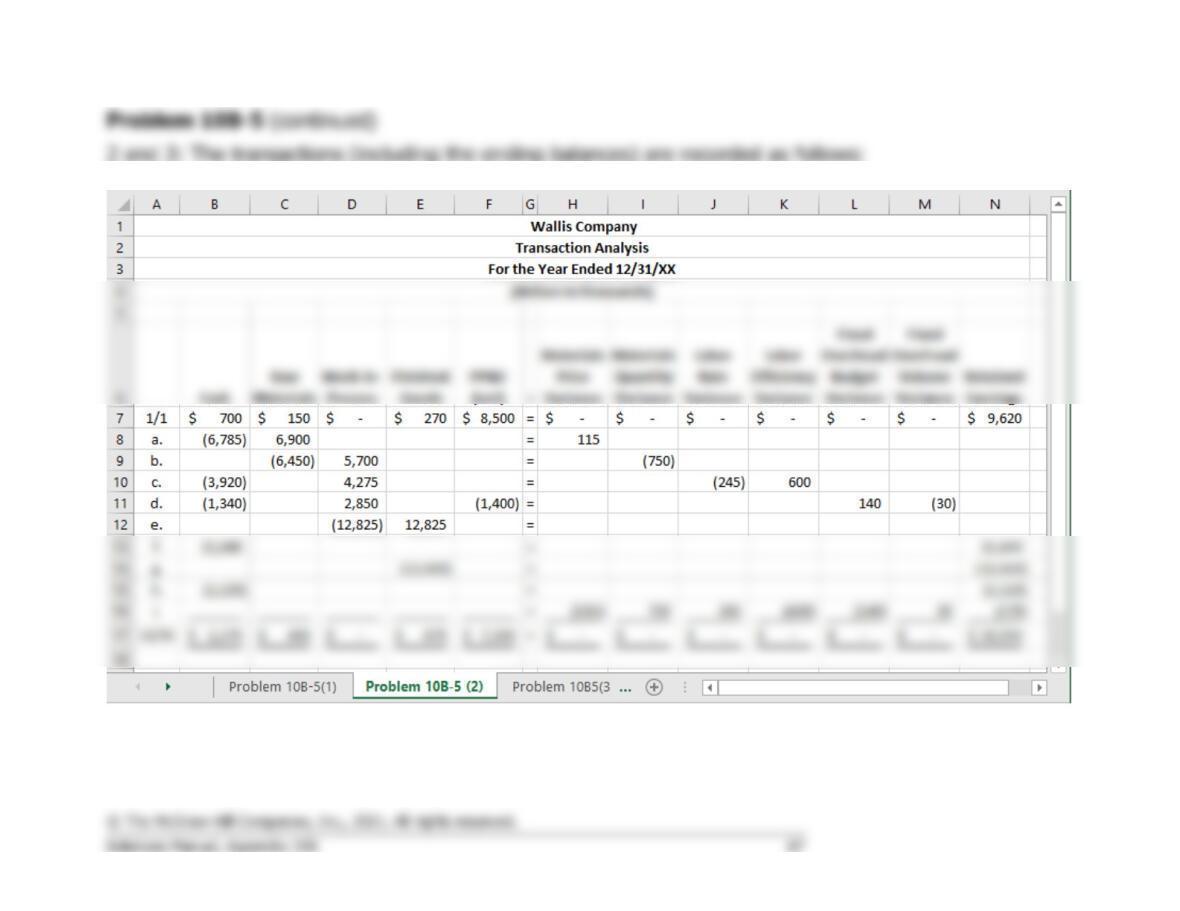
Materials price variance = AQ(AP – SP)
230,000 pounds ($29.50 per pound – $30.00 per pound) = $115,000 F
Materials quantity variance = SP(AQ – SQ)
$30.00 per pound (215,000 pounds – 190,000 pounds*) = $750,000 U
*95,000 units × 2 pounds per unit = 190,000 pounds
$15.00 per hour (245,000 hours – 285,000 hours*) = $600,000 F
*95,000 units × 3 hours per unit = 285,000 hours
Problem 10B-5 (continued)
Problem 10B-6 (60 minutes)
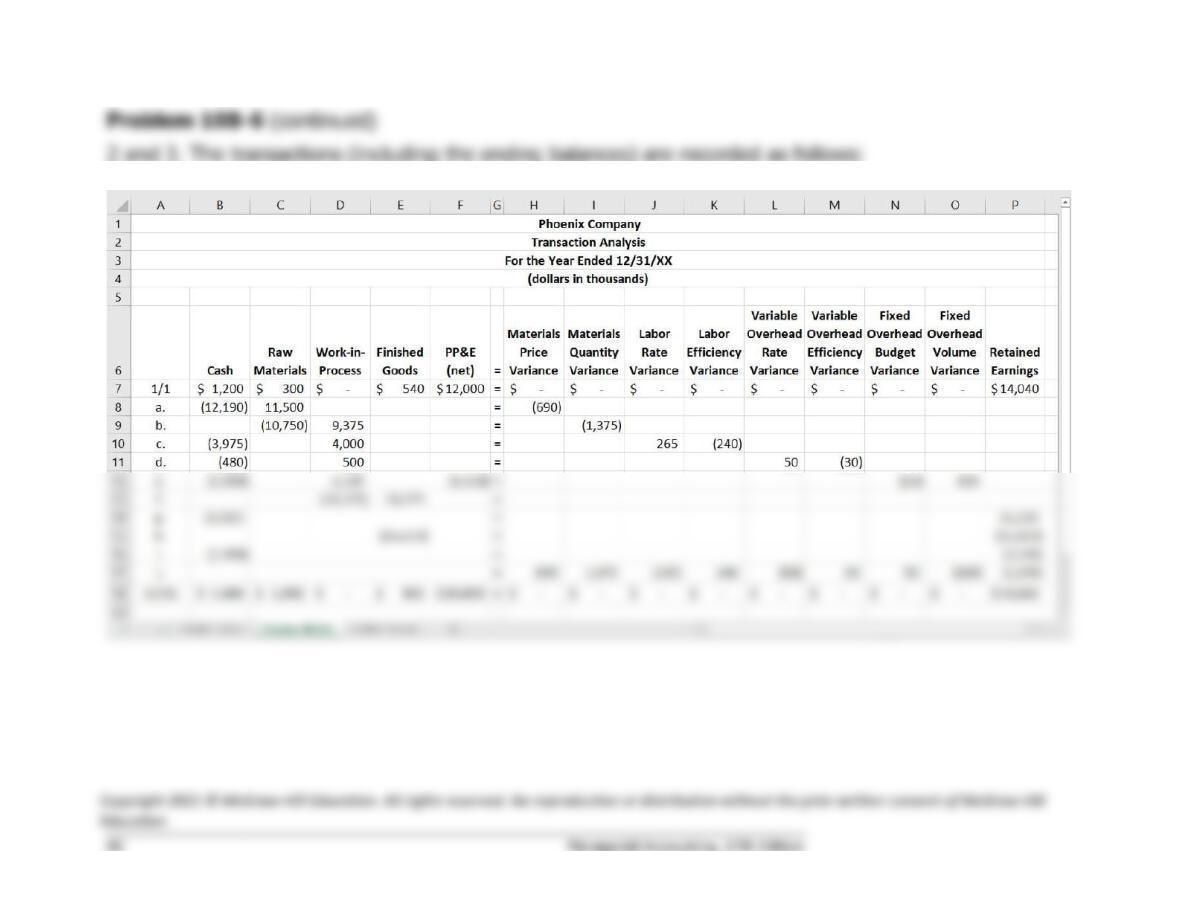
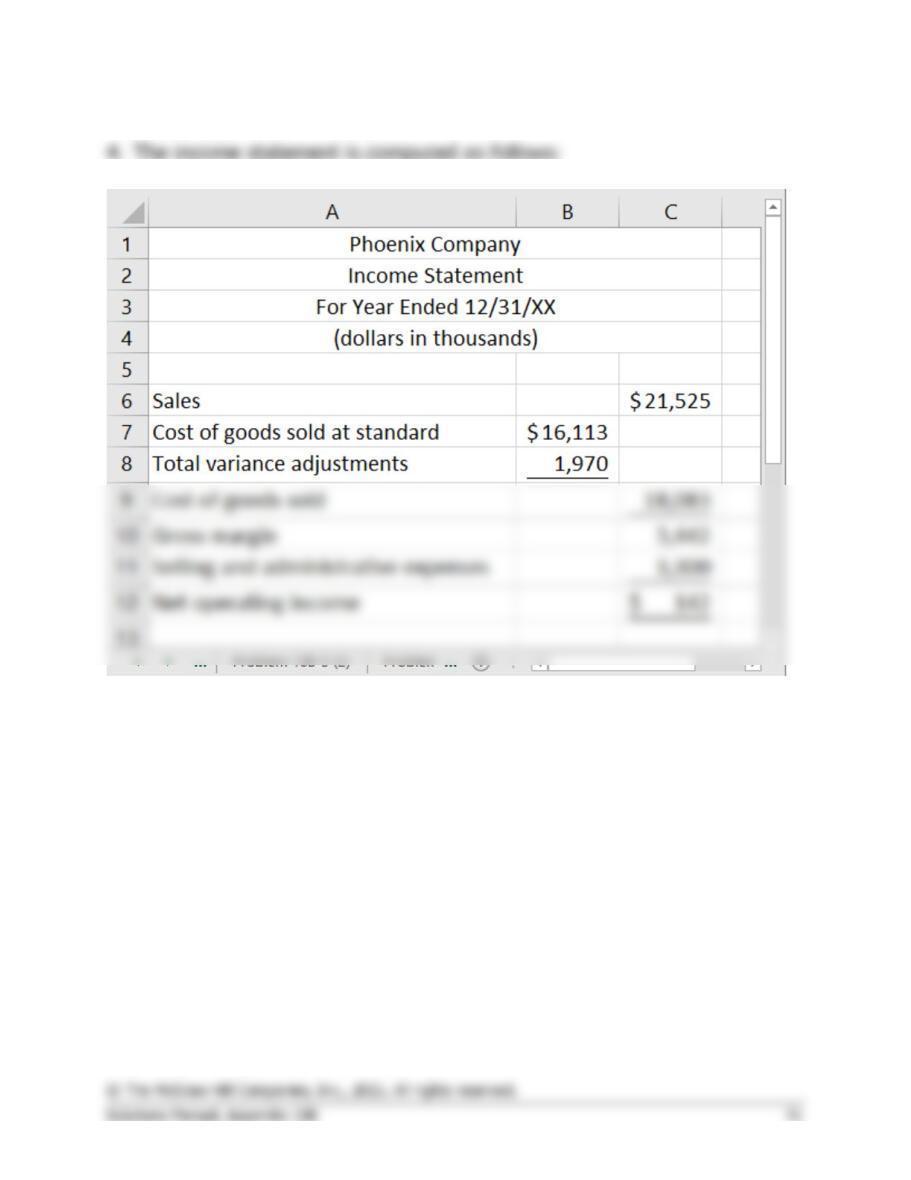
1. The manufacturing cost variances are computed as follows:
$25.00 per pound (430,000 pounds – 375,000 pounds) = $1,375,000 U
Labor rate variance = AH(AR – SR)
265,000 hours ($15.00 per hour – $16.00 per hour) = $265,000 F
Labor efficiency variance = SR(AH – SH)
$16.00 per hour (265,000 hours – 250,000 hours) = $240,000 U
$2.00 per hour (265,000 hours – 250,000 hours) = $30,000 U
Budget variance = Actual fixed overhead – Budgeted fixed overhead
Budget variance = $2,450,000 – $2,400,000 = $50,000 U
Volume variance = Budgeted fixed overhead – Fixed overhead applied
Volume variance = $2,400,000 – $2,500,000 = $100,000 F
Note: The budgeted fixed overhead of $2,400,000 is computed as
follows:
Problem 10B-6 (continued)