10
Fundamentals of Cost Management
Solutions to Review Questions
10–1.
Activity-based costing provides management with detailed costing information about
products and services. Activity-based management focuses on the use of activity-based
costing information to make decisions. Activity-based management is based on activity
analysis and finding ways to be more efficient with activities within the organization.
10–2.
Activity-based management can be implemented without an activity-based costing
10–3.
Value-added activities add value to the product or service whereas nonvalue-added
10–4.
Customers affect costs by the way they interact with the company and place demands
on company activities. Common examples are ordering behavior and sales support.
Suppliers affect costs by the way they interact with the company and place demands on
the company activities. Common examples are deliveries that are late or products that
have to be inspected before use or sale.
10–5.
10–6.
Resources supplied represent the capacity of the organization. They are the resources
available for use. Resources consumed are those used in the manufacture of the
product or the provision of the service. The difference is important because the firm
pays for the resources supplied but benefits from the resources used. If the resources
supplied are greater than those used, the firm could benefit by selling or reducing the
excess resources supplied.
10–7.
Capacity costs, generally included in the fixed overhead allocation, affect reported
10–8.
The cost of excess capacity should be assigned to products or customers if the reason
for the excess capacity is customer demands. Examples include seasonality in demand
or “lumpy” capacity (additional capacity is only available in discrete increments). The
cost of excess capacity should not be assigned to products or customers if it is for the
benefit of the firm. An example would be excess capacity in anticipation of growth.
10–9.
Quality affects cost in two major ways. Conformance costs are those that the firm incurs
10–10.
The four categories of a cost of quality system are:
1. Prevention: Costs to ensure good quality (product design, training).
Solutions to Critical Analysis and Discussion Questions
10–11.
Answers will vary.
a) Health clinic: Waiting for test results and storing equipment.
b) Bank: Processing transactions with errors and waiting for manager to authorize a
transaction.
10–12.
10–13.
10–14.
Answers will vary.
a) Clothing retail store: Returning defective product to suppliers and processing
customer returns.
b) Record store: Replacing items lost to shrinkage (inventory theft) and storing
inventory.
10–15.
10–16.
The problem with first computing product costs and then customer costs is that it
assumes that all customers who buy the product have the same behavior of ordering
and using firm resources. Therefore, the firm cannot determine the type of customer
that is costly.
10–17.
10–18.
Two important factors managers need to consider are what competitors will do and how
10–19.
There is an opportunity cost associated with idle capacity. Knowing that capacity is not
being used allows managers to decide what to do with it. They may decide to leave it in
place for growth or to dispose of it. It could be sold or used to produce something else.
The point is that reporting the cost of unused capacity forces managers to consider the
resources being supplied but not consumed.
10–20.
10–21.
Answers will vary. The answer depends on why excess demand exists and what
competitors will do. Historically, many if not most schools held few classes for the
summer. In this case, the cost of excess capacity would be assigned to the programs
(students), because it is for the benefit of the programs. This is changing as schools
identify ways to utilize the excess capacity with classes or other programs.
10–22.
10–23.
Answers will vary. One example follows. The quality-based view would encourage
continuous improvement of the production process and might offer incentives (i.e. cash
bonuses) for production employees to make recommendations about how the
production process can be improved. The result would be fewer product defects and
10–24.
Answers will vary. There are an unlimited number of ways to reasonably allocate the
costs. Answers might include two parts: (1) how many cost pools and (2) how to
allocate the cost pools to the customers. For example, we might consider allocating the
building costs using one allocation base, and carrier and vehicle operating costs using a
different base. For example, we might allocate building costs on the average portion of
Solutions to Exercises
10–25. (10 min.) Activity-Based Cost Management in a College.
1. b. Improves efficiency. Renewing books no longer requires an intermediate
person, the librarian, as part of the transaction.
2. a. Reduces frequency of activity. Reducing the number of hours the library is
open reduces all of the activities required to keep it open.
10–26. (10 min.) Activity-Based Cost Management for a Hotel.
1. b. Improves efficiency. Having guests check in on-line means less work for the
clerk. In some cases, the key to the room can be provided by a kiosk or
downloaded to an app.
10–27. (10 min.) Activity-Based Cost Management for a Hotel.
1. B. Improves efficiency. Placing the direct material inventory nearer the production
line improves efficiency by reducing the time it takes to move it to the production
line.
10–28. (10 min.) Cost Hierarchy for a Not-for-Profit.
a. Facility level (will not vary over range of activity).
b. Facility level (will not vary over range of activity).
c. Unit level (likely to vary as activity changes).
d. Facility level (will not vary over range of activity).
10–29. (20 min.) Driver Identification.
Note: For all of the possible drivers listed below, these are likely part of the information
the company keeps (and in some cases they refer explicitly to the records kept).
a. Number of calls to new commercial customers; records kept by sales reps.
f. Number of employees, time.
g. Number of commercial loans; from accounting records, employee time.
h. Number of consumer loans; from accounting records.
i. Number of consumer loans.
j. Number of calls to existing commercial customers; records kept by sales reps.
10–30. (20 min.) Driver Identification.
Note: For all of the possible drivers listed below, these are likely part of the information
the company keeps (and in some cases they refer explicitly to the records kept).
a. Number of classes: With some exceptions, faculty compensation is based on
classes, not students.
b. Number of interviews; number of students.
c. Number of students; number of full-time students.
d. Number of students; number of classes.
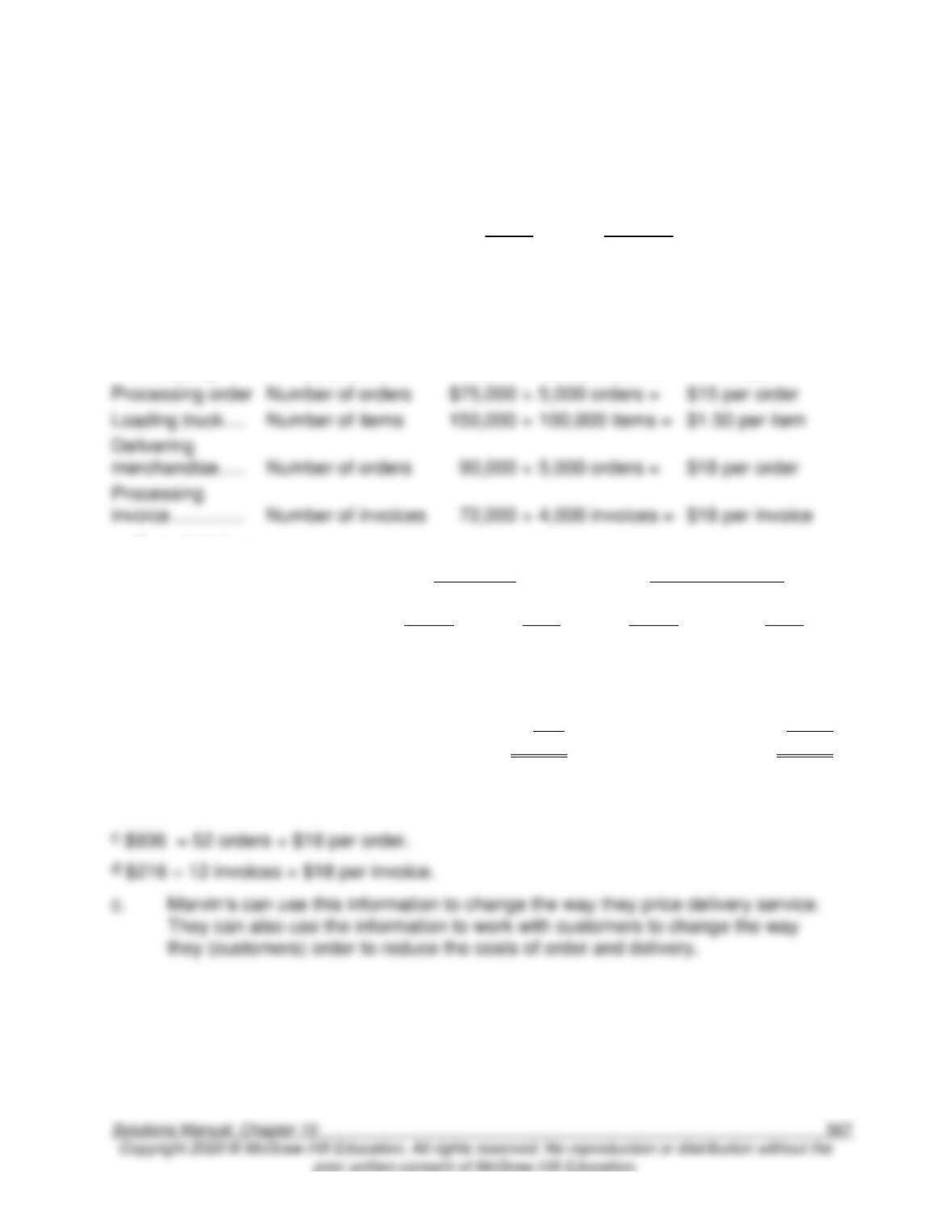
10–31. (20 min.) Activity-Based Costing of Customers: Marvin’s Kitchen Supply.
a. Delivery cost based on order value:
Customer
Order
Value
Delivery Charge
(@10%)
City Diner ……………………….
$75,000
$7,500
Le Chien Chaud ………………
$90,000
9,000
b. Delivery cost based on activity-based costing:
Cost driver rates:
Activity
Cost Driver
Cost ÷
Driver Volume =
Rate
Cost of delivery:
City Diner
Le Chien Chaud
Activity
Units of Cost
Driver
Cost
Units of Cost
Driver
Cost
Processing order …………..
52 orders
$780a
110 orders
$1,650
Loading truck ………………..
600 items
900b
1,500 items
2,250
Delivering merchandise ….
52 orders
936c
110 orders
1,980
Processing invoice …………
12 invoices
216d
150 invoices
2,700
Total cost …………………..
$2,832
$8,580
a $780 = 52 orders × $15 per order.
b $900 = 600 items × $1.50 per item.
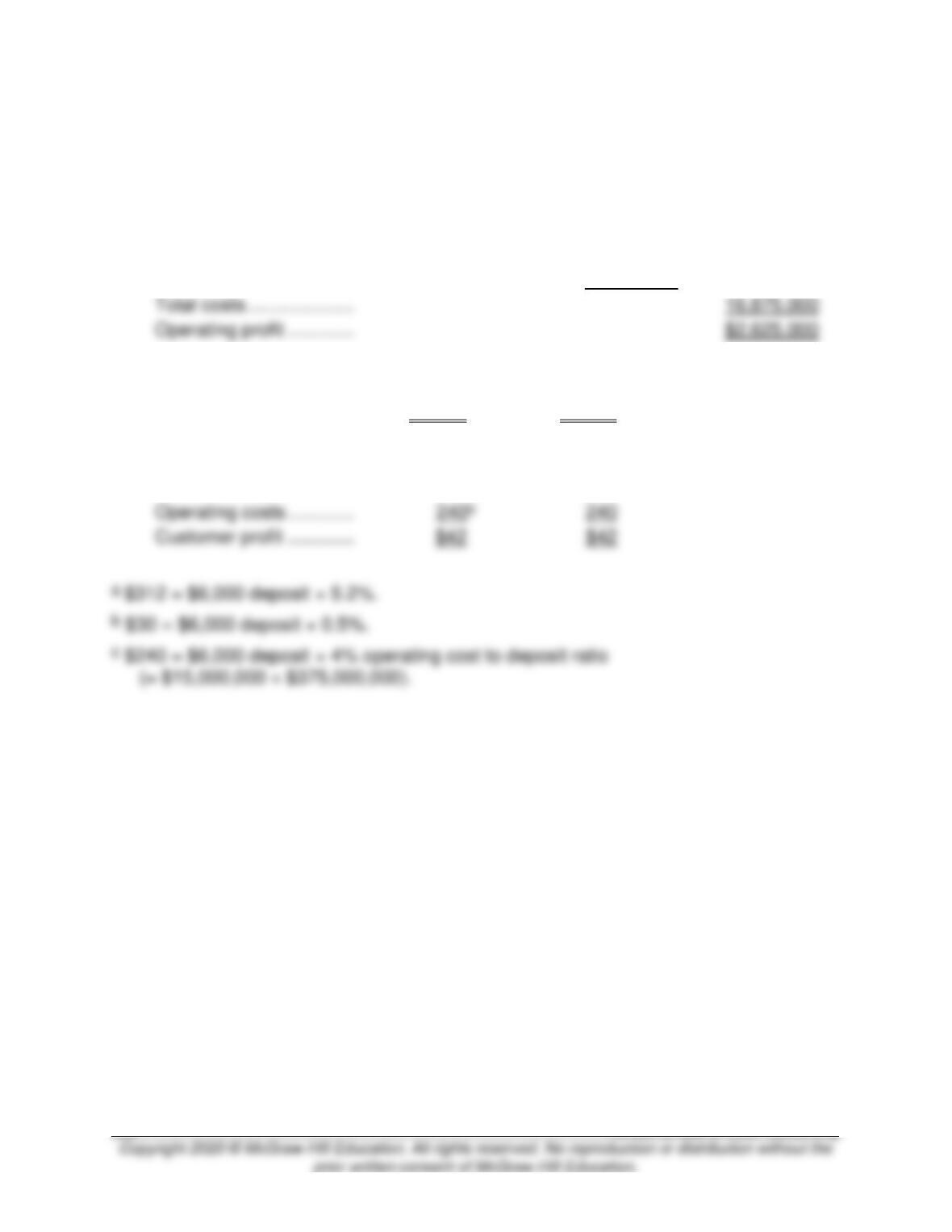
10–32. (30 min.) Activity-Based Costing of Customers: Rock Solid Bank & Trust.
a.
Sales revenue ……………
$375,000,000 × 5.2%
$19,500,000
Costs:
Interest on deposits …
$375,000,000 × 0.5%
1,875,000
Operating costs ……..
(Given)
15,000,000
Total costs…………………
Operating profit ………….
b.
Customer A
Customer B
Deposit ……………………..
$6,000
$6,000
Sales revenue ……………
$312a
$312
Interest on deposits …….
30b
30
Operating costs ………….
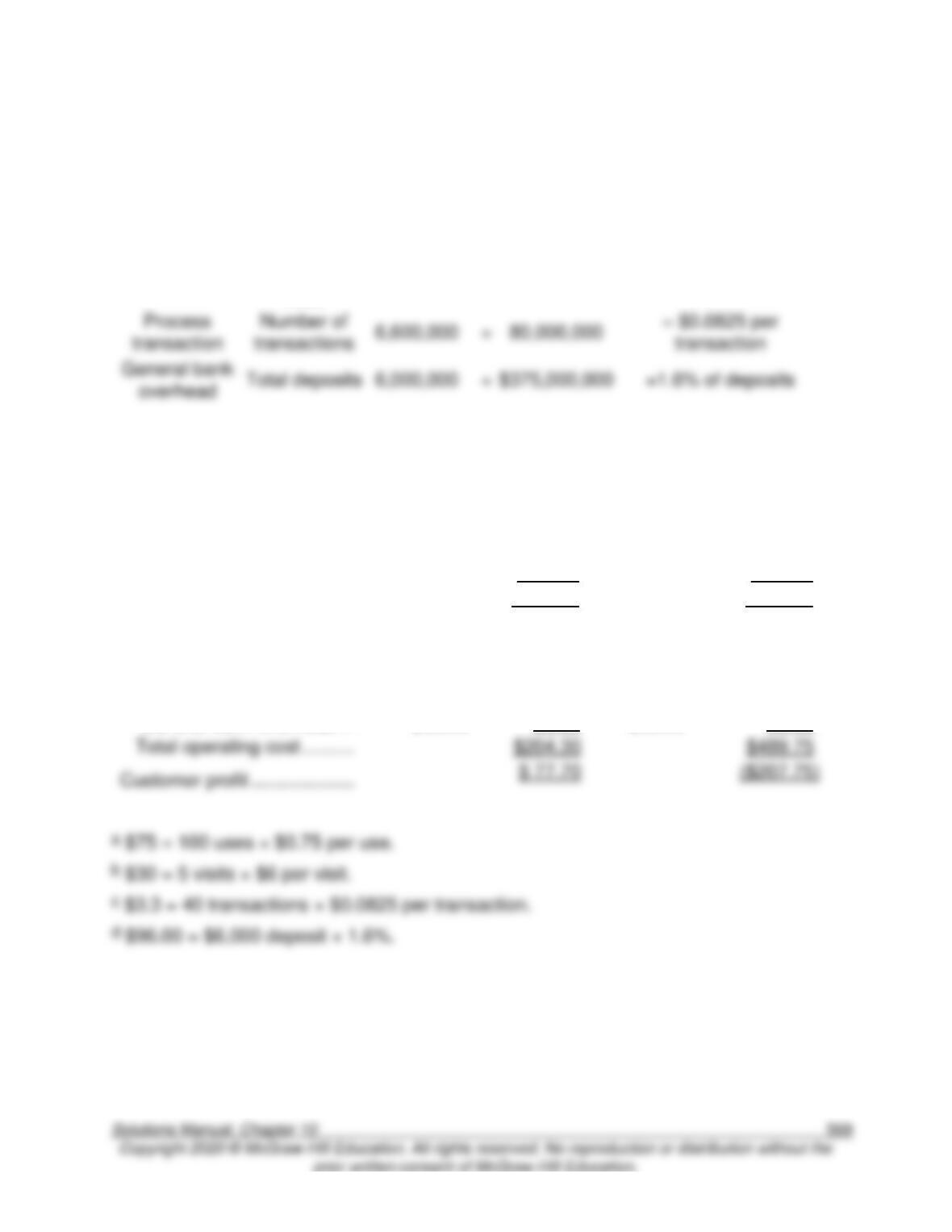
10–32. (continued)
c.
Activity
Cost Driver
Cost
Driver Volume
Rate
Use ATM
Number of
uses
$1,500,000
÷
2,000,000
= $0.75 per use
Visit branch
Number of
visits
900,000
÷
150,000
= $6 per visit
Number of
÷
Customer A
Customer B
Activity
Units of
Cost
Driver
Units of
Cost
Driver
Sales revenue ………………….
$312.00
$312.00
Interest on deposit ……………
30.00
30.00
Account margin …………….
$282.00
$282.00
Operating costs:
Use ATM ……………………..
100
$75.00a
200
$150.00
Visit branch ………………….
5
30.00b
20
120.00
Process transaction ………
40
3.30c
1,500
123.75
General bank overhead …
$6,000
96.00d
$6,000
96.00
Total operating cost ……….
$489.75
Customer profit ………………..
10–33. (15 min.) Activity-Based Costing of Customers: Rock Solid Bank & Trust.
a. RSB&T can use this information to change the way banking services are priced.
Managers at the bank may want to consider ATM fees or require minimum
balances.
10–34. (15 min.) Activity-Based Costing of Customers—Ethical Issues: Lygon
Food Distributors.
a. LFD could use the information to offer “discounts” for weekday orders, which is
equivalent to a premium for weekend orders. Before Anjana makes any changes,
she should try to understand the reason for the difference. Are the sales patterns
different? Do weekend customers buy more? Are weekend customers less
knowledgeable and, therefore, in need of greater assistance? As always, pricing
issues depend on market conditions. The cost information allows Anjana to make
better decisions.
10–35. (15 min.) Activity-Based Costing of Customers—Ethical Issues: Central
State College.
a. Possible allocation bases include number of students, student hours in the lab,
classes in the lab, and so on. We would like to link the use of the lab with the
cost, but it is not sufficient to say we will allocate on the basis of use. We need to
identify how to measure use.
10–36. (15 min.) Activity-Based Costing of Suppliers: Hult Games.
This can be answered using the format of Exhibit 10.9. First compute the cost of
a late delivery.
Number of cartons delivered late
(100,000 × 25% + 60,000 × 10%)
31,000
Cost of late deliveries ……………..
(Given)
$496,000
Cost of late delivery per carton ..
($496,000 ÷ 31,000)
$16
Now compute the “effective” price of a carton.
Milan
Dundee
Average purchase price per carton ……..
$20.00
$22.00
Additional cost of late delivery per carton
$16.00
$16.00
Probability of late delivery ………………….
Expected cost of late delivery per carton
Effective cost per carton …………………….
$24.00
$23.60
10–37. (10 min.) Activity-Based Costing of Suppliers: Hult Games.
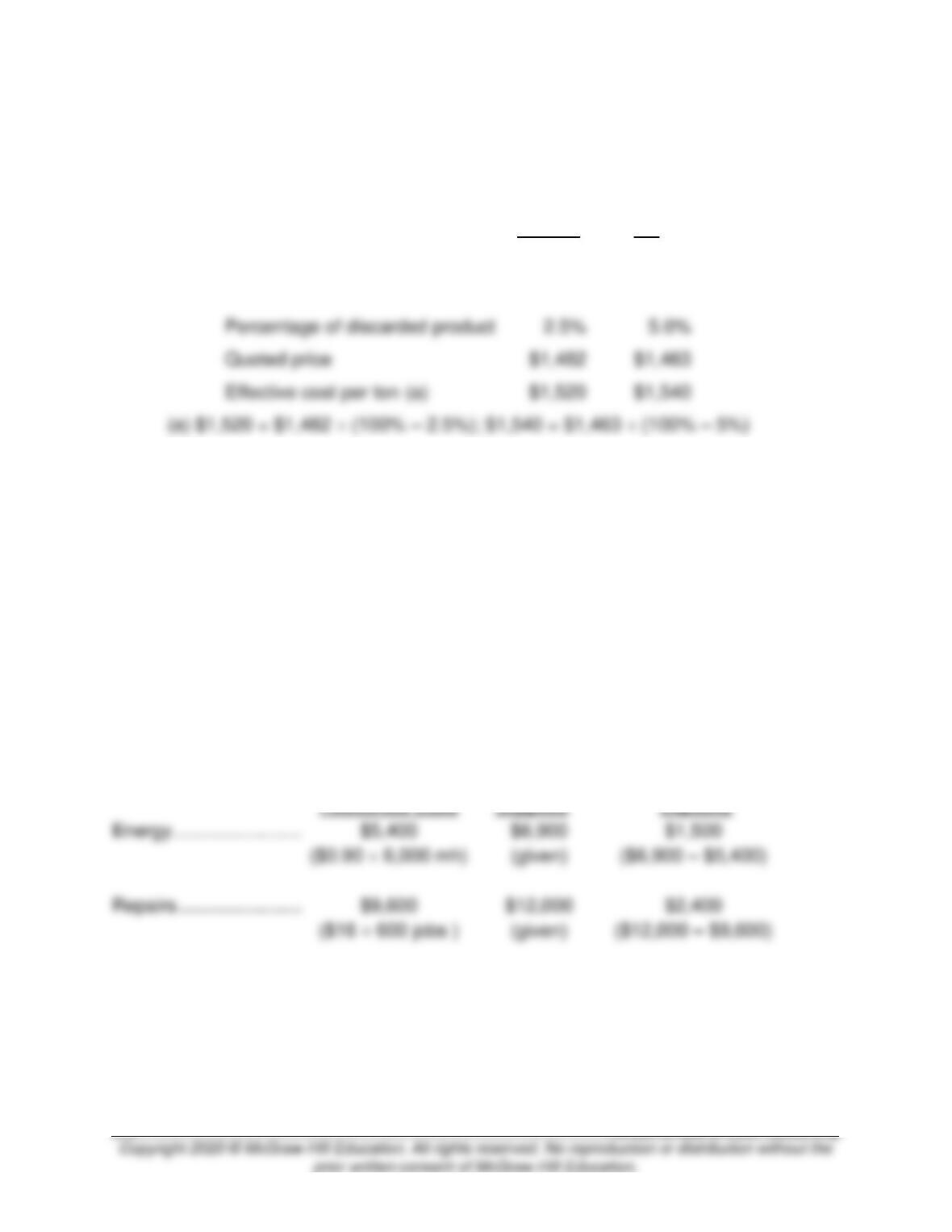
22.5%. This can be answered as a breakeven calculation, solving for P, the
percentage of late deliveries:
10–38. (20 min.) Activity-Based Costing of Suppliers: Kinnear Plastics.
The approach to this problem is to determine how much it costs to purchase a
ton of “good” plastic. The effective price is the quoted price divided by the
percentage of good tons that can be expected:
Tappan
Hill
Tons purchased
4,400
8,200
Tons discarded
110
410
Percentage of discarded product
Quoted price
Effective cost per ton (a)
10–39. (10 min.) Activity-Based Costing of Suppliers: Kinnear Plastics.
a. $1,501.50. This can be answered as a breakeven calculation, solving for B,
the bid:
(B ÷ 97.5%) = $1,540
B = $1,501.50.
b. There are several reasons, including Kinnear not wanting to be dependent on
one supplier or capacity constraints at Tappan.
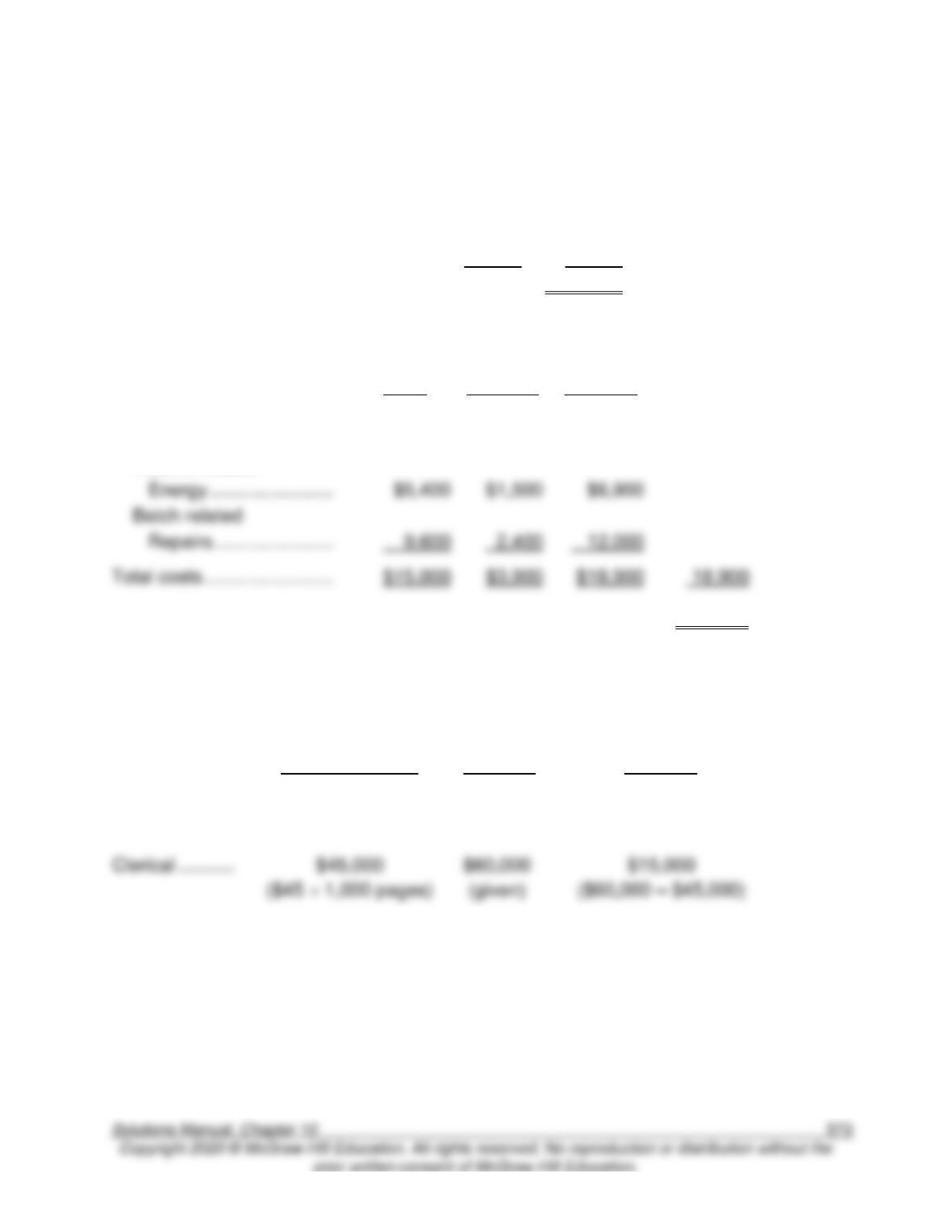
10–40. (15 min.) Resources Used versus Resources Supplied: Tri-State Mill.
Resources
Unused Resource
10–41. (10 min.) Resources Used versus Resources Supplied: Tri-State Mill.
a.
Finishing sales ……………………..
$ 30,000
Energy costs ……………………..
$6,900
Repair costs ……………………..
12,000
18,900
Operating profit ……………………
$ 11,100
b.
Resources
Used
Unused
Resource
Capacity
Resources
Supplied
Finishing sales ………………
$ 30,000
Costs
Volume related
Energy ……………………
$5,400
$6,900
Repairs …………………..
Total costs …………………….
Finishing operating profits ..
$ 11,100
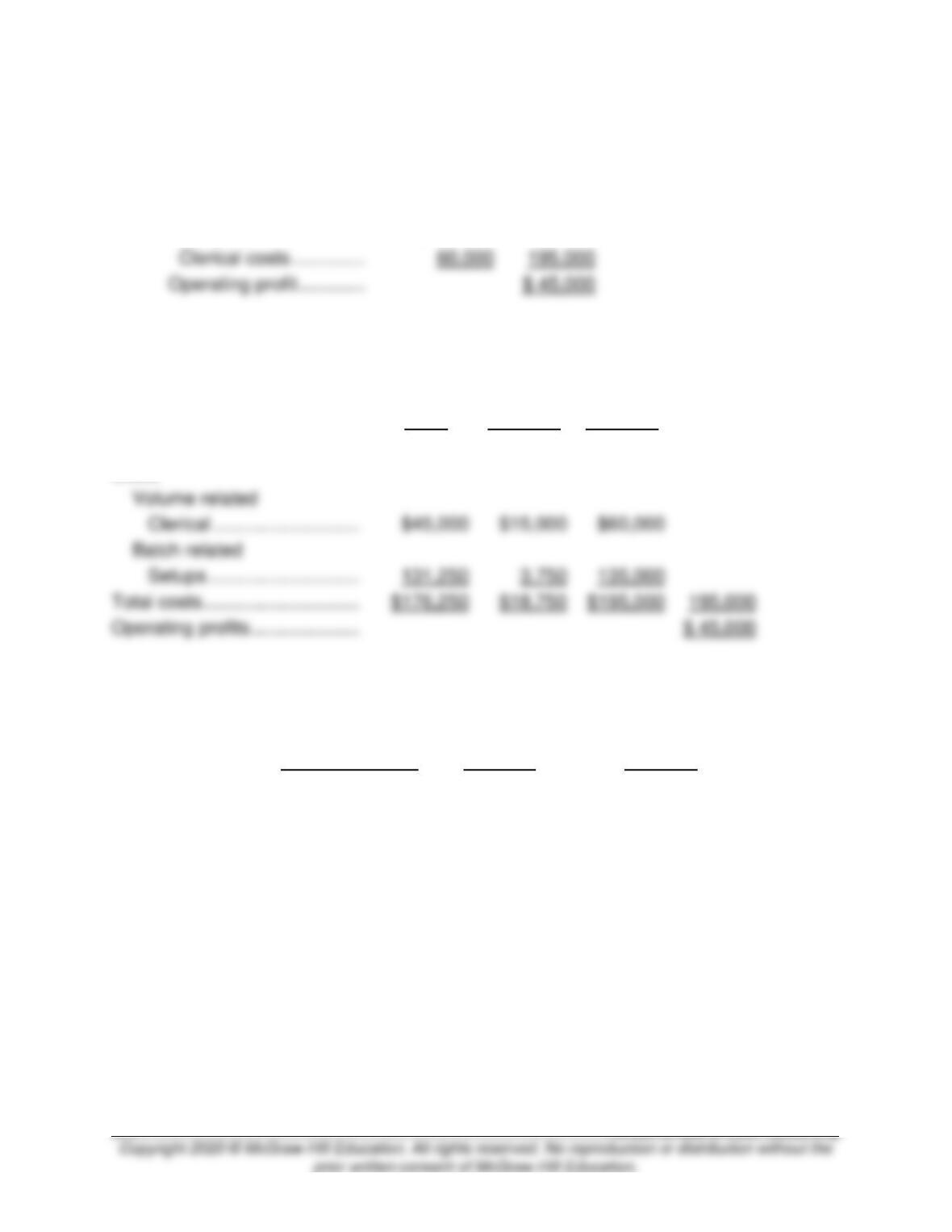
10–42. (15 min.) Resources Used versus Resources Supplied: Conlon
Enterprises.
Resources Used
Resources
Supplied
Unused Resource
Capacity
Setups …………
$131,250
$135,000
$3,750
($375 350 runs)
(given)
($135,000 – $131,250)
Clerical ………..
(given)
10–43. (10 min.) Resources Used versus Resources Supplied: Conlon Enterprises.
a.
Sales revenue ………………….
$ 240,000
Setup costs ……………..
$135,000
Clerical costs …………..
b.
Resources
Used
Unused
Resource
Capacity
Resources
Supplied
Sales revenue …………………..
$ 240,000
Volume related
Clerical ……………………….
10–44. (15 min.) Resources Used versus Resources Supplied: Arnold &
Daughters.
Resources Used
Resources
Supplied
Unused Resource
Capacity
Materials testing
$86,000
$100,000
$14,000
($43 2,000 tests)
(given)
($100,000 – $86,000)
Materials proc.
$300,000
$340,000
$40,000
($600 500 orders)
(given)
($340,000 – $300,000)
10–45. (15 min.) Resources Used versus Resources Supplied: Berkeley Bank.
Resources Used
Resources
Supplied
Unused Resource
Capacity
Process trans.
$400,000
$625,000
$225,000
($0.01 40,000,000
trans.)
(given)
($625,000 – $400,000)
10–46. (40 min.) Resources Used versus Resources Supplied: Carbon Company.
a.
Resources
Supplieda
Unused Resource
Capacitya
Resources Used
Materials ………………
÷ Cost Driver Volume
= Cost Driver Rate
$98,000
$2,000
$96,000
÷ 8,000 pounds
= $12 per pound
Energy ………………….
÷ Cost Driver Volume
= Cost Driver Rate
Setups ………………….
Purchasing ……………
= Cost Driver Rate
$1,800
$17,880
$1,560
$16,320
340 mh
Customer service …..
÷ Cost Driver Volume
= Cost Driver Rate
$15,600
$7,600
$8,000
÷ 50 returns
= $160 per return
Long-term labor ……..
$29,000
$3,400
a Given
b. Unused resource capacity is the difference between resources supplied and
resources used. Unit-related costs typically have little or no unused resources
since they vary directly with output. At the other end of the cost spectrum are
capacity-related costs which typically have unused resources (unless the
company is operating at full capacity) since these costs are long-term costs and
cannot be changed quickly in the short term.
10–47. (20 min.) Assigning Cost of Capacity: Mimi’s Fixtures.
a. Because the plant was purchased with excess capacity for future growth, current
production should not be charged with excess capacity. Therefore, the cost
system should report a cost of $38 per tile computed as follows:
Variable cost per tile …………………
(Given)
Allocated fixed capacity cost ……..
Cost per tile ………………………….
$38
b. The cost of excess capacity is $100,000 [= $600,000 – ($20 × 25,000 tiles)].
c. If the minimum plant size was 30,000 tiles, then the capacity is for the customers’
benefit and the costing system should charge the cost of excess capacity to
current production. In this case, the cost of a tile is $42, computed as follows:
Variable cost per tile …………………
(Given)
Allocated fixed capacity cost ……..
Cost per tile ………………………….
$42
10–48. (20 min.) Assigning Cost of Capacity: Curt’s Castings.
a. Because the plant was purchased for the benefit of Curt, current production
should not be charged with excess capacity. Therefore, the cost system should
report a cost of $8 per ton computed as follows:
Variable cost per ton ………………..
(Given)
$ 6
Allocated fixed capacity cost ……..
($400,000 ÷ 80,000 tons)
5
Cost per casting ……………………
$11
10–49. (15 min.) Costs of Quality: Waterloo Company.
Customer complaints
EF
Field testing
A
Materials inspection
P
Preventive maintenance
P
Process inspection
P
Quality training
P
Rework
Scrap
Testing equipment
A
Warranty repairs
10–50. (20 min.) Costs of Quality: Domingo Corporation.
a. Prevention: Process inspection, quality training, preventive maintenance,
materials inspection.
Appraisal: Product testing equipment, field testing.
Internal failure: Scrap, rework.
External failure: Warranty repairs, customer complaints.
b.
March
April
Prevention
$41,450 ÷ $490,000 ………….
8.5%
$29,180 ÷ $440,000 ………….
6.6%
Appraisal
$16,400 ÷ $490,000 ………….
3.4%
$19,400 ÷ $440,000 ………….
4.4%
Internal failure
$20,430 ÷ $440,000 ………….
4.6%
External failure
$7,100 ÷ $490,000 ……………
1.5%
$8,200 ÷ $440,000 ……………
1.9%