John J. Wild, Financial Accounting: Information for Decisions, 8th Edition
10-1
Chapter 10
REPORTING AND ANALYZING LONG-TERM LIABILITIES
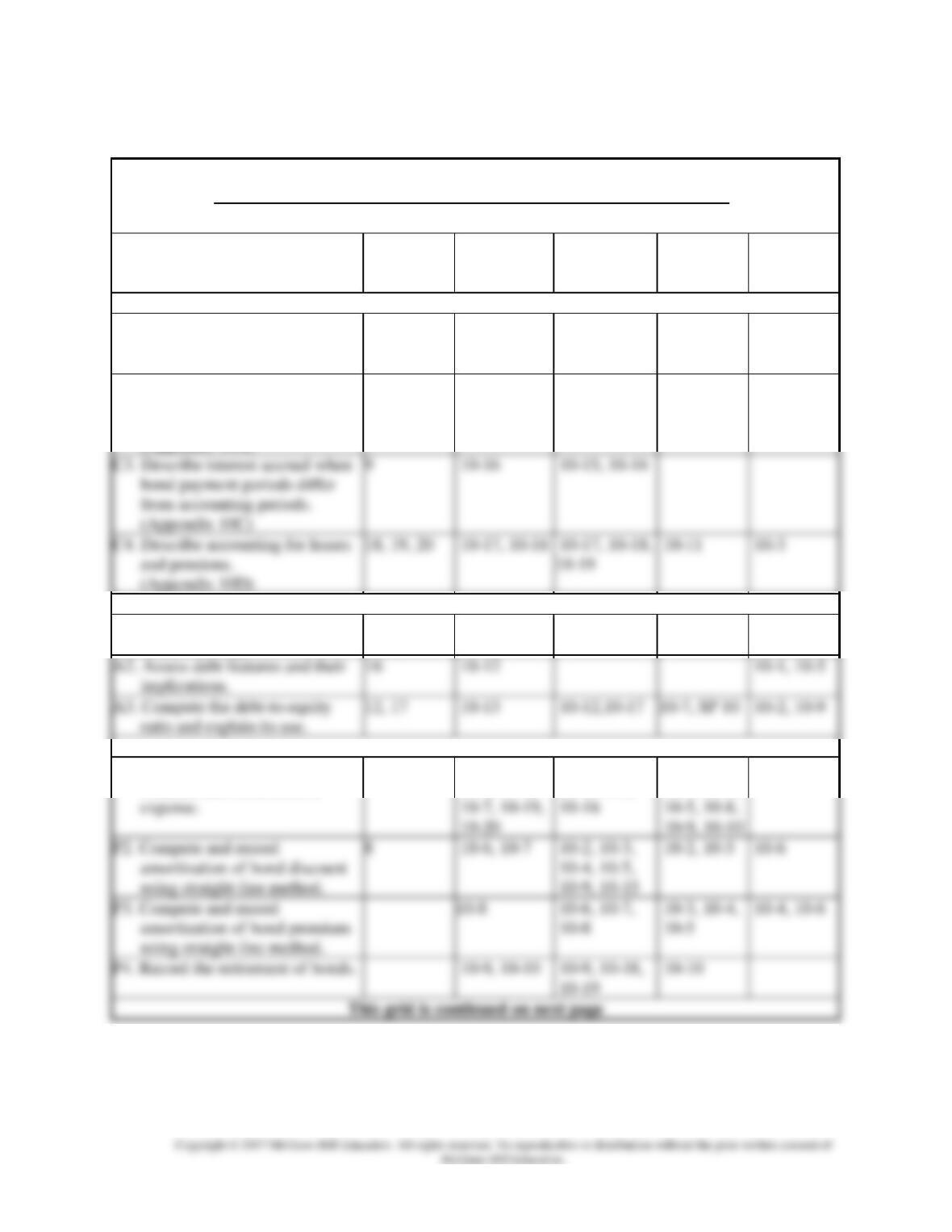
Student Learning Objectives and Related Assignment Materials*
Student Learning Objectives
Discussion
Questions
Quick
Studies
Exercises
Problems
Beyond the
Numbers
Conceptual objectives:
C1. Explain the types of notes and
payment entries to account for
notes.
1
10-11
10-10, 10-11,
10-20
10-6
C2. Explain and compute the
present value of an amount to
be paid at a future date.
(Appendix 10A)
C3. Describe interest accrual when
bond payment periods differ
from accounting periods.
(Appendix 10C)
9
10-16
10-15, 10-16
C4. Describe accounting for leases
and pensions.
(Appendix 10D)
18, 19, 20
10-17, 10-18
10-17, 10-18,
10-19
10-11
10-3
Analytical objectives:
A1. Compare bond financing with
stock financing.
2, 3, 4, 5, 6,
7, 13, 15
10-1
SP 10
10-1, 10-3,
10-7, 10-8
A2. Assess debt features and their
implications.
16
10-12
10-1, 10-5
A3. Compute the debt-to-equity
ratio and explain its use.
12, 17
10-13
10-12,10-17
10-7, SP 10
10-2, 10-9
expense.
10-7, 10-19,
10-16
10-5, 10-8,
P2. Compute and record
amortization of bond discount
using straight-line method.
8
10-6, 10-7
10-2, 10-3,
10-4, 10-5,
10-9, 10-15
10-2, 10-5
10-6
P3. Compute and record
amortization of bond premium
using straight-line method.
10-8
10-6, 10-7,
10-8
10-3, 10-4,
10-5
10-4, 10-6
P4. Record the retirement of bonds.
10-9, 10-10
10-9, 10-18,
10-10
P1. Prepare entries to record bond
issuance and bond interest
10, 11, 14
10-2, 10-3,
10-4, 10-5,
10-1, 10-4,
10-5, 10-6,
10-1, 10-2,
10-3, 10-4,
John J. Wild, Financial Accounting: Information for Decisions, 8th Edition
10-2
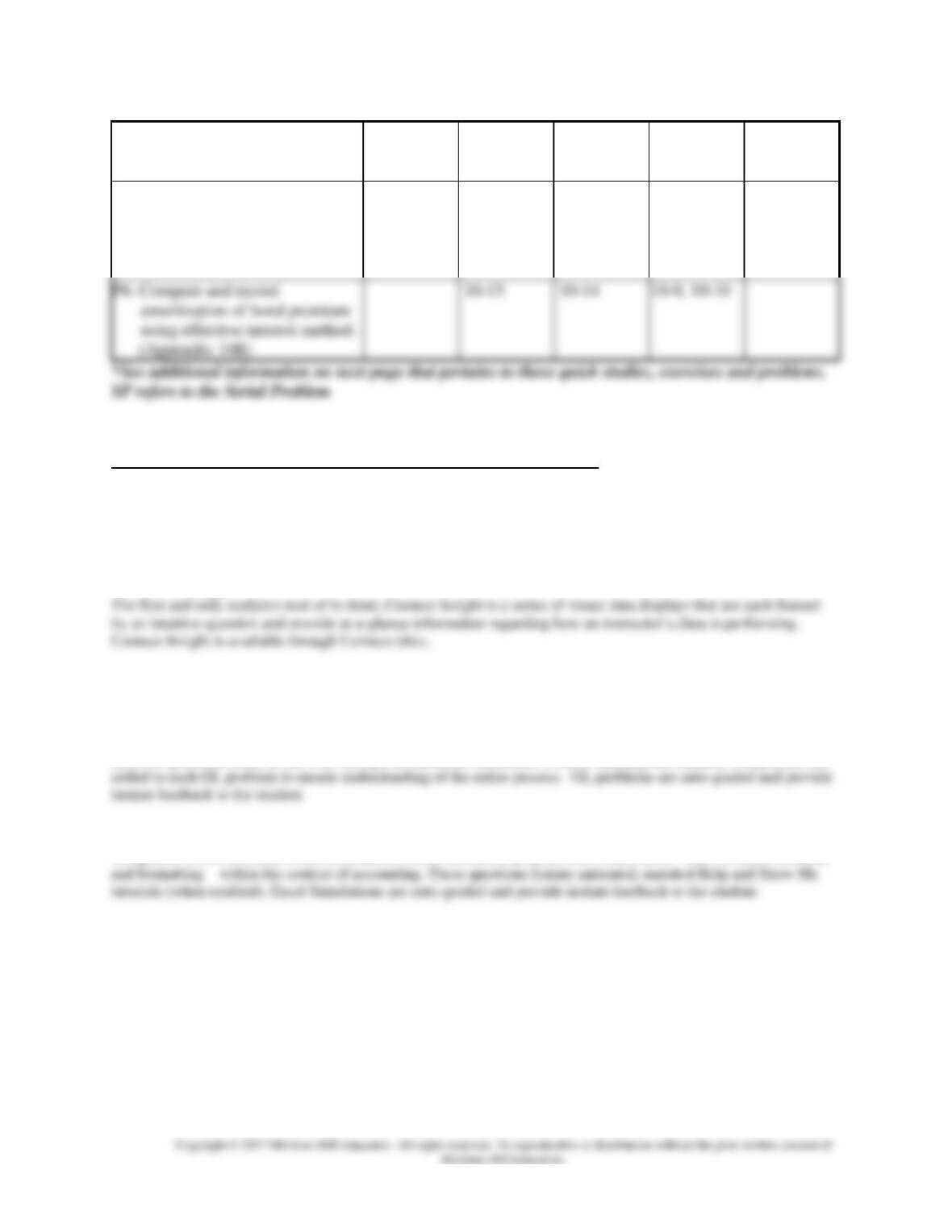
Student Learning Objectives
Discussion
Questions
Quick
Studies
Exercises
Problems
Beyond the
Numbers
P5. Compute and record
amortization of bond discount
using effective interest method.
(Appendix 10B)
8
10-14
10-13
10-8, 10-10
Additional Information on Related Assignment Material
Connect
Available on the instructor’s course-specific website) repeats all numerical Quick Studies, all Exercises and
Problems Set A. Connect also provides algorithmic versions for Quick Study, Exercises and Problems. It allows
instructors to monitor, promote, and assess student learning. It can be used in practice, homework, or exam mode.
Connect Insight
The Serial Problem for Success Systems continues in this chapter.
General Ledger
Assignable within Connect, General Ledger (GL) problems offer students the ability to see how transactions post
from the general journal all the way through the financial statements. Critical thinking and analysis components are
Excel Simulations
Assignable within Connect, Excel Simulations allow students to practice their Excel skills—such as basic formulas
John J. Wild, Financial Accounting: Information for Decisions, 8th Edition
10-3
Synopsis of Chapter Revisions
• NEW opener—Box
• Simplified Exhibit 10.1 for ease of learning.
• Reported largest bond offerings in history—Verizon & Apple.
• New bond image from Minnesota Vikings.
John J. Wild, Financial Accounting: Information for Decisions, 8th Edition
10-4
Chapter Outline
Notes
I. Basics of Bonds
Projects that demand large amounts of money often are funded from
bond issuances.
A. Bond Financing
1. A bond is its issuer’s written promise to pay an amount
identified as the par value of the bond with interest.
a. Most bonds require the issuer to make periodic interest
2. Advantages of bonds
b. Interest on bonds is tax deductible.
on those funds increases its return on equity. This process is
a. Bonds do not affect owner control.
3. Disadvantages of bonds
a. Bonds can decrease return on equity. A company that earns
a lower return with borrowed funds than it pays in interest
on those funds decreases its return on equity.
require any payments because cash withdrawals (dividends)
B. Bond Trading
sure they do not violate any existing contractual agreements.
1. Bonds can be traded on exchanges including both the New York
Stock Exchange and the American Stock Exchange.
2. A bond issue consists of a large number of bonds
(denominations of $1,000 or $5,000, etc.) that are sold to many
different lenders.
John J. Wild, Financial Accounting: Information for Decisions, 8th Edition
10-5
Chapter Outline
Notes
1. Bond indenture is the contract between the bond issuer and the
bondholders; it identifies the obligations and rights of each
II. Bond Issuances
A. Issuing Bonds at Par—bonds are sold for face amount.
Entries are:
3. Maturity date: debit Bonds Payable, credit Cash (face amount).
1. Issue date: debit Cash, credit Bonds Payable (face amount).
B. Bond Discount or Premium—bonds are sold for an amount different
than the face amount.
1. Contract rate—(also called coupon rate, stated rate, or nominal
rate) annual interest rate paid by the issuer of bonds (applied to
par value).
C. Issuing Bonds at a Discount—sell bonds for less than par value.
1. The discount on bonds payable is the difference between the
par (face) value of a bond and its lower issuance price.
John J. Wild, Financial Accounting: Information for Decisions, 8th Edition
10-6
Chapter Outline
Notes
4. Amortizing a Bond Discount
a. Total bond interest expense is the sum of all the cash interest
payments plus the bond discount (or can be computed by
5. Straight-line method—allocates an equal portion of the total
discount to bond interest expense in each of the six-month
interest periods.
D. Issuing Bonds at a Premium—sell bonds for more than par value.
Bonds Payable (par value).
1. The premium on bonds payable is the difference between the
par value of a bond and its higher issuance price.
2. Entry to record issuance at a premium: debit Cash (issue price),
3. Premium on Bonds Payable is an adjunct liability account; it is
added to par value to yield the carrying (or book) value of the
bonds payable.
4. Amortizing a Bond Premium
a. Total bond interest expense incurred is the sum of the
interest payments less the bond premium.
5. Straight-line method allocates an equal portion of the total
premium to bond interest expense in each of the six-month
interest periods.
E. Bond Pricing
John J. Wild, Financial Accounting: Information for Decisions, 8th Edition
10-7
Chapter Outline
Notes
3. Present values found in present value tables in Appendix B at the
end of this book.
be used to compute price, which is the combination of the:
1. Present value of the maturity payment (par value) is found by
III. Bond Retirement
A. Bond Retirement at Maturity
1. Carrying value at maturity will always equal par value.
2. Entry to record bond retirement at maturity: debit Bonds
Payable, credit Cash.
B. Bond Retirement Before Maturity
1. Two common approaches to retire bonds before maturity:
2. Difference between the purchase price and the bonds’ carrying
value is recorded as a gain (or loss) on retirement of bonds.
stock. If converted, the carrying value of bonds is transferred to
equity accounts and no gain or loss is recorded.
a. Exercise a call option—pay par value plus a call premium.
IV. Long-Term Notes Payable
Notes are issued to obtain assets, such as cash. Notes are typically
transacted with a single lender, such as a bank.
A. Installment Notes—obligations requiring a series of periodic
payments to the lender.
1. Entry to record issuance of an installment note for cash: debit
Cash, credit to Notes Payable.
2. Payments include interest expense accruing to the date of the
payment plus a portion of the amount borrowed (principal).
John J. Wild, Financial Accounting: Information for Decisions, 8th Edition
10-8
Chapter Outline
Notes
B. Mortgage Notes and Bonds
A mortgage is a legal agreement that helps protect a lender if a
borrower fails to make required payments. A mortgage contract
describes the mortgage terms.
V. Global View—Compares U.S. GAAP to IFRS
1. Accounting for Bonds and Notes – The definitions and
characteristics of bonds and notes are broadly similar for both
GAAP and IFRS.
a. Both systems allow companies to account for bonds and notes
using the fair value option method. This method is similar to
that applied to measuring and accounting for debt and equity
securities.
b. Fair value is the amount a company would receive if it
settled a liability in an orderly transaction as of the balance
sheet date.
c. Companies can use several sources of inputs to determine fair
value which fall into three classes:
i. Level 1: observable quoted market price in active markets
2. Accounting for Leases and Pensions – Both GAAP and IFRS
require companies to distinguish between operating leases and
lease are more general under IFRS.
VI. Decision Analysis—Debt Features and the Debt-to-Equity Ratio
Collateral Agreements—reduce the risk of loss for both bonds and notes;
unsecured bonds and notes are riskier because the issuer’s obligation to
pay interest and principal has the same priority as all other unsecured
liabilities in the event of bankruptcy.
A. Features of Bonds and Notes
1. Secured or Unsecured
a. Secured bonds and notes have specific assets of the issuer
pledged (or mortgaged) as collateral.
Notes
John J. Wild, Financial Accounting: Information for Decisions, 8th Edition
10-9
Chapter Outline
2. Term or Serial
a. Term bonds and notes are scheduled for maturity on one
series) and are usually repaid over a number of periods.
3. Registered or Bearer
a. Registered bonds are issued in the names and addresses of
4. Convertible and/or Callable
a. Convertible bonds and notes can be exchanged for a fixed
number of shares of the issuing company’s common stock.
B. Debt-to-Equity Ratio
1. Knowing the level of debt helps in assessing the risk of a
company’s financing structure.
2. A company financed mainly with debt is riskier than a company
financed mainly with equity because liabilities must be repaid.
VI. Present Values of Bonds and Notes (Appendix 10A)
A. Present Value Concepts
1. Cash paid (or received) in the future has less value now than the
same amount of cash paid (or received) today.
2. An amount borrowed equals the present value of the future
payment(s).
B. Present Value Tables (Complete tables in Appendix B)
1. Present values can be computed using a formula or a table.
John J. Wild, Financial Accounting: Information for Decisions, 8th Edition
10–10
Chapter Outline
Notes
3. Present value of an annuity of $1 table is used to compute
present value of a series of equal payments (annuity).
C. Applying a Present Value Table (Complete tables in Appendix B)
1. Determine the column with the interest rate.
2. Determine the row with the periods hence.
D. Present Value of an Annuity (Complete tables in Appendix B)
1. Determine the column with the interest rate.
2. Determine the row with the number of periods.
E. Compounding Periods Shorter than a Year
2. They can be allocated to shorter periods of time.
1. Interest rates are generally stated as annual rates.
VII. Effective Interest Amortization (Appendix 10B)
A Effective Interest Amortization of a Discount Bond
1. The straight-line method yields changes in the bonds’ carrying
value while the amount for bond interest expense remains
constant. (Total interest expense/ # interest periods)
2. The effective interest method allocates total bond interest
expense over the bonds’ life in a way that yields a constant rate
of interest.
B Effective Interest Amortization of a Premium Bond
1. As noted above, the effective interest method allocates total
bond interest expense over the bonds’ life in a way that yields a
constant rate of interest.
John J. Wild, Financial Accounting: Information for Decisions, 8th Edition
10–11
Chapter Outline
Notes
VIII. Issuing Bonds Between Interest Dates (Appendix 10C)
accrued since issuance date), credit Cash.
A. Procedure used to simplify recordkeeping:
1. Buyers pay the purchase price plus any interest accrued since the
prior interest payment date.
2. This accrued interest is repaid to these buyers on the next
interest date.
B. Accruing Bond Interest Expense
1. Necessary when bond’s interest period does not coincide with
issuer’s accounting period.
IX. Leases and Pensions (Appendix 10D)
a. Lease Liabilities
A lease is a contractual agreement between a lessor (asset owner)
and a lessee (asset renter or tenant) that grants the lessee the right to
use the asset for a period of time in return for cash (rent) payments.
Lease accounting will change over the next few years, whereby
operating leases are likely to be accounted for similar to capital
leases.
1. Operating leases are short-term (or cancelable) leases in which
the lessor retains the risks and rewards of ownership.
2. Capital leases are long-term (or noncancelable) leases in which
the lessor transfers substantially all risks and rewards of
ownership to the lessee.
a. The lease must meet any one of the four following criteria:

John J. Wild, Financial Accounting: Information for Decisions, 8th Edition
10–12
Chapter Outline
Notes
b. Failure to meet one of the criteria results in off-balance-
sheet financing (not recorded on the balance sheet)
amortized to record interest expense incurred.
B. Pension Liabilities

John J. Wild, Financial Accounting: Information for Decisions, 8th Edition
10–13
Alternate Demonstration Problem
Chapter 10
Note: Instructor can choose the interest amortization method. Solution one
demonstrates the straight line method and solution two demonstrates the
effective interest method.
ABC Company issued $200,000 face value bonds on January 1, 2017, with
semiannual interest payments to be made on June 30 and December 31 at a
contract rate of 10%. The bonds were scheduled to mature five years after
they were issued. On January 1, 2020, three years after the bonds were
issued, the company repurchased 40% of the outstanding bonds for
$79,000.
Required:
Part A
1. Assume that the bonds were issued when the market rate of interest
was 9%. Show calculation of issue price. If using the effective interest
method of amortization, prepare a schedule showing the bond interest
expense and amounts of amortization for the life of the bonds. If using
straight line, show the calculation of the periodic amortization within
the appropriate journal entries explanations.
2. Prepare the journal entry to record the bond issuance.
3. Prepare journal entries for the first two interest payments.
4. Prepare the journal entry to recognize the partial repurchase of the
bonds.
Part B
Redo Part A under the assumption that the market rate on the bonds when
issued was 16%.
John J. Wild, Financial Accounting: Information for Decisions, 8th Edition
10–14
Solution One: Alternate Demonstration Problem
Using Straight Line Interest Method of Amortization
Chapter 10
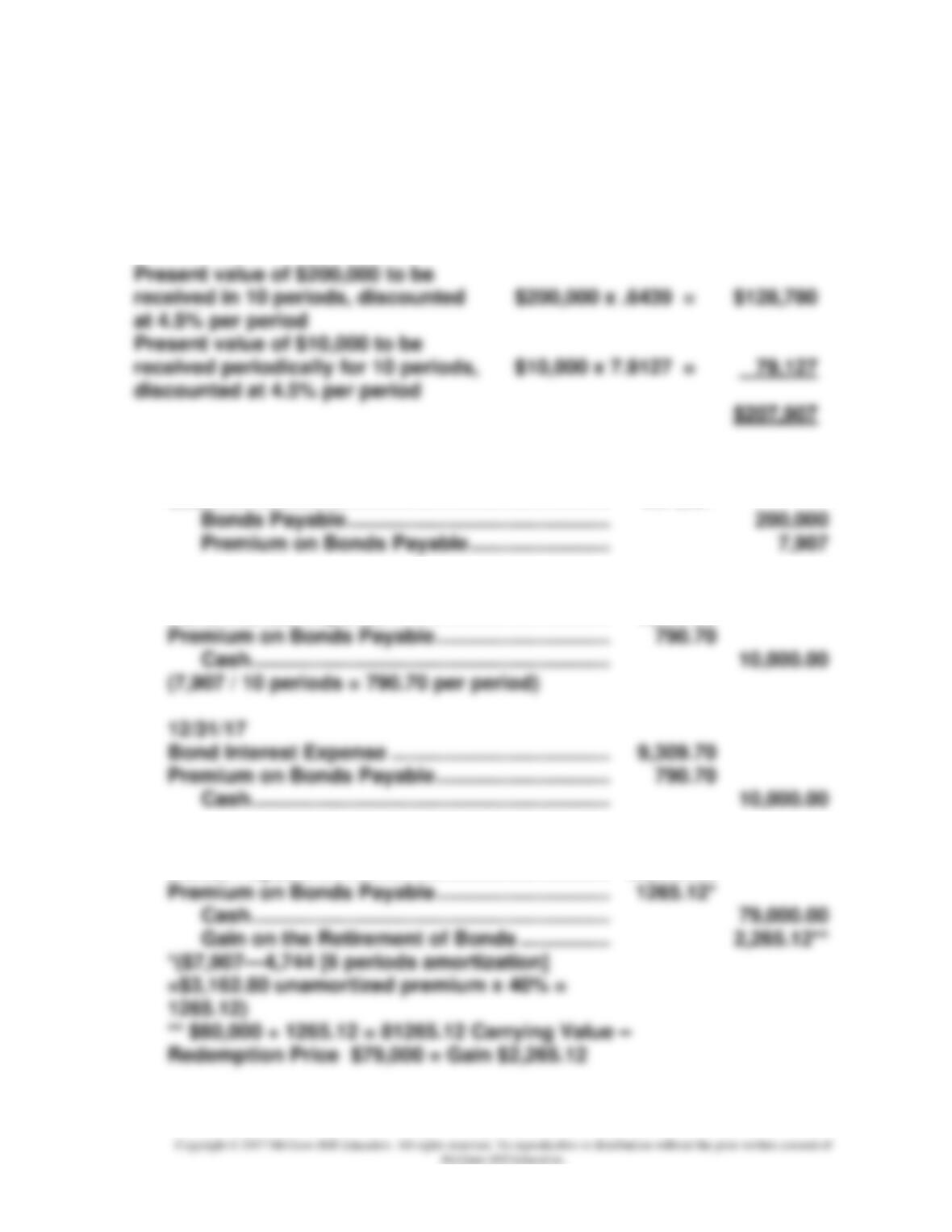
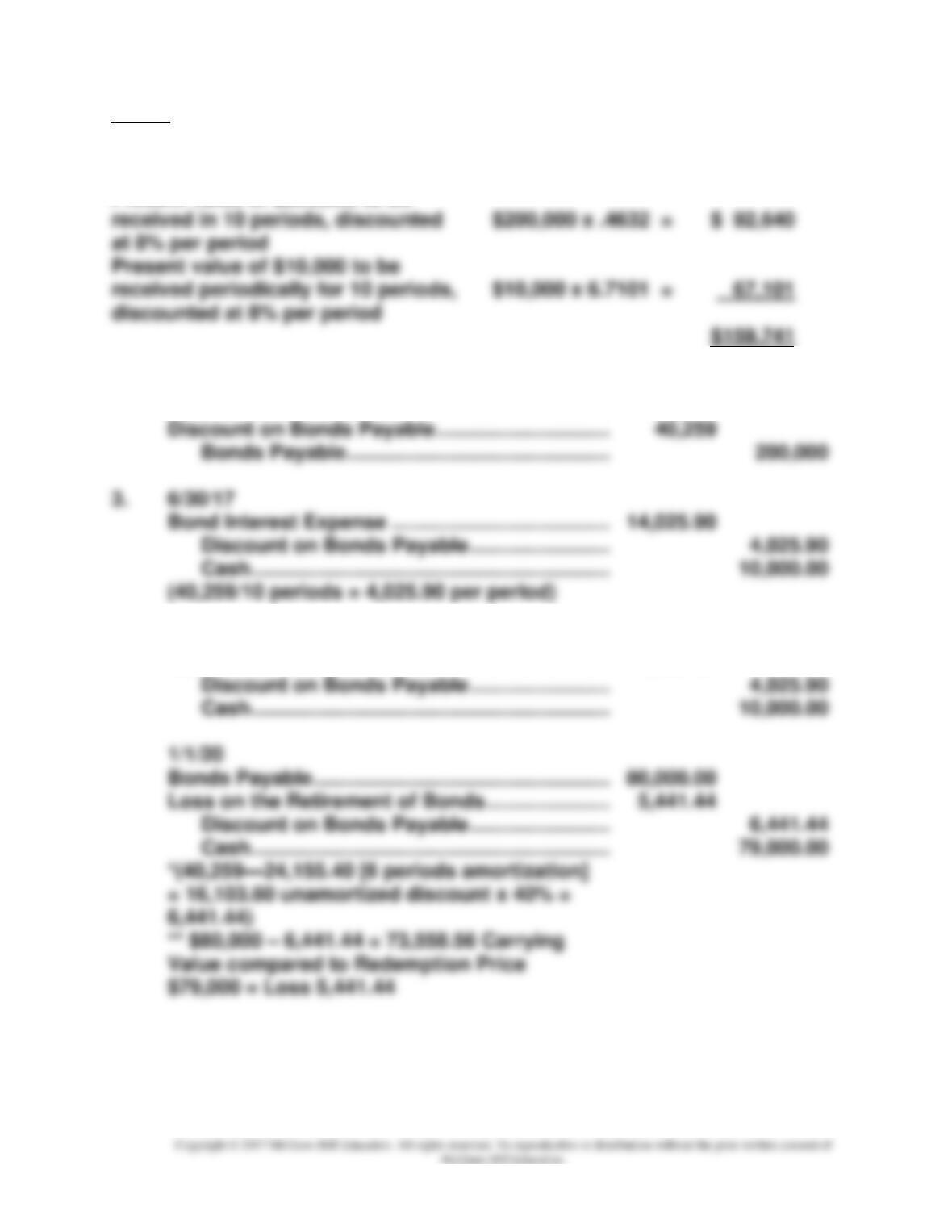
1. Calculation of cash received upon issuance of bonds (issue price):
at 4.5% per period
2.
1/1/17
Cash …………………………………………………………….
207,907
Bonds Payable ………………………………………..
200,000
Premium on Bonds Payable …………………….
3.
6/30/17
Bond Interest Expense …………………………………
9,309.30
Premium on Bonds Payable ………………………….
10,000.00
(7,907 / 10 periods = 790.70 per period)
12/31/17
Bond Interest Expense …………………………………
9,309.70
Premium on Bonds Payable ………………………….
10,000.00
4.
1/1/20
Bonds Payable ……………………………………………..
80,000.00
Premium on Bonds Payable ………………………….
79,000.00
2,265.12**
Redemption Price $79,000 = Gain $2,265.12
John J. Wild, Financial Accounting: Information for Decisions, 8th Edition
10–15
Part B
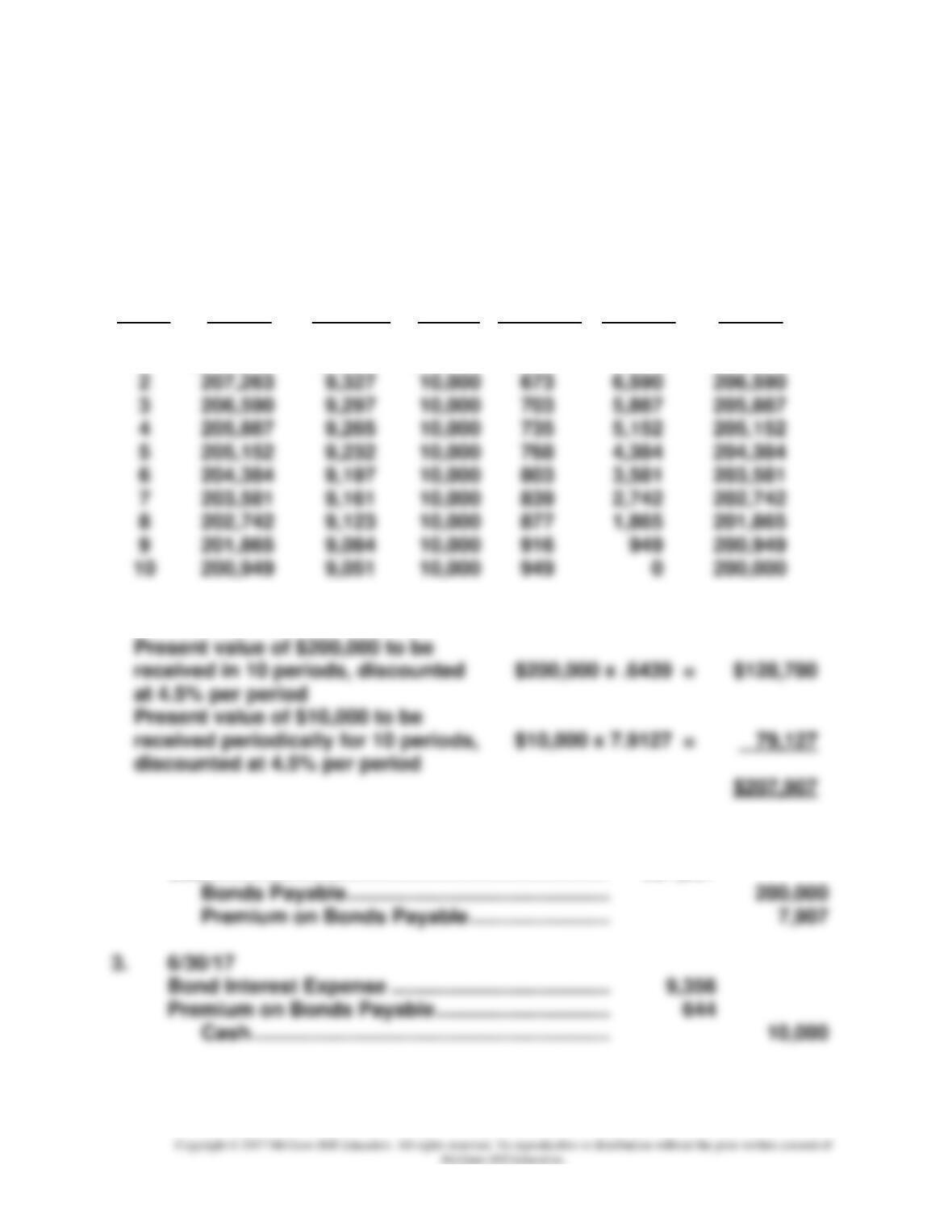
1. * Calculation of cash received upon issuance of bonds (issue price):
at 8% per period
Present value of $200,000 to be
2.
1/1/17
Cash …………………………………………………………….
159,741
Discount on Bonds Payable ………………………….
Bonds Payable ………………………………………..
200,000
3.
6/30/17
Bond Interest Expense …………………………………
14,025.90
(40,259/10 periods = 4,025.90 per period)
4.
12/31/17
Bond Interest Expense …………………………………
14,025.90
1/1/20
Bonds Payable ……………………………………………..
79,000.00
** $80,000 – 6,441.44 = 73,558.56 Carrying
$79,000 = Loss 5,441.44
John J. Wild, Financial Accounting: Information for Decisions, 8th Edition
10–16
Solution Two: Alternate Demonstration Problem
Using Effective Interest Method of Amortization
Chapter 10
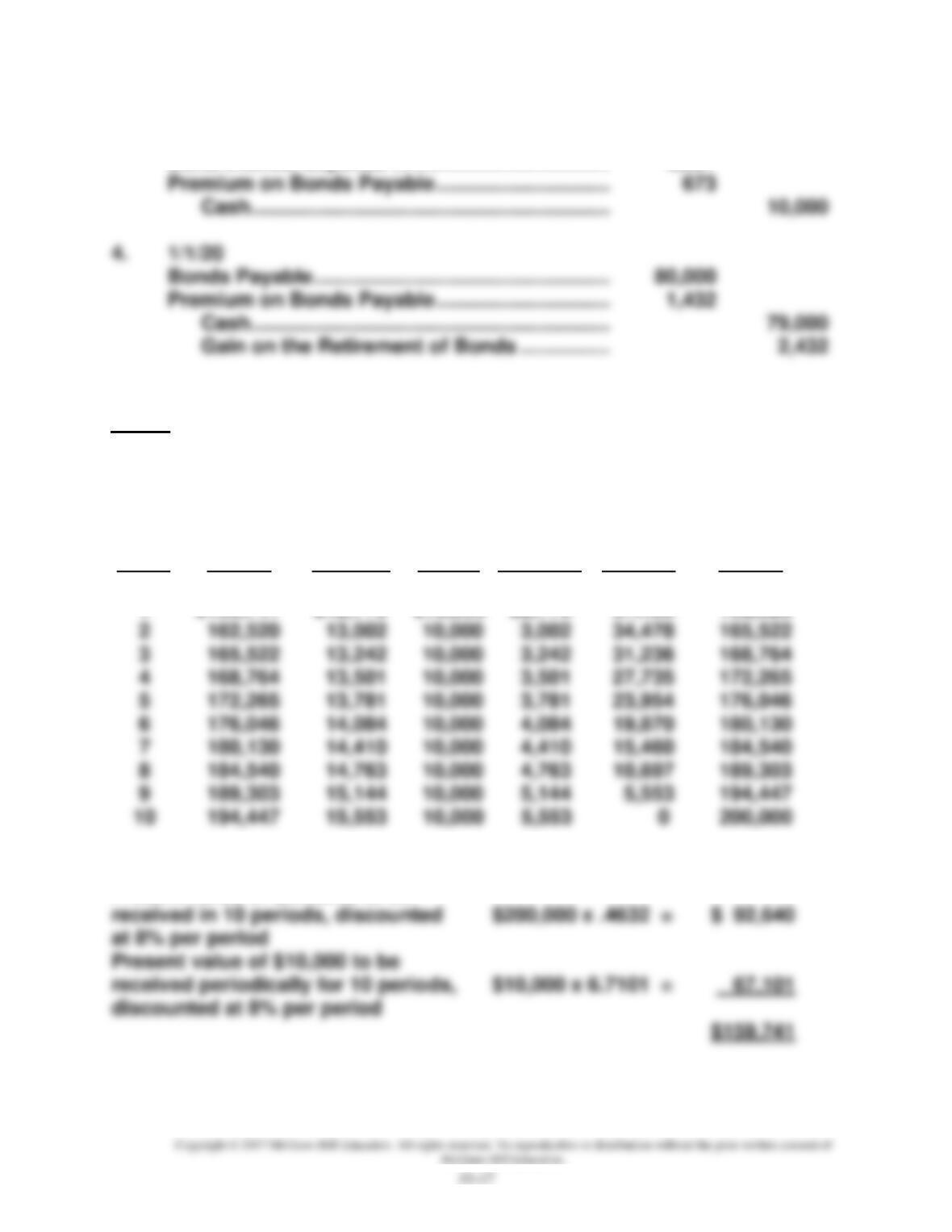
1.
Period
Beginning
of Period
Carrying
Amount
Interest
Expense
to be
Recorded
Interest
to be Paid
to Bond-
holders
Premium
to be
Amortized
Unamortized
Premium end
of Period
End-of–
Period
Carrying
Amount
0
$7,907
$207,907
*
1
$207,907
$9,356
$10,000
$644
7,263
207,263
3
206,590
9,297
703
5,887
205,887
4
205,887
9,265
735
5,152
205,152
5
205,152
9,232
768
4,384
204,384
6
204,384
9,197
803
3,581
203,581
7
203,581
9,161
839
2,742
202,742
8
202,742
9,123
877
1,865
201,865
9
201,865
9,084
916
949
200,949
200,949
9,051
949
0
200,000
* Calculation of cash received upon issuance of bonds:
at 4.5% per period
2.
1/1/17
Cash …………………………………………………………….
207,907
Bonds Payable ………………………………………..
200,000
Premium on Bonds Payable …………………….
3.
6/30/17
Premium on Bonds Payable ………………………….
John J. Wild, Financial Accounting: Information for Decisions, 8th Edition
12/31/17
Bond Interest Expense …………………………………
9,327
Premium on Bonds Payable ………………………….
4.
1/1/20
Bonds Payable ……………………………………………..
Premium on Bonds Payable ………………………….
1,432
2,432
Part B
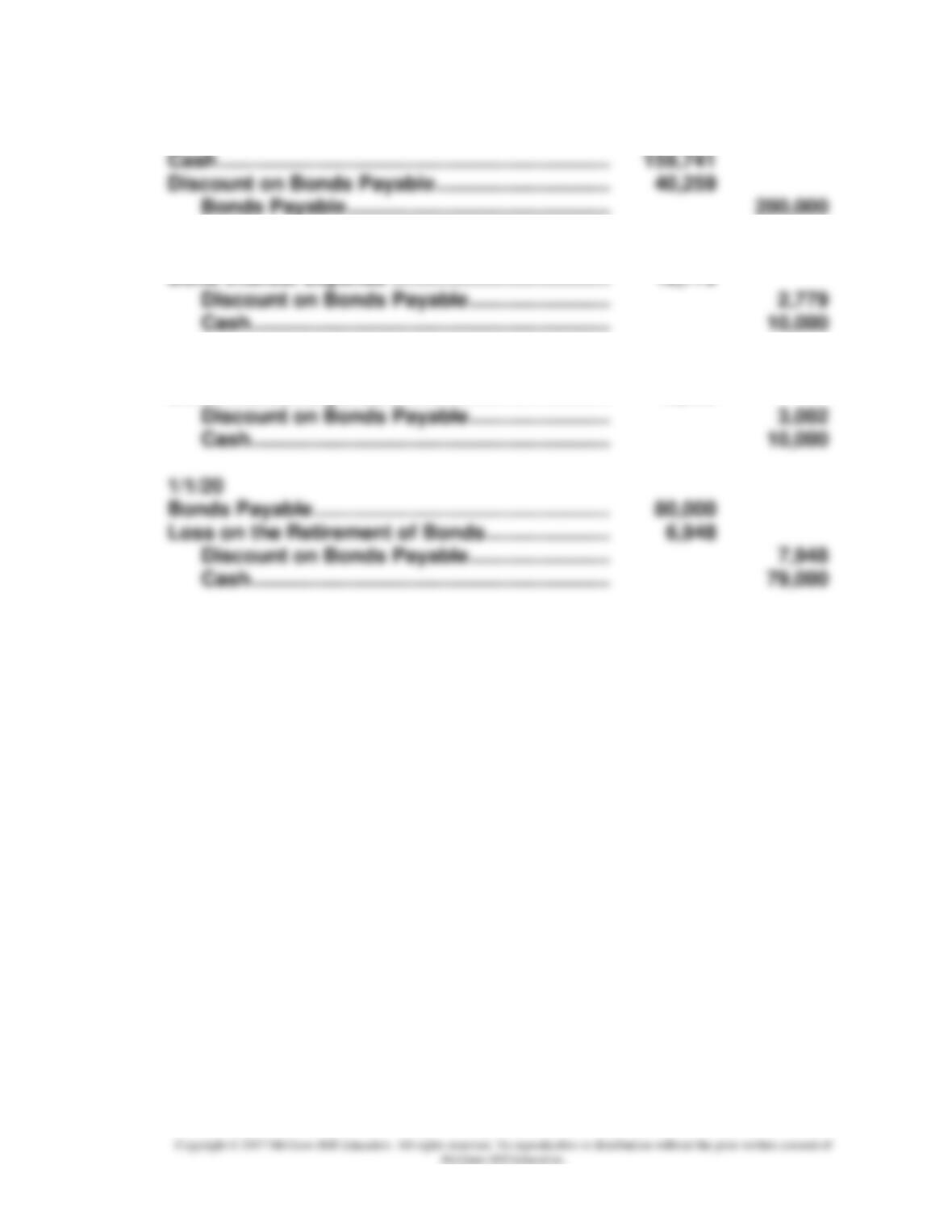
1.
Period
Beginning
of-Period
Carrying
Amount
Interest
Expense
to be
Recorded
Interest to
be Paid
to Bond-
holders
Discount
to be
Amortized
Unamortized
Discount end
of Period
End-of–
Period
Carrying
Amount
0
$40,259
$159,741
*
1
$159,741
$12,779
$10,000
$2,779
37,480
162,520
2
162,520
13,002
3,002
34,478
165,522
3
165,522
13,242
3,242
31,236
168,764
4
168,764
13,501
3,501
27,735
172,265
5
172,265
13,781
3,781
23,954
176,046
6
176,046
14,084
4,084
19,870
180,130
7
180,130
14,410
4,410
15,460
184,540
8
184,540
14,763
4,763
10,697
189,303
9
189,303
15,144
5,144
5,553
194,447
194,447
15,553
5,553
0
200,000
* Calculation of cash received upon issuance of bonds:
at 8% per period
Present value of $200,000 to be
John J. Wild, Financial Accounting: Information for Decisions, 8th Edition
10–18
2.
1/1/17
Discount on Bonds Payable ………………………….
40,259
Bonds Payable ………………………………………..
3.
6/30/17
Bond Interest Expense …………………………………
12,779
10,000
4.
12/31/17
Bond Interest Expense …………………………………
13,002
10,000
1/1/20
Bonds Payable ……………………………………………..
80,000
79,000