CHAPTER 10
Reporting and Analyzing Liabilities
Learning Objectives
1. Explain a current liability and identify the major types of current liabilities.
2. Describe the accounting for notes payable.
3. Explain the accounting for other current liabilities.
4. Identify the types of bonds.
5. Prepare the entries for the issuance of bonds and interest expense.
6. Describe the entries when bonds are redeemed.
7. Identify the requirements for the financial statement presentation and analysis of liabilities.
*8. Apply the straight-line method of amortizing bond discount and bond premium.
*9. Apply the effective-interest method of amortizing bond discount and bond premium.
*10. Describe the accounting for long-term notes payable.
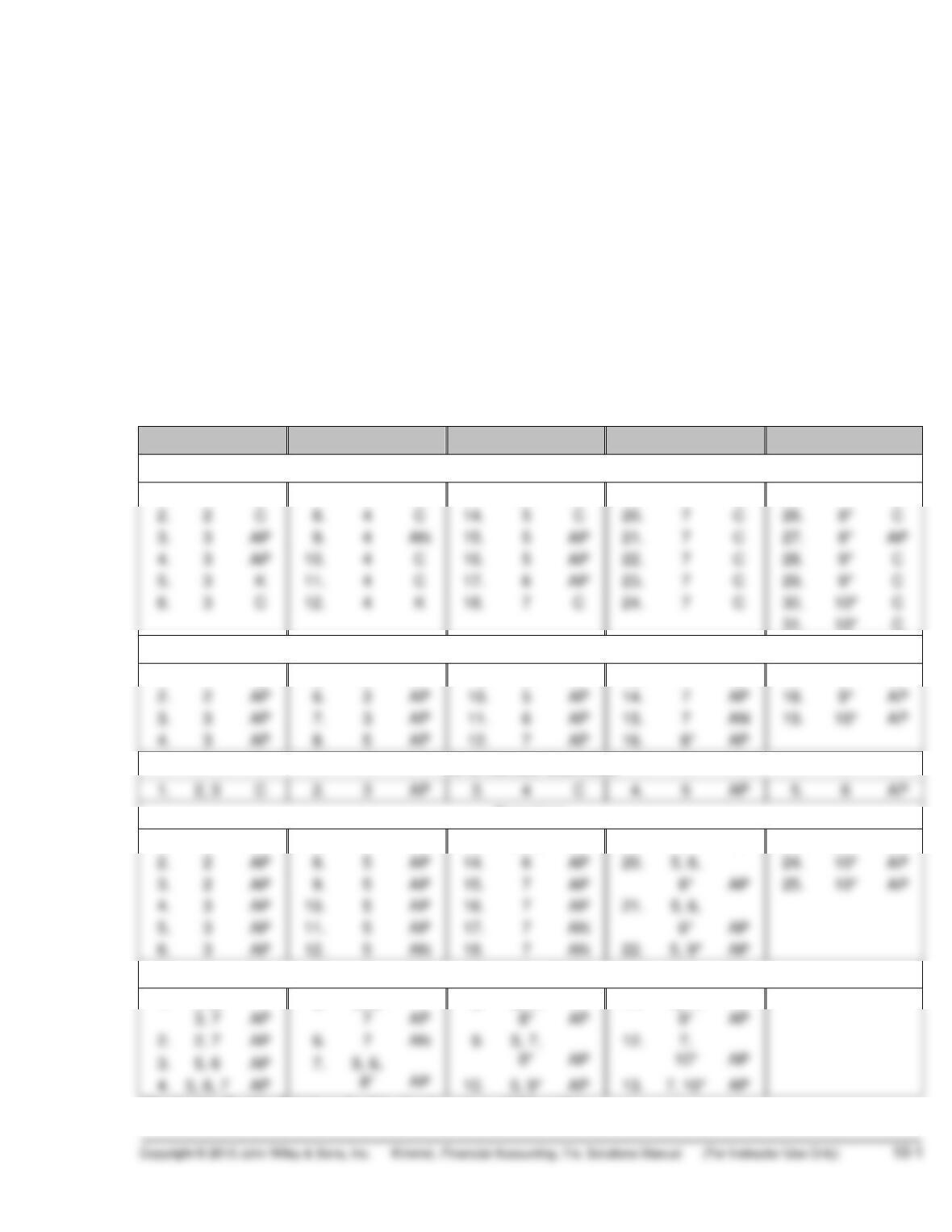
Summary of Questions by Learning Objectives and Bloom’s Taxonomy
Item LO BT Item LO BT Item LO BT Item LO BT Item LO BT
Questions
1. 1 C 7. 1 K 13. 4, 5 C 19. 7 K 25. 7 C
Brief Exercises
1. 1 C 5. 3 AP 9. 5 AP 13. 7 AP 17. 8* AP
Do It! Review Exercises
Exercises
1. 2 AP 7. 3 AP 13. 5, 6, AP 19. 7 C 23. 5, 9* AP
Problems: Set A
1. 1, 2,
5. 5, 6,
8. 5, 7,
11. 5, 7,
*Continuing Cookie Solutions for this chapter are available online.
Summary of Questions by Learning Objectives and Bloom’s Taxonomy
(Continued)
Item LO BT Item LO BT Item LO BT Item LO BT Item LO BT
Problems: Set B
1. 1, 2,
5. 5, 6,
8. 5, 7,
11. 5, 7,
ASSIGNMENT CHARACTERISTICS TABLE
Problem
Number
Description
Difficulty
Level
Time
Allotted (min.)
*1A Prepare current liability entries, adjusting entries, and
current liabilities section.
Moderate 30–40
*2A Journalize and post note transactions; show balance sheet
presentation.
Moderate 30–40
*5A Prepare journal entries to record issuance of bonds,
show balance sheet presentation, and record bond
redemption.
Simple 30–40
6A Calculate and comment on ratios. Moderate 30–40
*7A Prepare journal entries to record interest payments,
straight-line discount amortization, and redemption
of bonds.
Moderate 30–40
**11A Prepare journal entries to record issuance of bonds,
payment of interest, effective-interest amortization, and
balance sheet presentation.
Moderate 30–40
**12A Prepare installment payments schedule, journal entries,
and balance sheet presentation for a mortgage note
payable.
Moderate 30–40
ASSIGNMENT CHARACTERISTICS TABLE (Continued)
Problem
Number
Description
Difficulty
Level
Time
Allotted (min.)
*1B Prepare current liability entries, adjusting entries, and
current liabilities section.
Moderate 30–40
5B Prepare journal entries to record issuance of bonds,
show balance sheet presentation, and record bond
redemption.
Simple 30–40
6B Calculate and comment on ratios. Moderate 30–40
**7B Prepare journal entries to record interest payments,
straight-line premium amortization, and redemption
of bonds.
Moderate 30–40
*12B Prepare installment payments schedule, journal entries,
and balance sheet presentation for a mortgage note
payable.
Moderate 30–40
*13B Prepare journal entries to record payments for long-term
note payable, and balance sheet presentation.
Moderate 30–40
ANSWERS TO QUESTIONS
1. While this is generally true, more precisely a current liability is a debt that can reasonably be
expected to be paid: (a) from existing current assets or through the creation of other current
liabilities and (2) within one year or the operating cycle, whichever is longer.
2. In the balance sheet, Notes Payable of $20,000 and Interest Payable of $450 ($20,000 X 9% X
3/12) should be reported as current liabilities. In the income statement, Interest Expense of $450
should be reported under other expenses and losses.
3. (a) Disagree. The company only serves as a collection agent for the taxing authority. It does not
report sales taxes as an expense; it merely forwards the amount paid by the customer to the
government.
5. Three taxes commonly withheld by employers from employees’ gross pay are (1) federal income
taxes, (2) state income taxes, and (3) social security (FICA) taxes.
6. (a) Three taxes commonly paid by employers on employees’ salaries and wages are (1) social
security (FICA) taxes, (2) state unemployment taxes, and (3) federal unemployment taxes.
7. The liabilities that Tootsie Roll identified as current are: Accounts payable, Dividends payable,
and Accrued liabilities.
8. (a) Long-term liabilities are obligations that are expected to be paid after one year. Examples
include bonds and long-term notes.
Questions Chapter 10 (Continued)
10. (a) Face value is the amount of principal due at the maturity date.
11. (a) A convertible bond permits bondholders to convert it into common stock at the option of the
bondholders.
12. The two major obligations incurred by a company when bonds are issued are the interest
payments due on a periodic basis and the principal which must be paid at maturity.
15. $48,000. $800,000 X 6% X 1 year = $48,000.
18. Two issues need to be considered. First, by financing a major purchase such as this with short-
term financing the company will reduce its liquidity. In the case of Mullins Inc., its current ratio will
decrease from 2.2:1 to a less acceptable level of 1.5:1. However, of equal concern is that by
Questions Chapter 10 (Continued)
19. (a) The nature and the amount of each long-term liability should be presented in the balance
sheet or in schedules in the accompanying notes to the financial statements. The notes
20. No, Samuel is not correct. Liquidity involves measuring the short-term ability of a company to pay
21. When companies are trying to overcome customer skepticism about the quality of their product
they often consider providing a more generous warranty. While this may be effective in increasing
22. One alternative to purchasing the assets is to lease them through an operating lease agreement.
In an operating lease, the lease payments are recorded as an expense. This allows the lessee to
keep the leased assets and, more importantly, lease liabilities off the balance sheet (referred to as
23. Tim is not correct. In order to reduce costs, many companies today keep low amounts of inventory
on hand. Consequently, liquidity ratios are generally lower than they used to be. Companies that
24. If a company has significant operating leases, most analysts would argue that its recorded
assets and liabilities understate their true values. These analysts will increase the company’s
25. Two criteria must be met: (1) the contingency must be probable and (2) the company must be
Questions Chapter 10 (Continued)
*26. The straight-line method of amortization results in the same amortized amount being assigned
to Interest Expense each interest period. This amount is determined by dividing the total bond
discount or premium by the number of interest periods the bonds will be outstanding.
*27. The total amount of interest expense is $10,800. Interest expense is the interest to be paid in cash
less the premium amortization for the year. Cash to be paid equals 6% X $200,000 or $12,000.
*28. Glenda is probably indicating that since the borrower has the use of the bond proceeds over the
term of the bonds, the borrowing rate in each period should be the same. The effective-interest
*29. Decrease. Under the effective-interest method the interest expense per period is determined
by multiplying the carrying value of the bonds by the effective-interest rate. When bonds are
*30. The installment note requires equal payments. Each payment will pay any interest that has been
incurred during the time that has past since the previous payment. The remaining amount of the
*31. No, Roy is not right. Each payment by Roy consists of: (1) interest on the unpaid balance of the
SOLUTIONS TO BRIEF EXERCISES
BRIEF EXERCISE 10-1
(a) A note payable due in two years is a long-term liability, not a current
liability.
BRIEF EXERCISE 10-2
(a) July 1 Cash ………………………………………………….. 90,000
Notes Payable …………………………….. 90,000
BRIEF EXERCISE 10-3
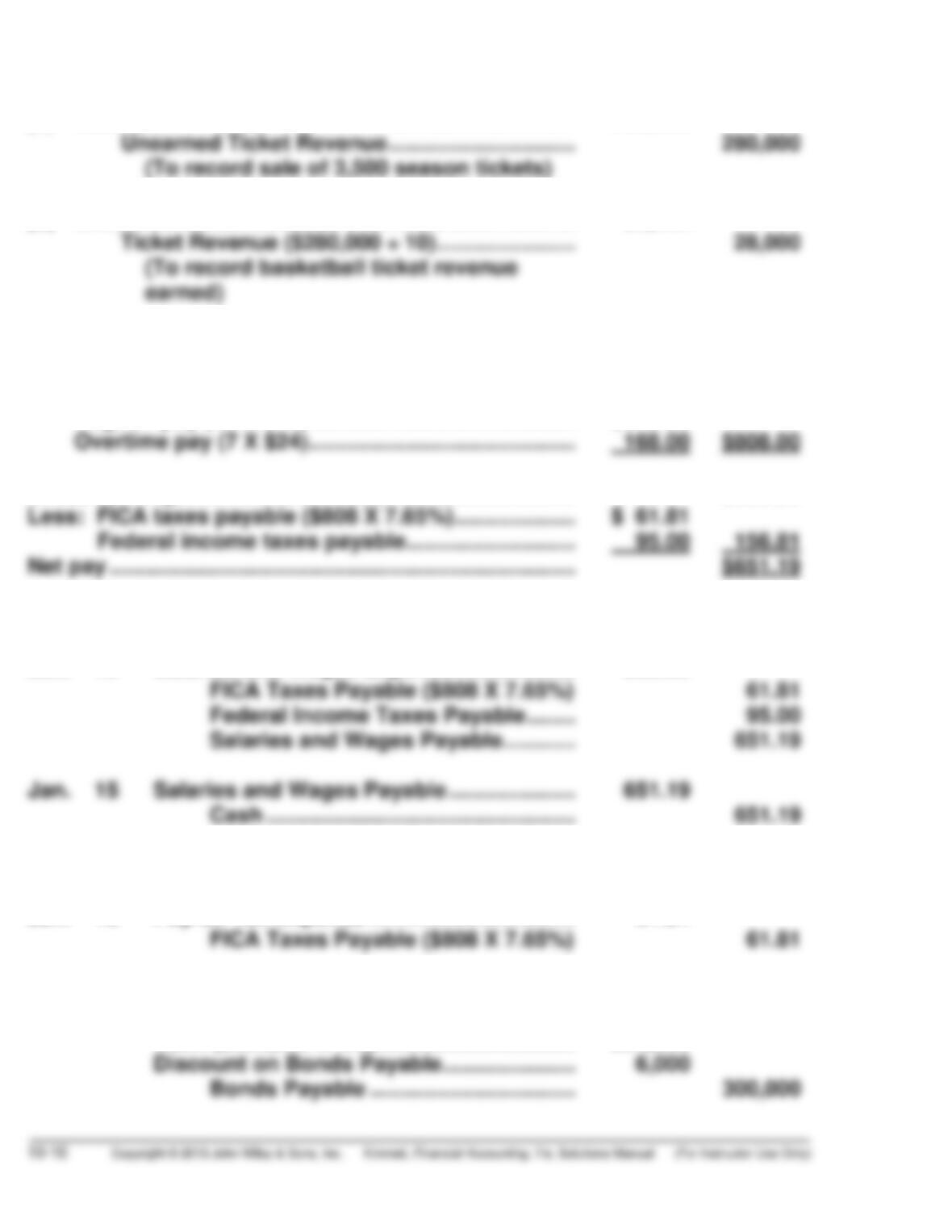
Sales tax payable
(1) Sales = ($10,388 ÷ 1.06) = $9,800
Mar. 16 Cash ………………………………………………………… 10,388
BRIEF EXERCISE 10-4
(a) Cash (3,500 X $80) …………………………………………… 280,000
(b) Unearned Ticket Revenue ……………………………….. 28,000
BRIEF EXERCISE 10-5
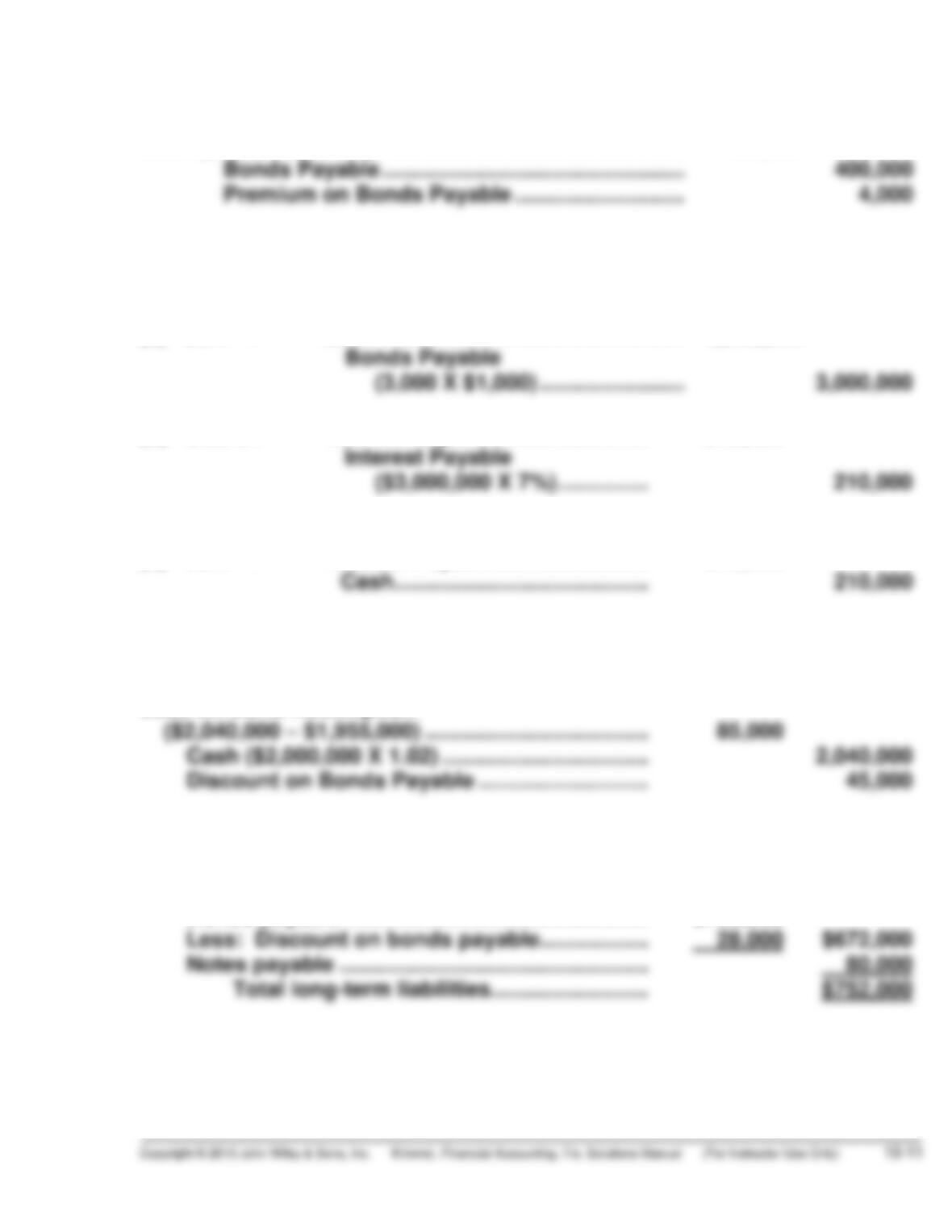
Gross earnings:
Regular pay (40 X $16) …………………………………….. $640.00
Gross earnings ………………………………………………………. $808.00
BRIEF EXERCISE 10-6
Jan. 15 Salaries and Wages Expense ……………….. 808.00
BRIEF EXERCISE 10-7
Jan. 15 Payroll Tax Expense ……………………………. 61.81
BRIEF EXERCISE 10-8
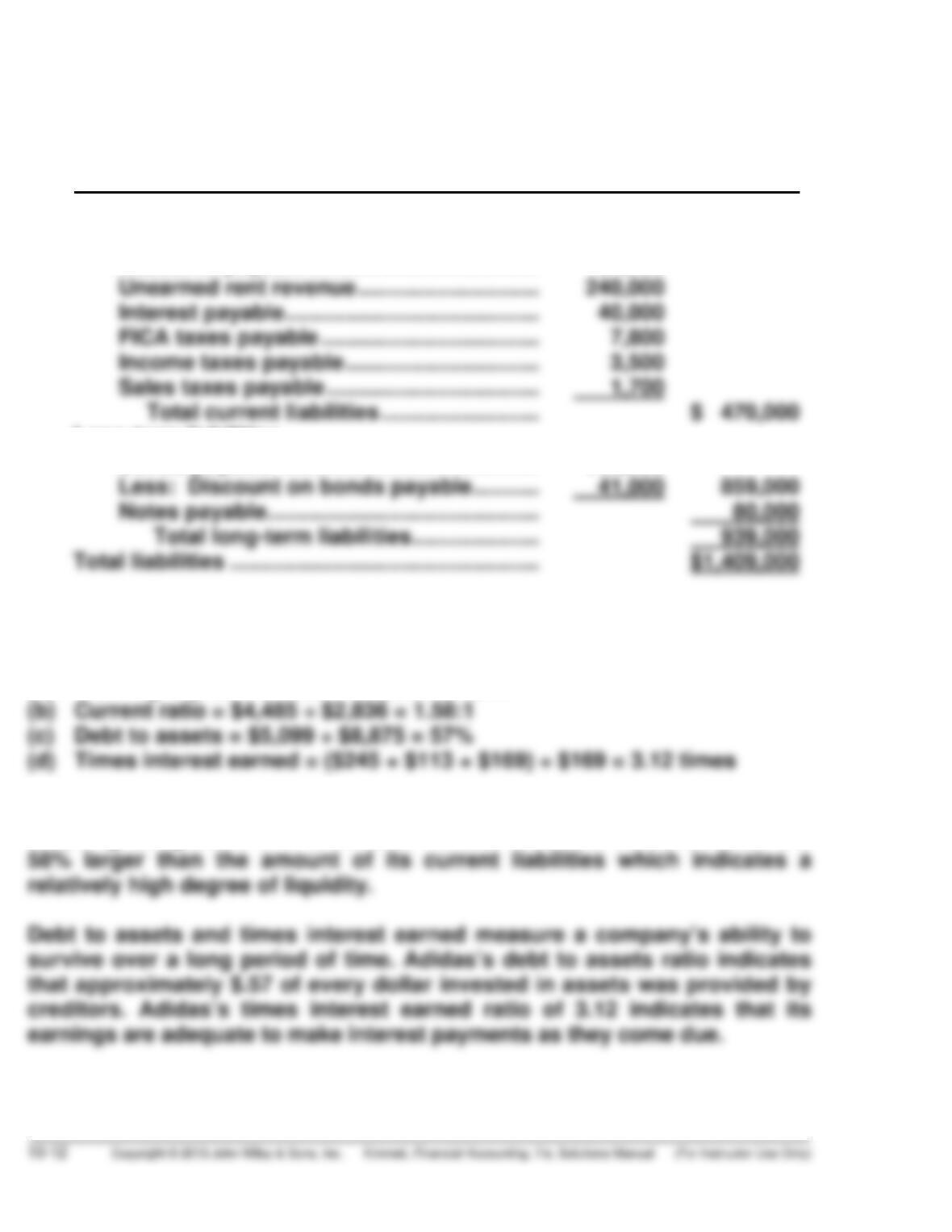
Cash ($300,000 X .98) …………………………… 294,000
BRIEF EXERCISE 10-9
Cash ($400,000 X 1.01) …………………………………………… 404,000
BRIEF EXERCISE 10-10
2014
(a) Jan. 1 Cash …………………………………………… 3,000,000
(b) Dec. 31 Interest Expense …………………… 210,000
2015
(c) Jan. 1 Interest Payable ……………………. 210,000
BRIEF EXERCISE 10-11
Bonds Payable …………………………………………………. 2,000,000
Loss on Bond Redemption
BRIEF EXERCISE 10-12
Long-term liabilities
Bonds payable ………………………………………….. $700,000
BRIEF EXERCISE 10-13
DESMOND INC.
Balance Sheet (Partial)
December 31, 2014
Current liabilities
Note payable ……………………………………….. $ 20,000
Accounts payable ……………………………….. 157,000
Long-term liabilities
Bonds payable ……………………………………. 900,000
BRIEF EXERCISE 10-14
(a) Working capital = $4,485 – $2,836 = $1,649
Working capital and the current ratio measure a company’s ability to pay
maturing obligations and meet cash needs. Adidas’s current assets are
BRIEF EXERCISE 10-15
(a) Debt to assets:
Without operating leases $14,180 = 59%
$24,004
(b) CN does not have significant operating leases, therefore its assets and
liabilities reflect its true financial position. By increasing its assets and
*BRIEF EXERCISE 10-16
(a) Jan. 1 Cash (99% X $2,000,000) …………….. 1,980,000
Discount on Bonds Payable ……….. 20,000
*BRIEF EXERCISE 10-17
(a) Jan. 1 Cash (102% X $4,000,000) ………….. 4,080,000
Bonds Payable ……………………. 4,000,000
*BRIEF EXERCISE 10-18
(a) Interest Expense ……………………………………….. 48,070
(b) Interest expense is greater than interest paid because the bonds sold
at a discount. The bonds sold at a discount because investors demanded
(c) Interest expense increases each period because the bond carrying
BRIEF EXERCISE 10-19
Semiannual
Interest
Period
(A)
Cash
Payment
(B)
Interest
Expense
(D) X 5%
(C)
Reduction
of Principal
(A) – (B)
(D)
Principal
Balance
(D) – (C)
Issue Date $600,000
1 $48,145 $30,000 $18,145 581,855
SOLUTIONS TO DO IT! REVIEW EXERCISES
DO IT! 10-1
1. $60,000 X 10% X 5/12 = $2,500
DO IT! 10-2
(a) To determine wages payable, reduce wages expense by the withholdings
for FICA, federal income tax, and state income tax.
Feb. 28 Salaries and Wages Expense …………………… 74,000
(b) Payroll taxes would be for the company’s share of FICA, as well as for
federal and state unemployment tax.
DO IT! 10-3
1. False. Convertible bonds can be converted into common stock at the
DO IT! 10-4
(a) Cash …………………………………………………………….. 315,000
(b) Long-term liabilities
DO IT! 10-5
Bonds Payable ……………………………………………… 400,000
SOLUTIONS TO EXERCISES
EXERCISE 10-1
2014
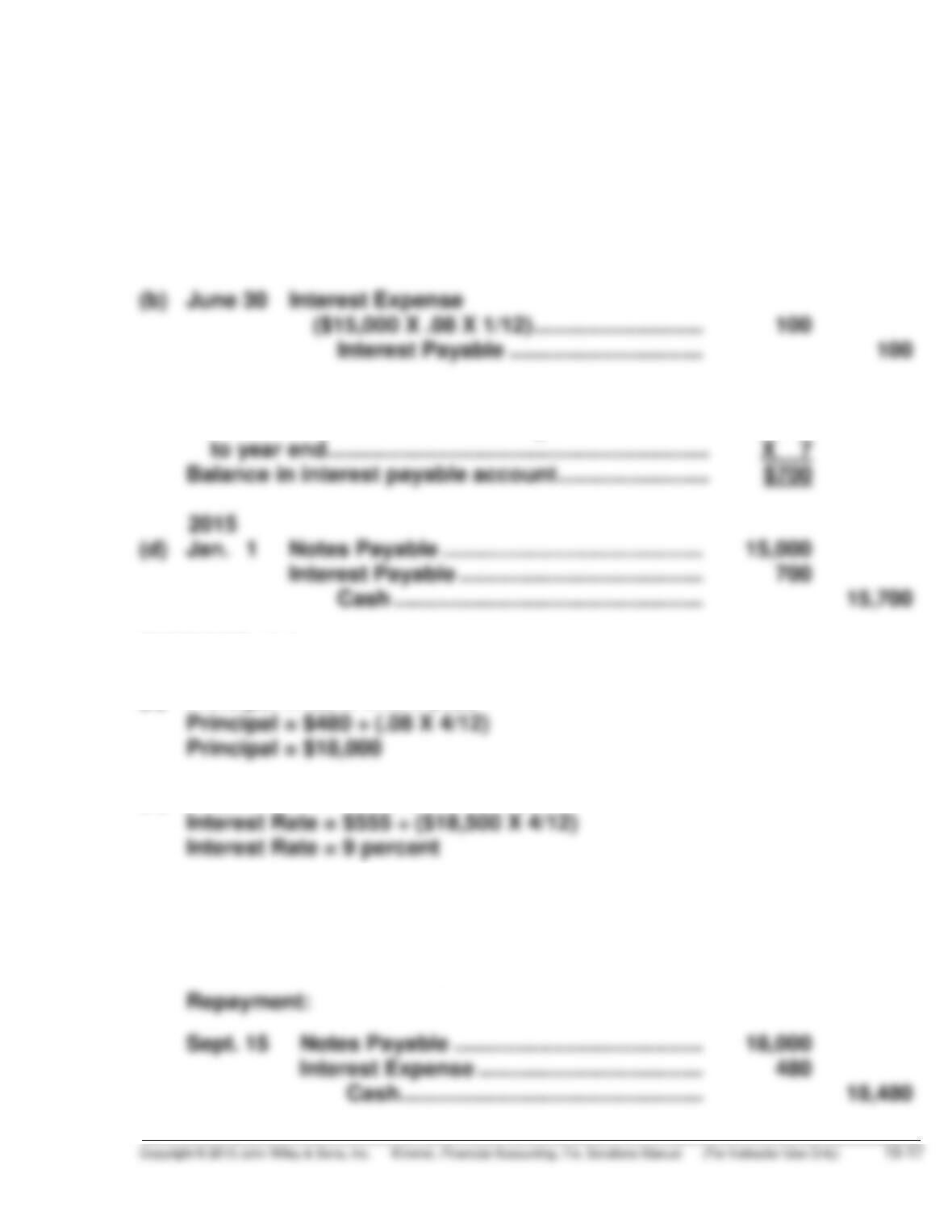
(a) June 1 Cash ………………………………………………….. 15,000
Notes Payable …………………………….. 15,000
(c) Interest payable accrued each month …………………. $100
Number of months from borrowing
EXERCISE 10-2
(a) Principal X .08 X 4/12 = $480
(b) $18,500 X Interest Rate X 4/12 = $555
(c) Initial Borrowing:
May 15 Cash ………………………………………………… 18,000
Notes Payable ……………………………. 18,000
EXERCISE 10-3
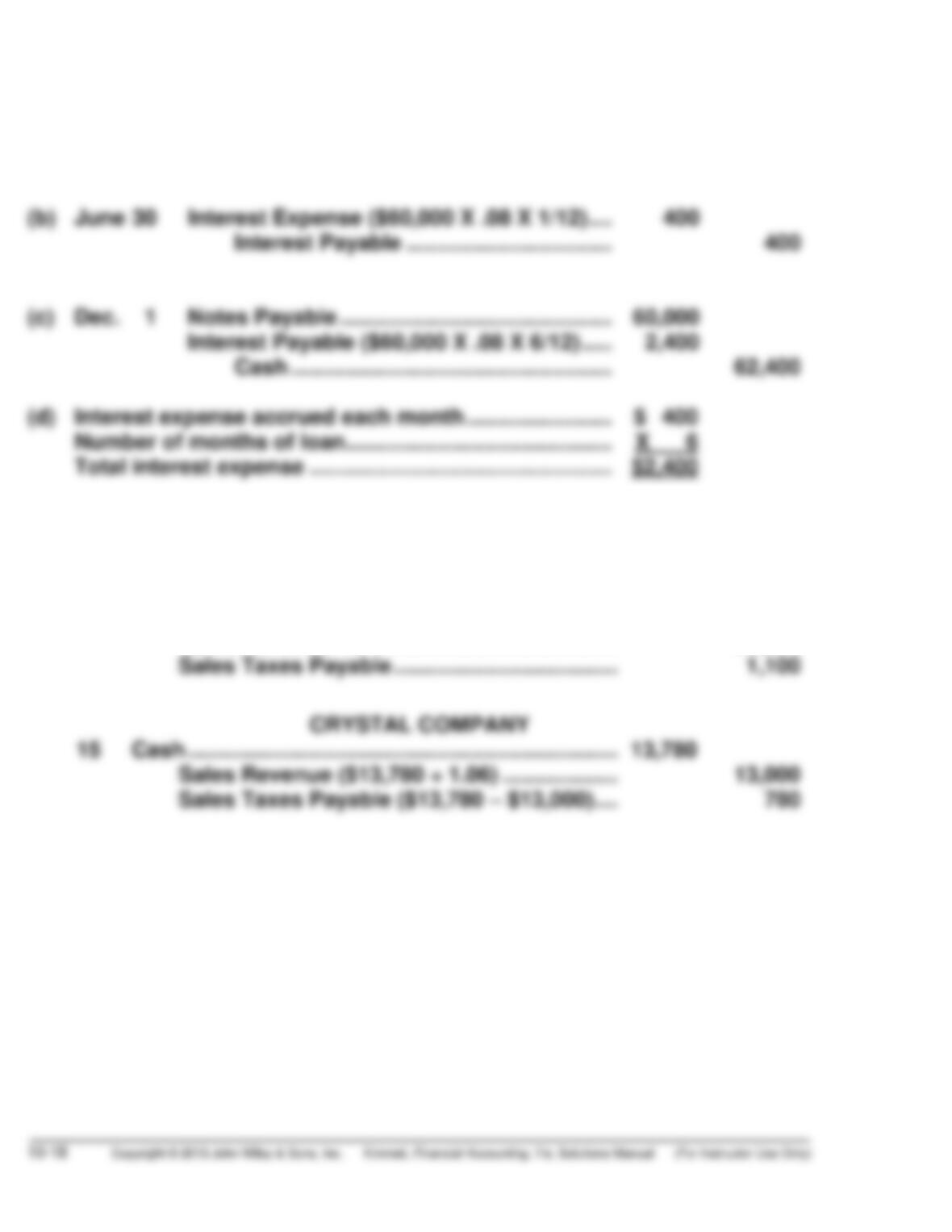
(a) June 1 Cash ……………………………………………………. 60,000
Notes Payable ………………………………. 60,000
EXERCISE 10-4
FURCAL COMPANY
Apr. 10 Cash …………………………………………………………….. 23,100
Sales Revenue ……………………………………….. 22,000
EXERCISE 10-5
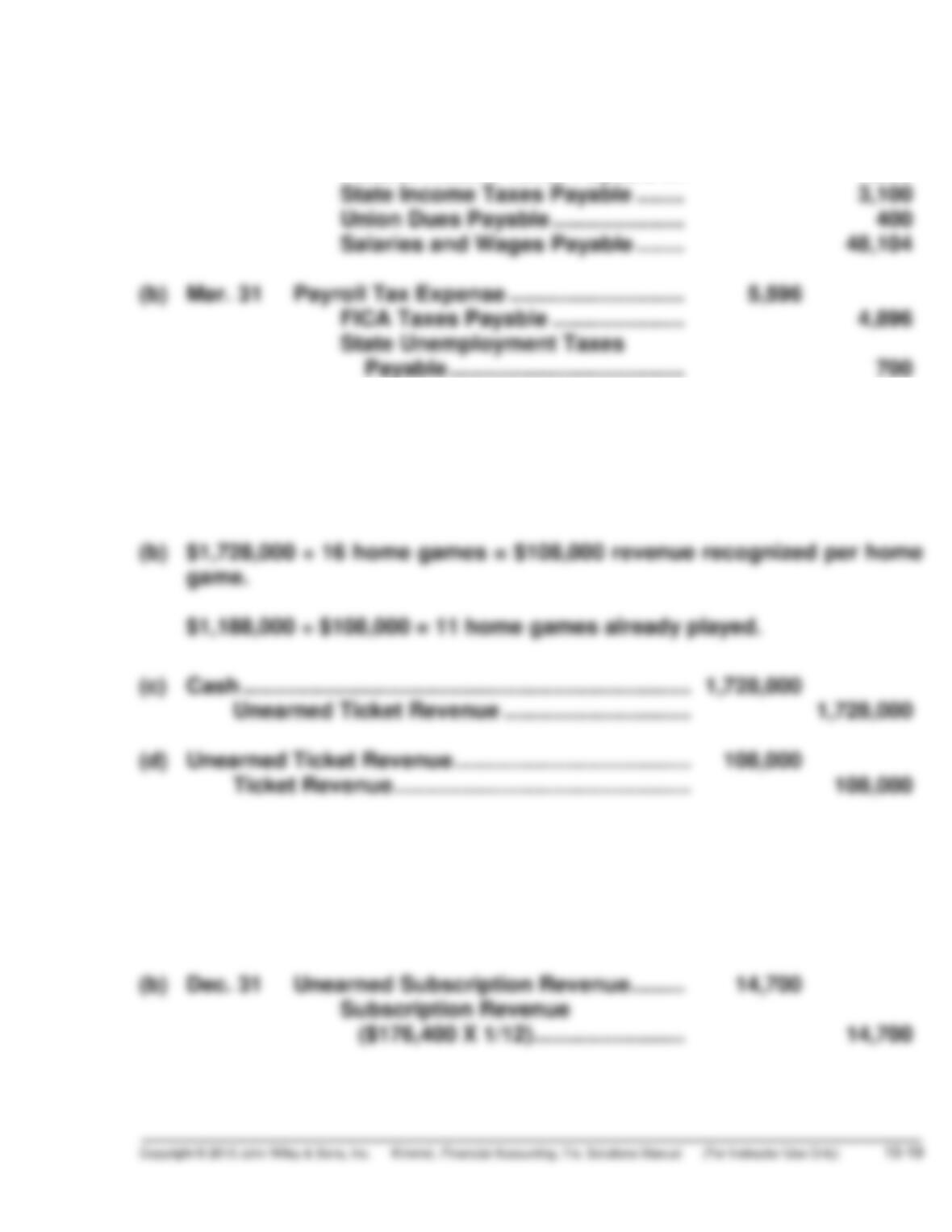
(a) Mar. 31 Salaries and Wages Expense …………… 64,000
FICA Taxes Payable …………………. 4,896
Federal Income Taxes Payable …. 7,500
EXERCISE 10-6
(a) $1,728,000 ÷ $320 = 5,400 season tickets sold.
EXERCISE 10-7
(a) Nov. Cash (6,300 X $28) …………………………… 176,400
Unearned Subscription Revenue . 176,400
EXERCISE 10-7 (Continued)
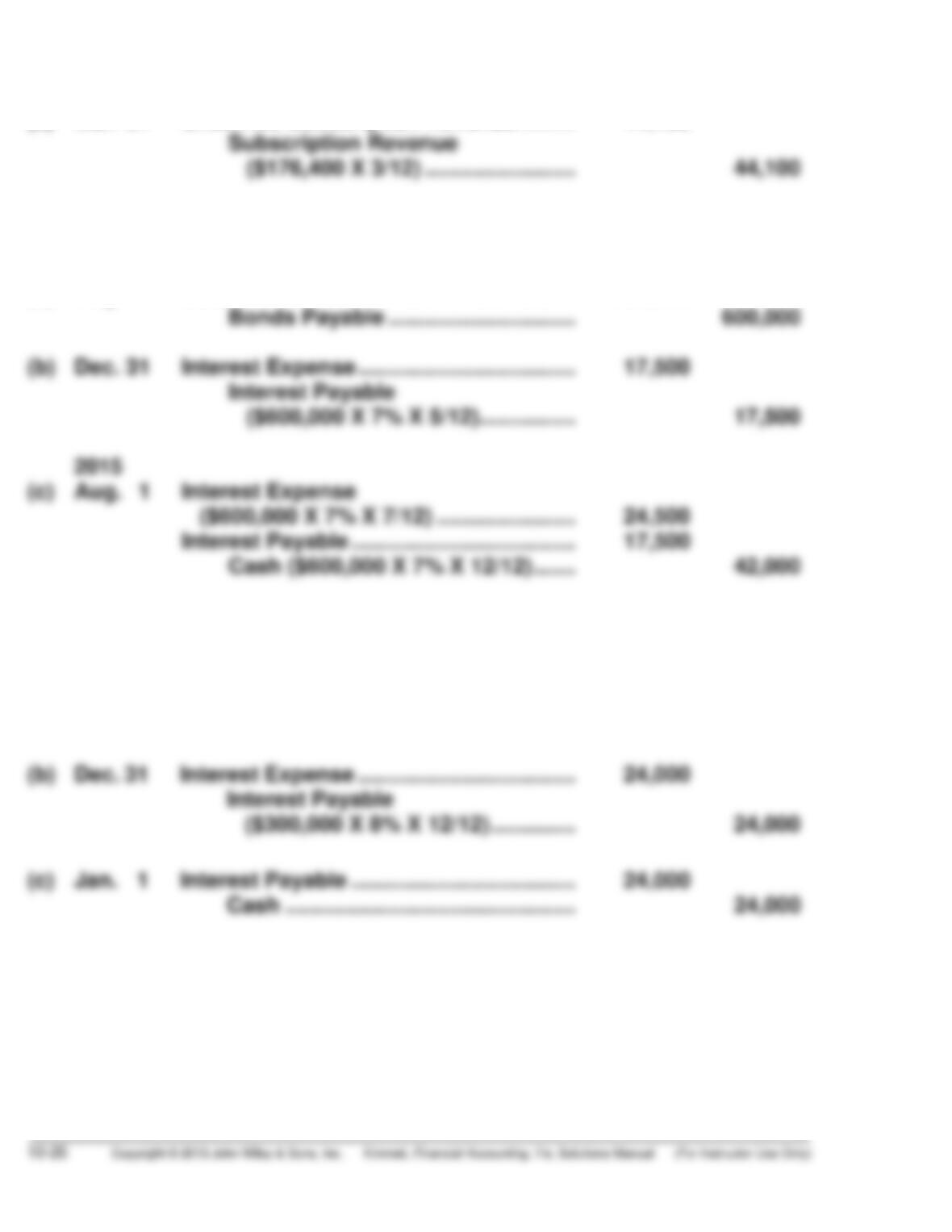
(c) Mar. 31 Unearned Subscription Revenue ……… 44,100
EXERCISE 10-8
2014
(a) Aug. 1 Cash ……………………………………………….. 600,000
EXERCISE 10-9
(a) Jan. 1 Cash ……………………………………………….. 300,000
Bonds Payable …………………………. 300,000