PROBLEMS: SET B
Problem 10-1B (LO 10-1 to 10-8)
Terms
__e___ 1. PE ratio.
__i___ 2. Stockholders’ equity section of the balance sheet.
__c___ 5. 100% stock dividend.
__j___ 7. Treasury stock.
__g___ 8. Value stocks.
__d___ 10. Retained earnings,
Definitions
a. A debit balance in retained earnings.
b. Priced high in relation to current earnings as investors expect future earnings
Problem 10-2B (LO 10-2, 10-3, 10-4, 10-5)
Requirement 1
March 1, 2018
Debit
Credit
Cash (3,000 x $10)
30,000
April 1, 2018
Cash (175 shares x $40)
7,000
June 1, 2018
Dividends (6,300 shares x $0.25)
1,575
(Declare cash dividends)
June 30, 2018
Dividends Payable (6,300 shares x $0.25)
1,575
August 1, 2018
Treasury Stock (175 shares x $7)
1,225
October 1, 2018
Cash (125 shares x $9)
1,125
(Reissue treasury stock above cost)
Requirement 2
Transaction
Total
Assets
Total
Liabilities
Total
Stockholders’
Equity
Issue common stock
+
NE
+
Declare cash dividends
Pay cash dividends
NE
Reissue treasury stock
+
NE
+
Problem 10-3B (LO 10-6)
Before
After 100%
Stock Dividend
After 2-for-1
Stock Split
Common stock, $0.01 par value
$ 11
$ 22
$ 11
Additional paid-in capital
34,990
34,990
34,990
Retained earnings
Shares outstanding
Share price
Problem 10-4B (LO 10-7)
Requirement 1
Requirement 2
Requirement 3
Requirement 4
Retained earnings, beginning
$45,000,000
+ Net income
= Retained earnings, ending
Requirement 5
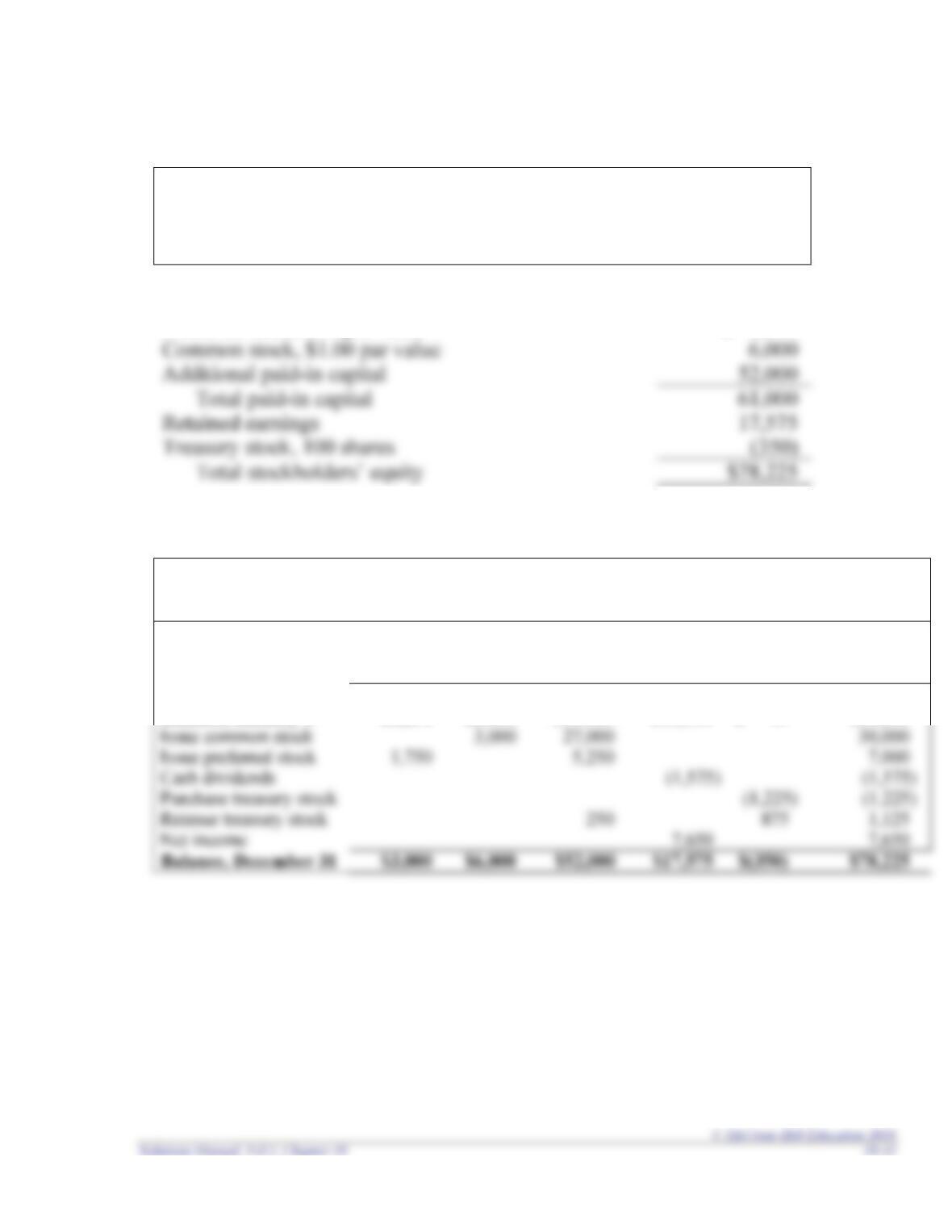
Problem 10-5B (LO 10-7)
Requirement 1
Nautical
Balance Sheet
(Stockholders’ Equity Section)
December 31, 2018
Stockholders’ equity:
Preferred stock, $10 par value
$ 3,000
Common stock, $1.00 par value
Additional paid-in capital
Retained earnings
Treasury stock, 100 shares
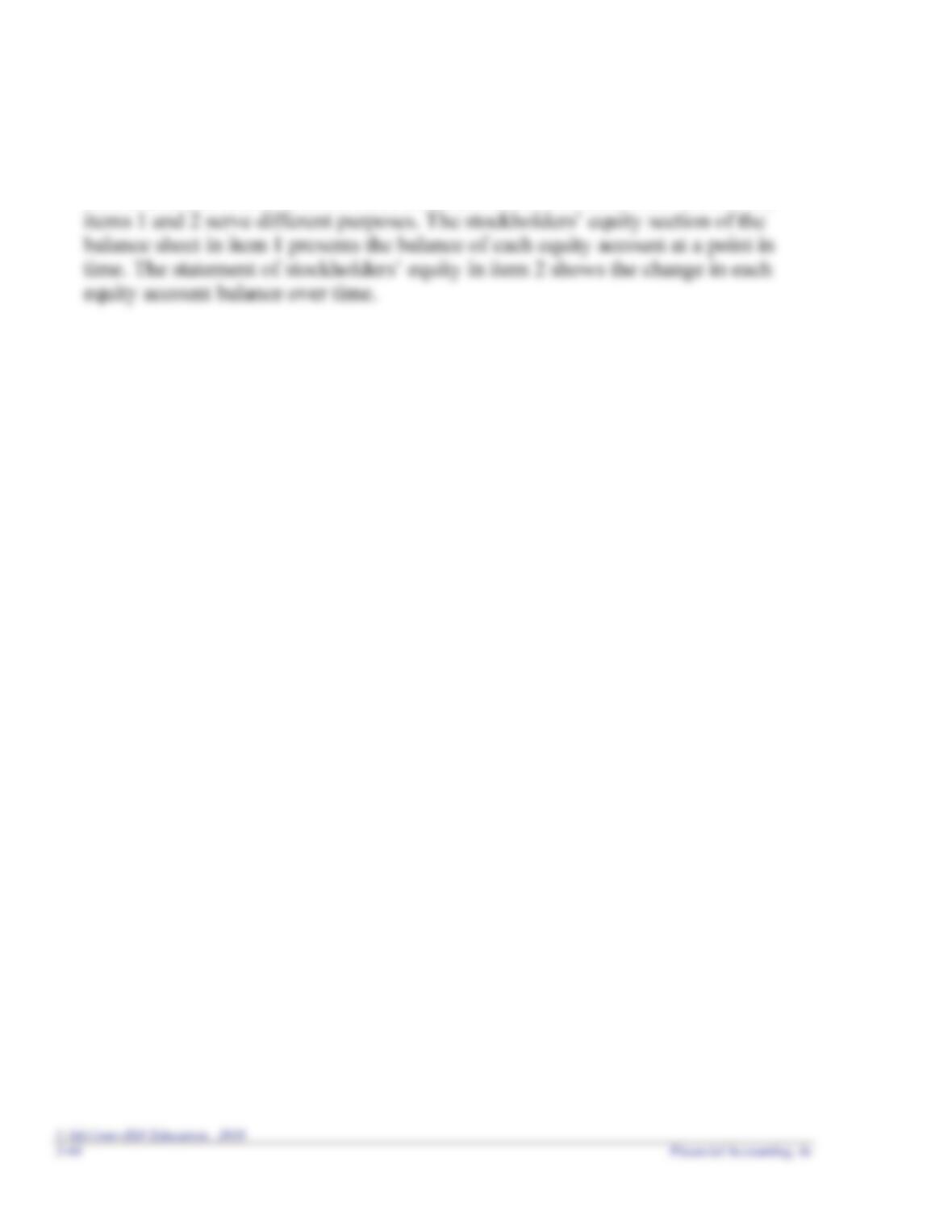
Requirement 2
Nautical
Statement of Stockholders’ Equity
For the Year Ended December 31, 2018
Preferred
Stock
Common
Stock
Additional
Paid-in
Capital
Retained
Earnings
Treasury
Stock
Total
Stockholders’
Equity
Balance, January 1
$1,250
$3,000
$19,500
$11,500
$ -0-
$35,250
Balance, December 31
Requirement 3
Items 1 and 2 are similar in that item 1 shows the equity balances in a column
format and item 2 shows these same balances across the bottom row. However,
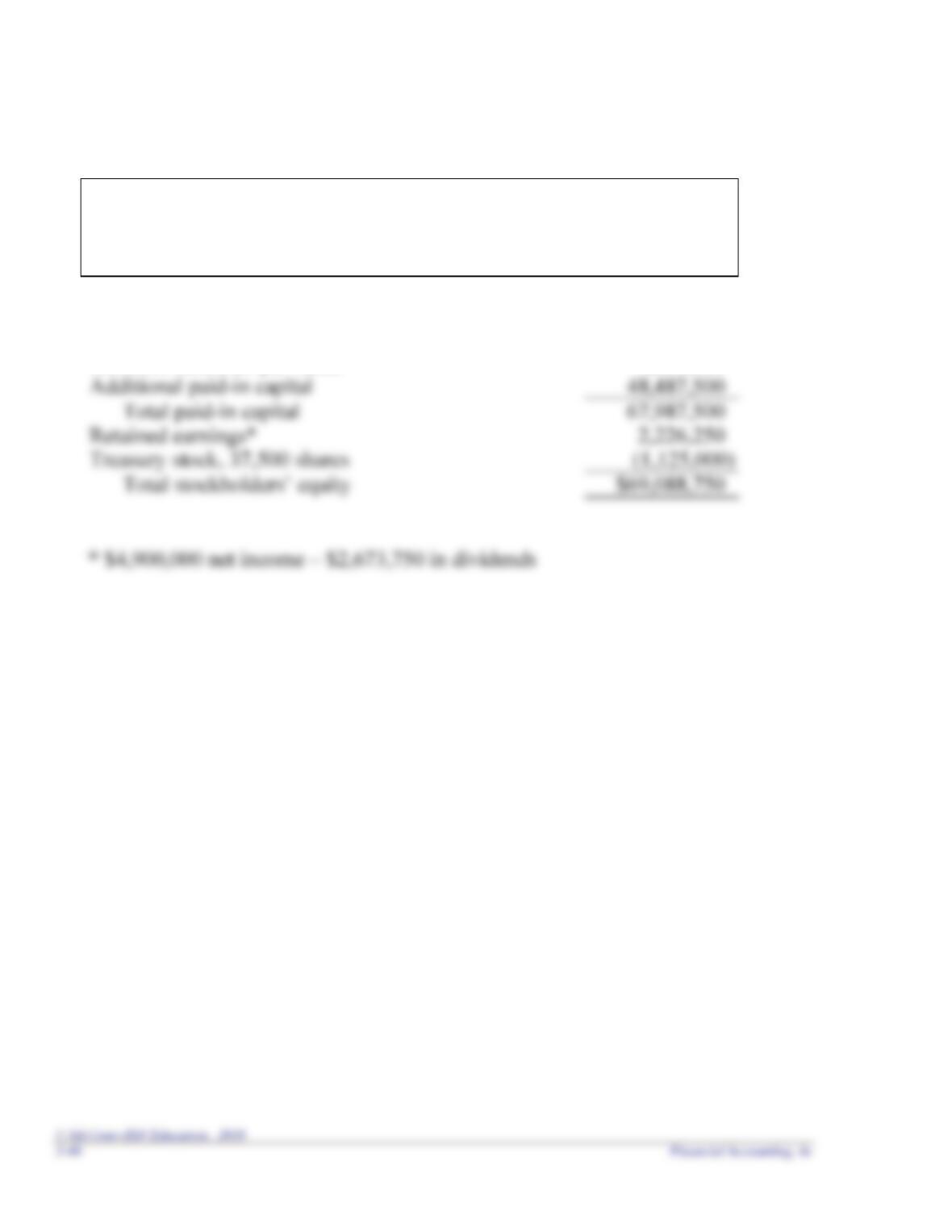
Problem 10-6B (LO 10-2, 10-3, 10-4, 10-5, 10-7)
Requirement 1
February 2, 2018
Debit
Credit
Cash (1,500,000 x $35)
52,500,000
Common Stock (1,500,000 x $5)
7,500,000
Additional Paid-in Capital (difference)
February 4, 2018
Cash (600,000 x $23)
13,800,000
Preferred Stock (600,000 x $20)
Additional Paid-in Capital (difference)
June 15, 2018
Treasury Stock (150,000 shares x $30)
4,500,000
August 15, 2018
Cash (112,500 shares x $45)
Treasury Stock (112,500 shares x $30)
3,375,000
Additional Paid-in Capital (112,500 x $15)
November 1, 2018
Dividends (1,462,500 shares x $1.50) + $480,000)
2,673,750
November 30, 2018
Problem 10-6B (Continued)
Requirement 2
National League Gear
Balance Sheet
(Stockholders’ Equity Section)
December 31, 2018
Stockholders’ equity:
Preferred stock, $20 par value
$12,000,000
Common stock, $5 par value
7,500,000
Retained earnings*
Treasury stock, 37,500 shares
Problem 10-7B (LO 10-8)
Requirement 1
($ in millions)
Net
Income
÷
Average
Stockholders’ Equity
=
Return on
Equity
DC Menswear
$833
÷
($4,080 + 2,755) / 2
=
24.4%
Requirement 2
Dividends
Per Share
÷
Stock
Price
=
Dividend
Yield
DC Menswear
$1.00
÷
$18.93
=
5.3%
Requirement 3
($ in millions)
Stock Price
÷
Earnings Per Share
=
Price-Earnings
Ratio
DC Menswear
$18.93
÷
($833 / 485)
=
11.0
ADDITIONAL PERSPECTIVES
Continuing Problem: Great Adventures
AP10-1
Requirement 1
July 2, 2020
Debit
Credit
Cash (100,000 x $12)
1,200,000
Common Stock (100,000 x $1)
100,000
Additional Paid-in Capital (difference)
September 10, 2020
Treasury Stock (10,000 shares x $15)
November 15, 2020
Cash (5,000 shares x $16)
80,000
Treasury Stock (5,000 shares x $15)
75,000
December 1, 2020
Dividends
115,000
December 31, 2020
Dividends Payable
115,000
115,000
Requirement 2
Great Adventures, Inc.
Balance Sheet
(Stockholders’ Equity Section)
December 31, 2020
Stockholders’ equity:
Common stock, $1 par value
$ 120,000
Additional paid-in capital
Retained earnings*
Treasury stock, 5,000 shares
Financial Analysis: American Eagle
AP10-2
Requirement 1
$0.01 par value per share. The par value per share is listed in the stockholders’
Requirement 2
249,566,000 shares. The number of shares issued (in thousands) is listed in the
$0.01 par value.
Requirement 3
Yes, 55,050,000 shares. The number of shares of treasury stock (in thousands) is
Requirement 4
$99,585,000. The cash dividends paid (in thousands) is listed in the retained
Financial Analysis: Buckle
AP10-3
Requirement 1
$0.01 par value per share. The par value per share is listed in the stockholders’
Requirement 2
48,379,613 shares. The number of shares issued is listed in the stockholders’ equity
Requirement 3
No. There is no treasury stock reported in the stockholders’ equity section of the
Requirement 4
$176,604,000. The cash dividends paid (in thousands) is listed in the retained
Comparative Analysis: American Eagle vs. Buckle
AP10-4
Requirement 1
($ in thousands)
Net
Income
÷
Average
Stockholders’
Equity
=
Return on
Equity
American Eagle
$80,322
÷
$1,152,962*
=
7.0%
Requirement 2
Dividends Per Share
÷
Stock
Price
=
Dividend
Yield
American Eagle
$99,585,000 / 194,516,000*
÷
$14.04
=
3.6%
Buckle
÷
$50.79
=
Requirement 3
Stock
Price
÷
Earnings
Per Share*
=
Price-Earnings
Ratio
American Eagle
$14.04
÷
$0.42
=
33.4
Buckle
÷
=
14.0
Ethics
AP10-5
Answers regarding the allocation of the additional $5 million in operating cash flows
will vary. Other areas to spend the money, not specifically mentioned in the case,
include increasing employee benefits such as retirement and healthcare, investing in
Internet Research
AP10-6
This case provides an opportunity for students to learn more about Form 10-K,
Written Communication
AP10-7
Requirement 1
Requirement 2
The balance sheet has always distinguished between liabilities and stockholders’
equity. Financial accounting information is designed to provide information useful to
Requirement 3
Arguments in support of eliminating the distinction relate to the difficulty, in certain
cases, in distinguishing between liabilities and stockholders’ equity. For instance,
preferred stock can be structured so that it is nearly identical to common stock by
Requirement 4
Earnings Management
AP10-8
Requirement 1
Net Income
÷
Shares outstanding
=
Earnings
Per Share
Before Repurchase
$878,000
÷
950,000
=
$0.92
Net Income
÷
Average
Stockholders’ Equity
=
Return on
Equity
Before Repurchase
$878,000
÷
=
Requirement 2
Net Income
÷
Shares outstanding
=
Earnings
Per Share
After Repurchase
$878,000
÷
=
$0.98
Net Income
÷
Average
Stockholders’ Equity
=
Return on
Equity
After Repurchase
$878,000
÷
=
Requirement 3
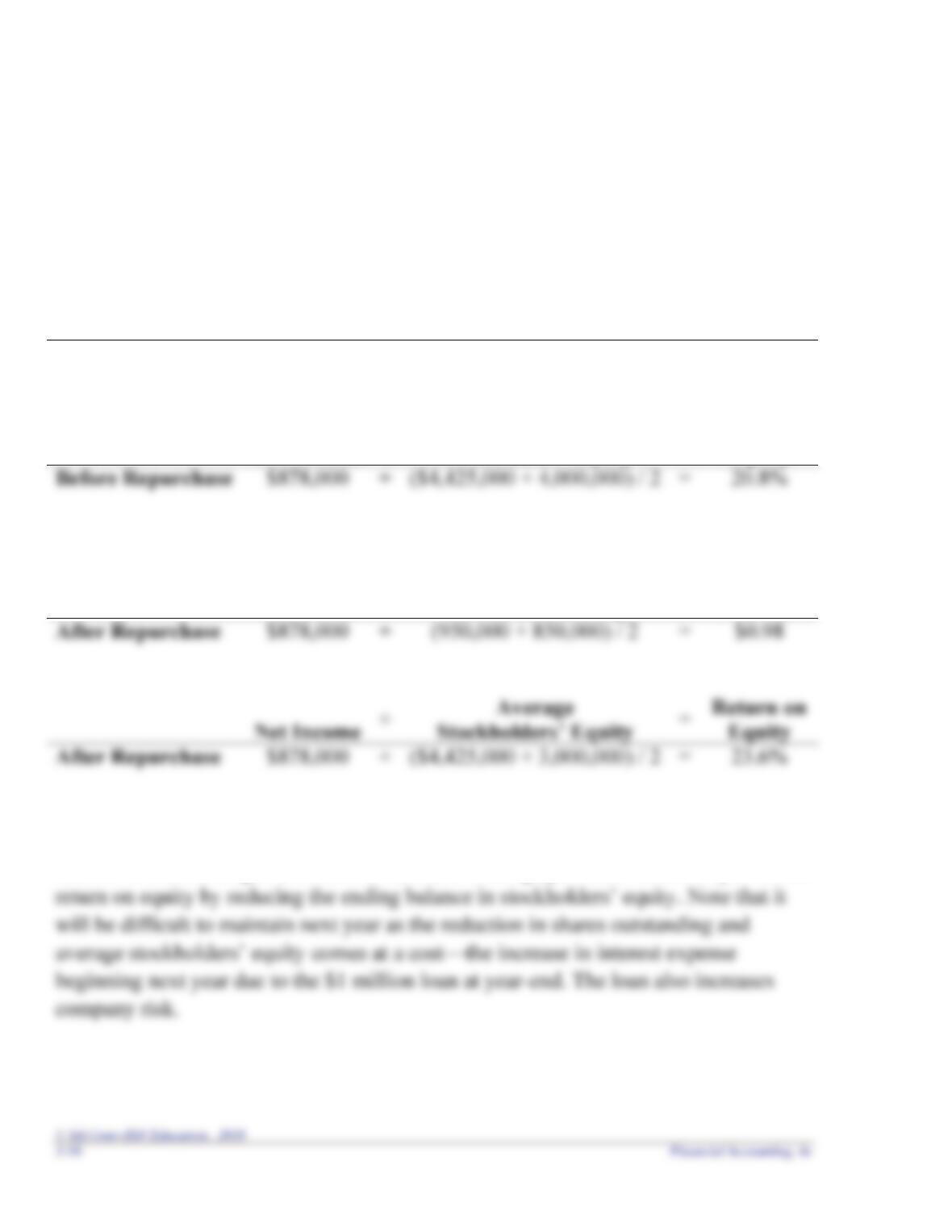
The repurchase of stock near year-end improves earnings per share by reducing the
number of outstanding shares used to calculate earnings per share. It also improves the