Exercise 10A–4 (10 minutes)
Company A:
This company has a favorable volume variance because the
standard hours allowed for the actual production are greater
than the denominator hours.
Company B:
This company has an unfavorable volume variance because
the standard hours allowed for the actual production are less
than the denominator hours.
Company C:
This company has no volume variance because the standard
hours allowed for the actual production and the denominator
hours are the same.
Exercise 10A–5 (15 minutes)
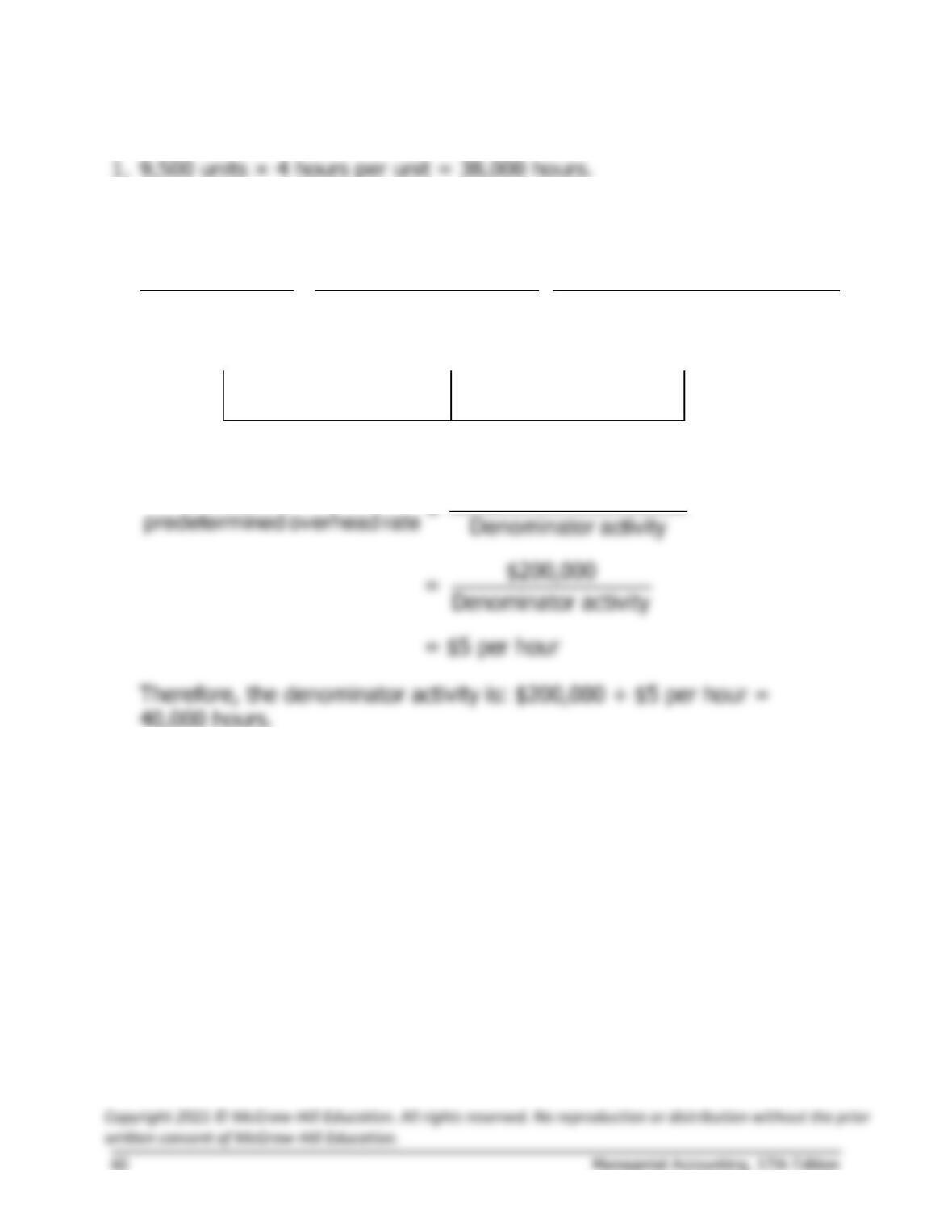
2. and 3.
Actual Fixed
Overhead
Budgeted Fixed
Overhead
Fixed Overhead Applied to
Work in Process
$198,700*
$200,000
38,000 hours × $5 per hour*
= $190,000
Budget variance,
$1,300 F
Volume variance,
$10,000 U*
*Given
4.
Budgeted fixed overhead
Fixed element of the =
Exercise 10A-6 (15 minutes)
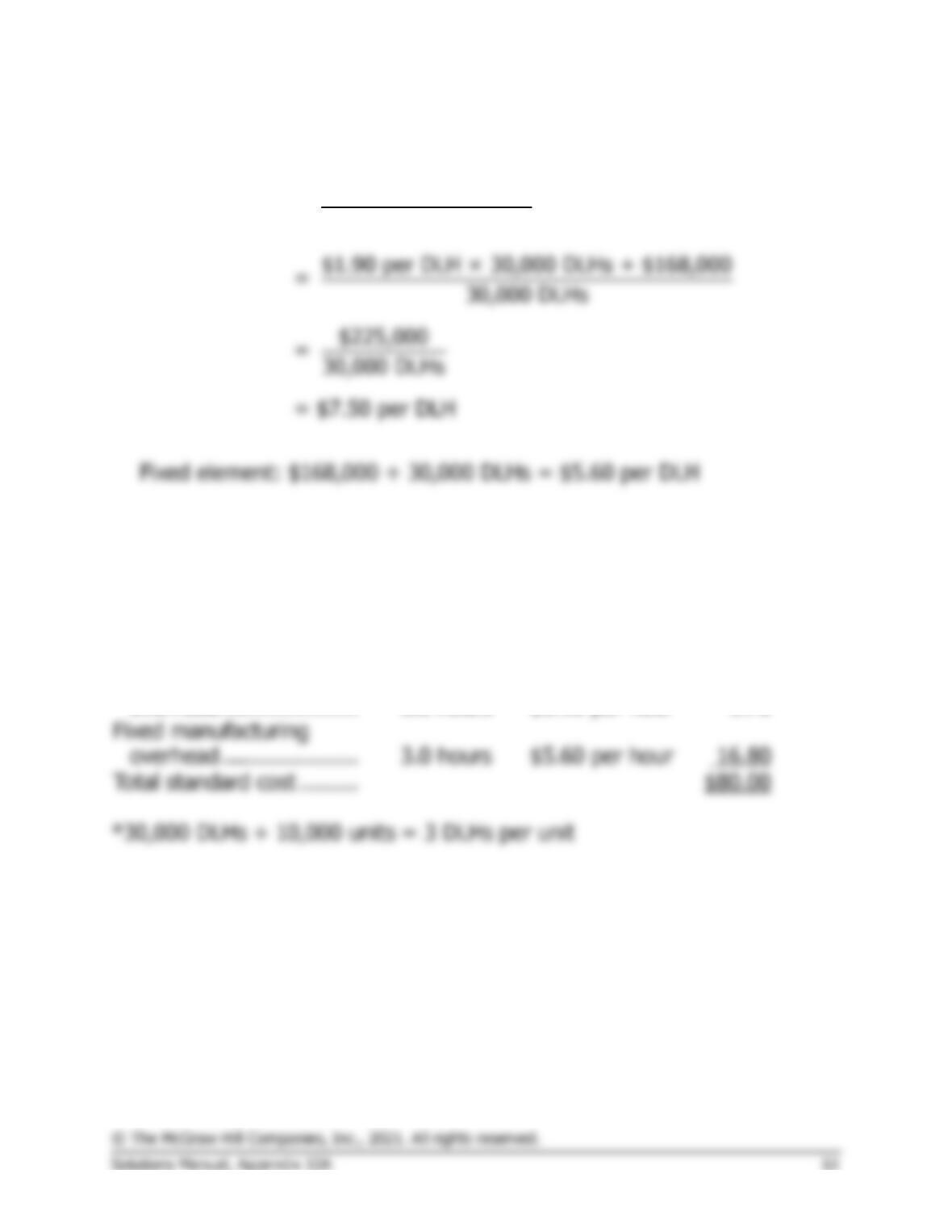
1.
Total overhead at the
denominator activity
Predetermined =
overhead rate Denominator activity
2.
Standard
Quantity or
Hours
Standard
Price or
Rate
Standard
Cost
Direct materials …………..
2.5 yards
$8.60 per yard
$21.50
Direct labor ………………..
3.0 hours*
$12.00 per hour3
36.00
Variable manufacturing
Fixed manufacturing
Total standard cost ………
$80.00
Exercise 10A-7 (15 minutes)
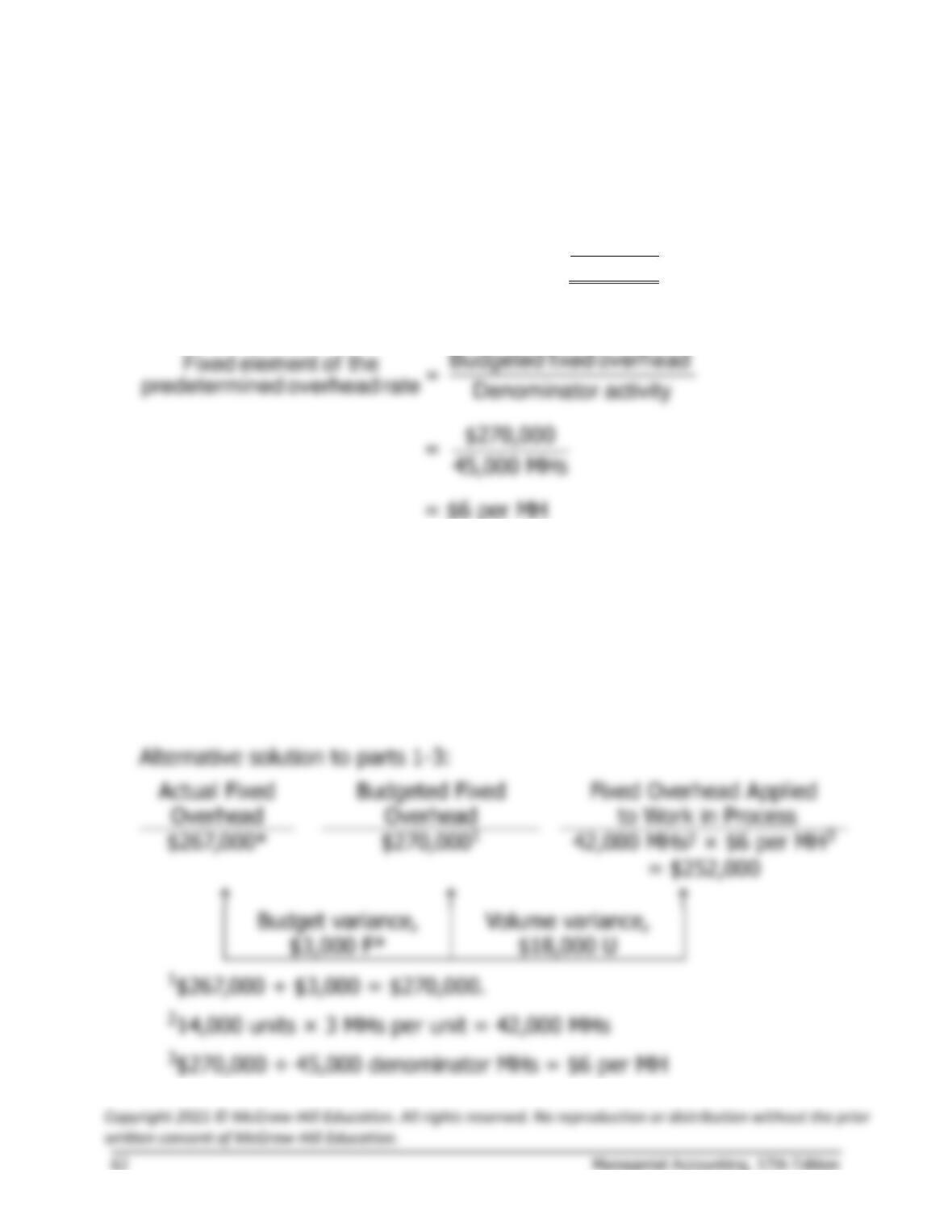
1. 14,000 units produced × 3 MHs per unit = 42,000 MHs
2.
Actual fixed overhead incurred …………….
$267,000
Add: Favorable budget variance …………..
3,000
Budgeted fixed overhead cost ……………..
$270,000
3.
4.
Fixed portion of Standard
Volume Denominator
= the predetermined × – hours
Variance hours
overhead rate allowed
= $6 per MH (45,000 MHs – 42,000 MHs)
= $18,000 U
æö
÷
ç÷
ç÷
ç÷
ç÷
÷
ç
èø
*Given
Problem 10A-8 (45 minutes)
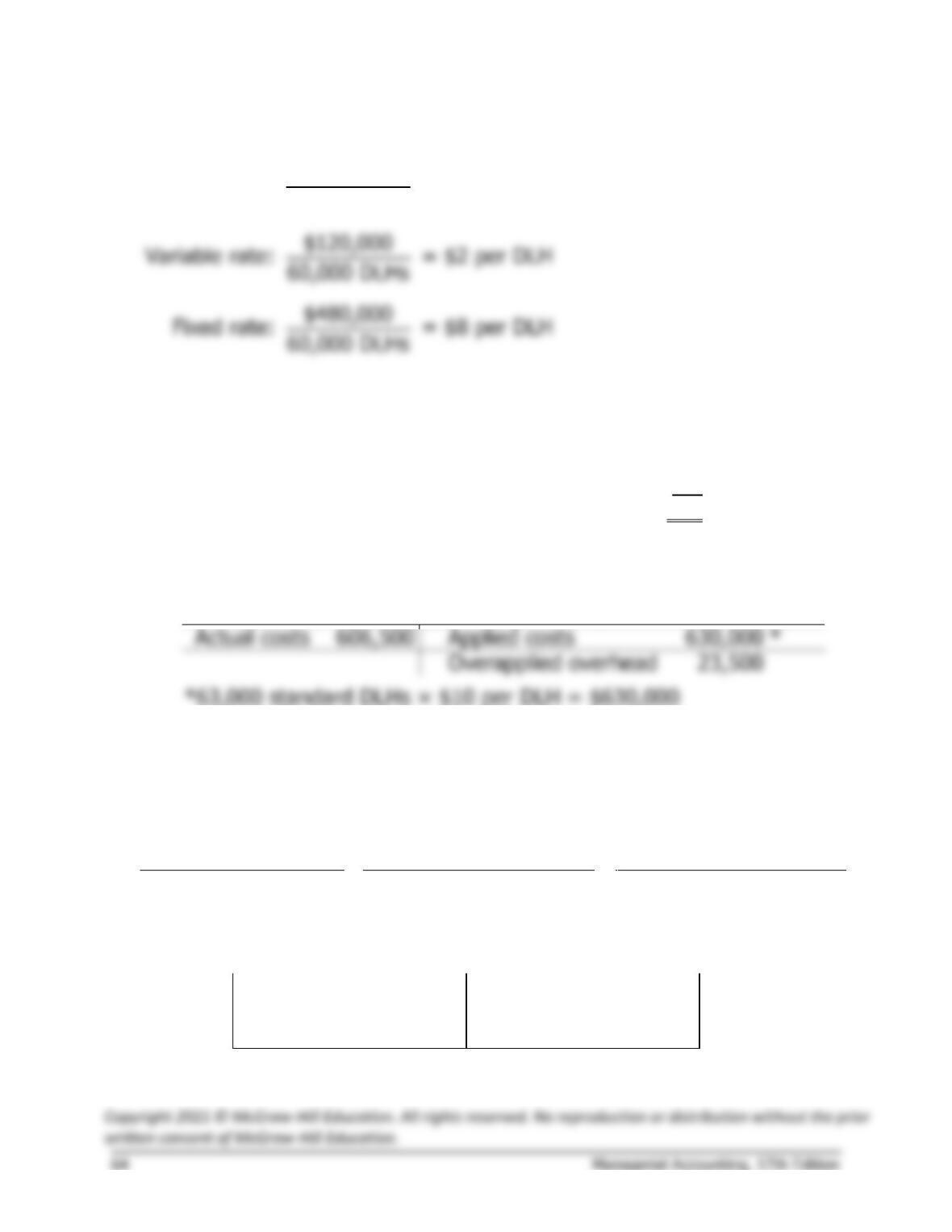
1.
$600,000
Total rate: = $10 per DLH
60,000 DLHs
2.
Direct materials: 3 pounds at $7 per pound ……….
$21
Direct labor: 1.5 DLHs at $12 per DLH ………………
18
Variable overhead: 1.5 DLHs at $2 per DLH ……….
3
Fixed overhead: 1.5 DLHs at $8 per DLH …………..
12
Standard cost per unit …………………………………..
$54
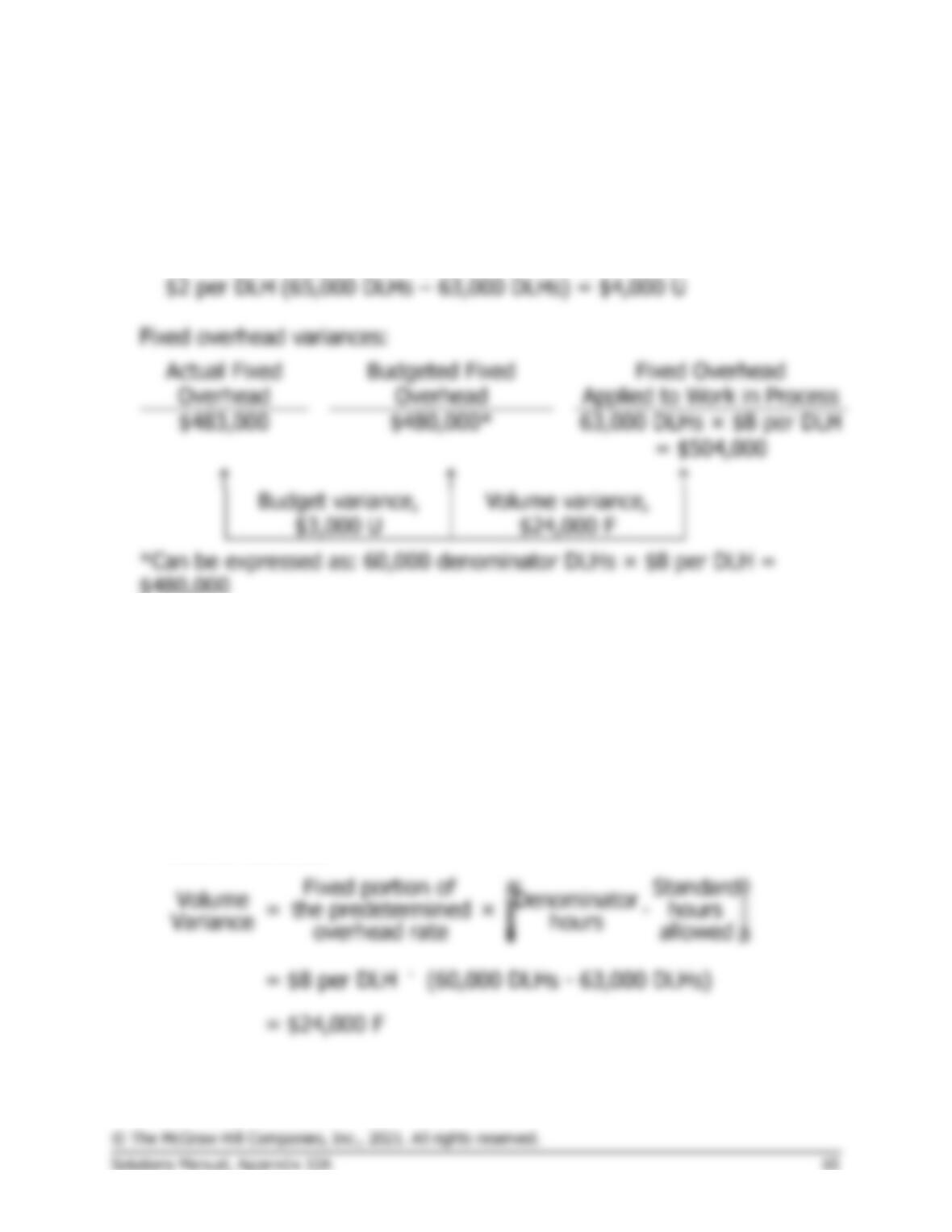
3. a. 42,000 units × 1.5 DLHs per unit = 63,000 standard DLHs
b.
Manufacturing Overhead
*
Overapplied overhead
4. Variable overhead variances:
Actual Hours of
Input, at the
Actual Rate
Actual Hours of Input,
at the Standard Rate
Standard Hours
Allowed for Output, at
the Standard Rate
(AH × AR)
(AH × SR)
(SH × SR)
$123,500
65,000 DLHs ×
$2 per DLH
63,000 DLHs ×
$2 per DLH
= $130,000
= $126,000
Variable overhead rate
variance,
$6,500 F
Variable overhead
efficiency variance,
$4,000 U
Problem 10A-8 (continued)
Alternative solution:
Variable overhead rate variance = (AH × AR) – (AH × SR)
($123,500) – (65,000 DLHs × $2 per DLH) = $6,500 F
Variable overhead efficiency variance = SR (AH – SH)
Alternative solution:
Budget variance:
Budget Actual fixed Budgeted fixed
= –
variance overhead overhead
= $483,000 – $480,000
= $3,000 U
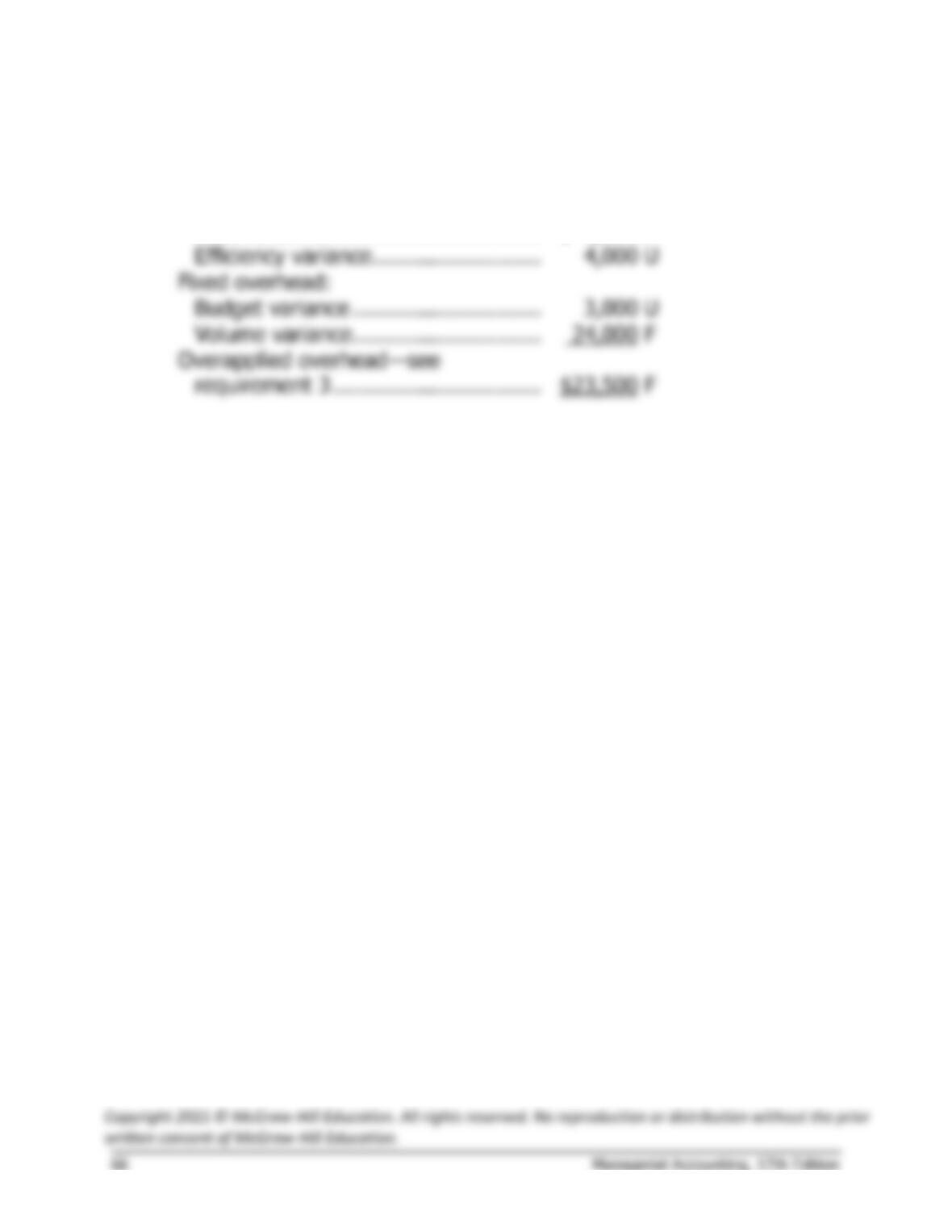
Volume variance:
Problem 10A–8 (continued)
The company’s overhead variances can be summarized as follows:
Variable overhead:
Rate variance …………………………...
$ 6,500
F
Budget variance ………………………..
U
Volume variance ………………………..
F
5. Only the volume variance would have changed. It would have been
unfavorable because the standard DLHs allowed for the year’s
production (63,000 DLHs) would have been less than the denominator
DLHs (65,000 DLHs).
Problem 10A–9 (45 minutes)
1.
$297,500
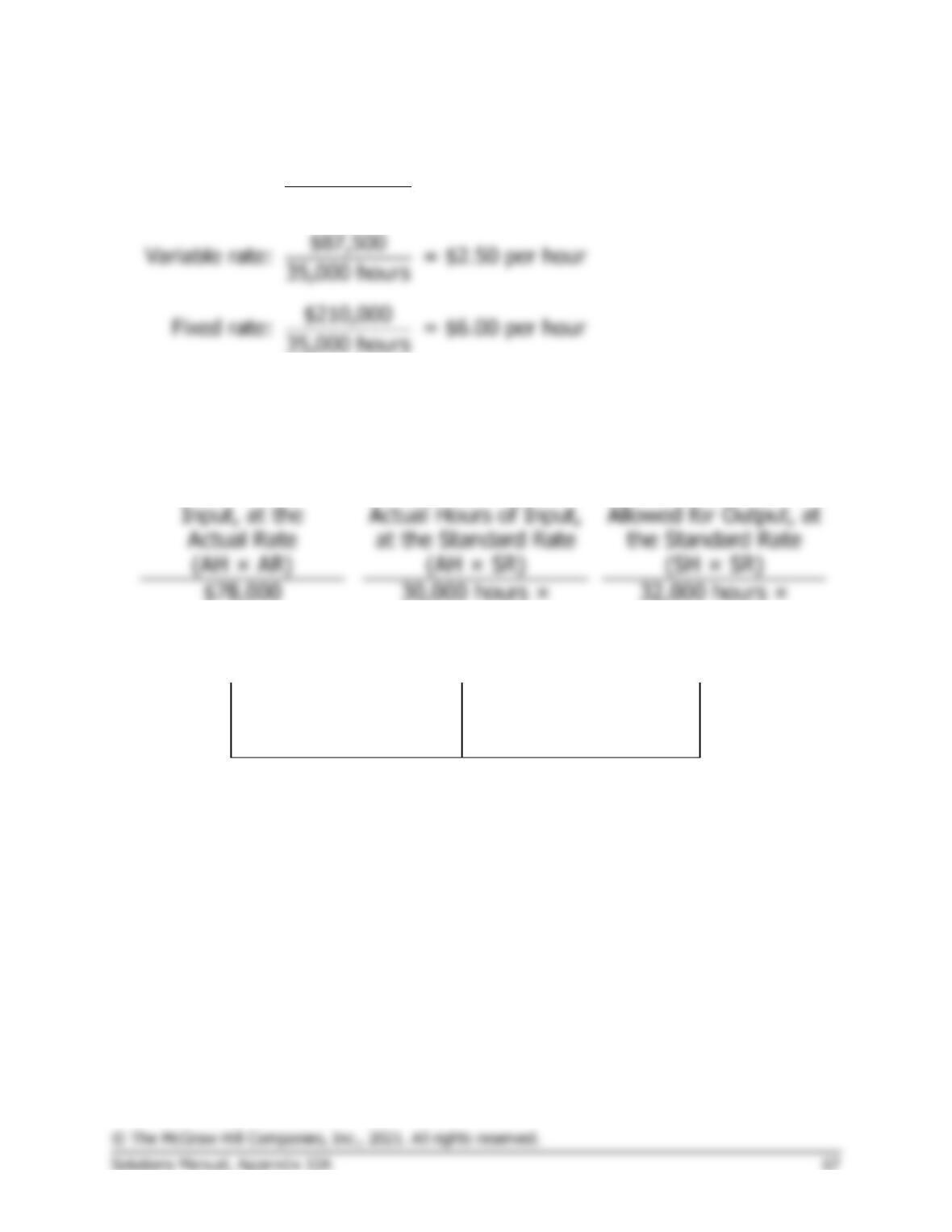
Total rate: = $8.50 per hour
35,000 hours
2. 32,000 standard hours × $8.50 per hour = $272,000
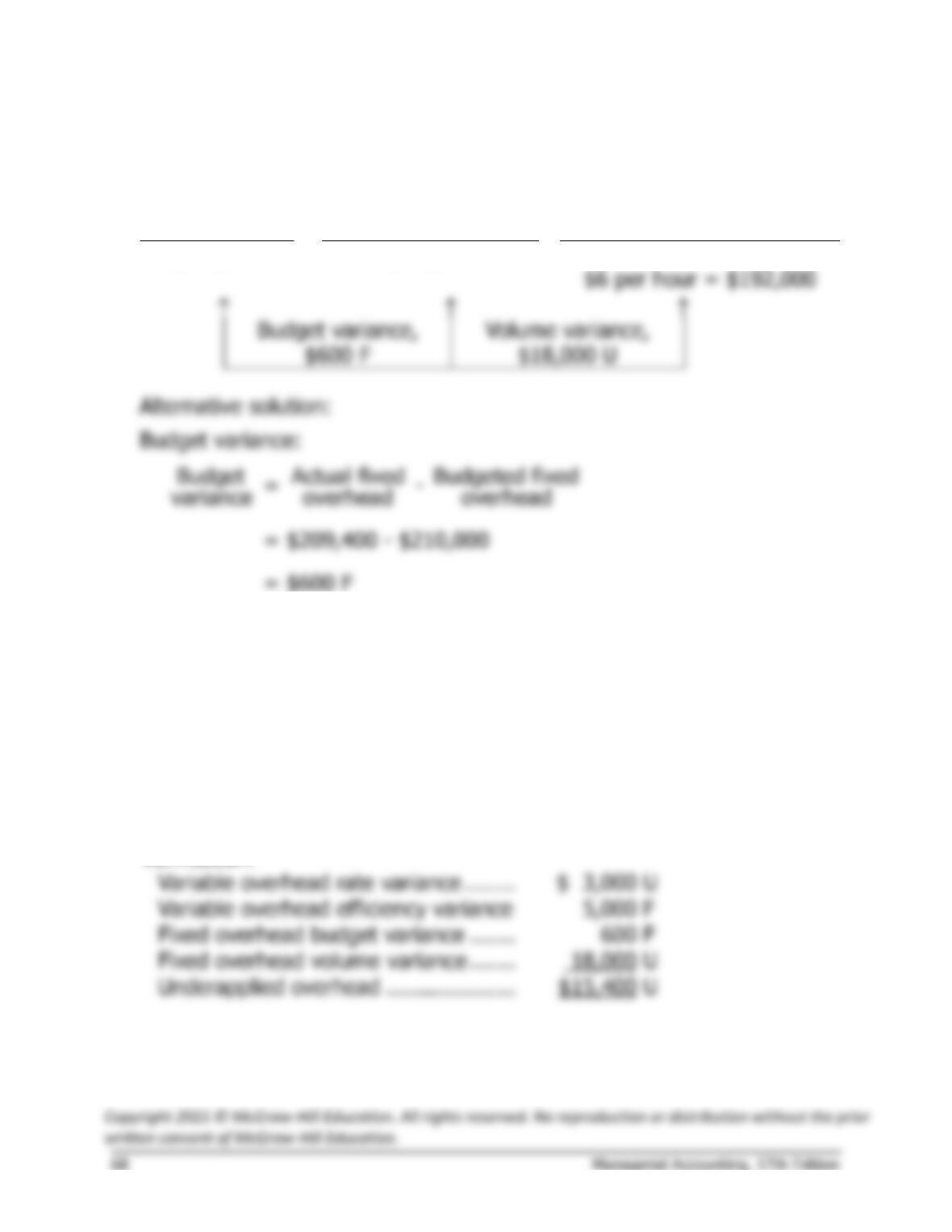
3. Variable overhead variances:
Actual Hours of
Standard Hours
$2.50 per hour
$2.50 per hour
= $75,000
= $80,000
Variable overhead rate
variance,
$3,000 U
Variable overhead
efficiency variance,
$5,000 F
Alternative solution:
Variable overhead rate variance = (AH × AR) – (AH × SR)
($78,000) – (30,000 hours × $2.50 per hour) = $3,000 U
Variable overhead efficiency variance = SR (AH – SH)
$2.50 per hour (30,000 hours – 32,000 hours) = $5,000 F
Problem 10A-9 (continued)
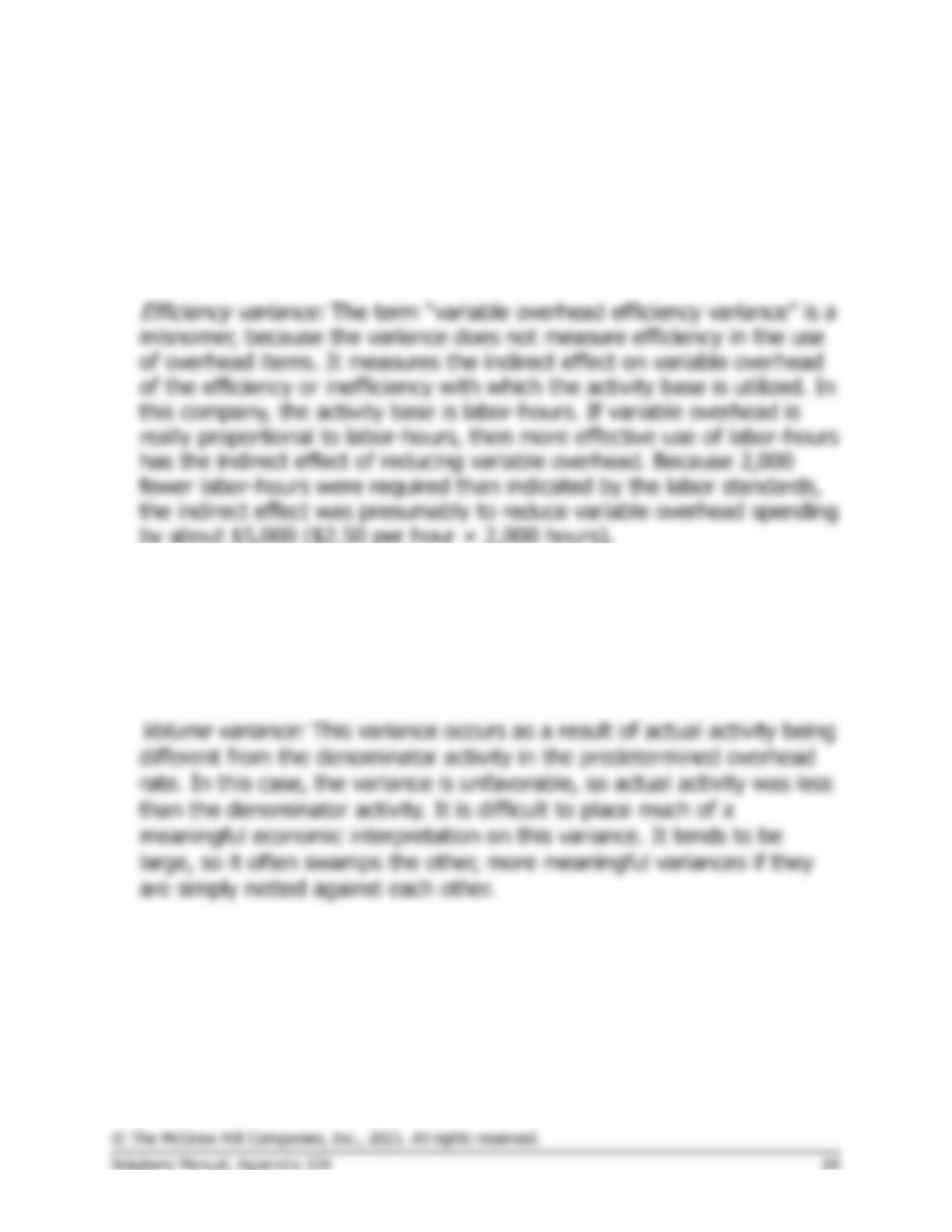
Fixed overhead variances:
Actual Fixed
Overhead
Budgeted Fixed
Overhead
Fixed Overhead Applied to
Work in Process
$209,400
$210,000
32,000 hours ×
Volume variance:
Fixed portion of Standard
Volume Denominator
= the predetermined × – hours
Variance hours
overhead rate allowed
= $6.00 per hour (35,000 hours – 32,000 hours)
= $18,000 U
æö
÷
ç÷
ç÷
ç÷
ç÷
÷
ç
èø
Problem 10A–9 (continued)
4. Variable overhead
Rate variance:
This variance reflects differences between actual and
standard prices for variable overhead items. Because the variable
overhead rate variance is unfavorable, too much was paid for variable
overhead items.
by about $5,000 ($2.50 per hour × 2,000 hours).
Fixed overhead
Budget variance:
This variance is simply the difference between the
budgeted fixed cost and the actual fixed cost. In this case, the variance
is favorable which indicates that actual fixed costs were lower than
anticipated in the budget.
Problem 10A–10 (45 minutes)
1. Direct materials price and quantity variances:
Materials price variance = AQ (AP – SP)
64,000 feet ($8.55 per foot – $8.45 per foot) = $6,400 U
Materials quantity variance = SP (AQ – SQ)
$8.45 per foot (64,000 feet – 60,000 feet*) = $33,800 U
*30,000 units × 2 feet per unit = 60,000 feet
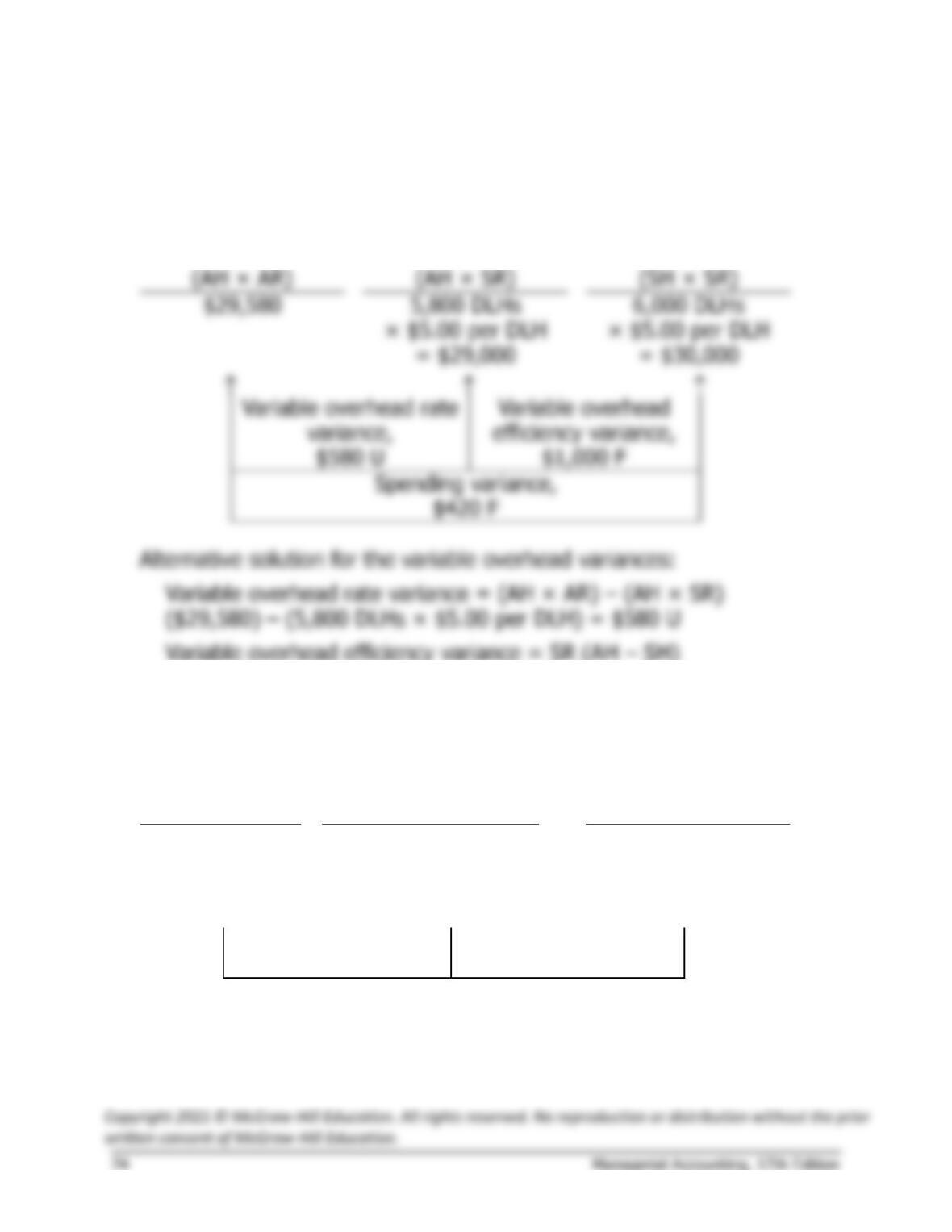
2. Direct labor rate and efficiency variances:
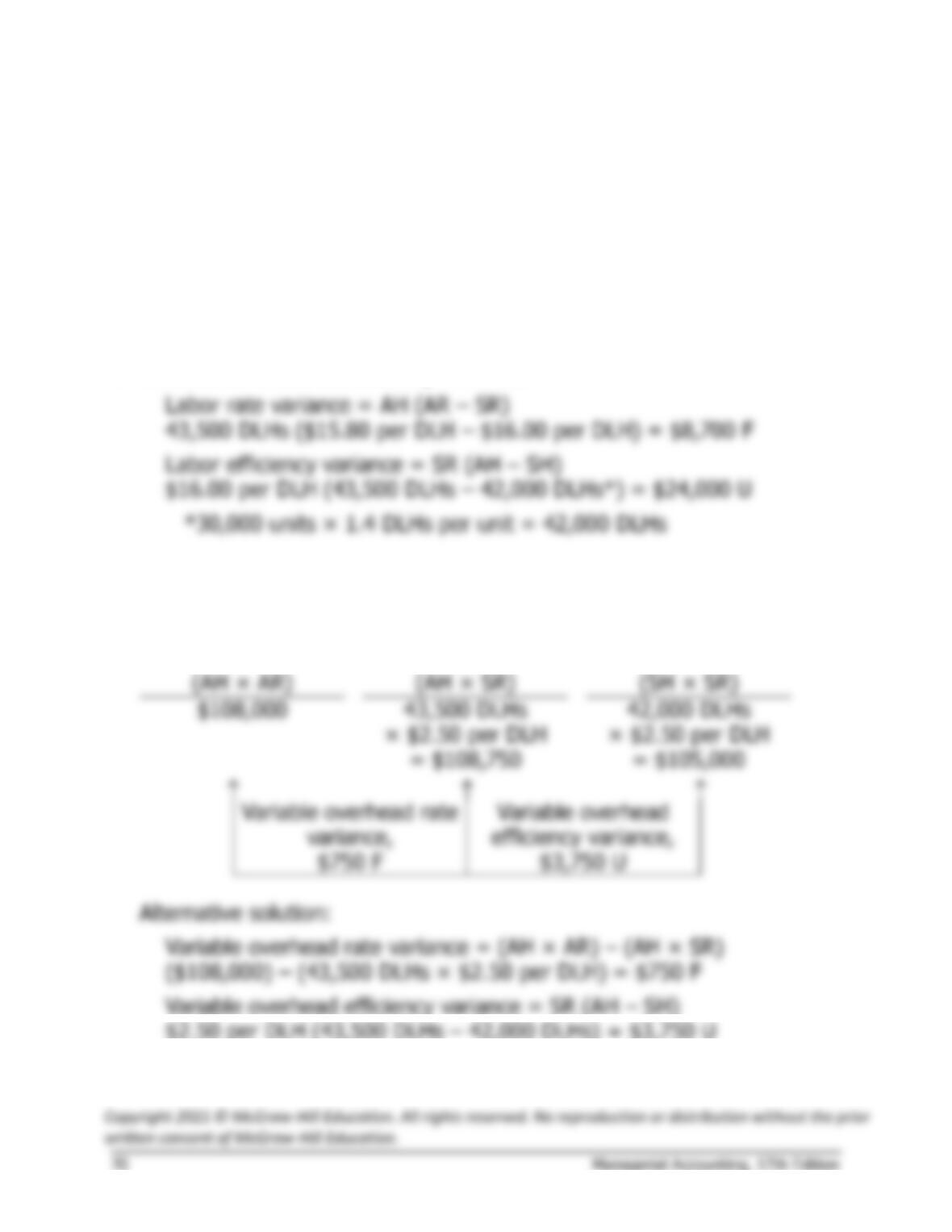
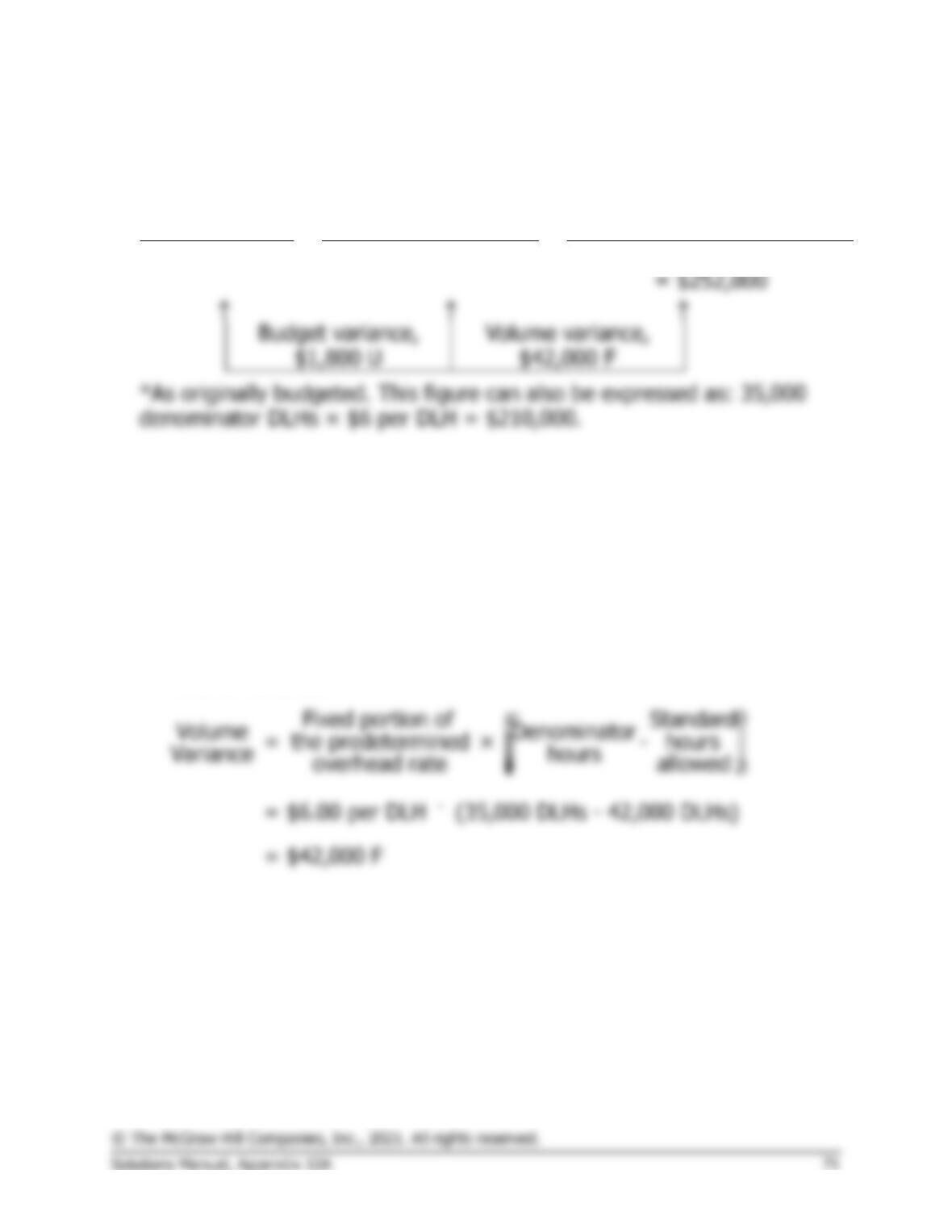
3. a. Variable overhead spending and efficiency variances:
Actual Hours of
Input, at the
Actual Rate
Actual Hours of
Input, at the
Standard Rate
Standard Hours
Allowed for Output,
at the Standard Rate
Problem 10A-10 (continued)
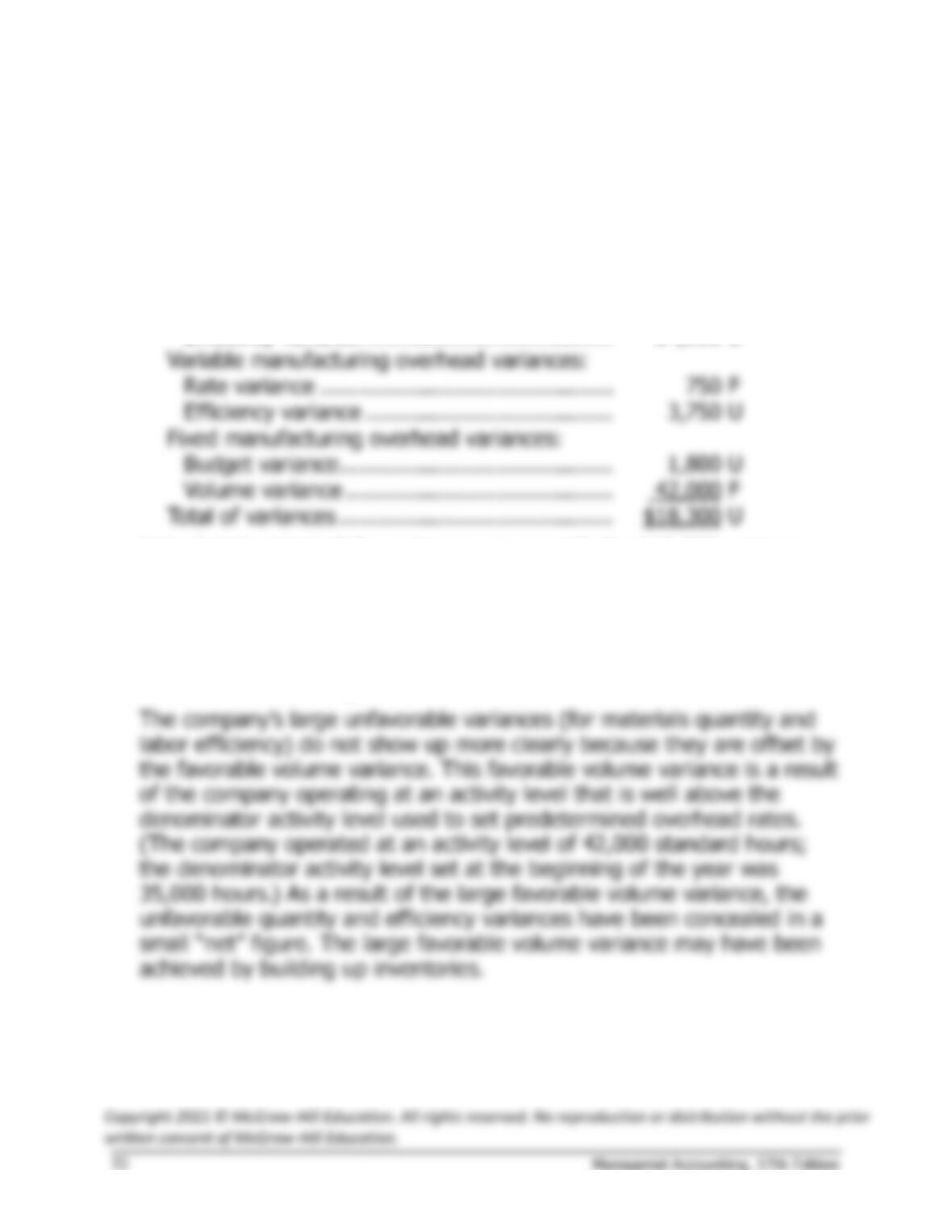
b. Fixed overhead budget and volume variances:
Actual Fixed
Overhead
Budgeted Fixed
Overhead
Fixed Overhead Applied to
Work in Process
$211,800
$210,000*
42,000 DLHs × $6 per DLH
Alternative solution:
Budget variance:
Budget Actual fixed Budgeted fixed
= –
variance overhead overhead
= $211,800 – $210,000
= $1,800 U
Volume variance:
Problem 10A–10 (continued)
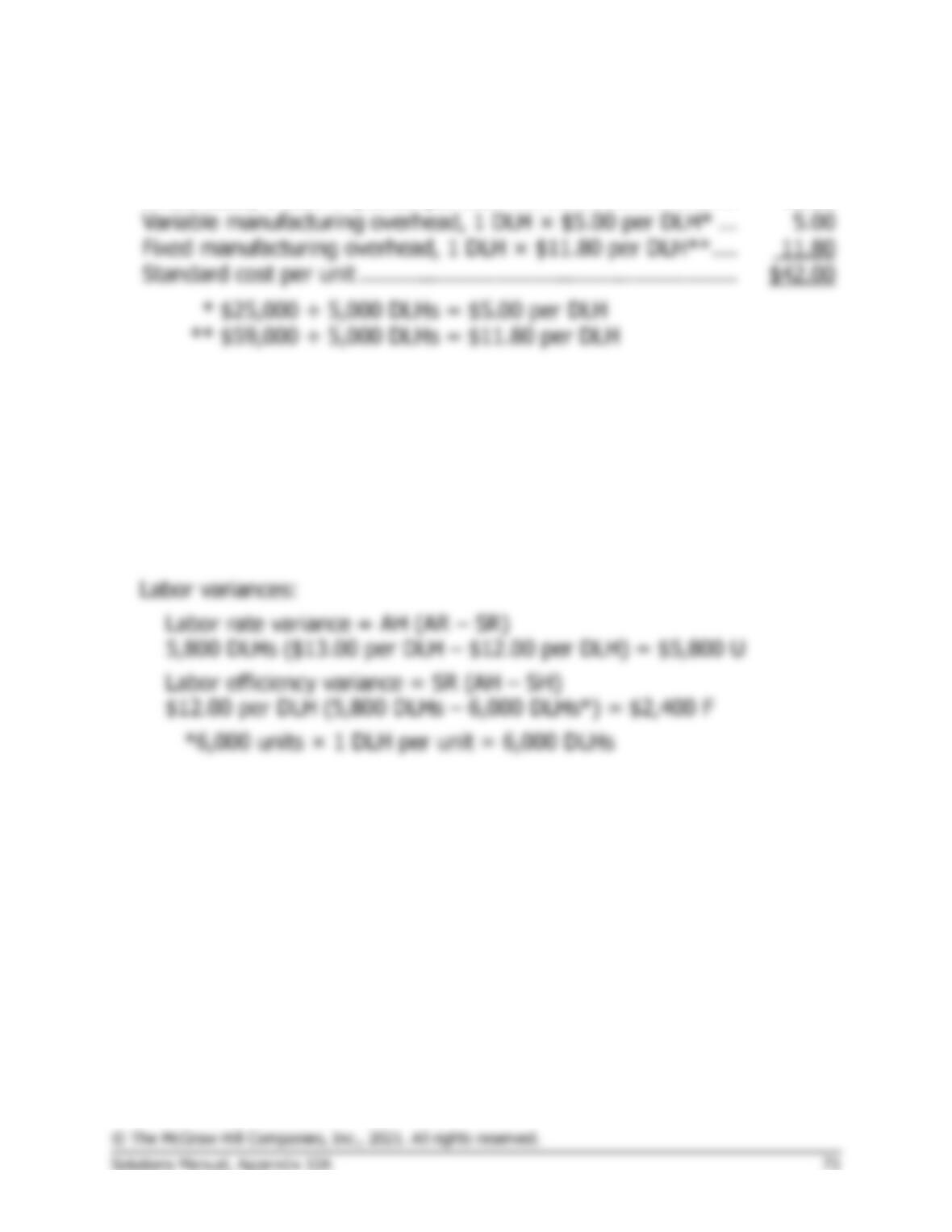
4. The total of the variances would be:
Direct materials variances:
Price variance ………………………………………
$ 6,400
U
Quantity variance ………………………………….
33,800
U
Direct labor variances:
Rate variance ………………………………………
8,700
F
Efficiency variance ………………………………..
U
Variable manufacturing overhead variances:
Rate variance ………………………………………
F
Efficiency variance ………………………………..
U
Fixed manufacturing overhead variances:
Budget variance ……………………………………
1,800
U
Volume variance …………………………………..
42,000
F
Total of variances ……………………………………
U
Note that the total of the variances agrees with the $18,300 variance
mentioned by the president.
It appears that not everyone should be given a bonus for good cost
control. The materials quantity variance and the labor efficiency variance
are 6.7% and 3.6%, respectively, of the standard cost allowed and thus
would warrant investigation.
Problem 10A-11 (30 minutes)
1.
Direct materials, 3 yards × $4.40 per yard ………………………..
$13.20
Direct labor, 1 DLH × $12.00 per DLH ……………………………..
12.00
Variable manufacturing overhead, 1 DLH × $5.00 per DLH* …
Fixed manufacturing overhead, 1 DLH × $11.80 per DLH** ….
2. Materials variances:
Materials price variance = AQ (AP – SP)
24,000 yards ($4.80 per yard – $4.40 per yard) = $9,600 U
Materials quantity variance = SP (AQ – SQ)
$4.40 per yard (18,500 yards – 18,000 yards*) = $2,200 U
*6,000 units × 3 yards per unit = 18,000 yards
Problem 10A-11 (continued)
3. Variable overhead variances:
Actual DLHs of
Input, at the
Actual Rate
Actual DLHs of
Input, at the
Standard Rate
Standard DLHs
Allowed for Output,
at the Standard Rate
(AH × AR)
(AH × SR)
= $29,000
= $30,000
$5.00 per DLH (5,800 DLHs – 6,000 DLHs) = $1,000 F
Fixed overhead variances:
Actual Fixed
Overhead
Budgeted Fixed
Overhead
Fixed Overhead
Applied to
Work in Process
$60,400
$59,000
6,000 DLHs
× $11.80 per DLH
= $70,800
Budget variance,
$1,400 U
Volume variance,
$11,800 F
Problem 10A-11 (continued)
Alternative approach to the budget variance:
Budget Actual fixed Budgeted fixed
= –
variance overhead overhead
= $60,400 – $59,000
4. The choice of a denominator activity level affects standard unit costs in
that the higher the denominator activity level chosen, the lower
standard unit costs will be. The reason is that the fixed portion of
overhead costs is spread over more units as the denominator activity
rises.