FINANCIAL ACCOUNTING – Eleventh Edition Solutions Manual
E10-86
(20-25 min.)
Requirement
Solution:
DATE DEBIT CREDIT
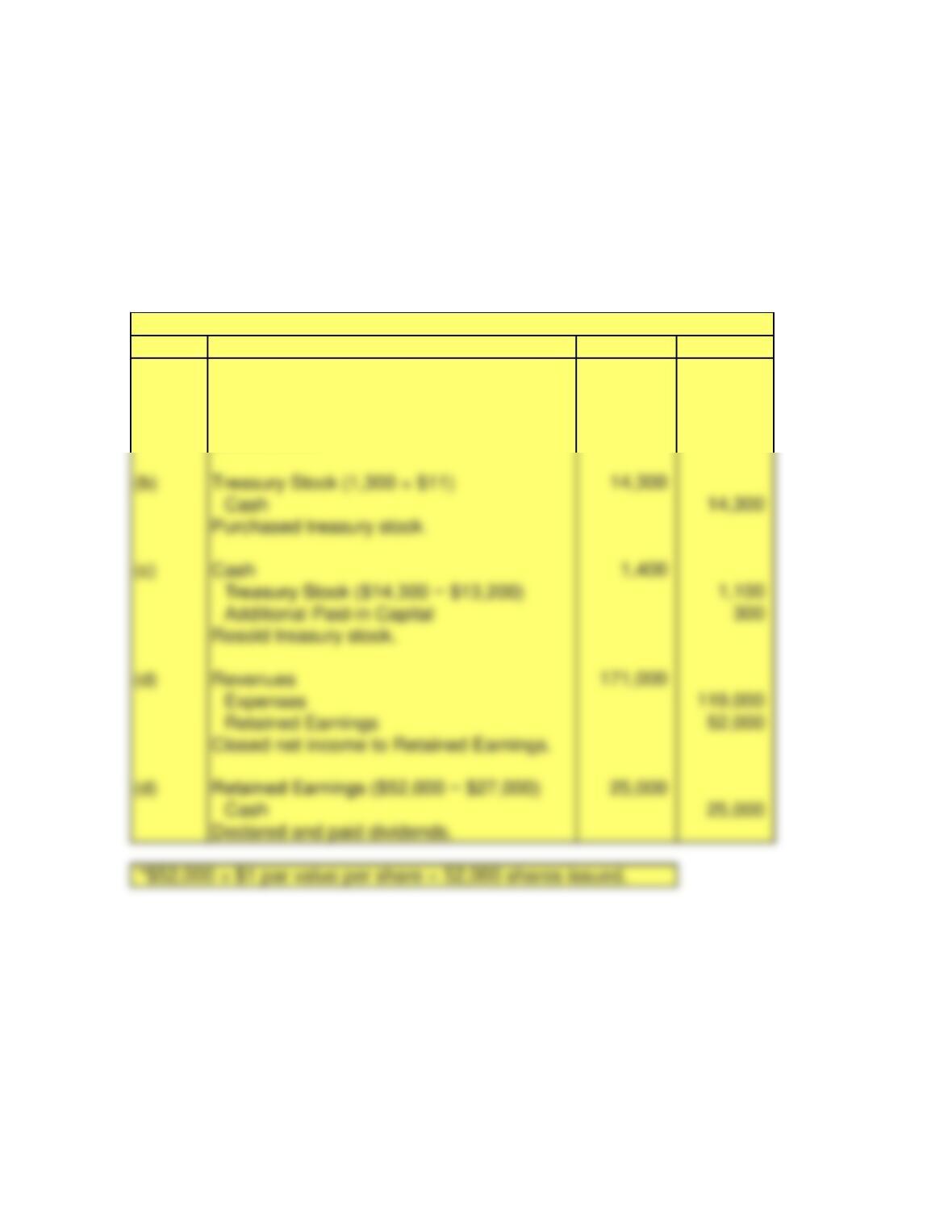
(a) Cash (52,000* × $6) 312,000
Common Stock
52,000
Additional Paid-in Capital
260,000
Issued stock.
1. Journalize all of Dolson’s stockholders’ equity transactions during the year.
Dolson’s entry to close net income to Retained Earnings was as given in problem.
Journal
ACCOUNT TITLES AND EXPLANATION
Chapter 10: Stockholders’ Equity Page 80 of 98
Purchased treasury stock.
Resold treasury stock.
FINANCIAL ACCOUNTING – Eleventh Edition Solutions Manual
E10-87
(20-25 min.)
Solution:
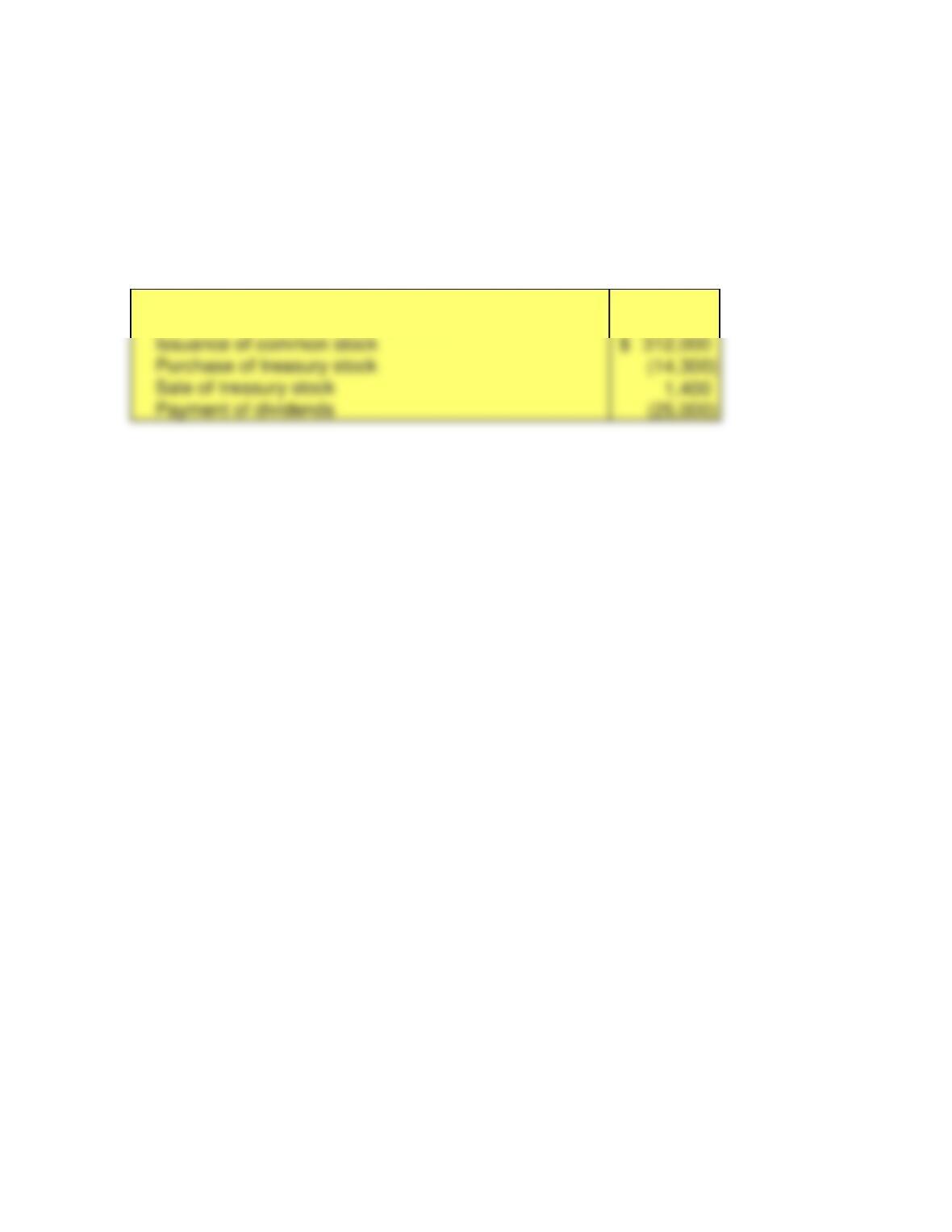
Statement of cash flows:
Cash Flows from Financing Activities:
Use the Dolson Networking Solutions data in E10-86 to show how the company
reported cash flows from financing activities during 2016.
Chapter 10: Stockholders’ Equity Page 81 of 98
FINANCIAL ACCOUNTING – Eleventh Edition Solutions Manual
E10-88
(15 min.)
Requirement
Solution:
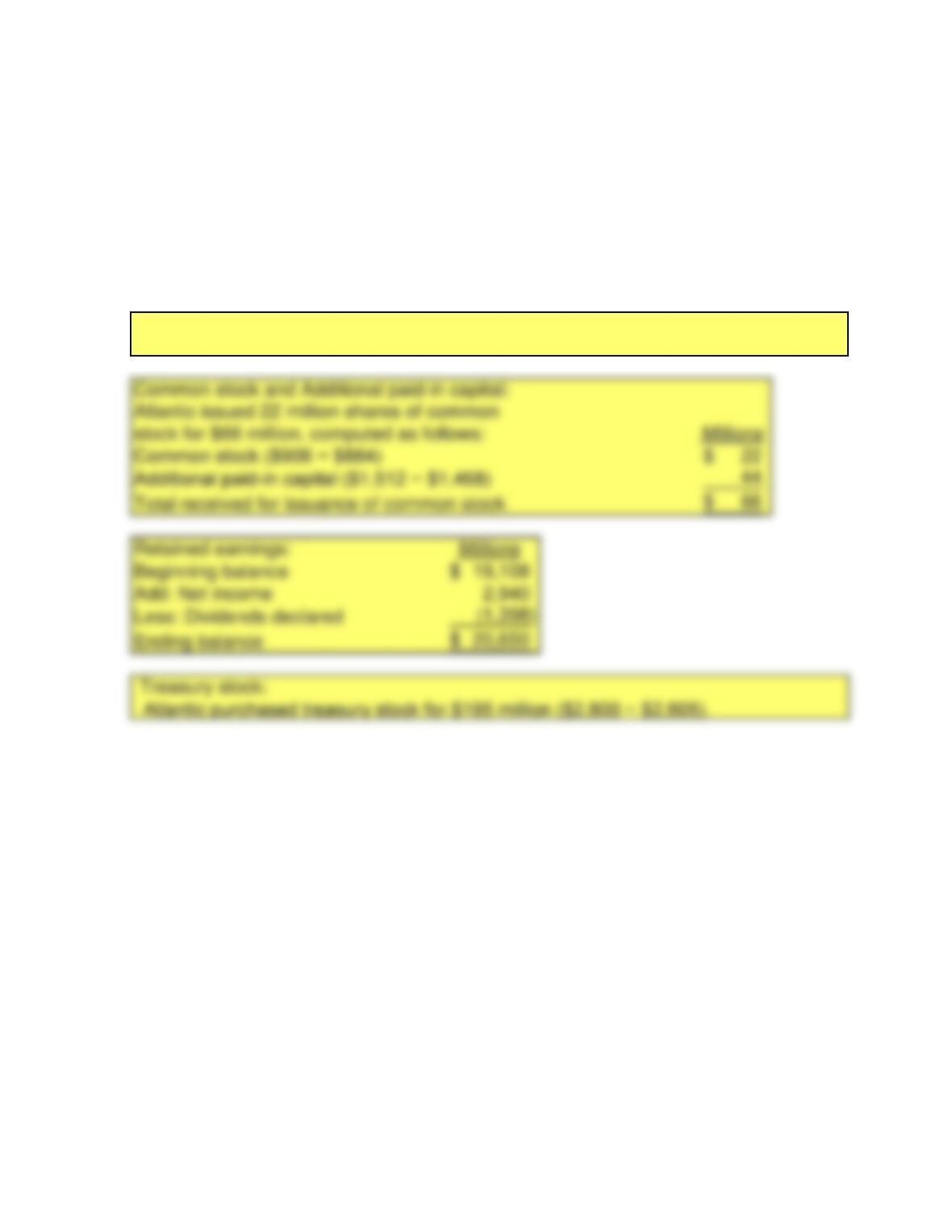
Two transactions affected Retained Earnings. Give a full explanation, including the
dollar amount, for the change in each account.
Preferred stock:
Atlantic retired preferred stock of $124 million ($730 − $606)
Chapter 10: Stockholders’ Equity Page 82 of 98
Treasury stock:
Atlantic purchased treasury stock for $195 million ($2,800 − $2,605).
FINANCIAL ACCOUNTING – Eleventh Edition Solutions Manual
E10-89
(15 min.)
Requirement
Solution:
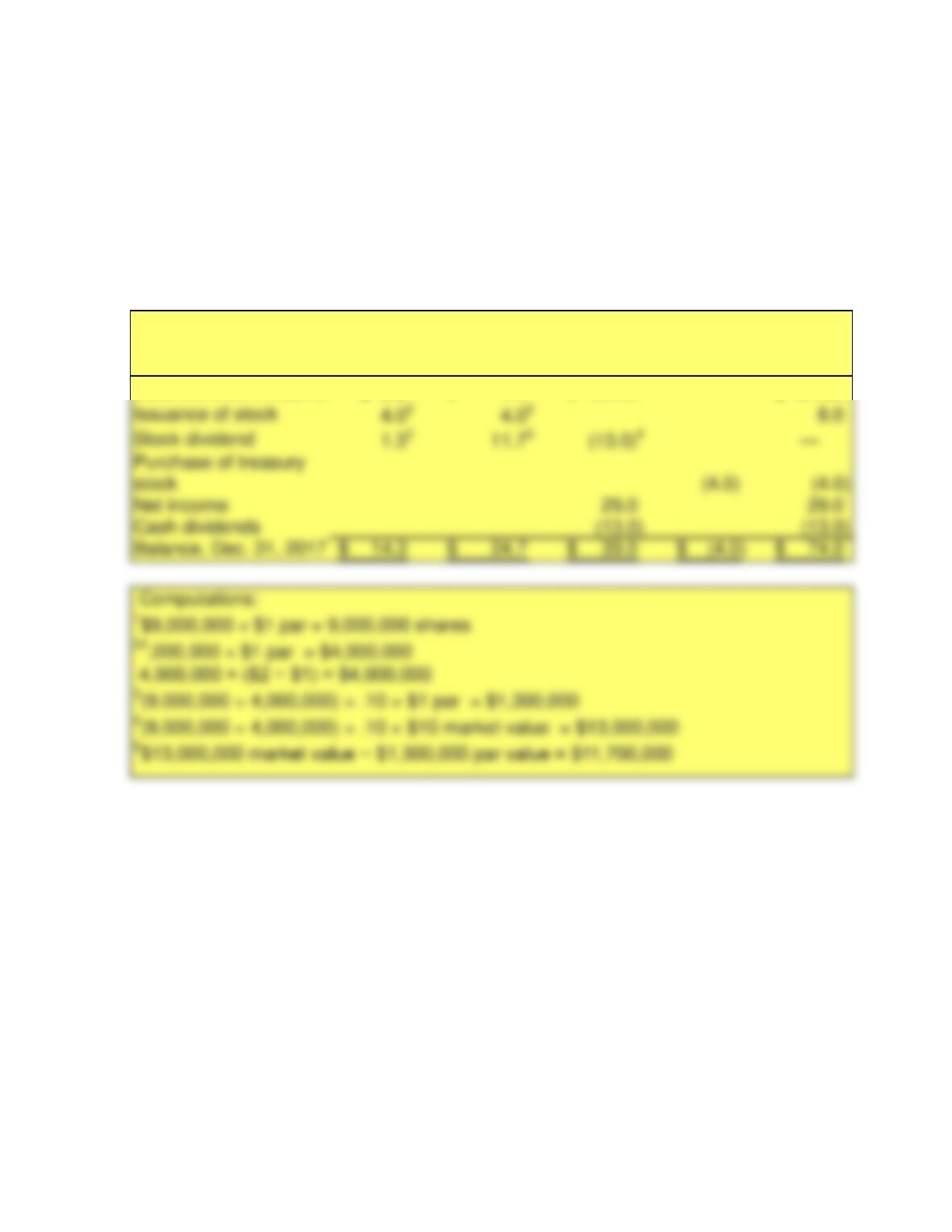
Amounts in Millions
Balance, Dec. 31, 2016
$ 9.019.0$ 36.00$ 54.00$
Retained
Earnings
Treasury
Stock
1. Complete the following tabulation to show what Fandom, Inc., should report for
stockholders’ equity at December 31, 2017. Journal entries are not required.
Total
Equity
+
+
−
=
Common
Stock
Additional
Paid-in
Capital
Chapter 10: Stockholders’ Equity Page 83 of 98
Purchase of treasury
FINANCIAL ACCOUNTING – Eleventh Edition Solutions Manual
P10-90
(20-25 min.)
Requirements
Solution:
Req. 1
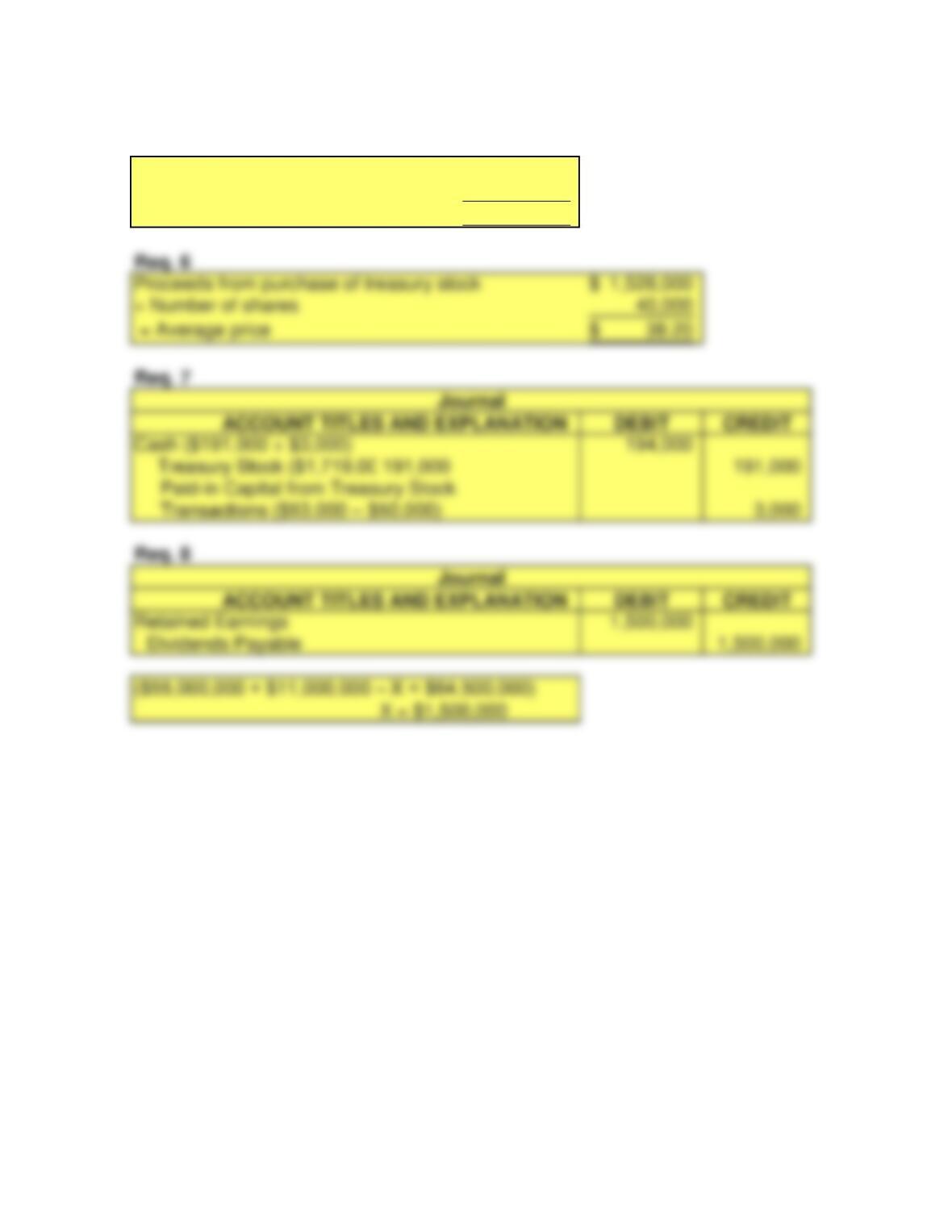
1. What is the par value of the common stock?
2. How many shares of common stock were outstanding at the end of 2016?
3. As of December 31, 2016, what was the average price that stockholders paid
for all common stock when issued?
4. Prepare a summary journal entry to record the change in common stock
during the year.
5. What was the average price that stockholders paid for the common stock
issued in 2016?
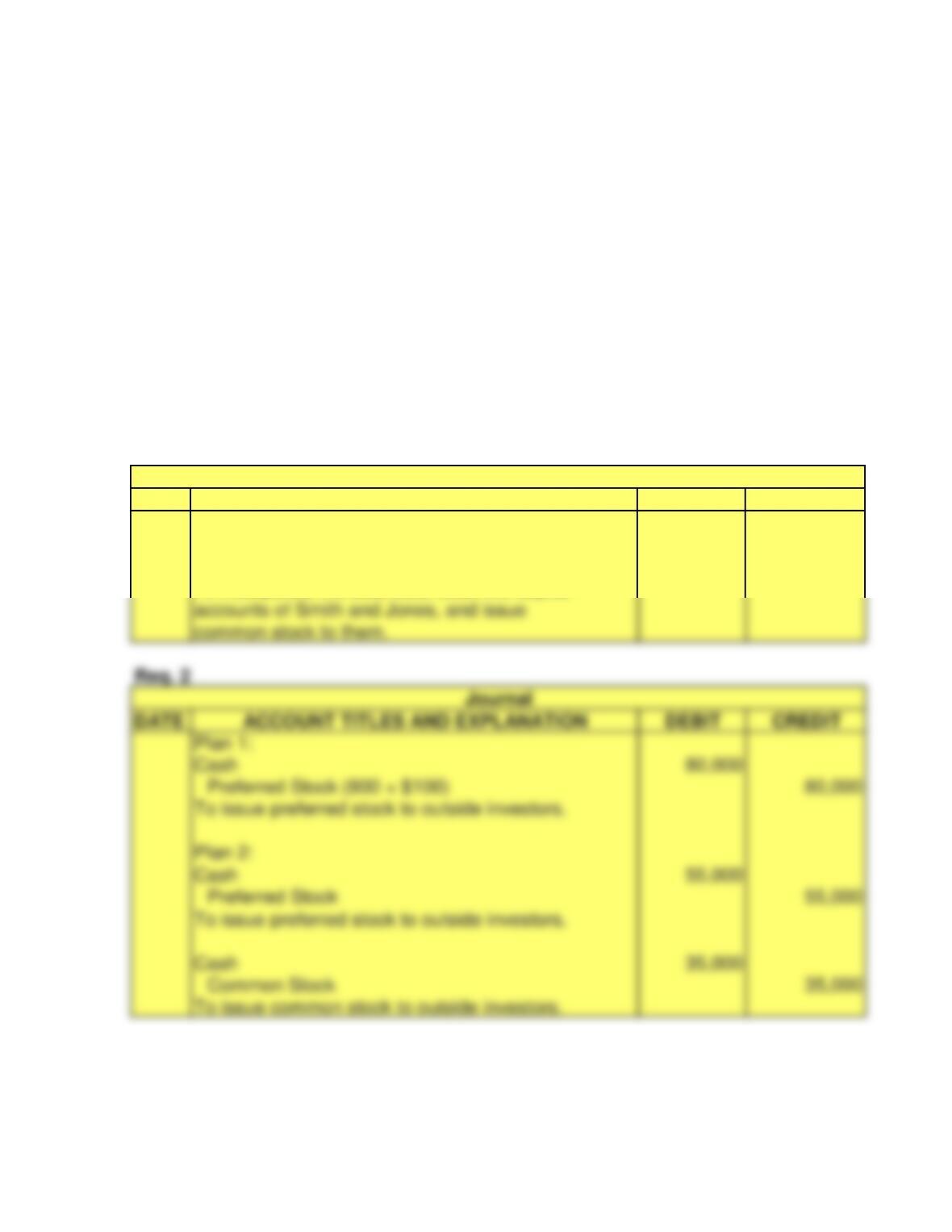
6. What was the average price paid by Akron Uniforms for the treasury stock at
December 31, 2016?
7. Prepare a summary journal entry to record the change in treasury stock during
the year.
8. Assuming net income for 2016 was $11,000,000, prepare a summary journal
entry to record the dividends declared during 2016.
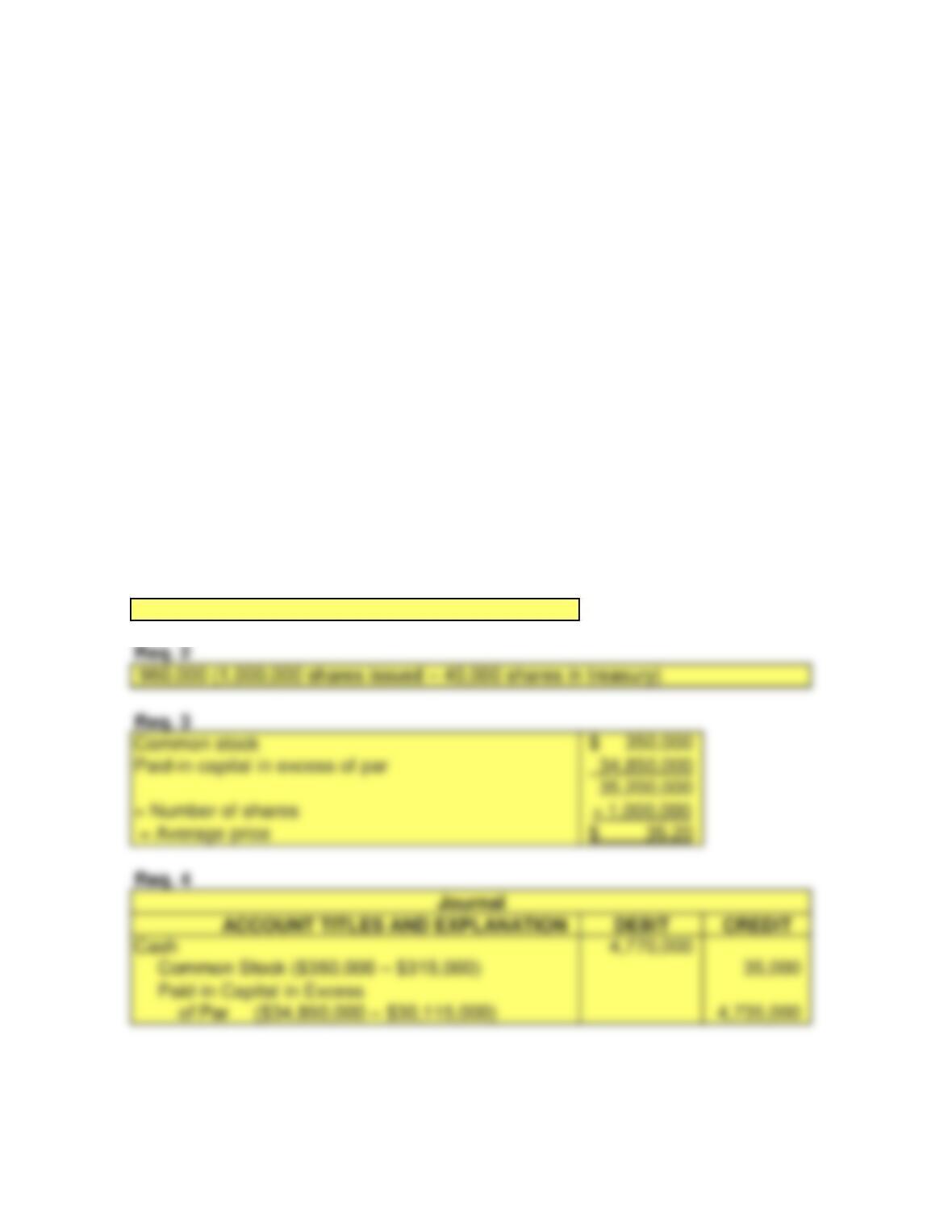
$350,000 / 1,000,000 shares = $.35 per share
Chapter 10: Stockholders’ Equity Page 84 of 98
Req. 2
FINANCIAL ACCOUNTING – Eleventh Edition Solutions Manual
Req. 5
Proceeds from issuance of stock 4,770,000$
÷ Number of shares 100,000
= Average price 47.70$
Chapter 10: Stockholders’ Equity Page 85 of 98
Proceeds from purchase of treasury stock 1,528,000$
Cash ($191,000 + $3,000) 194,000
Paid-in Capital from Treasury Stock
Req. 8
Retained Earnings 1,500,000
FINANCIAL ACCOUNTING – Eleventh Edition Solutions Manual
Decision Case 1
(30-45 min.)
Requirements
Solution:
Req. 1
DATE DEBIT CREDIT
Smith, Capital 25,000
Jones, Capital 25,000
Common Stock 50,000
To incorporate the business, close the capital
Assume that the corporation is chartered.
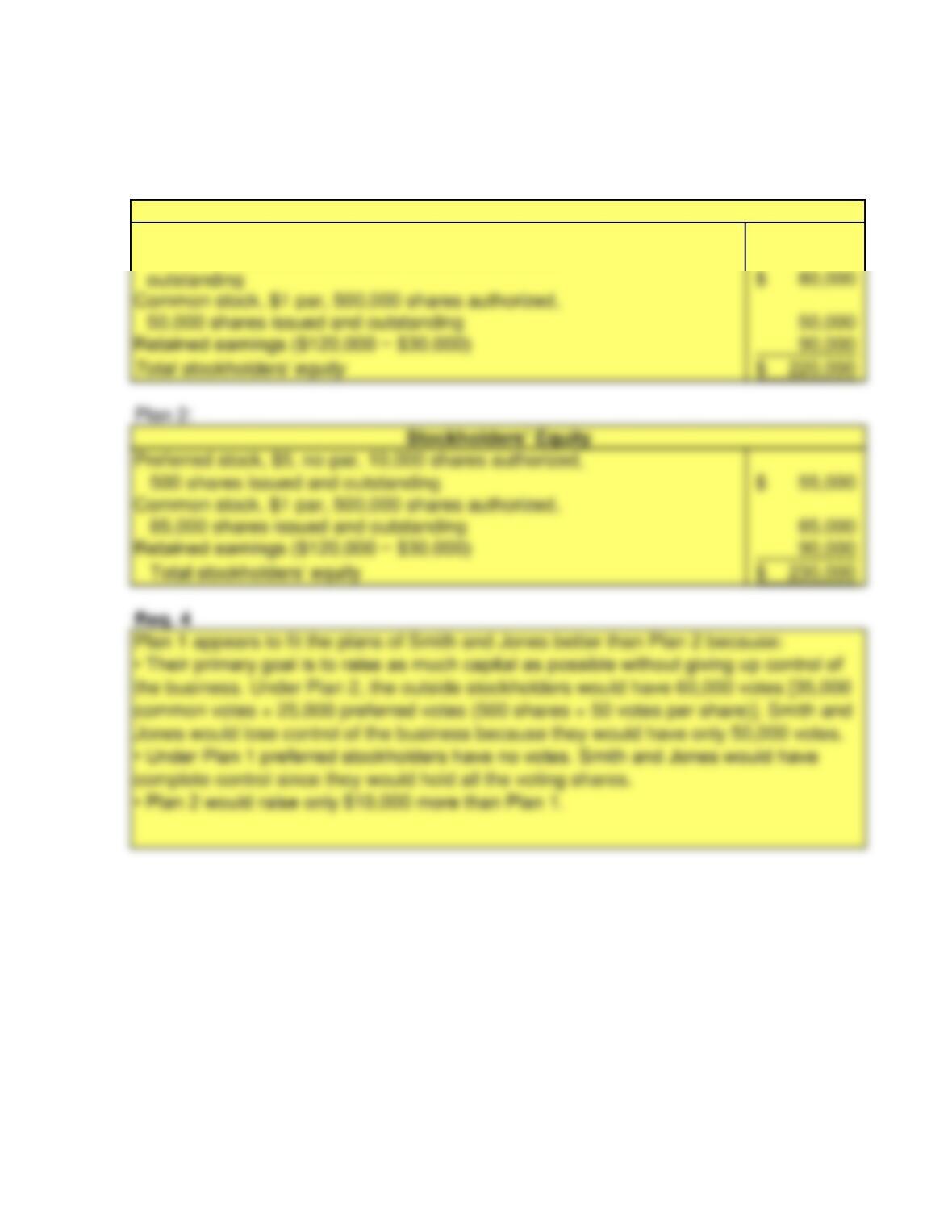
1. Journalize the issuance of common stock to Smith and Jones. Debit each person’s
capital account for its balance.
2. Journalize the issuance of stock to the outsiders under both plans.
3. Assume that net income for the first year is $120,000 and total dividends are
$30,000. Prepare the stockholders’ equity section of the corporation’s balance sheet
under both plans.
4. Recommend one of the plans to Smith and Jones. Give your reasons. (Challenge)
Journal
ACCOUNT TITLES AND EXPLANATION
Chapter 10: Stockholders’ Equity Page 86 of 98
accounts of Smith and Jones, and issue
Req. 2
DATE DEBIT CREDIT
Plan 1:
Cash 80,000
Preferred Stock (800 × $100) 80,000
To issue preferred stock to outside investors.
Cash 55,000
To issue preferred stock to outside investors.
Cash 35,000
Common Stock 35,000
To issue common stock to outside investors.
ACCOUNT TITLES AND EXPLANATION
Journal
FINANCIAL ACCOUNTING – Eleventh Edition Solutions Manual
Req. 3
Plan 1:
Preferred stock, 6%, $100 par, nonvoting,
Stockholders’ Equity
10,000 shares authorized, 800 shares issued and
Chapter 10: Stockholders’ Equity Page 87 of 98
Common stock, $1 par, 500,000 shares authorized,
500 shares issued and outstanding 55,000$
Common stock, $1 par, 500,000 shares authorized,
85,000 shares issued and outstanding 85,000
Req. 4
FINANCIAL ACCOUNTING – Eleventh Edition Solutions Manual
Decision Case 2
(15-20 min.)
Requirements
Solution:
Req. 1
1. How does the stock dividend affect your proportionate ownership in UPS? Explain.
2. What amount of cash dividends did you receive last year? What amount of cash
dividends will you receive after the above dividend action?
3. Assume that immediately after the stock dividend was distributed, the market value
of UPS’s stock decreased from $61.02 per share to $55.473 per share. Does this
decrease represent a loss to you? Explain.
4. Suppose UPS announces at the time of the stock dividend that the company will
continue to pay the annual $0.715 cash dividend per share, even after distributing the
stock dividend.
Would you expect the market price of the stock to decrease to $55.473 per share as in
requirement 3? Explain
The stock dividend does not affect your proportionate ownership in the company
because all the stockholders receive 10% new shares. All stockholders are in the same
relative position after the dividends as they were before.
Chapter 10: Stockholders’ Equity Page 88 of 98
Req. 2
Req. 3
Req. 4
Cash dividends received last year were $7,150 (10,000 shares × $0.715 per share).
Cash dividends after the dividend will be $7,150 (11,000 shares × $0.65 per share).
Thus, there is no change in cash dividends.
FINANCIAL ACCOUNTING – Eleventh Edition Solutions Manual
Ethical Issue 1
Requirements
Solution:
Req. 1
Req. 2 and Req.3
The stakeholders in the transaction include Campbell, the potential buyers of the
franchises, and potential lenders who loan them the money to buy the franchises in the
1. What is the ethical issue in this situation?
2. Who are the stakeholders in the suggested transaction?
3. Analyze this case from the following standpoints: (a) economic, (b) legal, and (c)
ethical. What are the consequences to each stakeholder?
4. How should the transaction be reported?
The ethical issue is, “What is the correct amount at which to record and disclose the
value of the franchise on Campbell’s balance sheet?”
Chapter 10: Stockholders’ Equity Page 89 of 98

FINANCIAL ACCOUNTING – Eleventh Edition Solutions Manual
Req. 4
The franchise should be valued at its true value, which is $50,000. Campbell should
focus his time and energy on ways to make the business profitable in the long run in
Chapter 10: Stockholders’ Equity Page 90 of 98
FINANCIAL ACCOUNTING – Eleventh Edition Solutions Manual
Ethical Issue 2
Requirements
Solution:
Req. 1
1. What is the ethical issue in this situation? What accounting principle is involved?
2. Who are the stakeholders?
3. Analyze the facts from the following standpoints: (a) economic, (b) legal, and (c)
ethical. What is the impact on each stakeholder?
4. What decision would you have made?
The ethical issue is whether the company acted properly in purchasing their shares
on the open market based on inside information known only to them.
Chapter 10: Stockholders’ Equity Page 91 of 98
Req. 2 and Req. 3
FINANCIAL ACCOUNTING – Eleventh Edition Solutions Manual
Req. 4
The correct way to handle this transaction is never to have proposed it in the first
place. However, if it did happen, the disclosure principle is relevant to the
Chapter 10: Stockholders’ Equity Page 92 of 98
FINANCIAL ACCOUNTING – Eleventh Edition Solutions Manual
Apple, Inc.
(20-30 min.)
Requirements
Solution:
Req. 1
1. Refer to Apple’s Consolidated Balance Sheets and Note 7 (Shareholders’ Equity).
Describe the class of stock that Apple Inc. has authorized. How many shares of that stock
have been issued as of September 27, 2014? How many are outstanding as of September
27, 2014? 2. Refer to the
Consolidated Balance Sheets and the Consolidated Statements of Stockholders’ Equity.
How many shares of treasury stock did the company purchase during the year ended
September 27, 2014? What was the cost of the treasury stock? How much per share?
3. Examine Apple Inc.’s Consolidated Statement of Stockholders’ Equity. Analyze the
change that occurred in the company’s Retained Earnings account during the year ended
September 27, 2014. Can you trace the change to any of its other financial statements? Is
this a good thing or a bad thing?
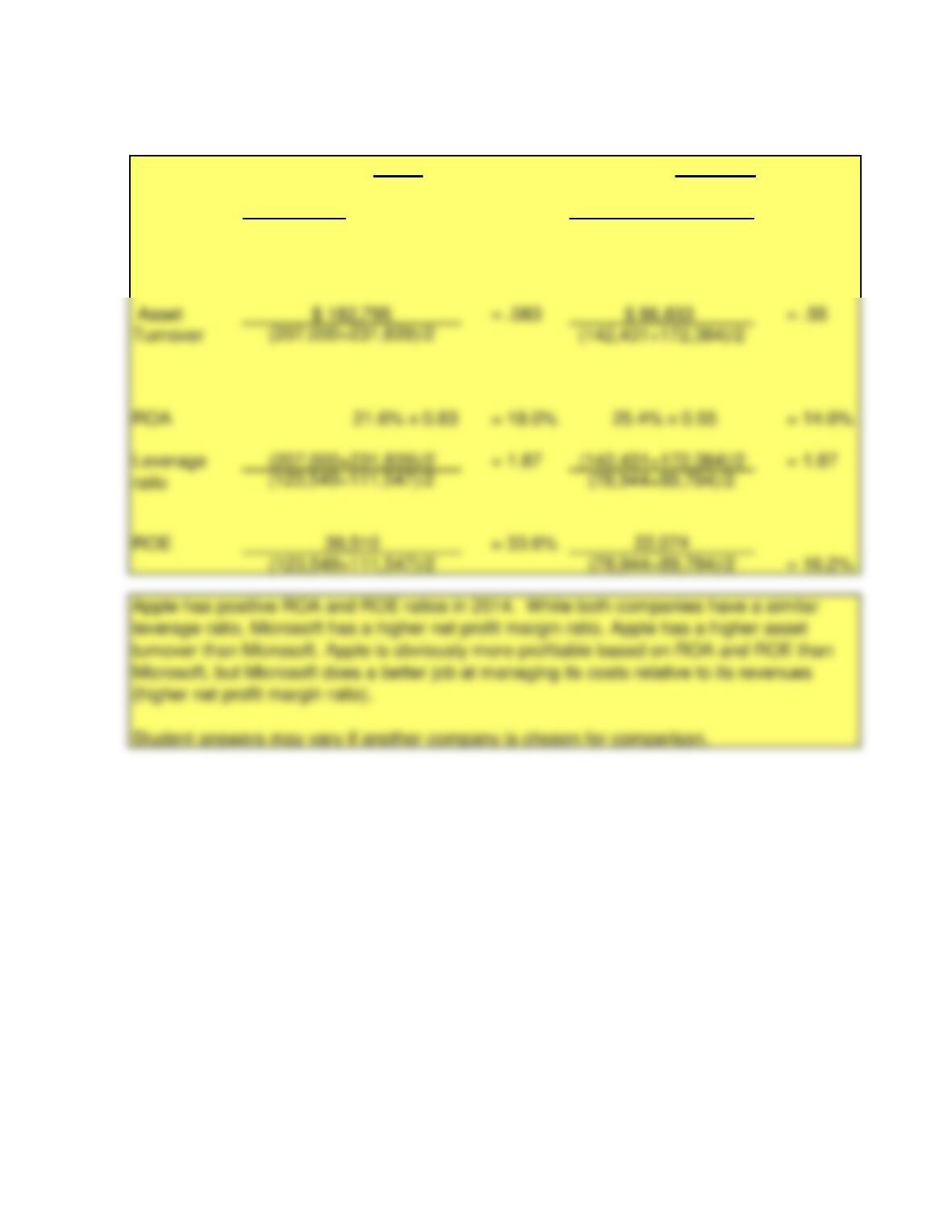
4. Use DuPont Analysis to compute Apple Inc.’s return on equity and return on assets for
2014. Pick a company that is a competitor of Apple Inc. and compute these ratios for the
competitor. Which ratios are similar? Which are different? Which company do you think is
more profitable? Explain.
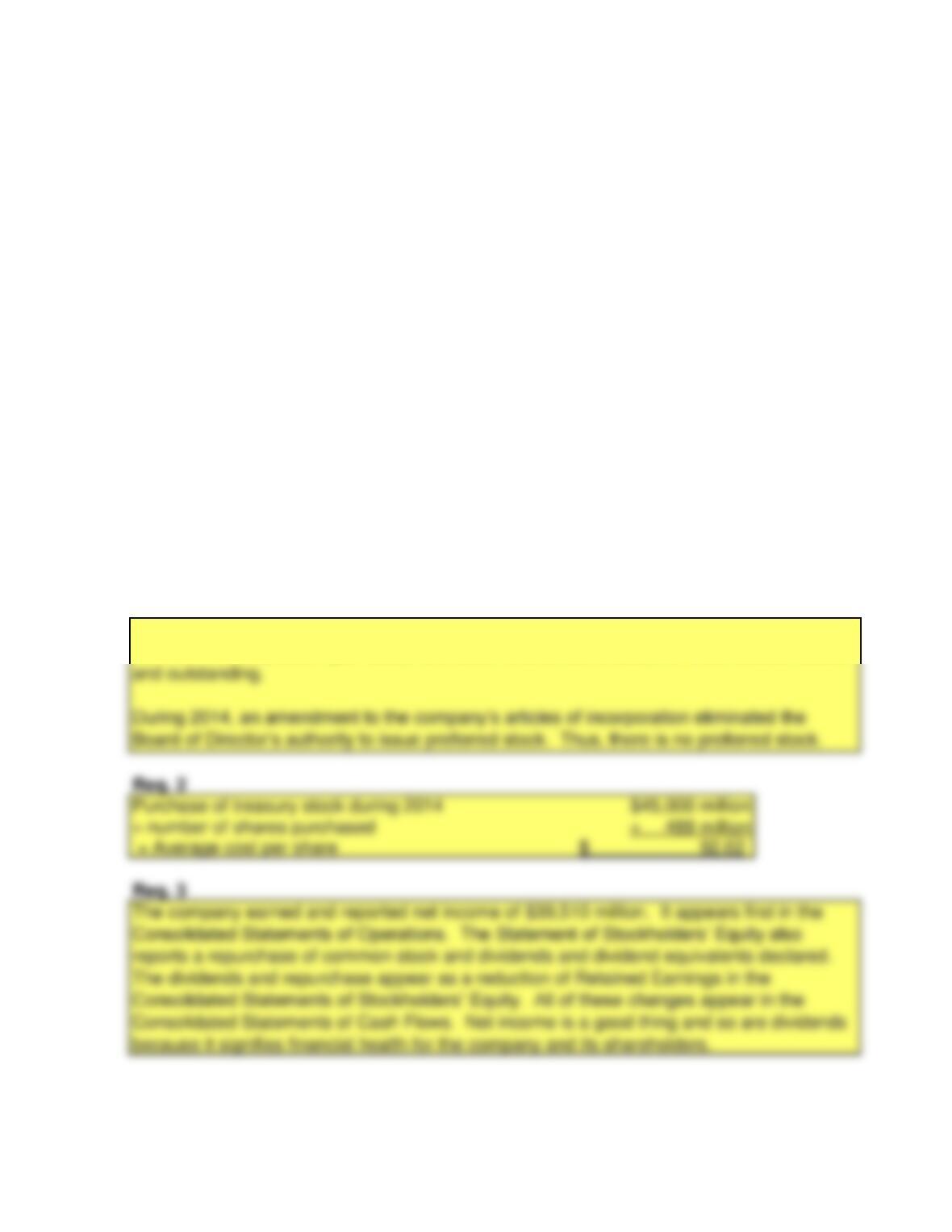
Apple Inc. has only one class of stock authorized at September 27, 2014:
Common stock, $.00001 par value, 12.6 billion shares authorized, 5.9 billion shares issued
Chapter 10: Stockholders’ Equity Page 93 of 98
Req. 2
Req. 3
FINANCIAL ACCOUNTING – Eleventh Edition Solutions Manual
Req. 4
39,510$ 21.6% $ 22,074 25.4%
$ 182,795 $ 86,833
Net
Profit
Margin
ratio
Apple
Microsoft
=
=
Chapter 10: Stockholders’ Equity Page 94 of 98
FINANCIAL ACCOUNTING – Eleventh Edition Solutions Manual
Under Armour, Inc.
(20-30 min.)
Requirements
Solution:
Req. 1
1. As of the end of December 31, 2014, how many shares of common stock does
Under Armour, Inc., have authorized? Issued? Outstanding?
2. Refer to Note 8 —Stockholders’ Equity and the Consolidated Statement of
Stockholders’ Equity for the year 2014. What is the difference between Under
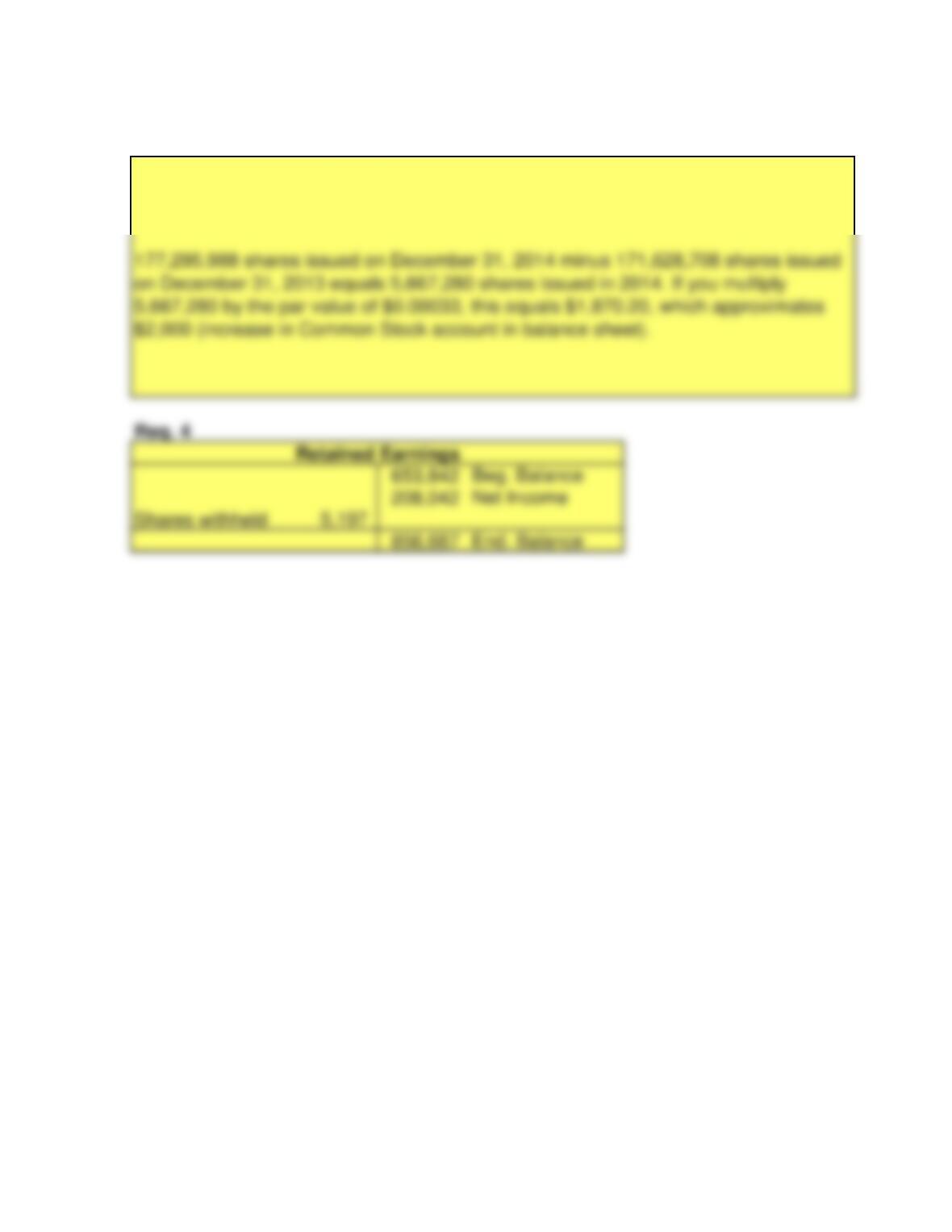
Armour’s Class A Common Stock and Class B Convertible Common Stock? Are there
any restrictions on who can own Class B stock?
3. Did Under Armour, Inc., issue any new shares of Class A Common Stock during
2014? How can you tell? (Challenge)
4. Prepare a T-account to show the beginning and ending balances plus all the activity
in Retained Earnings for 2014.
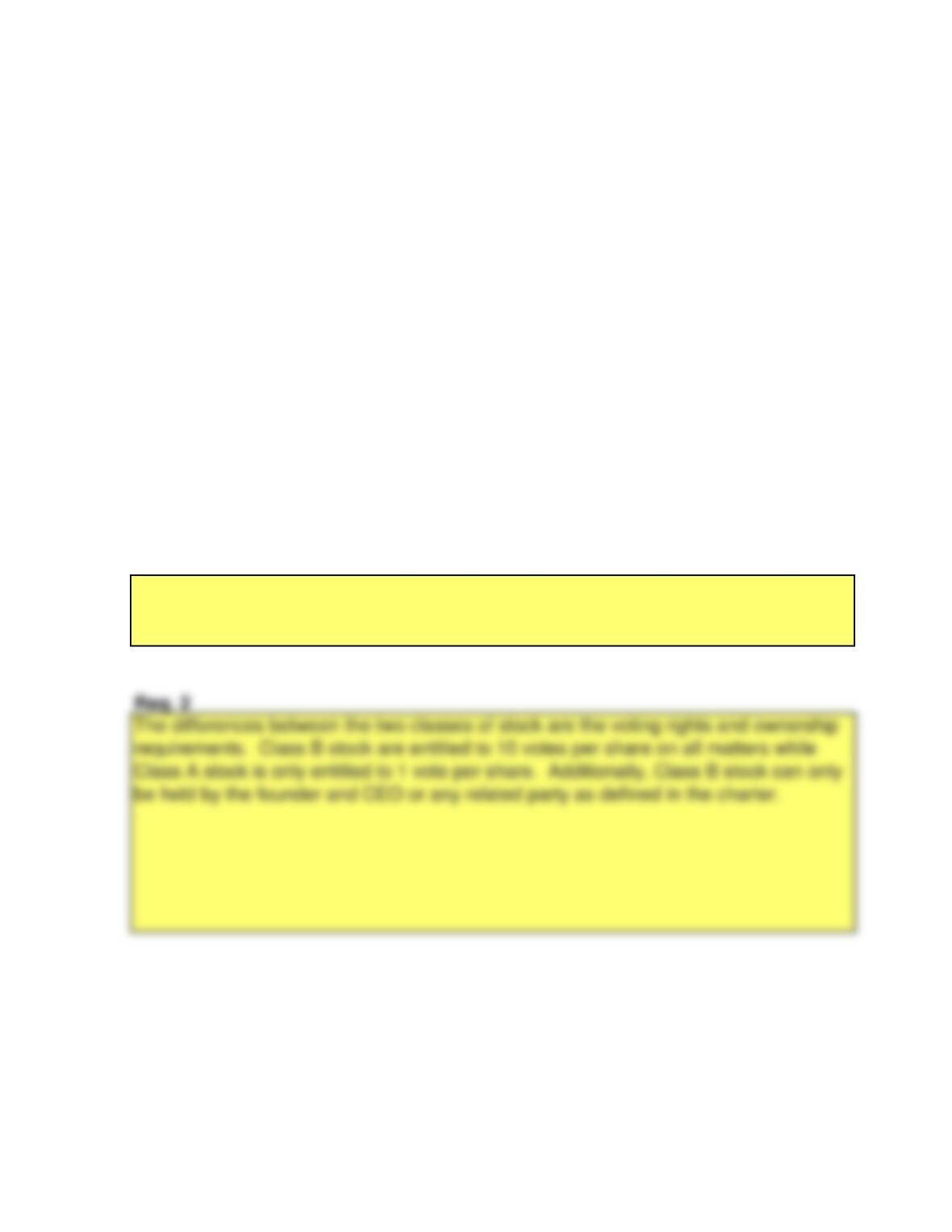
Under Armour, Inc. has 400,000,000 shares of Class A Common Stock authorized,
177,295,988 shares issued and outstanding. It also has 36,600,000 shares of Class B
Convertible Common Stock authorized, issued, and outstanding.
Chapter 10: Stockholders’ Equity Page 95 of 98
Req. 2
FINANCIAL ACCOUNTING – Eleventh Edition Solutions Manual
Req. 3
Under Armour, Inc. issued around 6 million new shares of Class A stock. This is
found in the consolidated balance sheet by looking at the number of shares issued in
the stockholders’ equity section.
Chapter 10: Stockholders’ Equity Page 96 of 98
Req. 4
FINANCIAL ACCOUNTING – Eleventh Edition Solutions Manual
Group Project in Ethics
(1-3 hours, including discussion)
Requirements
Solution:
Req. 1
Stakeholders in a corporation vary widely with the nature of the corporation. In the
case of the corporations included in this case (GM, Chrysler, AIG, Citibank, Bank of
America) because of their size and the scope of their operations, stakeholders include
1. Identify all the stakeholders of a corporation. A stakeholder is a person or a group
who has an interest (that is, a stake) in the success of the organization.
2. Do you believe that some entities are “too important to fail”? Should the federal
government help certain businesses to stay afloat during economic recessions and
allow others to fail?
3. Identify several measures by which a company may be considered deficient and in
need of downsizing. How can downsizing help to solve this problem?
4. Debate the bailout issue. One group of students takes the perspective of the
company and its stockholders, and another group of students takes the perspective of
the other stakeholders of the company (the community in which the company operates
and society at large).
5. What is the problem with the government taking an equity position such as preferred
stock in a private enterprise?
Chapter 10: Stockholders’ Equity Page 97 of 98
Req. 2
Req. 3
FINANCIAL ACCOUNTING – Eleventh Edition Solutions Manual
Req. 4
Student opinions on this will vary.
Chapter 10: Stockholders’ Equity Page 98 of 98
Req. 5