CHAPTER 10 Long-Term Assets: Fixed and Intangible
Prob. 10-2A
1.
a. Straight- b. Units-of- c. Double-
Line Activity Declining-Balance
Year Method Method Method
Year 1 $22,500 $28,500 $48,000
Year 2 22,500 22,500 16,000
Calculations:
Straight-line method:
($72,000 – $4,500) ÷ 3 = $22,500 each year
Units-of-activity method:
Double-declining-balance method:
Year 1: $72,000 × (2 ÷ 3) = $48,000
Year 2: ($72,000 – $48,000) × (2 ÷ 3) = $16,000
Year 3: ($72,000 – $48,000 – $16,000 – $4,500) = $3,500
Note: Book value should not be reduced below the residual value of $4,500.
2. The double-declining-balance method yields the most depreciation expense in
Year 1 of $48,000.
3. Over the three-year life of the equipment, all three depreciation methods yield
Depreciation Expense
CHAPTER 10 Long-Term Assets: Fixed and Intangible
Prob. 10-3A
a. Straight-line method:
Year 1: ($270,000 – $9,000) ÷ 3 × 9 ÷ 12……………………………………
…
$65,250
Year 2: ($270,000 – $9,000) ÷ 3………………………………………………
…
87,000
b. Units-of-activity method:
Activity rate = ($270,000 – $9,000) ÷ 18,000 hours = $14.50 per hour
Year 1: 7,500 hours × $14.50………………………………………………… $108,750
c. Double-declining-balance method:
Year 1: $270,000 × 2 ÷ 3 × 9 ÷ 12……………………………………………
…
$135,000
Year 2: ($270,000 – $135,000) × 2 ÷ 3………………………………………
…
90,000
Year 3: ($270,000 – $135,000 – $90,000) × 2 ÷ 3…………………………
…
30,000
Year 4: ($270,000 – $135,000 – $90,000 – $30,000 – $9,000)……………
…
6,000
Note: Book value should not be reduced below $9,000, the residual value.
…
…
CHAPTER 10 Long-Term Assets: Fixed and Intangible
Prob. 10-4A
1.
Depreciation Book Value,
Expense End of Year
a. 1……………………………………………
…
$142,000 $658,000
2……………………………………………
…
142,000 516,000
b. [$800,000 × (100% ÷ 5) × 2]……
…
$320,000 $480,000
[$480,000 × (100% ÷ 5) × 2]……
…
192,000 288,000
…
…
Note: Book value should not be reduced below $90,000, the residual value.
2. Mar. 4 Cash
Accumulated Depreciation—Equipment
Equipment
Gain on Sale of Equipment
Gain on sale of equipment = $135,000 – ($800,000 – $696,320) = $31,320
3. Mar. 4 Cash
Accumulated Depreciation—Equipment
Depreciation,
End of Year
88,750
696,320
31,320
696,320
800,000
135,000
$320,000
512,000
$142,000
284,000
Accumulated
Year
1
2
…
…
…
CHAPTER 10 Long-Term Assets: Fixed and Intangible
Prob. 10-5A
Year 1
Jan. 4 Delivery Truck 28,000
Cash 28,000
Nov. 2 Truck Repair Expense 675
Cash 675
Year 2
Jan. 6 Delivery Truck 48,000
Cash 48,000
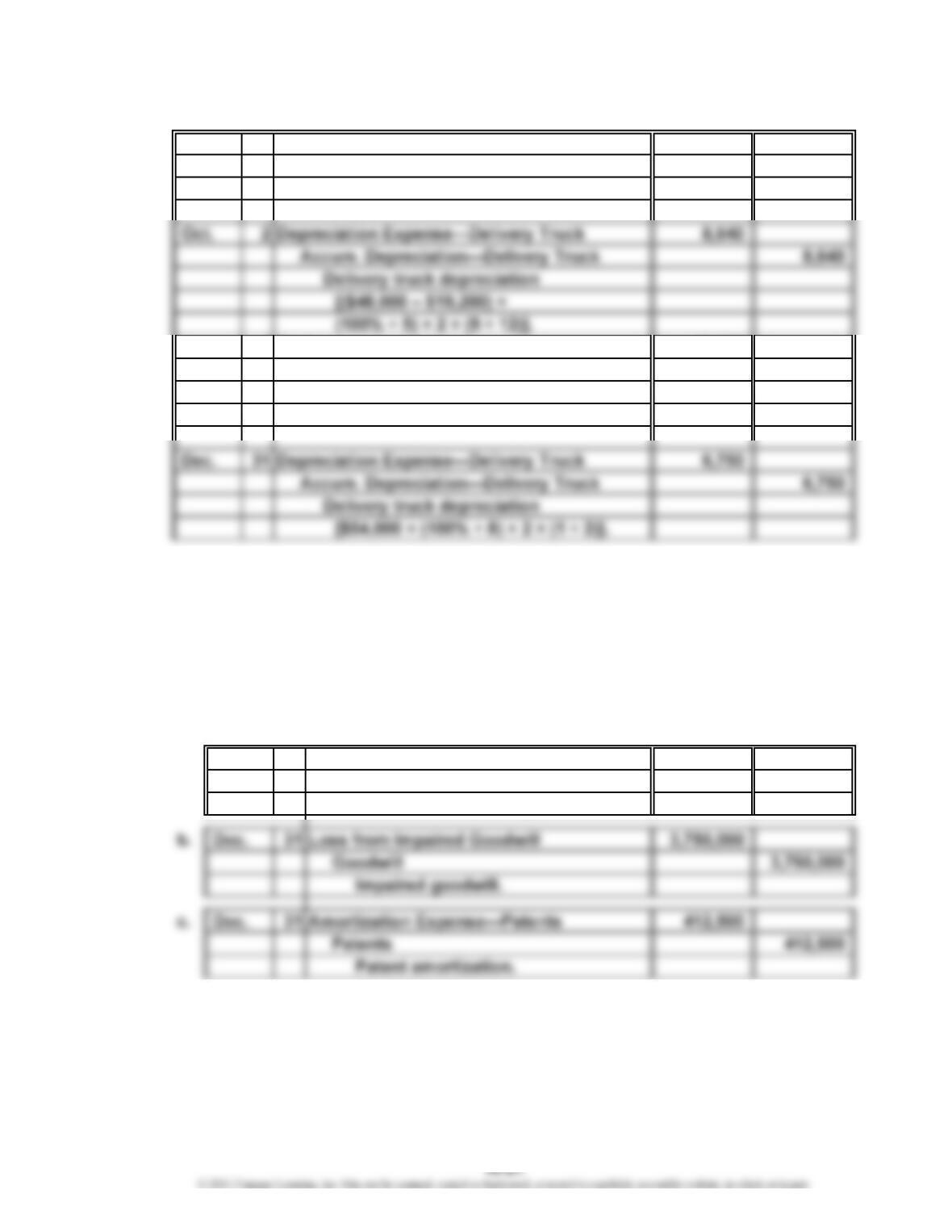
Apr. 1 Depreciation Expense—Delivery Truck 1,750
Accum. Depreciation—Delivery Truck 1,750
Delivery truck depreciation
[($28,000 – $14,000) ×
(100% ÷ 4) × 2 × (3 ÷ 12)].
June 11 Truck Repair Expense 450
Cash 450
CHAPTER 10 Long-Term Assets: Fixed and Intangible
Prob. 10-5A (Concluded)
1 Delivery Truck 54,000
Cash 54,000
2 Cash 16,750
Accum. Depreciation—Delivery Truck 27,840
Loss on Sale of Delivery Truck 3,410
Delivery Truck 48,000
Prob. 10-6A
1. a. $1,600,000 ÷ 5,000,000 board feet = $0.32 per board foot;
1,100,000 board feet × $0.32 per board foot = $352,000
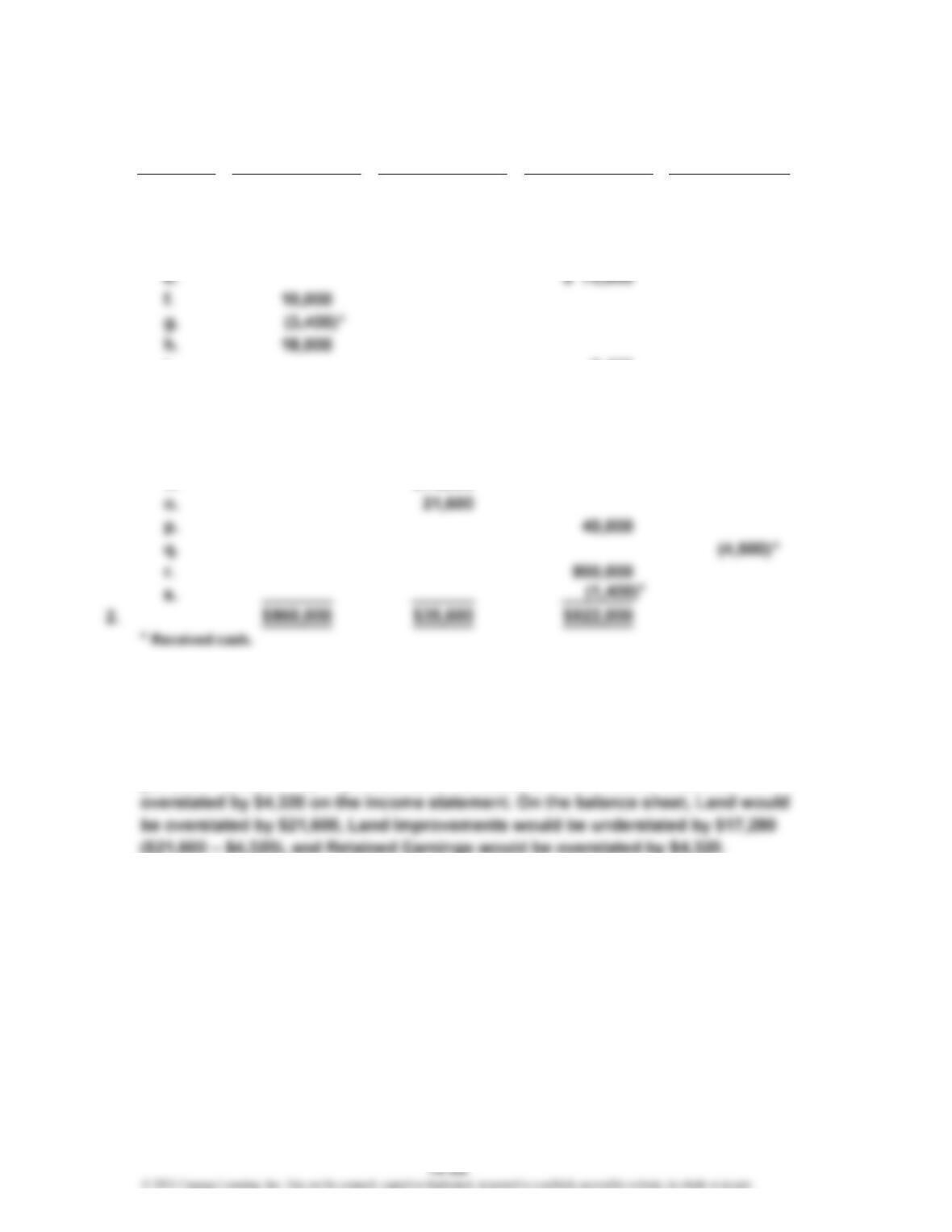
b. Loss from impaired goodwill, $3,750,000
c. $6,600,000 ÷ 12 years = $550,000;
3/4 of $550,000 = $412,500
2. a. Dec. 31 Depletion Expense 352,000
Accumulated Depletion 352,000
Depletion of timber rights.
Year 3
July
CHAPTER 10 Long-Term Assets: Fixed and Intangible
Prob. 10-1B
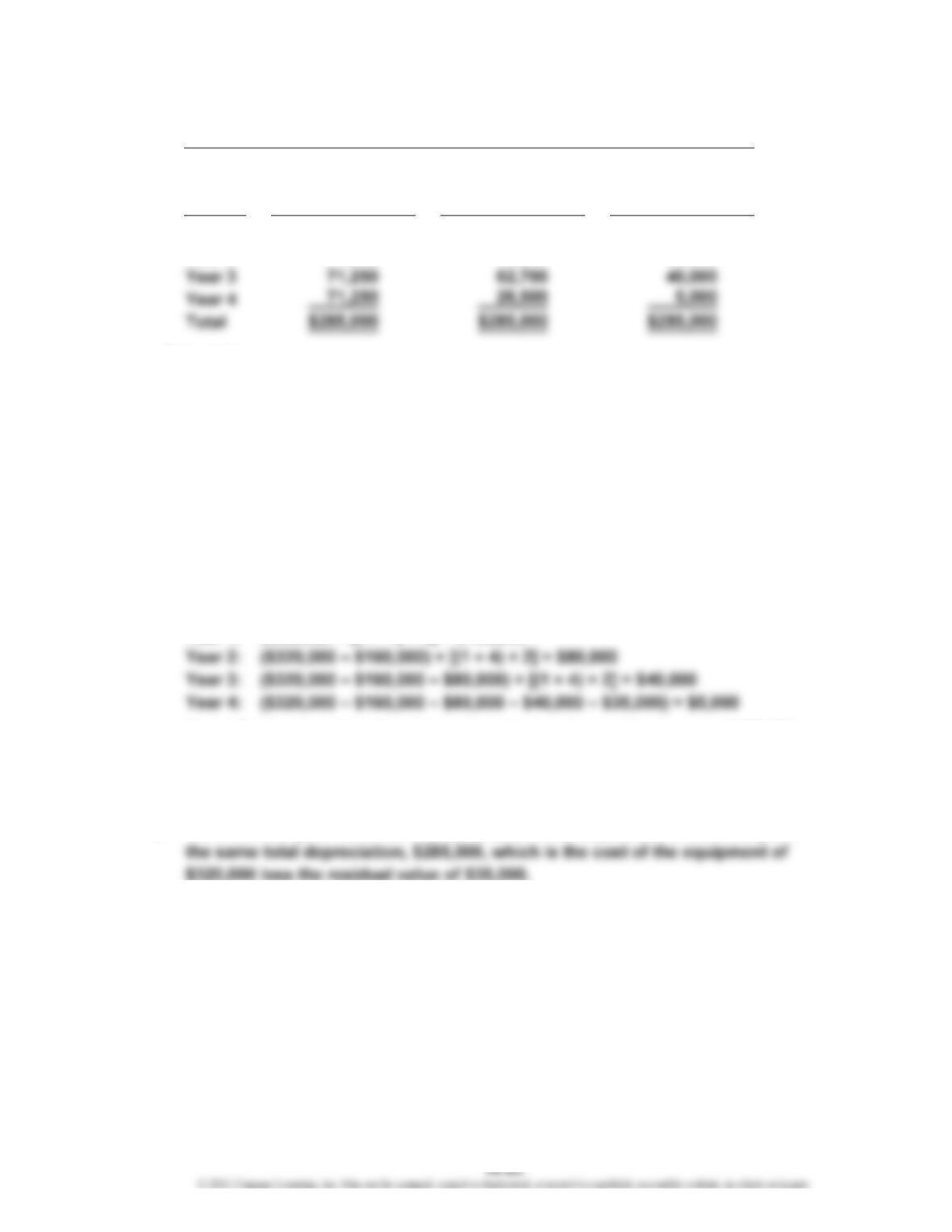
1. Land Other
Item Land Improvements Building Accounts
a. $ 3,600
b. 780,000
c. 23,400
d. 15,000
i. 8,400
j. $(800,000)
k. 13,400
l. 3,000
m. 2,000
3. Land used as a plant site does not lose its ability to provide services; thus, it is
not depreciated. However, land improvements do lose their ability to provide
services as time passes and are, therefore, depreciated.
4. Because land improvements are depreciated, depreciation expense of $4,320
[$21,600 × (100% ÷
10) × 2] would be understated and net income would be
*
CHAPTER 10 Long-Term Assets: Fixed and Intangible
Prob. 10-2B
1.
a. Straight- b. Units-of- c. Double-
Line Activity Declining-Balance
Year Method Method Method
Year 1 $ 71,250 $102,600 $160,000
Year 2 71,250 91,200 80,000
Calculations:
Straight-line method:
($320,000 – $35,000) ÷ 4 = $71,250 each year
Units-of-activity method:
($320,000 – $35,000) ÷ 20,000 hours = $14.25 per hour
Year 1: 7,200 hours × $14.25 = $102,600
Year 2: 6,400 hours × $14.25 = $91,200
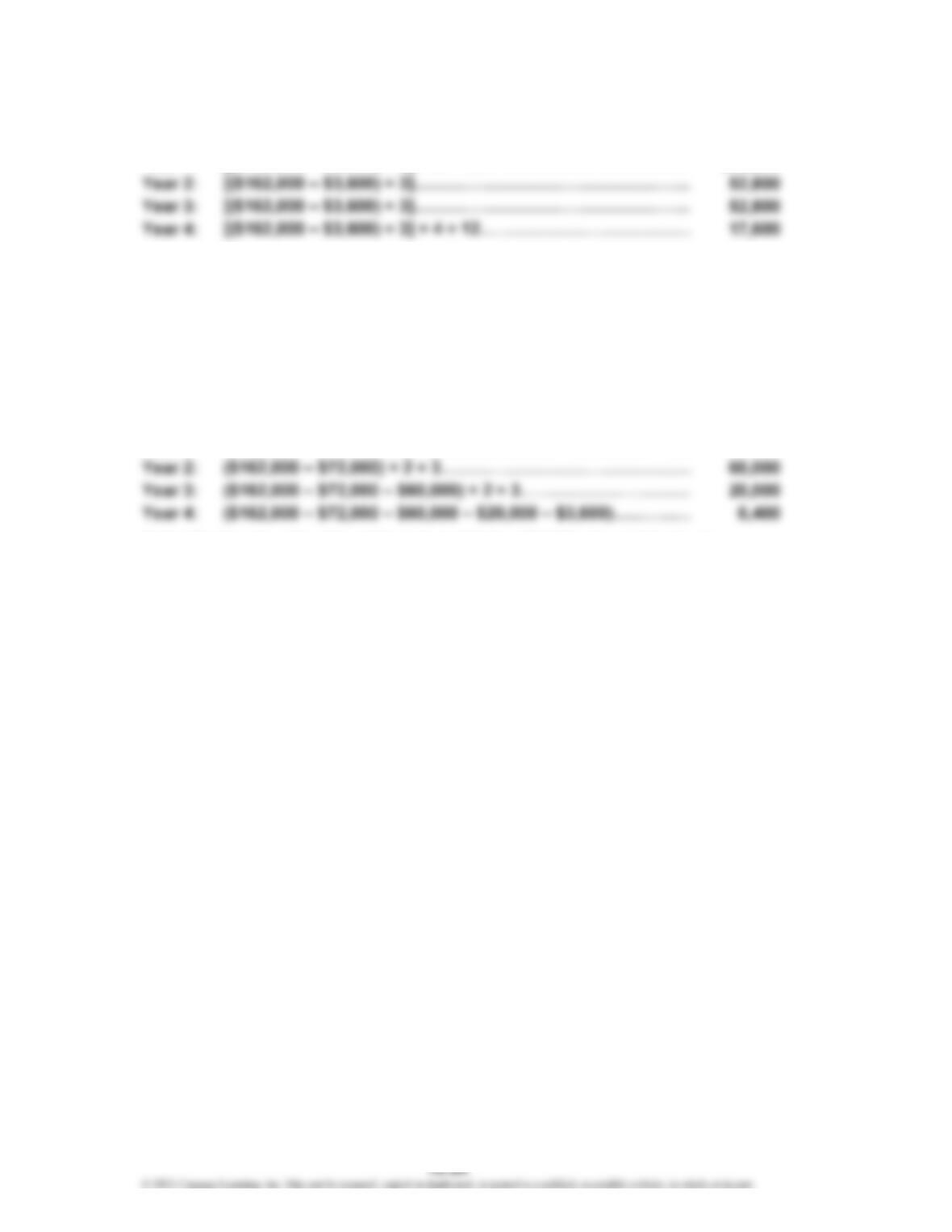
Year 3: 4,400 hours × $14.25 = $62,700
Year 4: 2,000 hours × $14.25 = $28,500
Double-declining-balance method:
Year 1: $320,000 × [(1 ÷ 4) × 2] = $160,000
Note: Book value should not be reduced below the residual value of $35,000.
2. The double-declining-balance method yields the most depreciation expense in
Year 1 of $160,000.
3. Over the four-year life of the equipment, all three depreciation methods yield
Depreciation Expense
CHAPTER 10 Long-Term Assets: Fixed and Intangible
Prob. 10-3B
a. Straight-line method:
Year 1: [($162,000 – $3,600) ÷ 3] × 8 ÷ 12………………………………
…
$35,200
b. Units-of-activity method:
Activity rate = ($162,000 – $3,600) ÷ 12,000 hours = $13.20 per hour
Year 1: 2,400 hours × $13.20……………………………………………… $31,680
Year 2: 3,900 hours × $13.20……………………………………………… 51,480
Year 3: 4,050 hours × $13.20……………………………………………… 53,460
Year 4: 1,650 hours × $13.20……………………………………………… 21,780
c. Double-declining-balance method:
Year 1: $162,000 × 2 ÷ 3 × 8 ÷ 12…………………………………………
…
$72,000
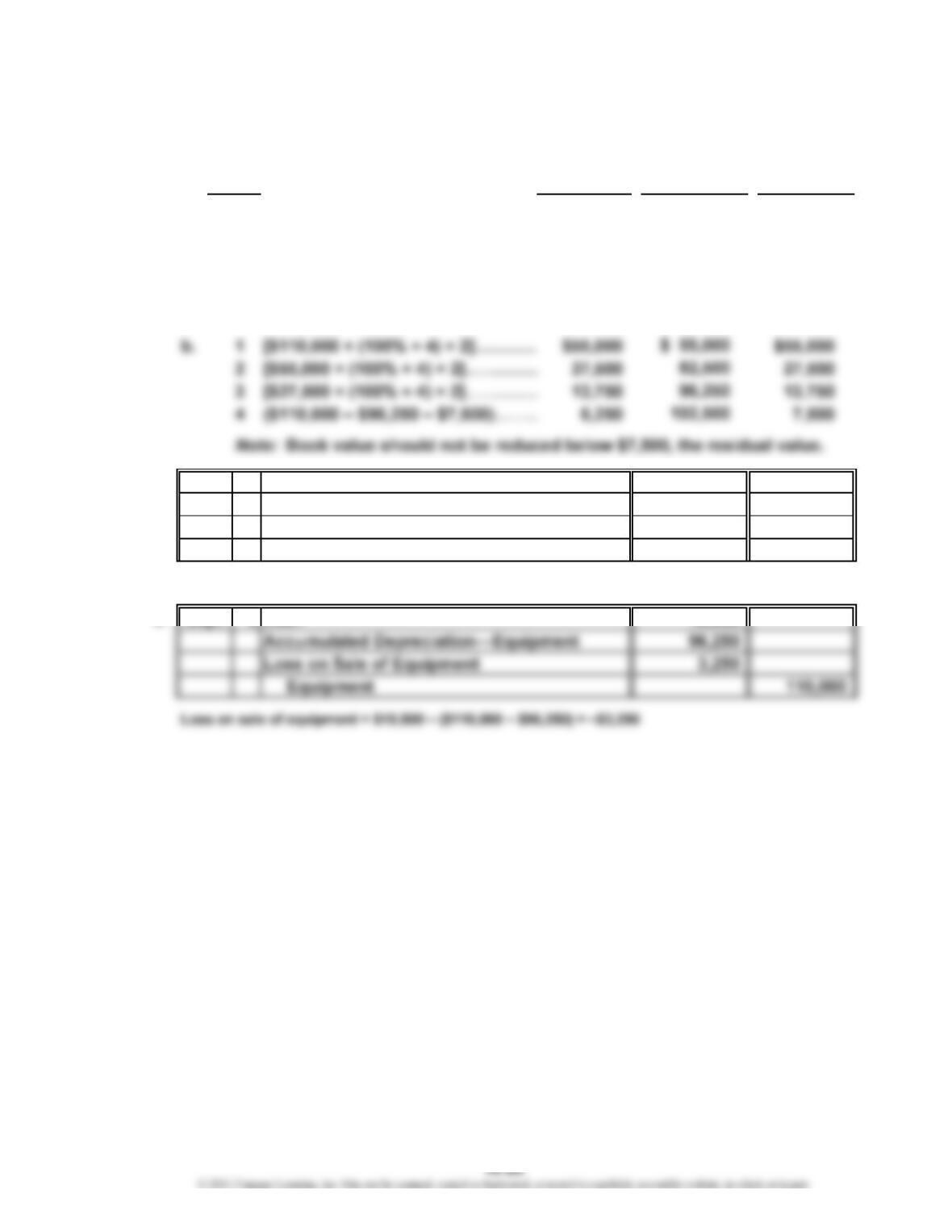
Note: Book value should not be reduced below $3,600, the residual value.
…
CHAPTER 10 Long-Term Assets: Fixed and Intangible
Prob. 10-4B
1.
Depreciation Book Value,
Expense End of Year
a. 1………………………………………………
…
$25,625 $84,375
2………………………………………………
…
25,625 58,750
3………………………………………………
…
25,625 33,125
4………………………………………………
…
25,625 7,500
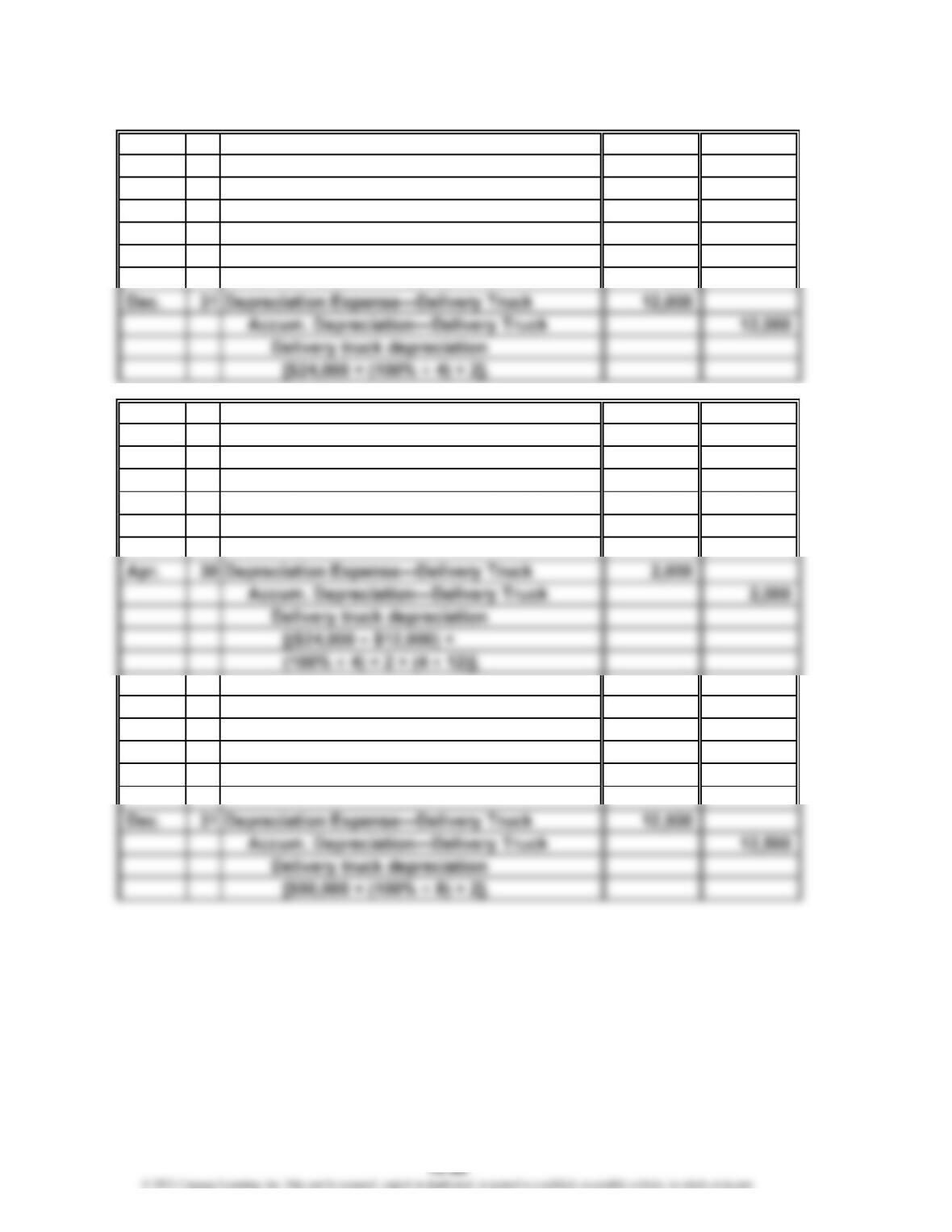
Yearly depreciation = [($110,000 – $7,500) ÷ 4] = $25,625
2. Sept. 6 Cash
Accumulated Depreciation—Equipment
Equipment
Gain on Sale of Equipment
Gain on sale of equipment = $18,000 – ($110,000 – $96,250) = $4,250
Depreciation,
End of Year
4,250
$ 25,625
51,250
76,875
Accumulated
102,500
Year
110,000
18,000
96,250
CHAPTER 10 Long-Term Assets: Fixed and Intangible
Prob. 10-5B
Year 1
Jan. 8 Delivery Truck 24,000
Cash 24,000
Mar. 7 Truck Repair Expense 900
Cash 900
Year 2
Jan. 9 Delivery Truck 50,000
Cash 50,000
Feb. 28 Truck Repair Expense 250
Cash 250
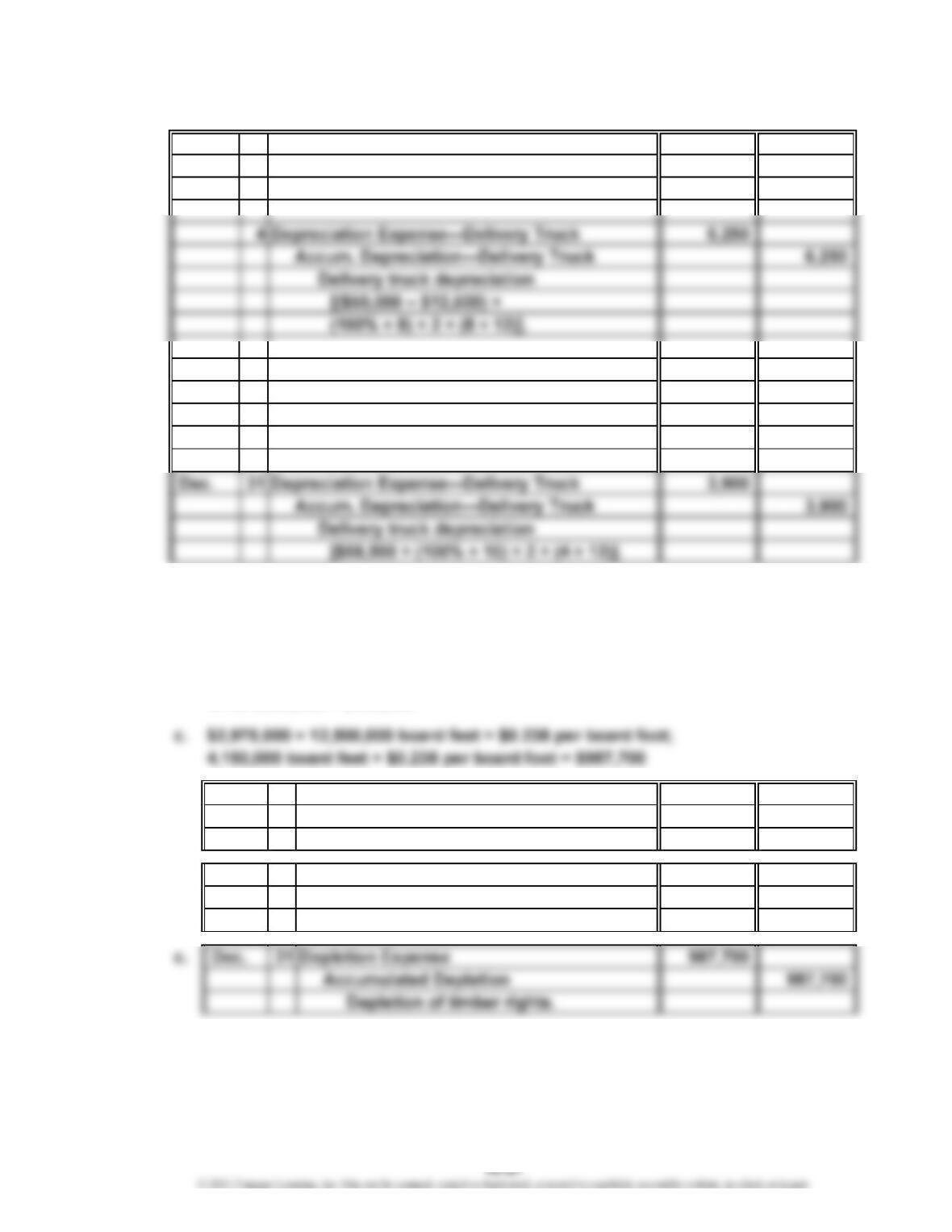
30 Accum. Depreciation—Delivery Truck 14,000
Cash 9,500
Loss on Sale of Delivery Truck 500
Delivery Truck 24,000
CHAPTER 10 Long-Term Assets: Fixed and Intangible
Prob. 10-5B (Concluded)
1 Delivery Truck 58,500
Cash 58,500
4 Cash 36,000
Accum. Depreciation—Delivery Truck 18,750
Delivery Truck 50,000
Gain on Sale of Delivery Truck 4,750
Prob. 10-6B
1. a. Loss from impaired goodwill, $3,400,000
b. $4,800,000 ÷ 8 years = $600,000;
1/4 of $600,000 = $150,000
2. a. Dec. 31 Loss from Impaired Goodwill 3,400,000
Goodwill 3,400,000
Impaired goodwill.
b. Dec. 31 Amortization Expense—Patents 150,000
Patents 150,000
Patent amortization.
Year 3
Sept.
CHAPTER 10 Long-Term Assets: Fixed and Intangible
CP 10-1
1. Estimates of the factors determining depreciation expense create a unique financial
reporting challenge. Because the useful life and residual value are estimates, there
is no “correct” amount. The company must use judgment along with historical data to
develop estimates that fairly reflect these items. These estimates are required under
2. In this case, both Mike and James appear to be acting unethically. The original
useful life and residual value estimates were based on good faith estimates. By
changing these estimates in order to meet an earnings goal, they have both
CP 10-2
It is considered unprofessional for employees to use company assets for personal
reasons because such use reduces the useful life of the assets for normal business
purposes. Thus, it is unethical for Dave Elliott to use Lyric Consulting Co.’s
CP 10-3
A sample solution based on Nike Inc.’s Form 10-K for the fiscal year ended May 31, 2018,
follows:
1. a. Depreciation is determined on a straight-line basis for buildings and leasehold
improvements over 2 to 40 years and for machinery and equipment over 2 to
15 years.
b. The company does not report depreciation expense separately on the face of the
income statement. However, the amount of depreciation can be obtained from
footnotes to the financial statements and is reported at $747 million.
CASES & PROJECTS
CHAPTER 10 Long-Term Assets: Fixed and Intangible
CP 10-3 (Concluded)
e. Identifiable intangible assets consist of indefinite-lived trademarks,
which are not subject to amortization, and acquired trademarks and other
intangible assets, which are subject to amortization. At May 31, 2018 and 2017,
2. No. Book value is the difference between the fixed asset account and its related
accumulated depreciation account. Depreciation does not measure a decline in
the market value of a fixed asset. Instead, depreciation is an allocation of a
CP 10-4
Note to Instructors: The purpose of this activity is to familiarize students with the
procedures involved in acquiring a patent, a copyright, and a trademark. You may
wish to divide the class into three groups to report back on patents, copyrights,
and trademarks separately.
The following is some information on patents, copyrights, and trademarks that you
may find helpful in your discussions.
Patent
A patent is requested by filing a written application at the relevant patent office.
The person or company filing the application is referred to as “the applicant.”
The applicant may be the inventor or its assignee. The application contains a
description of how to make and use the invention that must provide sufficient detail
for a person skilled in the art (i.e., the relevant area of technology) to make and use
the invention. In some countries, there are requirements for providing specific
information such as the usefulness of the invention, the best mode of performing
the invention known to the inventor, or the technical problem or problems solved
by the invention. Drawings illustrating the invention may also be provided.
CHAPTER 10 Long-Term Assets: Fixed and Intangible
CP 10-4 (Concluded)
Copyright
While copyright in the United States automatically attaches upon the creation of an
original work of authorship, registration with the Copyright Office puts a copyright
holder in a better position if litigation arises over the copyright. A copyright holder
wanting to register his or her copyright should do the following:
1. Obtain and complete appropriate form.
Source: http://en.wikipedia.org/wiki/United_States_copyright_law#Procedural_issues.
Trademark
The law considers a trademark to be a form of property. Proprietary rights in
relation to a trademark may be established through actual use in the marketplace
or through registration of the mark with the trademarks office (or “trademarks
registry”) of a particular jurisdiction. In some jurisdictions, trademark rights can
be established through either or both means. Certain jurisdictions generally do not
recognize trademark rights arising through use. In the United States, the only
way to qualify for a federally registered trademark is to first use the trademark in
CP 10-5
To: CFO, Godwin Co.
From: IMA Student
Re: Financial Statement Effects of Modifications to Trucks 1 and 2
The modification to Truck 1 is an example of an asset improvement. After this truck was
placed into service, a hydraulic lift was added to the truck. This change increased the
capabilities of the truck. As a result, the cost of the hydraulic lift is added to the cost of
the truck and depreciated over the truck’s remaining useful life. Because the cost of the
CP 10-6
You should explain to Nolan and Stacy that it is acceptable to maintain two sets
of records for tax and financial reporting purposes. This can happen when a
company uses one method for financial statement purposes, such as straight-line
depreciation, and another method for tax purposes, such as MACRS depreciation.
This should not be surprising because the methods for taxes and financial statements
are established by two different groups with different objectives. That is, tax laws
and related accounting methods are established by Congress. The Internal
Revenue Service then applies the laws and, in some cases, issues interpretations
of the law and congressional intent. The primary objective of the tax laws is to