15 Minutes, Easy
PROBLEM 10.5B
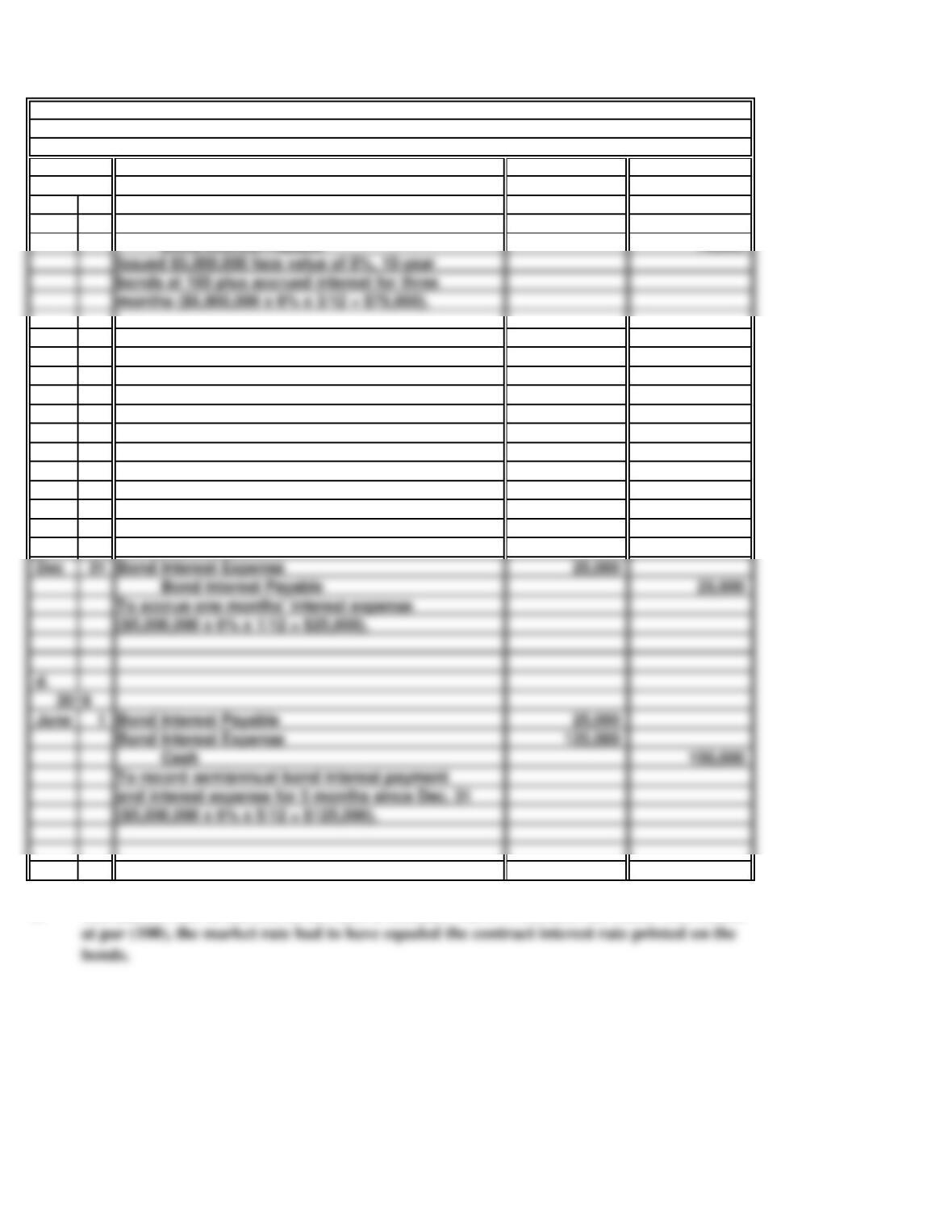
Sept 1 Cash 5,075,000
Bonds Payable 5,000,000
Bond Interest Payable 75,000
b.
Dec 1 75,000
75,000
Cash 150,000
c.
Dec 31 25,000
Bond Interest Payable 25,000
d.
June 1 25,000
Cash 150,000
Bond Interest Expense
Bond Interest Expense
($5,000,000 x 6% x 5/12 = $125,000).
and interest expense for 5 months since Dec. 31
($5,000,000 x 6% x 1/12 = $25,000).
Bond Interest Payable
To record semiannual bond interest payment
To accrue one months’ interest expense
e.
$150,000).
The market rate of interest on the date of issuance was 6%. Because the bonds were issued
Paid semiannual interest ($5,000,000 x 6% x 1/2 =
2018
Bond Interest Payable
Bond Interest Expense
STEVENS MANUFACTURING COMPANY
a.
General Journal
bonds at 100 plus accrued interest for three
months ($5,000,000 x 6% x 3/12 = $75,000).
Issued $5,000,000 face value of 6%, 10-year
35 Minutes, Strong
RODRIGUEZ PLUMBING COMPANY
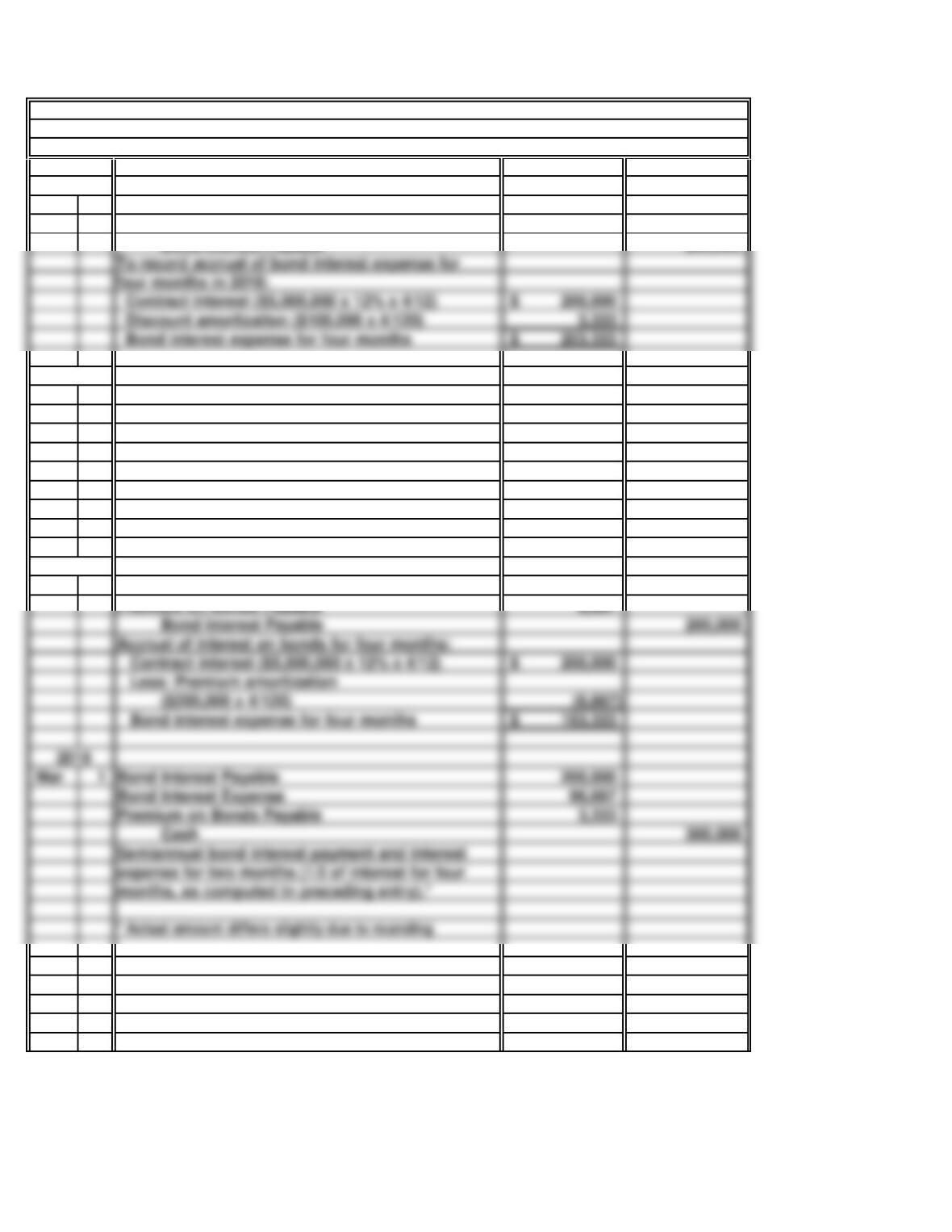
Dec 31 Bond Interest Expense 203,333
3,333
Bond Interest Payable 200,000
Mar 1 200,000
101,667
1,667
Cash 300,000
(2)
Dec 31 193,333
6,667
Bond Interest Payable 200,000
193,333$
Mar 1 200,000
Cash 300,000
Less: Premium amortization
($200,000 x 4/120)
Premium on Bonds Payable
Contract interest ($5,000,000 x 12% x 4/12)
Bond interest expense for four months
2019
Bond Interest Expense
expense for two months (1/2 of interest for four
months, as computed in preceding entry).*
Bond Interest Payable
Semiannual bond interest payment and interest
Premium on Bonds Payable
2018
2019
Discount on Bonds Payable
interest expense for two months (1/2 of interest for
four months, as computed in preceding entry). *
Bond Interest Expense
Bond Interest Payable
PROBLEM 10.6B
a.
General Journal
(1)
Bonds issued at 98:
Bonds Interest Expense
Bonds issued at 104:
2018
Discount on Bonds Payable
To record semiannual bond interest payment and
Bond interest expense for four months
Contract interest ($5,000,000 x 12% x 4/12)
To record accrual of bond interest expense for
four months in 2018:
Discount amortization ($100,000 x 4/120)
b.
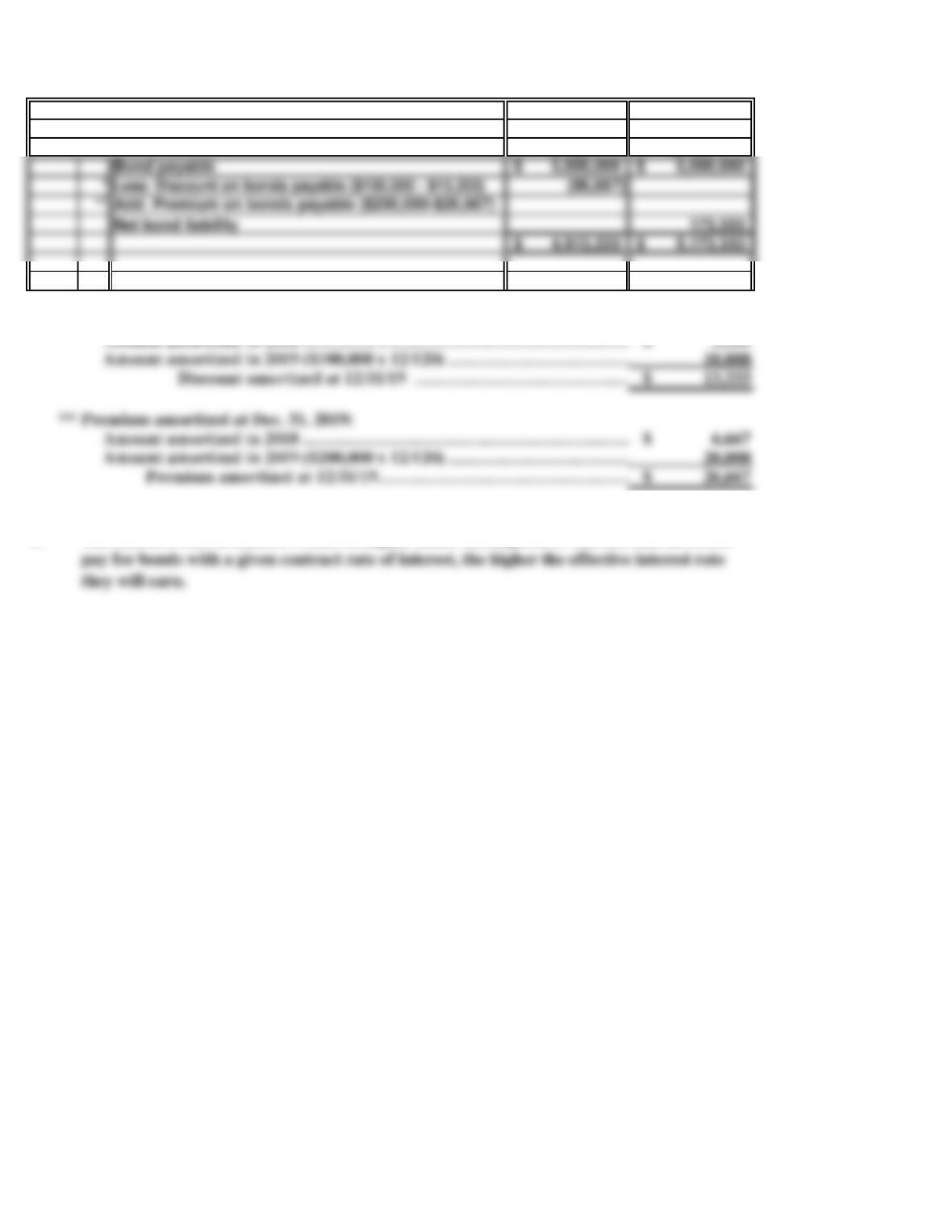
Net bond liability at Dec. 31, 2019: Bonds Bonds
Issued Issued
at 98 at 104
*
Premium amortized at Dec. 31, 2019:
c.
PROBLEM 10.6B
RODRIGUEZ PLUMBING COMPANY (concluded)
The effective rate of interest would be higher under assumption 1. The less that investors
Discount amortized at Dec. 31, 2019:
* Less: Discount on bonds payable ($100,000 – $13,333) (86,667)
Net bond liability
45 Minutes, Strong
a.
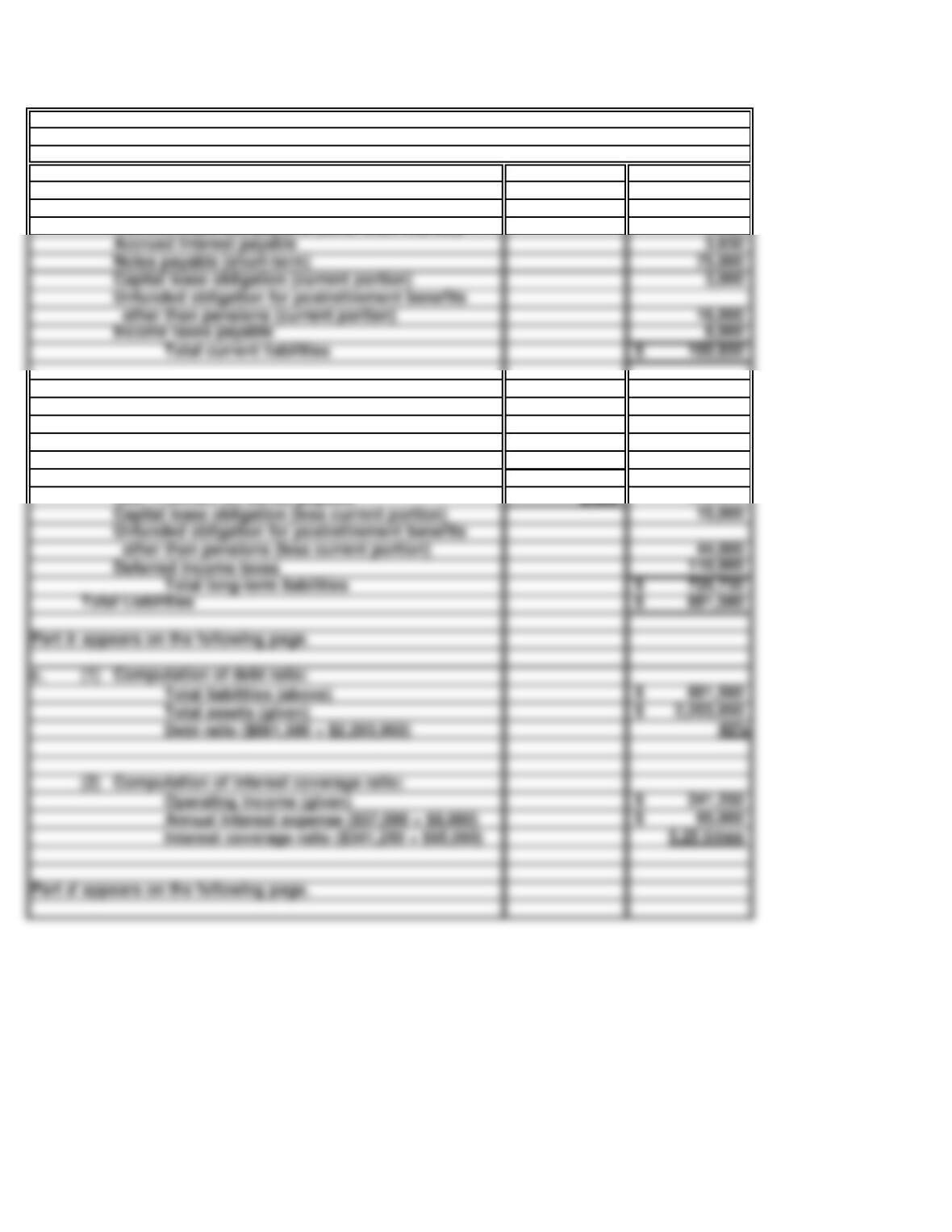
Liabilities:
(in thousands)
Accounts payable 48,000$
7,200
100,000$
150,000$
270 149,730
300,000$
Total liabilities (above) 881,580$
Total assets (given) 2,203,950$
(2) Computation of interest coverage ratio:
Part b appears on the following page.
Capital lease obligation (less current portion)
Deferred income taxes
PROBLEM 10.7B
NEVADA UTILITY COMPANY
December 31, 2018
Partial Balance Sheet
NEVADA UTILITY COMPANY
Add: Premium on bonds payable
Current liabilities:
Accrued expenses payable (other than interest)
Long-term liabilities:
10% Bonds payable, due April 1, 2019
8% Bonds payable, due October 1, 2019
Less: Discount on bonds payable
12% Bonds payable, due April 1, 2018
Accrued interest payable 3,650
b. (1)
(3)
(4)
(5)
The $16,000 portion of the unfunded liability for postretirement benefits that will be
(6)
d.
PROBLEM 10.7B
NEVADA UTILITY COMPANY
(concluded)
In summary, the fact that Nevada Utility is a profitable utility company with a reasonable
As the 10% bond issue is being refinanced on a long-term basis (that is, paid from the
The portion of the capital lease obligation that will be repaid within one year ($3,000) is
Income taxes payable relate to the current year’s income tax return and, therefore, are
Based solely upon its debt ratio and interest coverage ratio, Nevada Utility appears to be a
good credit risk. One must consider, however, that Nevada Utility is a utility company, not a
(2)
The 8% bonds will be repaid from a bond sinking fund rather than from current assets.
20 Minutes, Strong
a.
Liabilities:
Unearned revenues 268,000$
750,000$
Total Liabilities 1,540,500$
Notes payable*
Deferred income taxes**
b.
PROBLEM 10.8B
ALEXANDER COMPANY
Bonds payable
Current liabilities:
Long-term liabilities:
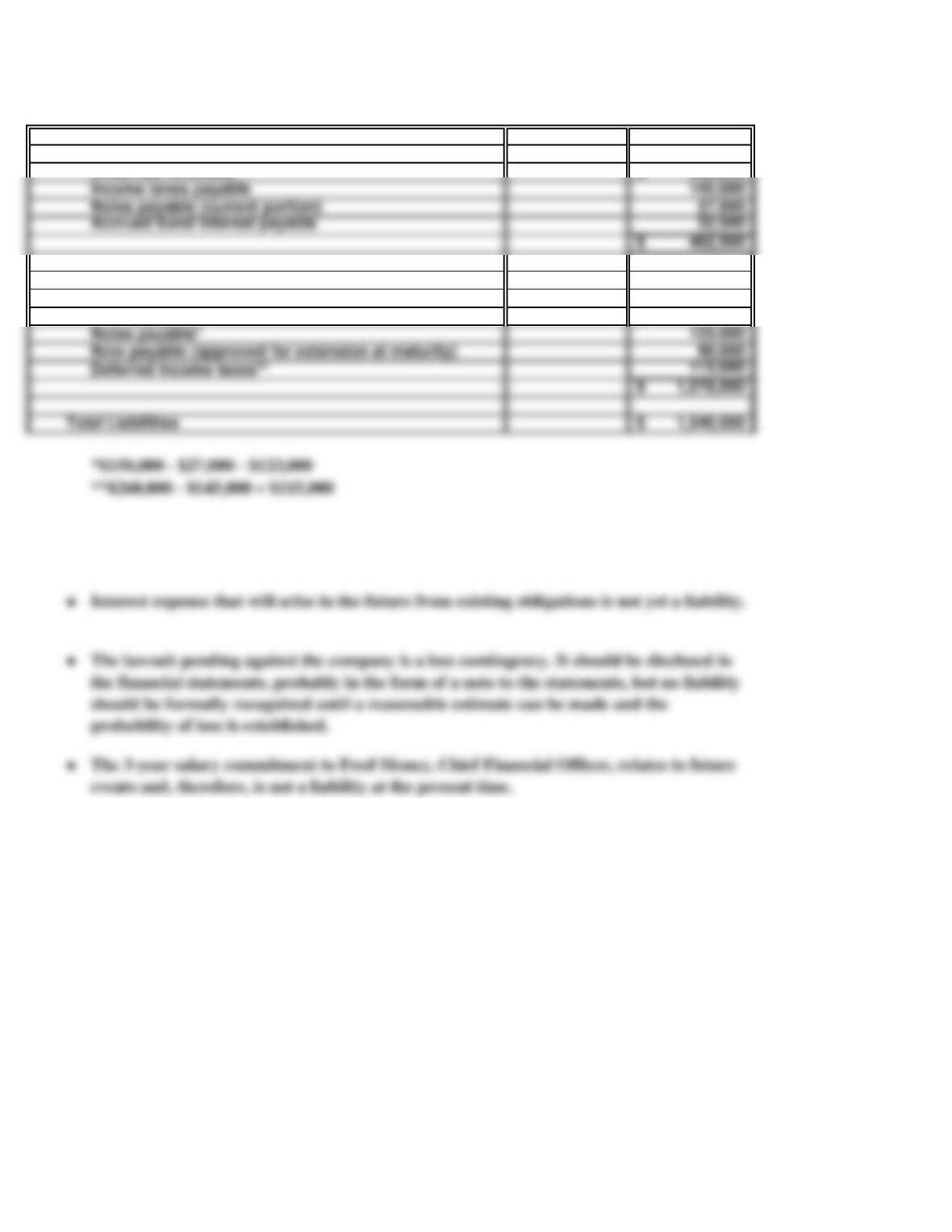
The following items listed by the company have been excluded from current and long-term
liabilities for the reasons indicated:
Notes payable (current portion) 27,000
Income taxes payable

30 Minutes, Medium
a.
b.
c.
d.
e.
f.
SOLUTIONS TO CRITICAL THINKING CASES
LIABILITIES IN PUBLISHED
CASE 10.1
FINANCIAL STATEMENTS
Wausau Paper’s liability for “current maturities” of long-term debt is common to most large
Club Med’s liability for future vacations is unearned revenue. This liability arises when
Wells Fargo’s liability for interest-bearing deposits represents the amounts on deposit in
The New York Times’ liability for unexpired subscriptions is a form of unearned revenue
Horse racing tracks issue mutual tickets as evidence of the bets that customers have made on
As American Greetings is a manufacturer, it probably sells primarily to wholesalers or
retailers rather than directly to consumers. Apparently, the company allows its customers to

g.
h.
GM’s liability for postretirement costs is an obligation to pay retirement benefits to
Case 10.1
LIABILITIES IN PUBLISHED
Apple’s accrued marketing and distribution liability represents accrued marketing and
FINANCIAL STATEMENTS (concluded)

20 Minutes, Strong
BOND PRICES
a.
c.
CASE 10.2
ABBOTT LABS
Differences in the length of time remaining until the bond issues mature is the major factor
influencing the current market prices. As bonds near their maturity dates, their market
The effective rate of interest is higher on issue A bonds. The less that investors pay for

25 Minutes, Medium
a.
1
2
3
4
b.
Management is responsible to disclose loss contingencies which are significant in nature and
that they might affect an investor’s or creditor’s analysis and subsequent decisions regarding
This lawsuit is based upon past events (treatment of displaced passengers) and involves
CASE 10.3
LOSS CONTINGENCIES
The risk of a future airplane crash does not stem from past events. Therefore, it is not a loss
contingency. A loss contingency would exist if an airplane had crashed, but the amount of the
The estimated loss from uncollectible accounts is a loss stemming from past events (credit
in the amount of the estimated loss.
The health, retirement, or even death of company executives are not loss contingencies and

20 Minutes, Medium
a.
b.
c.
If Delta Airlines had structured all of its lease agreements as capital leases (Type A) instead
of operating leases (Type B), its operating leases would be reported in the company’s
CASE 10.4
DELTA AIRLINES
ETHICS, FRAUD & CORPORATE GOVERNANCE
GAAP associated with the financial reporting treatment of lease agreements has been
criticized for its many loopholes. Nevertheless, if Delta remains in compliance with GAAP
In the case of Delta’s lease agreements, it is important that investors and creditors read and
understand the notes to the company’s financial statements. This is particularly true in
20 Minutes, Strong
a.
●
●
●
●
Junk bonds typically pay very high interest rates and are sometimes referred to as
high-yield bonds.
Because junk bonds have a high default risk, they are speculative.
Zero coupon bonds securities
●
●
In a zero coupon bond, the stated rate is zero, meaning that the bonds do not pay
annual interest.
b.
c.
CASE 10.5
This requirement is for students to state in their own words several technical terms. It is
not possible to state a solution that reflects exactly what students will say, but following are
basic ideas that should be included in their definitions:
INTERNET
CREDIT RATINGS
With traditional bonds, the coupon rate is the rate of annual interest the issuer pays
to the bondholder.
BONDS ONLINE
Convertible bonds
Gives the investor the right to convert its bond into stock of the company.
Junk bonds
Junk bonds are low-grade bonds issued by companies without long track records or
within questionable ability to meet their debt obligations.
No definitive answer can be given because market conditions and the information reported
Again, no definitive answer can be given because individual students will have different
●
●
●
You will want to know how many shares of stock you can get for each bond.
The number of shares you can receive, as well as their price, is preset at the bond’s
issue and remains fixed throughout the life of the bond.
market value, is equal to the amount of the bond’s conversion value.