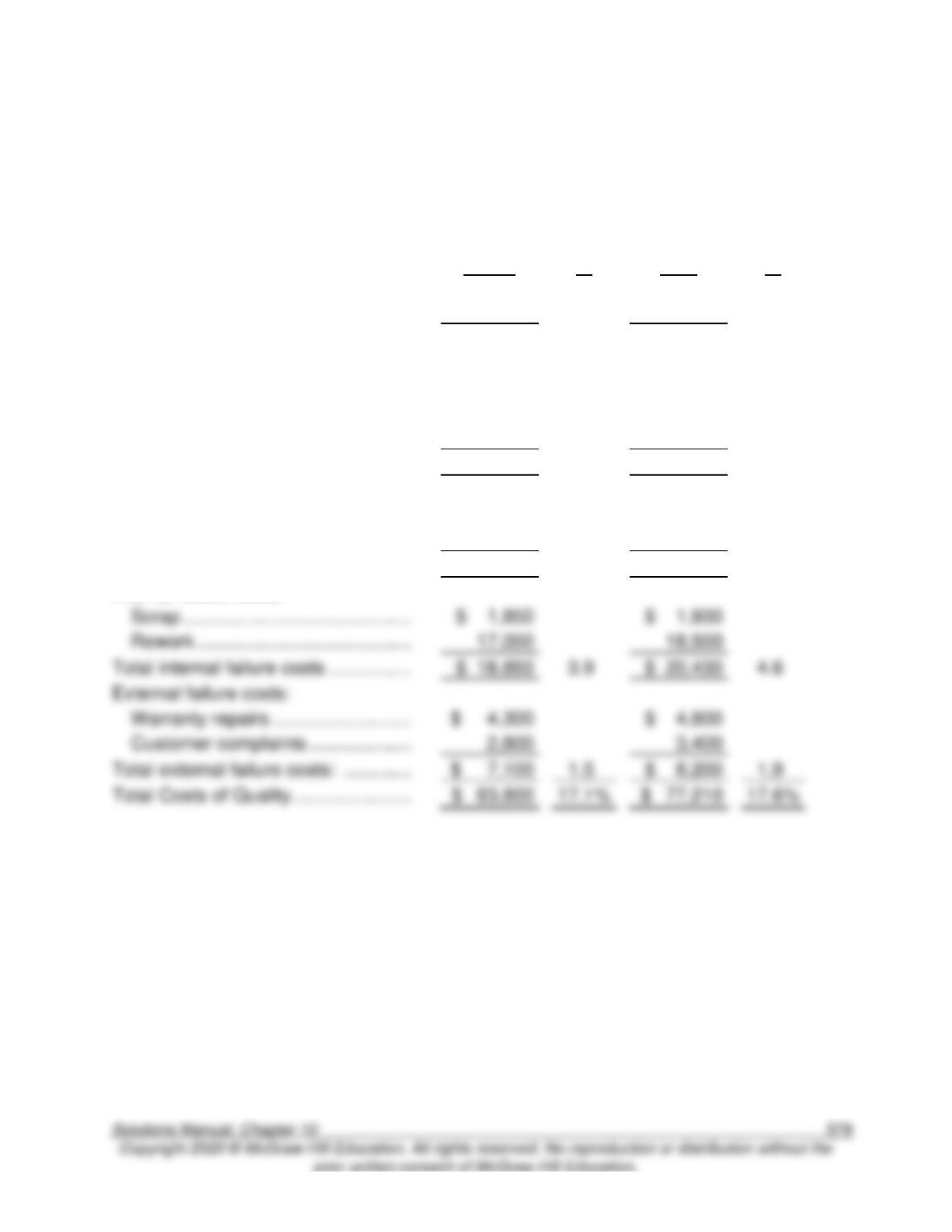
10–51. (30 min.) Trading-Off Costs of Quality: Domingo Corporation.
Domingo Corporation
Cost of Quality Report
March
%
April
%
Sales revenue …………………………….
$490,000
$440,000
Prevention costs:
Process inspection …………………..
$ 1,650
$ 1,880
Quality training …………………………
19,800
13,000
Preventive maintenance ……………
13,500
9,500
Materials inspection ………………….
6,500
4,800
Total prevention costs ………………….
$ 41,450
8.5%
$ 29,180
6.6%
Appraisal costs:
Testing equipment …………………..
$ 7,000
$ 7,000
Field testing …………………………...
9,400
12,400
Total appraisal costs ……………………
$ 16,400
3.4
$ 19,400
4.4
Internal failure costs:
Scrap ……………………………………..
$ 1,850
$ 1,930
Total internal failure costs …………….
$ 18,850
3.9
$ 20,430
4.6
External failure costs:
Warranty repairs ………………………
$ 4,800
Customer complaints ………………..
2,800
3,400
Total external failure costs: ………….
1.5
$ 8,200
1.9
Total Costs of Quality …………………..
10–52. (20 min.) Costs of Quality: Nuke–It-Now.
a. Prevention: Redesign process, training on equipment, preventative maintenance.
Appraisal: Final inspection.
Internal failure: Discard defective units, rework.
External failure: Warranty claims, contract cancellations, product liability claims.
b.
Year 1
Year 2
Prevention
$393,000 ÷ $3,500,000 …
11.2%
$399,000 ÷ $3,800,000 …
10.5%
Appraisal
$190,000 ÷ $3,500,000 …
5.4%
$198,000 ÷ $3,800,000 …
5.2%
Internal failure
$109,000 ÷ $3,500,000 …
3.1%
$139,000 ÷ $3,800,000 …
3.7%
External failure
$632,000 ÷ $3,500,000 …
$506,000 ÷ $3,800,000 …
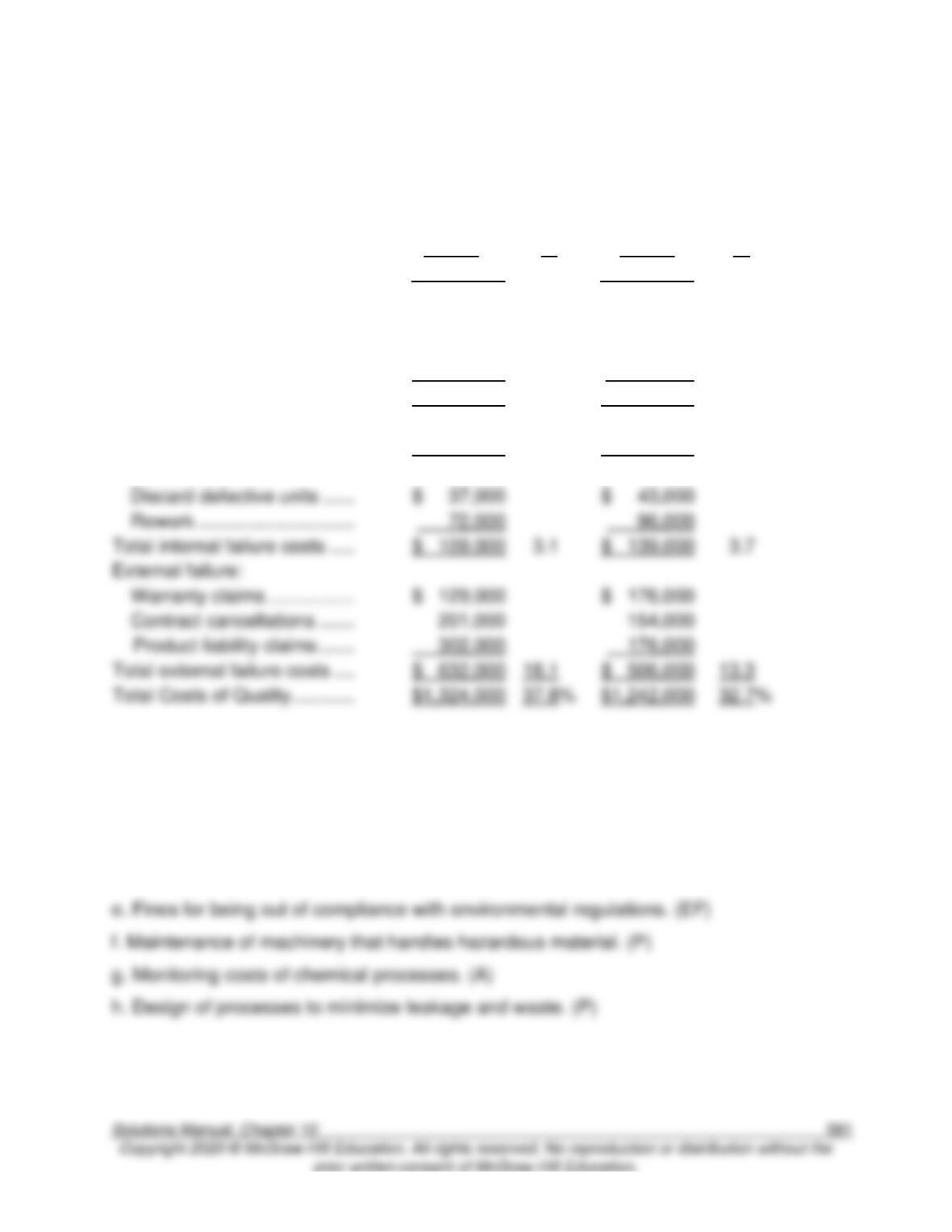
10–53. (30 min.) Trading-off Costs of Quality: Nuke-It-Now.
Nuke-It-Now Corporation
Cost of Quality Report
Year 1
%
Year 2
%
Sales revenue …………………..
$3,500,000
$3,800,000
Prevention:
Redesign process …………..
$ 29,000
$ 37,000
Training on equipment ……
250,000
210,000
Preventive maintenance ….
114,000
152,000
Total prevention costs ………..
$ 393,000
11.2%
$ 399,000
10.5%
Appraisal:
Final inspection ………………
$ 190,000
5.4
$ 198,000
5.2
Internal failure:
$ 43,000
Rework …………………………
96,000
Total internal failure costs …..
$ 109,000
3.1
$ 139,000
3.7
External failure:
Warranty claims ……………..
$ 129,000
$ 176,000
Contract cancellations …….
Product liability claims …….
Total external failure costs ….
$ 632,000
18.1
$ 506,000
10–54. (15 min.) Cost of Quality—Environmental Issues.
a. Criminal penalties for illegal dumping. (EF)
b. Cleanup of leaks and spills on the plant floor. (IF)
c. Employee training of environmental policies. (P)
d. Lost sales from bad publicity after toxic spill. (EF)
10–55. (15 min.) Cost of Quality: Financial Reporting Issues.
a. Extra work done by external auditors to complete the audit because new
employees made a lot of errors. (IF)
b. Effects of bad publicity on stock prices because publication of financial
statements was delayed to correct for errors in the statements. (EF)
c. Employee training: new accounting regulations. (P)
Solutions to Problems
10–56. (50 min.) Activity-Based Reporting and Capacity: Carbon Company.
a.
Sales revenue ……………..
$300,000
Materials ………………….
$98,000
Energy …………………….
17,880
Setups …………………….
24,000
Purchasing ………………
21,000
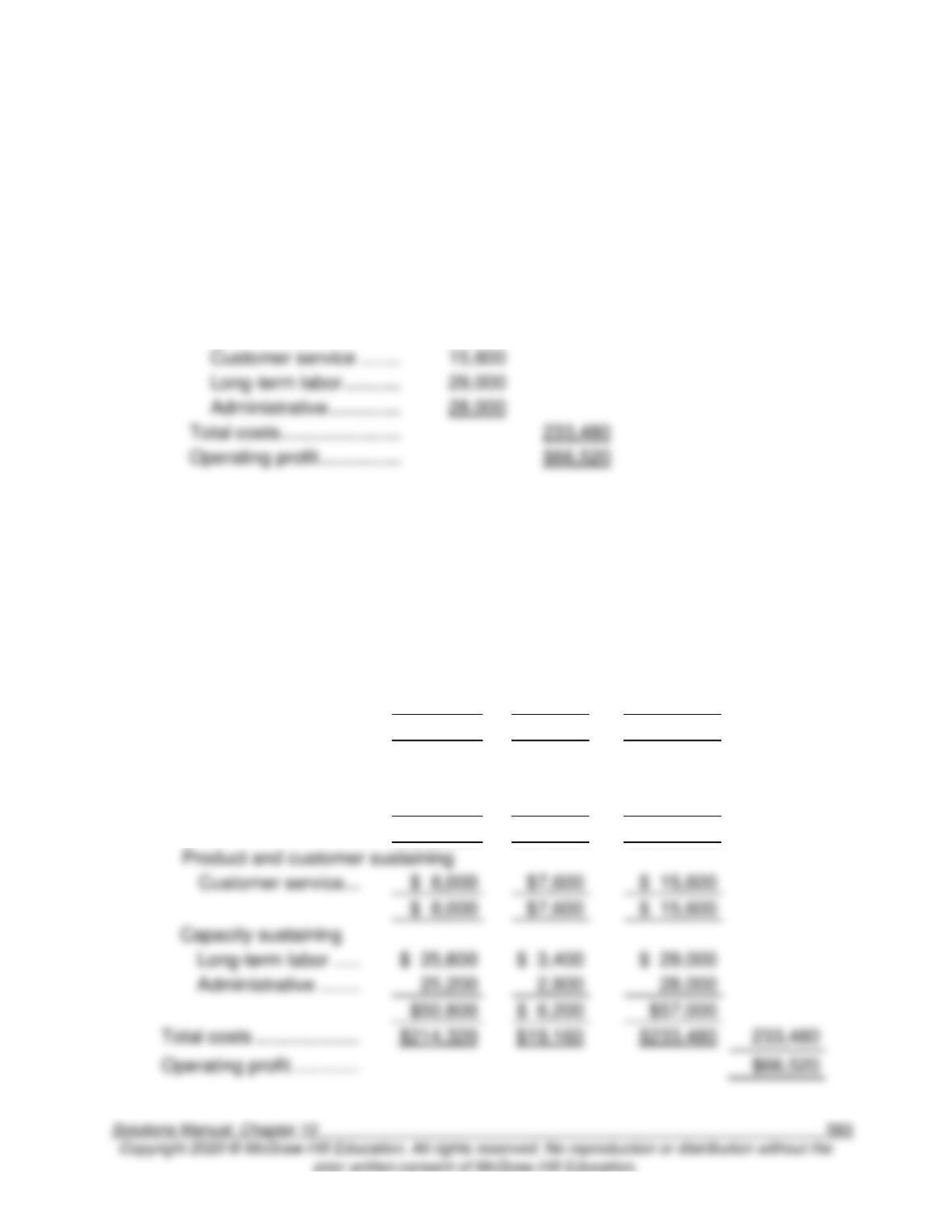
Customer service ……..
15,600
Administrative …………..
28,000
b.
Sales revenue
$300,000
Resources
Used
Unused
Resource
Capacity
Resources
Supplied
Costs
Unit
Materials …………….
$96,000
$ 2,000
$98,000
Energy ……………….
16,320
1,560
17,880
$112,320
$3,560
$115,880
Batch
Setups ……………….
$ 24,000
$ -0-
$ 24,000
Purchasing ………….
19,200
1,800
21,000
$ 43,200
$ 1,800
$ 45,000
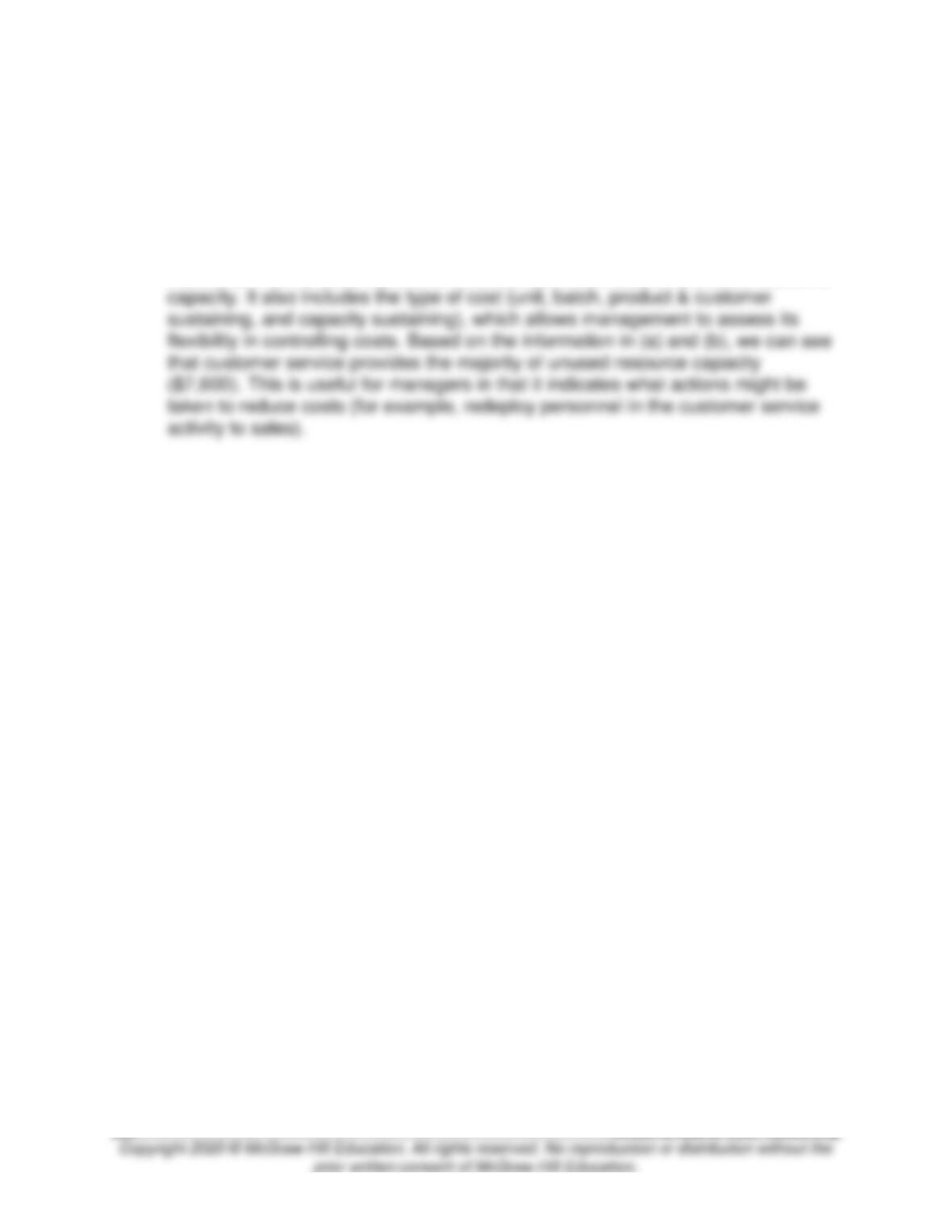
Product and customer sustaining
Customer service …
$ 15,600
Capacity sustaining
Long-term labor …..
Administrative ……..
28,000
Operating profit ………….
10–56. (continued)
c. A traditional income statement shows management resources supplied, but gives
no indication of the resources used and unused resource capacity. Management
has no way of knowing the amount of unused resource capacity or the cost of
unused resource capacity ($19,160). The activity-based income statement
provides management with resources supplied information (as does the
traditional income statement) and includes resources used and unused resource
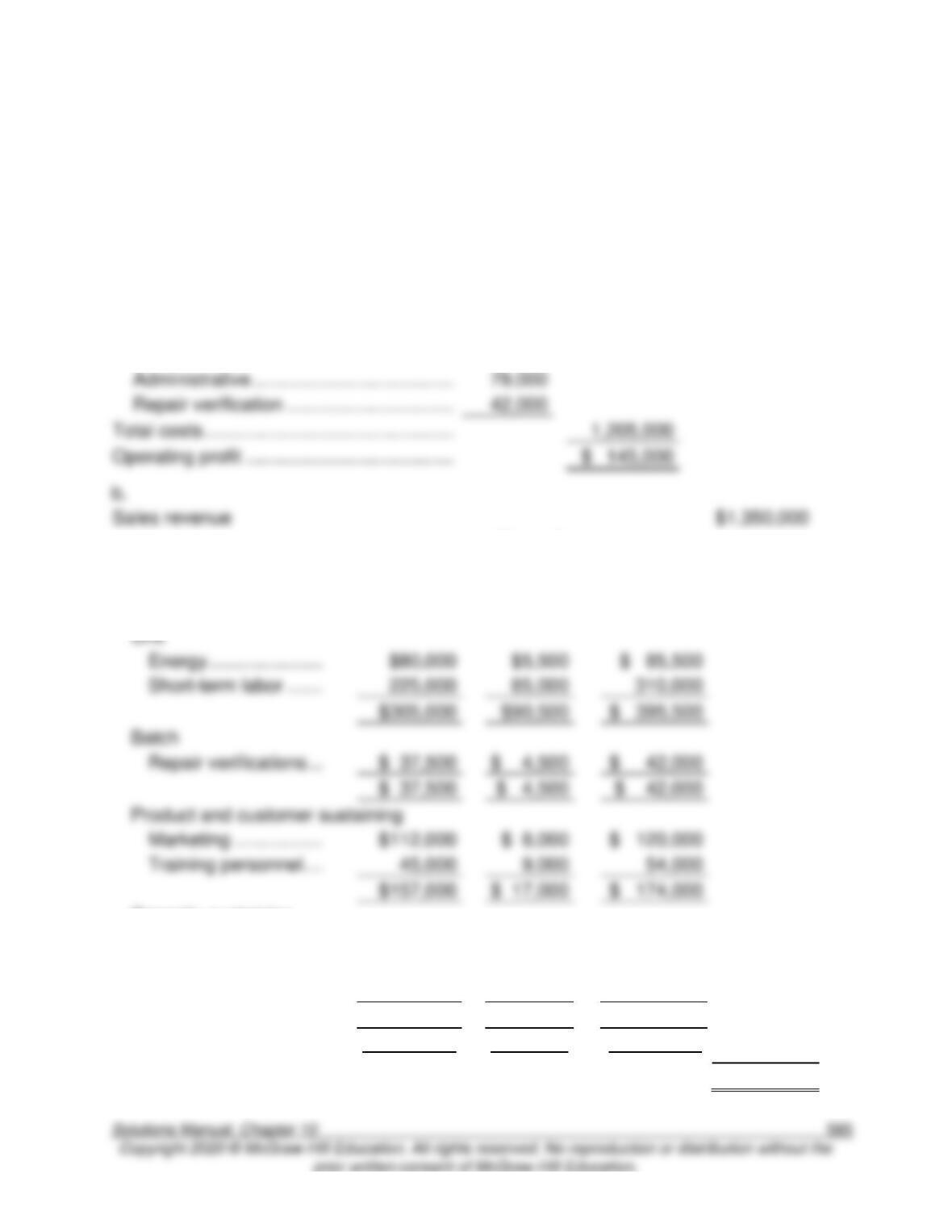
10–57. (50 min.) Activity-Based Reporting: Allcott Computer Services.
a.
Sales revenue ……………………………………
$1,350,000
Marketing …………………………..………….
$120,000
Depreciation …………………………………..
89,500
Training personnel ………………………….
54,000
Energy …………………………………………..
85,500
Short-term labor ……………………………..
310,000
Long-term labor ………………………………
425,000
Administrative …………………………………
Repair verification …………………………..
42,000
Total costs …………………………………………
Operating profit ………………………………….
Sales revenue
$1,350,000
Resources
Used
Unused
Resource
Capacity
Resources
Supplied
Costs
Unit
Energy ………………….
$ 85,500
Short-term labor …….
225,000
310,000
$305,000
$ 395,500
Repair verifications …
$ 42,000
$ 37,500
Marketing ……………..
$112,000
$ 120,000
Training personnel….
45,000
9,000
54,000
$157,000
$ 17,000
$ 174,000
Capacity sustaining
Depreciation ………….
$87,000
$ 2,500
$ 89,500
Long-term labor ……..
415,000
10,000
425,000
Administrative ………..
70,000
9,000
79,000
$572,000
$ 21,500
$593,500
Total costs …………………..
$1,071,500
$133,500
$1,205,000
1,205,000
Operating profit ……………
$ 145,000

10–57. (continued)
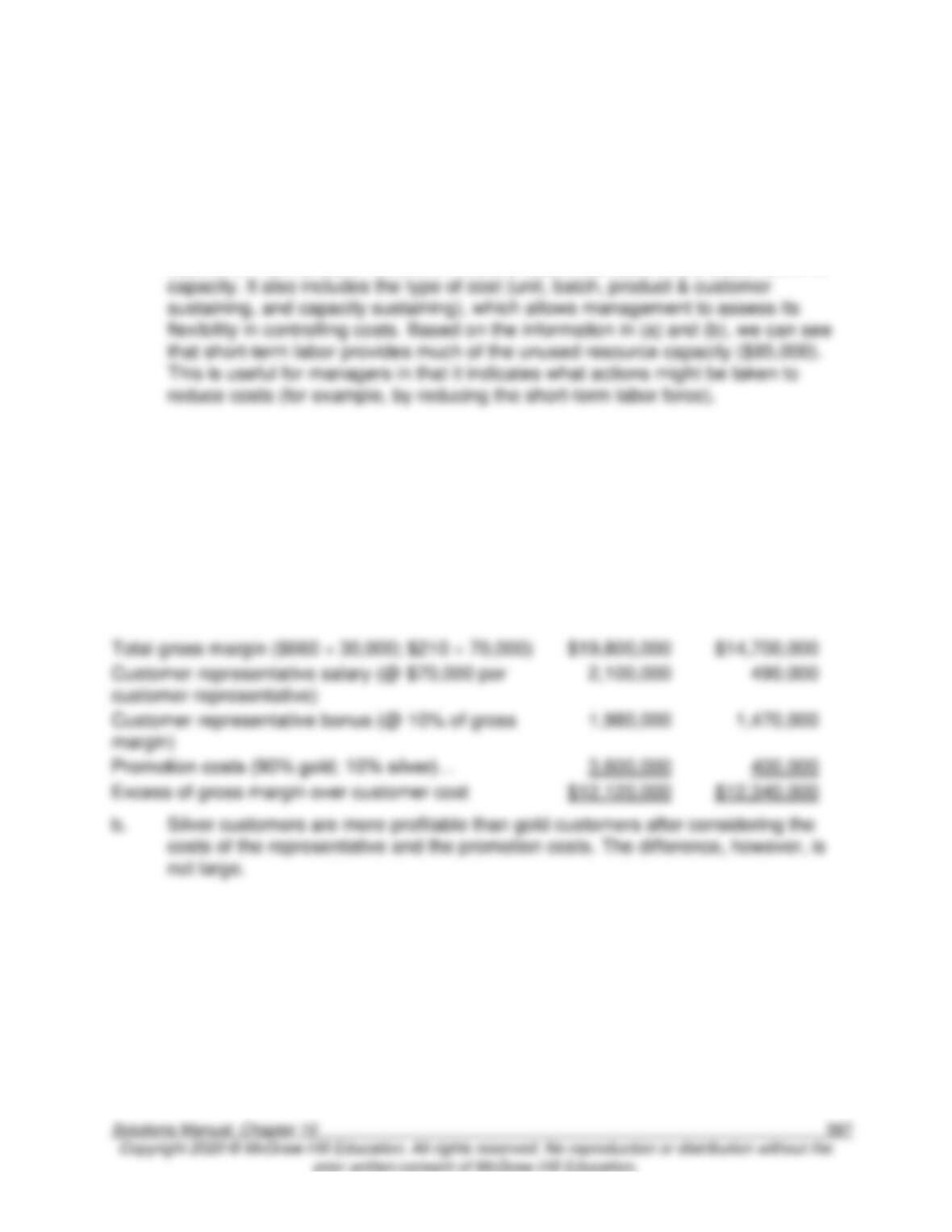
c. A traditional income statement shows management resources supplied, but gives
no indication of the resources used and unused resource capacity. Management
has no way of knowing the amount of unused resource capacity or the cost of
unused resource capacity ($133,500). The activity-based income statement
provides management with resources supplied information (as does the
traditional income statement) and includes resources used and unused resource
10–58. (50 min.) Customer Profitability: SkiBlu, Ltd.
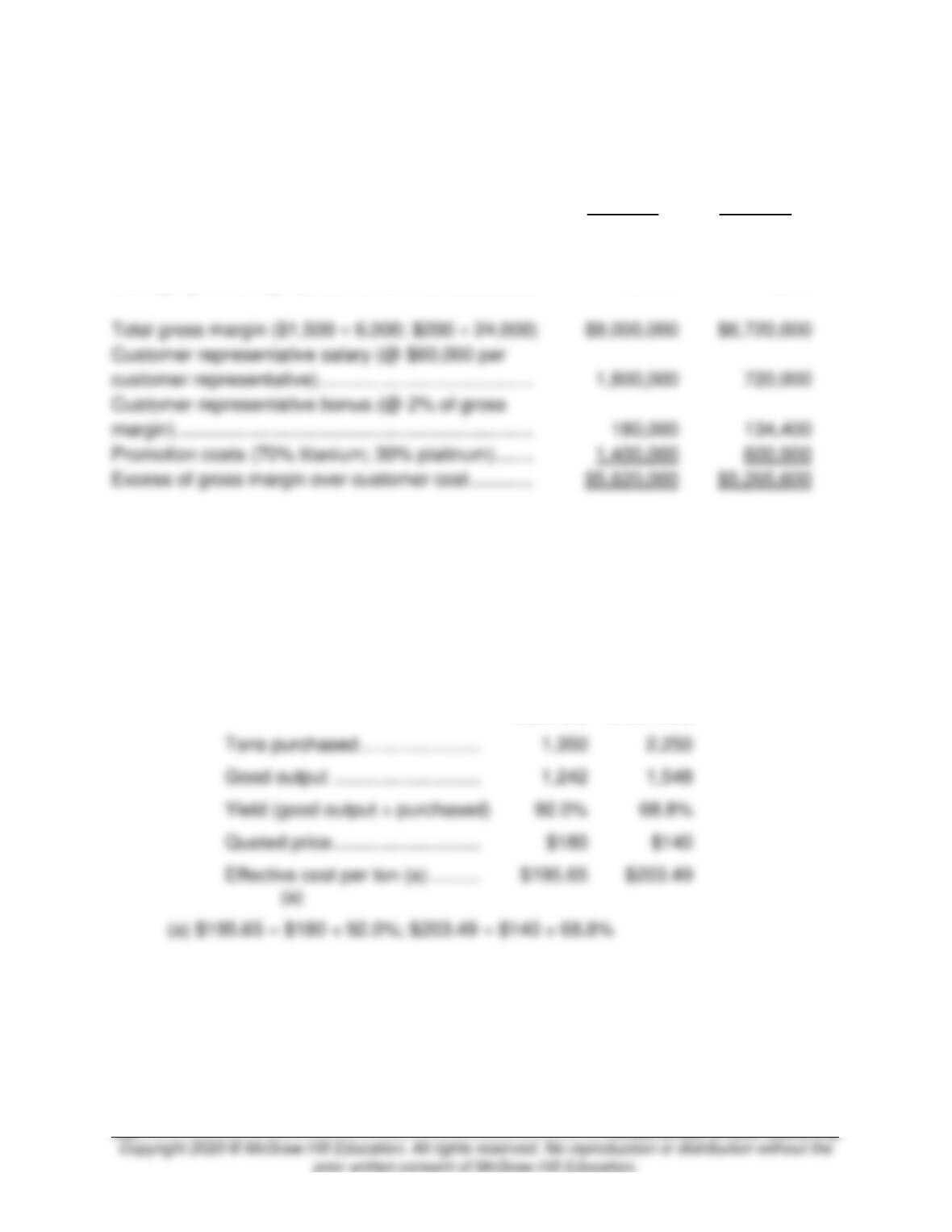
a.
Customer Costs
Gold
Silver
Number of customers ………
30,000
70,000
Number of customer representatives
30
7
Average gross margin per customer ……….
$660
$210
Total gross margin ($660 30,000; $210 70,000)
Excess of gross margin over customer cost
10–59. (50 min.) Customer Profitability: Carmel Company.
a.
Customer Costs
Titanium
Platinum
Number of customers ……………………………………….
6,000
24,000
Number of customer representatives ………………….
30
12
Average gross margin per customers………………….
$1,500
$280
Total gross margin ($1,500 6,000; $200 24,000)
Promotion costs (70% titanium; 30% platinum) …….
b. Titanium customers are more profitable even after considering the cost of
representatives and the promotion costs.
10–60. (30 min.) Activity-Based Costing of Suppliers: JFI Foods.
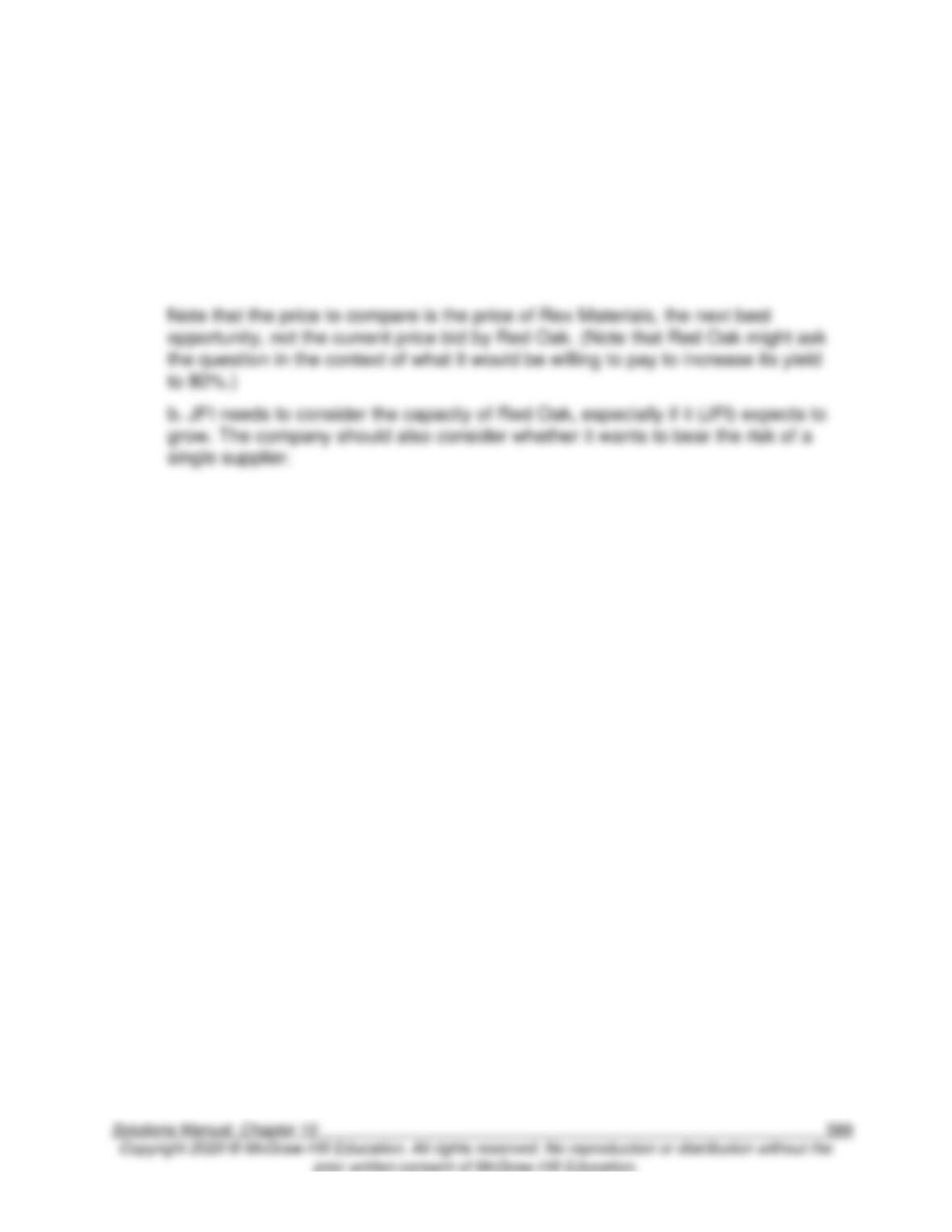
The effective price is the price to buy a “good” ton of feedstock. This can be
computed as the bid price divided by the yield (the ratio of good output to total
input).
Rex
Materials
Red Oak
Chemicals
Tons purchased …………………..
Good output ……………………….
Yield (good output ÷ purchased)
Quoted price ……………………….
10–61. (20 min.) Activity-Based Costing of Suppliers: JFI Foods.
a. $156.52. If Red Oak has an exclusive contract, the price per ton, adjusted for
an 80% yield, should be no more than the effective price that JFI pays Rex
Materials ($195.65). This price can be determined by solving the following
equation:
(P ÷ 80%) = $195.65
P = $156.52.
10–62. (30 min.) Activity-Based Costing of Suppliers: Roscoe Construction Co.
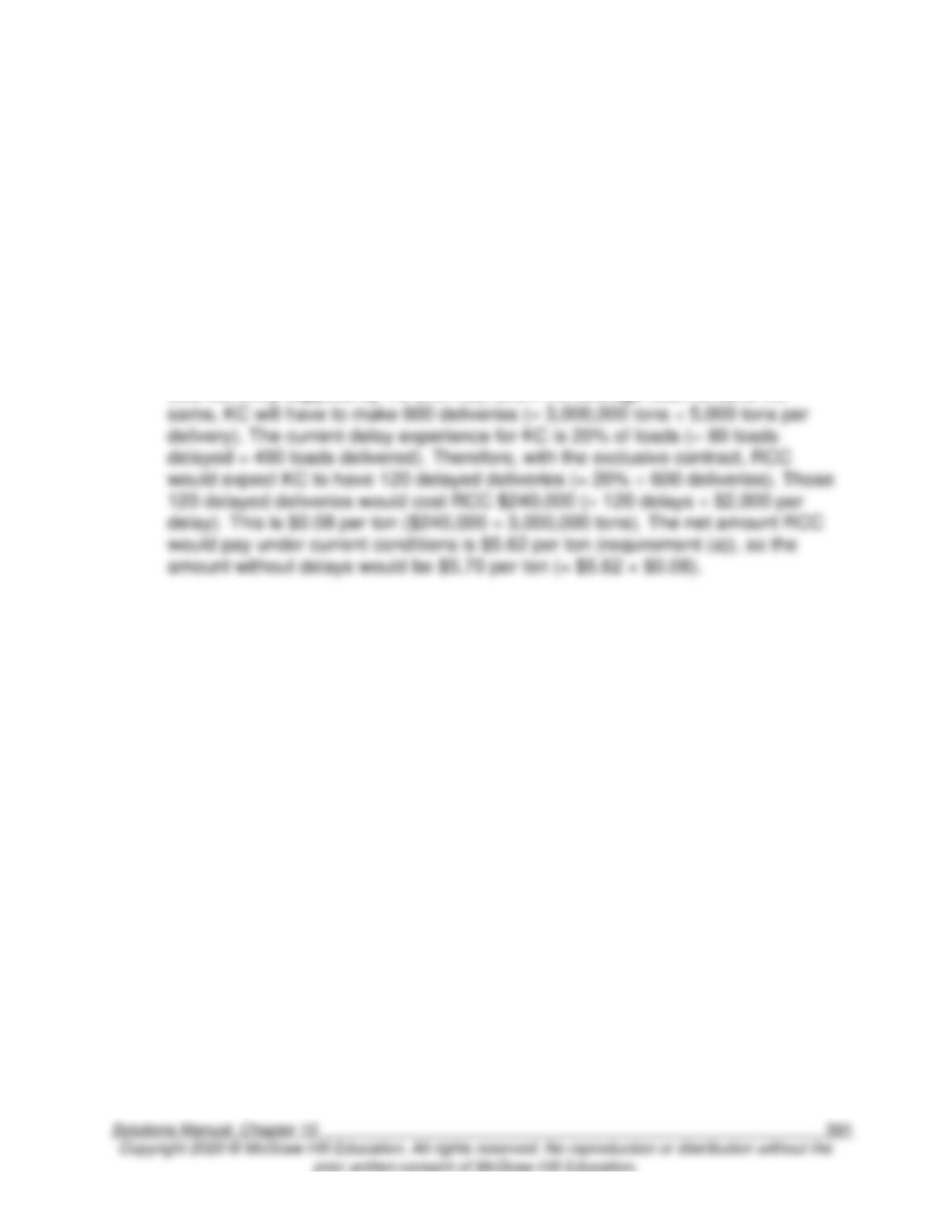
The effective price is the price to buy a ton of aggregate including the costs of
inspection, both initial and secondary, plus the cost of delays. This can be
computed as the average price paid, plus the costs of inspections and delays,
divided by the number of tons purchased.
Row
Item
Toorak
Gravel
Kilda
Corporation
(1)
Loads purchased …………………
100
(a)
400
(2)
Average tons per load …………..
10,000
(a)
5,000
(3)
Total tons purchased ……………
1,000,000
(b)
2,000,000
(4)
Loads passing initial inspection
94
(a)
300
(5)
Loads delayed …………………….
10
(a)
80
(6)
Average price paid per ton …….
(a)
$5.90
(7)
Total purchase price …………….
(8)
Initial inspection costs …………..
(d)
(9)
Secondary inspection costs …..
(e)
Delay costs …………………………
Total costs ………………………….
(g)
Average effective price per ton
(h)
$6.43
Notes:
(a)
Given
(b)
= (1) (2).
(c)
= (3) (6).
(d)
= $1,000 (1).
= $2,000 (5).
(g)
= (7) + (8) + (9) + (10).
(h)
= (11) ÷ (3).
10–63. (20 min.) Activity-Based Costing of Suppliers: Roscoe Construction Co.
a. $5.62 per ton. If KC is going to be the exclusive supplier, it has to have a price
after inspection and delay costs of $6.15 per ton, which is what the supplies from
TG costs. Therefore, the net price paid to KC must be $0.28 (= $6.43 – $6.15)
less than the current net price of $5.90. So the maximum RCC should offer is
$5.62 per ton (= $5.90 – $0.28).
Note that the price to compare is the price of Toorak Gravel, the next best
opportunity, not the current price bid by KC.
b. $5.70 per ton. If KC will guarantee no delays (or pay the delay costs if one
occurs), RCC can expect to save the costs of delay implicit under the conditions
of requirement (a). If KC is the exclusive supplier of the three million tons (the
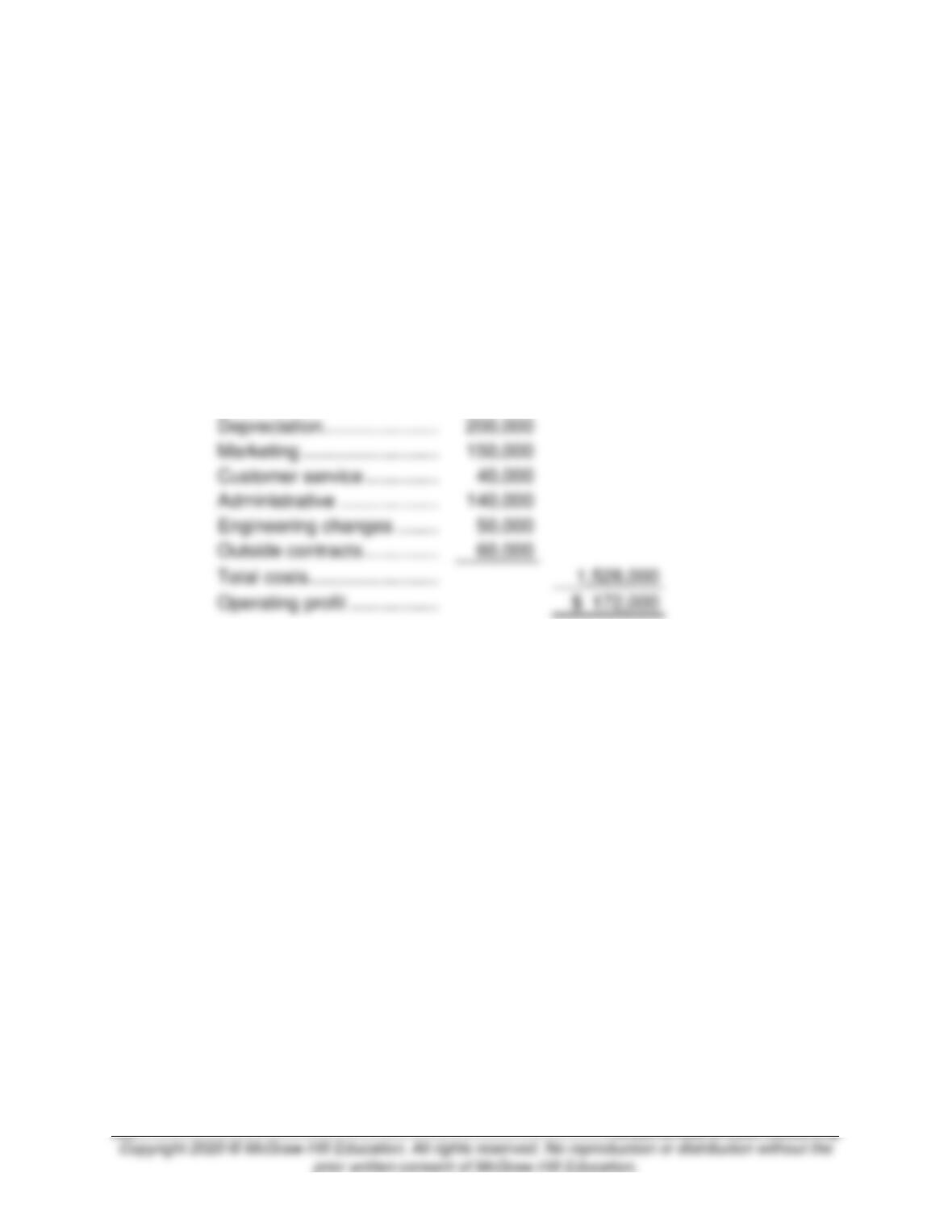
10–64. (50 min.) Activity-Based Reporting: Leidenheimer Corporation.
a.
Sales revenue ……………….
$1,700,000
Parts management …………
$ 70,000
Energy………………………….
100,000
Quality inspections …………
100,000
Long-term labor ……………..
70,000
Short-term labor …………….
48,000
Setups ………………………….
200,000
Materials ………………………
300,000
Depreciation ………………….
Marketing ……………………..
150,000
Customer service …………..
Administrative ……………….
140,000
Engineering changes ……..
50,000
Outside contracts …………..
Total costs …………………….
Operating profit ……………..
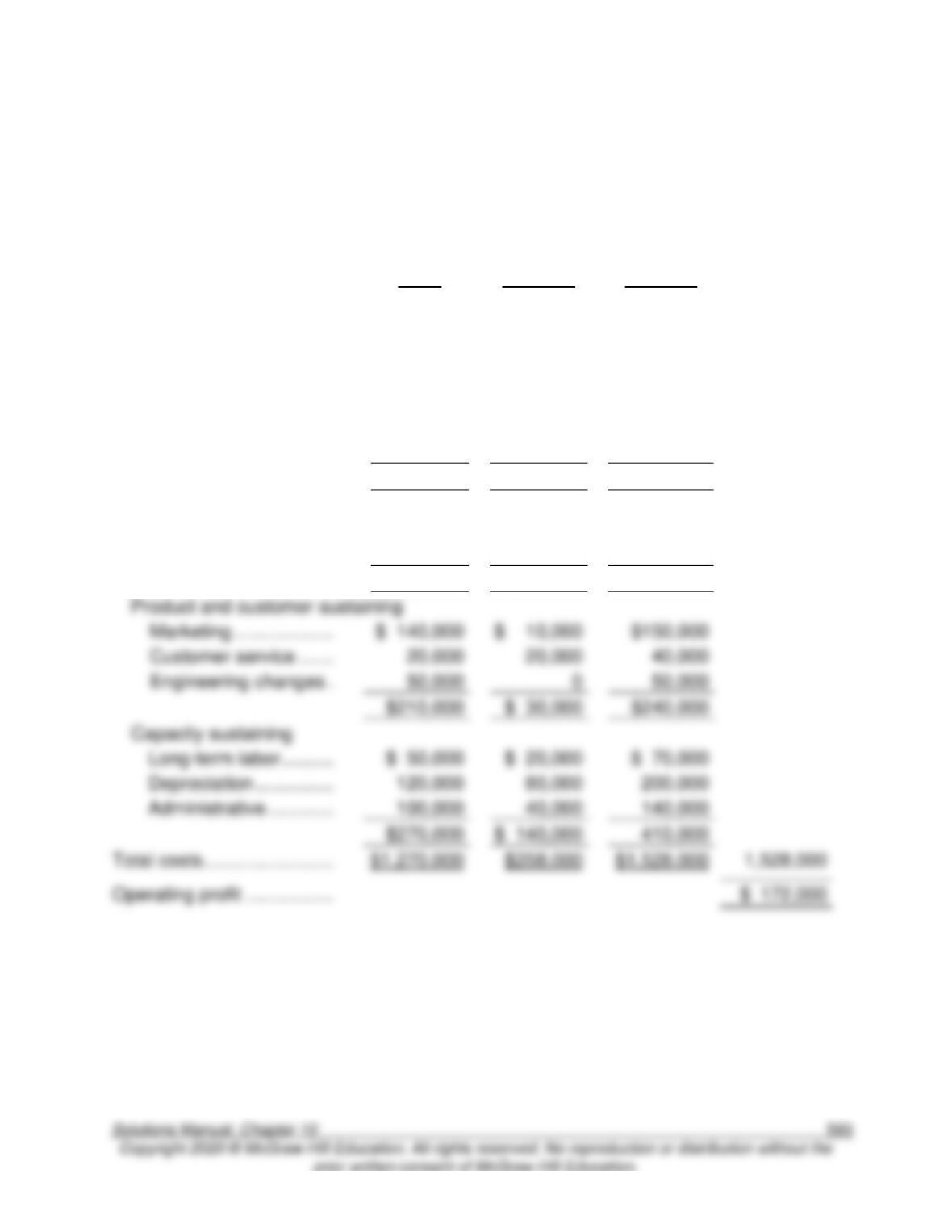
10–64. (continued)
b.
Sales revenue
$1,700,000
Resources
Used
Unused
Resource
Capacity
Resources
Supplied
Costs
Unit
Parts management …..
$ 60,000
$ 10,000
$ 70,000
Energy ……………………
100,000
0
100,000
Short-term labor ………
40,000
8,000
48,000
Materials …………………
300,000
0
300,000
Outside contracts …….
60,000
0
60,000
$560,000
$ 18,000
$578,000
Batch
Quality inspections …..
$ 90,000
$ 10,000
$100,000
Setups ……………………
140,000
60,000
200,000
$230,000
$ 70,000
$300,000
Marketing ……………….
20,000
20,000
40,000
0
$210,000
$ 30,000
Capacity sustaining
Long-term labor ……….
$ 50,000
$ 20,000
$ 70,000
Depreciation ……………
120,000
80,000
200,000
Administrative ………….
40,000
$270,000
$ 140,000
Operating profit ……………..