
Chapter 10 – Analysis of Government Financial Performance
10-1
CHAPTER 10: ANALYSIS OF GOVERNMENT FINANCIAL
PERFORMANCE
OUTLINE
Number
Topic
Type/Task
Status
(re: 18/e)
Questions:
10-1
Economic condition
Identify, define
Same
10-2
Financial Trend Monitoring System
Define, explain
Same
10-3
Financial condition
Identify, explain
New
10-4
Financial Trend Monitoring System and
citizens
Identify, explain
Same
10-5
Economic condition and ratio analysis
Explain, relate
Same
10-6
Organizational factors in the FTMS
Explain
Same
10-7
Pension plan funding
Explain
Same
10-8
Financial performance evaluation
Explain
New
10-9
Electronic Municipal Market Access
Define, explain
Same
10-10
Benchmarking
Explain
Same
10-11
Credit rating agencies
Identify, explain
Same
Cases:
10-12
EMMA
Research
Revised
10-14
Financial analysis
Analyze
New
10-15
Financial analysis
Analyze
New
Exercises/Problems:
10-16
Examine the CAFR
Analyze
Revised
10-17
Various
Multiple Choice
Items 2, 5,
10, 11, 12, 14
revised. Items
4, 9 new.
10-18
Financial condition
Matching
Revised
10-19
Benchmarks
Evaluate
Same
10-20
Financial analysis
Analyze
Revised
10-21
City of Arborland financial ratios
Calculate
Revised

Chapter 10 – Analysis of Government Financial Performance
10-2
CHAPTER 10: EVALUATION OF GOVERNMENT FINANCIAL
PERFORMANCE
Answers to Questions
10-1. The GASB identifies economic condition as a composite measure that comprises three
components: financial position, fiscal capacity, and service capacity. Financial position is
the status of the items on the government’s balance sheets and statements of financial
position. It relates to questions such as, “What is the value of the government’s assets or
its liabilities?” Fiscal capacity is the government’s ongoing willingness and ability to
meet its financial obligations as they become due. It relates to questions such as, “Is the
government willing and able to pay its bills when they are due?” Service capacity refers
to the government’s ongoing willingness and ability to meet commitments and provide
services. A question related to service capacity might be, “Is the government maintaining
streets?”
General Problem Information: Economic condition
Learning Objective: 10-2
10-2. The Financial Trend Monitoring System (FTMS) is a tool developed by the International
City/County Management Association (ICMA) that can be used to help governments
track financial performance. The FTMS tool provides a large number of quantifiable
indicators for different environmental, organizational and financial factors that can be
used to monitor financial performance over time.
General Problem Information: Financial Trend Monitoring System
Learning Objective: 10-3
Topic: Internal Financial Trend Monitoring
10-3. Financial position is generally viewed as a short-term concept that focuses primarily on a
government’s liquid position. As such, emphasis is on cash and assets that can be

Chapter 10 – Analysis of Government Financial Performance
10-3
Ch. 10, Answers, Question 10–3 (Cont’d)
General Problem Information: Financial condition
Learning Objective: 10-2
Topic: Government Financial Reporting Concepts
Bloom’s Taxonomy: Understand
10-4. As part of community needs and resources in Illustration 10-1 of the chapter several
citizen characteristics are identified that can impact the government’s financial condition.
Some of the characteristics include age, income, employment, and home
ownership/property values. These characteristics can impact both the demand for services
and ability to provide services. For example, the age of the citizenry can impact the need
for schools, public safety, and perhaps the types of parks and recreation facilities.
Additionally, it may impact the business climate given that the age of the population can
affect the types of businesses establishing in a location. The income level of the citizens
affects the demand for services and the ability to provide services. Lower income and
General Problem Information: Financial Trend Monitoring System and citizens
Learning Objective: 10-3
Topic: Internal Financial Trend Monitoring
10-5. Ratios constructed from governmental fund financial statement information would reflect
the modified accrual basis of accounting. Modified accrual focuses on the current sources
and uses of funds. Since the focus is on cash and near-cash resources that will be
available to expend in the current period, ratios constructed using the governmental fund
information cannot provide information on long-run solvency or the ability of the
government to meet its financial obligations and service commitments into the future
(fiscal capacity and service capacity).
General Problem Information: Economic condition and ratio analysis

Chapter 10 – Analysis of Government Financial Performance
10-4
Ch. 10, Answers, Question 10–5 (Cont’d)
10-6. Organizational factors, such as management practices and legislative policies, play a
crucial role in determining fiscal policy. If sound management policies are in place, then
the financial problems that might arise from economic downturns or natural disasters can
be minimized. Sound financial policies that plan for adverse environmental events and
focus on long-term strategies for meeting government goals are critical determinants of
strong financial condition.
General Problem Information: Organizational factors in the FTMS
Learning Objective: 10-3
10-7. Yes, citizens should consider a decrease in the ratio of the fiduciary net position to total
pension liability from year to year to be a warning sign. Generally accepted accounting
principles require display and disclosure of pension information, but do not prescribe the
funding levels, so a decrease in the pension plan funding measure over time is not a
violation of GAAP. The value of plan assets may fluctuate with changes in the value of
investments of the plan, so the value of the fiduciary net pension amount does not reveal
General Problem Information: Pension plan funding
Learning Objective: 10-4
Topic: Internal Financial Trend Monitoring
Bloom’s Taxonomy: Understand
Accreditation Skills tag: AACSB: Communication, AICPA: FN Reporting
Level of Difficulty: Medium
10-8. The reason for the importance of evaluating government performance can vary across
stakeholders; however, having open and transparent financial information that allows for
evaluation is critical regardless of the reason for evaluation. For creditors, evaluation of
financial performance is necessary to ascertain whether the government is be able to meet
debt obligations as they come due. Evaluation is also important when a creditor is

Chapter 10 – Analysis of Government Financial Performance
Ch. 10, Answers, Question 10-8 (Cont’d)
repay future debt and meet interest payment obligations). Citizens, as taxpayers and
users of government services should evaluate government financial performance to
ensure tax dollars are being spent appropriately and efficiently to provide the services
needed. Oversight entities with the responsibility of monitoring governments should
regularly evaluate government financial performance as a necessary part of their
government assessment.
General Problem Information: Financial performance evaluation
Learning Objective: 10-1
Topic: The Need to Evaluate Financial Performance
10-9. EMMA is the Electronic Municipal Market Access, which is operated by the Municipal
Securities Rulemaking Board. EMMA is a free online service that is available to
investors or other users who are interested in learning more about the municipal securities
market and accessing information on specific state or local government debt issues.
General Problem Information: Electronic Municipal Market Access
Learning Objective: 10-5
Topic: Use of Benchmarks to Aid Interpretation
Bloom’s Taxonomy: Understand
Accreditation Skills tag: AACSB: Communication, AICPA: BB Industry
Level of Difficulty: Medium
10-10. The most common type of benchmarking in government is the comparison over time of
the government to itself. According to the Government Finance Officers’ Association a
government’s past performance is the most relevant basis for considering the current year
performance. This is due to the fact that it is difficult to find comparable governments.
Governments tend to be quite diverse in the services offered, the population served, and
the political and geographic environments in which they operate.

Chapter 10 – Analysis of Government Financial Performance
10-6
10-11. Municipal bond rating agencies each have established criteria to conduct a bond rating
analysis. Although there is some difference in the criteria, they all give considerable
weight to the economy. Other factors that are common in the rating process are
management, debt, and some aspect of finance (this could include liquidity, budget, and
other more specific items). The factor over which management has the least control is the
economy. Although management cannot control the economy its ability to plan and adapt
to changes in the economy is important. Changes in the economy can impact both the
government’s ability to generate revenues and its expenditure levels. If an economy is
depressed, revenues derived from underlying transactions (e.g., sales and income taxes)
can be severely depressed. Additionally, as unemployment increases in an economic
Solutions to Cases
10-12.
a.
1. An official statement is a document prepared in connection with a primary offering
that includes information regarding the purposes of the issue, how the securities will
be repaid, and the financial and economic characteristics of the issuer of the debt with
b. The answers for questions 1–4 will vary widely, depending on the city selected by the
student. Information for the four questions is easily available once a debt issue is selected.
The student should keep in mind that not all state and local governments opt to pay for a
credit rating for their debt issue. Students should be able to tell if the initial issue of a debt
maturity was sold at premium or discount by looking at the initial price. If the value
provided is over 1.00 the issue sold at premium; whereas, if the value is below 1.00 the

Chapter 10 – Analysis of Government Financial Performance
10-7
Ch. 10, Solutions, Case 10-12 (Cont’d)
General Problem Information: EMMA
Learning Objective: 10-5
10-13.
a. Following is a narrative of some of the indicators that students may address. However,
the indicators are not exhaustive, and students may include additional information.
Despite its high debt position, the debt service level remains quite low and well within
what is considered to be an acceptable range based on information in Illustration 10-3.
Additionally, the debt per capita has been trending downward, even as the debt limit used
has grown over time. Given the large amount of debt that must be outstanding based on
the debt limit used, it would be interesting to see just what debt is outstanding and when
the debt will be coming due.
Since 2012 the City of Flint has been able to generate sufficient revenues to cover its
operating expenditures, however, it will be noted that Flint relies heavily on
intergovernmental revenues. Eight out of the ten years analyzed show that
intergovernmental revenues accounted for over 40 percent of the total governmental
revenues. The General Fund balance is becoming increasingly healthy, having gone from

Chapter 10 – Analysis of Government Financial Performance
10-8
Ch. 10, Solutions, Case 10-13 (Cont’d)
Year Liquidity Intergovt’l Revenues over Debt Limit Debt Service
Revenue Expenditures Used
2017 4.26 41.6% 107.0% 62.24% 3.97%
2015 2.62 27.4% 99.2% 41.87% 3.10%
2014 2.08 42.7% 109.8% 53.82% 2.98%
2013 1.58 45.1% 110.3% 52.95% 2.16%
2011 0.10 42.8% 98.7% 11.82% 2.62%
2009 0.67 37.6% 95.5% 9.40% 3.26%
b. Based on the information provided and in response to the warning indicators the following is
provided:
1. There is not a consistent decline in revenue; therefore, this is not a warning indicator.
However, a review of the statistical section of the CAFR indicates that since 2009,
taxable valuation of properties has declined by over half. Such a serious decline in
property values is a warning sign.
3. As discussed, expenditures are not growing faster than revenues in that revenues to
expenditures ratios have been improving and the General Fund fund balances have not
been in a deficit situation in the last four years.
5. A review of the statistical section shows that the funded ratio for pension plans is 36.3
percent in 2017, declining every year for the past 10 years and well below any benchmark
for what would be considered acceptable. Such a low ratio is a red flag.
6. A decline in economic activity – economic indicators tend to be weak. The population
sign. Per capita income has been declining over the past 10 years.
7. Students will have different views on Flint’s financial condition. It certainly isn’t in a
strong financial condition and how the city performs once it has weathered its current
water crisis will help determine whether Flint is again under the watchful eye of an
emergency manager.
General Problem Information: Financial analysis
Learning Objective: 10-3

Chapter 10 – Analysis of Government Financial Performance
10-9
Ch. 10, Solutions, Case 10-13 (Cont’d)
Accreditation Skills tag: AACSB: Analytical Thinking, AICPA: BB Critical Thinking
Level of Difficulty: Hard
10-14.
a. The Mercatus Center, founded in 1980, is a not-for-profit organization at George Mason
University. The focus of the Mercatus Center is on the markets, with its emphasis on
b. The answers to the four questions listed will depend on the state the student selects
1. States are ranked from 1 to 50, with 1 being the best fiscal rank and 50 the worst.
2. The five categories on which the fiscal ranking is based are:
• Cash solvency – cash to cover short-term liabilities
• Service level solvency – assessment of how high taxes are relative to personal
income to determine if there is “fiscal slack,” that is could revenues be raised
without harming the state economy.
3. Mercatus will provide an analysis of where the state ranked on the above factors.
Those states that have overall strong rankings may not have a weak factor identified;
conversely those with weak rankings may not have a strong factor identified.
4. A ten-year graph is provided for four ratios related to the fiscal factors. The students
should analyze the trends to see if the state has been improving or declining for the
General Problem Information: Financial analysis
Learning Objective: 10-2
Learning Objective: 10-5

Chapter 10 – Analysis of Government Financial Performance
10–10
10-15.
a. At the time this solution was prepared the five risk factors were cash position/liquidity,
debt burden, financial reserves, revenue trends and retirement obligations.
c. Liquidity, debt burden, and General Fund reserves.
1. A city need only earn 71.24 points to be considered low risk, and it must only earn
41.77 points before it is moved out of the high-risk category and considered moderate
risk
2. Student responses to this question will vary by the city selected. Students will find
that although a city can have the same overall risk assessment, the financial indicators
driving the level of risk can be very different. For example, both San Francisco and
General Problem Information: Financial analysis
Learning Objective: 10-4
Learning Objective: 10-5
Topic: Analyzing Government Financial Statements, Use of Benchmarks to Aid
Interpretation
Solutions to Exercises and Problems
10-16. The specific solution to this exercise will depend on which city’s CAFR is evaluated.
Generally, the analysis for each ratio should follow the approach shown in Illustrations
10-3 and 10-4. Each student should present a well-organized and well written paper,
detailing his or her analysis and conclusions. We recommend grading on the basis of both
Chapter 10 – Analysis of Government Financial Performance
10–11
Ch. 10, Solutions, Exercise 10–16 (Cont’d)
General Problem Information: Examine the CAFR
Learning Objective: 10-3
Learning Objective: 10-4
10-17. 1. b. 6. b. 11. d.
3. c. 8. c. 13. b.
5. a. 10. a. 15. c.
General Problem Information: Various
Learning Objective: 10-1
Topic: Various Chapter Topics
Bloom’s Taxonomy: Understand
Accreditation Skills tag: AACSB: Knowledge Application, AICPA: BB Critical
Thinking
Level of Difficulty: Medium
10-18.
a. −
f. +
k. −
b. −
g. −
l. −
c. +
h. + (see note)
m. +
d. −
i. +
n. +
e. +
j. −
o. NE (see note)
Note: Increasing fund balances are generally viewed as a positive; however, excessively
large fund balances can indicate a management issue. The effect of birthrate on
financial condition should have no short-term impact.
General Problem Information: Financial condition
Learning Objective: 10-4
Chapter 10 – Analysis of Government Financial Performance
10–12
10-19.
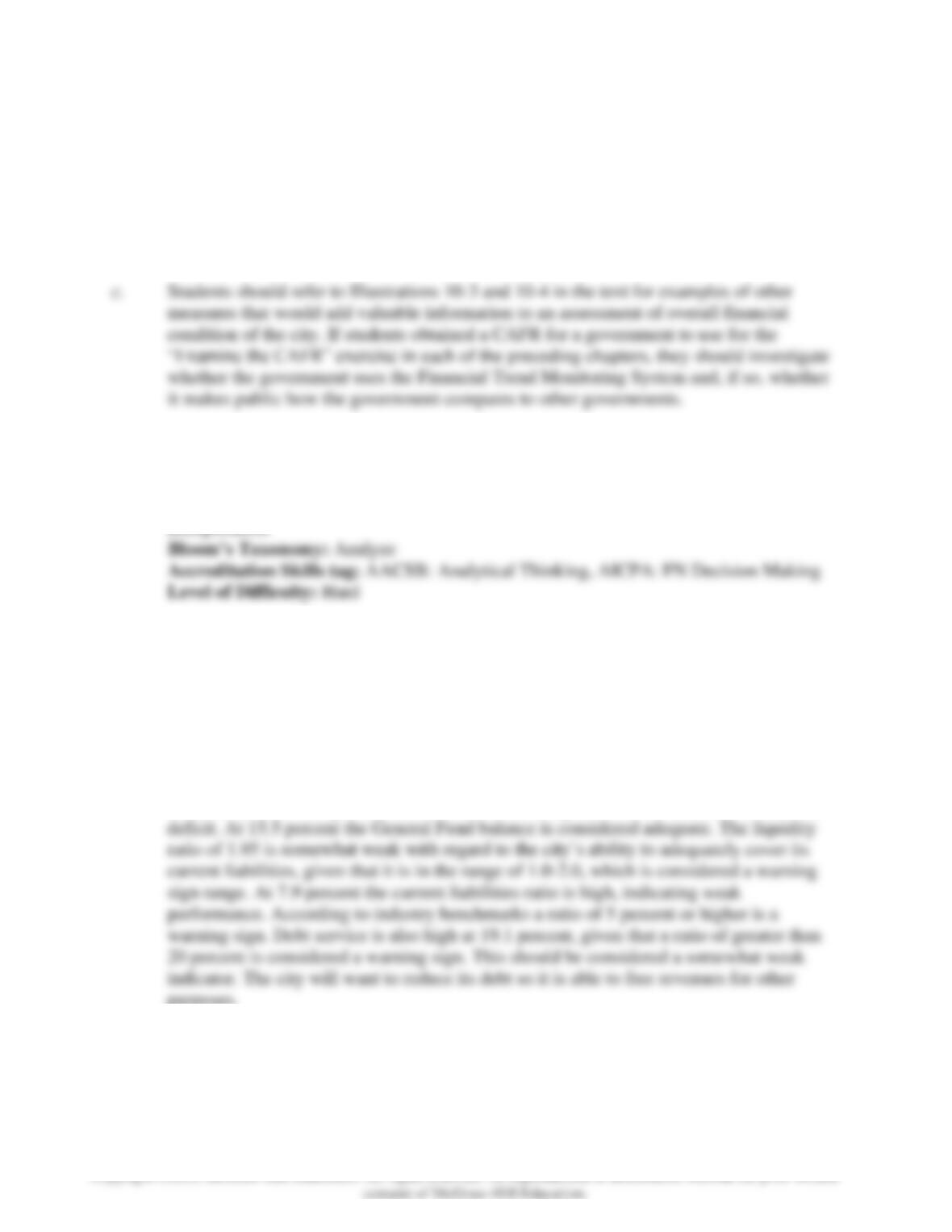
a. Here is a graphical presentation of the Town of Oakdale compared to three reference
groups, other Aaa-rated municipalities in the same state, 11 other comparable
municipalities in a reference group (RG) in the state, and the state median for two
financial measures: total revenue and revenue per capita.
FY Total Revenue
0
50,000,000
100,000,000
150,000,000
Oakdale
Aaa-Rated
Median
Comparison
RG Median
State Median
Comparison Groups
$ of Total Revenue
FY Revenue per Capita
0
500
1000
1500
3000
3500
Oakdale
Aaa-Rated
Median
Comparison
RG Median
State Median
Comparison Groups
$ of Revenue per Capita
Chapter 10 – Analysis of Government Financial Performance
10–13
Ch. 10, Solutions, Exercise 10–19 (Cont’d)
b. Oakdale has a much higher amount of total revenue for the fiscal year than its reference
groups’ medians, most notably larger than the state median. Oakdale’s revenue per
capita, however, is only slightly higher than each of the benchmark groups’ medians.
Based on this financial measure alone, Oakdale appears to be performing as well in terms
of sources available to finance government services as its comparison groups.
General Problem Information: Financial trends
Learning Objective: 10-4
Learning Objective: 10-5
Topic: Analyzing Government Financial Statements, Use of Benchmarks to Aid
10-20.
a. At 0.98 the total revenues over total expenditures ratio for 2023 indicates a below
average position. The city is not quite covering its expenditures for the year with the
revenues it is generating. A deficit of 2.9 percent is a weak indicator; however, because it
is less than a negative 5 percent it is not considered abnormally large when considered
within the context of a single year. The indication from this ratio is that the city was
unable to cover General Fund operating expenditures with current period operating
revenues. Although the General Fund is operating at a deficit in the current year, the fund
balances ratio of 15.5 percent indicates there are adequate reserves available to fund the
purposes.
b. Over the time period the city has improved its revenues over expenditures ratio, moving
from weak performance at 0.90 in 2020 to 0.98 in 2023. The city has been consistently
trending up over the past four years; however, it has not been able to cover its
expenditures with revenues since 2019. There is also improvement in the General Fund

Chapter 10 – Analysis of Government Financial Performance
10–14
Ch. 10, Solutions, Exercise 10-20 (Cont’d)
operating deficit position, moving from a negative 4.9 percent in 2020 to a negative 2.9
percent. The consecutive years of improvement is a strong indicator; however, the fact
the city is still operating at a deficit is a weak indicator. Once again, the city has not seen
a positive indicator since 2019. General Fund balance ratio has increased since 2022, a
favorable indicator. Although remaining in the adequate General Fund Balance range, the
c. Students should generally find that the city is weakly performing, while struggling to
trend upward. Generally, the City of Alma has been trending in a positive direction;
however, there are still many weak performance indicators.
d. Students will come up with several different answers to this question. However, some
factors not included in the table but which would impact financial performance include:
environmental factors (community demographics, political culture, how the economy is
impacting Alma); organizational factors (management practices and experience);
financial factors such as revenue diversity, long-term debt structure, and unfunded
liabilities. Several students may indicate 2020 could have seen the impact of the COVID-
19 pandemic.
General Problem Information: Financial analysis
Learning Objective: 10-3
10-21.
a. The performance measures shown in Illustration 10-4 use data from the basic financial
statements, which includes the government-wide financial statements as well as the fund
financial statements. The measures that can be calculated using the government-wide
financial statements presented in this case are:
1. Unrestricted net position
2. Debt ratio
4. Change in net position
Chapter 10 – Analysis of Government Financial Performance
10–15
Ch. 10, Solutions, Exercise 10-21 (Cont’d)
6. Business-type activities self-sufficiency
7. Capital asset condition
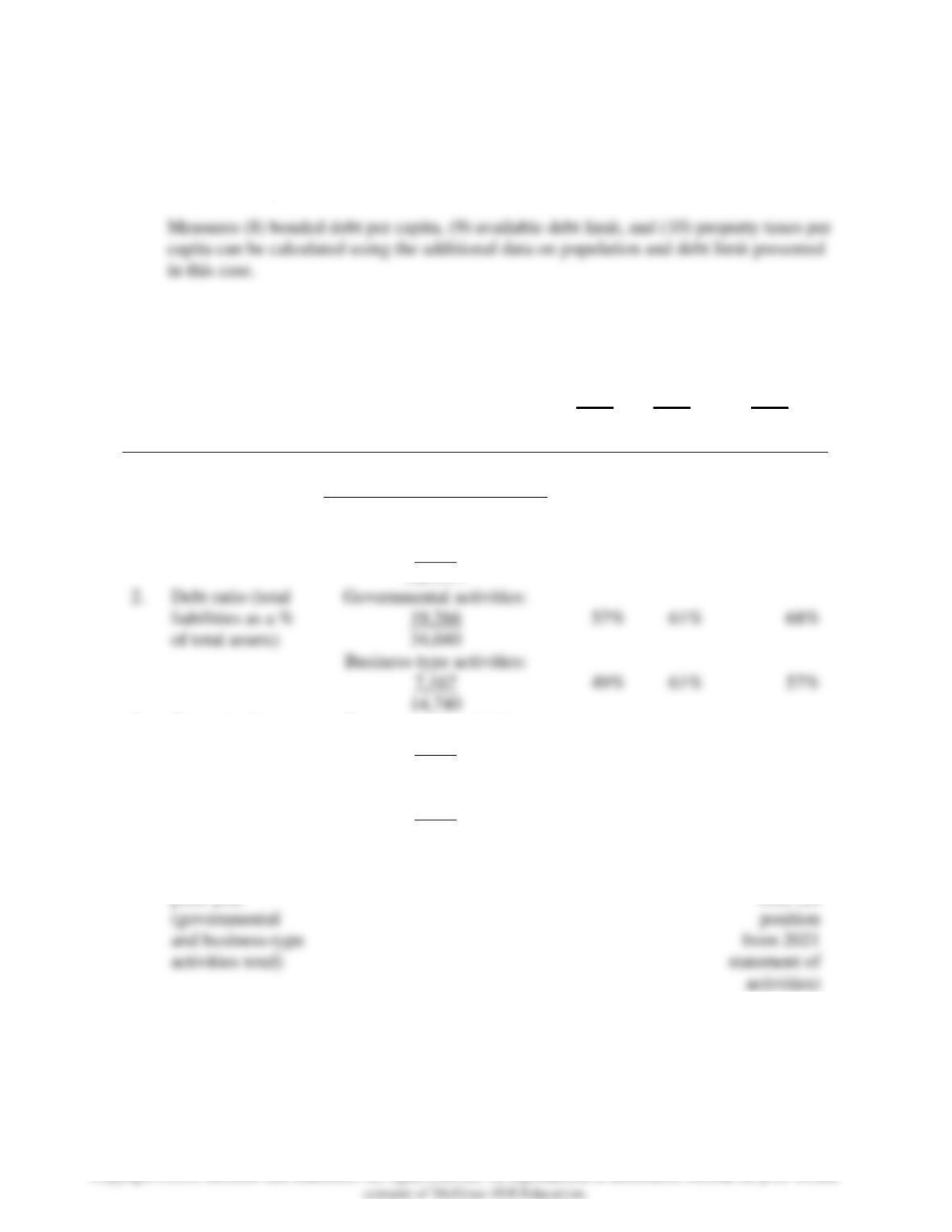
b.
City of Arborland
Government-wide Financial Performance Measures
2023 Calculations
2023
2022
2021
(see Ill. 10-4 for definition
of ratios)
($ or % or number of times)
1.
Ending
unrestricted net
position as a % of
annual revenue
Governmental activities:
3,597
20,302+3,860+1,886+495
Business-type activities:
2,546
Business-type activities:
7,167
14%
49%
7%
27%
11%
66%
3.
Current ratio
Governmental activities:
8,299
3,366
Business-type activities:
2,966
667
2.47
times
4.45
times
3.70
times
4.43
times
1.90
times
5.36
times
4.
Change in net
position from the
and business-type
activities total)
from 2021
22,347 – 17,447
$4,900
$3,220
$3,867
(change in

Chapter 10 – Analysis of Government Financial Performance
10–16
Ch. 10, Solutions, Exercise 10-21 (Cont’d)
5.
Interperiod
equity (number
of times revenue
exceeds
expenses)
Governmental activities:
20,302+3,860+1,886
+495-100
23,973
for BTA see next ratio
1.10
times
1.16
times
1.15
times
sufficiency
7.
Capital asset
condition (% of
useful life left in
depreciable
capital assets)
Governmental activities:
15,039
(37,683+37,600)/2*
Business-type activities:
5,782
(17,775+14,455)/2*
40%
36%
43%
60%
50%
50%
9.
Available legal
debt limit
(remaining % of
debt limit
available)
Governmental activities:
15,900,000
20,000,000
79.5%
84.5%
79.5%
28,420
* Insufficient information is available (i.e., the beginning of the year balance of
depreciable assets) to calculate average depreciable assets for the year 2021. Thus, for
2021, the end of year balance was used in the denominator of the ratio.

Chapter 10 – Analysis of Government Financial Performance
10–17
Ch. 10, Solutions, Exercise 10-21 (Cont’d)
c. The City of Arborland appears to be in a fairly strong financial condition based on the
following interpretations of the ratios calculated for part b: Unrestricted net position has
been positive and above 5 percent each of the three years in both governmental and
General Problem Information: Financial trends
Learning Objective: 10-4
Topic: Analyzing Government-wide Financial Statements