Exercise 10-6 (continued)
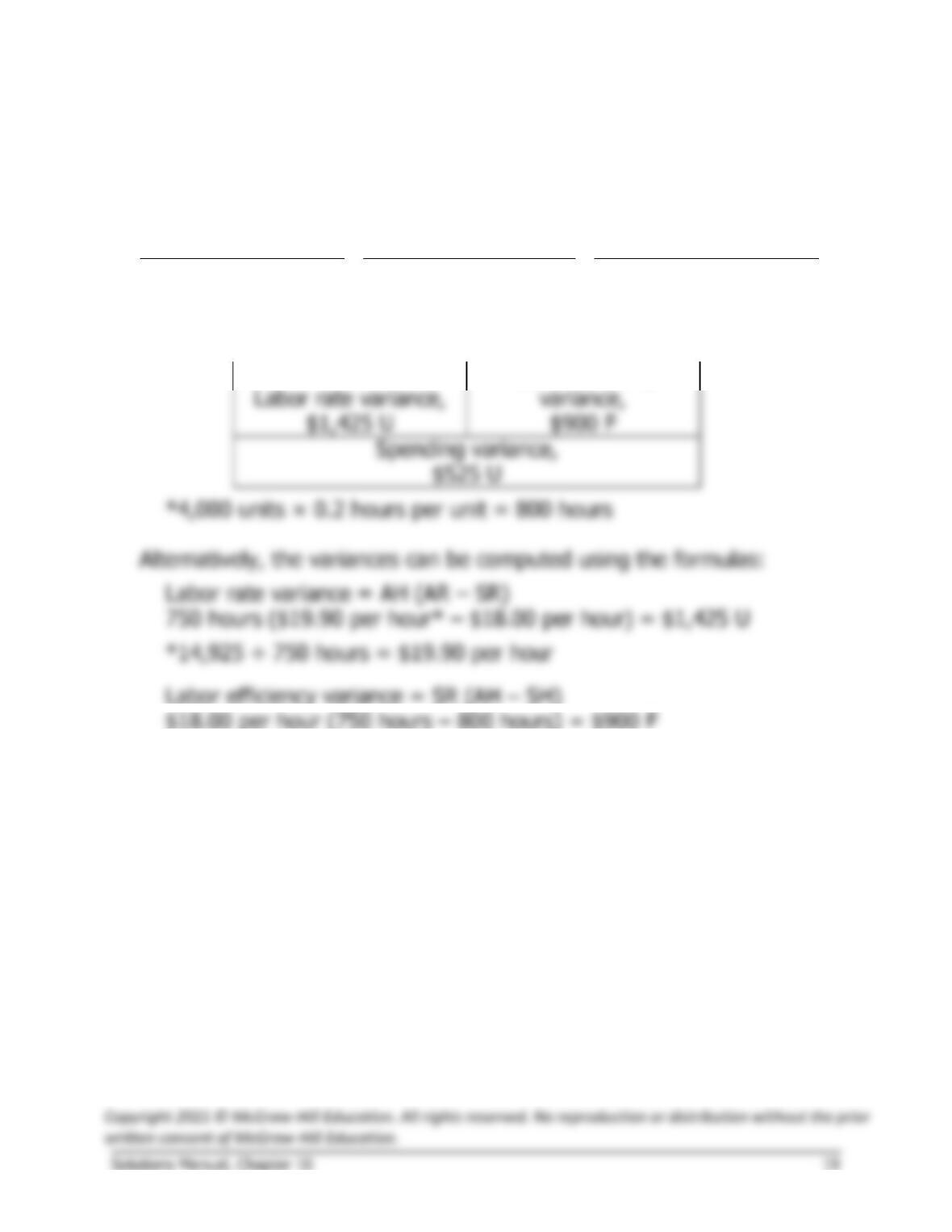
2.
Actual Hours of
Input, at the
Actual Rate
Actual Hours of Input,
at the Standard Rate
Standard Hours
Allowed for Output, at
the Standard Rate
(AH × AR)
(AH × SR)
(SH × SR)
750 hours ×
$18.00 per hour
800 hours* ×
$18.00 per hour
$14,925
= $13,500
= $14,400
Labor efficiency
Exercise 10-7 (15 minutes)
Notice in the solution below that the materials price variance is
computed for the entire amount of materials purchased, whereas the
materials quantity variance is computed only for the amount of materials
used in production.
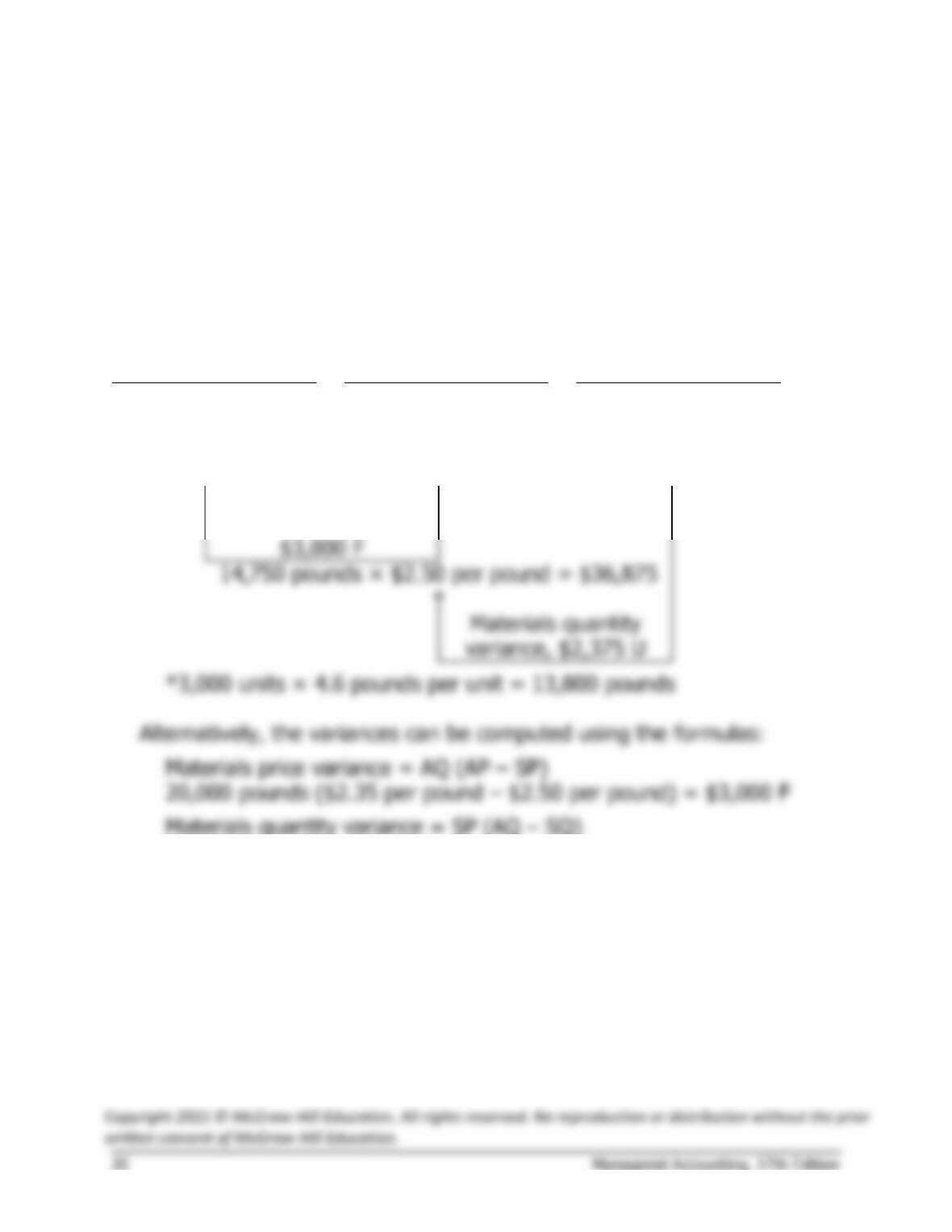
Actual Quantity of
Input, at Actual Price
Actual Quantity
of Input, at
Standard Price
Standard Quantity
Allowed for Output,
at Standard Price
(AQ × AP)
(AQ × SP)
(SQ × SP)
20,000 pounds ×
$2.35 per pound
20,000 pounds ×
$2.50 per pound
13,800 pounds* ×
$2.50 per pound
= $47,000
= $50,000
= $34,500
Materials price
variance,
$2.50 per pound (14,750 pounds – 13,800 pounds) = $2,375 U
Exercise 10-8 (30 minutes)
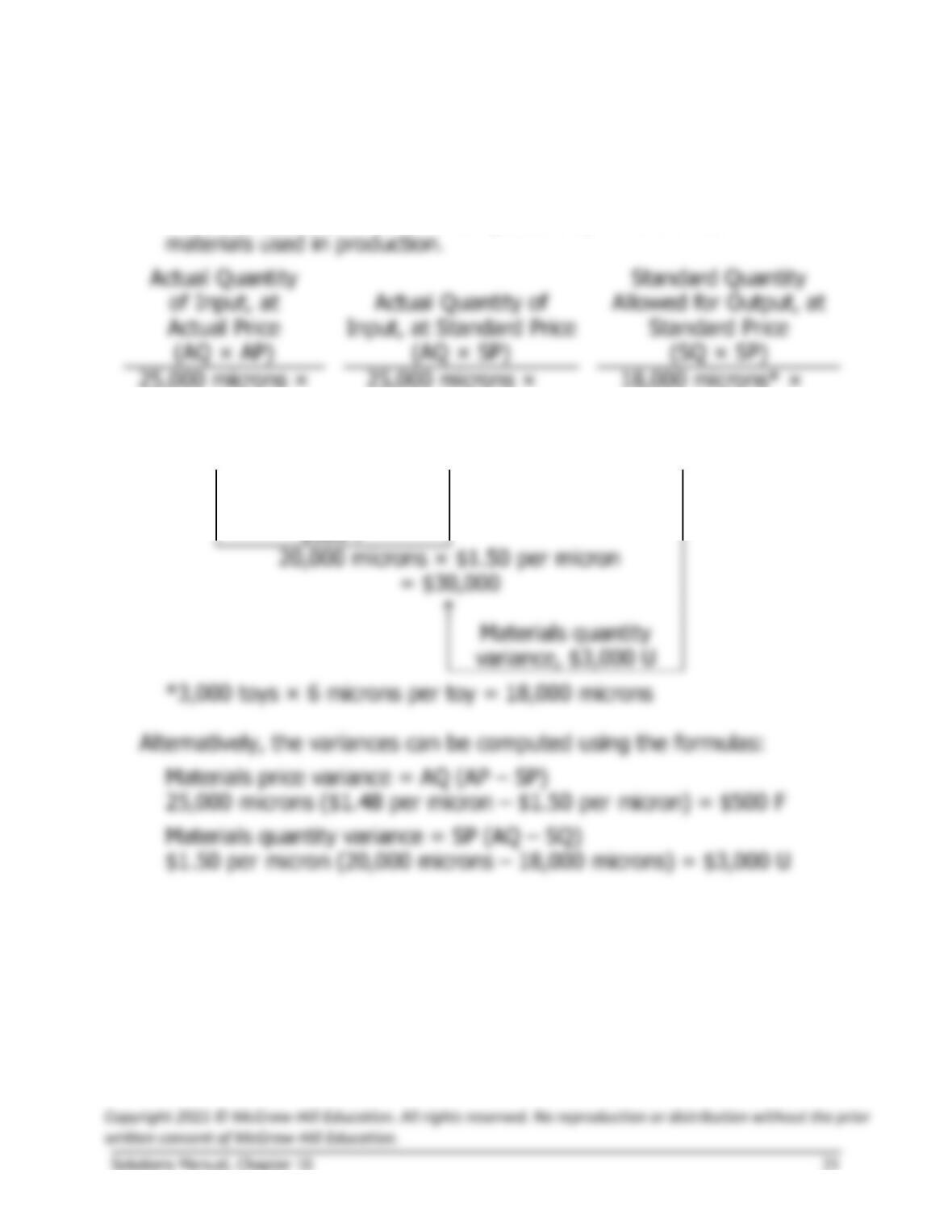
1. a. Notice in the solution below that the materials price variance is
computed on the entire amount of materials purchased, whereas the
materials quantity variance is computed only on the amount of
(AQ × AP)
(AQ × SP)
(SQ × SP)
$1.48 per micron
$1.50 per micron
$1.50 per micron
= $37,000
= $37,500
= $27,000
Materials price
variance,
Exercise 10-8 (continued)
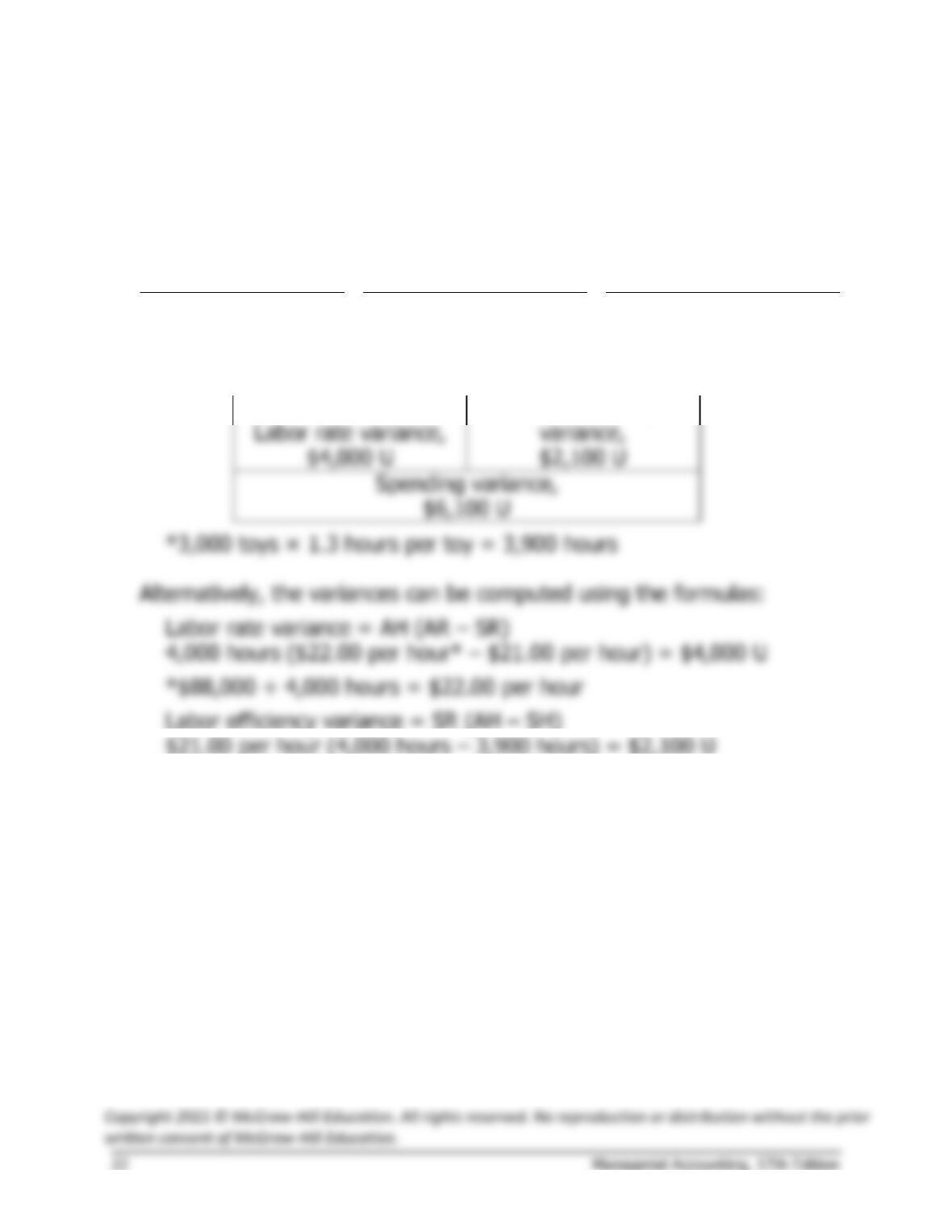
b. Direct labor variances:
Actual Hours of
Input, at the
Actual Rate
Actual Hours of Input,
at the Standard Rate
Standard Hours Allowed
for Output, at the
Standard Rate
(AH × AR)
(AH × SR)
(SH × SR)
4,000 hours ×
$21.00 per hour
3,900 hours* ×
$21.00 per hour
$88,000
= $84,000
= $81,900
Labor efficiency
Exercise 10-8 (continued)
2. A variance usually has many possible explanations. In particular, we
should always keep in mind that the standards themselves may be
incorrect. Some of the other possible explanations for the variances
observed at Dawson Toys appear below:
Materials Quantity Variance
Since this variance is unfavorable, more
materials were used to produce the actual output than were called for by
the standard. This could also occur for a variety of reasons. Some of the
possibilities include poorly trained or supervised workers, improperly
adjusted machines, and defective materials.
Labor Rate Variance
Since this variance is unfavorable, the actual
average wage rate was higher than the standard wage rate. Some of the
possible explanations include an increase in wages that has not been
reflected in the standards, unanticipated overtime, and a shift toward
more highly paid workers.
Problem 10-9 (45 minutes)
This problem is more difficult than it looks. Allow ample time for discussion.
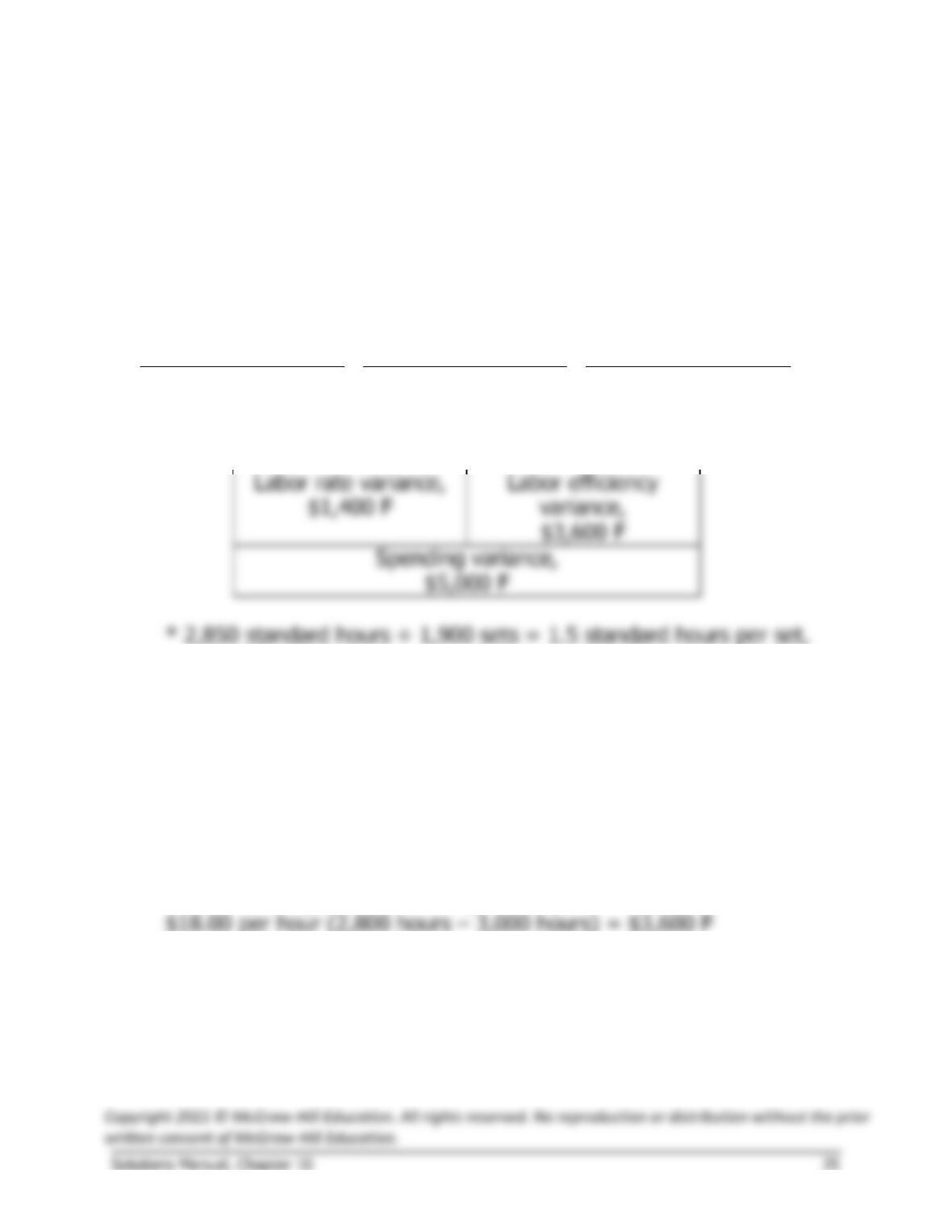
1.
Actual Quantity of
(AQ × AP)
Actual Quantity
of Input, at
Standard Quantity
Allowed for Output,
$4.00 per yard*
$4.00 per yard*
$45,600
= $48,000
= $44,800
Materials price
variance,
$2,400 F
Materials quantity
variance,
$3,200 U
Spending variance,
$800 U
*
$22.40 ÷ 5.6 yards = $4.00 per yard
**
2,000 sets × 5.6 yards per set = 11,200 yards
$4.00 per yard (12,000 yards – 11,200 yards) = $3,200 U
Problem 10-9 (continued)
2. Many students will miss parts 2 and 3 because they will try to use
product
costs as if they were
hourly
costs. Pay particular attention to
the computation of the standard direct labor time per unit and the
standard direct labor rate per hour.
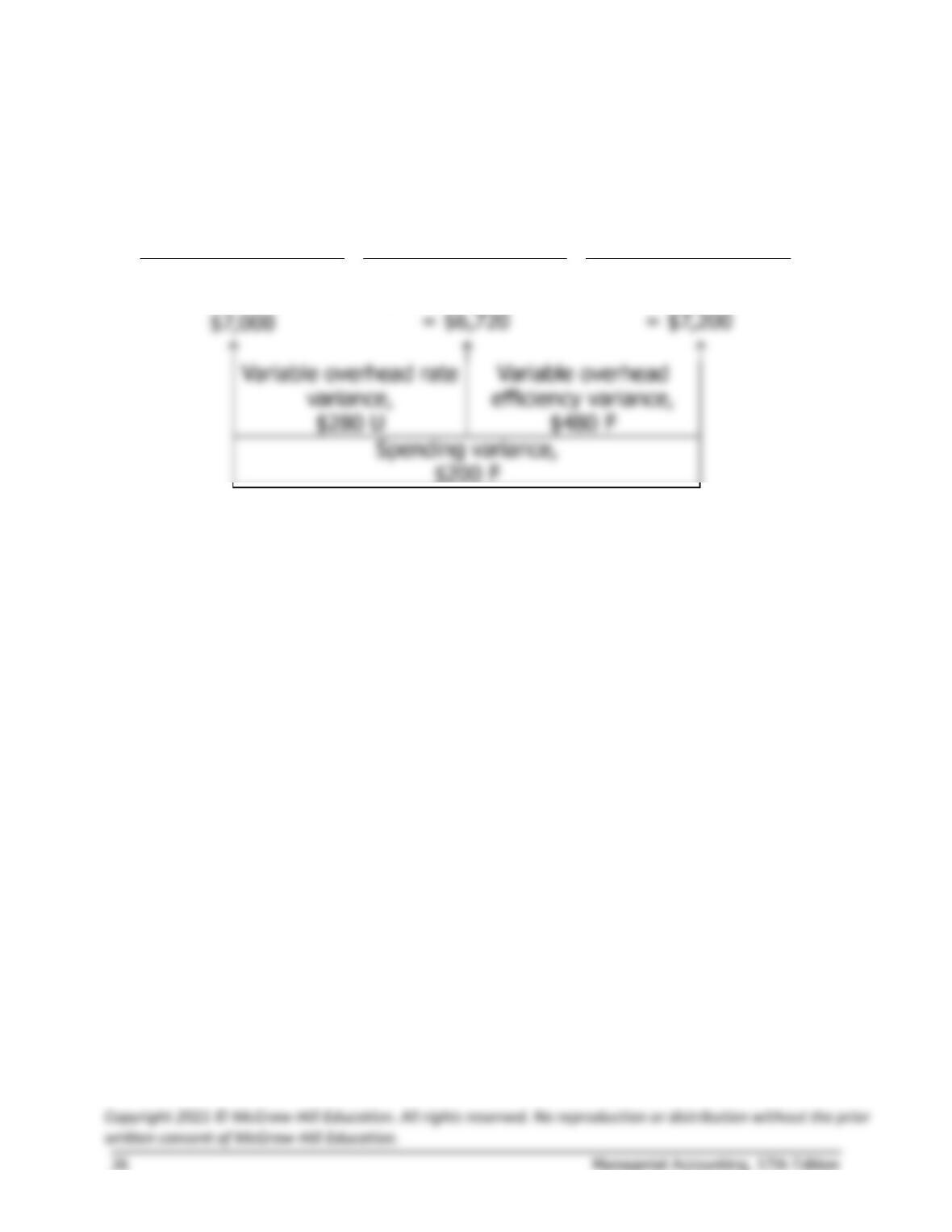
Actual Hours of
Input, at the
Actual Rate
Actual Hours of
Input, at the
Standard Rate
Standard Hours
Allowed for Output,
at the Standard Rate
(AH × AR)
(AH × SR)
(SH × SR)
2,800 hours ×
$18.00 per hour*
3,000 hours** ×
$18.00 per hour*
$49,000
= $50,400
= $54,000
$27.00 standard cost per set ÷ 1.5 standard hours per set =
$18.00 standard rate per hour.
**
2,000 sets × 1.5 standard hours per set = 3,000 standard hours.
Alternatively, the variances can be computed using the formulas:
Labor rate variance = AH (AR – SR)
2,800 hours ($17.50 per hour* – $18.00 per hour) = $1,400 F
*$49,000 ÷ 2,800 hours = $17.50 per hour
Labor efficiency variance = SR (AH – SH)
Problem 10-9 (continued)
3.
Actual Hours of
Input, at the
Actual Rate
Actual Hours of
Input, at the
Standard Rate
Standard Hours
Allowed for Output,
at the Standard Rate
(AH × AR)
(AH × SR)
(SH × SR)
2,800 hours ×
$2.40 per hour*
3,000 hours ×
$2.40 per hour*
*$3.60 standard cost per set ÷ 1.5 standard hours per set
= $2.40 standard rate per hour
Alternatively, the variances can be computed using the formulas:
Variable overhead rate variance = AH (AR – SR)
2,800 hours ($2.50 per hour* – $2.40 per hour) = $280 U
*$7,000 ÷ 2,800 hours = $2.50 per hour
Variable overhead efficiency variance = SR (AH – SH)
$2.40 per hour (2,800 hours – 3,000 hours) = $480 F
Problem 10-10 (45 minutes)
1.
Standard
Quantity or
Hours
Standard Price
or Rate
Standard
Cost
Alpha6:
Direct materials—X442 ……
1.8 kilos
$3.50 per kilo
$ 6.30
Direct materials—Y661 ……
2.0 liters
$1.40 per liter
2.80
Direct labor—Sintering ……
0.20 hours
$19.80 per hour
3.96
Direct labor—Finishing ……
0.80 hours
$19.20 per hour
15.36
Total …………………………..
$28.42
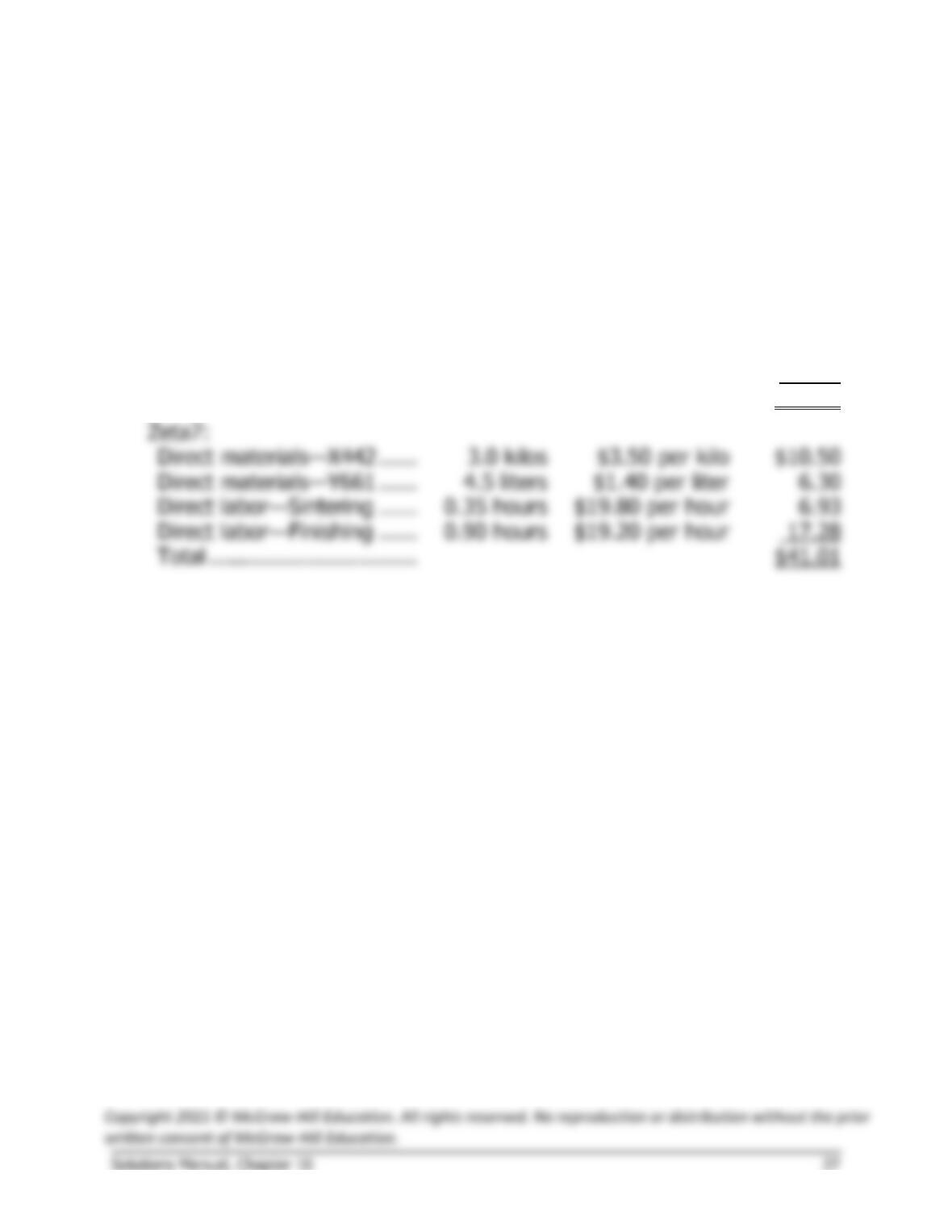
Zeta7:
Direct materials—X442 ……
3.0 kilos
$3.50 per kilo
$10.50
Direct materials—Y661 ……
4.5 liters
$1.40 per liter
6.30
Direct labor—Sintering ……
0.35 hours
$19.80 per hour
6.93
Direct labor—Finishing ……
0.90 hours
$19.20 per hour
17.28
Total …………………………..
$41.01
Problem 10-10 (continued)
2. The computations to follow will require the standard quantities allowed
for the actual output for each material.
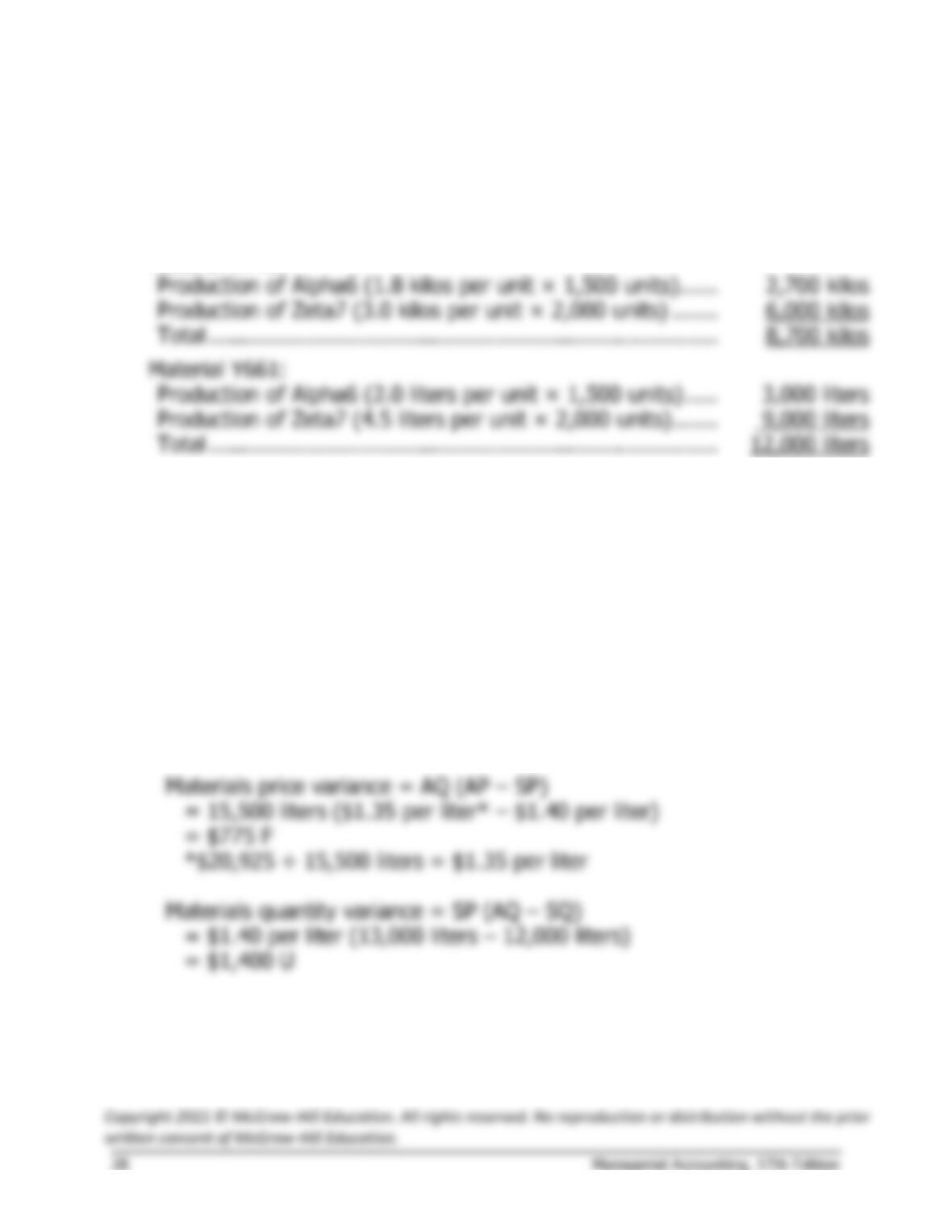
Standard Quantity Allowed
Material X442:
Material Y661:
Direct materials variances—Material X442:
Materials price variance = AQ (AP – SP)
= 14,500 kilos ($3.60 per kilo* – $3.50 per kilo)
= $1,450 U
*$52,200 ÷ 14,500 kilos = $3.60 per kilo
Materials quantity variance = SP (AQ – SQ)
= $3.50 per kilo (8,500 kilos – 8,700 kilos)
= $700 F
Direct materials variances—Material Y661:
Problem 10-10 (continued)
3. The computations to follow will require the standard quantities allowed
for the actual output for direct labor in each department.
Standard Hours Allowed
Sintering:
Production of Alpha6 (0.20 hours per unit × 1,500 units) ..
300 hours
Production of Zeta7 (0.35 hours per unit × 2,000 units) ….
700 hours
Total ……………………………………………………………………
1,000 hours
Finishing:
Production of Alpha6 (0.80 hours per unit × 1,500 units) ..
1,200 hours
Production of Zeta7 (0.90 hours per unit × 2,000 units) ….
1,800 hours
Total ……………………………………………………………………
3,000 hours
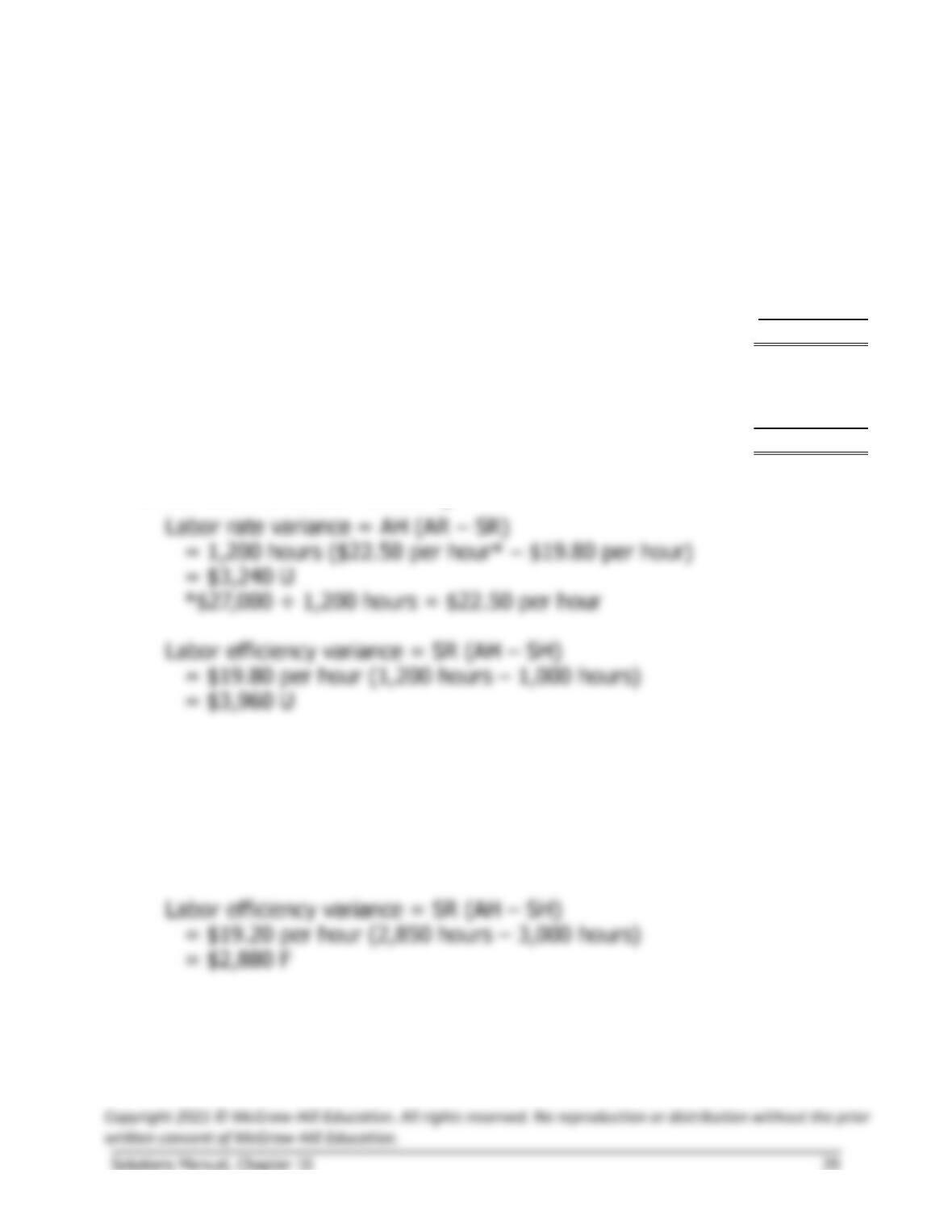
Direct labor variances—Sintering:
Direct labor variances—Finishing:
Labor rate variance = AH (AR – SR)
= 2,850 hours ($21.00 per hour* – $19.20 per hour)
= $5,130 U
*$59,850 ÷ 2,850 hours = $21.00 per hour
Problem 10-11 (45 minutes)
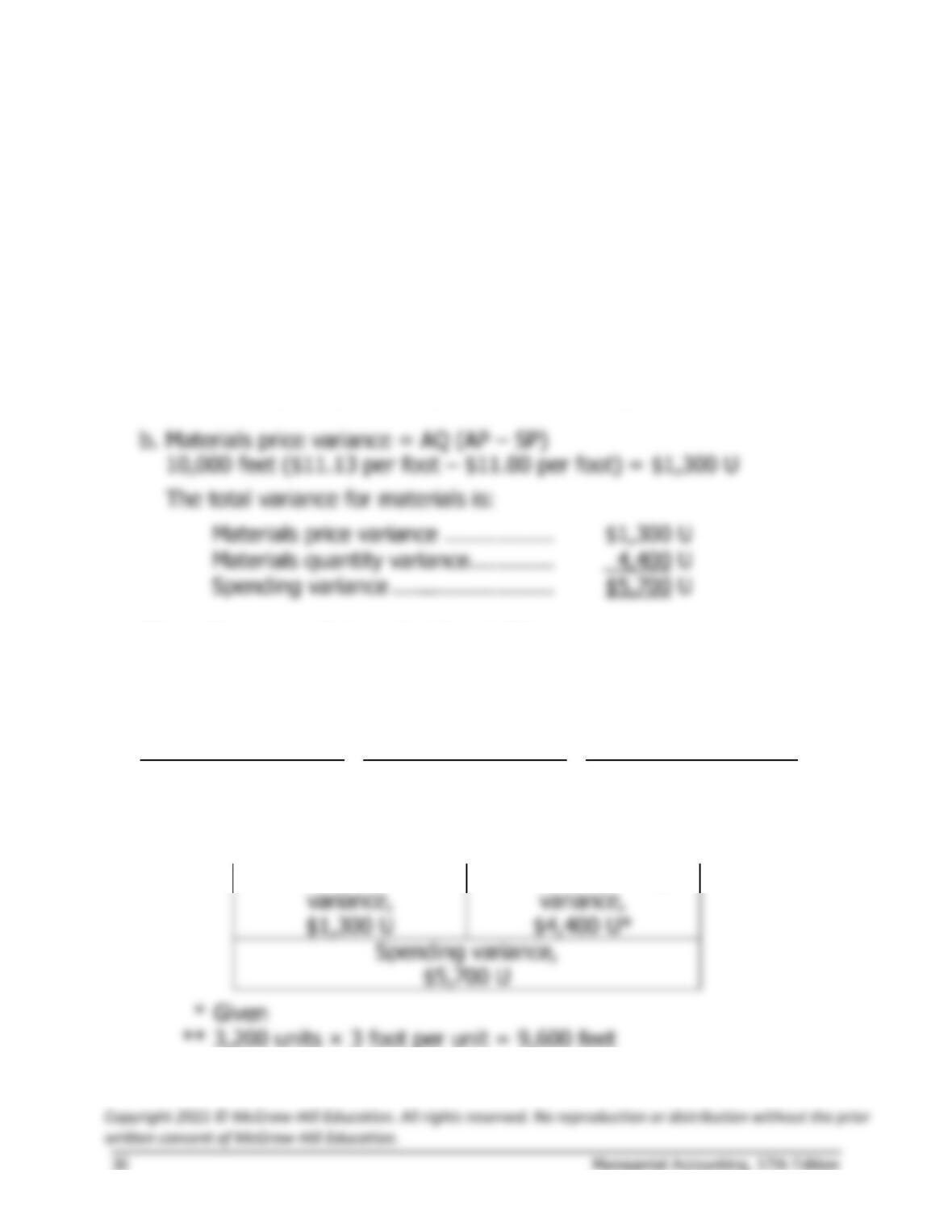
1. a. Materials quantity variance = SP (AQ – SQ)
$11.00 per foot (AQ – 9,600 feet*) = $4,400 U
$11.00 per foot × AQ – $105,600 = $4,400**
$11.00 per foot × AQ = $110,000
AQ = 10,000 feet
*
$3,200 units × 3 foot per unit = 9,600 feet
**
When used with the formula, unfavorable variances are
positive and favorable variances are negative.
Therefore, $111,300 ÷ 10,000 feet = $11.13 per foot
Alternative approach to parts (a) and (b):
Actual Quantity of
Input, at Actual Price
Actual Quantity
of Input, at
Standard Price
Standard Quantity
Allowed for Output,
at Standard Price
(AQ × AP)
(AQ × SP)
(SQ × SP)
10,000 feet ×
$11.13 per foot
10,000 feet ×
$11.00 per foot*
9,600 feet** ×
$11.00 per foot*
= $111,300*
= $110,000
= $105,600
Materials price
3,200 units × 3 foot per unit = 9,600 feet
Materials quantity
Problem 10-11 (continued)
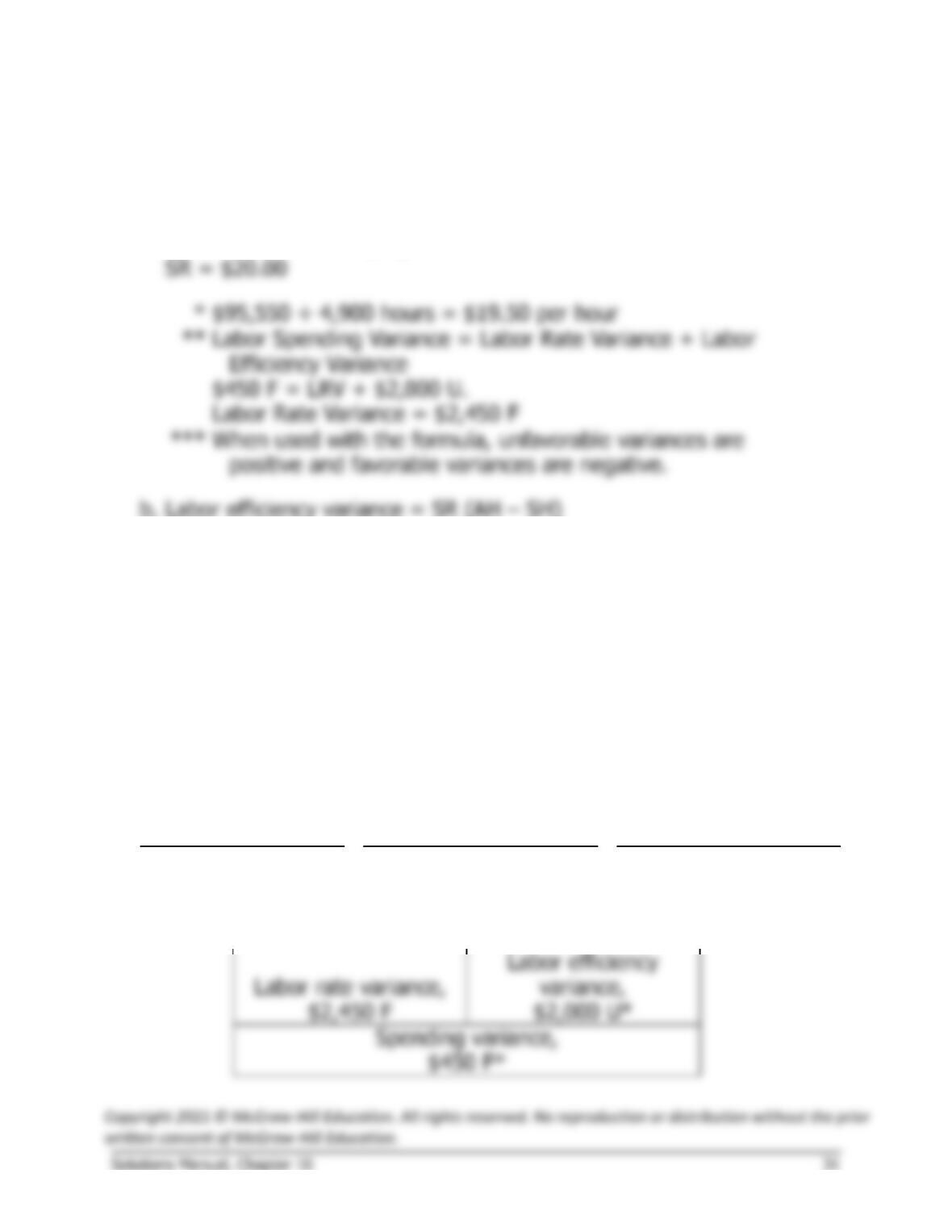
2. a. Labor rate variance = AH (AR – SR)
4,900 hours ($19.50 per hour* – SR) = $2,450 F**
$95,550 – 4,900 hours × SR = –$2,450***
4,900 hours × SR = $98,000
When used with the formula, unfavorable variances are
$20.00 per hour (4,900 hours – SH) = $2,000 U
$98,000 – $20.00 per hour × SH = $2,000*
$20.00 per hour × SH = $96,000
SH = 4,800 hours
*
When used with the formula, unfavorable variances are positive
and favorable variances are negative.
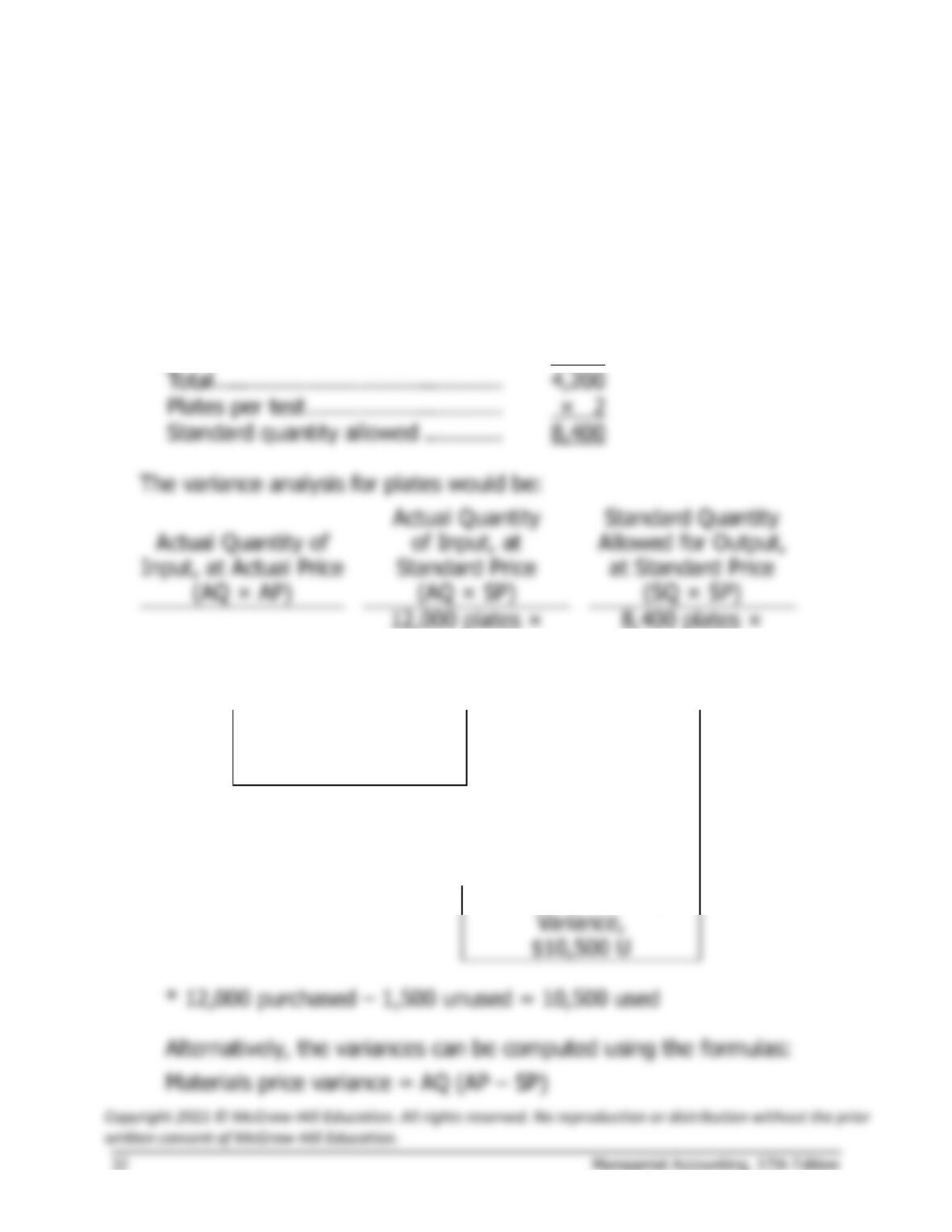
Alternative approach to parts (a) and (b):
Actual Hours of
Input, at the
Actual Rate
Actual Hours of Input,
at the Standard Rate
Standard Hours
Allowed for Output,
at the Standard Rate
(AH × AR)
(AH × SR)
(SH × SR)
4,900 hours* ×
$20.00 per hour
4,800 hours ×
$20.00 per hour
$95,550*
= $98,000
= $96,000
*Given
c. The standard hours allowed per unit of product are:
4,800 hours ÷ 3,200 units = 1.5 hours per unit
Problem 10-12 (45 minutes)
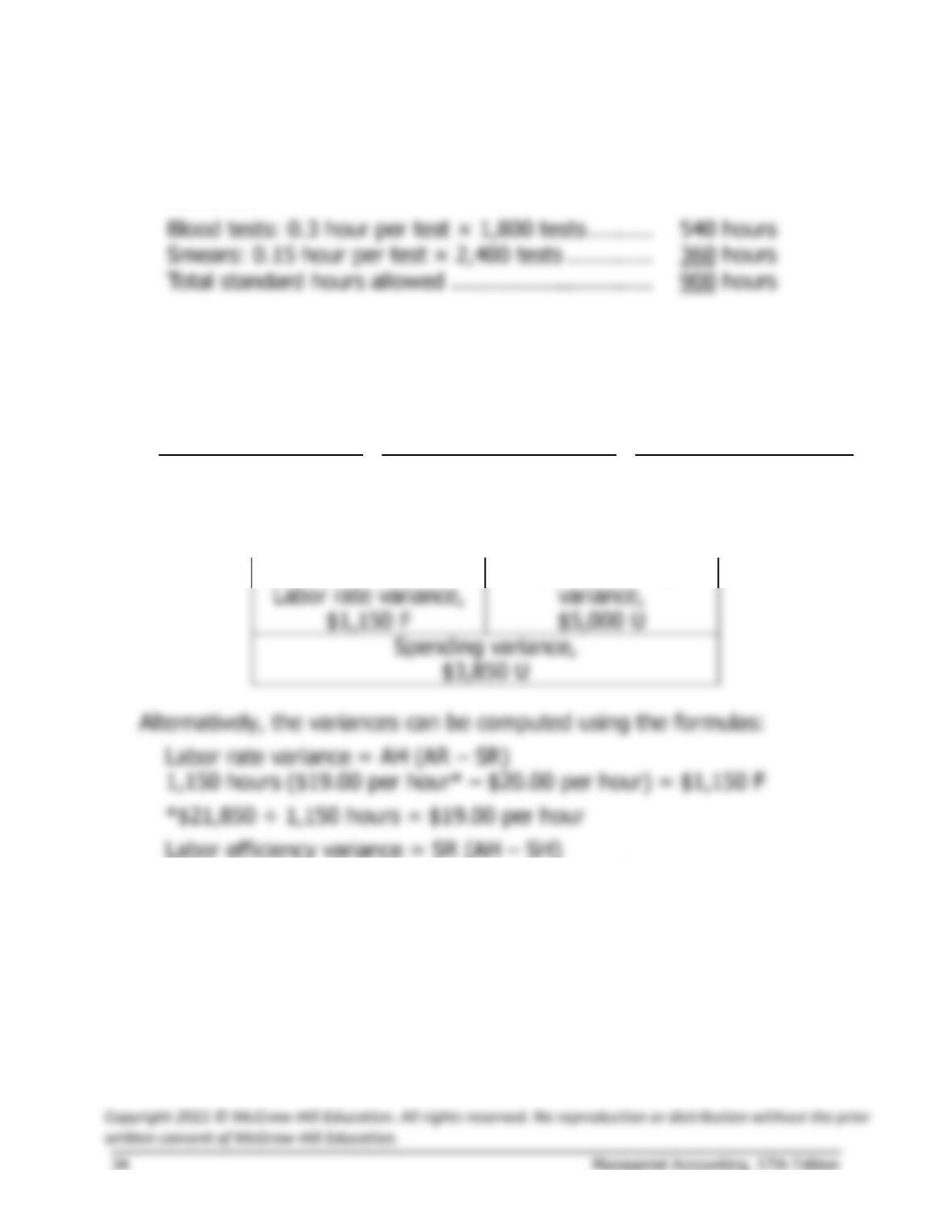
1. The standard quantity of plates allowed for tests performed during the
month would be:
Blood tests …………………………..…
1,800
Smears ………………………………….
2,400
Plates per test …………………………
$5.00 per plate
$5.00 per plate
$56,400
= $60,000
= $42,000
Materials price
variance,
$3,600 F
10,500* plates ×
$5.00 per plate =
$52,500
Materials quantity

12,000 plates ($4.70 per plate* – $5.00 per plate) = $3,600 F
*$56,400 ÷ 12,000 plates = $4.70 per plate.
Materials quantity variance = SP (AQ – SQ)
$5.00 per plate (10,500 plates – 8,400 plates) = $10,500 U
Problem 10-12 (continued)
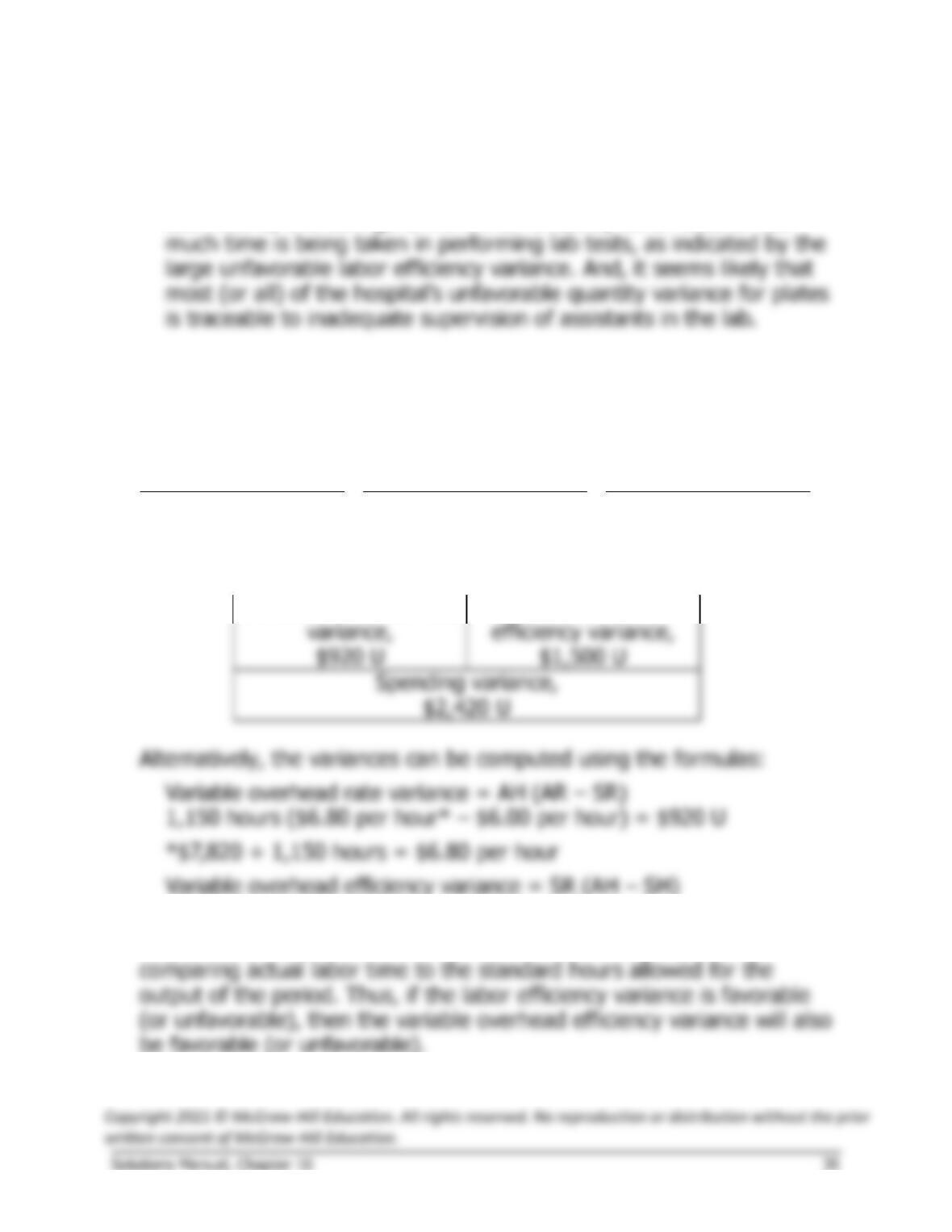
2. a. The standard hours allowed for tests performed during the month
would be:
The variance analysis would be:
Actual Hours of
Input, at the
Actual Rate
Actual Hours of Input,
at the Standard Rate
Standard Hours
Allowed for Output, at
the Standard Rate
(AH × AR)
(AH × SR)
(SH × SR)
1,150 hours ×
$20.00 per hour
900 hours ×
$20.00 per hour
$21,850
= $23,000
= $18,000
Labor efficiency
$20.00 per hour (1,150 hours – 900 hours) = $5,000 U
Problem 10-12 (continued)
b. The policy probably should not be continued. Although the hospital is
saving $1 per hour by employing more assistants than senior
technicians, this savings is more than offset by other factors. Too
3. The variable overhead variances follow:
Actual Hours of
Input, at the
Actual Rate
Actual Hours of Input,
at the Standard Rate
Standard Hours
Allowed for Output,
at the Standard Rate
(AH × AR)
(AH × SR)
(SH × SR)
1,150 hours ×
$6.00 per hour
900 hours ×
$6.00 per hour
$7,820
= $6,900
= $5,400
Variable overhead rate
Variable overhead
$6.00 per hour (1,150 hours – 900 hours) = $1,500 U
Yes, the two variances are closely related. Both are computed by
Problem 10-13 (45 minutes)
1. a.
Actual Quantity of Input,
at Actual Price
(AQ × AP)
Actual Quantity of
Input,
at Standard Price
(AQ × SP)
Standard Quantity
Allowed
for Actual Output,
at Standard Price
(SQ × SP)
21,600 feet** ×
$3.30 per foot
= $71,280
21,600 feet** ×
$3.00 per foot
= $64,800
21,600 feet* ×
$3.00 per foot
= $64,800
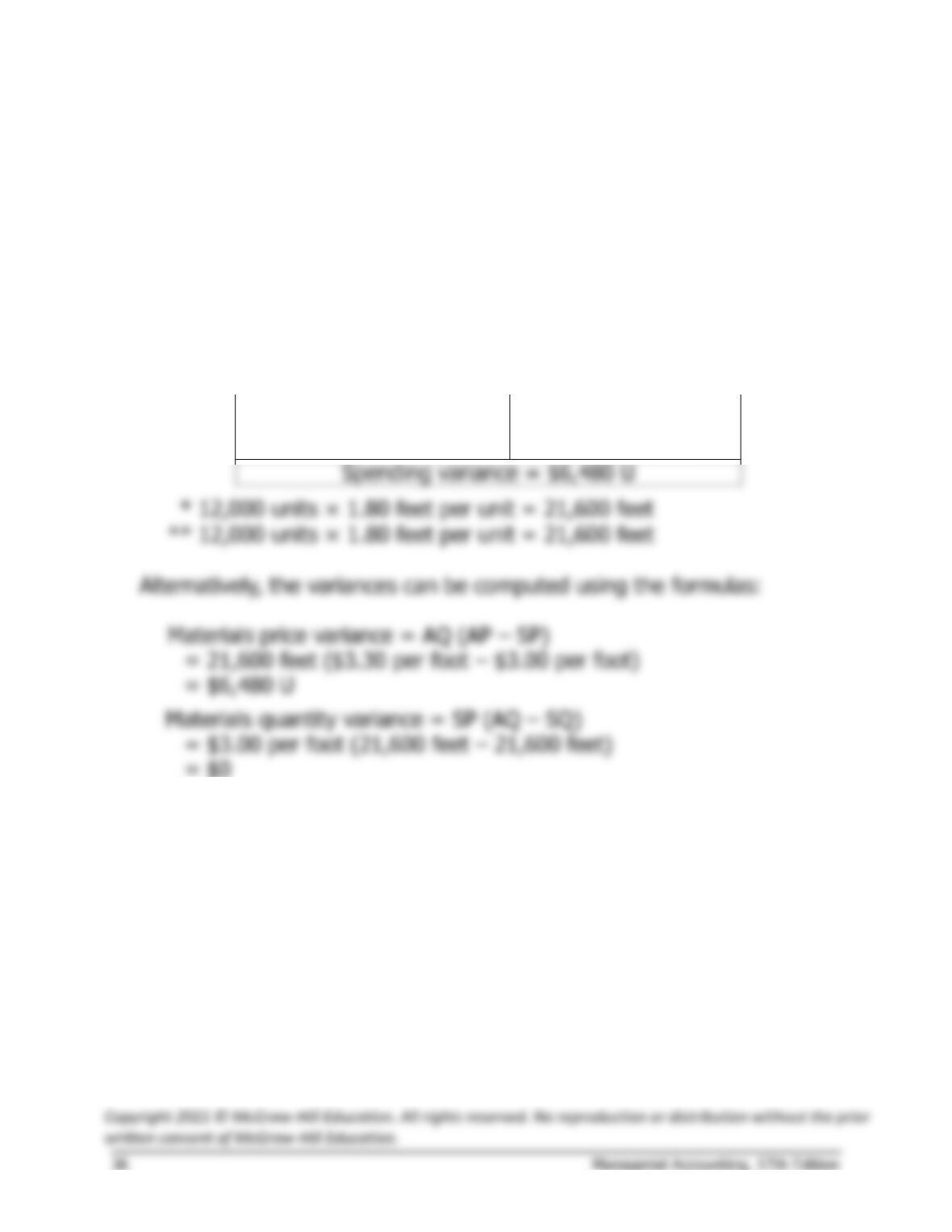
Materials price variance =
$6,480 U
Materials quantity
variance = $0
Problem 10-13 (continued)
1. b.
Actual Hours of Input,
at Actual Rate
(AH × AR)
Actual Hours of Input,
at Standard Rate
(AH × SR)
Standard Hours Allowed
for Actual Output,
at Standard Rate
(SH × SR)
11,040 hours** ×
$17.50 per hour
= $193,200
11,040 hours** ×
$18.00 per hour
= $198,720
10,800 hours* ×
$18.00 per hour
= $194,400
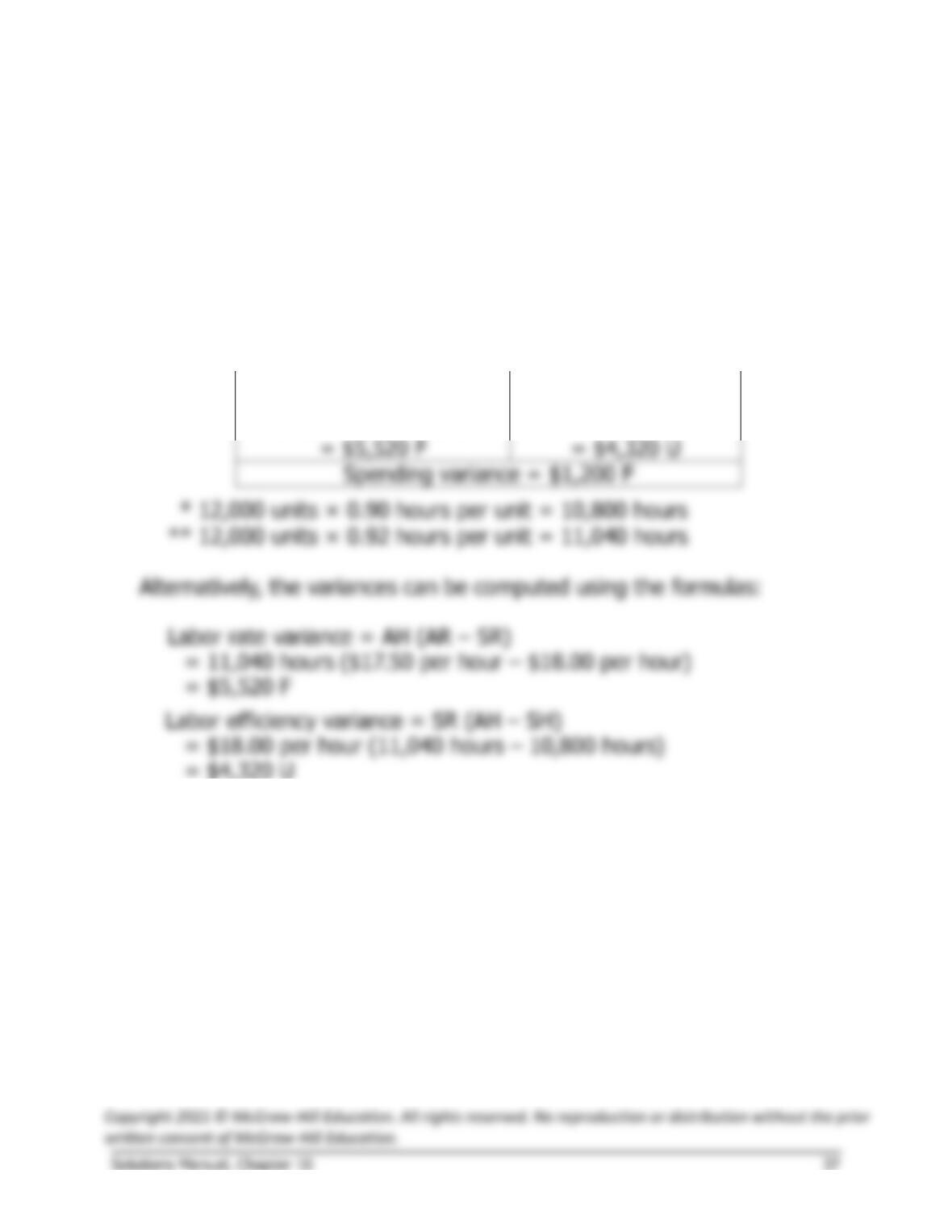
Labor rate variance
Labor efficiency
variance
Problem 10-13 (continued)
1. c.
Actual Hours of Input,
at Actual Rate
(AH × AR)
Actual Hours of Input,
at Standard Rate
(AH × SR)
Standard Hours Allowed
for Actual Output,
at Standard Rate
(SH × SR)
11,040 hours** ×
$4.50 per hour
= $49,680
11,040 hours** ×
$5.00 per hour
= $55,200
10,800 hours* ×
$5.00 per hour
= $54,000
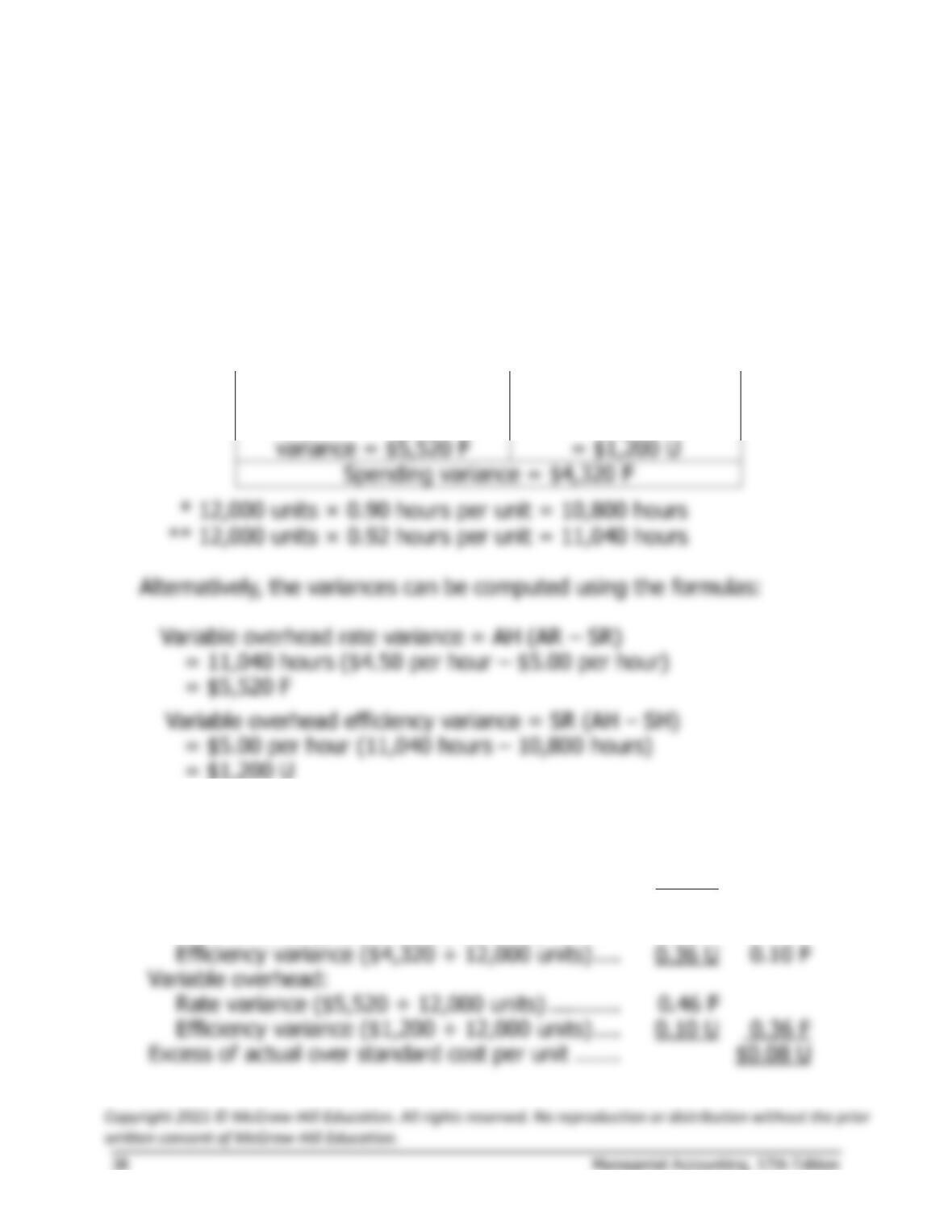
Variable overhead rate
**
Variable overhead
efficiency variance
2.
Materials:
Price variance ($6,480 ÷ 12,000 units) ………..
$0.54 U
Quantity variance ($0 ÷ 12,000 units) …………
0.00
$0.54 U
Labor:
Rate variance ($5,520 ÷ 12,000 units) ………..
0.46 F
Efficiency variance ($4,320 ÷ 12,000 units) ….
Variable overhead:
Rate variance ($5,520 ÷ 12,000 units) ………..
0.46 F
Efficiency variance ($1,200 ÷ 12,000 units) ….
0.10 U
Excess of actual over standard cost per unit …….