Decision Cases
(30-45 min.) Decision Case 1
Req. 1
Journal
DATE
ACCOUNT TITLES AND EXPLANATION
DEBIT
CREDIT
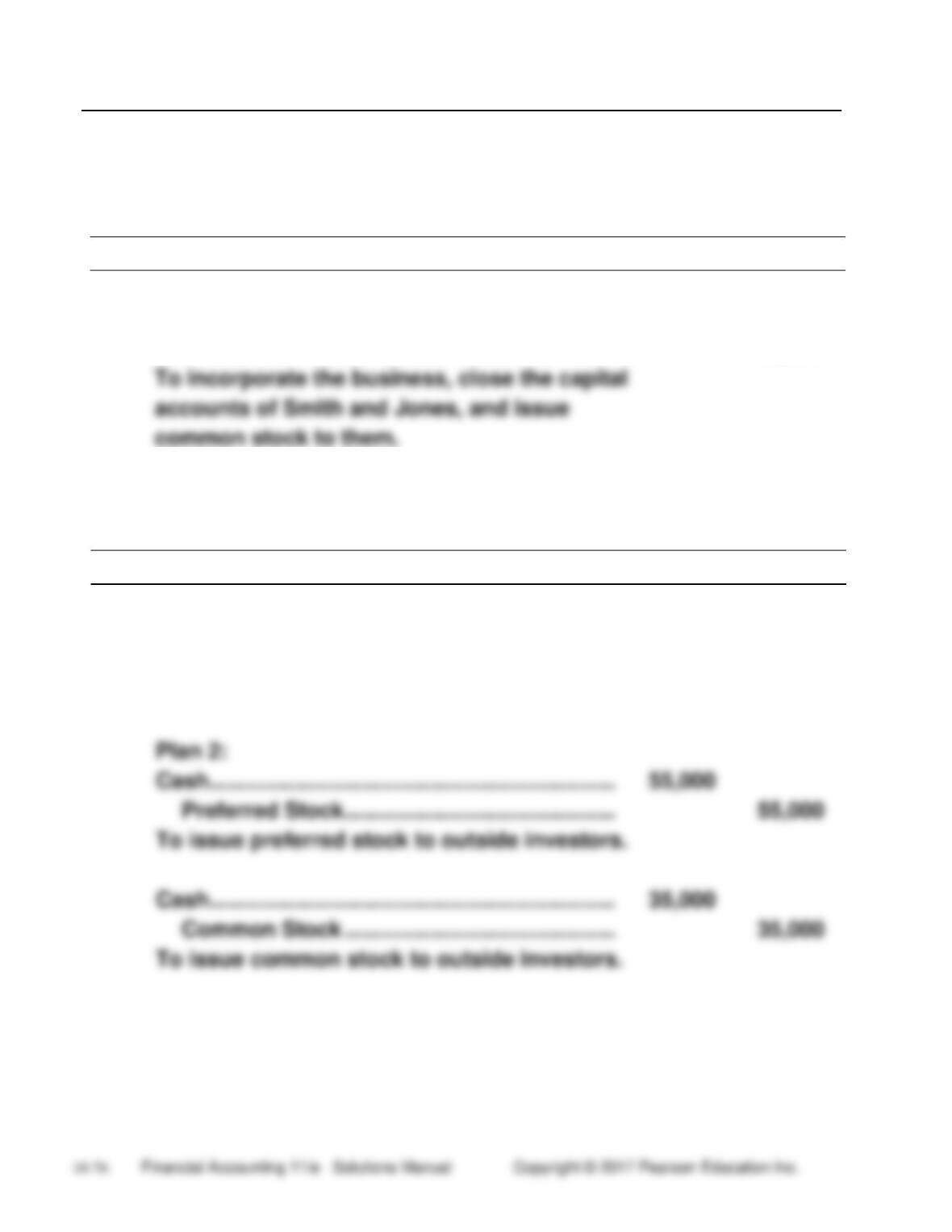
Smith, Capital ……………………………………………
25,000
Jones, Capital …………………………………………..
25,000
Common Stock ……………………………………..
50,000
accounts of Smith and Jones, and issue
common stock to them.
Req. 2
Journal
DATE
ACCOUNT TITLES AND EXPLANATION
DEBIT
CREDIT
Plan 1:
Cash…………………………………………………………
80,000
Preferred Stock (800 × $100)…………………..
80,000
To issue preferred stock to outside investors.
Plan 2:
55,000
Preferred Stock ……………………………………..
55,000
To issue preferred stock to outside investors.
Common Stock ……………………………………..
35,000
To issue common stock to outside investors.
(continued) Decision Case 1
Req. 3
Plan 1:
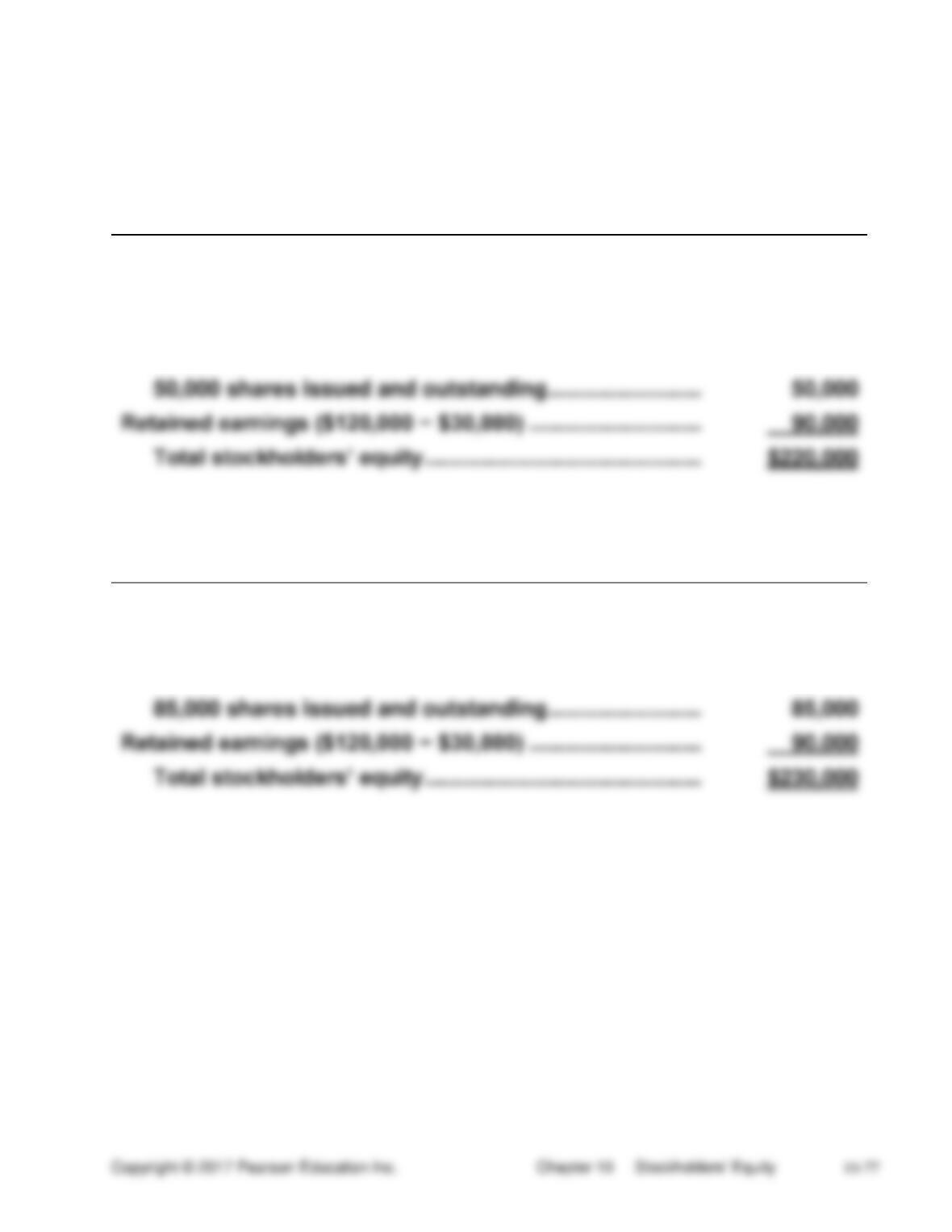
Stockholders’ Equity
Preferred stock, 6%, $100 par, nonvoting,
10,000 shares authorized, 800 shares issued and
outstanding …………………………………………………………..
$ 80,000
Common stock, $1 par, 500,000 shares authorized,
50,000 shares issued and outstanding …………………….
Plan 2:
Stockholders’ Equity
Preferred stock, $5, no-par, 10,000 shares authorized,
500 shares issued and outstanding …………………………
$ 55,000
Common stock, $1 par, 500,000 shares authorized,
85,000 shares issued and outstanding …………………….
(continued) Decision Case 1
Req. 4
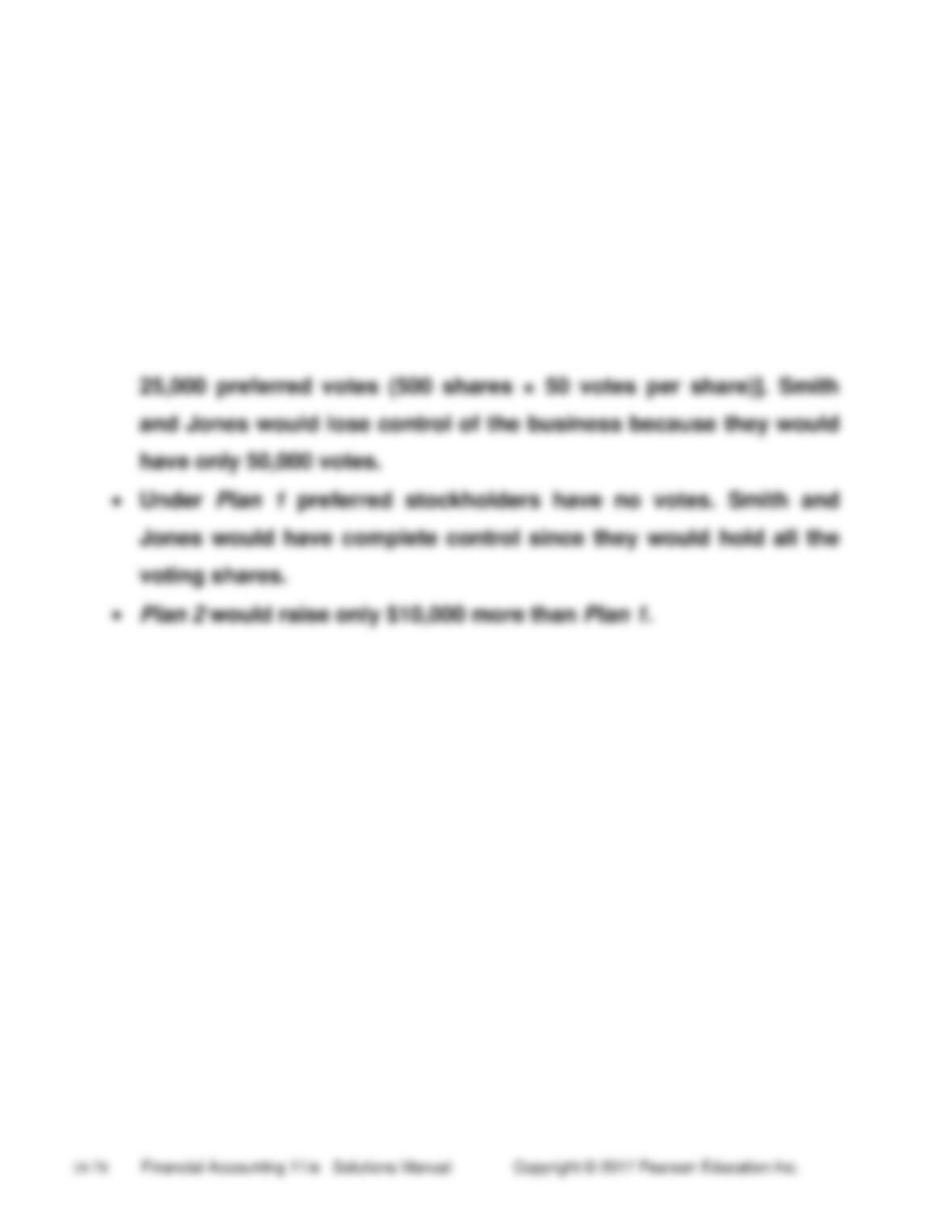
Plan 1 appears to fit the plans of Smith and Jones better than Plan 2
because:
• Their primary goal is to raise as much capital as possible without
giving up control of the business. Under Plan 2, the outside
stockholders would have 60,000 votes [35,000 common votes +
(15-20 min.) Decision Case 2
Req. 1
The stock dividend does not affect your proportionate ownership in the
company because all the stockholders receive 10% new shares. All
Req. 2
Cash dividends received last year were $7,150 (10,000 shares × $0.715
per share). Cash dividends after the dividend will be $7,150 (11,000
Req. 3
You incur no loss in value because the market value of your investment
after the stock dividend — $610,203 (11,000 shares × $55.473) — is the
same as it was before the dividend — 10,000 shares × $61.02. The
Req. 4
If the company continues paying the $0.715 cash dividend per share,
after issuing the 10% stock dividend, total cash dividends will increase.
(Your annual dividends will rise to $7,865 [11,000 shares × $0.715].) The
Ethical Issue 1
Req. 1
The ethical issue is, “What is the correct amount at which to record and
Req. 2 and Req.3
The stakeholders in the transaction include Campbell, the potential
buyers of the franchises, and potential lenders who loan them the
money to buy the franchises in the future. Campbell and the corporation
Analysis of the decision to overvalue the franchise:
(a) Economic: Campbell is better off temporarily, unless potential
buyers sue him for damages, in which case he could be worse off.
Potential buyers of the individual-language franchises can be harmed.
(b) Legal: If potential buyers are damaged by Campbell’s actions, they
might sue him for recovery of those damages. In this situation, the
(continued) Ethical Issue 1
(c) Ethical: This type of scheme is harmful to everyone involved. It is
not truthful, and it violates the rights of individuals and business entities
to full and complete disclosure of the proper valuation of a business. It
Req. 4
The franchise should be valued at its true value, which is $50,000.
Campbell should focus his time and energy on ways to make the
Ethical Issue 2
Req. 1
The ethical issue is whether the company acted properly in purchasing
Req. 2 and Req. 3
Stakeholders include the company, its officers and directors, the
(a) Economic analysis: The company, and likely its officers and
directors, benefitted temporarily at the other shareholders’ expense.
The managers purchased the stock at $6 and could sell it for $27. Thus,
the managers enriched themselves at the expense of the stockholders
who sold company stock at $6.
(continued) Ethical Issue 2
(c) Ethical analysis: The managers clearly did not behave ethically,
violating the rights of existing shareholders as well as the good faith of
Req. 4
The correct way to handle this transaction is never to have proposed it
in the first place. However, if it did happen, the disclosure principle is
relevant to the situation. The transaction should be disclosed in the
Focus on Financials: Apple Inc.
(20-30 min.)
Req. 1
Apple Inc. has only one class of stock authorized at September 27, 2014:
Common stock, $.00001 par value, 12.6 billion shares authorized, 5.9
Req. 2
Repurchase of common stock during 2014 $45,000 million
Req. 3
The company earned and reported net income of $39,510 million. It
appears first in the Consolidated Statements of Operations. The
Statement of Stockholders’ Equity also reports a repurchase of common
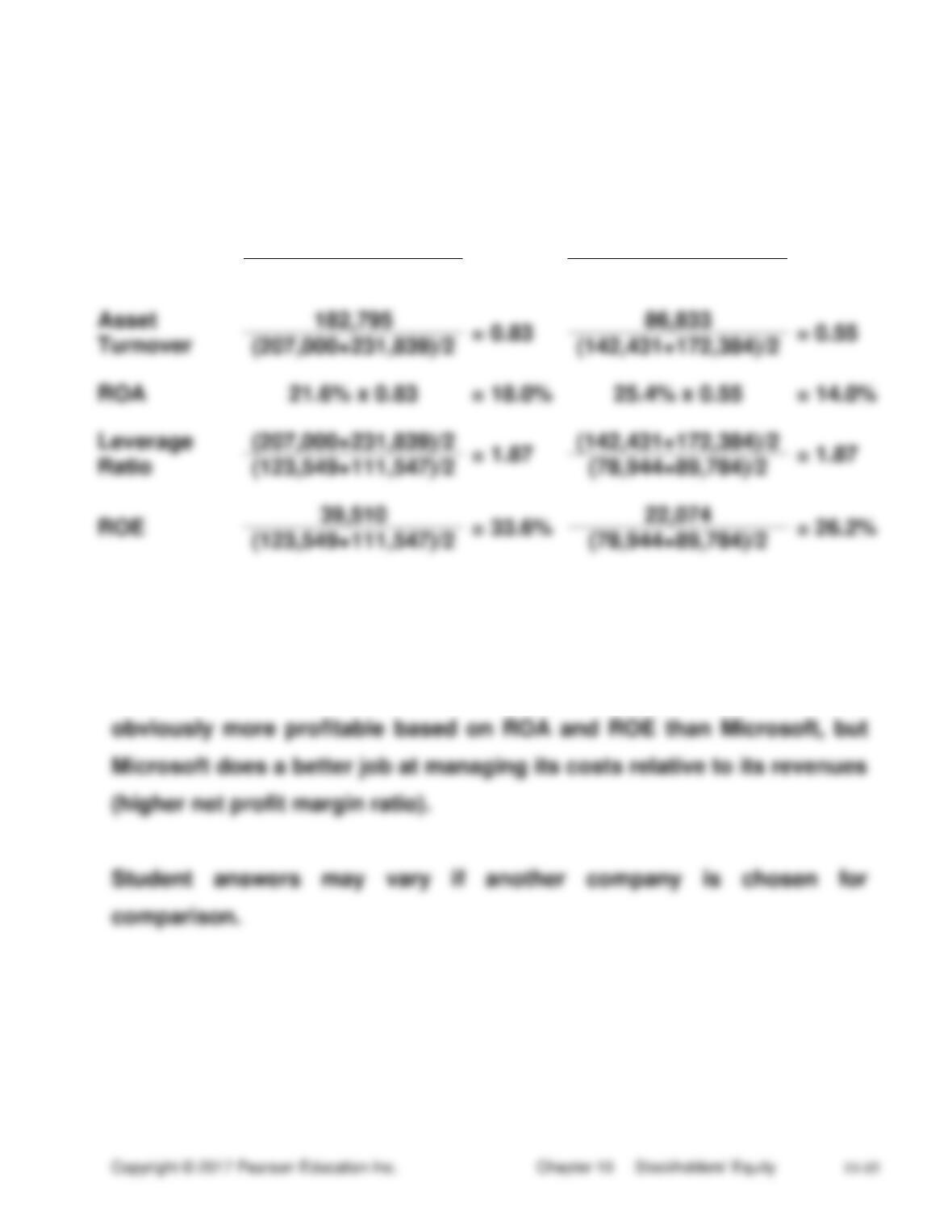
(continued) Apple Inc.
Req. 4
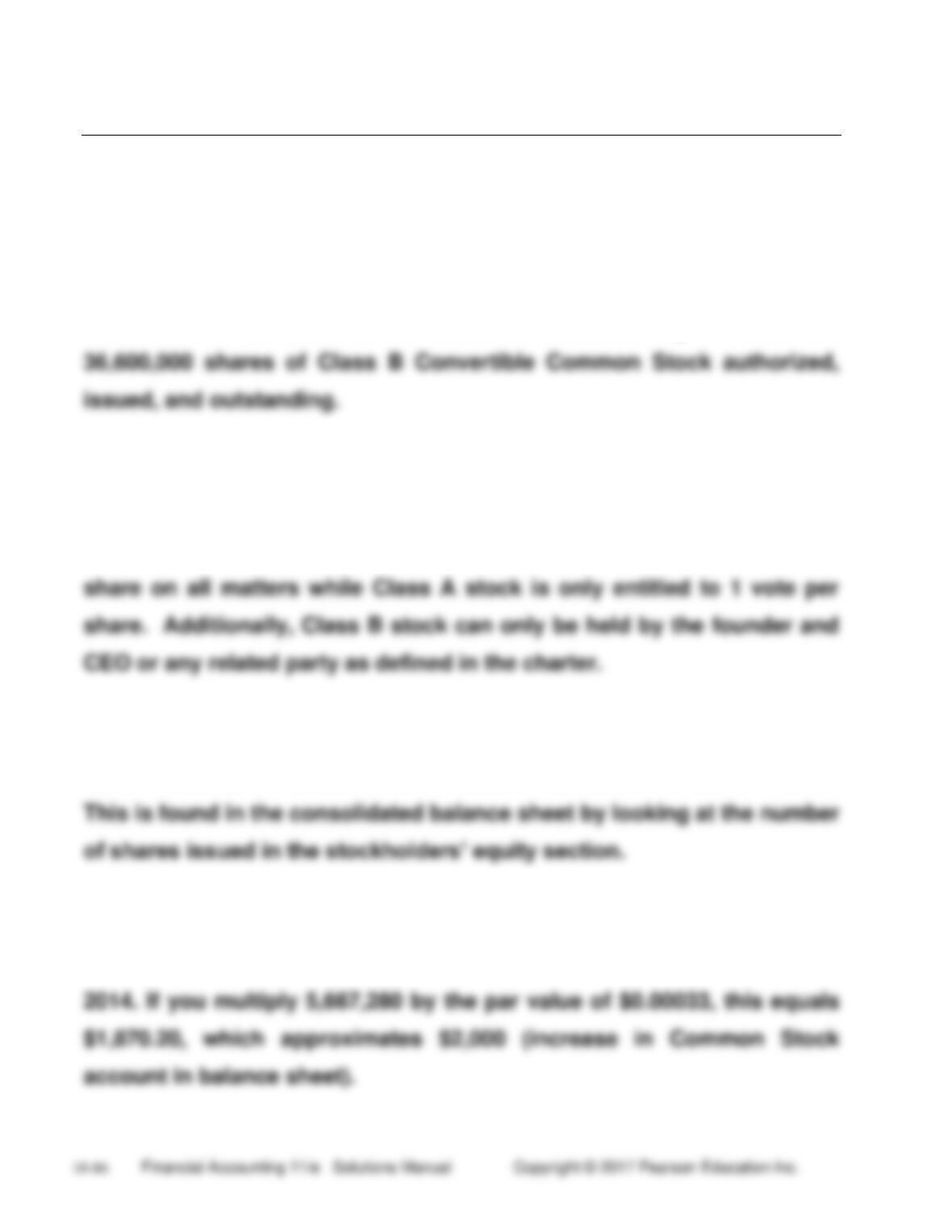
Apple
Microsoft
Net Profit
Margin Ratio
39,510
= 21.6%
22,074
= 25.4%
182,795
86,833
182,795
86,833
(207,000+231,839)/2
(142,431+172,384)/2
ROA
(207,000+231,839)/2
= 1.87
(142,431+172,384)/2
= 1.87
(123,549+111,547)/2
39,510
= 33.6%
22,074
= 26.2%
(123,549+111,547)/2
Apple has positive ROA and ROE ratios in 2014. While both companies
have a similar leverage ratio, Microsoft has a higher net profit margin
ratio. Apple has a higher asset turnover than Microsoft. Apple is
Focus on Analysis: Under Armour, Inc.
(20-30 min.)
Req. 1
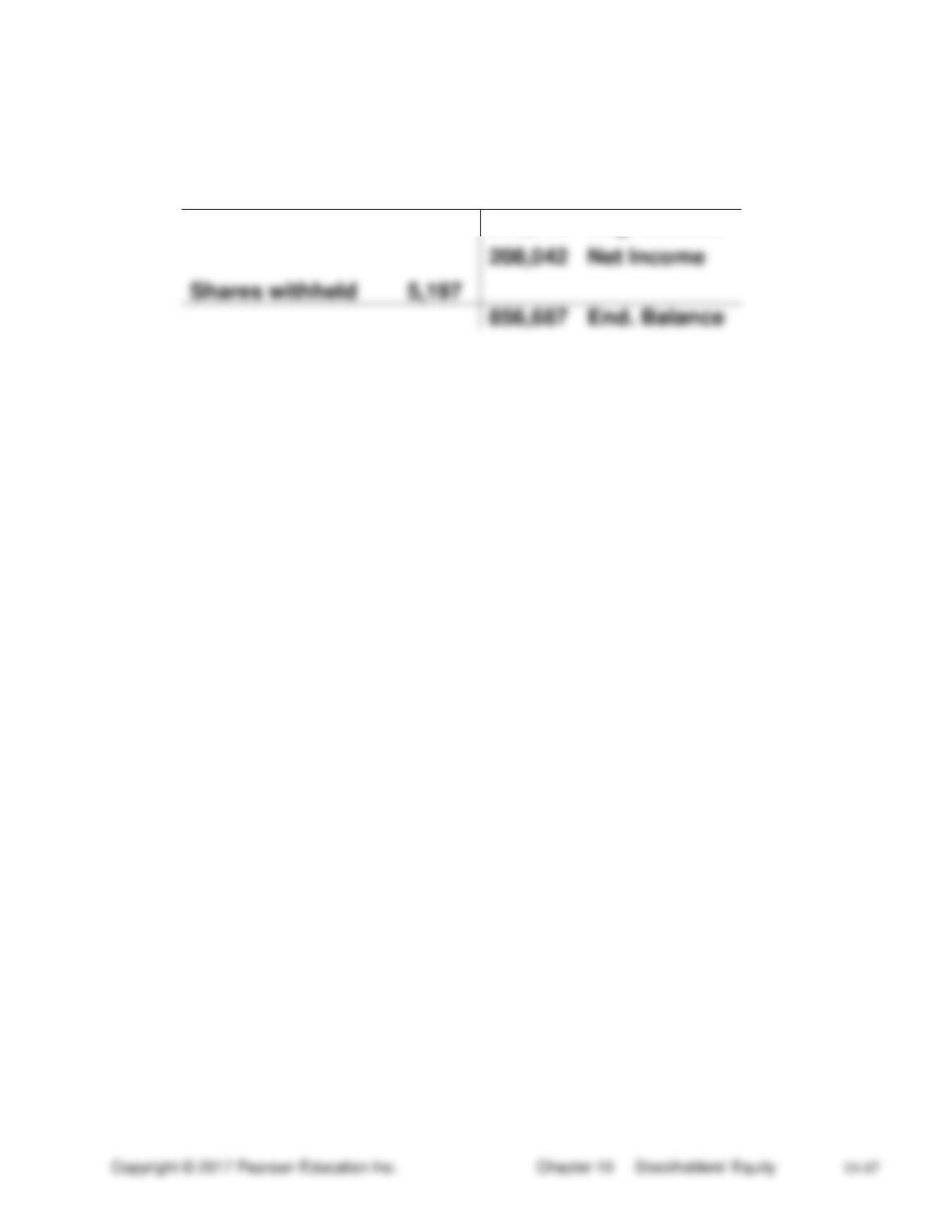
Under Armour, Inc. has 400,000,000 shares of Class A Common Stock
authorized, 177,295,988 shares issued and outstanding. It also has
Req. 2
The differences between the two classes of stock are the voting rights
and ownership requirements. Class B stock are entitled to 10 votes per
Req. 3
Under Armour, Inc. issued around 6 million new shares of Class A stock.
177,295,988 shares issued on December 31, 2014 minus 171,628,708
shares issued on December 31, 2013 equals 5,667,280 shares issued in
(continued) Under Armour, Inc.
Req. 4
Retained Earnings
653,842 Beg. Balance
208,042 Net Income
Shares withheld 5,197
856,687 End. Balance
Group Project in Ethics
(1-3 hours, including discussion)
Req. 1
Stakeholders in a corporation vary widely with the nature of the
corporation. In the case of the corporations included in this case (GM,
Chrysler, AIG, Citibank, Bank of America) because of their size and the
Req. 2
Student opinions on this will vary. It might be interesting to divide the
Req. 3
The measures of “deficiency” can vary, but usually are: excessively
high debt ratios, continuing and increasing deficits in retained earnings,
debt covenants that are being violated, labor troubles, litigation. If the
Req. 4
Student opinions on this will vary.
(continued) Group Project in Ethics
Req. 5
Student opinions on this will vary and should be related to the opinions
they express in requirement 4. This question has economic, political
and social ramifications. Some would say that government taking equity
positions in private businesses violates principles of free market