
10-1
CHAPTER 10
DECENTRALIZATION:
RESPONSIBILITY ACCOUNTING, PERFORMANCE
EVALUATION, AND TRANSFER PRICING
DISCUSSION QUESTIONS
1. Decentralization is the delegation of decision–
making authority to lower levels. In central-
ized decision making, decisions are made at
the very top level, and lower-level managers
are responsible for implementing these de-
cisions. For decentralized decision making,
decisions are made and implemented by
lower-level managers.
2. Reasons for decentralization include the fol-
lowing: access to local information, cognitive
limitations, more timely response, focusing
of central management, exposure of seg-
ments to market forces, enhanced competi-
tion, training, and motivation.
3. Knowledge of local conditions may be criti-
cal for decisions; local managers are aware
of these conditions, whereas higher-level
managers may not be.
4. Margin = Income/Sales, and Turnover =
Sales/Average operating assets. By break-
ing ROI into margin and turnover, more in-
sight into why ROI may change from one pe-
riod to the next is possible.
5. Three advantages of ROI include: (1) ROI
encourages managers to pay attention to
the relationships among sales, expenses,
and investment. (2) ROI encourages cost ef-
ficiency. (3) ROI discourages excessive in-
vestment in operating assets. Increased
profitability can be achieved (all other things
being equal) by increasing revenues, de-
creasing expenses, or lowering investment.
6. Two disadvantages of ROI are: (1) ROI may
discourage managers from investing in proj–
ects that would increase the profitability of
the firm but decrease the division’s ROI.
(2) It also may encourage managers to fo-
cus on short-run profitability and to take ac-
tions that may harm long-run profitability.
7. Residual income is the difference between
income and the minimum dollar return re-
quired on an investment. Residual income
encourages investment in all projects that
earn at least the minimum rate of return.
8. EVA is economic value added. It is the differ-
ence between after-tax income and the cost
of the capital employed. EVA is an absolute
dollar amount, not a percentage rate of return
like ROI. EVA differs from residual income in
EVA’s use of after-tax income and the true
cost of capital (rather than a hurdle rate).
9. A stock option is the right to purchase a cer-
tain amount of stock at a fixed price. It can
encourage goal congruence by giving man-
agers an ownership stake in the firm, en-
couraging them to view operations from a
long-run perspective.
10. A transfer price is the price charged for
goods that are transferred from one division
to another division of the same company.
11. The transfer pricing problem is finding a
transfer price that simultaneously satisfies
three objectives: accurate performance eval-
uation, goal congruence, and preservation of
divisional autonomy.
12. Agree. At least one division will be made
better off and firm profits will increase.
13. If a perfectly competitive outside market ex-
ists, the transfer price should be market price.
Minimum price = Maximum price = Market
price. Any other price would make at least
one division worse off, and firm profits may
decrease if the price is not market price.
14. Full cost, full cost plus, variable cost plus.
The major disadvantage is that cost-based
transfer prices may not reflect the optimal
outcome for the divisions and the firm. Spe-
cifically, it is possible for the transfer price,
using one of the costing approaches, to be
less than the minimum price or greater than
the maximum price. The prices, however, are
simple to use and, in some cases, may reflect
the outcome of a negotiated agreement.

10-2
15. Internal Revenue Code Section 482 outlines
the transfer pricing methods acceptable for
income tax purposes. The four acceptable
methods are the comparable uncontrolled
price method, the resale price method, the
cost-plus method, and advance pricing
agreements, which are methods jointly ac-
ceptable to the IRS and the specific compa-
ny involved.
10-3
CORNERSTONE EXERCISES
Cornerstone Exercise 10.1
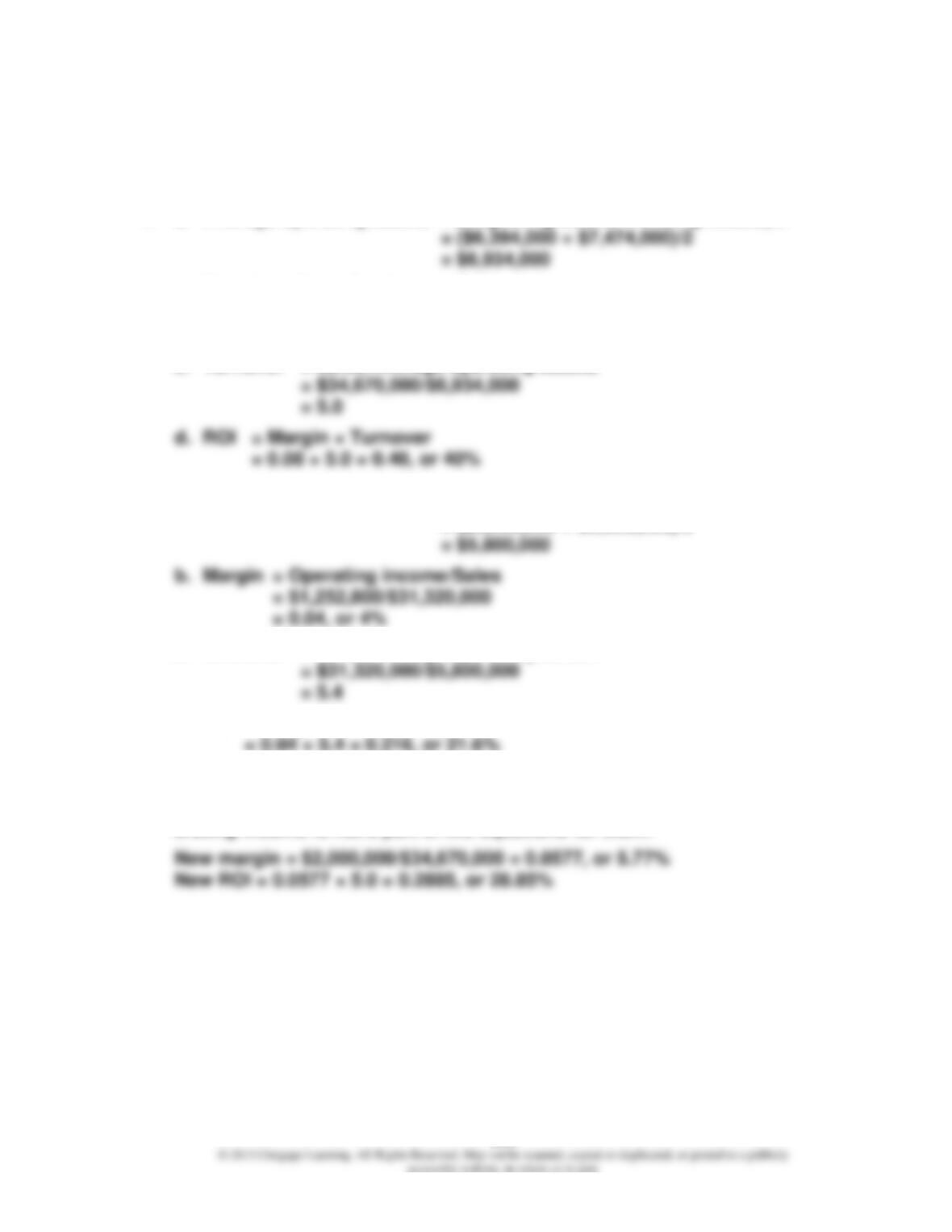
1. a. Average operating assets = (Beginning assets + Ending assets)/2
b. Margin = Operating income/Sales
= $2,773,600/$34,670,000
= 0.08, or 8%
c. Turnover = Sales/Average operating assets
2. a. Average operating assets = (Beginning assets + Ending assets)/2
= ($5,600,000 + $6,000,000)/2
c. Turnover = Sales/Average operating assets
d. ROI = Margin × Turnover
3. The new operating income is lower, therefore, both margin and ROI would be
lower. Average operating assets and turnover would be unaffected, since op-
erating income is not a part of the equations for them.
Cornerstone Exercise 10.2
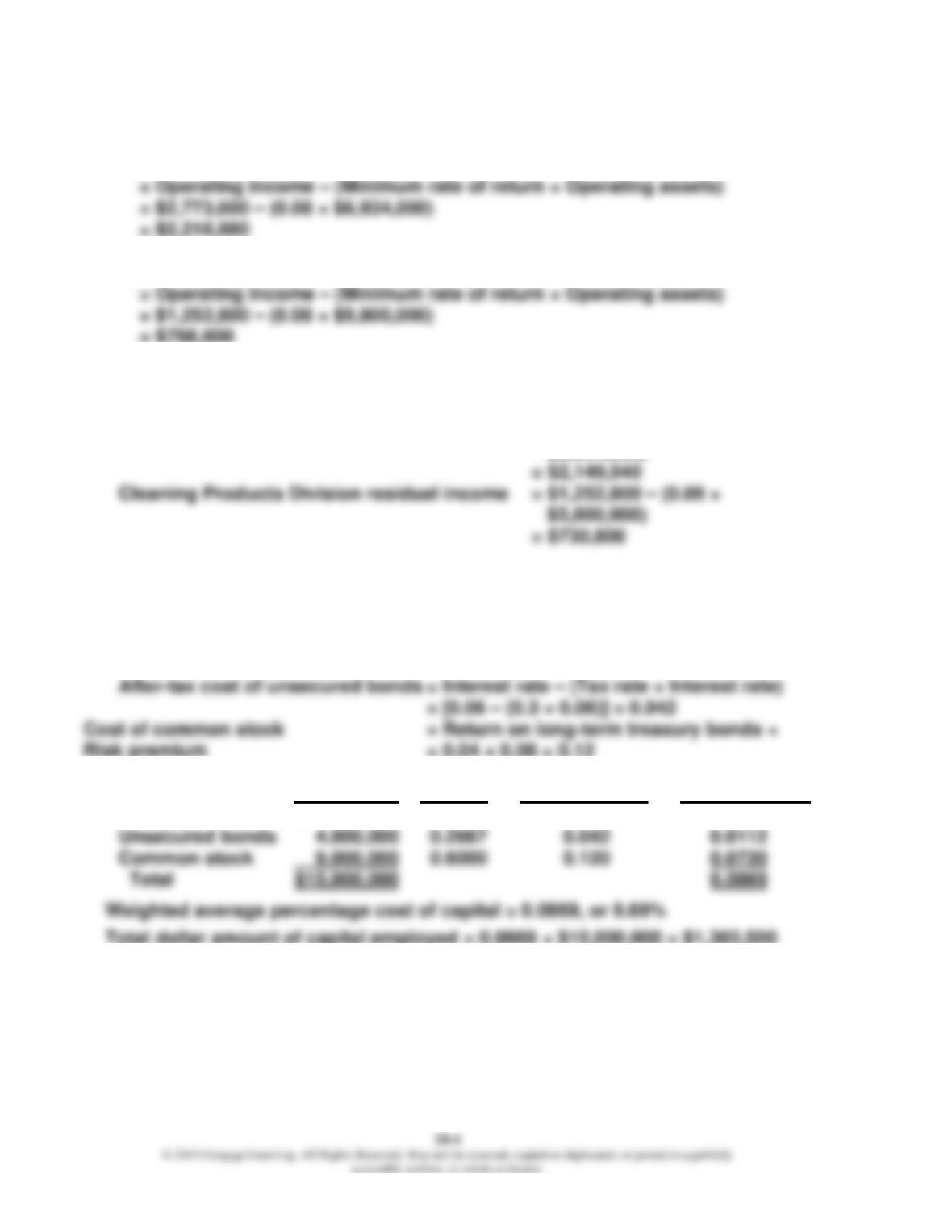
1. Residual income for Small Appliances Division:
2. Residual income for Cleaning Products Division:
3. If the minimum rate of return was 9 percent, the residual income of both divi-
sions would be lower.
Small Appliances Division residual income = $2,773,600 – (0.09 ×
$6,934,000)
Cornerstone Exercise 10.3
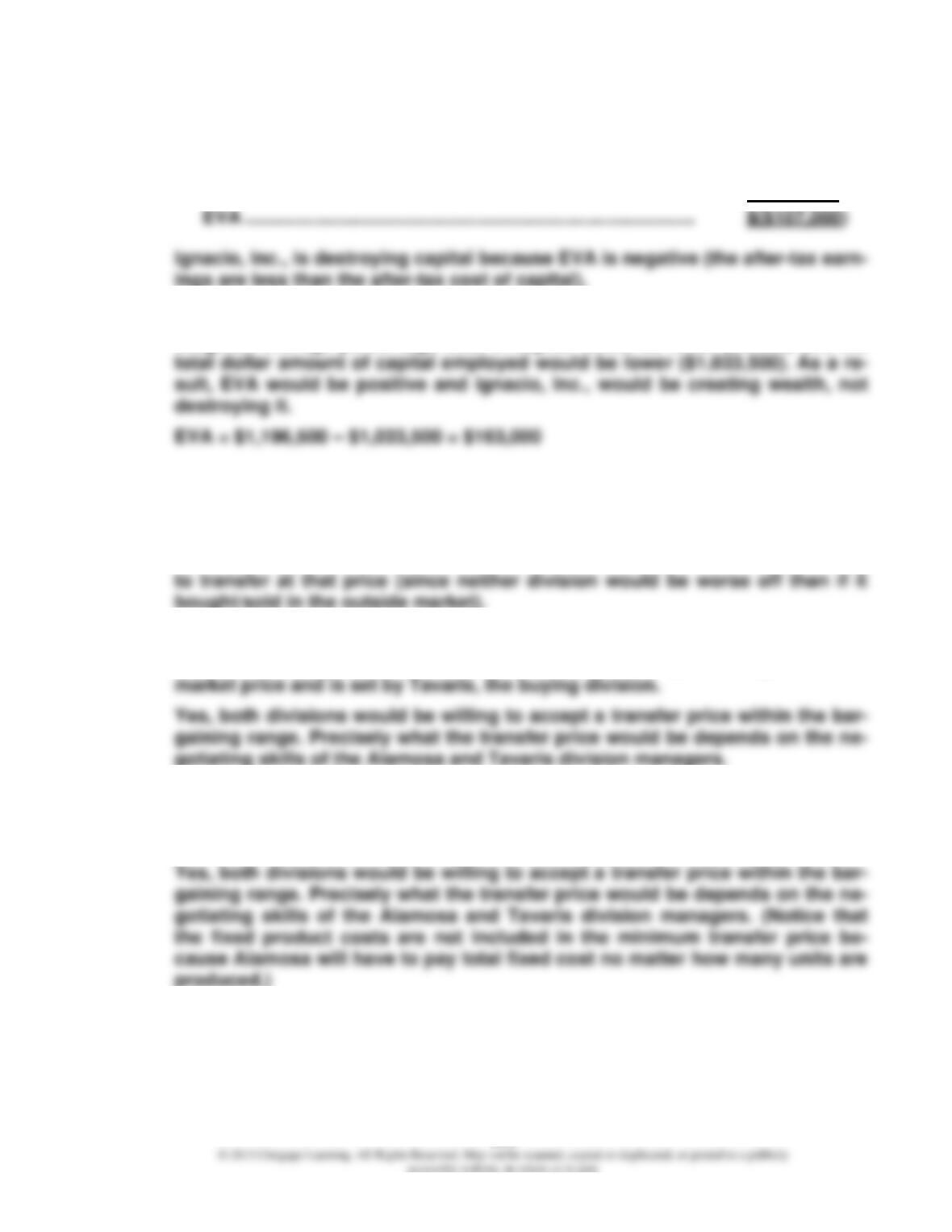
1. After-tax cost of mortgage bonds = Interest rate – (Tax rate × Interest rate)
= [0.04 – (0.3 × 0.04)] = 0.028
2. Amount Percent × After-Tax Cost = Weighted Cost
Mortgage bonds $ 2,000,000 0.1333 0.028 0.0037
10-5
Cornerstone Exercise 10.3 (Concluded)
3. After-tax operating income ……………………………………………… $1,196,500
Less: Total dollar amount of capital employed ………………… 1,303,500
4. If the common stock were less risky and had a lower risk premium, the
weighted average percentage cost of capital would be lower (0.0689) and the
Cornerstone Exercise 10.4
1. The market price is $21. Both Tavaris and Alamosa divisions would be willing
2. Minimum transfer price = $21.00 – $1.75 = $19.25. This price is set by Ala-
mosa, the selling division. Maximum transfer price = $21. This price is the
3. Minimum transfer price = $9.70 (the variable cost of production). This price is
set by Alamosa, the selling division. Maximum transfer price = $21. This price
is the market price and is set by Tavaris, the buying division.
10-6
Cornerstone Exercise 10.5
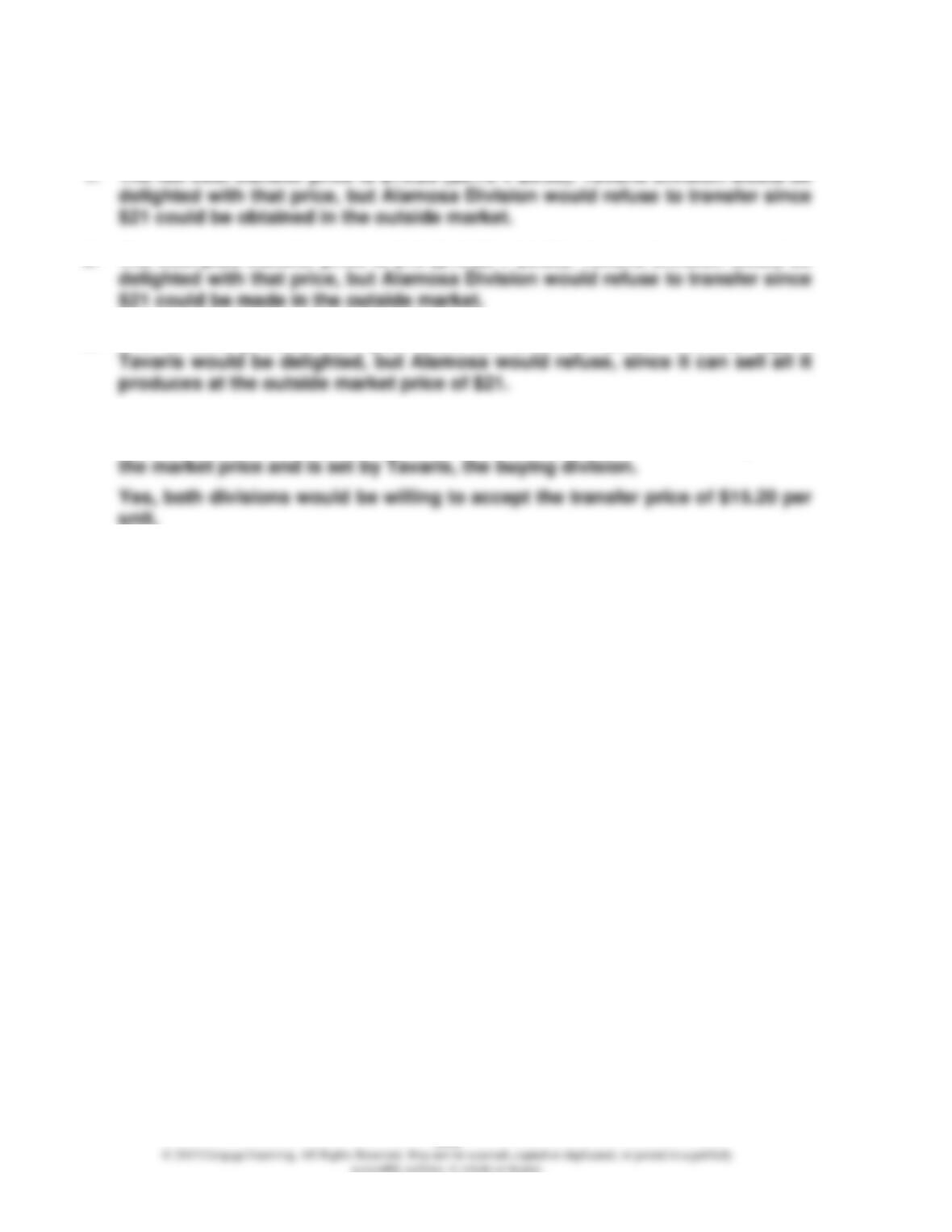
2. The cost-plus transfer price is $19 ($15.20 + $3.80). Tavaris Division would be
3. The variable product cost plus fixed fee is $11.20 ($9.20 + $2.00). Again,
4. Minimum transfer price = $15.20 (the full cost of production). This price is set
by Alamosa, the selling division. Maximum transfer price = $21. This price is
Cornerstone Exercise 10.6
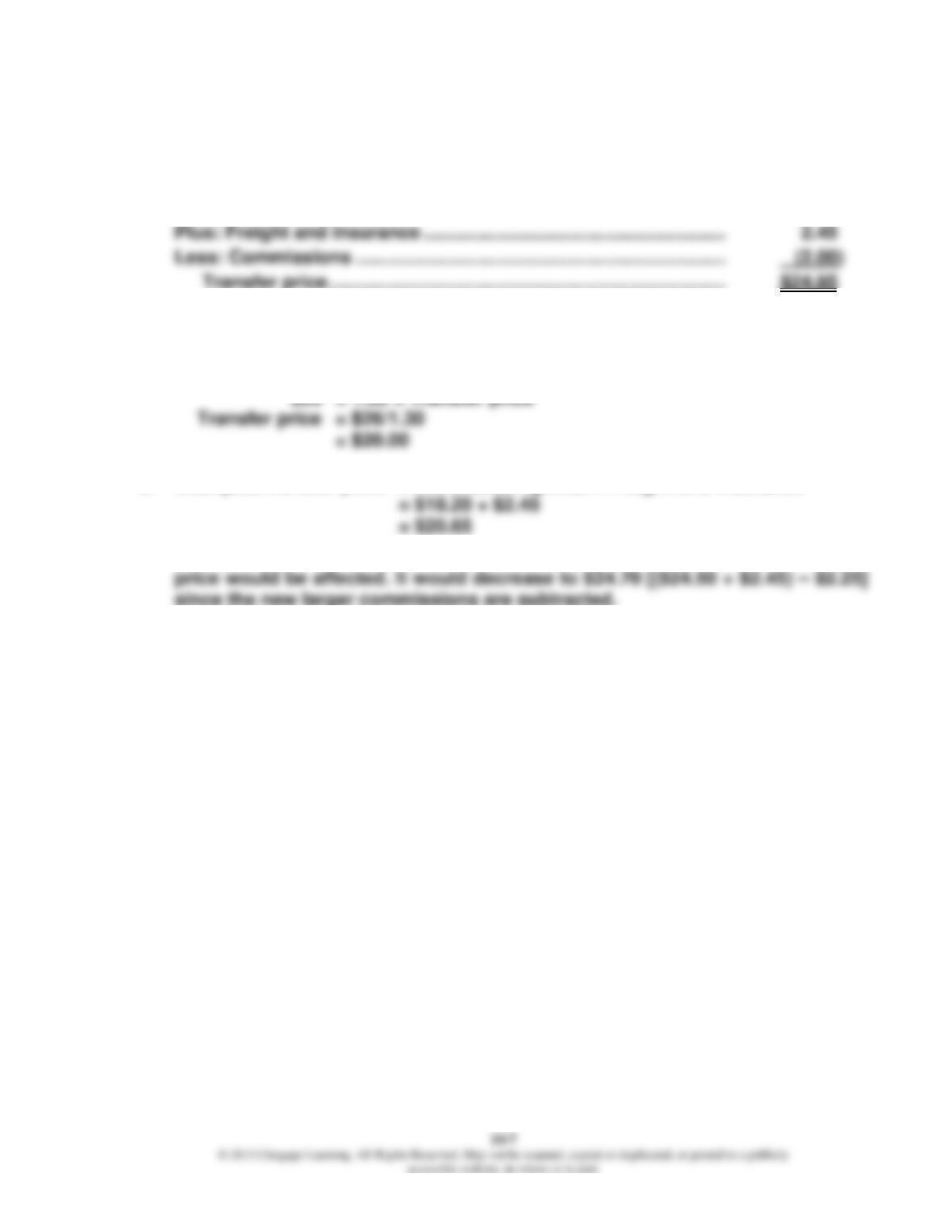
1. The comparable uncontrolled price is calculated as follows:
Market price ………………………………………………………………………… $24.50
2. With no outside market for Division N, and a resale price for Division US, the
transfer price is calculated as follows:
Resale price = Transfer price + (Markup percentage × Transfer price)
3. Cost-plus transfer price = Manufacturing cost + Freight and insurance
4. If commissions increased to $2.25 per unit, only the comparable uncontrolled
EXERCISES
Exercise 10.7
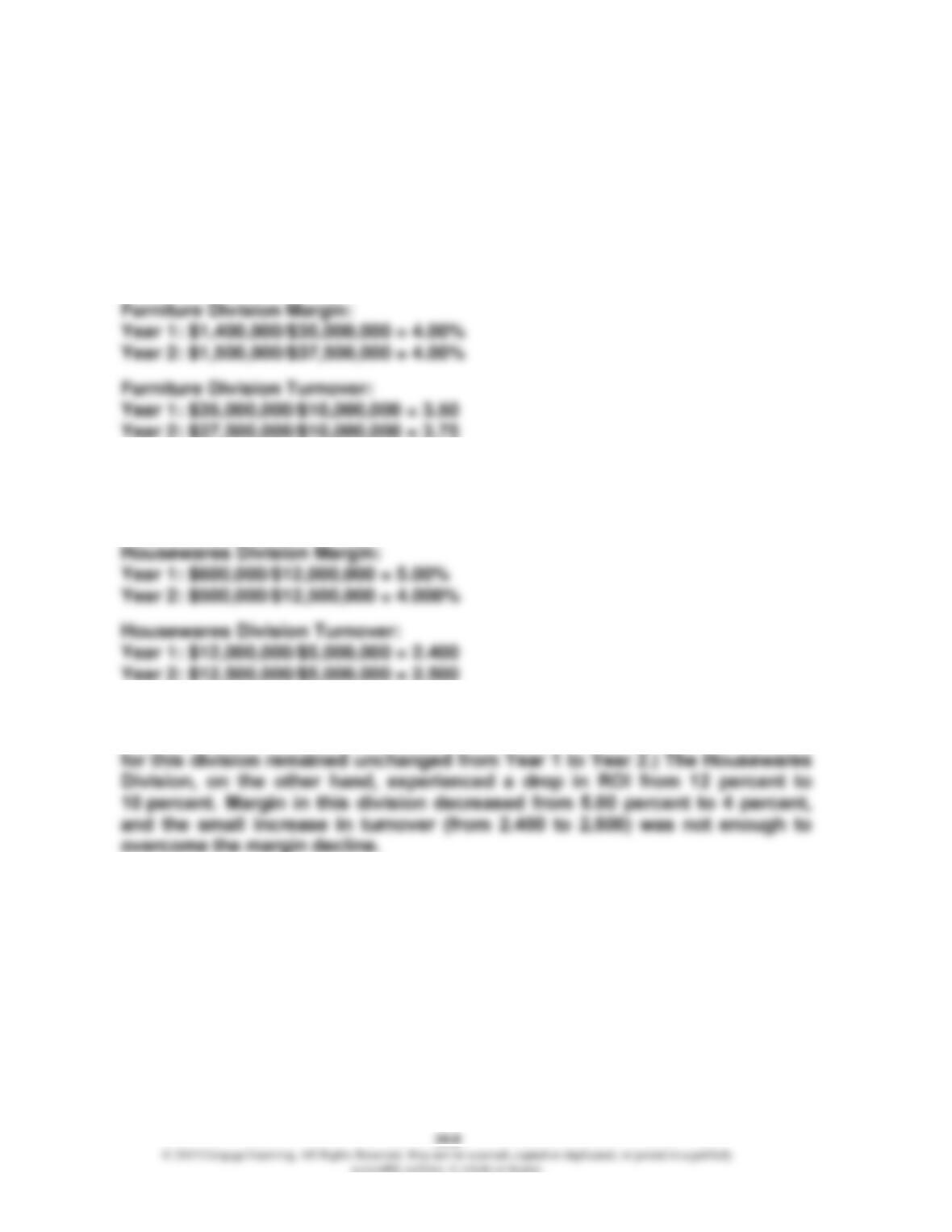
1. Furniture Division ROI:
Year 1: $1,400,000/$10,000,000 = 14.00%
Year 2: $1,500,000/$10,000,000 = 15.00%
2. Housewares Division ROI:
Year 1: $600,000/$5,000,000 = 12.00%
Year 2: $500,000/$5,000,000 = 10.00%
3. ROI for the Furniture Division increased from 14 percent to 15 percent. This in-
crease is due entirely to the increase in turnover from 3.500 to 3.750. (Margin
10-9
Exercise 10.8
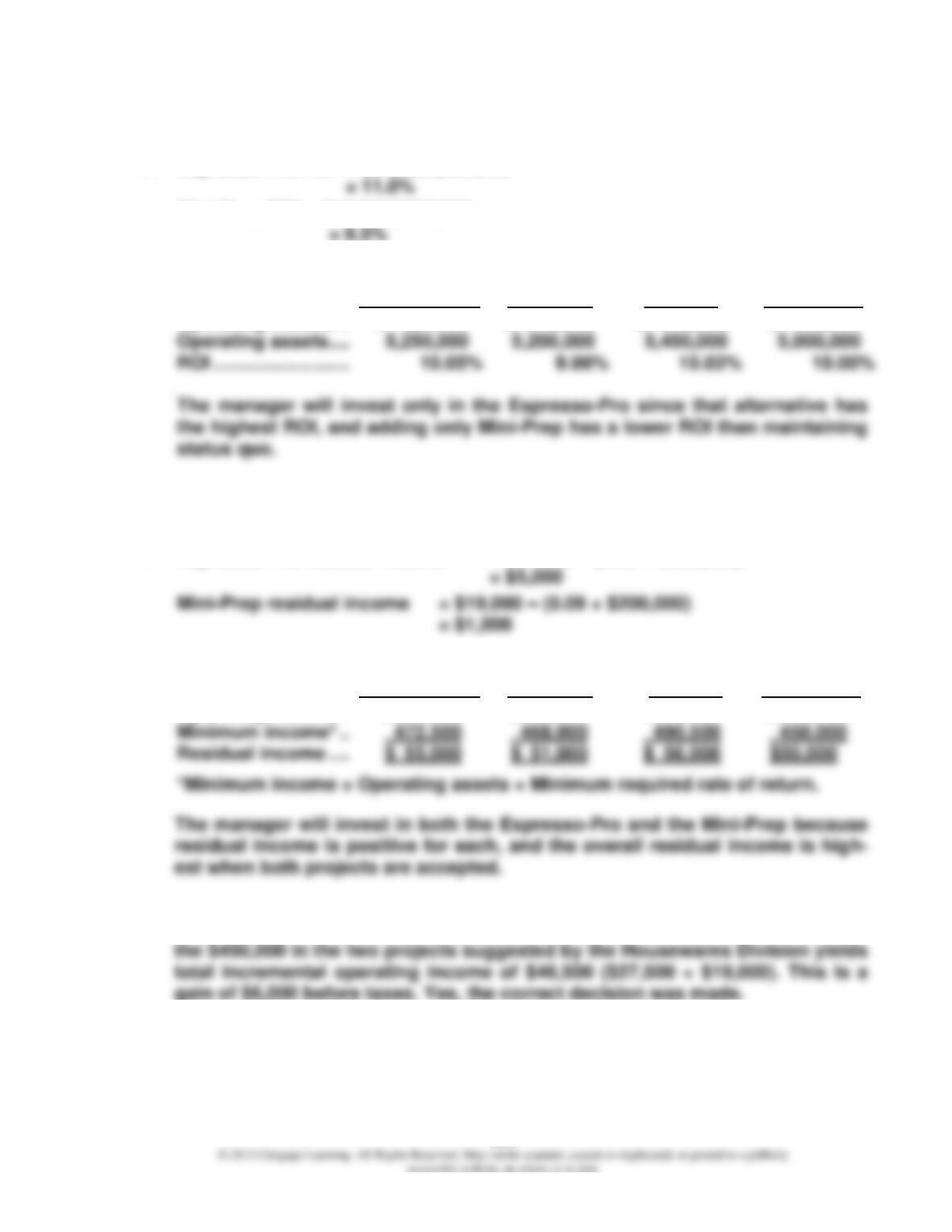
1. Espresso-Pro ROI = $27,500/$250,000
Mini-Prep ROI = $19,000/$200,000
2. Add Only Add Only Add Both Maintain
Espresso-Pro Mini-Prep Projects Status Quo
Operating income .. $ 527,500 $ 519,000 $ 546,500 $ 500,000
Exercise 10.9
1. Espresso-Pro residual income = $27,500 – (0.09 × $250,000)
2. Add Only Add Only Add Both Maintain
Espresso-Pro Mini-Prep Projects Status Quo
Operating income .. $527,500 $519,000 $546,500 $500,000
3. If the company had retained the $450,000 and invested it at 9 percent, the in-
come would have been $40,500 ($450,000 × 0.09). However, the investment of
10–10
Exercise 10.10
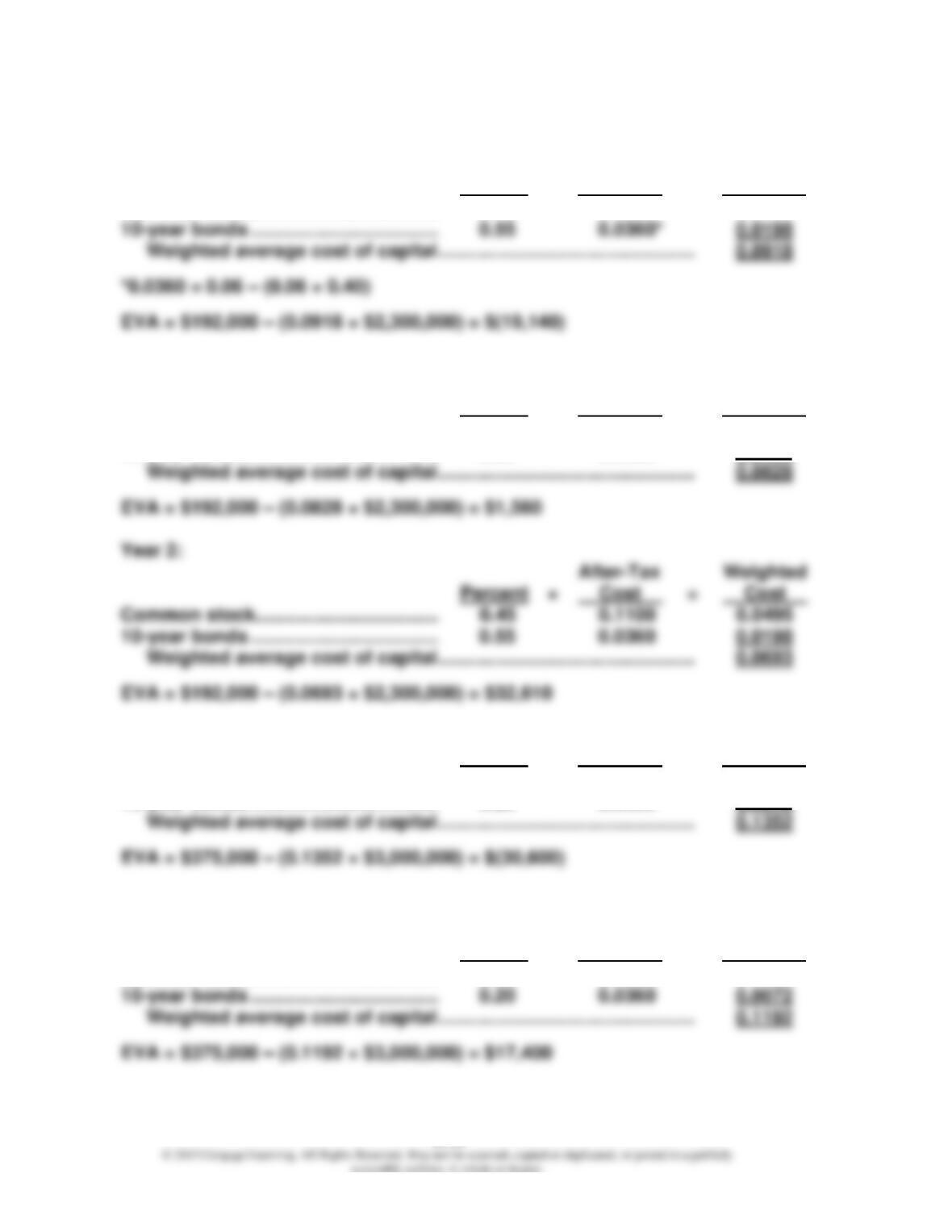
1. After-Tax Weighted
Percent × Cost = Cost
Common stock…………………………….. 0.45 0.1600 0.0720
2. Year 1:
After-Tax Weighted
Percent × Cost = Cost
Common stock …………………………….. 0.45 0.1400 0.0630
10-year bonds ……………………………… 0.55 0.0360 0.0198
3. After-Tax Weighted
Percent × Cost = Cost
Common stock …………………………….. 0.80 0.1600 0.1280
10-year bonds ……………………………… 0.20 0.0360 0.0072
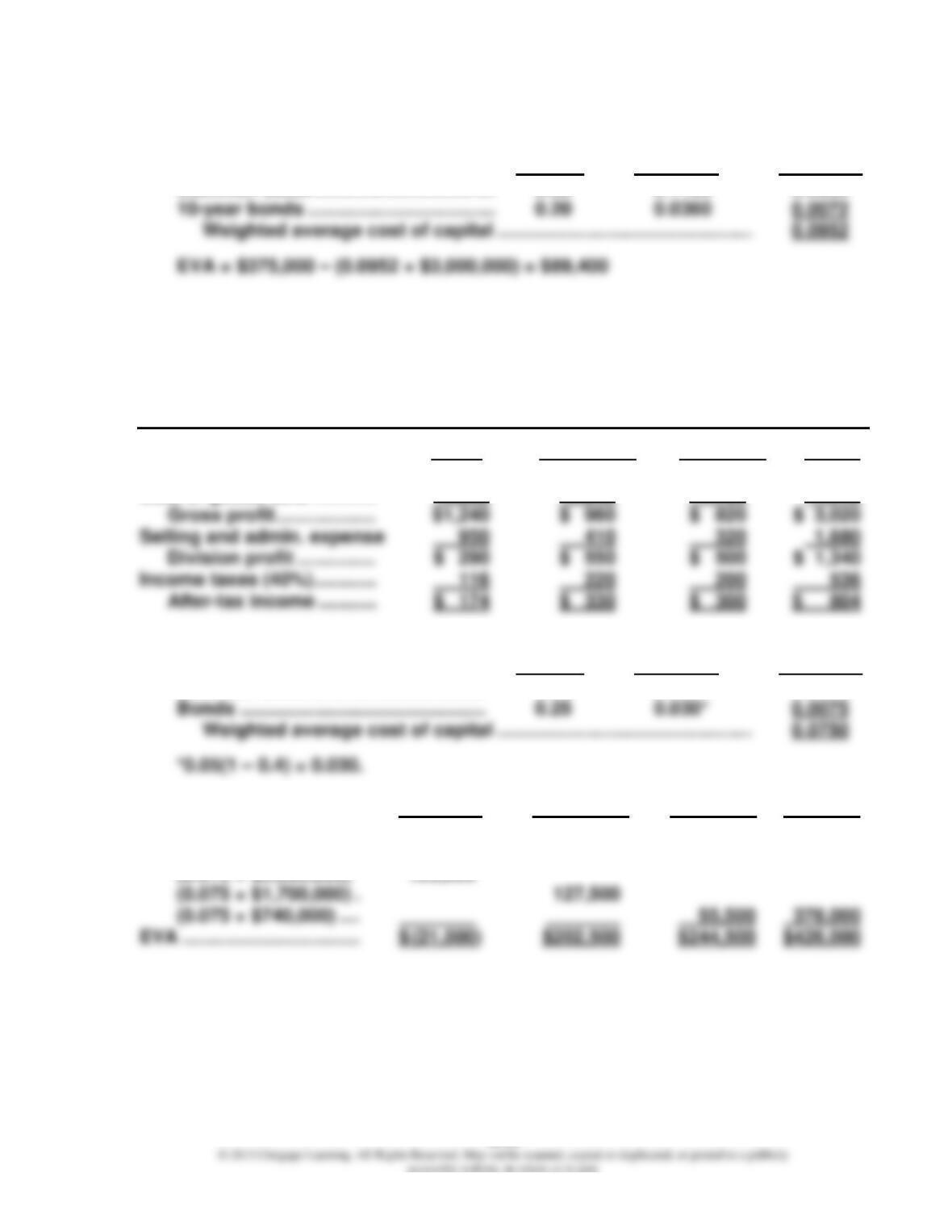
Year 1 (10% premium):
After-Tax Weighted
Percent × Cost = Cost
Common stock …………………………….. 0.80 0.1400 0.1120
Exercise 10.10 (Concluded)
10–11
Year 2 (7% premium):
After-Tax Weighted
Percent × Cost = Cost
Common stock …………………………….. 0.80 0.1100 0.0880
Exercise 10.11
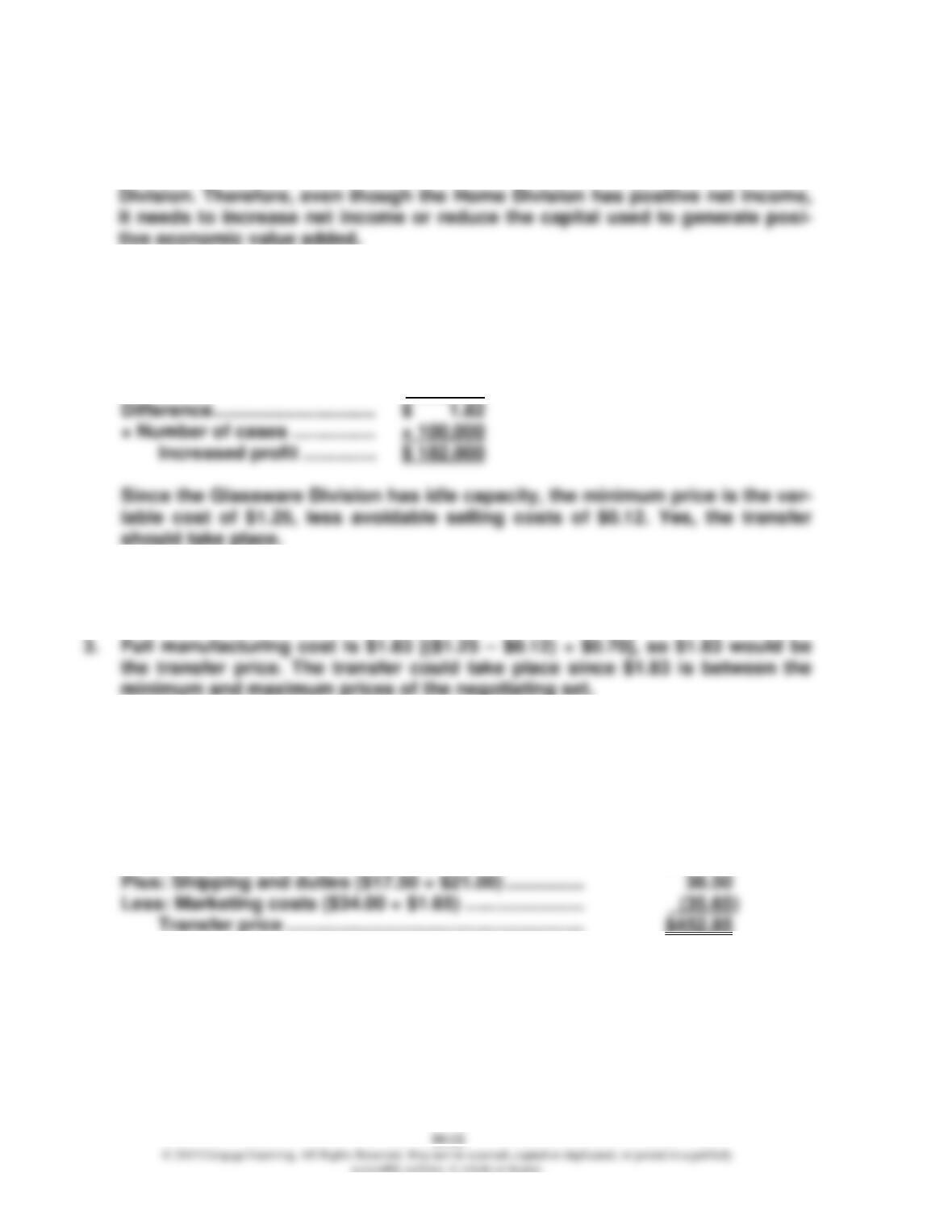
1. Xenold, Inc.
Income Statement (in thousands)
For the Year 20XX
Home Restaurant Speciality Total
Sales …………………………….. $4,140 $3,600 $2,520 $10,260
Cost of goods sold ………… 2,900 2,640 1,700 7,240
2. After-Tax Weighted
Percent × Cost = Cost
Common stock …………………………... 0.75 0.090 0.0675
3. Home Restaurant Speciality Total
After-tax income ………….. $174,000 $330,000 $300,000 $804,000
Less:
(0.075 × $2,600,000) 195,000
Exercise 10.11 (Concluded)
4. While EVA is positive for Xenold, Inc., as a whole, it is negative for the Home
Exercise 10.12
1. Maximum price …………………. $ 2.95
Minimum price ………………….. 1.13
2. Justin might negotiate for a lower price. Ellyn would consider the $2.40 price,
as her income would increase by $127,000 [($2.40 – $1.13) × 100,000].
Exercise 10.13
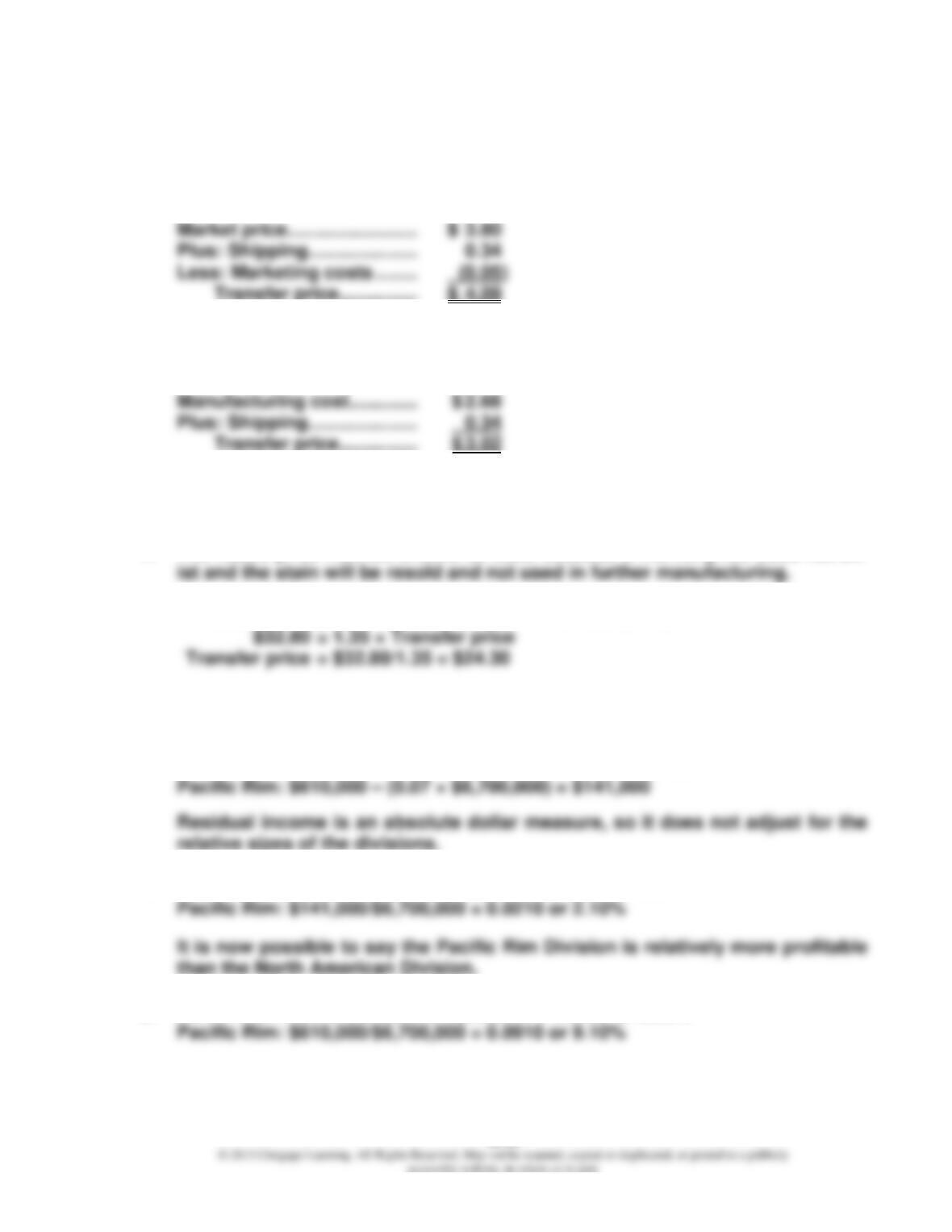
1. The comparable uncontrolled price method should be used because a market
price exists.
2. Market price …………………………………………………………. $450.00
10–13
Exercise 10.14
1. The comparable uncontrolled price method should be used because a market
price exists.
2. The cost-plus method should be used because a market price does not exist,
and the U.S. division is not going to resell the powder.
Exercise 10.15
1. The resale price method should be used because a market price does not ex-
2. Resale price = Transfer price + (0.35 × Transfer price)
Exercise 10.16
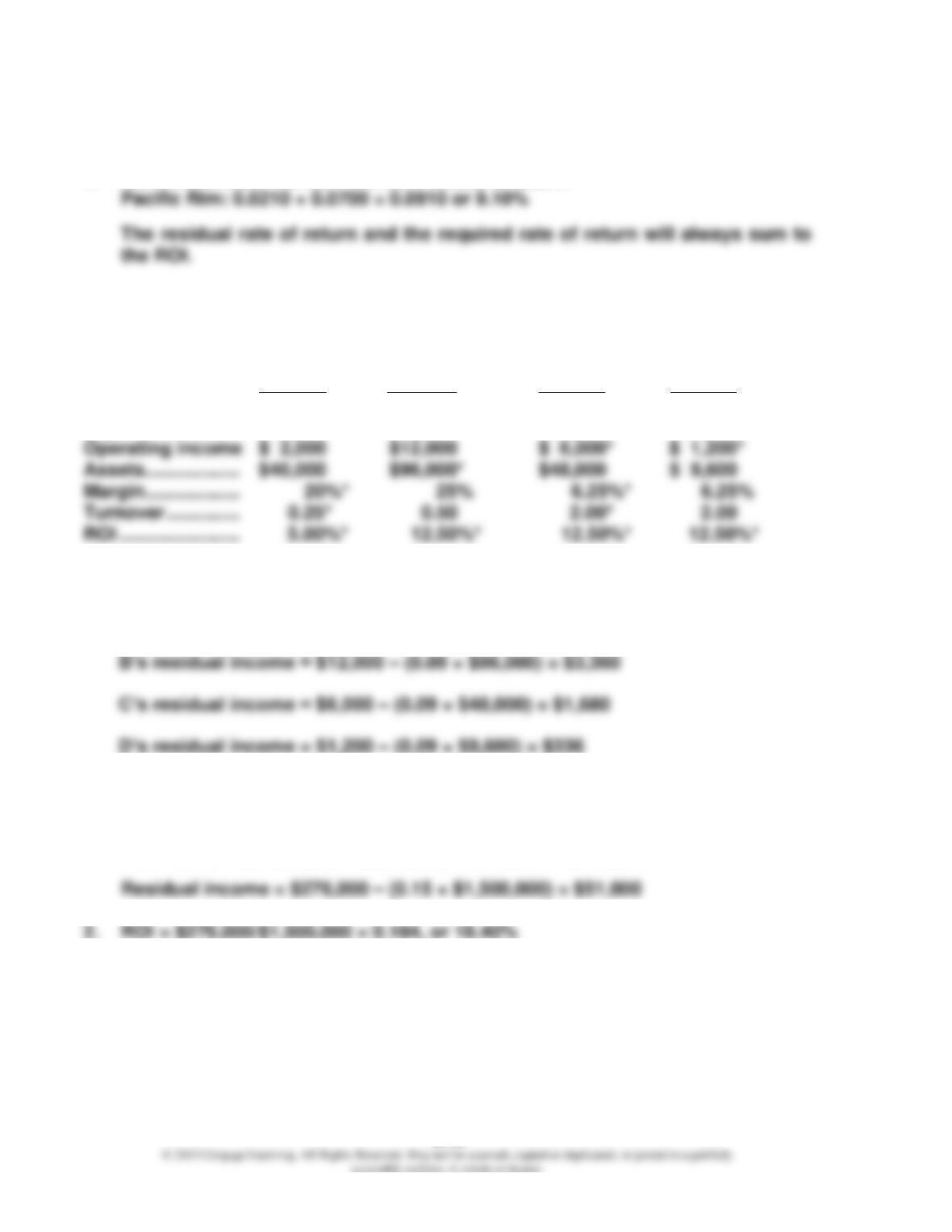
1. North American: $1,250,000 – (0.07 × $15,000,000) = $200,000
2. North American: $200,000/$15,000,000 = 0.0133 or 1.33%
3. North American: $1,250,000/$15,000,000 = 0.0833 or 8.33%
Exercise 10.16 (Concluded)
10–14
ROI can be used to compare relative divisional profitability.
4. North American: 0.0133 + 0.0700 = 0.0833 or 8.33%
Exercise 10.17
1.
A B C D
Revenue …………… $10,000 $48,000 $96,000 $19,200*
Expenses …………. $ 8,000 $36,000* $90,000 $18,000*
*Indicates calculated amounts.
2. A’s residual income = $2,000 – (0.09 × $40,000) = ($1,600)
Exercise 10.18
1. Net income = ($1,000,000 – $624,000) – $100,000 = $276,000