Chapter 10 – Standard Costing and Analysis of Direct Costs
10-1
CHAPTER 10
Standard Costing and Analysis of Direct Costs
ANSWERS TO REVIEW QUESTIONS
10-1 Any control system has three basic parts: a predetermined or standard performance
level, a measure of actual performance, and a comparison between standard and
10-3 One method of setting standards is the analysis of historical data. Historical cost
data provide an indicator of future costs. The methods for analyzing cost behavior
10-4 A perfection (or ideal) standard is the cost expected under perfect or ideal operating
conditions. A practical (or attainable) standard is the cost expected under normal
10-6 The standard quantity of material is the amount required to be included in the
10-7 An unfavorable direct-material price variance means that a higher price was paid for
Chapter 10 – Standard Costing and Analysis of Direct Costs
10-2
10-9 An unfavorable direct-material quantity variance means that a larger amount of
10–11 The direct-material purchase price variance is based on the quantity purchased (PQ).
Deviations between the actual and standard price, which are highlighted by the
10–12 An unfavorable direct-labor rate variance means that a higher labor rate was paid
than was anticipated when the standard was set. One possible cause is that labor
10–13 In some cases, the manager in the best position to influence the direct-labor rate
10–14 The interpretation of an unfavorable direct-labor efficiency variance is that more
Chapter 10 – Standard Costing and Analysis of Direct Costs
10-3
10–16 The issue of quantity purchased versus quantity used does not arise in the context
10–17 Several factors that managers often consider when determining the significance of a
10–18 Several ways in which standard-costing should be adapted in today’s manufacturing
environment are as follows:
(a) Reduced importance of labor standards and variances: As direct labor occupies
10-4
10–19 Under a standard-costing system, standard costs are used for product-costing
purposes as well as for control purposes. The costs entered into Work-in-Process
10–20 Advantages of a standard-costing system include the following:
(a) Standard costs provide a basis for sensible cost comparisons. Standard costs
enable the managerial accountant to compute the standard allowed cost, given
10-5
10-21 Seven criticisms of standard costing in an advanced manufacturing setting are the
following:
(a) Variances are too aggregate and too late to be useful.
Chapter 10 – Standard Costing and Analysis of Direct Costs
10-6
SOLUTIONS TO EXERCISES
EXERCISE 10-22 (15 MINUTES)
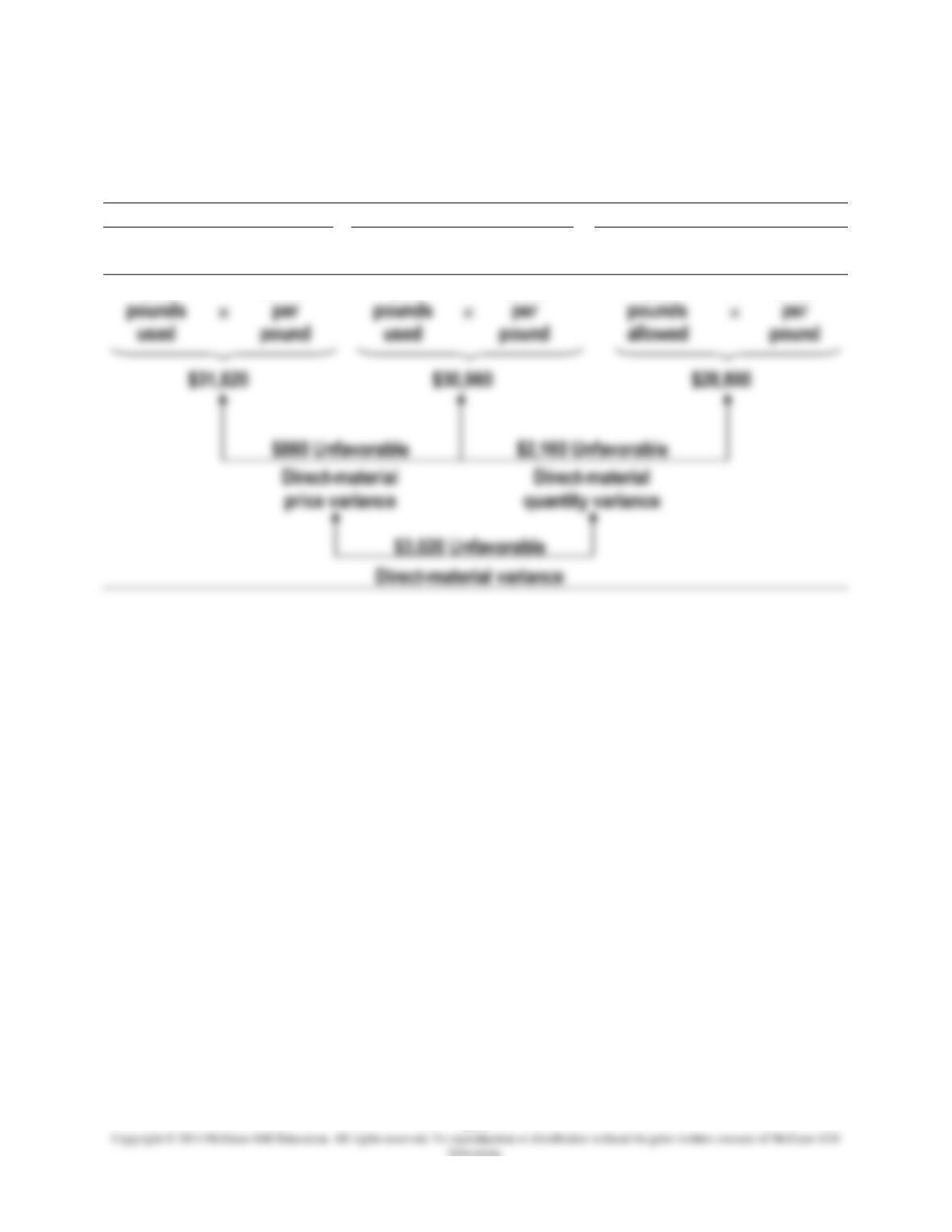
Direct-material price variance
=
AQ(AP – SP)
=
SP(AQ – SQ)
Direct-material purchase price variance
=
PQ(AP – SP)
†SQ = 4,000 pounds = 2,000 units 2 pounds per unit
Direct-labor rate variance
=
AH(AR – SR)
=
$1,935 Unfavorable
=
SR(AH – SH)
=
$8,100 Unfavorable
Chapter 10 – Standard Costing and Analysis of Direct Costs
10-7
EXERCISE 10-23 (30 MINUTES)
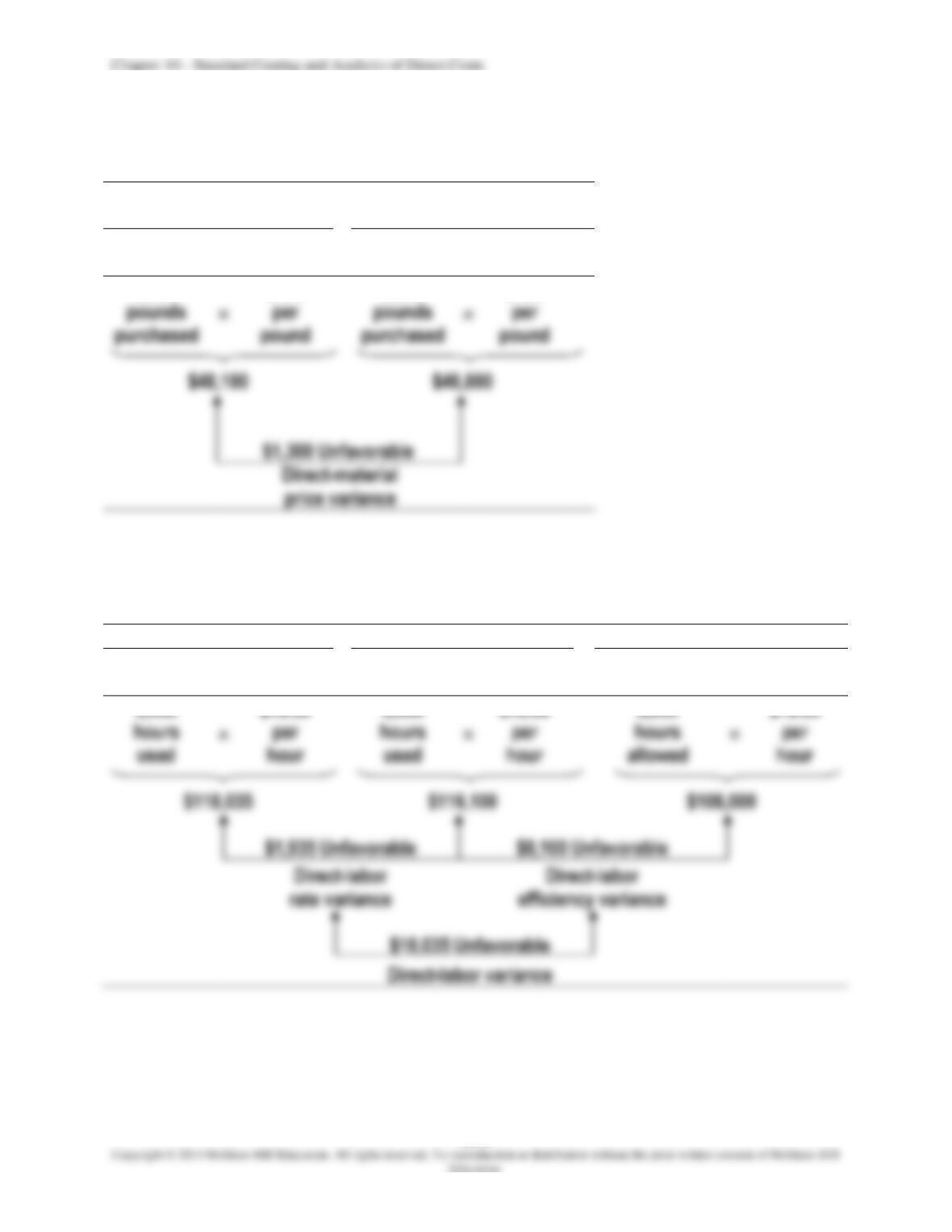
DIRECT-MATERIAL PRICE AND QUANTITY VARIANCES
ACTUAL MATERIAL COST
PROJ. MATERIAL COST
STANDARD MATERIAL COST
Actual
Quantity
Actual
Price
Actual
Quantity
Standard
Price
Standard
Quantity
Standard
Price
4,300
$7.40
4,300
$7.20
4,000
$7.20
10-8
EXERCISE 10-23 (CONTINUED)
DIRECT-MATERIAL PURCHASE PRICE VARIANCES
ACTUAL MATERIAL COST
OF PURCHASES
PROJ. MATERIAL COST
OF PURCHASES
Actual
Quantity
Actual
Price
Actual
Quantity
Standard
Price
6,500
$7.40
6,500
$7.20
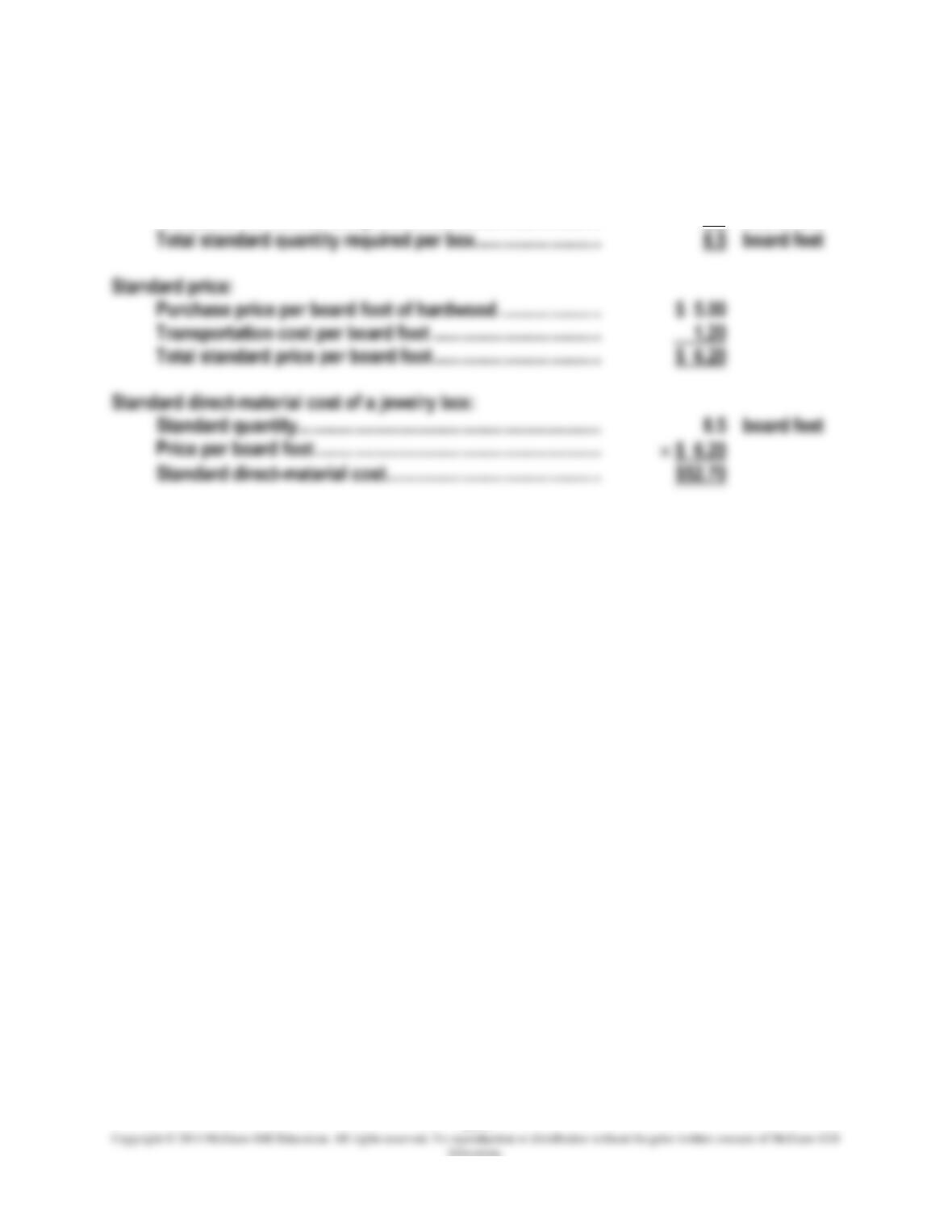
DIRECT-LABOR RATE AND EFFICIENCY VARIANCES
ACTUAL LABOR COST
PROJ. LABOR COST
STANDARD LABOR COST
Actual
Hours
Actual
Rate
Actual
Hours
Standard
Rate
Standard
Hours
Standard
Rate
6,450
6,450
$18.00
Chapter 10 – Standard Costing and Analysis of Direct Costs
10-9
EXERCISE 10-24 (10 MINUTES)
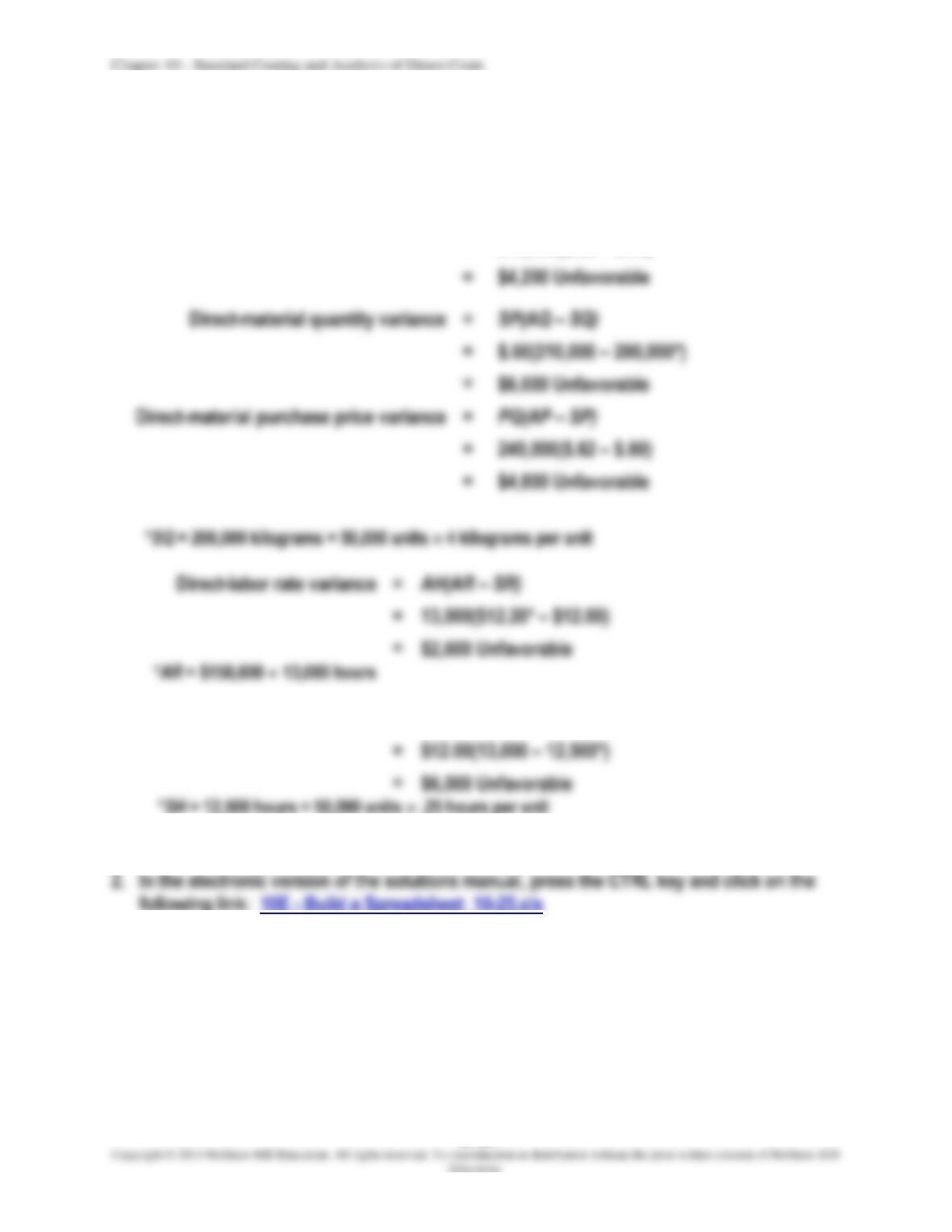
Standard quantity:
Hardwood in finished product ………………………………………
7
board feet
Allowance for normal scrap …………………………………………
1.5
board feet
Total standard quantity required per box ………………………
8.5
board feet
Standard price:
Purchase price per board foot of hardwood ………………….
Transportation cost per board foot ………………………………
Total standard price per board foot ………………………………
Standard direct-material cost of a jewelry box:
Standard quantity ………………………………………………………..
8.5
board feet
Standard direct-material cost ……………………………………….
10–10
EXERCISE 10-25 (15 MINUTES)
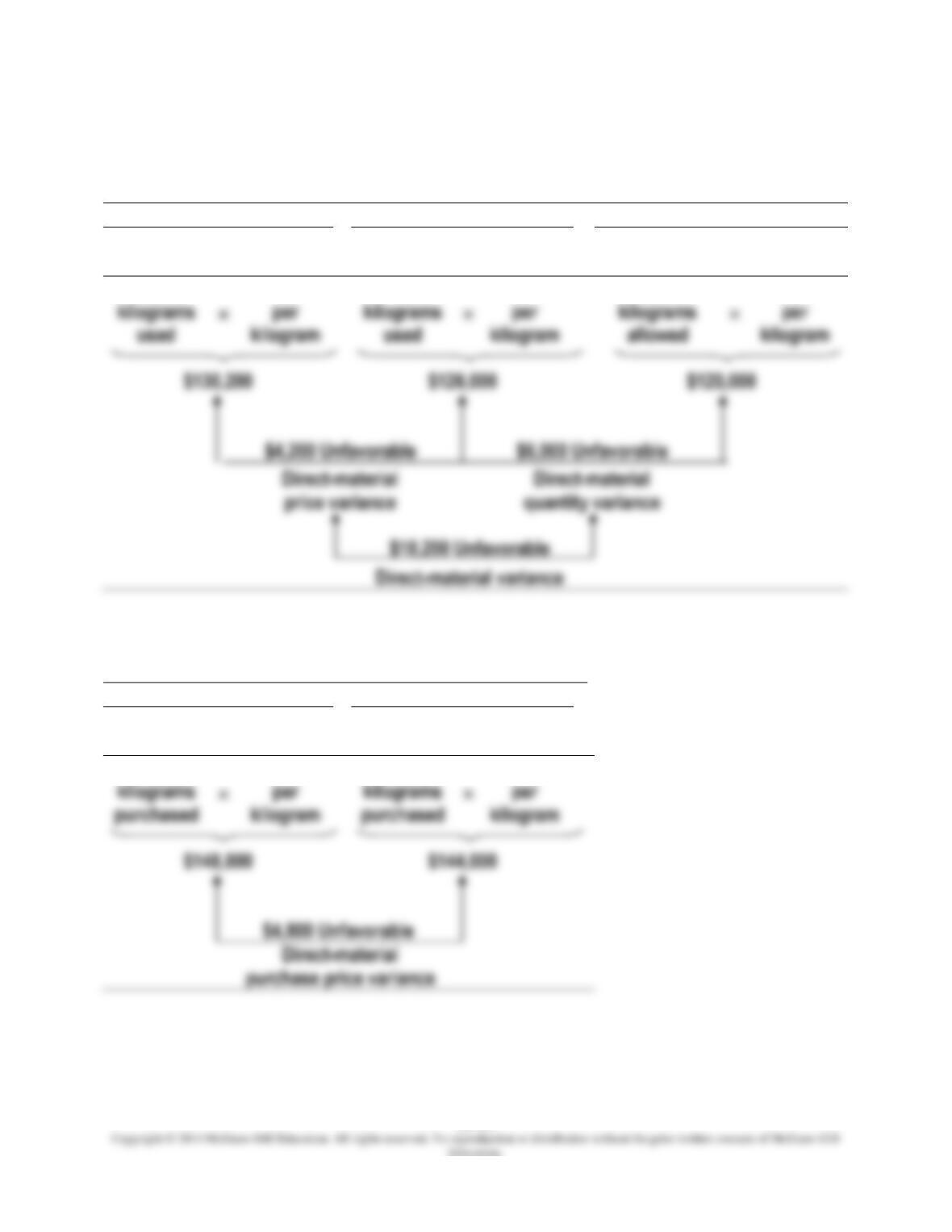
1. Calculation of variances:
Direct-material price variance
=
AQ(AP – SP)
=
210,000($.62 – $.60)
=
SP(AQ – SQ)
=
$.60(210,000 – 200,000*)
=
$6,000 Unfavorable
=
PQ(AP – SP)
=
240,000($.62 – $.60)
=
AH(AR – SR)
=
13,000($12.20* – $12.00)
=
$2,600 Unfavorable
Direct-labor efficiency variance
=
SR(AH – SH)
=
$12.00(13,000 – 12,500*)
=
$6,000 Unfavorable
Chapter 10 – Standard Costing and Analysis of Direct Costs
10–11
EXERCISE 10-26 (30 MINUTES)
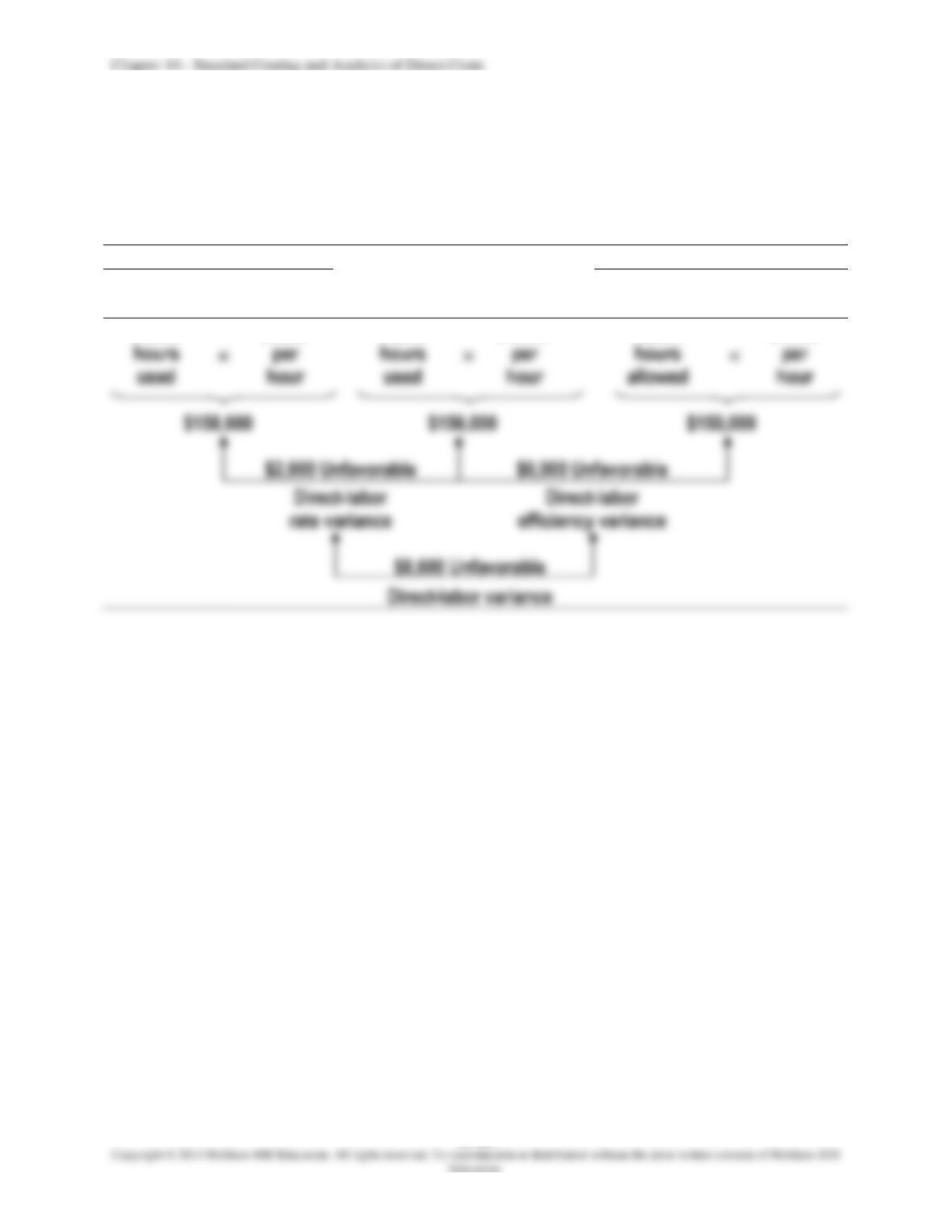
DIRECT-MATERIAL PRICE AND QUANTITY VARIANCES
ACTUAL MATERIAL COST
PROJ. MATERIAL COST
STANDARD MATERIAL COST
Actual
Quantity
Actual
Price
Actual
Quantity
Standard
Price
Standard
Quantity
Standard
Price
210,000
$.62
210,000
$.60
200,000
$.60
DIRECT-MATERIAL PURCHASE PRICE VARIANCE
ACTUAL MATERIAL COST
PROJ. MATERIAL COST
Actual
Quantity
Actual
Price
Actual
Quantity
Standard
Price
240,000
$.62
240,000
$.60
10–12
EXERCISE 10-26 (CONTINUED)
DIRECT-LABOR RATE AND EFFICIENCY VARIANCES
ACTUAL LABOR COST
STANDARD LABOR COST
Actual
Hours
Actual
Rate
Actual
Hours
Standard
Rate
Standard
Hours
Standard
Rate
13,000
$12.20
13,000
$12.00
12,500
$12.00
Chapter 10 – Standard Costing and Analysis of Direct Costs
10–13
EXERCISE 10-27 (30 MINUTES)
Answers will vary widely, depending on the company and the product. Typically, new
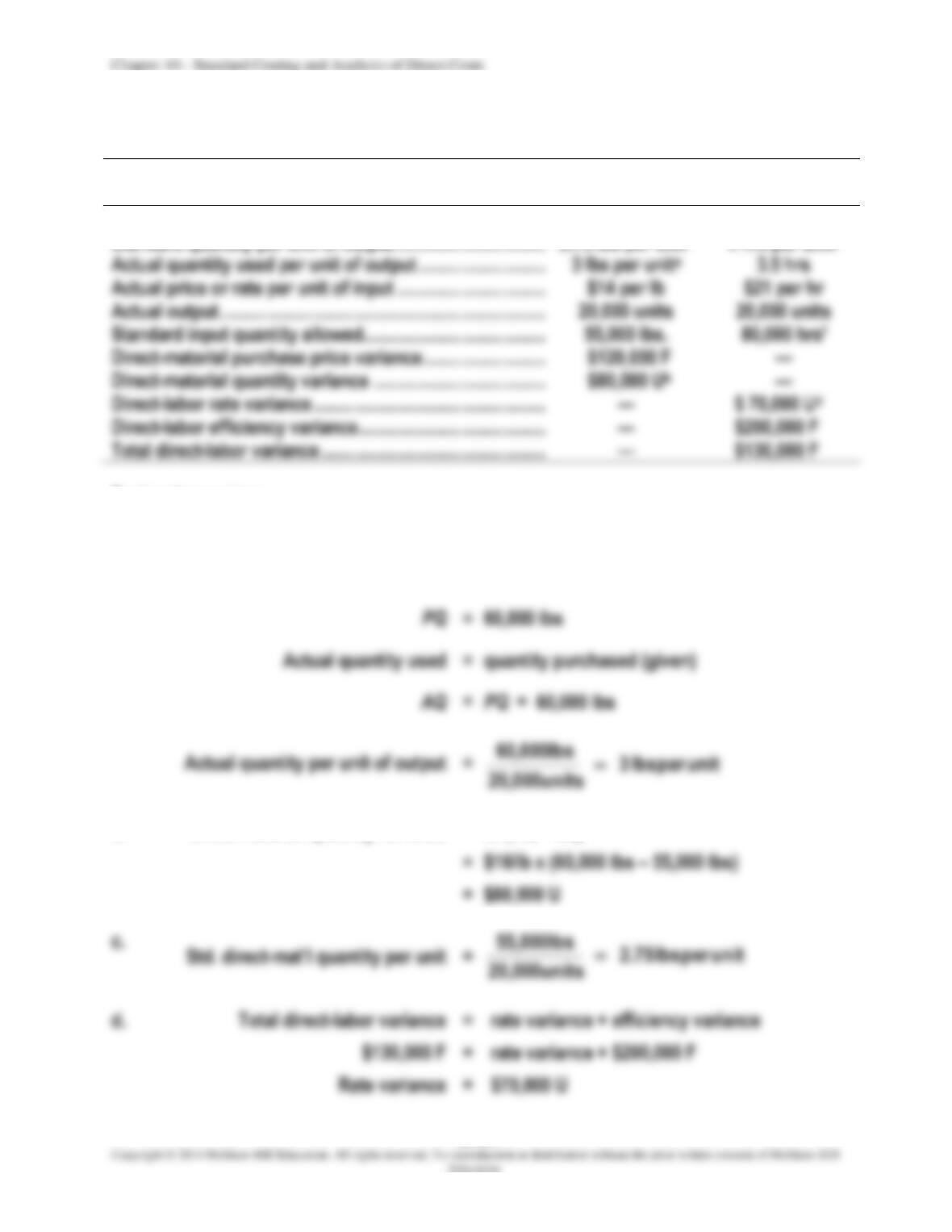
EXERCISE 10-28 (5 MINUTES)
Good output
=
(3/4) input = .75 input
10–14
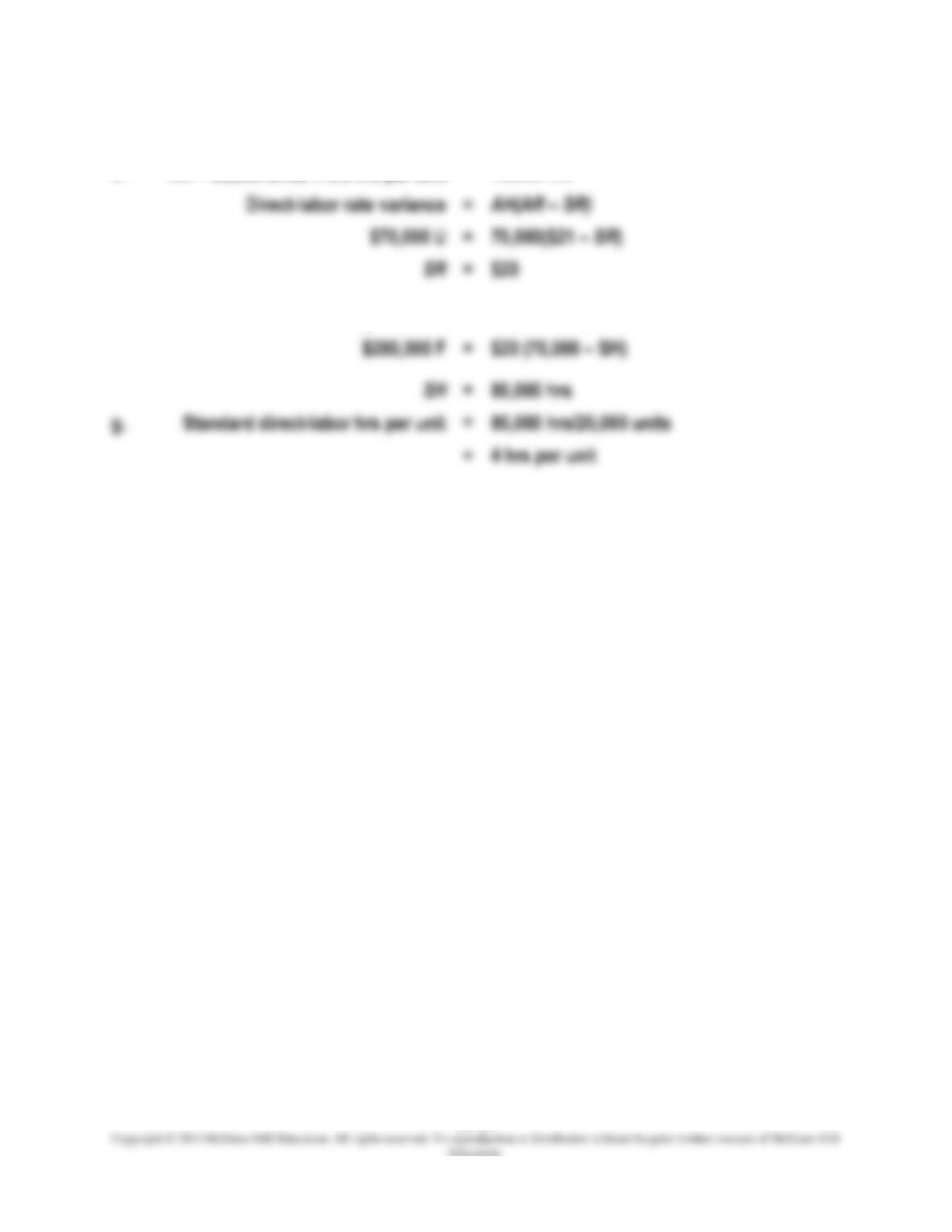
EXERCISE 10-29 (30 MINUTES)
Direct
Material
Direct
Labor
Standard price or rate per unit of input ……………………….
$16 per lb
$20 per hre
Standard quantity per unit of output …………………………..
2.75 lbs per unitc
4 hrs per unitg
Actual quantity used per unit of output ………………………
Actual price or rate per unit of input …………………………..
$14 per lb
Actual output …………………………………………………………….
Standard input quantity allowed …………………………………
Direct-material purchase price variance ……………………..
$120,000 F
Direct-material quantity variance ……………………………….
$80,000 Ub
Direct-labor rate variance …………………………………………..
$ 70,000 Ud
Direct-labor efficiency variance ………………………………….
$200,000 F
Total direct-labor variance …………………………………………
$130,000 F
Explanatory notes:
a.
Direct-mat’l purchase price variance
=
PQ(AP – SP)
$120,000 F
=
PQ($14 – $16)
=
60,000 lbs
=
b.
Direct-material quantity variance
=
SP(AQ – SQ)
=
$16/lb x (60,000 lbs – 55,000 lbs)
=
$80,000 U
d.
=
rate variance + efficiency variance
$130,000 F
=
rate variance + $200,000 F
Chapter 10 – Standard Costing and Analysis of Direct Costs
10–15
EXERCISE 10-29 (CONTINUED)
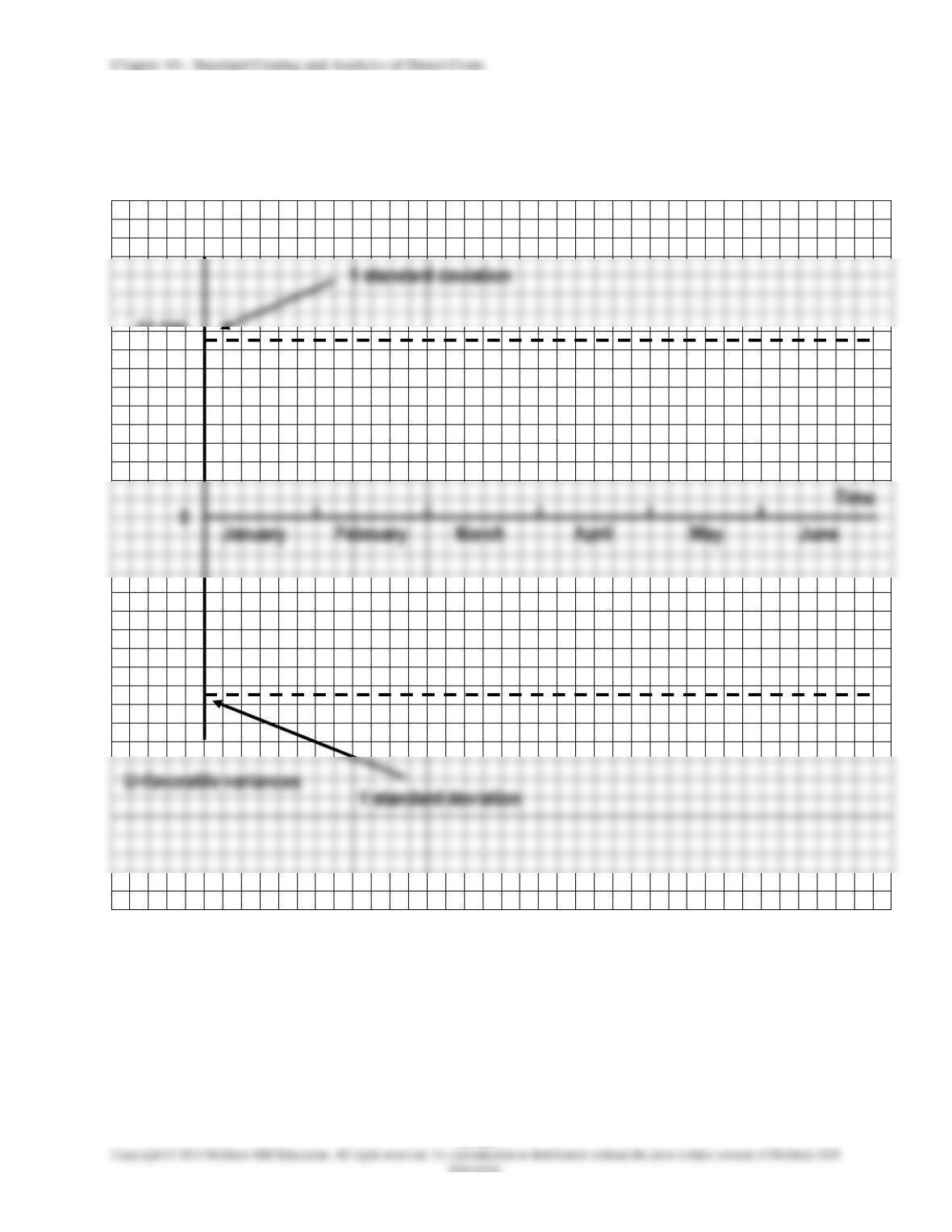
e.
AH = 20,000 units 3.5 hrs per unit
=
70,000 hrs
=
f.
Direct-labor efficiency variance
=
SR(AH – SH)
=
80,000 hrs
=
4 hrs per unit
10–16
EXERCISE 10-30 (25 MINUTES)
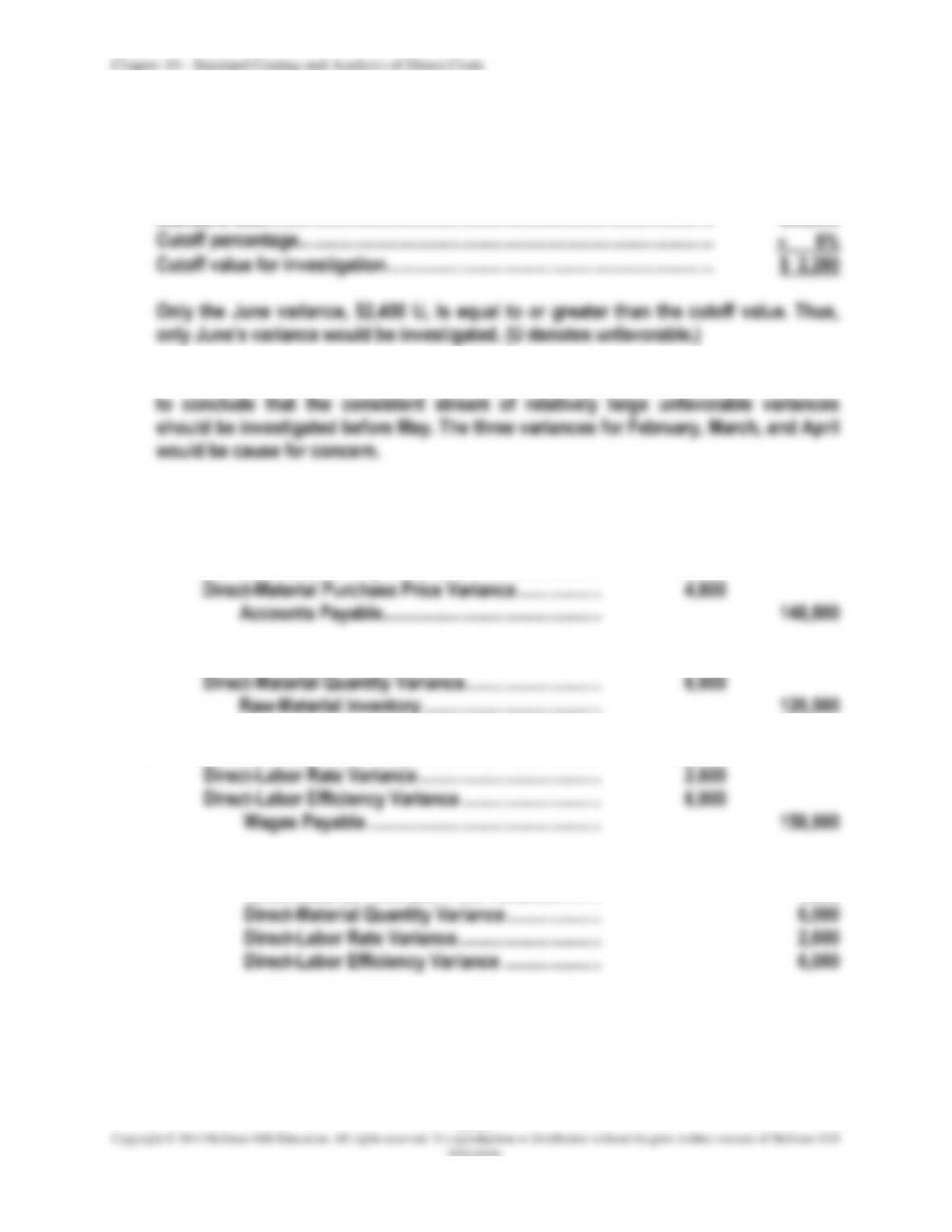
1. Statistical control chart with variance data plotted:
Only the variances in May and June would be investigated, since they are the only ones
that exceed 1 standard deviation, $1,900.
Favorable variances
1 standard deviation
Time
$2,000
$1,000
$1,000
$2,000
•
•
•
•
•
•
10–17
EXERCISE 10-30 (CONTINUED)
2.
Rule of thumb:
Standard cost …………………………………………………………………………………..
$38,000
3.
would be cause for concern.
This is a judgment call, and there is no right or wrong answer. It would be reasonable
EXERCISE 10-31 (15 MINUTES)
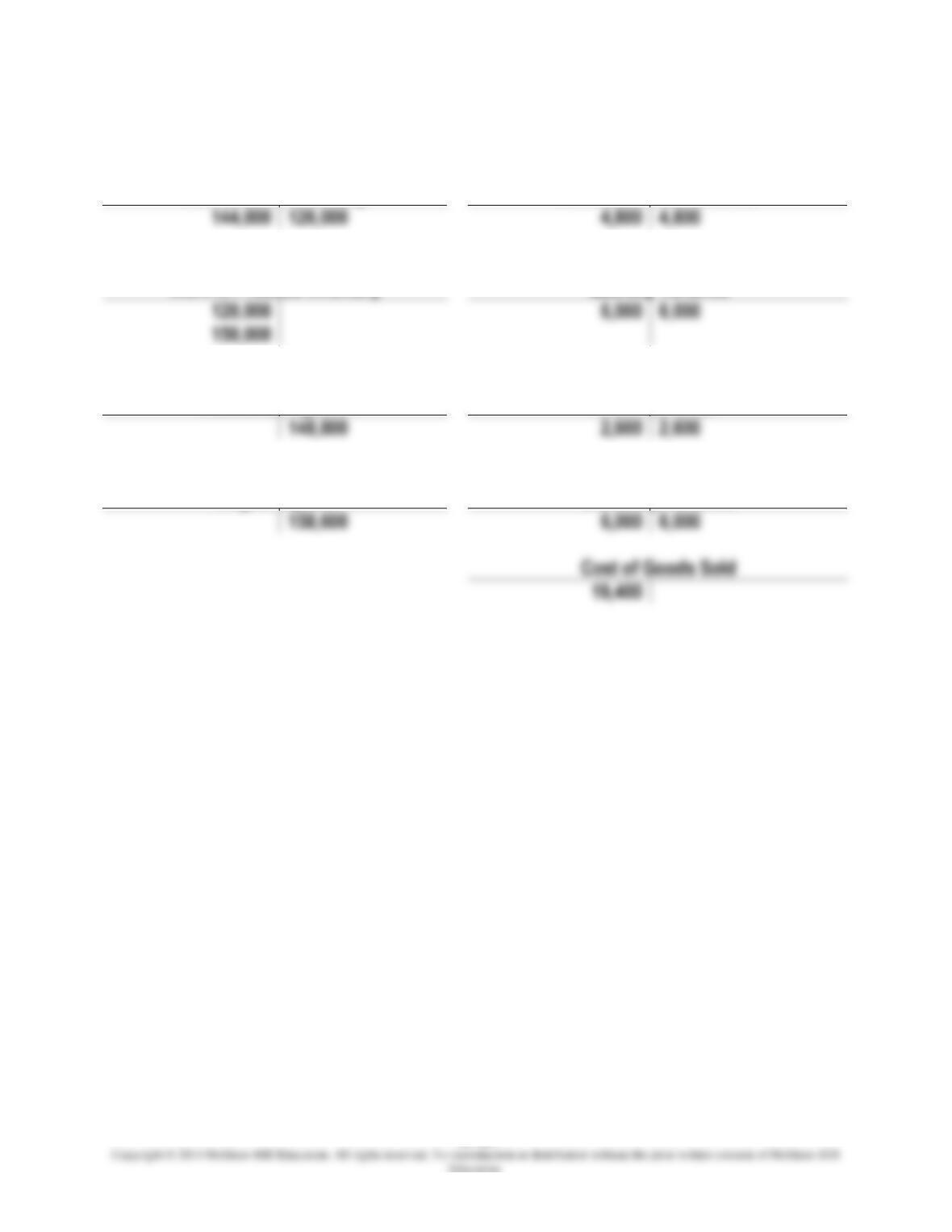
1. Raw-Material Inventory ………………………………………..
144,000
Direct-Material Purchase Price Variance ………………
Accounts Payable ………………………………………..
148,800
2. Work-in-Process Inventory …………………………………..
120,000
Direct-Material Quantity Variance ………………………..
Raw-Material Inventory ………………………………..
126,000
3. Work-in-Process Inventory …………………………………..
150,000
Direct-Labor Rate Variance …………………………………
Direct-Labor Efficiency Variance …………………………
Wages Payable …………………………………………..
158,600
4. Cost of Goods Sold …………………………………………….
19,400
Direct-Material Purchase Price Variance ………
4,800
Direct-Material Quantity Variance ………………..
6,000
Direct-Labor Rate Variance ………………………….
2,600
Direct-Labor Efficiency Variance …………………
6,000
Chapter 10 – Standard Costing and Analysis of Direct Costs
10–18
EXERCISE 10-32 (15 MINUTES)
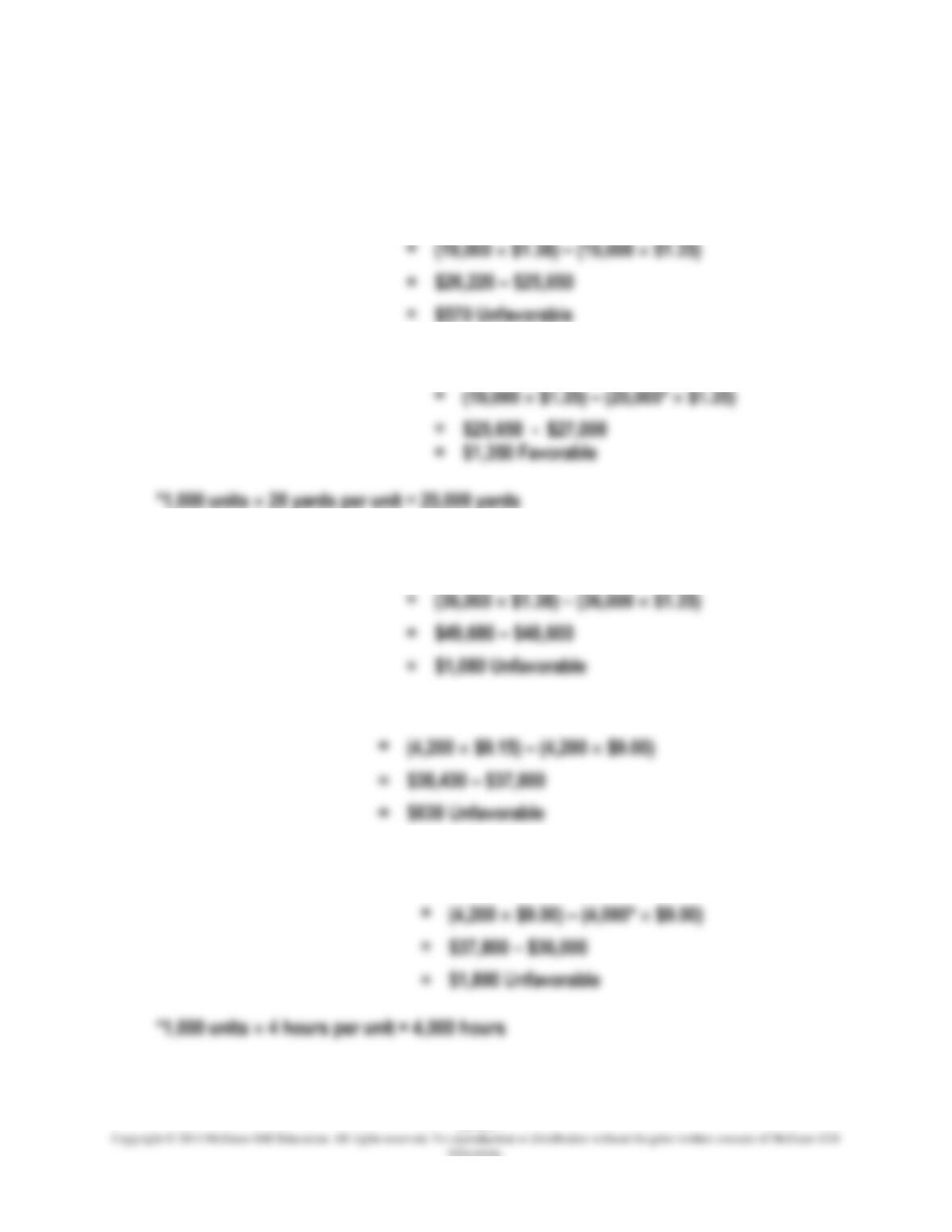
Raw-Material Inventory
Direct-Material
Purchase Price Variance
126,000
4,800
Work-in-Process Inventory
Direct-Material
Quantity Variance
6,000
Accounts Payable
Direct-Labor
Rate Variance
148,800
2,600
Wages Payable
Direct-Labor
Efficiency Variance
158,600
6,000
Chapter 10 – Standard Costing and Analysis of Direct Costs
10–19
SOLUTIONS TO PROBLEMS
PROBLEM 10-33 (25 MINUTES)
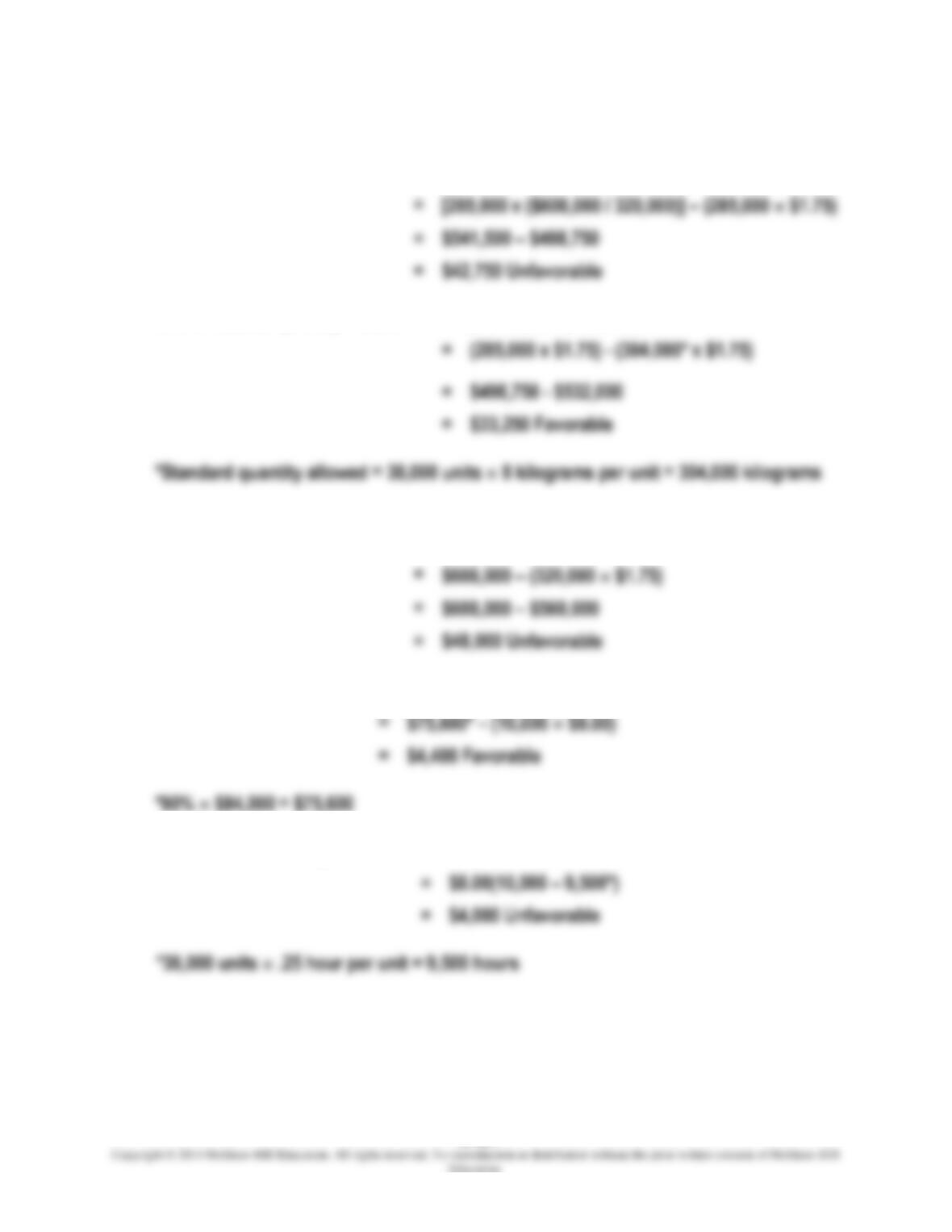
1.
Direct-material price variance
=
(AQ
AP) – (AQ
SP)
=
=
=
2.
Direct-material quantity variance
=
(AQ
SP) – (SQ
SP)
=
$25,650 – $27,000
=
$1,350 Favorable
3.
Direct-material purchase
price variance
=
(PQ
AP) – (PQ
SP)
=
=
$49,680 – $48,600
=
$1,080 Unfavorable
4.
Direct-labor rate variance
=
(AH
AR) – (AH
SR)
=
=
$38,430 – $37,800
=
$630 Unfavorable
5.
Direct-labor efficiency variance
=
(AH
SR) – (SH
SR)
=
=
$37,800 – $36,000
=
$1,800 Unfavorable
Chapter 10 – Standard Costing and Analysis of Direct Costs
10–20
PROBLEM 10-34 (25 MINUTES)
1.
Direct-material price variance
=
(AQ
AP) – (AQ
SP)
=
=
$42,750 Unfavorable
2.
Direct-material quantity variance
=
(AQ x SP) – (SQ x SP)
=
$33,250 Favorable
3.
Direct-material purchase price
variance
=
(PQ
AP) – (PQ
SP)
=
=
$608,000 – $560,000
4.
Direct-labor rate variance
=
(AH
AR) – (AH
SR)
=
$4,400 Favorable
5.
Direct-labor efficiency variance
=
SR(AH – SH)
=
$4,000 Unfavorable