CHAPTER 24 (FIN MAN); CHAPTER 10 (MAN) Evaluating Decentralized Operations
Prob. 24–5B (FIN MAN); Prob. 10–5B (MAN) (Concluded)
4. On the basis of operating income, the Road Bike Division generated $49,600 ($172,800
– $123,200) more operating income than did the Mountain Bike Division. However,
operating income does not consider the amount of invested assets in each division.
On the basis of the return on investment, the Road Bike Division earned 12.0 cents
(12.0%) on each dollar of invested assets, while the Mountain Bike Division earned
15.4 cents (15.4%) on each dollar of invested assets. Although the profit margin of the
CHAPTER 24 (FIN MAN); CHAPTER 10 (MAN) Evaluating Decentralized Operations
Prob. 24–6B (FIN MAN); Prob. 10–6B (MAN)
1. No. When unused capacity exists in the supplying division (the Semiconductors
Division), the use of the market price approach may not lead to the maximization of
total company income.
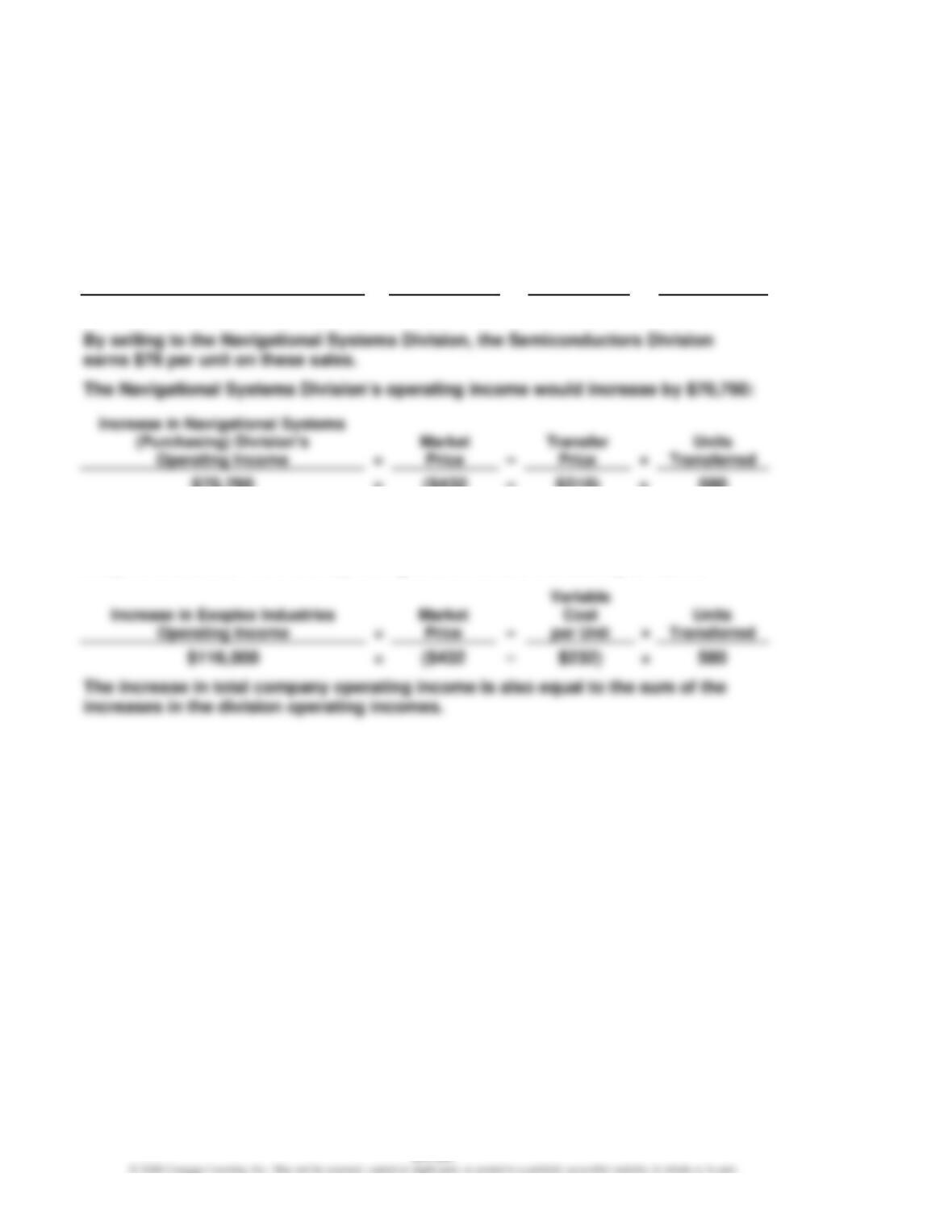
2. The Semiconductors Division’s operating income would increase by $45,240:
Increase in Semiconductors
(Supplying) Division’s
Operating Income
Transfer Price
Variable
Cost
per Unit
Units
Transferred
=
–
×
$45,240
=
($310
–
$232)
×
580
Operating Income
Transferred
$70,760
=
($432
–
$310)
×
580
By purchasing from the Semiconductors Division, the Navigational Systems
Division saves $122 per unit on its purchases.
Exoplex Industries Inc.’s total operating income would increase by $116,000:
Operating Income
Transferred
=
–
=
–
CHAPTER 24 (FIN MAN); CHAPTER 10 (MAN) Evaluating Decentralized Operations
Prob. 24–6B (FIN MAN); Prob. 10–6B (MAN) (Continued)
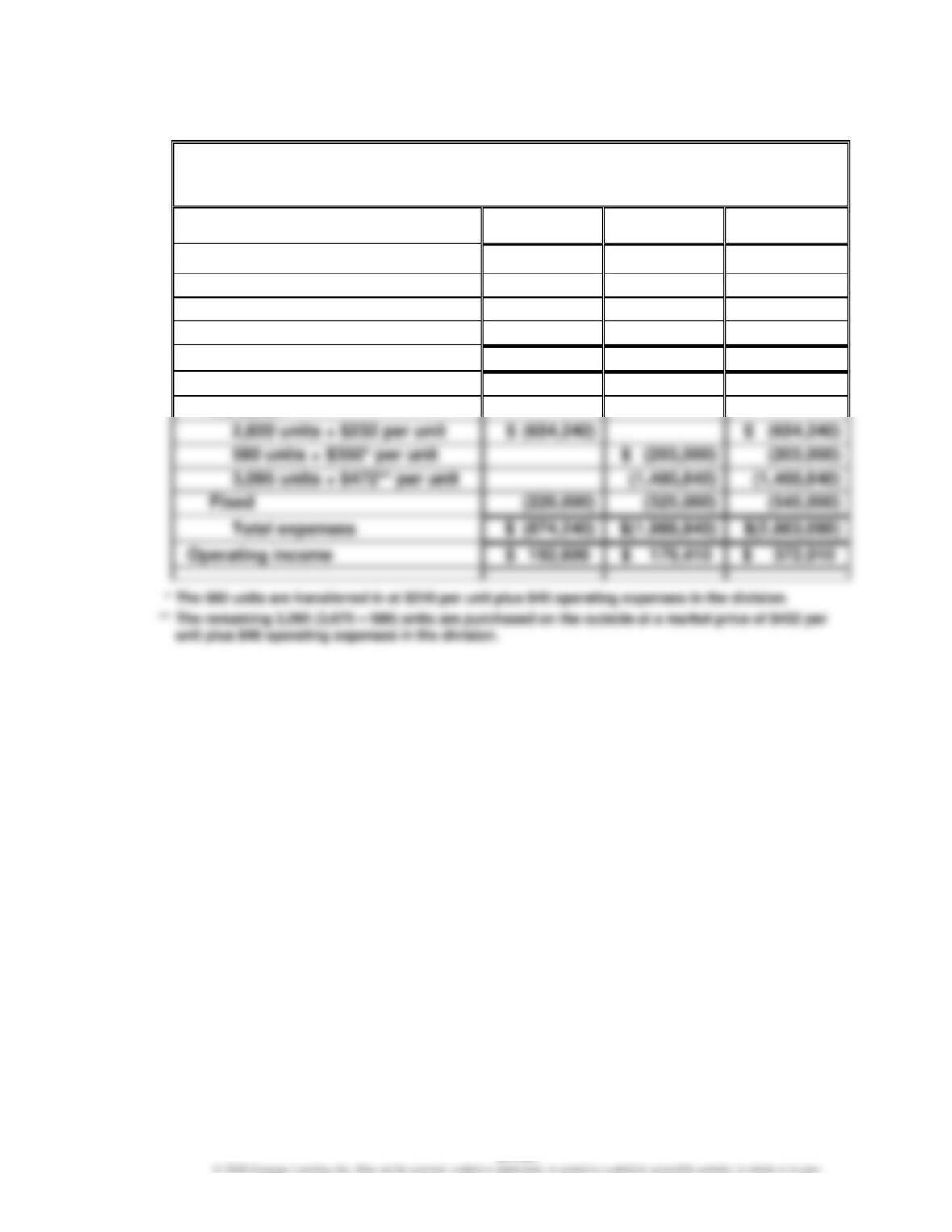
3.
Exoplex Industries Inc.
Divisional Income Statements
For the Year Ended December 31, 20Y8
Semi-
conductors
Navigational
Systems
Total
Sales:
2,240 units × $396 per unit
$ 887,040
$ 887,040
580 units × $310 per unit
179,800
179,800
3,675 units × $590 per unit
$ 2,168,250
2,168,250
Total sales
$1,066,840
$ 2,168,250
$ 3,235,090
Expenses:
2,820 units × $232 per unit
580 units × $350* per unit
Total expenses
Variable:
CHAPTER 24 (FIN MAN); CHAPTER 10 (MAN) Evaluating Decentralized Operations
Prob. 24–6B (FIN MAN); Prob. 10–6B (MAN) (Concluded)
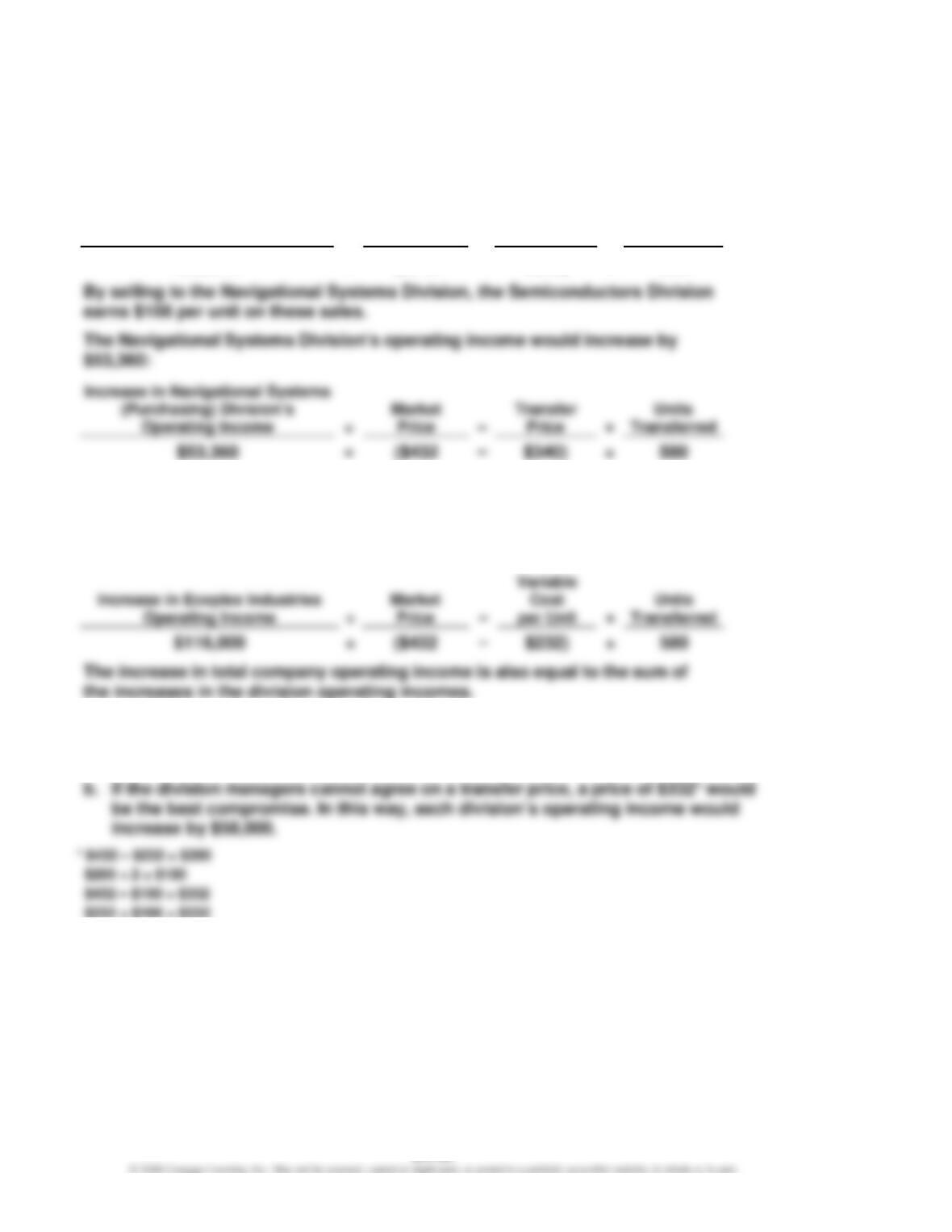
4. The Semiconductors Division’s operating income would increase by
$62,640:
Increase in Semiconductors
(Supplying) Division’s
Operating Income
Transfer
Price
Variable
Cost
per Unit
Units
Transferred
=
–
×
$62,640
=
($340
–
$232)
×
580
Operating Income
Price
Units
Transferred
–
–
By purchasing from the Semiconductors Division, the Navigational Systems
Division saves $92 per unit on its purchases.
Exoplex Industries Inc.’s total operating income would increase by the same
amount as in (2), $116,000:
Transferred
580
5. a. Any transfer price greater than the Semiconductors Division’s variable
expenses per unit of $232 but less than the market price of $432 would be
acceptable.
CHAPTER 24 (FIN MAN); CHAPTER 10 (MAN) Evaluating Decentralized Operations
MAKE A DECISION
MAD 24–1 (FIN MAN); MAD 10–1 (MAN)
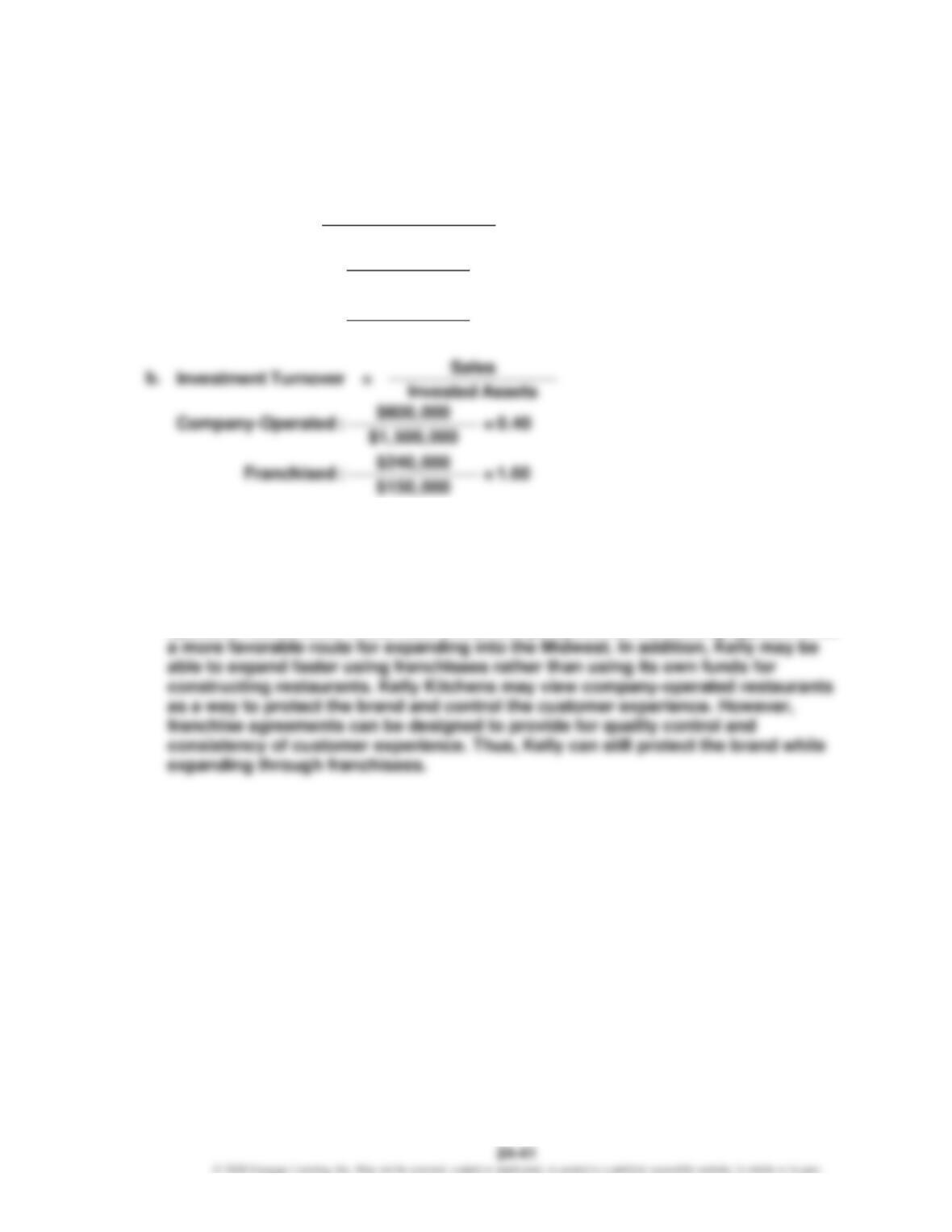
a.
Operating Income
Profit Margin = Sales
$180,000
Company Operated : = 30%
$600,000
$192,000
Franchised : = 80%
$240,000
–
=
c. Return on Investment (ROI) = Profit Margin × Investment Turnover
Company-Operated: 30% × 0.40 = 12%
Franchised: 80% × 1.60 = 128%
d. The profit margin, investment turnover, and ROI favor franchised over company-
operated restaurants. Thus, from a financial perspective, franchising appears to be
CHAPTER 24 (FIN MAN); CHAPTER 10 (MAN) Evaluating Decentralized Operations
MAD 24–2 (FIN MAN); MAD 10–2 (MAN)
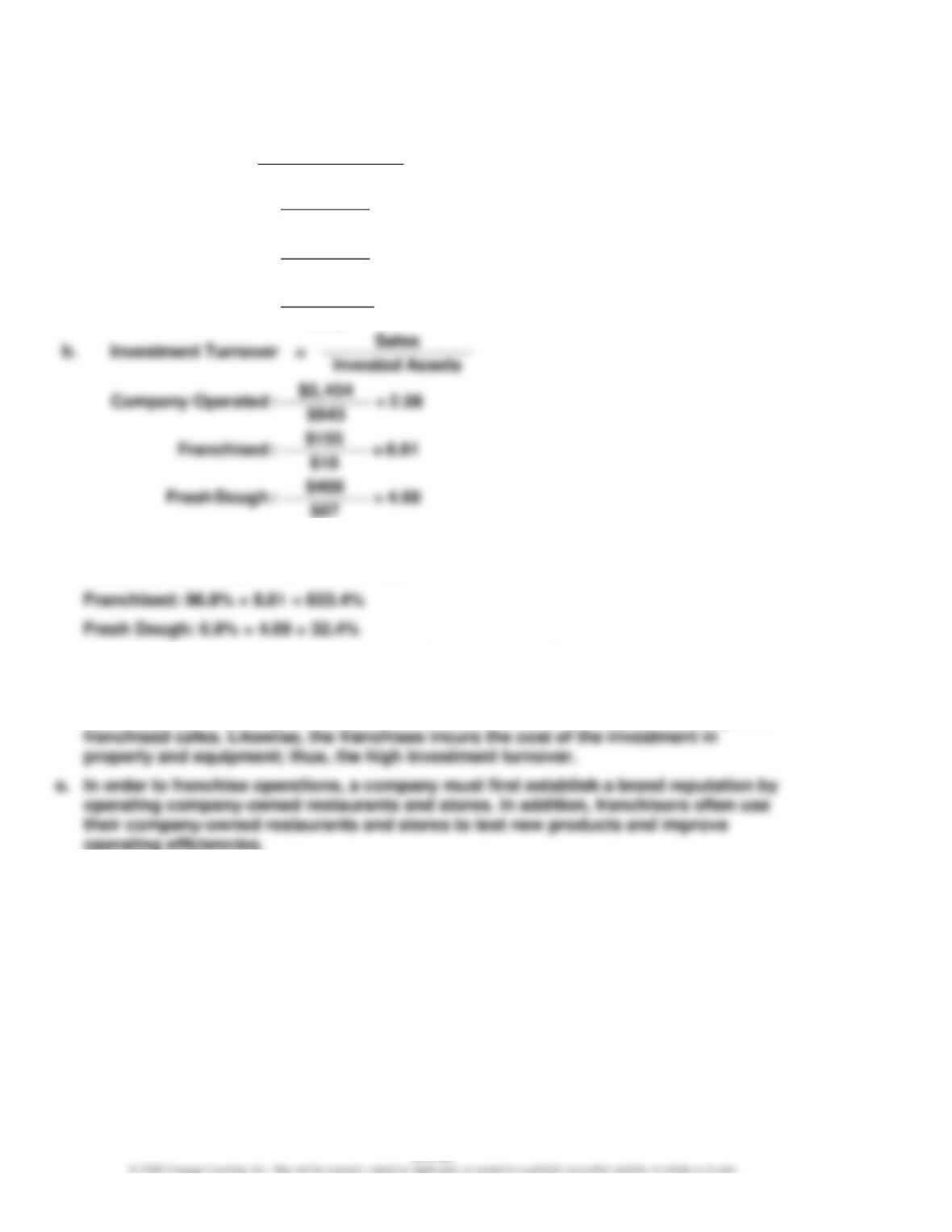
a.
Operating Income
Profit Margin = Sales
$398
Company Operated : = 16.4%
$2,434
$150
Franchised : = 96.8%
$155
$28
Fresh Dough : = 6.9%
$408
–
c. Return on Investment (ROI) = Profit Margin × Investment Turnover
Company-Operated: 16.4% × 2.58 = 42.3%
d. The franchised cafes have the highest profit margin of 96.8% and investment turnover
of 8.61, thus yielding the highest return on investment of 833.4%. The franchised
cafes are extremely profitable because Panera incurs no cost of goods sold or
operating expenses in generating this revenue; thus, there is a high profit margin for
CHAPTER 24 (FIN MAN); CHAPTER 10 (MAN) Evaluating Decentralized Operations
MAD 24–3 (FIN MAN); MAD 10–3 (MAN)
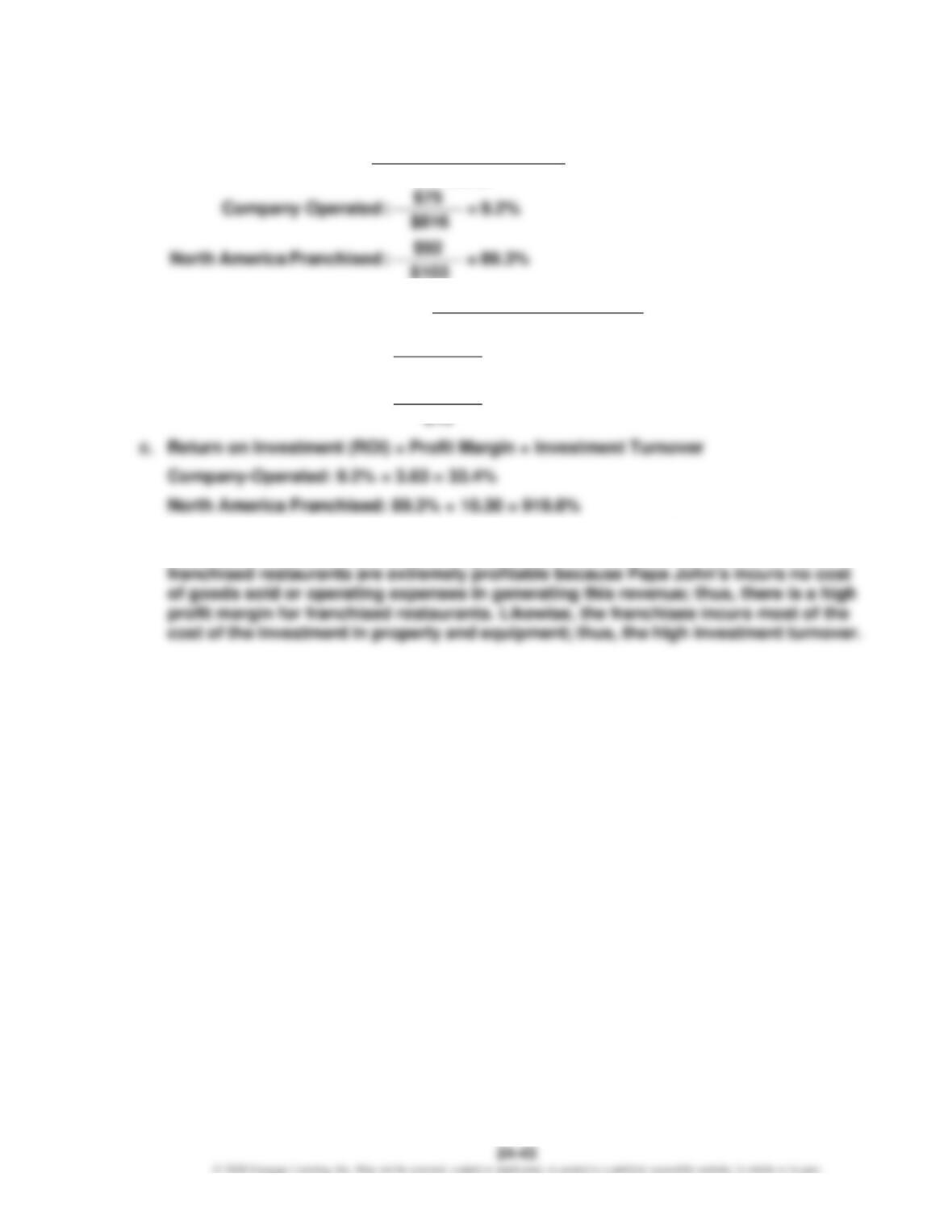
a.
Operating Income
Profit Margin = Sales
b.
Sales
Investment Turnover = Invested Assets
$816
Company Operated : = 3.63
$225
$103
North America Franchised : = 10.30
–
d. The franchised restaurants have the highest profit margin of 89.3% and investment
turnover of 10.30, thus yielding the highest return on investment of 919.8%. The
CHAPTER 24 (FIN MAN); CHAPTER 10 (MAN) Evaluating Decentralized Operations
MAD 24–4 (FIN MAN); MAD 10–4 (MAN)
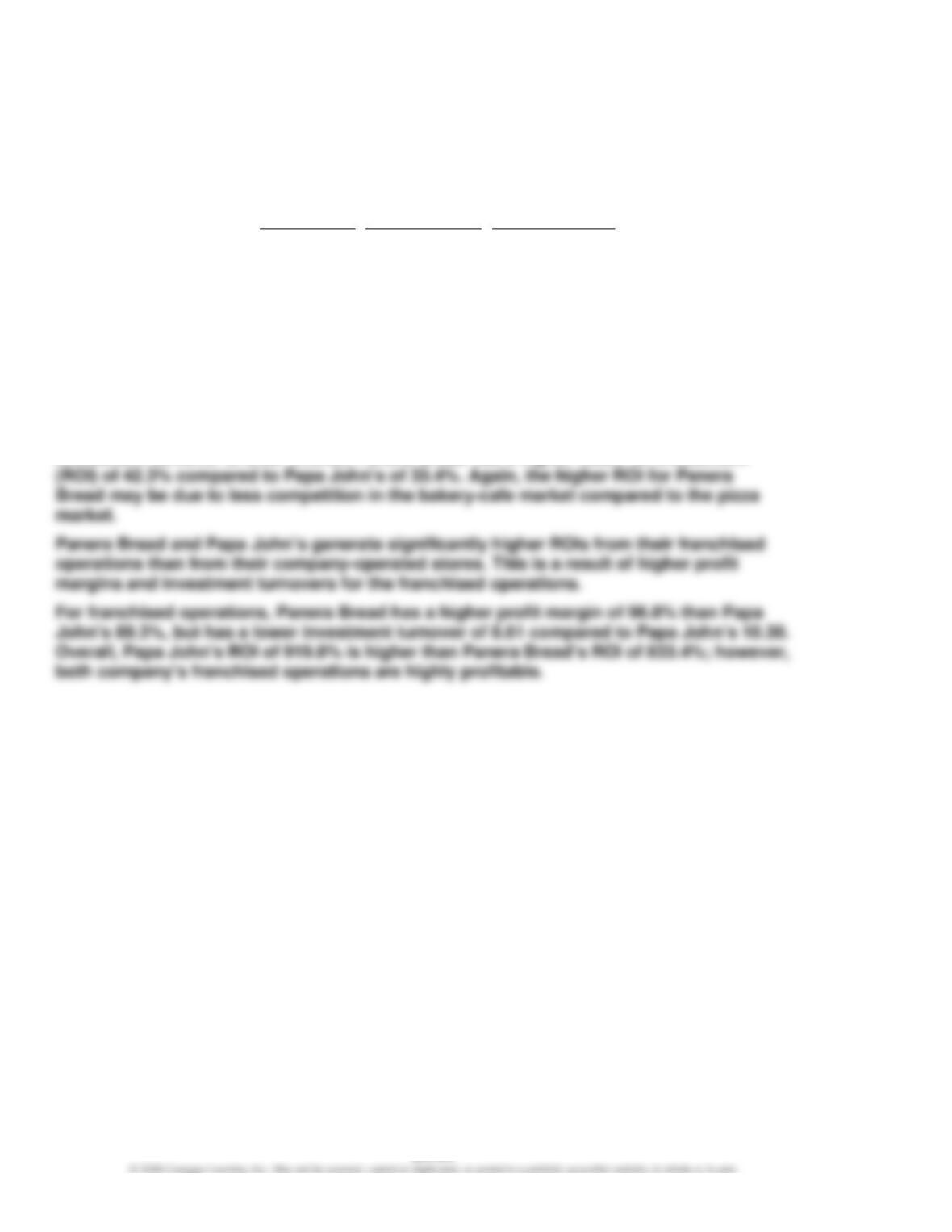
The profit margin, investment turnover, and return on investment for Panera Bread (MAD 2)
and Papa John’s (MAD 3) are summarized as follows:
Profit
Margin
Investment
Turnover
Return on
Investment
Panera Bread:
Company-operated
16.4%
2.58
42.3%
Franchised
96.8%
8.61
833.4%
Papa John’s:
Company-operated
9.2%
3.63
33.4%
Franchised
89.3%
10.30
919.8%
For company-operated restaurants, Panera Bread’s profit margin of 16.4% is higher than
Papa John’s profit margin of 9.2%. This may be due to more competition in the market for
pizzas. However, Papa John’s investment turnover of 3.63 is higher than Panera Bread’s
CHAPTER 24 (FIN MAN); CHAPTER 10 (MAN) Evaluating Decentralized Operations
MAD 24–5 (FIN MAN); MAD 10–5 (MAN)
a.
Operating Income
Profit Margin = Sales
$3,769
United States : = 45.7%
$8,253
b.
Sales
Investment Turnover = Invested Assets
$8,253
United States : = 0.69
$11,961
c. Return on Investment (ROI) = Profit Margin × Investment Turnover
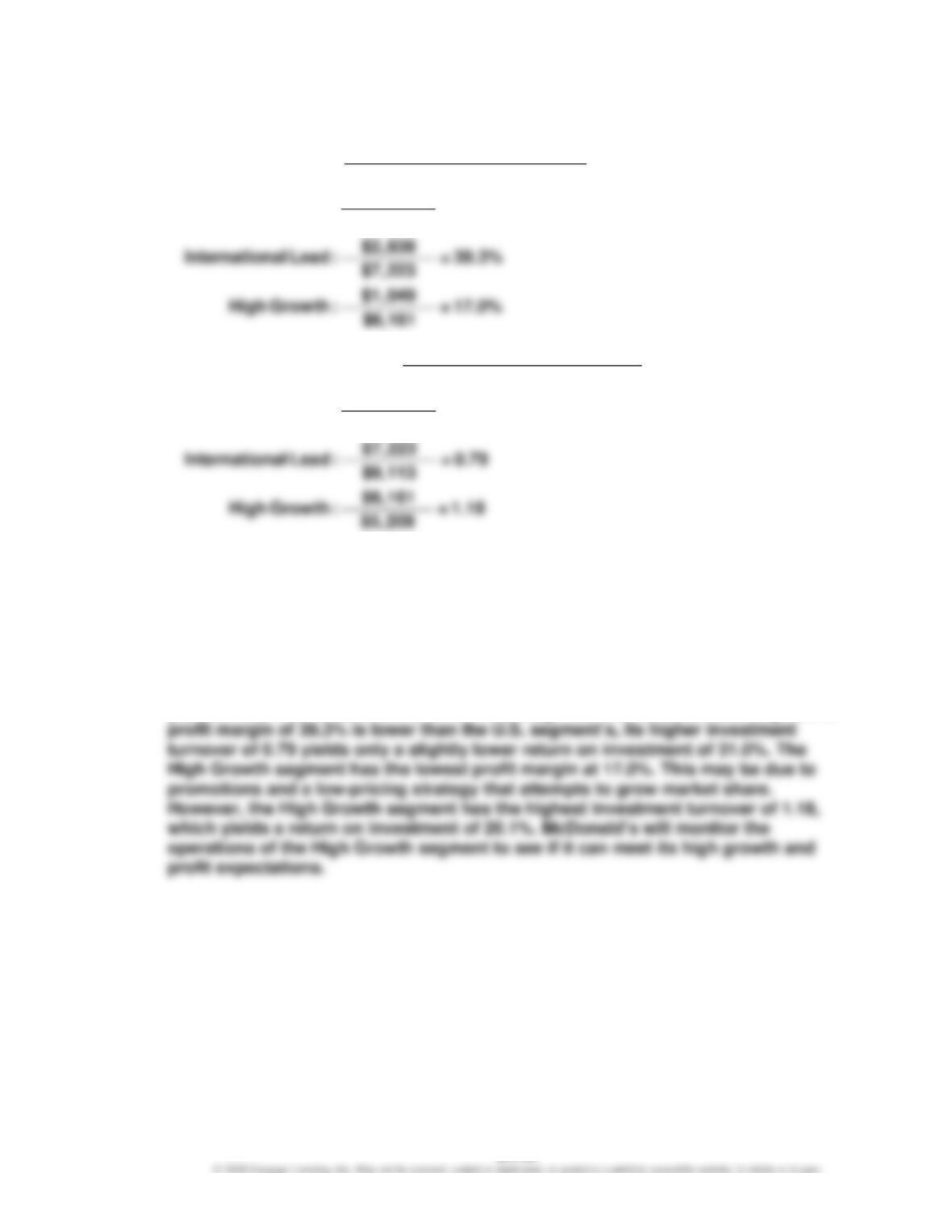
United States: 45.7% × 0.69 = 31.5%
International Lead: 39.3% × 0.79 = 31.0%
High Growth: 17.0% × 1.18 = 20.1%
d. The U.S. segment has the highest profit margin of the three segments at 45.7%.
However, the U.S. segment’s investment turnover of 0.69 is the lowest, which
yields a return on investment of 31.5%. Although the International Lead segment’s
CHAPTER 24 (FIN MAN); CHAPTER 10 (MAN) Evaluating Decentralized Operations
TAKE IT FURTHER
TIF 24–1 (FIN MAN); TIF 10–1 (MAN)
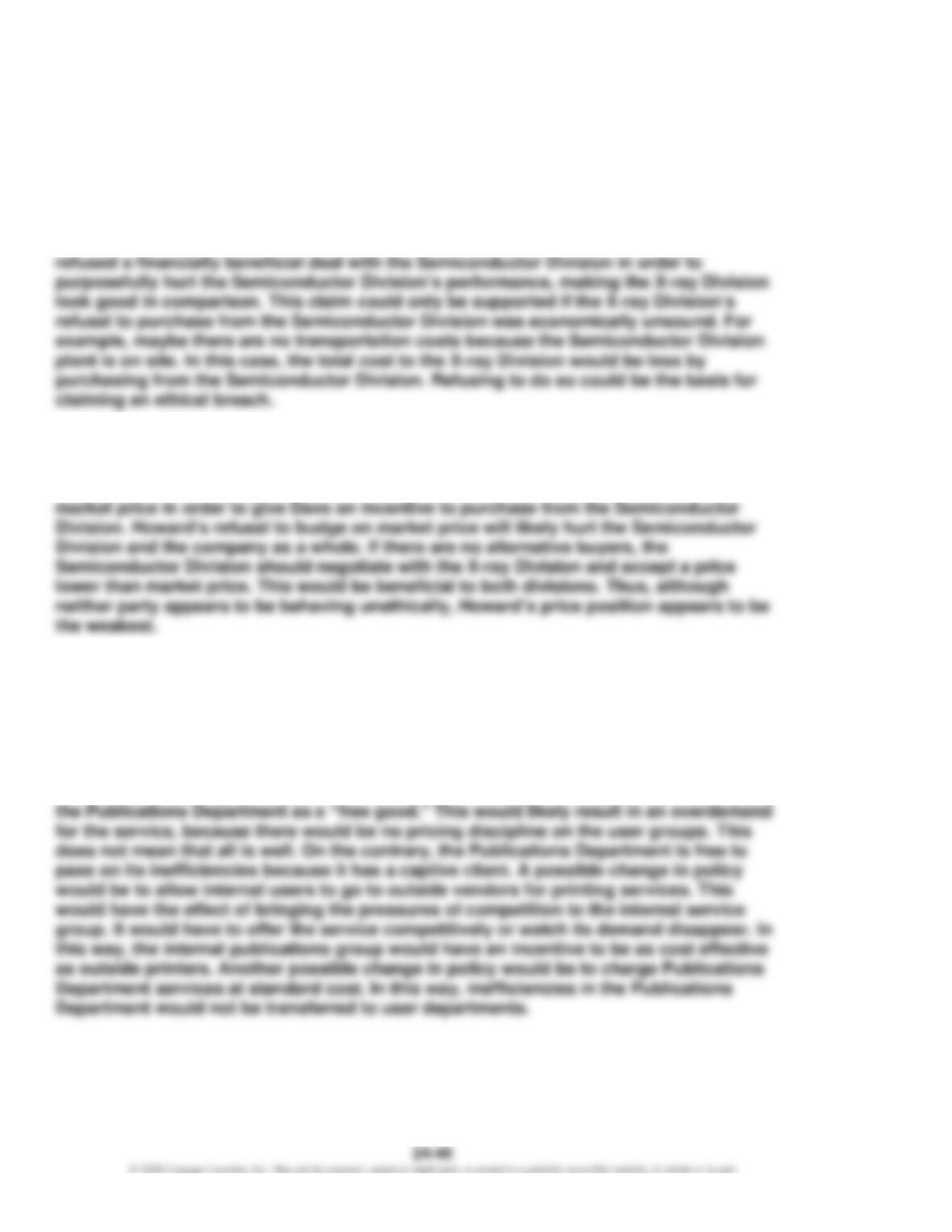
This scenario is a negotiation between two divisions. Dave is not behaving unethically by
attempting to get a better price from the Semiconductor Division than from the market, or
by refusing market price. This may not seem “fair,” but price negotiation is both a typical
business activity and part of Dave’s job. It would be unethical only if the X-ray Division
Because the X-ray Division has overall profit responsibility and authority, the division
has the choice of purchasing from inside or outside the company. The company should
establish incentives for the X-ray Division to purchase from inside the company in order
to maximize overall corporate income. Thus, the transfer price should be set below
TIF 24–2 (FIN MAN); TIF 10–2 (MAN)
The Customer Service Department head is responsible for the quantity of service but not
the source of the service (i.e., not the price). Most accountants would hold the
department head responsible for the cost by transferring the cost of the brochures to the
Customer Service Department, even though the price is 25% higher than could be
obtained from the outside. This may not seem fair, but it does control the use of internal
services to some degree. If there were no internal transfer price, departments would view
CHAPTER 24 (FIN MAN); CHAPTER 10 (MAN) Evaluating Decentralized Operations
TIF 24–3 (FIN MAN); TIF 10–3 (MAN)
Memo
To: Knute Holz
From: Ima Student
Re: Norse Division Financial Performance
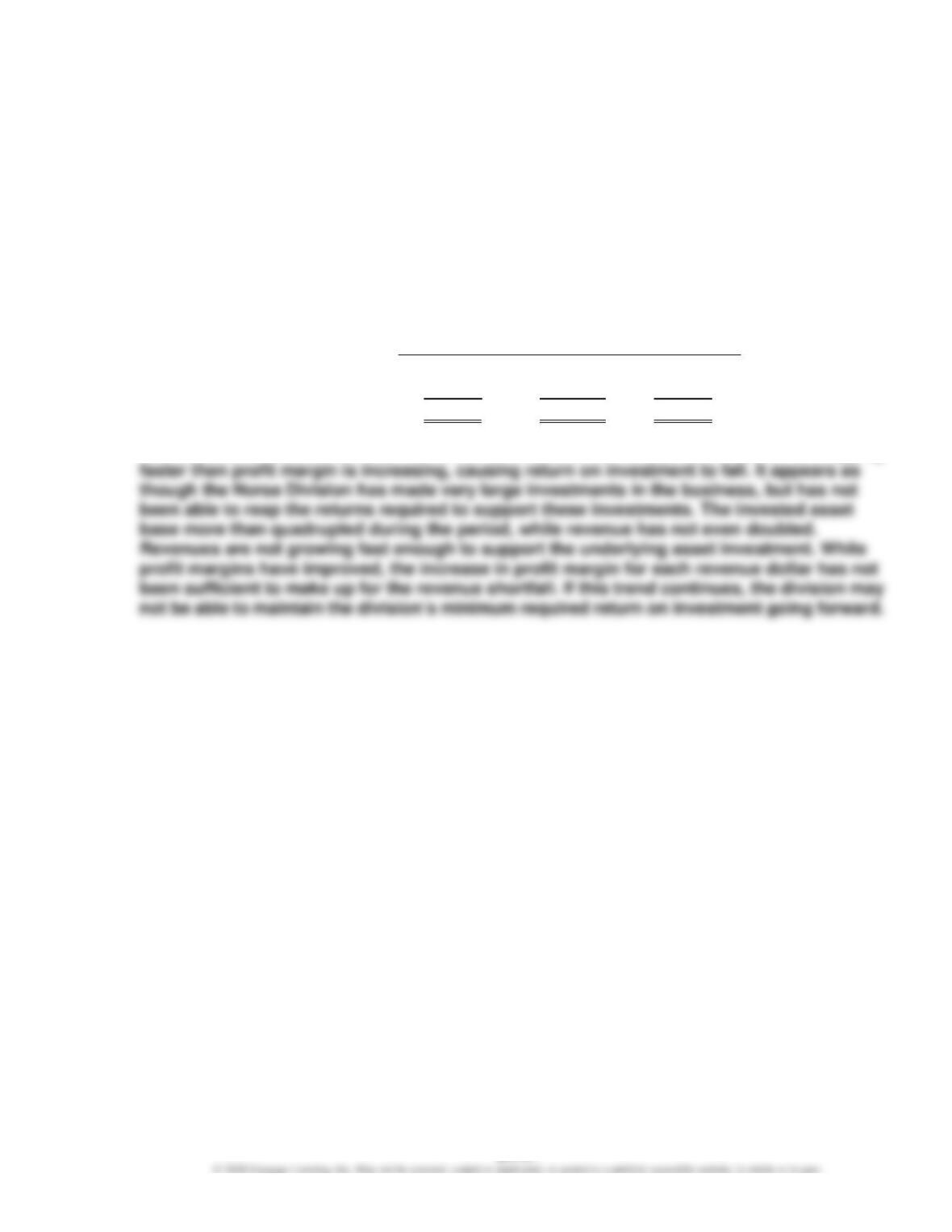
The Norse Division’s revenues, gross profit, and operating income have increased
significantly from 20Y4 to 20Y6. While these increases indicate that the division is growing
profitability, return on investment is falling. The division’s profit margin, investment
turnover, and return on investment are as follows:
20Y4
20Y5
20Y6
Profit margin
15.0%
18.0%
22.0%
Investment turnover
× 2.0
× 1.4
× 0.7
Return on investment
30.0%
25.2%
15.4%
The detailed breakdown of return on investment shows that investment turnover is dropping
CHAPTER 24 (FIN MAN); CHAPTER 10 (MAN) Evaluating Decentralized Operations
TIF 24–4 (FIN MAN); TIF 10–4 (MAN)
a. The return on invested assets is computed as follows:
Snack
Goods
Cereal
Frozen
Foods
Operating income …………….
$ 396,000
$ 554,400
$ 420,000
÷ Invested assets …………….
2,000,000
1,680,000
1,750,000
ROI …………………………………
19.8%
33.0%
24.0%
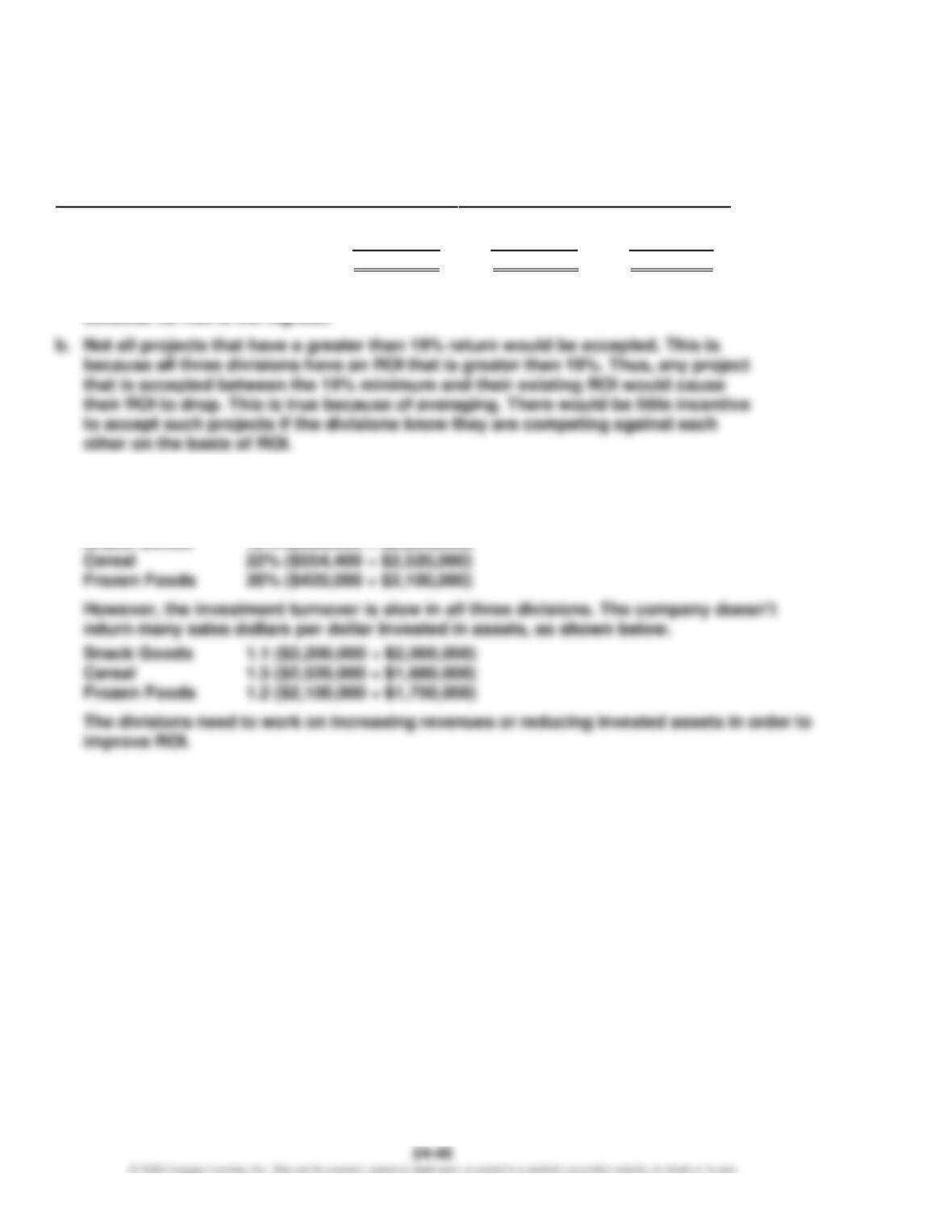
The Cereal Division appears to be making the best use of invested assets
c. There are two approaches to improving ROI: (1) improve the profit margin or (2)
improve the investment turnover. For all three divisions, the profit margin is
excellent:
CHAPTER 24 (FIN MAN); CHAPTER 10 (MAN) Evaluating Decentralized Operations
TIF 24–5 (FIN MAN); TIF 10–5 (MAN)
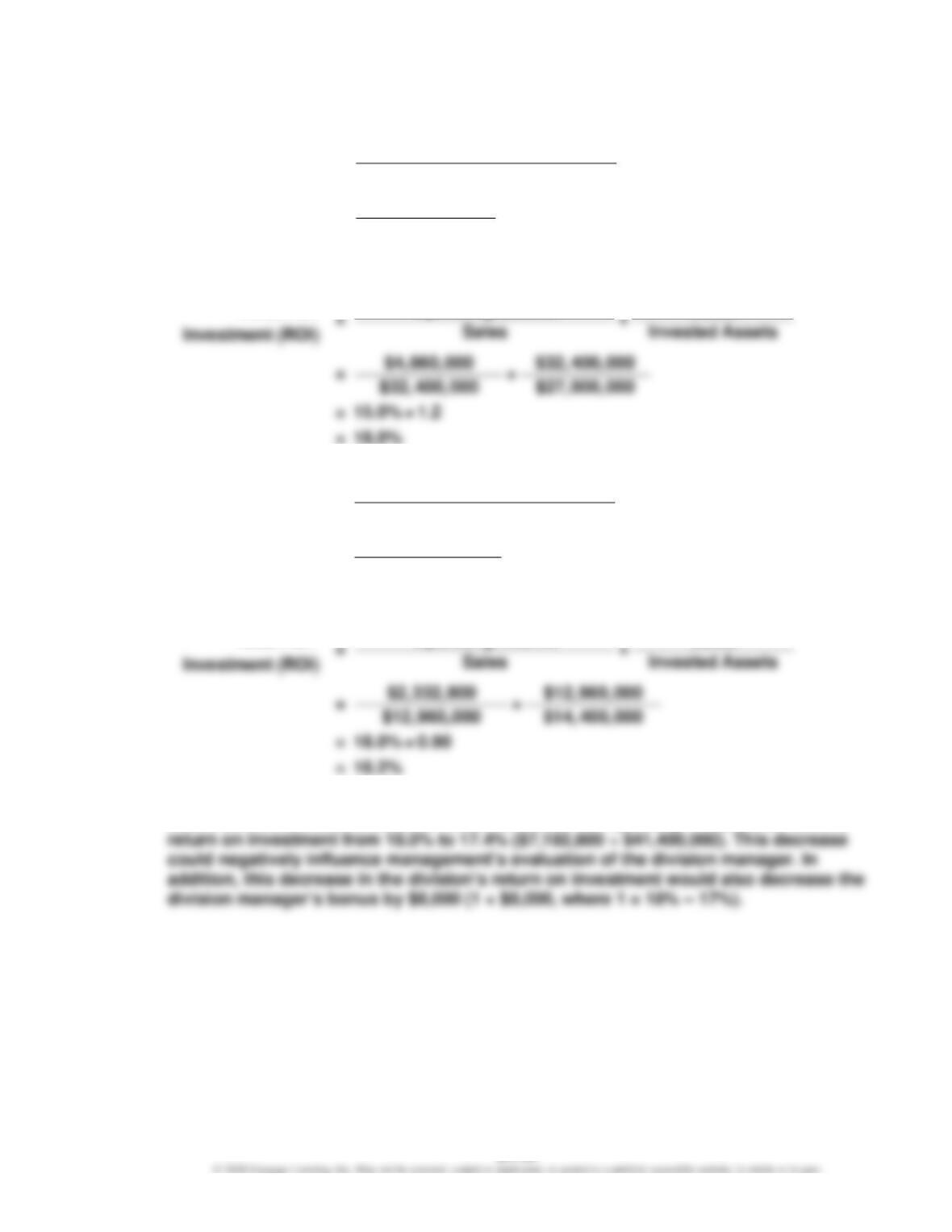
a.
( )
Return on Operating Income
=Invested Assets
Investment ROI
$4,860,000
=$27,000,000
= 18.0%
or
Return on Operating Income Sales
b. $64,000 (8.0 × $8,000 = $64,000, where 8.0 = 18.0% – 10.0%)
c.
( )
Return on Operating Income
=Invested Assets
Investment ROI
$2,332,800
=$14,400,000
= 16.2%
or
Return on Operating Income Sales
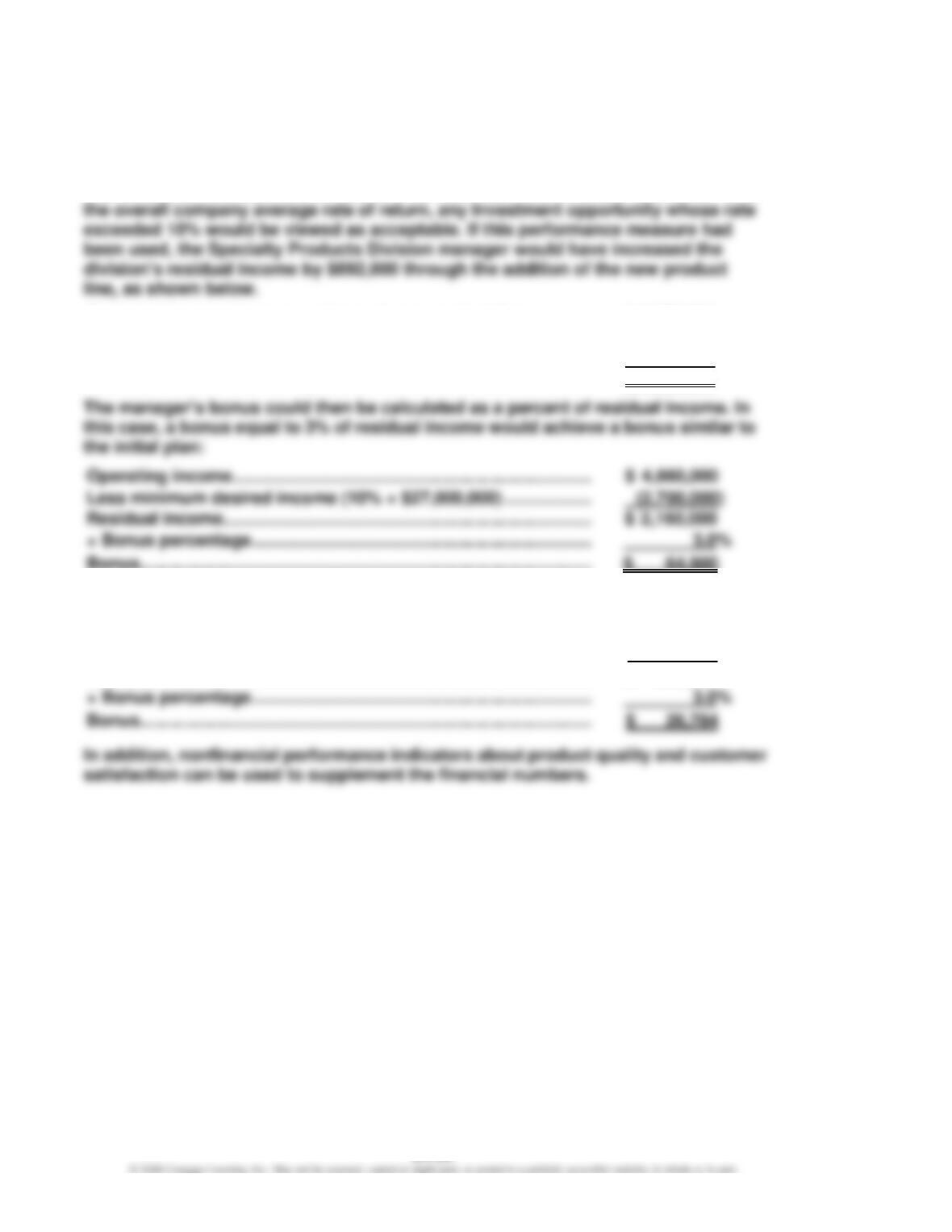
d. Even though the addition of the new product line would increase the overall company
return on investment, its addition would decrease the Specialty Products Division’s
CHAPTER 24 (FIN MAN); CHAPTER 10 (MAN) Evaluating Decentralized Operations
TIF 24–5 (FIN MAN); TIF 10–5 (MAN) (Concluded)
e. Use of residual income as a performance measure and as the basis for granting
bonuses would motivate division managers to accept investment opportunities
that exceed a minimum rate of return. If the minimum rate of return was set at 10%,
Projected income from operations of new product line ………….
$ 2,332,800
Less minimum amount of desired operating income
($14,400,000 × 10%) …………………………………………………………..
(1,440,000)
Residual income from new product line ………………………………..
$ 892,800
Operating income ………………………………………………………………..
$ 4,860,000
Residual income………………………………………………………………….
Bonus …………………………………………………………………………………
$ 64,800
The new project would add $26,784 (3% × $892,800) to the bonus.
Operating income with new product line ……………………………….
$ 2,332,800
Less minimum desired income (10% × $14,400,000) ………………
(1,440,000)
Residual income………………………………………………………………….
$ 892,800
CHAPTER 24 (FIN MAN); CHAPTER 10 (MAN) Evaluating Decentralized Operations
CERTIFIED MANAGEMENT ACCOUNTANT (CMA®)
EXAMINATION QUESTIONS (ADAPTED)
1. b. A sales team is generally only accountable for sales dollars; this type of responsibility
center is, therefore, a revenue center.
2. b. If corporate and support costs are being allocated to divisions and
departments, there is very little incentive for central managers to control costs
no matter how much pressure they receive from profit center managers.