Problem 10-13 (continued)
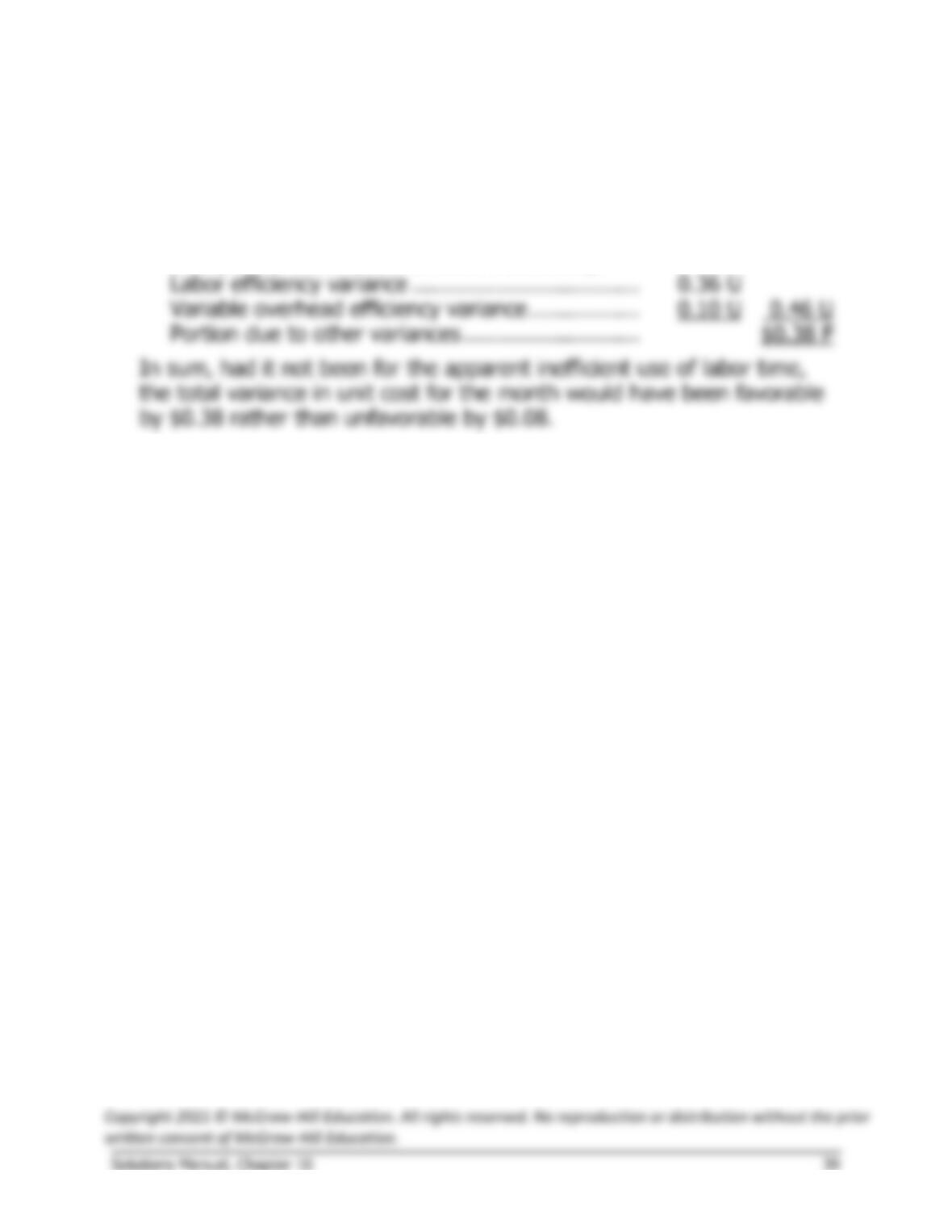
3. Both the labor efficiency and variable overhead efficiency variances are
affected by inefficient use of labor time.
Excess of actual over standard cost per unit …….
$0.08 U
Less portion attributable to labor inefficiency:
Variable overhead efficiency variance ……………..
Portion due to other variances ………………………
4. Although the excess of actual cost over standard cost is only $0.08 per
unit, the details of the variances are significant. The materials price
variance is $6,480 U and it warrants further investigation. The labor
efficiency variance is $4,320 U and the variable overhead efficiency
variance is $1,200 U. Taken together, these latter two variances
highlight an opportunity for the company to pursue process
improvement opportunities that would improve efficiency.
Problem 10-14 (45 minutes)
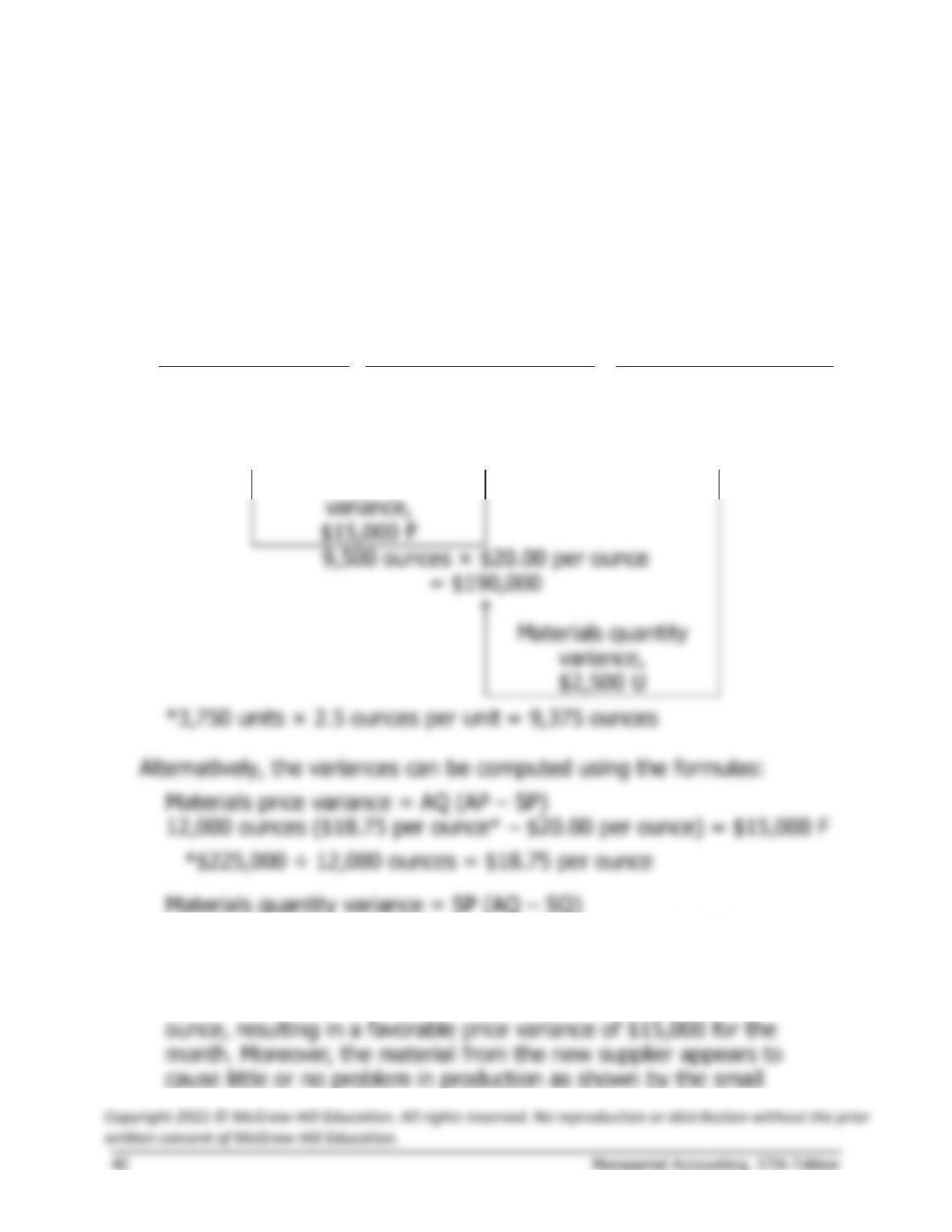
1. a. In the solution below, the materials price variance is computed on the
entire amount of materials purchased whereas the materials quantity
variance is computed only on the amount of materials used in
production:
Actual Quantity of
Input, at
Actual Price
Actual Quantity
of Input, at
Standard Price
Standard Quantity
Allowed for Output, at
Standard Price
(AQ × AP)
(AQ × SP)
(SQ × SP)
12,000 ounces ×
$20.00 per ounce
9,375 ounces* ×
$20.00 per ounce
$225,000
= $240,000
= $187,500
Materials price
$20.00 per ounce (9,500 ounces – 9,375 ounces) = $2,500 U
b. Yes, the contract probably should be signed. The new price of $18.75
per ounce is substantially lower than the old price of $20.00 per

materials quantity variance for the month.
Problem 10-14 (continued)
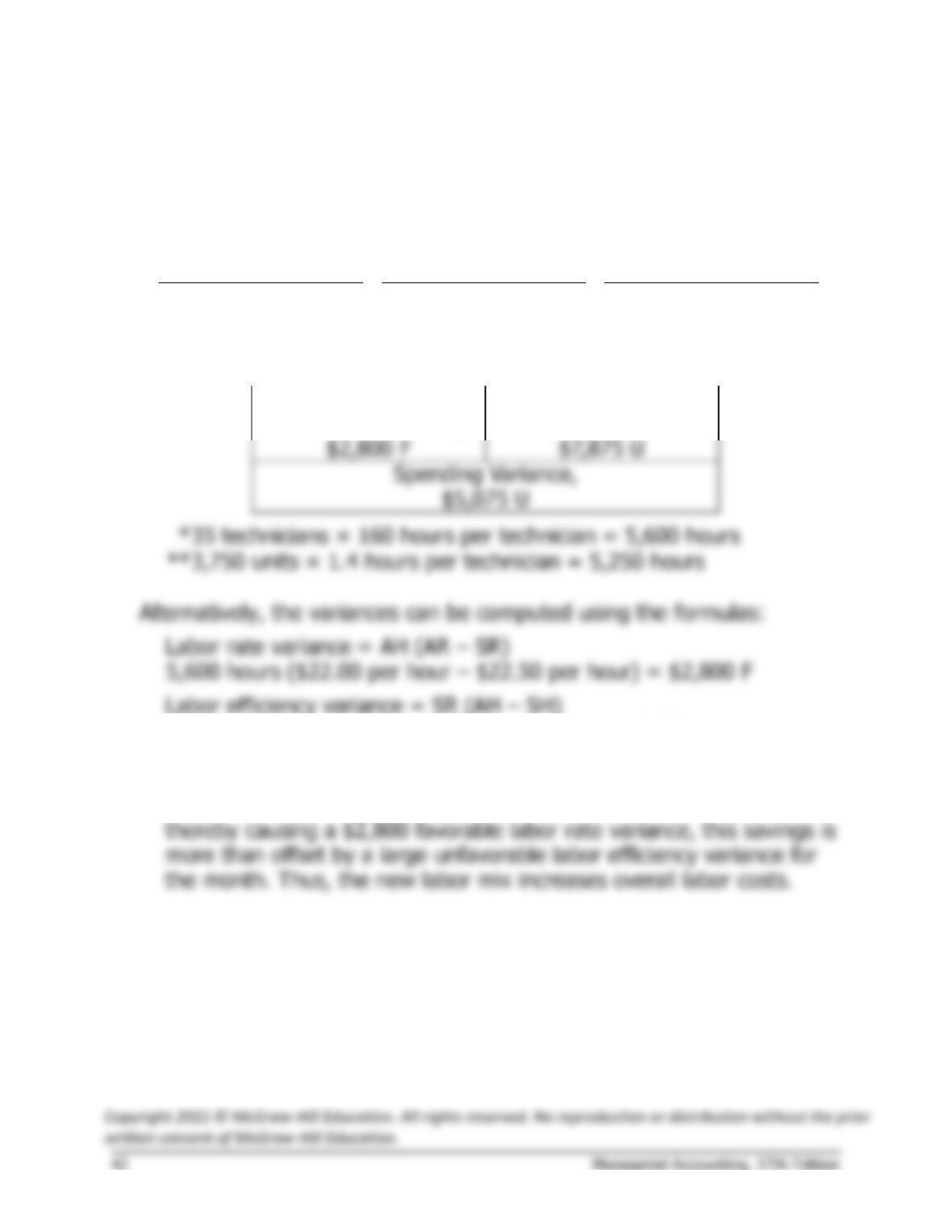
2. a.
Actual Hours of
Input, at the
Actual Rate
Actual Hours of
Input, at the
Standard Rate
Standard Hours
Allowed for Output, at
the Standard Rate
(AH × AR)
(AH × SR)
(SH × SR)
5,600 hours* ×
$22.00 per hour
5,600 hours ×
$22.50 per hour
5,250 hours** ×
$22.50 per hour
= $123,200
= $126,000
= $118,125
Labor rate variance,
Labor efficiency
variance,
$22.50 per hour (5,600 hours – 5,250 hours) = $7,875 U
b. No, the new labor mix probably should not be continued. Although it
decreases the average hourly labor cost from $22.50 to $22.00,
Problem 10-14 (continued)
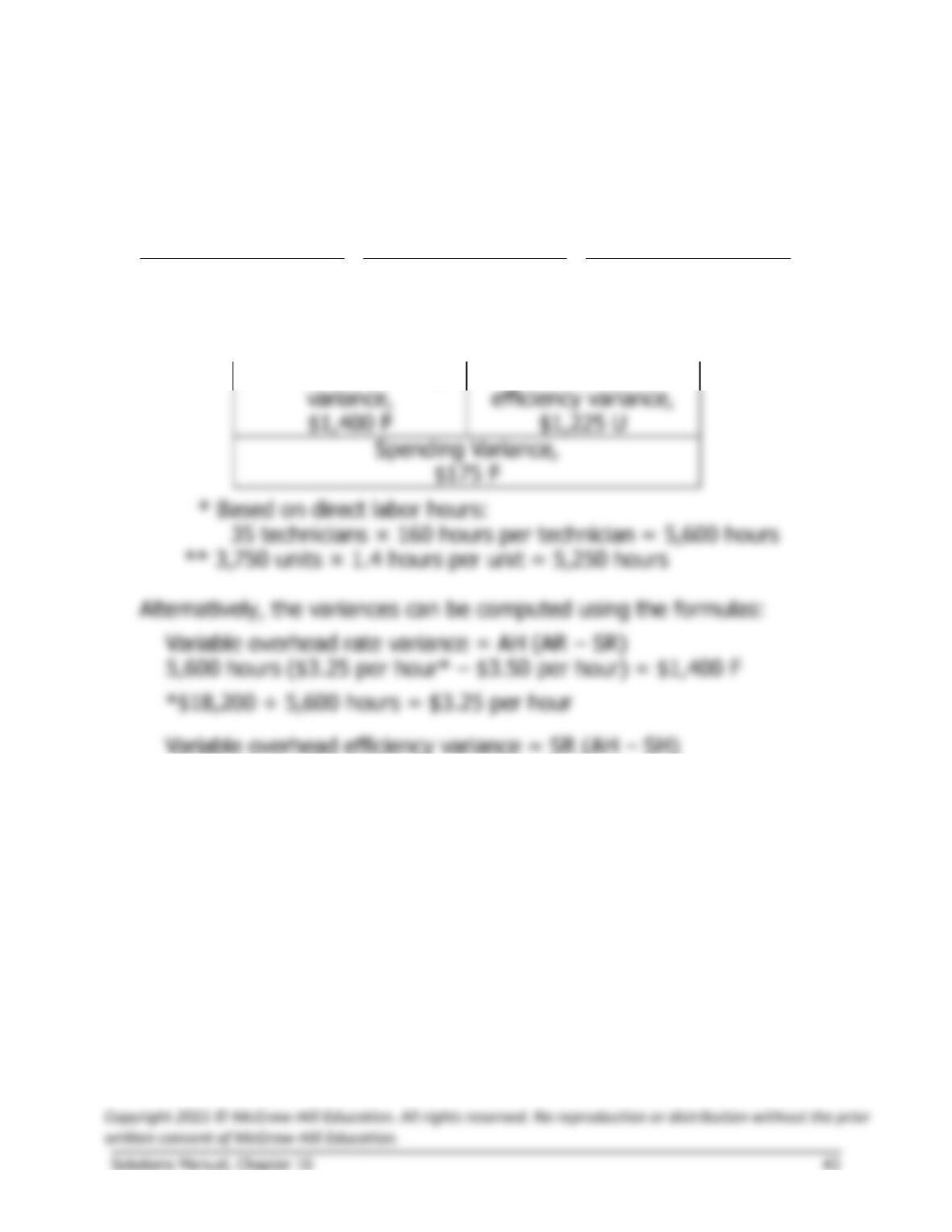
3.
Actual Hours of
Input, at the
Actual Rate
Actual Hours of
Input, at the
Standard Rate
Standard Hours
Allowed for Output,
at the Standard Rate
(AH × AR)
(AH × SR)
(SH × SR)
5,600 hours* ×
$3.50 per hour
5,250 hours** ×
$3.50 per hour
$18,200
= $19,600
= $18,375
Variable overhead rate
Variable overhead
$3.50 per hour (5,600 hours – 5,250 hours) = $1,225 U
Both the labor efficiency variance and the variable overhead efficiency
variance are computed by comparing actual labor-hours to standard
labor-hours. Thus, if the labor efficiency variance is unfavorable, then
the variable overhead efficiency variance will be unfavorable as well.
Problem 10-15 (45 minutes)
1. a.
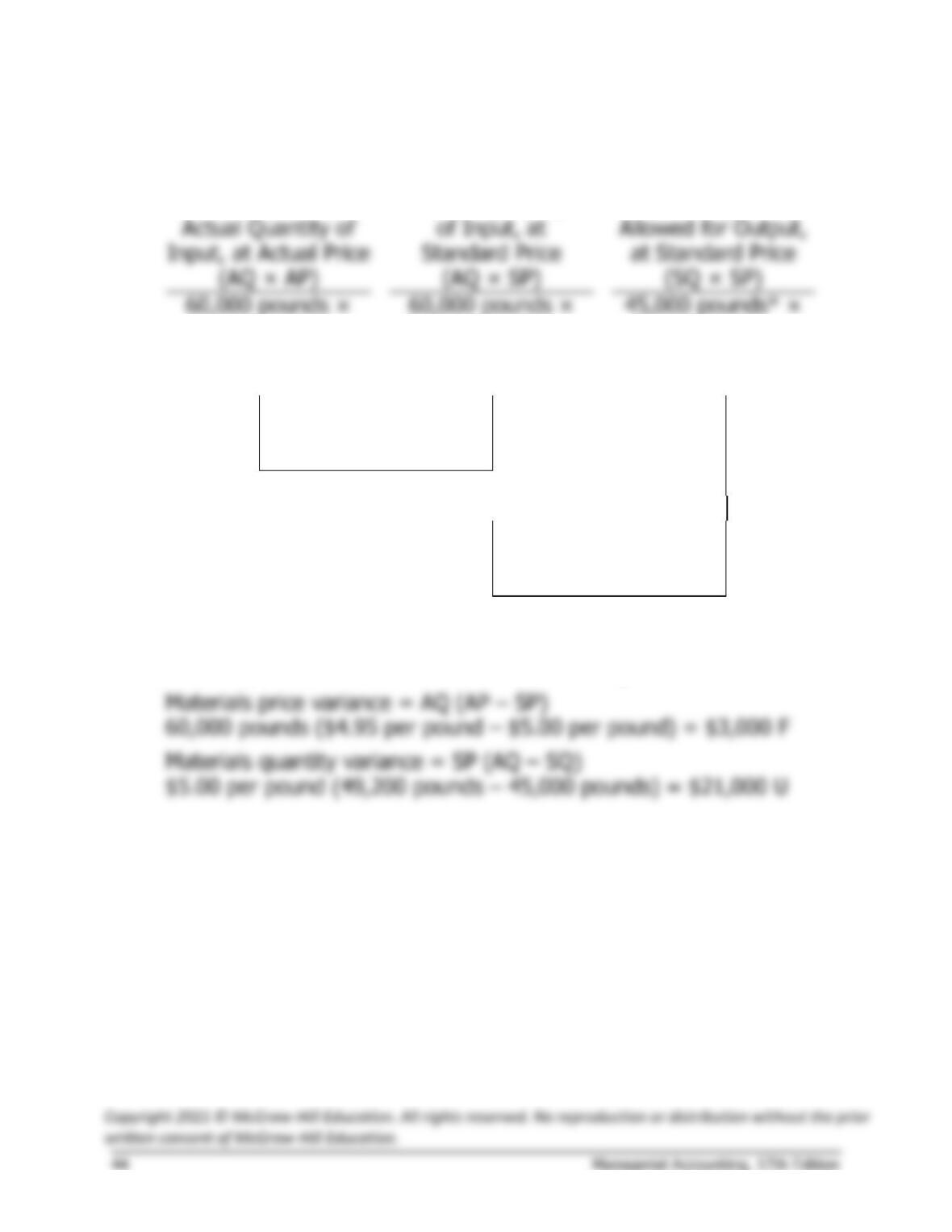
Actual Quantity
Standard Quantity
$4.95 per pound
$5.00 per pound
$5.00 per pound
= $297,000
= $300,000
= $225,000
Materials price
variance,
$3,000 F
49,200 pounds × $5.00 per pound = $246,000
Materials quantity
variance,
$21,000 U
*15,000 pools × 3.0 pounds per pool = 45,000 pounds
Alternatively, the variances can be computed using the formulas:
Problem 10-15 (continued)
b.
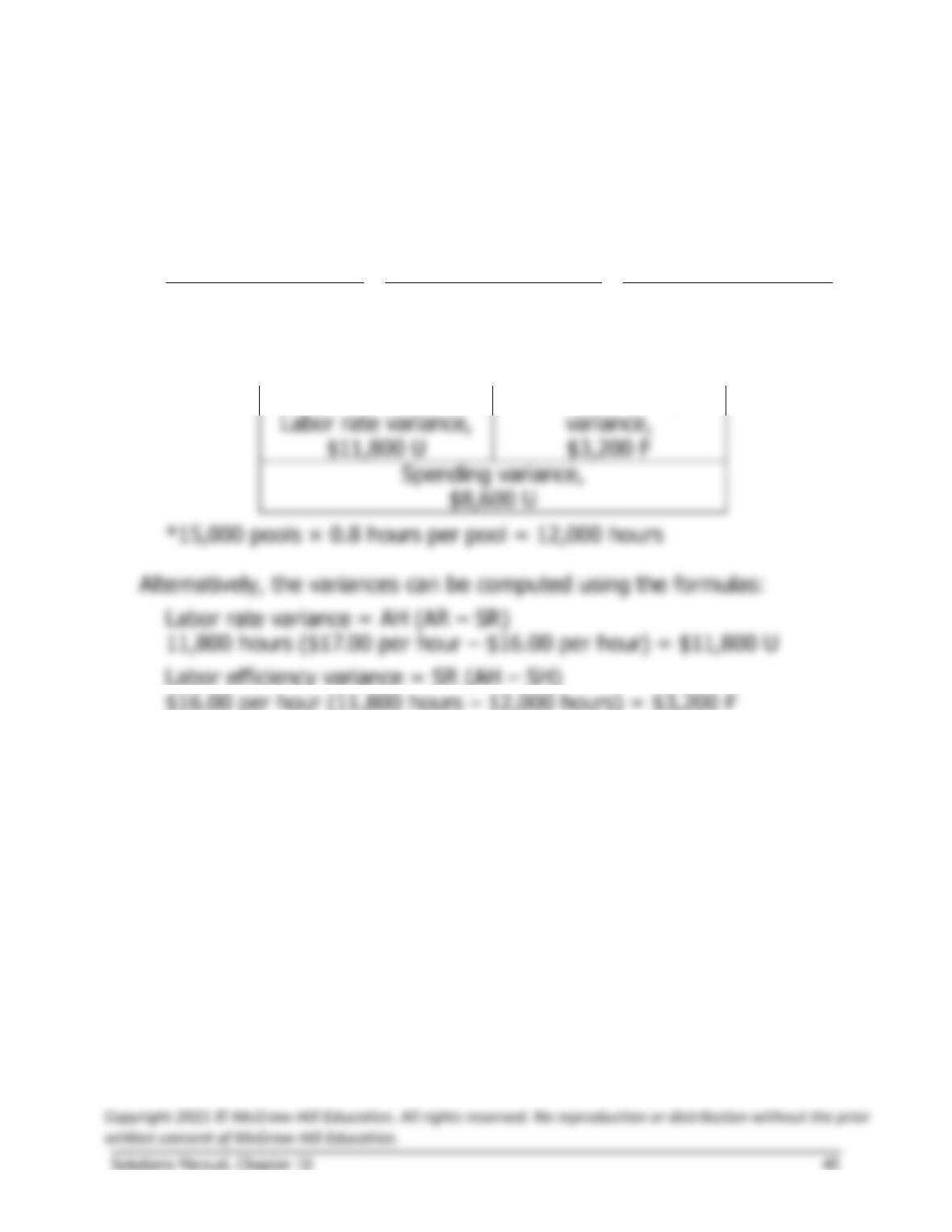
Actual Hours of
Input, at the
Actual Rate
Actual Hours of Input,
at the Standard Rate
Standard Hours
Allowed for Output,
at the Standard Rate
(AH × AR)
(AH × SR)
(SH × SR)
11,800 hours ×
$17.00 per hour
11,800 hours ×
$16.00 per hour
12,000 hours* ×
$16.00 per hour
= $200,600
= $188,800
= $192,000
Labor efficiency
Problem 10-15 (continued)
c.
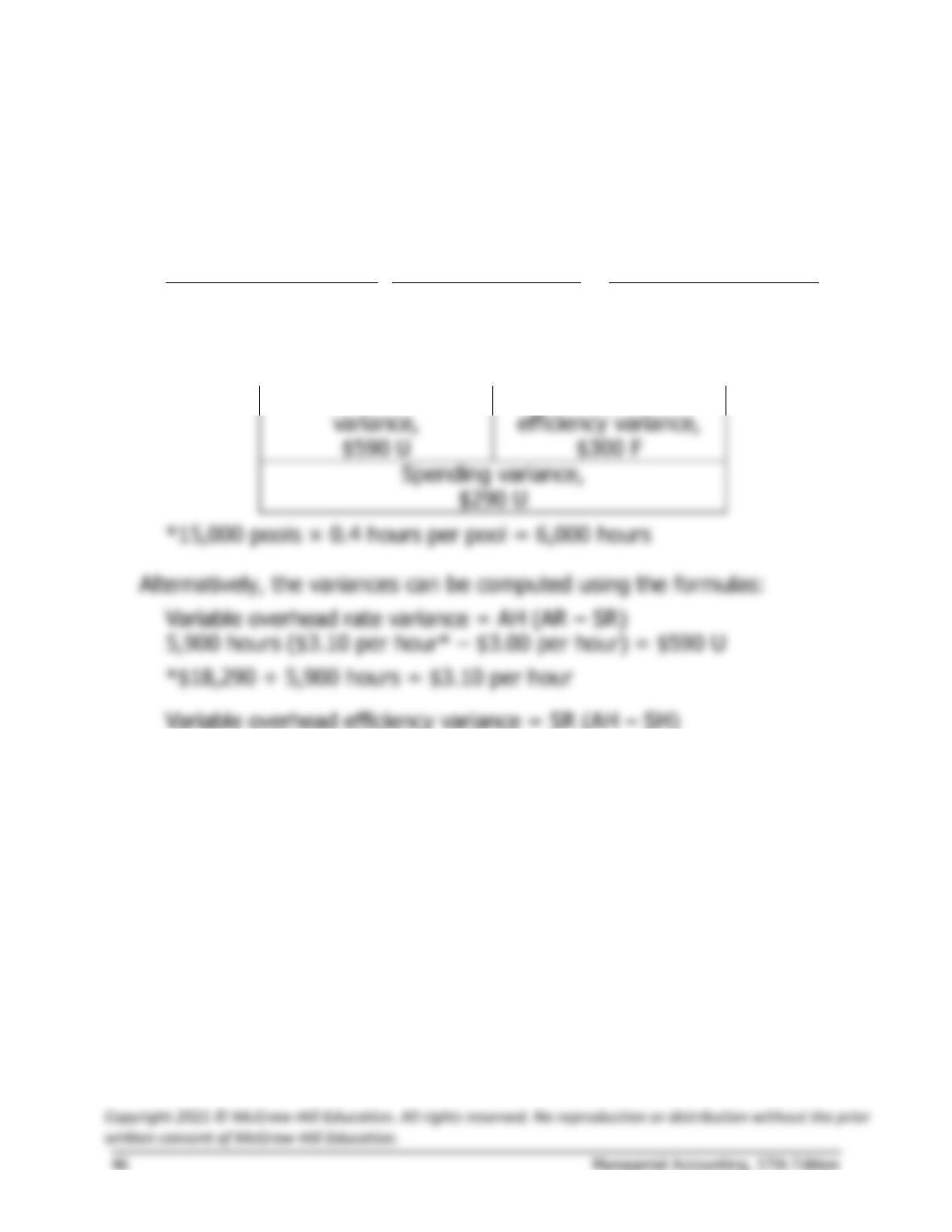
Actual Hours of
Input, at the
Actual Rate
Actual Hours of
Input, at the
Standard Rate
Standard Hours
Allowed for Output,
at the Standard Rate
(AH × AR)
(AH × SR)
(SH × SR)
5,900 hours ×
$3.00 per hour
6,000 hours* ×
$3.00 per hour
$18,290
= $17,700
= $18,000
Variable overhead rate
Variable overhead
$3.00 per hour (5,900 hours – 6,000 hours) = $300 F
Problem 10-15 (continued)
2. Summary of variances:
Material price variance ……………………..
$ 3,000
F
Material quantity variance …………………
21,000
U
Labor rate variance………………………….
11,800
U
Labor efficiency variance …………………..
3,200
F
Variable overhead rate variance …………
590
U
Variable overhead efficiency variance…..
300
F
Net variance ………………………………….
$26,890
U
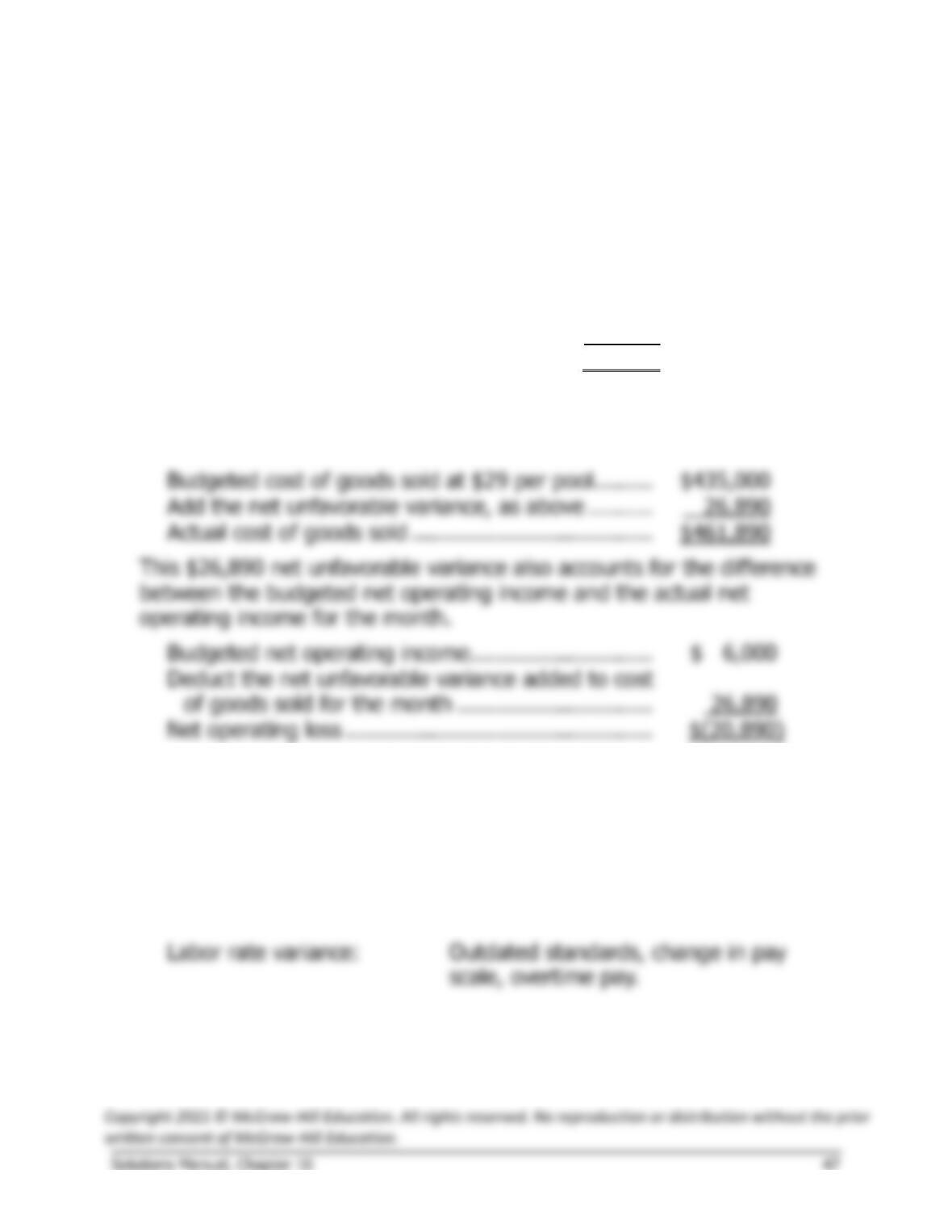
The net unfavorable variance of $26,890 for the month caused the
plant’s variable cost of goods sold to increase from the budgeted level of
$435,000 to $461,890:
Budgeted cost of goods sold at $29 per pool ………
Add the net unfavorable variance, as above ……….
Actual cost of goods sold ……………………………….
Budgeted net operating income ……………………….
Net operating loss ………………………………………..
3. The two most significant variances are the materials quantity variance
and the labor rate variance. Possible causes of the variances include:
Materials quantity variance:
Outdated standards, unskilled workers,
poorly adjusted machines,
carelessness, poorly trained workers,
inferior quality materials.
Problem 10-16 (60 minutes)
1.
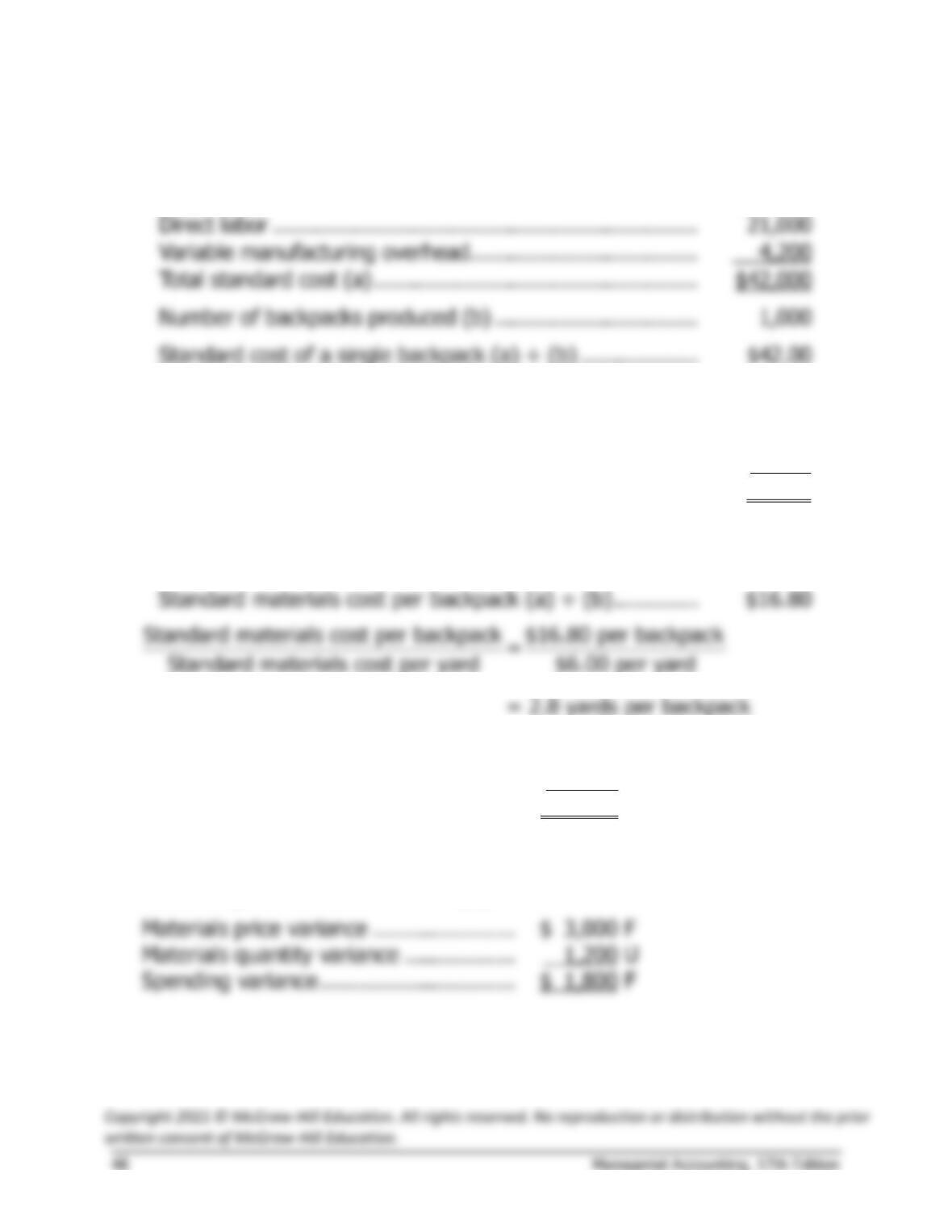
Standard cost for March production:
Materials ……………………………………………………………..
$16,800
Direct labor …………………………..……………………………..
Variable manufacturing overhead ………………………………
4,200
Total standard cost (a) ……………………………………………
Number of backpacks produced (b) …………………………..
Standard cost of a single backpack (a) ÷ (b) ………………
$42.00
2.
Standard cost of a single backpack (above) …………………
$42.00
Deduct difference between standard and actual cost …….
0.15
Actual cost per backpack …………………………………………
$41.85
3.
Total standard cost of materials during March (a) ……….
$16,800
Number of backpacks produced during March (b) ……….
1,000
Standard materials cost per backpack (a) ÷ (b) ………….
4.
Standard cost of material used …………
$16,800
Actual cost of material used …………….
15,000
Spending variance …………………………
$ 1,800
F
The materials price and quantity variances together equal the spending
variance. If the materials quantity variance is $1,200 U, then the
materials price variance must be $3,000 F:
Materials price variance ………………….
$ 3,000
F
Materials quantity variance ……………..
U
Spending variance …………………………
$ 1,800
F
Problem 10-16 (continued)
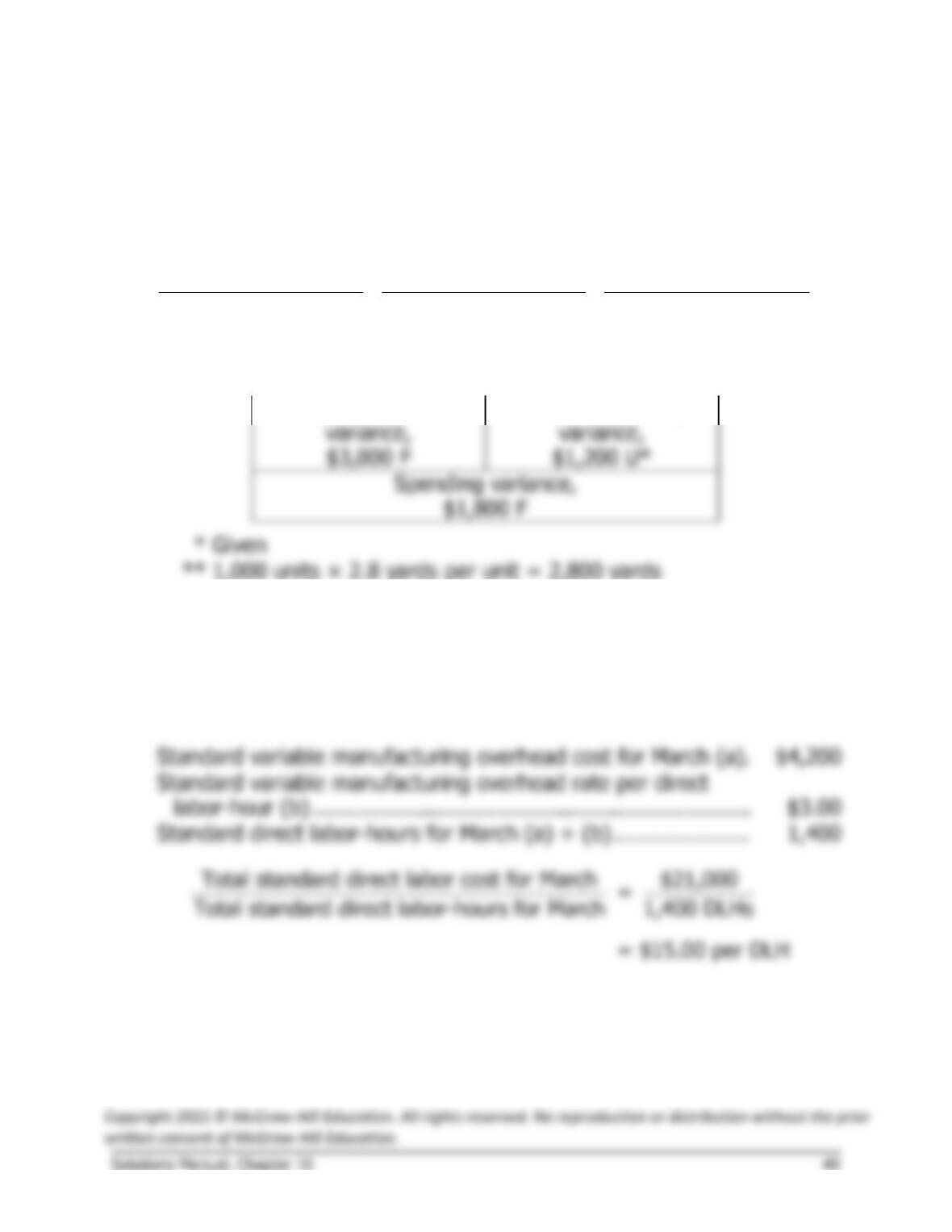
Alternative Solution:
Actual Quantity
of Input, at
Actual Price
Actual Quantity
of Input, at
Standard Price
Standard Quantity
Allowed for Output,
at Standard Price
(AQ × AP)
(AQ × SP)
(SQ × SP)
3,000 yards ×
$5.00 per yard
3,000 yards ×
$6.00 per yard*
2,800 yards** ×
$6.00 per yard*
= $15,000*
= $18,000
= $16,800*
Materials price
Materials quantity
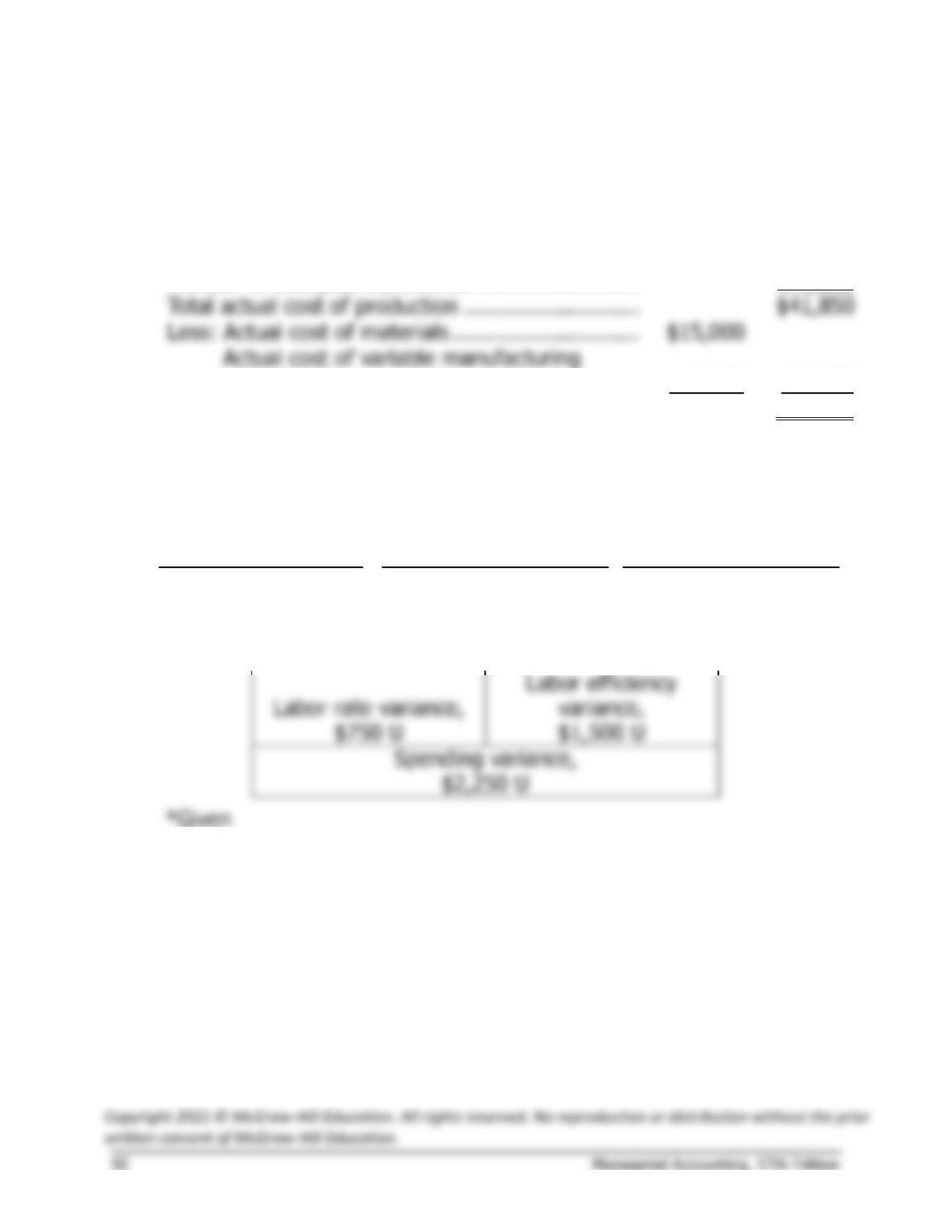
5. The first step in computing the standard direct labor rate is to determine
the standard direct labor–hours allowed for the month’s production. The
standard direct labor-hours can be computed by working with the
variable manufacturing overhead costs, because they are based on
direct labor-hours worked:
Problem 10-16 (continued)
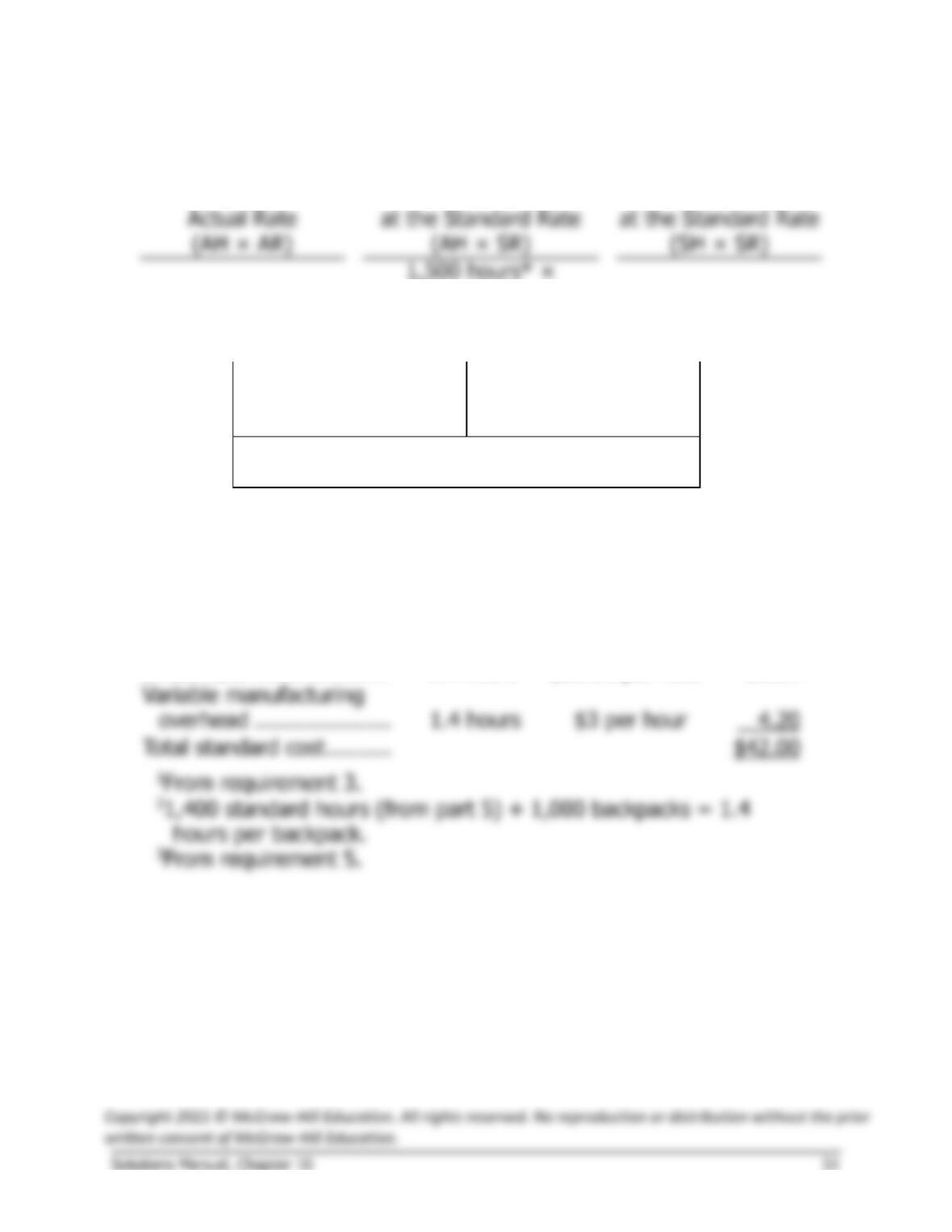
6. Before the labor variances can be computed, it is necessary to compute
the actual direct labor cost for the month:
Actual cost per backpack produced (see
requirement 2) ………………………………………..
$ 41.85
Number of backpacks produced …………………….
× 1,000
Total actual cost of production ………………………
Less: Actual cost of materials ………………………..
overhead ………………………………………..
3,600
18,600
Actual cost of direct labor …………………………….
$23,250
With this information, the variances can be computed:
Actual Hours of
Input, at the
Actual Rate
Actual Hours of Input,
at the Standard Rate
Standard Hours
Allowed for Output, at
the Standard Rate
(AH × AR)
(AH × SR)
(SH × SR)
1,500 hours* ×
$15.00 per hour
$23,250
= $22,500
$21,000*
Problem 10-16 (continued)
7.
Actual Hours of
Input, at the
Actual Hours of Input,
Standard Hours
Allowed for Output,
$3.00 per hour*
$3,600*
= $4,500
$4,200*
Variable overhead rate
variance,
$900 F
Variable overhead
efficiency variance,
$300 U
Spending variance,
$600 F
*Given
8.
Standard
Quantity or
Hours
Standard
Price or
Rate
Standard
Cost
Direct materials ……………
2.8 yards1
$6 per yard
$16.80
Direct labor …………………
1.4 hours2
$15.00 per hour3
21.00
Total standard cost ……….
Case 10-17 (60 minutes)
1. The number of units produced can be computed by using the total
standard cost applied for the period for
any
input—direct materials,
direct labor, or variable manufacturing overhead. Using the standard
cost applied for direct materials, we have:
Total standard cost applied for the period $405,000
=
Standard cost per unit $18 per unit
= 22,500 units
The same answer can be obtained by using direct labor or variable
manufacturing overhead.
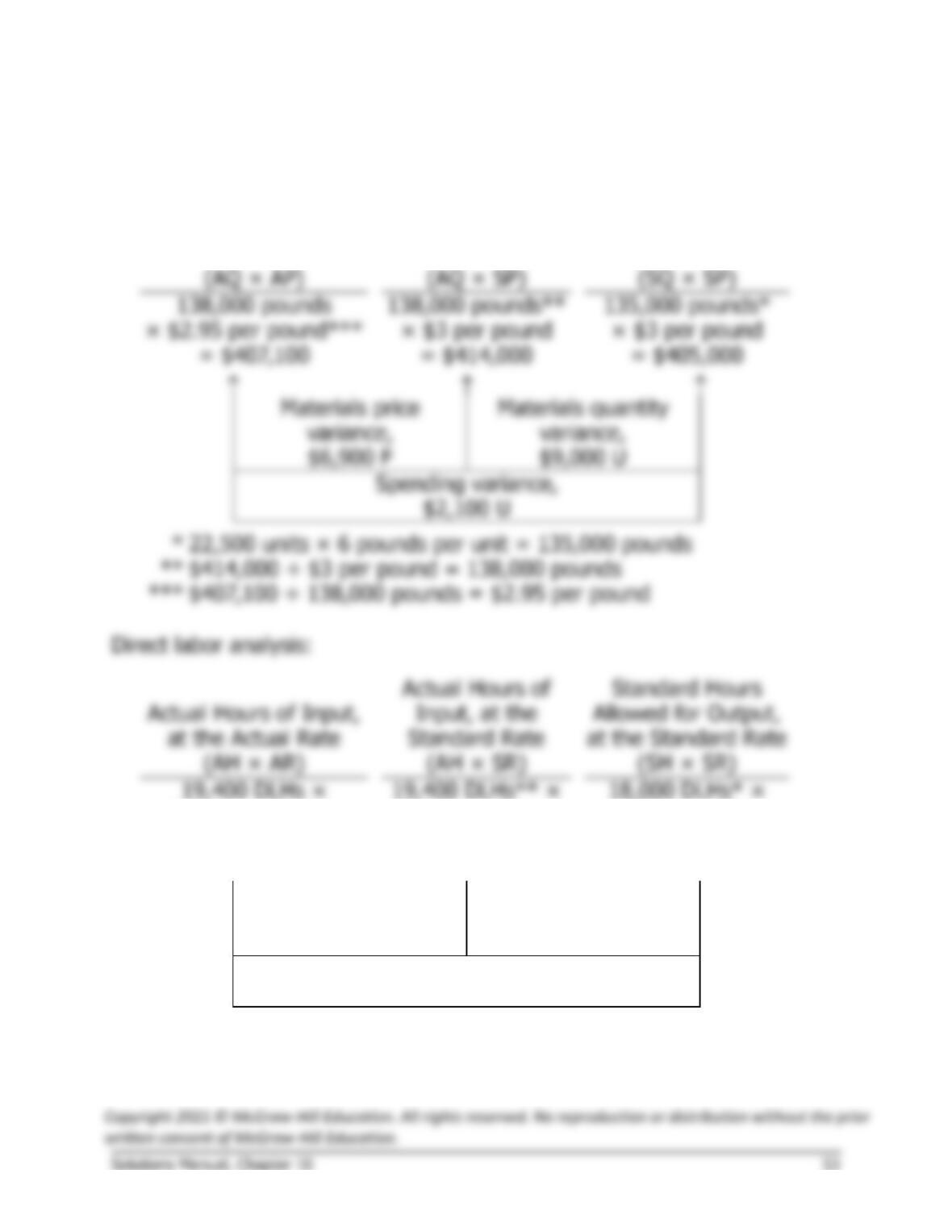
3. $2.95 per pound; see below for a detailed analysis.
5. $15.75 per direct labor-hour; see below for a detailed analysis.
6.
Standard variable overhead cost applied
$54,000
Case 10–17 (continued)
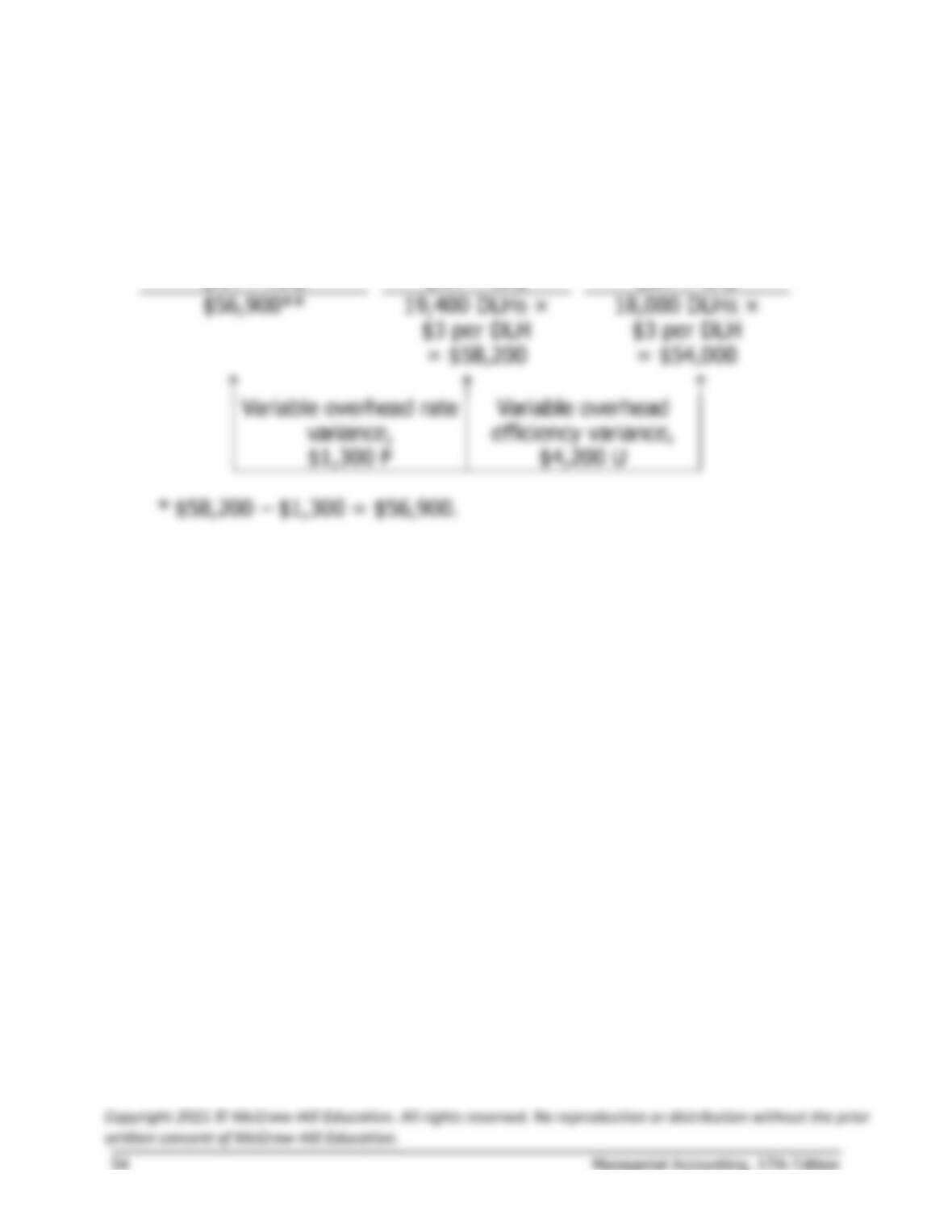
Direct materials analysis:
Actual Quantity of
Inputs, at Actual
Price
Actual Quantity
of Inputs, at
Standard Price
Standard Quantity
Allowed for Output,
at Standard Price
= $407,100
= $414,000
= $405,000
variance,
variance,
22,500 units × 6 pounds per unit = 135,000 pounds
$414,000 ÷ $3 per pound = 138,000 pounds
Actual Hours of
Standard Hours
$15.75 per DLH***
$15 per DLH
$15 per DLH
= $305,550
= $291,000
= $270,000
Labor rate variance,
$14,550 U
Labor efficiency
variance,
$21,000 U
Spending variance,
$35,550 U
*
22,500 units × 0.8 DLHs per unit = 18,000 DLHs
**
$291,000 ÷ $15 per DLH = 19,400 DLHs
***
$305,550 ÷ 19,400 DLHs = $15.75 per DLH
Case 10–17 (continued)
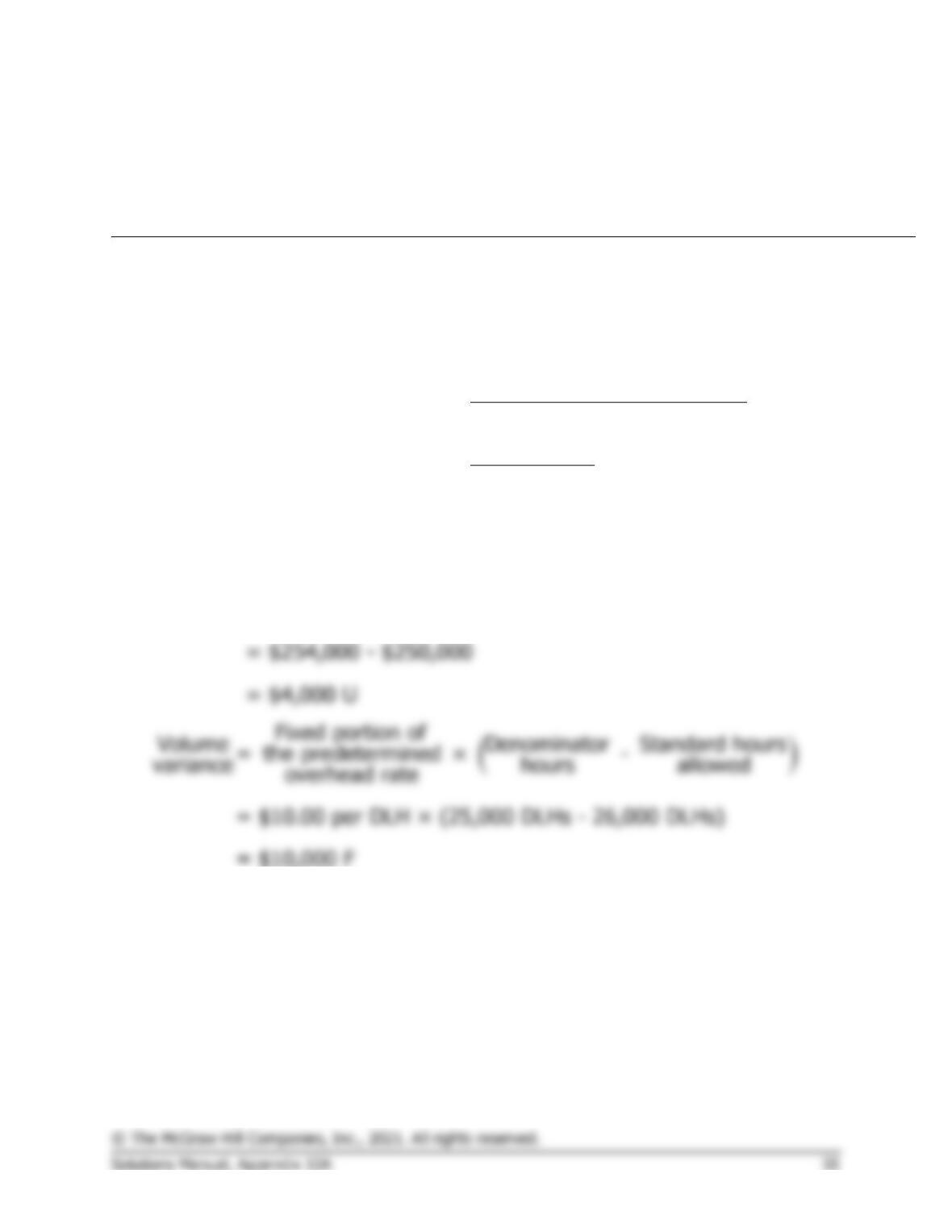
Variable overhead analysis:
Actual Hours of Input,
at the Actual Rate
Actual Hours of
Input, at the
Standard Rate
Standard Hours
Allowed for Output,
at the Standard Rate
Appendix 10A
Predetermined Overhead Rates and Overhead
Analysis in a Standard Costing System
Exercise 10A-1 (15 minutes)
1.
Fixed overhead
Fixed portion of the =
predetermined overhead rate Denominator level of activity
$250,000
= 25,000 DLHs
= $10.00 per DLH
2.
Budget Actual fixed Budgeted fixed
= –
variance overhead overhead
Exercise 10A-2 (20 minutes)
1.
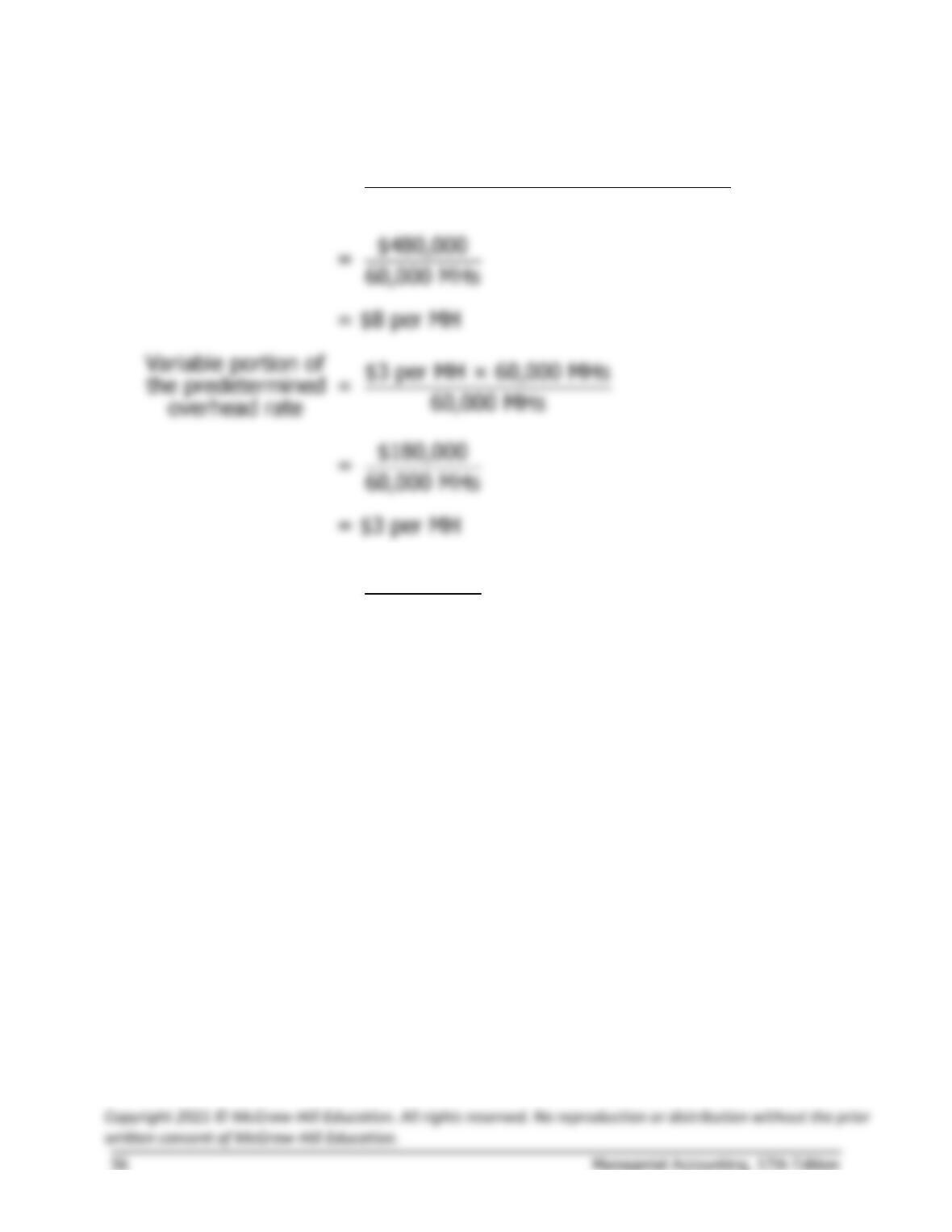
$3 per MH × 60,000 MHs + $300,000
Predetermined =
overhead rate 60,000 MHs
Fixed portion of $300,000
the predetermined = 60,000 MHs
overhead rate
= $5 per MH
2. The standard hours per unit of product are:
60,000 hours ÷ 40,000 units = 1.5 hours per unit
Given this figure, the standard hours allowed for the actual production
would be:
42,000 units × 1.5 hours per unit = 63,000 standard hours allowed
Exercise 10A-2 (continued)
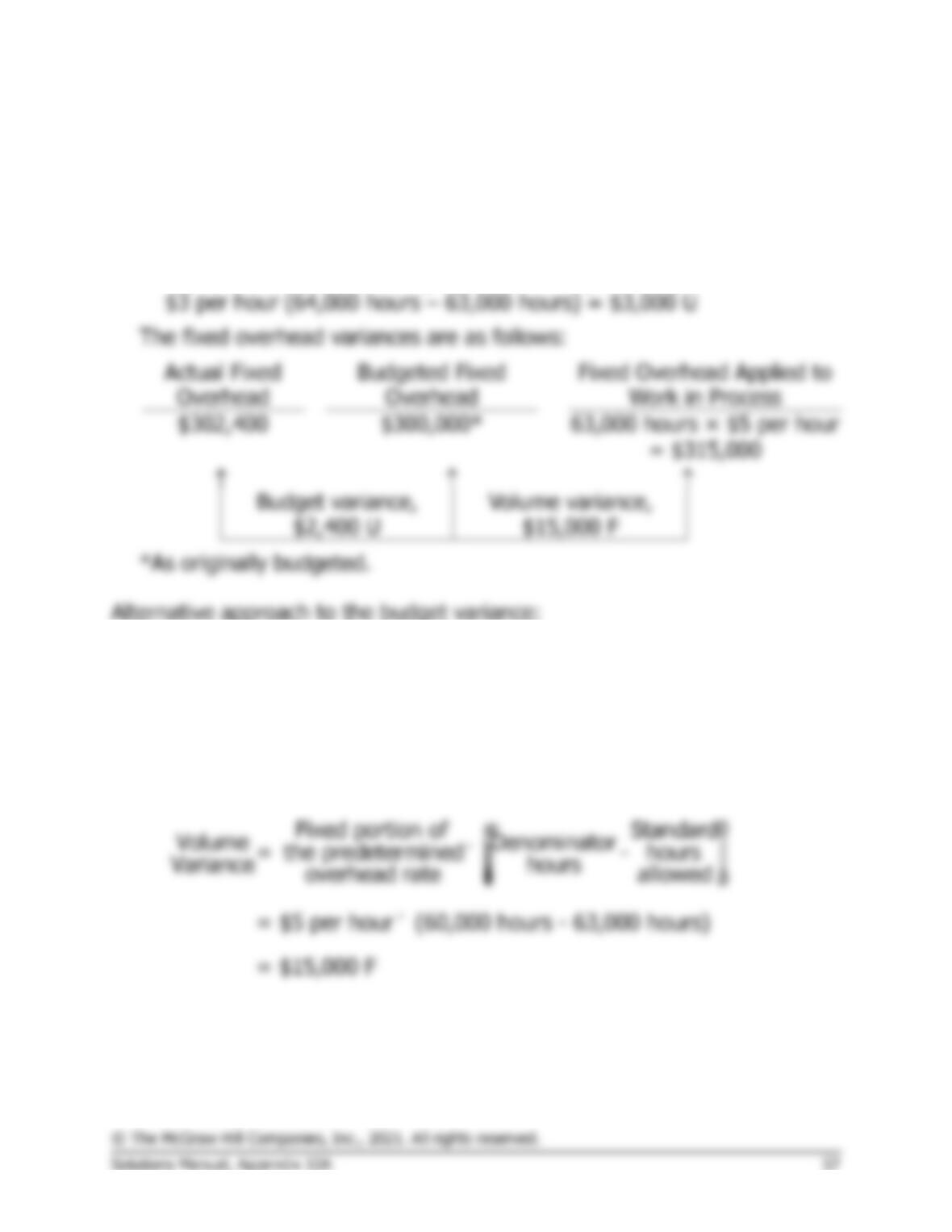
3. Variable overhead rate variance:
Variable overhead rate variance = (AH × AR) – (AH × SR)
($185,600) – (64,000 hours × $3 per hour) = $6,400 F
Variable overhead efficiency variance:
Variable overhead efficiency variance = SR (AH – SH)
Budget Actual fixed Budgeted fixed
= –
variance overhead overhead
= $302,400 – $300,000
= $2,400 U
Alternative approach to the volume variance:
Exercise 10A-3 (15 minutes)
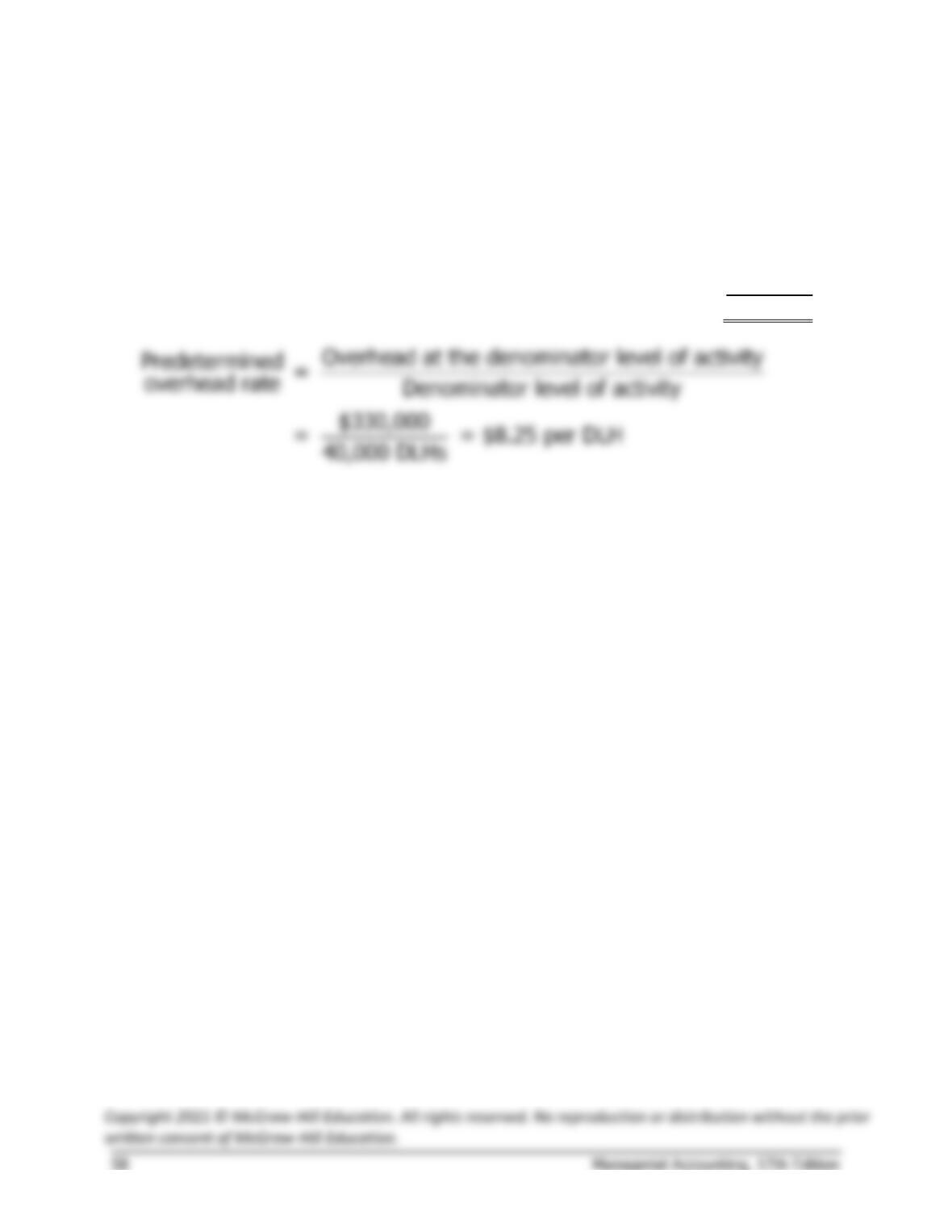
1. The total overhead cost at the denominator level of activity must be
determined before the predetermined overhead rate can be computed.
Total fixed overhead cost per year …………………………...
$250,000
Total variable overhead cost
($2 per DLH × 40,000 DLHs) ………………………………..
80,000
Total overhead cost at the denominator level of activity ..
$330,000
2.
Standard direct labor-hours allowed for
the actual output (a) ……………………..
38,000
DLHs
Predetermined overhead rate (b) ………..
$8.25
per DLH
Overhead applied (a) × (b) ………………..
$313,500