
Auditing: A Risk Based Approach to Conducting a Quality Audit, 10e
Solutions for Chapter 10
True/False Questions
10-1 F
10-2 F
10-4 T
10-6 F
10-8 F
10-10 T
10-12 T
10-14 F
10-16 F
10-18 F
Multiple-Choice Questions
10-19 C
10-20 D
10-22 A
10-24 D
10-26 D
10-28 E
10-30 C
10-32 E
10-34 B
10-36 C
10-2
Review and Short Case Questions
10-37
(a) General Checking Accounts. A general checking account is used for most cash
transactions. The organization’s regular cash receipts and disbursements are processed through
this account. In some cases, the receipts are received directly by the bank through a lockbox or
(b) Cash Management Accounts. Good cash management requires the organization to
effectively balance returns and risks on idle cash balances Most organizations have developed
agreements with their financial institutions to move excess cash into and out of short-term
savings accounts to generate extra returns. The auditor will need to understand the relationships
with these financial institutions, the controls applicable to cash transfers, and the risks to the
client occurring from errors or financial problems associated with the financial institution.
10-38
(a) Lockboxes. The collection of cash and reduction of the possibility of fraud can be
facilitated by the use of lockboxes. Customers are instructed to send payments directly to the
10-3
(b) Electronic Funds Transfers. Many organizations have adopted electronic funds transfers
(EFT) as an integral part of their business. Cash transfers are made automatically and
instantaneously; checks are not used. Over time, EFT will reduce the use of lockboxes and other
cash collection approaches, although they will still be maintained for customers who are unable
to make electronic transfers.
10-39
2. A
4. C
10-40
Cash is inherently risky because a high volume of activity flows through the account, it is liquid,
automated systems can cause problems if inadequately controlled, debt covenants are often tied
to cash balances, and cash can be easily manipulated and stolen.
Inherent risk for cash is usually assessed as high because of the following reasons:
• Volume of activity—The volume of transactions flowing through the account during
the year makes the account more susceptible to error than most other accounts.
• Liquidity—The cash account is more susceptible to fraud than most other accounts
company’s ability to pay dividends. The covenants may affect management’s actions in
its endeavor to present financial statements that do not violate the debt covenants.
10-41
We disagree with the auditor’s assessment of inherent risk of cash transactions as low. Granted,
10-42
1. Does the company have significant cash flow problems in meeting its current obligations on
a timely basis? A
2. Are there any restrictions in getting access to cash? For example, does the company have
3. Does the internal audit department conduct timely reviews of the cash management and cash
handling process? If yes, review recent internal audit reports. B
4. Does the company use cash budgeting techniques? How effective are the company’s cash
management budgeting techniques? A (Although cash budgeting may represent a control at
5. Are bank reconciliations performed on a timely basis by personnel independent of
processing? Is follow-up action taken promptly on all reconciling items? B
6. Does the company use the cash management services offered by its banker? What is the
nature of these arrangements? A
7. Has the company made significant changes in its cash processing during the past year? Have
any major changes taken place in the company’s computerized cash management
applications during the year? A (Although note that changes in the processing will likely
8. Have cash management service arrangements been reviewed by management and the board
of directors? Are the arrangements monitored on a current basis? B
9. Does the company have loan or bond covenants that influence the use of cash or the
maintenance of working-capital ratios? A
10-5
10. Are cash transactions, including electronic cash transfers, properly authorized? What
11. Does the company use a lockbox collect cash receipts? What is the agreement with the
financial institution? What are the company’s controls associated with the lockbox
12. Is there any reason to suspect that management may desire to misstate the cash balance? A
13. Do management and the board periodically review the cash management process? Does the
14. Who is authorized to make cash transfers, including electronic fund transfers, and what are
the procedures by which that authorization is verified before the transfers take place? What
10-43
The following is a list of common schemes relating to cash receipts:
• Inventory is sold, but the employee making the sale does not record the sale and steals the
cash.
• An employee receives a check and deposits it, but does not record the sale; then the
employee writes a check out to himself and does not record the disbursement.
• The employee collects a customer payment, steals the cash, and writes off the accounts
receivable as uncollectible.
• The employee steals a payment from Customer X. To cover the theft, the employee applies
The following is a list of common schemes relating to cash payments:
• The employee purchases merchandise and records the sale at an unauthorized discounted
amount.
• The employee sells merchandise to a friend at a discounted price; the friend returns the
merchandise for a refund at the undiscounted price; the two split the profits.
Discussing frauds that students have heard about in their community yields lively class
discussion.
10-6
10-44
a. Lapping occurs when an employee steals from one customer, then applies payment from
10-45
a. 1, 2, 3, 4, 6
b. 1, 3, 6
10-46
Common controls for petty cash include:
• Limiting access to petty cash funds by keeping funds in a locked box and restricting the
10-47
1. A list of incoming receipts is prepared by the person who opens the remittances and who
delivers the list to a person independent of the deposit function. a
b
3. A duplicate deposit slip is prepared by someone other than the person opening the mail. a
6. An agreement exists between the bank and the company on cash-handling activities, including
when the remittances are added to the client’s account. a
7. Management monitors controls to follow up on discrepancies in accounts receivable postings.
10-48
a. Students might indicate that the CBSA should have the following controls in place to
assure proper cash receipt, handling, depositing, and recording:
• Payments are deposited within 24 hours.
• Payments are recorded within four working days.
b. If an audit were to be conducted the audit might consist of the following steps:
• Interviews are conducted with management and staff, at multiple locations.
• A review of applicable legislation and regulations, policies, procedures and guidelines is
conducted.
• An examination and analysis of location statistics is completed, with comparison across
different locations.
10-49
2. Operating cash flow is consistent with sales and net income. a
4. Operating cash flow is not significantly different from the prior year. a
6. There are unexpected declines in the petty cash account. b
10-8
10-50
The major components of an audit program for cash receipts and cash management controls
include:
Procedures for Understanding Controls
Examples: Inquire of management about the existence of lines of credit etc., Review the
General Tests of Controls
Examples: Review the frequency of monitoring activities; determine their effectiveness through
reviews of the reports, indications of management actions, descriptions of corrective actions
taken, and interviews with key personnel.
Testing of Controls over Cash Receipts if Monitoring Controls are Not Effective
Testing of Specific Control Activities
Examples: For a sample of cash receipts, determine that the following procedures takes place:
each payment is given a unique identifier, which is subsequently entered into the system; the
payments received are the same as the amount applied to the update of accounts receivable. See
Exhibit 10.6 for further examples.
Documenting Work Performed
10-51
Periodic reconciliation of cash accounts is one of the most important control procedures an
10-9
reconciliation at year-end and requesting a bank cut-off statement to verify most of the
reconciling items.
Professional skepticism would be heightened if the client does not perform a periodic
reconciliation of cash because the question the auditor should ask is “Why?”. The downside risk
10-52
a. The confirmation provides information on the current balances of all accounts and any
loans the client has with the financial institution. The confirmation will also seek information on
the nature of financial relationships with the bank. These relationships could include
10-53
Kiting takes place by transferring funds from one bank account to another bank account, but not
recording the deposit and withdrawal in the same period. For example, a December 31 transfer
would record the receipt in one account on December 31 but not record the disbursement on the
10-10
10-54
10-55
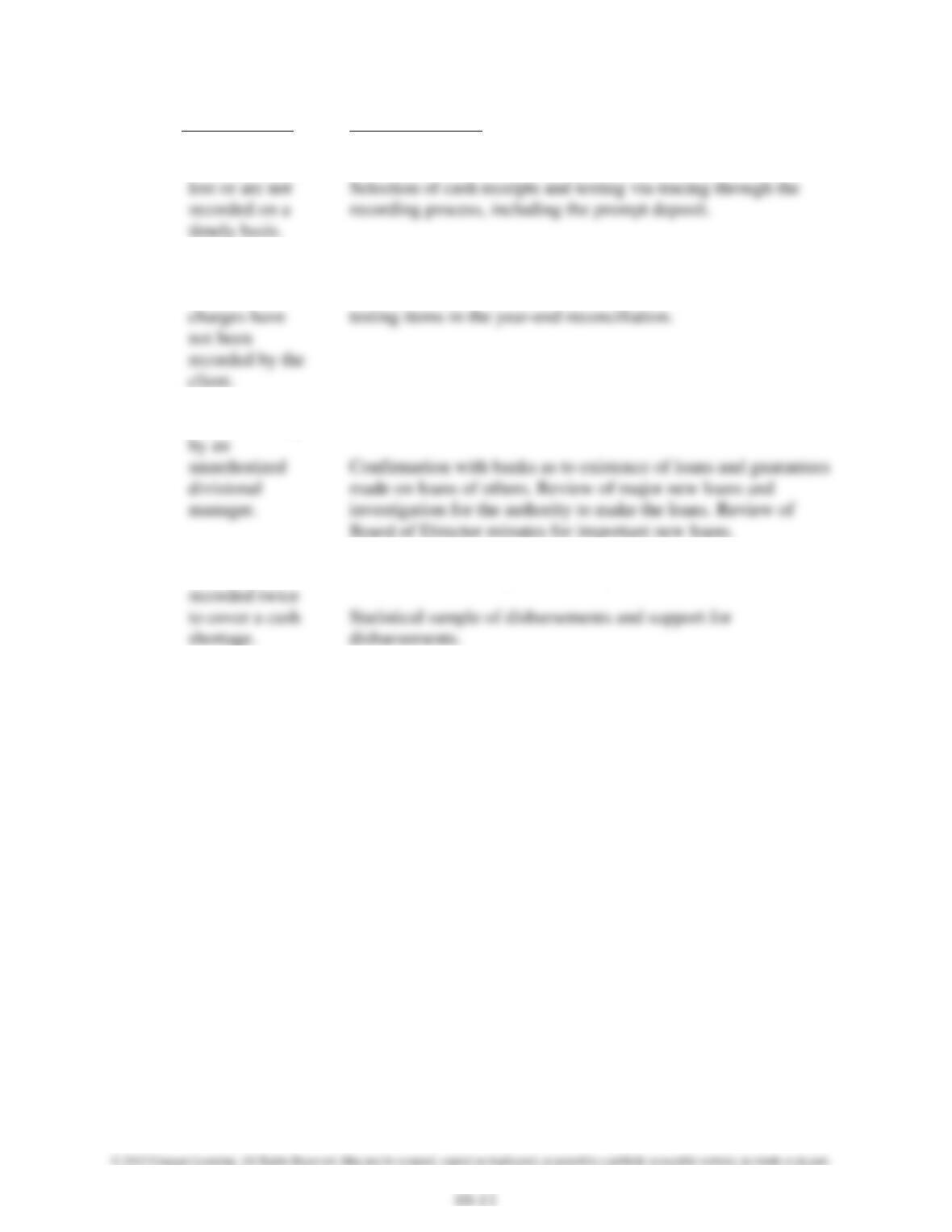
Audit Finding
Audit Procedure
1. Kiting
Preparation of an inter-bank transfer schedule noting the dates
the deposits and disbursements were recorded.
Review of summary reports on nature of customer complaints
and follow-up to customer complaints.
2. Employee
pockets cash
Confirmation of accounts receivable balances.
3. Employee
confiscates
Analytical review of discounts recorded in comparison with
company policy and past amounts.
4. Controller
defalcation
Reperformance of the year-end bank reconciliation.
5. Certificates of
Deposit seem
Testing of marketable securities through a typical worksheet
which lists investments, date of investment, interest rate, interest
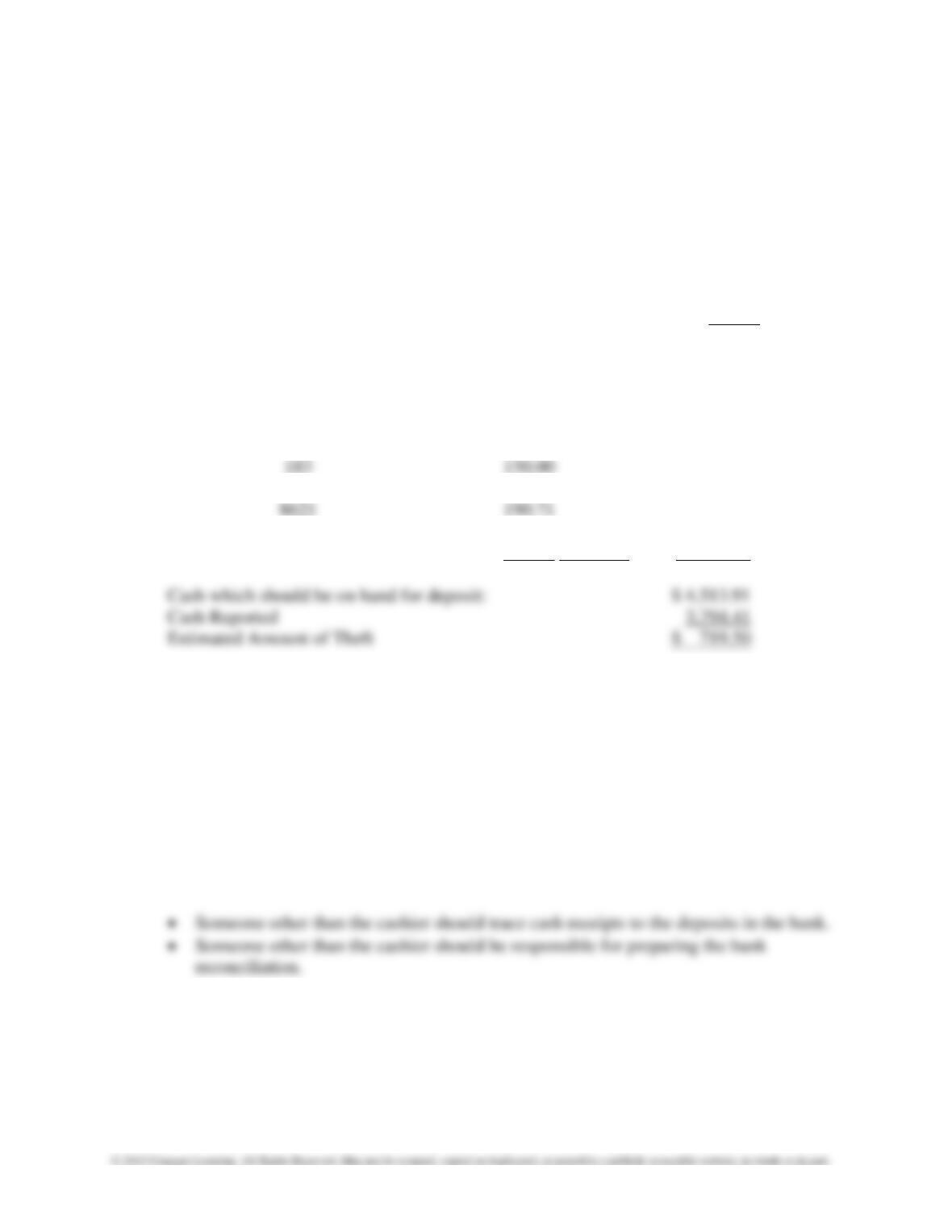
Audit Finding
Audit Procedure
6. Cash
remittances are
Detailed cash trace.
testing items in the year-end reconciliation.
7. Substantial
bank service
Perform i or reperformance of year-end client bank
reconciliation. Obtain bank cut-off statement as a basis for
unauthorized
Confirmation with banks as to existence of loans and guarantees
made on loans of others. Review of major new loans and
8. Loan negotiated
for a subsidiary
Review of company policies regarding authorization to make
loans.
disbursements.
9. Check was
Perform review or reperformance year-end bank reconciliation.
10-12
10-56
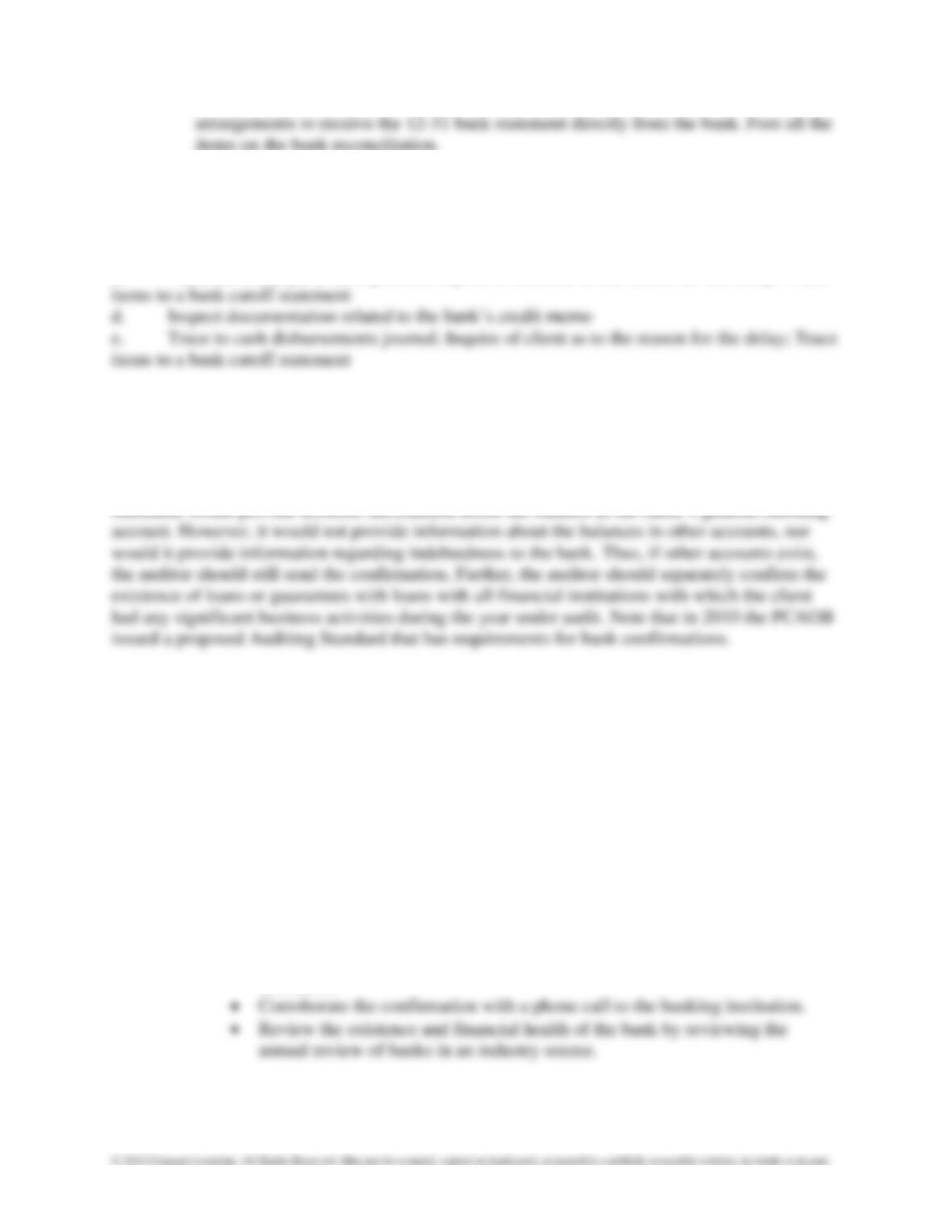
a. Schedule of Amount Taken by Cashier
Pembrook Company
Computation of Amount of Theft by Cashier
Cash – per books, November 30 $ 18,901.62
Add: Credit by bank 100.00
Adjusted Cash Balance $ 19,001.62
Less: Adjusted Bank Balance:
Bank Balance, November 30 $15,550.00
Less: Outstanding Checks:
62 116.25
284 253.25
8623 206.80
8632 145.28 1,062.29 14,487.71
b. It appears that the cashier removed $719.50. The most likely methods used to conceal
the theft would be:
• Not listing all outstanding checks on the bank reconcilements.
• Under-footing outstanding checks shown on the reconciliation.
• Subtracting an item from the bank balance that should be added to the book balance.
c. Some of the control procedures that would have been effective in preventing or detecting the
irregularity would include:
d. Additional audit procedures that might be performed:
• Prepare an independent bank reconciliation as of November 30. Verify the items on
the reconcilement by obtaining a cut-off statement from the bank, or make
10-13
10-57
a. Confirm directly with the bank
b. Agree balance on reconciliation with the amount recorded on the client’s general ledger
c. Trace cash receipts to cash journal; Inquire of client as to the reason for the delay; Trace
10-58
a. The purposes of a bank confirmation are to obtain information about the correctness of
year-end account balances as well as to obtain information about indebtedness and guarantees of
indebtedness. If the auditor directly receives a cut-off bank statement shortly after year-end, that
b. The primary other information gathered using a bank confirmation is information on
indebtedness. The confirmation is one means of identifying a potential understatement of a
liability. The information will be used in the audit of liabilities and determining the potential
need for disclosure of loan guarantees.
c. Scenarios and Related Audit Procedures:
1. There is concern that the auditor is not familiar with the bank. Past frauds have
taught the profession that an unknown bank with only a P.O. box as a mailing
address could be a dummy company set up by the client. Assuming the amounts
deposited in the distant bank are material, the auditor should consider:
• Inquiring of an office of the audit firm (if a multiple office firm) located near
the distant city about the existence and financial health of the banking
institution.
10-14
2. Unfortunately, the banking community often makes mistakes while preparing
confirmations for the auditors. However, it is anticipated that the use of electronic
3. The auditor should pursue the matter first with the client. If the client believes the
confirmation is in error, the auditor might consider a personal discussion with the
10-59
Basic audit procedures that should be performed by Kautz in gathering evidence in support of
each of the items (a) through (f) are as follows:
Balance per bank (item a)
2. Obtain and inspect a January 2016 cutoff bank statement directly from the bank
Deposit in transit (item b)
1. Verify that the deposit was listed in the January 2016 cutoff bank statement on a
timely basis.
3. Inspect the client’s copy of the deposit slip for the date of deposit.
Outstanding checks (item c)
2. Examine all supporting documents for those outstanding checks that were not
returned with the cutoff bank statement.
10-15
NSF check returned (item d)
1. Follow up on the ultimate disposition of the NSF check.
Note collected (item e)
1. Examine bank credit memo.
Balance per books (item f)
10-60
a. The procedures that would be used to audit the interbank transfers include:
• All items listed on the schedule should be traced to both sets of books to determine
the time period in which they were recorded.
b. The journal entries (for the consolidated company) that would be required as a result of
the interbank transfer statement would be:
Cash 45,000
Inter-Company Payable 45,000
(The cash was not disbursed from the branch’s account until January, and was thus included
in the branch account at year-end. The home office recorded the receipt of the item in
10-16
10-61
Weakness
Substantive Audit Procedure
a. Inadequate segregation
of duties in the mail
room.
Expand confirmations with customers, select
a sample of daily deposits and trace to
accounts receivable credits for payments.
b. No remittance advice is
prepared.
Same as b.
c. Supporting documents
not cancelled.
Search for duplicate payments. GAS can be
customers and/or discuss collectability with
independent person.
statement. Expand confirmations.
Each student’s answer will likely differ as to which causes them most concern and thus
heightened professional skepticism. Two of the most likely answers are (e) because of the lack of
timeliness and lack of segregation of duties of this important controls and (d) because of the risk
10-62
a. Confirmation responses are written responses provided by external third parties and are
generally considered to be strong sources of audit evidence about the existence and valuation of
bank account balances. However, the confirmations are designed to also provide evidence on
other issues such as complex banking relationships (trade finance arrangements, derivative
b. In Step One, the auditor structures the problem, considering the relevant parties to
involve in the decision process, identifying various feasible alternatives, considering how to
evaluate the alternatives, identifying uncertainties or risks, and determining how to structure the
10-17
In Step Two, the auditor assesses the consequences of the potential alternatives.
Considerations at this stage include determining the dimensions on which to evaluate the
alternatives and considering how to weight those dimensions. In this case, the alternatives relate
to designing the substantive audit procedures related to sending bank confirmations – to what
extent will this procedure be used, how many of the financial institutions should receive
In Step Three, the auditor assesses the uncertainties in the situation. For example, the
auditor tries to assess the likelihood of various consequences associated with potential
alternatives. Some consequences are more likely than others, and some are more costly than
In Step Four, the auditor evaluates the alternatives against some decision rule. For auditors,
decision rules related to evidence gathering decisions are often articulated in terms of
professional auditing standards. In our example, the primary criterion is simple: follow the
professional auditing standards and gather sufficient competent evidence to assess whether the
client’s cash exists and whether the client has recorded all other financial arrangements and
liabilities (including guarantees).
In Step Six, the auditor gathers information in an iterative process that affects
considerations about the consequences of potential alternatives and the uncertainties associated
with those judgments. Importantly, the auditor considers the costs and benefits of information
acquisition, knowing that gathering additional evidence requires time, effort, and money. Given
that audits are a for-profit enterprise, cost-benefit considerations in evidence gathering are
particularly important. A good auditor knows “when to say when” and decides to stop collecting
evidence at the right time. In contrast, some auditors stop evidence collection too soon, thereby
10-63
The three major categories of marketable securities are: temporary investments in debt or equity
securities, short-term cash management securities, and other short-term hybrid securities
10-64
1. B
3. D
5. A
10-65
1. Management manipulation of the classification of the securities to achieve preferable
valuation treatment, i.e., market value versus amortized cost (a)
3. Management manipulation of the valuation of market value if the securities are thinly
traded (a)
5. Lack of monitoring of changes in securities balances (b)
7. Risk of theft of the securities if they are not physically controlled, or if authorization and
monitoring over their purchase or sale is not adequate (b)
9. Lack of involvement or oversight by internal audit in relation to securities (b)