295
CHAPTER 10
ACCOUNTING SYSTEMS FOR
MANUFACTURING BUSINESSES
CLASS DISCUSSION QUESTIONS
1. Managerial accounting differs from financial
accounting in the following ways:
(1) Financial accounting records and re-
ports transactions and events using
generally accepted accounting princi-
ples (GAAP), while managerial account-
ing is not restricted by specific rules.
That is, managerial accounting records
and reports whatever information is use-
ful to management for its decision mak-
ing.
2. For a company that produces desktop com-
puters, memory chips would be considered
a direct materials cost. For a cost to be con-
sidered as a direct materials cost, the cost
must be an integral part of the finished
product and a significant portion of the total
cost of the product.
3. Product cost information is used by manag-
c. Process cost systems accumulate costs
for each department or process within a
factory.
5. Job order costing is used by firms that sell
custom goods and services to customers.
The job order system is frequently associat-
ed with firms that will produce a product or
service specifically to a customer order.
6. No. A job order cost system is not appropri-
ate because workers could not physically
differentiate among the products being
in which the time was spent.
b. The total time reported on an employee’s
time tickets for a payroll period is com–
pared with the time reported on the em–
ployee’s clock cards as an internal check
on the accuracy of payroll disbursements.
9. The sources of the increases to Work in
Process are:
296
10. The use of a predetermined factory over-
head rate in job order cost accounting as-
sists management in pricing jobs. By esti-
11. a. The predetermined factory overhead
rate is determined by dividing the bud-
geted factory overhead for the forth-
coming year by an estimated activity
base, one that will equitably apply the
factory overhead costs to the goods
manufactured.
b. Direct labor cost, direct labor hours, and
machine hours.
plied.
b. Underapplied
13. The simplest satisfactory procedure for
disposing of a relatively minor balance in the
factory overhead account is to transfer it to
Cost of Goods Sold.
14. Product costs are composed of three ele-
ments of manufacturing costs: direct materi-
als cost, direct labor cost, and factory over-
head cost. These costs are treated as
assets until the product is sold. Product
costs are sometimes referred to as invento-
16. Job order cost accumulation would be most
appropriate for professional service firms
that provide extended, project-type services
work in process (a current asset) until the
service is completed. Once completed, the
cost would be transferred to the cost of ser-
vices on the income statement.
17. Just-in-time processing is a philosophy that
focuses on reducing time, cost, and poor
quality within manufacturing processes. The
result of these efforts is a reduction in inven-
tory levels.
that focuses on reducing time and cost and
eliminating poor quality. Pull manufacturing
is an important just–in-time practice. Pull or
“make-to-order” manufacturing requires the
manufacturer to build product only as it is
needed for actual customer orders. As a re-
sult, finished goods, work-in-process, and
materials inventories are minimized. Make–
to-order manufacturing requires a high de-
gree of flexibility and insignificant setup
costs.
20. Product defects can cause additional costs

21. Under supplier partnering, long-term rela-
tionships are established with suppliers to
improve quality, cost, and delivery. Tradi-
22. Service companies can use activity-based
costing to determine the cost of service of-
ferings. This information can be used to de-
EXERCISES
E10–1
a. Direct materials cost
e. Direct materials cost
E10–2
a. Direct labor cost
f. Factory overhead cost
E10–3
a, b, h, i, j
E10–4
a. Period cost
b. Period cost
j. Product cost
k. Period cost
E10–5
a. period
e. direct materials
299
E10–6
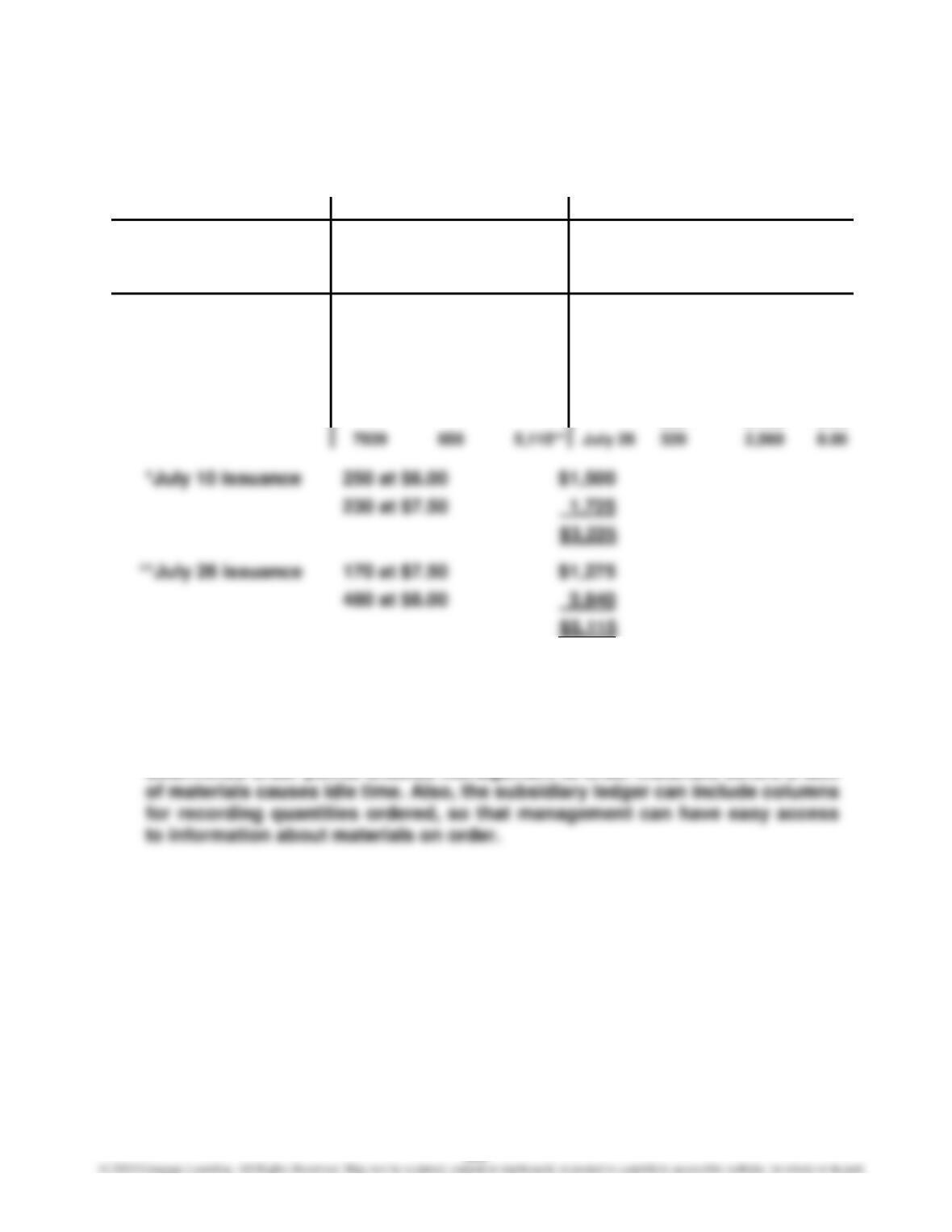
a. Materials requisitioned for use (both direct and indirect)
E10–7
a.
Cost of goods sold:
Sales ………………………………………………………………………… $478,000
Less gross profit ………………………………………………………. 286,800
Cost of goods sold ……………………………………………………. $191,200
b.
Direct materials cost:
Materials purchased ………………………………………………….. $124,000
300
E10–8
a.
RECEIVED
ISSUED
BALANCE
Receiving
Report
Number
Quantity
Unit
Price
Materials
Requi-
sition
Number
Quantity
Amount
Date
Quantity
Amount
Unit
Price
July 1
250
$1,500
$6.00
309
400
$7.50
July 5
250
1,500
6.00
400
3,000
7.50
7401
480
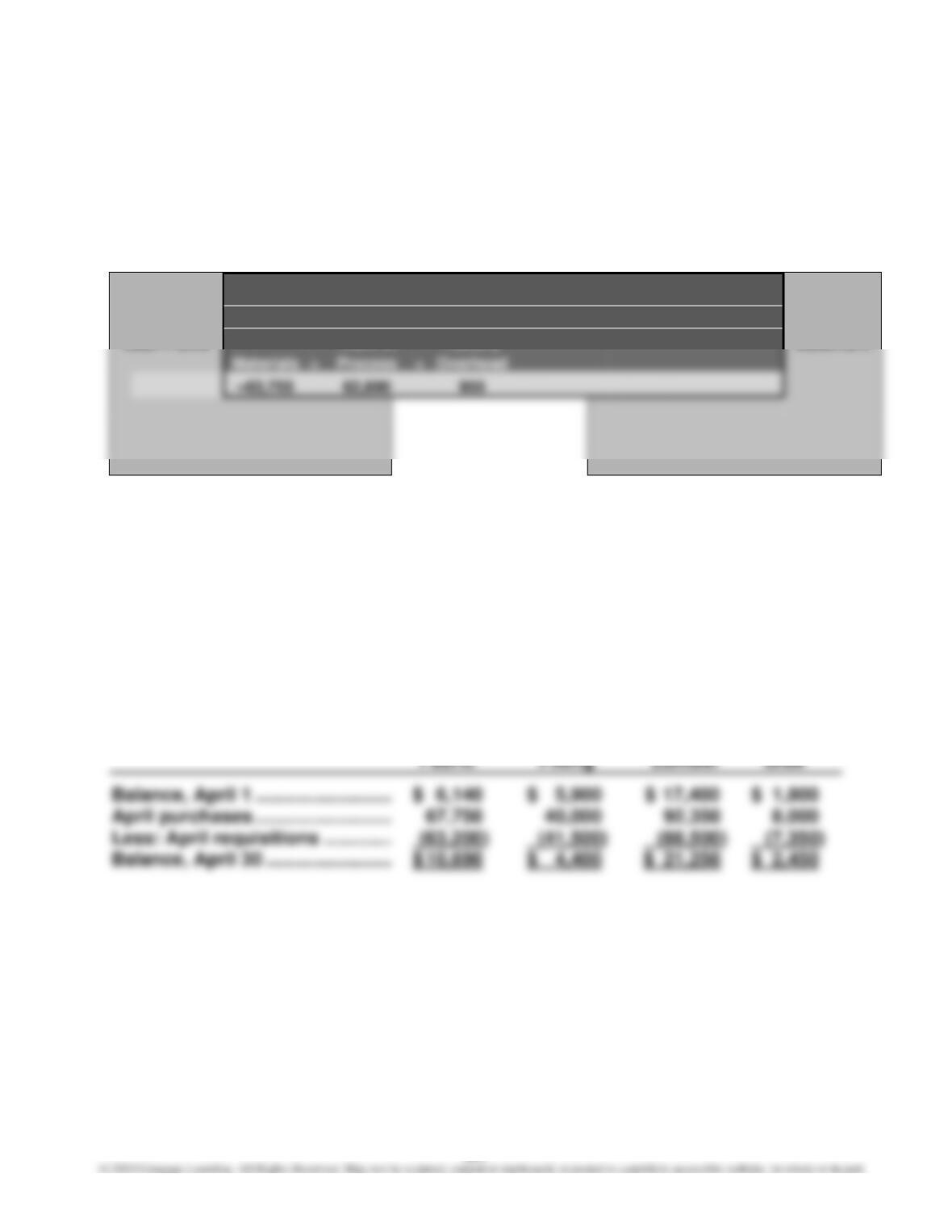
$3,225*
July 10
170
1,275
7.50
422
800
8.00
July 20
170
1,275
7.50
800
6,400
8.00
7639
650
5,115**
July 26
320
2,560
8.00
b. Ending wire cable balance:
320 at $8.00 ……………………………………………………… $2,560
c. Work in Process ($3,225 + $5,115) …………………………. $8,340
d. Comparing quantities on hand as reported in the materials ledger with pre–
determined order points enables management to order materials before a lack
301
E10–9
a. Materials transferred to Work in Process: $62,800*
Materials transferred to Factory Overhead: $955
*$62,800 = $17,600 + $8,600 + $3,150 + $33,450
b.
Balance Sheet
Statement of
Assets
=
Liabilities
+
Stockholders’ Equity
Income
Cash Flows
Work in
Factory
Statement
+
+
E10–10
a. Materials purchases ……………………………………………… $208,100*
*$208,100 = $67,750 + $40,000 + $92,350 + $8,000
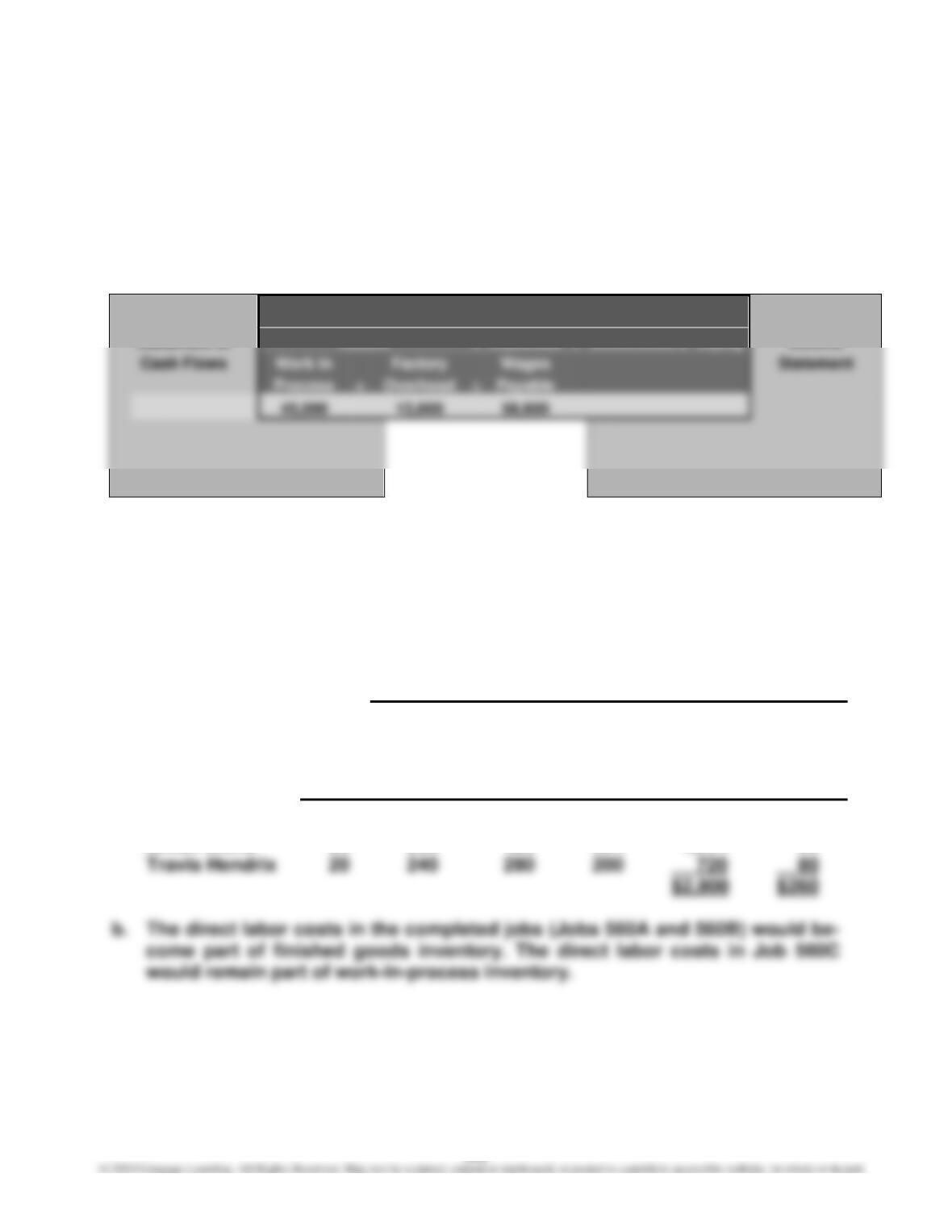
b. Materials transferred to Work in Process ……………….. $193,200*
*$193,200 = $35,935 + $59,345 + $97,920
Materials transferred to Factory Overhead …………….. $7,350
c.
Polyester
302
E10–11
a. Factory labor costs transferred to Work in Process: $45,000*
*$45,000 = $4,350 + $2,190 + $7,180 + $5,800 + $6,300 + $8,050 + $11,130
Factory labor costs transferred to Factory Overhead: $13,600
b.
Balance Sheet
Statement of
Assets
=
Liabilities
+
Stockholders’ Equity
Income
Statement
+
=
E10–12
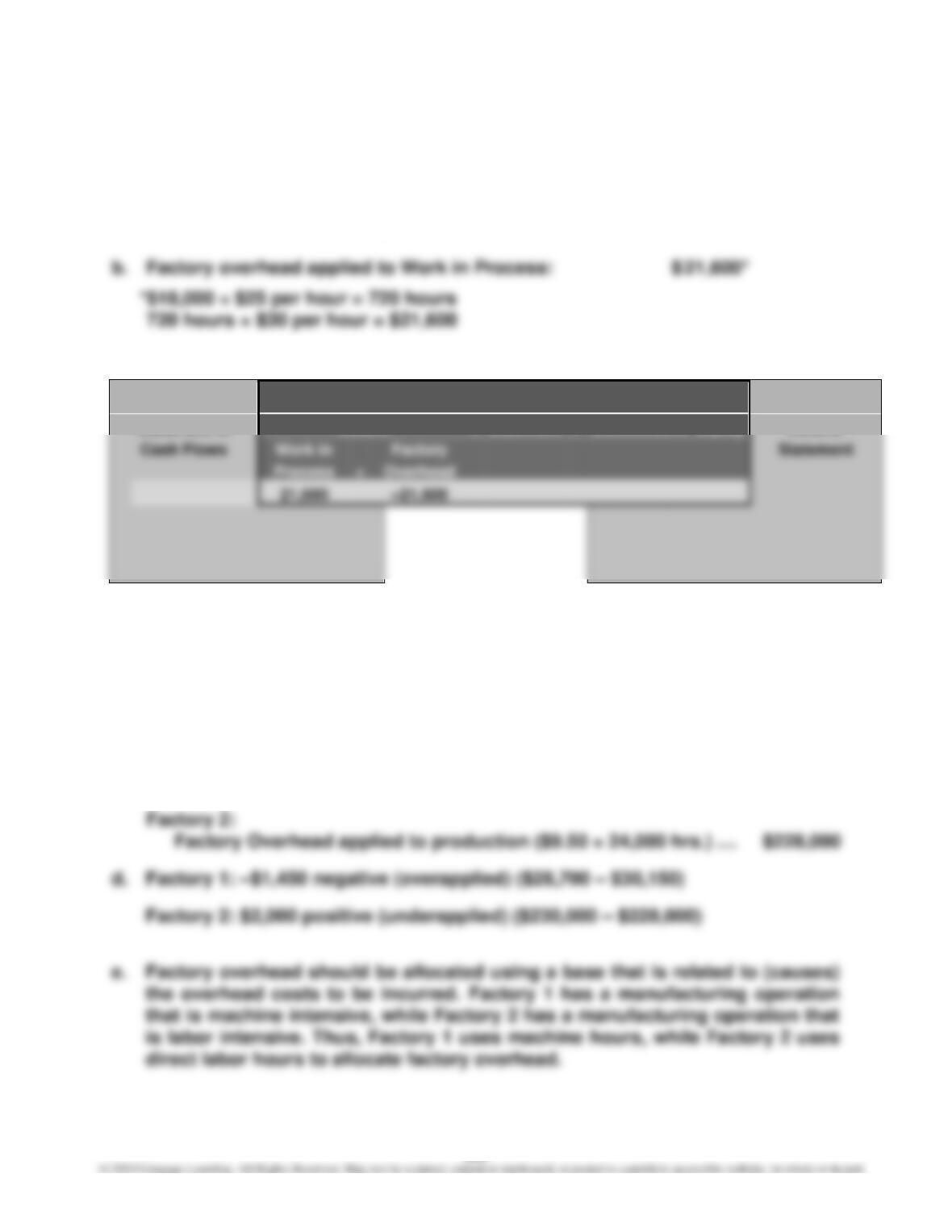
a. Factory labor costs transferred to Work in Process: $2,900
Factory labor costs transferred to Factory Overhead: $260
Supporting Calculations:
Labor Costs (Hourly Rate × Hours)
Direct
Labor
Hourly (sum of Indirect
Rate Job 560A Job 560B Job 560C job costs) Labor
Eva Leavitt $31 $465 $465 $186 $1,116 $ 124
Micah Stone 28 280 420 364 1,064 56
303
E10–13
a. Factory labor costs transferred to Work in Process: $ 18,000*
Factory labor costs transferred to Factory Overhead: $1,750
*$6,400 + $3,900 + $4,800 + $2,900 = $18,000
c.
Balance Sheet
Statement of
Assets
=
Liabilities
+
Stockholders’ Equity
Income
Statement
+
E10–14
a. Factory 1: $16.75 per machine hour = $375,200 ÷ 22,400 machine hours
b. Factory 2: $9.50 per direct labor hour = $2,660,000 ÷ 280,000 direct labor
hours
c. Factory 1:
Factory Overhead applied to production ($16.75 × 1,800 hrs.) …. $30,150
E10–15
The estimated shop overhead is determined as follows:
Shop and repair equipment depreciation …………………………………… $ 18,000
Shop supervisor salaries ………………………………………………………….. 110,000
Shop property taxes …………………………………………………………………. 20,500
Shop supplies ………………………………………………………………………….. 7,500
Total shop overhead ……………………………………………………………. $156,000
The engine parts and shop labor are direct to the jobs and are not included in the
E10–16
a. Estimated annual operating room overhead: $1,071,000
Estimated operating room activity base (number of operating room hours):
Hours per day ……………………………………………… 10
305
E10–16, Concluded
c. Actual hours used in July ……………………………………… 280
E10–17
a. Cost of jobs completed and transferred to
Finished Goods: $825,000*
E10–18
a. Direct materials used and transferred to Work in Process: $43,400*
*$14,000 + $6,000 + $19,000 + $4,400 = $43,400
Indirect materials used and transferred to Factory Overhead: $3,300
b. Direct labor used and transferred to Work in Process: $14,800*
*$5,000 + $3,000 + $5,800 + $1,000 = $14,800
306
E10–18, Concluded
e. Actual factory overhead incurred ………………………….. $11,800*
E10–19
a. BRIDGER BIKES INC.
Income Statement
For the Month Ended July 31, 20Y6
Revenues …………………………………………………………………. $918,000
Cost of goods sold ……………………………………………………. 550,000
Gross profit ………………………………………………………………. $368,000
Selling expenses ………………………………………………………. $132,500
Administrative expenses …………………………………………… 80,000 212,500
Income from operations ……………………………………………. $155,500
307
E10–20
a.
Unit
Date Job No. Quantity Product Amount Cost
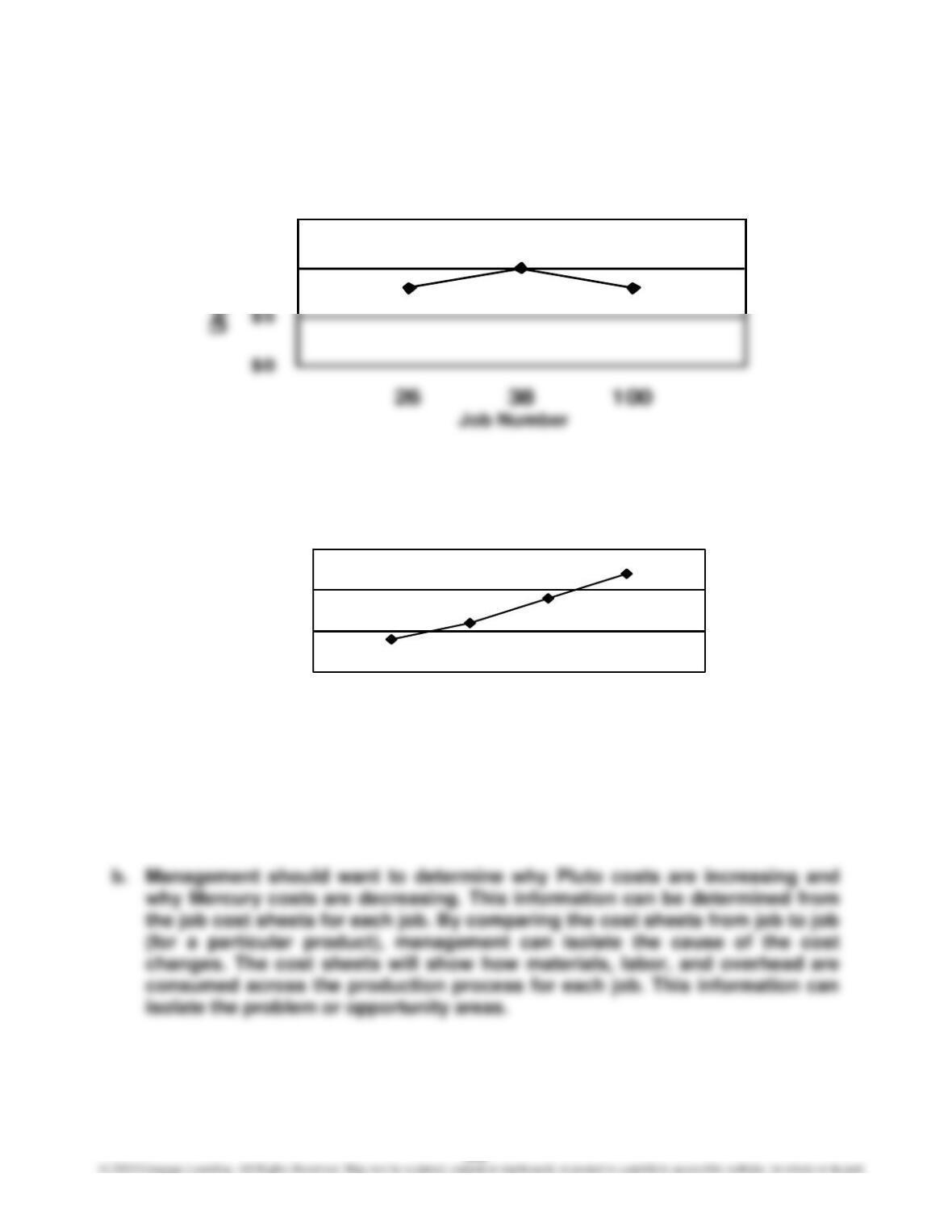
Jan. 13 1 180 Mercury $ 4,500 $25
Jan. 29 26 1,020 Venus 8,160 8
Feb. 3 38 1,330 Venus 13,300 10
Mercury Unit Costs
$15
$20
$25
$30
308
E10–20, Concluded
Venus Unit Costs
$10
$15
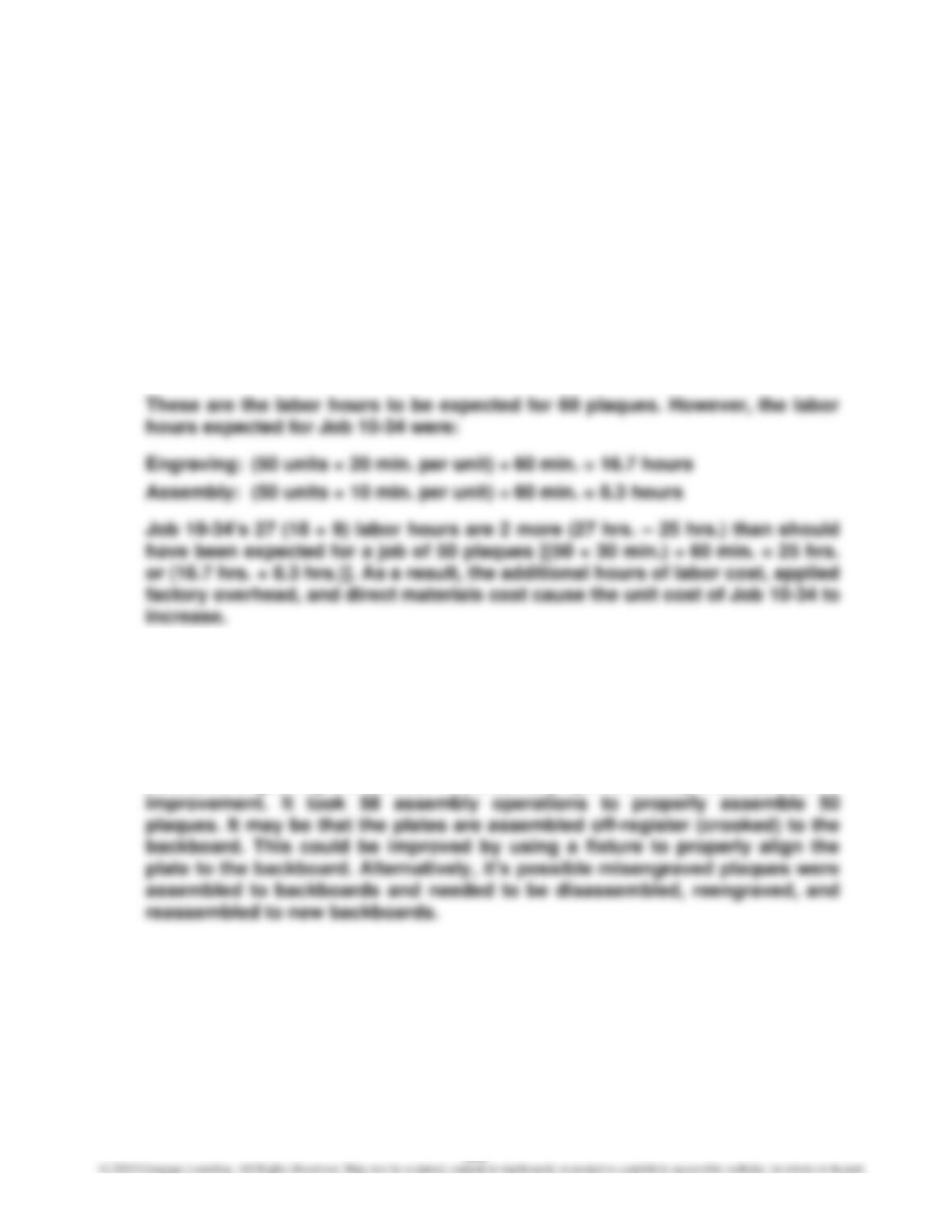
Pluto Unit Costs
$0
$5
$10
$15
65 74 92 116
Unit Cost
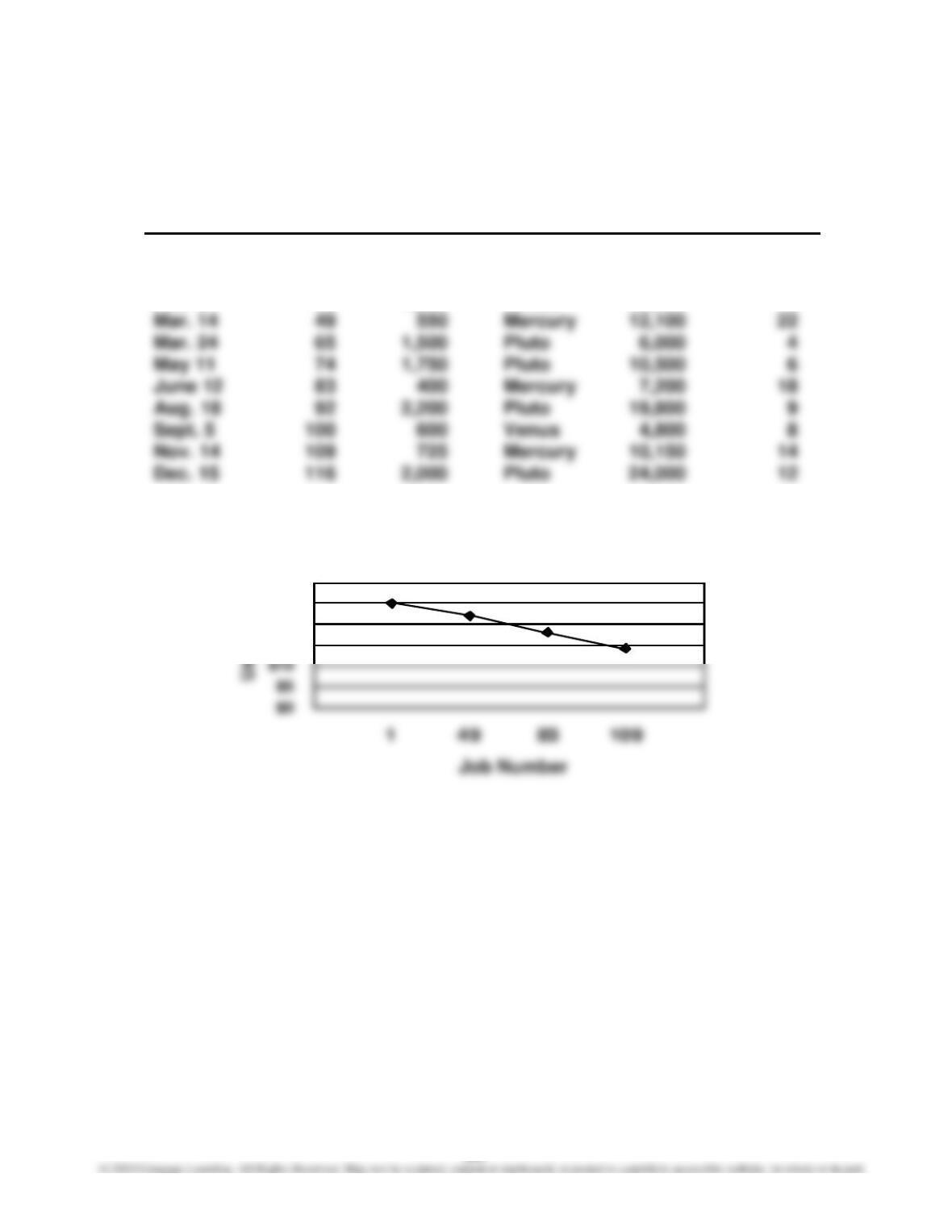
As can be seen, the unit costs behave differently for each product. Pluto has
increasing unit costs during the year, Venus is steady, and Mercury has de-
creasing unit costs during the year.
Job Number
309
E10–21
a. The first item to note is that the cost did not go up due to any increases in the
cost of labor or materials. Rather, the cost of the plaques increased because
Job 10-34 used more labor and materials per unit than did Job 9-08. Specifi-
cally, Job 9-08 required exactly the same number of backboards and brass
plates as the number of actual plaques shipped. However, Job 10–34 required
eight more backboards and brass plates than the number actually shipped (58
vs. 50). In addition, the labor hours for Job 09–08 were as follows:
Engraving: (60 units × 20 min. per unit) ÷ 60 min. = 20 hours
Assembly: (60 units × 10 min. per unit) ÷ 60 min. = 10 hours
b. Apparently, the engraving and assembly work is becoming sloppy. Job 10–34
required 58 engraved brass plates in order to get 50 with acceptable quality. It
is likely that the engraver is not being careful in correctly spelling the names.
The names should be supplied to the engraver using large typewritten fonts
so that it is easy to read the names. The engraver should be instructed to be
careful in engraving the names. The assembly operation may also need some
310
E10–22
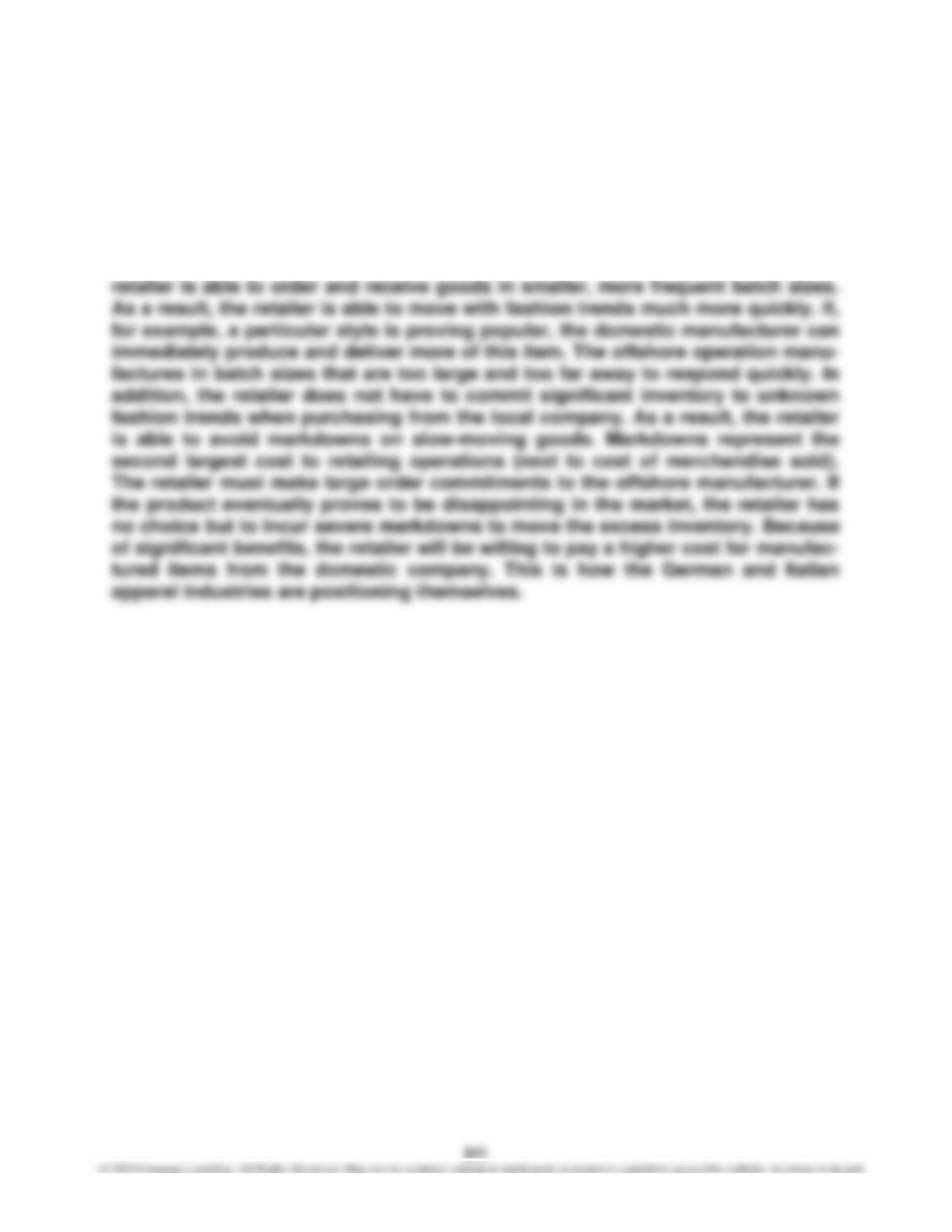
a. Direct labor costs for April …………………………... $434,000
b. Media purchases for April …………………………….. $1,300,000
c. Overhead applied during April (40% × $1,300,000) $520,000
d. Cost of services completed ………………………….. $1,377,000
Cost of completed jobs, $1,377,000; as follows:
E10–23
The CEO must not have been listening very closely at the conference. Just–in–
time is not primarily an inventory reduction method. Just–in-time is a process
improvement philosophy that focuses on reducing time, cost, poor quality, and
uncertainty from a process. Large inventories are merely a symptom of poorly
designed processes. Thus, the CEO’s statement is naive. The company must first
E10–24
This is an actual situation facing the U.S. apparel industry. Warren Featherbone
and other U.S.-based apparel manufacturers are discovering the strategic power
of just-in-time. Rather than competing with the offshore manufacturers on price,
these companies are providing smaller quantities with much faster delivery. The
312
E10–25
Onsite Insurance Company should adopt just-in-time principles in its claims
payment operations. Management should first consider changing the layout for
this process. Instead of processing the claims payments through three different
departments that are organized by process, the company could design claims
payment “cells” that are organized around different types of insurance products
or customers. For example, a cell could be created for all marine insurance. The
cell would have data input, claims audit, and claims adjustment personnel all lo-