10-1
CHAPTER 10
Reporting and Analyzing Liabilities
Learning Objectives
1. Explain a current liability and identify the major types of current liabilities.
2. Describe the accounting for notes payable.
3. Explain the accounting for other current liabilities.
10-2
Chapter Outline
Learning Objective 1 – Explain a Current Liability and Identify the Major Types of
Current Liabilities
Current Liabilities—A current liability is a debt that a company reasonably expects to
pay (1) from existing current assets or through the creation of other current liabilities,
and (2) within one year or the operating cycle, whichever is longer.
▪ Debts that do not meet both criteria are classified as long-term liabilities.
▪ The different types of current liabilities include:
o notes payable
TEACHING TIP
Ask students if they have personal liabilities. Are those liabilities current liabilities or long–
term liabilities? Why is it important that students know whether they are current or long-term?
Learning Objective 2 – Describe the Accounting for Notes Payable
Notes payable—Companies record obligations in the form of written notes as notes
payable.
▪ Are often used instead of accounts payable because they give the lender written
documentation of the obligation in case legal remedies are needed to collect the
debt.
TEACHING TIP
Ask students to list some similarities and differences between Notes Payable and Accounts
Payable. Ask students if a Note Payable is more binding on a debtor than an Accounts
Payable. Why?
10-3
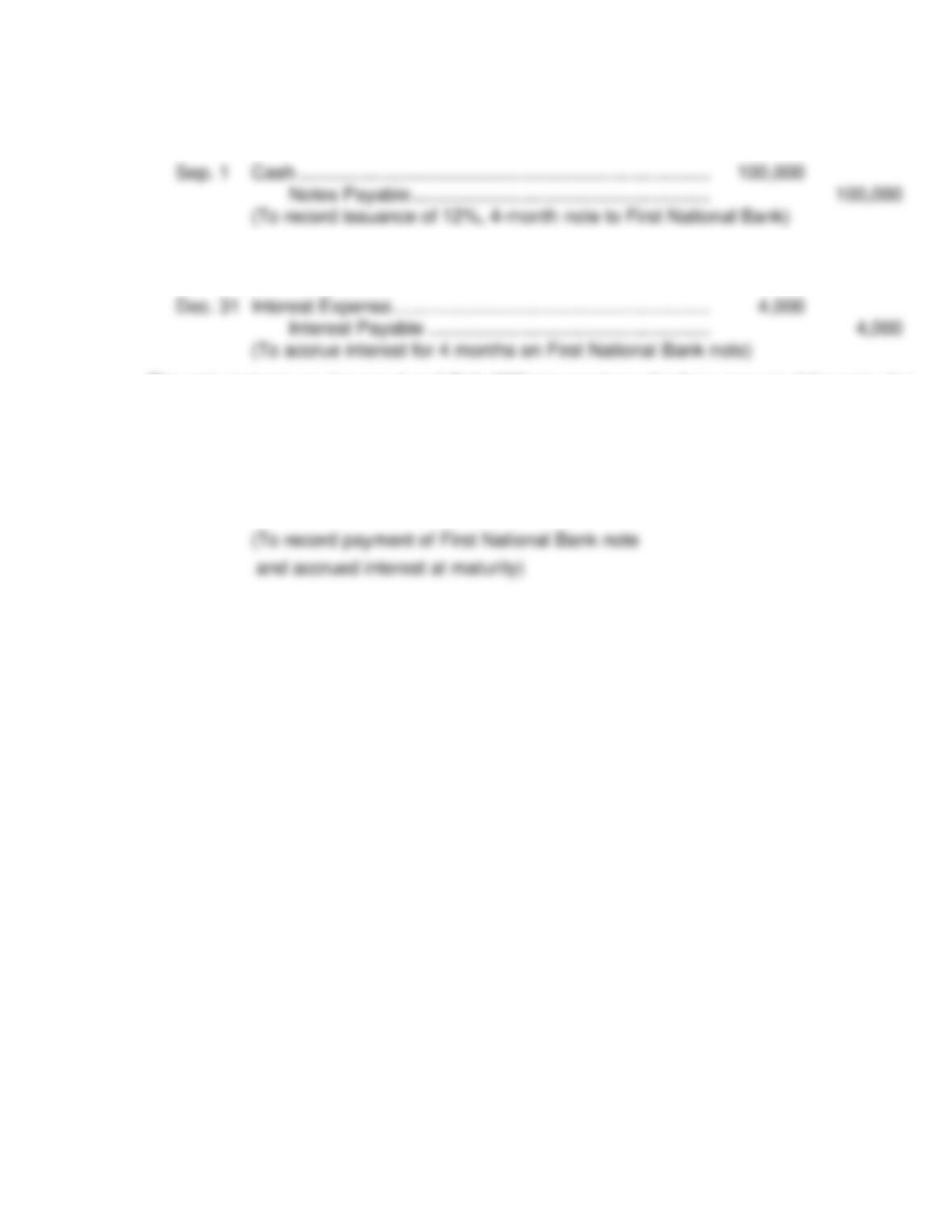
○ This is the illustration in the chapter concerning Cole Williams Co. borrowing $100,000
from the First National Bank on September 1, 2012. The note earns interest at a rate of 12%
and matures in four months. On September 1 Cole Williams Co. receives $100,000 and
makes the following journal entry:
The interest, which accrues over the life of the note, must be recorded when financial
statements are prepared at December 31.
The note matures on January 1 and Cole Williams must pay the face amount of the note plus
the interest ($100,000 x 12% x 4/12). The entry to record the payment of the note and
accrued interest is:
Jan. 1 Notes Payable ………………………………………………………. 100,000
Interest Payable ……………………………………………… 4,000
Cash 104,000
o A discussion of accounting for long-term installment notes payable is presented in
Appendix 10C at the end of the chapter.
10-4
Learning Objective 3 – Explain the Accounting for Other Current Liabilities
Sales Taxes Payable—Many of the purchases in a retail stores are subject to sales taxes.
▪ Sales taxes are expressed as a percentage of the sales price.
▪ The seller collects the sales tax from the customer when the sale occurs and remits the
tax collected to the state’s department of revenue periodically (usually monthly).
▪ Most states require that the sales tax collected be rung up separately on the cash
register. (Gasoline sales are a major exception.)
TEACHING TIP
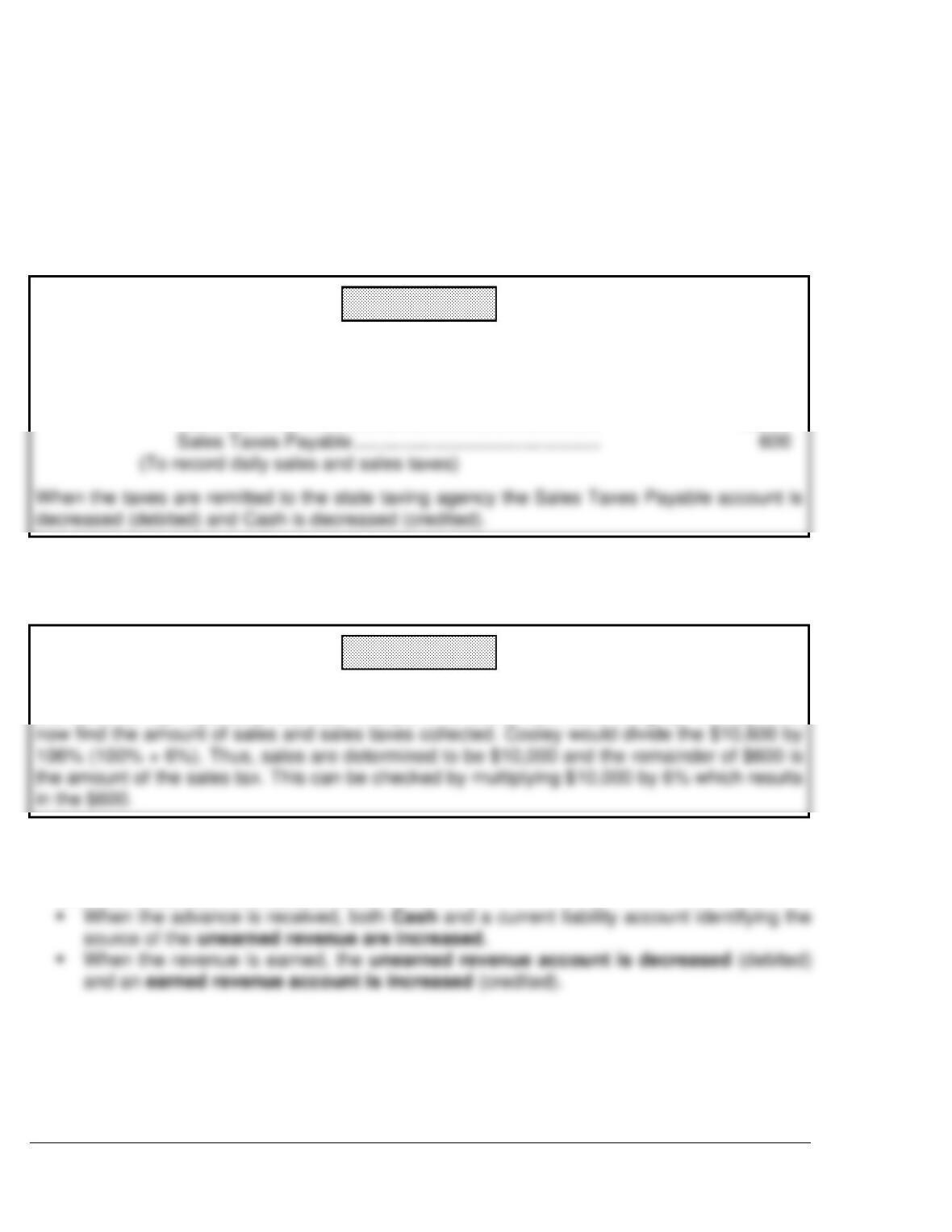
Show the entry to be made by Cooley Grocery Store for the March 25 cash register reading
showing sales of $10,000 and sales taxes of $600.
Mar. 25 Cash ……………………………………………………………………. 10,600
Sales Revenue ……………………………………………….. 10,000
▪ When sales taxes are not rung up separately on the cash register, divide total receipts
by 100% plus the sales tax percentage to determine sales.
TEACHING TIP
For example, Cooley is responsible for collecting 6% on all taxable sales. Cooley did not ring
the sales tax up separately and total receipts of $10,600 have been rung up. Cooley must
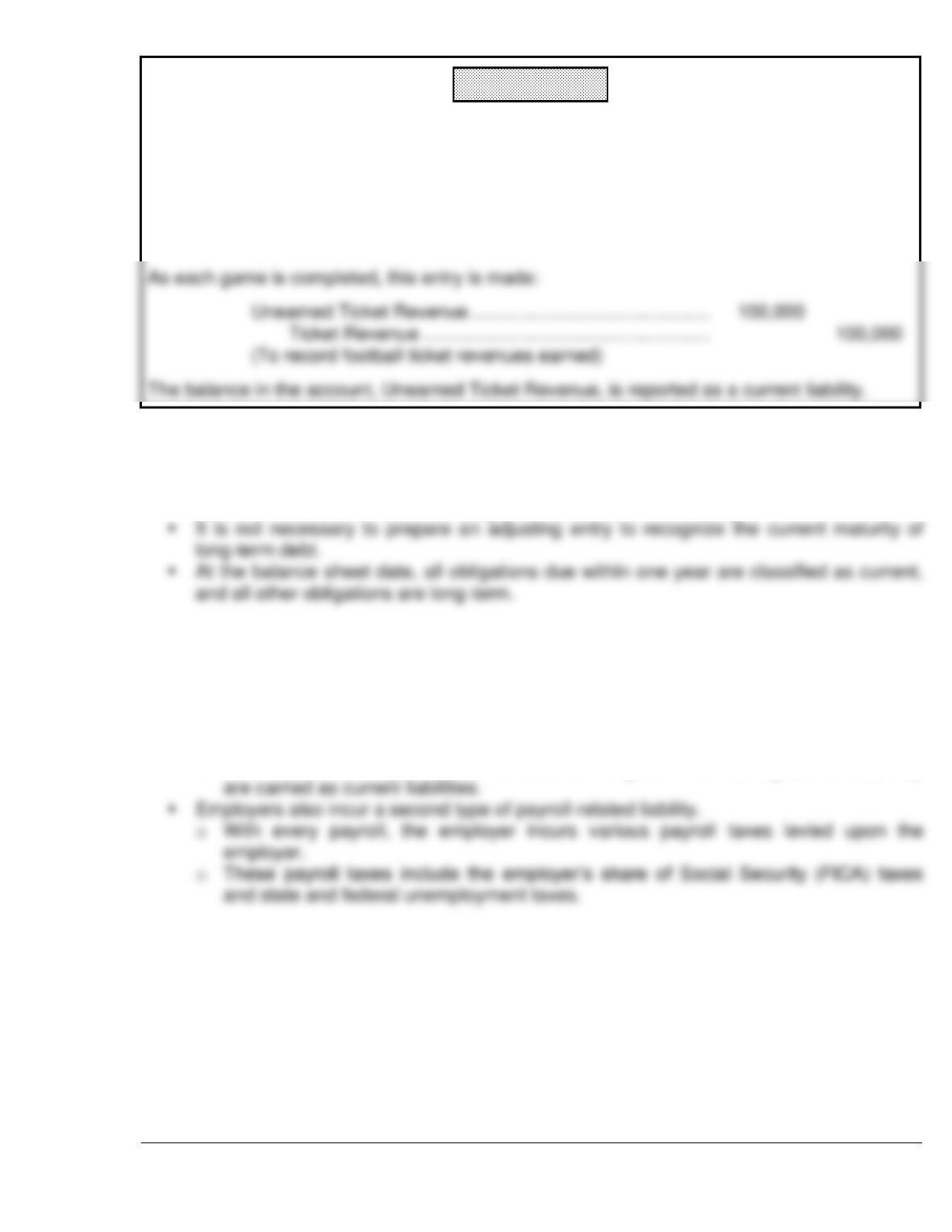
Unearned Revenues—Companies such as magazine publishers and airlines typically
receive cash before goods are delivered or services are rendered. The companies account
for these unearned revenues as follows:
10-5
TEACHING TIP
Walk through the illustration in the text in which Superior University sold 10,000 season
football tickets at $50 each for its five-game home schedule. The entry for the sales of
season tickets is:
Aug. 6 Cash ……………………………………………………………………. 500,000
Unearned Ticket Revenue ………………………………… 500,000
(To record sale of 10,000 season tickets)
Current Maturities of Long-Term Debt—The current portion of a long-term debt should
be included in current liabilities.
▪ Current maturities of long-term debt are frequently identified in the current liabilities
portion of the balance sheet as long-term debt due within one year.
Payroll and Payroll Taxes Payable – Every employer incurs liabilities relating to
employees’ salaries and wages.
▪ One is the amount of salaries and wages owed to employees—Salaries and Wages
Payable.
▪ Another is the withholding taxes—Federal and State Income Taxes Payable and
FICA Taxes Payable, required by law to be withheld from employees’ gross pay.
o Until the withholding taxes are remitted to the government taxing authorities, they
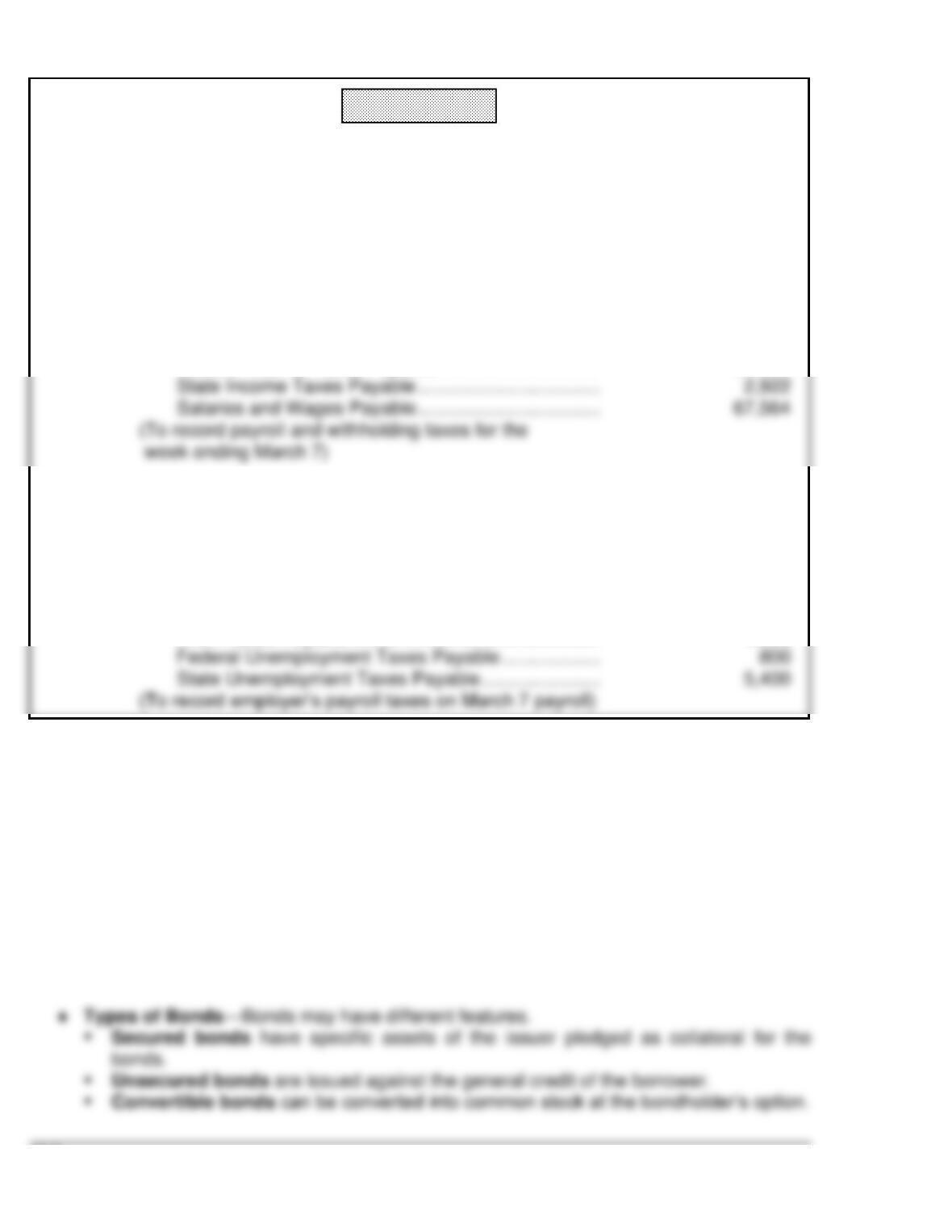
10-6
TEACHING TIP
Ask students if they work 40 hours a week, making $10 per hour, is their take home pay for
the week $400. Why not? If the employer pays a student $10 an hour for the 40 hours or
$400 is this all of the expense the employer has relative to the student’s work week? Why
not?
Work through the example in the book concerning the entry for the accrual and payment of a
$100,000 payroll for the week of March 7, on which Cargo Corporation withholds taxes from
its employees’ wages and salaries:
Mar. 7 Salaries and Wages Expense ………………………………….. 100,000
FICA Taxes Payable ………………………………………… 7,650
Federal Income Taxes Payable …………………………. 21,864
Mar. 7 Salaries and Wages Payable …………………………………… 67,564
Cash ……………………………………………………………… 67,564
(To record payment of the March 7 payroll)
The employer’s share of Social Security (FICA) taxes and state and federal unemployment
taxes would be recorded with the following entry:
Mar. 7 Payroll Tax Expense ………………………………………………. 13,850
FICA Taxes Payable ………………………………………… 7,650
Learning Objective 4 – Identify the Types of Bonds
Bonds: Long-Term Liabilities—Long-term liabilities are obligations that are
expected to be paid more than one year in the future and are often in the form of bonds
or long-term notes.
▪ Bonds are a form of interest-bearing note payable issued by corporations,
universities, and governmental agencies. Bonds, like common stock, are sold in
small denominations (usually $1,000 or multiples of $1,000).
10-7
TEACHING TIP
Explain to students that bondholders are creditors whereas stockholders are owners of a
corporation. Discuss reasons why investors would choose bonds over stocks.
Issuing Procedures—A bond certificate is issued to the investor to provide evidence of
the investor’s claim against the company. The information that the certificate provides
includes:
▪ The face value is the amount of principal due at the maturity date.
▪ The maturity date is the date that the final payment is due to the investor from the
issuing company.
Determining the Market Price of Bonds—The purchase of a bond needs to determine
how much to pay for a particular bond, its current market value.
▪ The current market value (present value) of a bond is a function of three factors:
o The dollar amounts to be received.
o Length of time until the amounts are received.
o The market rate of interest.
10-8
TEACHING TIP
Ask students which they would rather have, $100,000 cash now or $100,000 in 8% bonds
maturing in 20 years. When asked why they would rather have the $100,000 cash now, they
are going to say that they could be earning interest on the $100,000. Explain to them that is
why the cash inflow associated with the maturity value of the bond is much less than
$100,000.
TEACHING TIP
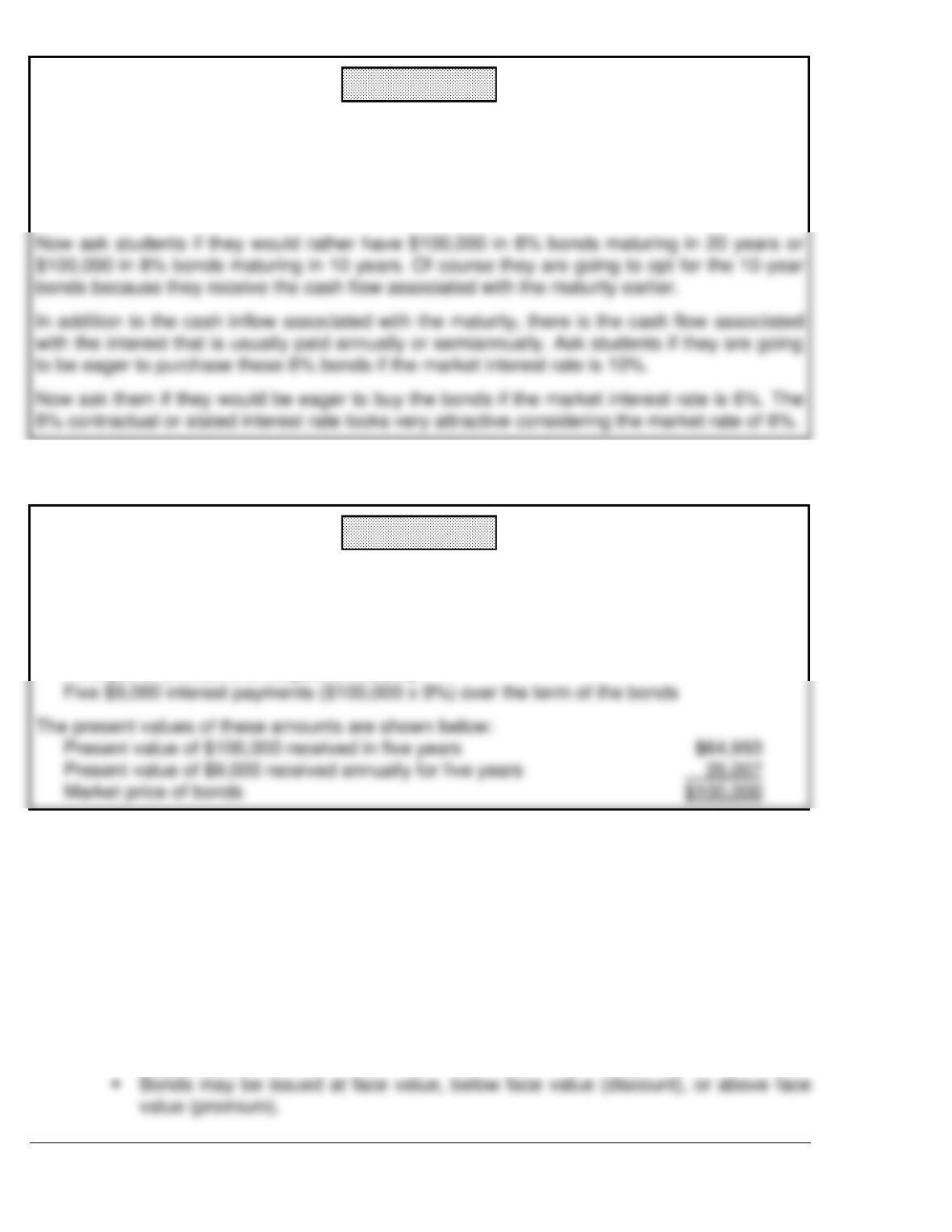
Walk through the illustration in the text which assumes that Acropolis Company on January
1, 2012, issues $100,000 of 9% bonds, due in five years, with interest payable annually at
year end.
The purchaser of the bonds would receive the following two cash payments:
Principal of $100,000 to be paid at maturity
Learning Objective 5 – Prepare the Entries for the Issuance of Bonds and Interest
Expense
Accounting for Bond Issues—A corporation records bond transactions when it
issues or retires (buys back) bonds and when bondholders convert bonds into
common stock.
▪ If a bondholder sells a bond to another investor, the issuing firm receives no
further money on the transaction, nor is the transaction journalized by the issuing
corporation.
10-9
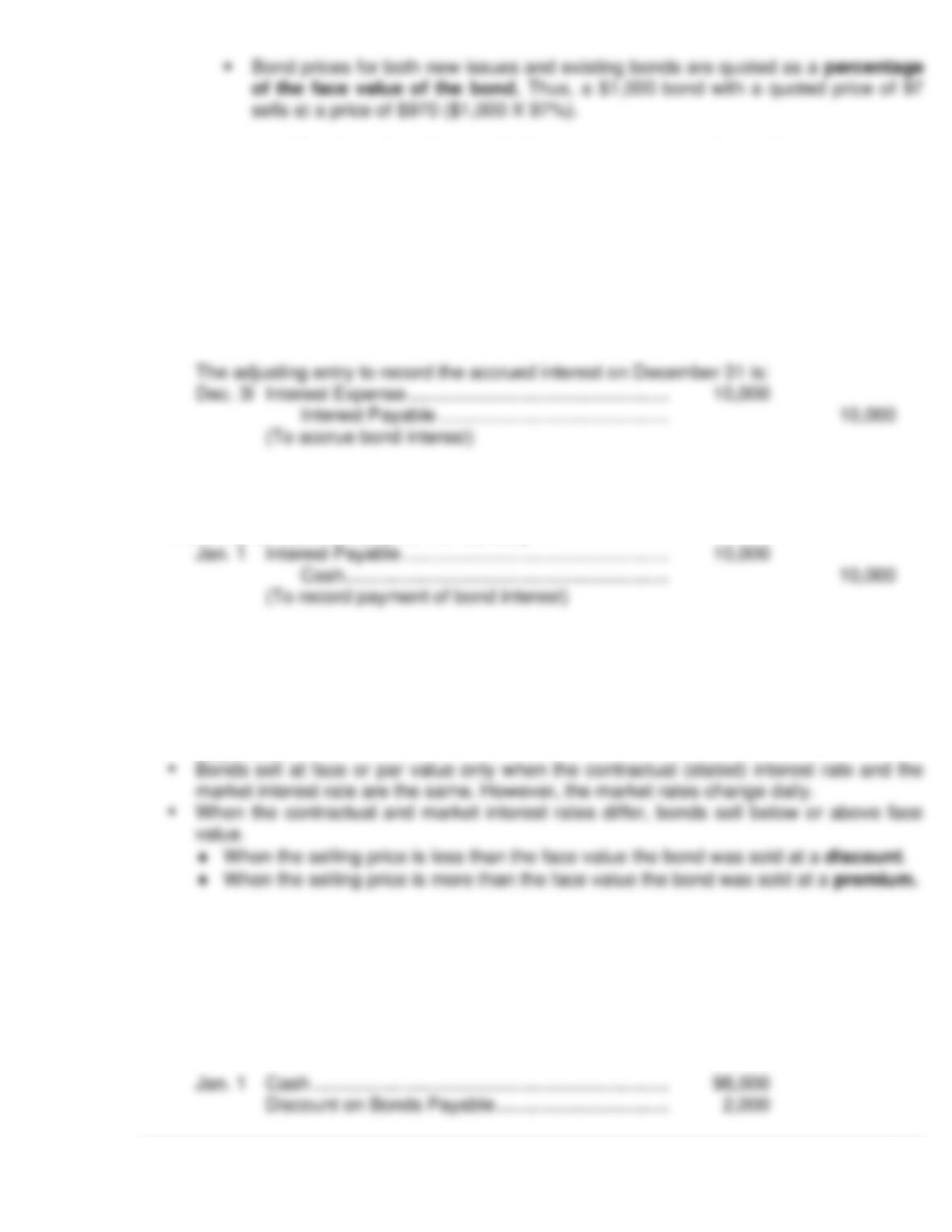
Issuing Bonds at Face Value—To illustrate, assume that Devor Corporation issued
100, 5-year, 10%, $1,000 bonds dated January 1, 2012, at 100 (100% of face
value). Assume interest is payable annually on January 1. The entry to record the
sale is:
Jan. 1 Cash ………………………………………………………….. 100,000
Bonds Payable ………………………………………. 100,000
(To record sale of bonds at face value)
The bonds are reported in the long-term liability section of the balance sheet because
the maturity date is more than one year away.
Bond interest payable is classified as a current liability because it is scheduled for
payment within the next year.
The entry to record the payment on January 1:
Discount or Premium on Bonds—The previous illustration assumed that the
stated interest rate and the market rate paid on the bonds were the same
▪ The contractual or stated interest rate is the rate applied to the face (par) value to arrive
at the amount of interest paid in a year.
▪ The market (effective) interest rate is the rate investors demand for loaning funds to the
corporation.
Issuing Bonds at a Discount—If the contractual interest rate is less than the market rate,
bonds sell at a discount or at a price less than 100% of face value.
▪ Although Discount on Bonds Payable has a debit balance, it is not an asset; it is a
contra account, which is deducted from bonds payable on the balance sheet.
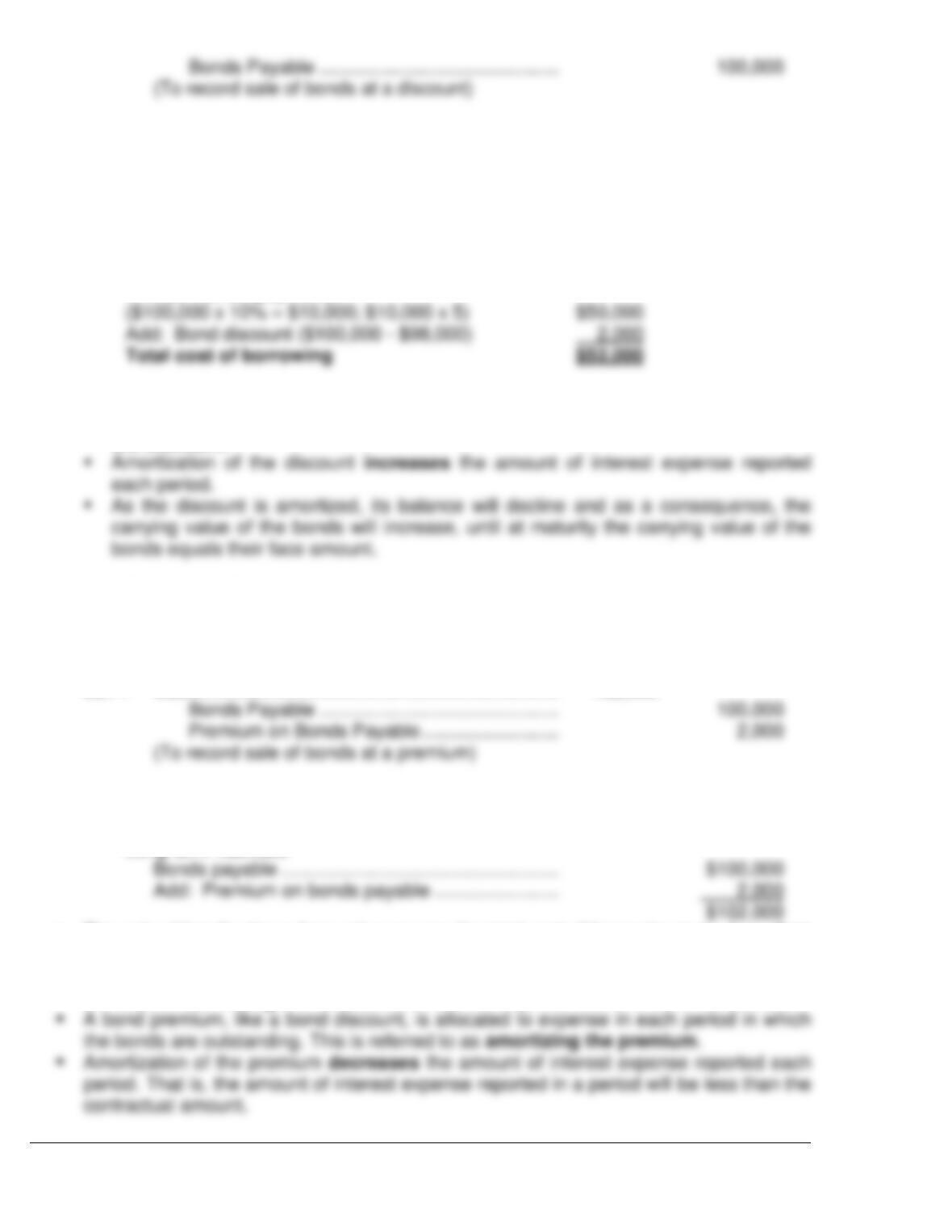
▪ To illustrate bonds sold at a discount, assume that on January 1, 2012, Candlestick,
Inc., sells $100,000, 5-year, 10% bonds at 98 (98% of face value) with interest payable
on January 1. The entry to record the issuance is:
10–10
▪ The $98,000 represents the carrying (or book) value of the bonds.
▪ The issuance of bonds below face value causes the total cost of borrowing to differ
from the bond interest paid. The difference between the issuance price and the face
value of the bonds—the discount—represents an additional cost of borrowing and
should be recorded as bond interest expense over the life of the bond.
▪ The total cost of borrowing $98,000 for Candlestick, Inc. is $52,000 computed as
follows:
Annual interest payments
▪ To follow the expense recognition principle, bond discount is allocated to expense in
each period in which the bonds are outstanding. This is referred to as amortizing
the discount.
Issuing Bonds at a Premium—If the contractual interest rate is greater than the market
rate, bonds sell at a premium or at a price greater than 100% of face value.
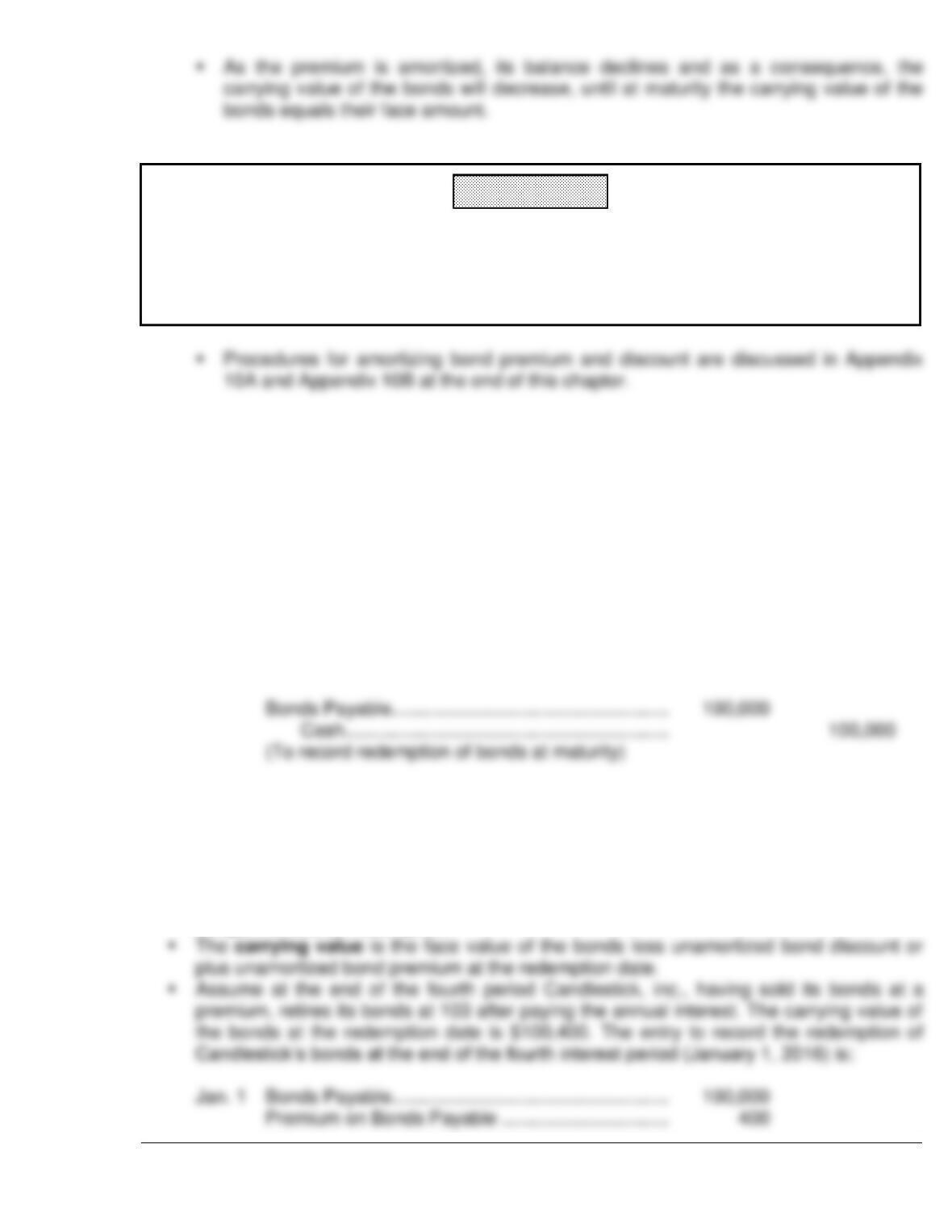
▪ To illustrate bonds sold at a premium, assume the Candlestick, Inc. bonds described
before are sold at 102 (102% of face value) rather than 98. The entry to record the sale is:
Jan 1 Cash …………………………………………………………… 102,000
▪ The premium on bonds payable is added to bonds payable on the balance sheet, as
shown below:
Long-term liabilities
▪ The sale of bonds above face value causes the total cost of borrowing to be less than
the bond interest paid because the borrower is not required to pay the bond premium
at the maturity date of the bonds. Thus, the premium is considered to be a reduction in
the cost of borrowing that reduces bond interest expense over the life of the bonds.
10–11
TEACHING TIP
Discuss with students the issue of risk and how that affects bond ratings.
Expand your discussion with these questions: Does a bond sold at a discount imply that the
bonds are inferior? Do bonds that are sold at a premium imply the bonds are superior to the
bonds that are sold at a discount?
Learning Objective 6 – Describe the Entries when Bonds are Redeemed
Accounting for Bond Redemptions—Bonds are retired when they are purchased
(redeemed) by the issuing corporation.
Redeeming Bonds At Maturity
▪ Regardless of the issue price of bonds, the book value of the bonds at maturity will
equal their face value.
▪ Assuming that the interest for the last interest period is paid and recorded separately,
the interest to record the redemption of the Candlestick bonds at maturity is:
Redeeming Bonds Before Maturity
▪ A company may decide to retire bonds before maturity to reduce interest cost and
remove debt from its balance sheet. A company should retire debt early only if it has
sufficient cash resources.
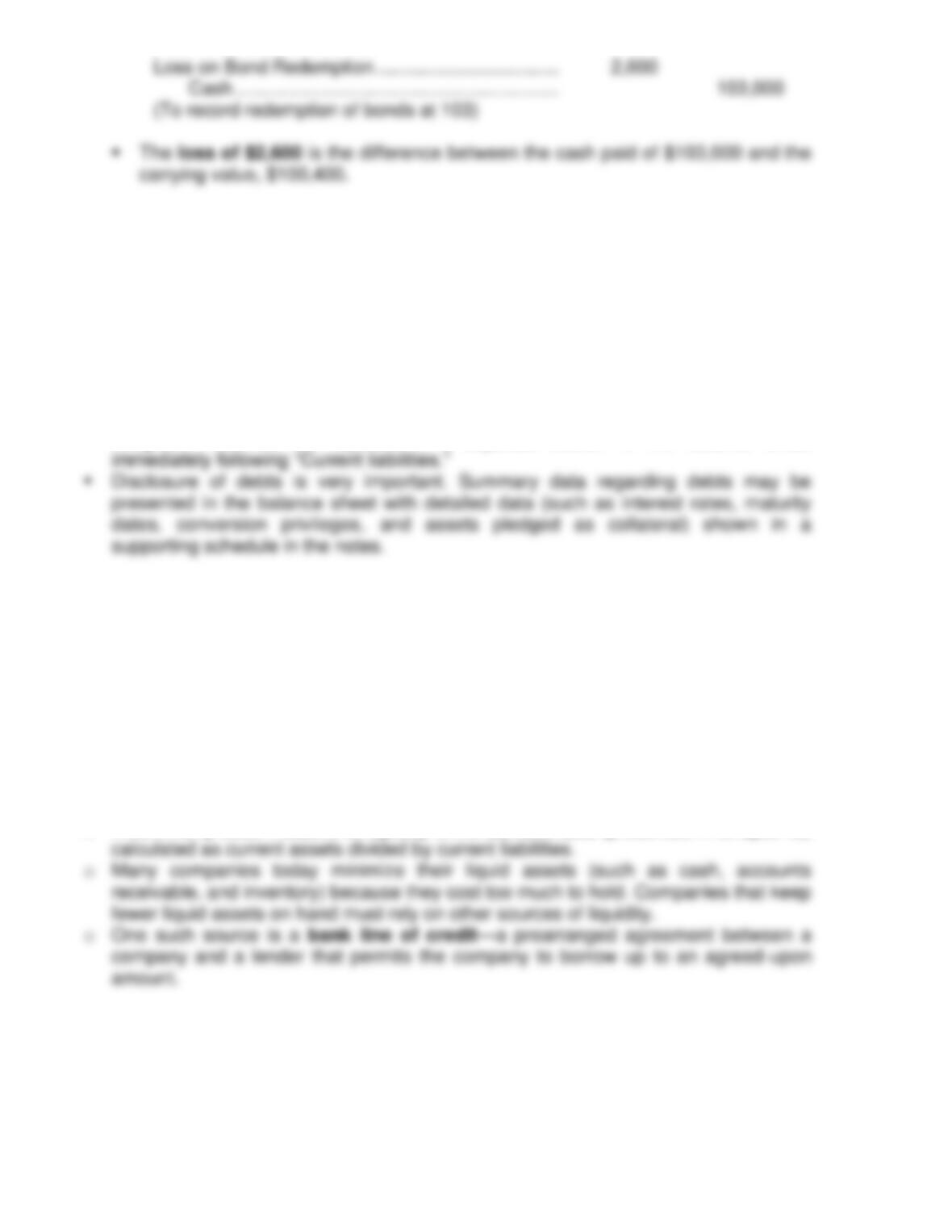
▪ When bonds are retired before maturity, it is necessary to: (1) eliminate the carrying
value of the bonds at the redemption date, (2) record the cash paid, and (3) recognize
the gain or loss on redemption.
10–12
Learning Objective 7 – Identify the Requirements for the Financial Statement
Presentation and Analysis of Liabilities
Balance Sheet Presentation—Current liabilities are the first category under “Liabilities” on
the balance sheet. Each of the principal types of current liabilities is listed separately within
the category.
▪ Companies usually list notes payable first
▪ Followed by accounts payable.
▪ Other items then follow in the order of their magnitude.
▪ The current maturities of long-term debt should be reported as current liabilities.
▪ Long-term liabilities are reported in a separate section of the balance sheet
Statement of Cash Flows Presentation—Information regarding cash inflows and outflows
that resulted from the principal portion of debt transactions appears in the “Financing
activities” section of the statement of cash flows.
▪ Interest expense is reported in the “Operating activities” section, even though it
resulted from debt transactions.
Analysis—Careful examination of debt obligations helps assess a company’s ability to pay
its current and long-term obligations. It also helps to determine whether a company can
obtain debt financing in order to grow.
▪ Liquidity ratios measure the short-term ability of a company to pay its maturing
obligations and to meet unexpected needs for cash.
o A commonly used measure of liquidity is the current ratio (presented in Chapter 2),
10–13
▪ Solvency ratios measure the ability of a company to survive over a long period of time.
o One measure of a company’ solvency is the debt to total assets ratio (Chapter 2),
calculated as total liabilities divided by total assets. This ratio indicates the extent to
which a company’s assets are financed with debt.
o Another useful solvency measure is the times interest earned ratio, which provides
an indication of a company’s ability to meet interest payments as they come due. It
TEACHING TIP
Work through the computation of the debt to total assets ratio and the times interest earned
ratio for the Automotive Division of Toyota and the auto industry that is presented in the text
in Illustration 10-18.
Remind students that different industries have different capital structures and businesses
within different industries have ratios that are quite different from the ones computed here.
Off-Balance-Sheet Financing
▪ A concern for analysts when they evaluate a company’s liquidity and solvency is
whether that company has properly recorded all of its obligations.
The bankruptcy of Enron Corporation, one of the largest bankruptcies in U.S.
history, demonstrated how much damage can result when a company does not
Contingencies—A company’s balance sheet may not fully reflect its potential obligations
due to contingencies—events with uncertain outcomes that may represent liabilities.
▪ Accounting rules require that companies disclose contingencies in the notes; in
some cases, they must accrue them as liabilities.
▪ A lawsuit is an example of a contingent liability.
10–14
Leasing—One very common type of off-balance-sheet financing results from leasing.
▪ Operating leases are treated like rentals – no asset or liabilities show on the books.
▪ Capital leases are treated like a debt – financed purchase-increasing both assets
and liabilities.
▪ Most lessees do not like to report leases on their balance sheets because the lease
liability increases the company’s total liabilities. May companies attempt to keep
leased assets and lease liabilities off the balance sheet by structuring the lease
agreement to avoid meeting the criteria of a capital lease.
Learning Objective 8 – Appendix 10A – Apply the Straight–Line Method of
Amortizing Bond Discount and Bond Premium
Amortizing Bond Discount—To follow the expenses recognition principle, bond
discount should be allocated to expense in each period in which the bonds are
outstanding.
▪ The straight-line method of amortization allocates the same amount of interest
expense in each interest period.
▪ In the Candlestick, Inc. example, the company sold $100,000, 5-year, 10% bonds on
January 1, 2012, for $98,000. Interest is payable on January 1. The $2,000 bond
Dec. 31 Interest Expense …………………………………….. 10,400
Discount on Bonds Payable …………………….. 400
Interest Payable……………………………………… 10,000
(To record accrued bond interest and amortization of bond discount)
10–15
TEACHING TIP
Work through Illustration 10A-2 Bond discount amortization schedule to demonstrate the
calculations for straight-line amortization of the bond discount.
Amortizing Bond Premium—The amortization of bond premium parallels that of bond
discount.
▪ Continuing the Candlestick Inc. example, assume the bonds are sold for $102,000,
rather than $98,000. This results in a bond premium of $2,000 ($102,000 – $100,000).
The premium amortization for each interest period is $400 ($2,000 5). The entry to
record the first accrual of interest on December 31 is:
Dec. 31 Interest Expense ………………………………………….. 9,600
Premium on Bonds Payable ………………………….. 400
TEACHING TIP
Work through Illustration 10A-4 bond premium amortization schedule to demonstrate the
calculations for straight-line amortization of the bond premium.
Learning Objective 9 – Appendix 10B – Apply the Effective-Interest Method of
Amortizing Bond Discount and Bond Premium.
Effective-Interest Amortization—To follow the expense recognition principle, bond
discount should be allocated to expense in each period in which the bonds are outstanding.
▪ However, to completely comply with the expense recoginition principle, interest expense
as a percentage of carrying value should not change over the life of the bonds.
▪ This percentage, referred to as the effective-interest rate, is established when the
bonds are issued and remains constant in each interest period.
10–16
▪ Interest expense each period is generally comparable in amount. However, when the
amounts are materially different, the effective-interest method is required under
generally accepted accounting principles (GAAP).
Amortizing Bond Discount
▪ To illustrate, assume that Candlestick Inc. issues $100,000 of 10%, 5-year bonds on
January 1, 2012, with interest payable each January 1. The bonds sell for $98,000,
which results in bond discount of $2,000 ($100,000 – $98,000) and an effective-
interest rate of 10.53%. For the first period, the computations of bond interest
expense and the bond discount amortization are as follows:
▪ The entry to record the accrual of interest and amortization of bond discount by
Candlestick Inc. on December 31, is:
Dec. 31 Interest Expense ………………………………………….. 10,319
▪ For the second interest period, bond interest expense will be $10,353 ($98,319 x
10.53%) and the discount amortization will be $353. At December 31, the following
adjusting entry is made:
Dec. 31 Interest Expense ………………………………………….. 10,353
TEACHING TIP
Work through Illustration 10B-2 Bond discount amortization schedule to demonstrate the
calculations for the effective-interest method of amortization of the bond discount.
Amortizing Bond Premium
▪ The amortization of bond premium by the effective-interest method is similar to the
procedures described for bond discount.
▪ As an example, assume that Candlestick Inc. issues $100,000, 10%, 5-year bonds on
January 1, with interest payable on January 1. In this case, the bonds sell for $102,000,
10–17
▪ The entry on December 31 is:
Dec. 31 Interest Expense ………………………………………….. 9,670
▪ For the second interest period, bond interest expense will be $9,638 and the
premium amortization will be $362.
TEACHING TIP
Work through Illustration 10B-4 Bond premium amortization schedule to demonstrate the
calculations for the effective-interest method of amortization of the bond premium.
Learning Objective 10 – Appendix 10C – Describe the Accounting for Long-Term
Notes Payable
Accounting for Long-Term Notes Payable —Are similar to short-term interest-bearing
notes payable except that the terms of the notes exceed one year.
▪ May be secured by a document called a mortgage that pledges title to specific assets
as security for a loan.
▪ Mortgage notes payable are widely used in the purchase of homes by individuals and
in the acquisition of plant assets by many companies. Like some other long-term notes
payable, the mortgage may stipulate either a fixed or an adjustable interest rate.
TEACHING TIP
Work through the example in the text to demonstrate the entries to record the mortgage loan
and first installment payment.