BYP 10-6 REAL-WORLD FOCUS
(a) An ‘A’ rating means that the company has a strong capacity to meet
financial commitments, but is somewhat susceptible to adverse
economic conditions and changes in circumstances. A ‘C’ rating means
that a company is currently highly vulnerable due to obligations and
other defined circumstances.
BYP 10-7 DECISION MAKING ACROSS THE ORGANIZATION
(a) 1. Bonds Payable ……………………………………. 3,000,000
Cash ……………………………………………. 2,500,000
Discount on Bonds Payable ………….. 54,000*
2. Cash …………………………………………………… 2,500,000
Bonds Payable …………………………….. 2,500,000
(b) Dear President Garner:
The early redemption of the 8%, 5-year bonds results in recognizing a
gain of $446,000 that increases current year net income by the after-tax
effect of the gain. The amount of the liabilities on the balance sheet will
be lowered by the issuance of the new bonds and redemption of the
5-year bonds.
1. The cash flow of the company as it relates to bonds payable will be
adversely affected as follows:
BYP 10-7 (Continued)
2. The amount of interest expense shown on the income statement
will be higher as a result of the decision to issue new bonds:
Annual interest expense on new bonds ………. $300,000
Annual interest expense on 8% bonds:
BYP 10-8 COMMUNICATION ACTIVITY
To: Harry Jackman
From: I. M. Student
Subject: Bond Financing
The types of bonds that may be issued are:
1. Secured or unsecured bonds. Secured bonds have specific assets of
the issuer pledged as collateral while unsecured bonds do not.
BYP 10-9 ETHICS CASE
(a) The stakeholders in this situation include:
Stockholders
(b) The possible courses of action and their consequences include:
1. The CEO could inform the auditors. The auditors would then re-
quire that this information be disclosed in the annual report. When
2. The CEO could conceal the information from the auditors. If the
company is not ultimately found at fault, then the company will not
(c) Answer will vary according to student.
(d) If the CEO conceals the information, and the company is subsequently
found to be at fault, a number of stakeholders will suffer. First, the com-
pany’s creditors will lose money because it is likely the company won’t
BYP 10-10 ETHICS CASE
(a) The stakeholders include:
1. Enron management
(b) Yes. Although the primary responsibility for proper accounting rests
with company management, other knowledgable parties have secon-
(c) The auditor may have been unable to detect the inappropriate account-
(d) A company may wish to conceal financing arrangements in order to
appear more solvent to investors and creditors. GAAP requires full
(e) The Citigroup deal was more harmful than other off-balance-sheet trans-
actions because it was not fully explained in the financial statement
BYP 10-11 ALL ABOUT YOU ACTIVITY
The answer to these questions depends on the state in which the student
resides. It also will be depend on the year chosen, although we expect that
the results will be much the same whether they pick any rates between
2012 and 2014. We provide a solution for this problem using the state of
Wisconsin as an example. It should be pointed out that certain taxes can
be deducted for computing federal income tax but are ignored in our
computation.
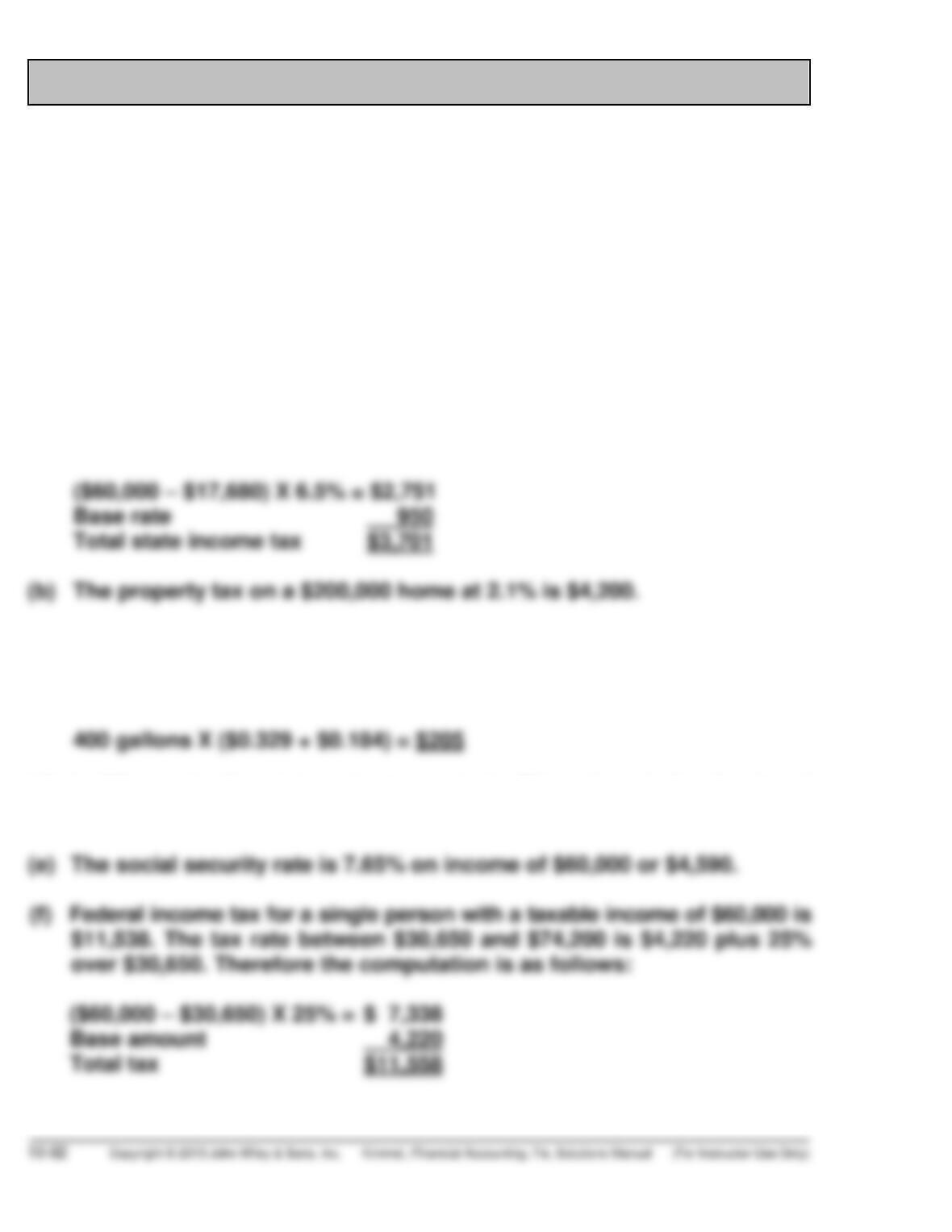
(a) Wisconsin state income tax for a single person with a taxable income of
$60,000 is $3,710.80. The tax rate between $17,680 and $132,580 is
$950.30 plus 6.5 percent over $17,680. Therefore the computation is as
follows:
(c) The state gasoline tax in Wisconsin is 32.9 cents per gallon and the federal
gasoline tax is 18.4 cents per gallon. Your total taxes on gasoline are
computed as follows:
(d) In Wisconsin the state sales tax rate is 5% and excludes food and
prescription drug purchases. Therefore the sales tax is $200 ($4,000 X 5%).
BYP 10-11 (Continued)
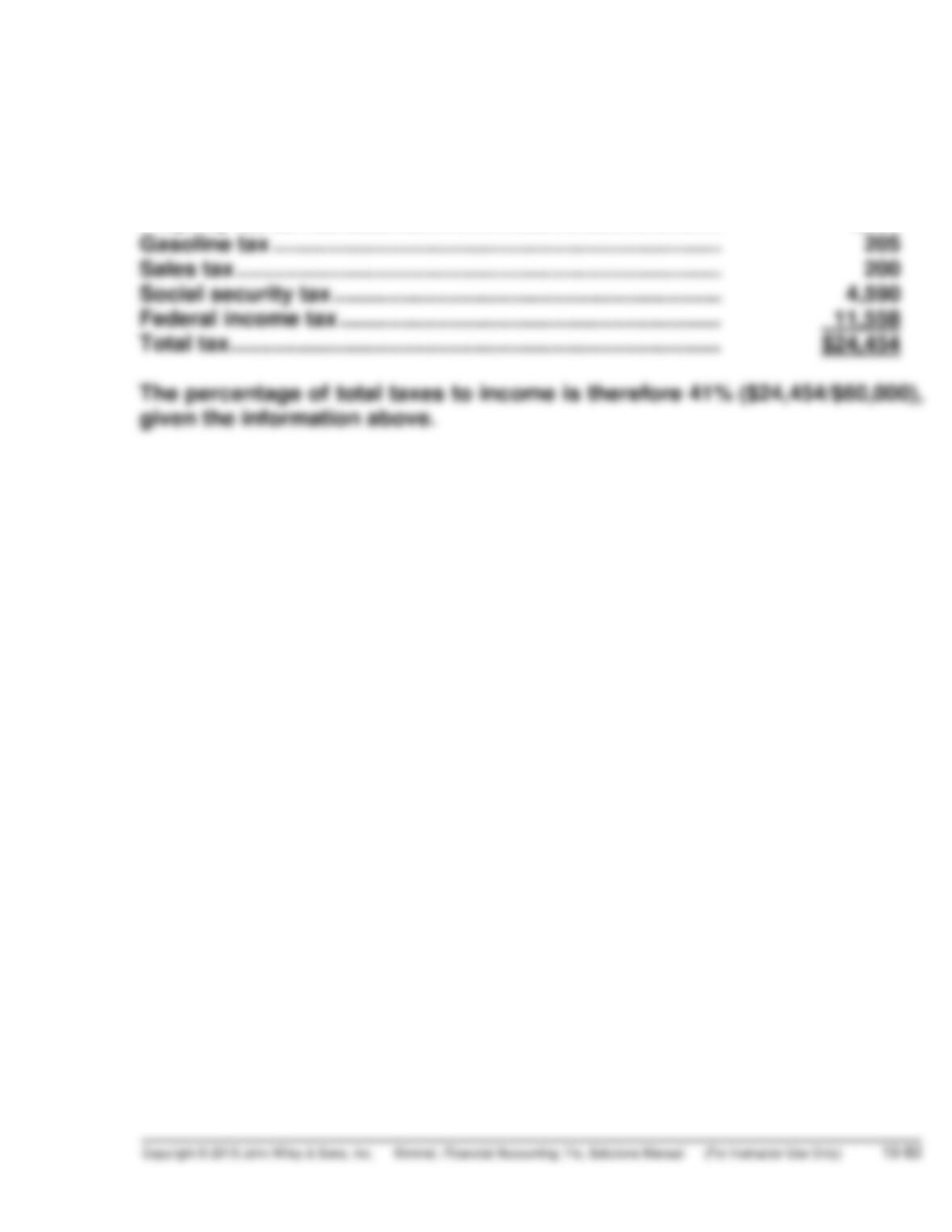
The total taxes paid therefore are computed as follows, based on a $60,000
income amount:
State income tax …………………………………………………………. $ 3,701
Property tax on home ………………………………………………….. 4,200
BYP 10-12 ALL ABOUT YOU
A company’s insurance premiums would be substantially lower if its
employees did not smoke and if they were in better shape. Some argue that
employees with unhealthy habits increase the share of insurance
BYP 10-13 FASB CODIFICATION ACTIVITY
(a) Current liabilities is used principally to designate obligations whose
liquidation is reasonably expected to require the use of existing re–
(b) Long-term obligations are those scheduled to mature beyond one year
(or the operating cycle, if applicable) from the date of an entity’s balance
sheet.
(c) The Codification provides the following guidance for disclosure of long-
term obligations:
Bonds, mortgages and other long-term debt, including capitalized
leases.
(1) State separately, in the balance sheet or in a note thereto, each
issue or type of obligation and such information as will indicate
(see §210.4–06):
(2) The amount and terms (including commitment fees and the condi-
tions under which commitments may be withdrawn) of unused
BYP 10-14 CONSIDERING PEOPLE, PLANET AND PROFIT
(a) The monthly rates paid by borrowers on loans from these microfinance
organizations is 5% to 10%. This would convert to roughly 60% (5% × 12)
to 120% (10% × 12) per year.
(c) The organizations are structured as savings and loans. (Savings and
loans used to be quite common in the U.S. until a financial crisis in the
1980s caused many of them to go bankrupt.) The organizations in the
IFRS CONCEPTS AND APPLICATION
IFRS 10-1
Under IFRS a provision is defined as a liability of uncertain timing or amount.
Examples include warranties, employee vacation pay, and anticipated losses.
IFRS 10-2
Under IFRS a contingent liability is defined as a possible obligation that is not
recognized in the financial statements but may be disclosed if certain criteria
are met. Under IAS 37 contingent liabilities are defined as being:
• A possible obligation that arises from past events whose existence
will be confirmed only by the occurrence or nonoccurrence of one
or more uncertain future events not wholly within the control of the
entity; or
IFRS 10-3
The similarities between GAAP and IFRS include: (1) the basic definition of
a liability, (2) liabilities are normally reported in the order of their liquidity,
and (3) preferred stock that is required to be redeemed at a specific point in
time in the future must be reported as debt.
IFRS 10-4
(a) Jan. 1 Cash (€2,000,000 X .97) ……………………. 1,940,000
Bonds Payable …………………………. 1,940,000
IFRS 10-5
(a) In the 1870s, a securities system was introduced in Japan and public
bond negotiation began. This resulted in the request for a public
(b) In March of 1943, the “Japan Securities Exchange Law” was enacted to
reorganize the Stock Exchange as a wartime-controlled institution. With
(c) The following are major items with respect to decisions by the com-
pany that need to be disclosed to the public:
• Issuance of stocks, convertible bonds, and bonds with warrants
• Reduction of capital
IFRS 10-5 (Continued)
(d) The following are major items with respect to “occurrence of material
fact” that need to be disclosed to the public:
• Damage incurred by natural disaster or business operations
• Change in major shareholders
IFRS10-6 INTERNATIONAL FINANCIAL REPORTING PROBLEM
(a) Trade payables represent amounts payable for goods and services
received. It took Zetar an average of 48 days to pay its trade payables.
(b) Provisions relate to amounts potentially payable to the vendors of
companies and businesses acquired by Zetar. The estimates are based