10–64. (continued)
c. A traditional income statement shows management resources supplied, but gives
no indication of the resources used and unused resource capacity. Management
has no way of knowing the amount of unused resource capacity or the cost of
unused resource capacity ($258,000). The activity-based income statement
provides management with resources supplied information (as does the
10–65. (30 min.) Assigning Capacity Costs: Cathy and Tom’s Specialty Ice Cream
Company.
Cathy and Tom’s Specialty Ice Cream Company illustrates in a very simple way the
issues of cost system design when costing excess capacity. Although the problem
setting is simple, the basic issues and the resolution of those issues are applicable in a
large number of settings. The three problems (10-65, 10-66, and 10-67) illustrate
different aspects of the capacity costing problems and issues.
There are two customers who demand a total of 13,500 gallons, which is 75% of plant
capacity. The cost of the capacity (all assumed fixed) is $27,000.
There are two possible approaches to costing the ice cream:
1. Cost at capacity:
Overhead rate =
($27,000 ÷ 18,000 gallons) =
$1.50/gallon
Product cost =
$1.00 + $1.50 =
$2.50/gallon
2. Cost at demand:
Overhead rate =
($27,000 ÷ 13,500 gallons) =
$2.00/gallon
Product cost =
$1.00 + $2.00 =
$3.00/gallon
How do you choose between the two? Why did Cathy and Tom buy a plant with a
capacity of 18,000 gallons? Possible reasons include:
(1) They hope to grow the market, i.e., for future expansion.
(2) Because capacity is “lumpy” and they can only buy in increments of, perhaps,
9,000 gallons.
10–66. (30 min.) Assigning Capacity Costs—Seasonality: Cathy and Tom’s
Specialty Ice Cream.
With seasonal demand fluctuations, the reason for the excess capacity is for the benefit
of the two customers (Cathy and Tom need all the capacity in the summer). The issue is
how to treat the excess capacity costs. The capacity costs in each season are $13,500
(= $27,000 ÷ 2 seasons). Two approaches to costing are:
1. Excess capacity costs assigned to season in which it is incurred, then to products
in that season. Thus,
Winter:
Overhead rate =
$3.00/gallon
Product cost =
$4.00/gallon
Summer
Overhead rate =
$1.50/gallon
Product cost =
$2.50/gallon
2. Excess capacity costs assigned to the season requiring it, then to products
produced in that season. Thus,
Winter:
Overhead rate =
($13,500 50%) ÷ 4,500
gallons) =
$1.50/gallon
Product cost =
$1.00 + $1.50 =
$2.50/gallon
Summer
Overhead rate =
[$13,500 + ($13,500 50%)] ÷
9,000 gallons) =
$2.25/gallon
Product cost =
$1.00 + $2.25 =
$3.25/gallon
10–67. (30 min.) Assigning Capacity Costs—Seasonality: Cathy and Tom’s
Specialty Ice Cream.
With seasonal demand fluctuations, the reason for the excess capacity is for the benefit
of the two customers (Cathy and Tom need all the capacity in the summer). The issue is
how to treat the excess capacity costs. The capacity costs in each season are $9,000 (=
$27,000 ÷ 3 seasons).
We can use the approach in Problem 10-66 to answer this problem. There are now
three seasons and three levels of demand. First, note that there is still $6,750 (4,500
gallons) of unused capacity costs, as in Problems 10-65 and 10-66.
The capacity costs and capacity in each season is:
Capacity Costs
Winter
Fall/Spring
Summer
Total ……………………………….
$9,000
$9,000
$9,000
Unused…………………………..
(4,500)
(2,250)
–0–
Used………………………………
$4,500
$6,750
$9,000
Charge for unused …………..
–0–
1,125a
5,625b
Total capacity costs ……………..
$4,500
$7,875
$14,625
Production (gallons) ……………..
3,000
4,500
6,000
Rate …………………………………..
$1.50c
Variable cost ……………………….
1.00
10–68. (30 min.) Assigning Capacity Costs: Mercia Chocolates.
Mercia Chocolates illustrates in a very simple way the issues of cost system design
when costing excess capacity. Although the problem setting is simple, the basic issues
and the resolution of those issues are applicable in a large number of settings. The two
problems (10-68 and 10-69) illustrate different aspects of the capacity costing problems
and issues.
There are two customers who demand a total of 60,000 packages, which is 66.7% of
plant capacity. The cost of the capacity (all assumed fixed) is $540,000.
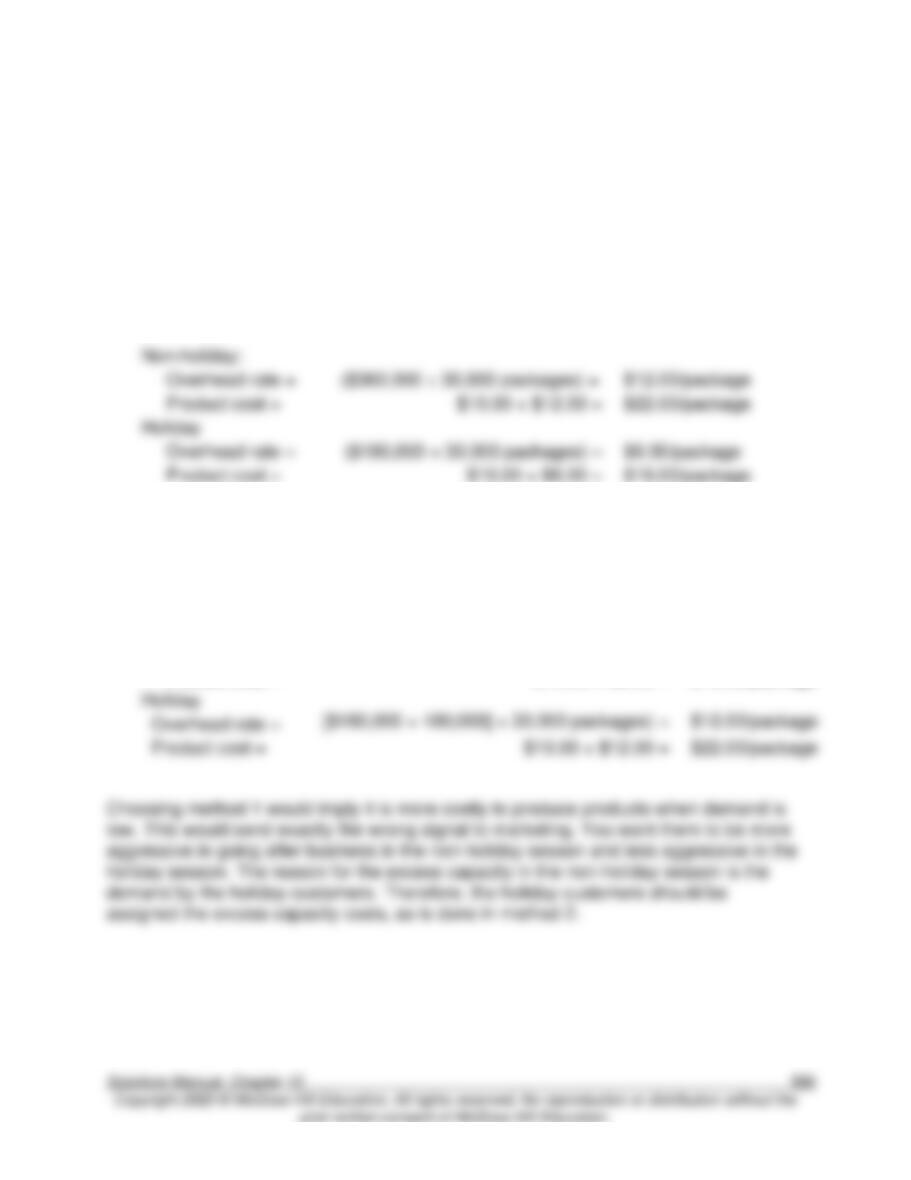
There are two possible approaches to costing the chocolate:
How do you choose between the two? Why did Mercia buy a plant with a capacity of
90,000 packages? Possible reasons include:
(1) They hope to grow the market, i.e., for future expansion.
(2) Because capacity is “lumpy” and they can only buy in increments of, perhaps,
45,000 packages.
10–69. (30 min.) Assigning Capacity Costs—Seasonality: Mercia Chocolates.
With seasonal demand fluctuations, the reason for the excess capacity is for the benefit
of the two customers (Vern’s and Mega Stores need all the capacity in the holiday
season). The issue is how to treat the excess capacity costs. The capacity costs in each
month are $45,000 (= $540,000 ÷ 12 months). This means that the capacity costs are
$180,000 (= $45,000 4 months) in the holiday season and $360,000 (= $45,000 8
months) in the non-holiday season. Two approaches to costing are:
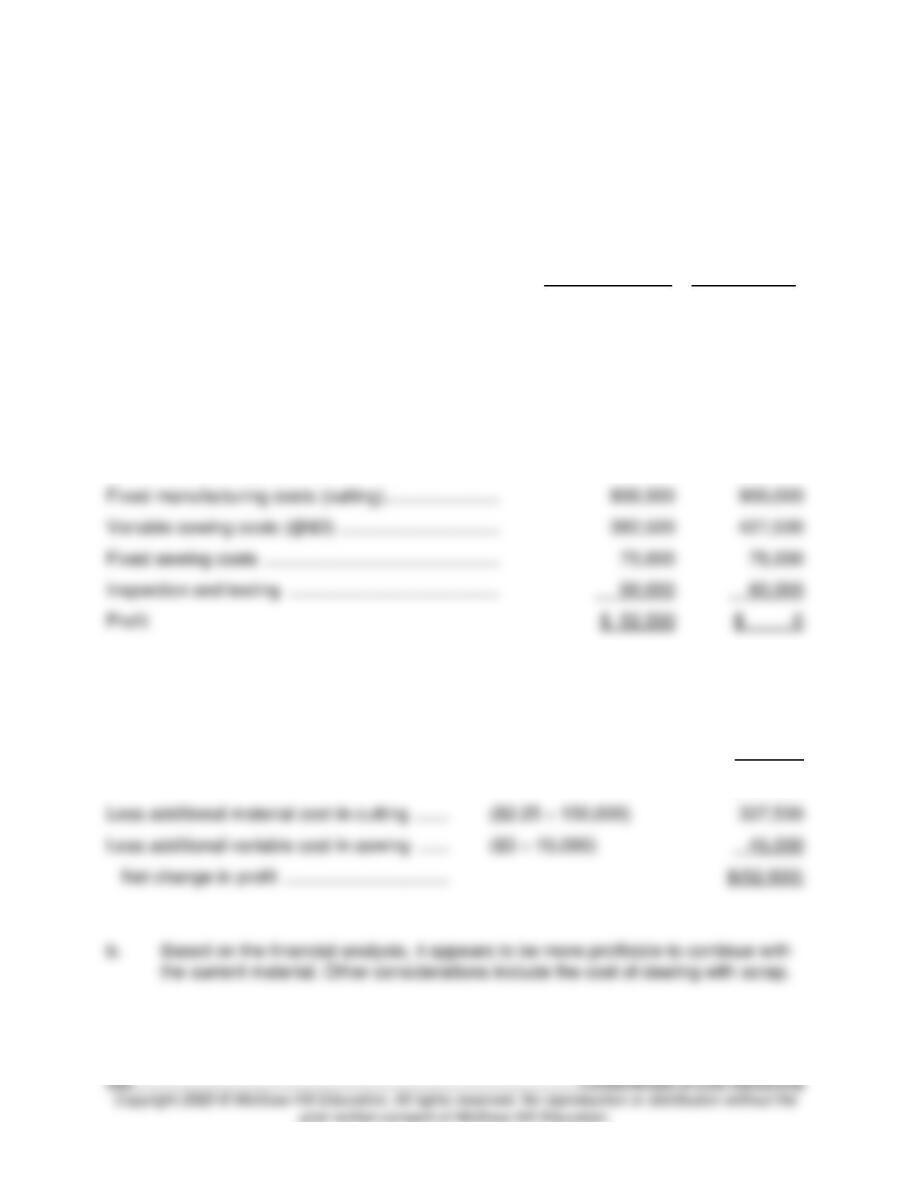
1. Excess capacity costs assigned to season in which it is incurred, then to products
in that season. Thus,
Non-holiday:
Product cost =
$22.00/package
Holiday
$6.00/package
Product cost =
2. Excess capacity costs (= $540,000 33-1/3%, or $180,000) are assigned to the
season requiring it, then to products produced in that season. Thus,
Non-holiday:
Overhead rate =
(($360,000 – $180,000) ÷ 30,000 packages)
=
$6.00/package
Product cost =
$10.00 + $6.00 =
$16.00/package
Holiday
Product cost =
10–70. (30 min.) Quality Improvement: IPort Products.
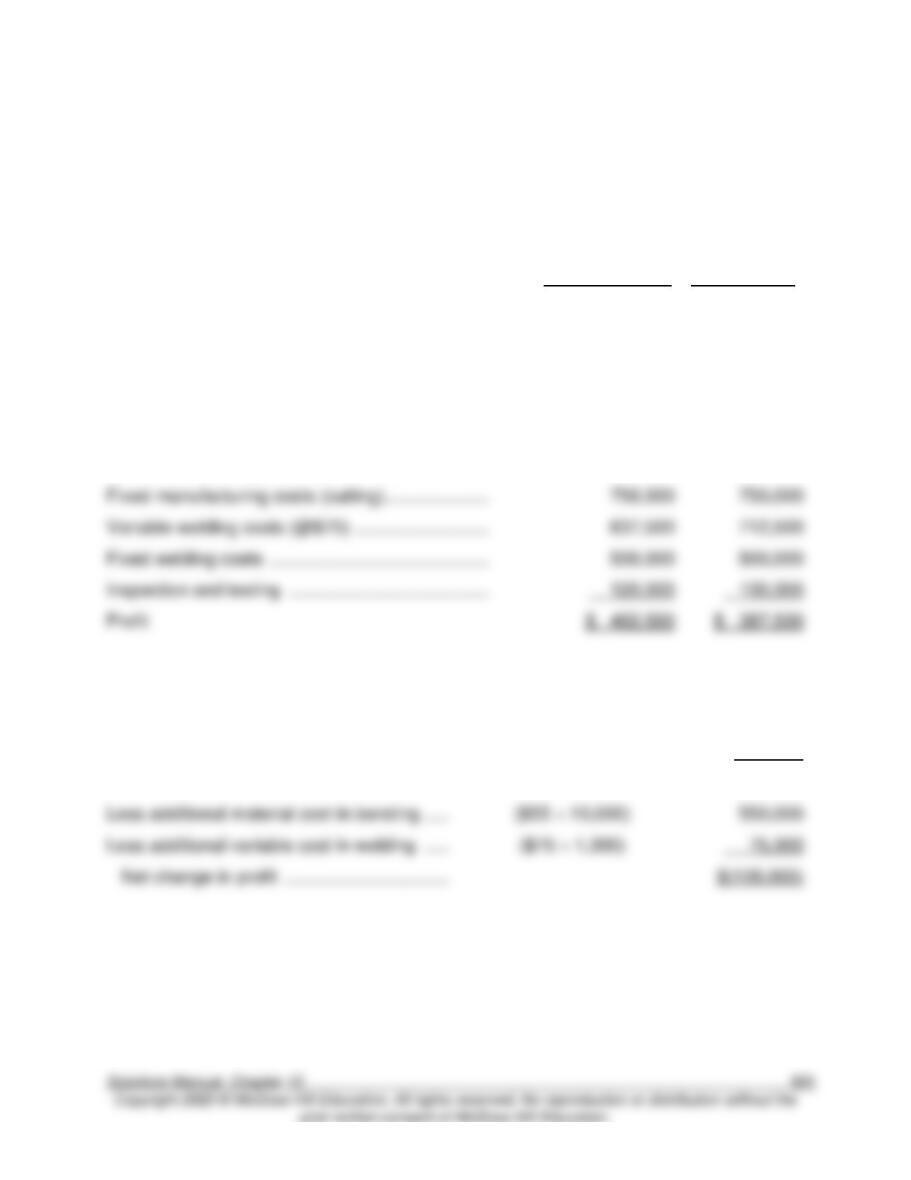
a. There are two alternatives: continue with the current material or use the new
material. To determine the best alternative (considering only the financial
consequenses), compute profit under each alternative:
Current Material
New Material
Number of units sold ……………………………………..
127,500
142,500
Price per unit ………………………………………………..
$20
$20
Sales revenue ………………………………………………
$2,550,000
$2,850,000
Variable cutting manufacturing costs (150,000 units):
Materials (@$5 for current; $7.25 for new) ……..
750,000
1,087,500
Other variable (@$2) ………………………………….
300,000
300,000
Fixed manufacturing costs (cutting)…………………..
900,000
900,000
Variable sewing costs (@$3) …………………………..
382,500
427,500
Fixed sewing costs ………………………………………..
Inspection and testing ……………………………………
Alternatively, we can do a differential analysis:
Additional revenue ………………………………..
($20 15,000 units)
$300,000
Inspection savings ………………………………..
30,000
$330,000
Less additional material cost in cutting …….
($2.25 150,000)
Less additional variable cost in sewing ……
($3 15,000)
45,000
10–71. (30 min.) Quality Improvement: Metallic, Inc.
a. There are two alternatives: continue with the current material or use the new
material. To determine the best alternative (considering only the financial
consequenses), compute profit under each alternative:
Current Material
New Material
Number of units sold ……………………………………
8,500
9,500
Price per unit ………………………………………………
$500
$500
Sales revenue …………………………………………….
$4,250,000
$4,750,000
Variable bending manufacturing costs (10,000 units):
Materials (@$125 for current; $180 for new) …
1,250,000
1,800,000
Other variable (@$50) ………………………………
500,000
500,000
Fixed manufacturing costs (cutting)…………………
750,000
750,000
Variable welding costs (@$75) ………………………
637,500
712,500
Fixed welding costs …………………………..…………
500,000
500,000
Inspection and testing ………………………………….
Alternatively, we can do a differential analysis:
Additional revenue ………………………………..
($500 1,000 units)
$500,000
Inspection savings ………………………………..
20,000
$520,000
Less additional material cost in bending …..
Less additional variable cost in welding …..
b. Based on the financial analysis, it appears to be more profitable to continue with
the current material. Other considerations include the cost of dealing with scrap.
Solutions to Integrative Cases
10–72. (50 Min) Cost Hierarchies, Cost of Customers, and Pricing: WSM
Corporation.
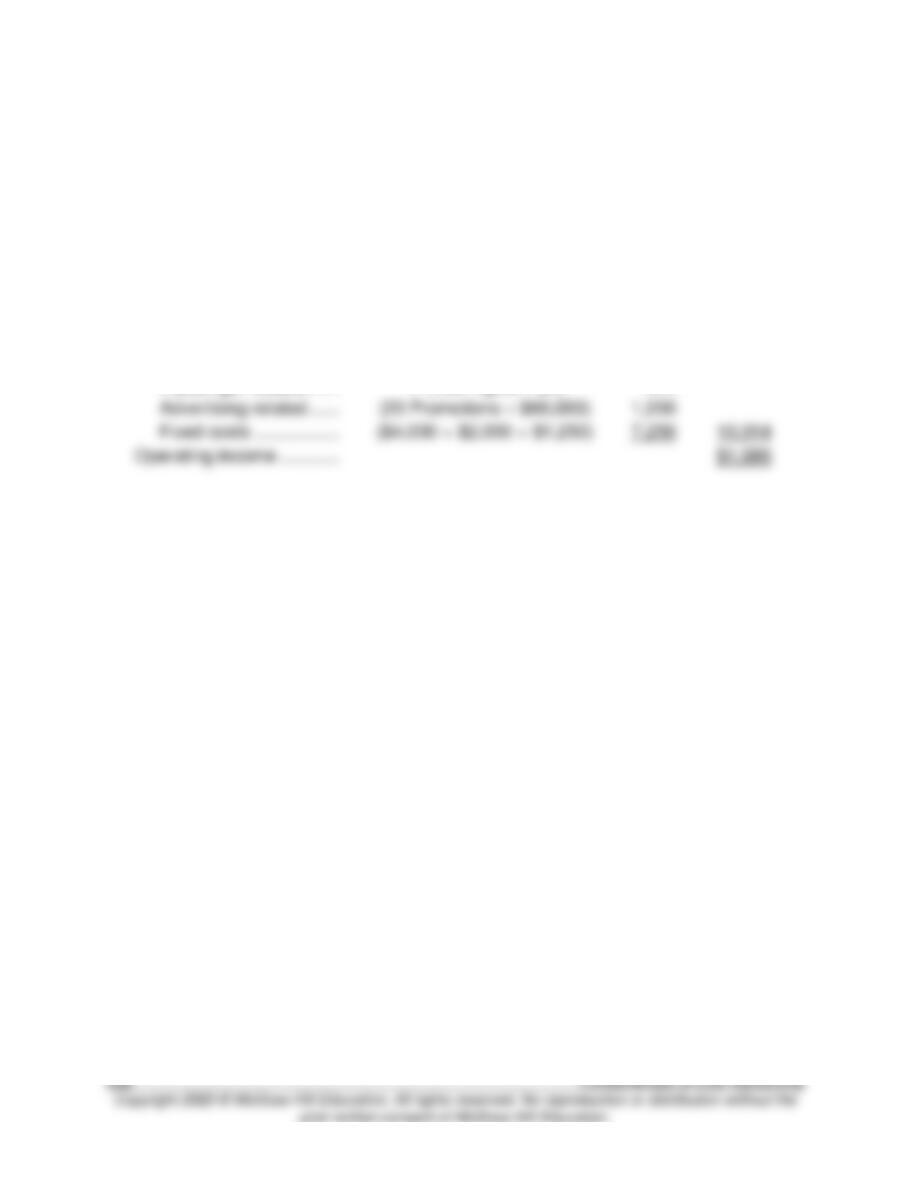
a.
($000)
Sales revenue ………………
(40 Passengers
1,400 flights $225)
$12,600
Costs:
Flight related ……………
(1,400 $1,600)
$2,240
Advertising related ……
(40 Passengers
10–72. (continued)
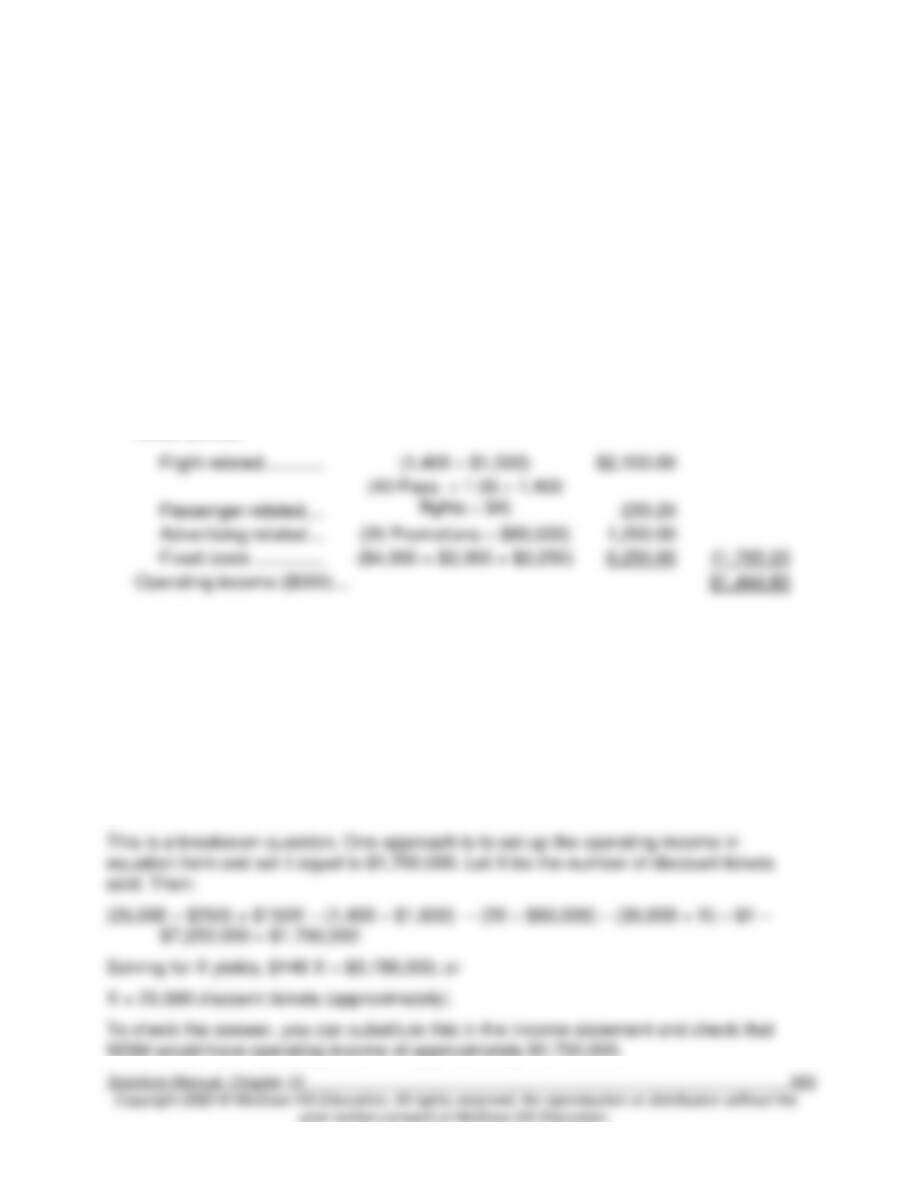
b.
We can first consider the incremental revenues and costs that would result:
Increase in revenues: (5% 40 passengers 1,400 flights $225) = $630,000
Increase in costs: $1,000,000 – (1,400 flights $100) + (5% 40 1,400 $4) =
$871,200
The net effect will be to lower profit by ($630,000 – $871,200) = $(241,200)
An analysis of total income would conclude that with the program, operating income
would be:
Revenue ($000) …………
(40 Pass. 1.05 1,400
flights $225)
$13,230.00
(40 Pass. 1.05 1,400
which is $241,200 less than the income calculated in requirement a above.
Based on a purely financial analysis, we might recommend that WSM not adopt the
Internet sales alternative. However, there are other considerations that may make this
alternative attractive. For example, some issues that would need to be considered
include:
1. Will we lose business to competitors that offer Internet sales?
2. Will we increase customer satisfaction if we offer Internet sales?
c.
WSM would have operating income of approximately $1,700,000.
10–73. (50 Min) Unused Capacity: The Grape Cola Caper.
(Refer to the solution for 9-73.)
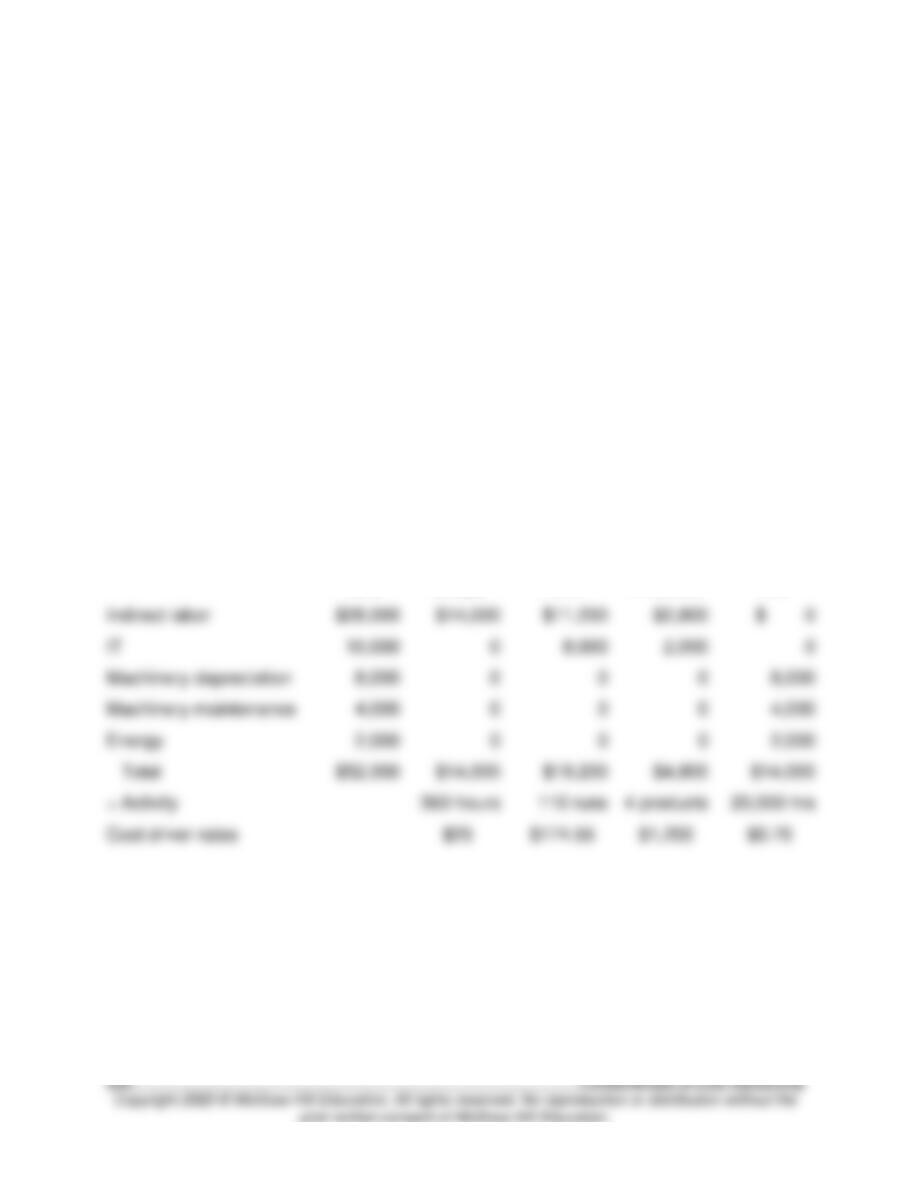
a. Percentage utilization of resource by activities:
Activity
Setups
Production
Runs
Products
Machine
Time
Indirect labor (including fringe benefits)
50%
40%
10%
0%
Information technology (IT)
0
80
20
0
Machinery depreciation
0
0
0
100
Machinery maintenance
0
0
0
100
Energy
0
0
0
100
Costs assigned to activiities:
Activity
Cost
Setups
Production
Runs
Products
Machine
Time
10,000
0
Machinery depreciation
8,000
0
Machinery maintenance
4,000
0
Energy
2,000
0
0
÷ Activity
20,000 hrs
Cost driver rates
$1,200
10–73. (continued)
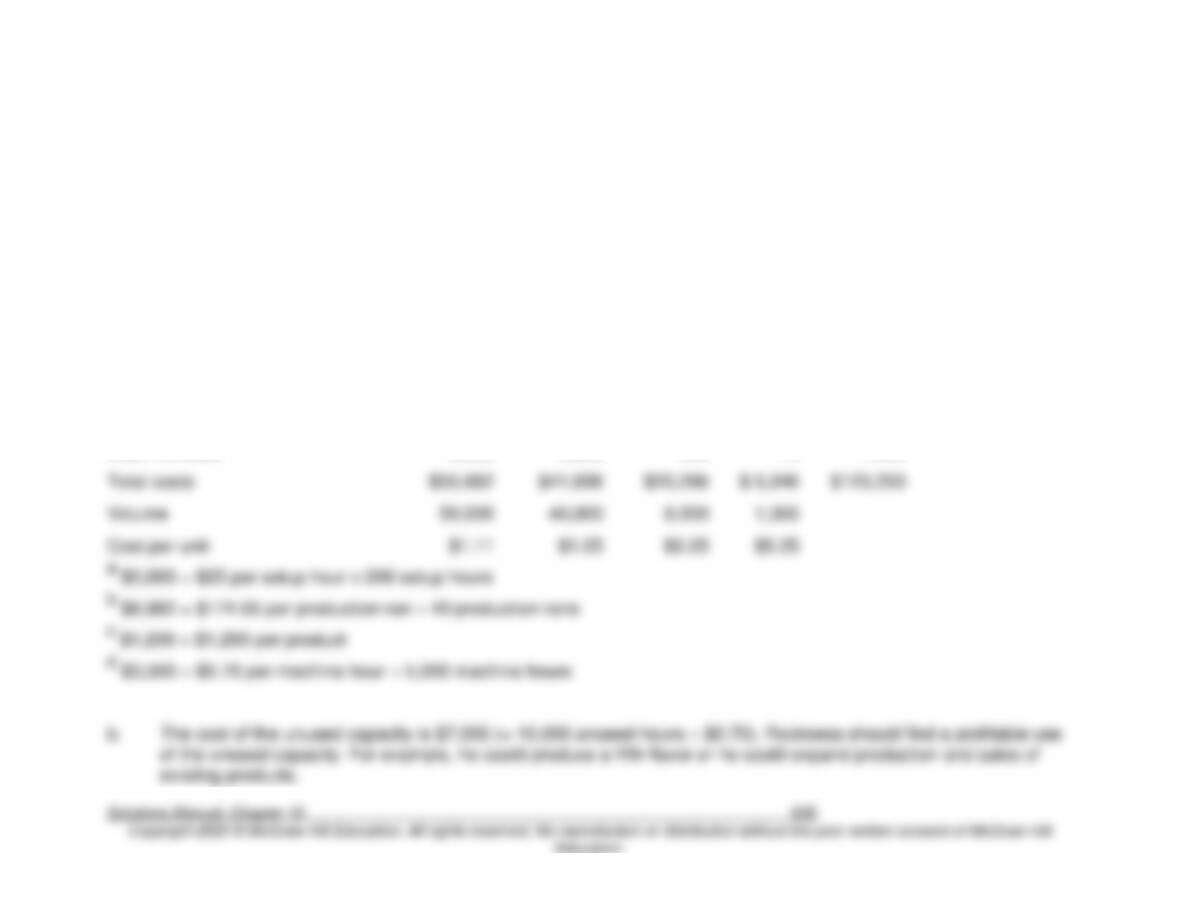
The only change is the cost driver rate for machine time:
Unit Costs on Cola Bottling Line
Diet
Regular
Cherry
Grape
Total
Materials
$ 25,000
$ 20,000
$ 4,680
$ 550
$ 50,230
Direct labor
10,000
8,000
1,800
200
20,000
Fringe benefits on direct labor
4,000
3,200
720
80
8,000
Setup costs
5,000
a
1,500
6,000
1,500
14,000
Production run costs
6,982
b
5,236
5,236
1,746
19,200
Product costs
1,200
c
1,200
1,200
1,200
4,800
Machine costs
Total costs
Volume
Cost per unit
d
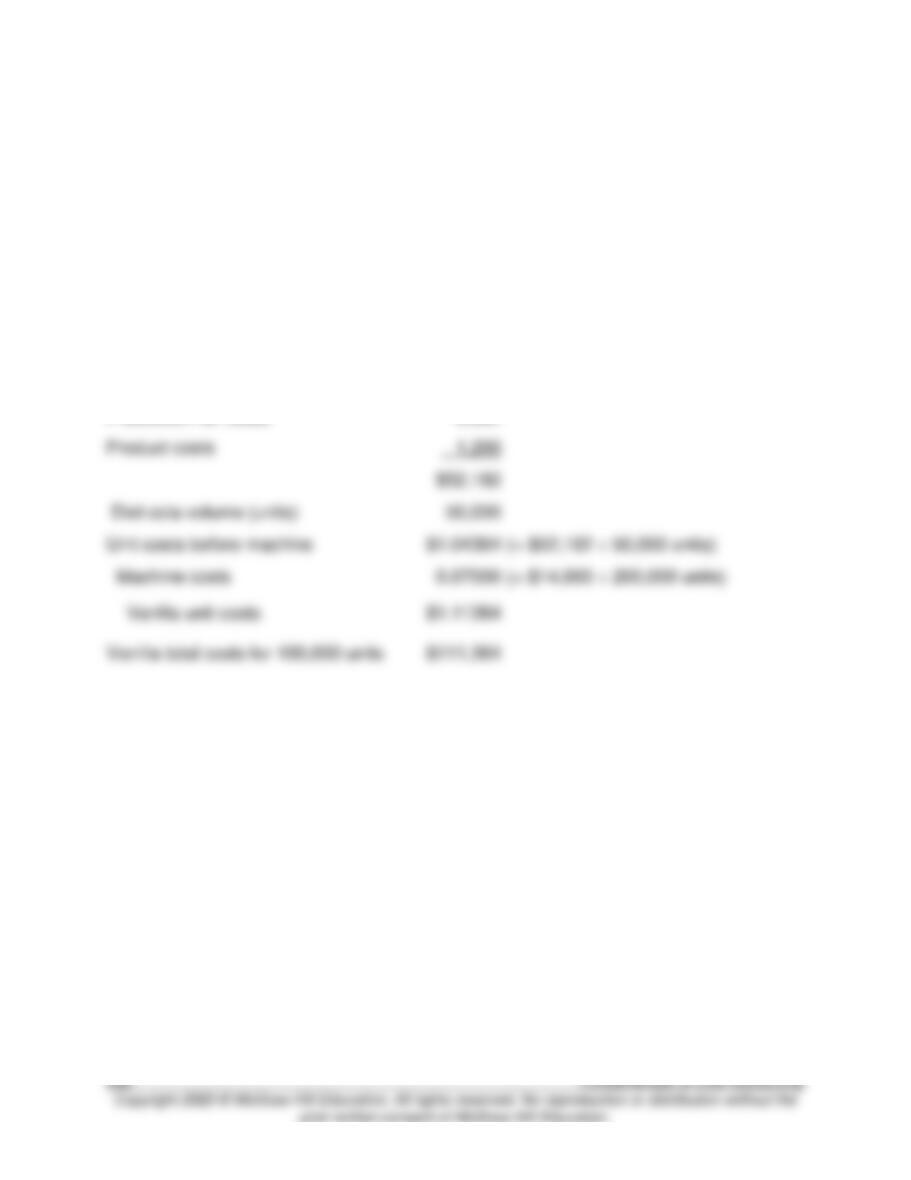
10–73. (continued)
c.
First, compute the costs per unit of Diet Cola, except for the machine costs:
Diet cola costs:
Materials
$ 25,000
Direct labor
10,000
Fringe benefits on direct labor
4,000
Setup costs
5,000
Production run costs
6,982
Product costs
Diet cola volume (units)
Unit costs before machine
$1.04364
(= $52,182 ÷ 50,000 units)
(= $14,000 ÷ 200,000 units)
Vanilla total costs for 100,000 units
$111,364