10–21
PROBLEM 10-35 (15 MINUTES)
Direct
Material
Initial
Mix
Unit
Cost
Standard
Material
Cost
Nyclyn ……………………………………………………………
12 kg
R$ 4.35
R$ 52.20
Salex ……………………………………………………………..
9.6 ltr
R$ 5.40
51.84
Protet …………………………………………………………….
R$ 7.20
PROBLEM 10-36 (45 MINUTES)
1. Type I fertilizer:
Price variance:
Actual quantity used x actual price
3,700 pounds x $ .53………………………………
$1,961
Actual quantity used x standard price
3,700 pounds x $ .50………………………………
Quantity variance:
Actual quantity used x standard price
$1,850
Standard quantity allowed x standard price
$ 350 Favorable
Purchase price variance:
Actual quantity purchased x actual price
$2,650
Actual quantity purchased x standard price
$ 150 Unfavorable
* 40 pounds x 55 clients x 2 applications/client
10–22
PROBLEM 10-36 (CONTINUED)
Type II fertilizer:
Price variance:
Actual quantity used x actual price
7,800 pounds x $ .40…………………………….
$3,120
Actual quantity used x standard price
7,800 pounds x $ .42…………………………….
$ 156 Favorable
Quantity variance:
Actual quantity used x standard price
$3,276
Standard quantity allowed x standard price
$ 420 Favorable
Purchase price variance:
Actual quantity purchased x actual price
$4,000
Actual quantity purchased x standard price
$ 200 Favorable
* 40 pounds x 55 clients x 4 applications/client
2. Direct-labor variances:
Rate variance:
Actual hours used x actual rate
$1,897.50
Actual hours used x standard rate
$ 412.50 Unfavorable
Chapter 10 – Standard Costing and Analysis of Direct Costs
PROBLEM 10-36 (CONTINUED)
Efficiency variance:
$1,485.00
$ 495.00 Favorable
* 2/3 hours x 55 clients x 6 applications
3. Actual cost of applications:
Type I fertilizer:
Actual quantity used x actual price (3,700 pounds x $ .53)….
$1,961.00
Type II fertilizer:
Actual quantity used x actual price (7,800 pounds x $ .40)….
Direct labor:
$6,978.50
10–24
PROBLEM 10-36 (CONTINUED)
4. (a) Yes, the service was a success. Overall costs were controlled, with each of
the three cost components (Type I fertilizer, Type II fertilizer, and direct labor)
producing a net favorable variance on usage, and an overall favorable
(b) In this case, several of the favorable variances may have come back to haunt
Wolfe. The favorable labor efficiency variance means that less time is being
5. This is a management judgment for Wolfe to make. If the service is continued, Wolfe
10–25
PROBLEM 10-37 (35 MINUTES)
1. a. Machine hours x 4 = standard direct-labor hours
2.
a. Standard
Direct-Labor
Cost*
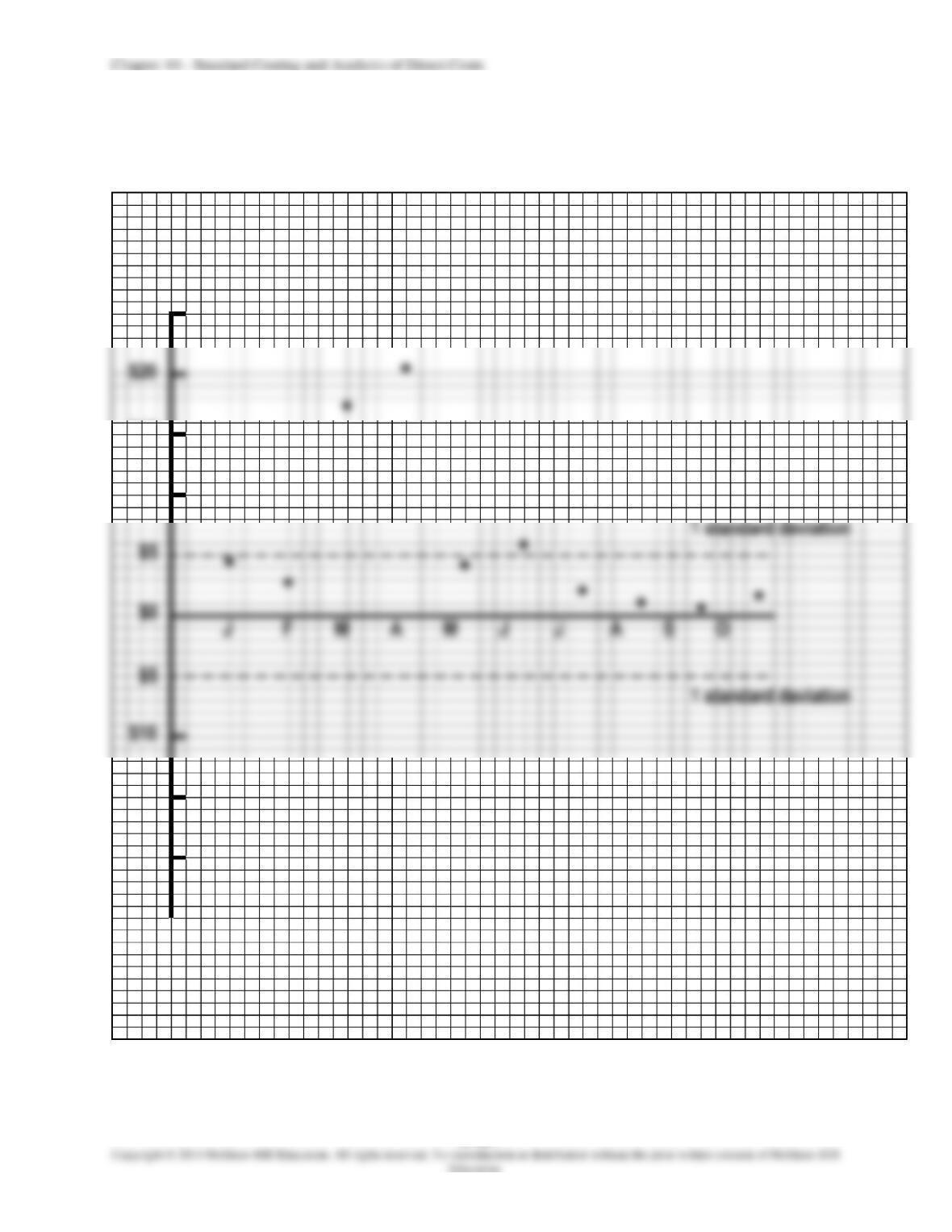
b. 20% of the
Standard Direct-
Labor Cost*
January …………………………………………………….
$ 9,983
$1,997
February …………………………………………………..
6,050
1,210
March ……………………………………………………….
33,297
6,659
April …………………………………………………………
43,056
8,611
May …………………………………………………………..
9,651
1,930
June …………………………………………………………
13,994
2,799
July ………………………………………………………….
6,273
1,255
August ……………………………………………………..
5,791
1,158
September ………………………………………………..
5,791
1,158
October …………………………………………………….
4,343
10–26
PROBLEM 10-37 (CONTINUED)
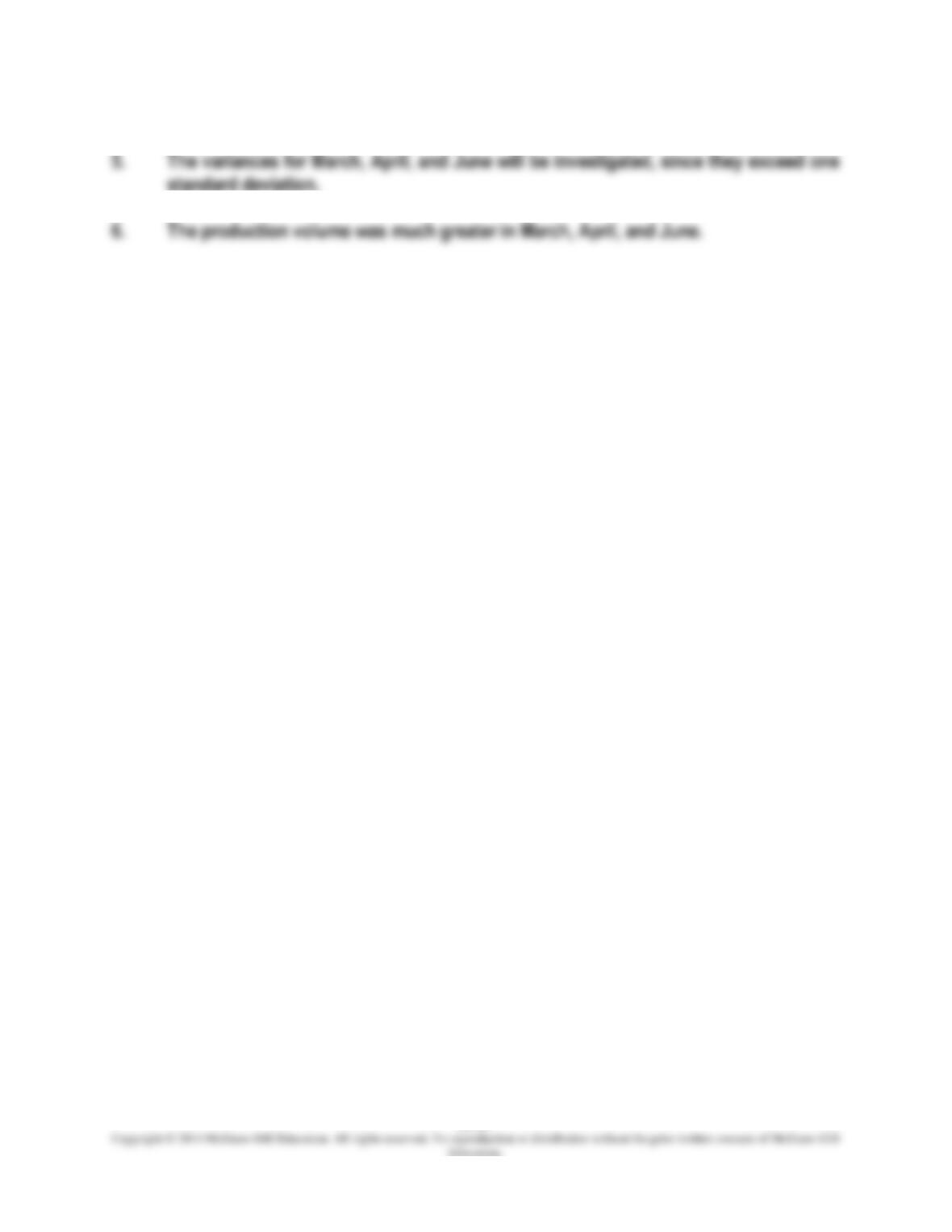
4. Statistical control chart for direct-labor efficiency variances:
$5
$0
$5
$10
$10
$15
$20
$25
$15
$20
$25
Favorable variances
(in thousands)
Unfavorable variances
(in thousands)
Chapter 10 – Standard Costing and Analysis of Direct Costs
10–27
PROBLEM 10-37 (CONTINUED)
10–28
PROBLEM 10-38 (35 MINUTES)
1.
Schedule of standard production costs:
VALPORT VALVE COMPANY: SHREVEPORT PLANT
SCHEDULE OF STANDARD PRODUCTION COSTS: BASED ON 15,600 UNITS
FOR THE MONTH OF MARCH
Standard
Costs
Direct material ………………………………………………
15,600 units 3 lbs. $5.00
$ 234,000
Direct labor …………………………………………………..
877,500
2.
Variances:
a.
Direct-material price variance
=
(AQ
AP) – (AQ
SP)
=
b.
Direct-material quantity variance
=
(AQ
SP) – (SQ
SP)
=
$3,000 Favorable
c.
Direct-material purchase
=
$10,000 Unfavorable
d.
Direct-labor rate variance
=
(AH
=
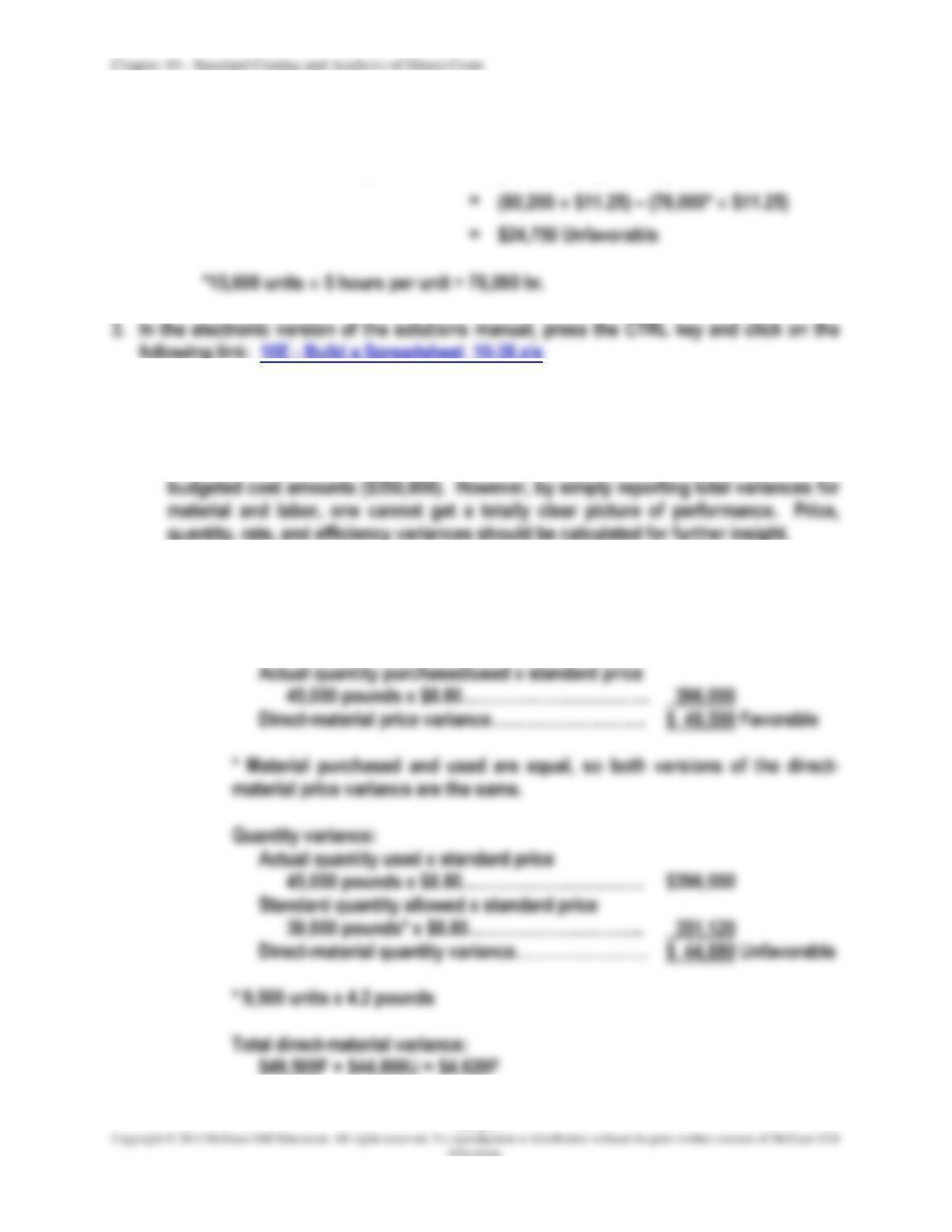
$24,060 Favorable
10–29
PROBLEM 10-38 (CONTINUED)
e.
Direct-labor efficiency variance
=
(AH
SR) – (SH
SR)
=
$24,750 Unfavorable
PROBLEM 10-39 (30 MINUTES)
1. No. The variances are favorable and small, with each being less than 2% of
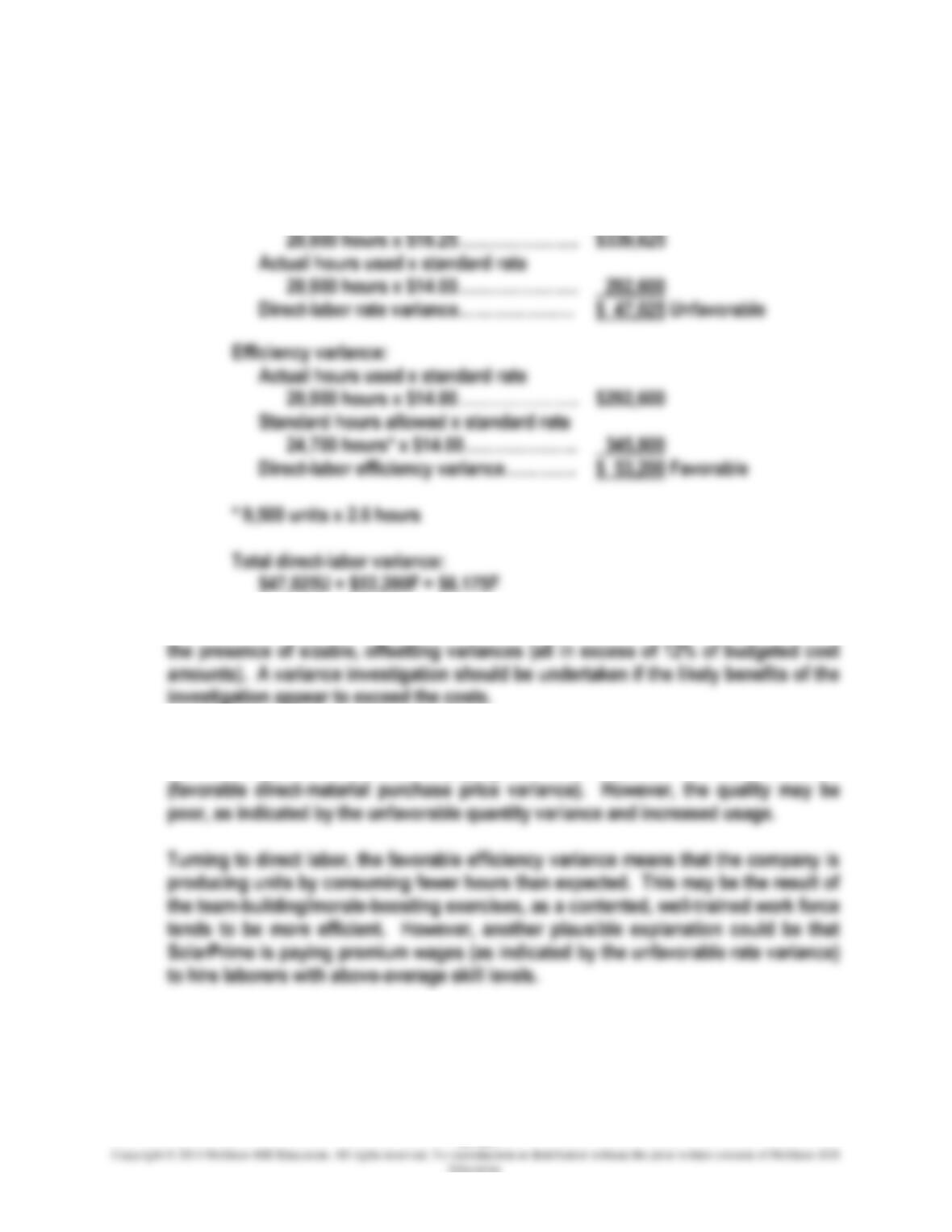
2. Direct-material variances:
Price variance*:
Actual quantity purchased/used x actual price
45,000 pounds x $7.70…………………………….
$346,500
Actual quantity purchased/used x standard price
$ 49,500 Favorable
Quantity variance:
Actual quantity used x standard price
45,000 pounds x $8.80……………………………
$396,000
Standard quantity allowed x standard price
39,900 pounds* x $8.80…………………………..
$ 44,880 Unfavorable
* 9,500 units x 4.2 pounds
Total direct-material variance:
Chapter 10 – Standard Costing and Analysis of Direct Costs
10–30
PROBLEM 10-39 (CONTINUED)
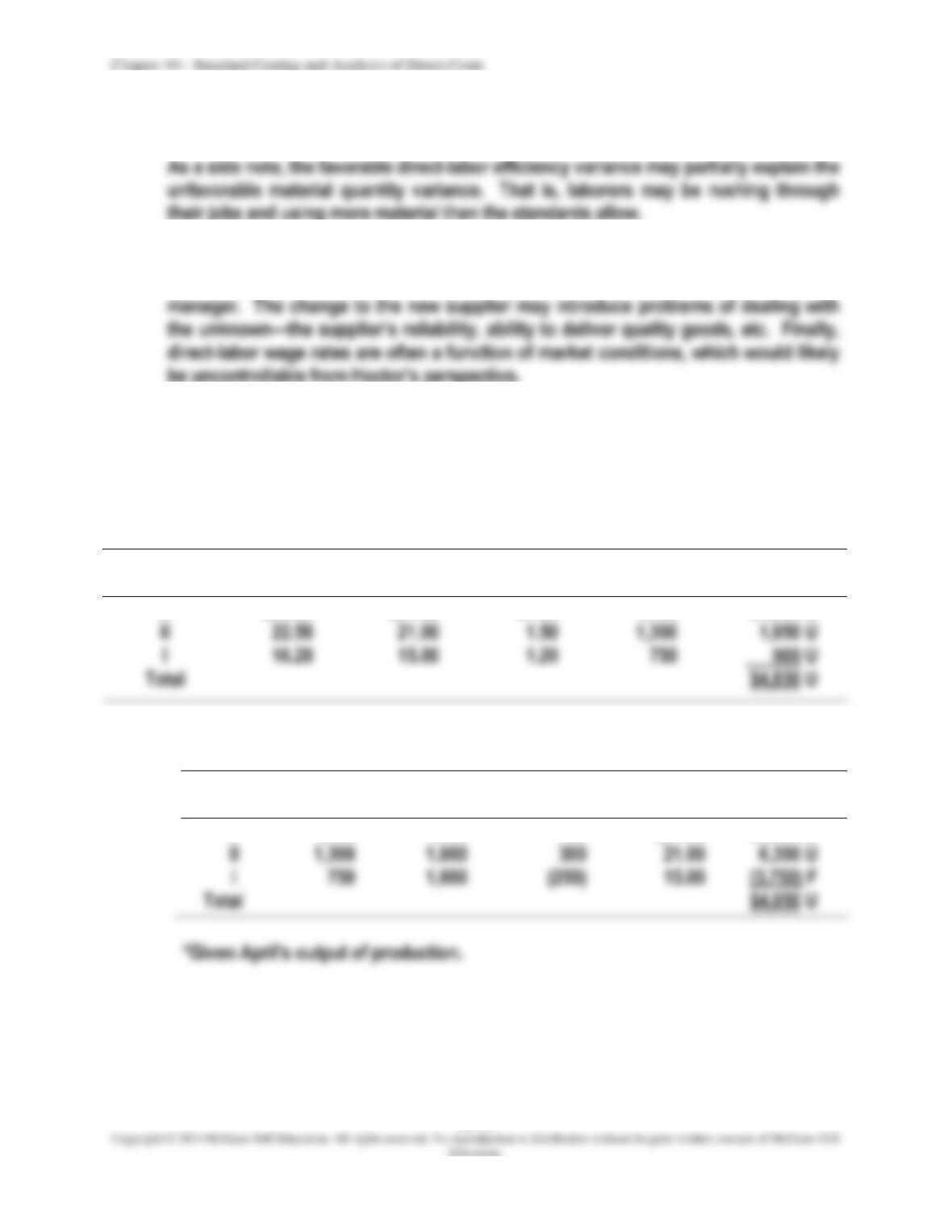
Direct-labor variances:
Rate variance:
Actual hours used x actual rate
$339,625
Actual hours used x standard rate
$ 47,025 Unfavorable
Efficiency variance:
Actual hours used x standard rate
$292,600
Standard hours allowed x standard rate
$ 53,200 Favorable
* 9,500 units x 2.6 hours
Total direct-labor variance:
$47,025U + $53,200F = $6,175F
3. Yes. Although the combined variances are small, a more detailed analysis reveals
4. No, things are not going as smoothly as the vice president believes. With regard to
the new supplier, SolarPrime is paying less than expected for direct materials
10–31
PROBLEM 10-39 (CONTINUED)
5. Yes. Hoctor is the production supervisor. The prices paid for materials and the
quality of material acquired are normally the responsibility of the purchasing
PROBLEM 10-40 (30 MINUTES)
1.
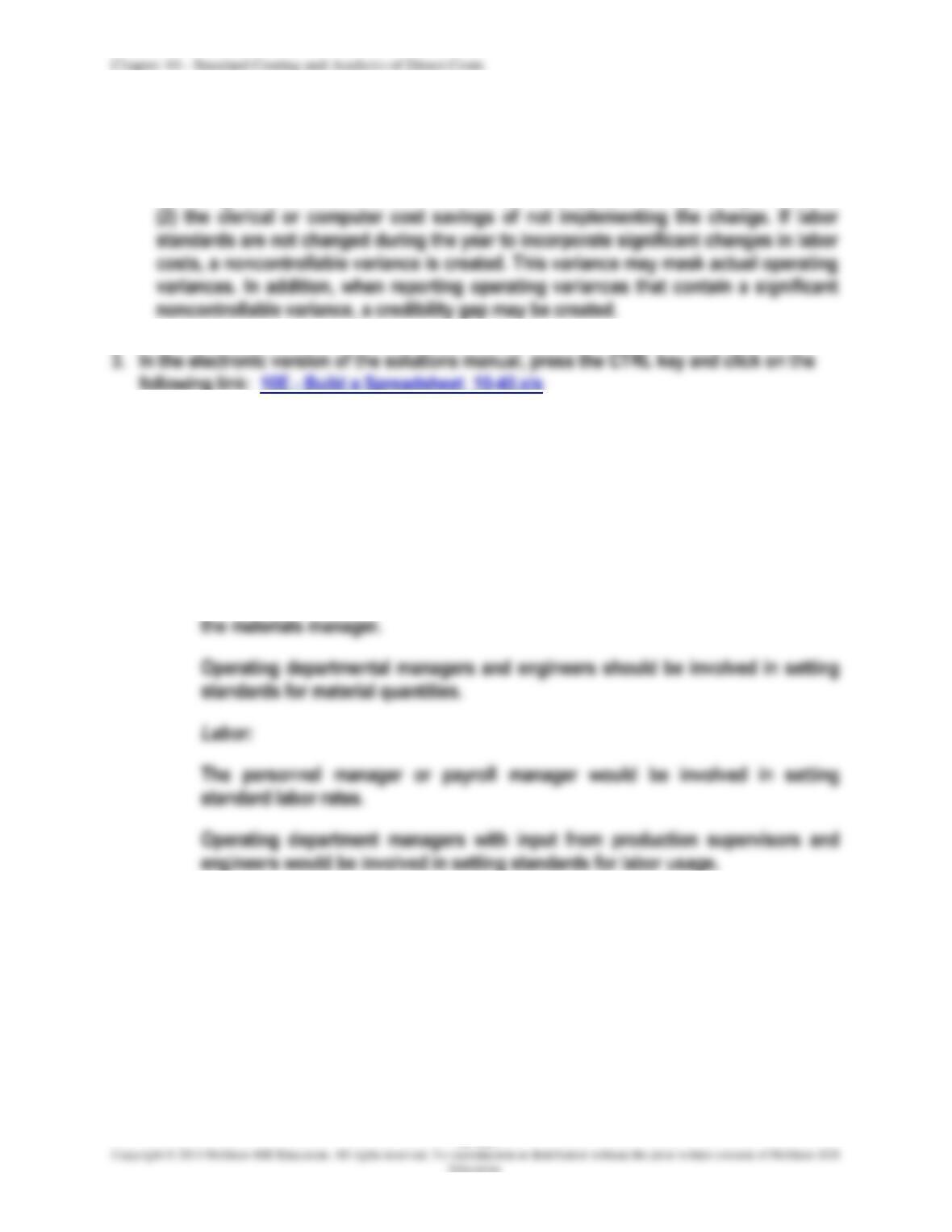
Variances (U denotes unfavorable; F denotes favorable):
a.
Direct-labor rate variance for each labor class:
Labor
Class
Actual
Rate
Standard
Rate
Difference
in Rates
Actual
Hours
Rate
Variance
III
$25.80
$24.00
$1.80
1,100
$1,980 U
1,300
I
750
b.
Direct-labor efficiency variance for each labor class:
Labor
Class
Actual
Hours
Standard
Hours*
Difference
in Hours
Standard
Rate
Efficiency
Variance
III
1,100
1,000
100
$24.00
$2,400 U
1,300
300
21.00
6,300 U
1,000
15.00
(3,750) F
*Given April’s output of production.
10–32
PROBLEM 10-40 (CONTINUED)
2.
The advantages of not changing the labor rate would include (1) comparison of actual
operating results to a fixed base which was previously approved by management, and
PROBLEM 10-41 (30 MINUTES)
1.
a.
Responsibility for setting standards:
Materials:
Labor:
The development of standard prices for material is primarily the responsibility of
Chapter 10 – Standard Costing and Analysis of Direct Costs
10–33
PROBLEM 10-41 (CONTINUED)
b.
The factors that should be considered in establishing material standards include
the following:
• Price studies, including expected general economic conditions, industry
prospects, demand for the materials, and market conditions.
2.
The basis for assignment of responsibility under a standard-costing system is
controllability. Judgments about whether departments or department managers are
10–34
PROBLEM 10-42 (40 MINUTES)
1. The standard cost per 10-gallon batch of strawberry jam is determined as follows:
Strawberries (7.5 qts.* $1.60) …………………………………….
$12.00
Sorting labor (3/60 hr. 6 qt. $18.00) …………………………
Packaging (40 qt.† $.76) …………………………………………….
Total standard cost per 10-gallon batch ………………………..
2.
Joe Adams’ behavior regarding the cost information is unethical because it
violates the following ethical standards (refer to the IMA Statement of Ethical
Professional Practice in the “Focus on Ethics” of Chapter 1):
3.
a.
In general, the purchasing manager is held responsible for unfavorable material
purchase price variances. Causes of these variances include the following:
PROBLEM 10-42 (CONTINUED)
b.
In general, the production manager is held responsible for unfavorable labor
efficiency variances. Causes of these variances include the following:
PROBLEM 10-43 (40 MINUTES)
1.
Variances to be investigated using rule of thumb:
Variance Type
Month
Amount
Percentage of
Standard Cost
Efficiency …………………….
August …………….
76,000 U ………………
7.60%
Efficiency …………………….
September ……….
74,000 U ………………
7.40%
Efficiency …………………….
October ……………
84,000 U ………………
8.40%
Efficiency …………………….
November ………..
120,000 U ………………
Efficiency …………………….
December ………..
104,000 U ………………
2.
The company’s direct-labor efficiency variances exhibit a consistent unfavorable
trend throughout the year. Beginning in January with an unfavorable variance of
3.
It is important to follow up on favorable variances. A consistent pattern of favorable
variances, a favorable trend, or a large favorable variance may indicate that
10–36
PROBLEM 10-43 (CONTINUED)
4. Statistical control chart: investigate August and October variances.
1 standard deviation
•
•
1 standard deviation
Time
Favorable variances
0
Unfavorable variances
•
•
10–37
PROBLEM 10-44 (35 MINUTES)
1.
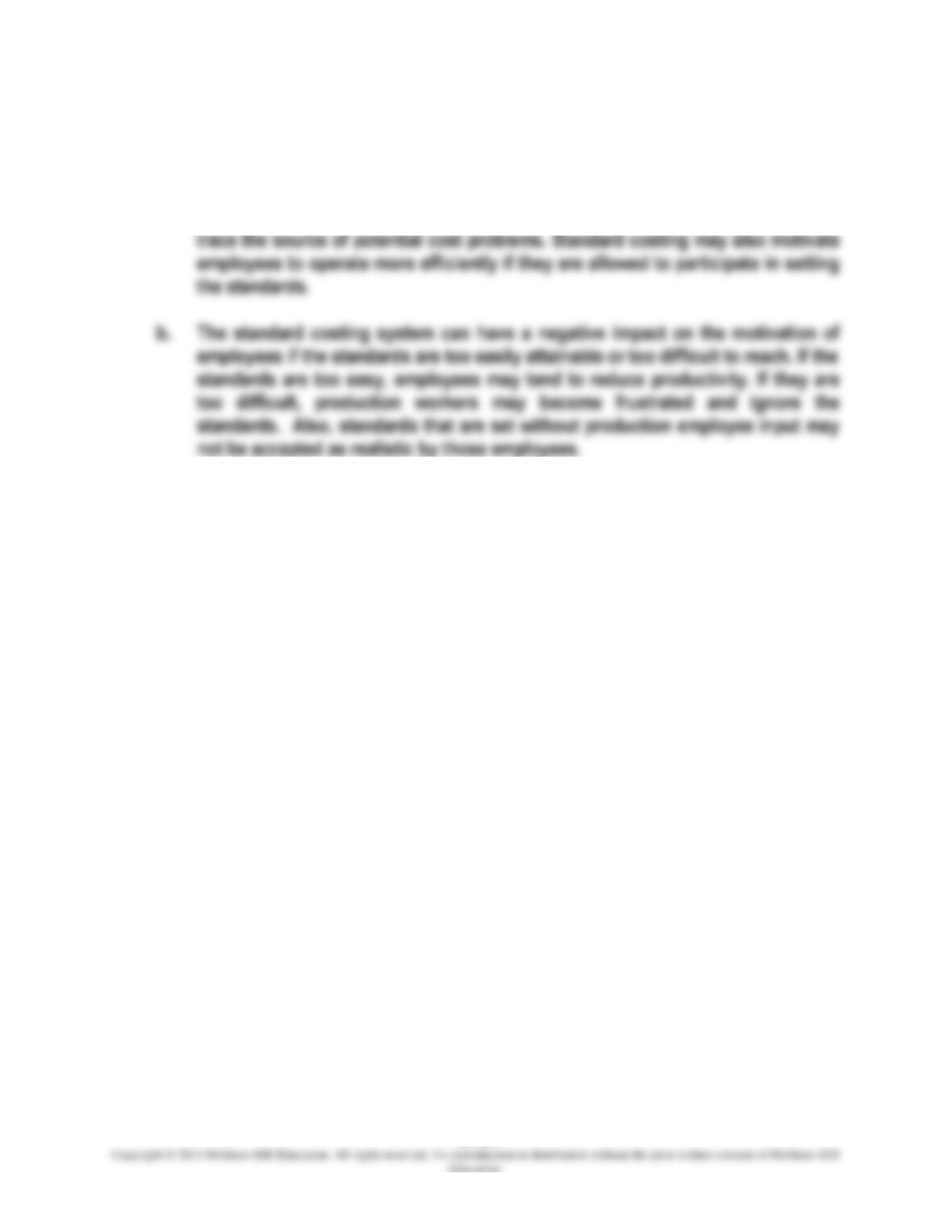
At California Housewares’ Merced Division, the standard cost per cutting board is
calculated as follows:
Direct material:
Lumber (1.5 board ft.* $4.00 per board ft.) ……………
$6.00
Direct labor:
Prepare and cut (14.4†/60 hr. $8.00 per hr.) …………..
$1.92
2.
a.
The role of the purchasing manager in the development of standards includes
establishing the standard cost for material required by the bill of materials,
b.
The role of the industrial engineer in the development of standards includes
preparing the bill of materials that specifies the types and quantities of material
Chapter 10 – Standard Costing and Analysis of Direct Costs
10–38
PROBLEM 10-44 (CONTINUED)
3.
a.
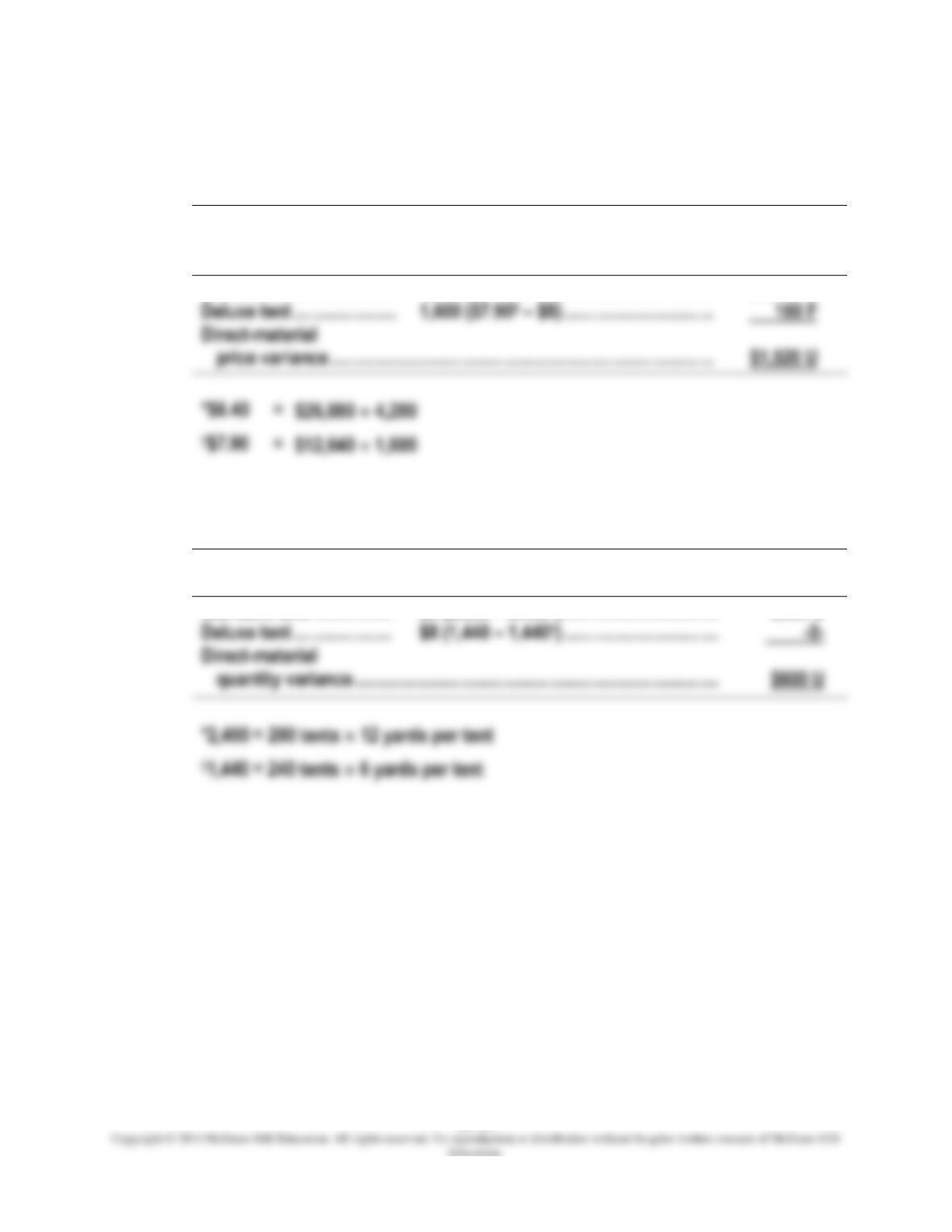
Standard costing allows for management by exception. Timely reporting of
variances allows management to take corrective action before costs get out of
hand. The breakdown of variances into various components helps management
Chapter 10 – Standard Costing and Analysis of Direct Costs
10–39
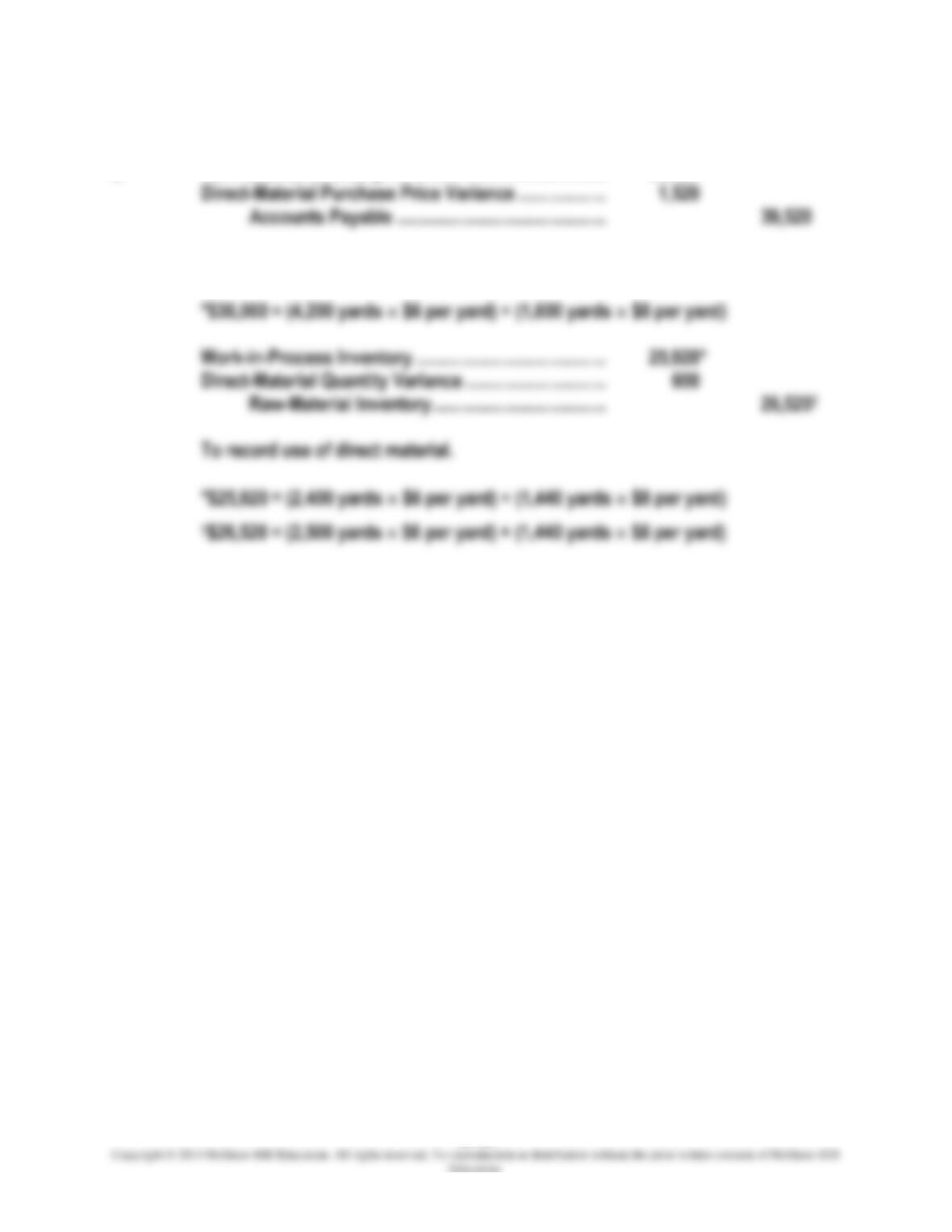
PROBLEM 10-45 (25 MINUTES)
1.
(a)
Direct-material purchase price variance = PQ(AP – SP)
Product
Calculation
PQ(AP – SP)
Purchase
Price
Variance
Standard tent ………………
4,200 ($6.40* – $6) …………………………..
$1,680 U
Deluxe tent ………………….
1,600 ($7.90† – $8) …………………………..
(b)
Direct-material quantity variance = SP(AQ – SQ)
Product
Calculation
SP(AQ – SQ)
Quantity
Variance
Standard tent ……………..
$6 (2,500 – 2,400*) …………………………...
$600 U
Deluxe tent …………………
$8 (1,440 – 1,440†) …………………………...
Chapter 10 – Standard Costing and Analysis of Direct Costs
10–40
PROBLEM 10-45 (CONTINUED)
2.
Raw-Material Inventory ………………………………………..
38,000*
Direct-Material Purchase Price Variance ……………….
Accounts Payable ………………………………………
To record purchase of tent fabrics.
25,920*
Direct-Material Quantity Variance …………………………
Raw-Material Inventory ……………………………….
To record use of direct material.