1. Standard costs are essentially budgeted amounts on a per-unit basis. Unit standards serve as
inputs in building budgets.
2. Unit standards are used to build flexible budgets. Unit standards for variable costs are the
variable cost component of a flexible budgeting formula.
5. Standard costing systems improve planning and control and facilitate product costing.
6. By identifying standards and assessing deviations from the standards, managers can locate
areas where change or corrective behavior is needed.
9. Managers generally tend to have more control over the quantity of an input used rather than the
price paid per unit of input.
10. A standard cost variance should be investigated if the variance is material and if the benefit of
investigating and correcting the deviation is greater than the cost.
13. Disagree. A materials usage variance can be caused by factors beyond the control of the
production manager, e.g., purchase of a lower (or higher) quality of material than normal.
14. Disagree. Using higher-priced workers to perform lower-skilled tasks is an example of an event
that will create a rate variance that is controllable.
10 STANDARD COSTING:
A MANAGERIAL CONTROL TOOL
DISCUSSION QUESTIONS
10-1
CHAPTER 10 Standard Costing: A Managerial Control Tool
15. Some possible causes of an unfavorable labor efficiency variance are inefficient labor, machine
downtime, and poor-quality materials.
16. A kaizen standard is the planned improvement for the coming period. Usually, kaizen focuses on
17. Target costing is a cost management method that is used to reduce costs to a level that reflects
10-2
CHAPTER 10: Standard Costing: A Managerial Control Tool
10-1. a
10-2. e
10-9. d
10-10. a
10-11. c
10-12. d
MULTIPLE-CHOICE QUESTIONS
10-3
CHAPTER 10 Standard Costing: A Managerial Control Tool
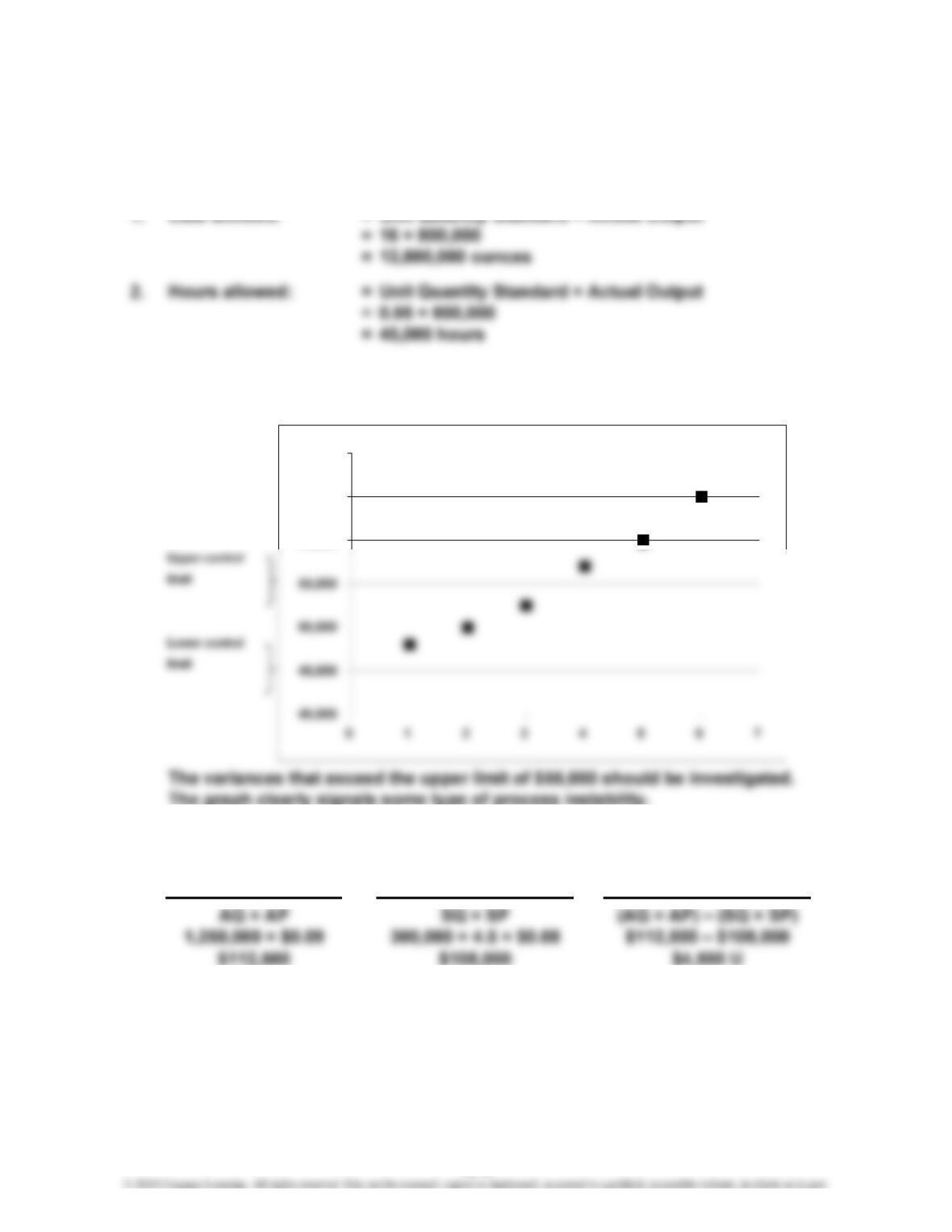
CE 10-20
CE 10-21
CE 10-22
CORNERSTONE EXERCISES
Actual Costs Budgeted Costs Total Variance
60,000
65,000
70,000
10-4
CHAPTER 10: Standard Costing: A Managerial Control Tool
CE 10-23
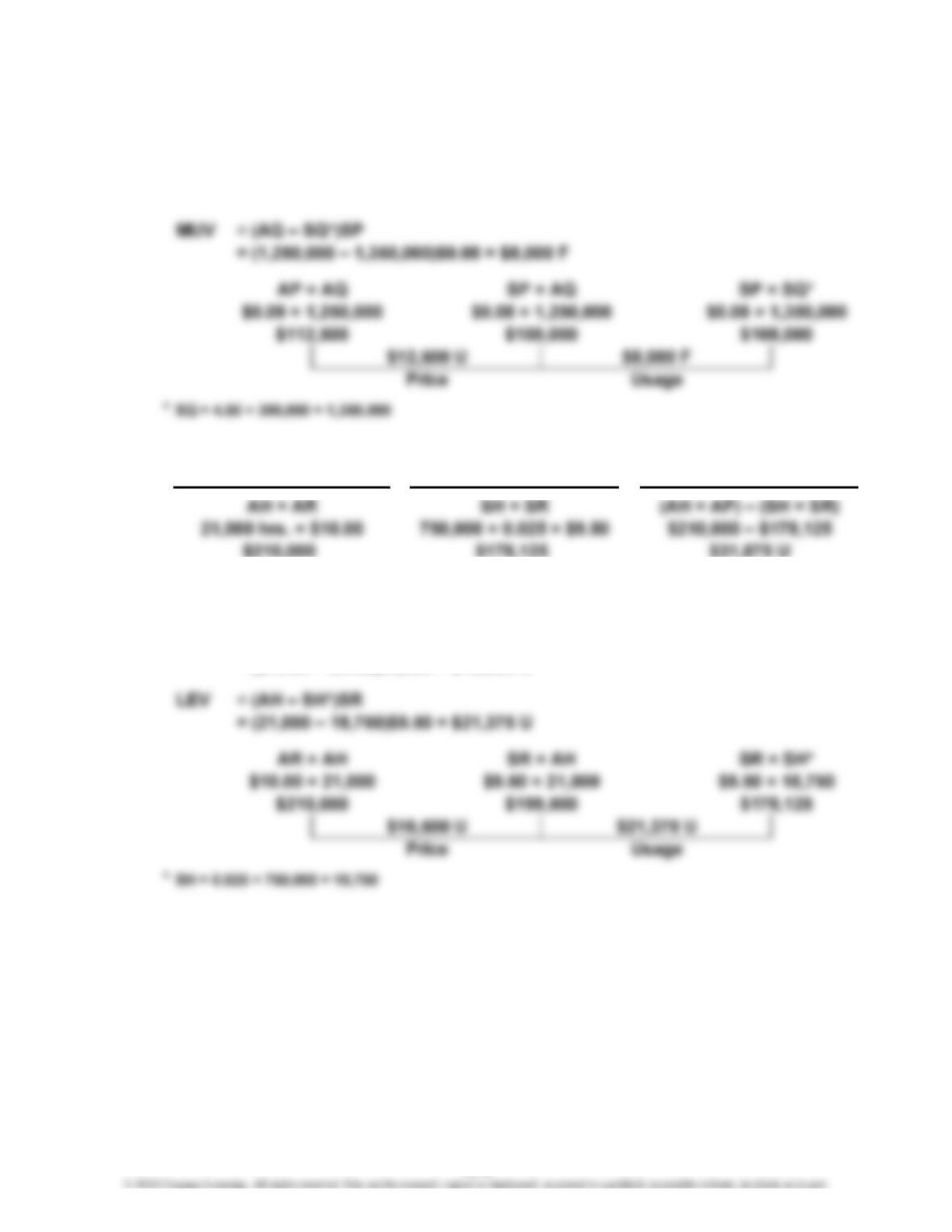
MPV = (AP – SP)AQ
= ($0.09 – $0.08)1,250,000 oz. = $12,500 U
CE 10-24
CE 10-25
LRV = (AR – SR)AH
= ($10.00 – $9.50)21,000 = $10,500 U
Budgeted Costs
Actual Costs
Total Variance
10-5
CHAPTER 10 Standard Costing: A Managerial Control Tool
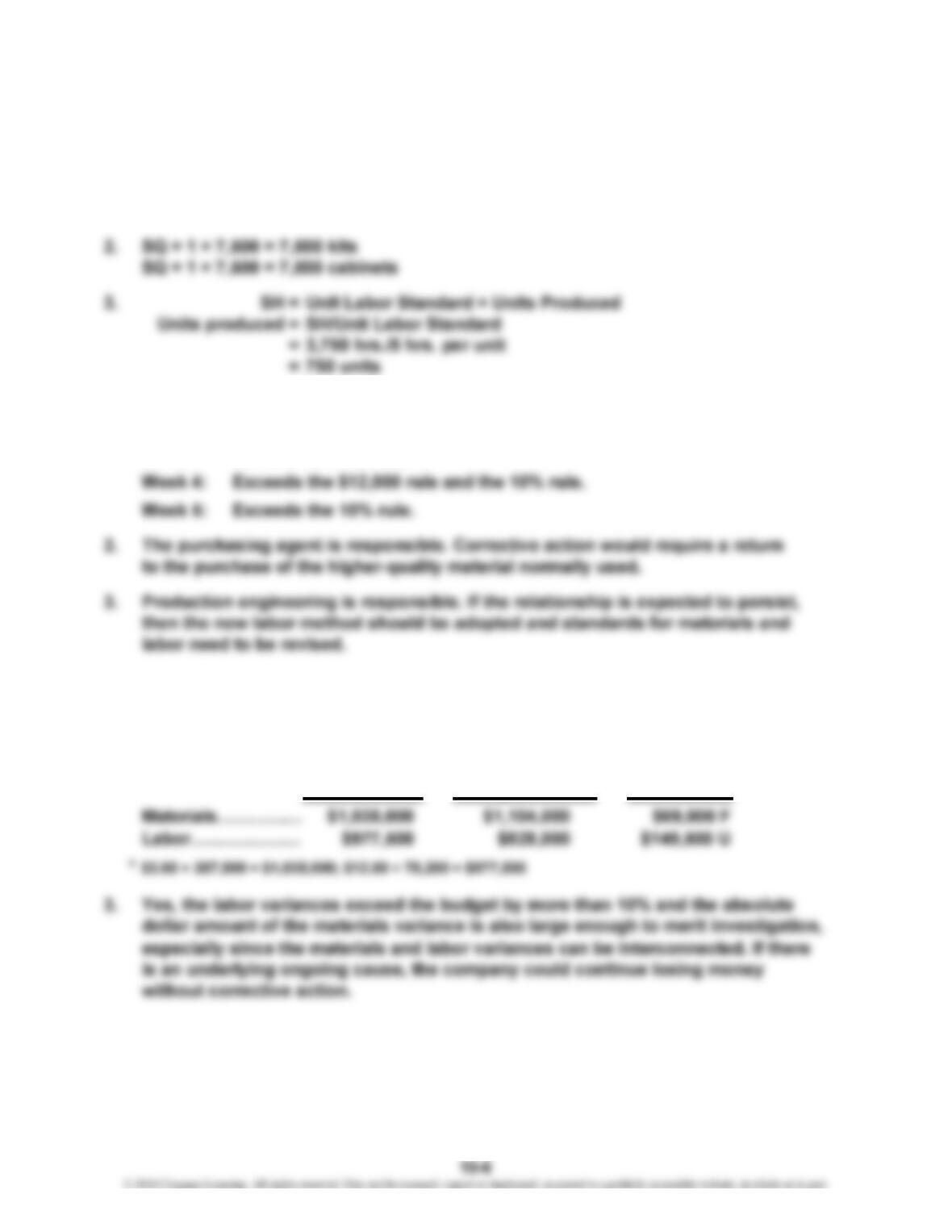
E 10-26
1. SH = 5 × 7,500 = 37,500 hours
E 10-27
1. Cases needing investigation:
Week 2: Exceeds the 10% rule.
E 10-28
1. Materials:
Labor:
2. Actual Cost* Budgeted Cost
EXERCISES
V
ariance
$12 × 92,000 = $1,104,000
$ 9 × 92,000 = $828,000
CHAPTER 10: Standard Costing: A Managerial Control Tool
E 10-29
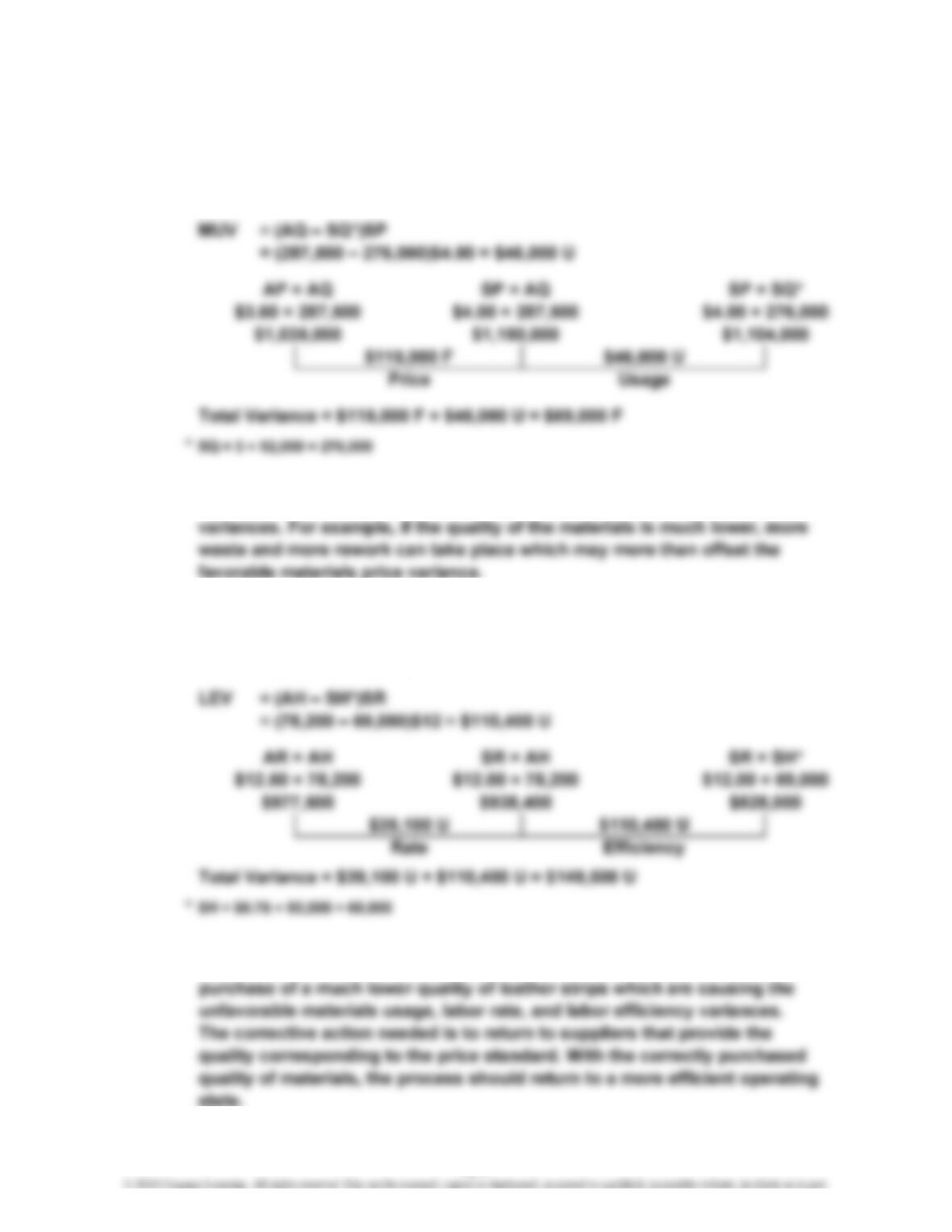
1. MPV = (AP – SP)AQ
= ($3.60 – $4.00)287,500 strips = $115,000 F
2. The suggestion of the purchasing manager is premature. A favorable
materials price can produce an effect on both materials usage and labor
E 10-30
1. LRV = (AR – SR)AH
= ($12.50 – $12.00)78,200 = $39,100 U
2. The feedback from the production manager pinpoints the cause of the
variances. The favorable materials variance is apparently due to the
10-7
CHAPTER 10 Standard Costing: A Managerial Control Tool
E 10-31
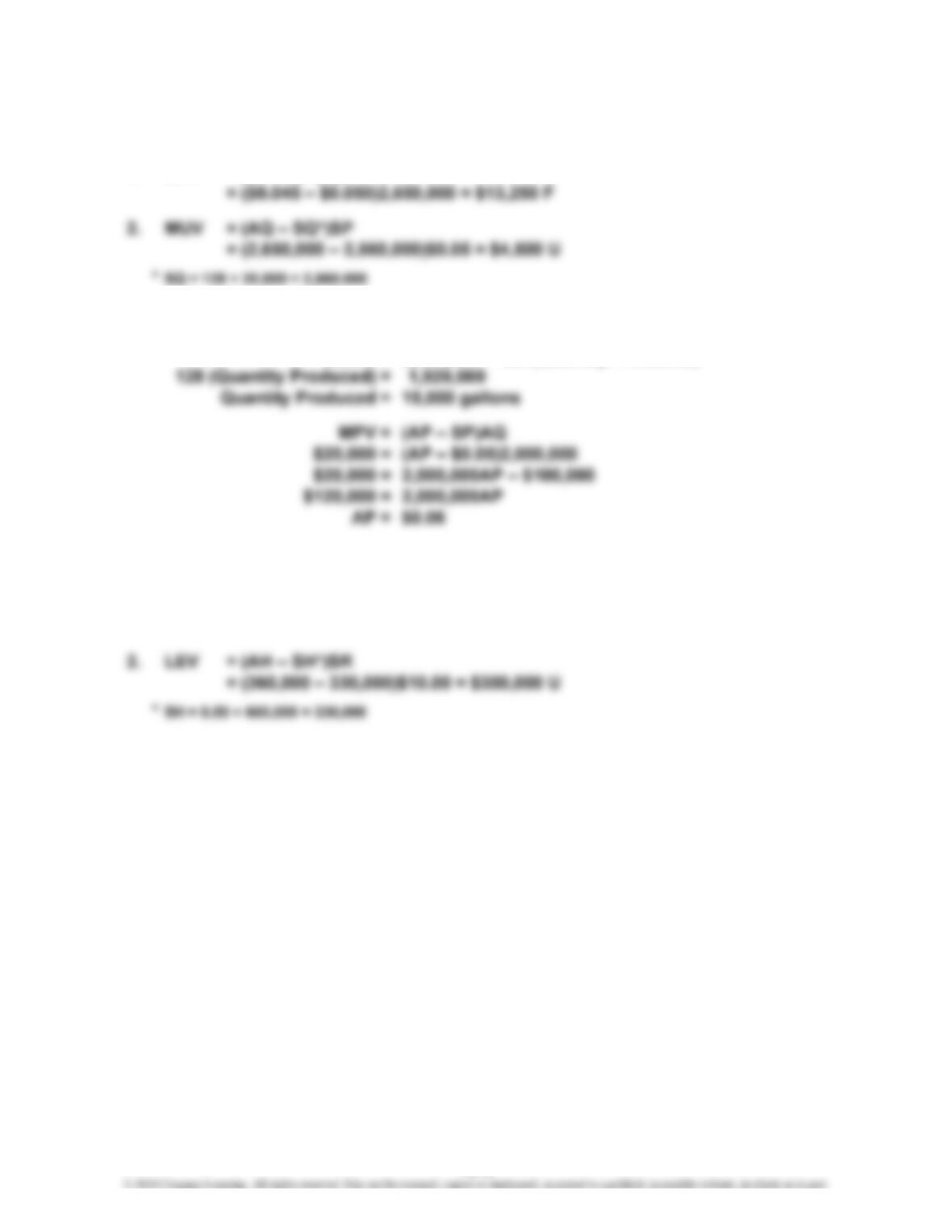
1. MPV = (AP – SP)AQ
3. MUV = (AQ – SQ)SP
$4,000 = [2,000,000 – 128 (Quantity Produced)] × $0.05
80,000 = 2,000,000 – 128 (Quantity Produced)
E 10-32
1. LRV = (AR – SR)AH
= ($9.50 – $10.00)360,000 = $180,000 F
10-8
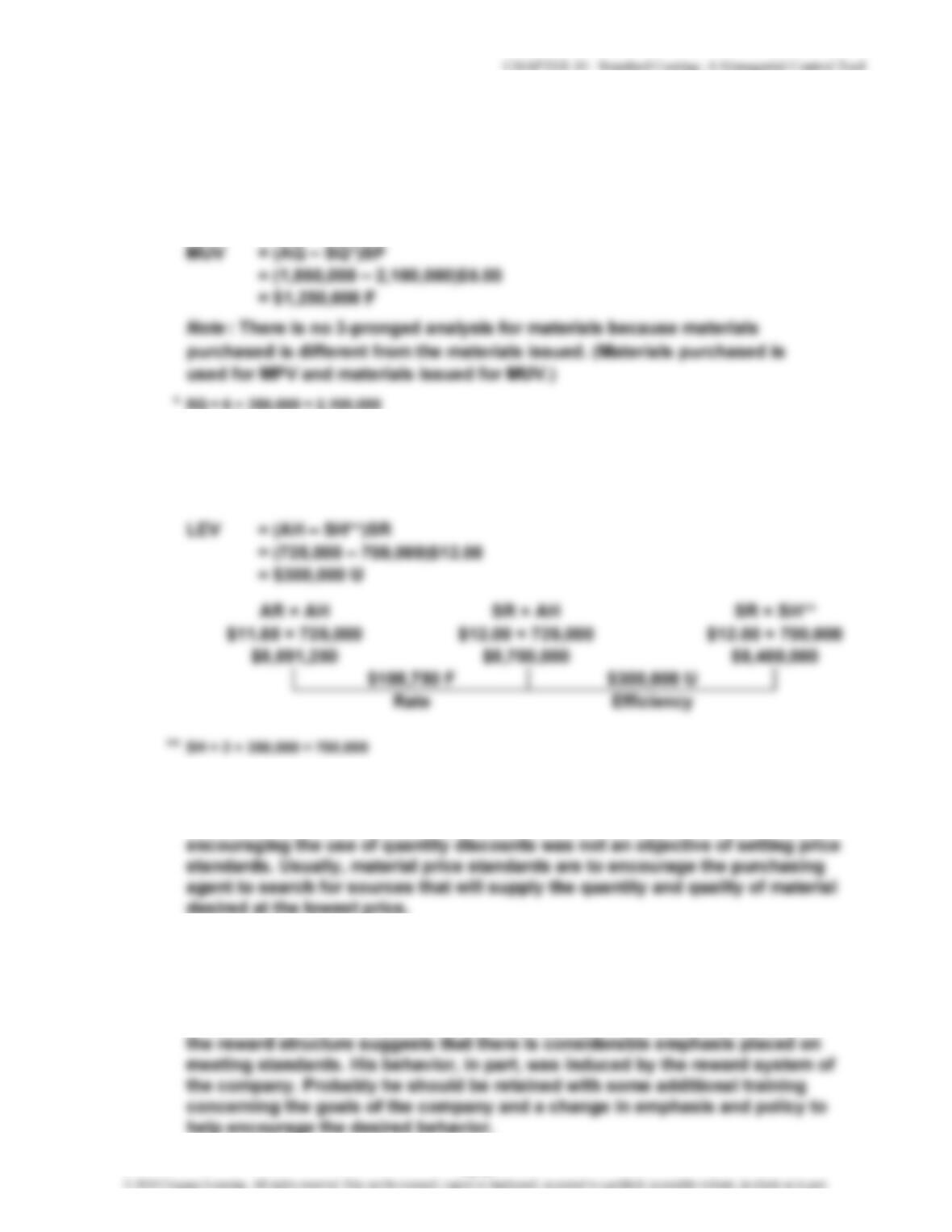
E 10-33
1. MPV = (AP – SP)AQ
= ($5.10 – $5.00)1,860,000
= $186,000 U
2. LRV = (AR – SR)AH
= ($11.85 – $12.00)725,000
= $108,750 F
E 10-34
1. Tom purchased the large quantity to obtain a lower price so that the price
standard could be met. In all likelihood, given the reaction of Jackie Iverson,
2. It sounds like the price standard may be out of date. Revising the price standard
and implementing a policy concerning quantity purchases would likely prevent
this behavior from reoccurring.
3. Tom apparently acted in his own self-interest when making the purchase. He
surely must have known that the quantity approach was not the objective. Yet
10-9
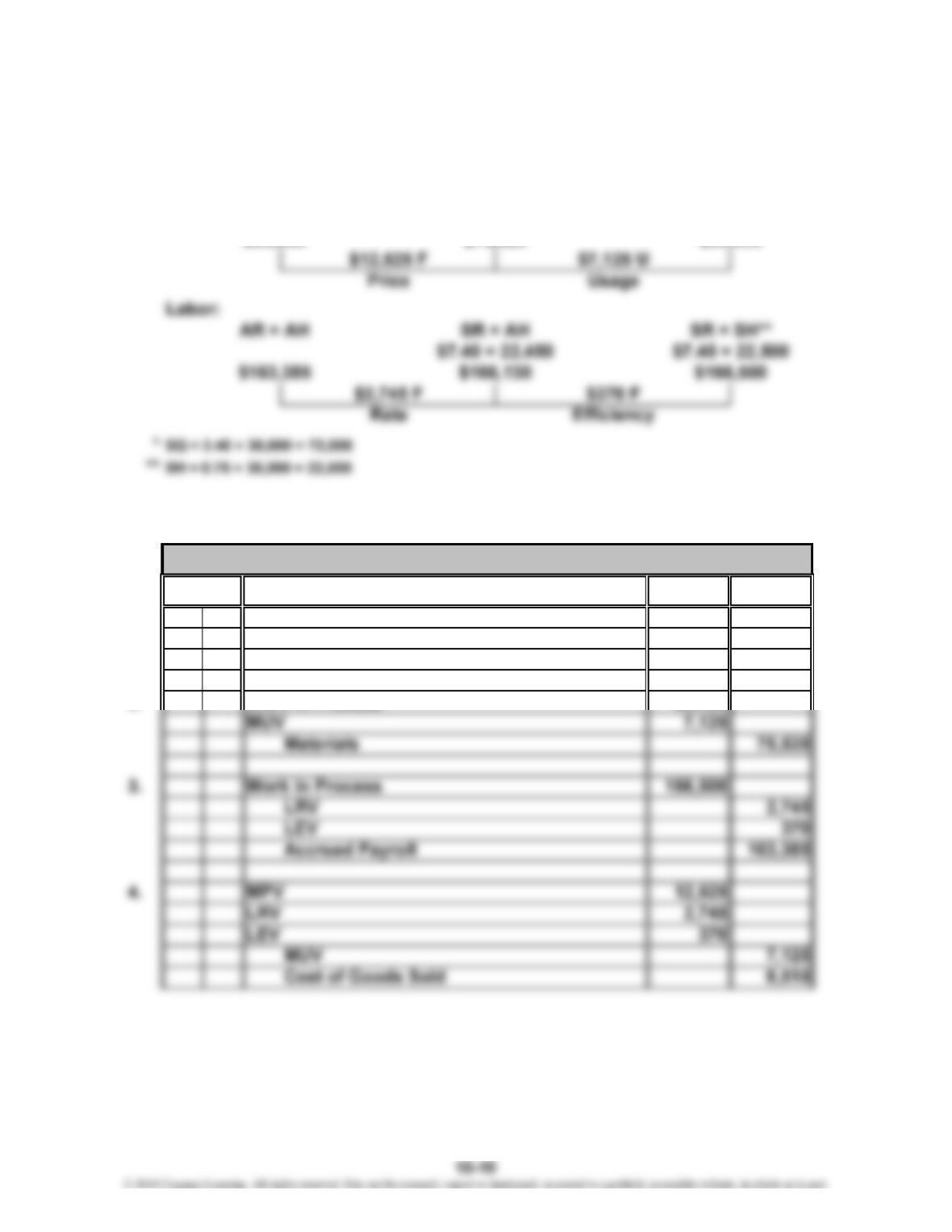
CHAPTER 10 Standard Costing: A Managerial Control Tool
E 10-35
Materials:
E 10-36
Debit Credit
1. Materials 75,525
MPV 12,525
Accounts Payable 63,000
2. Work in Process 68,400
$68,400
Journal
Date Account & Explanation
SP × SQ*
$0.95 × 79,500 $0.95 × 72,000
AP × AQ SP × AQ
$63,000 $75,525
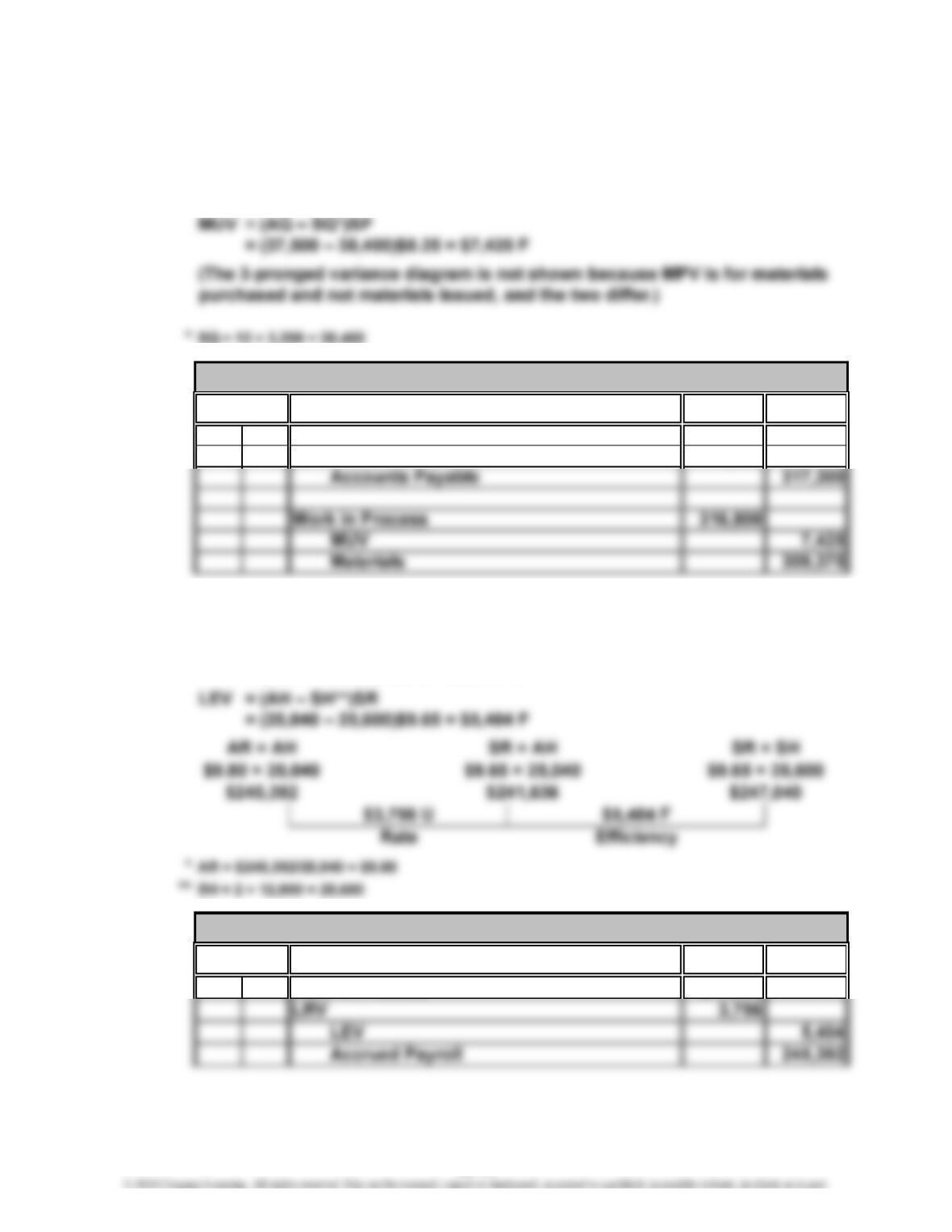
CHAPTER 10: Standard Costing: A Managerial Control Tool
E 10-37
1. MPV = (AP – SP)AQ
= ($8.35 – $8.25)38,000 = $3,800 U
2.
Debit Credit
Materials 313,500
MPV 3,800
E 10-38
1. LRV = (AR* – SR)AH
= ($9.80 – $9.65)25,040 = $3,756 U
2.
Debit Credit
Work in Process 247,040
Date Account & Explanation
Journal
Journal
Date Account & Explanation
10-11
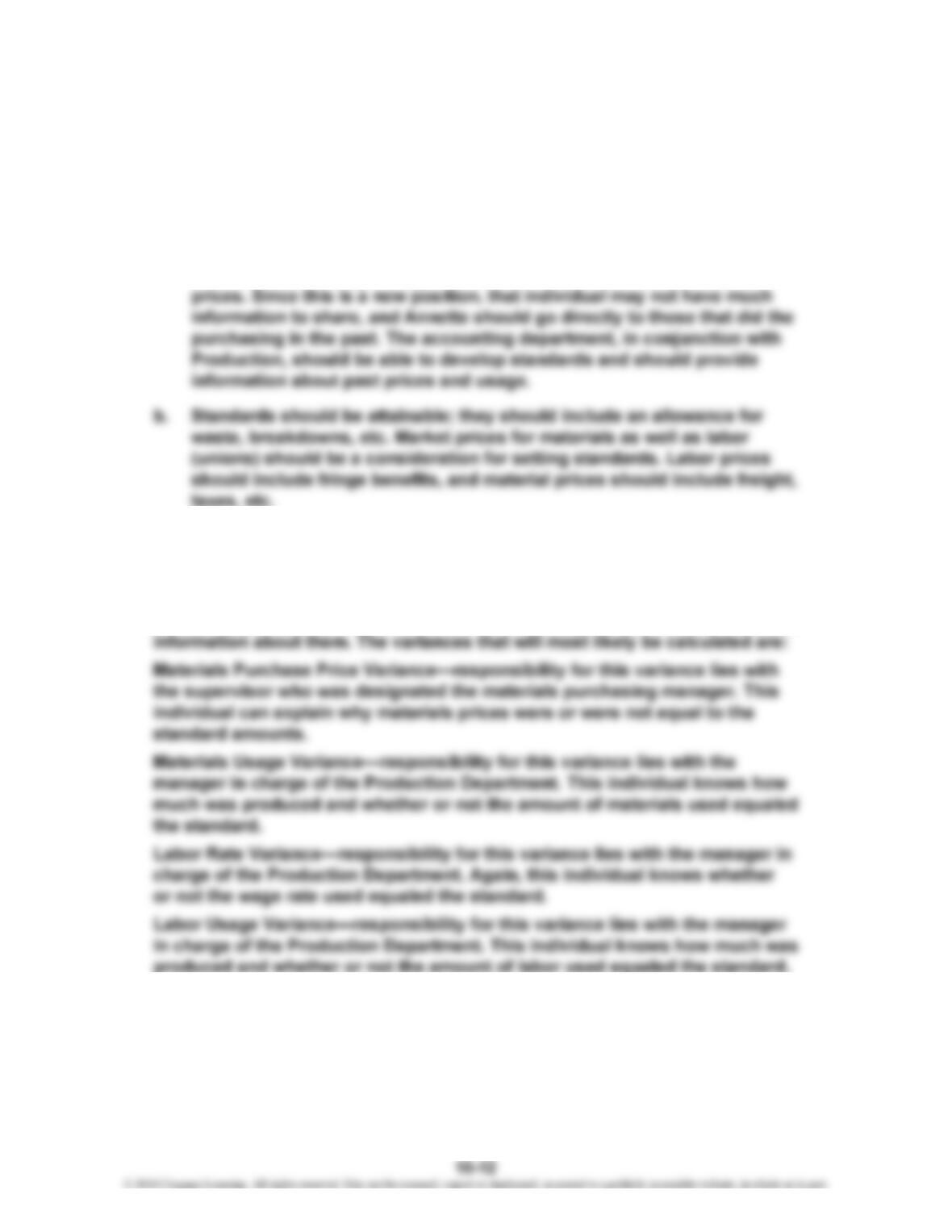
CHAPTER 10 Standard Costing: A Managerial Control Tool
P 10-39
1. a. The managers of each cost center should be involved in setting standards.
They understand the actual conditions and are the primary source fo
r
information on quantity used and wages paid. The newly designated
materials purchasing manager is the information source for material
2. Once the standards are set, actual results can be compared with the standards
and variances can be calculated. Of course, the variances themselves are onl
y
indicators of potential problems. The underlying causes of the variances must
be determined to decide whether or not corrective action is needed. For this
reason, responsibility for the variances will be assigned to those with the most
PROBLEMS
CHAPTER 10: Standard Costing: A Managerial Control Tool
P 10-40
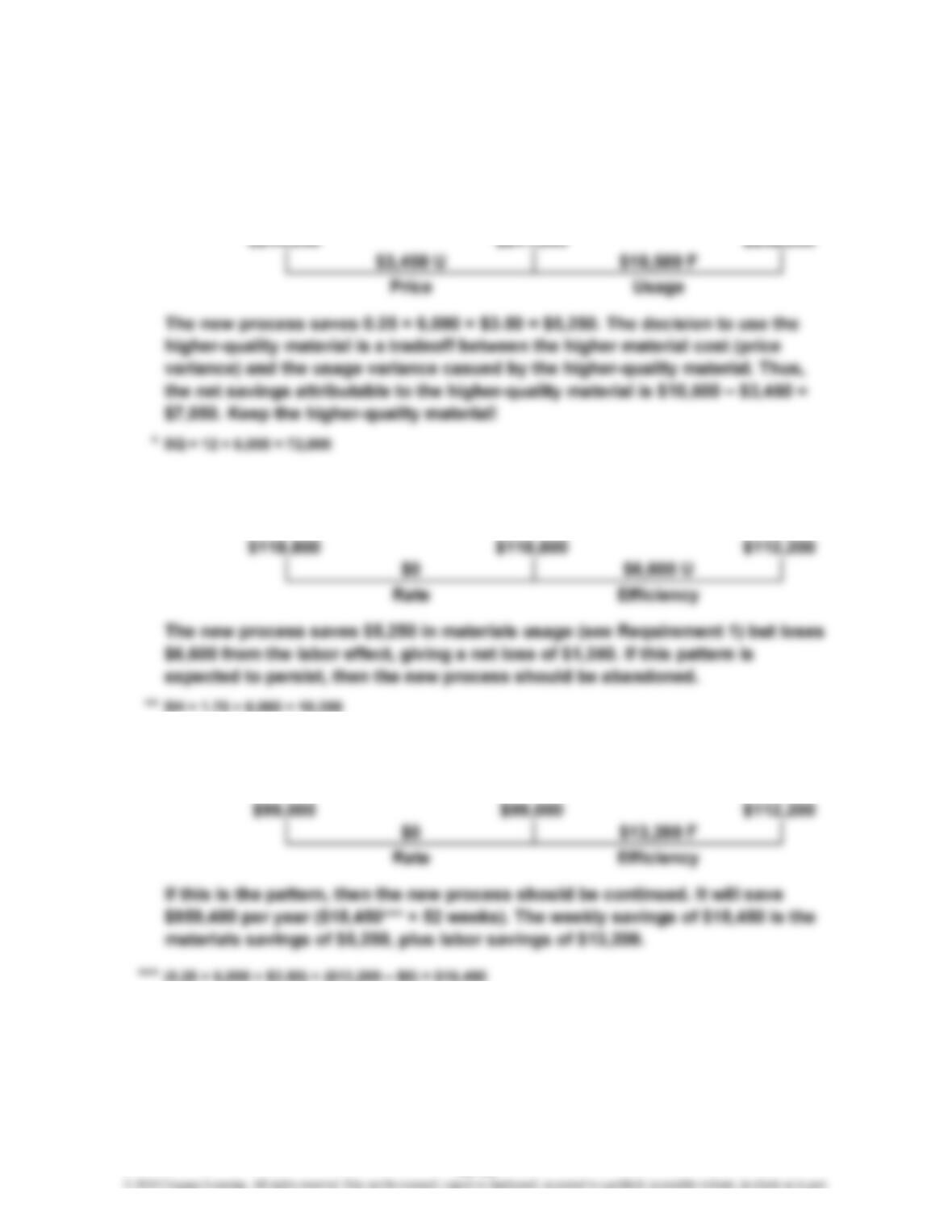
1. Materials:
2. Labor for new process:
3. Labor for new process, one week later:
AR × AH
$11 × 10,800
SR × SH**
AR × AH SR × AH SR × SH
SP × SQ*
$3.50 × 72,000
AP × AQ
$3.55 × 69,000
SP × AQ
$3.50 × 69,000
$11 × 9,000
$11 × 10,200
SR × AH
$11 × 10,200
10-13
CHAPTER 10 Standard Costing: A Managerial Control Tool
P 10-41
1. Granite:
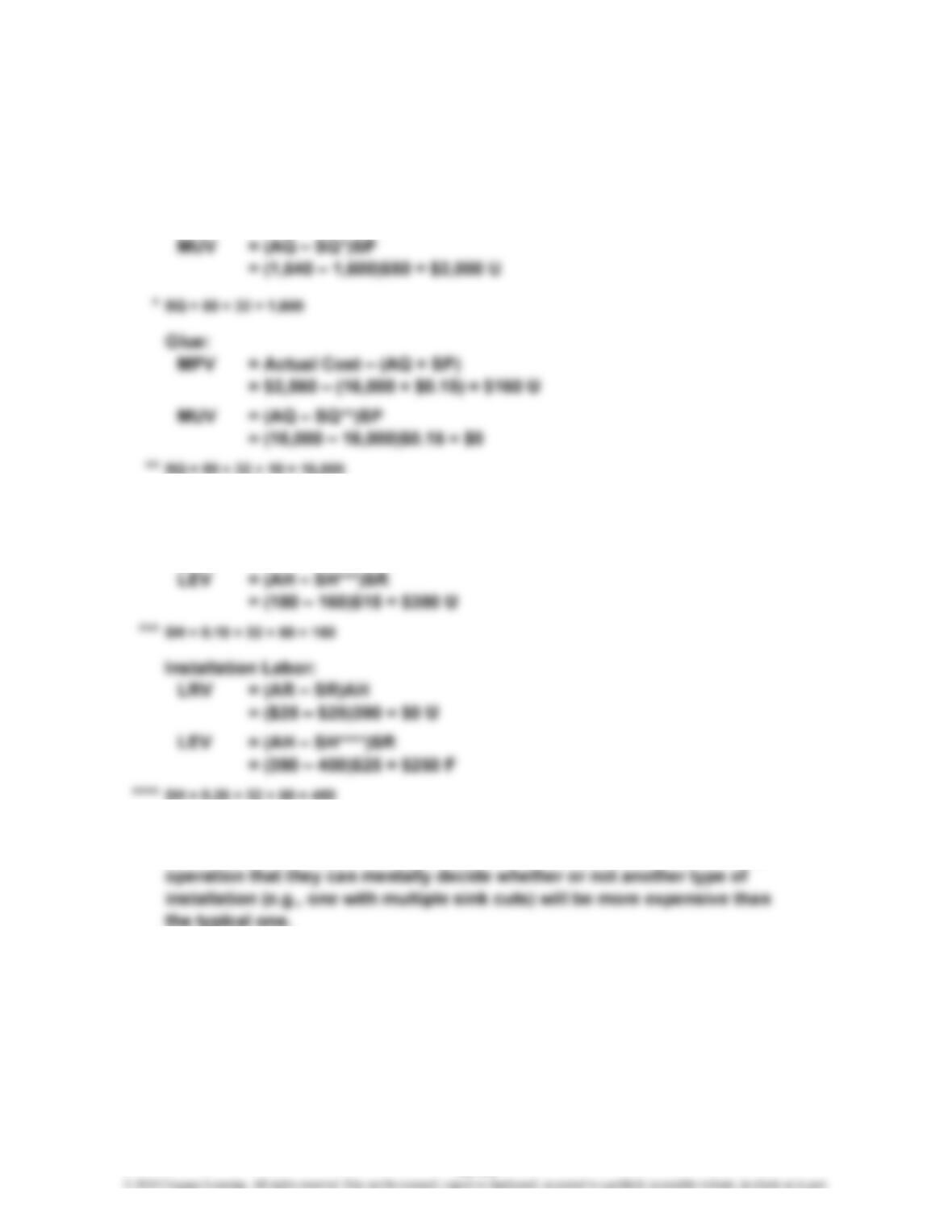
MPV = Actual Cost – (AQ × SP)
= $79,048 – (1,640 × $50) = $2,952 F
2. Cutting Labor:
LRV = (AR – SR)AH
= ($15 – $15)180 = $0
3. It would probably not be worthwhile for Charlene to establish standards
for every different type of installation. Tom and Tony have a small enough
10-14