CA 10.3 (Continued)
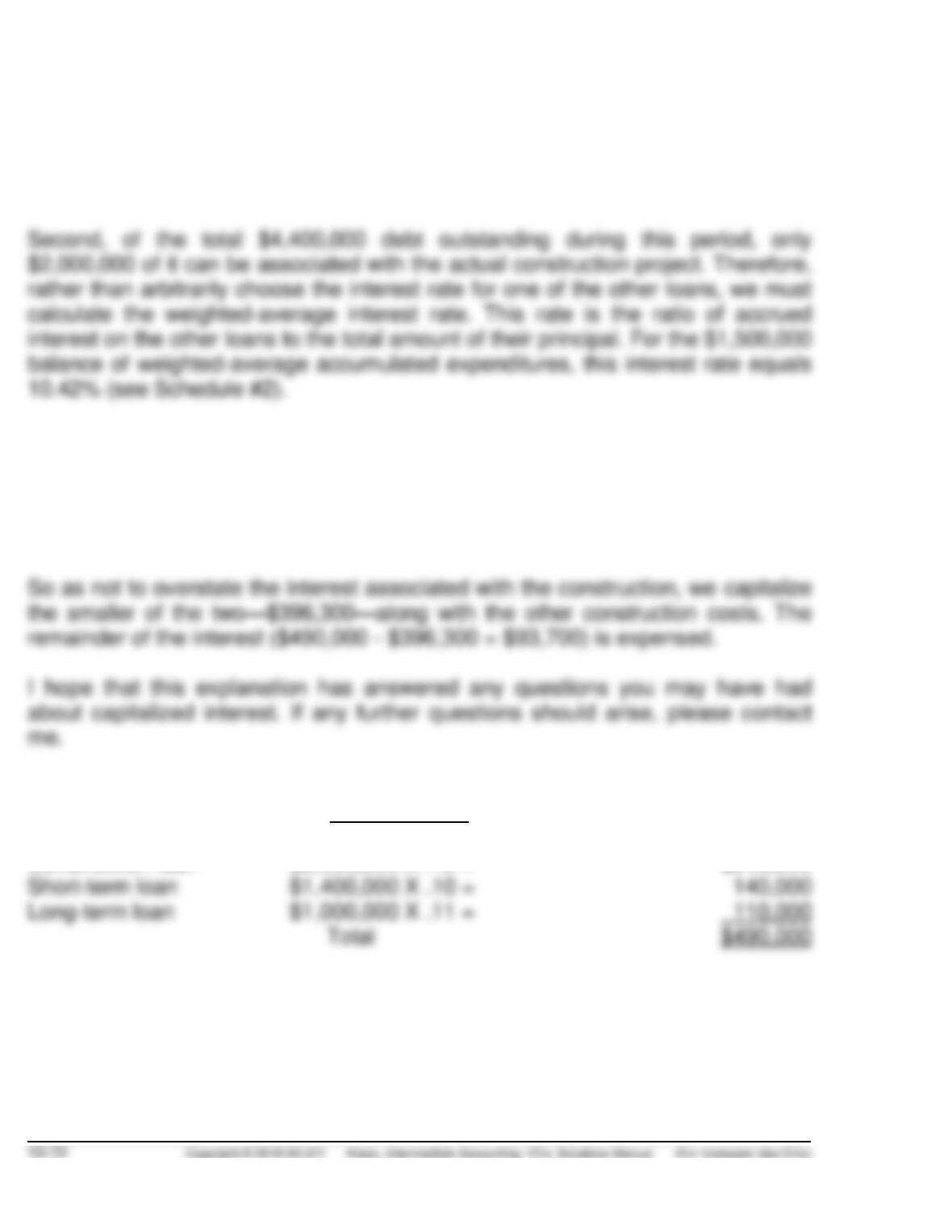
Calculations for avoidable interest are more complex. First, interest can be
capitalized only on the weighted-average amount of accumulated expenditures.
Although total costs amounted to $5,200,000 for the project, an average of only
$3,500,000 was outstanding during the period of construction.
Third, we compute our avoidable interest as follows: calculate the interest on the
loan directly associated with the construction. Apply the weighted-average
interest rate to the remainder of the weighted-average accumulated expenditures.
Add these products. Avoidable interest for 2019 amounts to $396,300 (see
Schedule #3).
Schedule #1
Actual Interest
Construction loan
$2,000,000 X .12 =
$240,000
$1,400,000 X .10 =
$1,000,000 X .11 =
CA 10.3 (Continued)
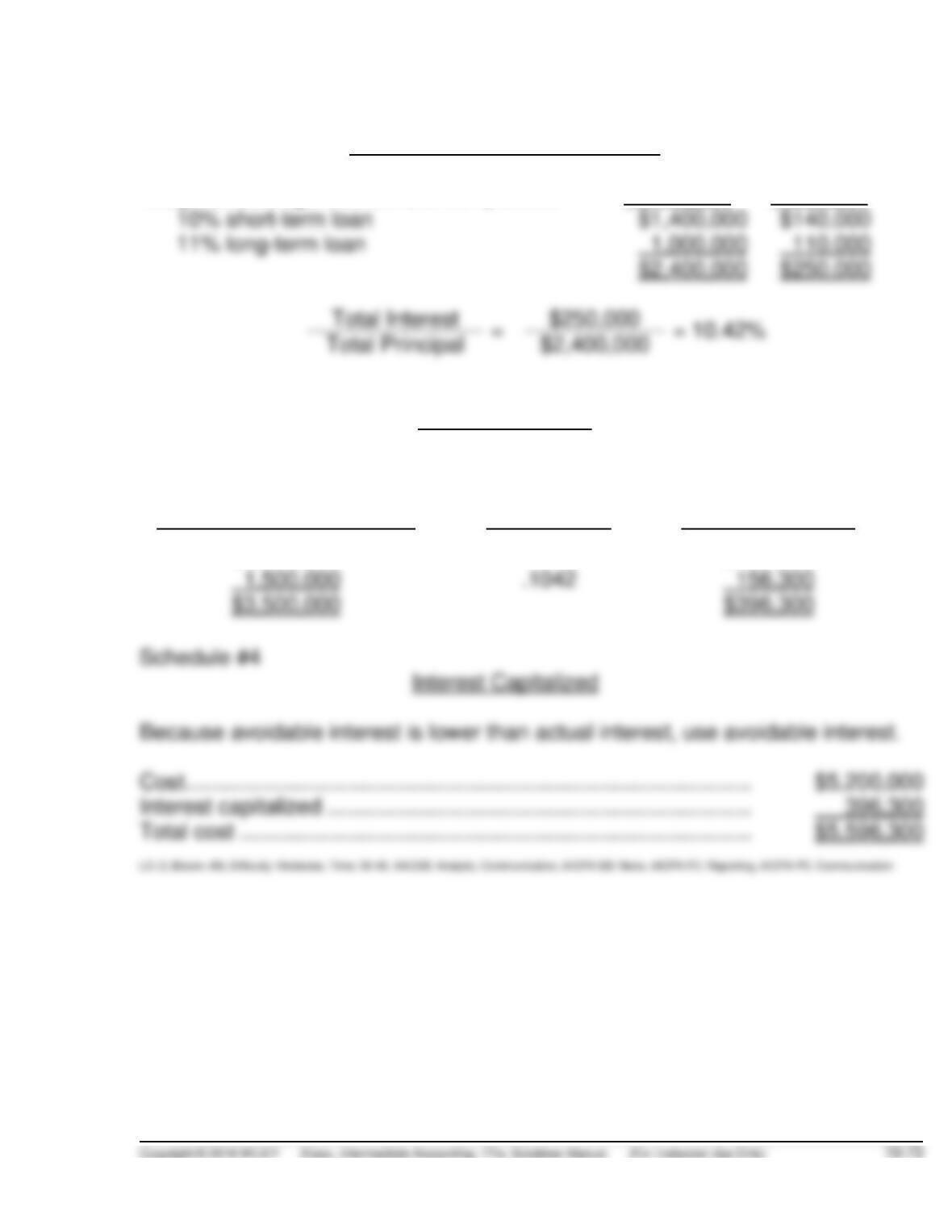
Schedule #2
Weighted-Average Interest Rate
Weighted-average interest rate computation
Principal
Interest
10% short-term loan
11% long-term loan
Schedule #3
Avoidable Interest
Weighted-Average
Accumulated Expenditures
X
Interest Rate
=
Avoidable Interest
$2,000,000
.12
$240,000
Schedule #4
Interest capitalized ……………………………………………………………
Total cost ………………………………………………………………………..
CA 10.4
(a) Client A
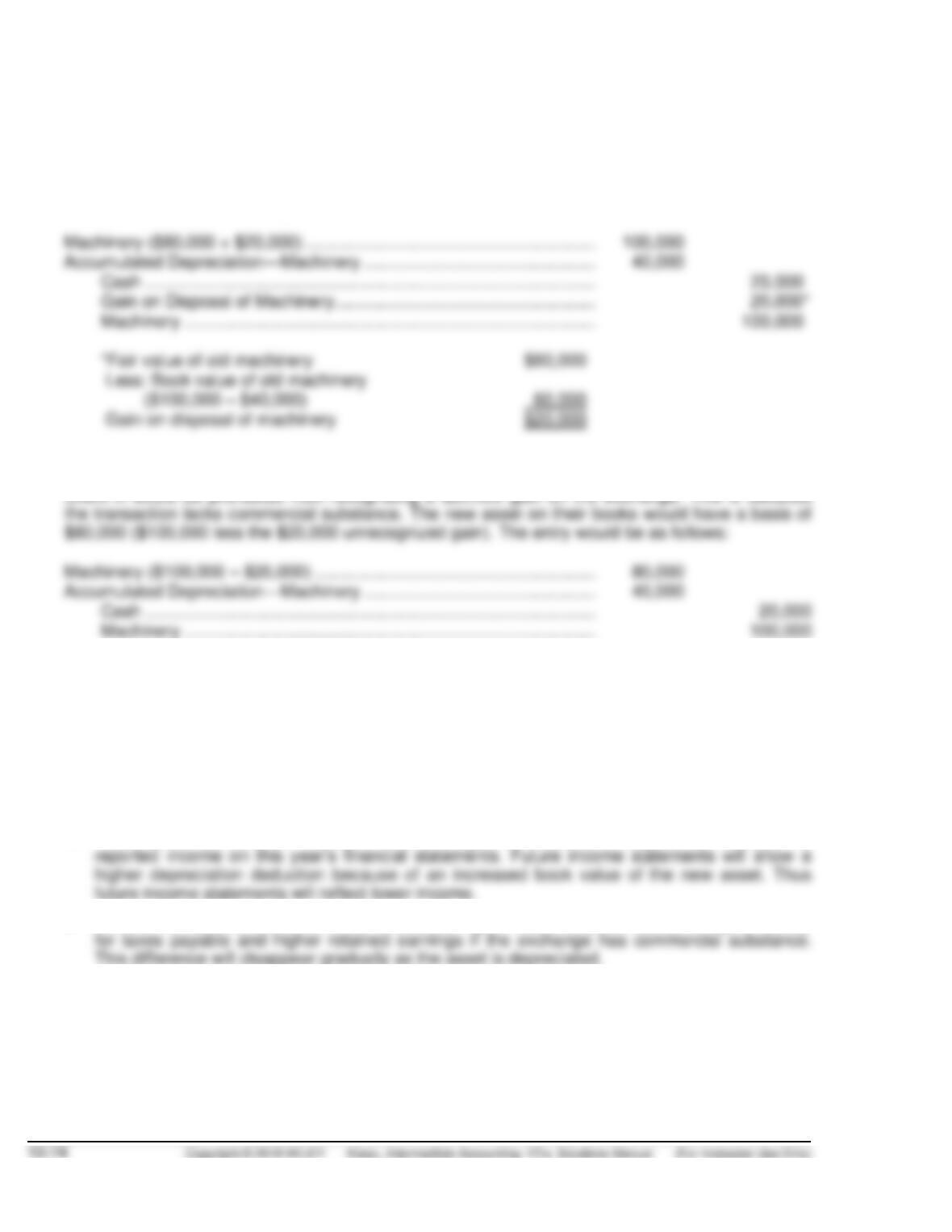
Treatment if the exchange has commercial substance
Client A would recognize a gain of $20,000 on the exchange. The basis of the asset acquired
would be $100,000. The entry would be as follows:
(b) Treatment if the exchange lacks commercial substance
(c) Memo to the Controller:
TO: The Controller
RE: Exchanges of Assets—Commercial Substance Issues.
Financial statement effect of treating the exchange as having commercial substance versus not.
1. The income statement will reflect a before-tax gain of $20,000. This gain will increase the
2. The current balance sheet will show a $20,000 higher value for plant assets, a higher liability
CA 10.4 (Continued)
(d) Client B
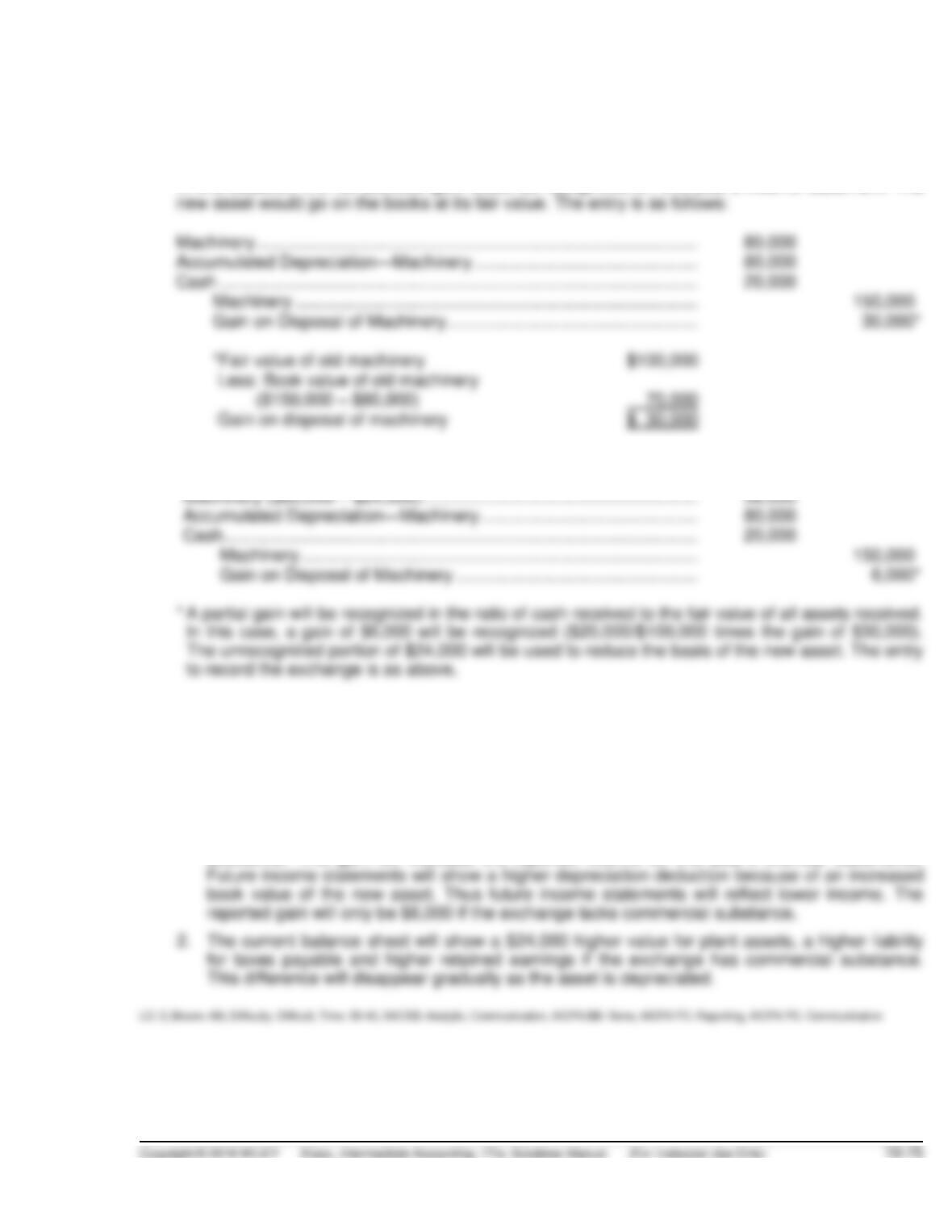
Treatment if the exchange has commercial substance
In this situation, the full $30,000 gain would be recognized on this year’s income statement. The
(e) Treatment if the exchange lacks commercial substance
(f) Memo to the Controller:
TO: The Controller
RE: Asset Exchanges—Commercial Substance
1. The income statement will reflect a before-tax gain of $30,000 if the exchange has commercial
substance. This gain will increase the reported income on this year’s financial statements.
CA 10.5
In general, the inclusion of the $7,500 as part of the cost of the machine is justified because the primary
(1) It may be true that these installation costs could not be recovered if the machine were to be sold.
This is not important, however, because presumably the machine was acquired to be used, not to
(2) Again, the purpose of accounting for plant assets is not to arrive at an approximation of fair
(3) Assuming that the $7,500 could properly be deducted, there would be some tax savings over the
years unless the tax rates applicable to the business were reduced during the following years.
CA 10.6
(a) If the land is undervalued so that a higher depreciation expense is assigned to the building,
management interests are served. The lower net income and reduced tax liability save cash to be
used for management purposes. By contrast, stockholders and potential investors are misled by
FINANCIAL STATEMENT ANALYSIS CASE
JOHNSON & JOHNSON ($ millions)
(a) The cost of building and building equipment at the end of 2017 was
$11,240.
(b) As indicated in footnote number 1 to the financial statements, the
(d) Free cash flow is defined as net cash flows provided by operating
activities less capital expenditures and dividends.
Free cash flow is the amount of discretionary cash flow a company has
for purchasing additional investments, retiring its debt, purchasing
treasury stock, or simply adding to its liquidity. In Johnson & Johnson’s
ACCOUNTING, ANALYSIS, AND PRINCIPLES
Accounting
Equipment** ……………………………………………………….
62,000
Equipment ………………………………………………………
Cash ………………………………………………………………
12,000
*Fair value of old asset
$50,000
Less: Cost of old asset
$112,000
Gain on disposal of equipment
$18,000
Fair value of old equipment
50,000
Analysis
The gain on the disposal increases income, leading to a one-time increase
in the return on assets (ROA) in the year of the exchange. In essence, the
gain reflects the extent to which prior years’ depreciation was overstated
Principles
The concept of commercial substance is a fundamental element in the
accounting for exchanges. If the transaction above lacked commercial
SOLUTIONS TO CODIFICATION EXERCISES
CE10.1
Master Glossary
(a) Capitalize is used to indicate that the cost would be recorded as the cost of an asset. That
procedure is often referred to as deferring a cost, and the resulting asset is sometimes described
as a deferred cost.
CE10.2
According to FASB ASC 835-20–15-8 (Capitalization of Land Expenditures), it depends:
Land that is not undergoing activities necessary to get it ready for its intended use is not a qualifying
asset. If activities are undertaken for the purpose of developing land for a particular use, the expendi-
tures to acquire the land qualify for interest capitalization while those activities are in progress. The
CE10.3
According to FASB ASC 360-10–25-5, (Planned Major Maintenance Activities)
CE10.4
According to FASB ASC 845-10–15-5 (Purchases and Sales of Inventory with the Same Counterparty),
the accounting for these exchanges is similar to other nonmonetary exchanges:
30–15 A nonmonetary exchange whereby an entity transfers finished goods inventory in exchange for
the receipt of raw materials or work-in-process inventory within the same line of business is not
30-16 All other nonmonetary exchanges of inventory within the same line of business shall be recog–
nized at the carrying amount of the inventory transferred. That is, a nonmonetary exchange
within the same line of business involving either of the following shall not be recognized at fair
PROFESSIONAL RESEARCH
(a) Yes; according to FASB ASC 835-20-05, it is required to capitalize interest
into the cost of assets that meet selected criteria (see (c) below).
(b) According to FASB ASC 835-20–10–1,
The objectives of capitalizing interest are to obtain a measure of
(c) According to FASB ASC 835-20–15–5,
Interest shall be capitalized for the following types of assets (qualifying
assets):
a. Assets that are constructed or otherwise produced for an entity’s
own use, including assets constructed or produced for the entity by
(d) According to FASB ASC 835-20–30–6,
The total amount of interest cost capitalized in an accounting period
shall not exceed the total amount of interest cost incurred by the entity
PROFESSIONAL RESEARCH (Continued)
(e) According to FASB ASC 835-20–50–1,
An entity shall disclose the following information with respect to
interest cost in the financial statements or related notes: