Problem 10-23A (continued)
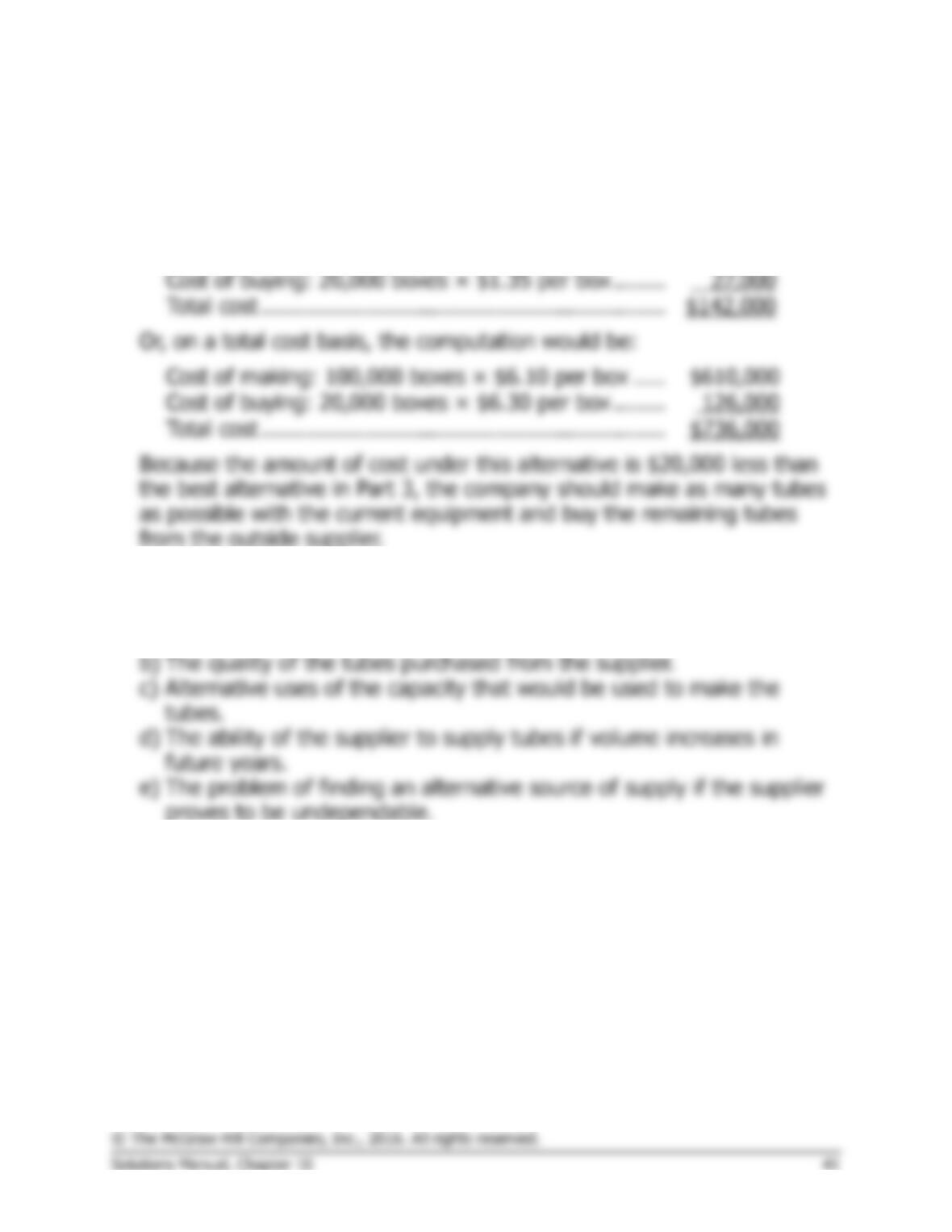
4. Under these circumstances, the company should make the 100,000
boxes of tubes and purchase the remaining 20,000 boxes from the
outside supplier. The costs would:
Cost of making: 100,000 boxes × $1.15 per box …..
$115,000
Cost of buying: 20,000 boxes × $1.35 per box ……..
Total cost ……………………………………………………..
$142,000
Total cost ……………………………………………………..
5. Management should take into account at least the following additional
factors:
a) The ability of the supplier to meet required delivery schedules.
Problem 10-24A (45 minutes)
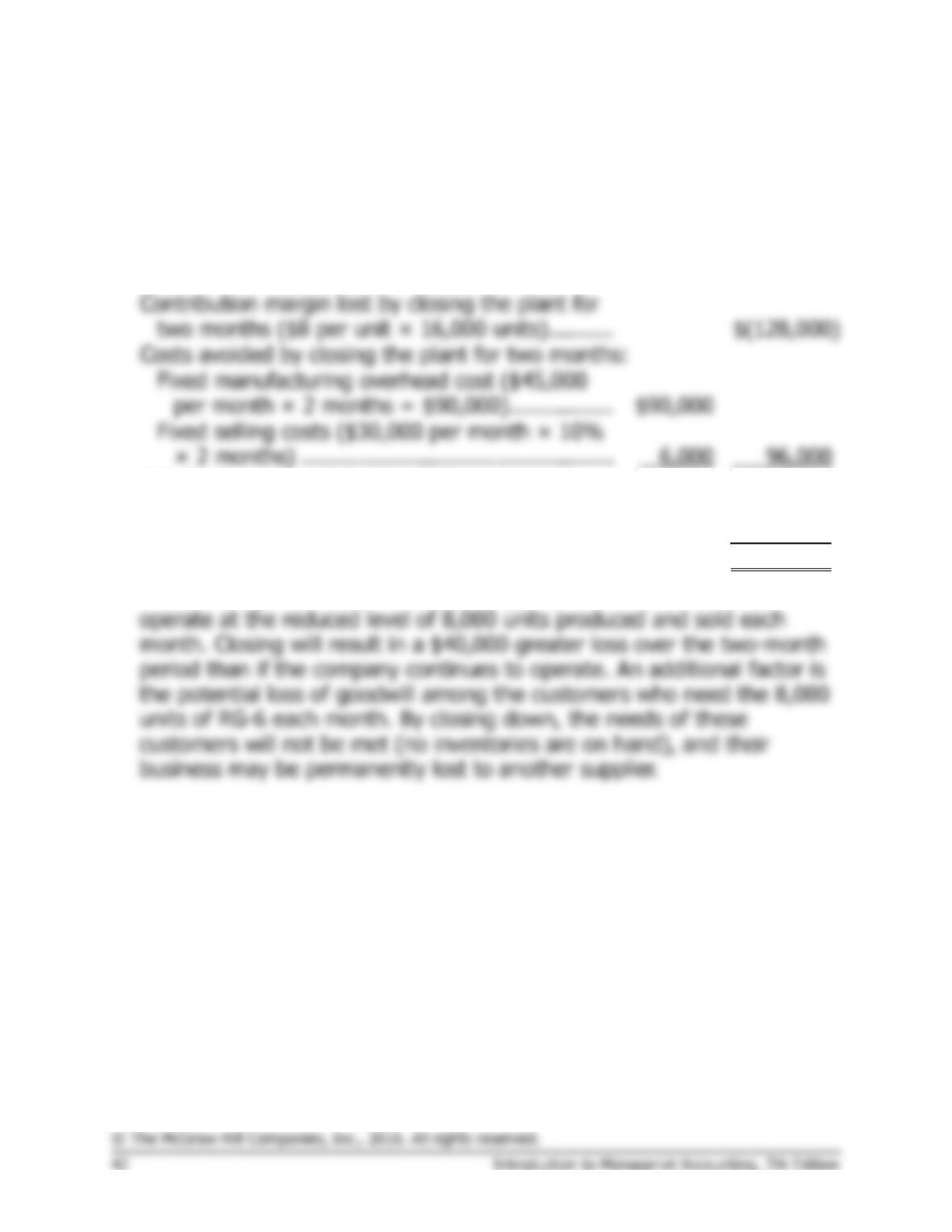
1. Product RG-6 has a contribution margin of $8 per unit ($22 – $14 = $8).
If the plant closes, this contribution margin will be lost on the 16,000
units (8,000 units per month × 2 months) that could have been sold
during the two-month period. However, the company will be able to
avoid some fixed costs as a result of closing down. The analysis is:
Contribution margin lost by closing the plant for
Costs avoided by closing the plant for two months:
Net disadvantage of closing, before start-up
costs ……………………………………………………..
(32,000)
Add start-up costs ………………………………………
8,000
Disadvantage of closing the plant …………………..
$ (40,000)
No, the company should not close the plant; it should continue to
Problem 10-24A (continued)
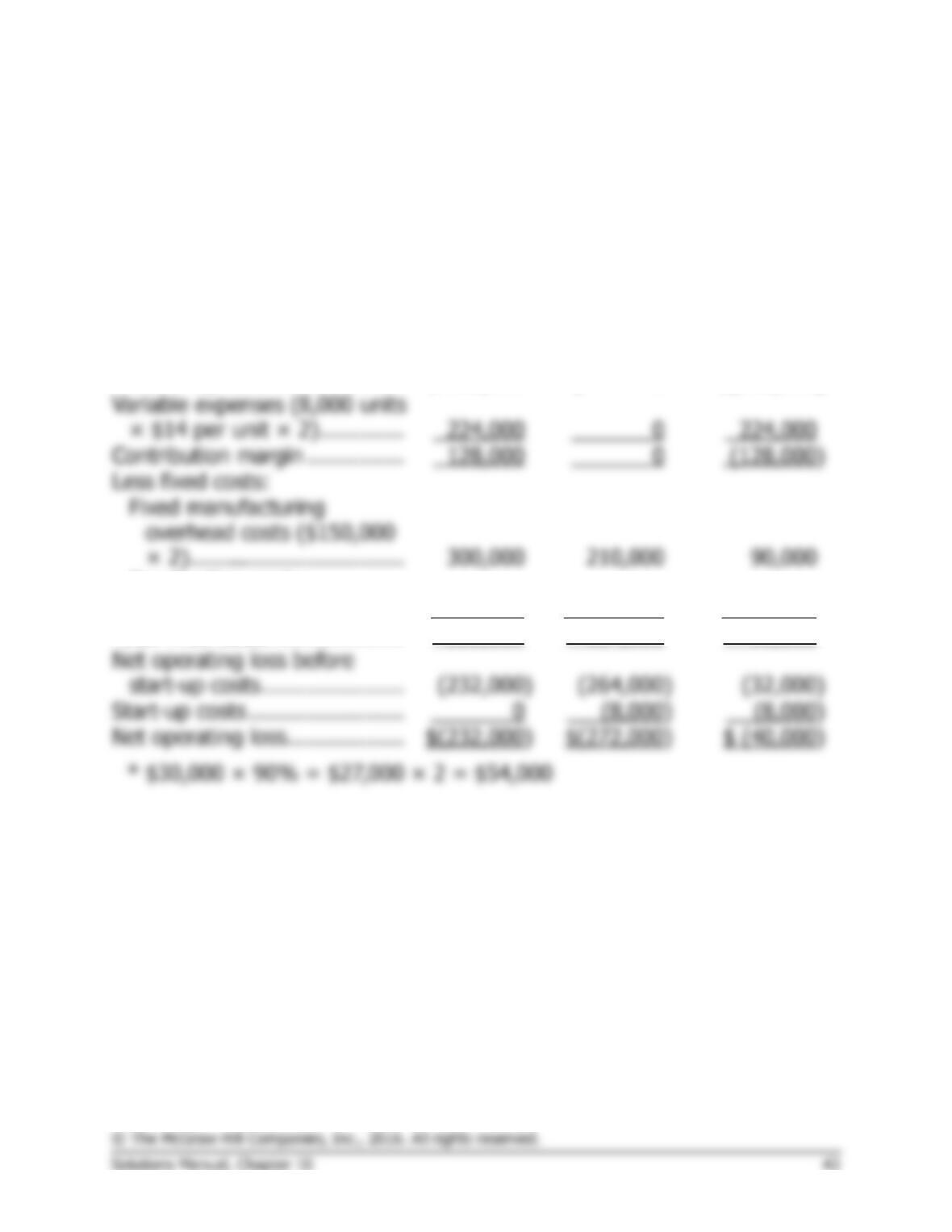
Alternative Solution:
Plant
Kept
Open
Plant
Closed
Difference:
Net
Operating
Income
Increase or
(Decrease)
Sales (8,000 units × $22 per
unit × 2)………………………..
$ 352,000
$ 0
$(352,000)
Contribution margin ……………
Less fixed costs:
Fixed selling costs
($30,000 × 2) ………………
60,000
54,000
*
6,000
Total fixed costs …………………
360,000
264,000
96,000
Start-up costs ……………………
(8,000)
Net operating loss ………………
$30,000 × 90% = $27,000 × 2 = $54,000
Problem 10-24A (continued)
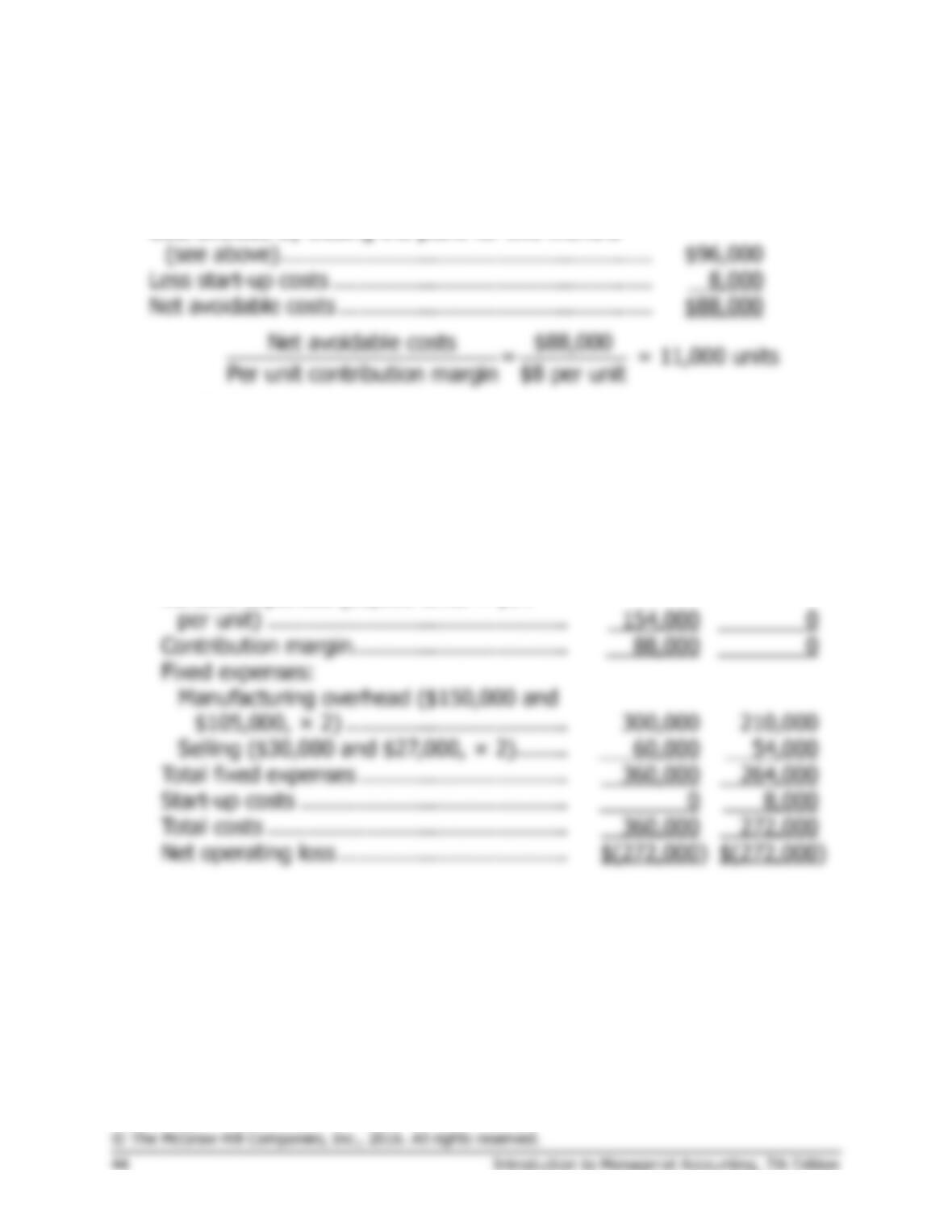
2. Birch Company will not be affected at a level of 11,000 total units sold
over the two-month period. The computations are:
Less start-up costs ………………………………………….
Net avoidable costs …………………………………………
Cost avoided by closing the plant for two months
Verification:
Operate at
11,000
Units for
Two
Months
Close for
Two
Months
Sales (11,000 units × $22 per unit) ……….
$ 242,000
$ 0
Fixed expenses:
Start–up costs …………………………………..
Total costs ……………………………………….
Net operating loss …………………………..…
Variable expenses (11,000 units × $14
Problem 10-25A (60 minutes)
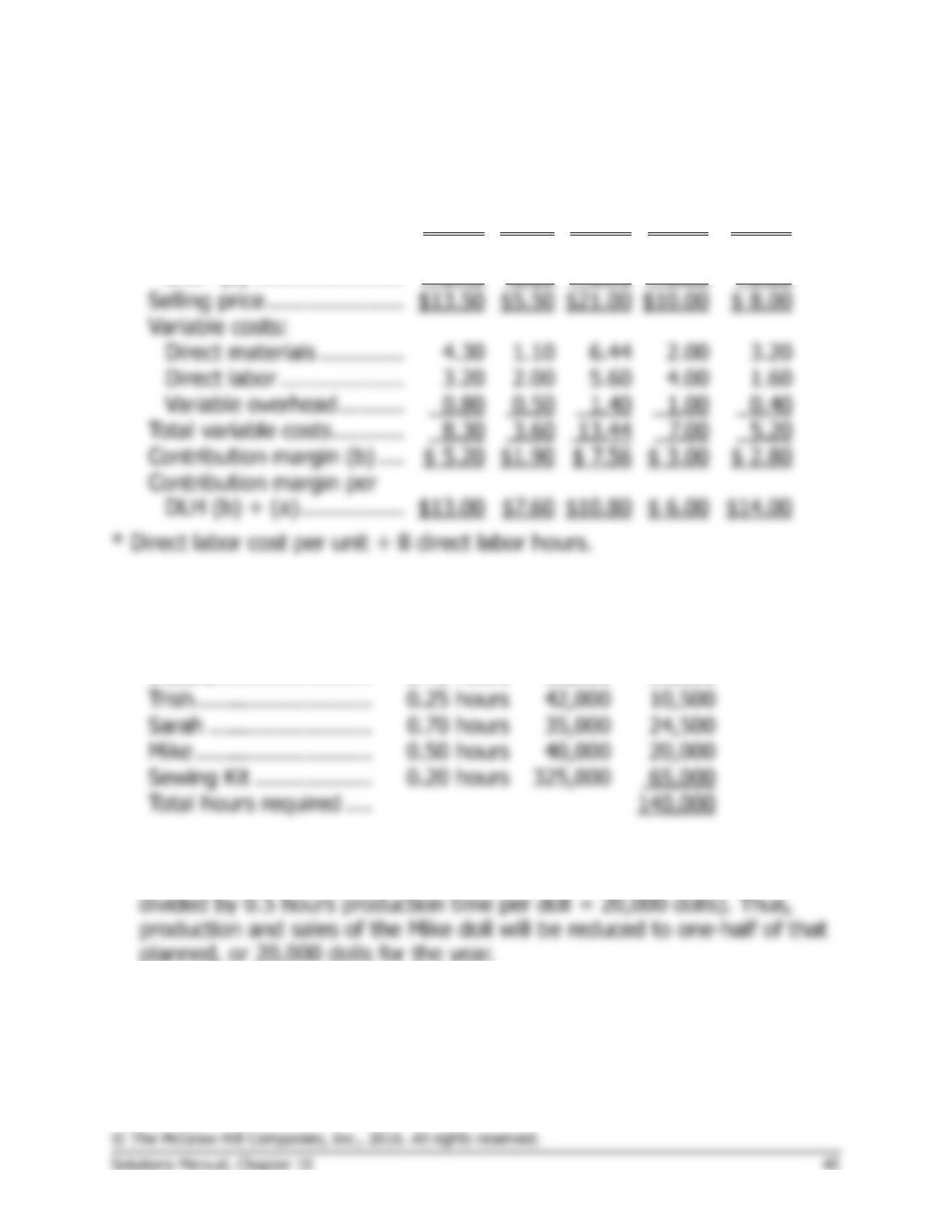
1.
Debbie
Trish
Sarah
Mike
Sewing
Kit
Direct labor cost per unit ..
$ 3.20
$2.00
$ 5.60
$ 4.00
$ 1.60
Direct labor hours per
unit* (a) …………………..
0.40
0.25
0.70
0.50
0.20
Selling price …………………
$5.50
$ 8.00
Variable costs:
Direct materials ………….
4.00
Total variable costs ………..
3.60
13.44
5.20
Contribution margin (b) ….
$ 5.20
$1.90
$ 3.00
$ 2.80
Contribution margin per
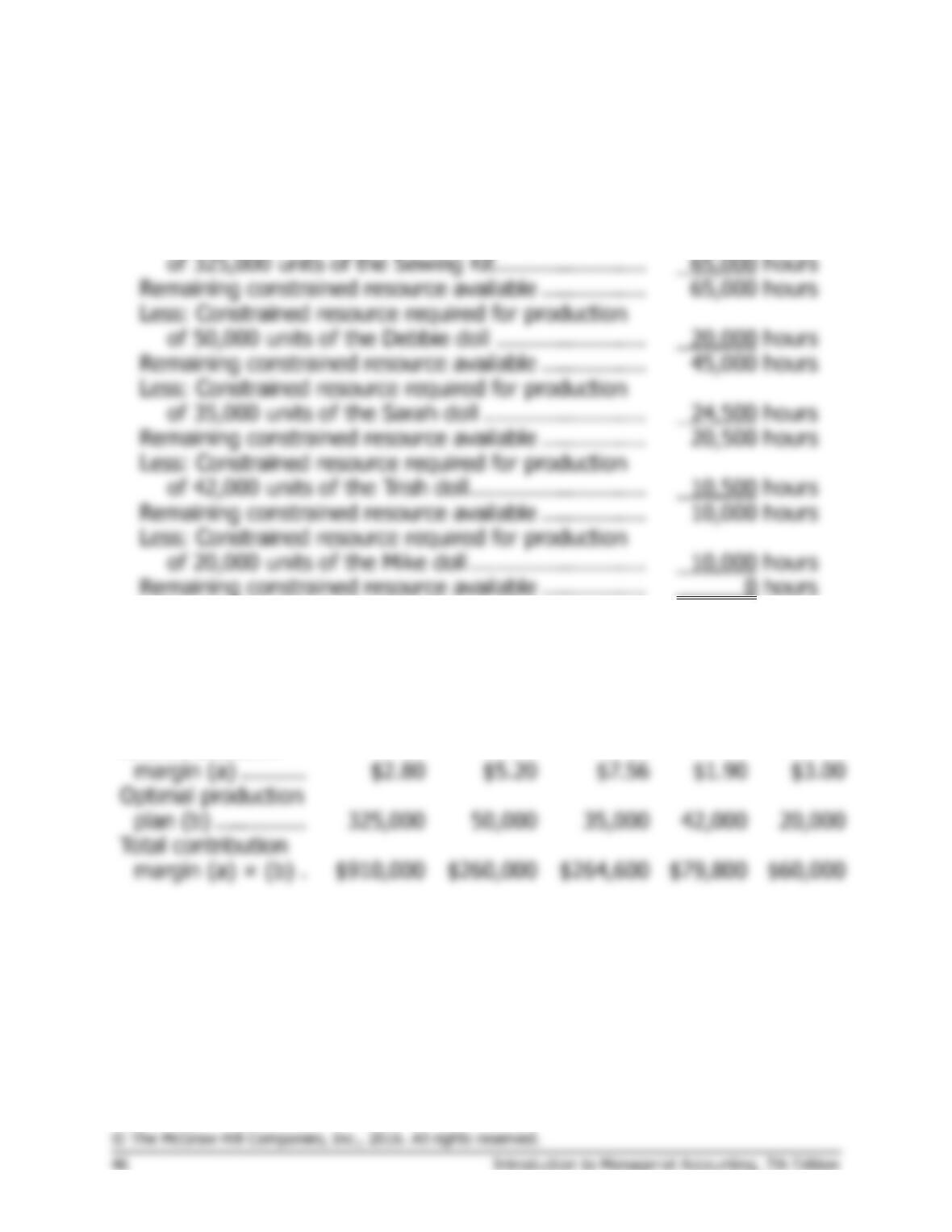
2.
Product
DLH Per
Unit
Estimated
Sales
(units)
Total
Hours
Debbie……………………
0.40
hours
50,000
20,000
Trish ………………………
0.25
hours
42,000
10,500
Sarah …………………….
hours
Mike ………………………
hours
Sewing Kit ………………
hours
325,000
Total hours required ….
3. Because the Mike doll has the lowest contribution margin per labor hour,
its production should be reduced by 20,000 dolls (10,000 excess hours
Problem 10-25A (continued)
An alternative means of deriving this solution is as follows:
Amount of constrained resource available …………….
130,000 hours
Remaining constrained resource available …………….
Less: Constrained resource required for production
Remaining constrained resource available …………….
Less: Constrained resource required for production
Remaining constrained resource available …………….
Less: Constrained resource required for production
Remaining constrained resource available …………….
Less: Constrained resource required for production
Remaining constrained resource available …………….
Less: Constrained resource required for production
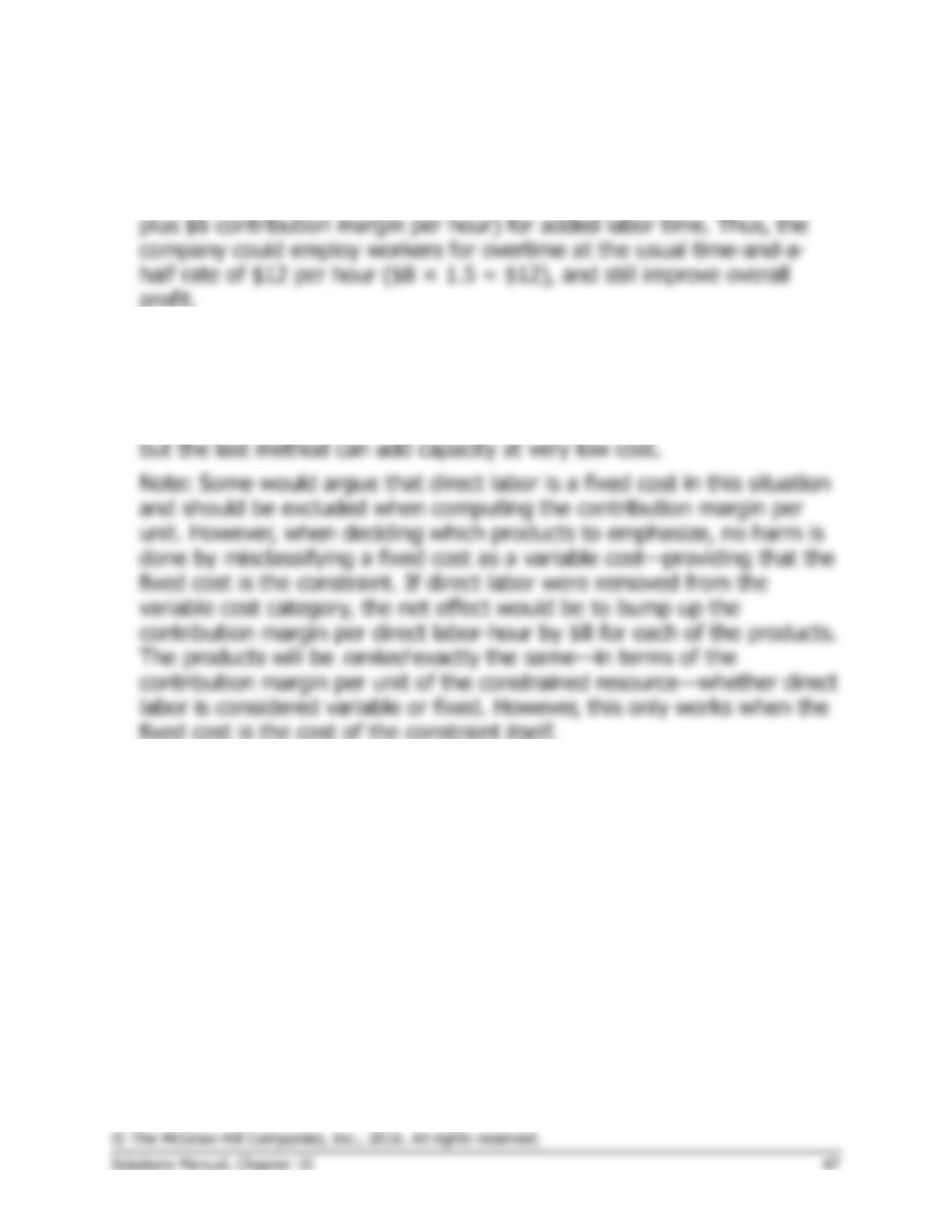
4. The highest possible contribution margin is the sum of the contribution
margins earned on each of the five products, or $1,574,400:
Sewing
Kit
Debbie
Sarah
Trish
Mike
Optimal production
Total contribution
Unit contribution
Problem 10-25A (continued)
5. Because the additional capacity would be used to produce the Mike doll,
the company should be willing to pay up to $14 per hour ($8 usual rate
6. Additional output could be obtained in a number of ways including
working overtime, adding another shift, expanding the workforce,
contracting out some work to outside suppliers, and eliminating wasted
labor time in the production process. The first four methods are costly,
Problem 10-26A (60 minutes)
1. The simplest approach to the solution is:
Gross margin lost if the store is closed …………
$(316,800)
Costs that can be avoided:
Sales salaries …………………………………….
$70,000
Direct advertising ……………………………….
51,000
Store rent …………………………………………
85,000
Delivery salaries …………………………………
Salary of new manager ……………………….
11,000
General office compensation …………………
Insurance on inventories ($7,500 × 2/3) …
Utilities …………………………………………….
31,000
Employment taxes ……………………………..
*
287,000
Store is closed …………………………………..
$ (29,800)
*Salaries avoided by closing the store:
Sales salaries ……………………………………
$70,000
Delivery salaries ………………………………..
4,000
Store management salaries ………………….
Salary of new manager ……………………….
General office compensation ………………..
6,000
Total avoided ………………………………………
100,000
Employment tax rate …………………………….
Employment taxes avoided …………………….
$15,000
Problem 10-26A (continued)
Alternative Solution:
North
Store
Kept
Open
North
Store
Closed
Difference:
Net
Operating
Income
Increase or
(Decrease)
Sales …………………………………….
$720,000
$ 0
$(720,000)
Cost of goods sold …………………..
403,200
0
403,200
Gross margin ………………………….
316,800
(316,800)
Sales salaries ……………………..
Depreciation of store fixtures …
4,600
4,600
0
Delivery salaries …………………
7,000
3,000
4,000
Depreciation of delivery
equipment ………………………
3,000
3,000
0
Total selling expenses …………….
231,400
21,400
210,000
Administrative expenses:
Store management salaries …..
9,000
Salary of new manager ………..
Utilities …………………………….
Employment taxes ………………
3,150
*
18,000
18,000
0
Total administrative expenses ….
118,650
41,650
77,000
Total operating expenses …………..
350,050
63,050
Net operating income (loss) ……….
$(33,250)
$ (29,800)
*See the computation on the prior page.
Problem 10-26A (continued)
2. Based on the data in (1), the North Store should not be closed. If the
store is closed, then the company’s overall net operating income will
3. Under these circumstances, the North Store should be closed. The
computations are as follows:
Gross margin lost if the North Store is closed (part 1) …..
$(316,800)
Problem 10-27A (60 minutes)
1. A product should be processed further if the incremental revenue from
the further processing exceeds the incremental costs. The incremental
revenue from further processing of the Grit 337 is:
The incremental variable costs are:
Other ingredients …………………………………………
$0.65
Direct labor …………………………………………………
1.48
Problem 10-27A (continued)
2. Only the cost of advertising and the cost of the production supervisor
are avoidable if production of the silver polish is discontinued.
Therefore, the number of jars of silver polish that must be sold each
month to justify continued processing of the Grit 337 into silver polish
is:
Therefore, if 10,000 jars of silver polish can be sold each month, the
company would be indifferent between selling it or selling all of the Grit
337 as a cleaning powder. If the sales of the silver polish are greater
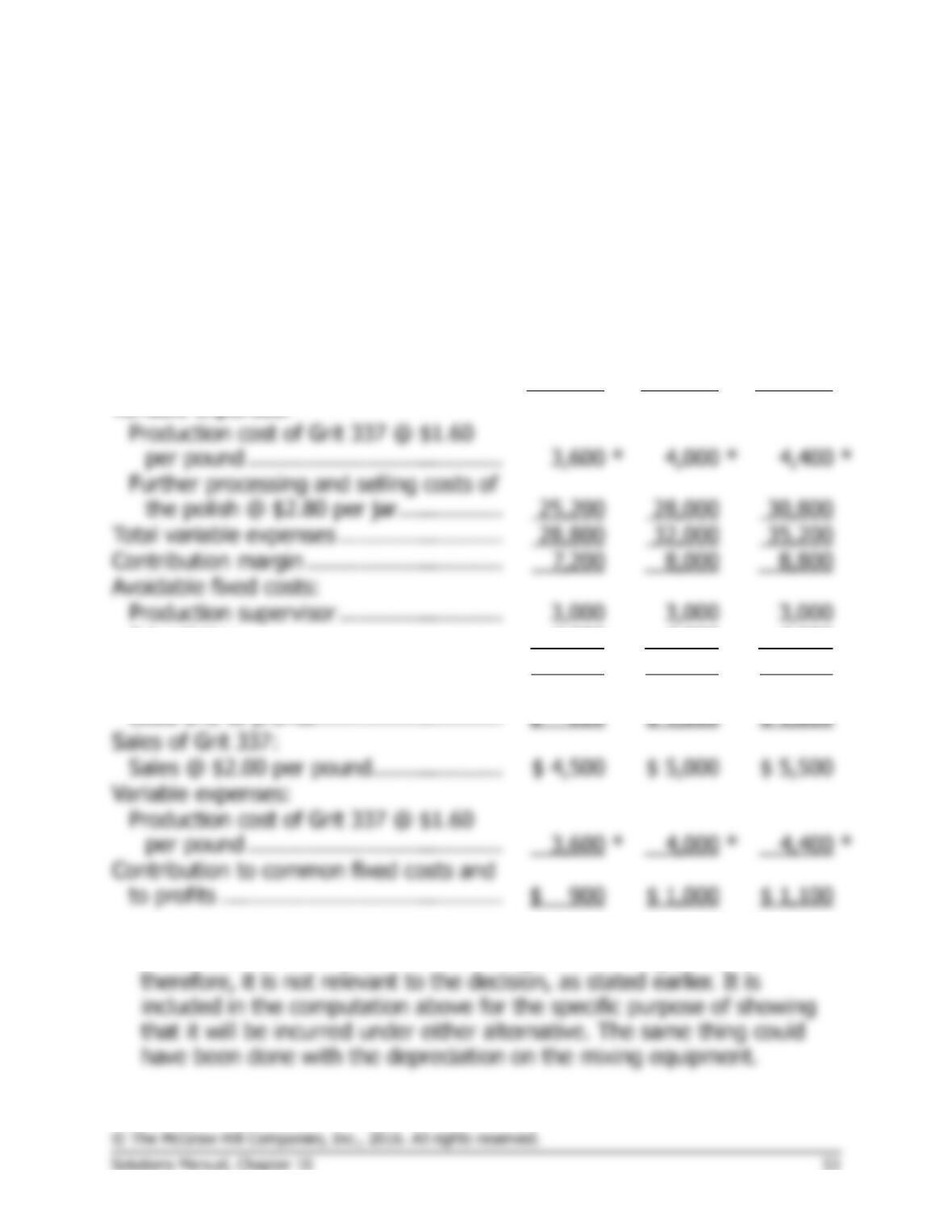
Problem 10-27A (continued)
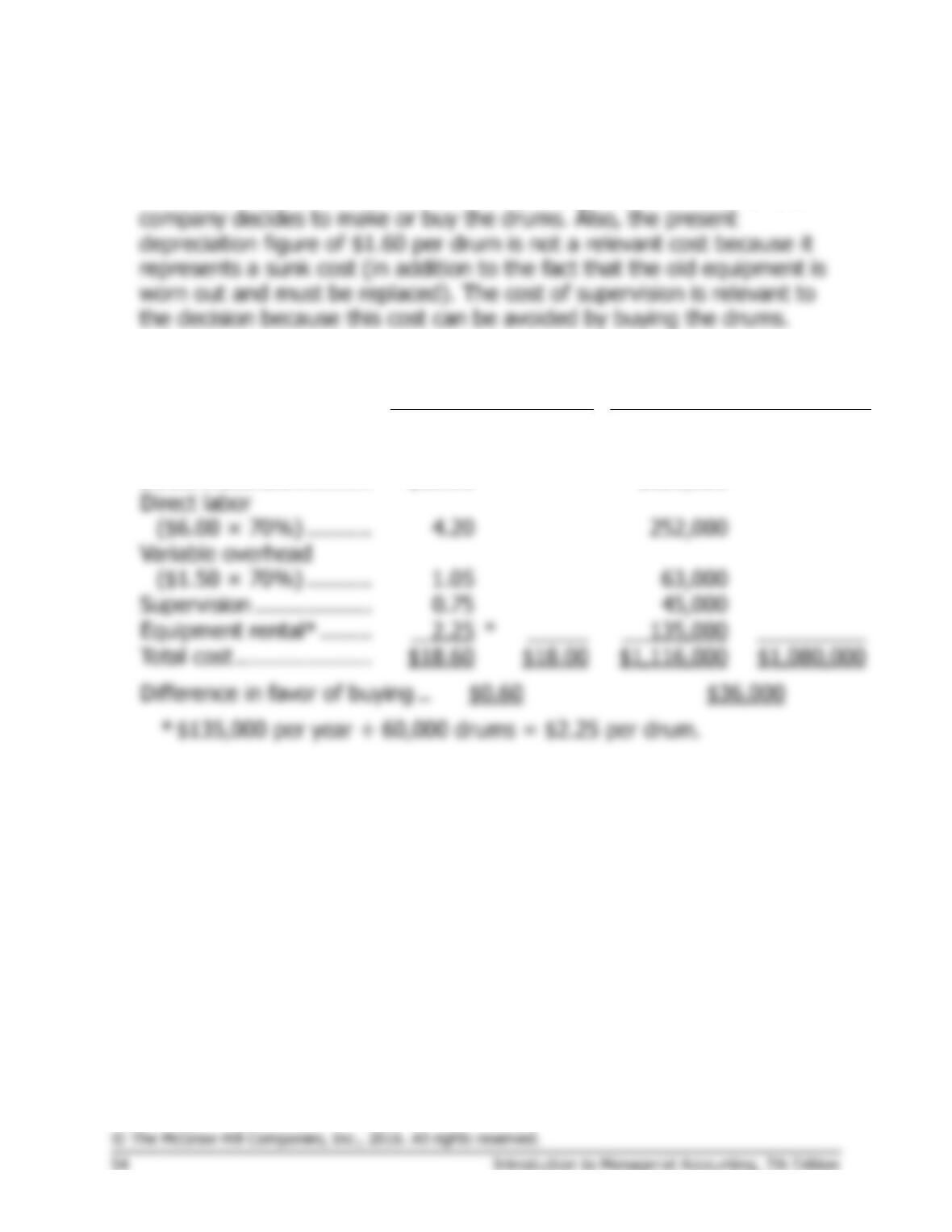
9,000
Jars of
Polish;
or 2,250
pounds
of Grit
337
10,000
Jars of
Polish;
or 2,500
pounds
of Grit
337
11,000
Jars of
Polish;
or 2,750
pounds
of Grit
337
Sales of Silver Polish:
Sales @ $4.00 per jar …………………….
$36,000
$40,000
$44,000
Variable expenses:
*
*
*
25,200
28,000
30,800
Total variable expenses …………………….
28,800
32,000
35,200
Contribution margin …………………………
7,200
Avoidable fixed costs:
Production supervisor …………………….
Advertising ………………………………….
4,000
4,000
4,000
Total avoidable fixed costs …………………
7,000
7,000
7,000
$ 1,000
$ 1,800
Sales of Grit 337:
Sales @ $2.00 per pound ………………..
Variable expenses:
*
*
*
$ 1,000
$ 1,100
Total contribution to common fixed
*
This cost will be incurred regardless of whether the Grit 337 is further
processed into silver polish or sold outright as cleaning powder;
Problem 10-28A (60 minutes)
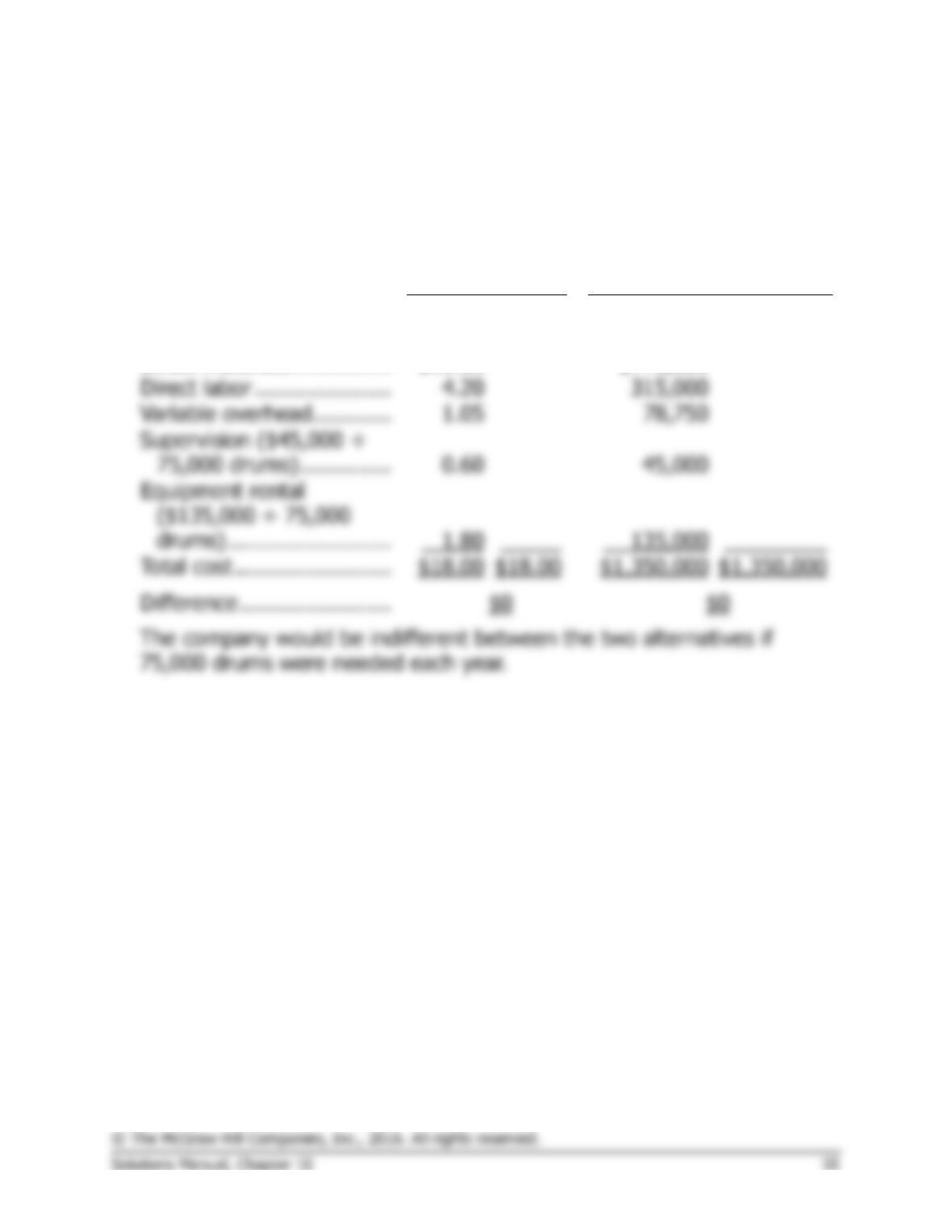
1. The $2.80 per drum general overhead cost is not relevant to the
decision because this cost will be the same regardless of whether the
Differential Costs
Per Drum
Total Differential Costs—
60,000 Drums
Make
Buy
Make
Buy
Outside supplier’s price .
$18.00
$1,080,000
Direct materials …………
$10.35
$621,000
Supervision ………………
Total cost …………………
Difference in favor of buying …………………………..
*
$135,000 per year ÷ 60,000 drums = $2.25 per drum.
Problem 10-28A (continued)
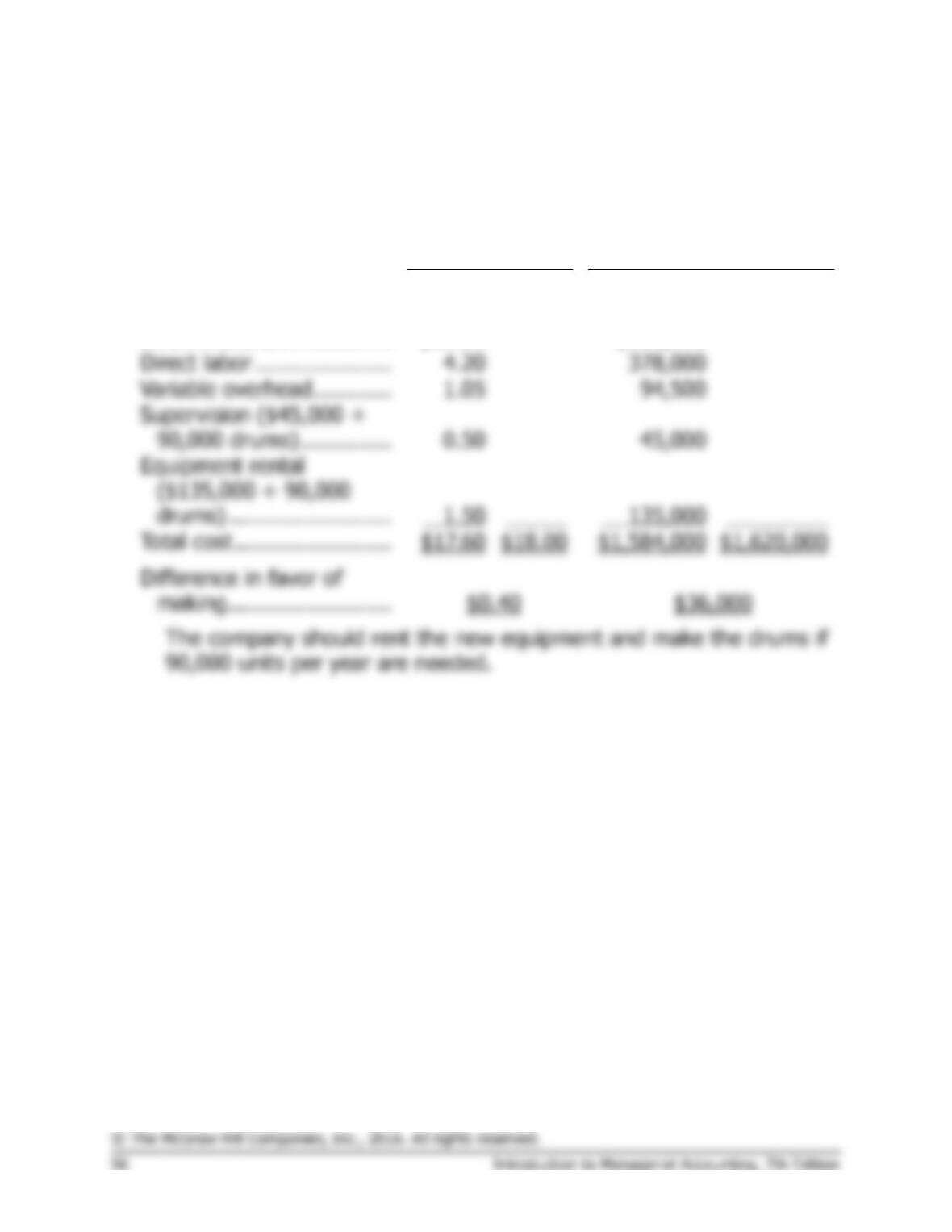
2. a. Notice that unit costs for both supervision and equipment rental
decrease with the greater volume because these fixed costs are
spread over more units.
Differential
Cost Per Drum
Total Differential Cost—
75,000 Drums
Make
Buy
Make
Buy
Outside supplier’s price ….
$18.00
$1,350,000
Direct materials ……………
$10.35
$776,250
1.80
135,000
Total cost ……………………
$18.00
$18.00
$1,350,000
$1,350,000
Difference …………………..
Problem 10-28A (continued)
b. Again, notice that the unit costs for both supervision and equipment
rental decrease with the greater volume of units.
Differential
Costs Per Drum
Total Differential Cost—
90,000 Drums
Make
Buy
Make
Buy
Outside supplier’s price ….
$18.00
$1,620,000
Direct materials ……………
$10.35
$931,500
Direct labor …………………
Variable overhead …………
Total cost ……………………
$18.00
$1,584,000
$1,620,000
Problem 10-28A (continued)
3. Other factors that the company should consider include:
a. Will volume in future years increase, or will it remain constant at
60,000 units per year? (If volume increases, then renting the new
equipment becomes more desirable, as shown in the computations
above.)
d. Will the outside supplier dependably meet shipping schedules?
e. Can the company begin making the drums again if the supplier
proves to be undependable? Are there alternative suppliers?
f. What is the labor outlook in the supplier’s industry (e.g., are frequent
labor strikes likely)?
Case (45 minutes)
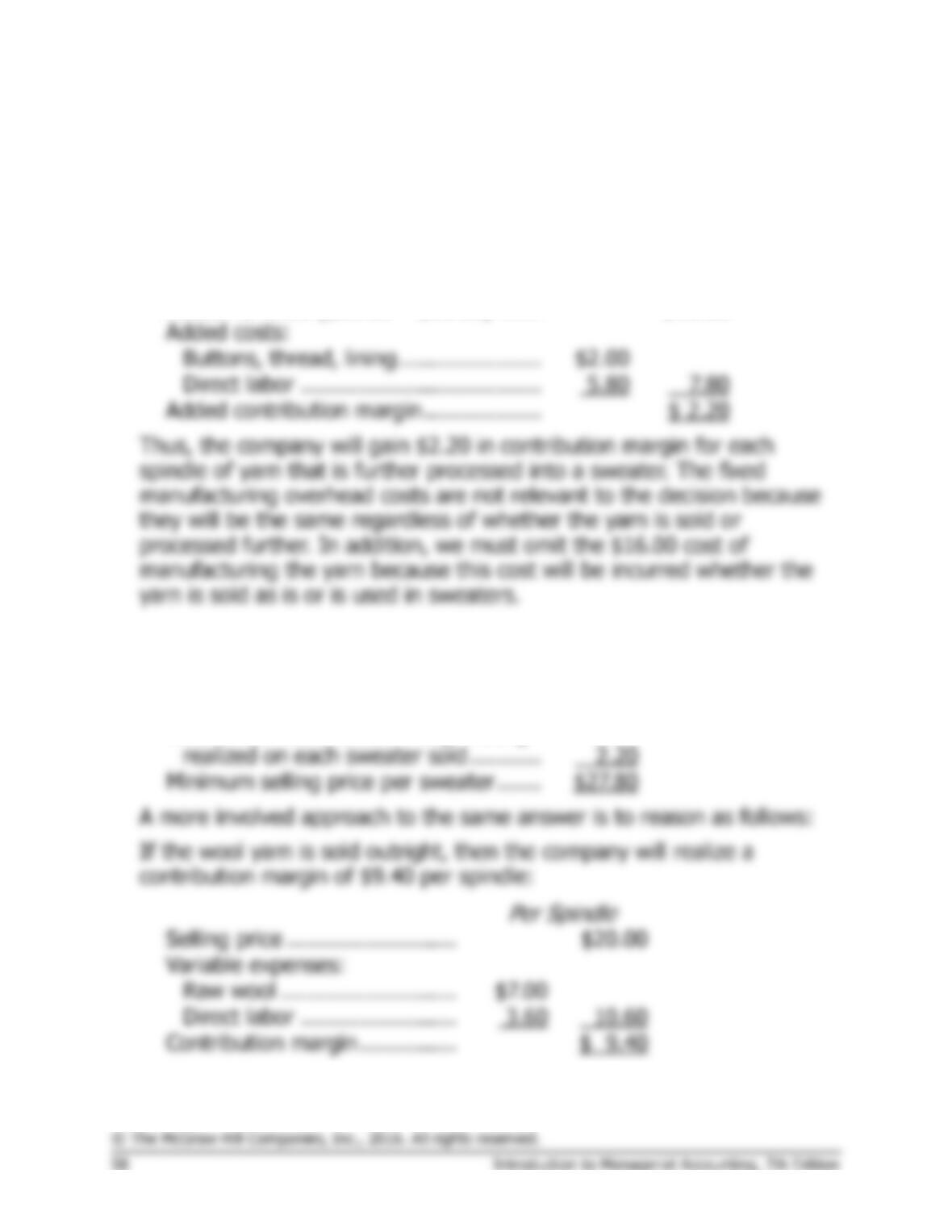
1. As much yarn as possible should be processed into sweaters. Products
should be processed further so long as the added revenues from further
processing are greater than the added costs. In this case, the added
revenues and costs are:
Per Sweater
Added revenue ($30.00 – $20.00) …….
$10.00
Added costs:
5.80
Added contribution margin ………………
2. The lowest price the company should accept is $27.80 per sweater. The
simplest approach to this answer is:
Present selling price per sweater ………
$30.00
Minimum selling price per sweater …….
Selling price ……………………..
$20.00
Variable expenses:
Contribution margin ……………
Less added contribution margin being
Case (continued)
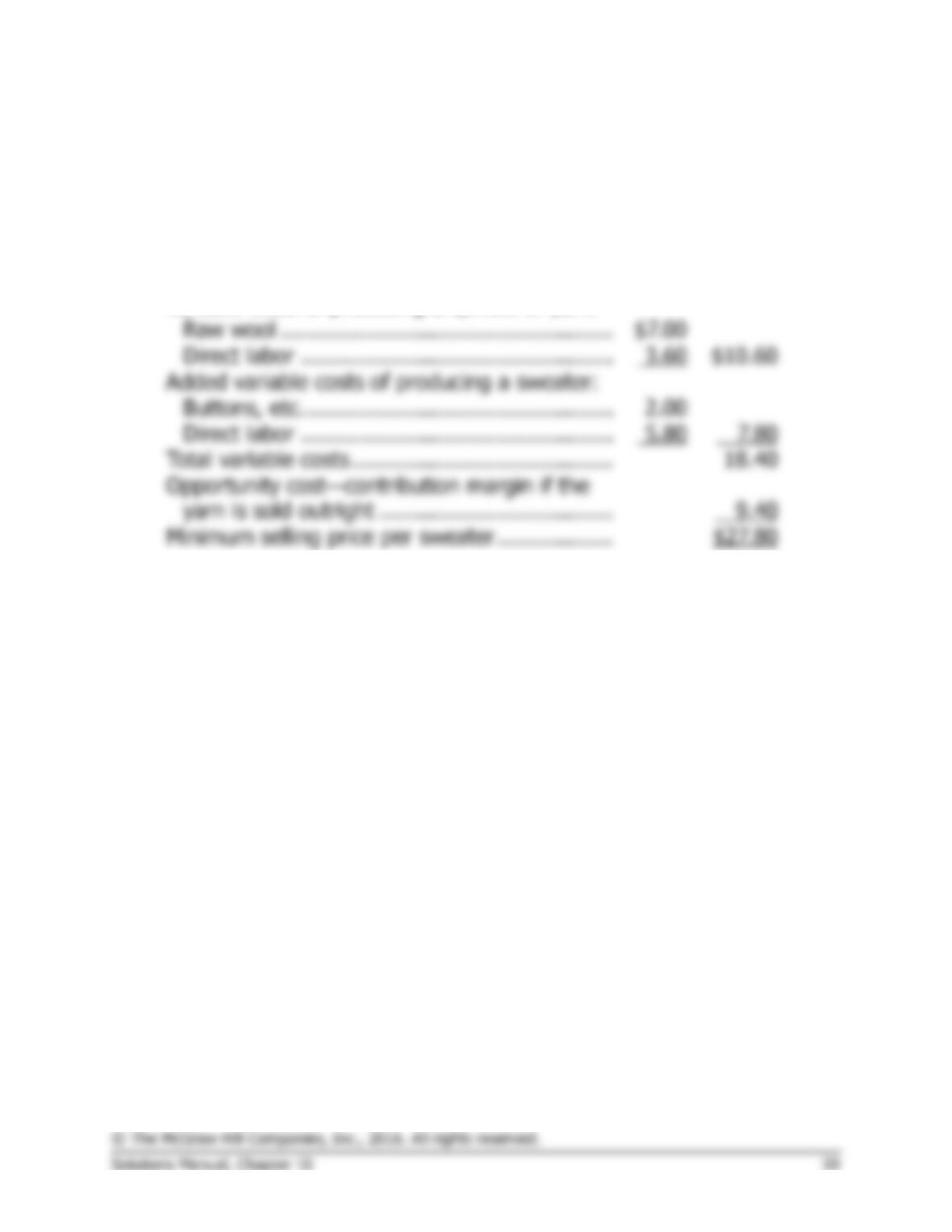
This $9.40 is an opportunity cost. The price of the sweaters must be
high enough to cover this opportunity cost. In addition, the company
must be able to cover all of its variable costs from the time the raw wool
is purchased until the sweater is completed. Therefore, the minimum
price is:
Variable costs of producing a spindle of yarn:
Total variable costs ………………………………….