Chapter 10
Differential Analysis: The Key to Decision
Making
Solutions to Questions
10-1 A relevant cost is a cost that differs in
total between the alternatives in a decision.
10-2 An incremental cost (or benefit) is the
change in cost (or benefit) that will result from
10-3 No. Variable costs are relevant costs
only if they differ in total between the
alternatives under consideration.
10-4 No. Not all fixed costs are sunk—only
those for which the cost has already been
10-5 No. A variable cost is a cost that varies
in total amount in direct proportion to changes
10-6 No. Only those future costs that differ
between the alternatives are relevant.
10-7 Only those costs that would be avoided
as a result of dropping the product line are
10-8 Not necessarily. An apparent loss may
be the result of allocated common costs or of
as a result of dropping the product is less than
the fixed costs that would be avoided. Even in
that situation the product may be retained if it
promotes the sale of other products.
10-10 If a company decides to make a part
internally rather than to buy it from an outside
supplier, then a portion of the company’s
facilities have to be used to make the part. The
company’s opportunity cost is measured by the
benefits that could be derived from the best
alternative use of the facilities.
customers could be a constraint. Some examples
are machine time, direct labor time, floor space,
10-12 Assuming that fixed costs are not
affected, profits are maximized when the total
contribution margin is maximized. A company
can maximize its total contribution margin by
10-13 Joint products are two or more products
10-14 Joint costs should not be allocated
among joint products for decision-making
purposes. If joint costs are allocated among the
joint products, then managers may think they
processed further.
10-16 Most costs of a flight are either sunk
costs, or costs that do not depend on the
The Foundational 15
1. The total traceable fixed manufacturing overhead for Alpha and Beta is
computed as follows:
Alpha
Beta
Traceable fixed overhead per unit (a) ……..
Level of activity in units (b) …………………..
Total traceable fixed overhead (a) × (b) ….
2. The total common fixed expenses is computed as follows:
Alpha
Beta
Common fixed expenses per unit (a) ………
$15
$10
Level of activity in units (b) …………………..
Total common fixed expenses (a) × (b) …..
3. The profit impact is computed as follows:
Per
Total
Unit
10,000 units
Incremental revenue ……………………….
$80
$800,000
The Foundational 15 (continued)
4. The profit impact is computed as follows:
Per
Total
Unit
5,000 units
Incremental revenue ……………………….
$39
$195,000
Incremental costs:
$40
5. The profit impact is computed as follows:
Incremental revenue
(10,000 units × $80) (a) …………………………..
$800,000
Incremental variable costs:
Incremental net operating income
Note to instructors: Emphasize to students that the variable costs
related to 5,000 units of production are irrelevant to the decision
because they will be incurred whether the special order is accepted or
rejected.
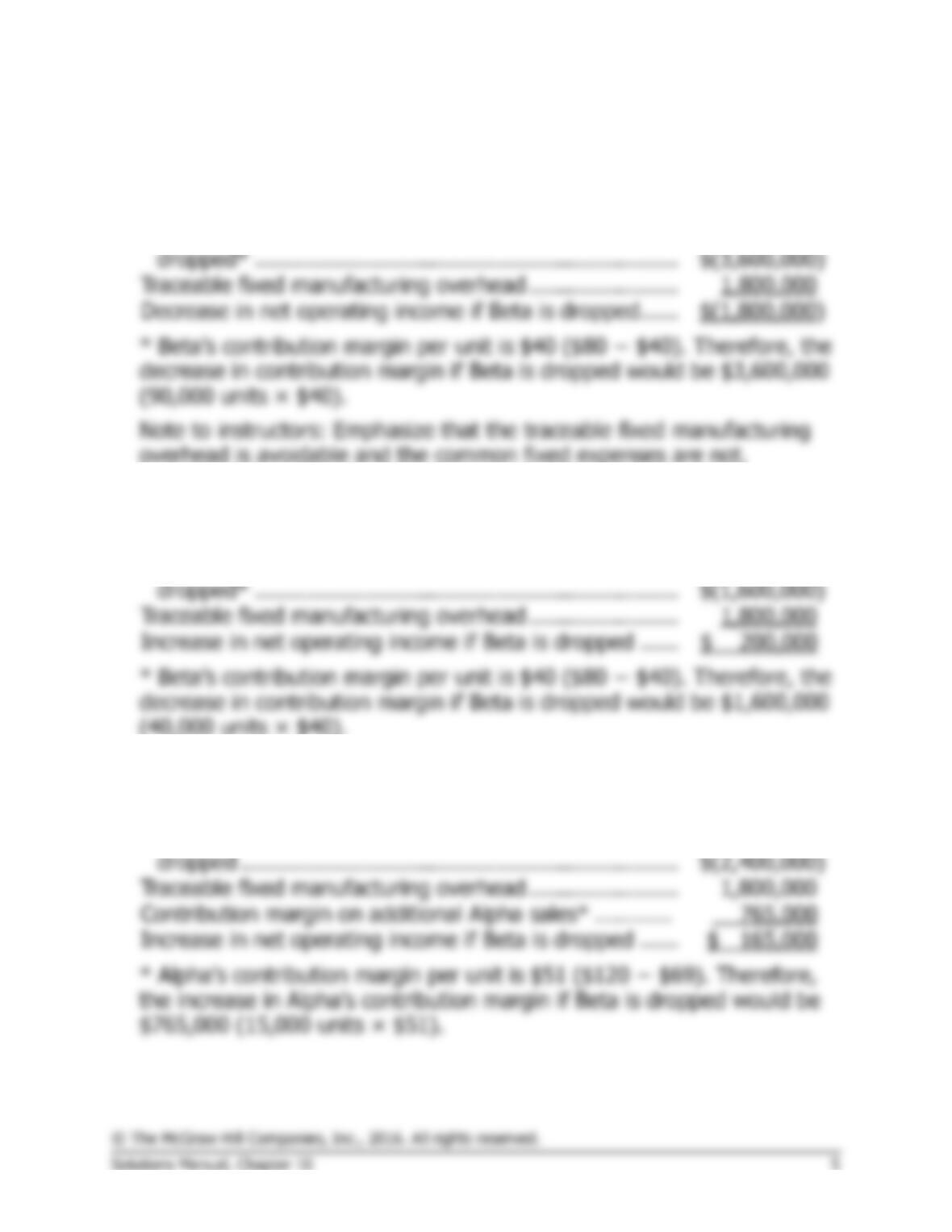
The Foundational 15 (continued)
6. The profit impact of dropping the Beta product line is computed as
follows:
Contribution margin lost if the Beta product line is
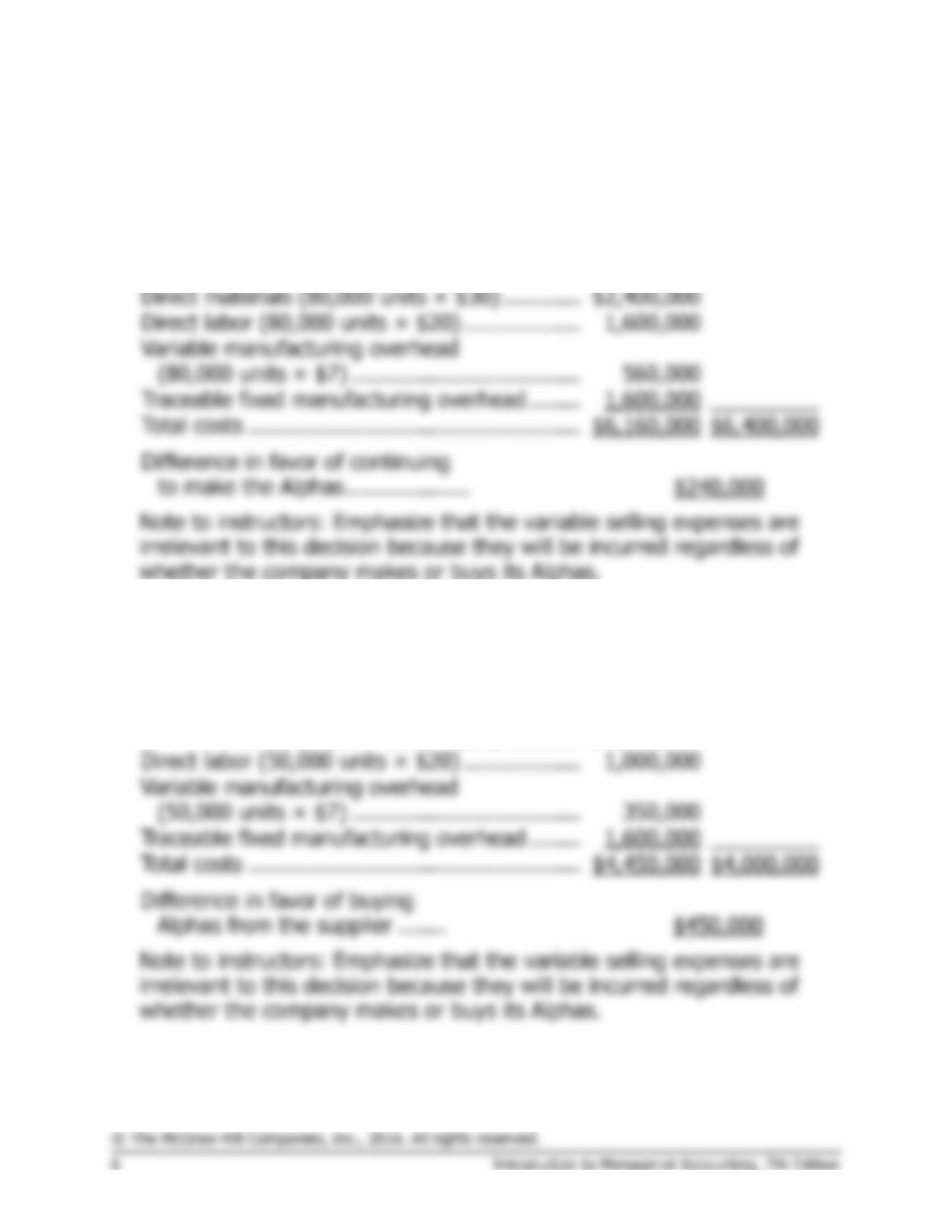
7. The profit impact of dropping the Beta product line is computed as
follows:
Contribution margin lost if the Beta product line is
8. The profit impact of dropping the Beta product line is computed as
follows:
Contribution margin lost if the Beta product line is
The Foundational 15 (continued)
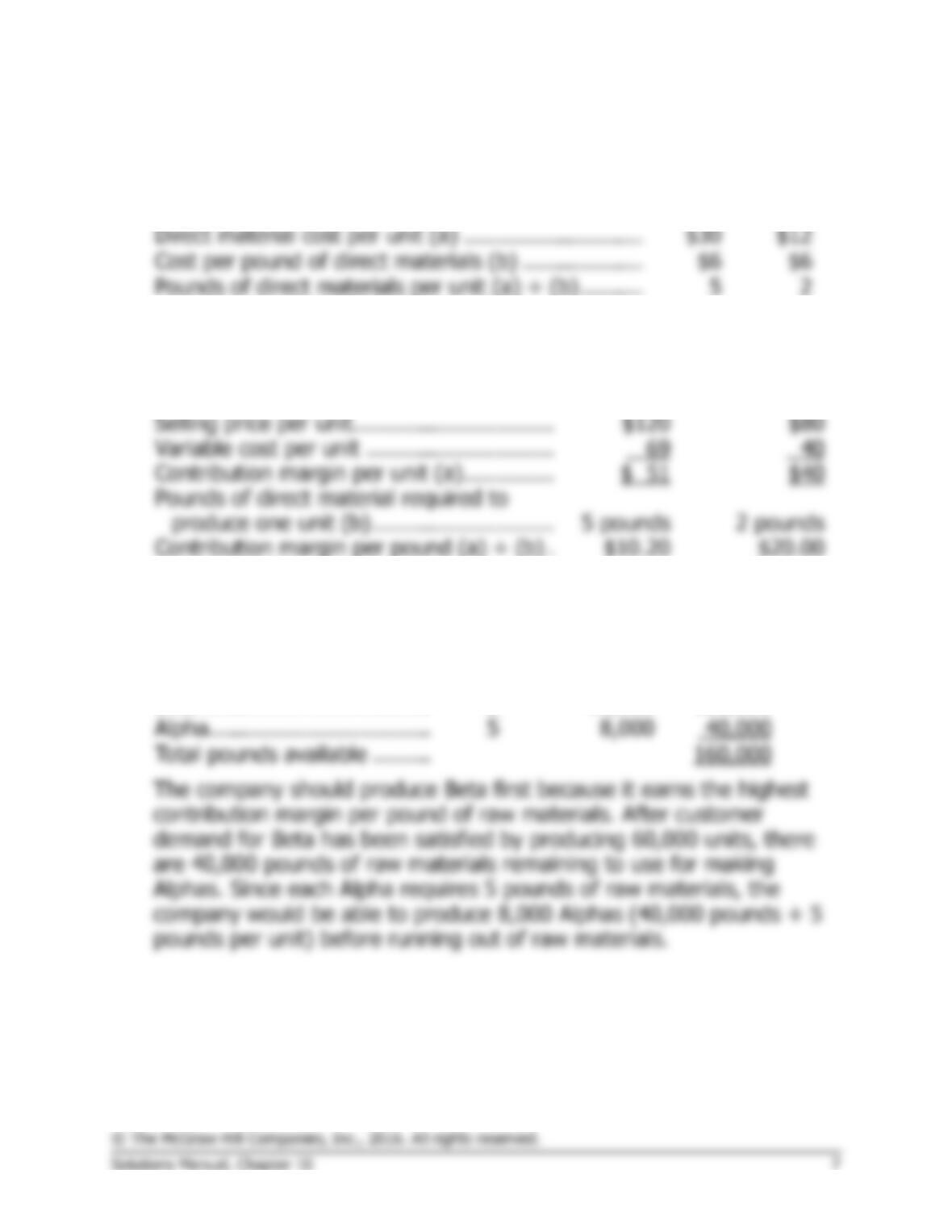
9. The profit impact of buying 80,000 Alphas from a supplier rather than
making them is computed as follows:
Make
Buy
Cost of purchasing (80,000 units × $80) ……..
$6,400,000
Direct materials (80,000 units × $30) …………
$2,400,000
Direct labor (80,000 units × $20) ………………
Traceable fixed manufacturing overhead ……..
Total costs ……………………………………………
$6,160,000
$6,400,000
10. The profit impact of buying 50,000 Alphas from a supplier rather than
making them is computed as follows:
Make
Buy
Cost of purchasing (50,000 units × $80) ……..
$4,000,000
Direct materials (50,000 units × $30) …………
$1,500,000
Traceable fixed manufacturing overhead ……..
Total costs ……………………………………………
$4,450,000
$4,000,000
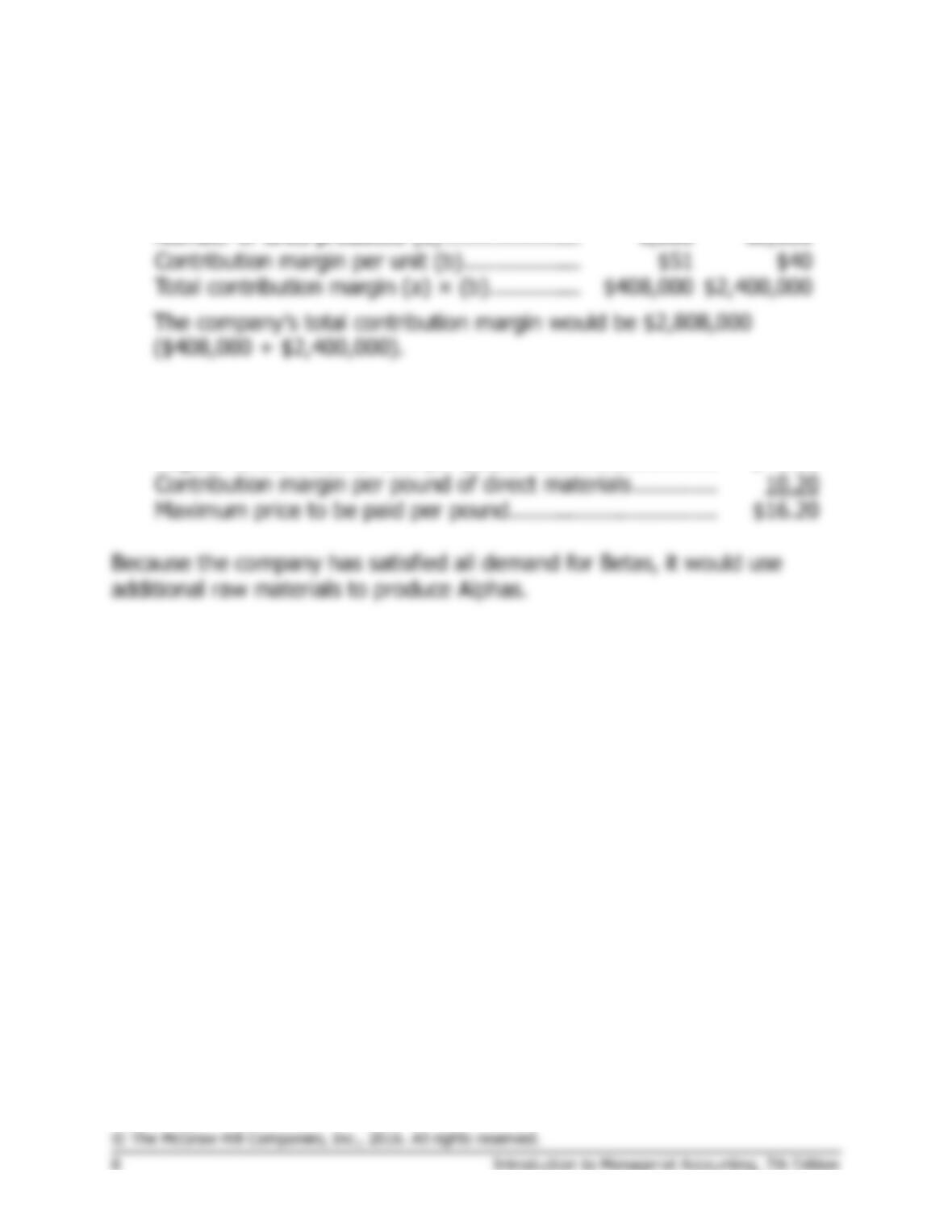
The Foundational 15 (continued)
11. The pounds of raw material per unit are computed as follows:
Alpha
Beta
Direct material cost per unit (a) ……………………….
12. The contribution margins per pound of raw materials are computed as
follows:
Alpha
Beta
13. The optimal number of units to produce would be computed as
follows:
Product
Pounds
Per Unit
Units
Produced
Total
Pounds
Beta ……………………………..
2
60,000
120,000
Alpha …………………………….
5
Total pounds available ………
160,000
The Foundational 15 (continued)
14. The total contribution margin would be computed as follows:
Alpha
Beta
Number of units produced (a) ………………………….
15. The maximum price per pound is computed as follows:
Alpha
Regular direct material cost per pound ………………………..
$ 6.00
Contribution margin per pound of direct materials ………….
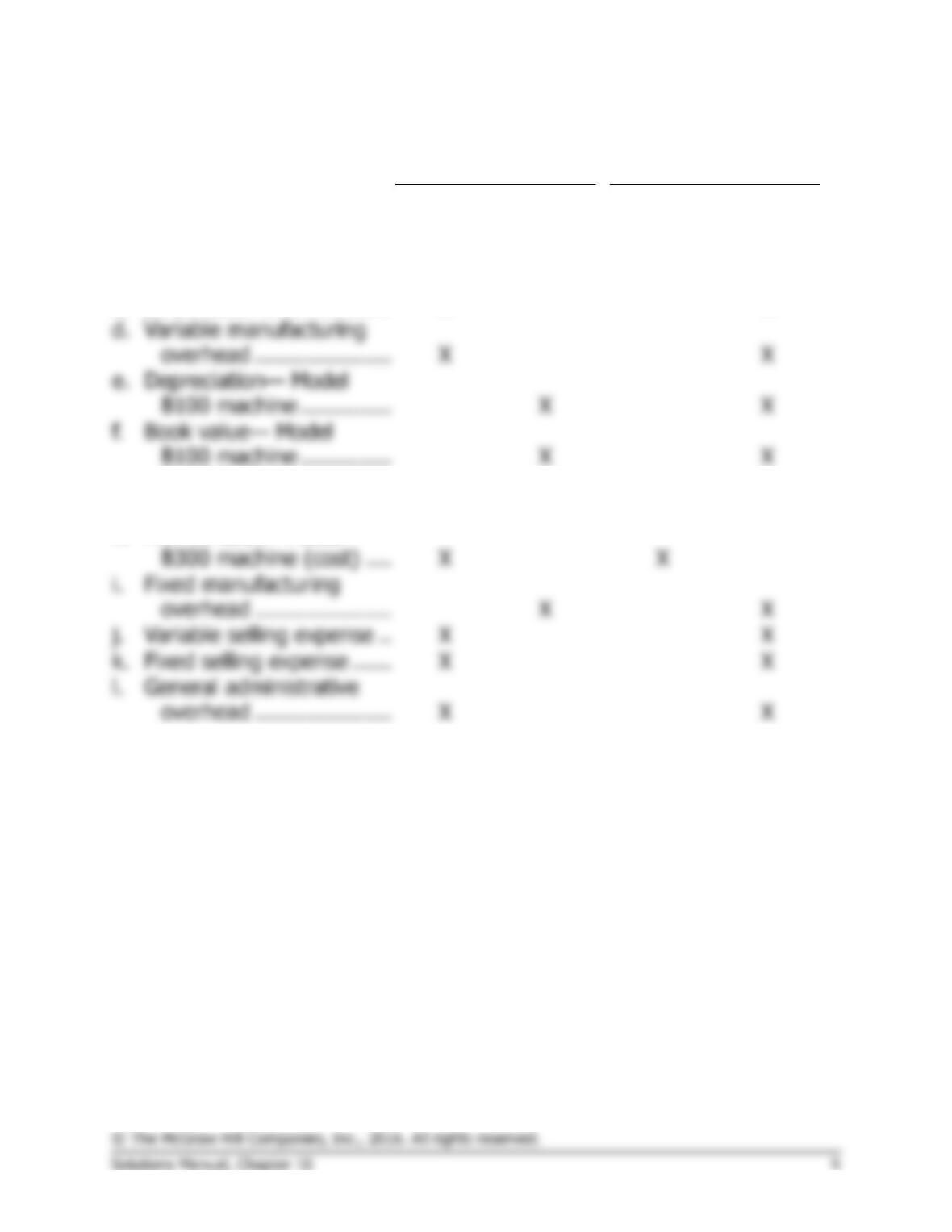
Exercise 10-1 (15 minutes)
Case 1
Case 2
Item
Relevant
Not
Relevant
Relevant
Not
Relevant
a.
Sales revenue ……………..
X
X
b.
Direct materials …………..
X
X
c.
Direct labor ………………..
X
X
d.
Variable manufacturing
X
X
B100 machine …………..
X
X
Book value— Model
X
X
g.
Disposal value— Model
B100 machine …………..
X
X
h.
X
X
Fixed manufacturing
overhead …………………
X
X
Variable selling expense ..
X
X
Fixed selling expense ……
X
X
X
X
Market value—Model
Exercise 10-2 (30 minutes)
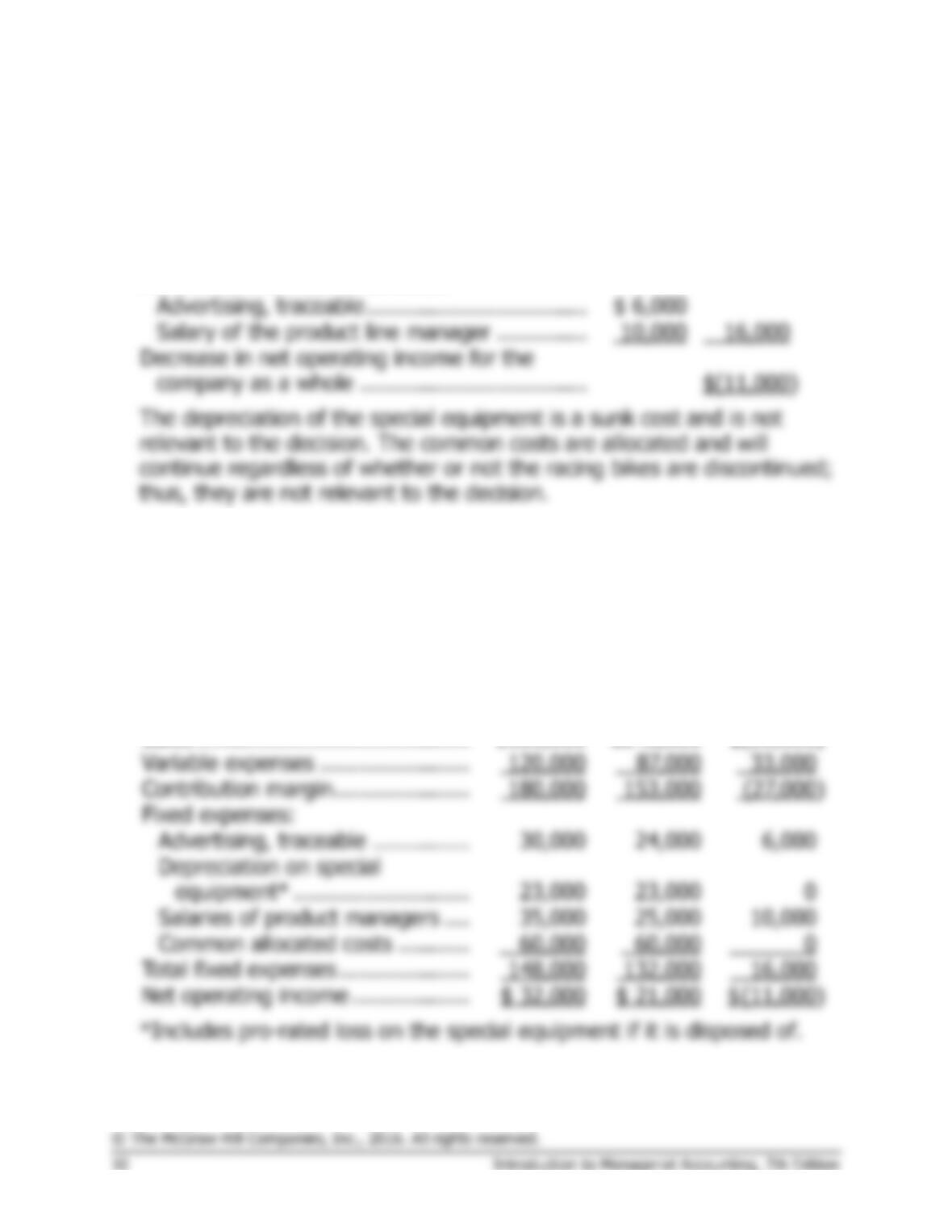
1. No, production and sale of the racing bikes should not be discontinued.
If the racing bikes were discontinued, then the net operating income for
the company as a whole would decrease by $11,000 each quarter:
Lost contribution margin …………………………..
$(27,000)
Fixed costs that can be avoided:
Alternative Solution:
Current
Total
Total If
Racing
Bikes Are
Dropped
Difference:
Net
Operating
Income
Increase or
(Decrease)
Sales ……………………………………
$300,000
$240,000
$(60,000)
Variable expenses …………………..
Contribution margin…………………
Fixed expenses:
Total fixed expenses ………………..
Net operating income ………………
Exercise 10-2 (continued)
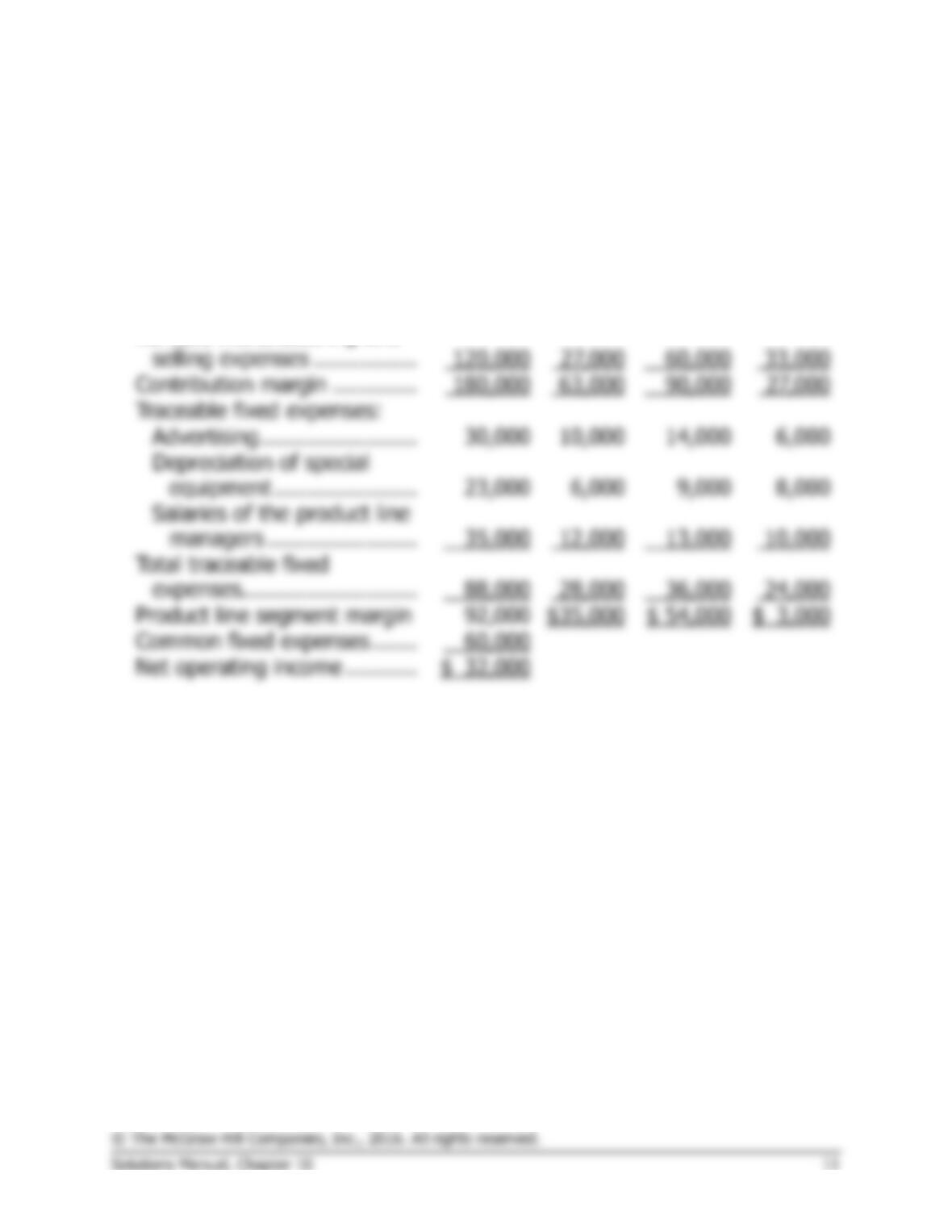
2. The segmented report can be improved by eliminating the allocation of
the common fixed expenses. Following the format introduced in Chapter
12 for a segmented income statement, a better report would be:
Total
Dirt
Bikes
Mountain
Bikes
Racing
Bikes
Sales ……………………………..
$300,000
$90,000
$150,000
$60,000
120,000
Contribution margin ………….
180,000
63,000
Traceable fixed expenses:
12,000
Total traceable fixed
28,000
Product line segment margin
$35,000
$ 54,000
$ 3,000
Common fixed expenses …….
Net operating income ………..
$ 32,000
Variable manufacturing and
Exercise 10-3 (30 minutes)
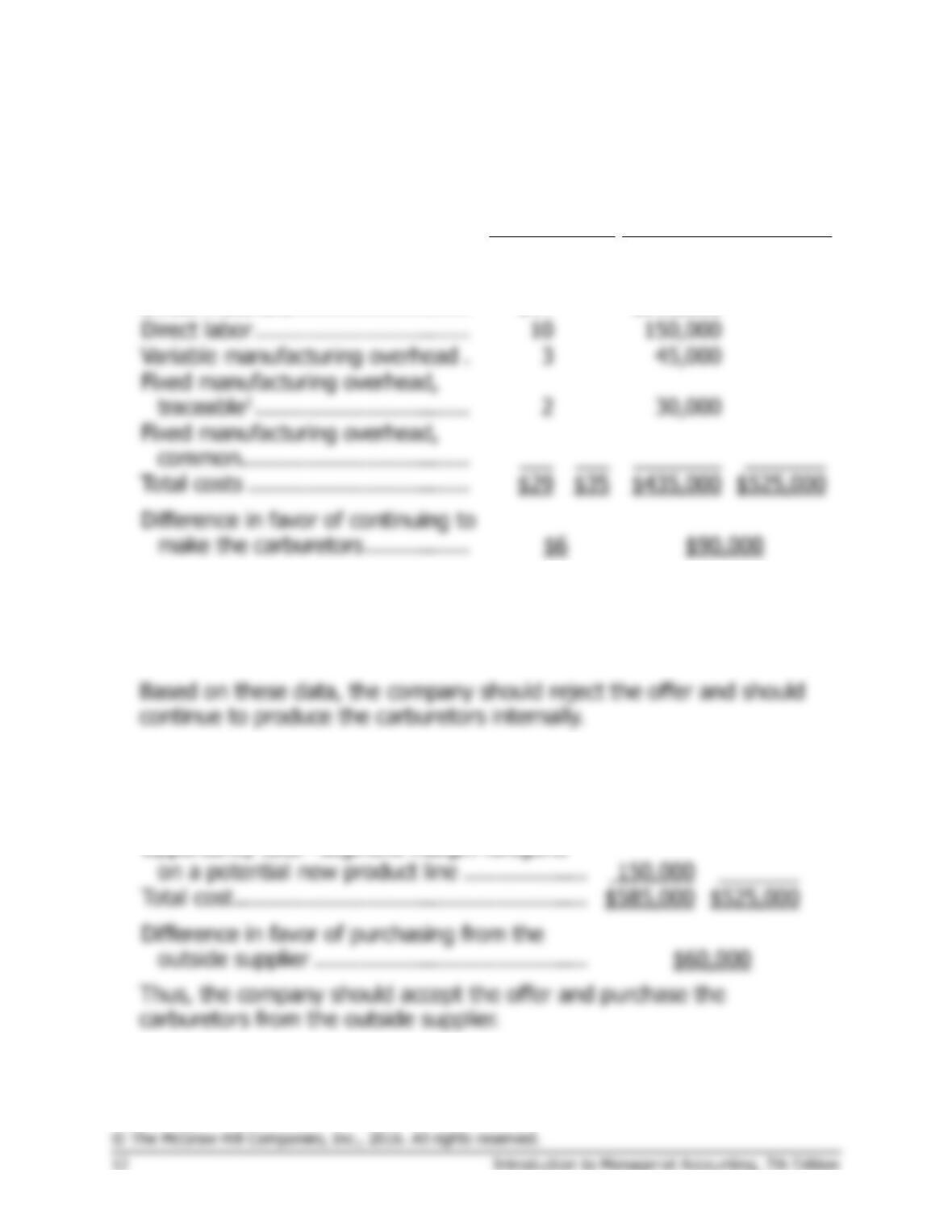
1.
Per Unit
Differential
Costs
15,000 units
Make
Buy
Make
Buy
Cost of purchasing …………………..
$35
$525,000
Direct materials ………………………
$14
$210,000
Direct labor …………………………...
Variable manufacturing overhead .
Total costs …………………………….
$435,000
1
Only the supervisory salaries can be avoided if the carburetors are
purchased. The remaining book value of the special equipment is a
sunk cost; hence, the $4 per unit depreciation expense is not
relevant to this decision.
2.
Make
Buy
Cost of purchasing (part 1) ……………………….
$525,000
Cost of making (part 1) …………………………...
$435,000
Total cost …………………………..………………….
$585,000
$525,000
Opportunity cost—segment margin foregone
Exercise 10-4 (15 minutes)
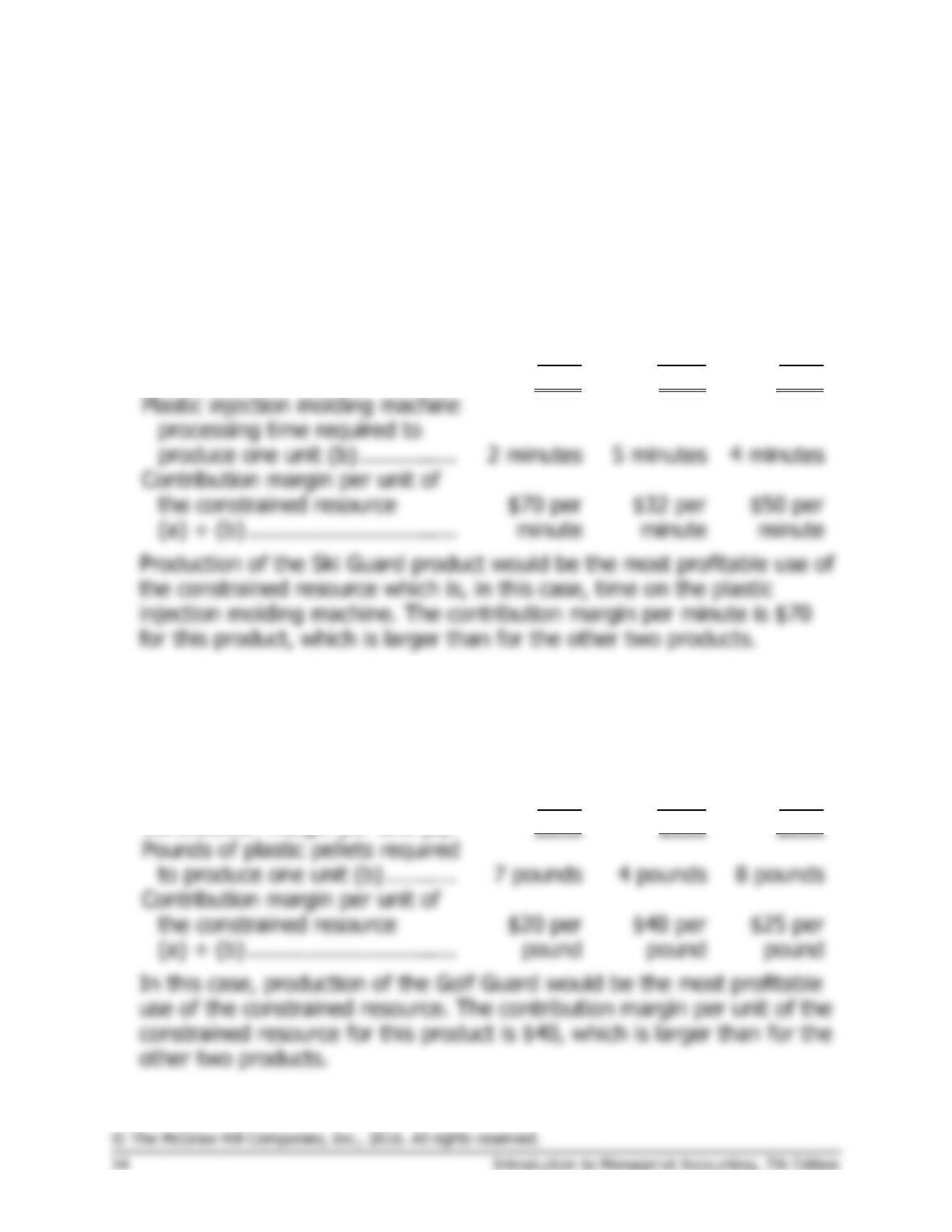
Only the incremental costs and benefits are relevant. In particular, only the
variable manufacturing overhead and the cost of the special tool are
relevant overhead costs in this situation. The other manufacturing
overhead costs are fixed and are not affected by the decision.
Per Unit
Total
for 20
Bracelets
Incremental revenue ………………………..
$169.95
$3,399.00
Incremental costs:
Variable costs:
$135.00
Fixed costs:
Total incremental cost ………………………
Incremental net operating income ………
Even though the price for the special order is below the company’s regular
price for such an item, the special order would add to the company’s net
Exercise 10-5 (20 minutes)
1. The most profitable use of the constrained resource is determined by
the contribution margin per unit of the constrained resource. In part 1,
the constrained resource is time on the plastic injection molding
machine. Therefore, the analysis would proceed as follows:
Ski
Golf
Fishing
Guard
Guard
Guard
Selling price per unit ………………
$200
$300
$255
Variable cost per unit …………….
60
140
55
Contribution margin per unit (a) .
$140
$160
$200
4 minutes
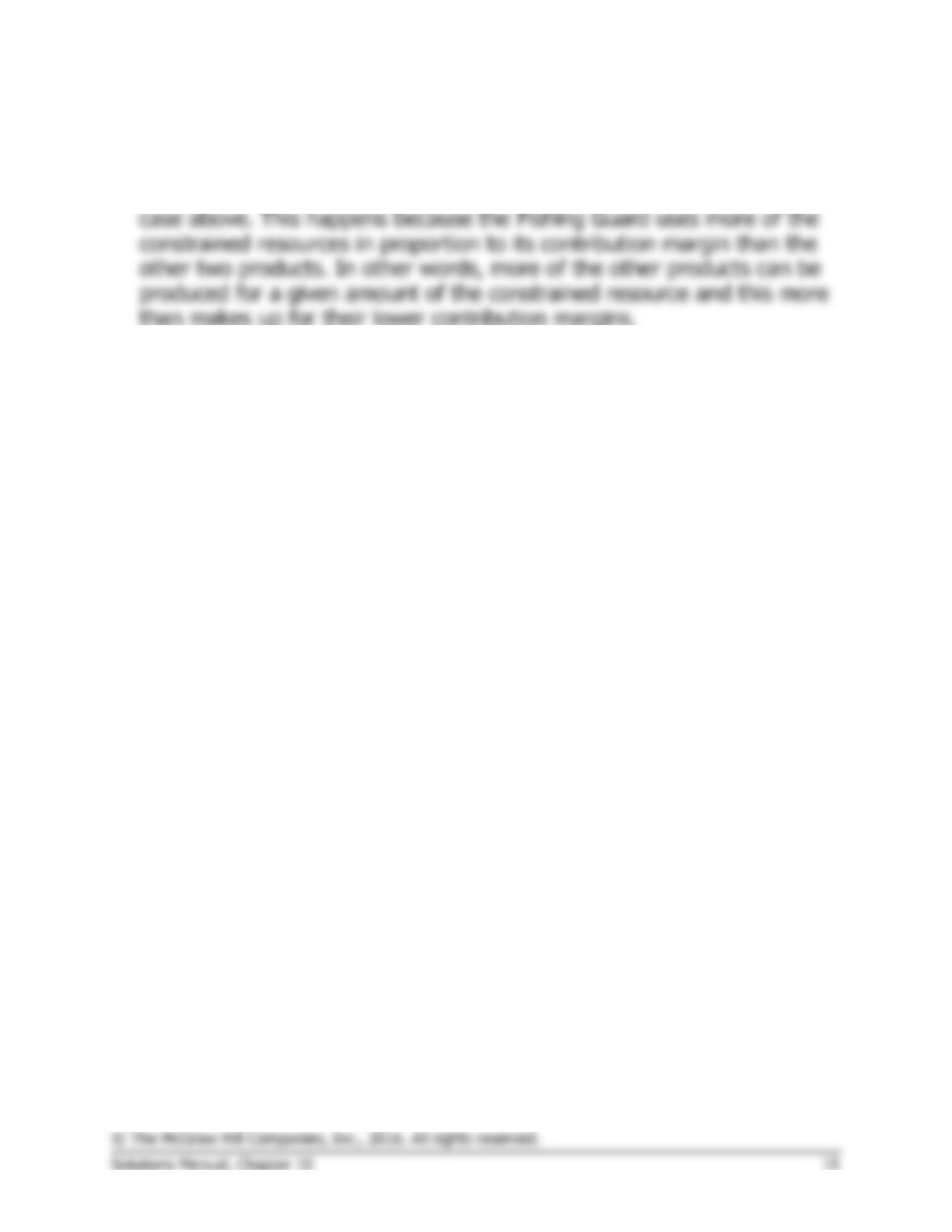
2. In this part, the constraint is the available pounds of plastic pellets.
Ski
Golf
Fishing
Guard
Guard
Guard
Selling price per unit ………………
$200
$300
$255
Variable cost per unit …………….
60
140
55
Contribution margin per unit (a) .
$140
$160
$200
Exercise 10-5 (continued)
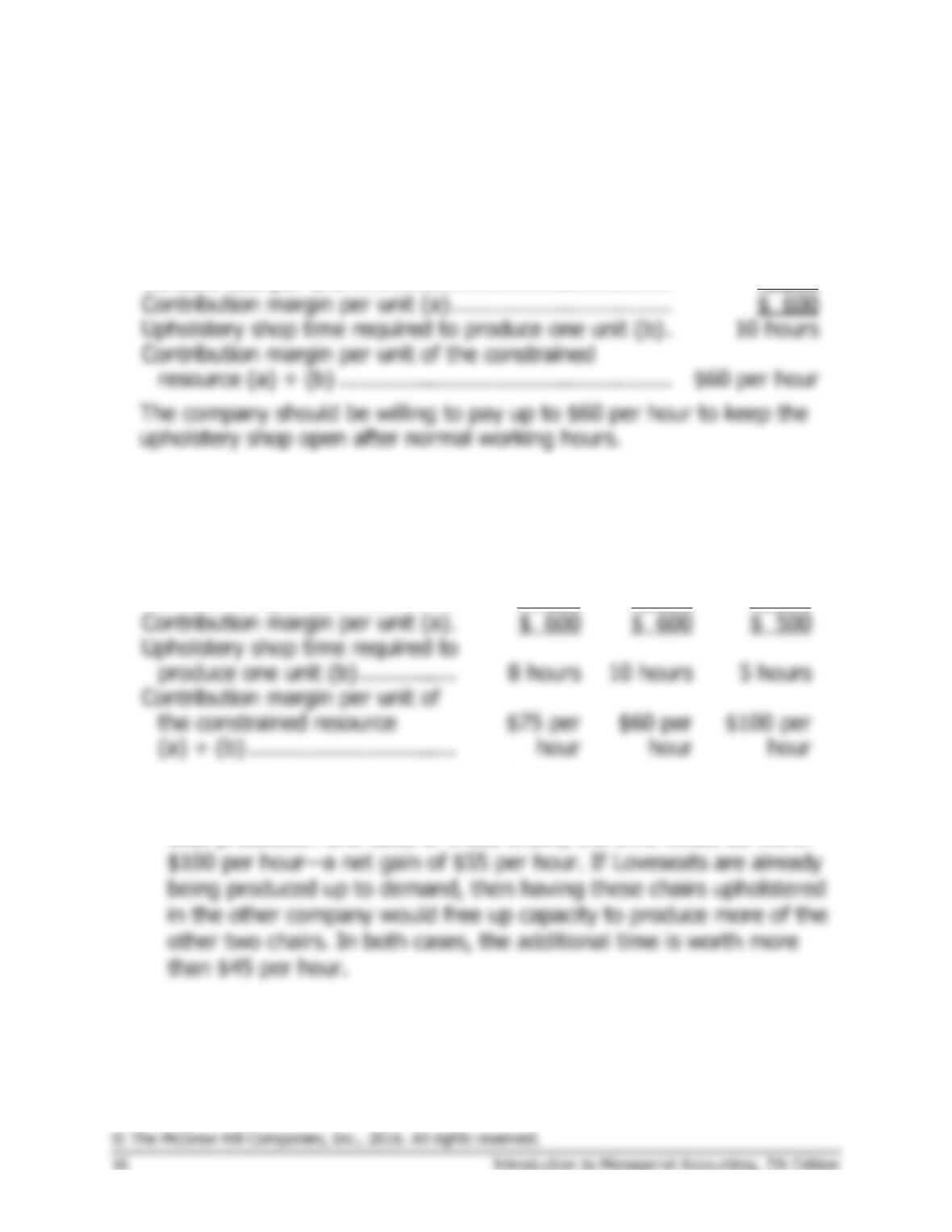
3. The Fishing Guard product has the largest unit contribution margin, but
it is not the most profitable use of the constrained resource in either
Exercise 10-6 (20 minutes)
1. The value of relaxing the constraint can be determined by computing
the contribution margin per unit of the constrained resource:
Sofa
Selling price per unit ……………………………………………
$1,800
Variable cost per unit ………………………………………….
1,200
Contribution margin per unit (a) …………………………….
Upholstery shop time required to produce one unit (b) .
$60 per hour
2. To answer this question, it is desirable to compute the contribution
margin per unit of the constrained resource for all three products:
Recliner
Sofa
Loveseat
Selling price per unit ………………
$1,400
$1,800
$1,500
Variable cost per unit …………….
800
1,200
1,000
Contribution margin per unit (a) .
The offer to upholster chairs for $45 per hour should be accepted.
The time would be used to upholster Loveseats. If this increases the
total production and sales of those chairs, the time would be worth
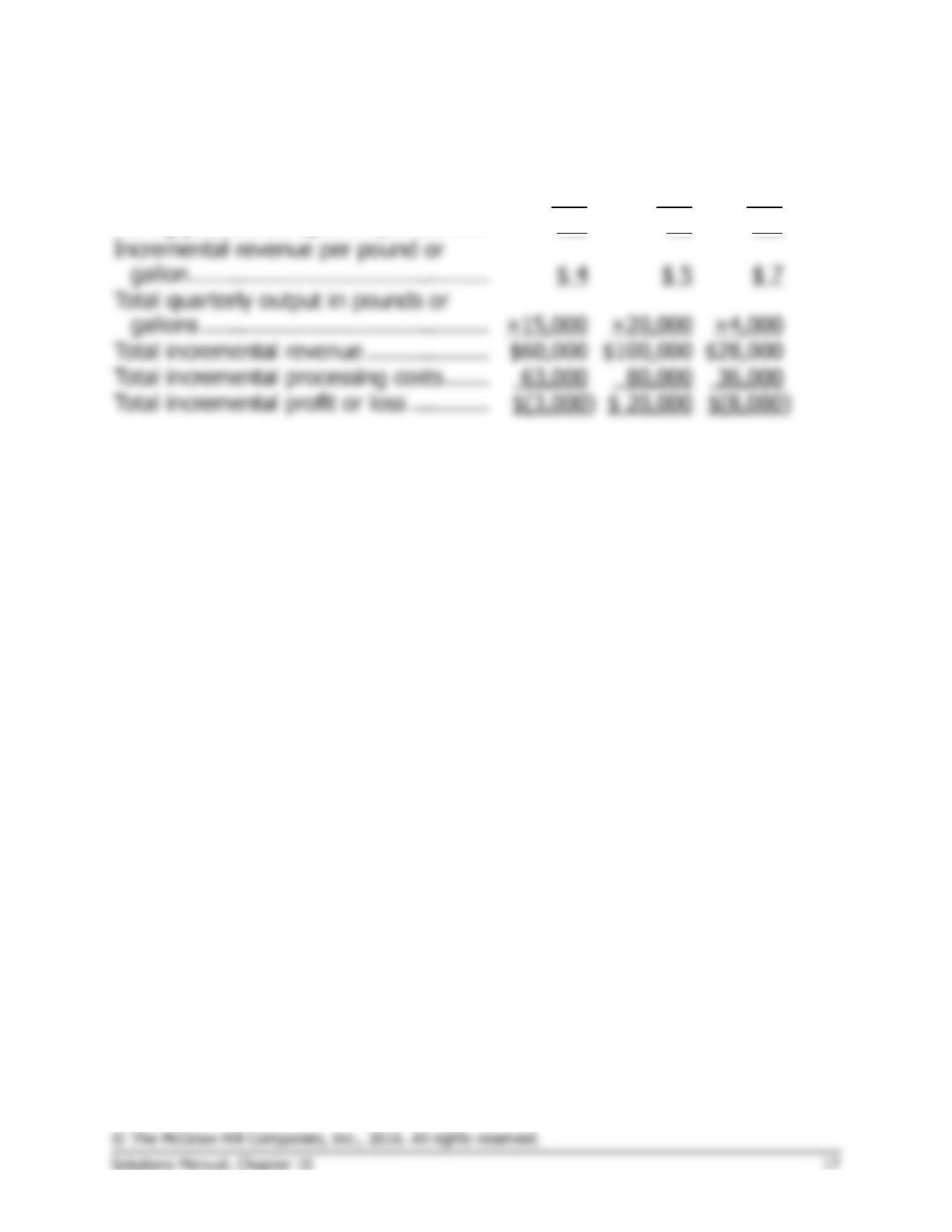
Exercise 10-7 (10 minutes)
A
B
C
Selling price after further processing ….
$20
$13
$32
Selling price at the split-off point ………
16
8
25
Total incremental revenue ……………….
Total incremental processing costs …….
Total incremental profit or loss …………
Therefore, only product B should be processed further.
Exercise 10-8 (30 minutes)
1.
A
B
C
(1)
Contribution margin per unit ………………………
$54
$108
$60
(2)
Direct material cost per unit ………………………
$24
$72
$32
Direct material cost per pound ……………………
Pounds of material required per unit (2) ÷ (3) .
Contribution margin per pound (1) ÷ (4) ………
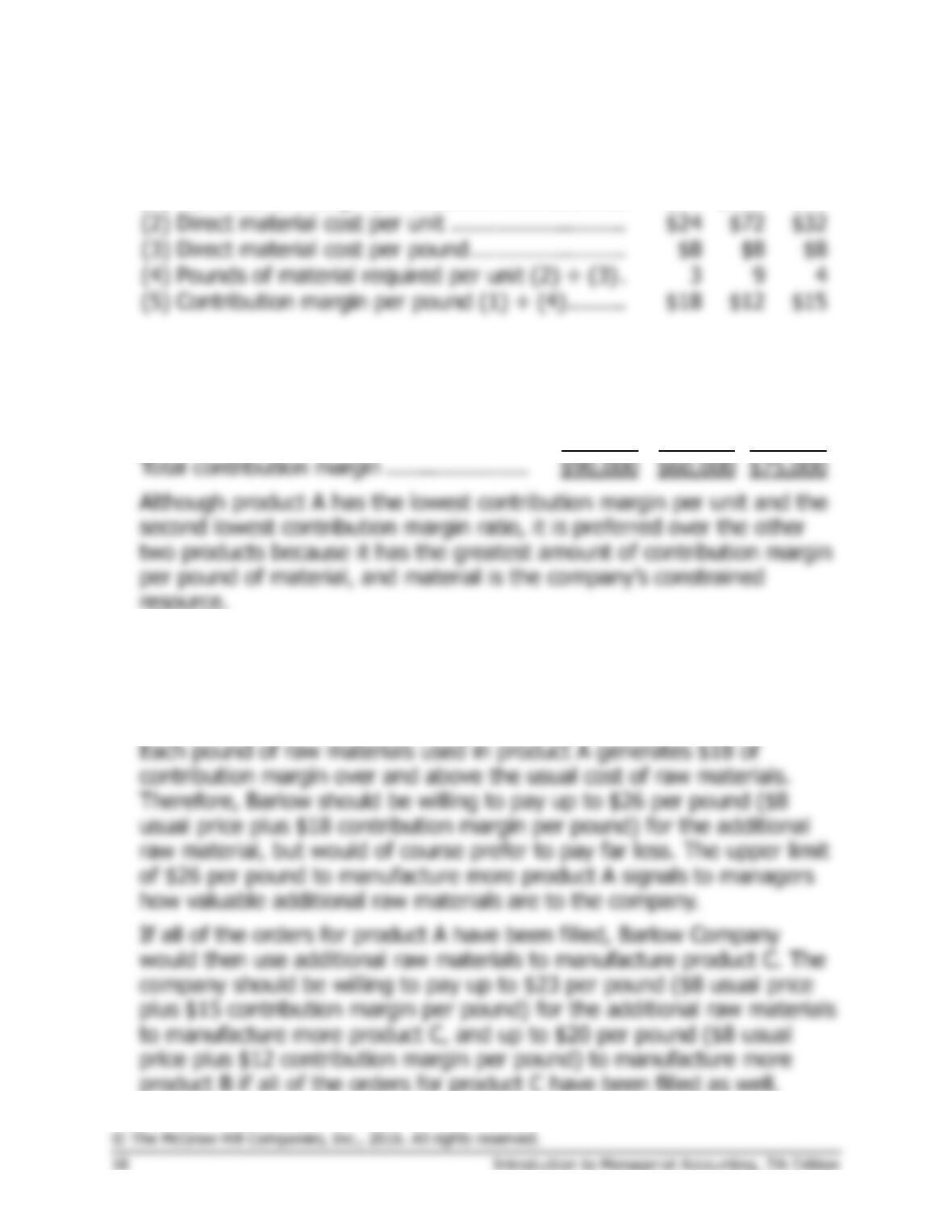
2. The company should concentrate its available material on product A:
A
B
C
Contribution margin per pound (above) .
$ 18
$ 12
$ 15
Pounds of material available ………………
× 5,000
× 5,000
× 5,000
Total contribution margin ………………….
3. The price Barlow Company would be willing to pay per pound for
additional raw materials depends on how the materials would be used.
If there are unfilled orders for all of the products, Barlow would
presumably use the additional raw materials to make more of product A.
Exercise 10-9 (15 minutes)
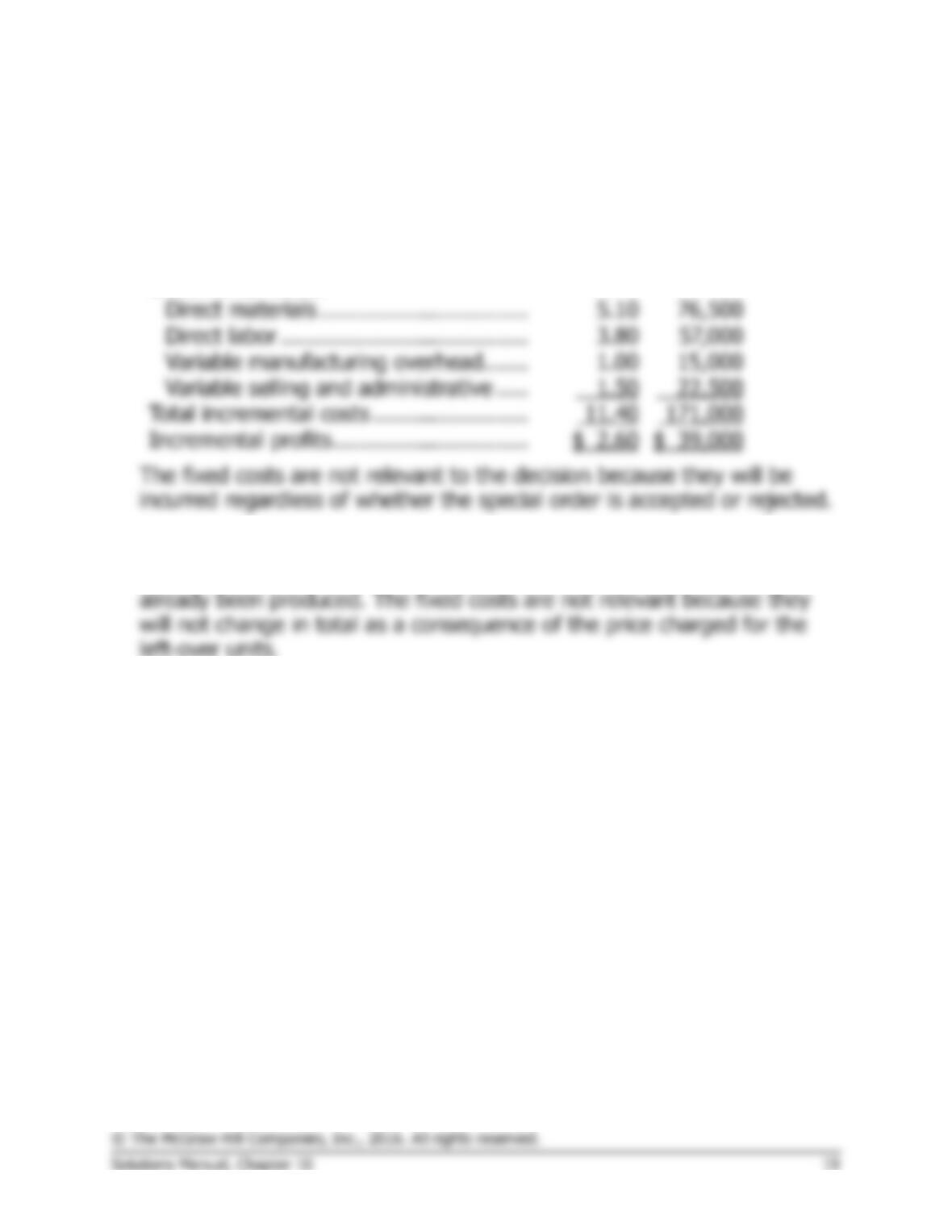
1. Annual profits will increase by $39,000:
Per Unit
15,000
Units
Incremental sales …………………………..
$14.00
$210,000
Incremental costs:
Total incremental costs ……………………
Incremental profits …………………………
2. The relevant cost is $1.50 (the variable selling and administrative
expenses). All other variable costs are sunk because the units have
Exercise 10-10 (15 minutes)
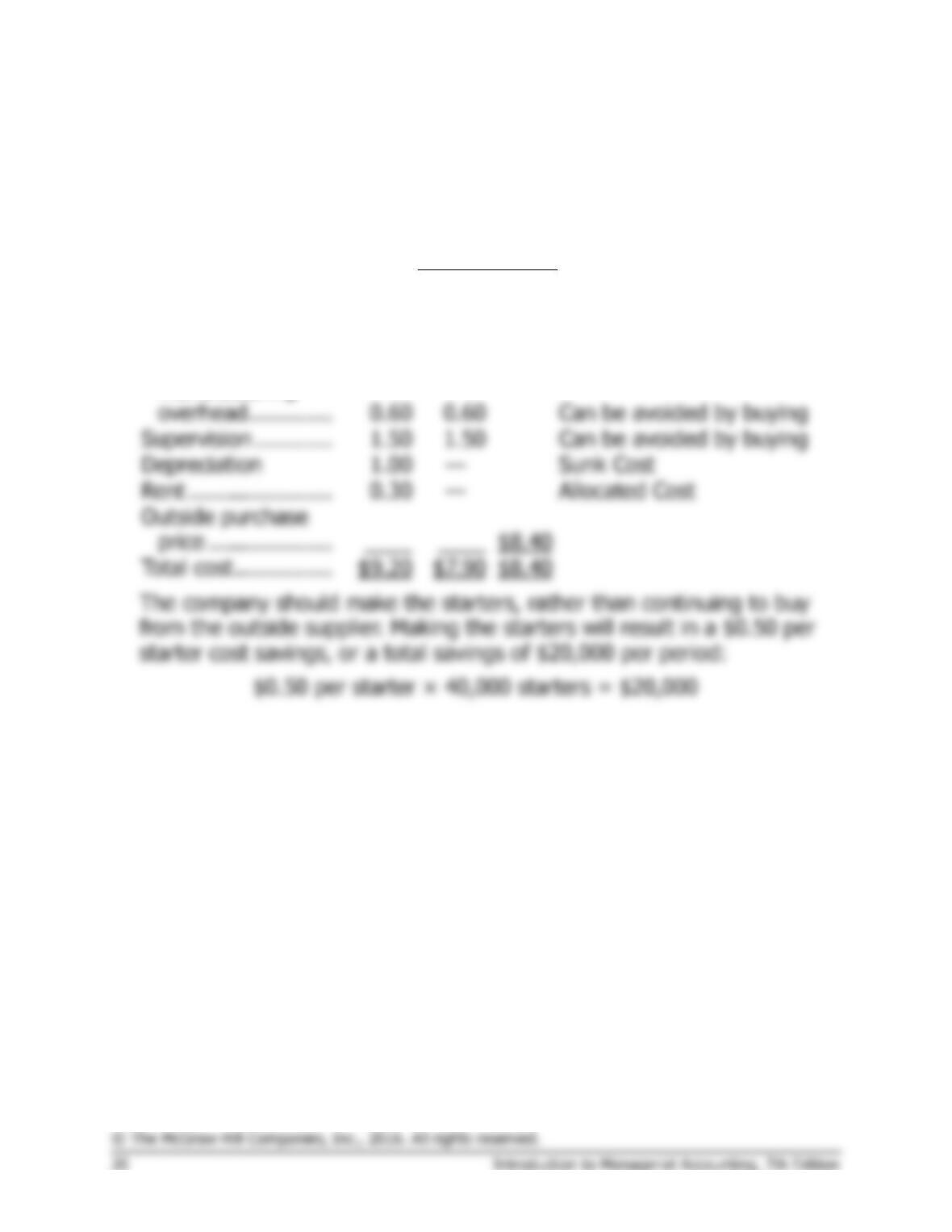
The target production level is 40,000 starters per period, as shown by the
relations between per-unit and total fixed costs.
“Cost”
Per
Differential
Costs
Unit
Make
Buy
Explanation
Direct materials ……
$3.10
$3.10
Can be avoided by buying
Direct labor …………
2.70
2.70
Can be avoided by buying
0.60
0.60
Can be avoided by buying
Supervision …………
1.50
1.50
Can be avoided by buying
Depreciation
1.00
Sunk Cost
Rent ………………….
0.30
Allocated Cost
Total cost ……………
$9.20
Variable
manufacturing