Financial and Managerial Accounting 9th Edition
1-1
CHAPTER 1
ACCOUNTING IN BUSINESS
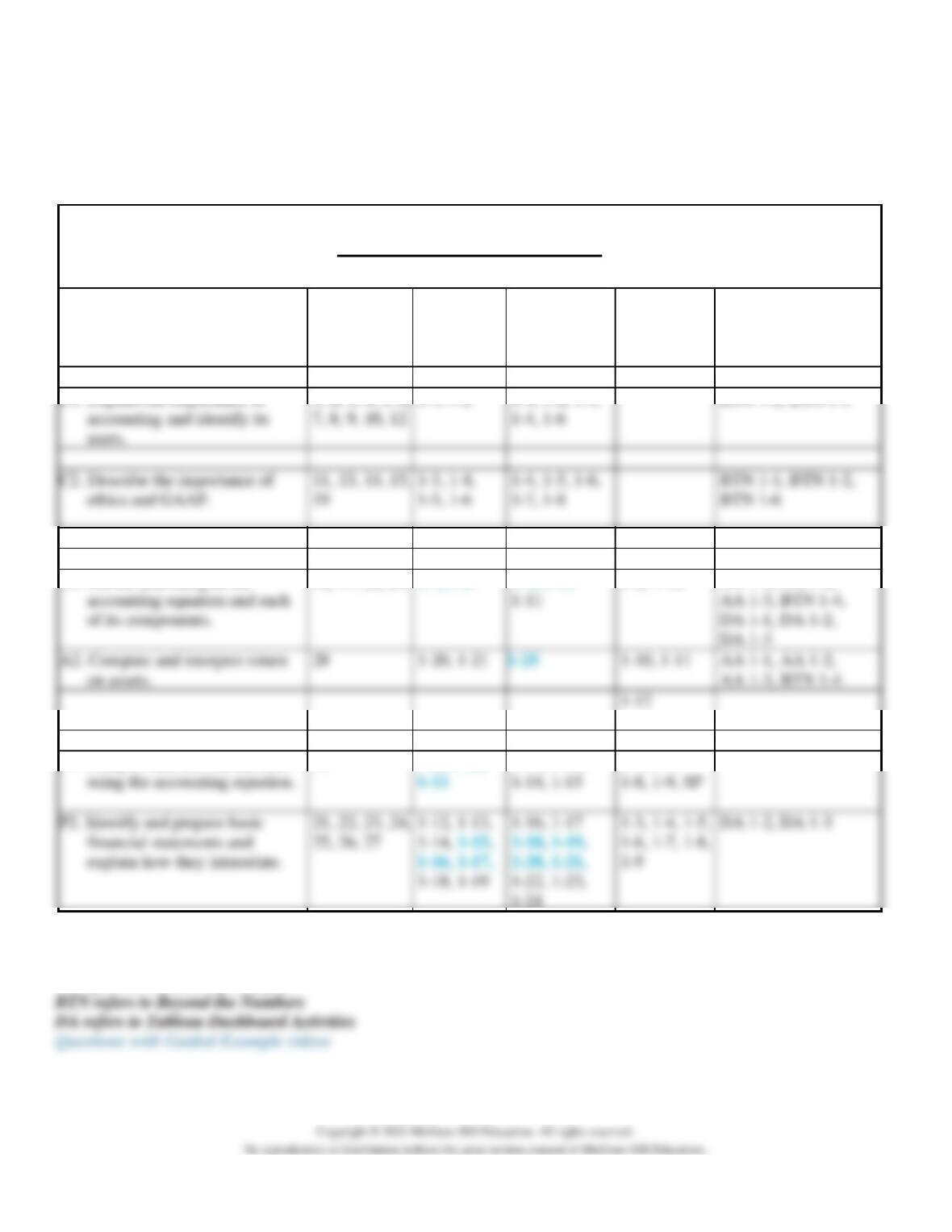
Related Assignment Materials
Student Learning Objectives
Questions
Quick
Studies*
Exercises*
Problems*
AA, BTN, DA
Conceptual objectives:
Analytical objectives:
DA 1-3
AA 1-3, BTN 1-4
A1. Define and interpret the
16, 17, 20, 24
1-7, 1-8
1-9, 1-10
1-2, 1-10
AA 1-1, AA 1-2,
Procedural objectives:
1-24
P1. Analyze business transactions
18
1-9, 1-10,
1-12, 1-13,
1-1, 1-7,
*See additional information on next page that pertains to these quick studies, exercises, and problems.
SP refers to the Serial Problem
AA refers to Accounting Analysis
Financial and Managerial Accounting 9th Edition
1-2
Additional Information on Related Assignment Material available in Connect®
Available on the instructor’s course-specific website, Connect repeats all numerical Quick Studies, all Exercises, and
Problem Set A. Connect also provides algorithmic versions for Quick Study, Exercises, and Problems. It allows
instructors to monitor, promote, and assess student learning. It can be used in practice, homework, or exam mode.
Connect Pre-Built Course Package (formerly called Library course)
• Connect course: Pre-built courses include reading, homework, and assessment for each chapter. Pre-built courses
The Connect Orientation Videos provide an introduction for your students for using Connect to complete assignments to
help get your students up and running in the system. There are videos covering:
• End-of-Chapter Assignments
General Ledger Problems
Assignable within Connect, General Ledger (GL) problems offer students the ability to see how transactions post from the general
journal all the way through the financial statements. Critical thinking and analysis components are added to each GL problem to
ensure understanding of the entire process. GL problems are auto-graded and provide instant feedback to the student.
Smartbook 2.0
Available within Connect, SmartBook makes study time as productive and efficient as possible. SmartBook identifies and closes
knowledge gaps through a continually adapting reading experience that provides personalized learning resources at the precise
moment of need. This ensures that every minute spent with SmartBook is returned to the student as the most value-added minute
possible. The result? More confidence, better grades, and greater success.
Financial and Managerial Accounting 9th Edition
1-3
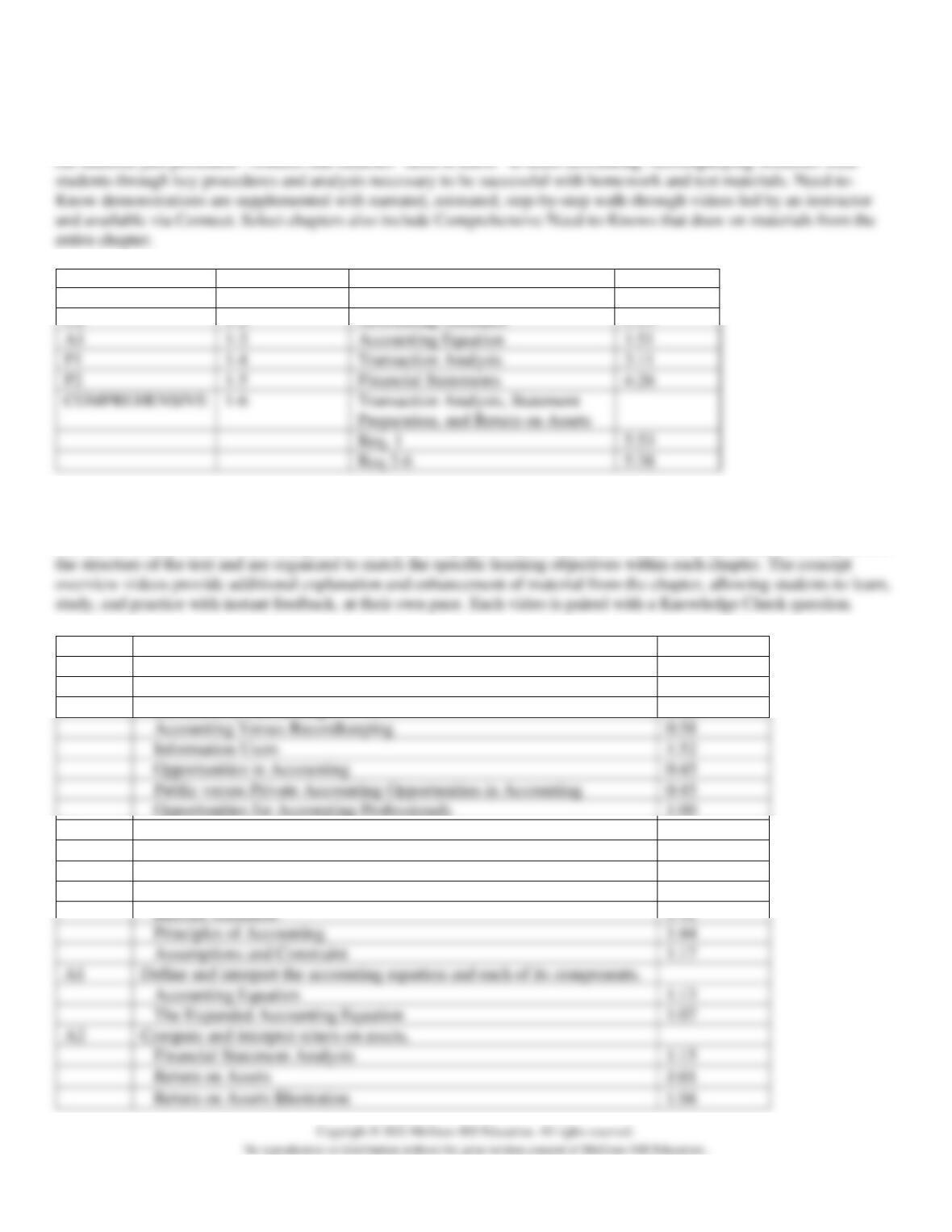
Need-to-Know
Need-to-Know demonstrations are located at key junctures in each chapter. These demonstrations pose questions about
LO
Need–to-Know
Title
Time
C1
1-1
Accounting Users
1:29
C2
1-2
Accounting Guidance
3:59
1-3
Accounting Equation
1:51
1-4
Transaction Analysis
3:11
1-5
Financial Statements
4:26
Preparation, and Return on Assets
Req. 1
5:53
Req 2-6
5:38
Concept Overview
The Concept Overview Videos (COVs) provide engaging narratives of all chapter learning objectives in an assignable and
interactive online format. The concept overview videos replace the previous edition interactive presentations. They follow
LO
Title
Time
C1
Explain the importance of accounting and identify its users.
Importance of Accounting
0:50
Definition of Accounting
0:41
Accounting Versus Recordkeeping
0:58
Information Users
1:52
Opportunities in Accounting
0:45
Public versus Private Accounting Opportunities in Accounting
0:45
Opportunities for Accounting Professionals
1:00
C2
Describe the importance of ethics and GAAP.
Ethical Decision Making
0:55
Fraud Triangle
0:32
Generally Accepted Accounting Principles
1:12
Internal Standards
1:41
Principles of Accounting
1:44
Assumptions and Constraint
1:17
Define and interpret the accounting equation and each of its components.
Accounting Equation
1:13
The Expanded Accounting Equation
1:07
Compute and interpret return on assets.
Financial Statement Analysis
1:15
Financial and Managerial Accounting 9th Edition
1-4
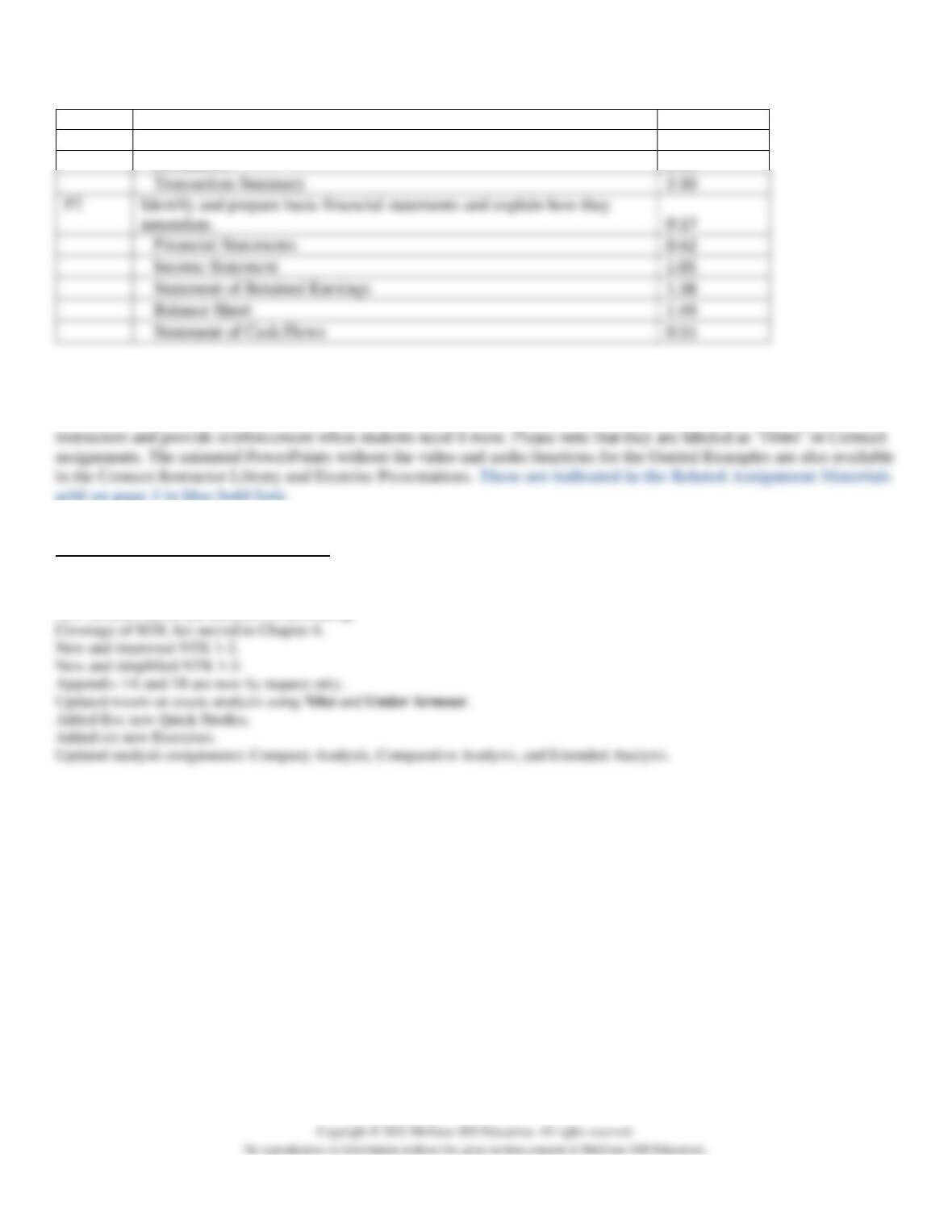
P1
Analyze business transactions using the accounting equation.
Transaction Analysis
0:52
Illustration
0:55
Transaction Summary
2:30
interrelate.
0:17
Financial Statements
0:42
Income Statement
1:05
Statement of Retained Earnings
1:38
Balance Sheet
1:49
Statement of Cash Flows
0:55
Hints/Guided Examples
The Guided Examples in Connect provide a narrated, animated, step-by-step walk-through of select quick studies,
exercises, and general ledger problems similar to those assigned. These short presentations can be turned on or off by
grid on page 1 in blue bold font.
Synopsis of Chapter Revisions
NEW opener—Netflix and entrepreneurial assignment.
Streamlined conceptual learning objectives.
New sections on AI and analytics in accounting.
Financial and Managerial Accounting 9th Edition
1-5
Chapter Outline
I. Importance of Accounting—we live in the information age in which information, and its reliability,
impacts the financial well-being of us all.
Accounting is an information and measurement system that identifies, records, and communicates an
organization’s business activities.
A. Users of Accounting Information – accounting is called the language of business because it
communicates data the helps users make better decisions. People using accounting information are
divided into two groups:
1. External Users—those not directly involved with running the company. They have limited access
to the company’s accounting information. Examples: shareholders (investors), lenders, external
marketing, and service managers.
2. Internal Users—those directly involved in managing and operating an organization. Internal users
include research and development, purchasing, human resource, production, distribution,
B. Opportunities in Accounting—four broad areas of opportunities are financial, managerial, taxation,
and accounting-related.
visualization is a graphical presentation of data to help people understand its significance. They
help individuals make informed business decisions.
1. Private accounting, which are employees working for businesses, offers the most opportunities.
2. Public accounting offers the next largest number of opportunities. Opportunities include auditing
and taxation.
II. Fundamentals of Accounting
A. Ethics—A Key concept—Ethics are beliefs that separate right from wrong.
1. Fraud Triangle: Ethics under Attack—model that asserts three factors must exist for a person to
Financial and Managerial Accounting 9th Edition
1-6
B. Generally Accepted Accounting Principles (GAAP)—concepts and rules that govern financial
accounting. The purpose of GAAP is to make information in accounting statements relevant,
reliable, and comparable.
Securities and Exchange Commission (SEC). The SEC oversees proper use of GAAP.
accounting practices in the global economy. IFRS are similar but sometimes different from U.S.
1. The Financial Accounting Standards Board (FASB) is given the task of setting GAAP from the
C. Conceptual Framework—FASB Conceptual Framework consists of:
1. Objectives—to provide information useful to investors, creditors, and others.
5. Principles, Assumptions and Constraint—two types are general principles (assumptions,
concepts, and guidelines for preparing financial statements; stem from long-used accounting
practices) and specific principles (detailed rules used in reporting transactions and events).
a. Accounting Principles—General principles consist of four general principles:
i Measurement principle (cost principle)—accounting information is based on actual
costs incurred in business transactions. Cost is measured on a cash or equal-to-cash basis.
b. Accounting Assumptions –
i. Going-concern assumption—accounting information presumes that the business will continue
operating instead of being closed or sold.
c. Exhibit 1.8: Types and Attributes of Businesses
i. Sole proprietorship is a business owned by one person that has unlimited liability. It is
not a separate legal entity. The owner has unlimited liability and is, therefore,
personally liable for the business debts.
Financial and Managerial Accounting 9th Edition
1-7
ii. Partnership is a business owned by two or more people, called partners, who are
subject to unlimited liability. The business is not subject to an income tax, but the
d. Accounting Constraints -there are basic constraints on financial reporting.
i. The cost-benefit constraint says that information disclosed by the entity must have
iii. Conservatism and industry practices are sometimes referred to as constraints as well.
III. Business Transactions and Accounting
A. Accounting Equation (Assets = Liabilities + Equity)—elements of the equation include:
2. Liabilities—creditors’ claims on assets. These claims reflect obligations to transfer assets or
3. Equity—owner’s claim on assets; assets minus liabilities. Also called net assets or residual
equity. Increases in equity result from owner investments and revenues. Decreases results from
dividends and expenses. Equity consists of:
a. Common stock —owner investments are inflows of cash and other net assets from
B. Transaction Analysis—each transaction and event always leaves the equation in balance. (Assets =
Liabilities + Equity)
1. Investment by owner:
Financial and Managerial Accounting 9th Edition
1-8
2. Purchase supplies for cash:
ASSET = LIABILITIES + EQUITY
3. Purchase equipment for cash:
ASSET = LIABILITIES + EQUITY
4. Purchase supplies on credit:
5. Provide services for cash:
6, 7. Payment of expenses in cash (salaries, rent, etc.):
8. Provided services and facilities for credit:
9. Receipt of cash from accounts receivable (customers paying on their accounts):
ASSET = LIABILITIES + EQUITY
10. Payment of accounts payable:
11. Payment of Cash Dividends:
ASSET = LIABILITIES + EQUITY
IV. Communicating with Users
The four financial statements and their purposes are:
Financial and Managerial Accounting 9th Edition
A. Income Statement—describes a company’s revenues and expenses along with the resulting
net income or loss over a period of time. (Net income occurs when revenues exceed
expenses. Net loss occurs when expenses exceed revenues.)
Statement Preparation from Transaction Analysis—prepared in the following order using the
procedure indicated below.
A. Income Statement⎯information about revenues and expenses is conveniently taken from
C. Balance Sheet⎯shows the financial position as of the date of the statement. Includes the
balance of each asset, liability and the ending retained earnings balance. Note that the
retained earnings balance is taken from the statement of retained earnings, and added to
V. Decision Analysis—Return on Assets (ROA)—a profitability measure. Also called Return on
Investment (ROI).
A. Useful in evaluating management, analyzing and forecasting profits, and planning activities.
B. The return on assets is calculated by dividing net income for a period by average total assets.