Chapter 1
Managerial Accounting and Cost Concepts
Solutions to Questions
1-1 The three major elements of product
costs in a manufacturing company are direct
materials, direct labor, and manufacturing
overhead.
1-2
a. Direct materials are an integral part of a
finished product and their costs can be
conveniently traced to it.
b. Indirect materials are generally small
items of material such as glue and nails. They
1-3 A product cost is any cost involved in
purchasing or manufacturing goods. In the case
of manufactured goods, these costs consist of
1-4
a. Variable cost: The variable cost per unit is
constant, but total variable cost changes in
direct proportion to changes in volume.
b. Fixed cost: The total fixed cost is constant
within the relevant range. The
average
fixed
cost per unit varies inversely with changes
in volume.
c. Mixed cost: A mixed cost contains both
variable and fixed cost elements.
about variable and fixed cost behavior are
valid.
1-7 An activity base is a measure of
within the relevant range.
1-9 A discretionary fixed cost has a fairly
short planning horizon—usually a year. Such
costs arise from annual decisions by
1-10 Yes. As the anticipated level of activity
changes, the level of fixed costs needed to
support operations may also change. Most fixed
costs are adjusted upward and downward in
large steps, rather than being absolutely fixed at
one level for all ranges of activity.
1-11 The high-low method uses only two
points to determine a cost formula. These two
points are likely to be less than typical because
1-13 The term “least–squares regression”
means that the sum of the squares of the
deviations from the plotted points on a graph to
traditional approach organizes costs by function,
such as production, selling, and administration.
Within a functional area, fixed and variable costs
are intermingled.
1-15 The contribution margin is total sales
revenue less total variable expenses.
1-16 A differential cost is a cost that differs
between alternatives in a decision. An
The Foundational 15
1.
Direct materials ……………………………………………….
$ 6.00
Direct labor …………………………………………………….
3.50
Variable manufacturing overhead ………………………..
1.50
Variable manufacturing cost per unit ……………………
$11.00
Variable manufacturing cost per unit (a) ……………….
$11.00
Number of units produced (b) …………………………..
Total variable manufacturing cost (a) × (b) ……………
$110,000
Number of units produced (d) …………………………..
Total fixed manufacturing cost (c) × (d) ……………….
Total product (manufacturing) cost ………………………
$150,000
2.
Sales commissions ……………………………………………
$1.00
Variable administrative expense ………………………….
0.50
Variable selling and administrative per unit ……………
$1.50
Variable selling and admin. per unit (a)…………………
$1.50
Number of units sold (b) …………………………..
10,000
Number of units sold (d) …………………………..
Total period (nonmanufacturing) cost …………………..
The Foundational 15 (continued)
3.
Direct materials ……………………………………………….
$ 6.00
Direct labor …………………………………………………….
3.50
Variable manufacturing overhead ………………………..
Sales commissions ……………………………………………
Variable administrative expense …………………………..
Variable cost per unit sold …………………………..
4.
Direct materials ……………………………………………….
$ 6.00
Direct labor …………………………………………………….
3.50
Variable manufacturing overhead ………………………..
Sales commissions ……………………………………………
1.00
Variable administrative expense …………………………..
Variable cost per unit sold …………………………..
5.
Variable cost per unit sold (a)…………………………..
$12.50
Number of units sold (b) …………………………..
Total variable costs (a) × (b) …………………………..
6.
Variable cost per unit sold (a)…………………………..
$12.50
Number of units sold (b) …………………………..
Total variable costs (a) × (b) …………………………..
7.
Total fixed manufacturing cost
(see requirement 1) (a) …………………………..
$40,000
Number of units produced (b) …………………………..
8.
Total fixed manufacturing cost
(see requirement 1) (a) …………………………..
$40,000
Number of units produced (b) …………………………..
9.
Total fixed manufacturing cost
(see requirement 1) ……………………………………….
$40,000
The Foundational 15 (continued)
10.
Total fixed manufacturing cost
(see requirement 1) ……………………………………….
$40,000
11.
Variable overhead per unit (a) …………………………..
$1.50
Number of units produced (b) …………………………..
8,000
Total variable overhead cost (a) × (b) …………………..
Total fixed overhead (see requirement 1) ………………
Total manufacturing overhead cost ………………………
12.
Variable overhead per unit (a) …………………………..
$1.50
Number of units produced (b) …………………………..
12,500
Total variable overhead cost (a) × (b) …………………..
Total fixed overhead (see requirement 1) ………………
Total manufacturing overhead cost ………………………
13.
Selling price per unit …………………………………………
$22.00
(see requirement 4) ……………………………………….
Contribution margin per unit …………………………..
Variable cost per unit sold
The Foundational 15 (continued)
14.
Direct materials per unit …………………………..
$6.00
Direct labor per unit …………………………………………
3.50
Direct manufacturing cost per unit (a) ………………….
$9.50
Number of units produced (b) …………………………..
Total direct manufacturing cost (a) × (b) ………………
15.
Direct materials per unit …………………………..
$6.00
Direct labor per unit …………………………………………
3.50
Variable manufacturing overhead per unit ……………..
Incremental cost per unit produced ……………………..
Exercise 1-1 (15 minutes)
Cost
Cost Object
Direct
Cost
Indirect
Cost
1.
The wages of pediatric
nurses
The pediatric
department
X
2.
Prescription drugs
A particular patient
X
Heating the hospital
The pediatric
department
salary
A particular patient
Lab tests by outside
A particular patient
X
Exercise 1-2 (10 minutes)
1. The cost of a hard drive installed in a computer: direct materials.
2. The cost of advertising in the
Puget Sound Computer User
newspaper:
selling.
6. The wages of the company’s accountant: administrative.
7. Depreciation on equipment used to test assembled computers before
release to customers: manufacturing overhead.
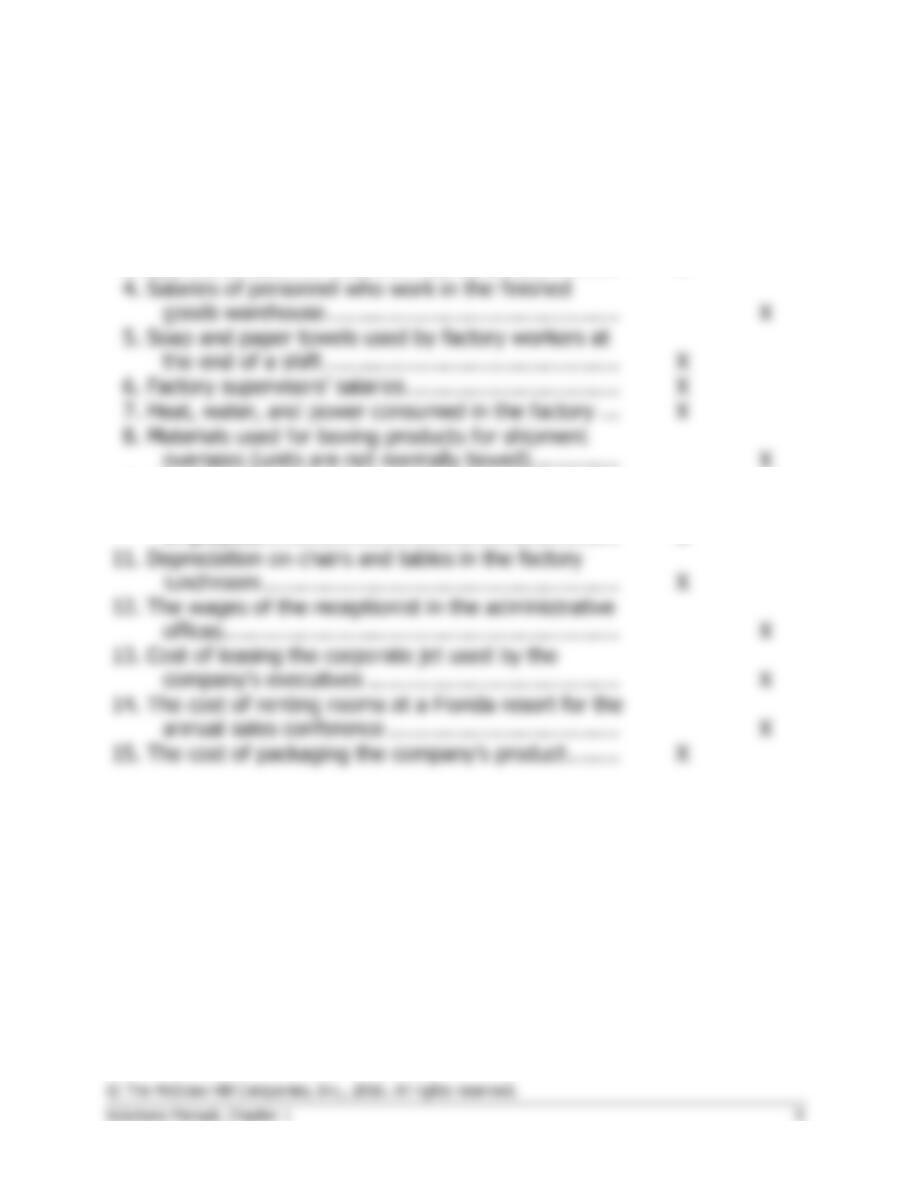
Exercise 1-3 (15 minutes)
Product
Cost
Period
Cost
1.
Depreciation on salespersons’ cars ……………………
X
2.
Rent on equipment used in the factory ………………
X
3.
Lubricants used for machine maintenance…………..
X
X
X
6.
Factory supervisors’ salaries …………………………….
X
7.
X
X
9.
Advertising costs …………………………………………..
X
10.
Workers’ compensation insurance for factory
employees …………………………………………………
X
X
X
X
14.
X
X
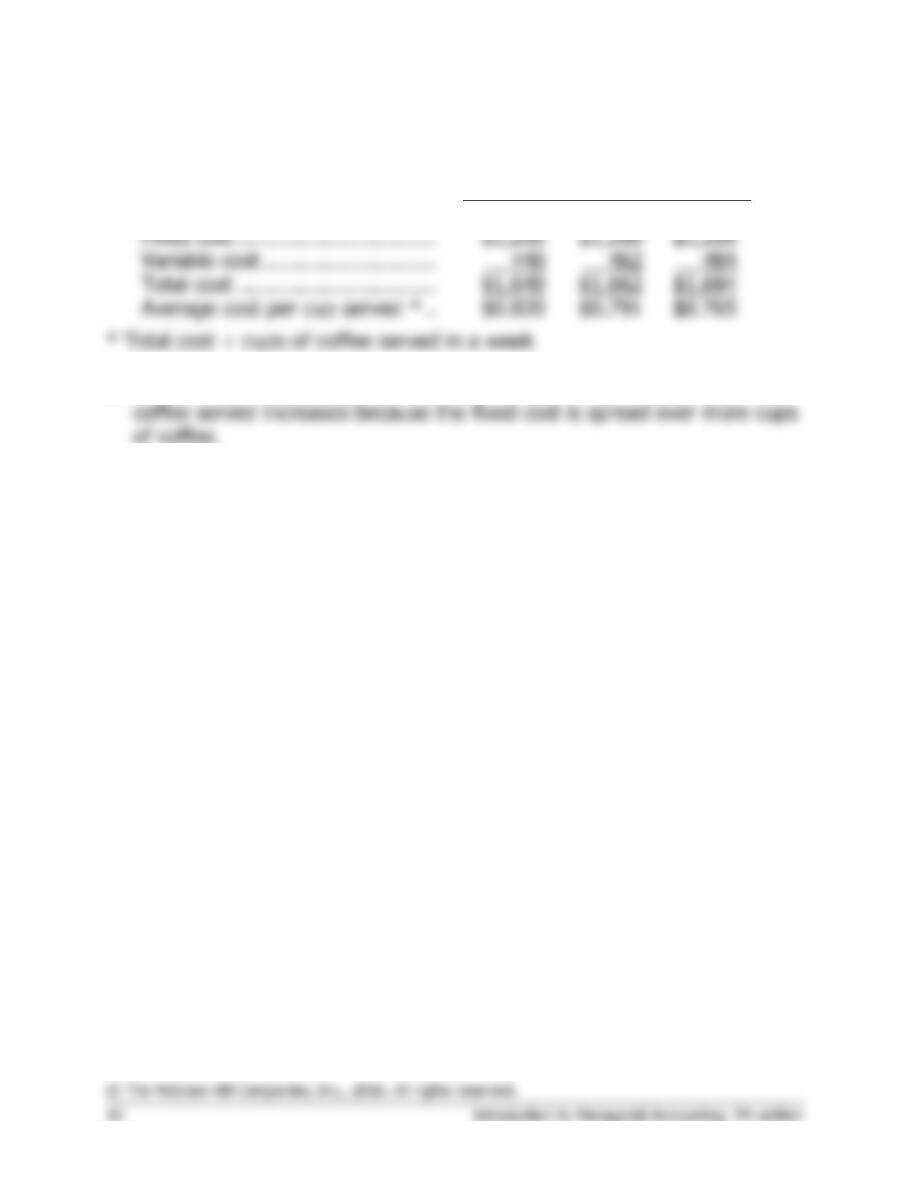
Exercise 1-4 (15 minutes)
1.
Cups of Coffee Served
in a Week
2,000
2,100
2,200
Fixed cost …………………………..
Total cost …………………………..
Average cost per cup served * ..
2. The average cost of a cup of coffee declines as the number of cups of
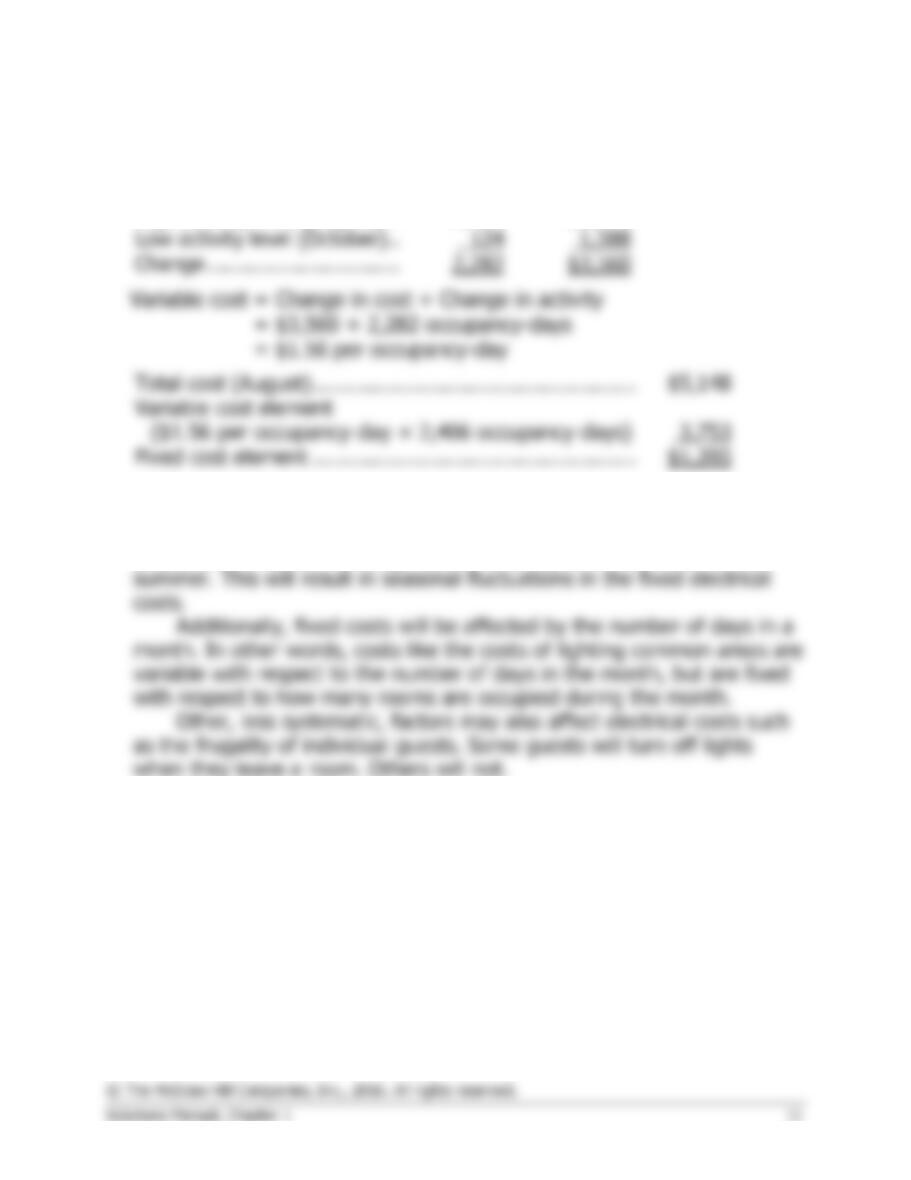
Exercise 1-5 (20 minutes)
1.
Occupancy-
Days
Electrical
Costs
High activity level (August) ..
2,406
$5,148
Total cost (August) …………………………………………….
Fixed cost element …………………………………………….
2. Electrical costs may reflect seasonal factors other than just the variation
in occupancy days. For example, common areas such as the reception
area must be lighted for longer periods during the winter than in the
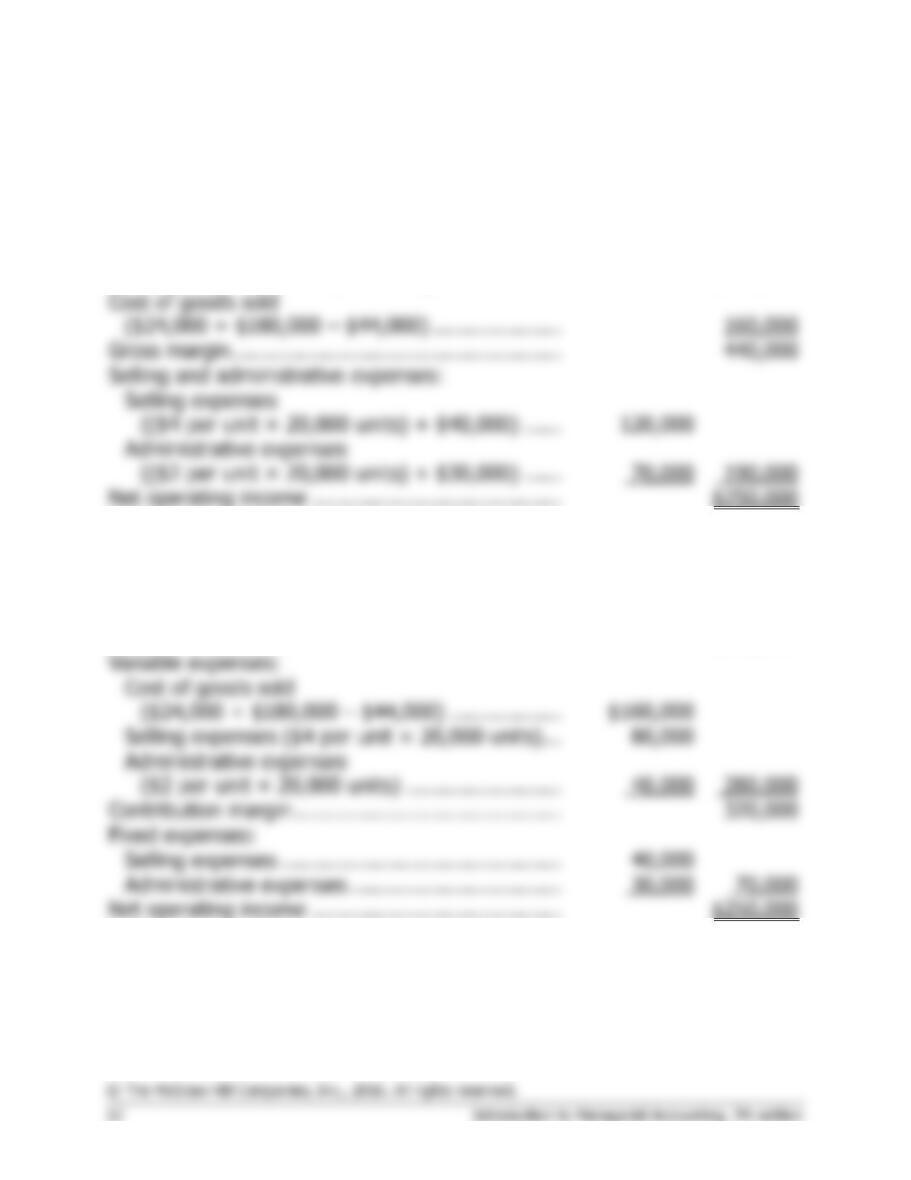
Exercise 1-6 (15 minutes)
1. Traditional income statement
Cherokee Inc.
Traditional Income Statement
Sales ($30 per unit × 20,000 units) ………………..
$600,000
Selling and administrative expenses:
Net operating income ………………………………….
$250,000
2. Contribution format income statement
Cherokee Inc.
Contribution Format Income Statement
Sales ……………………………………………………….
$600,000
Contribution margin …………………………………….
Fixed expenses:
Exercise 1-7 (15 minutes)
Item
Differential
Cost
Opportunity
Cost
Sunk
Cost
1.
Cost of the old X-ray machine ….
X
2.
The salary of the head of the
Radiology Department …………
3.
5.
Rent on the space occupied by
6.
The cost of maintaining the old
7.
Benefits from a new DNA
8.
Cost of electricity to run the X-
The salary of the head of the
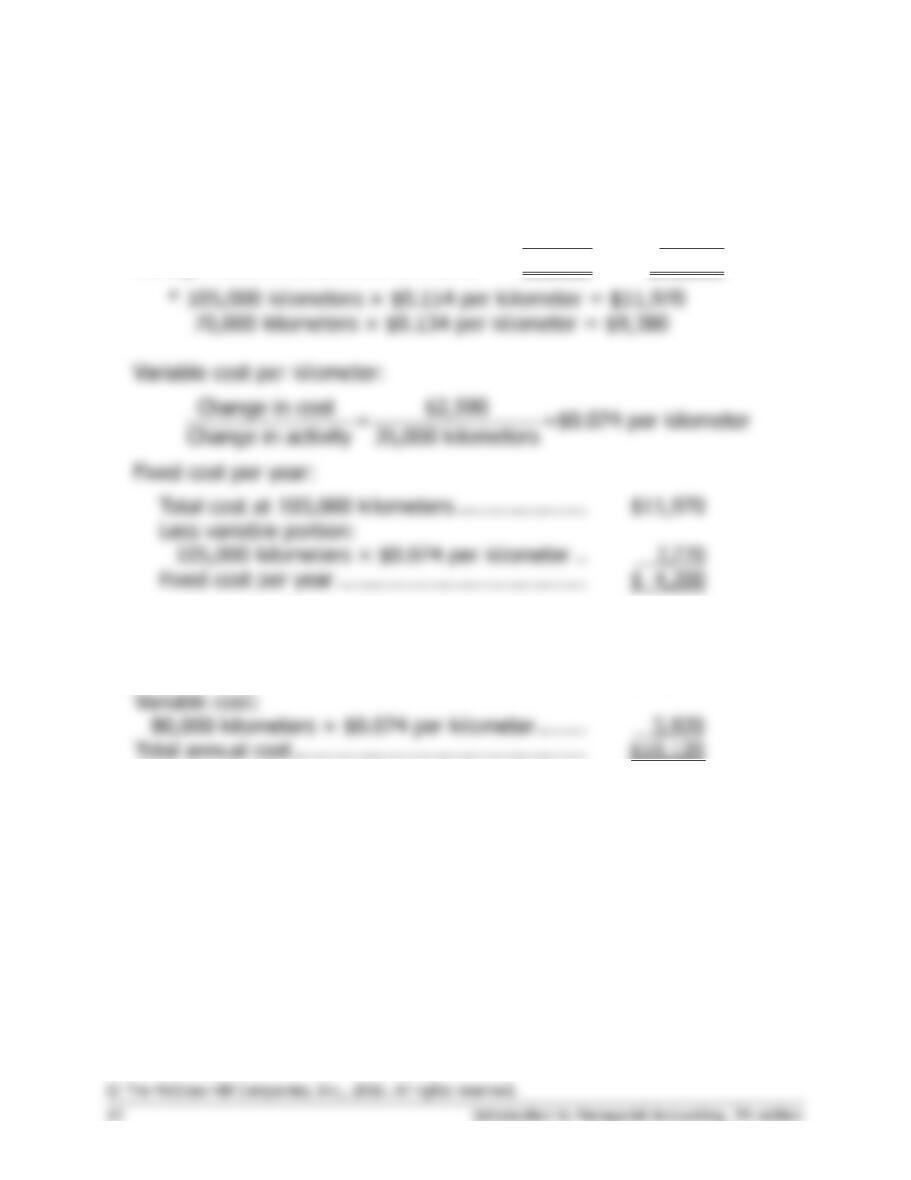
Note: The costs of the salaries of the head of the Radiology Department
Exercise 1-8 (20 minutes)
1.
Kilometers
Driven
Total Annual
Cost*
High level of activity …………………….
105,000
$11,970
Low level of activity ……………………..
70,000
9,380
Change ……………………………………..
35,000
$ 2,590
*
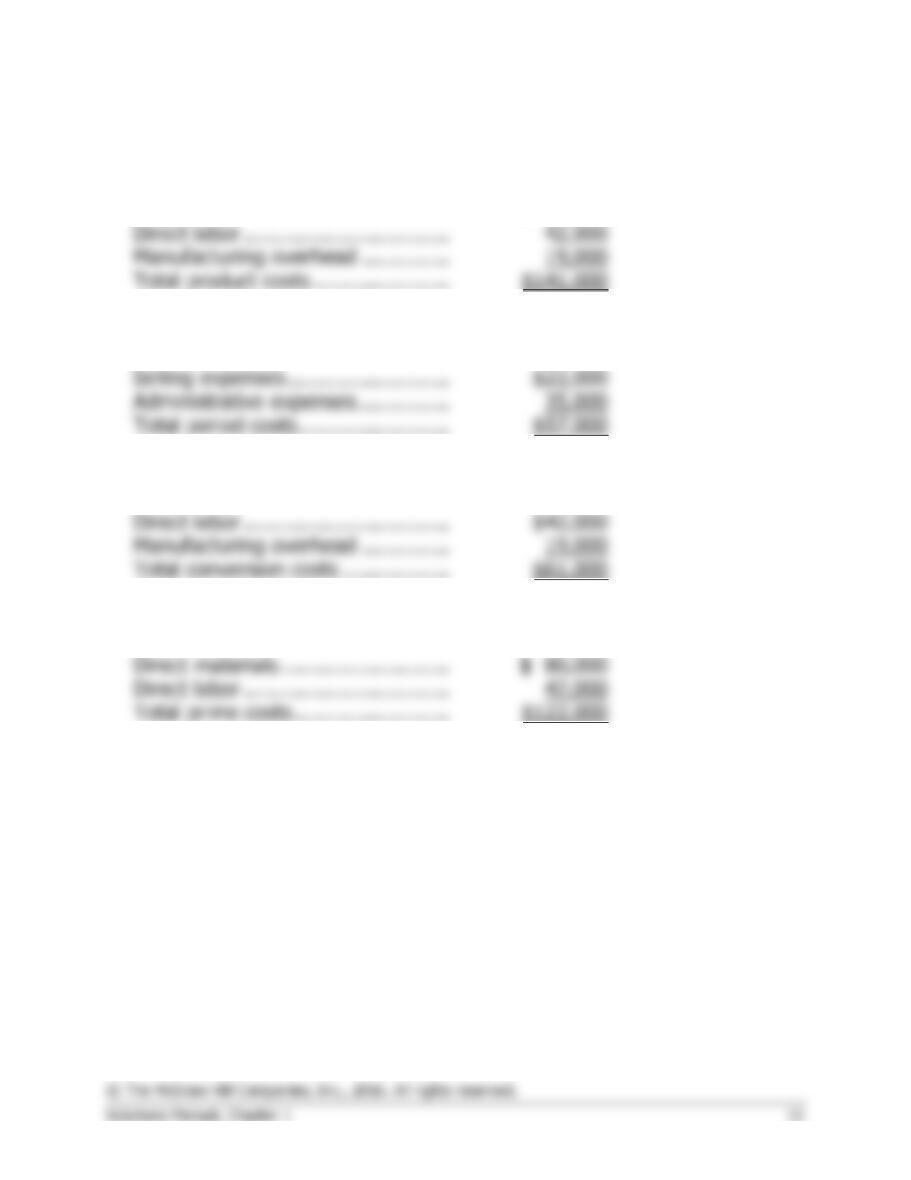
105,000 kilometers × $0.114 per kilometer = $11,970
70,000 kilometers × $0.134 per kilometer = $9,380
Total cost at 105,000 kilometers …………………
Fixed cost per year ………………………………….
2. Y = $4,200 + $0.074X
3.
Fixed cost …………………………………………………
$ 4,200
Total annual cost ………………………………………..
Exercise 1-9 (10 minutes)
1. Product costs:
Direct materials ………………………
$ 80,000
Total product costs ………………….
2. Period costs:
Selling expenses ……………………..
3. Conversion costs:
Total conversion costs ……………..
4. Prime costs:
Total prime costs …………………….
Exercise 1-10 (20 minutes)
1. The company’s variable cost per unit is:
$180,000 =$6 per unit.
30,000 units
In accordance with the behavior of variable and fixed costs, the
completed schedule is:
Units produced and sold
30,000
40,000
50,000
Total costs:
$240,000
Cost per unit:
2. The company’s income statement in the contribution format is:
Sales (45,000 units × $16 per unit) ……………………
$720,000
Variable expenses (45,000 units × $6 per unit) …….
Contribution margin………………………………………..
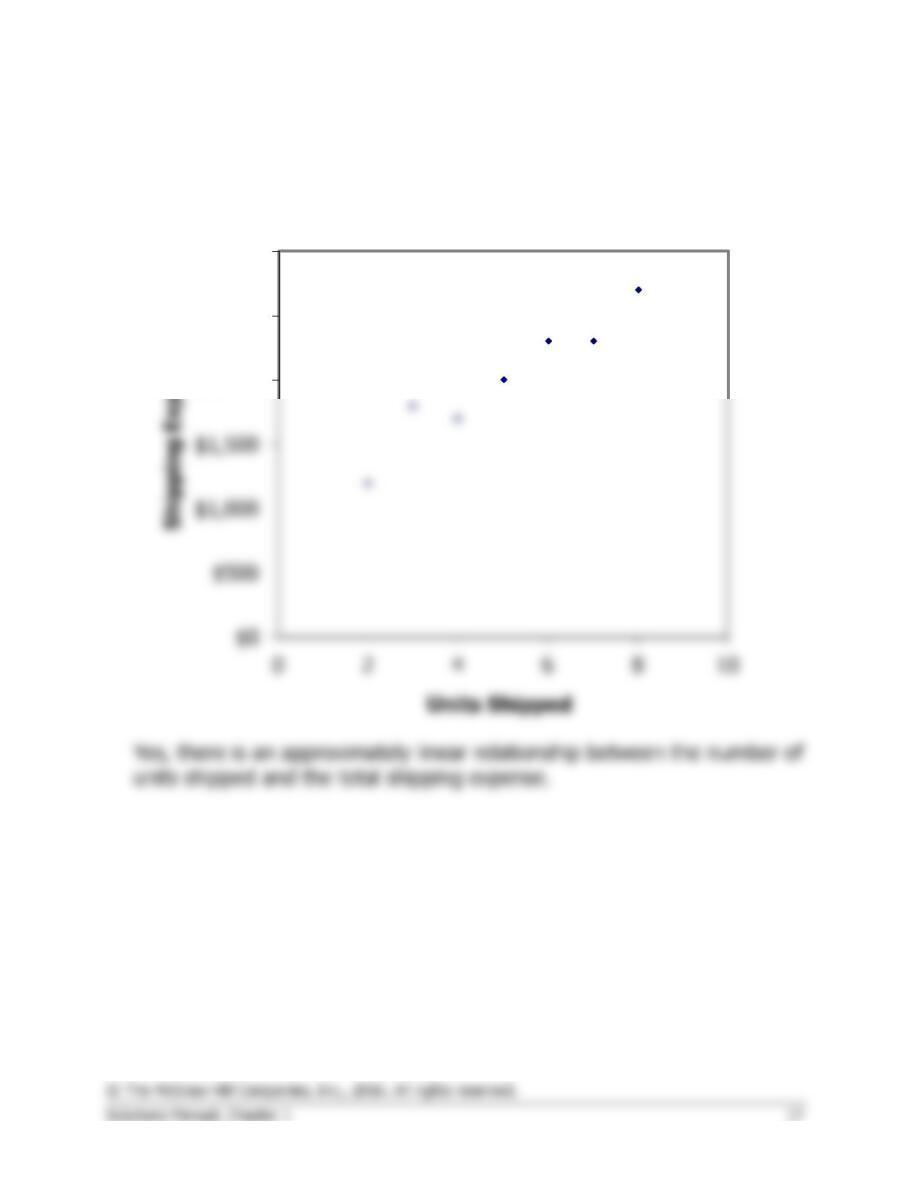
Exercise 1-11 (45 minutes)
1. The scattergraph appears below:
$2,000
$2,500
$3,000
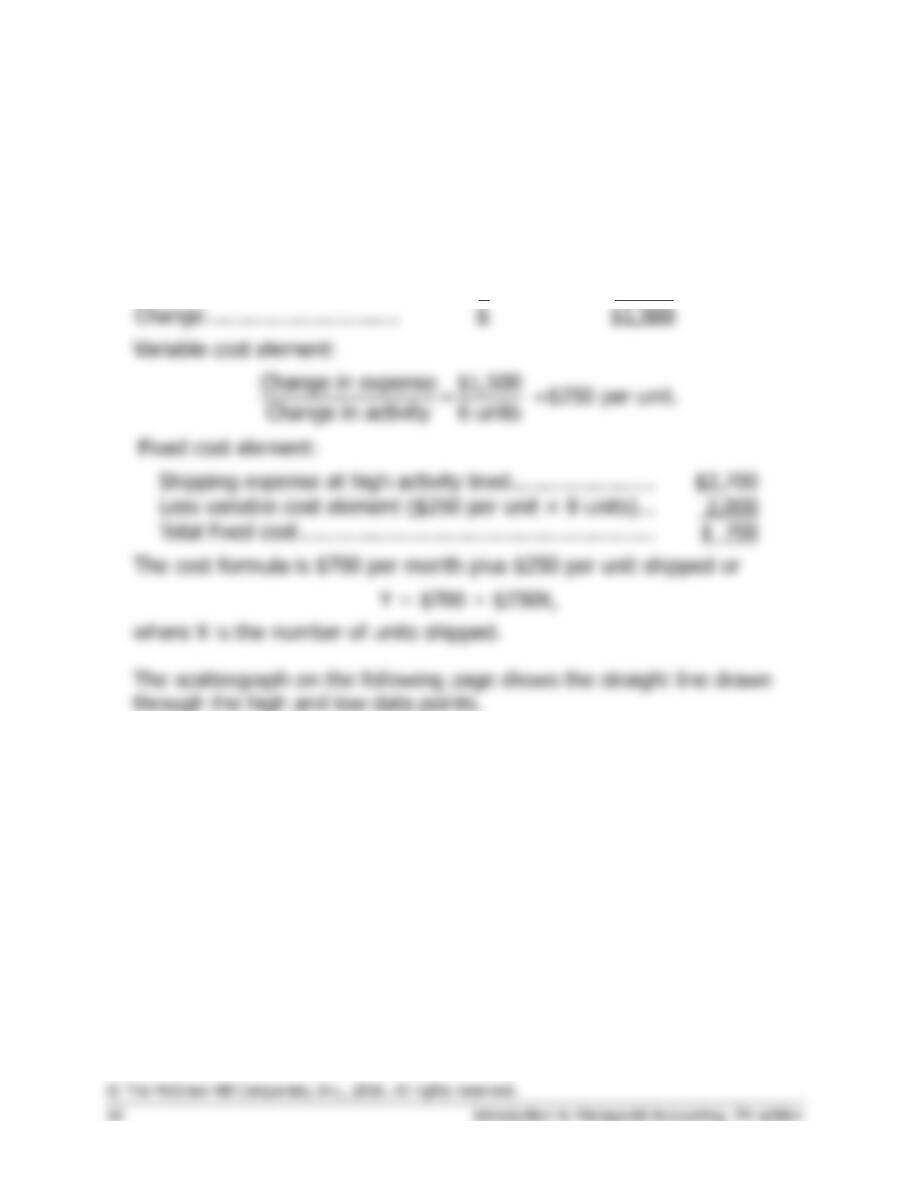
Exercise 1-11 (continued)
2. The high-low estimates and cost formula are computed as follows:
Units Shipped
Shipping Expense
High activity level (June) ……
8
$2,700
Low activity level (July) ……..
2
1,200
Change ………………………….
6
$1,500
Shipping expense at high activity level …………………..
Less variable cost element ($250 per unit × 8 units)…
Total fixed cost …………………………………………………
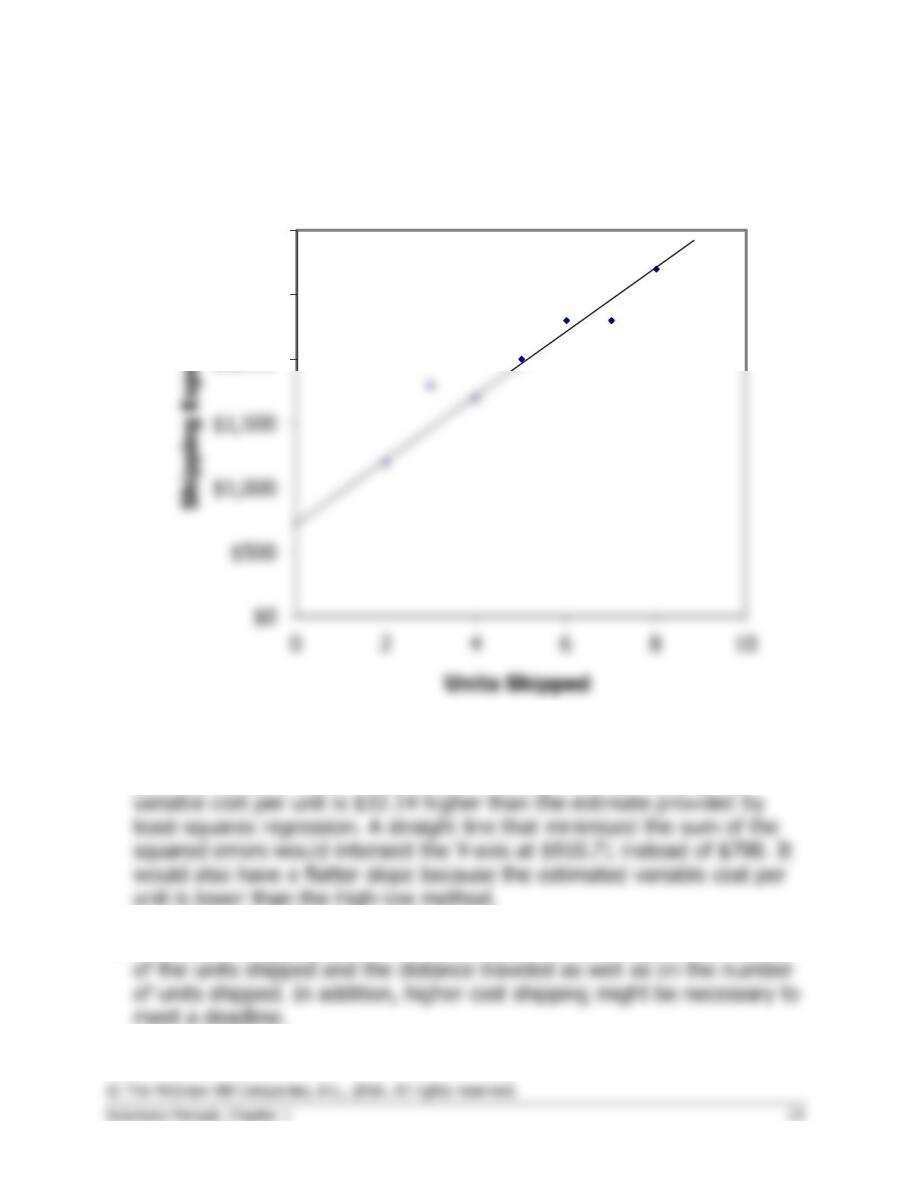
Exercise 1-11 (continued)
3. The high-low estimate of fixed costs is $210.71 lower than the estimate
provided by least–squares regression. The high-low estimate of the
4. The cost of shipping units is likely to depend on the weight and volume
$2,000
$2,500
$3,000
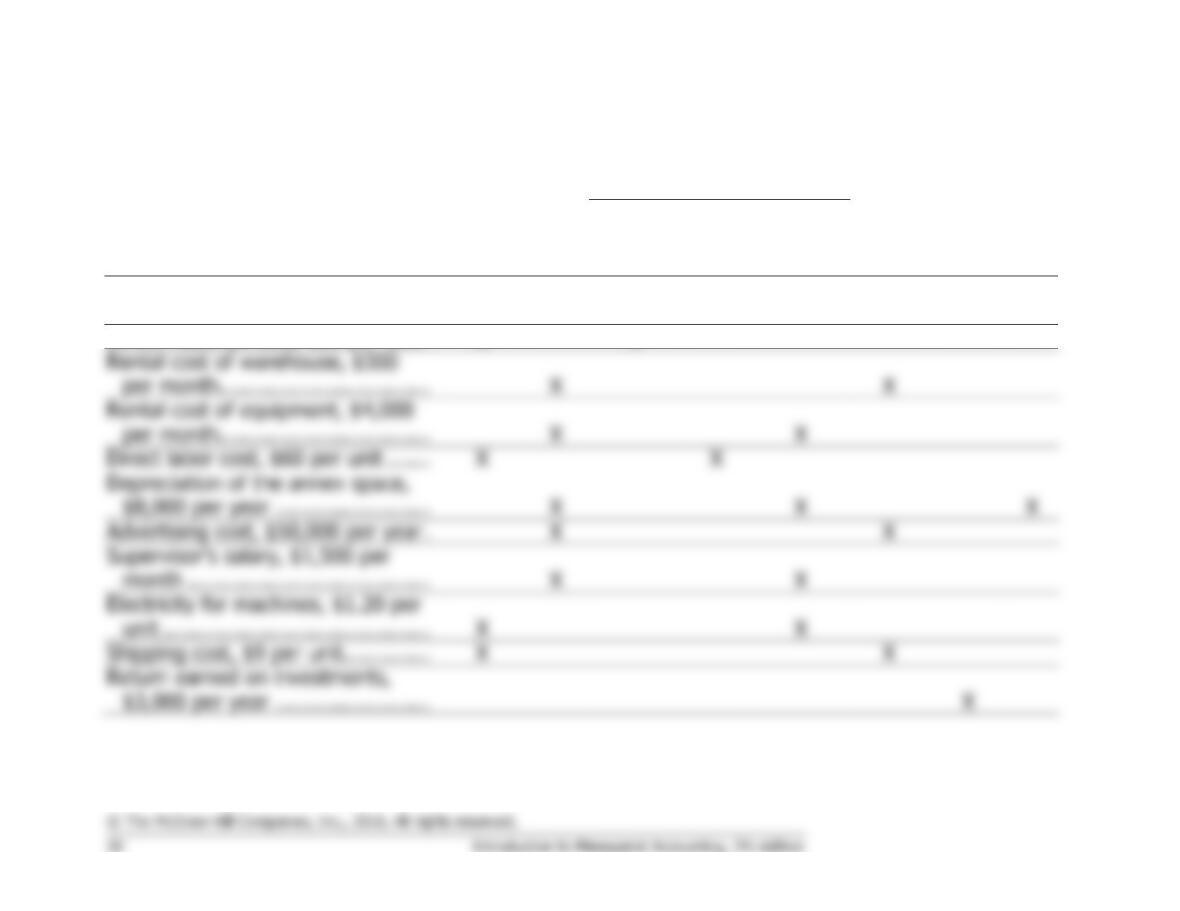
Exercise 1-12 (30 minutes)
Product Cost
Period
(Selling
Name of the Cost
Variable
Cost
Fixed
Cost
Direct
Materials
Direct
Labor
Manu-
facturing
Overhead
and
Admin)
Cost
Oppor-
tunity
Cost
Sunk
Cost
Rental revenue forgone, $30,000
per year ……………………………….
X
Direct materials cost, $80 per unit .
X
X
X
X
Rental cost of equipment, $4,000
per month…………………………….
X
X
Advertising cost, $50,000 per year .
X
X
Supervisor’s salary, $1,500 per
Electricity for machines, $1.20 per
Shipping cost, $9 per unit …………..
X
X
Return earned on investments,
$3,000 per year …………………….
X