Chapter 01 – Financial Statements and Business Decisions
1-1
CHAPTER 1
FINANCIAL STATEMENTS AND BUSINESS DECISIONS
Learning Objectives and Related Assignment Materials
Learning Objectives
Mini-
Exercises
Exercises
Problems
Alternate
Problems
Cases and
Projects
1-1 Recognize the information
conveyed in each of the
1, 2
1, 2, 3, 4, 5,
6, 7, 8, 9,
1, 2, 3, 4
1, 2, 3
1, 2, 3, 4
1-2 Identify the role of
generally accepted
accounting principles
(GAAP) in determining
financial statement content
3
1
1, 2, 5, 6
Synopsis of Chapter Revisions
Focus Company: Le-Nature’s Inc.
• Chapter 1 is written around a recent accounting fraud that is exciting, yet simple. Students are
introduced to the structure, content, and use of the four basic financial statements through the
story of two brothers who founded Le–Nature’s Inc., a natural beverage company. Le-Nature’s
financial statements are used to support increases in borrowing for expansion. When actual sales
Chapter 01 – Financial Statements and Business Decisions
1-2
Chapter 01 – Financial Statements and Business Decisions
1-3
PowerPoint Slides
Learning Objectives
PowerPoint® Slides
1-1 Recognize the information conveyed in each of the four basic financial
statements and the way that it is used by different decision makers
(investors, creditors, and managers).
1-3 through 1-26
Chapter Take-Aways
1-1 Recognize the information conveyed in each of the four basic financial statements and the way
that it is used by different decision makers (investors, creditors, and managers).
The balance sheet is a statement of financial position that reports dollar amounts for the assets,
1-2 Identify the role of generally accepted accounting principles (GAAP) in determining financial
statement content and how companies ensure the accuracy of their financial statements.
GAAP refers to the measurement rules used to develop the information in financial statements.
Chapter 01 – Financial Statements and Business Decisions
1-4
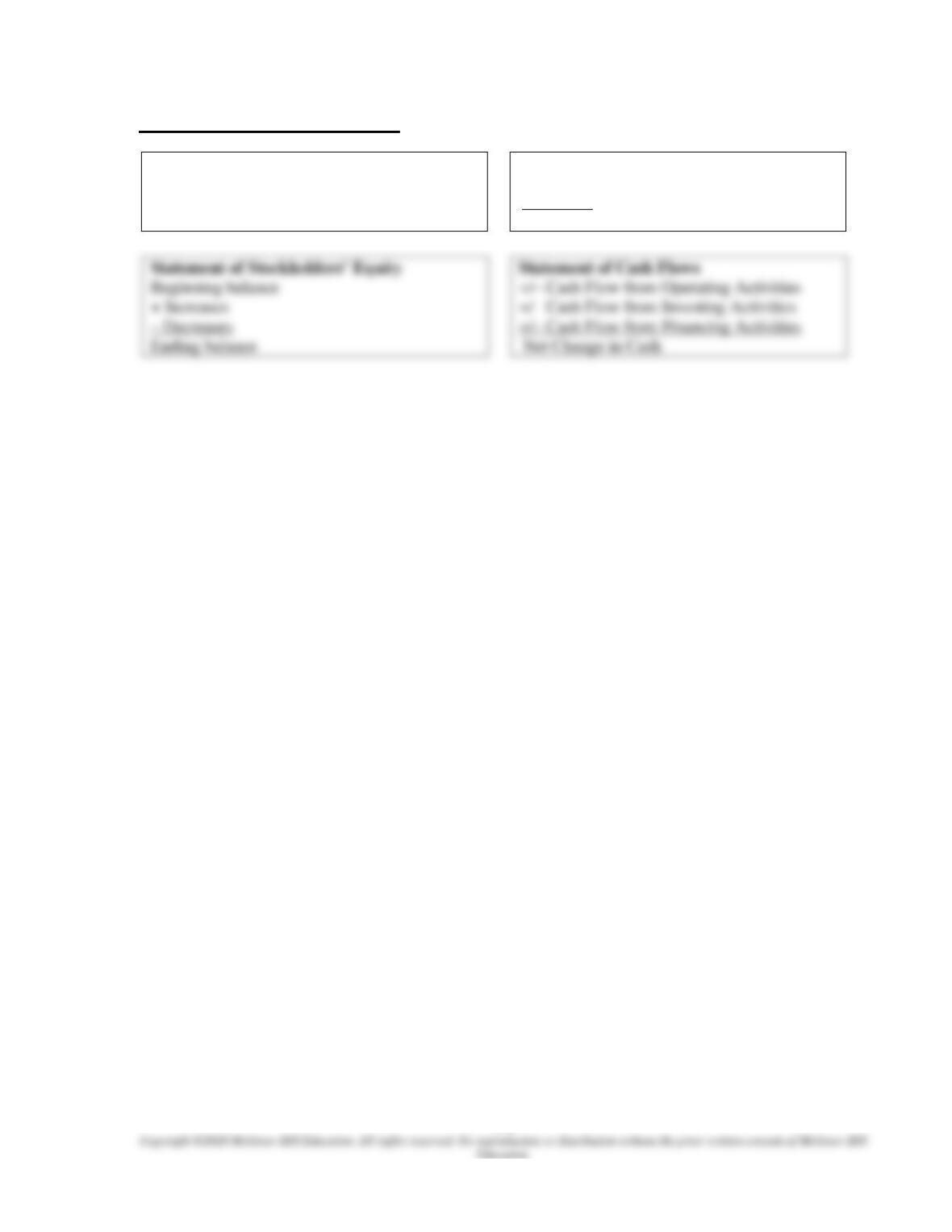
Finding Financial Information
Balance Sheet
Assets = Liabilities + Stockholders’ Equity
Income Statement
Revenues
– Expense
Net Income
Beginning balance
Ending balance
Net Change in Cash
Chapter 01 – Financial Statements and Business Decisions
1-5
Chapter Outline
Teaching Notes
Provide a learning strategy:
Overview the textbook:
Marginal information
Pause for Feedback (Self-
library
LO 1-1 Recognize the information conveyed in each of the four basic financial statements and the
way that it is used by different decision makers (investors, creditors, and managers).
I. Understanding the Business
A. Accounting System––collects and processes financial
information about an organization and reports that
information to decision makers:
Illustrated in Exhibit 1.1
1. Managerial accounting––accounting for internal decision
2. Financial accounting––accounting for external decision
collecting cash from customers, and paying suppliers.
C. Why Study Financial Accounting?
1. Regardless of the functional area of management in
which business professionals are employed, they will
use financial statement data
D. Goals for Chapter 1—Areas of Focus:
1. Content (i.e. categories of items or elements) reported on
Chapter 01 – Financial Statements and Business Decisions
1-6
II. The Four Basic Financial Statements: An Overview
Use Supplemental
Enrichment Activity #1
Illustrated in Exhibit 1.2
A. Balance Sheet––reports the financial position (assets,
liabilities, and stockholders’ equity) of an accounting entity
at a point in time
1. Structure
statement, specific date of the statement, and unit of
measure
data are to be collected; must be precisely defined
Use Supplemental
a. Heading includes: name of the entity, title of the
2. Elements
c. Stockholders’ equity––the amount of financing
See Financial Analysis
feature “Interpreting Assets,
Liabilities, and Stockholders’
a. Assets––the economic resources owned by the
company; initially measured at total cost incurred to
acquire it
B. Income Statement (statement of income, statement of
earnings, or statement of operations, statement of
comprehensive income)––reports the revenues less the
expenses of the accounting period
1. Structure
Illustrated in Exhibit 1.3
Net Income
a. Heading includes: name of the entity, title of the
2. Elements
See Financial Analysis
feature “Analyzing
the Income Statement:
a. Revenues––earned from sale of goods or services to
customers, whether or not the customer has paid for
Chapter 01 – Financial Statements and Business Decisions
1-7
Refer students to Pause for
C. Statement of Stockholders’ Equity––reports the changes in
each of the company’s stockholders’ equity accounts during
that period
Illustrated in Exhibit 1.4
1. Structure
c. Statement of stockholders’ equity equation: Beginning
a. Heading includes: name of the entity, title of the
2. Elements
a. Starts with beginning balances in the stockholders’
equity accounts, lists the increases and decreases, and
reports the resulting ending balances
See Financial Analysis
feature “Interpreting
Retained Earnings”
Refer students to Pause for
D. Statement of Cash Flows––reports inflows and outflows of
cash during the accounting period in the categories of
operations, investing, and financing.
Illustrated in Exhibit 1.5
1. Structure
c. Prepared because the income statement does not
a. Heading includes: name of the entity, title of the
statement, specific period of time covered by the
2. Elements
a. Cash Flows from Operating Activities––cash flows
that are directly related to earning income
Use Supplemental
Enrichment Activity #3
b. Cash Flows from Investing Activities––cash flows
Chapter 01 – Financial Statements and Business Decisions
1-8
E. Relationship Among the Statements
Illustrated in Exhibit 1.6
1. Net income from the income statement results in an
increase in ending retained earnings on the statement of
F. Notes and Financial Statement Formats
financial statements cannot be fully understood
1. Notes provide supplemental information about the
2. Additional formatting conventions for all four basic
financial statements:
i. Assets are listed on the balance sheet by ease of
conversion to cash; liabilities are listed by their
maturity (due date)
last item in a group before the total or subtotal
a double underline below
Enrichment Activity #4
III. Responsibilities for the Accounting Communication Process
LO 1-2 Identify the role of generally accepted accounting principles (GAAP) in determining
financial statement content and how companies ensure the accuracy of their financial
statements.
A. Generally Accepted Accounting Principles––measurement
and disclosure rules used to develop the information in
financial statements
1. How Are Generally Accepted Accounting Principles
Determined?
Chapter 01 – Financial Statements and Business Decisions
1-9
accounting principles
2. Why is GAAP Important to Managers and External
Users?
a. Companies incur the cost of preparing the statements
b. Companies bear the major economic consequences of
B. Ensuring the Accuracy of Financial Statements
1. What if the numbers are wrong?
2. Ethical conduct
a. Ethics are standards of conduct for judging right from
wrong, honest from dishonest, and fair from unfair
b. Three step process to be followed when you are faced
iii. Choose the one you would like your family and
3. Responsibility and the Need for Controls
a. Three important steps to assure investors that the
a. Primary responsibility for the information in the
financial statements lies with management
(represented by the highest officer of the company and
Chapter 01 – Financial Statements and Business Decisions
1-10
IV. Chapter Supplement A: Types of Business Entities
1. Legally, the business and the owner are not separate
2. Business is a separate entity for accounting purposes
A. Sole proprietorship––an unincorporated business owned by
one person; usually small in size and common in service,
B. Partnership––an unincorporated business owned by two or
more persons known as partners
2. Partnership is not legally separate from its owners
4. Partnership is a separate entity for accounting purposes
1. Agreements between the owners are specified in a
partnership contract, which deals with division of income
C. Corporation––business incorporated under the laws of a
particular state
1. Ownership is represented by shares of capital stock
2. Stockholders enjoy limited liability and are liable for the
corporation’s debts only to the extent of their investments
3. Stockholders elect a board of directors, which in turn
4. Corporation is a separate entity for accounting purposes
5. Dominant form of business organization in the U.S.
V. Chapter Supplement B: Employment in the Accounting Profession Today
A. Professional designations:
Use Supplemental
1. Certified Public Accountant (CPA)
Enrichment Activity #5
a. CPA designation is granted only on completion of
requirements specified by the state that issues the
license
2. Certified Management Accountant (CMA)
3. Certified Internal Auditor (CIA)
b. Requirements generally include college degree with a
Chapter 01 – Financial Statements and Business Decisions
1-11
B. Practice of Public Accounting
1. Audit or assurance services––independent professional
2. Management consulting services––usually accounting
based
a. Encompass such activities as the design and
3. Tax services
C. Employment by Organizations
1. Depending on size and complexity, an organization may
D. Employment in the Public and Not-for-Profit Sector
1. Perform functions similar to those performed by those in
private organizations
Chapter 01 – Financial Statements and Business Decisions
Supplemental Enrichment Activities
Note: These activities would be suitable for individual or group activities.
1. Handout 1-1
2. Handout 1-2
Use this handout for an in-class activity designed to review the classification of various account
names on the balance sheet. The solution follows the handout master.
3. Handout 1-3
4. Handout 1-4
Use this handout for an in-class activity designed to review the classification of various accounts,
5. Handouts 1-5 and 1-6
“Acronym” Game – The business and accounting arenas are inundated with acronyms. Use Handout
1-5, which contains the list of names/terms, and ask them to derive the acronyms. During the next