P a g e | 41
Business & Professional Ethics for Directors, Executives & Accountants, 8e
governments clean up the mess and we all lose in one way or another except for the drug
5. In some cultures, a ‘culture of secrecy’ or manipulation of the news is tolerated more than others.
How can this be remedied by other governments, corporations, investors, and members of the
public?
Secrecy is usually a misguided policy because the truth usually comes out, and many
6. Many other companies with long supply chains, including subcontractors in far-off lands, have found
themselves in difficulty. For example, in 1995 Nike was accused of employing child labor in Pakistan
and Cambodia through its subcontractors, and subsequently changed its policy and practices with
respect to the minimum age of employees working in contract factories. However, it is very difficult
to verify age when people do not have birth certificates or when they can be bought cheaply on the
black-market.
a. Under such conditions, what are a firm’s responsibilities with respect to checking that each
stage in the supply chain is complying with company policy?
Companies must accept responsibility for the quality and integrity of all inputs and
b. Are there organizations that can help companies set standards and confirm adherence to
them? If so, what are the organizations’ mandates and website addresses?
c. Should Menu Foods be held responsible for the melamine found in its products?
d. Would your response be different if it was the lives of people that were at stake rather than
the lives of animals?
P a g e | 42
Business & Professional Ethics for Directors, Executives & Accountants, 8e
e. How and why does Nike disclose its policies and practices with regard to supply chain
responsibility, and what are the major factors covered?
Nike policies and practices are disclosed on company websites and in printed material.
Subsequent Events
The officials at the Sanlu Dairy, a company that distributed tainted milk, were convicted of selling fake
and substandard products in late 2008 and early 2009. The chairwoman was sentences to life in prison,
Useful Articles, Links, and Videos
“Sanlu Milk Sickens Babies” (December 1, 2010). China Daily. Retrieved from
This website provides a series of articles, videos, photos and up to date news on China’s Tainted
Milk Powder scandal.
“China executes two over tainted milk powder scandal,” (November 24, 2009). BBC News. Retrieved
“China milk poisoning cases rise,” (September 22, 2008). BBC News. Retrieved from
“China’s baby-milk scandal: Formula for disaster,” (September 18, 2008). Economist. Retrieved from
P a g e | 43
Cases Concerning the Environment
13. Nestlé Bottles Water in a California Drought (Chapter 1, pages 49-50)
What this case has to offer
This case looks at distribution, extraction and sustainability for an essential resource that is in
Teaching suggestions
I begin by asking how many people in the room have bottled water. Often, they hold them up
by the neck and shake the bottles. I ask why they like bottled water. The normal responses are:
convenience, portability, and taste (i.e., no chemicals). Then we talk about the pros and cons of
Discussion of ethical issues
1. Do you think that it is ethical or unethical for Nestlé to drain the groundwater in the Millard
Canyon spring during a drought?
Unethical: If we consider that the water is essentially a non-renewable resource,
necessary for life, but in short supply, this case shows that the company (and the
Business & Professional Ethics for Directors, Executives & Accountants, 8e
2. Does Nestlé have an ethical obligation to disclose proprietary information, such as the
amount of groundwater extracted and the water levels in the Millard Canyon spring? Or,
does Nestlé have the right to privacy and therefore need not disclose water consumption
information?
That Nestlé doesn’t make public its water extraction data—so to prove that there is
enough water to extract—exacerbates the public sentiment that the bottler is not
3. From a marketing perspective, what, if anything, is required of companies in order to sell
bottled water in an ethical manner?
Resource protection-minded individuals, consumers, and competitors want to see that
Useful Articles, Links, and Videos
“WATER our most precious resource” [Video]. Robeco Asset Management (April 24, 2014).
“The Story of Bottled Water” [Video], [Annie Leonard] (2010), The Story of Stuff Project
P a g e | 45
Business & Professional Ethics for Directors, Executives & Accountants, 8e
Project is a group dedicated to reducing consumerism and increasing community
activism in environmental issues. While figures are presented as facts with no
references, the video provokes questions to challenge consumers and corporations.]
Globe staff (December 7, 2015). “The Globe examines the future of our most critical resource:
Leslie, Keith (August 21, 2016). “1Nestlé continues to extract water from Ontario town despite
drought: activists.” The Globe and Mail,
Morongo Band of Mission Indians: A Sovereign Nation [Website].
Indigenous and Northern Affairs Canada: First Nations Land Management Regime [website],
14. The Union Carbide-Bhopal Case (Chapter 1, pages 50-53)
What this case has to offer
I find this case to be an excellent way of:
1. Breaking the ice with a new group and developing a good learning dynamic.
Essentially this means getting to know the group, getting them to start discussing issues
2. Developing a greater awareness and appreciation of more ethical issues.
Usually, the discussion dynamic produces a greater awareness by everyone of issues which
3. Stimulating discussion, leading to a desire to learn more about ethics
Bhopal – Union Carbide provides ample opportunity for stimulating discussion about real
4. Exploring the following specific ethical issues, among others:
• Do businesses have responsibilities beyond what is proscribed by law?
• Whose laws should apply, foreign or domestic?
P a g e | 47
Business & Professional Ethics for Directors, Executives & Accountants, 8e
Teaching suggestions
Usually, I barely introduce myself and the objectives of the course/session, and then ask the participants
to read the Bhopal – Union Carbide Case. It takes them about 7-10 minutes, and then I start the
discussion by asking them what ethical issues they noted (Question 1) and why they thought each was
discussion after about 45 minutes. Even if all the issues are not dealt with by that time, most of the
pedagogical objectives outlined above will have been met. I wind up the case discussion dealing with
Questions 2 and 3, and then move into a discussion of the other issues raised in Chapter 1 using
overheads covering:
• Background: a definition of ethics, reasons for heightened interest in ethics
Discussion of ethical issues/questions
1. What are the ethical issues raised by this case?
Profit vs. safety
Among the first topics ethical issues suggested will be the causing of death and injury by a
commercial process. I usually play devil’s advocate here, by asking questions and reminding the
P a g e | 48
Business & Professional Ethics for Directors, Executives & Accountants, 8e
Assessing blame: the role of government, whose laws should apply?
The discussion often moves rather quickly to who is to blame for the tragedy. Some will claim
that the government was at fault for not regulating tightly enough. After all, that is the role of
government, and business’ role is to respond. They often couple this argument with the issue of
Negligence is a factor that is usually debated. The local management, if they were adequately
knowledgeable, clearly lost track of the shut down of how many fail-safe safeguards were under
repair. The loss of good human power as a result of cost-cutting is probably the responsibility of
the US firm even though they only own a slim majority (0.9%), because they had the knowledge
Can unethical behavior go unnoticed?
Some students will think that they and their companies can get away with unethical or
illegal acts. Of course they can, but there is a risk of getting caught and the cost of
Aside from loss of life and health, what is the greatest loss?
This is an interesting question to put to the class. Some will say reputation…and I will
P a g e | 49
Business & Professional Ethics for Directors, Executives & Accountants, 8e
line students.
What can be done to avoid a recurrence?
Most large companies have developed internal mechanisms to maintain safety and
ecological standards on a worldwide basis. This usually involves a mechanism for
2. Did the doctrine of “Limited Liability” apply to protect the shareholders of Union Carbide
Corporation (U.S.)?
Many people have heard that the doctrine of limited liability will protect you if you are a
shareholder if difficulties arise for the company you own. But they really don’t understand what
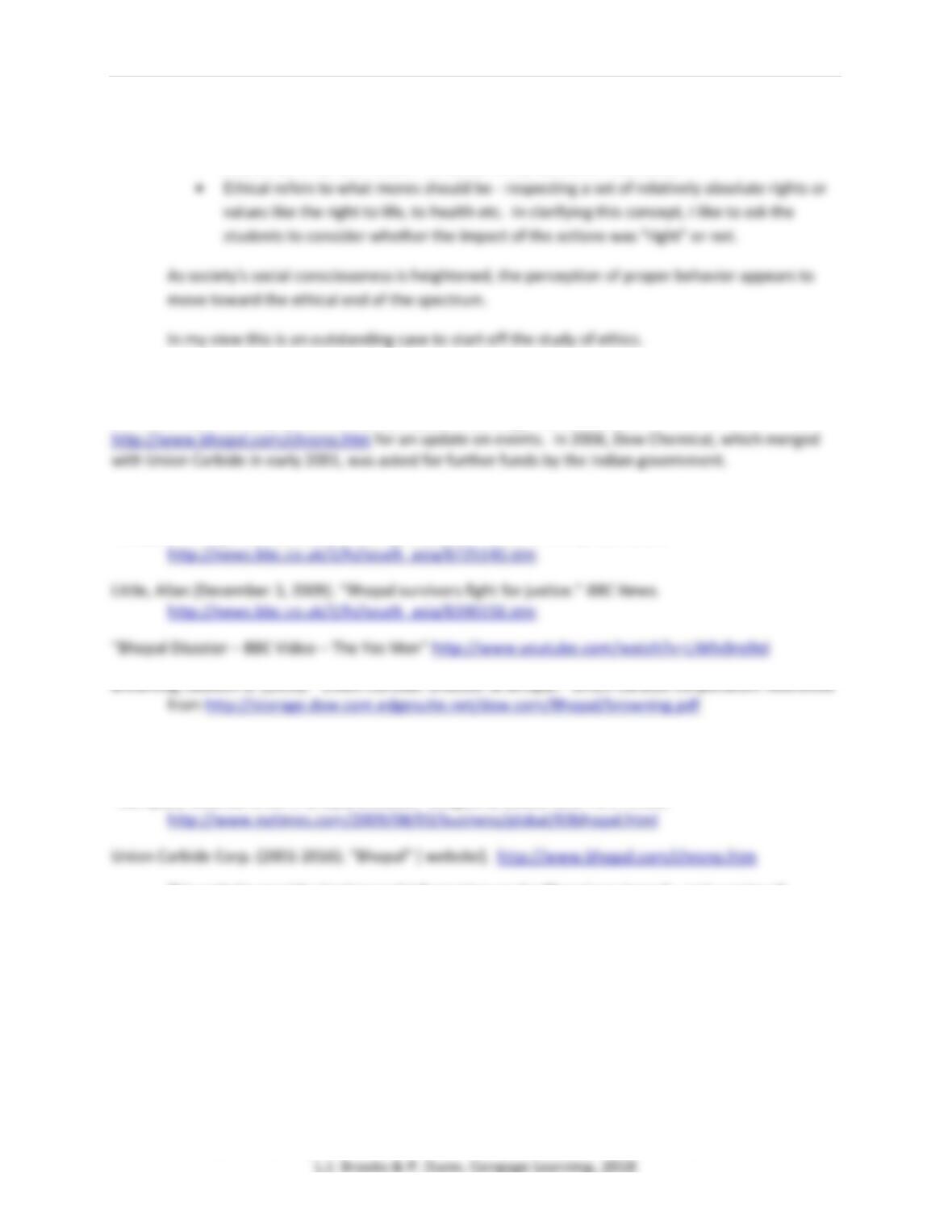
3. Were the Indian operations, which were being overseen by the managers of Union Carbide
Corporation (U.S.), in compliance with legal, moral, or ethical standards?
One of the more interesting parts of this case discussion occurs when the students grapple with
whether the Indian operations were in accord with legal moral or ethical standards. This forces
Compliance With…
Reference Society
Legal
Moral
Ethical
Indian standards
Yes
Yes/No
No
USA standards
No
No
No
P a g e | 50
Business & Professional Ethics for Directors, Executives & Accountants, 8e
I usually have to clarify what I mean by moral and ethical standards, which I do as follows:
• Moral has to do with habits – what current practices or mores are.
Subsequent Events
See Union Carbide Corp. (2001-2016). “[Bhopal] Chronology” on the website
Useful Articles, Links, and Videos
“Bhopal trial: Eight convicted over India gas disaster,” (June 7, 2010). BBC News,
This report was written by Retired Vice President, Health, Safety, and Environmental Programs,
Union Carbide Corporation.
“Company Defends Chief in Bhopal Disaster,” (August 2, 2009). New York Times,
This website provides background information on the Bhopal gas tragedy, and a series of
webpages documenting the history, chronology of events, remediation, litigation, etc.
Business & Professional Ethics for Directors, Executives & Accountants, 8e
15. Texaco: The Ecuador Issue (Chapter 1, pages 53-55)
What this case has to offer
This is the case of a company that has to answer for problems from its past in a foreign land that were
thought to have been put behind it years ago. It provides a real-life, interesting vehicle for discussion of:
• Responsibility of a corporation on foreign soil and the role of the foreign government involved
Teaching suggestions
I begin this case with a brief introduction about the challenges of operating in foreign lands with their
varying cultures. I point out that: today’s world is very small in that CNN will broadcast on TV any
problem from any part of the world within one day of its occurrence; and that a corporation is
Discussion of Ethical Issues
Responsibility of corporation and of the foreign government
The assertion that the company’s goal is to make profit, and the government is to say how, breaks
Stakeholder networks
Students should not view Texaco’s problem in a static framework. The stakeholder groups suing
Texaco influence each other and also external groups such as Texaco’s customers in the US.
P a g e | 52
Business & Professional Ethics for Directors, Executives & Accountants, 8e
Legal vs. ethical approach
Texaco has relied upon legal agreements with the Ecuadorian government to resolve its problems.
1. Should Ecuadorians be able to sue Texaco in U.S. courts?
Why shouldn’t the Ecuadorians be able to sue in US courts? If they weren’t, companies would
2. If an oil spill was caused by an act of God, an earthquake, should Texaco be held responsible?
A company should not be liable for an act of God unless there is some confounding aspect of
3. Do you find Texaco’s arguments against the lawsuits convincing? Why or why not?
Texaco’s arguments showed evidence of concern, but the associated actions did not seem to
Subsequent Events
In 2001, Chevron and Texaco merged to become Chevron Corporation.
Useful Articles, Links, and Videos
Forero, Juan (April 28, 2009) “In Ecuador, High Stakes in Case against Chevron.” Washington Post,
P a g e | 53
Business & Professional Ethics for Directors, Executives & Accountants, 8e
“Chevron Statement on Ecuador Court Filings,” (September 17, 2010). The Wall Street Journal,
This documentary details the story of a lawsuit issued by tens of thousands of Ecuadorans
against Chevron (Texaco) claiming contamination of the Ecuadorean Amazon.
P a g e | 54
Business & Professional Ethics for Directors, Executives & Accountants, 8e
Product Safety Cases
16. The Right to be Informed? – The Link Between Talcum Powder and Cervical
Cancer (Chapter 1, pages 56-57)
What this case has to offer
While this case looks specifically at Johnson & Johnson (J&J) and a link between talcum powder and
cancer, it can also be used generally to examine the link between J&J’s past deeds—namely, the pulling
Teaching suggestions
I begin by reviewing the J&J Tylenol recall of 1982. We talk about the importance of the company’s
Credo in influencing the decision to recall the company’s largest selling product worldwide. That sets up
Discussion of ethical issues
1. Was J&J’s decision to not inform its customers of the potential risks of extended use of talcum
powder products acceptable?
From the viewpoint of its Credo, J & J did not meet the needs of “doctors, nurses and patients,
to mothers and fathers and all others who use our products”. From the viewpoint of
P a g e | 55
2. If J&J knew about the potential risks of talcum powder products in 1987, should the company have
withdrawn all its talcum products in the same way that it recalled all of its Tylenol products in 1982?
Tylenol in 1982 posed a double threat: 1) sudden death 2) uncertainty of the extent of the
predictability.
3. Do you think that Credos are effective at encouraging ethical business behavior?
It depends. No credo, code of ethics or conduct can be effective on its own. Unless top
management supports the spirit of the document, encourages its use, and is responsible for
adherence, the document is just ethical art – to be hung on the wall. That said, if properly
supported, a credo can provide excellent directional guidance – as an ethical compass – in a
readily digestible form as it did for J&J in 1982.
Useful Articles, Links, and Videos
Kristof, Nicholas (September 15, 2015). “When Crime Pays: J&J’s Drug Risperdal” [Editorial]. New York
P a g e | 56
Business & Professional Ethics for Directors, Executives & Accountants, 8e
Ingram, David, and Krasny, Ros (November 4, 2013). “Johnson & Johnson to pay $2.2 billion to end U.S.
kickbacks to pharmacists, for “anti-psychotic drugs Risperdal and Invega and the heart drug
Natrecor.”
Brill, Steven [September 15, 2015]. “America’s most admired lawbreaker.” Huffington Post,
This is a 15-chapter exposé of J&J’s 20-year Risperdal marketing and cover ups by lawyer-
journalist, Steven Brill. It includes links and videos.
P a g e | 57
17. Valeant Pharmaceuticals vs. Coca Cola – Which Business Model is Worse: Price
Gouging or Fostering Obesity & Diabetes? (Chapter 1, pages 57-58)
What this case has to offer
This case offers the opportunity for students to consider what a business model is, why it is important,
Teaching suggestions
I find that it is helpful for students to consider first what a business model is and why it is important. A
business model refers to how a company creates value, and how it realizes that value from customers,
patients, and others. A successful business model is one where the value created is in demand, and
Discussion of ethical issues
1. Compare the ethicality of the two business models – (a) price gouging and questionable practices by
Valeant to (b) contributing to obesity and diabetes by Coca Cola. Which is worse?
a) Valeant
Valeant, as part of its business model under CEO Michael Pearson, decided that in-house R&D
on drugs was a money loser, and that mergers and acquisitions with/of pharmaceutical
P a g e | 58
It should also be noted that Valeant’s mode of doing business involves other questionable
practices in addition to its fundamental business model, including:
• a decision was made to purchase Canadian pharmaceutical Biovail—using a Barbados
subsidiary (Vardi 2014)—to reduce taxes from 36% to 3% and to try to lower them
• in 2016, Valeant filed a Form 8-K statement with the SEC. It included the following
statement (Valeant Pharmaceuticals International, Inc. 2016):
“As part of this assessment of internal control over financial reporting, the Company
has determined that the tone at the top of the organization and the performance-
b) Coca-Cola
Coca-Cola’s business model is to offer products that can be addictive, and may cause harm to
health leading to obesity and/or diabetes which, some argue, has reached epidemic
8 Janet McFarland (June 4, 2016). “The CEOS who cashed in as their companies cut back.” The Report on Business,
B6. Available at