1
Cost Accounting: Information for Decision
Making
Solutions to Review Questions
1-1.
Among the goals of an organization, a central one is to create and increase value. Cost
accounting systems are designed to provide information to decision makers in the
organization with the information they need to accomplish this goal. Therefore, the
designers of the cost accounting system need to understand how value is created in the
organization in order to design systems for their particular organization.
1-2.
Financial accounting is designed to provide information about the firm to external users.
External users include investors, creditors, government authorities, regulators,
customers, competitors, suppliers, labor unions, and so on. Cost accounting systems
are designed to provide information to internal users (managers).
1-3.
B Providing cost information for financial reporting
A Identifying the best store in a chain
C Determining which plant to use for production
1-4.
1-6.
Value-added activities are activities that customers perceive as adding utility to the
goods or services they purchase. Nonvalue-added activities do not add value to the
goods or services. By classifying costs this way, the cost accounting system can help
the manager identify areas (processes) that can be improved, lowering costs and
adding value to the organization.
1-7.
Answers will vary, but should include some of the following:
Title
Major Responsibilities and Major Duties
Chief financial officer (CFO) ….
• Manages entire finance and accounting function
Treasurer …………………………...
• Manages liquid assets
• Conducts business with banks and other
financial institutions
• Oversees public issues of stock and debt
1-8.
No. Sarbanes-Oxley is a law and violations of it are legal issues. Codes of ethics are
necessary to help accountants and managers identify situations that might develop into
ethical conflicts, understand what they could do in these situations, and to learn what to
do when they believe that an ethical violation has occurred.
Solutions to Critical Analysis and Discussion Questions
1-9.
We would not agree. The role of accountants is to help manage the organization. Part of
that role is to report results. Another part is to design systems that assist other
managers in making decisions to improve performance. This role requires that
accountants understand how value is created in their organizations.
1-10.
The calculation of cost depends on the decision being made. Therefore, the first
question to ask is, “What decision (or decisions) are you trying to make?”
1-11.
1-12.
Although it is not the “job” of accounting to determine strategy, accounting provides
important information to those who do determine strategy. If the cost accounting system
provides inaccurate information, the firm may end up with an unintended strategy,
because managers are making decisions based on faulty information.
1-13.
1-14.
1-15.
Airlines are characterized by the need to own a substantial amount of capacity costs.
Managers at airlines require very sophisticated load management information that
predicts the number of passengers flying on a particular route on a particular day. If they
set a single price that would cover their costs given a certain number of passengers,
they risk flying with empty seats. Once the plane takes off, they cannot sell the seat.
Therefore, they need a flexible pricing system. Such a system requires detailed cost
information about passengers and aircraft.
1-16.
The cost accounting issues for Hostess Brands are the same as for The AM Bakery in
the sense that managers at Hostess Brands want the same kind of information as
Adam: what are the costs of products, who is performing the best, and so on.
The cost accounting issues are different in the size and complexity of the operations at
Hostess compared to The AM Bakery.
1-17.
In decision-making, managers or supervisors may wish to take actions that they believe
will increase the firm’s value that are difficult to justify given available information. Often,
these situations arise when managers are using their intuition and their experience to
identify new business opportunities and cannot point to data that support their views.
The final responsibility for the decision rests with the manager. Therefore, plans that
cannot be justified on a cost analysis basis may still be adopted at the discretion of
operating management. The controller should be clear that the project is justified on a
basis other than (easily measured) costs.
The controller is charged with the responsibility of making certain that plans are
executed in an optimal and efficient manner. In some cases this may be viewed as
placing restrictions on management actions. Under these circumstances the marketing
manager may view the accounting function as placing too great a constraint on him
while the controller may view the marketing manager as attempting to circumvent the
rules.
1-18.
1-19.
The purpose of accounting is to communicate the economic reality of the firm. This
requires estimates of the effect of events not yet realized. Always choosing the most
pessimistic outcome does not communicate the reality any more than always choosing
the most optimistic outcome. We want accountants to use their best judgment on what
will happen. A problem arises when the judgment is affected by a desire to present a
particular result.
1-20.
The cost accountant provides information to decision makers in the firm. He or she
1-21.
Studying cost accounting will most likely increase Adam’s chances of success with his
store. As illustrated in the chapter, he has a better idea of the costs of his business and
the financial status of its different operations. Of course, it cannot guarantee success. A
successful business depends on many things, including identifying the right products,
efficient operations, and good marketing. Cost accounting helps managers make better
decisions about these aspects, but cannot forecast trends or overcome bad managerial
decision-making.
1-22.
There are two types of costs the airline or hotel incur with such upgrades. One type of
cost results from the incremental resources that are a part of the upgraded service
(perhaps a free meal on the airline or the costs of cleaning a larger room). These costs
will be shown in the accounting records. In addition to these “direct” costs, there are
Solutions to Exercises
1-23. (10 Min.) Value Chain and Classification of Costs: Apple Inc.
Cost
Stage in the Value Chain
Programmer costs for a new operating system.
4. Research & Development
Costs to ship computers to customers.
6. Distribution
Call center costs for support calls.
3. Customer Service
Salaries for employees working on new product
designs.
5. Design
Costs to purchase advertising in university stores.
1. Marketing
1-24. (10 Min.) Value Chain and Classification of Costs: Pfizer Inc.
Cost
Stage in the Value Chain
Salaries for employees to develop most efficient
dropper to administer drug.
2. Design
Costs of chemicals to make the drug.
5. Production
Costs to visit doctors to explain value of drug.
4. Marketing
Expenses to deliver product to customers.
6. Distribution
Laboratory experiments to evaluate drug
effectiveness.
3. Research and
development
1-25. (10 Min.) Value Chain and Classification of Costs: Tesla, Inc.
Cost
Stage in the Value Chain
Engineer costs to develop optimal battery.
6. Research & Development
Costs for employees to develop grill logo.
3. Design
Cost to assemble cars.
1. Production
Costs to attend the Detroit Auto Show.
4. Marketing
Costs to ship cars to sales centers.
5. Distribution
Call center to handle maintenance calls from
2. Customer Service
1-26. (5 Min.) Supply Chain and Supply Chain Costs: Coastal Cabinets.
It is important that costs are minimized in the supply chain. Because it is cheaper for
Coastal Cabinets to carry the inventory, the resolution should result in Coastal Cabinets
carrying the inventory. You might suggest that the two firms share the inventory savings
through price increases or other contractual agreements.
1-27. (10 Min.) Accounting Systems: McDonald’s.
Decision Maker
System
a. Investor* ……………………..
Financial (F)
b. Marketing manager ………
Cost (C)
c. Competitor* …………………
Financial (F)
d. Labor organization* ………
Financial (F)
e. Advertising manager …….
Cost (C)
1-28. (10 Min.) Accounting Systems: Ford Motor Company.
Answers will vary, but examples include the following.
Manager
Example Decision
a. Plant manager ……………..
How to layout the plant.
b. Purchasing manager …….
Which supplier to use.
c. Quality supervisor …………
Where to focus quality improvement efforts.
d. Personnel manager ………
Where to recruit workers.
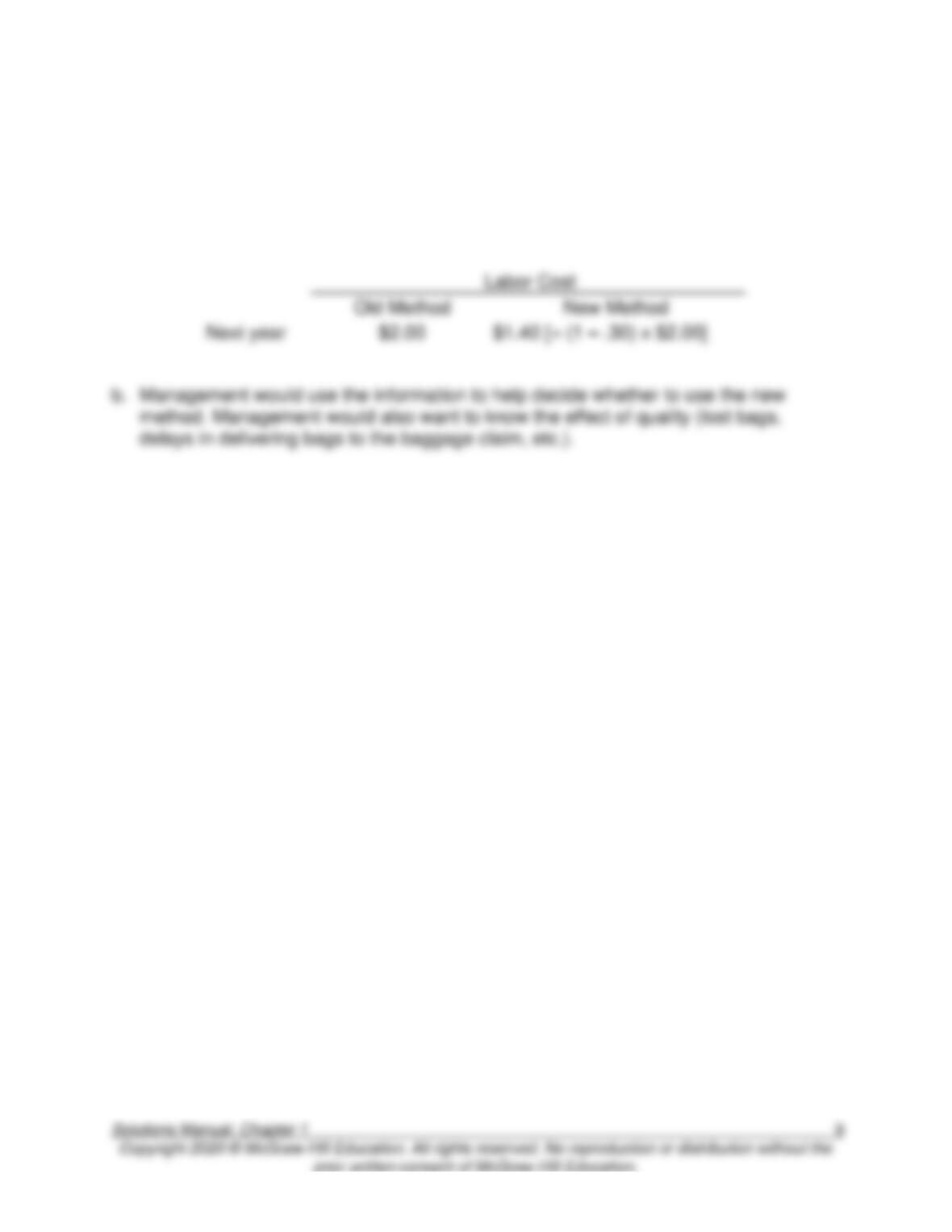
1-29. (10 min.) Cost Data for Managerial Purposes: Delta Air Lines.
a. Differential costs are costs that would change, which are the labor costs in this
situation. Other costs would presumably not be affected by the change in labor.
Other issues include the quality and dependability of the new approach.
Differential costs next year are $0.60 (= $2.00 – $1.40) calculated as follows:
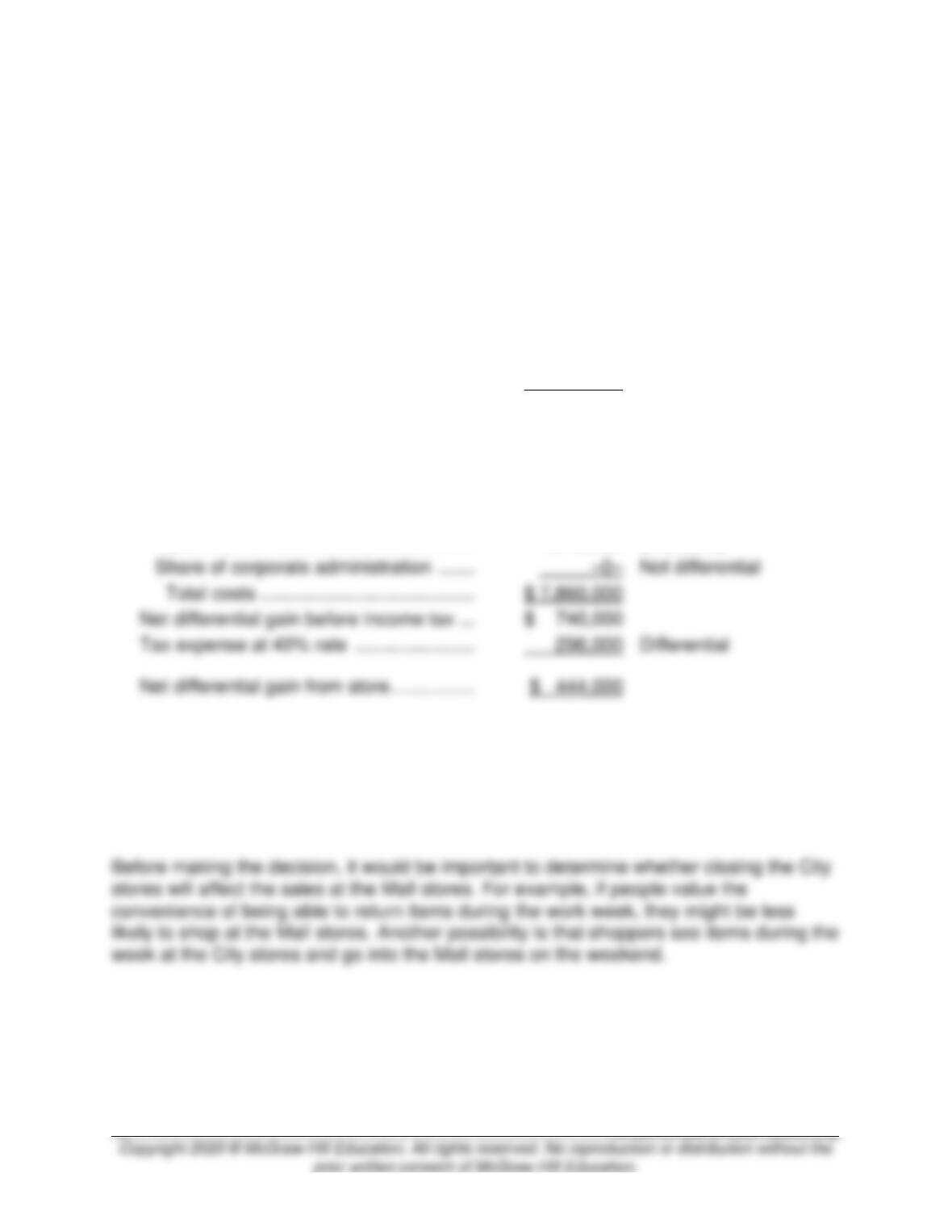
1-30. (20 Min.) Cost Data for Managerial Purposes: Betty’s Fashions.
Considering the following costs as differential shows that closing the City Division will
lower profits for the chain.
Betty’s Fashions, City Division
Divisional Income Statement
Differential Revenues and Costs
For the Year Ending January 31
Sales revenue …………………………..……..
$ 8,600,000
Differentiala
Costs
Advertising ……………………………………
350,000
Differentialb
Cost of goods sold …………………………
4,300,000
Differentiala
Divisional administrative salaries ……..
580,000
Differential
Selling costs (sales commissions) ……
1,160,000
Differentiala
Rent …………………………………………….
1,470,000
Differential
Share of corporate administration …….
–0–
Not differential
Total costs …………………………………..
Net differential gain before income tax …
Differential
a These revenues and costs are differential if the sales (and the associated cost of
sales) will be lost to the chain. If customers go to other stores in the chain when the
City Division is closed, these revenues and costs will not be differential.
b If some of the advertising is “brand” advertising that benefits all stores, some of the
advertising costs may not be differential.
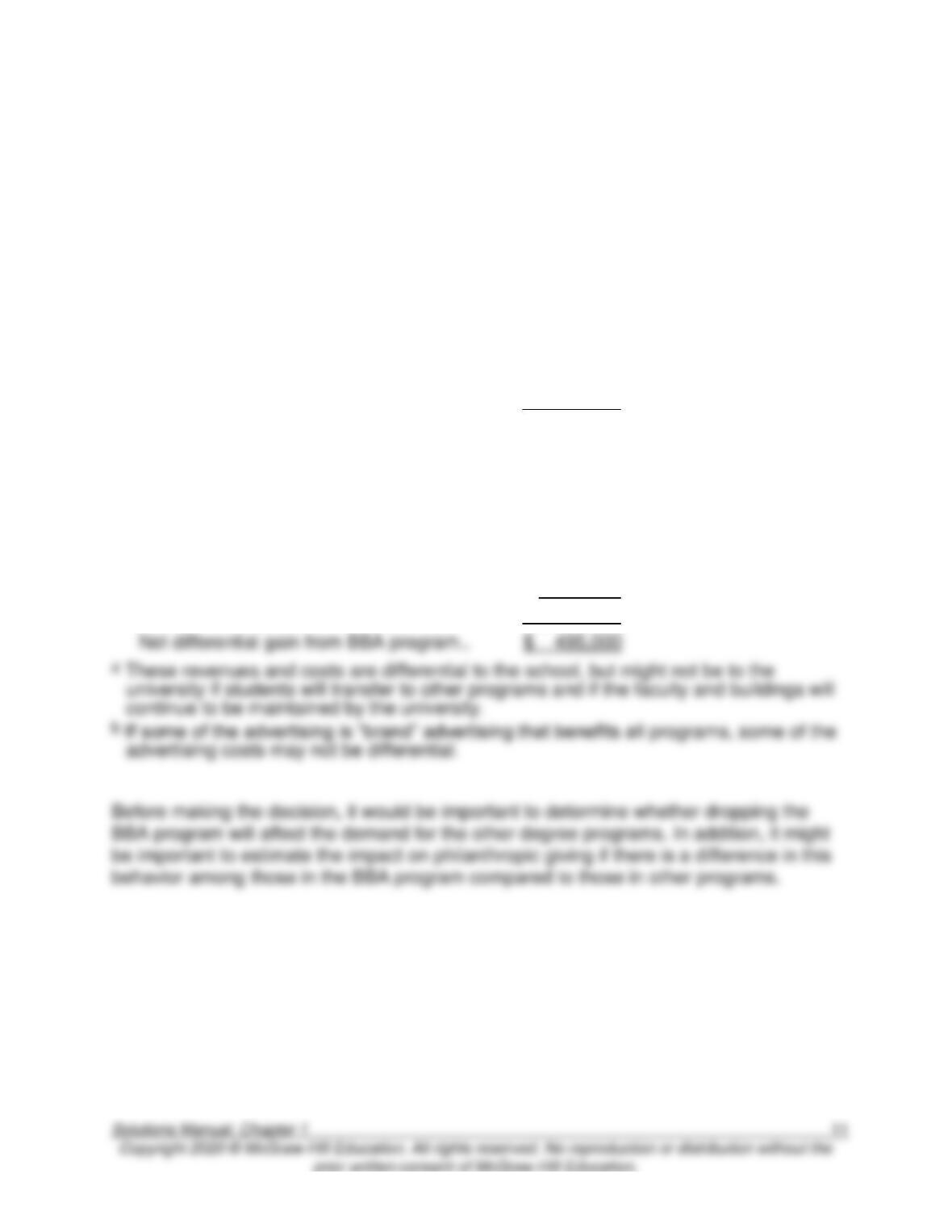
1-31. (20 Min.) Cost Data for Managerial Purposes: State University Business
School.
Considering the following costs as differential shows that dropping the BBA degree will
lower profits for the school.
State University Business School
Degree Income Statement
Differential Revenues and Costs
For the Academic Year Ending June 30
Revenue …………………………………………
$ 6,000,000
Differentiala
Costs
Advertising – BBA program ……………..
225,000
Differentialb
Faculty salaries …………………………....
3,060,000
Differentiala
Degree operating costs ………………….
390,000
Differentiala
Building maintenance …………………….
555,000
Differentiala
Classroom costs …………………………...
1,275,000
Differentiala
Allocated school administration costs
–0–
Not differential
Total costs ………………………………….
$ 5,505,000
1-32. (20 Min.) Cost Data for Managerial Purposes: State University Business
School.
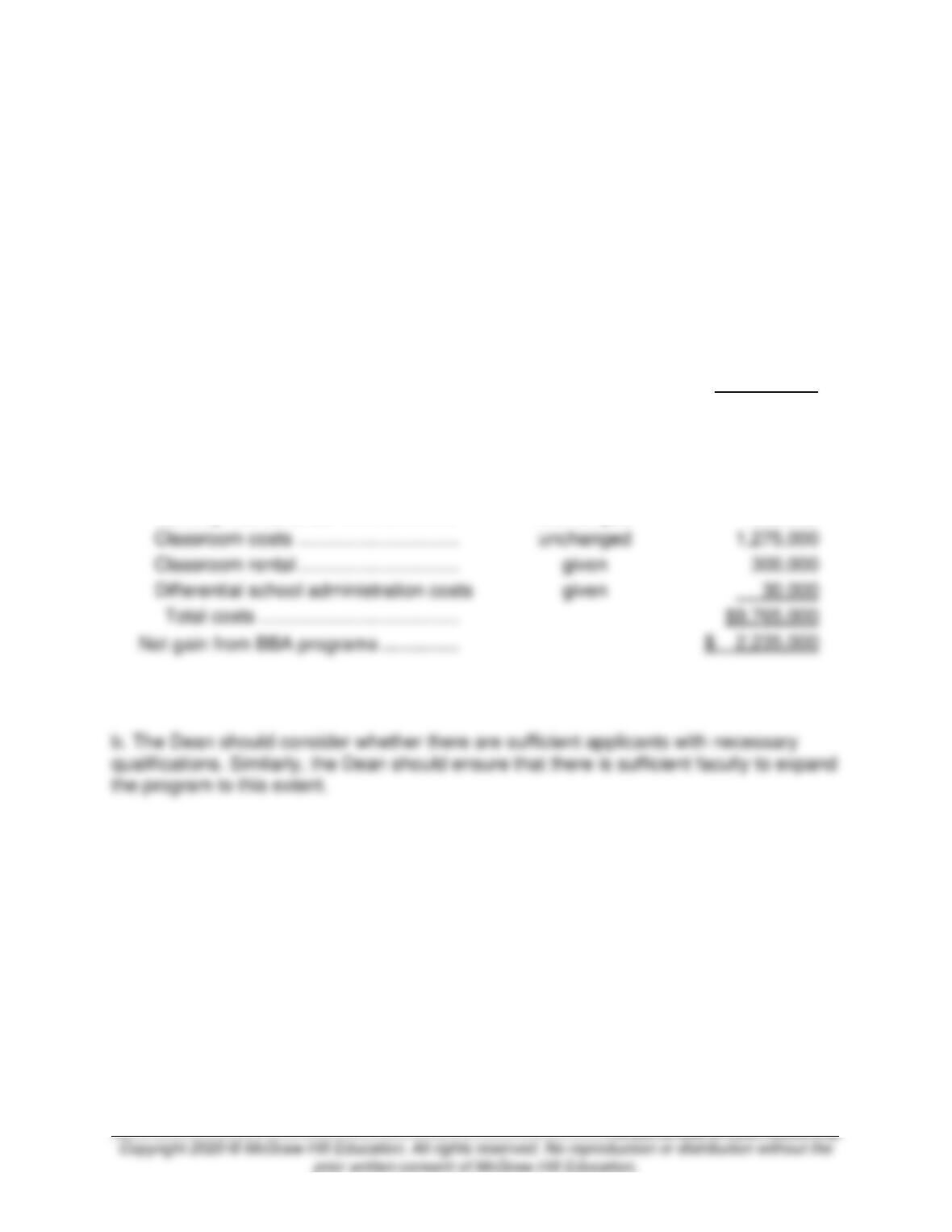
a. The following differential analysis shows that the combined contribution of the BBA
program will be positive.
State University Business School
Degree Income Statement
Differential Revenues and Costs, BBA Programs
For the Academic Year Ending June 30
Revenue ……………………………………….
$ 6,000,000 x 2
$12,000,000
Costs
Advertising – BBA program ……………
225,000 + (225,000 x 3)
900,000
Faculty salaries …………………………..
3,060,000 x 2
6,120,000
Degree operating costs ………………..
390,000 x 1.5
585,000
Building maintenance …………………..
unchanged
555,000
Classroom costs ………………………….
Classroom rental ………………………….
Differential school administration costs
Total costs ………………………………..
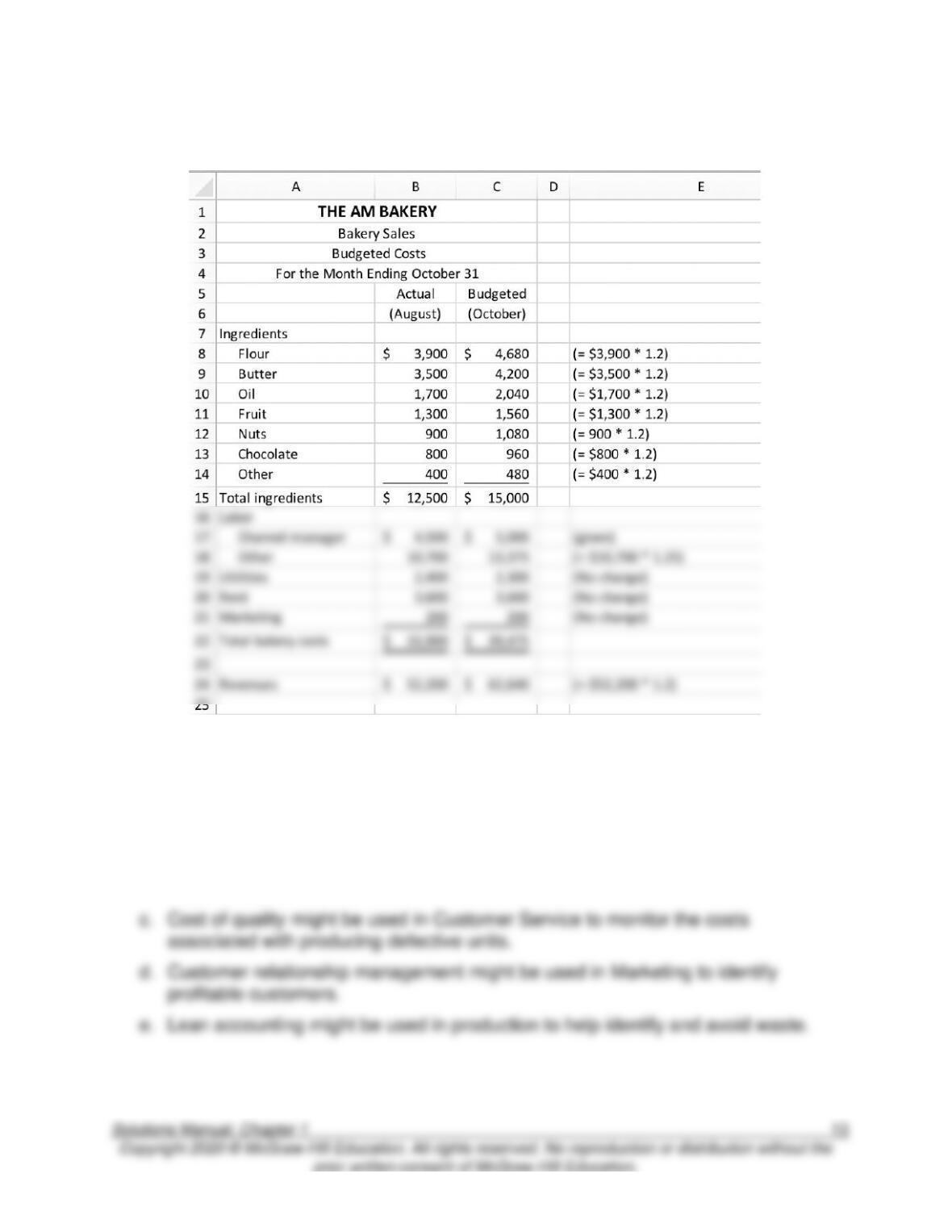
1-33. (20 Min.) Cost Data for Managerial Purposes––Budgeting
1-34. Trends in Cost Accounting
Answers will vary.
a. Activity-based costing might be used in the Design component to help designers
identify designs that will lead to less costly production requirements.
b. Benchmarking might be used in Purchasing to ensure the firm is not paying too
much for inputs.
1-35. Trends in Cost Accounting
Title
Responsibility
5 CFO
Signs off on financial statements.
3 Treasurer
Determines where to invest cash balances.
4 Controller
1 Internal auditor
Ensures procurement rules are followed.
2 Cost accountant
Evaluates costs of products.
1-36. (15 Min.) Ethics and Channel Stuffing: Continental Condiments.
a. As a management accountant, Maria has a responsibility to perform her professional
duties with competence in accordance with relevant laws and regulations. Channel
stuffing borders on illegal activity, especially if it is done to defraud investors by
presenting results that are not achieved. As a professional, she must communicate
both favorable and unfavorable information in an objective and fair manner. Thus,
she cannot simply ignore the fact that the managers are engaging in this behavior.
1-37. (15 Min.) Ethics and Cost Analysis: State University Business School.
a. As a management accountant, Jon has a responsibility to perform his professional
duties with competence in accordance with relevant laws and regulations. Choosing
a location in which the decision maker has a financial interest when a lower cost
equivalent location is unethical and may be illegal. As a professional, he must
communicate both favorable and unfavorable information in an objective and fair
manner. Thus, he cannot simply ignore the fact that the dean is engaging in this
behavior.
Solutions to Problems
1-38. (15 Min.) Responsibility for Ethical Action: Giant Engineering.
a. As a management accountant Dewi has a responsibility to perform her professional
duties with competence in accordance with relevant laws and regulations. Clearly,
overbilling the federal government is a violation of the law. As such, Dewi might have
both a legal and ethical responsibility to take some action. As a professional, she
must communicate both favorable and unfavorable information in an objective and
fair manner. Thus, she cannot simply ignore the fact that Giant is involved in illegal
contracting activities.
As for the second course of action, the proper authorities should be notified by
someone in the company. The local newspaper, however, is not the proper authority.
Dewi should discuss the matter with the Board of Directors only after exhausting
possibilities of discussing the matter with internal management.