
CHAPTER 1
Managerial Accounting
ASSIGNMENT CLASSIFICATION TABLE
Learning Objectives
Questions
Brief
Exercises
Do It!
Exercises
A
Problems
*1. Identify the features of
managerial accounting and
the functions of
management.
1, 2, 3, 4, 5,
6, 7, 8
1, 2
1
1
*2. Describe the classes of
manufacturing costs and the
differences between product
and period costs.
9, 11, 12, 13,
14
3, 4, 5, 6
2
2, 3, 4, 5, 6,
7, 13
1A, 2A
*3. Demonstrate how to compute
cost of goods manufactured
and prepare financial
statements for a
manufacturer.
10, 15, 16, 17,
18, 19, 20, 21
7, 8, 9, 10
3
8, 9, 10, 11,
12, 13, 14, 15,
16, 17
3A, 4A, 5A
*4. Discuss trends in managerial
accounting.
22, 23, 24, 25,
26
11
4
18

ASSIGNMENT CHARACTERISTICS TABLE
Problem
Number
Description
Difficulty
Level
Time
Allotted (min.)
1A
Classify manufacturing costs into different categories and
compute the unit cost.
Simple
20–30
2A
Classify manufacturing costs into different categories and
compute the unit cost.
Simple
20–30
3A
Indicate the missing amount of different cost items, and
prepare a condensed cost of goods manufactured schedule,
an income statement, and a partial balance sheet.
Moderate
30–40
4A
Prepare a cost of goods manufactured schedule, a partial
income statement, and a partial balance sheet.
Moderate
30–40
5A
Prepare a cost of goods manufactured schedule and a
correct income statement.
Moderate
30–40
BLOOM’ S TAXONOMY TABLE
Correlation Chart between Bloom’s Taxonomy, Learning Objectives and End–of-Chapter Exercises and Problems
Learning Objective
Knowledge
Comprehension
Application
Analysis
Synthesis
Evaluation
* 1. Identify the features of managerial
accounting and the functions of
management.
Q1-1
Q1-2
Q1-3
Q1-4
Q1-5
Q1-6
Q1-7
Q1-8
BE1-1
BE1-2
DI1-1
E1-1
* 2. Describe the classes of
manufacturing costs and the
differences between product and
period costs.
Q1–11
Q1-9
Q1–12
Q1–13
Q1–14
BE1-3
BE1-4
BE1-5
BE1-6
DI1-2
E1-2
E1-3
E1-5
E1-6
E1-4
E1-7
E1–13
P1–1A
P1–2A
* 3. Demonstrate how to compute cost of
goods manufactured and prepare
financial statements for a
manufacturer.
Q1–19
Q1–10
Q1–20
Q1–21
E1–15
Q1–15
Q1–16
Q1–17
Q1–18
BE1-7
BE1-8
BE1-9
BE1-10
DI1-3
E1-8
E1-9
E1–12
E1–13
E1–14
E1–16
E1–17
P1–4A
E1–10
E1–11
P1–3A
P1–5A
* 4. Discuss trends in managerial
accounting.
Q1–22
Q1–23
Q1–24
Q1–25
Q1–26
BE1-11
DI1-4
E1–18
Continuing Problems
CD1
WCP1
Broadening Your Perspective
BYP1-1
BYP1-2
BYP1-3
BYP1-4
BYP1-5
BYP1-6
BYP1-7

ANSWERS TO QUESTIONS
1. (a) Disagree. Managerial accounting is a field of accounting that provides economic and financial
information for managers and other internal users.
(b) Joe is incorrect. Managerial accounting applies to all types of businesses—service, merchandising,
and manufacturing.
2. (a) Financial accounting is concerned primarily with external users such as stockholders, creditors,
and regulators. In contrast, managerial accounting is concerned primarily with internal users such
as officers and managers.
(b) Financial statements are the end product of financial accounting. The statements are prepared
quarterly and annually. In managerial accounting, internal reports may be prepared as frequently
as needed.
(c) The purpose of financial accounting is to provide general-purpose information for all users.
The purpose of managerial accounting is to provide special-purpose information for specific
decisions.
3. Differences in the content of the reports are as follows:
Financial
Managerial
• Pertains to business as a whole and is highly
aggregated.
• Limited to double-entry accounting and cost
data.
• Generally accepted accounting principles.
• Pertains to subunits of the business and
may be very detailed.
• Extends beyond double-entry accounting
system to any relevant data.
• Standard is relevance to decisions.
In financial accounting, financial statements are verified annually through an independent audit
by certified public accountants. There are no independent audits of internal reports issued by
managerial accountants.
4. Linda should know that the management of an organization performs three broad functions:
(1) Planning requires management to look ahead and to establish objectives.
(2) Directing involves coordinating the diverse activities and human resources of a company to
produce a smooth-running operation.
(3) Controlling is the process of keeping the company’s activities on track.
5. Disagree. Decision making is not a separate management function. Rather, decision making involves
the exercise of good judgment in performing the three management functions explained in the
answer to question five above.
6. Employees with line positions are directly involved in the company’s primary revenue generating
operating activities. Examples would include plant managers and supervisors, and the vice president
of operations. In contrast, employees with staff positions are not directly involved in revenue–
generating operating activities, but rather serve in a support capacity to line employees. Examples
include employees in finance, legal, and human resources.

Questions Chapter 1 (Continued)
7. The differences between income statements are in the computation of the cost of goods sold as
follows:
Manufacturing
company:
Beginning finished goods inventory plus cost of goods manufactured minus
ending finished goods inventory = cost of goods sold.
Merchandising
company:
Beginning merchandise inventory plus cost of goods purchased minus ending
merchandise inventory = cost of goods sold.
8. The difference in balance sheets pertains to the presentation of inventories in the current asset
section. In a merchandising company, only merchandise inventory is shown. In a manufacturing
company, three inventory accounts are shown: finished goods, work in process, and raw materials.
9. Manufacturing costs are classified as either direct materials, direct labor, or manufacturing overhead.
10. No, Mel is not correct. The distinction between direct and indirect materials is based on two criteria:
(1) physical association and (2) the convenience of making the physical association. Materials which
cannot be easily associated with the finished product are considered indirect materials.
11. Product costs, or inventoriable costs, are costs that are a necessary and integral part of producing
the finished product. Period costs are costs that are identified with a specific time period rather
than with a salable product. These costs relate to nonmanufacturing costs and therefore are not
inventoriable costs.
12. A merchandising company has beginning merchandise inventory, cost of goods purchased, and
ending merchandise inventory. A manufacturing company has beginning finished goods inventory,
cost of goods manufactured, and ending finished goods inventory.
13. (a) X = total cost of work in process.
(b) X = cost of goods manufactured.
14. Raw materials inventory, beginning …………………………………………………………….. 12,000 $
Raw materials purchases ………………………………………………………………………….. 170,000
Total raw materials available for use ……………………………………………………………. 182,000
Raw materials inventory, ending …………………………………………………………………. (15,000 )
Direct materials used ………………………………………………………………………… $167,000
15. Direct materials used ………………………………………………………………………………… $240,000
Direct labor used ……………………………………………………………………………………… 220,000
Total manufacturing overhead ……………………………………………………………………. 180,000
Total manufacturing costs ………………………………………………………………….. $640,000
16. (a) Total cost of work in process ($26,000 + $640,000) ……………………………….. $666,000
(b) Cost of goods manufactured ($666,000 – $32,000) ……………………………….. $634,000
17. The order of listing is finished goods inventory, work in process inventory, and raw materials inventory.
Questions Chapter 1 (Continued)
18. The products differ in how each are consumed by the customer. Services are consumed
immediately; the product is not put into inventory. Meals at a restaurant are the best example
where they are consumed immediately by the customer. There could be a long lead time before
the product is consumed in a manufacturing environment.
19. Yes, product costing techniques apply equally well to manufacturers and service companies. Each
needs to keep track of the cost of production or services in order to know whether it is generating
a profit. The techniques shown in this chapter, to accumulate manufacturing costs to determine
manufacturing inventory, are equally useful for determining the cost of services.
20. The value chain refers to all activities associated with providing a product or service. For a manufac–
turer, these include research and development, product design, acquisition of raw materials, production,
sales and marketing, delivery, customer relations, and subsequent service.
21. An enterprise resource planning (ERP) system is an integrated software system that provides a
comprehensive, centralized resource for information. Its primary benefits are that it replaces the
many individual systems typically used for receivables, payables, inventory, human resources,
etc. Also, it can be used to get information from, and provide information to, the company’s customers
and suppliers.
22. In a just-in-time inventory system, the company has no extra inventory stored. Consequently, if
some units that are produced are defective, the company will not have enough units to deliver to
customers.
23. The balanced scorecard is called “balanced” because it strives to not over emphasize any one
performance measure, but rather uses both financial and non-financial measures to evaluate all
aspects of a company’s operations in an integrated fashion.
24. Budgets are prepared by companies to provide future direction. Because the budget is also used
as an evaluation tool, some managers try to game the budgeting process by underestimating
their division’s predicted performance so that it will be easier to meet their performance targets.
On the other hand, if the budget is set at unattainable levels, managers sometimes take unethical
actions to meet targets to receive higher compensation or in some cases to keep their jobs.
25. CEOs and CFOs must now certify that financial statements give a fair presentation of the company’s
operating results and its financial condition and that the company maintains an adequate system
of internal controls. In addition, the composition of the board of directors and audit committees receives
more scrutiny, and penalties for misconduct have increased.
26. Activity-based costing is an approach used to allocate overhead based on each product’s relative
use of activities in making the product. Activity-based costing is beneficial because it results in
more accurate product costing and in more careful scrutiny of all activities in the value chain.
SOLUTIONS TO BRIEF EXERCISES
BRIEF EXERCISE 1-1
Financial Accounting
Managerial Accounting
Primary users
External users
Internal users
Types of reports
Financial statements
Internal reports
BRIEF EXERCISE 1-2
BRIEF EXERCISE 1-3
(a) DM Frames and tires used in manufacturing bicycles.
Frequency of reports
Quarterly and annually
As frequently as needed
for specific decisions
accounting principles
public accountant
BRIEF EXERCISE 1-4
(a) Direct materials.
(b) Direct materials.
BRIEF EXERCISE 1-5
(a) Product.
BRIEF EXERCISE 1-6
Product Costs
Direct
Materials
Direct
Labor
Factory
Overhead
(d)
(a)
X
BRIEF EXERCISE 1-7
(a) Direct materials used …………………………………………………… $180,000
Direct labor …………………………………………………………………. 209,000
BRIEF EXERCISE 1-8
ROLAND COMPANY
Balance Sheet
December 31, 2017
Current assets
Cash …………………………..…………………………….. $ 62,000
Accounts receivable ………………………………….. 200,000
Inventories
BRIEF EXERCISE 1-9
Direct
Materials Used
Direct
Labor Used
Factory
Overhead
Total
Manufacturing
Costs
(1)
$151,000
BRIEF EXERCISE 1-10
Total
Manufacturing
Costs
Work in
Process
(January 1)
Work in
Process
(December 31)
Cost of Goods
Manufactured
(1)
$151,000*
$189,000
BRIEF EXERCISE 1-11
One implication of SOX was to clarify top management’s responsibility for
the company’s financial statements. CEOs and CFOs must now certify that
financial statements give a fair presentation of the company’s operating
results and its financial condition. In addition, top managers must certify
that the company maintains an adequate system of internal controls to
safeguard the company’s assets and ensure accurate financial reports. Also,
more attention is now paid to the composition of the company’s board of
directors. In particular, the audit committee of the board of directors must
be comprised entirely of independent members (that is, non-employees) and
must contain at least one financial expert. Finally, to increase the likelihood
of compliance with these and other new rules, the penalties for misconduct
were substantially increased.
SOLUTIONS FOR DO IT! REVIEW EXERCISES
DO IT! 1-1
1. False
DO IT! 1-2
Period costs:
Advertising
Salaries of sales representatives
Product costs:
Blank CDs (DM)
Depreciation of CD image burner (MO)
DO IT! 1-3
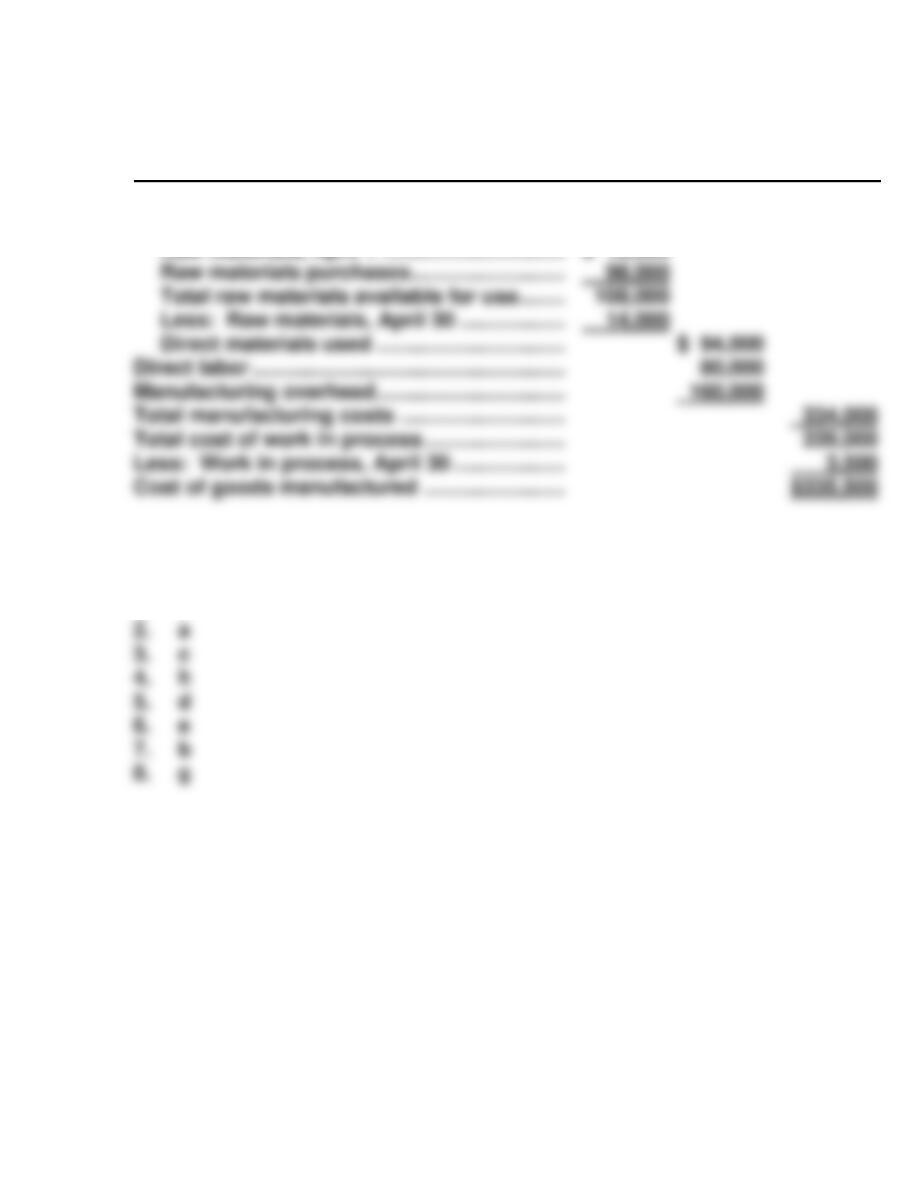
TOMLIN COMPANY
Cost of Goods Manufactured Schedule
For the Month Ended April 30
Work in process, April 1 ………………………….. $ 5,000
Direct materials ……………………………………….
Raw materials, April 1 …………………………. $ 10,000
DO IT! 1-4
1. f
SOLUTIONS TO EXERCISES
EXERCISE 1-1
1. False. Financial accounting focuses on providing information to external
users.
EXERCISE 1-2
1. (b) Direct labor.*
2. (c) Manufacturing overhead.
EXERCISE 1-3
(a)
Bicycle components …………… DM
Advertising expense ………….. Period
Depreciation on plant ………. MOH
Property taxes on plant ………… MOH
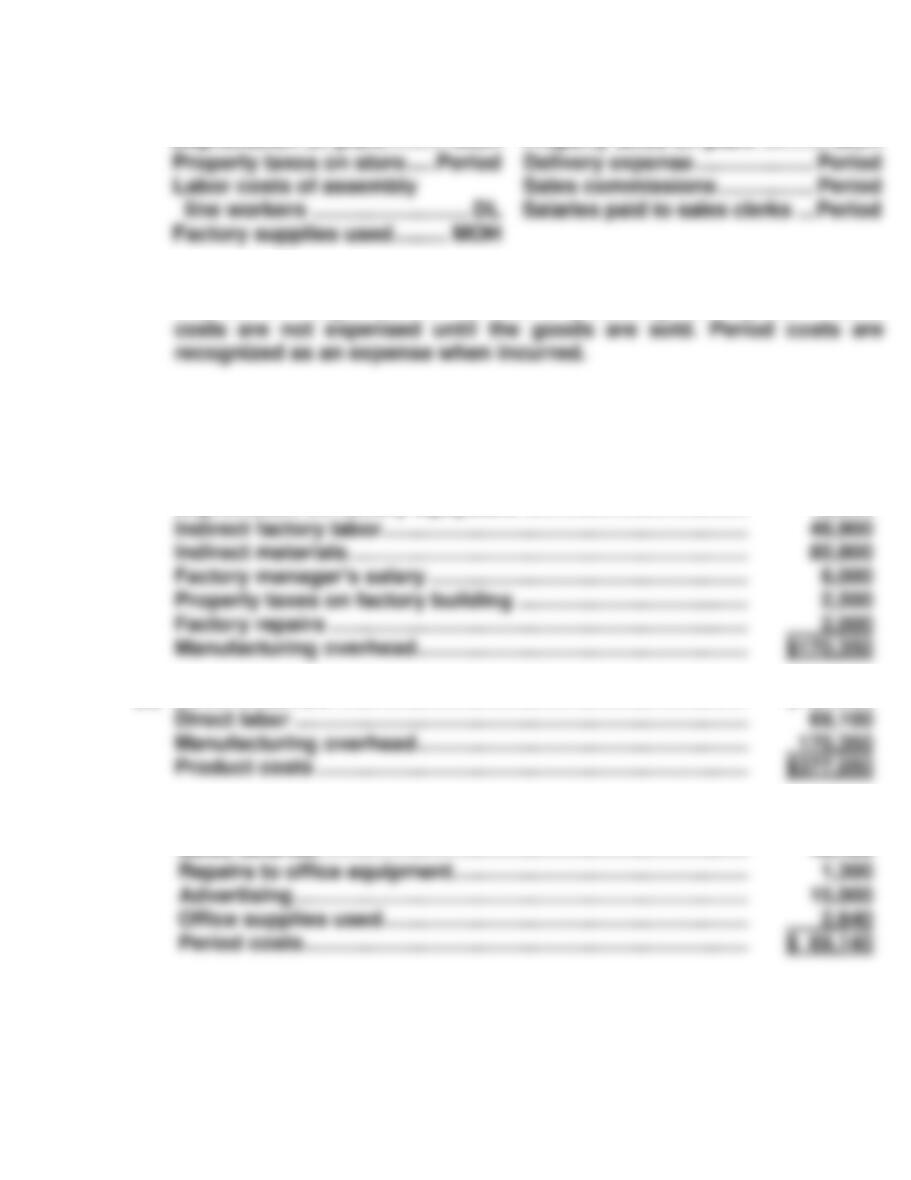
(b) Product costs are recorded as a part of the cost of inventory because
they are an integral part of the cost of producing the bicycles. Product
EXERCISE 1-4
(a) Factory utilities …………………………………………………………….. $ 15,500
Depreciation on factory equipment ……………………………….. 12,650
(b) Direct materials …………………………..……………………………….. $137,600
(c) Depreciation on delivery trucks …………………………………….. $ 3,800
Sales salaries ………………………………………………………………. 46,400
Salaries paid to sales clerks … Period
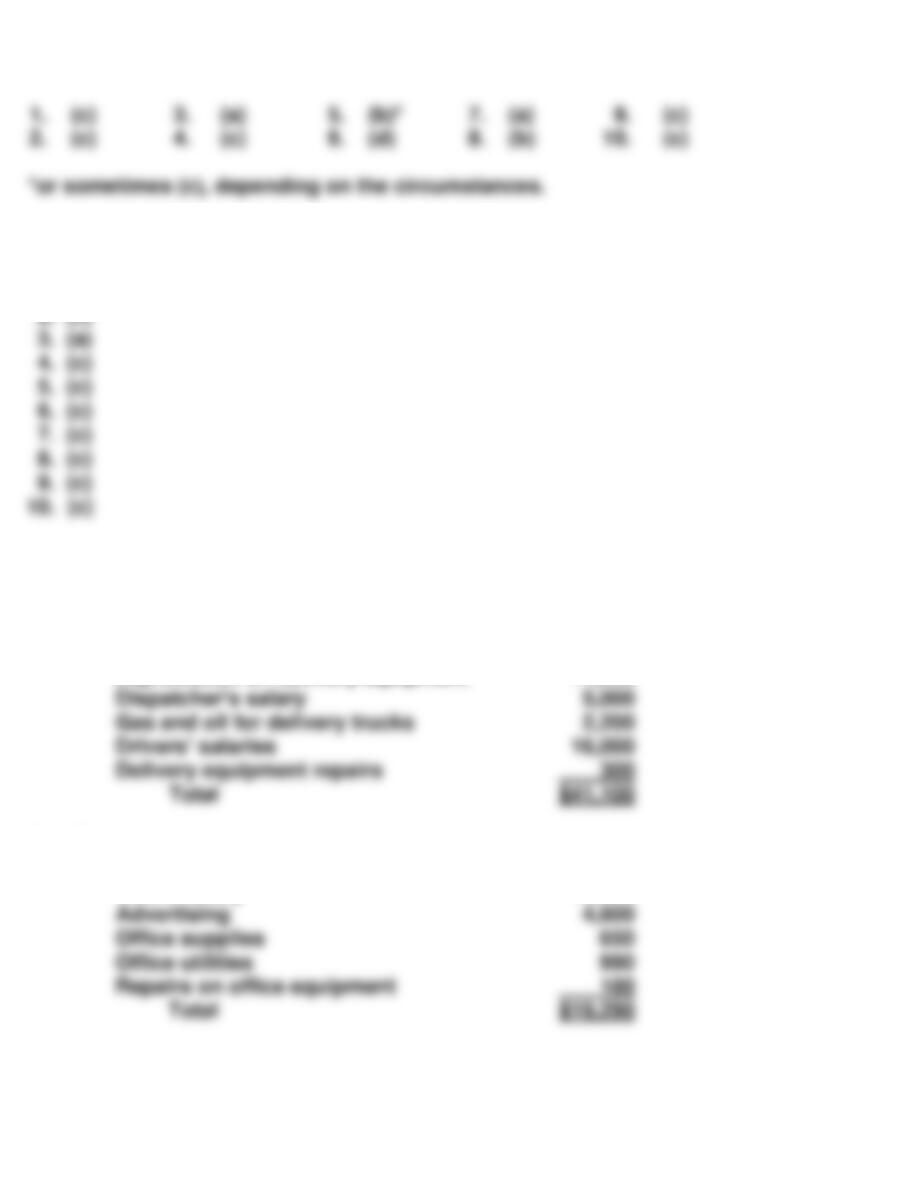
EXERCISE 1-5
EXERCISE 1-6
1. (b)
EXERCISE 1-7
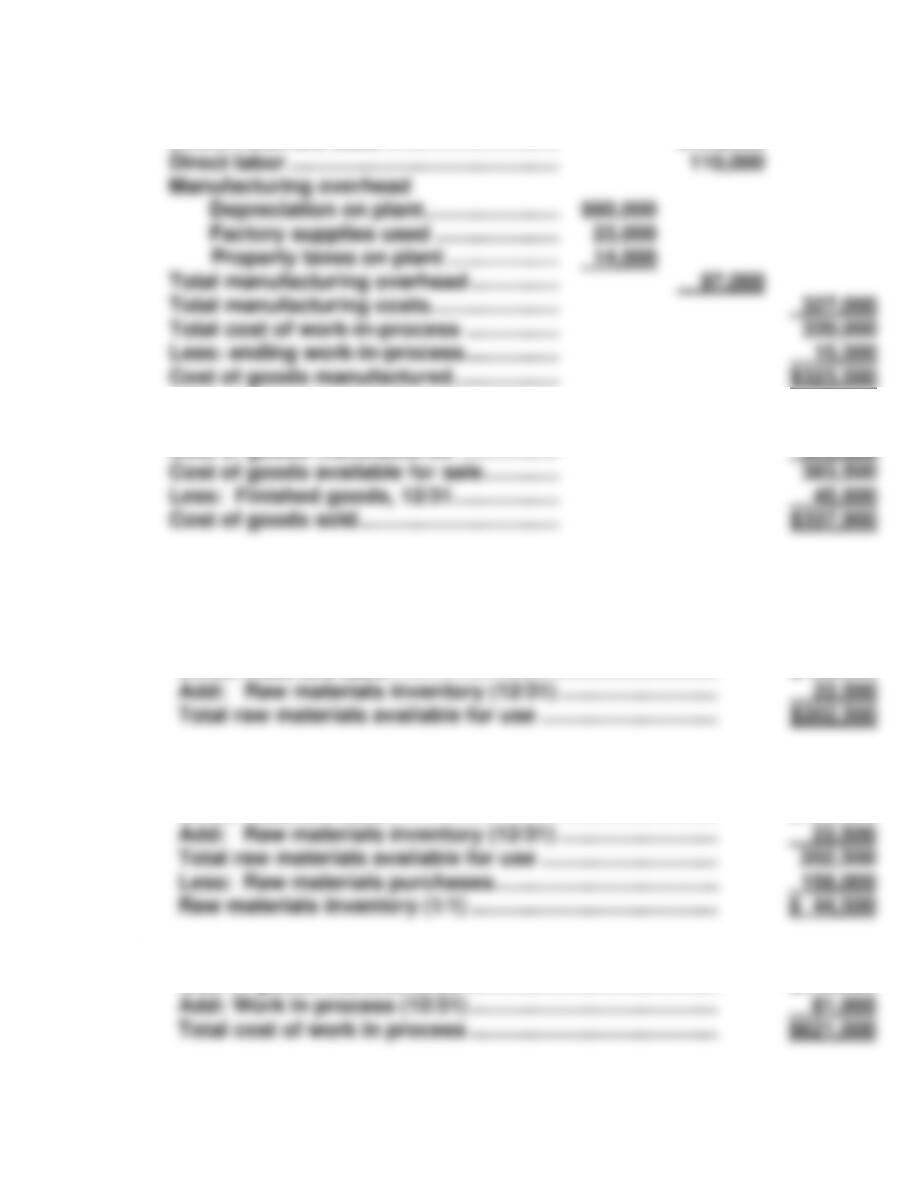
(a) Delivery service (product) costs:
Indirect materials
$ 6,400
Depreciation on delivery equipment
11,200
Dispatcher’s salary
Gas and oil for delivery trucks
Drivers’ salaries
16,000
Total
(b) Period costs:
Property taxes on office building
$ 870
CEO’s salary
12,000
Office supplies
Office utilities
Repairs on office equipment
180
Total
$19,290
EXERCISE 1-8
(a) Work-in-process, 1/1 …………………………. $ 12,000
Direct materials used ………………………… $120,000
(b) Finished goods, 1/1 …………………………... $ 60,000
Cost of goods manufactured …………….. 323,500
EXERCISE 1-9
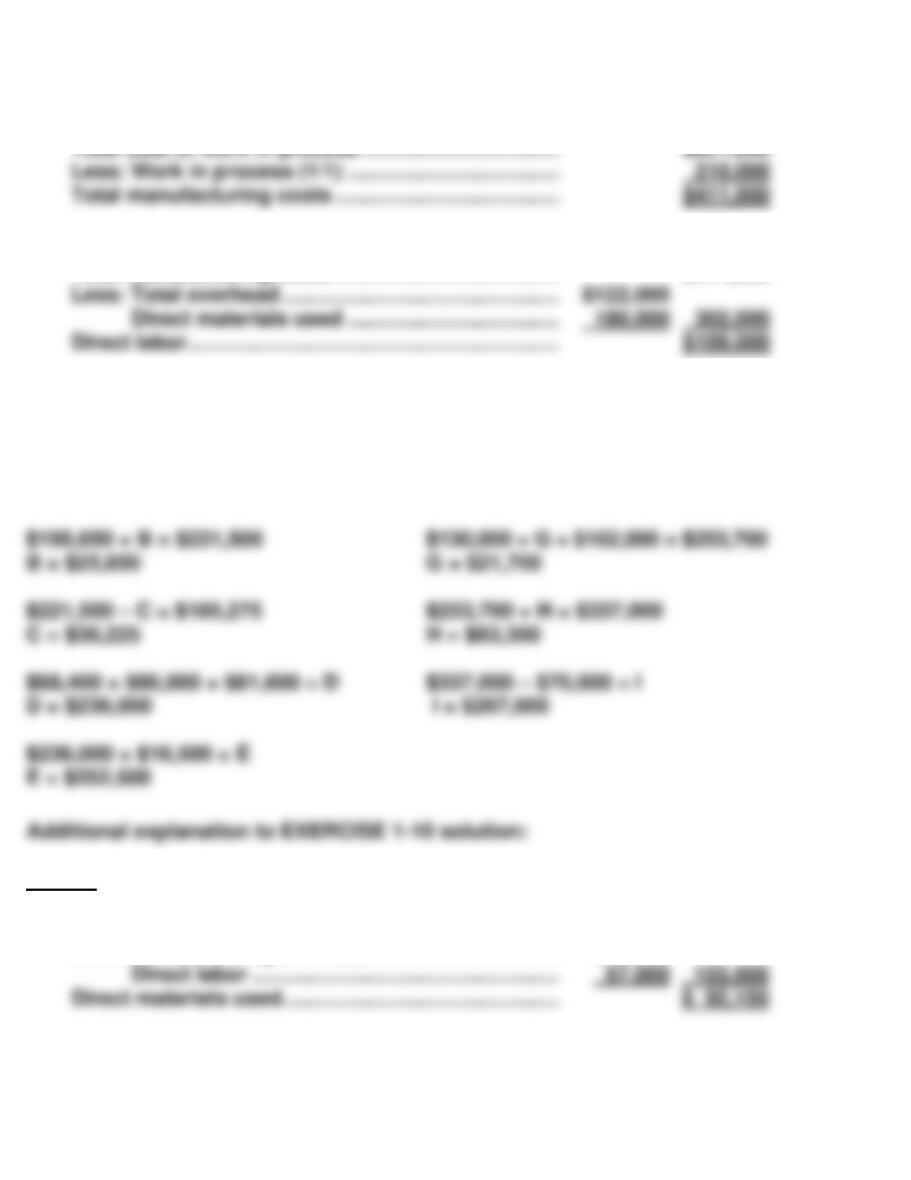
Total raw materials available for use:
Direct materials used ………………………………………………. $180,000
Raw materials inventory (1/1):
Total raw materials available for use:
Direct materials used ………………………………………………. $180,000
Total cost of work in process:
Cost of goods manufactured ……………………………………. $540,000
EXERCISE 1-9 (Continued)
Total manufacturing costs:
Direct labor:
Total manufacturing costs ……………………………….. $411,000
EXERCISE 1-10
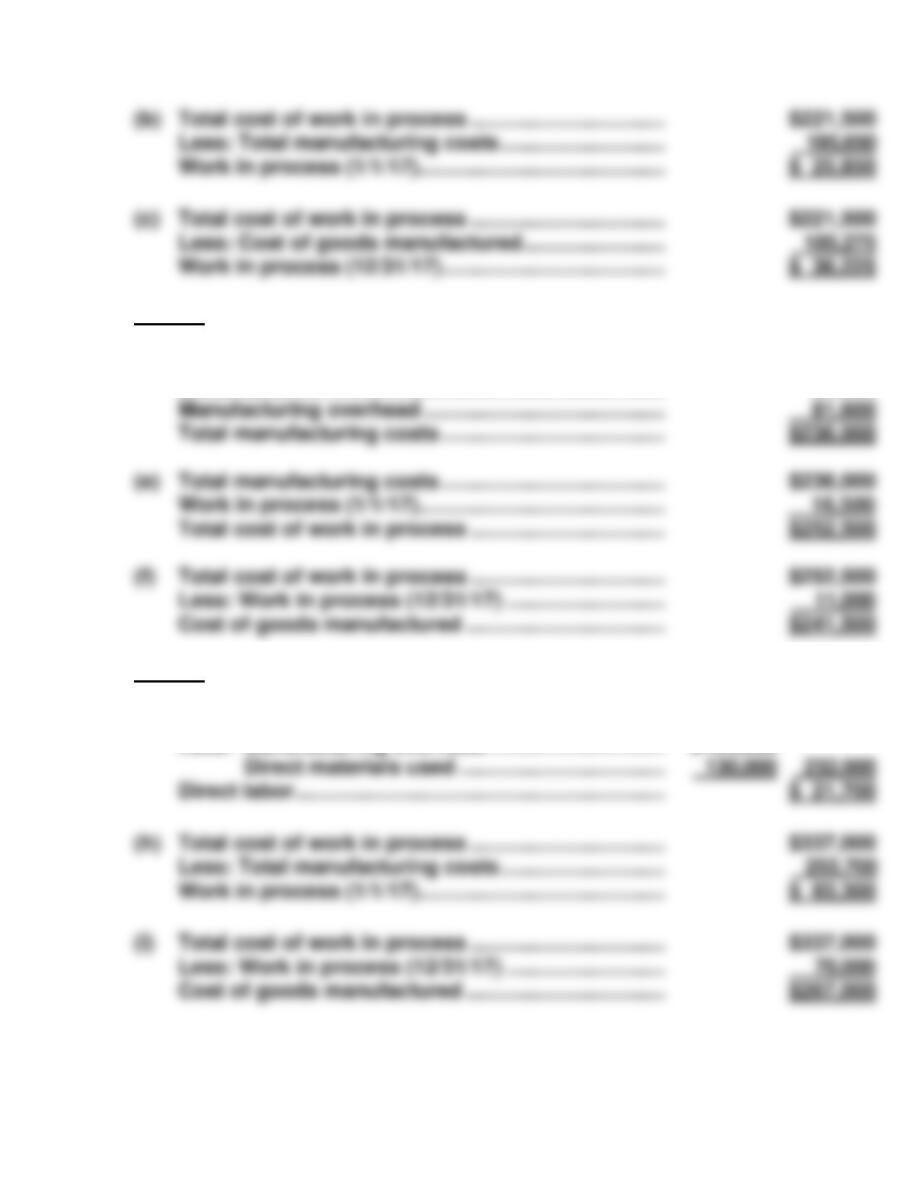
A + $57,000 + $46,500 = $195,650 $252,500 – $11,000 = F
A = $92,150 F = $241,500
Case A
(a) Total manufacturing costs ……………………………….. $195,650
Less: Manufacturing overhead …………………………. $46,500
EXERCISE 1-10 (Continued)
Case B
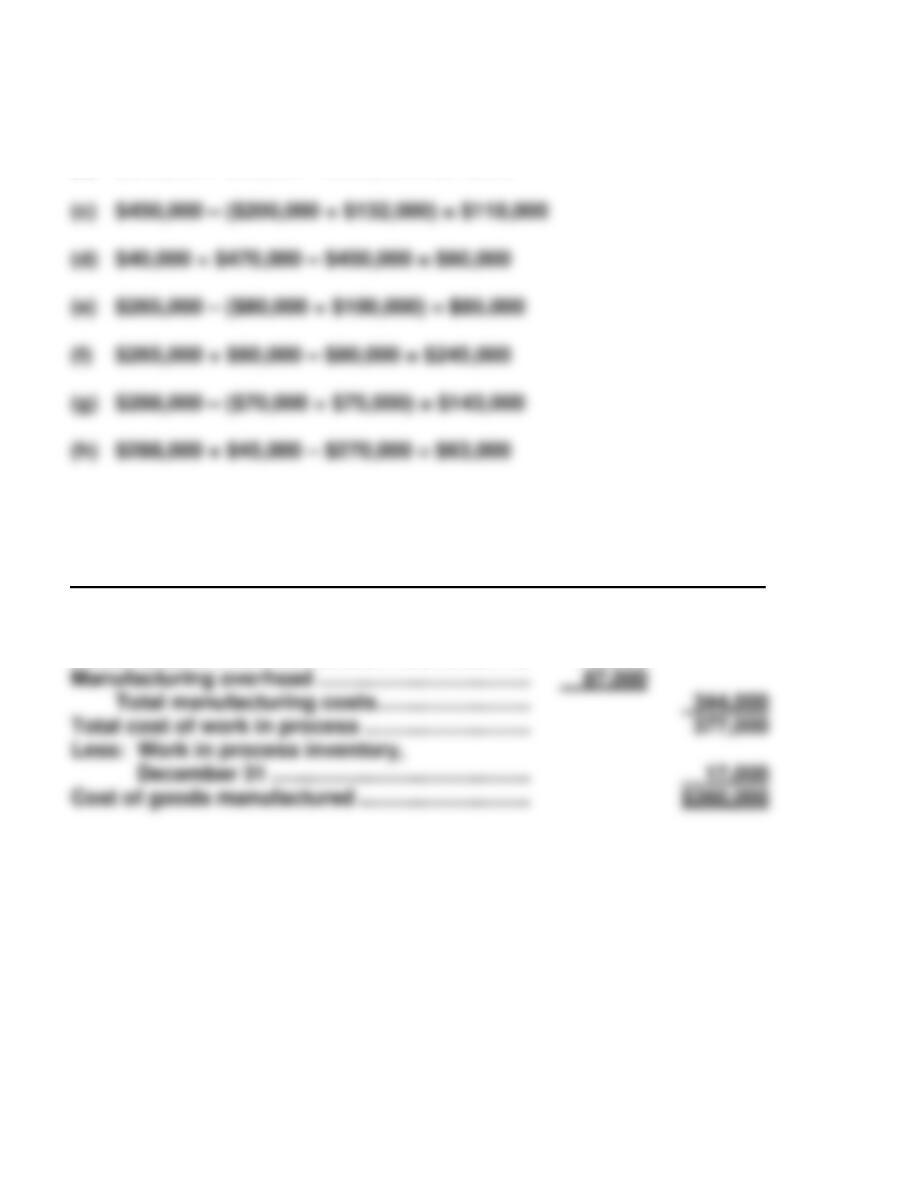
(d) Direct materials used ………………………………………. $ 68,400
Direct labor ……………………………………………………… 86,000
Case C
(g) Total manufacturing costs ……………………………….. $253,700
Less: Manufacturing overhead ………………………… $102,000
EXERCISE 1-11
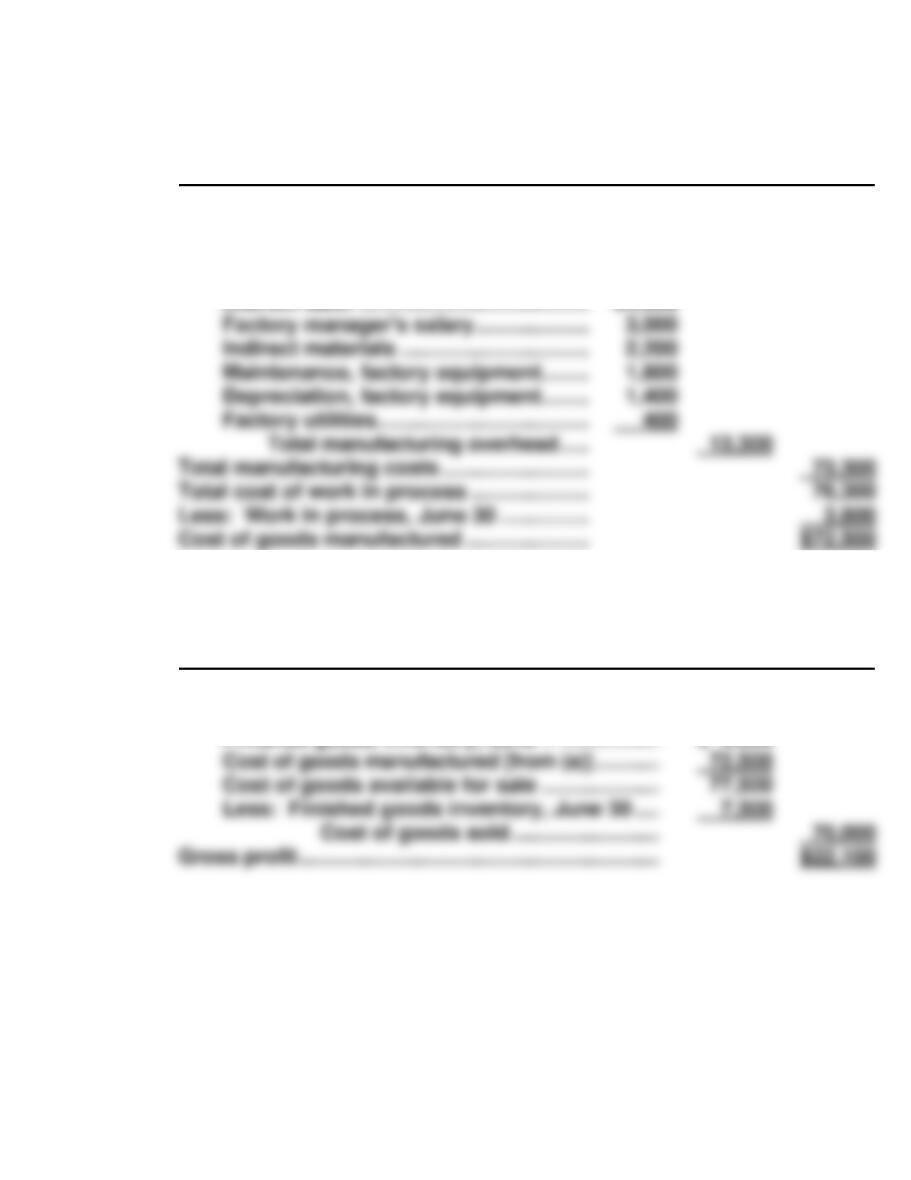
(a) (a) $117,000 + $140,000 + $87,000 = $344,000
(b) $344,000 + $33,000 – $360,000 = $17,000
(b) HORIZON COMPANY
Cost of Goods Manufactured Schedule
For the Year Ended December 31, 2017
Work in process, January 1 …………………………. $ 33,000
Direct materials …………………………………………… $117,000
Direct labor …………………………………………………. 140,000
EXERCISE 1-12
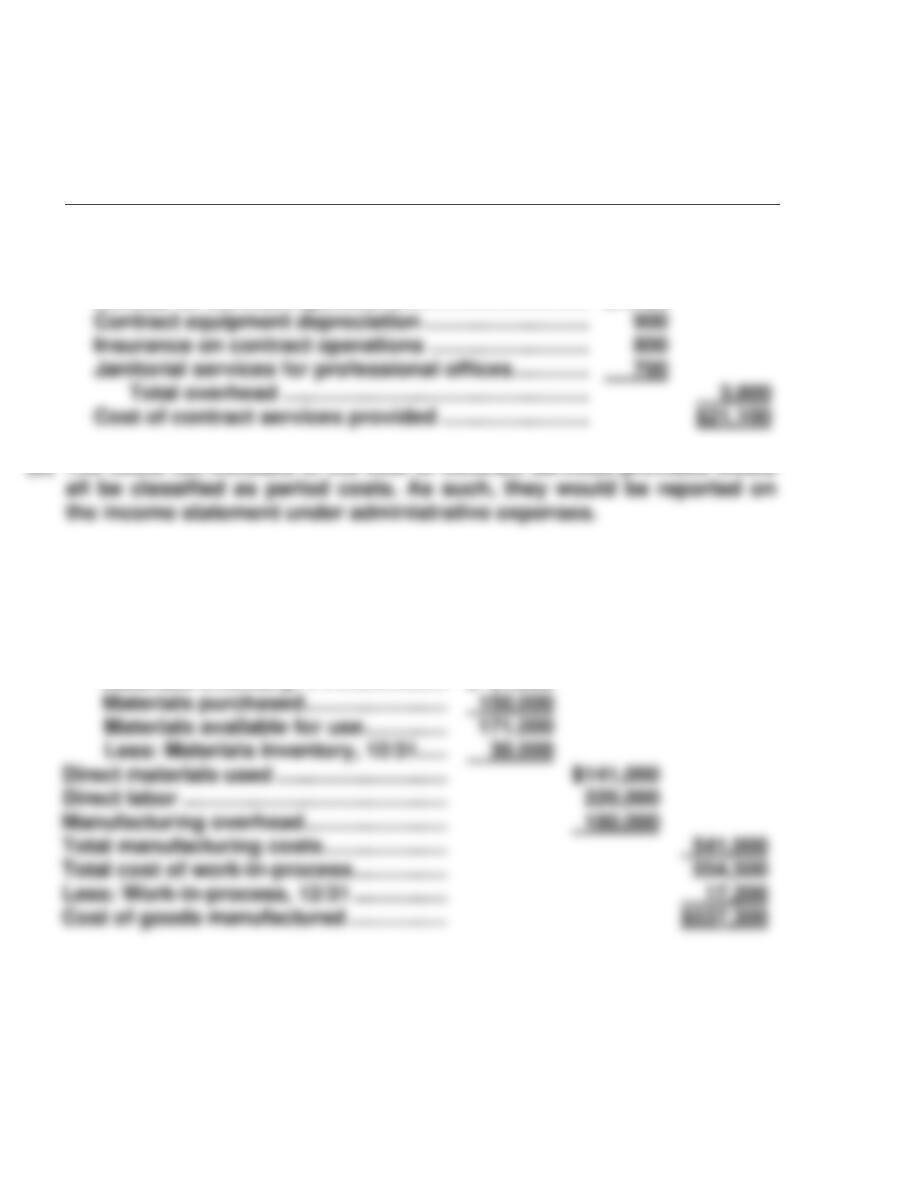
(a) CEPEDA CORPORATION
Cost of Goods Manufactured Schedule
For the Month Ended June 30, 2017
Work in process, June 1……………………….. $ 3,000
Direct materials used …………………………... $20,000
Direct labor ………………………………………….. 40,000
Manufacturing overhead
(b) CEPEDA CORPORATION
Income Statement (Partial)
For the Month Ended June 30, 2017
Sales revenue ………………………………………………… $92,100
Cost of goods sold
Finished goods inventory, June 1 …………….. $ 5,000
EXERCISE 1-13
(a) WASHINGTON CONSULTING
Schedule of Cost of Contract Services Performed
For the Month Ended August 31, 2017
Supplies used (direct materials) ……………………………..
$ 1,700
Salaries of professionals (direct labor) ……………………
15,600
Service overhead:
Utilities for contract operations ………………………….
$1,400
(b) The costs not included in the cost of contract services provided would
EXERCISE 1-14
(a) Work-in-process, 1/1 ………………………… $ 13,500
Direct materials
Materials inventory, 1/1 ………………. $ 21,000
Contract equipment depreciation ……………………….
Insurance on contract operations ………………………
Janitorial services for professional offices ………….
Total overhead …………………………………………….
EXERCISE 1-14 (Continued)
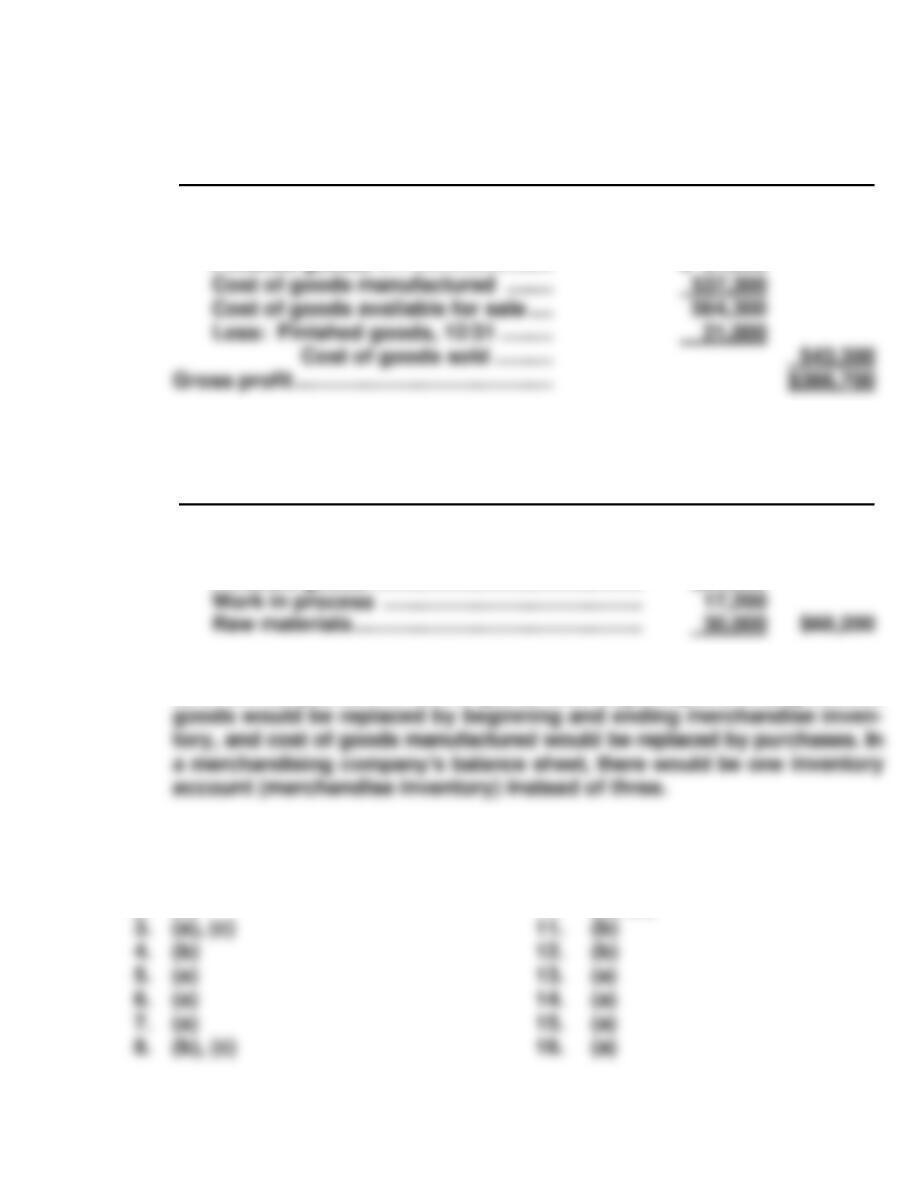
AIKMAN COMPANY
Income Statement (Partial)
For the Year Ended December 31, 2017
(b) Sales revenue …………………………..……. $910,000
Cost of goods sold
Finished goods, 1/1 …………………… $ 27,000
AIKMAN COMPANY
(Partial) Balance Sheet
December 31, 2017
(c) Current assets
Inventories
Finished goods ………………………………………. $21,000
(d) In a merchandising company’s income statement, the only difference would
be in the computation of cost of goods sold. Beginning and ending finished
EXERCISE 1-15
1. (a) 9. (a)
2. (a) 10. (a), (b)
EXERCISE 1-16
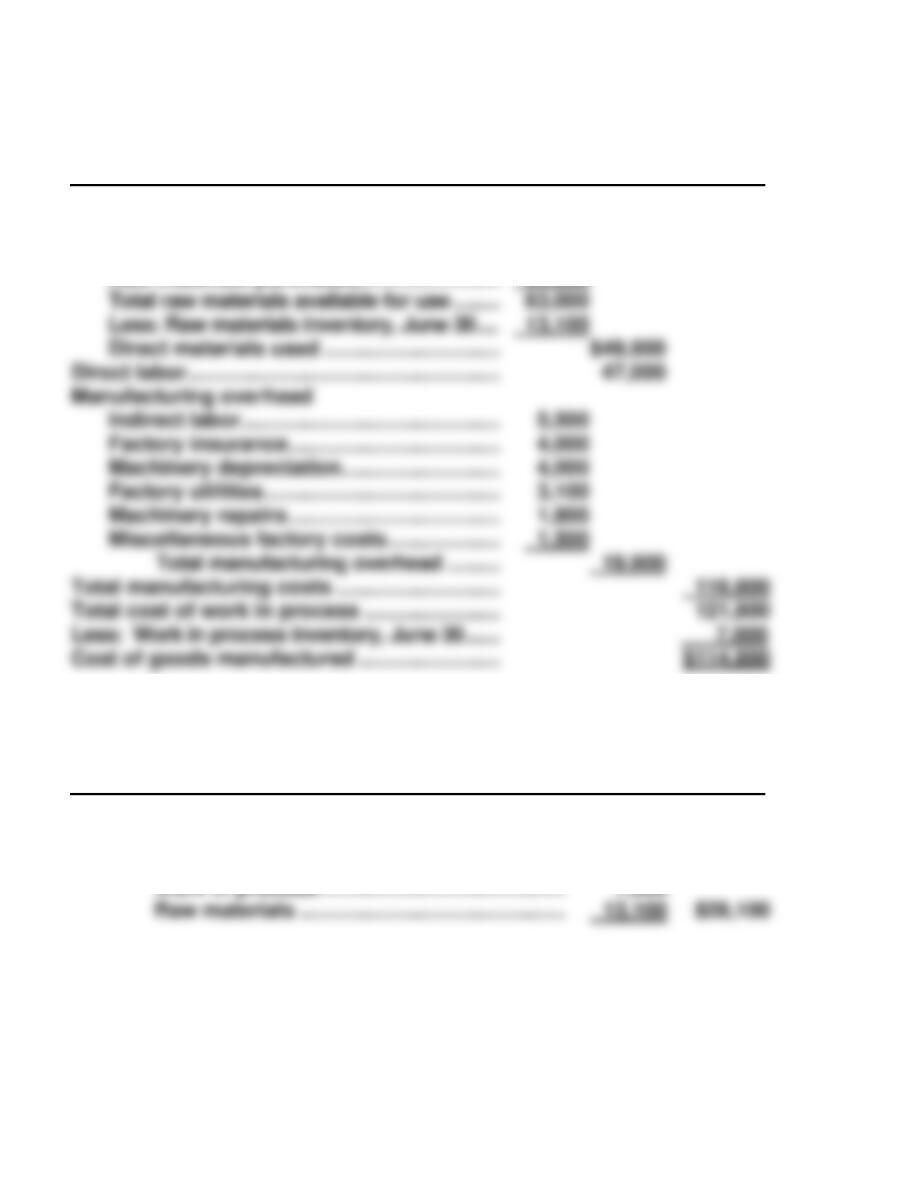
(a) ROBERTS COMPANY
Cost of Goods Manufactured Schedule
For the Month Ended June 30, 2017
Work in process inventory, June 1 …………….. $ 5,000
Direct materials
Raw materials inventory, June 1 ………… $ 9,000
Raw materials purchases …………………… 54,000
(b) ROBERTS COMPANY
(Partial) Balance Sheet
June 30, 2017
Current assets
Inventories
Finished goods ……………………………………. $ 8,000
EXERCISE 1-17
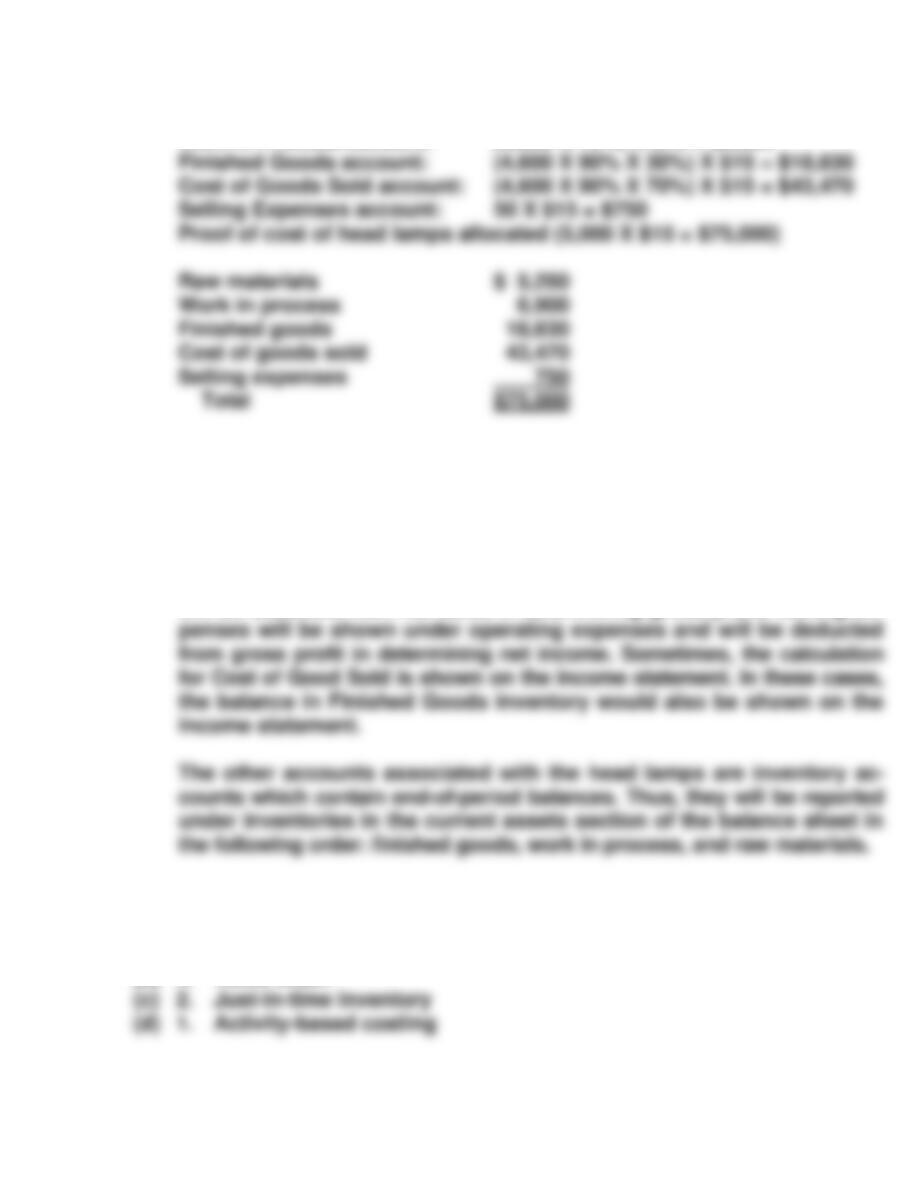
(a) Raw Materials account: (5,000 – 4,650) X $15 = $5,250
Work in Process account: (4,600 X 10%) X $15 = $6,900
(b) To: Chief Accountant
From: Student
Subject: Statement Presentation of Accounts
Two accounts will appear in the income statement. Cost of Goods Sold
will be deducted from net sales in determining gross profit. Selling ex-
EXERCISE 1-18
(a) 3. Balanced scorecard
(b) 4. Value chain
SOLUTIONS TO PROBLEMS
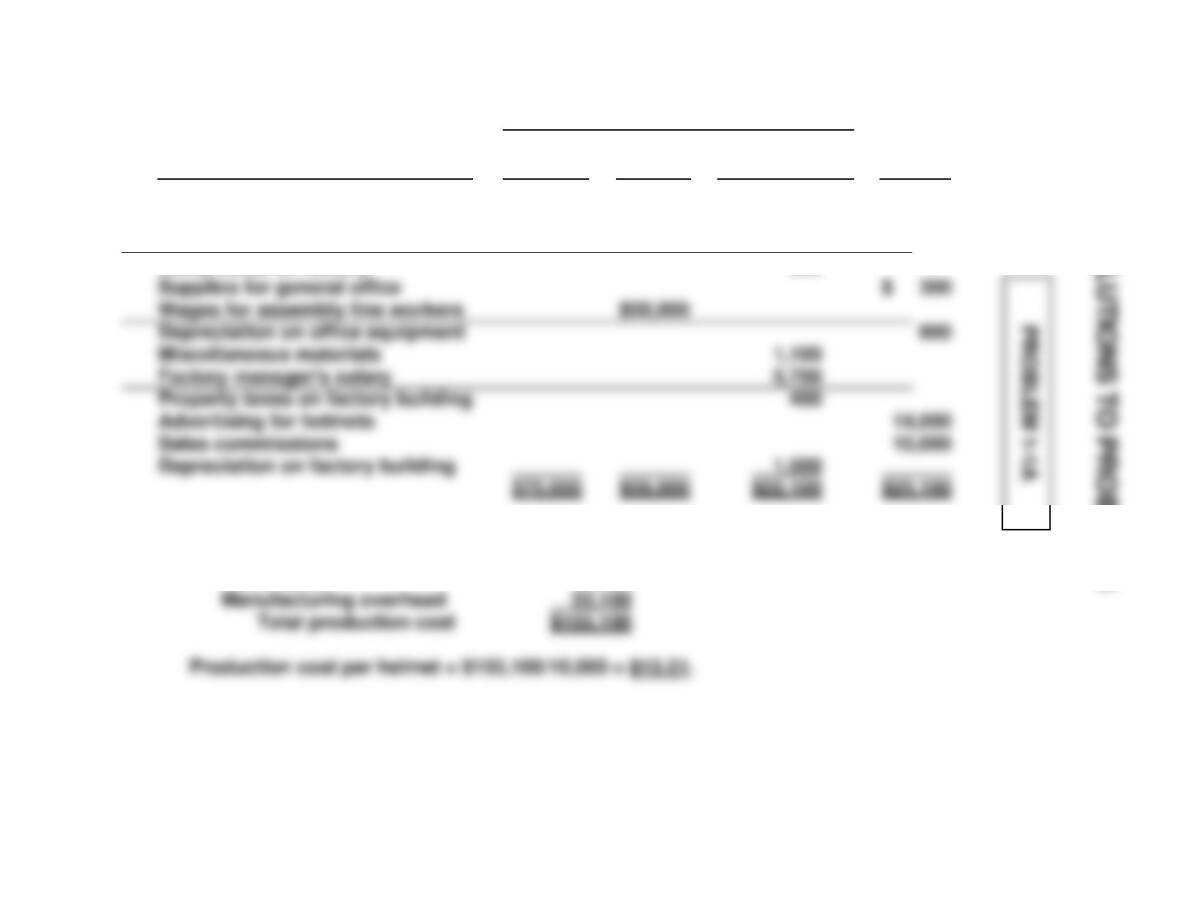
(a)
Product Costs
Cost Item
Direct
Materials
Direct
Labor
Manufacturing
Overhead
Period
Costs
Rent on factory equipment
Insurance on factory building
Raw materials
Utility costs for factory
$75,000
$11,000
1,500
900
(b) Total production costs
Direct materials $ 75,000
Direct labor 58,000
$90,000
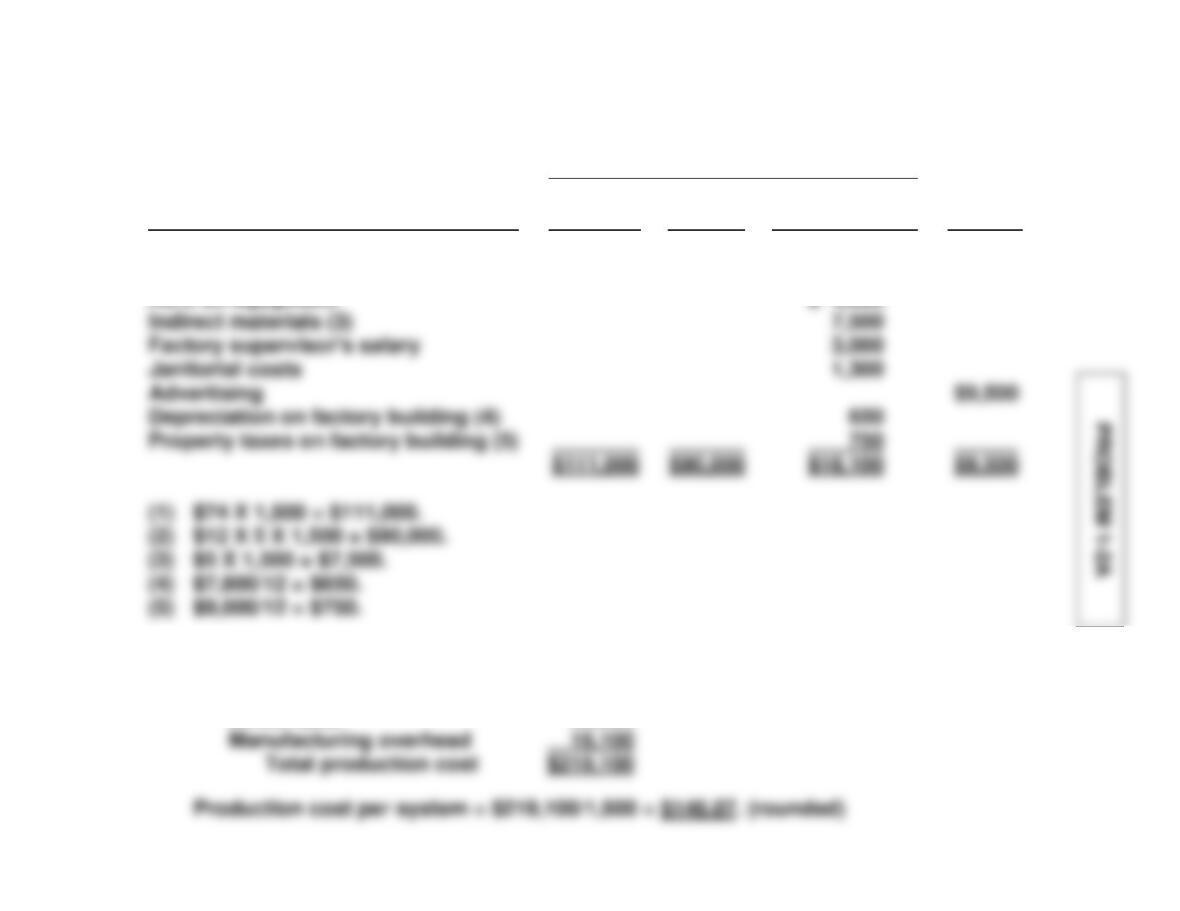
(a)
Product Costs
Cost Item
Direct
Materials
Direct
Labor
Manufacturing
Overhead
Period
Costs
Raw materials (1)
Wages for workers (2)
Rent on equipment
$111,000
$90,000
$ 4,900
(b) Total production costs
Direct materials $111,000
Direct labor 90,000
PROBLEM 1-3A
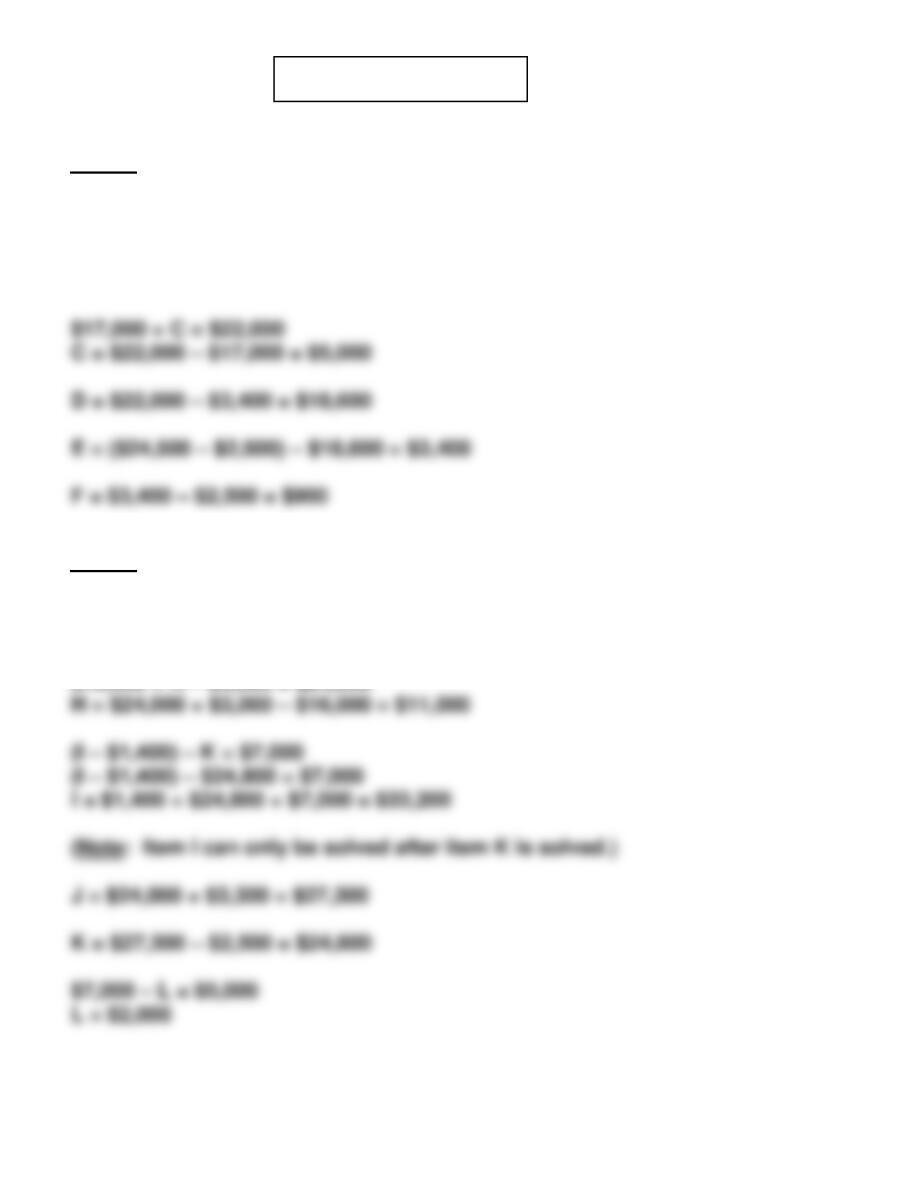
(a) Case 1
A = $9,600 + $5,000 + $8,000 = $22,600
$22,600 + $1,000 – B = $17,000
B = $22,600 + $1,000 – $17,000 = $6,600
Case 2
G + $8,000 + $4,000 = $16,000
G = $16,000 – $8,000 – $4,000 = $4,000
$16,000 + H – $3,000 = $24,000
PROBLEM 1-3A (Continued)
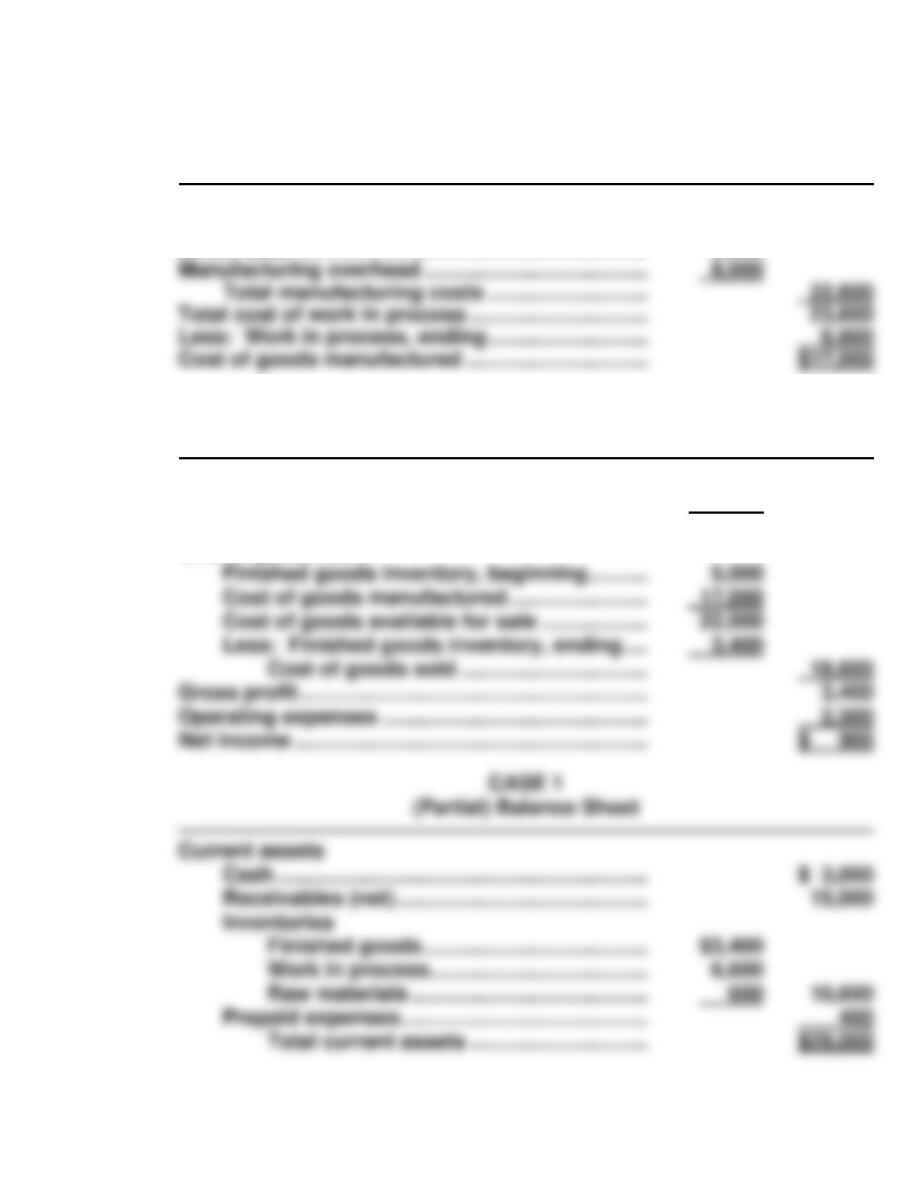
(b) CASE 1
Cost of Goods Manufactured Schedule
Work in process, beginning …………………………... $ 1,000
Direct materials …………………………………………….. $9,600
Direct labor …………………………………………………… 5,000
(c) CASE 1
Income Statement
Sales revenue ………………………………………………. $24,500
Less: Sales discounts ………………………………….. 2,500
Net sales ………………………………………………………. $22,000
Cost of goods sold
PROBLEM 1-4A
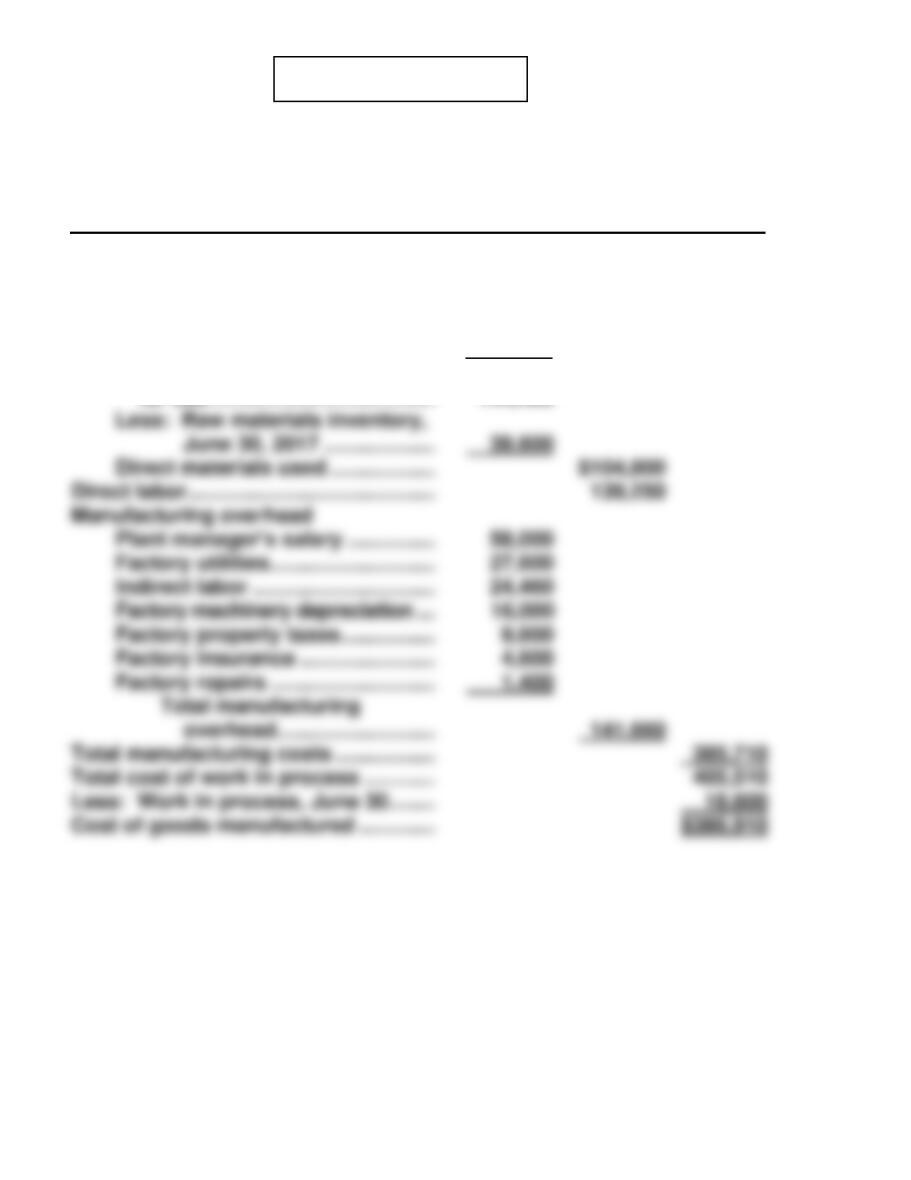
(a) CLARKSON COMPANY
Cost of Goods Manufactured Schedule
For the Year Ended June 30, 2017
Work in process, July 1, 2016 ………… $ 19,800
Direct materials
Raw materials inventory,
July 1, 2016 ………………………… $ 48,000
Raw materials purchases ……….. 96,400
Total raw materials available
for use ……………………………….. 144,400
PROBLEM 1-4A (Continued)
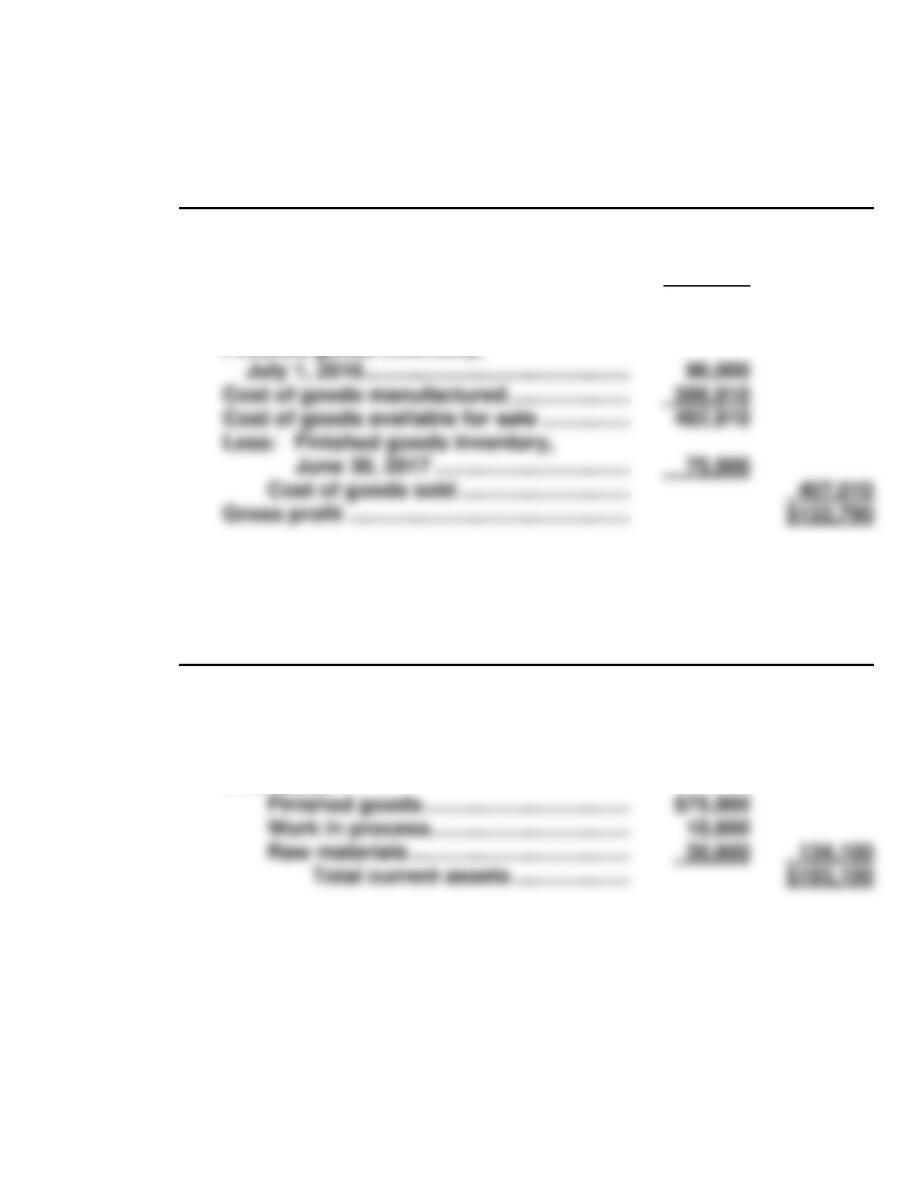
(b) CLARKSON COMPANY
(Partial) Income Statement
For the Year Ended June 30, 2017
Sales revenues
Sales revenue ……………………………………… $534,000
Less: Sales discounts…………………………. 4,200
Net sales …………………………………………….. $529,800
Cost of goods sold
Finished goods inventory,
(c) CLARKSON COMPANY
(Partial) Balance Sheet
June 30, 2017
Assets
Current assets
Cash …………………………………………………… $ 32,000
Accounts receivable ……………………………. 27,000
Inventories
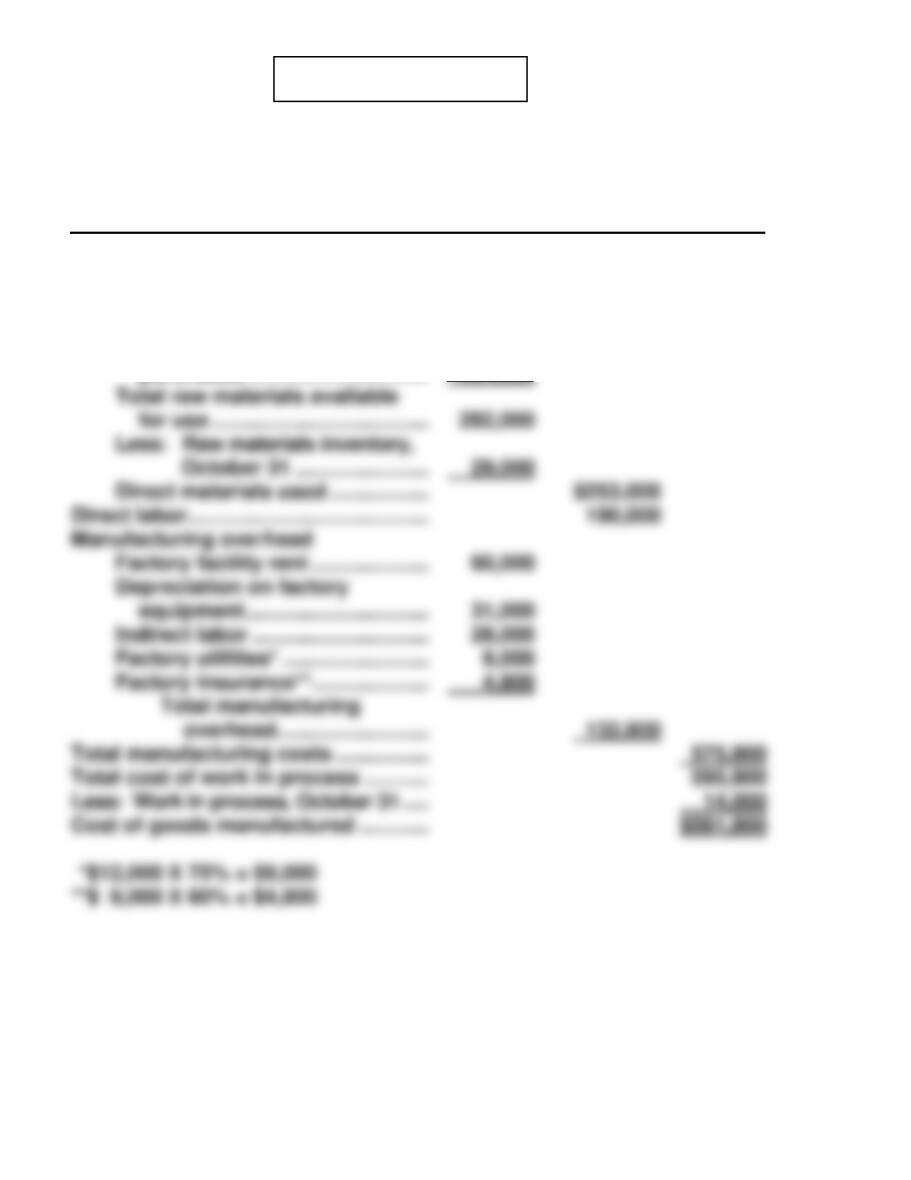
PROBLEM 1-5A
(a) EMPIRE COMPANY
Cost of Goods Manufactured Schedule
For the Month Ended October 31, 2017
Work in process, October 1 ………….. $ 20,000
Direct materials
Raw materials inventory,
October 1 ………………………….. $ 18,000
Raw materials
purchases …………………………. 264,000
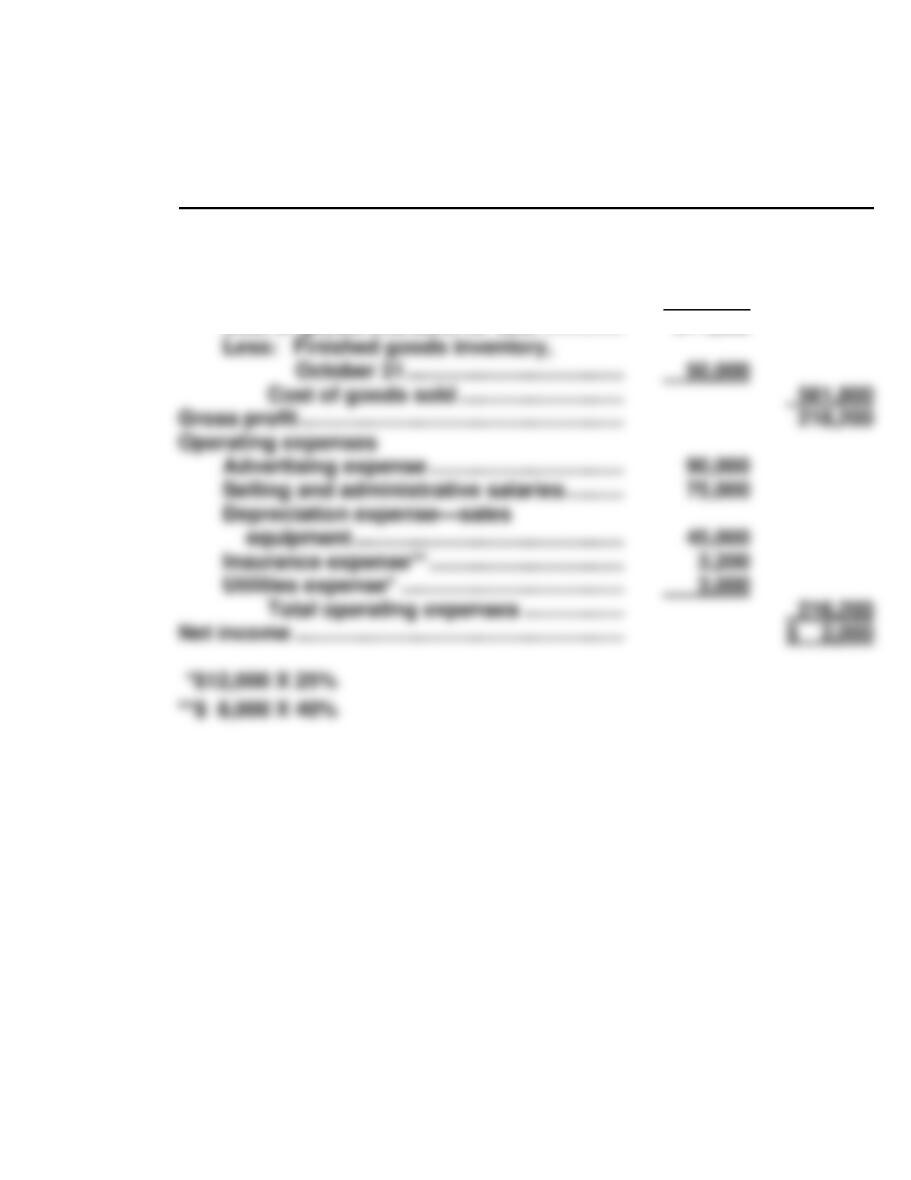
PROBLEM 1-5A (Continued)
(b) EMPIRE COMPANY
Income Statement
For the Month Ended October 31, 2017
Sales revenue …………………………………………… $780,000
Cost of goods sold
Finished goods inventory, October 1 …… $ 30,000
Cost of goods manufactured……………….. 581,800
Cost of goods available for sale ………….. 611,800
CURRENT DESIGNS
CD1
The answers to parts (a) and (b) may vary from student to student.
(a) What are the primary information needs of each manager?
Mike Cichanowski, CEO, needs to know the overall financial picture of
the company. He also needs to have a general picture of sales by
territory and product line, and of cost per unit by product line.
CD1 (Continued)
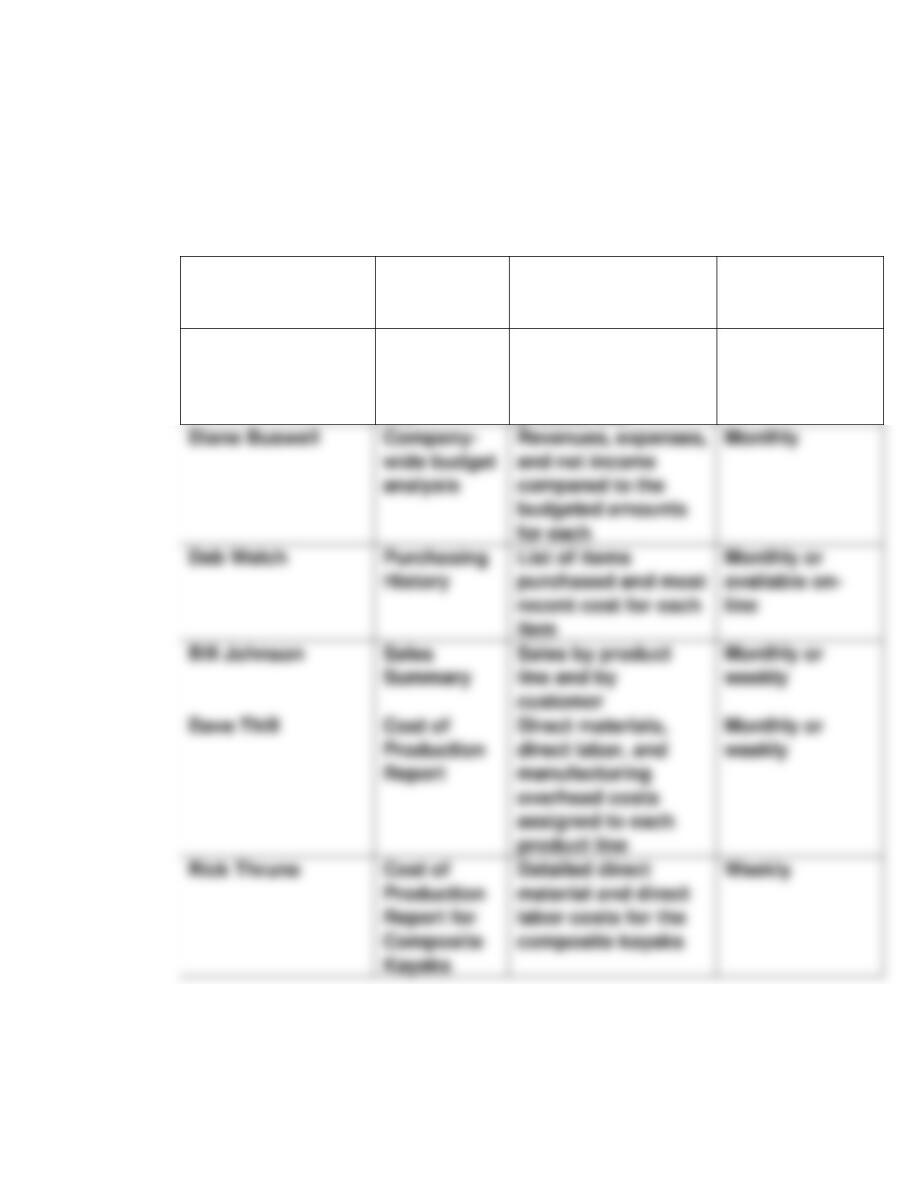
(b) Name one special-purpose management accounting report that could
be designed for each manager. Include the name of the report, the
information it would contain, and how frequently it should be issued.
Manager
Name of
report
Information report
would contain
How frequently
should it be
issued?
Mike Cichanowski
Analysis of
proposed
new product
line
Projected revenues
and expenses for a
possible new
product line
As needed and
requested
analysis
item
Bill Johnson
Sales by product
line and by
Monthly or
overhead costs
assigned to each
Report for
Composite
labor costs for the
composite kayaks
CD1 (Continued)
(c) When Diane Buswell, controller for Current Designs, reviewed the
accounting records for a recent period, she noted the following items.
Classify each item as a product cost or a period cost. If a cost is a
product cost, note if it is a direct materials, direct labor, or manufactur–
ing overhead item.
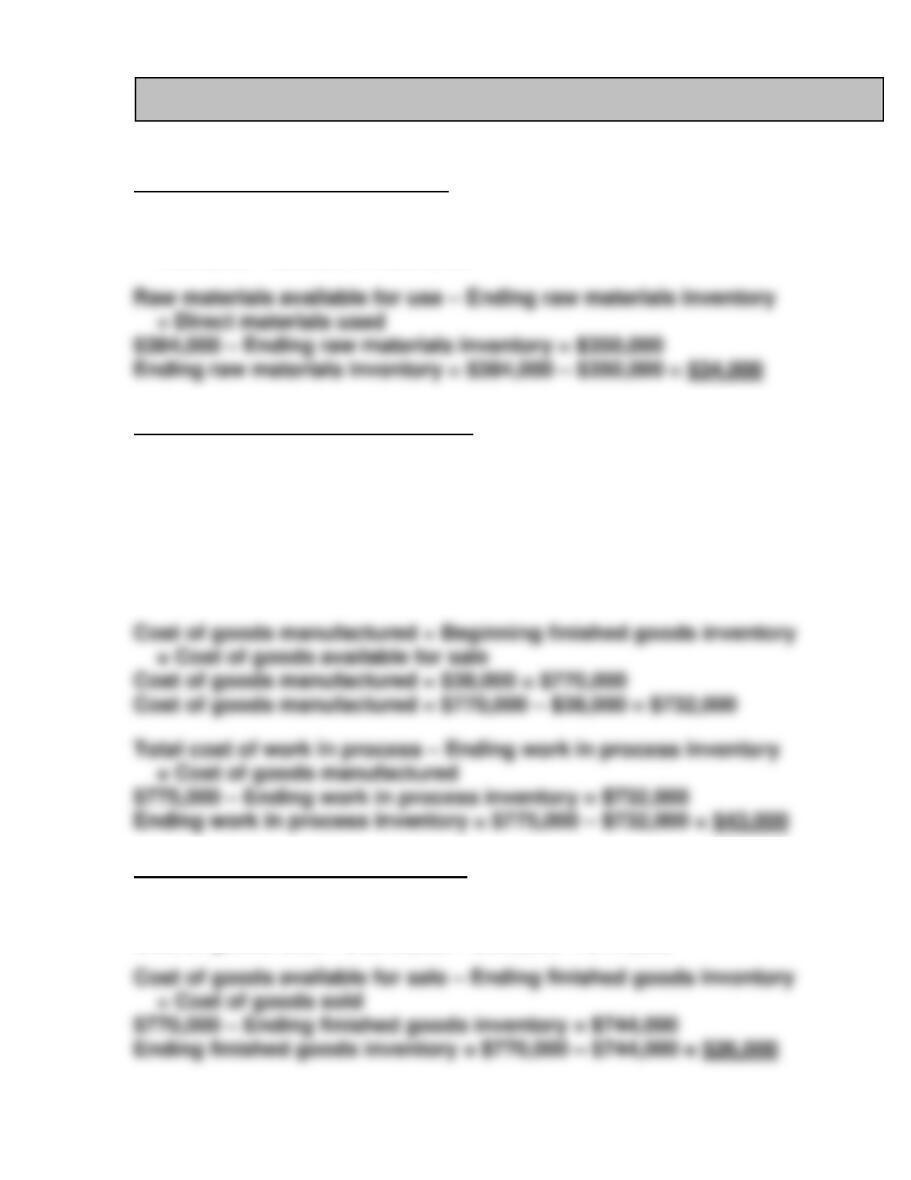
Payee
Purpose
Product Costs
Period
Costs
Direct
Materials
Direct
Labor
Manufacturing
Overhead
Winona Agency
Property insurance for
the manufacturing plant
X
Bill Johnson
(sales manager)
Payroll–payment to
sales manager
X
Xcel Energy
Electricity for
X
Winona Printing
Price lists for salespeople
X
Jim Kaiser (sales
Sales commissions
X
Dave Thill (plant
plant manager
X
kayaks are assembled. It
is discarded after use.
X
rotational molded kayaks
Winona County
Property taxes on
manufacturing plant
North American
composite kayaks
Waste Management
Trash disposal for the
X
manufacturing equipment
BYP 1-1 DECISION-MAKING ACROSS THE ORGANIZATION
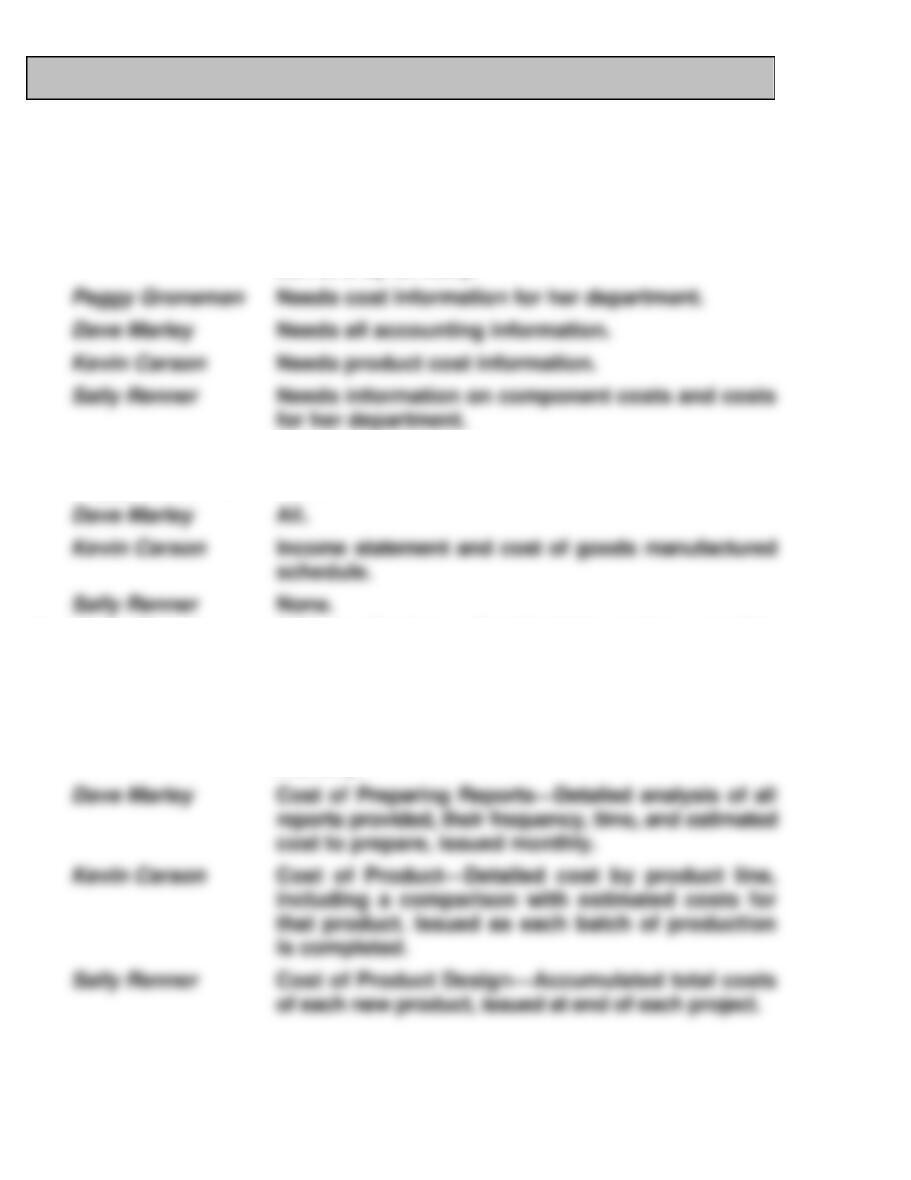
Ending Raw Materials Inventory
Beginning raw materials + Raw materials purchased
= Raw materials available for use
= $19,000 + $365,000 = $384,000
Ending Work in Process Inventory
Direct materials + Direct labor + Manufacturing overhead
= Total manufacturing costs
= $350,000 + $250,000 + ($250,000 X 60%) = $750,000
Beginning work in process inventory + Total manufacturing costs
= Total cost of work in process
= $25,000 + $750,000 = $775,000
Ending Finished Goods Inventory
Sales – Cost of goods sold = Gross profit
$1,240,000 – Cost of goods sold = $1,240,000 X 40%
Cost of goods sold = $1,240,000 – $496,000 = $744,000
BYP 1-2 MANAGERIAL ANALYSIS
Since the questions were fairly open-ended, the following are only sug-
gested results. The class may be able to think of others, or of more items
for each one.
(a) Jason Dennis Needs information on sales, perhaps by salesper–
son and by territory.
(b) Jason Dennis Income statement.
Peggy Groneman None.
(c) Jason Dennis Sales by Territory—Detailed information, possibly
by product line, issued daily or weekly.
Peggy Groneman Cost of Computer Programs—Accumulated cost
incurred for each major program used including
maintenance and updates of program, issued
monthly.
BYP 1-3 REAL-WORLD FOCUS
(a) The IMA has more than 60,000 members. These members include
business leaders, managers, and decision makers in accounting and
finance.
(b) Student and Associate members receive most of the benefits of Regular
membership at a significant savings.
• Unique access to the professional designation, the Certified Manage-
ment Accountant (CMA)
BYP 1-4 COMMUNICATION ACTIVITY
Ms. Shelly Phillips
President
Phillips Company
Dear Shelly:
As you requested, I corrected the income statement for October from the
information you gave me. The corrected statement is enclosed and it shows
that you actually earned net income of $2,000 for October. I also noticed
that you did not have a cost of goods manufactured schedule, so I prepared
one for you.

BYP 1-4 (Continued)
I have also modified the form of the income statement to recognize the dis-
tinction between product costs (cost of goods sold) and period costs (operating
expenses) as required by generally accepted accounting principles.
BYP 1-5 ETHICS CASE
(a) The stakeholders in this situation are:
• The users of Newton Industries’ financial statements.
(b) The ethical issues in this situation pertain to the adherence to sound
and acceptable accounting principles. Intentional violation of generally
(c) Ethically, the management of Newton Industries should be trying to report
the financial condition and results of operations as fairly as possible;
that is, in accordance with GAAP. Steve should inform management
BYP 1-6 ALL ABOUT YOU
Student responses will vary. We have provided some basic examples that
may represent common responses.
(a) Individuals must often make purchase decisions which involve choosing
between an item that has a more expensive initial purchase price, but
is expected to either last longer, or provides some form of cost savings.
(b) In order to increase control over their financial situation and reduce
the probability of financial hardship, all people should prepare personal
(c) Companies employ the balanced scorecard as a mechanism to ensure
that their financial goals are consistent with their efforts. Use of the
balanced scorecard requires clear articulation of goals, priorities, and
(d) Capital budgeting involves financial evaluation of long-term assets. Compa–
nies routinely make capital budgeting decisions, but so do individuals.
The purchase of a home or car is a decision that has implications for your
BYP 1-7 CONSIDERING YOUR COSTS AND BENEFITS
Discussion guide: This is a difficult decision. While the direct costs of
outsourced tax return preparation may in fact be lower, you must also
consider other issues: Will the accuracy of the returns be as high? Will your
relationships with your customers suffer due to the loss of direct contact?