CASE 1.3
JUST FOR FEET, INC.
Synopsis
Harold Ruttenberg emigrated to the United States from South Africa in 1976. In his early thirties
at the time and the father of three small children, Ruttenberg wanted to escape the political and
economic troubles brewing in South Africa. Over the previous decade, Ruttenberg had created a
successful retail business in his home country. However, South Africa’s emigration laws allowed
the young businessmen to take only $30,000 of his considerable net worth with him to the U.S. Not
to be deterred, the industrious Ruttenberg quickly resurrected his business career in his new
homeland.
Just for Feet shocked Wall Street in mid-1999 by announcing that it would post its first-ever
quarterly loss and that it might default on the interest payment that was coming due on its
outstanding bonds. The potential default was particularly stunning since the company had just sold
the bonds two months earlier. When Harold Ruttenberg resigned as the company’s CEO in July
1999, Just for Feet’s board hired a corporate turnaround specialist. Unfortunately, there was no
turnaround in the company’s future. In November 1999, the company filed for bankruptcy and was
eventually liquidated.
16
Case 1.3 Just for Feet, Inc. 17
Just For Feet, Inc.—Key Facts
1. In 1976, Harold Ruttenberg, a successful entrepreneur in South Africa, chose to emigrate to the
U.S. because of the economic and political turmoil in his home country.
2. Ruttenberg, who was forced to leave nearly all of his net worth in South Africa, quickly created a
thriving retail business in Birmingham, Alabama.
4. From 1988 through 1998, Just for Feet’s revenues and profits grew dramatically; by 1998, the
5. In mid-1999, Just for Feet shocked the investing public by announcing that it would report its
6. Just for Feet’s financial condition continued to deteriorate, causing the firm to file for bankruptcy
in November 1999.
7. A series of investigations by state and federal authorities revealed that Just for Feet’s impressive
operating results during the 1990s had been the product of a large-scale accounting fraud.
8. The three principal elements of the accounting fraud were improper accounting for vendor
9. An SEC investigation revealed numerous deficiencies in Deloitte & Touche’s audits of Just for
Feet during the late 1990s.
10. The principal criticisms of Deloitte’s audits included the improper application of confirmation
12. At the same time that the SEC announced the sanctions imposed on Deloitte for its Just for Feet
audits, the federal agency revealed that it was fining the accounting firm $50 million for its
flawed audits of the scandal-ridden telecommunications company, Adelphia Communications.
18 Case 1.3 Just for Feet, Inc.
Instructional Objectives
1. To demonstrate the need for auditors to employ analytical procedures during the planning phase
of an audit to identify high-risk accounts.
3. To understand the nature and purpose of audit confirmations.
Suggestions for Use
This case can be integrated with the coverage of several different topics in an undergraduate or
graduate auditing course. Exhibits in this case present Just for Feet’s financial statements for the
final three years that it was fully operational, namely, fiscal 1996 through fiscal 1998. Instructors
can use those financial statements as the basis for a major analytical procedures assignment—see the
first case question. The second and third case questions provide an opportunity for instructors to
introduce the audit risk model and/or to provide a real-world application of that model. Finally,
Case 1.3 Just for Feet, Inc. 19
Suggested Solutions to Case Questions
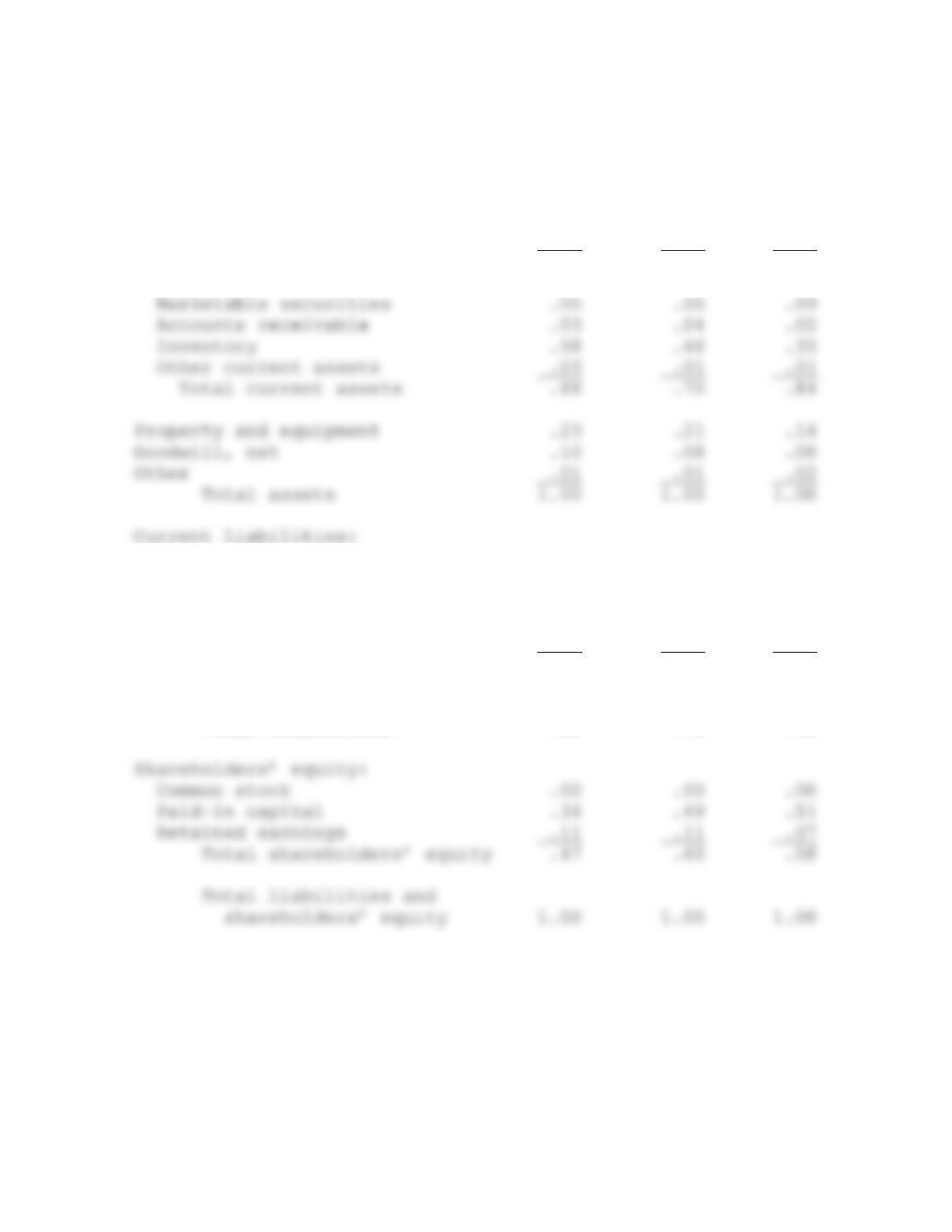
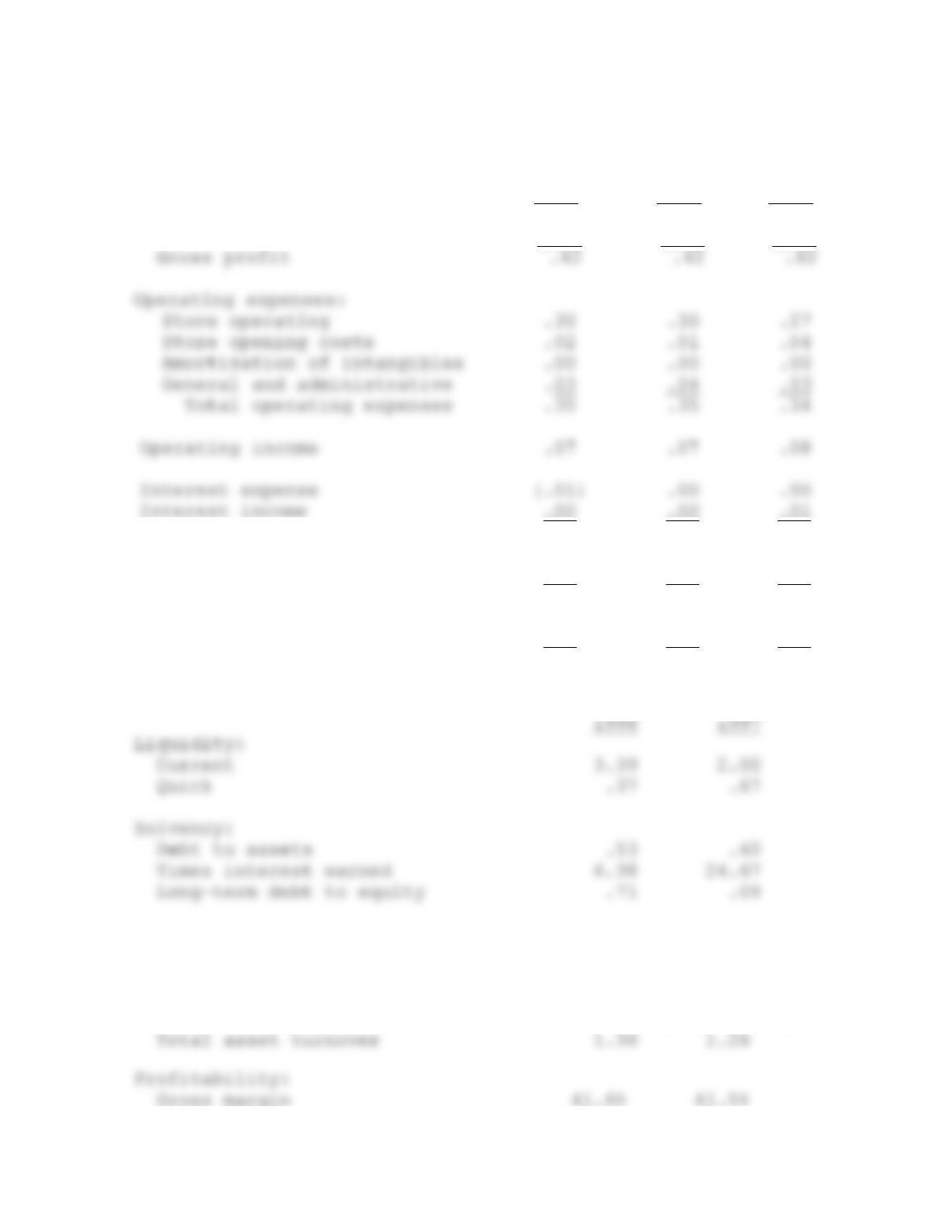
1. Common-sized balance sheets for Just for Feet’s 1996-1998 fiscal years: [Note: each fiscal year
ended on January 31 of the following year. For example, fiscal 1998 ended on January 31, 1999.]
1998 1997 1996
Current assets:
Cash .02 .19 .37
Short–term borrowings .00 .20 .27
Accounts payable .14 .12 .10
Accrued expenses .04 .02 .01
Income taxes payable .00 .00 .00
Current maturities of LT debt .01 .01 .01
Total current liabilities .19 .35 .39
Long–term debt and obligations .34 .05 .03
Total liabilities .53 .40 .42
20 Case 1.3 Just for Feet, Inc.
Common-sized income statements for Just for Feet:
1998 1997 1996
Net sales 1.00 1.00 1.00
Cost of sales .58 .58 .58
Earnings before income taxes
and cumulative effect .06 .07 .09
Provision for income taxes .02 .03 .03
Earnings before cumulative effect .04 .04 .06
Cumulative effect — — (.01)
Net earnings .04 .04 .05
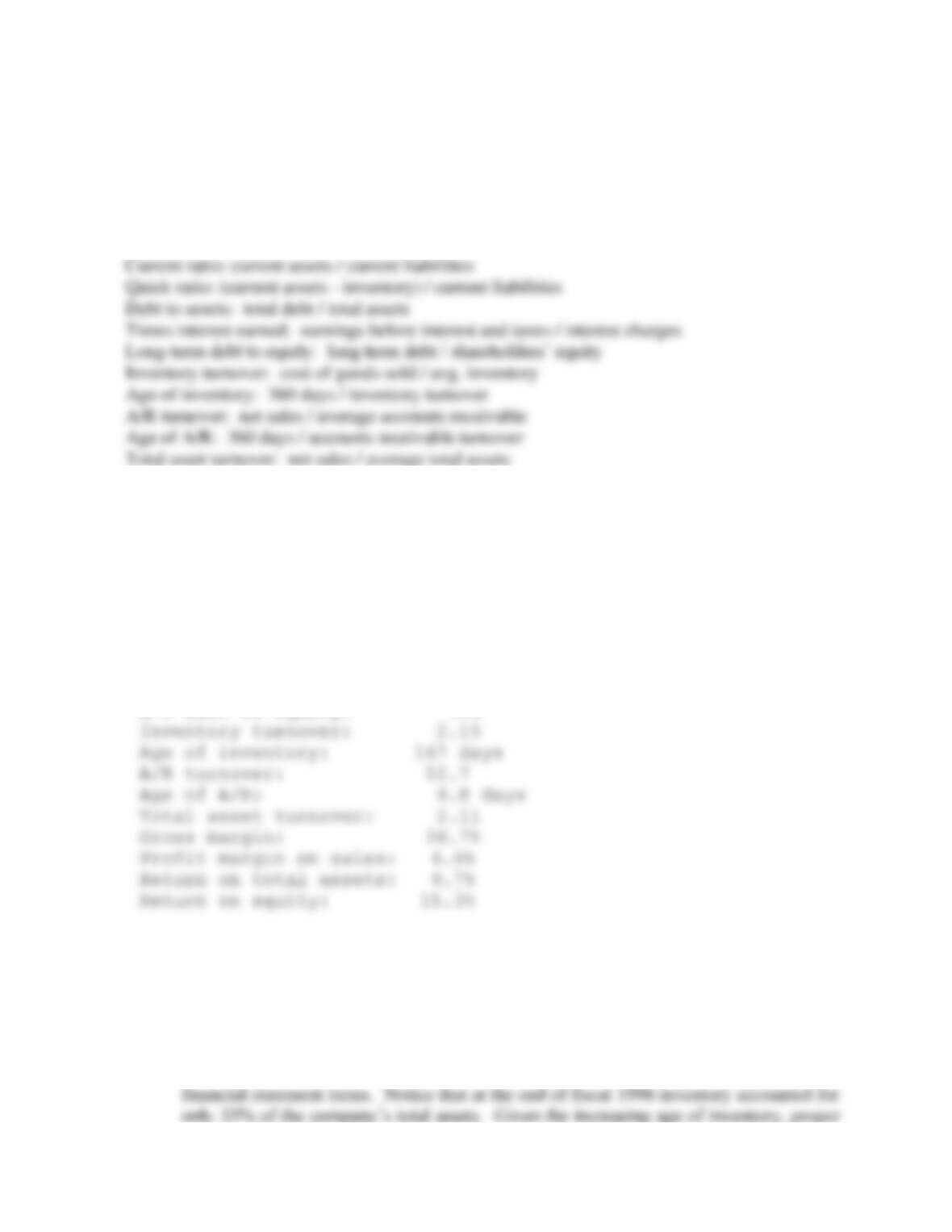
Financial Ratios for Just for Feet:
Activity:
Inventory turnover 1.49 1.65
Age of inventory 242 days 218 days
Accounts receivable turnover 44.6 42.75
Age of accounts receivable 8.1 days 8.4 days
Case 1.3 Just for Feet, Inc. 21
Profit margin on sales 3.4% 4.5%
Return on total assets 6.1% 5.5%
Return on equity 9.0% 8.8%
Equations:
Gross margin: total gross margin / net sales
Profit margin on sales: net income / net sales
Return on total assets: (net income + interest expense) / avg. total assets
Return on equity: net income / avg. shareholders’ equity
Selected industry norms as of 1998 (these norms were taken from a Dun & Bradstreet publication;
each industry norm is a mean for the given ratio):
Current ratio: 3.0
Quick ratio: .75
Debt to assets: .37
L-T debt to equity: .14
Following, in bullet form, are the key financial statement items and other issues that are “brought
to the surface” by the common-size financial statements, financial ratios, and other available
information regarding Just for Feet as of the end of fiscal 1998.
1. Clearly, inventory had to be a major focus of the fiscal 1998 audit. At January 31, 1999,
inventory was easily Just for Feet’s largest asset, accounting for almost 60% of the
company’s total assets. In addition, inventory was growing at a rapid pace relative to other
22 Case 1.3 Just for Feet, Inc.
2. Cash is a financial statement item that is not particularly challenging to audit; however,
auditors must closely monitor a client’s cash and near–cash assets to assess the entity’s
liquidity. A client that has limited cash resources may pose a going-concern issue for its
auditors. Notice the dramatic decline in Just for Feet’s cash resources, both on an absolute
3. Related to the previous item was the sharp increase in Just for Feet’s long-term debt during
1998. Notice that the company’s long-term debt to equity ratio spiked from .09 at the end of
fiscal 1997 to .71 at the end of fiscal 1998. Although the company’s interest coverage ratio
4. Just for Feet’s financial data suggest that accounts payable may have merited more attention
than normal at the end of fiscal 1998. As a general rule, the growth rates of inventory and
5. A final issue that is raised by an analysis of Just for Feet’s 1996-1998 financial data is the
seemingly improbable consistency of certain of the company’s key financial ratios. In
particular, notice how stable the company’s gross margin (profit) percentage was over that
period. Likewise, the company’s operating margin percentage (operating income / net sales)
was effectively unchanged over that period. Executives in the retail industry are aware that
analysts pay particular attention to certain financial statistics. Among these latter items are
Case 1.3 Just for Feet, Inc. 23
2. (The second part of this question will be addressed first.) The audit risk model suggests that
there is a direct relationship between control risk and audit risk. That is, as the level of control risk
posed by a client increases, ceteris paribus, there is a greater chance that an auditor will issue a
“clean” opinion when some other type of audit report is appropriate in the circumstances. Thus, as
3. This is a “sister” question to Question #2. Again, there is a direct correlation between inherent
risk and overall audit risk. As assessed inherent risk increases, ceteris paribus, overall audit risk
increases as well. To mitigate an increased level of inherent risk, auditors will typically increase the
rigor of their audit NET (nature, extent, and timing of their audit tests), thereby reducing detection
risk.
Listed next are examples of specific inherent risk factors that are common to companies
operating in a highly competitive industry.
4. As a point of information, the phrase “audit risk factor” is apparently never explicitly defined in
the professional standards. A related phrase, “fraud risk factors” is defined in AU-C 240.A28 of the
AICPA Professional Standards: “. . . the auditor may identify events or conditions that indicate an
24 Case 1.3 Just for Feet, Inc.
incentive or pressure to commit fraud or provide opportunity to commit fraud (fraud risk factors),
such as . . .” In this context, the phrase “audit risk factor” is intended to be more inconclusive. For
—the high-risk business strategies applied by management
—the “significant” emphasis that management placed on achieving earnings goals
—management’s aggressive application of accounting standards
—management’s “excessive” interest in maintaining the company’s stock price at a high level
—“unique and highly complex” transactions engaged in by the company near year-end
—the domineering management style of Harold Ruttenberg
—the large increase in vendor allowance receivables from the end of 1997 to the end of 1998
—the large increase in the company’s inventory from the end of 1997 to the end of 1998
—the over-saturation and thus extremely competitive nature of the athletic shoe segment of the
As suggested previously, you might consider having your students complete Question #4 as a
group exercise. After each group has developed its “top five” list, collect those lists and make each
of them available to the entire class. Next, challenge individual groups to defend obvious “outliers”
and/or obvious omissions in their individual rankings.
Did the Deloitte auditors identify and respond appropriately to the audit risk factors just listed?
First of all, the Deloitte auditors apparently identified most, if not all, of these factors. Granted, the
information available in the public domain does not explicitly confirm this assertion. For example,
Case 1.3 Just for Feet, Inc. 25
5. There was a wide range of parties who stood to be affected by the decision of Thomas Shine
regarding whether or not to send a false confirmation to Deloitte & Touche. These parties included,
among others, Just for Feet’s stockholders and potential stockholders, Just for Feet’s lenders and
potential lenders, Just for Feet’s independent auditors, Shine’s own company and the stakeholders in
that organization, his family, and, of course, himself.
individuals should force themselves to “look” well into the future and consider how each decision
alternative, if chosen, may eventually affect their careers, their feelings of self-worth, and other
stakeholders.
An effective approach to addressing this question is to ask students to suggest different ways
that Thomas Shine could have responded to the ethical dilemma he faced. Then, you can engage
students in an open discussion or debate regarding the advantages and disadvantages, propriety and
impropriety of each given suggestion. Too often when faced with this type of question, students will
suggest that the given individual should have “stood his or her ground” and simply refused to