Exercise 1-8 (continued)
3.
Direct materials …………………………………….
$ 7.00
Direct labor ………………………………………….
4.00
Variable manufacturing overhead ……………..
1.50
Variable manufacturing cost per unit …………
$12.50
Variable manufacturing cost per unit (a) …….
$12.50
Number of units produced (b) ………………….
22,000
Total variable manufacturing cost (a) × (b) …
$275,000
Total fixed manufacturing cost (see
requirement 1) …………………………………..
100,000
Total product cost …………………………………
$375,000
4.
Sales commissions ………………………………..
$1.00
Variable administrative expense ……………….
0.50
Variable selling and administrative per unit …
$1.50
Variable selling and admin. per unit (a) ……..
Number of units sold (b) …………………………
18,000
Total period cost …………………………………..
Exercise 1-9 (20 minutes)
1.
Direct materials …………………………………
$ 7.00
Direct labor ………………………………………
4.00
Variable manufacturing overhead ………….
1.50
Sales commissions……………………………..
1.00
Variable administrative expense ……………
0.50
Variable cost per unit sold ……………………
$14.00
2.
Direct materials …………………………………
$ 7.00
Direct labor ………………………………………
4.00
Variable manufacturing overhead ………….
1.50
Sales commissions……………………………..
1.00
Variable administrative expense ……………
0.50
Variable cost per unit sold ……………………
$14.00
Variable cost per unit sold (a) ………………
Number of units sold (b) ……………………..
Total variable costs (a) × (b) ………………..
Variable cost per unit sold (a) ………………
Number of units sold (b) ……………………..
Total variable costs (a) × (b) ………………..
Note: The key to answering questions 5 through 8 is to calculate the total
fixed manufacturing overhead costs as follows:
Average fixed manufacturing overhead
cost per unit (a) ………………………………
$5.00
Number of units produced (b) ………………
20,000
Total fixed manufacturing overhead (a) ×
(b) ……………………………………………….
$100,000

Exercise 1-9 (continued)
5. The average fixed manufacturing overhead per unit is:
Total fixed manufacturing overhead (a)…..
$100,000
Number of units produced (b) ………………
18,000
Average fixed manufacturing cost per unit
produced (rounded) (a) ÷ (b) …………….
$5.56
Total fixed manufacturing overhead (a)…..
Number of units produced (b) ………………
22,000
Exercise 1-10 (10 minutes)
1.
Direct materials …………………………………
$ 7.00
Direct labor ………………………………………
4.00
Variable manufacturing overhead ………….
1.50
Total incremental cost …………………………
$12.50
2.
Direct materials …………………………………
$ 7.00
Direct labor ………………………………………
4.00
Variable manufacturing overhead ………….
1.50
Sales commissions……………………………..
1.00
Variable administrative expense ……………
0.50
Variable cost per unit sold ……………………
$14.00
Sales commission ………………………………
Variable cost per unit sold ……………………
Exercise 1-11 (20 minutes)
1. The company’s variable cost per unit is:
$180,000 =$6 per unit.
30,000 units
The completed schedule is as follows:
Units produced and sold
30,000
40,000
50,000
Total costs:
Variable cost ……………
$180,000
$240,000
$300,000
Fixed cost ……………….
300,000
300,000
300,000
Total costs ………………
$480,000
$540,000
$600,000
Cost per unit:
Variable cost ……………
Fixed cost ……………….
Total cost per unit …….
2. The company’s contribution format income statement is:
Sales (45,000 units × $16 per unit) ……………………
$720,000
Variable expenses (45,000 units × $6 per unit) …….
270,000
Contribution margin ……………………………………….
450,000
Fixed expense ……………………………………………….
300,000
Net operating income ……………………………………..
$150,000
Exercise 1-12 (10 minutes)
1. The computations for parts 1a through 1e are as follows:
a. The cost of batteries in Raw Materials:
Beginning raw materials inventory ………….
0
Plus: Battery purchases ……………………….
8,000
Batteries available ………………………………
8,000
Minus: Batteries withdrawn …………………..
7,600
Ending raw materials inventory (a) …………
Cost per battery (b) …………………………...
b. The cost of batteries in Work in Process:
Beginning work in process inventory ………
0
Plus: Batteries withdrawn for production …
7,500
Batteries available ………………………………
7,500
Minus: Batteries transferred to finished
goods (7,500 × 90%) ……………………….
6,750
Ending work in process inventory (a)………
750
Cost per battery (b) …………………………...
$80
Work in process on April 30th (a) × (b) ……
$60,000
Beginning finished goods inventory ………..
0
Plus: Batteries transferred in from work in
Batteries available ………………………………
Minus: Batteries transferred out to cost of
goods sold (6,750 × (100% ‒ 30%)) ……
Ending finished goods inventory (a) ……….
Cost per battery (b) …………………………...
$80
Exercise 1-12 (continued)
d. The cost of batteries in Cost of Goods Sold:
Number of batteries (see requirement c)
(a) ………………………………………………..
4,725
Cost per battery (b) …………………………...
$80
Cost of goods sold for April (a) × (b) ………
$378,000
Number of batteries (a) ……………………….
100
Cost per battery (b) …………………………...
$80
Selling expense for April (a) × (b) ………….
Exercise 1-13 (30 minutes)
1. True. The variable manufacturing cost per unit will remain the same
within the relevant range.
2. False. The total fixed manufacturing cost will remain the same within
the relevant range.
5. False. The total variable manufacturing cost will increase (rather than
decrease) as the activity level increases.
6. False. The variable manufacturing cost per unit will remain the same,
but the average fixed manufacturing cost per unit will decrease as the
level of activity increases.
7. True. The variable manufacturing cost per unit of $28 will stay
constant within the relevant range. The $28 figure is computed as
follows:
Total manufacturing cost per unit (a) ………………
$70.00
Variable manufacturing cost percentage (b) ……..
40%
Variable manufacturing cost per unit (a) × (b) ….
$28.00
Total manufacturing cost per unit (a) ……..
Variable manufacturing cost per unit (b) …
Number of units produced……………………
Total fixed manufacturing cost ………………
Exercise 1-13 (continued)
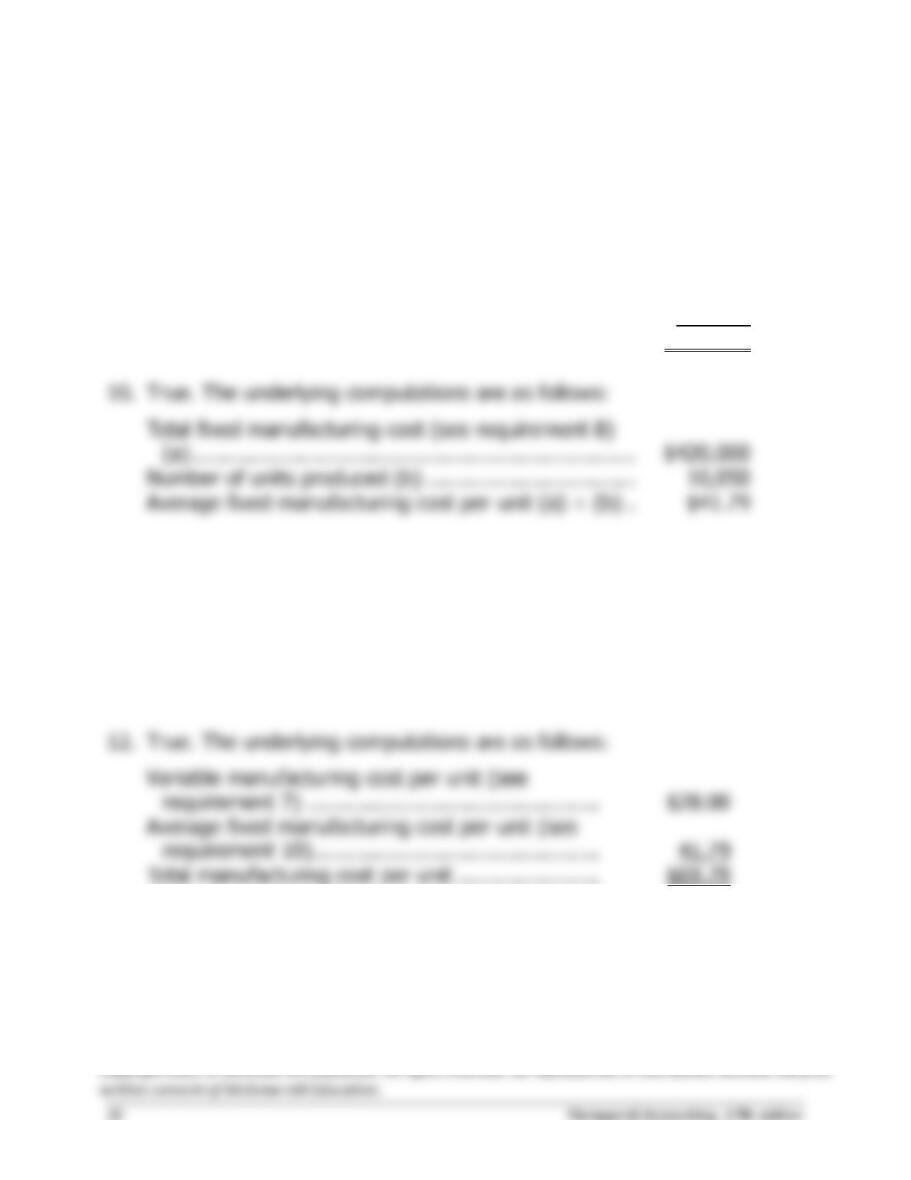
9. True. The underlying computations are as follows:
Variable manufacturing cost per unit (see
requirement 7) (a) …………………………...
$28.00
Number of units produced (b) ……………….
10,050
Total variable manufacturing cost (a) × (b)
$281,400
Total fixed manufacturing cost (see
requirement 8) ………………………………..
420,000
Total manufacturing cost ………………………
$701,400
Total fixed manufacturing cost (see requirement 8)
(a) ……………………………………………………………..
Number of units produced (b) …………………………….
Average fixed manufacturing cost per unit (a) ÷ (b) ..
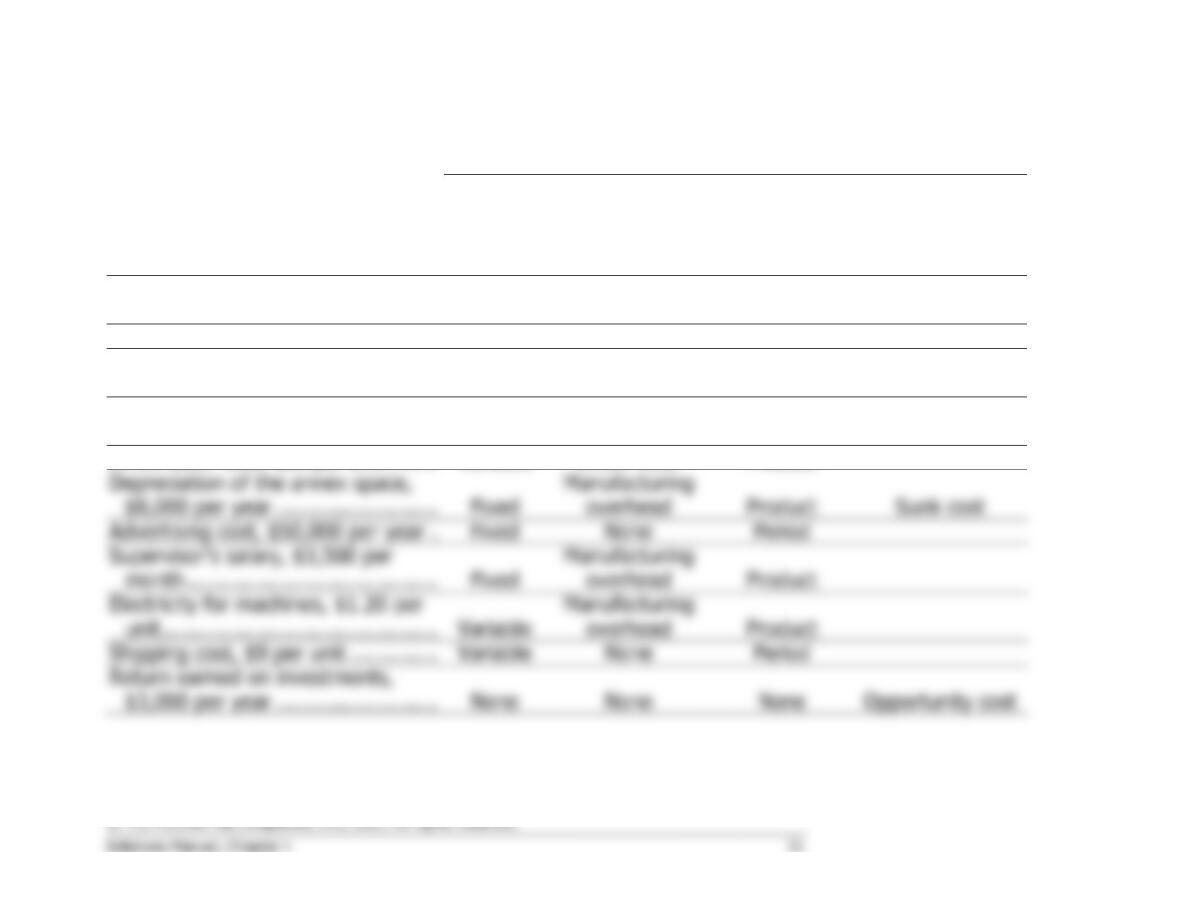
11. False. The total variable manufacturing cost will equal $281,400,
computed as follows:
Variable manufacturing cost per unit (see
requirement 7) (a) ……………………………………
$28.00
Number of units produced (b) ……………………….
10,050
Total variable manufacturing cost (a) × (b) ………
$281,400
Variable manufacturing cost per unit (see
requirement 7) ………………………………………..
$28.00
Average fixed manufacturing cost per unit (see
requirement 10) ……………………………………….
Total manufacturing cost per unit …………………..
Exercise 1-14 (30 minutes)
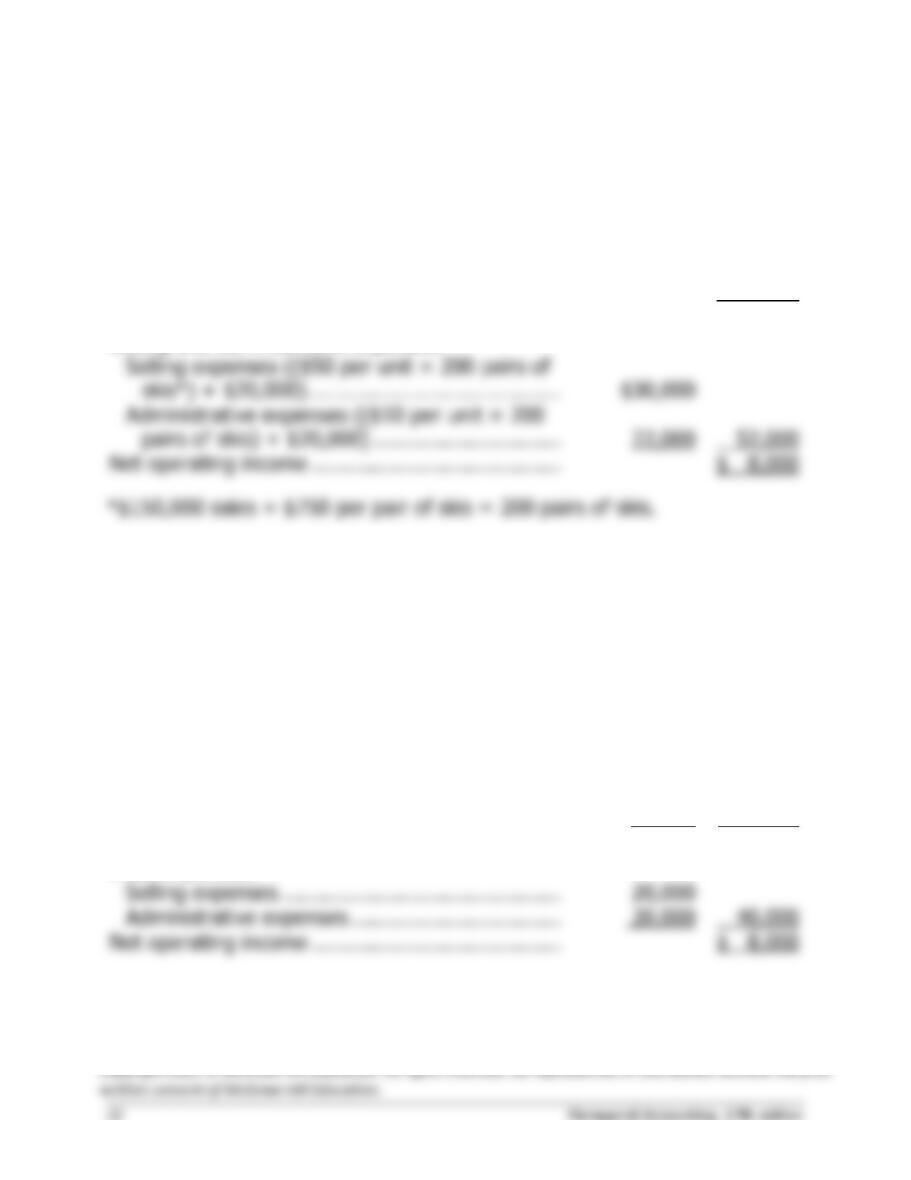
Cost Classifications for:
Name of the Cost
(1)
Predicting
Cost
behavior
(2)
Manufacturers
(3)
Preparing
Financial
Statements
(4)
Decision
Making
Rental revenue forgone, $30,000
per year ……………………………….
None
None
None
Opportunity cost
Direct materials cost, $80 per unit ..
Variable
Direct materials
Product
Rental cost of warehouse, $500
per month …………………………….
Fixed
None
Period
Rental cost of equipment, $4,000
per month …………………………….
Fixed
Manufacturing
overhead
Product
Depreciation of the annex space,
$8,000 per year ……………………..
Fixed
Product
Advertising cost, $50,000 per year .
Fixed
None
Period
Supervisor’s salary, $3,500 per
Manufacturing
Electricity for machines, $1.20 per
Manufacturing
Shipping cost, $9 per unit …………..
Variable
None
Period
Return earned on investments,
$3,000 per year ……………………..
None
None
None
Opportunity cost
Exercise 1-15 (20 minutes)
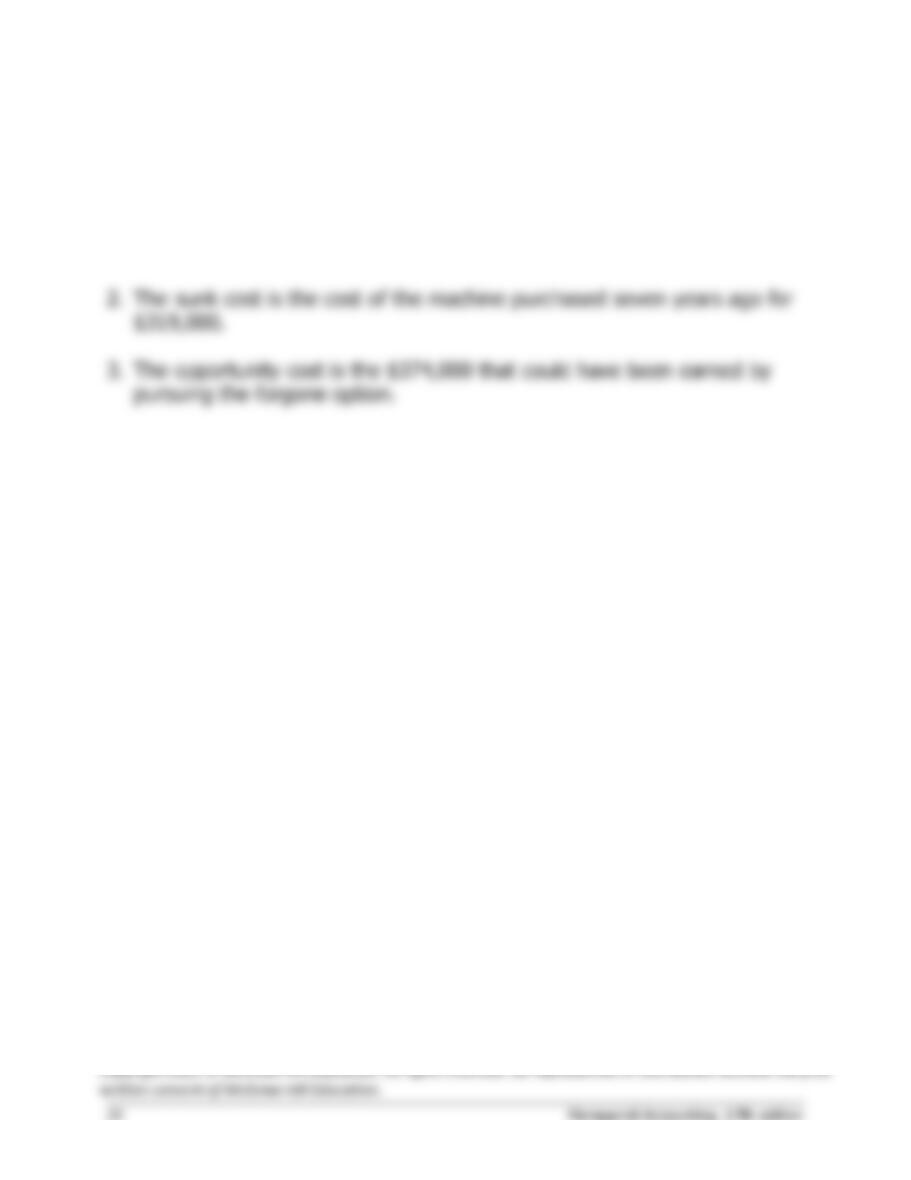
1. Traditional income statement
The Alpine House, Inc.
Traditional Income Statement
Sales ……………………………………………………….
$150,000
Cost of goods sold
($30,000 + $100,000 – $40,000) …………………
90,000
Gross margin …………………………………………….
60,000
Selling and administrative expenses:
Administrative expenses (($10 per unit × 200
52,000
Net operating income ………………………………….
2. Contribution format income statement
The Alpine House, Inc.
Contribution Format Income Statement
Sales ……………………………………………………….
$150,000
Variable expenses:
Cost of goods sold
($30,000 + $100,000 – $40,000) ………………
$90,000
Selling expenses
($50 per unit × 200 pairs of skis) ………………
10,000
Administrative expenses
($10 per unit × 200 pairs of skis) ………………
2,000
102,000
Contribution margin …………………………………….
48,000
Fixed expenses:
Selling expenses ………………………………………
20,000
Administrative expenses …………………………….
Net operating income ………………………………….

Exercise 1-15 (continued)
3. Since 200 pairs of skis were sold and the contribution margin totaled
$48,000 for the quarter, the contribution margin per unit was $240
($48,000 ÷ 200 pair of skis = $240 per pair of skis).
Exercise 1-16 (10 minutes)
1. The differential cost is computed as follows:
Cost of a new model 300 (a) …………………………
$313,000
Cost of a new model 200 (b) …………………………
$275,000
Differential cost (a) ‒ (b) ……………………………..
$38,000
Exercise 1-17 (15 minutes)
Cost Classifications for:
Cost Item
(1)
Predicting Cost
Behavior
(2)
Preparing
Financial
Statements
1.
Hamburger buns at a
Wendy’s restaurant …
Variable
Product
2.
Advertising by a dental
office ……………………
Fixed
Period
3.
Apples processed and
Variable
Product
Variable
Period
Fixed
Product
6.
Insurance on Nucor’s
corporate
headquarters …………
Fixed
Period
7.
Salary of a supervisor
overseeing
production of printers
at Ricoh ………………..
Fixed
Product
8.
Commissions paid to
automobile
salespersons ………….
Variable
Period
Fixed
Product
Problem 1-18 (10 minutes)
1. The direct costs of the Apparel Department are as follows:
Apparel Department cost of sales—Evendale Store
$ 90,000
Apparel Department sales commission—Evendale
Store ……………………………………………………….
7,000
Apparel Department manager’s salary—Evendale
Store ……………………………………………………….
8,000
Total direct costs for the Apparel Department ……..
$105,000
2. The direct costs of the Evendale Store are as follows:
Apparel Department cost of sales—Evendale Store
$ 90,000
Apparel Department sales commission—Evendale
Store utilities—Evendale Store …………………………
Apparel Department manager’s salary—Evendale
Janitorial costs—Evendale Store ………………………
Total direct costs for the Evendale Store ……………
3. The direct costs in the Apparel Department that are also variable with
respect to departmental sales is computed as follows:
Apparel Department cost of sales—Evendale Store
$90,000
Apparel Department sales commission—Evendale
Store ……………………………………………………….
are also variable costs …………………………………
Problem 1-19 (30 minutes)
1. Contribution format income statement
Sales (a) ………………………………………….
Contribution margin (b) ………………………
Total variable costs (a) ………………………..
Cost of goods sold ……………………………..
Variable selling expense ………………………
Variable administrative expense (a) ‒ (b) ..
Todrick Company
Contribution Format Income Statement
Sales ……………………………………………………….
$300,000
Variable expenses:
Cost of goods sold
($20,000 + $200,000 – $7,000) ………………..
$213,000
Selling expense ………………………………………..
15,000
Administrative expense ……………………………..
12,000
240,000
Contribution margin …………………………………….
60,000
Fixed expenses:
Selling expense ………………………………………..
30,000
Administrative expense ……………………………..
12,000
42,000
Net operating income ………………………………….
$ 18,000