FINANCIAL ACCOUNTING – Eleventh Edition Solutions Manual
S 1-1
(5 min.)
1
Solution:
2
How do the assets and owners’ equity of Nike, Inc., differ from each other?
Which one (assets or owners’ equity) must be at least as large as the
other? Which one can be smaller than the other?
Assets are the economic resources of a business that are expected to
How are Nike, Inc.’s, liabilities and owners’ equity similar? Different?
Both liabilities and owners’ equity are claims to assets. Liabilities are the
Chapter 1: The Financial Statements Page 1 of 70

FINANCIAL ACCOUNTING – Eleventh Edition Solutions Manual
S 1-2
(5 min.)
Solution:
a. A
Classify the following items as an Asset (A), a Liability (L), or Stockholders’
Equity (S) for Walmart:
Chapter 1: The Financial Statements Page 2 of 70
FINANCIAL ACCOUNTING – Eleventh Edition Solutions Manual
S 1-3
(5 min.)
Solution:
1. Identify the two basic categories of items on an income
statement.
2. What do we call the bottom line of the income statement?
Chapter 1: The Financial Statements Page 3 of 70
FINANCIAL ACCOUNTING – Eleventh Edition Solutions Manual
S 1-4
(10 min.)
Solution:
a.
Corporation, limited partners of a Limited-liability partnership (LLP) and
a. What forms of organization will enable the owners of Regal Signs, Inc., to limit
their risk of loss to the amounts they have invested in the business?
b. What form of business organization will give Megan Regal the most freedom to
manage the business as she wishes?
c. What form of organization will give creditors the maximum protection in the
event that Regal Signs, Inc., fails and cannot pay its debts?
Chapter 1: The Financial Statements Page 4 of 70
c.
FINANCIAL ACCOUNTING – Eleventh Edition Solutions Manual
S 1-5
(5 min.)
Solution:
1.
1. Which accounting assumption governs this situation?
2. How can the proper application of this accounting assumption
give Olson and others a realistic view of Healthy Fast Foods,
Inc.? Explain in detail.
The entity assumption applies.
Chapter 1: The Financial Statements Page 5 of 70
2.
FINANCIAL ACCOUNTING – Eleventh Edition Solutions Manual
S 1-6
(5 – 10 min.)
Solution:
a.
Identify the accounting concept, assumption, or principle that best applies
to each of the following situations:
Historical cost principle; the sale price is the amount actually
received from the sale
Chapter 1: The Financial Statements Page 6 of 70
c.
d.

FINANCIAL ACCOUNTING – Eleventh Edition Solutions Manual
S 1-7
(5 min.)
=
Identify the missing amount for each situation:
Computed amounts in boxes
Total Assets
Total
Liabilities
Stockholders’
Equity
+
Chapter 1: The Financial Statements Page 7 of 70
FINANCIAL ACCOUNTING – Eleventh Edition Solutions Manual
S 1-8
(5 min.)
Solution:
1.
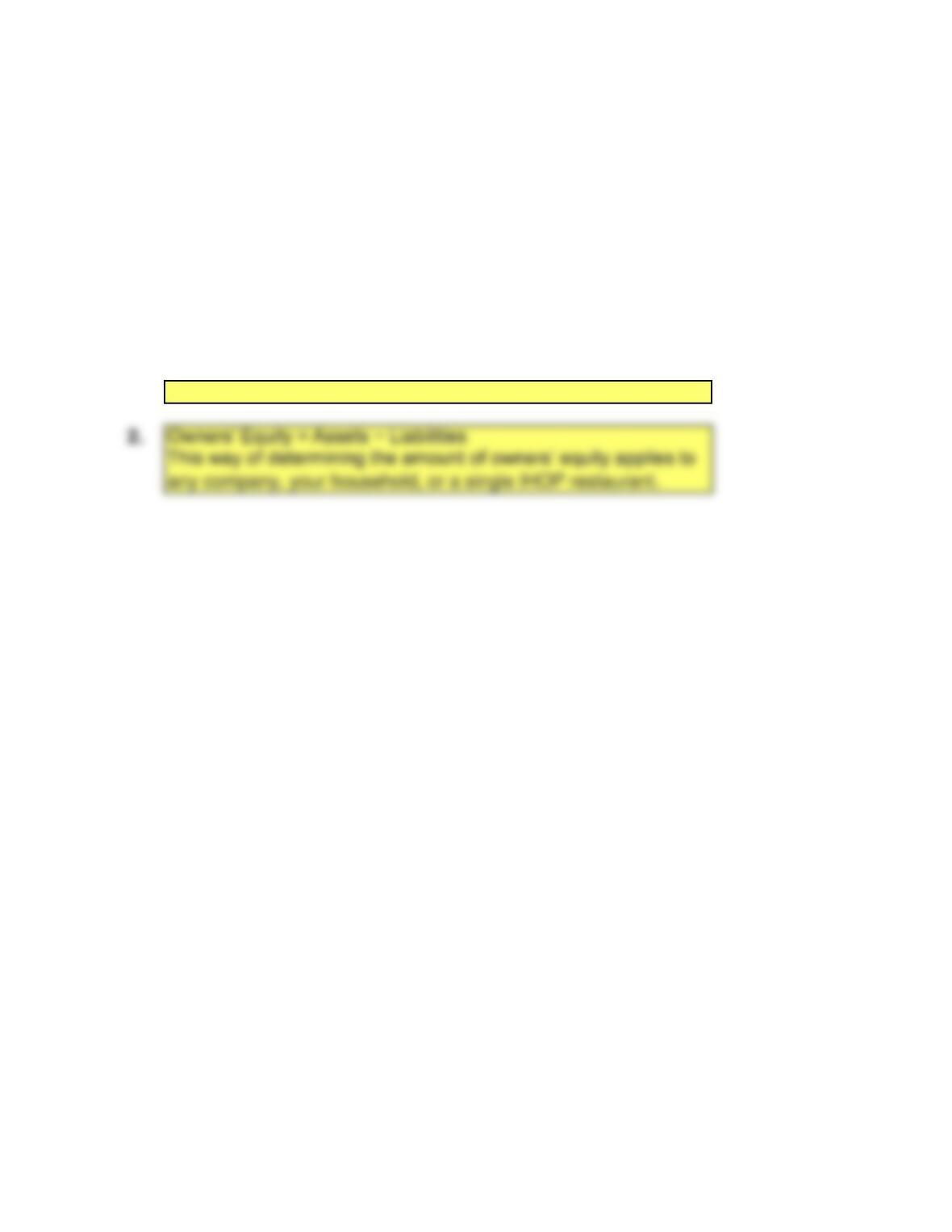
Liabilities = Assets − Owners’ Equity
1. If you know the assets and the owners’ equity of a business,
how can you measure its liabilities? Give the equation.
2. Use the accounting equation to show how to determine the
amount of a company’s owners’ equity. How would your answer
change if you were analyzing your own household or a single
IHOP restaurant?
Chapter 1: The Financial Statements Page 8 of 70
2.

FINANCIAL ACCOUNTING – Eleventh Edition Solutions Manual
S 1-9
(10 min.)
Solution:
a.
b.
Identify each item with its appropriate financial statement, using the following
abbreviations: Income statement (I), Statement of retained earnings (R), Balance
sheet (B), and Statement of cash flows (C).
B
B
Chapter 1: The Financial Statements Page 9 of 70
d.
e.
h.
n.
I
I
B
C
C
C
I
B
FINANCIAL ACCOUNTING – Eleventh Edition Solutions Manual
S 1-10
(15-20 min.)
Solution:
a.
Paying large dividends will cause retained earnings to be low.
a. How can a business earn large profits but have a small balance of retained
earnings?
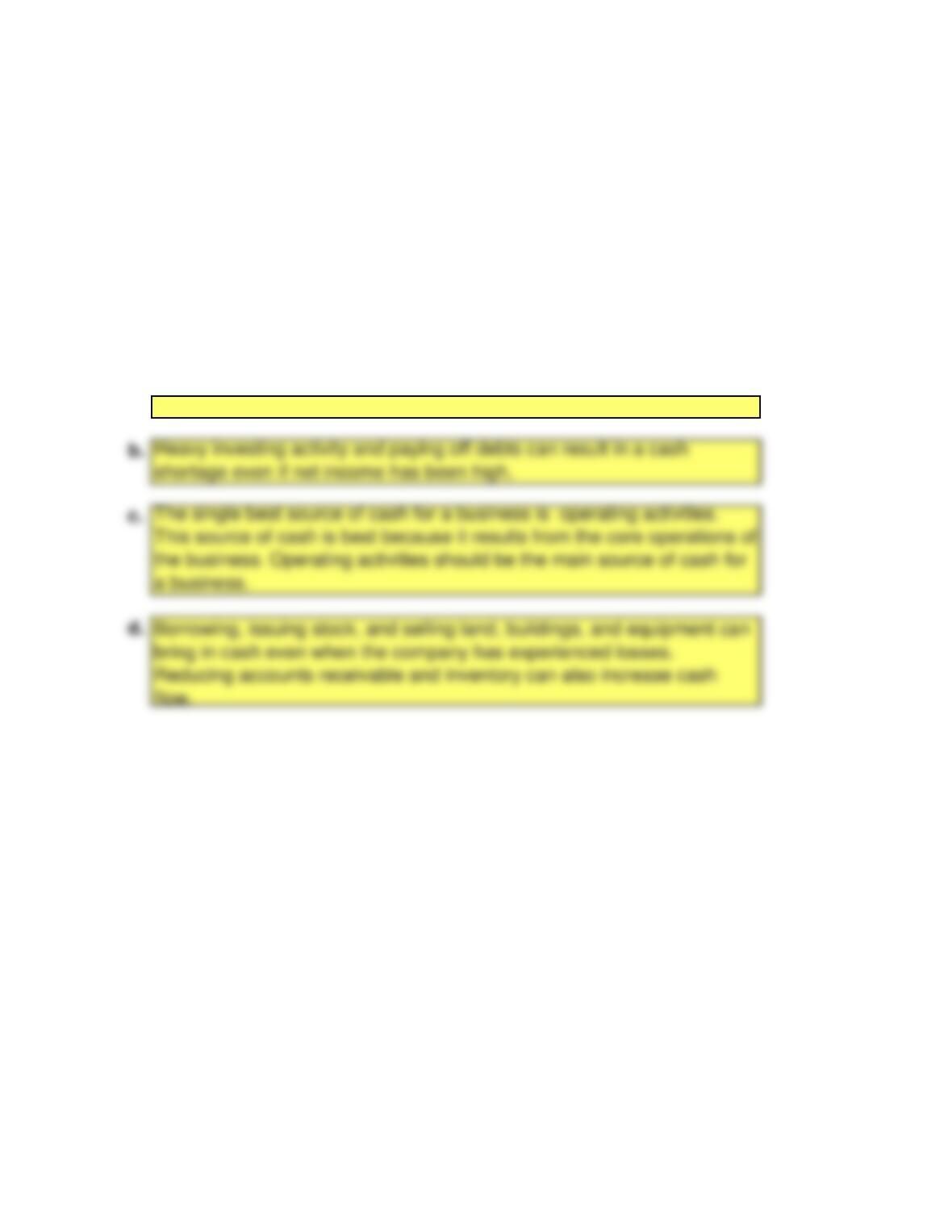
b. Give two reasons why a business can have a steady stream of net income over a
five-year period and still experience a cash shortage.
c. If you could pick a single source of cash for your business, what would it be? Why?
d. How can a business be unprofitable several years in a row and still have plenty of
cash?
Chapter 1: The Financial Statements Page 10 of 70
c.

FINANCIAL ACCOUNTING – Eleventh Edition Solutions Manual
S 1-11
(5 min.)
Solution:
a.
b.
For each of the following questions, indicate which financial statement would most
likely be used to provide the information. Use the following abbreviations: Income
statement (I), Statement of retained earnings (R), Balance sheet (B), and
Statement of cash flows (C).
I
R
Chapter 1: The Financial Statements Page 11 of 70
d.
e.
h.
B
C
I
B
R
B
C

FINANCIAL ACCOUNTING – Eleventh Edition Solutions Manual
S 1-12
(5 min.)
Solution:
(millions)
Revenues 397$
Prepare the company’s income statement for the year ended
December 31, 2016, complete with an appropriate heading.
O’Conner Services, Inc.
Income Statement
Year Ended December 31, 2016
Chapter 1: The Financial Statements Page 12 of 70
FINANCIAL ACCOUNTING – Eleventh Edition Solutions Manual
S 1-13
(5 min.)
Solution:
(millions)
230$
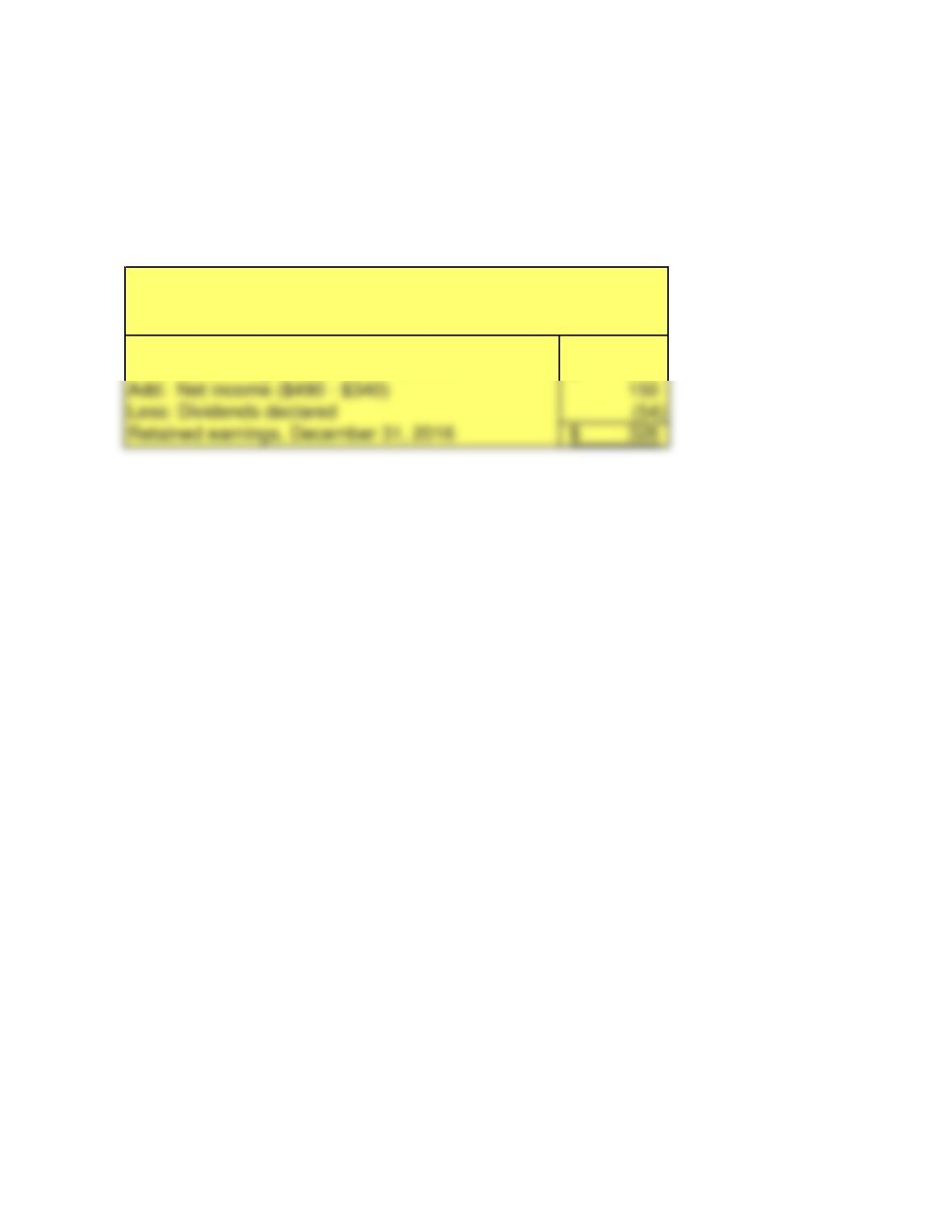
What was the company’s ending balance of retained earnings?
Roam Corp
Statement of Retained Earnings
Year Ended December 31, 2016
Retained earnings, December 31, 2015
Chapter 1: The Financial Statements Page 13 of 70
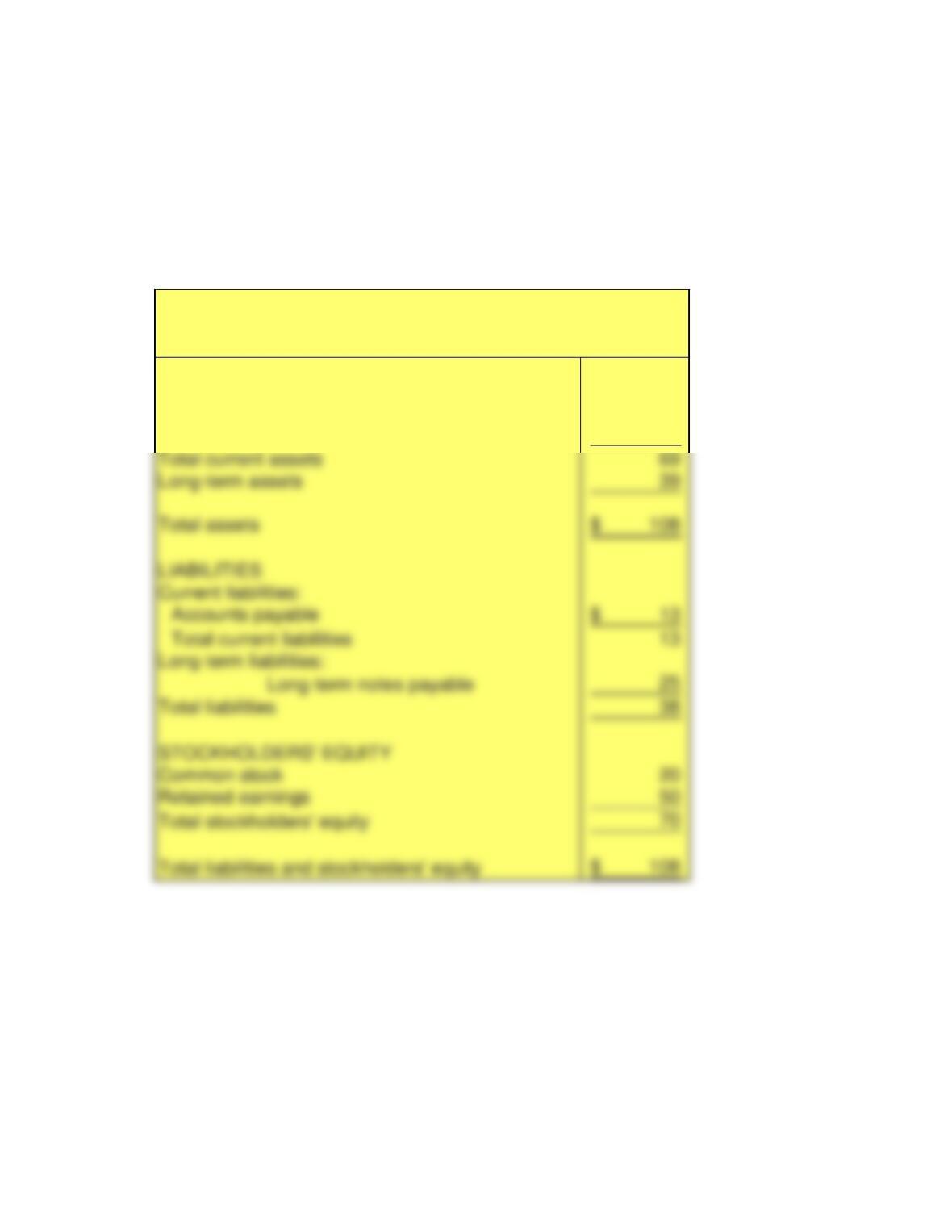
FINANCIAL ACCOUNTING – Eleventh Edition Solutions Manual
S 1-14
(10 – 15 min.)
Solution:
(in millions)
Cash 50$
19
Current assets:
Accounts receivable
December 31, 2016
ASSETS
Prepare Aloha Enterprises’s balance sheet at December 31, 2016, complete
with its proper heading.
Aloha Enterprises
Balance Sheet
Chapter 1: The Financial Statements Page 14 of 70
Long-term liabilities:
Retained earnings
Total stockholders’ equity
Total liabilities and stockholders’ equity
Current liabilities:
Total liabilities
STOCKHOLDERS’ EQUITY
Common stock
Total current assets
Total assets
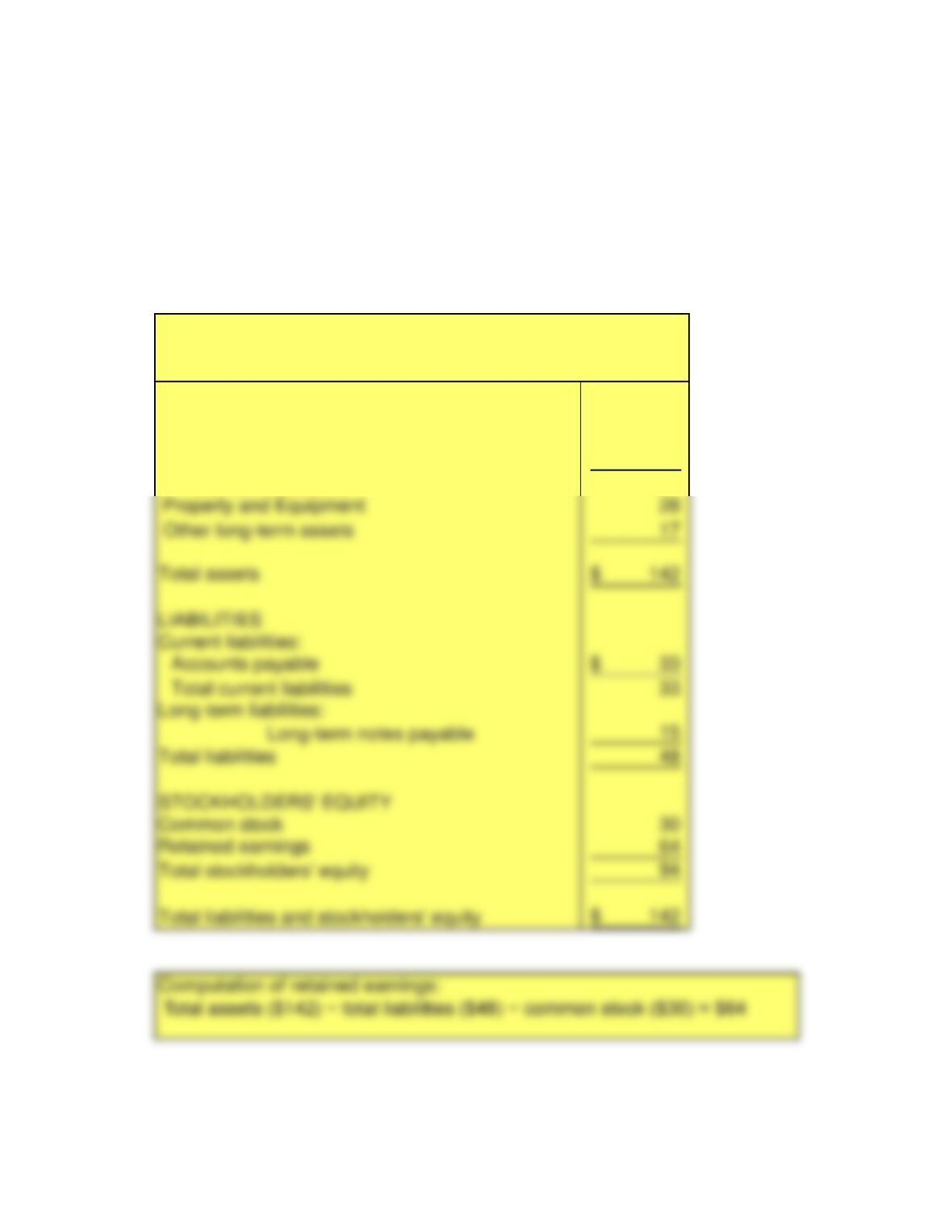
FINANCIAL ACCOUNTING – Eleventh Edition Solutions Manual
S 1-15
(10 – 15 min.)
Solution:
(in millions)
Cash 75$
22
97
Current assets:
Accounts receivable
Total current assets
Harmon Corporation
Balance Sheet
December 31, 2016
ASSETS
Solve for the company’s ending retained earnings and then prepare Harmon
Corporation’s balance sheet at December 31, 2016. Use a proper heading on
the balance.
Chapter 1: The Financial Statements Page 15 of 70
33
Long-term liabilities:
30
Total liabilities
Total assets
STOCKHOLDERS’ EQUITY
Common stock
Retained earnings
Total stockholders’ equity
Total liabilities and stockholders’ equity
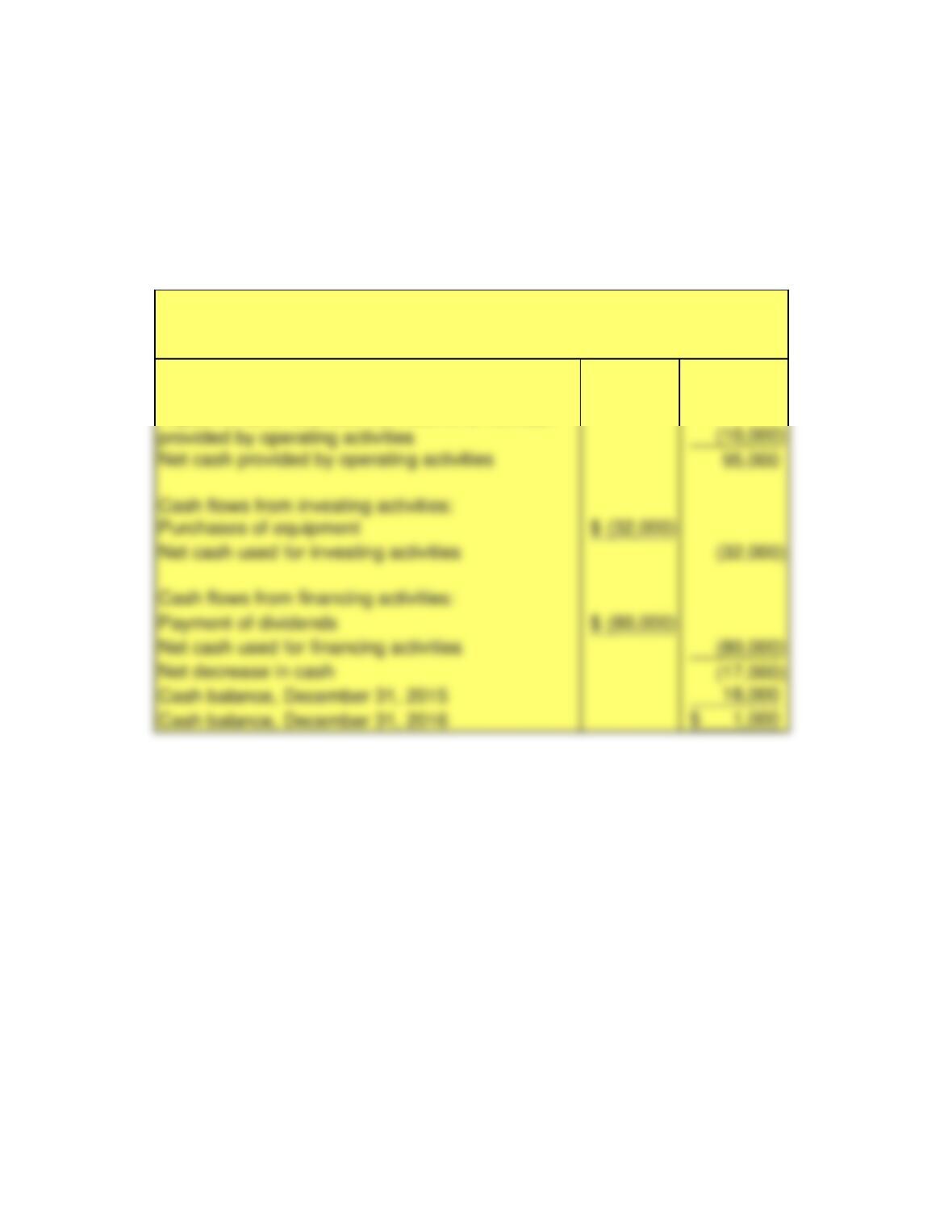
FINANCIAL ACCOUNTING – Eleventh Edition Solutions Manual
S 1-16
(10-15 min.)
Solution:
105,000$
Prepare Avalon’s statement of cash flows for the year ended December 31,
2016, complete with its proper heading.
Avalon Legal Services, Inc.
Net income
Cash flows from operating activities:
Adjustments to reconcile net income to net cash
Statement of Cash Flows
Year Ended December 31, 2016
Chapter 1: The Financial Statements Page 16 of 70
Net cash provided by operating activities
Cash flows from investing activities:
Net decrease in cash
Cash balance, December 31, 2015
Cash balance, December 31, 2016
Net cash used for investing activities

FINANCIAL ACCOUNTING – Eleventh Edition Solutions Manual
S 1-17
(10 – 15 min.)
Solution:
a. 81$
Complete the financial statements. All amounts are in millions.
Solve iin this order:
Chapter 1: The Financial Statements Page 17 of 70
FINANCIAL ACCOUNTING – Eleventh Edition Solutions Manual
S 1-18
(5 min.)
Solution:
Ethics is a factor that should be included in every business and accounting
decision, beyond the potential economic and legal consequences. Ideally,
How should ethics be incorporated into making accounting judgments?
Why is ethics important?
Chapter 1: The Financial Statements Page 18 of 70
FINANCIAL ACCOUNTING – Eleventh Edition Solutions Manual
E 1-19A
(10-15 min.)
Solution:
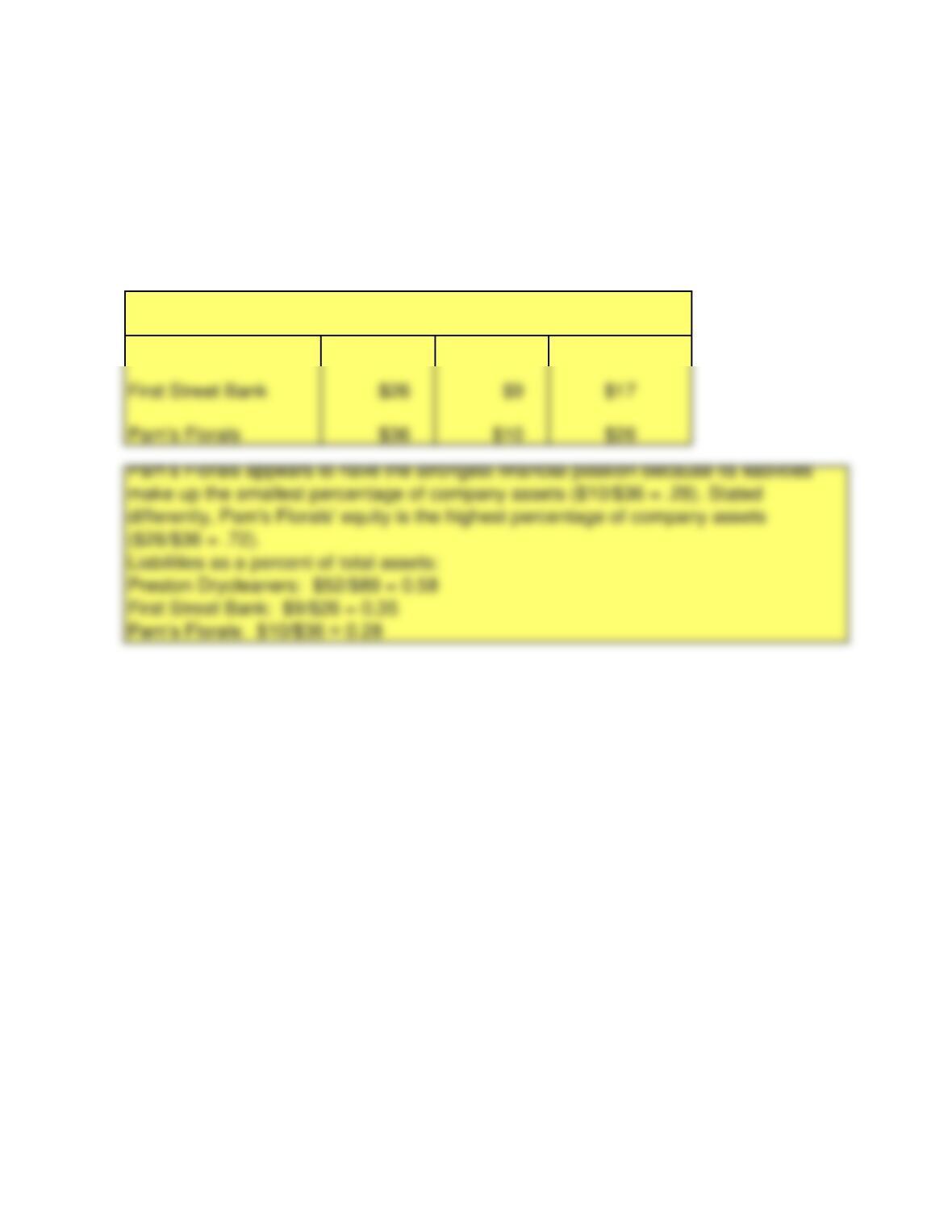
Preston Drycleaners $89 $52 $37
Which company appears to have the strongest financial position? Explain your
reasoning.
Stockholders’
Equity
Liabilities
Assets
=
+
Chapter 1: The Financial Statements Page 19 of 70
First Street Bank $26 $9 $17
Pam’s Florals $36 $10 $26
FINANCIAL ACCOUNTING – Eleventh Edition Solutions Manual
E 1-20A
(10-15 min.)
Solution:
Req. 1
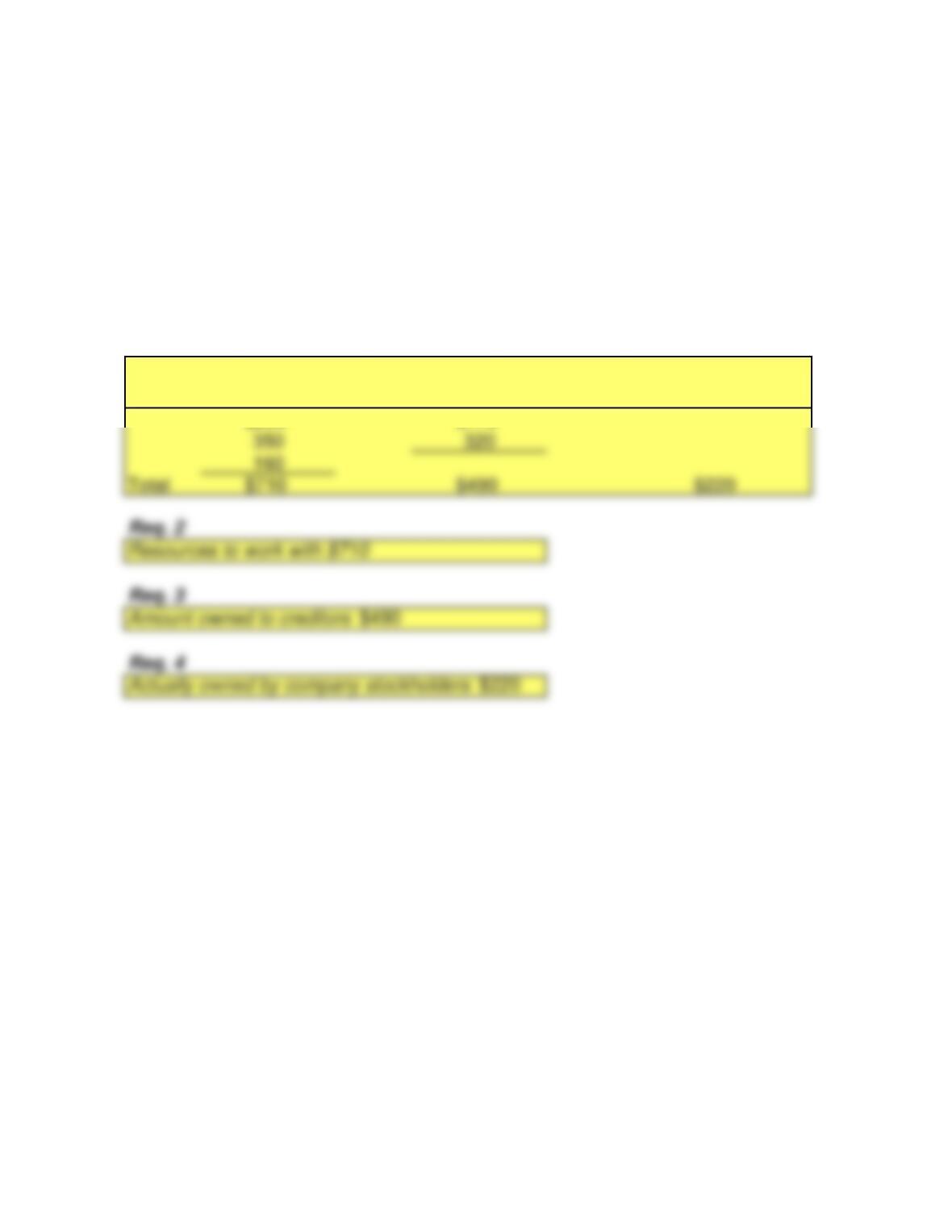
Assets = Liabilities + Stockholders’ Equity
$200 $170
(Amounts in millions)
1. Use these data to write Hooper’s accounting equation.
2. How much in resources does Hooper have to work with?
3. How much does Hooper owe creditors?
4. How much of the company’s assets do the Hooper stockholders actually own?
Chapter 1: The Financial Statements Page 20 of 70
Req. 2
Req. 3
Req. 4