Ethical Obligations and Decision Making in Accounting, 4/e 1
Case 1-9 Cleveland Custom Cabinets
This case is treated as GVV in the Test Bank IM in Chapter
2. Faculty can assign the case in Chapter 1 or delay it until
Chapter 2, if they plan to use it for GVV testing purposes in
Chapter 2.
Cleveland Custom Cabinets is a specialty cabinet manufacturer for high-end homes in the
Cleveland Heights and Shaker Heights areas. The company manufactures cabinets built to the
specifications of homeowners and employs 125 custom cabinetmakers and installers. There are
30 administrative and sales staff members working for the company.
The company applies overhead to jobs based on direct labor hours. For 2016, it estimated total
overhead to be $4.8 million and 80,000 direct labor hours. The cost of direct materials used
during the first quarter of the year is $600,000, and direct labor cost is $400,000 (based on
20,000 hours worked). The company’s accounting system is old and does not provide actual
overhead information until about four weeks after the close of a quarter. As a result, the applied
overhead amount is used for quarterly reports.
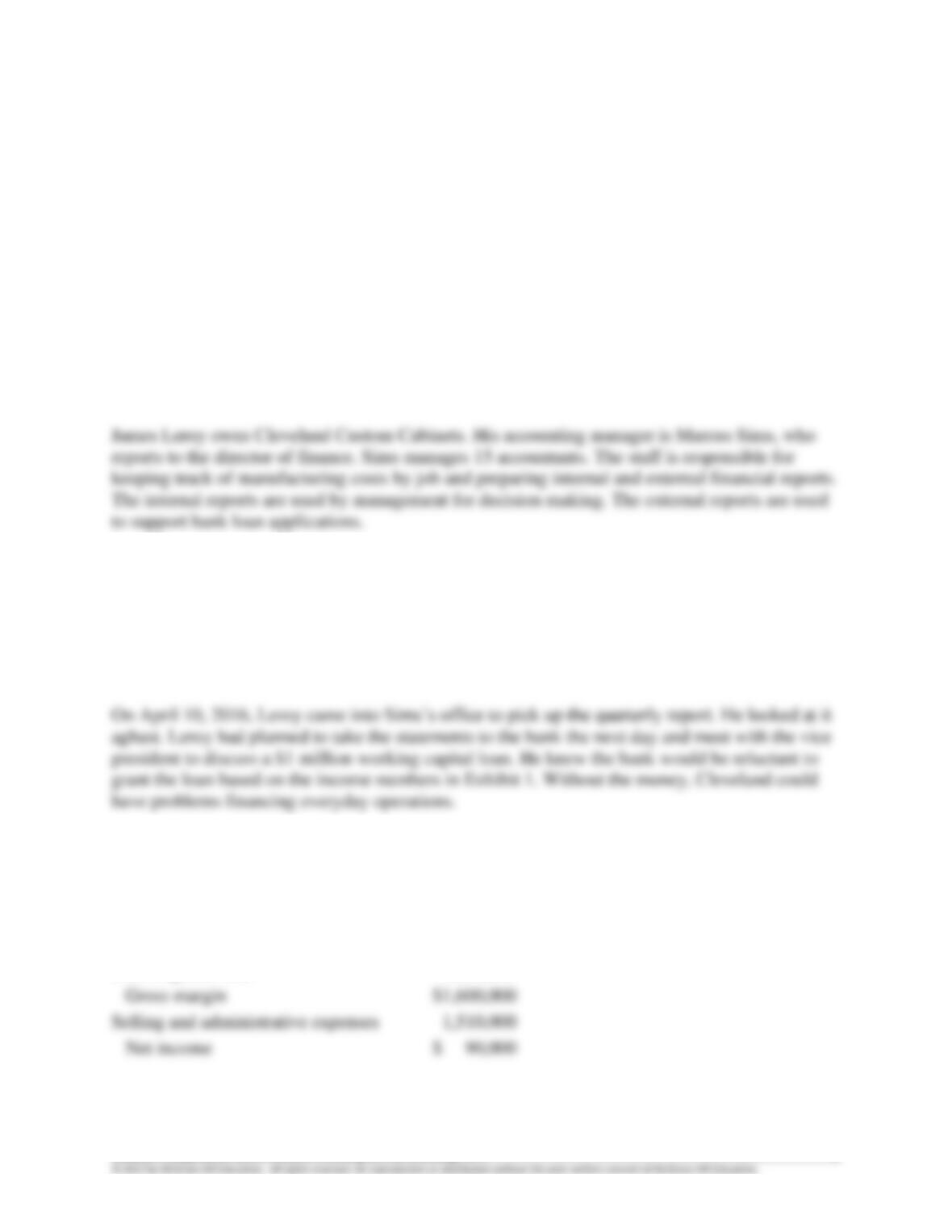
Exhibit 1
Cleveland Custom Cabinets
Net Income for the Quarter Ended March 31, 2016
Sales
$6,400,000
Cost of goods sold
4,800,000
Gross margin
$1,600,000
Selling and administrative expenses
1,510,000
Net income
$ 90,000
Ethical Obligations and Decision Making in Accounting, 4/e 2
Leroy asked Sims to explain how net income could have gone from 14.2 percent of sales for the
year ended December 31, 2015, to 1.4 percent for March 31, 2016. Sims pointed out that the
estimated overhead cost had doubled for 2016 compared to the actual cost for 2015. He
Ethical Overview
The stakeholders of the firm have a right to financial statements that follow GAAP and have
adequate disclosures. From a deontology perspective, Marcus Sims should follow the rules of the
profession; i.e., GAAP and no subordination of judgment. From a utilitarian perspective all the
stakeholders should benefit, not just Leroy the owner. In adjusting the numbers in order to obtain
From a rights perspective the stakeholders, other than Leroy, have a right to truthful dealings
(including financial statements) with the firm. From a deontology perspective, the firm has a
duty to be truthful. From a utilitarian perspective, all stakeholders should be considered in
determining the greatest good. From a virtue perspective the firm owes trustworthiness, respect,
responsibility and fairness to its stakeholders. The firm also has a citizenship responsibility to
pay taxes based upon truthful reporting of operations. The board has an obligation to corporate
governance that means oversight of Sims, and providing an audit committee to ensure that
truthful financial statements are provided to stakeholders and to serve as a check on management
behavior.
The board of directors are there to provide governance, ask questions, and to represent all the
Ethical Obligations and Decision Making in Accounting, 4/e 3
Questions
1. Do you agree with Leroy’s statement that it doesn’t matter what the numbers look
like because he is the sole owner? Even if it is true that Sims “owns” the board of
directors, what should be their role in this matter? What about the external
auditors? Should Sims simply accept Leroy’s statement that he would handle them?
No, Leroy is not the sole stakeholder to the firm. The firm has creditors (including the
bank), customers, employees, suppliers, and the government, who are all stakeholders.
Leroy possibly has a spouse and dependents who would share in gains and losses.
2. a. Assume that Sims is a CPA and holds the CMA. Put yourself in
Sims’s position. What are your ethical considerations in deciding
whether to tweak the numbers?
Now we know Sims is a CPA and CMA. He has an obligation to follow GAAP
and not subordinate his judgment. Sims must be prepared to act out of integrity
even if it means a loss of job. He has a responsibility to the public interest above
all else. Sims has to decide between subordinating his judgment and leaving his
Ethical Obligations and Decision Making in Accounting, 4/e 4
b. Assume you do a utilitarian analysis to help decide what to do.
Evaluate the harms and benefits of alternative courses of action. What
would you do? Would your analysis change if you use a rights theory
approach?
Using an act utilitarian analysis, Sims may consider doing as requested by Leroy.
This alternative may seem to provide the greatest good for all concerned as
Cleveland Cabinets can continue in business; Leroy is happy that the bank will
lend more money; the employees and Sims will continue employment with the
firm; creditors will be paid; and the board and shareholders will continue to
3. Think about how you would actually implement your chosen action. What barriers
could you face? How would you overcome them? Is it worth jeopardizing your job
in this case? Why or why not?
Sims may want to consult with the external auditors to see if he may have made a mistake
on the applied overhead for the current year. Getting a second opinion should help to
bring into focus what are his ethical responsibilities.