Wild, Shaw, Financial & Managerial Accounting, 8e Solutions Manual: Chapter 1
Chapter 1
Accounting in Business
QUESTIONS
1. The purpose of accounting is to provide decision makers with relevant and reliable
information to help them make better decisions. Examples include information for
people making investments, loans, and business plans.
2. Technology reduces the time, effort, and cost of recordkeeping. There is still a
demand for people who can design accounting systems, supervise their operation,
analyze complex transactions, and interpret reports. Demand also exists for people
who can effectively use computers to prepare and analyze accounting reports.
Technology will never substitute for qualified people with abilities to prepare, use,
analyze, and interpret accounting information.
3. External users and their uses of accounting information include: (a) lenders, to
measure the risk and return of loans; (b) shareholders, to assess whether to buy,
sell, or hold their shares; (c) directors, to oversee the organization; (d) employees
and labor unions, to judge the fairness of wages and assess future employment
opportunities; and (e) regulators, to determine whether the organization is
complying with regulations. Other users are voters, legislators, government officials,
contributors to nonprofits, suppliers, and customers.
4. Business owners and managers use accounting information to help answer
questions such as: What resources does an organization own? What debts are
owed? How much income is earned? Are expenses reasonable for the level of
sales? Are customers’ accounts being promptly collected?
9. Accounting is described as a service activity because it serves decision makers by
providing information to help them make better business decisions.
10. Some accounting-related professions include consultant, financial analyst,
underwriter, financial planner, appraiser, FBI investigator, market researcher, and
system designer.
11. Ethics rules require that auditors avoid auditing clients in which they have a direct
investment, or if the auditor’s fee is dependent on the figures in the client’s reports.
This will help prevent others from doubting the quality of the auditor’s report.
12. In addition to preparing tax returns, tax accountants help companies and individuals
plan future transactions to minimize the amount of tax to be paid. They are also
actively involved in estate planning and in helping set up organizations. Some tax
accountants work for regulatory agencies such as the IRS or the various state
16. Business organizations can be organized as a sole proprietorship, partnership,
corporation, or LLC. These forms have implications for legal entity and liability,
business life, taxation, and number of owners as follows.
Proprietorship
Partnership
Corporation
LLC
Business entity
yes
yes
yes
yes
Legal entity
no
no
yes
yes
Limited liability
no
no
yes
yes
Unlimited life
yes
yes
Business Taxed
no
no
yes
17. (a) Assets are resources owned or controlled by a company that are expected to
yield future benefits. (b) Liabilities are creditors’ claims on assets that reflect
obligations to provide assets, products, or services to others. (c) Equity is the
owner’s claim on assets and is equal to assets minus liabilities. (d) Net assets refer
to equity.
19. Accounting principles consist of (a) general and (b) specific principles. General
principles are the basic assumptions, concepts, and guidelines for preparing
financial statements. They stem from long-used accounting practices. Specific
principles are detailed rules used in reporting on business transactions and events.
They usually arise from the rulings of authoritative and regulatory groups such as
the Financial Accounting Standards Board or the Securities and Exchange
Commission.
23. An income statement reports a company’s revenues and expenses along with the
resulting net income or loss over a period of time.
24. Rent expense, utilities expense, administrative expenses, advertising and promotion
expenses, maintenance expense, and salaries and wages expenses are some
examples of business expenses.
27. The statement of cash flows reports on the cash inflows and outflows from a
company’s operating, investing, and financing activities.
28. Return on assets, also called return on investment, is a profitability measure that is
useful in evaluating management, analyzing and forecasting profits, and planning
activities. It is computed as net income divided by the average total assets. For
example, if we have an average annual balance of $100 in a bank account and it
earns interest of $5 for the year, then our return on assets is $5 / $100 or 5%. The
return on assets is a popular measure for analysis because it allows us to compare
companies of different sizes and in different industries.
31B. An organization’s financing activities (liabilities and equity) pay for investing
activities (assets). An organization cannot have more or less assets than its
liabilities and equity combined and, similarly, it cannot have more or less liabilities
and equity than its total assets. This means: assets = liabilities + equity. This
relation is called the accounting equation (also called the balance sheet equation),
and it applies to organizations at all times.

Wild, Shaw, Financial & Managerial Accounting, 8e Solutions Manual: Chapter 1
QUICK STUDIES
Quick Study 1-1 (10 minutes)
1.
f Technology
2.
c Recording
3.
h Recordkeeping (bookkeeping)
Quick Study 1-2 (10 minutes)
a.
E External user
g.
E External user
b.
E External user
h.
E External user
c.
E External user
I Internal user
d.
E External user
E External user
e.
I Internal user
k.
E External user
E External user
E External user
Quick Study 1-3 (10 minutes)
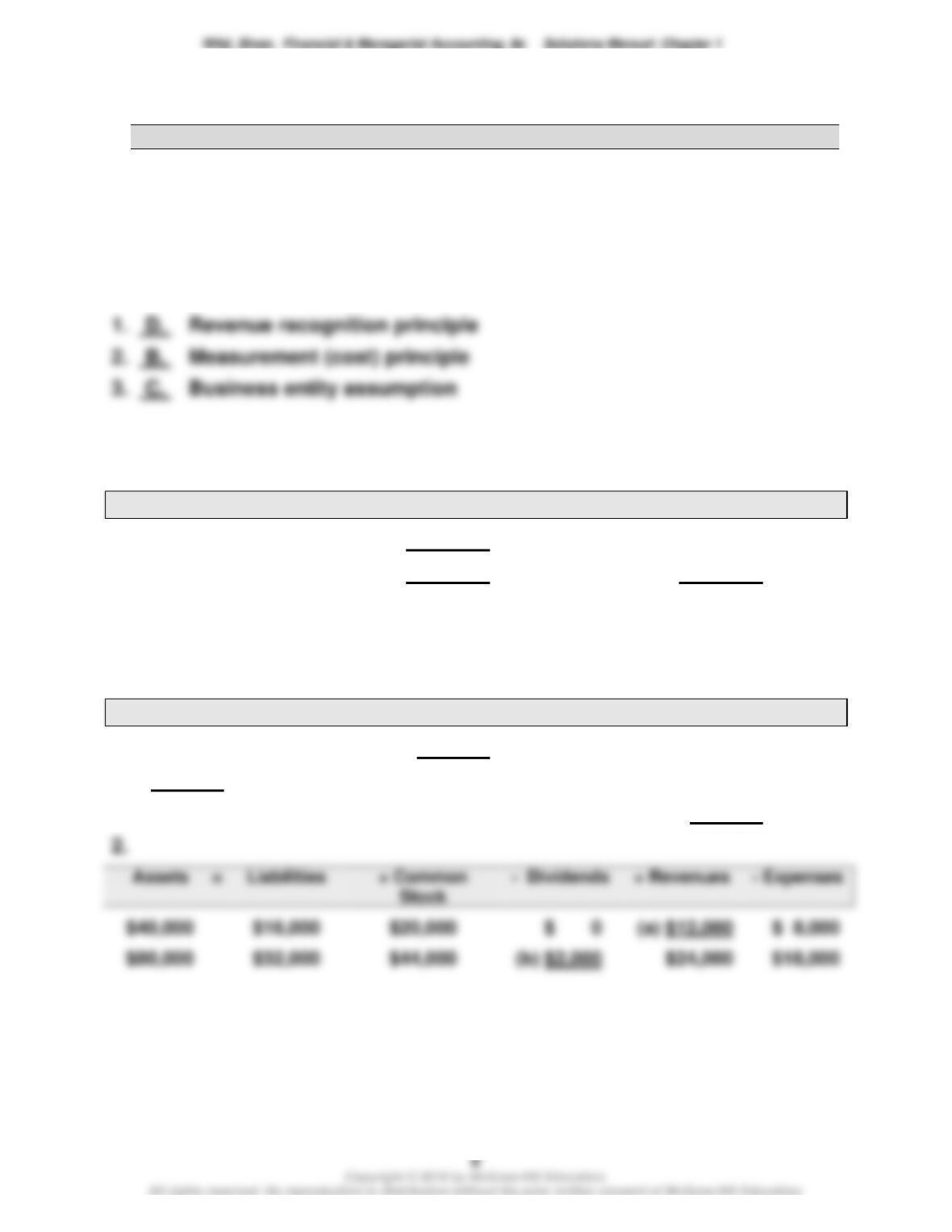
1. A. Opportunity
2. B. Pressure
3. C. Rationalization
Quick Study 1-4 (5 minutes)
1. a. principle
2. b. assumption
Quick Study 1-5 (10 minutes)
Attribute Present
Proprietorship
Partnership
Corporation
LLC
1.
Business taxed
no
no
yes
no
2.
Limited liability
no
no
yes
yes
3.
Legal entity
no
no
yes
yes
Quick Study 1-6 (10 minutes)
Quick Study 1-7 (5 minutes)
Assets = Liabilities + Equity
$700,000 (a) $280,000 $420,000
$500,000 (b) $250,000 (b) $250,000
Quick Study 1-8 (10 minutes)
1.
Assets = Liabilities + Equity
$75,000 (a) $35,000 $40,000
(b) $95,000 $25,000 $70,000
$85,000 $20,000 (c) $65,000
Quick Study 1-9 (10 minutes)
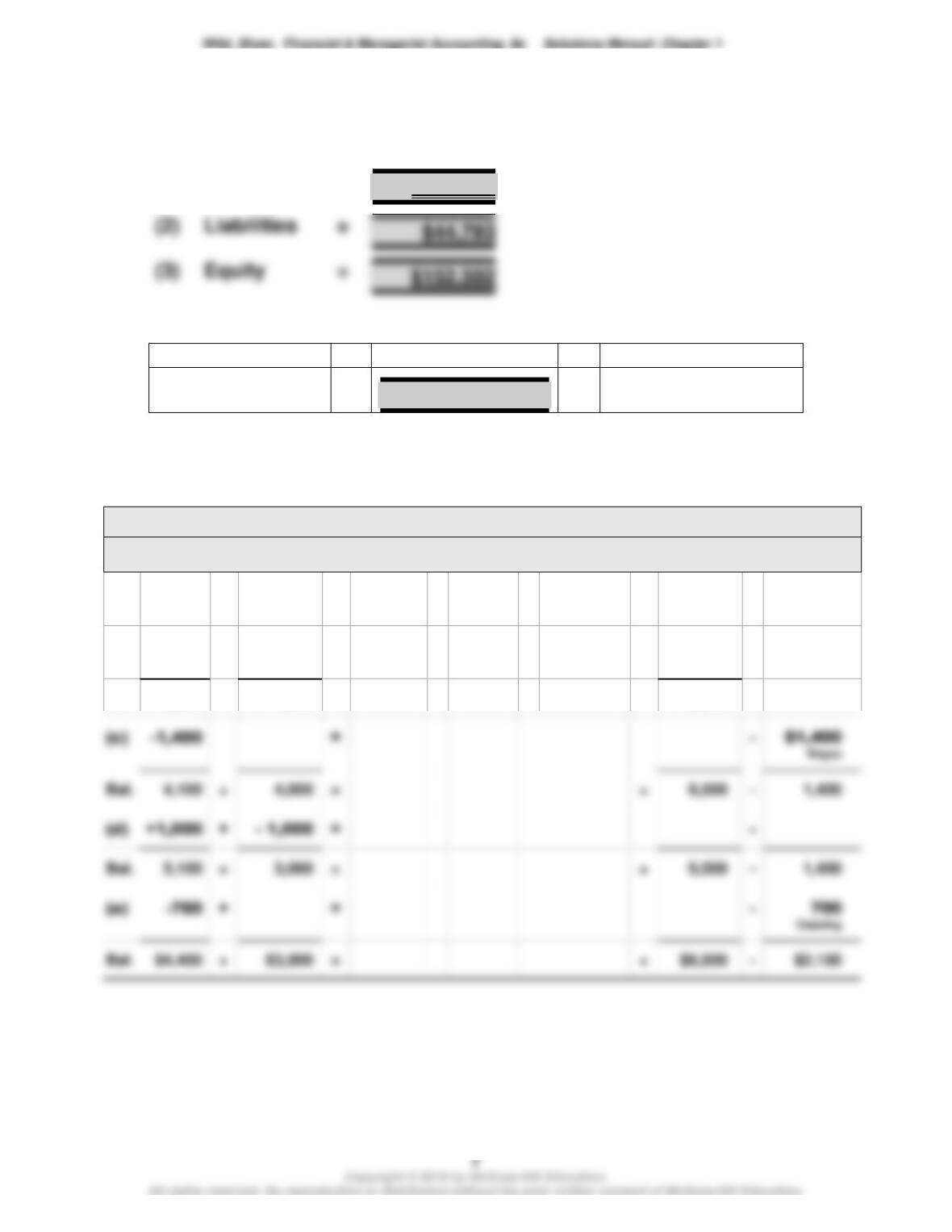
a. The accounts and their dollar amounts (in $ millions) for Google are:
(1)
Assets
=
$197,295
$152,502
b. Using Google’s amounts from (a) we verify that (in $ millions):
Assets
=
Liabilities
+
Equity
197,295
=
44,793
+
152,502
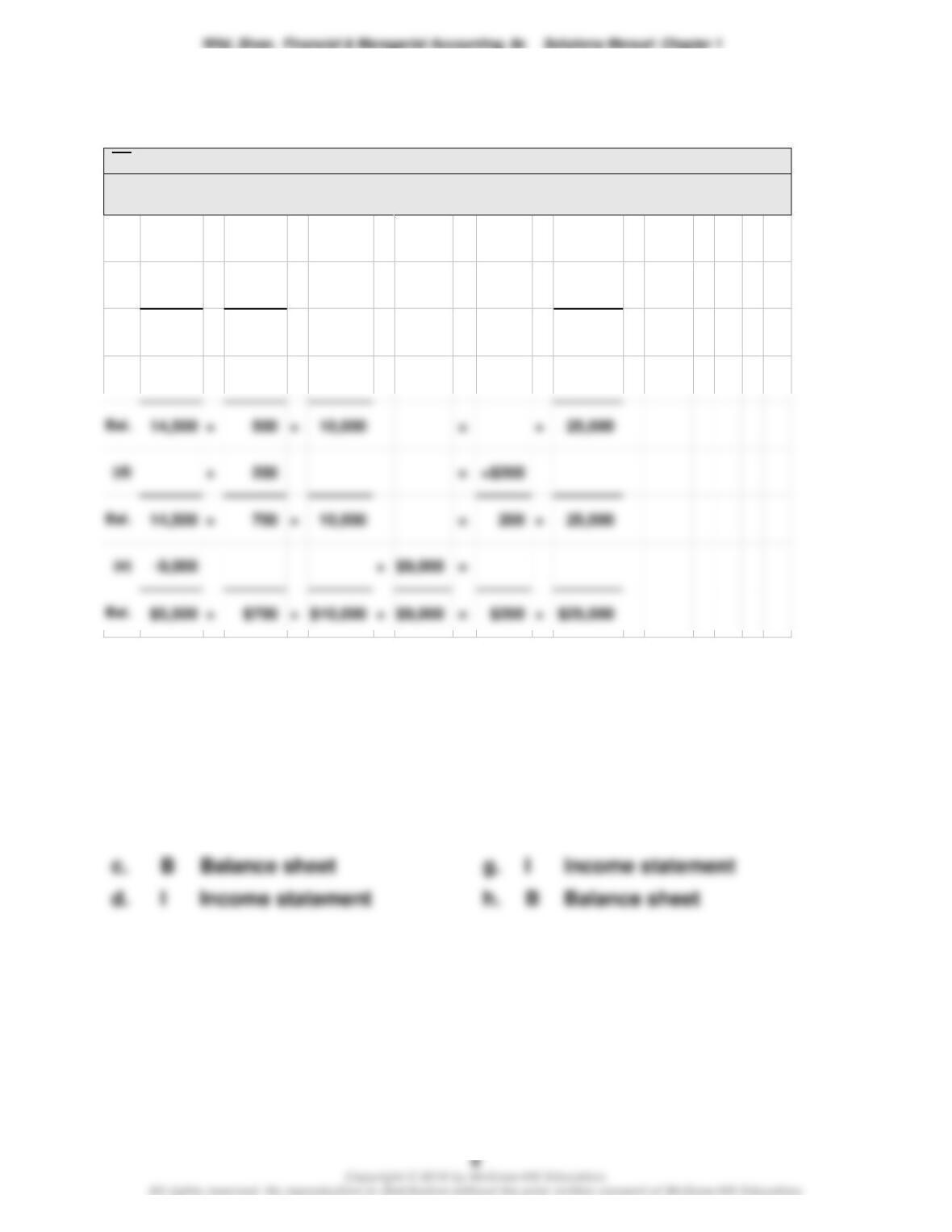
Quick Study 1-10 (15 minutes)
Assets
=
Liabilities
+
Equity
Cash
+
Accounts
Recble.
=
Accounts
Payable
+
Common
Stock
–
Dividends
+
Revenues
–
Expenses
(a)
$5,500
=
$5,500
Consulting
(b)
+
$4,000
=
+
4,000
Commission
Bal.
5,500
+
4,000
=
+
9,500
(c)
-1,400
=
–
Bal.
4,100
+
4,000
=
+
9,500
–
Bal.
+
=
+
–
Quick Study 1-11 (15 minutes)
Assets
=
Liabilities
+
Equity
Cash
+
Supplies
+
Equip.
+
Land
=
Accts.
Pay.
+
Common
Stock
–
Divi-
dends
+
Rev.
–
Exp.
(a)
$15,000
=
$15,000
(b)
–500
+
$500
=
Bal.
14,500
+
500
=
+
15,000
(c)
+
$10,000
=
10,000
(d)
+
200
=
+$200
Quick Study 1-12 (10 minutes)
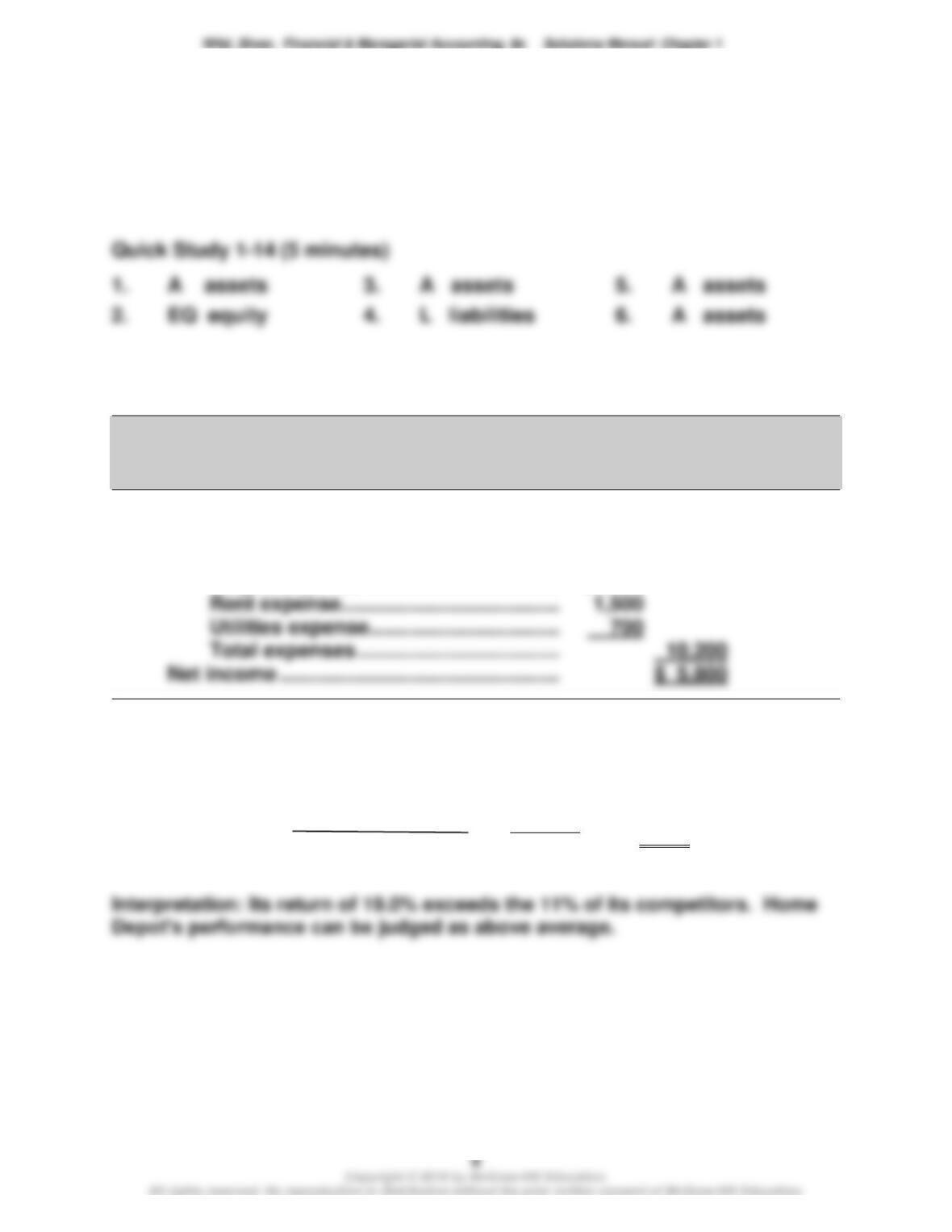
[Code: Income statement (I), Balance sheet (B), or Statement of cash flows (CF).]
a.
B Balance sheet
e.
B Balance sheet
b.
CF Statement of cash flows
f.
CF Statement of cash flows
c.
B Balance sheet
g.
I Income statement
Quick Study 1-13 (5 minutes)
1. EX expenses 4. D dividends 7. EX expenses
2. R revenues 5. EX expenses 8. R revenues
3. EX expenses 6. R revenues
Quick Study 1-15 (15 minutes)
HAWKIN
Income Statement
For Month Ended December 31
Revenues
Services revenue ………………………….. $16,000
Expenses
Wages expense …………………………….. $8,000
Quick Study 1-16 (10 minutes)
Return on assets = = = 19.0%
$8 billion
$42 billion
Net income
Average total assets
Quick Study 1-17 (10 minutes)
a. The accounts and their dollar amounts (in KRW millions) for Samsung
are:
(1)
Assets
=
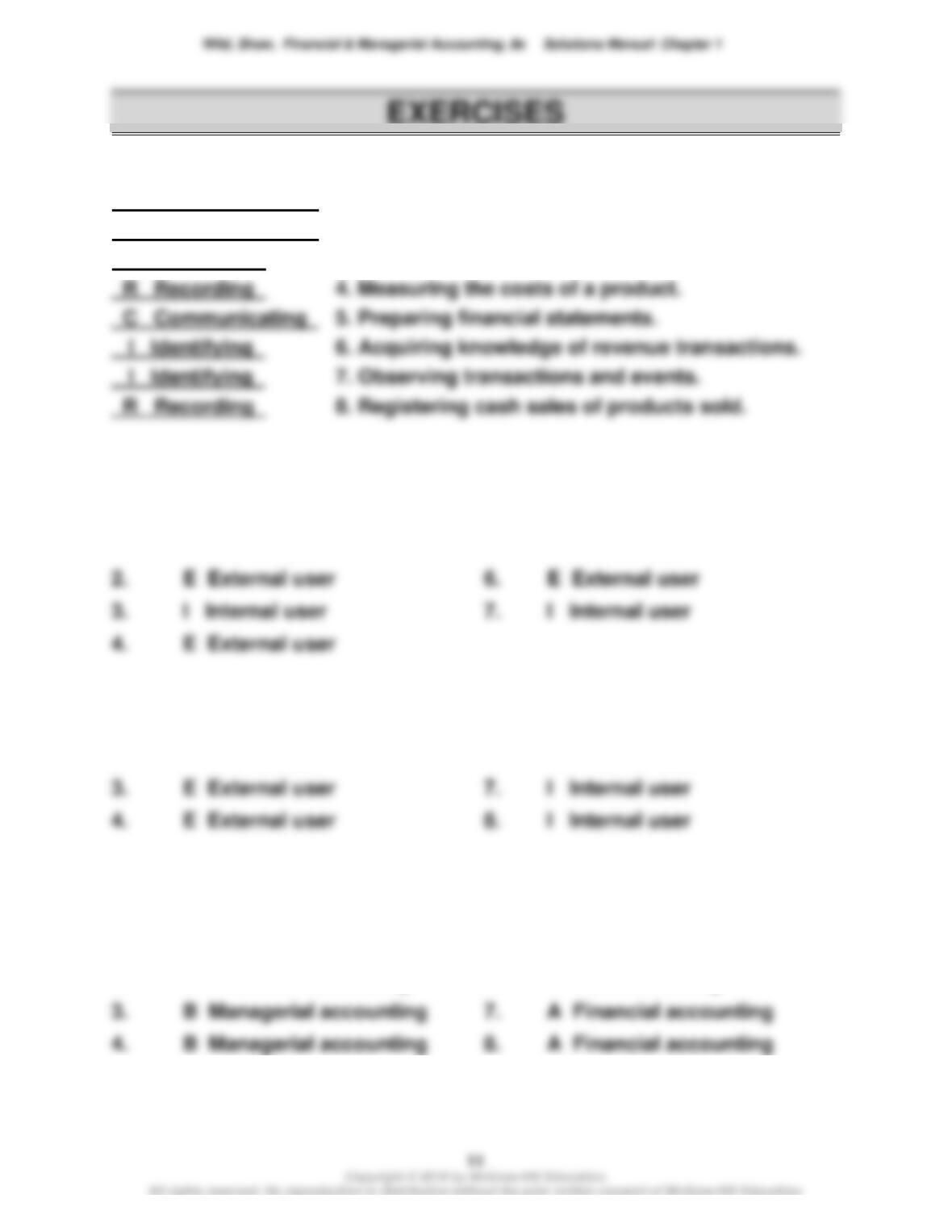
301,752,090
(2)
Liabilities
=
87,260,662
(3)
Equity
=
214,491,428
b. Using Samsung’s amounts from (a) we verify (in KRW millions):
Exercise 1-1 (10 minutes)
C Communicating 1. Analyzing and interpreting reports.
C Communicating 2. Presenting financial information.
R Recording 3. Keeping a log of service costs.
Exercise 1-2 (20 minutes)
Part A.
1.
I Internal user
5.
I Internal user
2.
6.
3.
I Internal user
7.
I Internal user
4.
Part B.
1.
I Internal user
5.
I Internal user
2.
I Internal user
6.
E External user
3.
7.
I Internal user
4.
E External user
8.
I Internal user
Exercise 1-3 (10 minutes)
1.
B Managerial accounting
5.
C Tax accounting
2.
A Financial accounting
6.
C Tax accounting
3.
B Managerial accounting
7.
A Financial accounting
Exercise 1-4 (10 minutes)
1. A Audit
2. G Net income
Exercise 1-5 (20 minutes)
1. G Dodd-Frank Act
2. F Audit
3. E Sarbanes-Oxley Act
Exercise 1-6 (10 minutes)
a.
(C) Corporation
e.
(C) Corporation
b.
(P) Partnership
f.
(SP) Sole proprietorship
c.
(SP) Sole proprietorship
(C) Corporation
d.
(SP) Sole proprietorship
(LLC) Limited liability company
Exercise 1-7 (10 minutes)
Code
Description
Principle/Assumption
H
1.
A company reports details behind financial
statements that would impact users’ decisions.
Full disclosure
principle
G
2.
Financial statements reflect the assumption that
the business continues operating.
Going-concern
assumption
F
3.
A company records the expenses incurred to
generate the revenues reported.
Expense recognition
(matching) principle
A
4.
Concepts, assumptions, and guidelines for
preparing financial statements.
General accounting
principle
C
5.
its owner or owners.
Business entity
assumption
D
6.
Revenue is recorded when products and
services are delivered.
Revenue recognition
principle
E
7.
Detailed rules used in reporting events and
transactions.
Specific accounting
principle
B
8.
Information is based on actual costs incurred in
transactions.
Measurement (cost)
principle
Exercise 1-8 (10 minutes)
Assets
=
Liabilities
+
Equity
(a) $ 65,000
=
$ 20,000
+
$45,000
Exercise 1-9 (20 minutes)
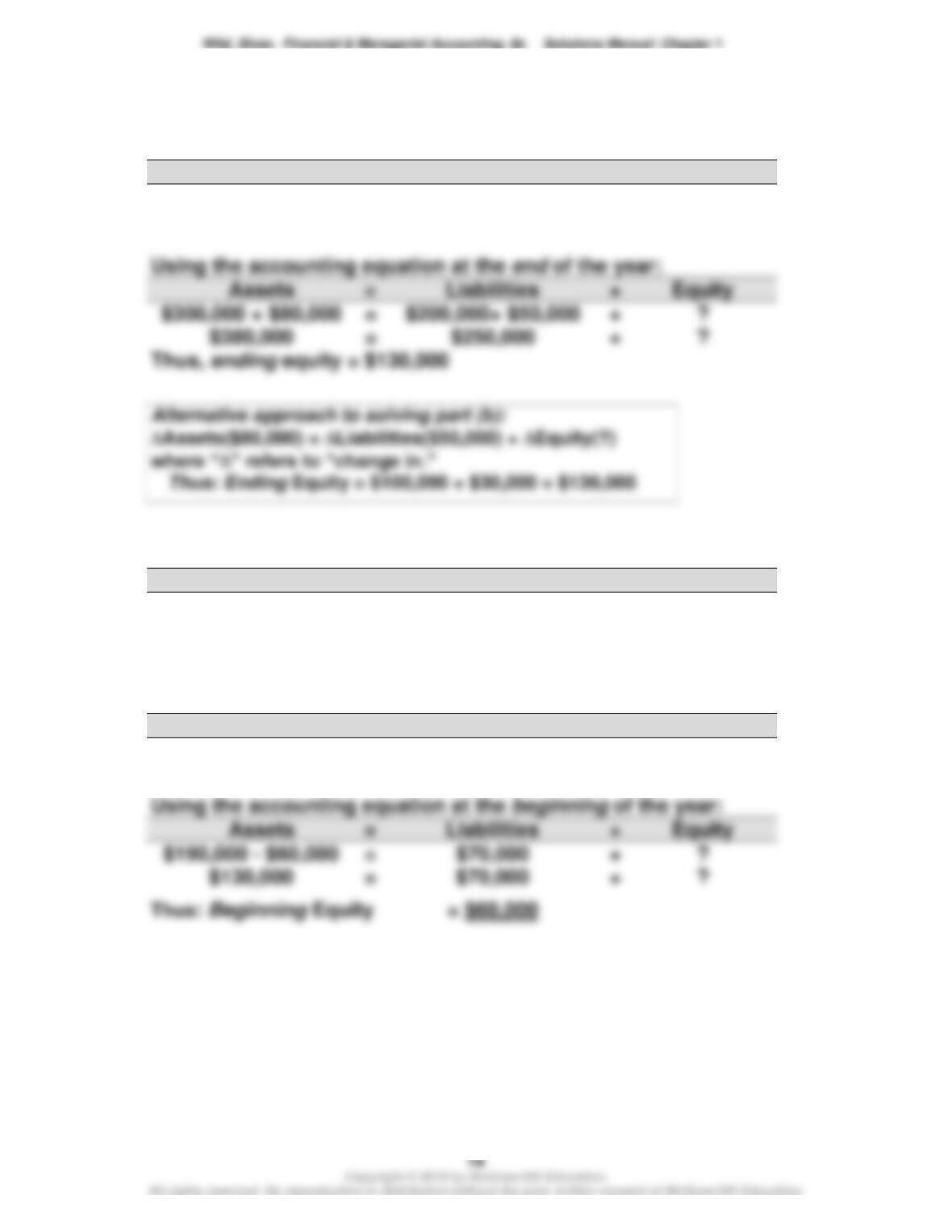
a. Using the accounting equation at the beginning of the year:
Assets
=
Liabilities
+
Equity
$300,000
=
?
+
$100,000
Thus, beginning liabilities = $200,000
Assets
=
Liabilities
+
Equity
=
+
?
$380,000
=
+
?
b. Using the accounting equation:
Assets
=
Liabilities
+
Equity
$123,000
=
$47,000
+
?
Thus, equity = $76,000
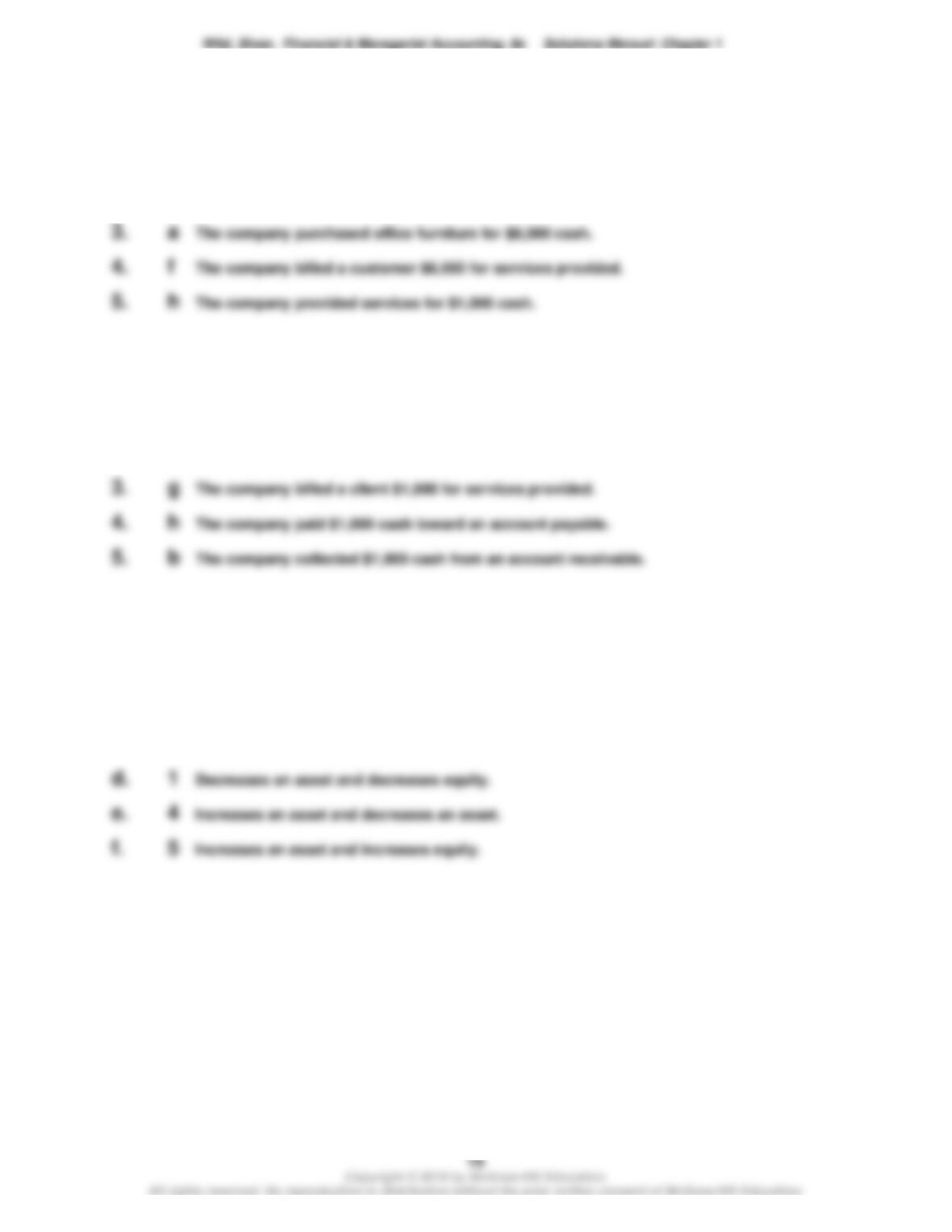
c. Using the accounting equation at the end of the year:
Assets
=
Liabilities
+
Equity
$190,000
=
$70,000 – $5,000
+
?
$190,000
=
$65,000
+
$125,000
Assets
=
Liabilities
+
Equity
=
$70,000
+
?
$130,000
=
$70,000
+
?
Exercise 1-10 (20 minutes)
1. d The owner invested $40,000 cash in the business in exchange for its common stock.
2. e The company purchased office supplies for $3,000 by paying $2,000 cash and putting
$1,000 on credit.
Exercise 1-11 (20 minutes)
1. f The company purchased land for $4,000 cash.
2. a The company purchased $1,000 of office supplies on credit.
Exercise 1-12 (15 minutes)
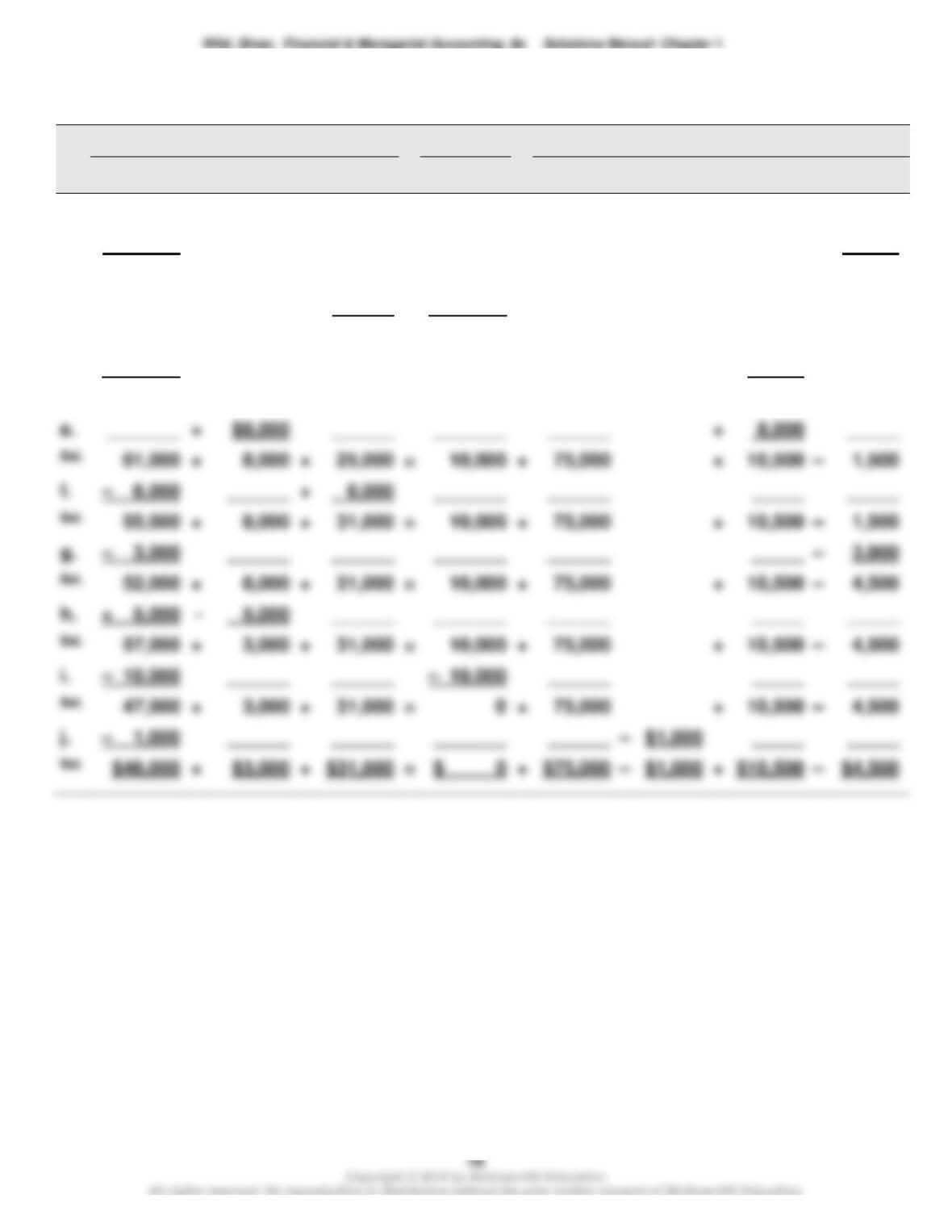
a. 3 Decreases an asset and decreases a liability.
b. 2 Increases an asset and increases a liability.
c. 5 Increases an asset and increases equity.
Exercise 1-13 (30 minutes)
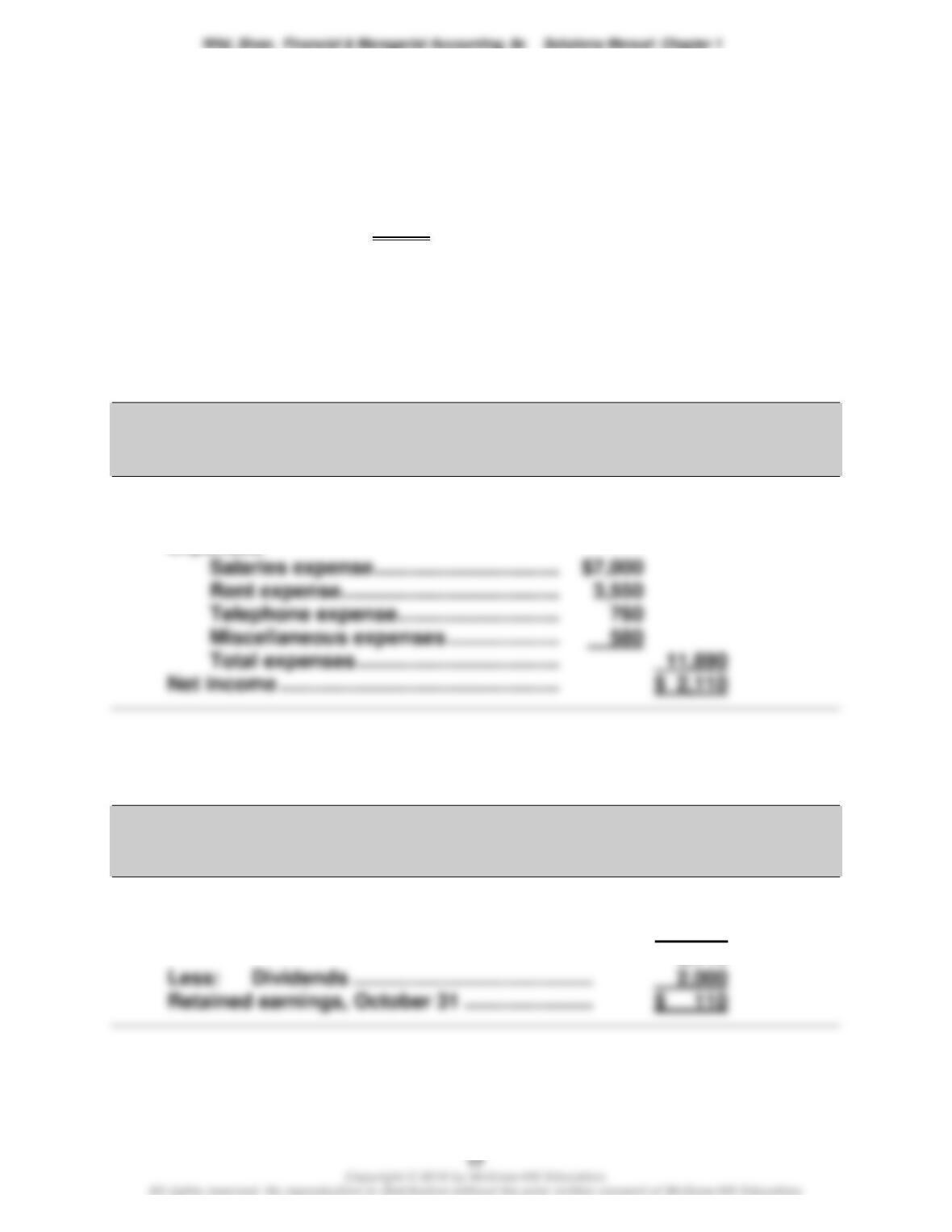
Assets
=
Liabilities
+
Equity
Cash
+
Accounts
Receivable
+
Equip-
ment
=
Accounts
Payable
+
Common
Stock
–
Divi-
dends
+
Revenues
–
Expenses
a.
+$60,000
+
$15,000
=
+
$75,000
b.
– 1,500
______
______
–
$1,500
Bal.
58,500
+
+
15,000
=
+
75,000
–
1,500
c.
_______
+
10,000
+$10,000
______
_____
Bal.
58,500
+
+
25,000
=
10,000
+
75,000
–
1,500
d.
+ 2,500
______
_______
______
+
$2,500
_____
Bal.
61,000
+
+
25,000
=
10,000
+
75,000
+
2,500
–
1,500
e.
_______
+
______
_______
______
+
8,000
_____
Bal.
61,000
+
+
25,000
=
10,000
+
75,000
+
10,500
–
1,500
– 6,000
+
_______
______
_____
_____
Bal.
55,000
+
+
31,000
=
10,000
+
75,000
+
10,500
–
1,500
g.
– 3,000
______
_______
______
–
3,000
Bal.
52,000
+
+
31,000
=
10,000
+
75,000
+
10,500
–
4,500
h.
+ 5,000
______
_______
______
_____
_____
57,000
+
+
31,000
=
10,000
+
75,000
+
10,500
–
4,500
– 10,000
______
______
_____
_____
Bal.
47,000
+
+
31,000
=
0
+
75,000
+
10,500
–
4,500
______
_______
______
_____
_____
Exercise 1-14 (10 minutes)
Return on assets
=
Net income / Average total assets
=
$40,000 / [($200,000 + $300,000)/2]
=
16.0%
Interpretation: Swiss Group’s return on assets of 16% is markedly above
the 11% return of its competitors. Accordingly, its performance is
assessed as superior to its competitors.
Exercise 1-15 (15 minutes)
ERNST CONSULTING
Income Statement
For Month Ended October 31
Revenues
Consulting revenue ………………………. $14,000
Exercise 1-16 (15 minutes)
ERNST CONSULTING
Statement of Retained Earnings
For Month Ended October 31
Retained earnings, October 1 ……………………. $ 0
Add: Net income (from Exercise 1-15) …….. 2,110
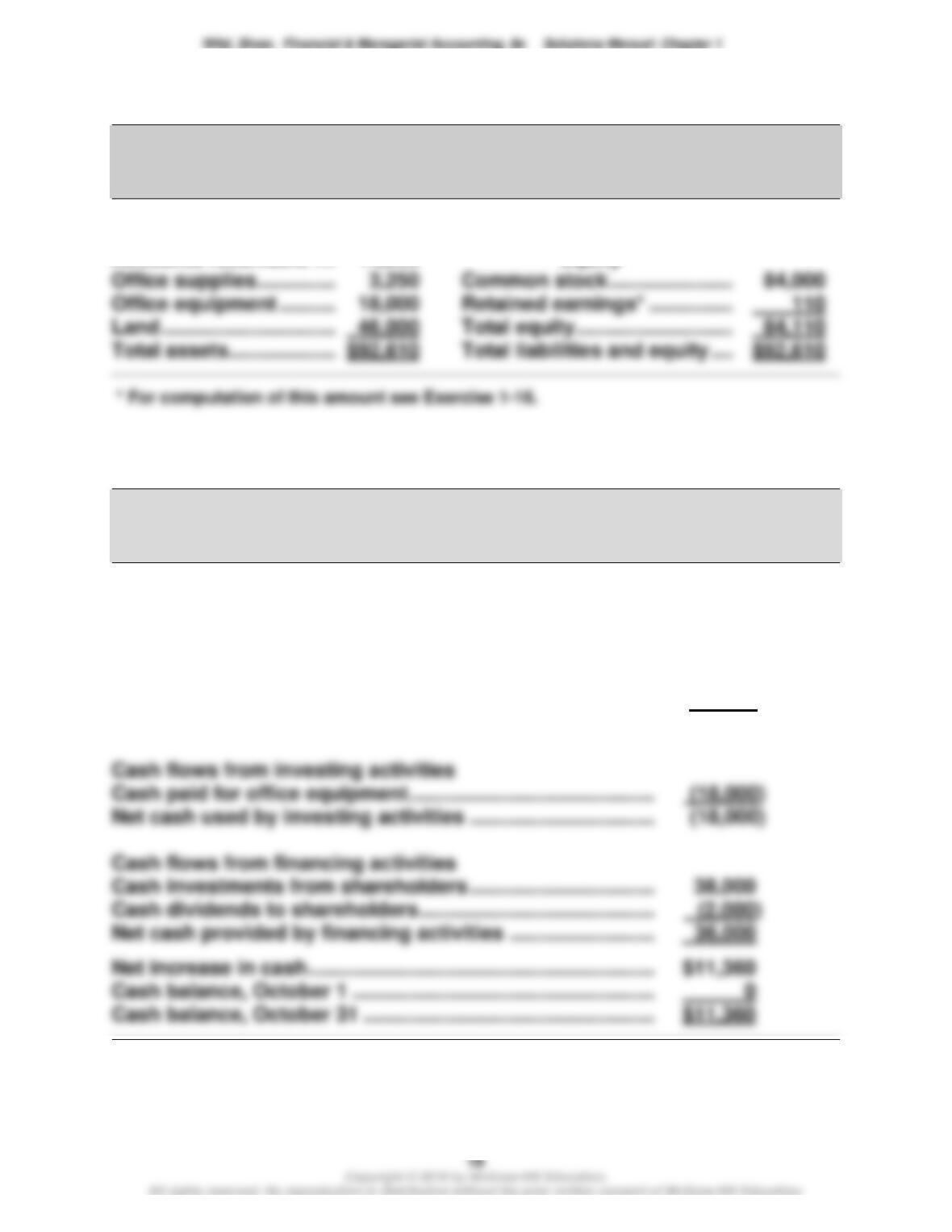
Exercise 1-17 (15 minutes)
ERNST CONSULTING
Balance Sheet
October 31
Assets Liabilities
Cash …………………………. $11,360 Accounts payable …………….. $ 8,500
Exercise 1-18 (15 minutes)
ERNST CONSULTING
Statement of Cash Flows
For Month Ended October 31
Cash flows from operating activities
Cash received from customers …………………………………….. $ 0
Cash paid to employeesa ……………………………………………… (1,750)
Cash paid for rent ………………………………………………………… (3,550)
Cash paid for telephone expenses ……………………………….. (760)
Cash paid for miscellaneous expenses ………………………… (580)
Net cash used by operating activities …………………………... ( 6,640)
a $7,000 Salaries Expense – $5,250 still owed = $1,750 paid to employees.
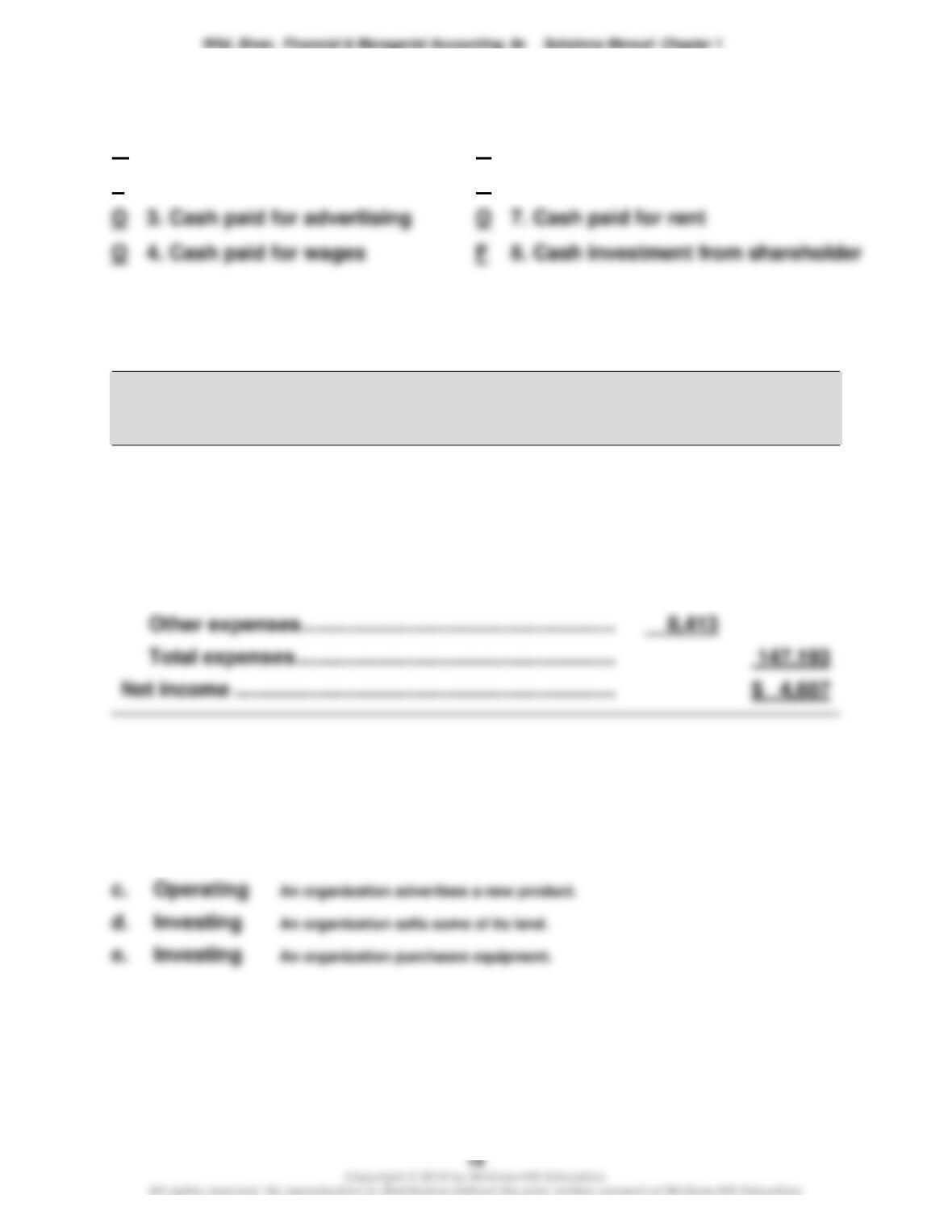
Exercise 1-19 (10 minutes)
I 1. Cash purchase of equipment O 5. Cash paid on account payable
F 2. Cash paid for dividends O 6. Cash received from clients
Exercise 1-20 (20 minutes)
Ford Motor Company
Income Statement
For Year Ended December 31
($ millions)
Revenues …………………………..……………………………….. $151,800
Expenses
Cost of sales …………………………………………………… $126,584
Selling and administrative costs ………………………. 12,196
Exercise 1-21B (10 minutes)
a. Financing An owner contributes cash to the business in exchange for its common stock.
b. Financing An organization borrows money from a bank.
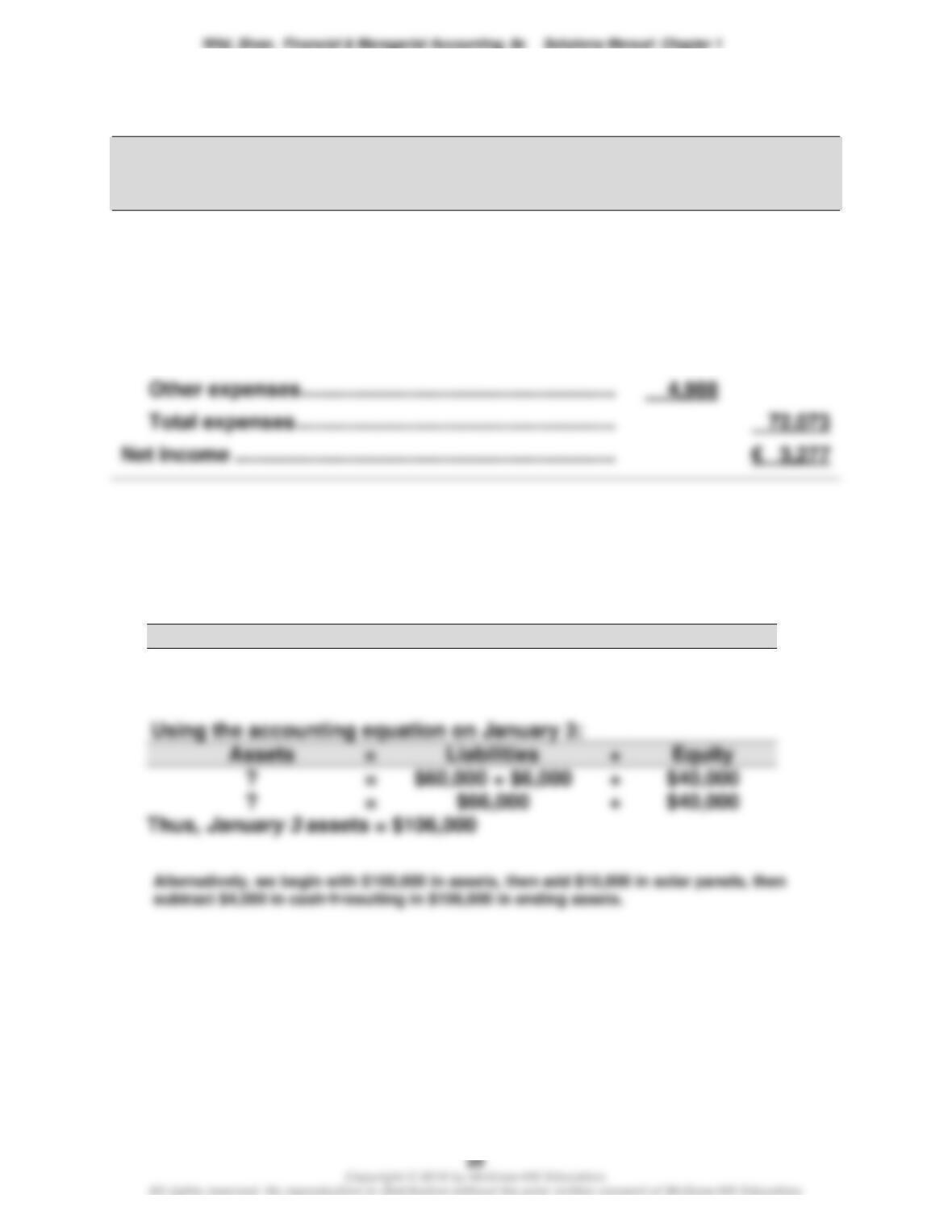
Exercise 1-22 (15 minutes)
BMW GROUP
Income Statement
For Year Ended December 31
(Euros in millions)
Revenues …………………………..……………………………….. € 75,350
Expenses
Cost of sales …………………………………………………… €60,946
Selling and administrative costs ………………………. 6,139
Exercise 1-23 (15 minutes)
a. Using the accounting equation on January 1:
Assets
=
Liabilities
+
Equity
?
=
$60,000
+
$40,000
Thus, beginning assets = $100,000
Assets
=
Liabilities
+
Equity
?
=
+
$40,000
?
=
$66,000
+
$40,000