Chapter 1
Managerial Accounting and Cost Concepts
Questions
1-1 The three major types of product costs
in a manufacturing company are direct
materials, direct labor, and manufacturing
overhead.
1-2
a. Direct materials are an integral part of a
finished product and their costs can be
conveniently traced to it.
b. Indirect materials are generally small
items of material such as glue and nails. They
may be an integral part of a finished product but
their costs can be traced to the product only at
1-3 A product cost is any cost involved in
purchasing or manufacturing goods. In the case
of manufactured goods, these costs consist of
direct materials, direct labor, and manufacturing
overhead. A period cost is a cost that is taken
directly to the income statement as an expense
in the period in which it is incurred.
1-4
a. Variable cost: The variable cost per unit is
constant, but total variable cost changes in
direct proportion to changes in volume.
b. Fixed cost: The total fixed cost is constant
within the relevant range. The
average
fixed
cost per unit varies inversely with changes
in volume.
c. Mixed cost: A mixed cost contains both
variable and fixed cost elements.
1-5
a. Unit fixed costs decrease as the activity level
about variable and fixed cost behavior are
valid.
1-7 An activity base is a measure of
whatever causes the incurrence of a variable
cost. Examples of activity bases include units
produced, units sold, letters typed, beds in a
hospital, meals served in a cafe, service calls
made, etc.
1-8 The linear assumption is reasonably
valid providing that the cost formula is used only
within the relevant range.
1-9 A discretionary fixed cost has a fairly
short planning horizon—usually a year. Such
costs arise from annual decisions by
management to spend on certain fixed cost
items, such as advertising, research, and
management development. A committed fixed
cost has a long planning horizon—generally
many years. Such costs relate to a company’s
1-11 The traditional approach organizes costs
by function, such as production, selling, and
administration. Within a functional area, fixed
and variable costs are intermingled. The
contribution approach income statement
organizes costs by behavior, first deducting
variable expenses to obtain contribution margin,
and then deducting fixed expenses to obtain net
1-14 No, differential costs can be either
variable or fixed. For example, the alternatives
might consist of purchasing one machine rather
than another to make a product. The difference
between the fixed costs of purchasing the two
machines is a differential cost.
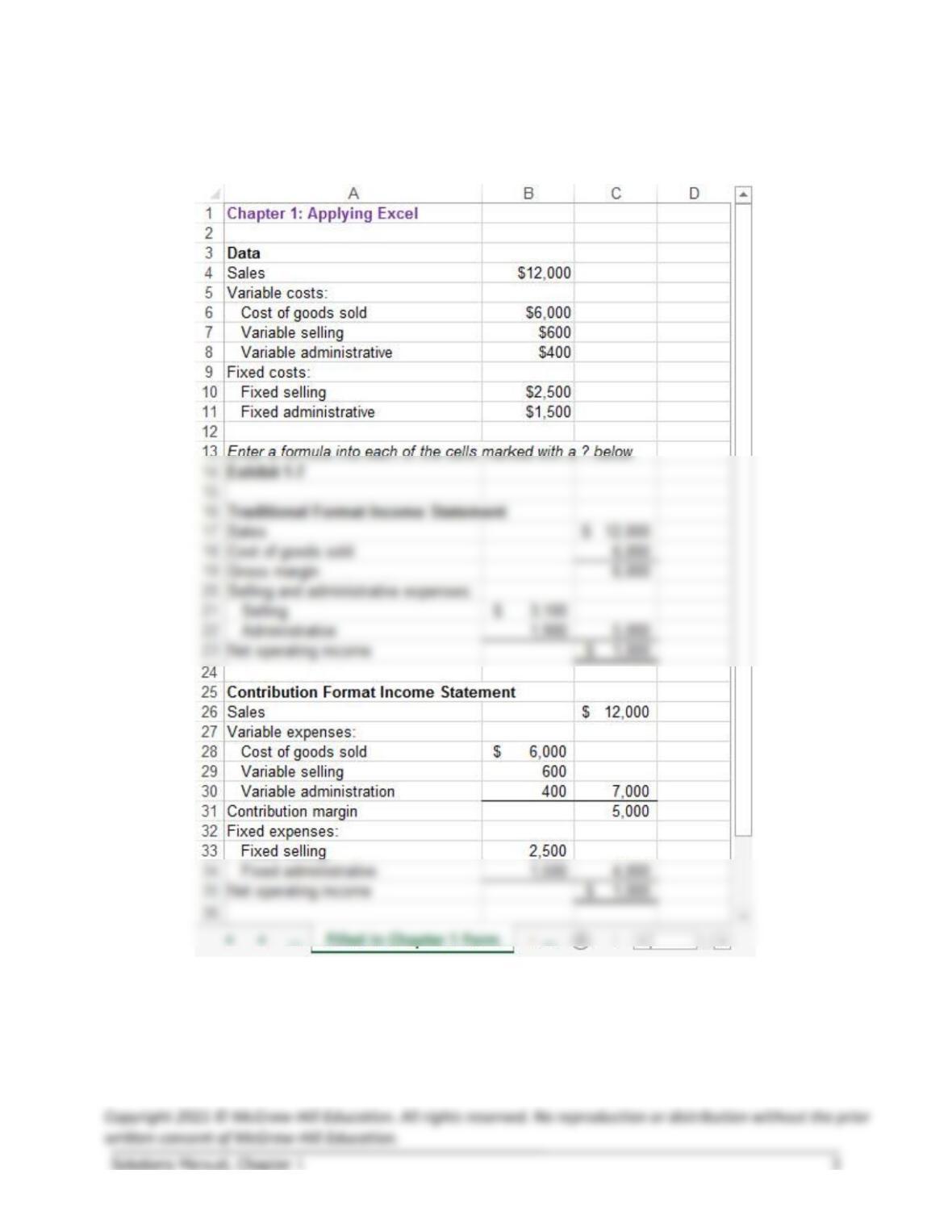
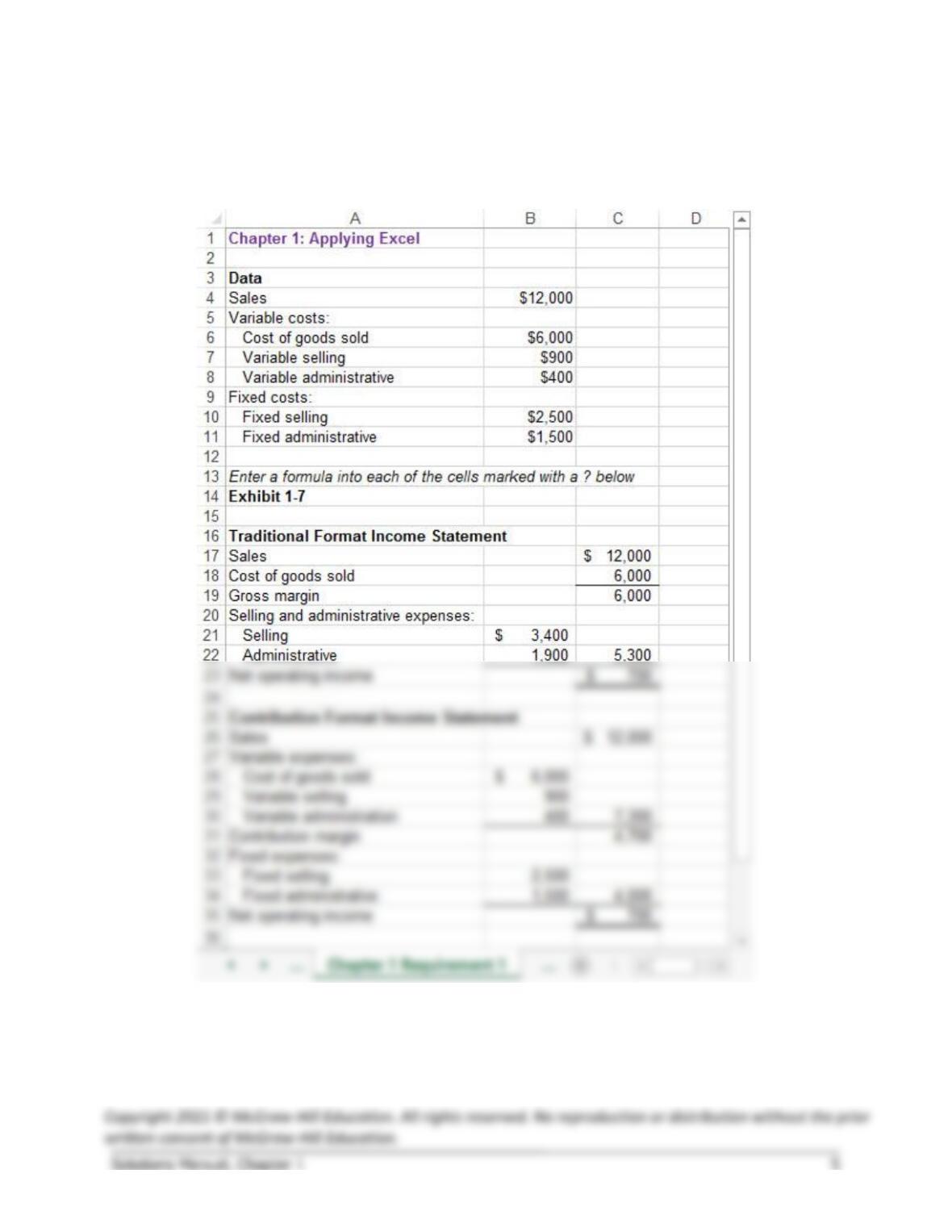
Chapter 1: Applying Excel
The completed worksheet is shown below.
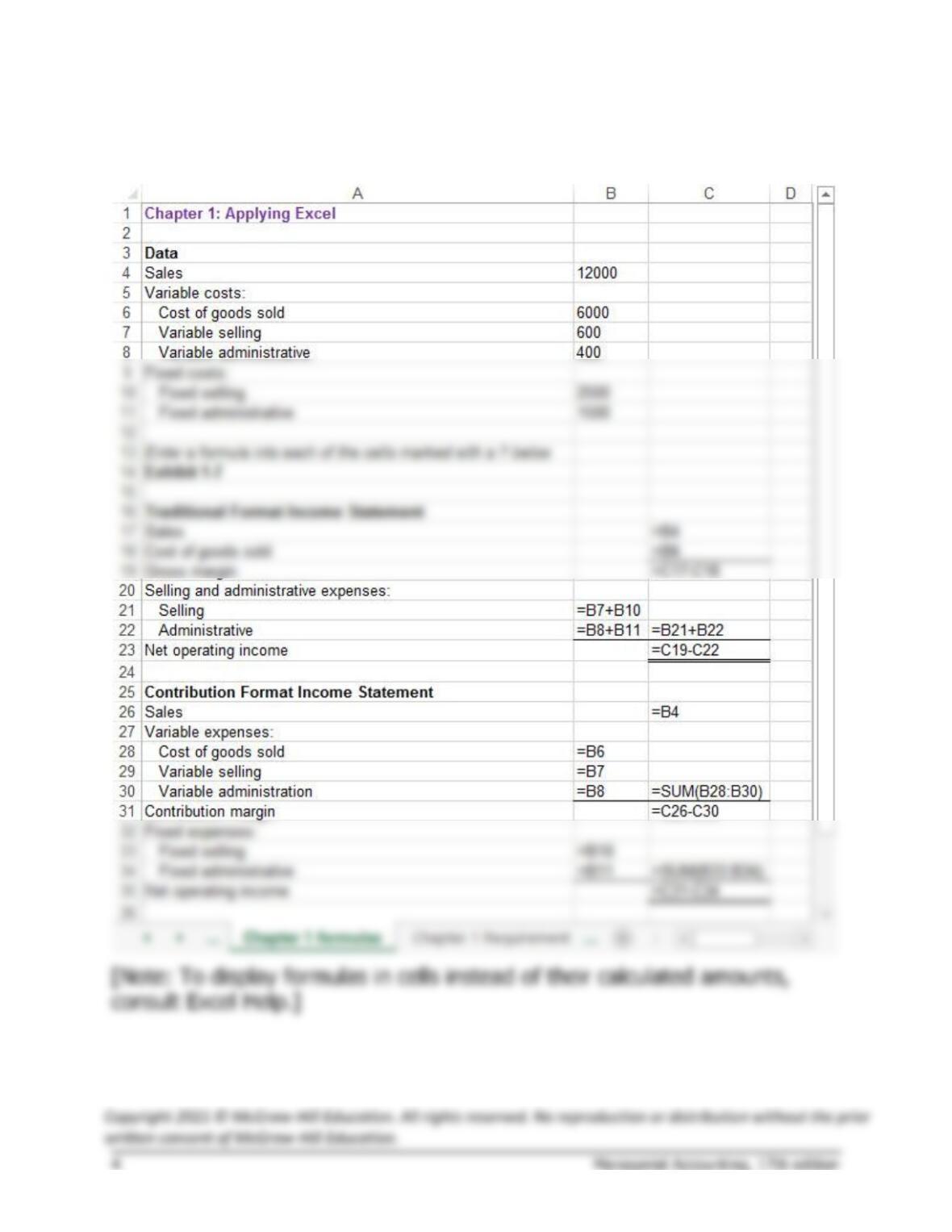
Chapter 1: Applying Excel (continued)
The completed worksheet, with formulas displayed, is shown below.
Chapter 1: Applying Excel (continued)
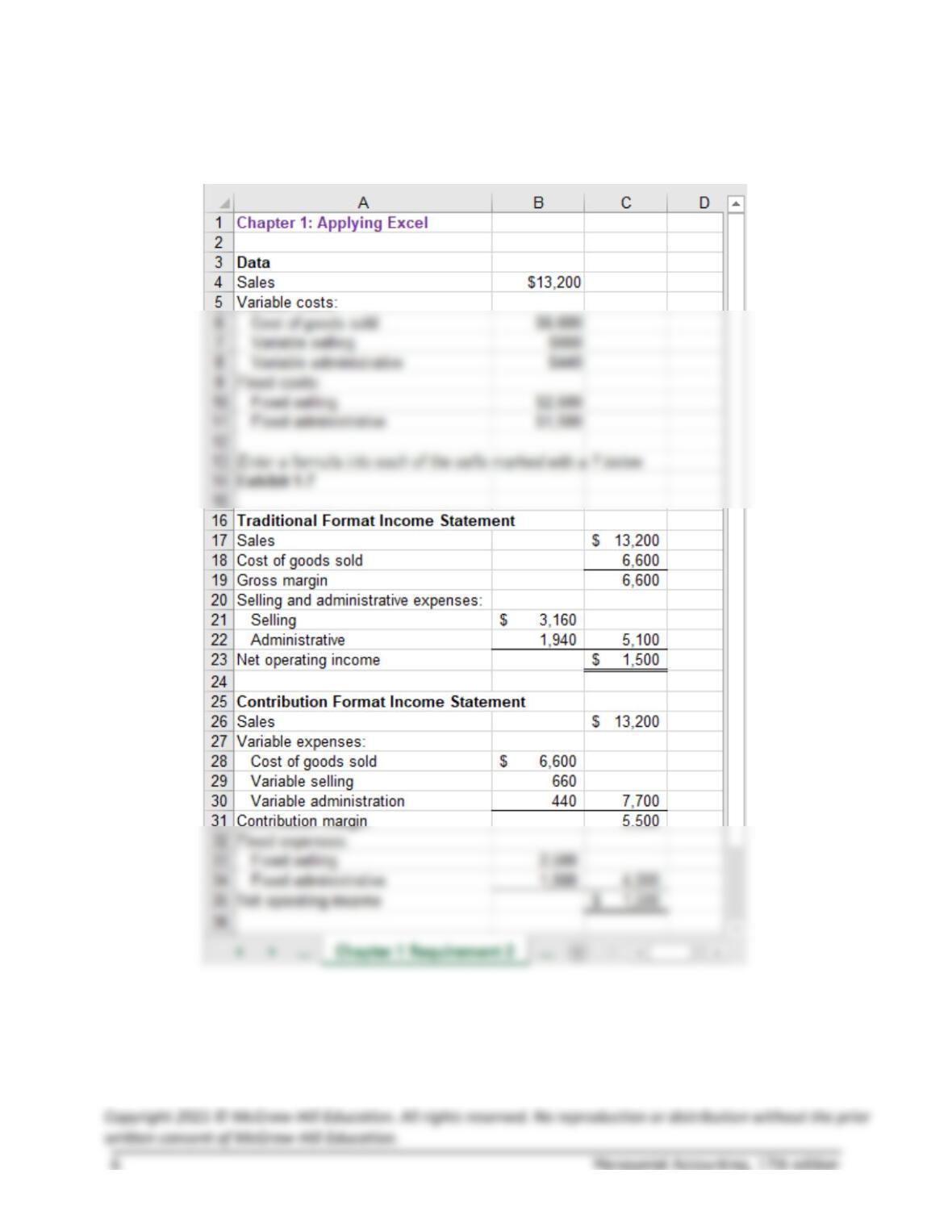
1. When the variable selling cost is changed to $900, the worksheet
changes as show below:
The gross margin is $6,000; the same as it was before. It did not
change because the variable selling expense is deducted
after
the gross
margin, not before it on the traditional format income statement.
Chapter 1: Applying Excel (continued)
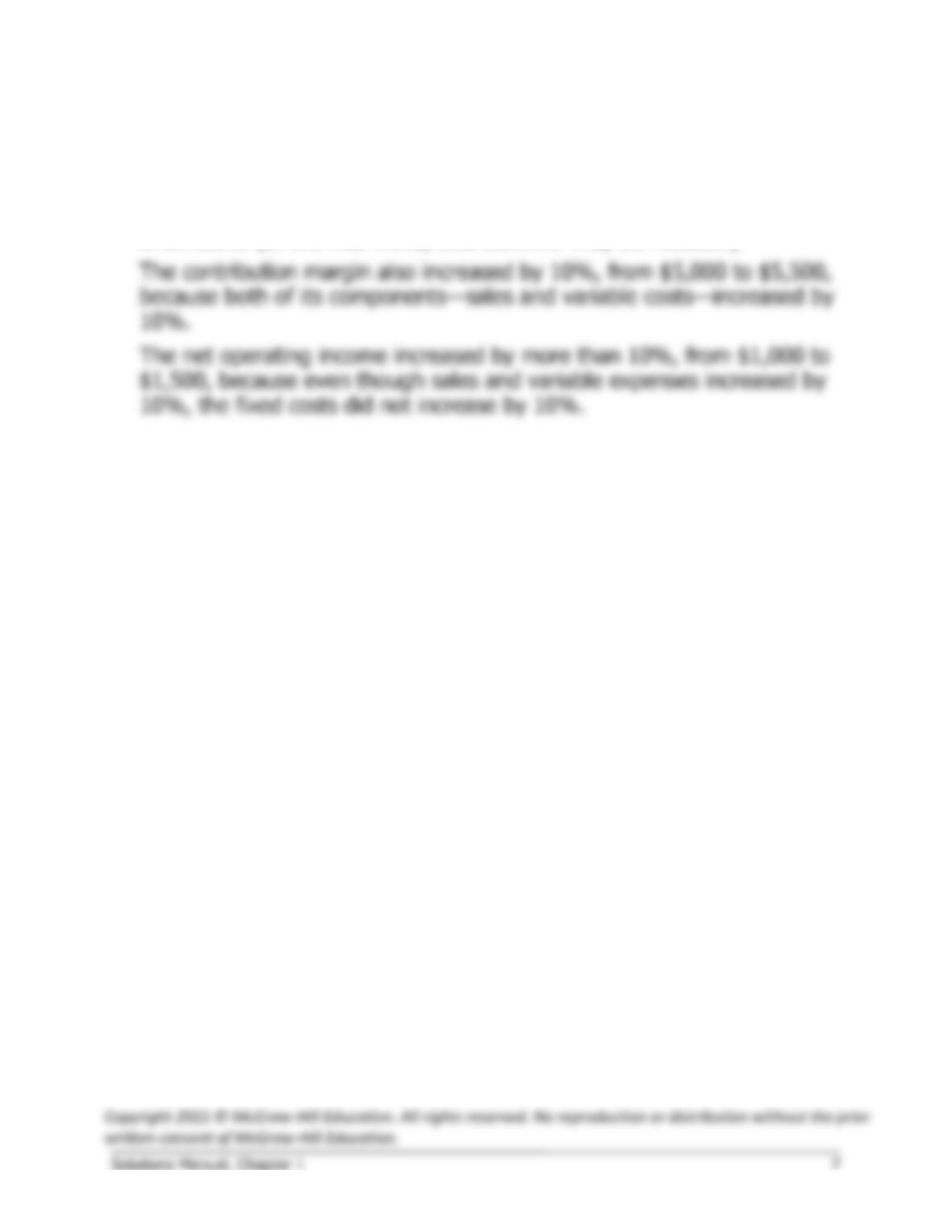
2. The new worksheet appears below:
Chapter 1: Applying Excel (continued)
The variable costs increased by 10% when the sales increased by 10%,
however the fixed costs did not increase at all. By definition, total
variable cost increases in proportion to activity whereas total fixed cost
is constant. (In the real world, cost behavior may be messier.)
The Foundational 15
1.
Direct materials …………………………………….
$ 6.00
Direct labor ………………………………………….
3.50
Variable manufacturing overhead ……………..
1.50
Variable manufacturing cost per unit …………
$11.00
Variable manufacturing cost per unit (a) …….
$11.00
Number of units produced (b) ………………….
10,000
Total variable manufacturing cost (a) × (b) …
$110,000
Number of units produced (d) ………………….
10,000
Total fixed manufacturing cost (c) × (d) …….
Total product (manufacturing) cost ……………
2.
Sales commissions ………………………………..
$1.00
Variable administrative expense ……………….
0.50
Variable selling and administrative per unit …
$1.50
Variable selling and admin. per unit (a) ……..
$1.50
Number of units sold (b) …………………………
10,000
Total variable selling and admin. expense
(a) × (b) ………………………………………..
$15,000
Number of units sold (d) …………………………
10,000
Total fixed selling and administrative
Total period (nonmanufacturing) cost ………..
The Foundational 15 (continued)
3.
Direct materials …………………………………
$ 6.00
Direct labor ………………………………………
3.50
Variable manufacturing overhead ………….
1.50
Sales commissions……………………………..
1.00
Variable administrative expense ……………
0.50
Variable cost per unit sold ……………………
$12.50
4.
Direct materials …………………………………
$ 6.00
Direct labor ………………………………………
3.50
Variable manufacturing overhead ………….
1.50
Sales commissions……………………………..
1.00
Variable administrative expense ……………
Variable cost per unit sold ……………………
$12.50
5.
Variable cost per unit sold (a) ………………
$12.50
Number of units sold (b) ……………………..
8,000
Total variable costs (a) × (b) ………………..
$100,000
6.
Variable cost per unit sold (a) ………………
$12.50
Number of units sold (b) ……………………..
12,500
Total variable costs (a) × (b) ………………..
$156,250
7.
Total fixed manufacturing cost
(see requirement 1) (a)…………………….
$40,000
Number of units produced (b) ………………
8,000
Average fixed manufacturing cost per unit
produced (a) ÷ (b) ………………………….
$5.00
8.
Total fixed manufacturing cost
(see requirement 1) (a)…………………….
$40,000
Number of units produced (b) ………………
12,500
Average fixed manufacturing cost per unit
9.
Total fixed manufacturing cost
(see requirement 1) …………………………
$40,000
The Foundational 15 (continued)
10.
Total fixed manufacturing cost
(see requirement 1) …………………………..
$40,000
11.
Variable overhead per unit (a) …………………
$1.50
Number of units produced (b) …………………
8,000
Total variable overhead cost (a) × (b) ………
Total fixed overhead (see requirement 1) …..
40,000
Total manufacturing overhead cost …………..
$52,000
Number of units produced (b) …………………
Manufacturing overhead per unit (a) ÷ (b) …
$6.50
12.
Variable overhead per unit (a) …………………
$1.50
Number of units produced (b) …………………
12,500
Total variable overhead cost (a) × (b) ………
$18,750
Total fixed overhead (see requirement 1) …..
40,000
Total manufacturing overhead cost …………..
$58,750
Total manufacturing overhead cost (a) ………
$58,750
Number of units produced (b) …………………
12,500
Manufacturing overhead per unit (a) ÷ (b) …
$4.70
13.
Selling price per unit ……………………………..
$22.00
Variable cost per unit sold
(see requirement 4) …………………………...
12.50
Contribution margin per unit …………………..
$ 9.50
The Foundational 15 (continued)
14.
Direct materials per unit ………………………..
$6.00
Direct labor per unit ……………………………..
3.50
Direct manufacturing cost per unit …………..
$9.50
Direct manufacturing cost per unit (a)
$9.50
Number of units produced (b) …………………
Total direct manufacturing cost (a) × (b) …..
15.
Direct materials per unit ………………………..
$6.00
Direct labor per unit ……………………………..
3.50
Variable manufacturing overhead per unit ….
1.50
Incremental cost per unit produced ………….
$11.00
Note: Variable selling and administrative expenses are variable with
respect to the number of units sold, not the number of units produced.
Exercise 1-1 (15 minutes)
Cost
Cost Object
Direct
Cost
Indirect
Cost
1.
The wages of pediatric
nurses
The pediatric
department
X
2.
Prescription drugs
A particular patient
X
3.
Heating the hospital
The pediatric
department
X
4.
The salary of the head
of pediatrics
The pediatric
department
X
5.
The salary of the head
of pediatrics
A particular pediatric
patient
X
6.
Hospital chaplain’s
salary
A particular patient
X
7.
Lab tests by outside
A particular patient
8.
Lab tests by outside
contractor
A particular
department
X
Exercise 1-2 (10 minutes)
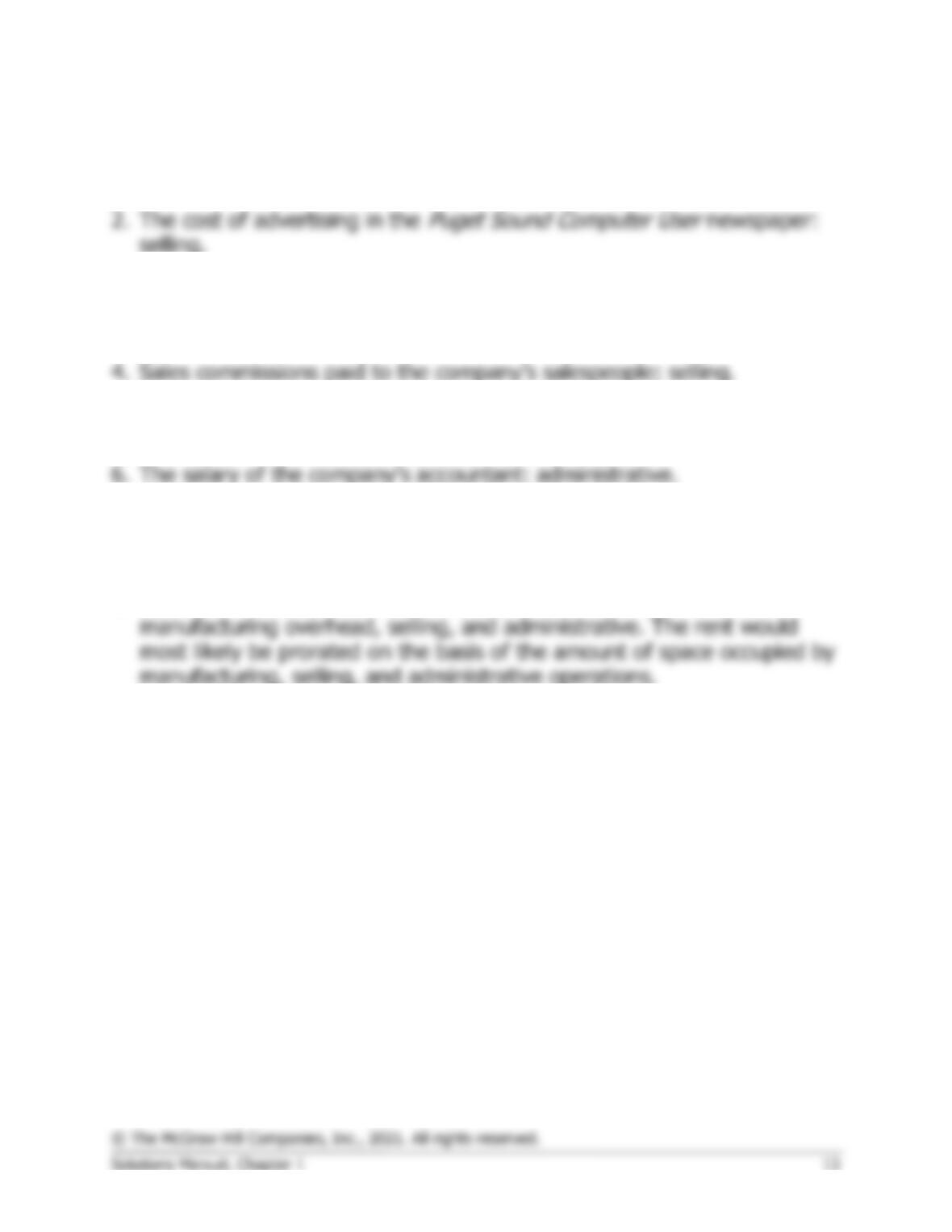
1. The cost of a hard drive installed in a computer: direct materials.
3. The wages of employees who assemble computers from components:
direct labor.
5. The salary of the assembly shop’s supervisor: manufacturing overhead.
7. Depreciation on equipment used to test assembled computers before
release to customers: manufacturing overhead.
8. Rent on the facility in the industrial park: a combination of
Exercise 1-3 (15 minutes)
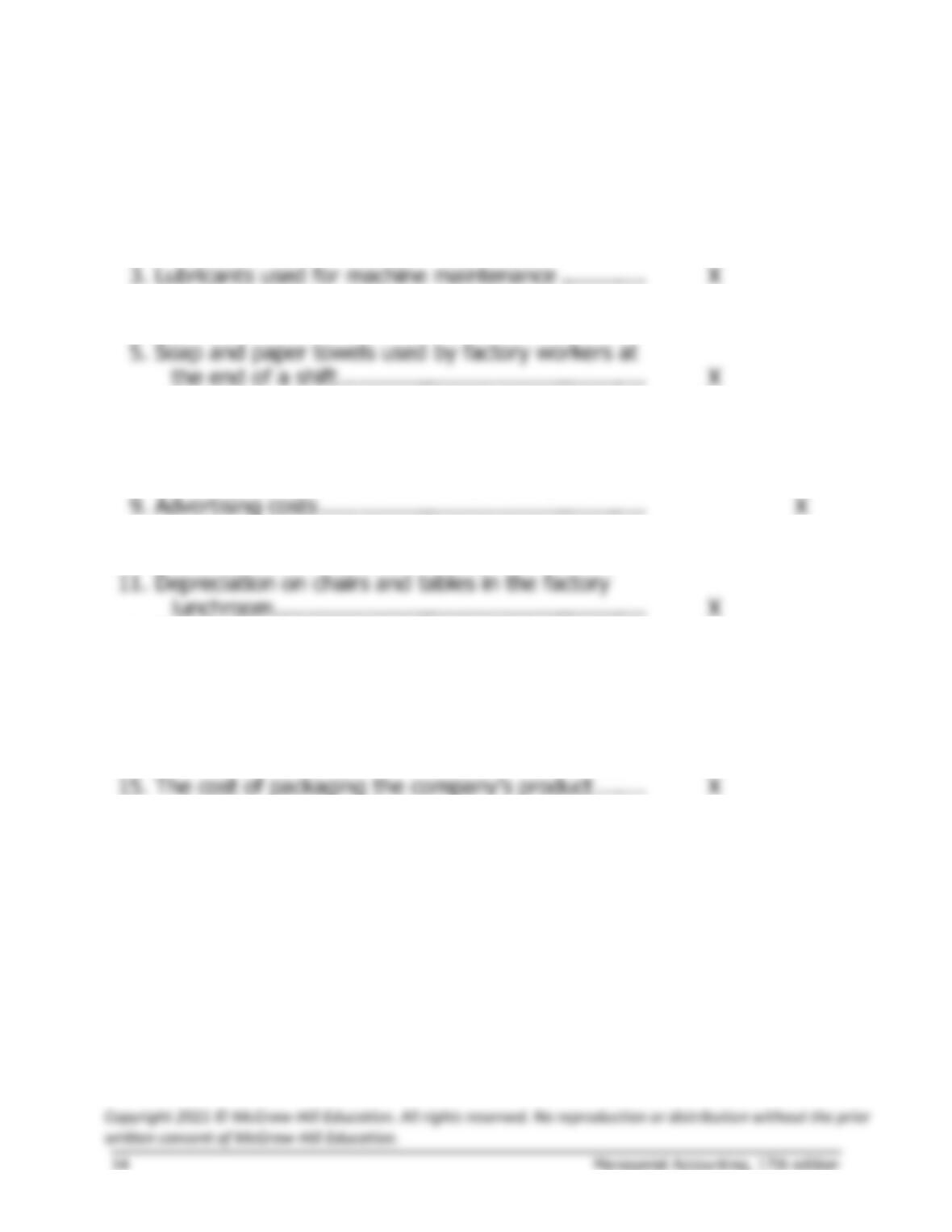
Product
Cost
Period
Cost
1.
Depreciation on salespersons’ cars ……………………
X
2.
Rent on equipment used in the factory ………………
X
3.
Lubricants used for machine maintenance ………….
X
4.
Salaries of personnel who work in the finished
goods warehouse ……………………………………….
X
5.
Soap and paper towels used by factory workers at
the end of a shift ………………………………………..
X
6.
Factory supervisors’ salaries …………………………….
X
7.
Heat, water, and power consumed in the factory …
X
8.
Materials used for boxing products for shipment
overseas (units are not normally boxed) ………….
X
9.
Advertising costs …………………………………………..
X
10.
Workers’ compensation insurance for factory
employees…………………………………………………
X
11.
Depreciation on chairs and tables in the factory
lunchroom …………………………………………………
X
12.
The wages of the receptionist in the administrative
offices ………………………………………………………
X
13.
Cost of leasing the corporate jet used by the
company’s executives ………………………………….
X
14.
The cost of renting rooms at a Florida resort for the
annual sales conference ……………………………….
X
The cost of packaging the company’s product ……..
X
Exercise 1-4 (15 minutes)
1.
Cups of Coffee Served
in a Week
2,000
2,100
2,200
Fixed cost …………………………...
$1,200
$1,200
$1,200
Variable cost ………………………..
440
462
484
Total cost …………………………...
$1,640
$1,662
$1,684
Average cost per cup served * …
$0.820
$0.791
$0.765
* Total cost ÷ cups of coffee served in a week
2. The average cost of a cup of coffee decreases as the number of cups of
Exercise 1-5 (15 minutes)
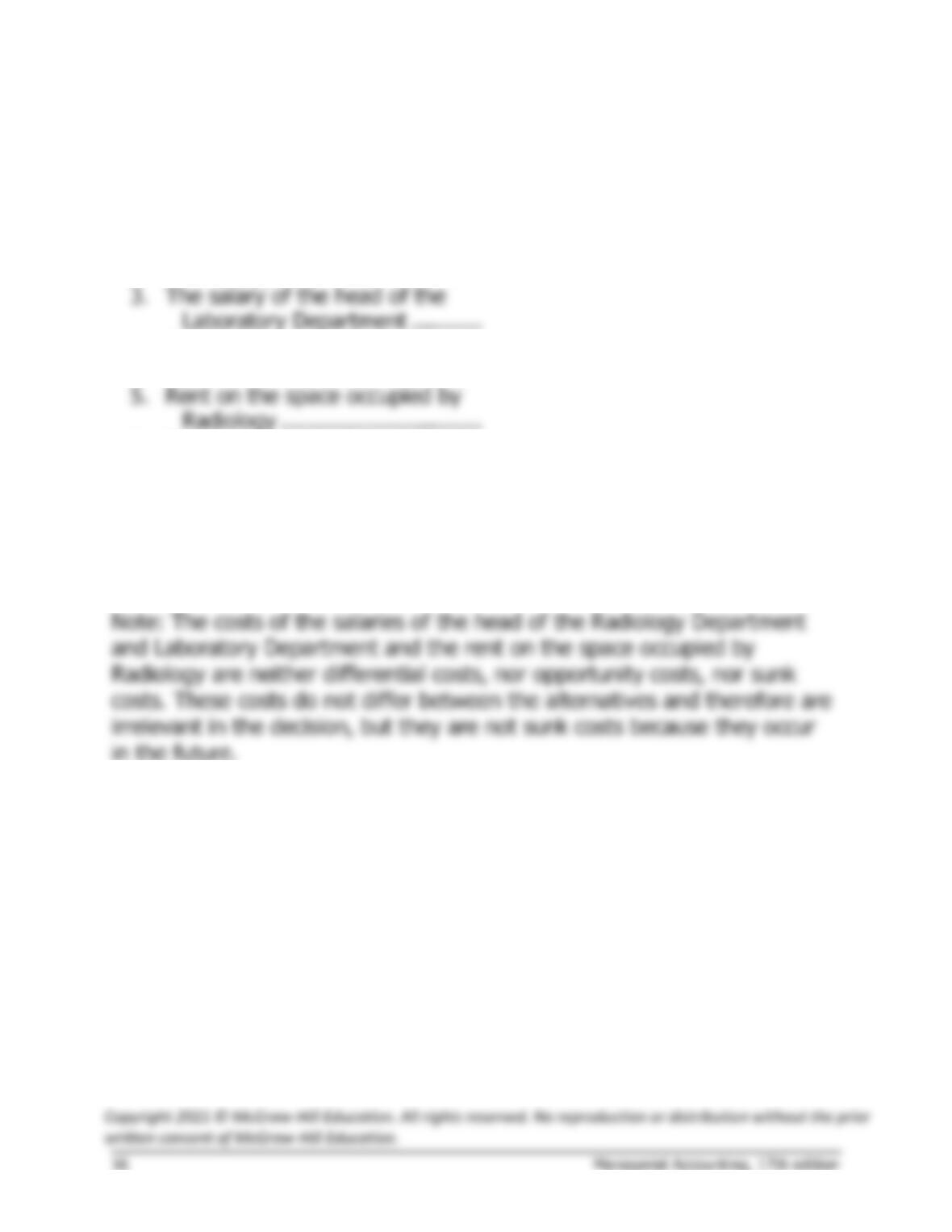
Item
Differential
Cost
Sunk
Cost
Opportunity
Cost
1.
Cost of the old X-ray machine ….
X
2.
The salary of the head of the
Radiology Department ………….
3.
The salary of the head of the
4.
Cost of the new color laser
printer ………………………………
X
5.
Rent on the space occupied by
Radiology ………………………….
6.
The cost of maintaining the old
machine …………………………...
X
7.
Benefits from a new DNA
analyzer …………………………...
X
8.
Cost of electricity to run the X-
ray machines ……………………..
X
Exercise 1-6 (15 minutes)
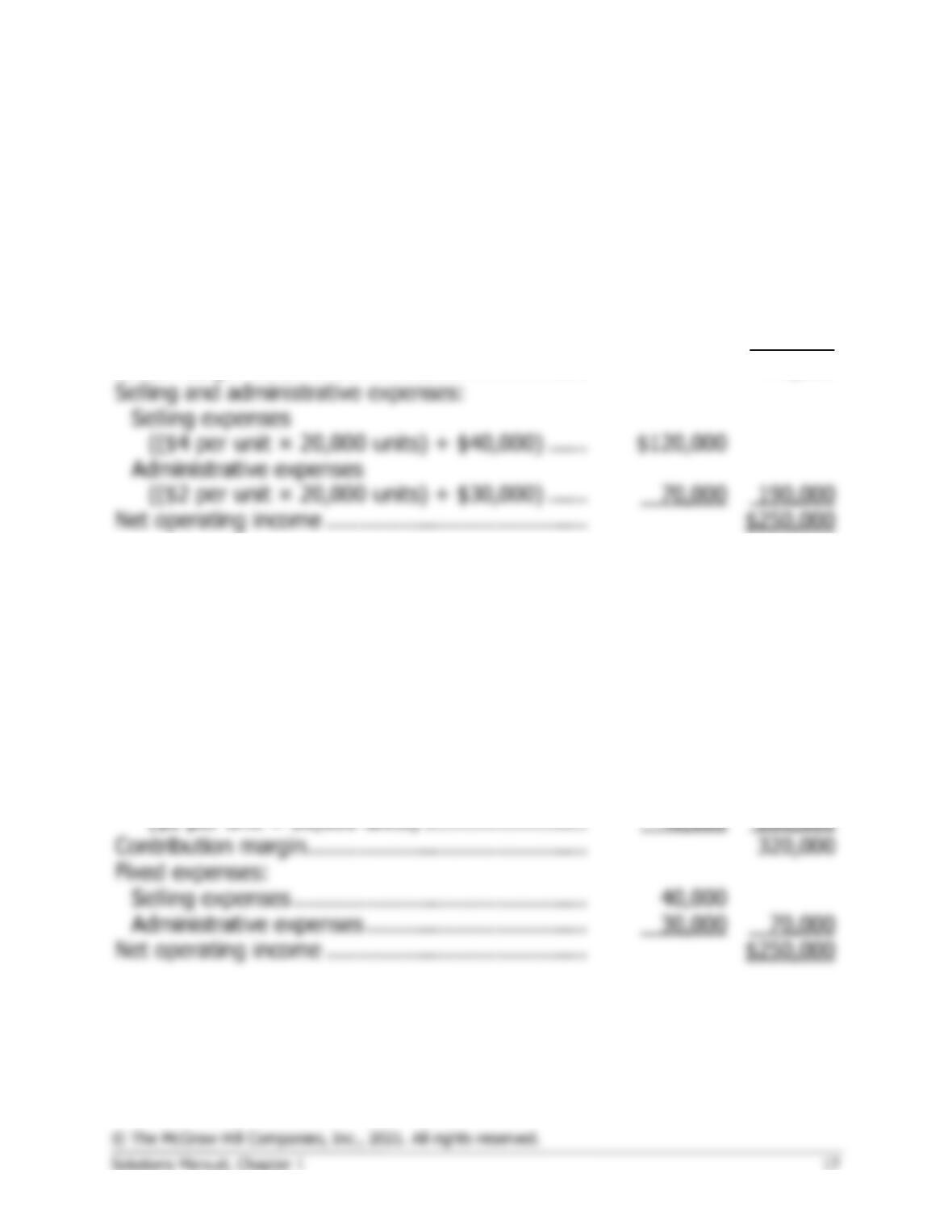
1. Traditional income statement
Cherokee Inc.
Traditional Income Statement
Sales ($30 per unit × 20,000 units) ………………..
$600,000
Cost of goods sold
($24,000 + $180,000 – $44,000) …………………
160,000
Gross margin …………………………..………………..
440,000
Selling and administrative expenses:
$120,000
Administrative expenses
(($2 per unit × 20,000 units) + $30,000) ……
Net operating income ………………………………….
$250,000
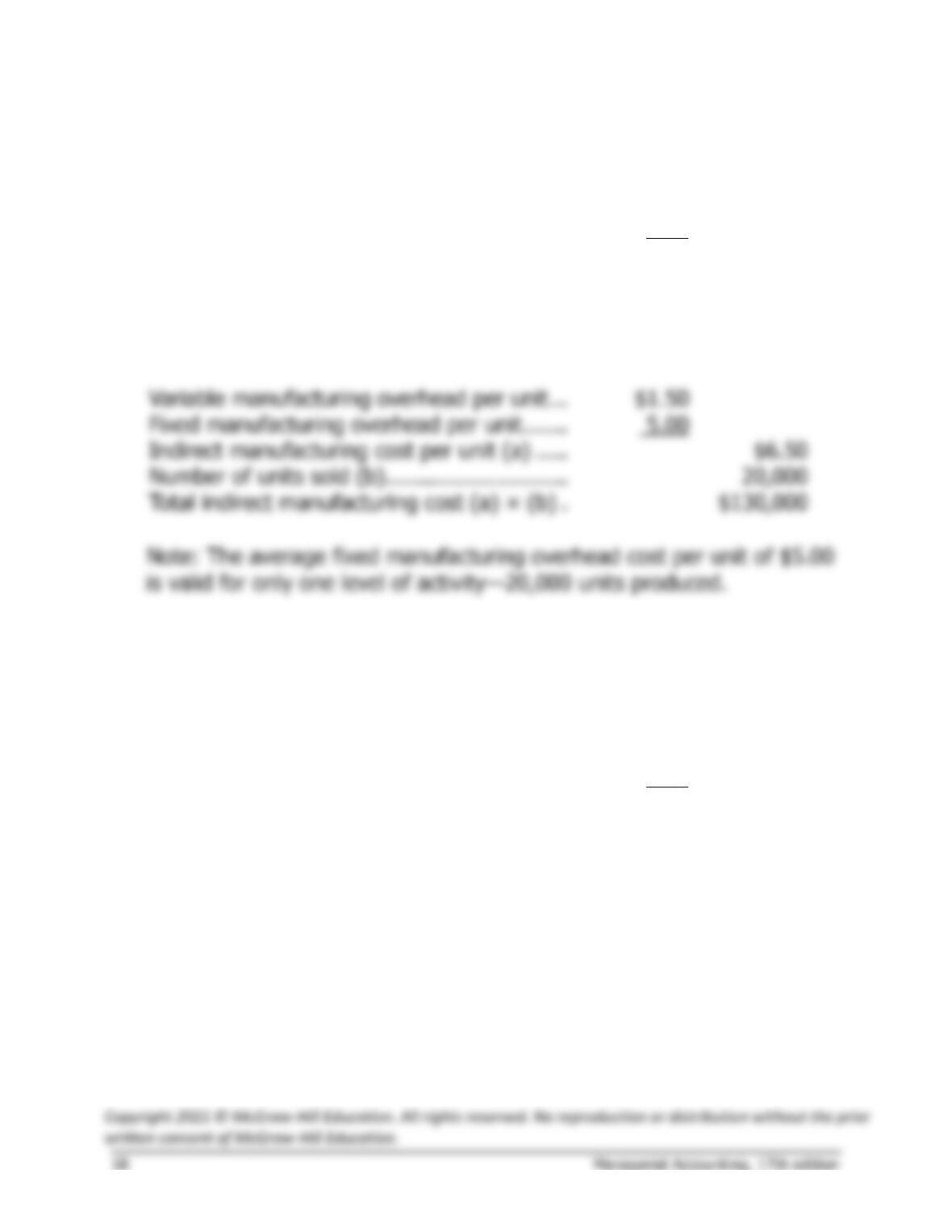
2. Contribution format income statement
Cherokee Inc.
Contribution Format Income Statement
Sales ($30 per unit × 20,000 units) ………………..
$600,000
Variable expenses:
Cost of goods sold
($24,000 + $180,000 – $44,000) ………………
$160,000
Selling expenses ($4 per unit × 20,000 units) …
80,000
Administrative expenses
Contribution margin …………………………………….
Fixed expenses:
Selling expenses ………………………………………
40,000
Administrative expenses …………………………….
Net operating income ………………………………….
Exercise 1-7 (20 minutes)
1a. The total direct manufacturing cost incurred is computed as follows:
Direct materials per unit ……………………….
$7.00
Direct labor per unit …………………………....
4.00
Direct manufacturing cost per unit (a) ……..
$11.00
Number of units sold (b) ……………………….
20,000
Total direct manufacturing cost (a) × (b) ….
$220,000
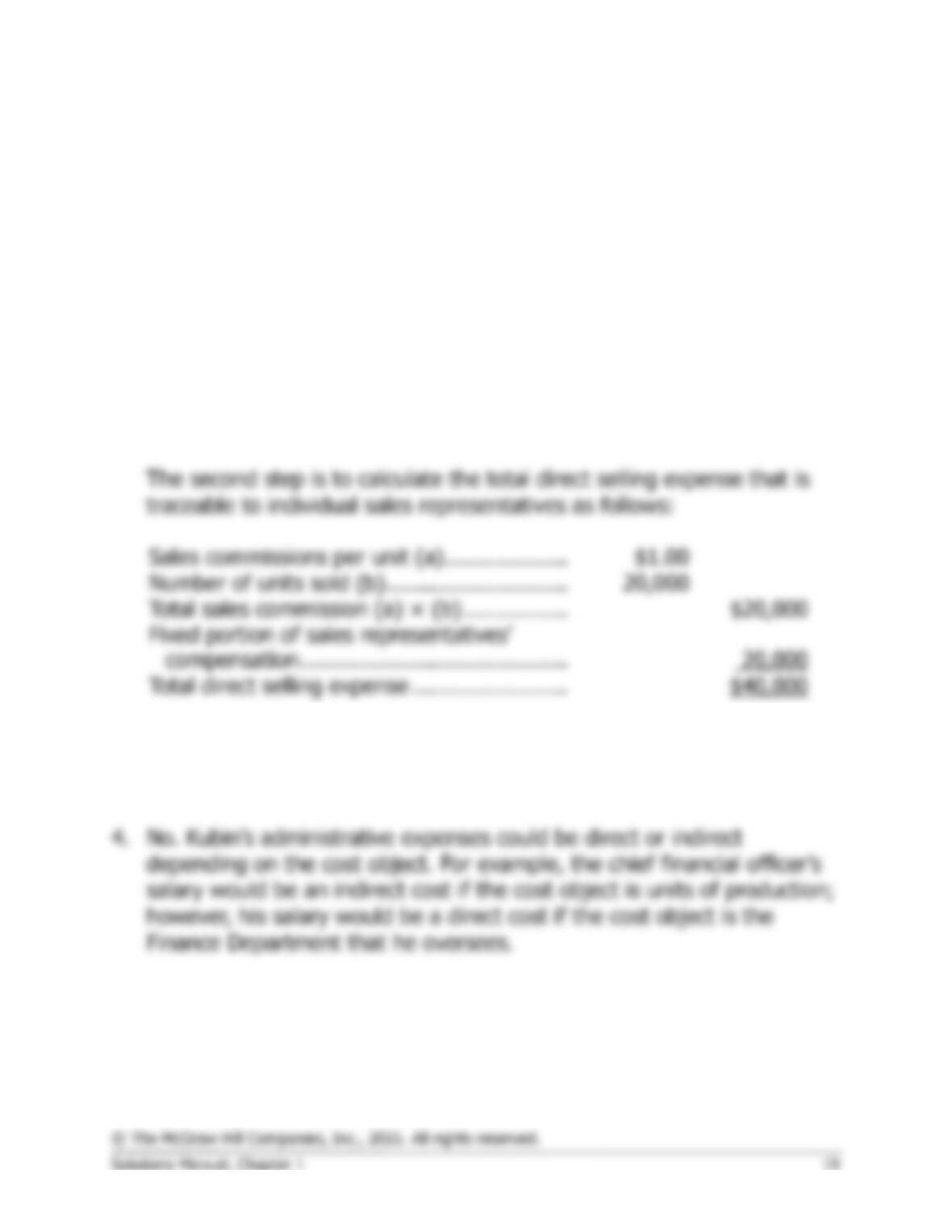
1b. The total indirect manufacturing cost incurred is computed as follows:
Variable manufacturing overhead per unit …
Fixed manufacturing overhead per unit …….
Indirect manufacturing cost per unit (a) …..
Number of units sold (b) ……………………….
20,000
Total indirect manufacturing cost (a) × (b) .
2a. The total manufacturing cost that is directly traceable to the
Manufacturing Department is computed as follows:
Direct materials per unit ……………………….
$7.00
Direct labor per unit …………………………....
4.00
Variable manufacturing overhead per unit …
1.50
Fixed manufacturing overhead per unit …….
5.00
Total manufacturing cost per unit (a) ……….
$17.50
Number of units sold (b) ……………………….
20,000
Total direct costs (a) × (b) …………………….
$350,000
2b. None of the manufacturing costs should be treated as indirect costs
when the cost object is the Manufacturing Department.
Exercise 1-7 (continued)
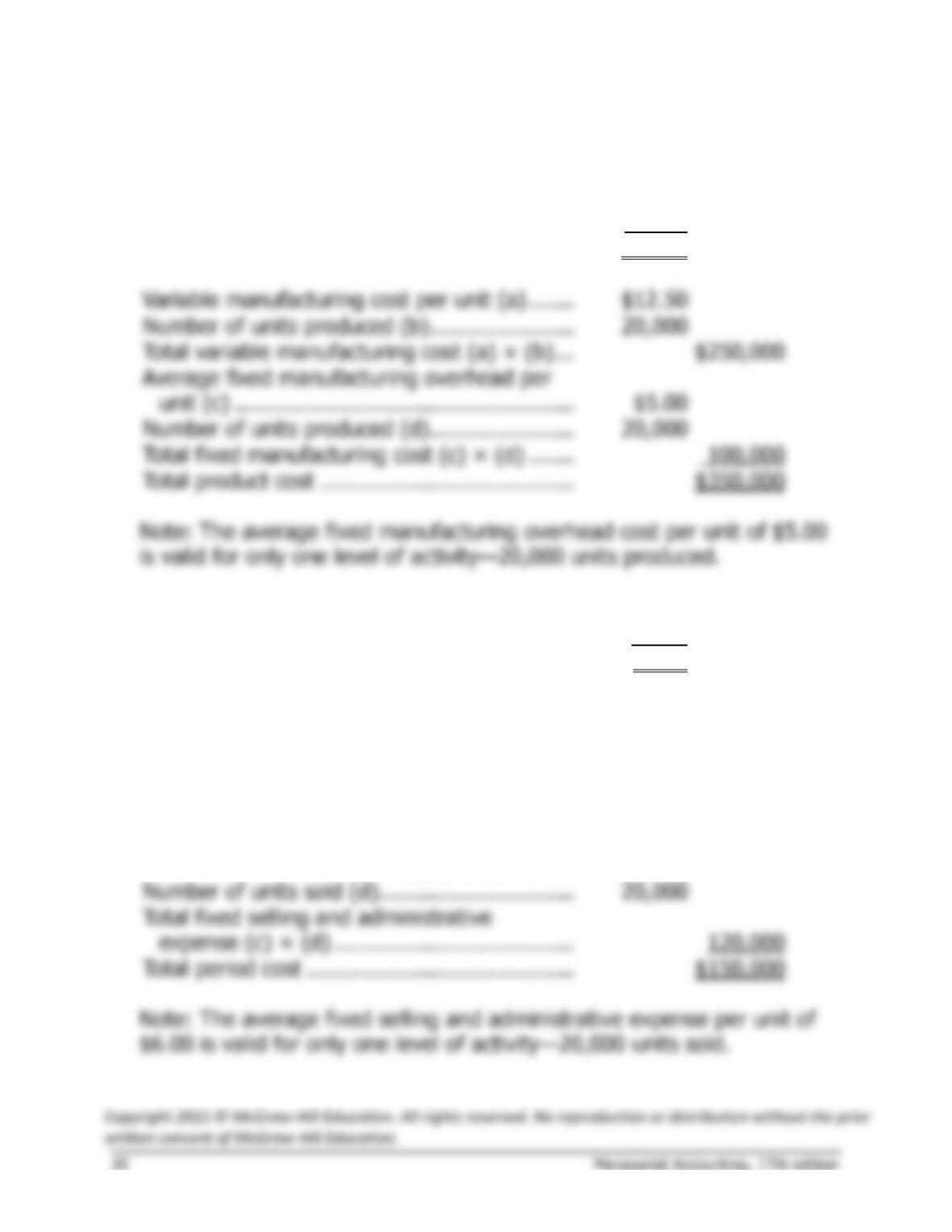
3a. The first step in calculating the total direct selling expense is to
determine the fixed portion of the sales representatives’ compensation
as follows:
Fixed selling expense per unit (a) ……………
$3.50
Number of units sold (b) ……………………….
20,000
Total fixed selling expense (a) × (b) ………..
$70,000
Total fixed selling expense (a) ………………..
$70,000
Advertising expenditures (b) ………………….
$50,000
Total fixed portion of the sales
representatives’ compensation (a) ‒ (b) …
$20,000
Sales commissions per unit (a) ……………….
Number of units sold (b) ……………………….
Total sales commission (a) × (b) …………….
Total direct selling expense ……………………
3b. The total indirect selling expense that cannot be traced to individual
sales representatives is $50,000. The advertising expenditures cannot
be traced to specific sales representatives.
Exercise 1-8 (20 minutes)
1.
Direct materials …………………………………….
$ 7.00
Direct labor ………………………………………….
4.00
Variable manufacturing overhead ……………..
1.50
Variable manufacturing cost per unit …………
$12.50
Variable manufacturing cost per unit (a) …….
Number of units produced (b) ………………….
Total variable manufacturing cost (a) × (b) …
Number of units produced (d) ………………….
Total fixed manufacturing cost (c) × (d) …….
Total product cost …………………………………
2.
Sales commissions ………………………………..
$1.00
Variable administrative expense ……………….
0.50
Variable selling and administrative per unit …
$1.50
Variable selling and admin. per unit (a) ……..
$1.50
Number of units sold (b) …………………………
20,000
Total variable selling and admin. expense
(a) × (b) ………………………………………..
$30,000
Average fixed selling and administrative
expense per unit ($3.50 fixed selling +
$2.50 fixed administrative) (c) ……………….
$6.00
Number of units sold (d) …………………………
Total period cost …………………………………..