CHAPTER 1
Introduction to Financial Statements
Learning Objectives
1. Describe the primary forms of business organization.
2. Identify the users and uses of accounting information.
3. Explain the three principal types of business activity.
4. Describe the content and purpose of each of the financial statements.
5. Explain the meaning of assets, liabilities, and stockholders’ equity, and state the basic
accounting equation.
6. Describe the components that supplement the financial statements in an annual report.
Summary of Questions by Learning Objectives and Bloom’s Taxonomy
Item LO BT Item LO BT Item LO BT Item LO BT Item LO BT
Questions
1. 1 K 6. 2 C 10. 4 C 14. 5 K 18. 6 K
2. 1 K 7. 3 C 11. 4 K 15. 5 K 19. 6 C
Brief Exercises
1. 1 K 4. 4 C 6. 4, 5 K 8. 5 AP 10. 5 K
2. 2 K 5. 4, 5 AP 7. 4 K 9. 5 AP 11. 6 K
3. 3 K
Do It! Review Exercises
1. 1 C 2. 3 K 3. 4,5 AP 4. 6 C
Exercises
1. 1, 2,
4, 6
K
5. 4 AP 9. 4, 5 AP 12. 5 AP 15. 5 AP
Problems: Set A
1. 1 C 2. 2, 4,
5
K
3. 4, 5 AP 4. 4, 5 AP 5. 4, 5 AP
Problems: Set B
ASSIGNMENT CHARACTERISTICS TABLE
Problem
Number
Description
Difficulty
Level
Time
Allotted (min.)
1A Determine forms of business organization. Simple 15–20
2A Identify users and uses of financial statements. Simple 15–20
3A Prepare an income statement, retained earnings
statement, and balance sheet; discuss results.
Moderate 40–50
4A Determine items included in a statement of cash flows,
prepare the statement, and comment.
Moderate 30–40
5A Comment on proper accounting treatment and prepare
a corrected balance sheet.
Moderate 40–50
1B Determine forms of business organization. Simple 15–20
ANSWERS TO QUESTIONS
1. The three basic forms of business organizations are (1) sole proprietorship, (2) partnership,
and (3) corporation.
2. Advantages of a corporation are limited liability (stockholders not being personally liable for
corporate debts), easy transferability of ownership, and ease of raising funds. Disadvantages
of a corporation are increased taxation and government regulations.
3. Proprietorships and partnerships receive favorable tax treatment compared to corporations and
are easier to form than corporations. They are also owner controlled. Disadvantages of
proprietorships and partnerships are unlimited liability (proprietors/partners are personally
liable for all debts) and difficulty in obtaining financing compared to corporations.
6. External users are those outside the business who have either a present or potential direct
financial interest (investors and creditors) or an indirect financial interest (taxing authorities,
regulatory agencies, labor unions, customers, and economic planners).
7. The three types of business activities are financing activities, investing activities, and operating
activities. Financing activities include borrowing money and selling shares of stock. Investing
activities include the purchase and sale of property, plant, and equipment. Operating activities
include selling goods, performing services, and purchasing inventory.
8. (a) Income statement. (d) Balance sheet.
(b) Balance sheet. (e) Balance sheet.
(c) Income statement. (f) Balance sheet.
9. When a company pays dividends, it reduces the amount of assets available to pay creditors.
Therefore, banks and other creditors monitor dividend payments to ensure they do not put a
company’s ability to make debt payments at risk.
Questions Chapter 1 (Continued)
12. The three categories of the statement of cash flows are operating activities, investing activities,
and financing activities. The categories were chosen because they represent the three
principal types of business activities.
13. Retained earnings is the net income retained in a corporation. Retained earnings is increased
by net income and is decreased by dividends and a net loss.
14. The basic accounting equation is Assets = Liabilities + Stockholders’ Equity.
16. The liabilities are (b) Accounts payable and (g) Salaries and wages payable.
17. (a) Net income from the income statement is reported as an increase to retained earnings on
the retained earnings statement.
(b) The ending amount on the retained earnings statement is reported as the retained
earnings amount on the balance sheet.
(c) The ending amount on the statement of cash flows is reported as the cash amount on the
balance sheet.
18. The purpose of the management discussion and analysis section is to provide
management’s views on its ability to pay short-term obligations, its ability to fund operations
and expansion, and its results of operations. The MD&A section is a required part of the
annual report.
21. Using dollar amounts, Tootsie Roll’s accounting equation is:
Assets = Liabilities + Stockholders’ Equity
$857,856,000 $191,921,000* $665,935,000
SOLUTIONS TO BRIEF EXERCISES
BRIEF EXERCISE 1-1
(a) P Shared control, tax advantages, increased skills and
resources.
BRIEF EXERCISE 1-2
(a) 4 Investors in common stock
(b) 3 Marketing managers
BRIEF EXERCISE 1-3
O (a) Cash received from customers.
F (b) Cash paid to stockholders (dividends).
BRIEF EXERCISE 1-4
E (a) Advertising expense
R (b) Service revenue
BRIEF EXERCISE 1-5
BURNETT COMPANY
Balance Sheet
December 31, 2014
Assets
Cash …………………………………………………………………….. $22,000
Accounts receivable ……………………………………………… 71,000
Total assets ………………………………………………………….. $93,000
Liabilities and Stockholders’ Equity
Liabilities
BRIEF EXERCISE 1-6
IS (a) Income tax expense
BS (b) Inventory
BRIEF EXERCISE 1-7
IS (a) Revenue during the period.
BRIEF EXERCISE 1-8
(a) $90,000 + $230,000 = $320,000 (Total assets)
BRIEF EXERCISE 1-9
(a) ($800,000 + $150,000) – ($500,000 – $80,000) = $530,000
(Stockholders’ equity)
BRIEF EXERCISE 1-10
A (a) Accounts receivable
L (b) Salaries and wages payable
SOLUTIONS TO DO IT! REVIEW EXERCISES
DO IT! 1-1
(a) Easier to transfer ownership: corporation
(b) Easier to raise funds: corporation
DO IT! 1-2
(a) Issuance of ownership shares is classified as common stock.
(b) Land purchased is classified as an asset.
(c) Amounts owed to suppliers are classified as liabilities.
DO IT! 1-3
MARSH CORPORATION
Income Statement
For the Year Ended December 31, 2014
Revenues
Service revenue …………………………………….. $25,000
Expenses
Rent expense ………………………………………… $10,000
DO IT! 1-3 (Continued)
MARSH CORPORATION
Retained Earnings Statement
For the Year Ended December 31, 2014
Retained earnings, January 1 ……………………………. $ –0–
Add: Net income …………………………………………….. 9,300
MARSH CORPORATION
Balance Sheet
December 31, 2014
Assets
Cash ………………………………………………………………… $ 3,100
Accounts receivable …………………………………………. 2,000
Supplies …………………………………………………………… 1,900
Equipment ………………………………………………………… 26,800
Total assets ……………………………………………………… $33,800
Liabilities and Stockholders’ Equity
Liabilities
Notes payable ……………………………………………. $ 7,000
Account payable ………………………………………… 5,000
DO IT! 1-4
(1) Description of ability to pay near-term obligations: MD&A
(2) Unqualified opinion: auditor’s report
(3) Details concerning liabilities, too voluminous to be included in the
SOLUTIONS TO EXERCISES
EXERCISE 1-1
(a) 8. Auditor’s opinion
(b) 1. Corporation
(c) 6. Common stock
EXERCISE 1-2
(a) Answers will vary.
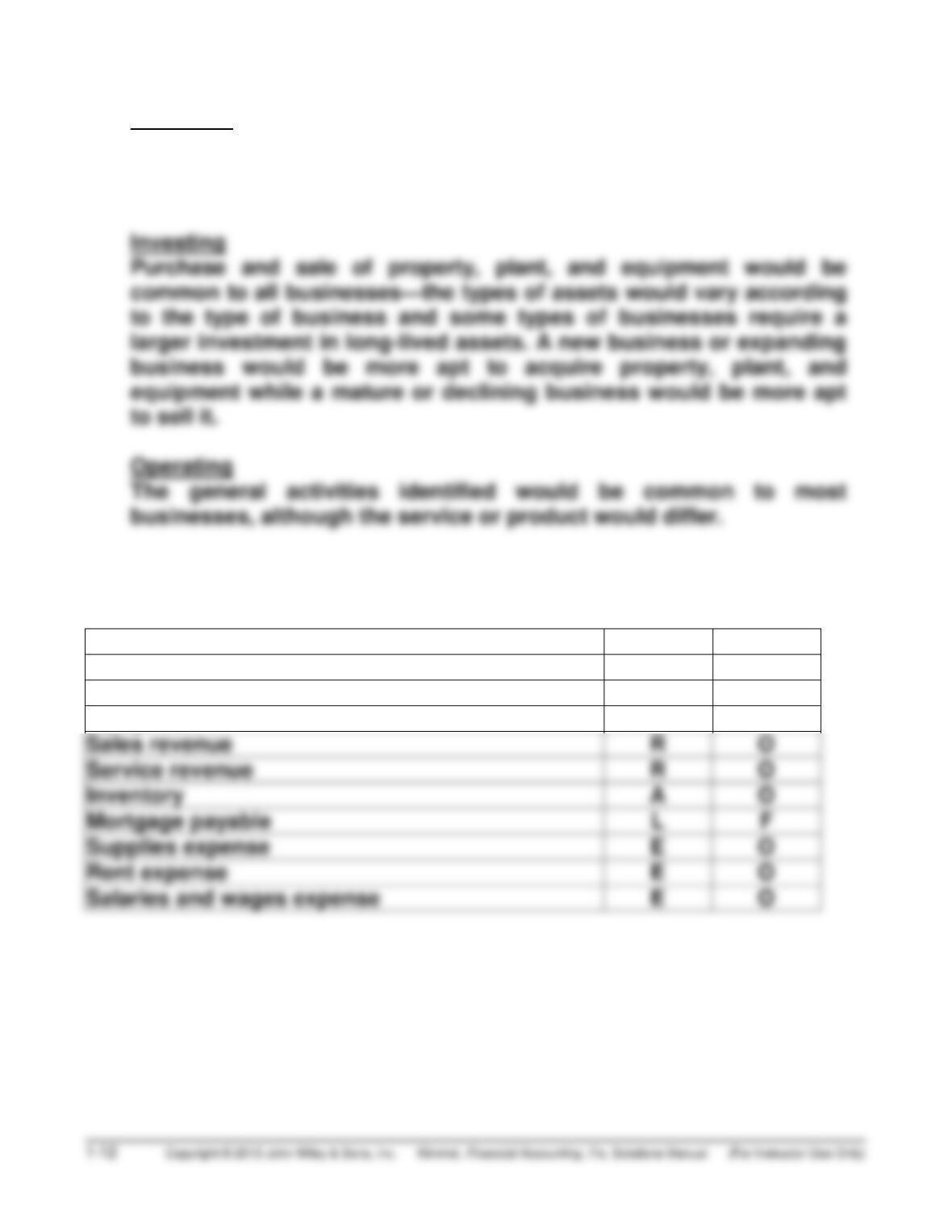
Financing Investing Operating
Abitibi Consolidated
Inc.
Sale of stock Purchase long-term
investments
Sale of
newsprint
Cal State—Northridge
Stdt Union
Borrow money
from a bank
Purchase office
equipment
Payment of
wages and
benefits
Oracle Corporation Sale of bonds Purchase other
companies
Payment of
research
EXERCISE 1-2 (Continued)
(b) Financing
Sale of stock is common to all corporations. Borrowing from a bank
is common to all businesses. Payment of dividends is common to all
corporations. Sale of bonds is common to large corporations.
EXERCISE 1-3
(a) (b)
Accounts payable L O
Accounts receivable
A
O
Equipment
A
I
A
EXERCISE 1-4
MOLINA CO.
Income Statement
For the Year Ended December 31, 2014
Revenues
Service revenue ………………………………………………. $58,000
Expenses
Salaries and wages expense ……………………………. $30,000
MOLINA CO.
Retained Earnings Statement
For the Year Ended December 31, 2014
Retained earnings, January 1 …………………………………………………. $67,000
Add: Net income ………………………………………………………………….. 13,400
EXERCISE 1-5
(a) MERCK AND CO.
Income Statement
For the Year Ended December 31, 2014
(in millions)
Revenues
Sales revenue ………………………………………….. $38,576.0
Expenses
Cost of goods sold ………………………………….. $ 9,018.9
MERCK AND CO.
Retained Earnings Statement
For the Year Ended December 31, 2014
(in millions)
Retained earnings, January 1 …………………………… $43,698.8
(b) The short-term implication would be a decrease in expenses of
$2,922.5 ($5,845 X 50%) resulting in a corresponding increase in income
EXERCISE 1-5 (Continued)
The long-term implications would be more difficult to quantify but it
is safe to predict that a reduction in research and development
expenses would probably result in lower sales revenues in the future.
Pharmaceutical companies are usually able to charge higher prices
EXERCISE 1-6
DEVITO INC.
Retained Earnings Statement
For the Year Ended December 31, 2014
Retained earnings, January 1 …………………………… $130,000
Add: Net income ……………………………………………. 225,000*
355,000
EXERCISE 1-7
(a) Grant Corporation is distributing nearly all of this year’s net income
as dividends. This suggests that Grant is not pursuing rapid growth.
Companies that have a lot of opportunities for growth pay low
dividends.
EXERCISE 1-8
(a) A Cash
SE Retained earnings
E Cost of goods sold
(b) MOTTE INC.
Income Statement
For the Year Ended December 31, 2014
Revenues
Sales revenue ………………………………… $584,951
Service revenue …………………………….. 4,806
Total revenues ……………………………. $589,757
EXERCISE 1-9
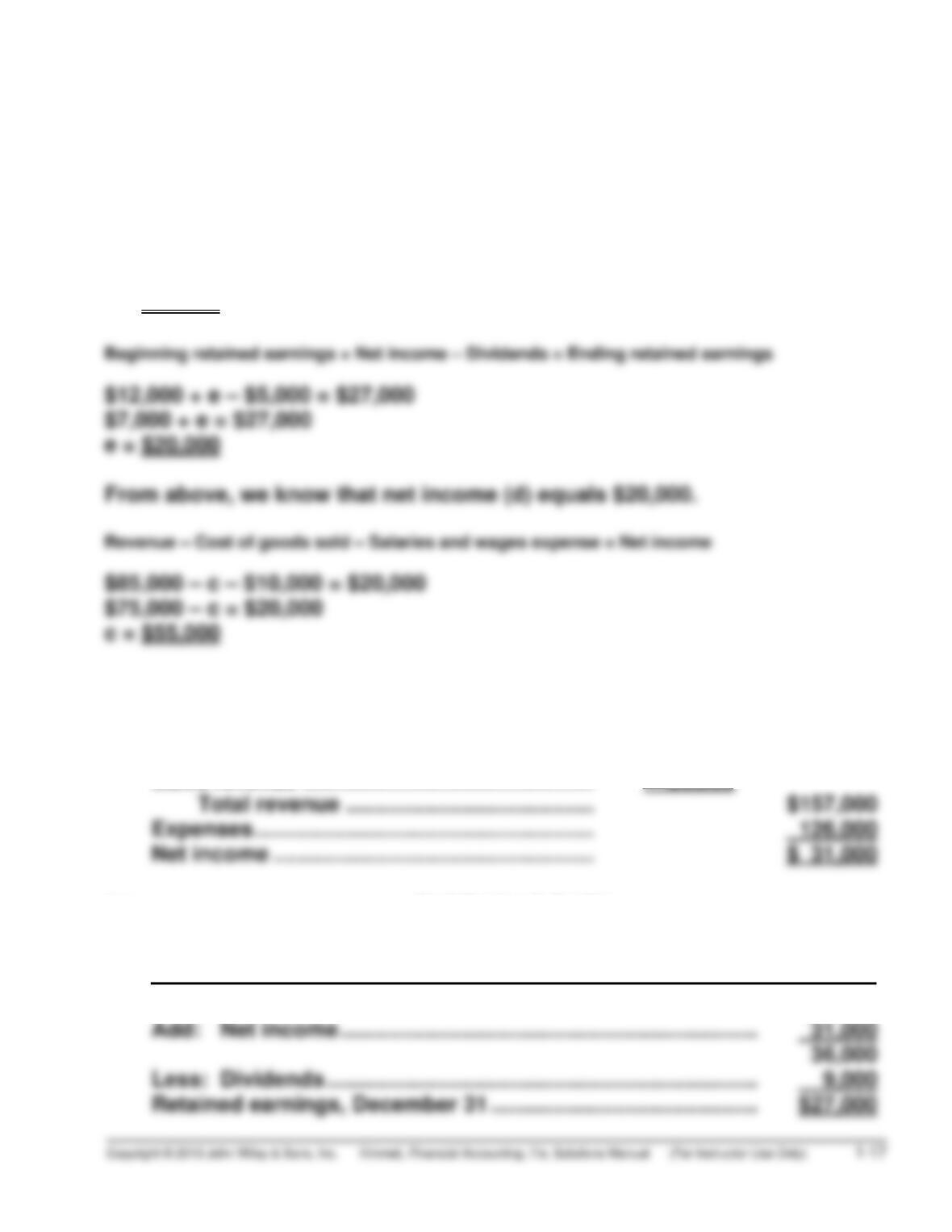
First note that the retained earnings statement shows that (b) equals
$27,000.
Accounts payable + Common stock + Retained earnings = Total liabilities and stockholders’
equity
$5,000 + a + $27,000 = $62,000
a + $32,000 = $62,000
a = $30,000
EXERCISE 1-10
(a) Service revenue ……………………………………… $132,000
Sales revenue ………………………………………… 25,000
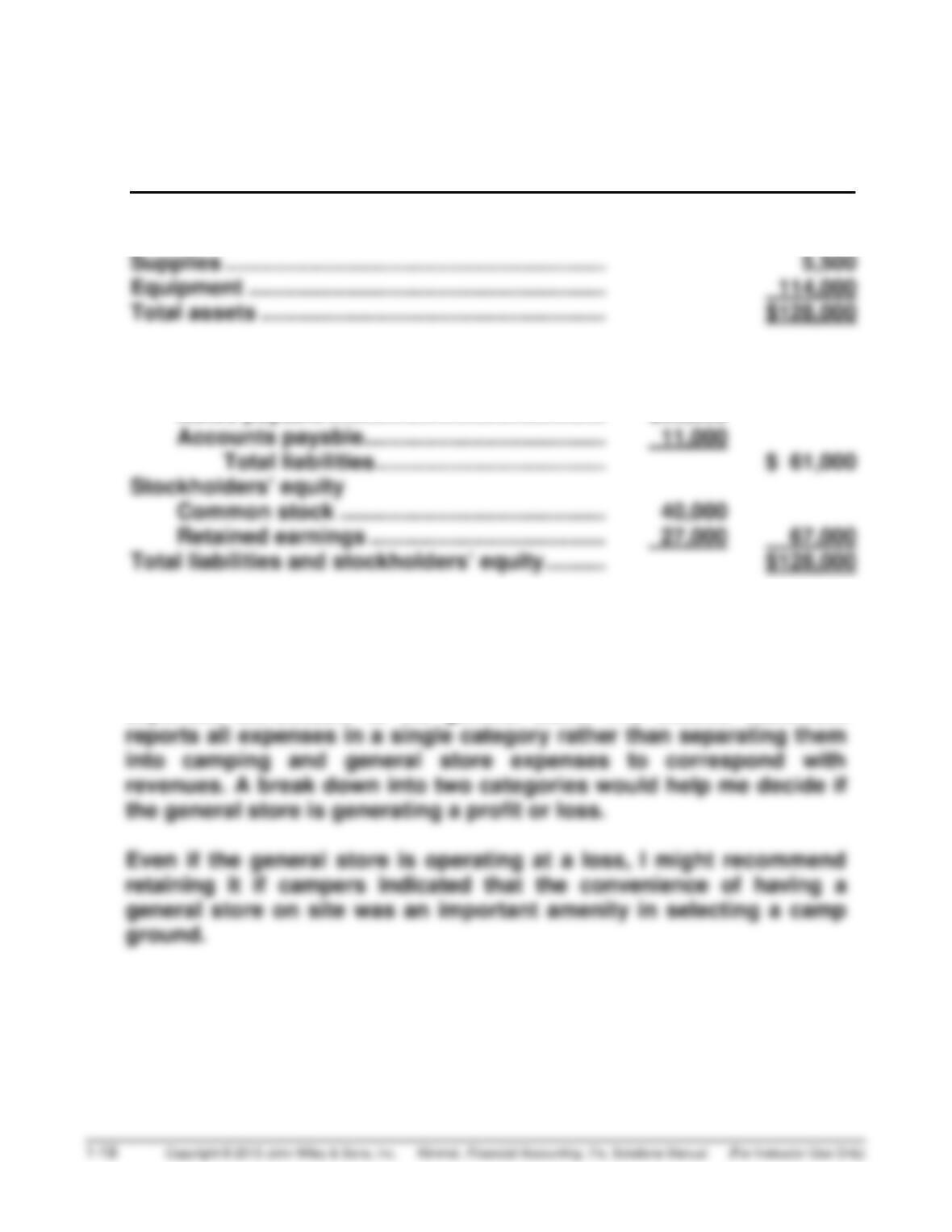
(b) FLINT HILLS PARK
Retained Earnings Statement
For the Year Ended December 31, 2014
Retained earnings, January 1 ………………………………………….. $ 5,000
EXERCISE 1-10 (Continued)
FLINT HILLS PARK
Balance Sheet
December 31, 2014
Assets
Cash …………………………………………………………… $ 8,500
Liabilities and Stockholders’ Equity
Liabilities
Notes payable ………………………………………. $50,000
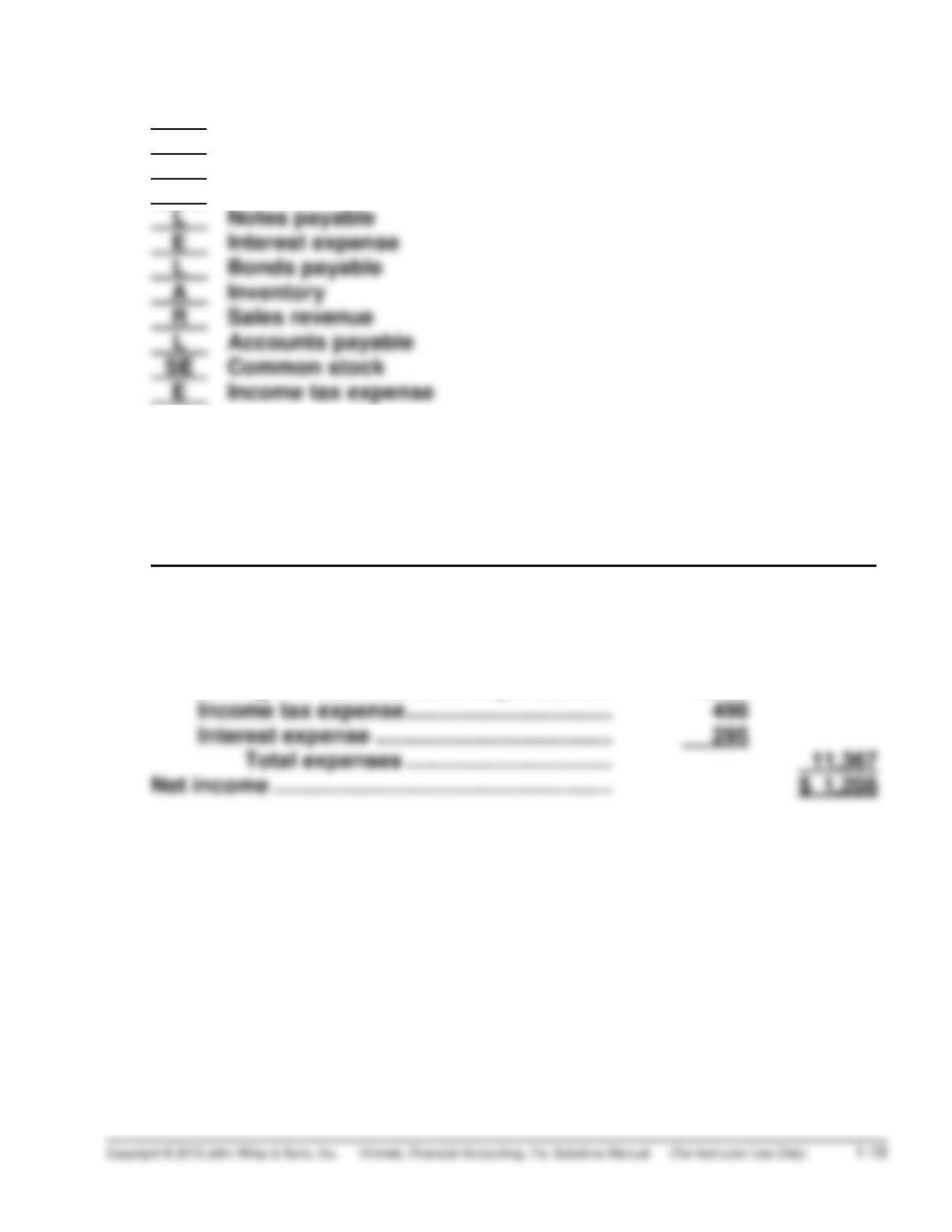
(c) The income statement indicates that revenues from the general store
were only about 16% ($25,000 ÷ $157,000) of total revenue which
tends to support Joe’s opinion. In order to decide if the store is “more
trouble than it is worth,” I would need to know the amount of
expenses attributable to the general store. The income statement
EXERCISE 1-11
(a) SE Retained earnings
E Cost of goods sold
E Selling and administrative expenses
A Cash
(b) KELLOGG COMPANY
Income Statement
For the Year Ended December 31, 2014
(in millions)
Revenues
Sales revenue …………………………………….. $12,575
Expenses
Cost of goods sold …………………………….. $7,184
Selling and administrative expenses …… 3,390
EXERCISE 1-12
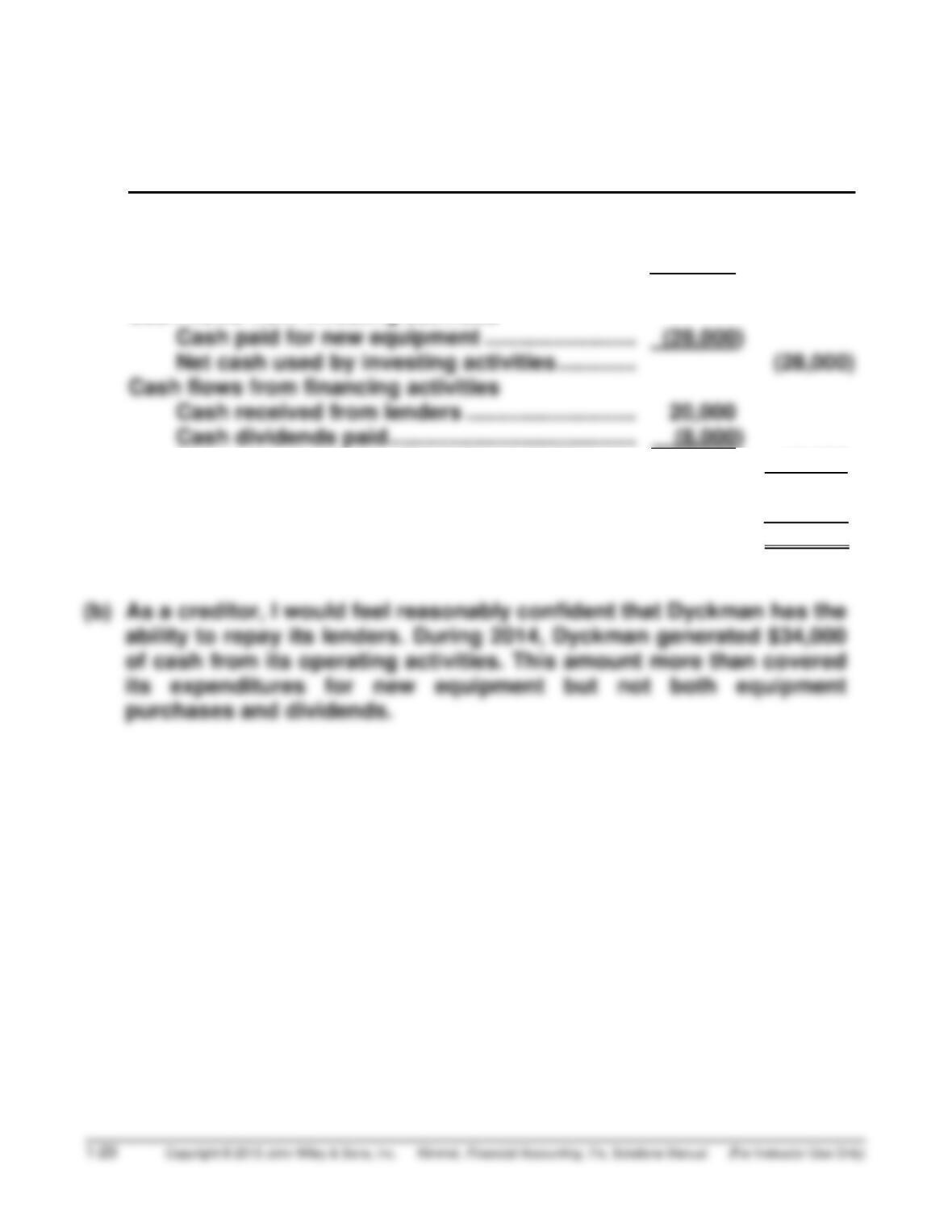
(a) DYCKMAN CORPORATION
Statement of Cash Flows
For the Year Ended December 31, 2014
Cash flows from operating activities
Cash received from customers ………………….. $ 50,000)
Cash paid to suppliers ………………………………. (16,000)
Net cash provided by operating activities ….. $ 34,000)
Cash flows from investing activities
Net cash provided by financing activities …… 12,000
Net increase in cash …………………………………………. ) 18,000
Cash at beginning of period ……………………………… 12,000
Cash at end of period ……………………………………….. $ 30,000